Jess and I have been coming back to Barcelona since 2012, and somewhere on every trip I end up chasing the same thing: the city seen from above, with a camera in my hand and the light doing something worth waiting for. I’ve shot it from the hill at Park Güell, from the old gun batteries at Montjuïc Castle, and from the free rooftop at Las Arenas that most visitors walk straight past. After thirty years behind a camera, I’ve decided Barcelona is one of those cities that just gets better the higher you climb.
The trouble is that it has more than a dozen viewpoints, and they are not all worth your time. Not by a long way. Some are free and take five minutes to reach; some cost €18 and a timed ticket; a couple involve a train, a tram and a funicular for a view you can get more easily somewhere else. What you actually need to know is simple enough: is it free or ticketed and how much, how do you get there, when is the light any good, and is it worth the effort at all.
I’ve grouped the viewpoints below by what they cost and whether I think they’re worth it, with current prices, how to reach each one, and a photographer’s read on when to go and which way to point the camera. One thing to know before you plan an evening around a sunset: the Bunkers del Carmel, the city’s most famous free viewpoint, now shuts behind a fence in the early evening, which means the classic sunset shot no longer works for most of the year. More on that in a moment.
Table of Contents:
The quick version
If you only have time for two or three, my picks are the Bunkers del Carmel for the free daytime panorama, the Las Arenas rooftop for an easy free view over Plaça d’Espanya, and the Sagrada Família towers if you want the one view that’s unlike any of the others. Here’s how the main viewpoints compare. Prices were checked in July 2026.
| Viewpoint | Cost | Getting there | Best light | Book ahead? |
|---|---|---|---|---|
| Bunkers del Carmel | Free | Bus V17 / 119, or a 20 min uphill walk from Alfons X (L4) | Sunrise or daytime (gate shuts before summer sunset) | No |
| Las Arenas rooftop | Free (interior stairs) | Espanya metro (L1, L3) | Late afternoon and sunset | No |
| MNAC terrace & Magic Fountain | Free steps / €2 rooftop | Espanya metro | Sunset into blue hour | No |
| Montjuïc Castle | €12 (free Sun from 3pm & 1st Sun) | Montjuïc cable car, or bus 150 | Late afternoon | No |
| Sagrada Família towers | €36 (online only) | Sagrada Família metro (L2, L5) | Morning | Yes, well ahead |
| La Pedrera rooftop | €25 | Diagonal metro (L3, L5) | Late afternoon | Yes |
| Torre Glòries Mirador | €18 (closed Tue in winter) | Glòries metro (L1) | Sunset (360° deck) | Yes |
| Park Güell (Monumental Zone) | €18 (residents free) | Lesseps / Vallcarca (L3), then uphill | Morning | Yes, timed entry |
| Montjuïc cable car | €12 one-way / €17.10 return | Funicular from Paral·lel, then the cable car | Clear daytime | Optional |
| Port cable car (Aeri) | €12.50 one-way / €20 return | Barceloneta or Miramar (Montjuïc) | Clear daytime | No |
| Columbus Monument | €10 | Drassanes metro (L3) | Daytime | No |
| Tibidabo (Sagrat Cor terrace) | Free church / €5 lift terrace | FGC + Tramvia Blau or bus + Cuca de Llum funicular | Clear days | No |
| Torre de Collserola | €7, or €13.50 with funicular | Via the Tibidabo funicular (seasonal) | Clear days, when open | Check dates first |
The free viewpoints worth your time
The really good news is that Barcelona’s finest views cost nothing. Start here.
Bunkers del Carmel (Turó de la Rovira)
This is the one locals send you to, and with good reason: a set of concrete anti-aircraft emplacements from the Spanish Civil War, sat on the Turó de la Rovira hill with an unbroken 360-degree sweep across the whole city, the sea on one side and the Collserola hills on the other. It’s free, and it’s the widest view in Barcelona that doesn’t cost a cent.
Here’s what’s changed, and it’s easy to miss. Since 2023 the site has been fenced, with a gate that closes at night: roughly 9am to 7.30pm in summer, 9am to 5.30pm in winter. That quietly breaks the old advice to come up here for sunset. In June the sun doesn’t go down until around 9.30pm, close to two hours after the summer gate shuts. Even in January and February, sunset has already crept past the 5.30pm winter close. The sunset-from-the-top shot really only lines up for a few weeks around the December solstice, when the sun sets at about 5.35pm. The rest of the year, come for sunrise or in the middle of the day instead.
Getting up there is the only faff. There’s no metro at the top, so it’s the V17 or 119 bus, or a 15 to 20 minute walk uphill from El Carmel or Alfons X on the L4.
Photography note: because it’s a full circle, it works in any light, so don’t feel you have to chase golden hour. The frame most people want is the dense city grid with the Sagrada Família poking up out of it and the sea beyond. Morning gives you the clearest air. You can read the current hours and history on the city’s own MUHBA Turó de la Rovira page.
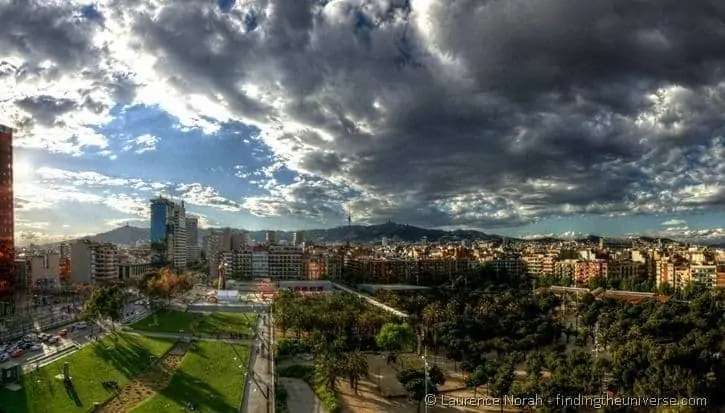
The Las Arenas rooftop
This is the one I send people to first, because it’s free, central, and takes about five minutes to reach the top. The old Les Arenes bullring on Plaça d’Espanya reopened in 2011 as a shopping centre, and its circular roof is now a public promenade with a clean 360-degree view: the MNAC and Montjuïc one way, the towers of the Sagrada Família the other. The interior escalators and stairs get you up for nothing, though. Only the exterior glass lift charges a fee, so walk up and don’t pay it.
Espanya metro (L1 and L3) drops you right at the door.
Photography note: the circular walkway lets you shoot in every direction, so it’s a rare spot where you can catch both the sunset side and the blue-hour city lights without moving far. The MNAC and Montjuïc side is the sunset frame, with the Magic Fountain below. Full details are on the Arenas de Barcelona site.
The MNAC terrace and the Magic Fountain
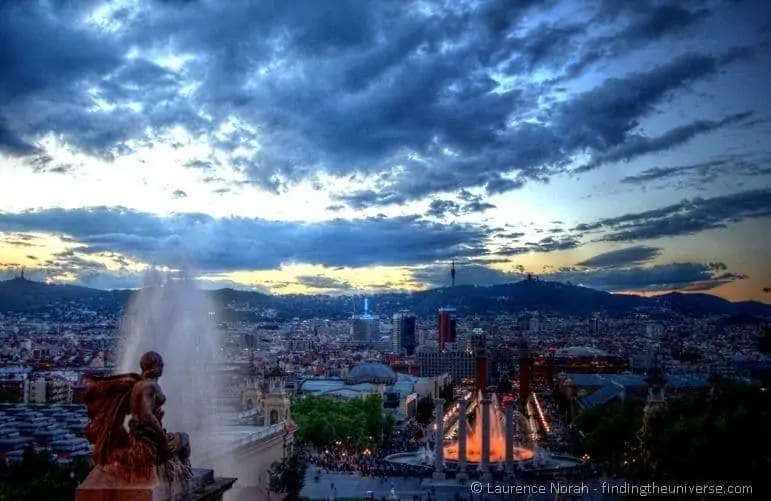
Straight across Plaça d’Espanya, the Museu Nacional d’Art de Catalunya sits at the top of a grand flight of steps on the flank of Montjuïc. The classic postcard view, back across the fountain and the twin Venetian towers to the city, is completely free from the outdoor steps and esplanade in front of the palace. You don’t need a ticket for that.
One thing to keep straight: the museum also has its own paid rooftop mirador, which comes with the €2 basic ticket or the €12 general admission. It’s a nice add-on, but the free view from the steps is the famous one, so don’t feel you have to pay to get the shot.
Below you, the Magic Fountain (the Font Màgica) runs its light-and-music shows on selected evenings. The schedule changes with the season and it pauses over winter, so check before you build an evening around it.
Photography note: this is my pick for blue hour. Set up on the steps as the sun drops, and shoot the fountain on a long exposure once the show starts, with the museum lit behind it. Bring a small tripod. Opening hours and the free-entry windows are on the MNAC website.
The paid viewpoints worth the ticket
Some views you do have to pay for, and a few of these are worth every euro. Here’s where I’d spend the money.
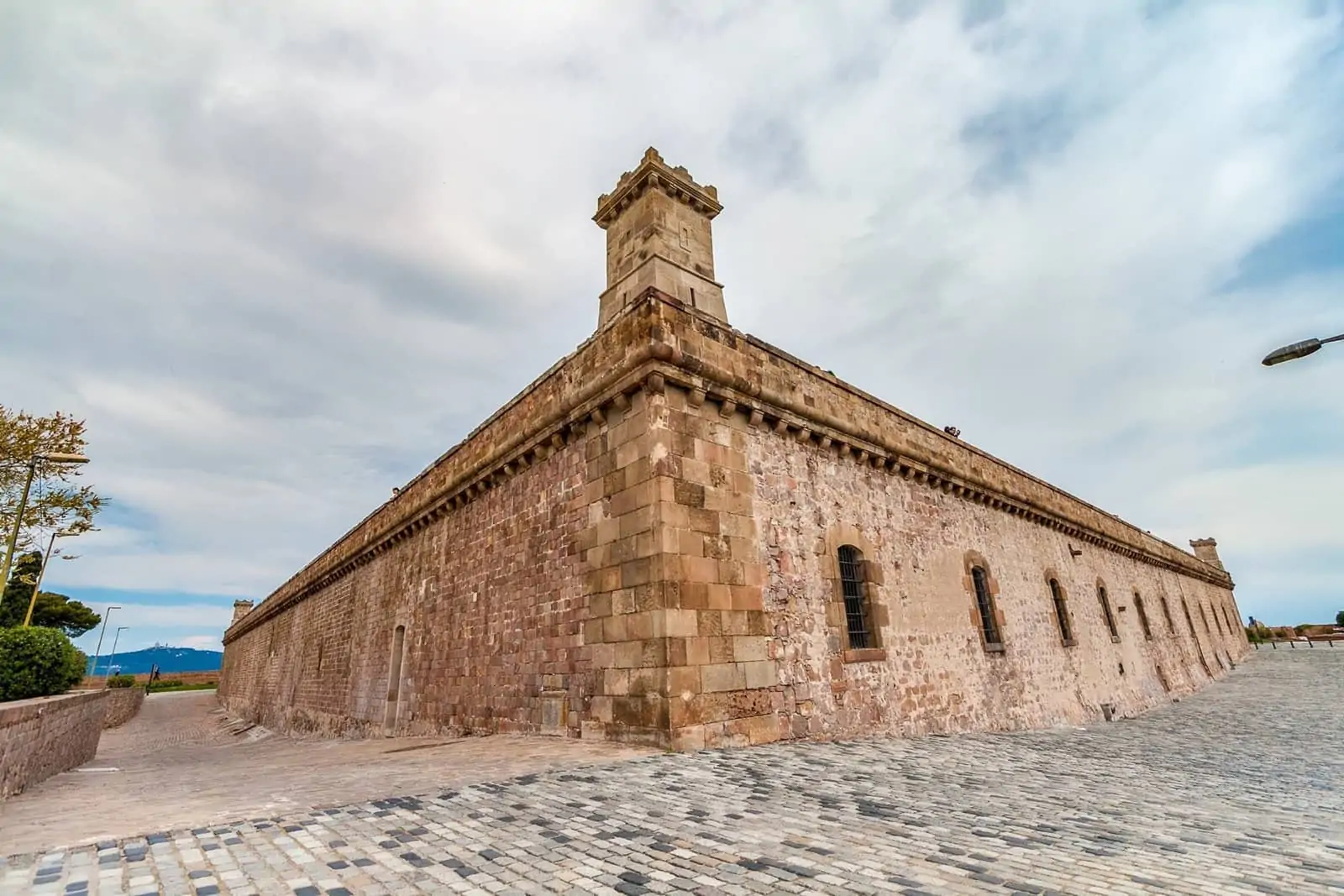
Montjuïc Castle
The old fortress on top of Montjuïc looks out over the port, the container terminals and the city, and the historic gun batteries are still lined up along the ramparts. Entry is €12 (reduced €8, free for under-16s), but time it right and it costs nothing: it’s free on Sundays from 3pm and all day on the first Sunday of the month. Line up a Sunday afternoon and you get one of the city’s best paid views for nothing. Hours run 10am to 8pm from March to October, and 10am to 6pm from November to February.
I’ve spent a good couple of hours up here with a camera, and the port side is really the draw, especially in the late afternoon when the light comes in low across the water. Get there on the Montjuïc cable car (below), or the 150 bus from Plaça d’Espanya. Current prices and hours are on the castle’s official page.
The Sagrada Família towers
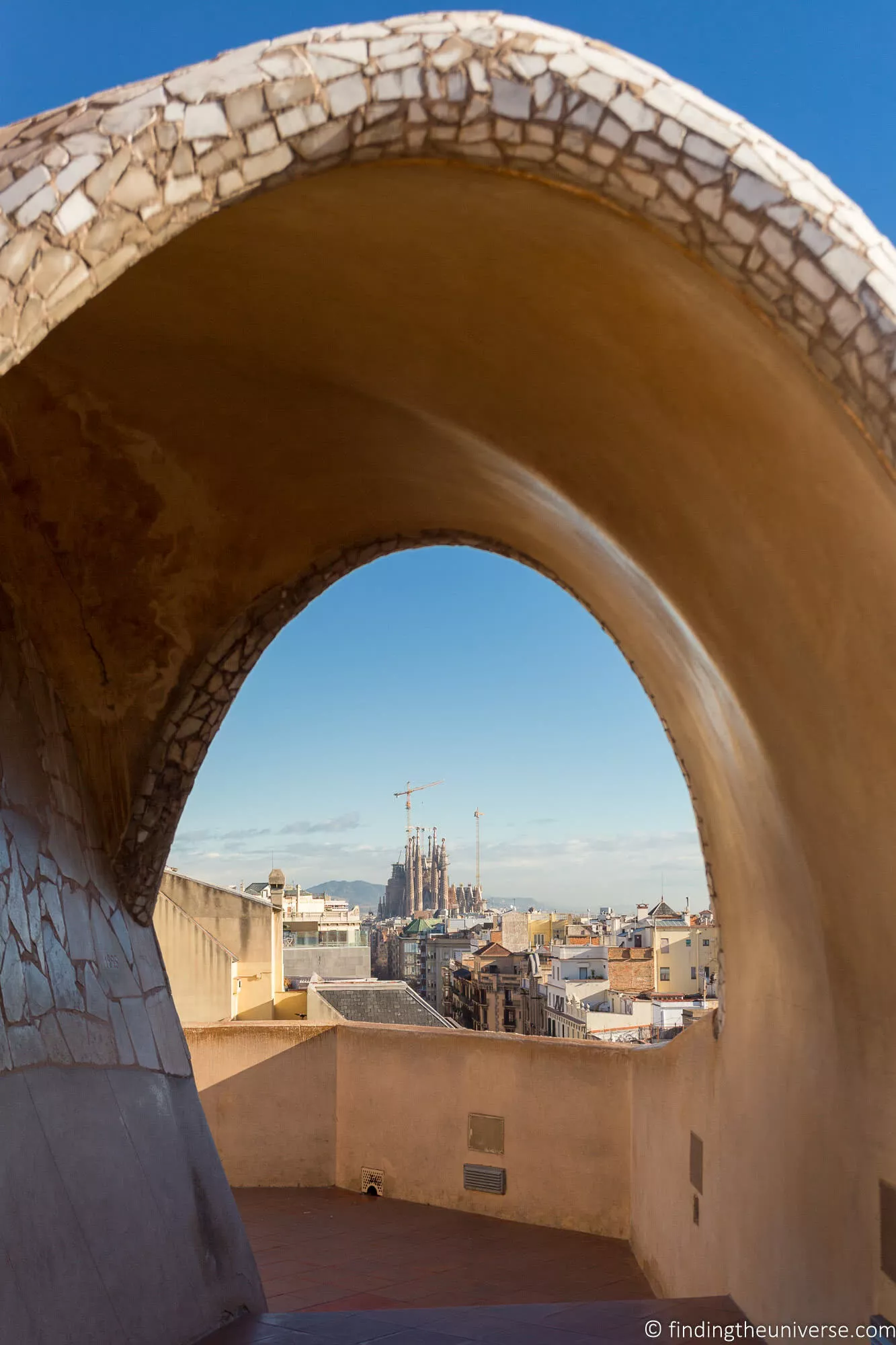
If you only pay to go up one thing in Barcelona, make it this. Climbing inside Gaudí’s towers, then looking straight down over the Eixample’s grid of chamfered blocks, gives you a view you simply can’t get anywhere else in the city. It’s tight up there, and you go up in a lift and come down a long, narrow spiral stair, so it isn’t for everyone. But it’s the one that’s stayed with me.
Tower access is an online-only add-on, with no ticket office at the door: it’s €36 for the ticket that includes a tower, or €40 with a guided tour. Book it well ahead, because the tower slots go early. One practical flag worth heeding in 2026: the basilica occasionally restricts access around major events, so check the basilica’s own site close to your visit rather than assuming you can turn up and buy on the day.
Book the tower add-on direct at the official Sagrada Família site. If general admission has sold out for your dates, GetYourGuide sometimes still has skip-the-line entry tickets, though note that’s ground-level entry, not the towers.
La Pedrera (Casa Milà) rooftop
Gaudí’s wave-fronted apartment block on Passeig de Gràcia keeps its best bit for the top. The roof terrace is a forest of sculptural chimneys, the ones that supposedly inspired the stormtrooper helmets, and you shoot them with the city rising behind. The rooftop is included in the standard €25 ticket, which also covers the attic, a restored period apartment and the courtyards, so you get a full Gaudí visit around it.
I’ve been up here with a camera and the chimneys are the whole reason to come; frame two or three of them in the foreground and let the Eixample fill in behind. Book online to skip the queue, and note the pricier summer “Night Experience” is a separate ticket. Diagonal metro is the closest stop. Tickets are on the official La Pedrera site, which is cheaper than the resellers and includes the rooftop as standard.
Torre Glòries Mirador
The bullet-shaped tower that locals still argue about, out in the 22@ tech district, has a 360-degree observation deck near the top called the Mirador, complete with a mirrored-ceiling art installation that reflects the city back at you. It’s €18 booked online, or €18 plus a €3 surcharge if you buy on site, and it’s closed on Tuesdays through winter (November to March), which is easy to get caught out by.
I haven’t been up this one myself, so I’ll stick to what’s verifiable: it’s the most modern of the paid decks, a full 360-degree wraparound deck is rare in this city, and it faces well for sunset. Glòries metro on the L1 is at the base. You can book a skip-the-line Mirador ticket, or check times direct on the official Mirador site.
Park Güell
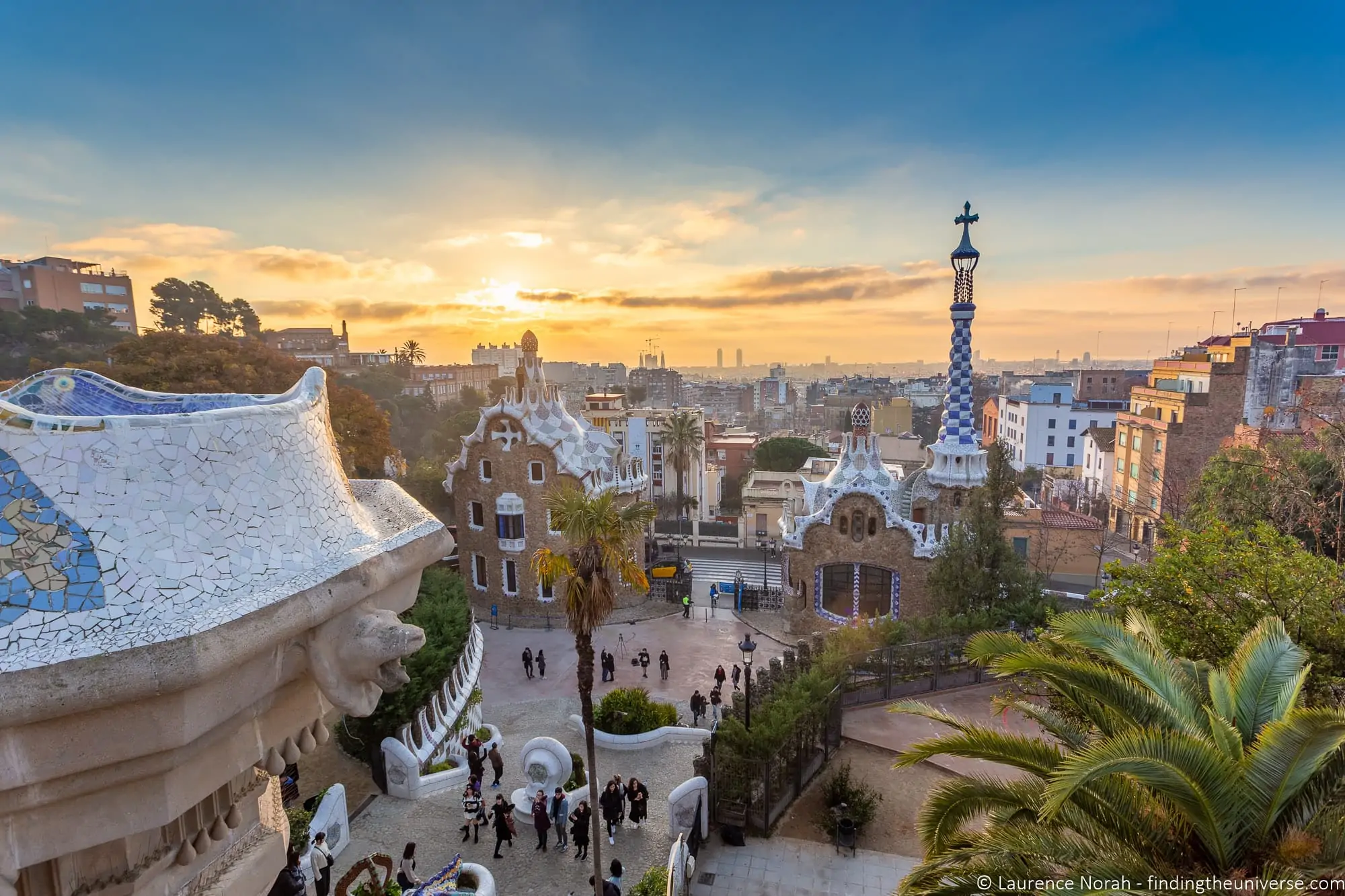
Gaudí’s hillside park is really a view with a mosaic in front of it. The main terrace, with its serpentine tiled bench, looks southeast down over the city to the sea, and it’s the shot everyone comes for. The snag is that the Monumental Zone (the famous, ticketed core) is now €18 on a timed-entry, online-only ticket, though the wider forested park around it stays free, and Barcelona residents get in for nothing.
I’ve shot the terrace on a bright morning and that’s when to come, both for the light and to beat the crush. Get there via Lesseps or Vallcarca on the L3, then it’s a 15 to 20 minute walk uphill (there are outdoor escalators for part of the climb, which help). Book your timed slot ahead at the official Park Güell site, since they sell out; if your slot’s gone, there’s a skip-the-line entrance ticket as a backup.
Photography note: a wide lens for the terrace-and-city sweep, and get there for opening if you want the mosaic bench without a crowd sitting on it.
The two cable cars
Barcelona has two cable cars, and both are moving viewpoints in their own right. Neither is essential, but each gives you a perspective you can’t get on foot.
Montjuïc cable car (Telefèric de Montjuïc)
This one runs up the Montjuïc hillside to near the castle, drifting over the gardens with the port spread out behind. It’s €12 one-way or €17.10 return, a little cheaper booked online. To reach the bottom station you first take the Funicular de Montjuïc from Paral·lel metro, which is covered by a normal transit ticket, then pick up the cable car at Parc de Montjuïc. Book a roundtrip ticket ahead, or check the seasonal timetable on the official cable car site.
The port cable car (Transbordador Aeri del Port)
The old red harbour cable car strings high across the port between Barceloneta and Miramar on Montjuïc, and the over-the-water view is unlike anything else on this list. It’s the pricier of the two at €12.50 one-way or €20 return, and one thing to note before you go: the central tower, Torre Jaume I, is currently closed, so you can’t get off midway. It’s worth doing once for the novelty of floating over the harbour, but it’s slow, the queues get long, and it’s a lot of money for a pretty short trip. The free rooftops give you as good a city view for nothing. Times and prices are on the operator’s site.
The ones with a catch
These two get listed everywhere, and both are real viewpoints. Each also comes with a catch that changes whether it’s worth your time.
Columbus Monument (Mirador de Colón)
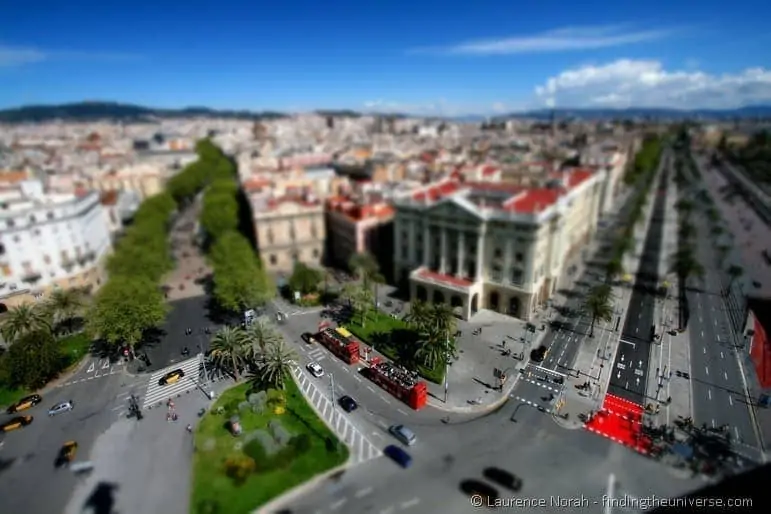
The column at the foot of La Rambla has a small lift that carries you about 60 metres up to a viewing platform under Columbus’s feet. It’s €10, and I’ve been up it. The view up La Rambla and across the old port is decent, but the platform is cramped, the windows are small, and you get a better and freer view from half a dozen other spots in this guide. Worth it only if you’re already down by the waterfront and curious. Drassanes on the L3 is the nearest metro.
Tibidabo and the Torre de Collserola
Tibidabo, at 512 metres, is the highest point of the Collserola ridge that forms Barcelona’s backdrop, crowned by the Sagrat Cor church and an old-fashioned amusement park that’s been running since 1901. The church terrace, reached by a €5 lift, and the summit itself give you the view; the crypt and church are free to enter. The problem is the journey. Getting up there means an FGC train to Avinguda Tibidabo, then the historic Tramvia Blau or a bus, then the Cuca de Llum funicular, so it’s a half-day expedition in its own right. The view is vast, but it’s hazy more often than not from that distance, so I’d only make the trip on a clear day, or if you’re bringing kids for the funfair.
Next door, the Torre de Collserola communications tower has a public mirador on its 10th floor, about 560 metres up, reached by a glass exterior lift. It sounds better than it is to plan around, because it’s not a daily walk-up: access runs on seasonal windows and you reach it via the Cuca de Llum funicular. It’s about €7 for the tower alone, or €13.50 combined with the funicular, and the summer “Sunset Experience” evenings in August are free. Check current dates with Tibidabo before you go, rather than turning up and hoping. Both are covered on the Tibidabo site.
Views with a drink
If you’d rather take your view with a cocktail in hand, there are two I’d point you to. The W Barcelona’s rooftop bar NOXE (once called Eclipse) sits on the 26th floor with a wide take over the port and Barceloneta; it shifts to a club format later in the evening, with a dress code and a door policy, so go early if it’s the view you’re after. The Barceló Raval’s “360°” terrace, on the 11th floor, is a more relaxed proposition, open through the day from around noon to 10pm and easier to just walk into. Both charge for the drink rather than the view, so you’re paying bar prices for the height, but on a warm evening it’s a pretty fair trade.
How to shoot Barcelona from above
A few things I’ve learned pointing a camera at this city from height, whichever viewpoint you pick.
The biggest variable is haze. Barcelona sits on the coast and hazes up quickly, especially on summer afternoons, which softens all those long-distance skyline shots. The clearest air comes early in the morning, and in the day or two after rain; winter often gives you the sharpest distance of all.
Think about which way the viewpoint faces. Most of the big ones, the Bunkers, Tibidabo, Park Güell and Las Arenas, look roughly south and east over the city to the sea, so they take beautiful morning light, but the sunset happens behind you rather than in your frame. For actual sunset colour in the shot, the western-facing spots and the port-side rooftop bars work better.
Blue hour usually beats sunset here. The ten minutes after the sun has gone, when the sky still holds colour and the street lights flick on across the grid, is nearly always the stronger frame. Bring a small tripod and give it a few seconds of exposure.
On lenses, a wide is the obvious choice for the big sweep, but pack something longer too, a 70-200 sort of range, so you can pull the Sagrada Família or the towers out of the skyline as a detail rather than losing them in a wide shot. If you want to get more out of your camera generally, we run a full online travel photography course, and my guide to the best photography locations in Barcelona covers the street-level spots to pair with these.
What we’d skip, and where not to waste money
A few calls to save you time and euros:
- The Bunkers sunset. A lovely idea, but the gate now shuts before the sun goes down for most of the year. Go at sunrise or midday, or pick a rooftop that stays open into the evening.
- The Torre de Collserola as a fixed plan. It isn’t a reliable walk-up, so don’t build an afternoon around it without checking it’s actually open.
- The Columbus Monument as a destination. It’s a five-minute curiosity, worth it only if you’re already at the bottom of La Rambla.
- Tibidabo on a hazy day. It’s a long way to go for a soft, distant view unless you’re there for the amusement park, or you’ve caught a clear day.
- A city pass, just for the views. Most of the best ones here are free, and the paid Gaudí sites are cheaper booked direct than through most resellers.
Frequently Asked Questions
What is the best free viewpoint in Barcelona?
The Bunkers del Carmel, for the full 360-degree panorama across the whole city. If you want something more central and quicker to reach, the free rooftop at Las Arenas on Plaça d’Espanya is my other pick.
Both cost nothing. Just remember the Bunkers now closes behind a gate in the early evening, so go in daylight.
Where is the best place to watch the sunset in Barcelona?
For a free spot, the Las Arenas rooftop faces the right way, across Montjuïc and the MNAC, and stays open in the evening. For sunset with a drink, the port-side rooftop bars work well.
The one to be careful with is the Bunkers del Carmel: it’s the classic sunset recommendation, but the gate closes before sunset for most of the year now, so it only really works around midwinter.
Is the Bunkers del Carmel still worth visiting?
Yes, very much, but go in daylight. It’s the widest free view in the city, and it’s free.
Since 2023 it’s been fenced, with the gate open roughly 9am to 7.30pm in summer and 9am to 5.30pm in winter. That means the famous sunset only lines up for a few weeks around the December solstice; the rest of the year, come for sunrise or a daytime visit instead.
Do you need to book Barcelona’s viewpoints in advance?
For the paid Gaudí sites, yes. Park Güell’s Monumental Zone, the Sagrada Família towers and La Pedrera all run on timed, online tickets that regularly sell out, so book a day or two ahead at least.
The free viewpoints (the Bunkers, Las Arenas, the MNAC steps) need no booking at all. Just turn up within opening hours.
What is the best viewpoint in Barcelona for photography?
There’s no single answer, it’s about the light and the shot you want. For a wide panorama of the whole city, the Bunkers del Carmel is the one I’d choose, and it works in any light. For a view you can’t get anywhere else, go up the Sagrada Família towers.
For blue hour, set up on the MNAC steps with the Magic Fountain below. And whatever you pick, morning or the day after rain gives you the clearest air over the city.
How much does it cost to go up the Sagrada Família towers?
Tower access is €36 for the standard ticket that includes a tower, or €40 with a guided tour. It’s sold online only, with no ticket office at the basilica.
Book well ahead, as the tower slots sell out faster than general admission, and check the official site close to your visit in case access is restricted around an event.
Further Reading
That’s the full set of Barcelona viewpoints, from the free panoramas to the ones I’d skip. If you’re putting a longer trip together, these should help:
- Our 2 day Barcelona itinerary and 3 day Barcelona itinerary, which weave several of these views into a full trip
- Our complete guide to visiting the Sagrada Família, including the towers
- My photos of Gaudí’s Barcelona, and my walking guides to the Gothic Quarter and street art of Barcelona
- My guide to the best photography locations in Barcelona for shooting the city at street level
- Day trip guides to Montserrat and Girona, both a short train ride away
- Jess’s guide to 20 Gaudí sites in Barcelona and her comparison of the Barcelona discount passes, useful if you’re visiting several paid sights
- For a guidebook, we use and like Rick Steves Barcelona
Have you found a Barcelona viewpoint we’ve missed, or got a question about getting to one of these? Let us know in the comments below. We read them all!
Leave a Reply