
Jess and I have been to Vienna many times, and every time we come back I’m reminded why we keep making the trip. Vienna has a way of being simultaneously grand and approachable. You can spend the morning wandering around a palace that was once the seat of one of the most powerful dynasties in European history, then the afternoon in a coffee house eating a slice of Sachertorte, and it somehow doesn’t feel like you’ve changed gears at all.
Two days is a good amount of time here, though you won’t scratch the surface of everything Vienna has to offer in a weekend. The city has more museums per square kilometre than pretty much anywhere else in Europe, several of the grandest palaces on the continent, a world-class music scene, and a cafe culture the Viennese have been refining for the best part of three centuries. Two days gets you the highlights and a very clear idea of what you’d come back for.
This itinerary covers what I think are the best two days in Vienna, mixing the major sights with a few personal favourites, and giving you a realistic sense of how to pace it. If you have more time, take a look at our three days in Vienna itinerary, which lets you get a bit further off the well-worn path.

Table of Contents:
Is 2 Days in Vienna Enough?
Two days in Vienna is enough to see the highlights and get a real feel for the city. It is not enough to feel like you’ve done it justice. That is not a reason not to go, it is just worth knowing what you are signing up for.
In two days you can comfortably fit in St. Stephen’s Cathedral, the Hofburg Palace, the Albertina, a morning at Schönbrunn, the Belvedere, a cruise on the Danube Canal, a ride on the Giant Ferris Wheel and a proper Viennese cafe visit. That covers the things most first-time visitors most want to see.
What you won’t have time for is going deep on the museum quarter, taking in the Spanish Riding School, spending a proper evening at the State Opera, or getting out into the Vienna Woods. If any of those are specific goals rather than “nice ifs,” I’d push for a third day and switch to our 3 day Vienna itinerary instead.
Two days works particularly well as part of a wider Central European trip. Vienna is excellently connected by train to Salzburg, Budapest, Prague and Bratislava, which makes it an easy addition to a longer itinerary without being the centrepiece.
2 Days in Vienna: A Complete Itinerary for a Weekend in the City
Day 1 in Vienna
Morning: St. Stephen’s Cathedral and the Hofburg. Lunch: Zwölf Apostelkeller. Afternoon: Albertina, Natural History Museum or Kunsthistorisches Museum. Late afternoon: Danube Canal cruise. Evening: Giant Ferris Wheel at sunset.
Before you start: breakfast at a Viennese café. Coffee and a pastry at Cafe Central, Demel or Cafe Sacher is not a side-activity on a Vienna trip, it’s the cultural anchor. See the coffee house section later in this article for the full list and what to order. Thirty minutes or an hour here before 9am is the right way to start Day 1.
Start at the cathedral at about 9am. The rest of the day flows from there. One caveat for winter visitors: sunset in Vienna is around 4:30pm in December, so you’ll want to flip the running order and do the Ferris Wheel mid-afternoon, then drop either the cruise or a second museum to make room.
St. Stephen’s Cathedral
Right in the centre of Vienna, St. Stephen’s Cathedral is an icon of the city skyline and the seat of the Catholic church in Vienna. There has been a church on this spot since the 12th century, though the current version with its remarkable multi-coloured tiled roof was largely completed in the early 16th century.
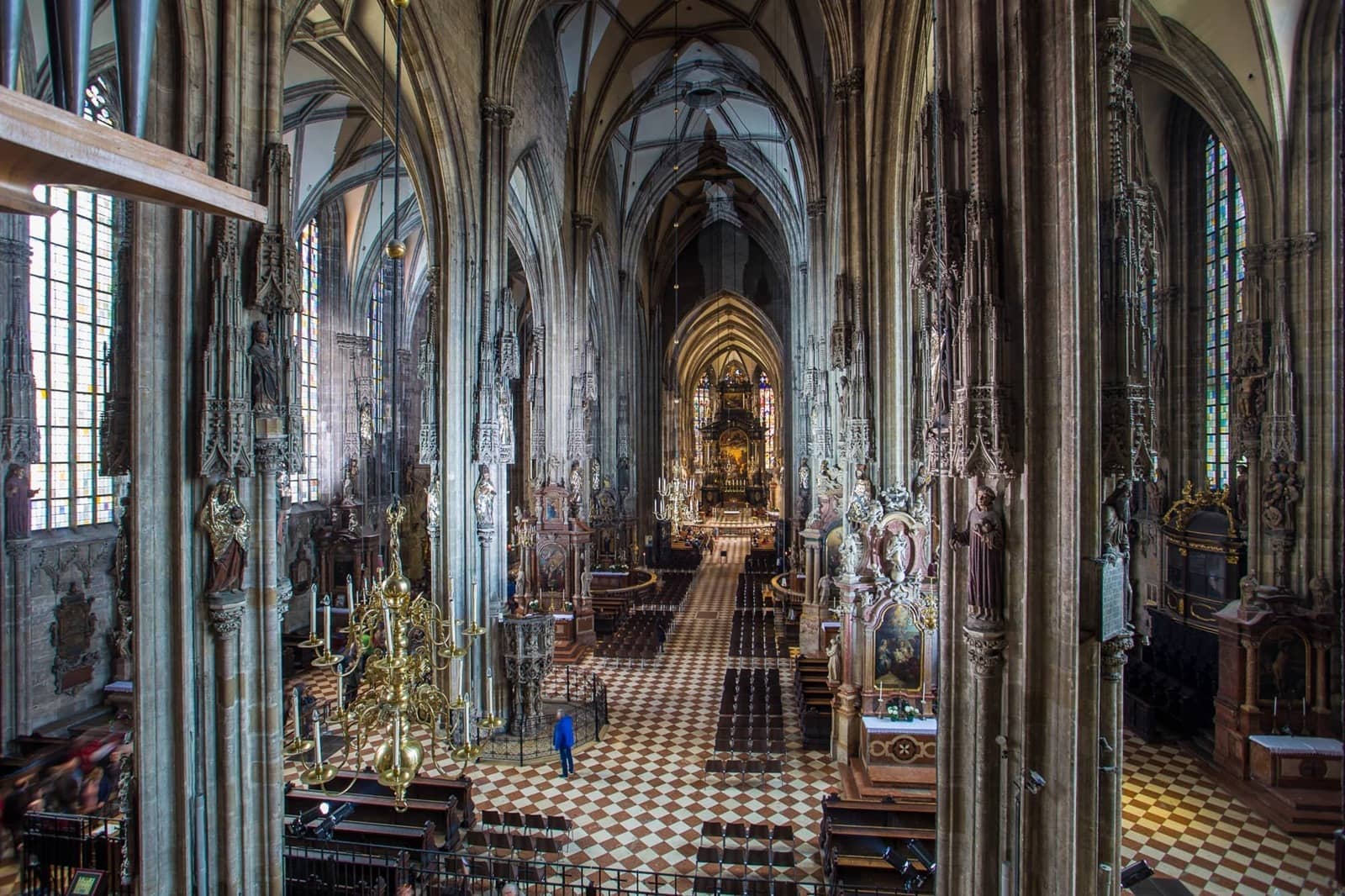
The cathedral itself is free to enter, and being one of the most popular attractions in Vienna it does get crowded. I’d recommend visiting the treasury. This is a paid attraction, and because it takes you up above the main cathedral floor, far fewer people bother. You get the views without the crush. It’s included on the Vienna Pass.
You can also head up both the south tower (136m, 343 steps, no lift, some puff required) and the north tower (68m, lift). The south tower is higher and offers the more expansive city views; the north tower gets you a close-up look at the roof tiles with considerably less effort.
The Hofburg Palace and Sisi Museum
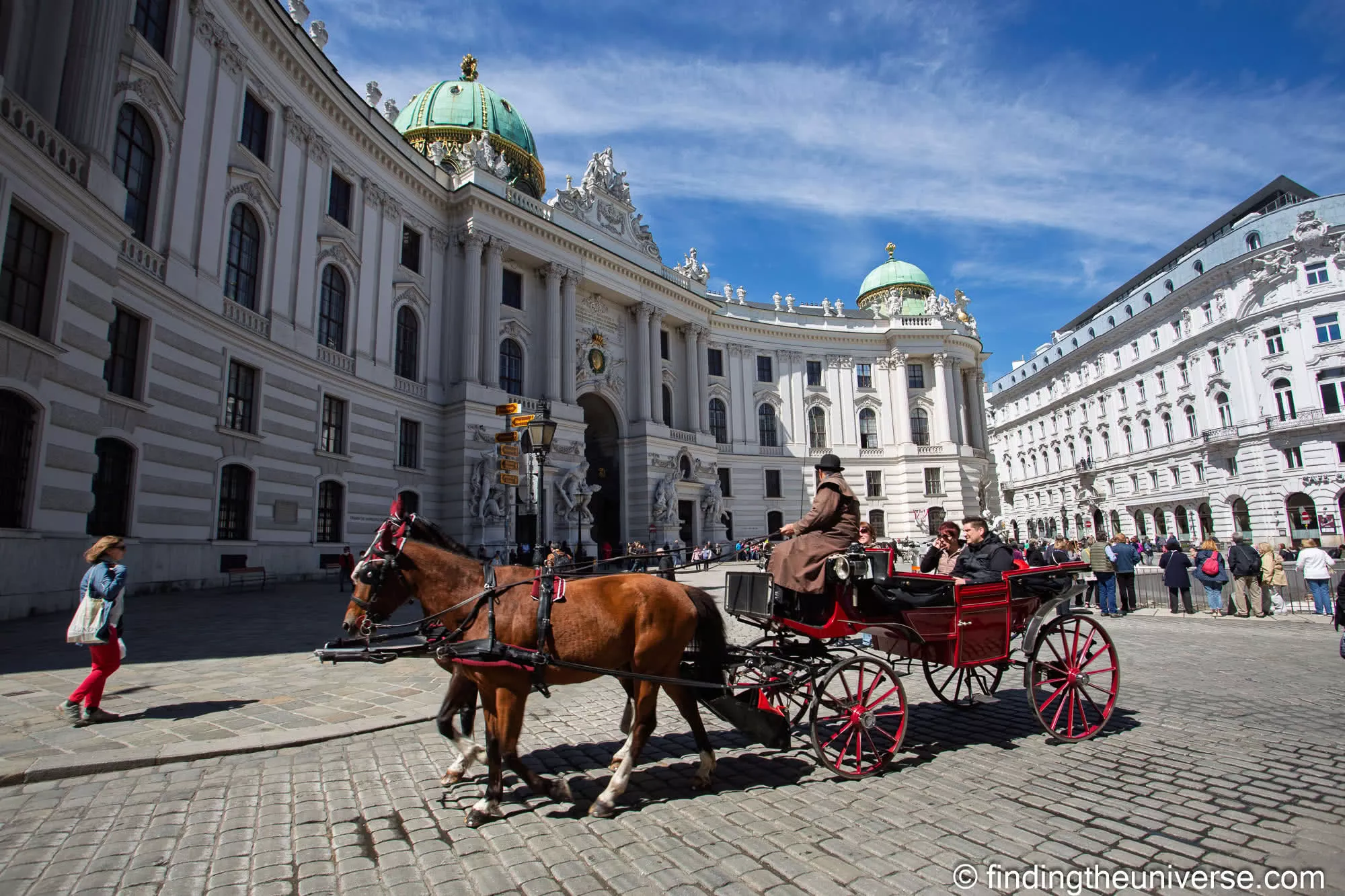
From St. Stephen’s it’s a ten minute walk through the pedestrianised Graben and Kohlmarkt to the Hofburg. This is the other great Habsburg address in Vienna: the winter residence (Schönbrunn was the summer one), the seat of the court for over 600 years, and now a slightly confusing palace complex housing multiple museums, the Spanish Riding School, and the office of the Austrian president.
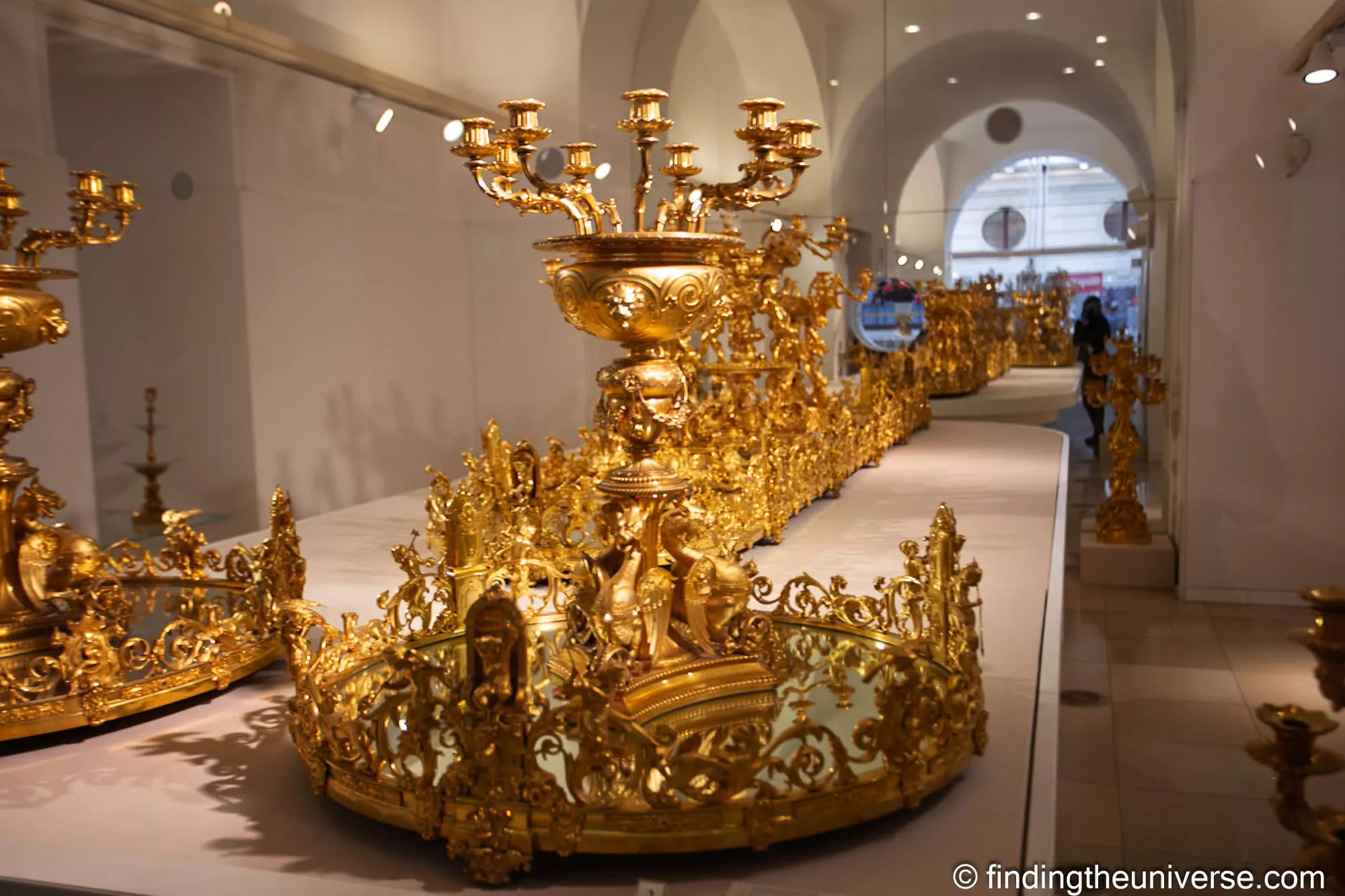
For two days in Vienna the combined ticket I’d go for is the Sisi Museum, Imperial Apartments and Silver Collection, which is about 60 minutes of visit time and gives you a very focused introduction to Empress Elisabeth (Sisi) and Emperor Franz Joseph. Sisi is something of a Viennese obsession, and the museum does a good job of separating the actual, rather sad woman from the romanticised icon she has become in Austrian popular culture.
Note that the Sisi Museum is currently undergoing a phased renovation, so parts of the exhibition may be restricted depending on when you visit. Entry is still happening on fixed time slots and it is well worth going; just be aware you may not see every room you’d normally see. See the official Sisi Museum site for current status.
You can buy tickets directly from the official site, or if you’d prefer a guided tour with skip-the-line entry, this well-reviewed GetYourGuide option includes a licensed guide and saves you queueing time. Either way, book in advance for summer weekends.
While you are in the Hofburg complex, also take a moment to wander the courtyards. Heldenplatz and the Michaelerplatz entrance are free, impressive on their own, and give you the best of the architecture without a ticket.
The Hofburg is enormous and houses several other sights beyond the Sisi Museum. You won’t do all of them in a two day trip but it’s worth knowing what’s there so you can choose what fits your interests:
- Imperial Treasury (about 30 minutes). The Habsburg crown jewels, including the Imperial Crown of the Holy Roman Empire, one of the largest emeralds in the world, and an agate bowl long believed to be the Holy Grail. If you’re going to add one more thing to Day 1, make it this.
- Spanish Riding School morning exercise (about 1 hour, typically 10am most days). Watching the Lipizzaner stallions train. Performances are more spectacular but harder to get into; the morning exercise sessions are the accessible option and still worth it.
- Austrian National Library State Hall (15 to 20 minutes). One of the most beautiful library interiors in Europe, with ceiling frescoes and four globes by Vincenzo Coronelli. A quick visit, but a memorable one.
- Weltmuseum and the House of Habsburgs tour (about 1 hour). Combined ticket covering the Armory Chamber (armour and weapons), the Collection of Historical Musical Instruments (several of which were used by famous composers), and the ethnographic Weltmuseum.
For most two day visitors, adding the Imperial Treasury to Day 1 after the Sisi Museum is the right call. Everything else here earns a place on a three or four day itinerary.
Lunch at Zwölf Apostelkeller
A short walk back towards the cathedral brings you to the Zwölf Apostelkeller, a classic Viennese Stadtheuriger (city wine tavern) housed in a building that dates to at least 1339. You descend into a winding maze of arched brick cellars, the music is live most evenings, and the menu is exactly what you want it to be: schnitzel, goulash, tafelspitz, and a surprisingly affordable selection of Austrian wines by the glass.
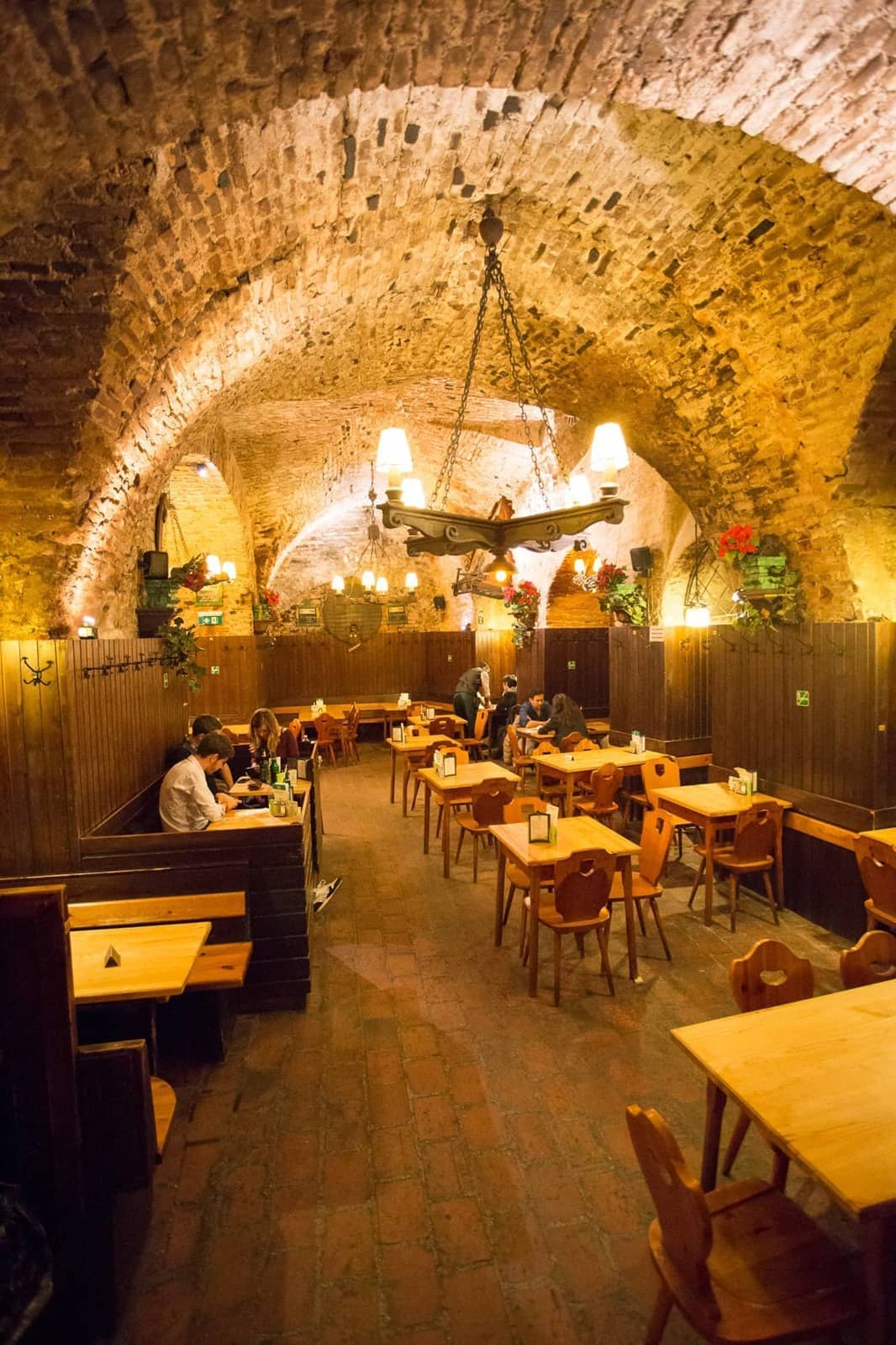
Austrian food is not light. A plate of wiener schnitzel is roughly the size of a hubcap, and this is before anyone has mentioned the apfelstrudel. I’d recommend not over-ordering and sharing a starter if you’re planning to keep moving in the afternoon. They’re open daily from 11am, reservations recommended on weekends.
If Zwölf Apostelkeller is full, Glacis Beisl near the Museum Quarter is another excellent traditional option and is handily on your route to the next stop.
Albertina
Time for some art. Vienna has a huge range of museums covering almost every niche you can think of, so do feel free to swap different museums into this itinerary depending on your interests. There is even a museum entirely dedicated to globes, which is one of Jess’s favourites and exactly as niche as it sounds.
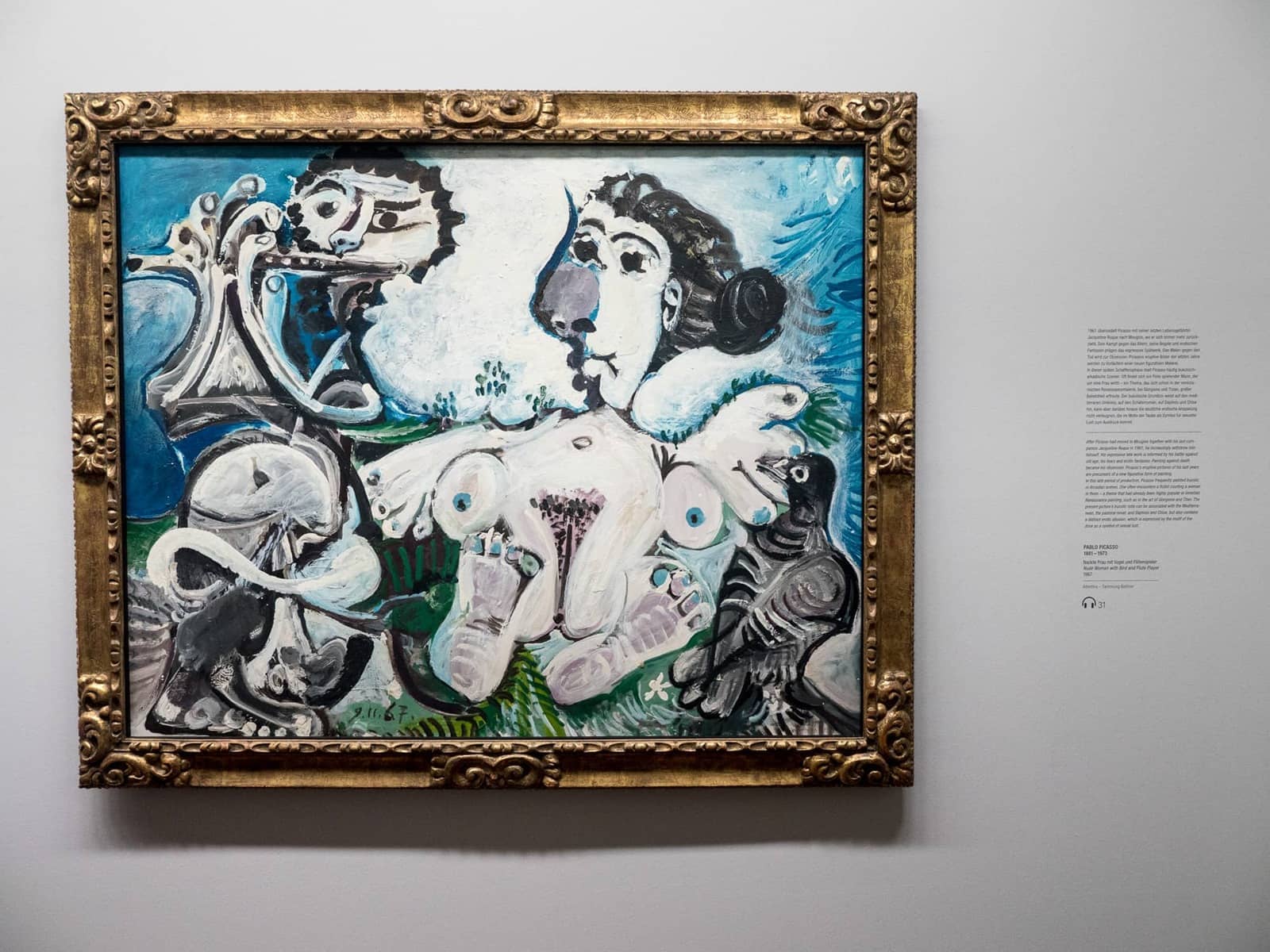
The Albertina is definitely worth an hour of your afternoon. It’s partly a palace (the former Habsburg residential apartments are upstairs and are worth the visit on their own) and partly a museum, with an excellent collection of classic modernist paintings including works by Monet and Picasso on permanent display. They also hold over 100,000 photographs in their collection, some of which rotate through the galleries.
There are rotating exhibitions from the Albertina’s own collections of modern and contemporary art, plus guest exhibitions that change several times a year. Check their site for what’s on when you visit, and don’t miss the state rooms.
The Albertina is open daily from 10am to 6pm, and until 9pm on Wednesdays and Fridays. There’s an admission fee; current prices are on the official site. Entry is included on the Vienna Pass, or you can buy tickets online in advance here.
Natural History Museum & Kunsthistorisches Museum
If you still have an hour of museum stamina in you, you’ve got a choice between two of the finest museums in Europe. Pick one. Doing both on top of the Albertina will cost you the canal cruise. The Natural History Museum and the Kunsthistorisches Museum face each other across Maria-Theresien-Platz in matching palatial buildings, and they sit right next to the Museum Quarter. Yes, Vienna has an entire quarter that is just museums.
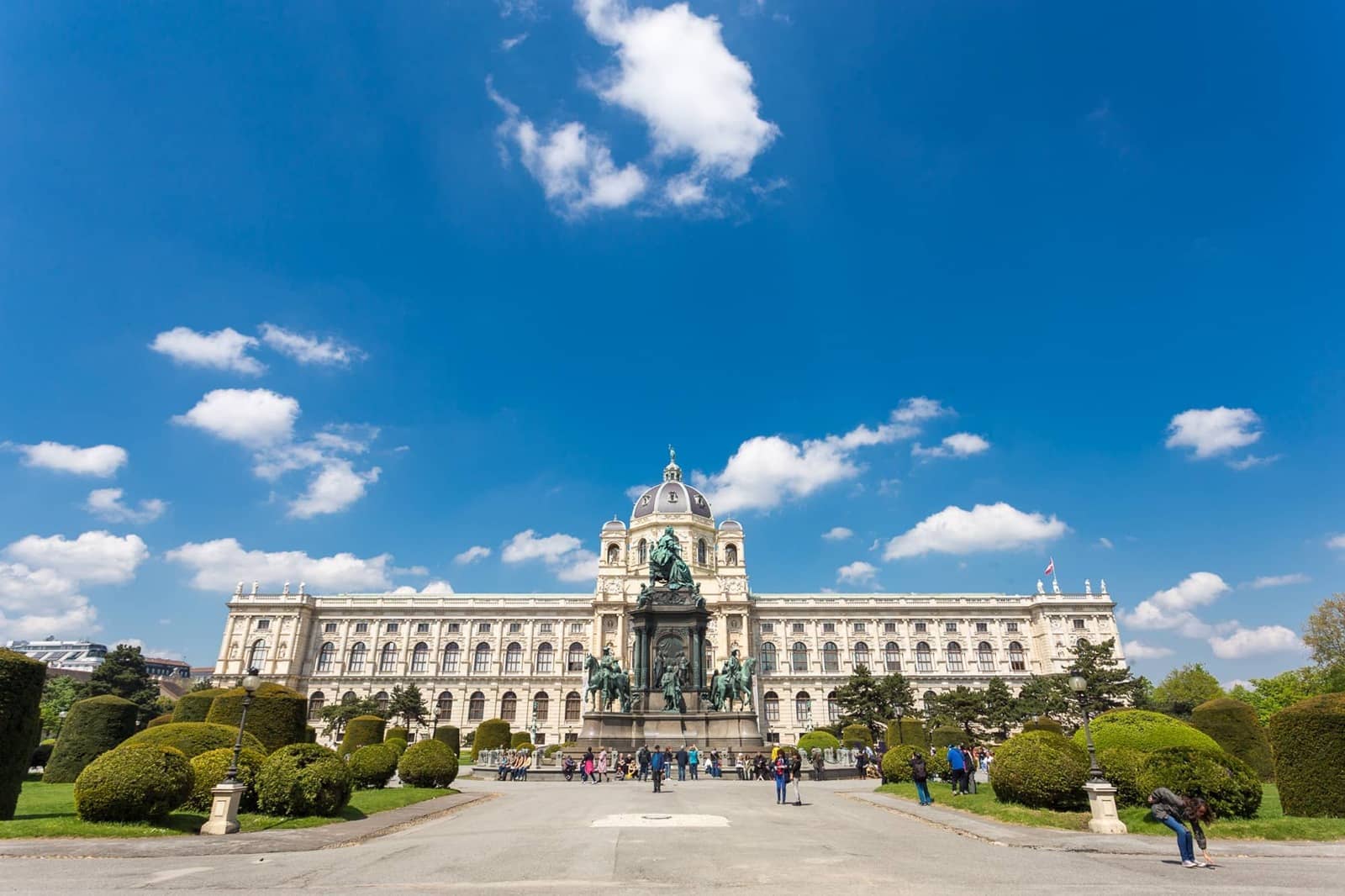
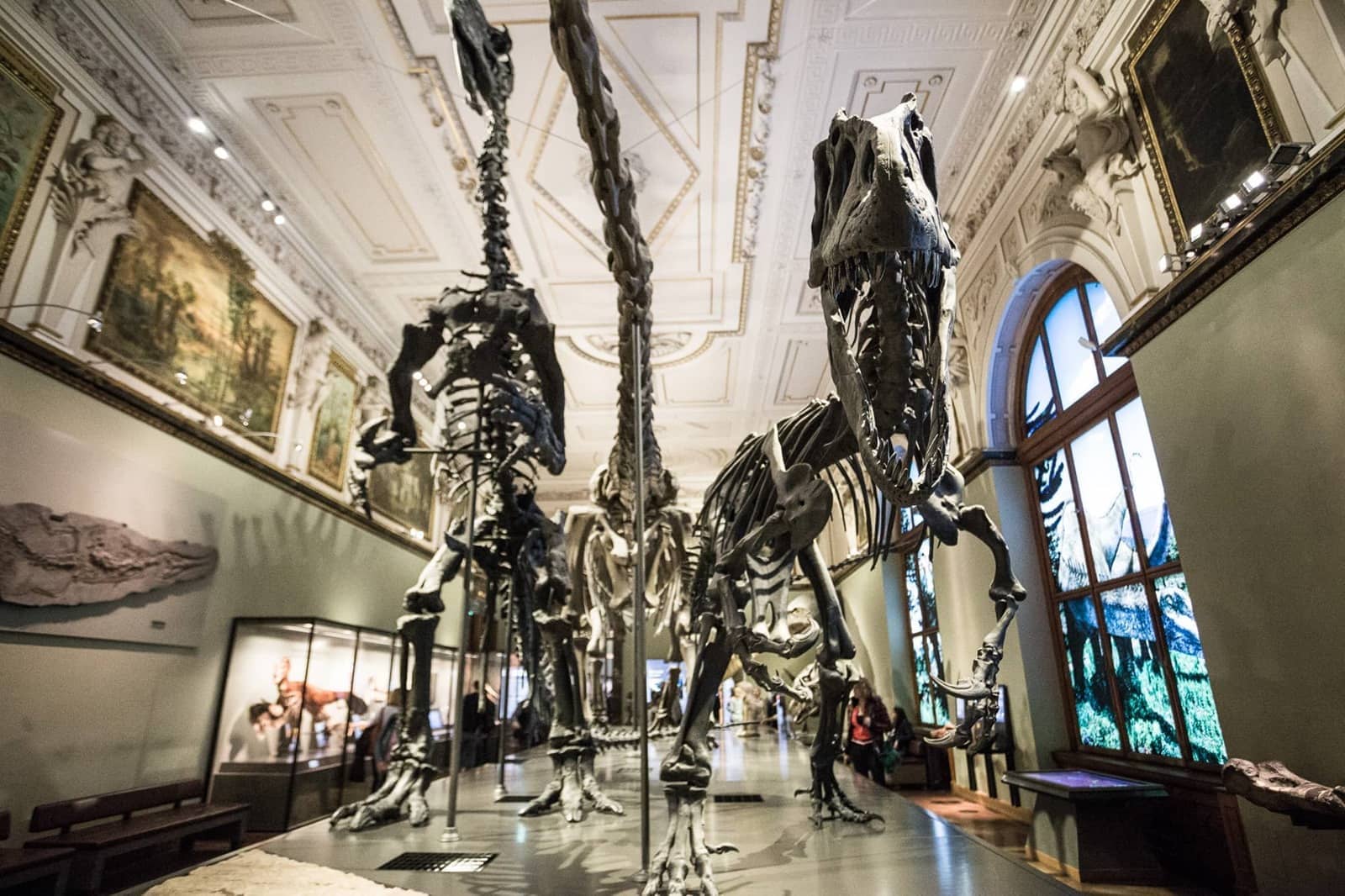
The Natural History Museum opened in 1889 and covers the natural history of the world, with meteorites, dinosaur skeletons, and the 29,500 year old Venus of Willendorf figurine. The building itself is magnificent and borderline worth visiting for itself alone.
Directly across the square, the Kunsthistorisches Museum opened in 1891. Both buildings were originally designed to house the rather extensive Habsburg collection and make it accessible to the public, and the Kunsthistorisches has the heavier art lifting to do. Vermeer’s The Art of Painting, Bruegel’s Hunters in the Snow, several Caravaggios, and room after room of Habsburg portraiture. The cafe on the first floor, incidentally, is one of the most beautiful museum cafes in Europe. You can book your tickets online in advance here.
If neither of those grabs you, within a few minutes walk you’ll find the Papyrus Museum, the modern art museum mumok, the Leopold Museum, and several others besides. You will, as I may have mentioned, not run out of museums.
Most of these are included on the Vienna Pass, which is why the pass gets to break-even fast in Vienna. One museum visit does not pay for it. Four will.
Danube Canal Cruise
After all the museums (or instead of, your call), you might want something that doesn’t involve being on your feet in a marble hall. A river cruise along the Danube Canal (which branches off the main Danube and runs past the old city) is a pleasant way to spend late afternoon.
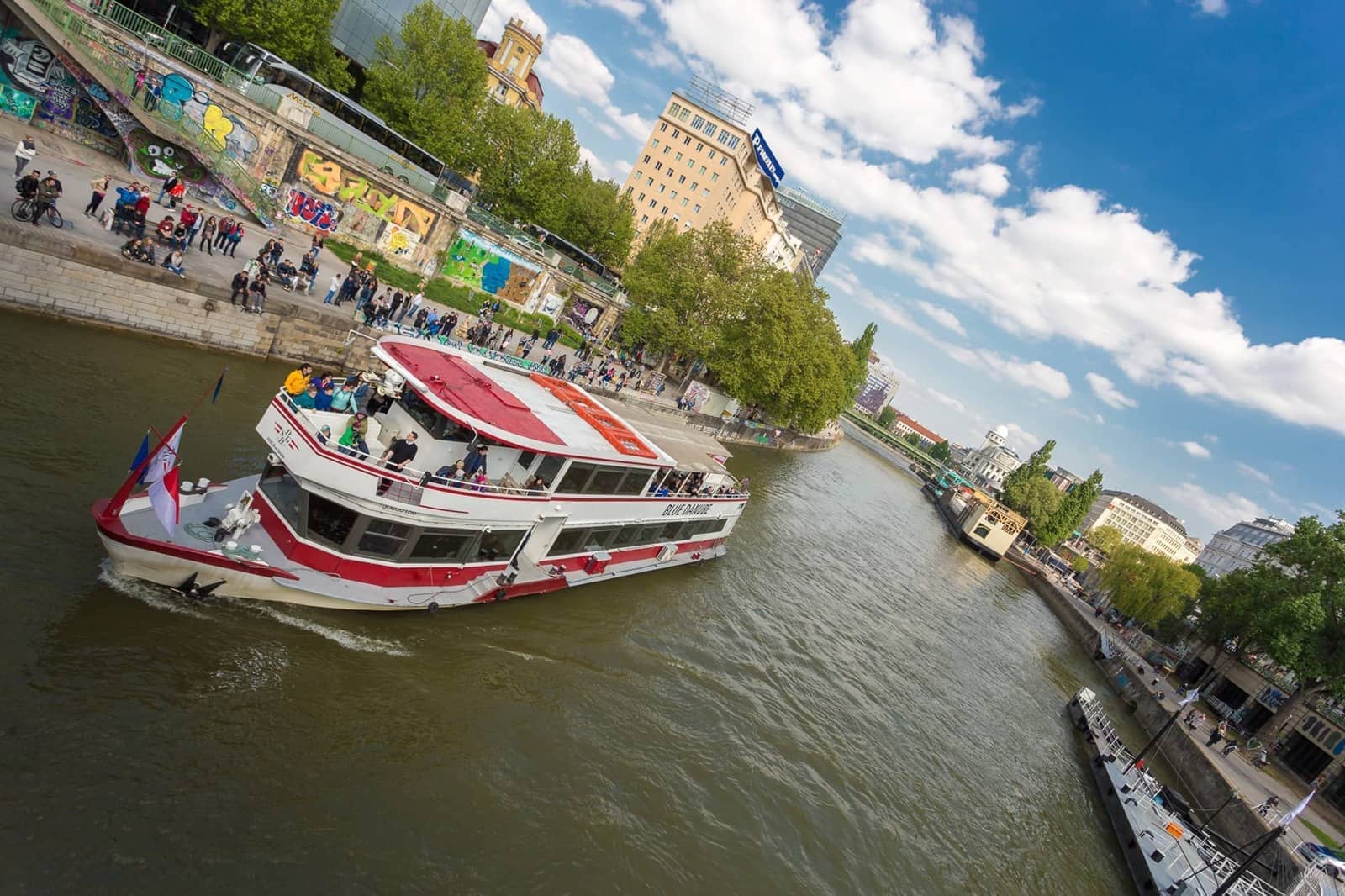
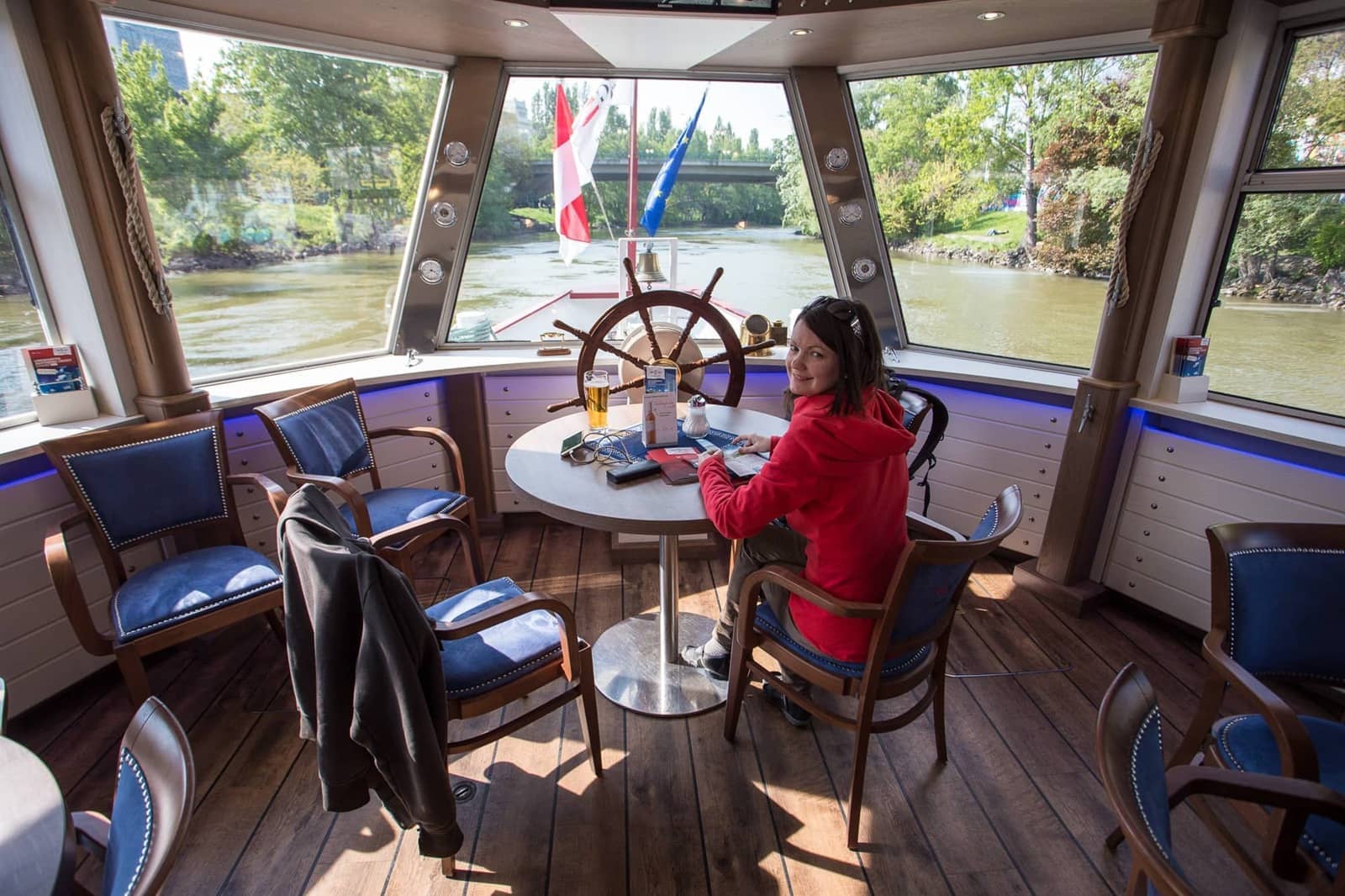
Several companies run cruises of varying lengths. We took the 75-minute MS Blue Danube option that was included on the Vienna Pass, watched the city roll past accompanied by a cold beer and a slice of apfelstrudel, and decided that this was a civilised way to end a museum day.
A note on timing: last departures vary by season. Expect the final cruise around 5pm in summer and 4pm in shoulder season (April, October), so check the booking page for your date before you commit to the museum-then-cruise running order. In winter the cruises mostly don’t run at all, which is another reason the winter version of this itinerary moves the Ferris Wheel to midday and drops the cruise.
If you’re not going for the Vienna Pass, you can book the cruise online in advance here.
Giant Ferris Wheel at Sunset
If you can time it right, end the day up in the air. Vienna’s Wiener Riesenrad is one of the few surviving 19th-century Ferris wheels, originally built in 1897 and (until 1985) the world’s largest. It was heavily damaged in World War II and much of the current structure dates from 1945.
A practical timing note: sunset in Vienna swings from around 4:30pm in December to around 9pm in late June, so “catch it at sunset” looks quite different depending on when you visit. In summer, if you’ve been on your feet since 9am, a 9pm wheel ride is a big ask. If you’re visiting between May and August, consider riding it mid-afternoon when the light is still good rather than waiting for the full sunset, or accept the trade-off of a very long day.
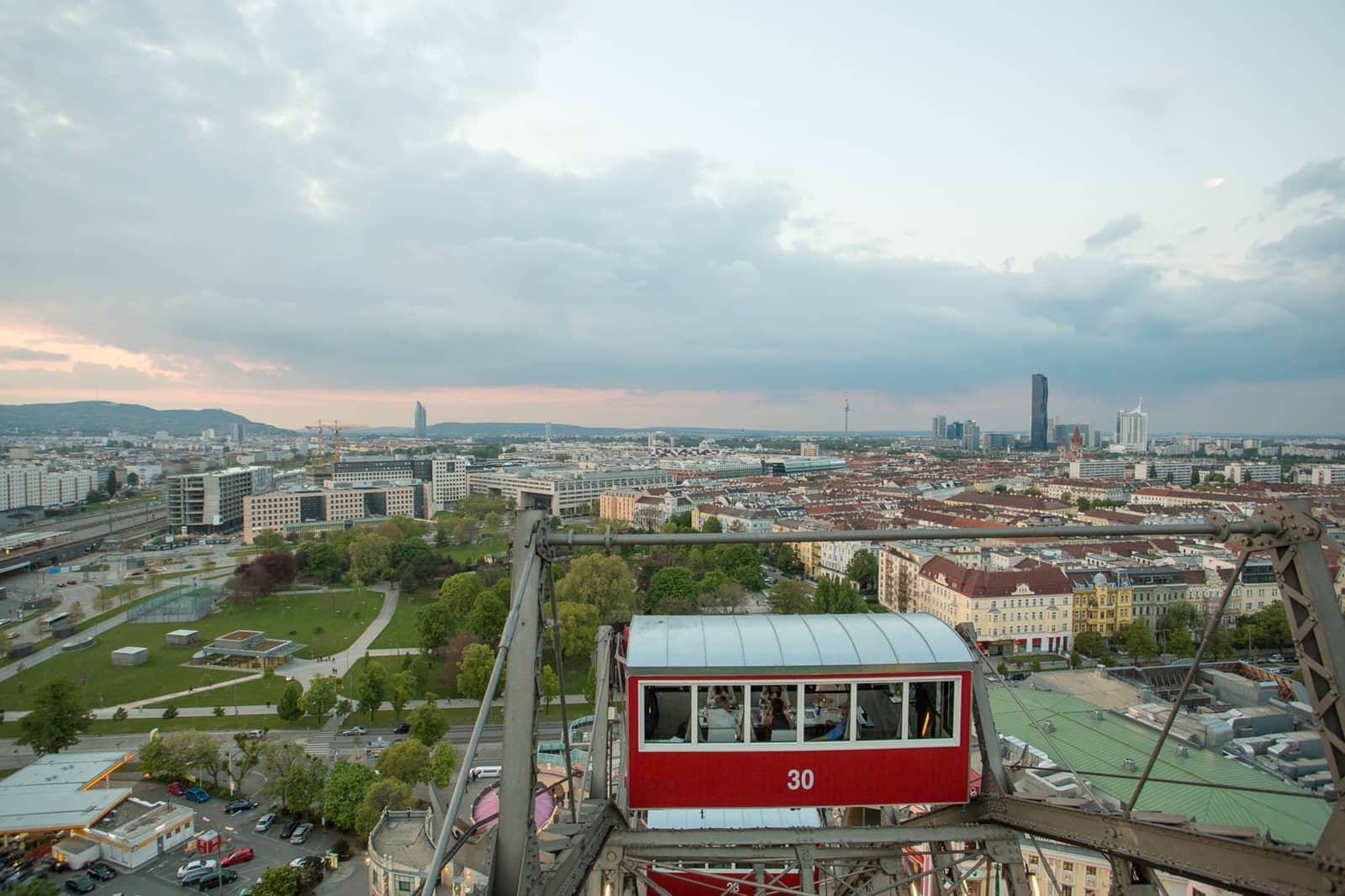
It’s in the Prater amusement park, a couple of metro stops from Schwedenplatz where the canal cruise returns to. A full revolution takes roughly 20 minutes, and if you catch it at sunset (check the sunset time for whenever you’re visiting) you get the whole city skyline going from gold to violet while you ride. There’s a fee, it’s included on the Vienna Pass, and tickets can be bought in advance here.
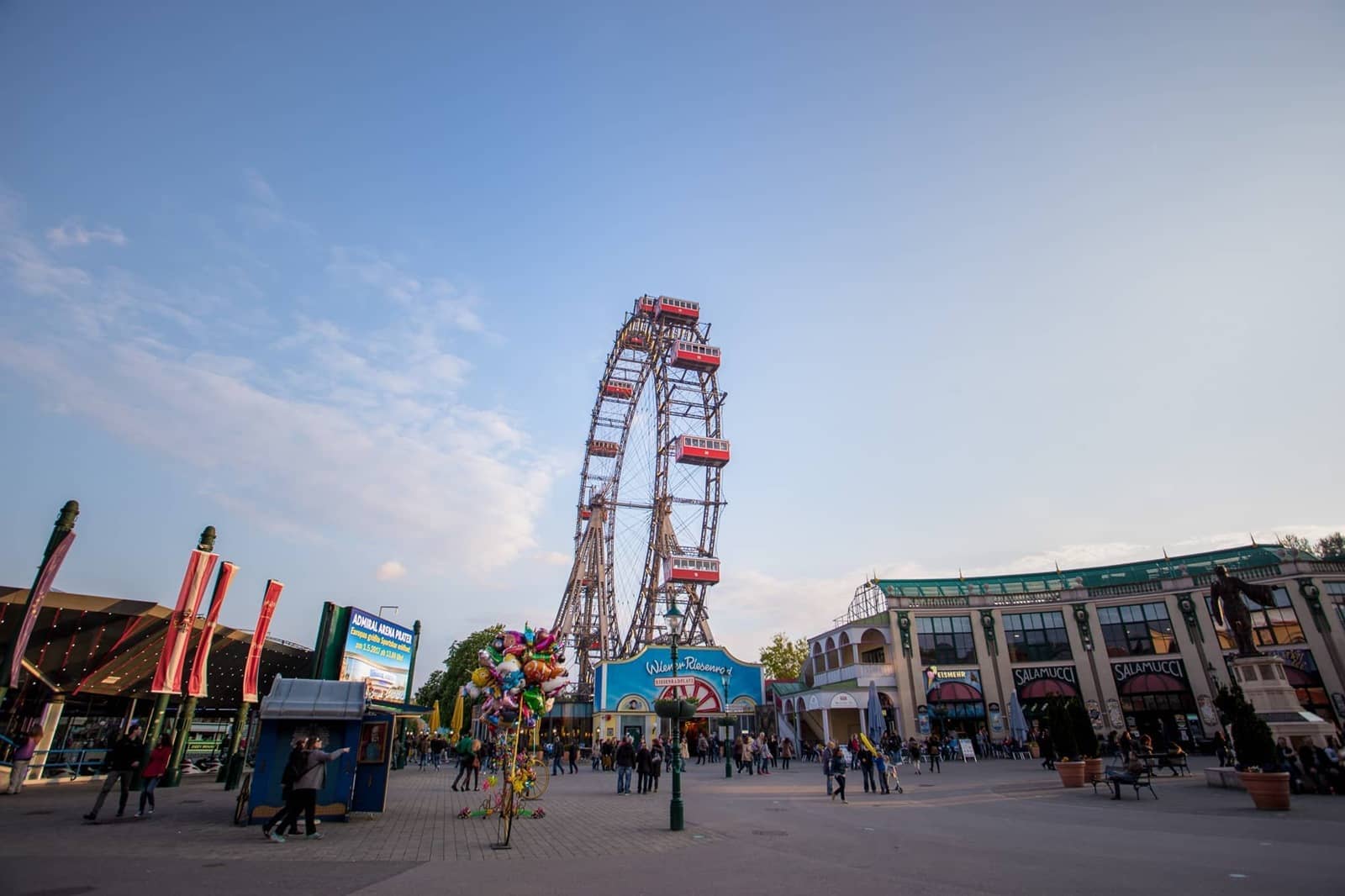
The Prater itself, beyond the wheel, is a slightly strange slightly wonderful 19th-century amusement park full of surprisingly intense rides if you have any energy left for that sort of thing. Or just walk back through it to the metro.
Day 2 in Vienna
Morning: Schönbrunn Palace (arrive for 8am or 9am). Lunch: At or near Schönbrunn. Afternoon: Military History Museum (optional), Belvedere Palace. Late afternoon: Coffee and cake in a proper Viennese cafe. Evening: Rooftop bar, dinner.
Schönbrunn Palace
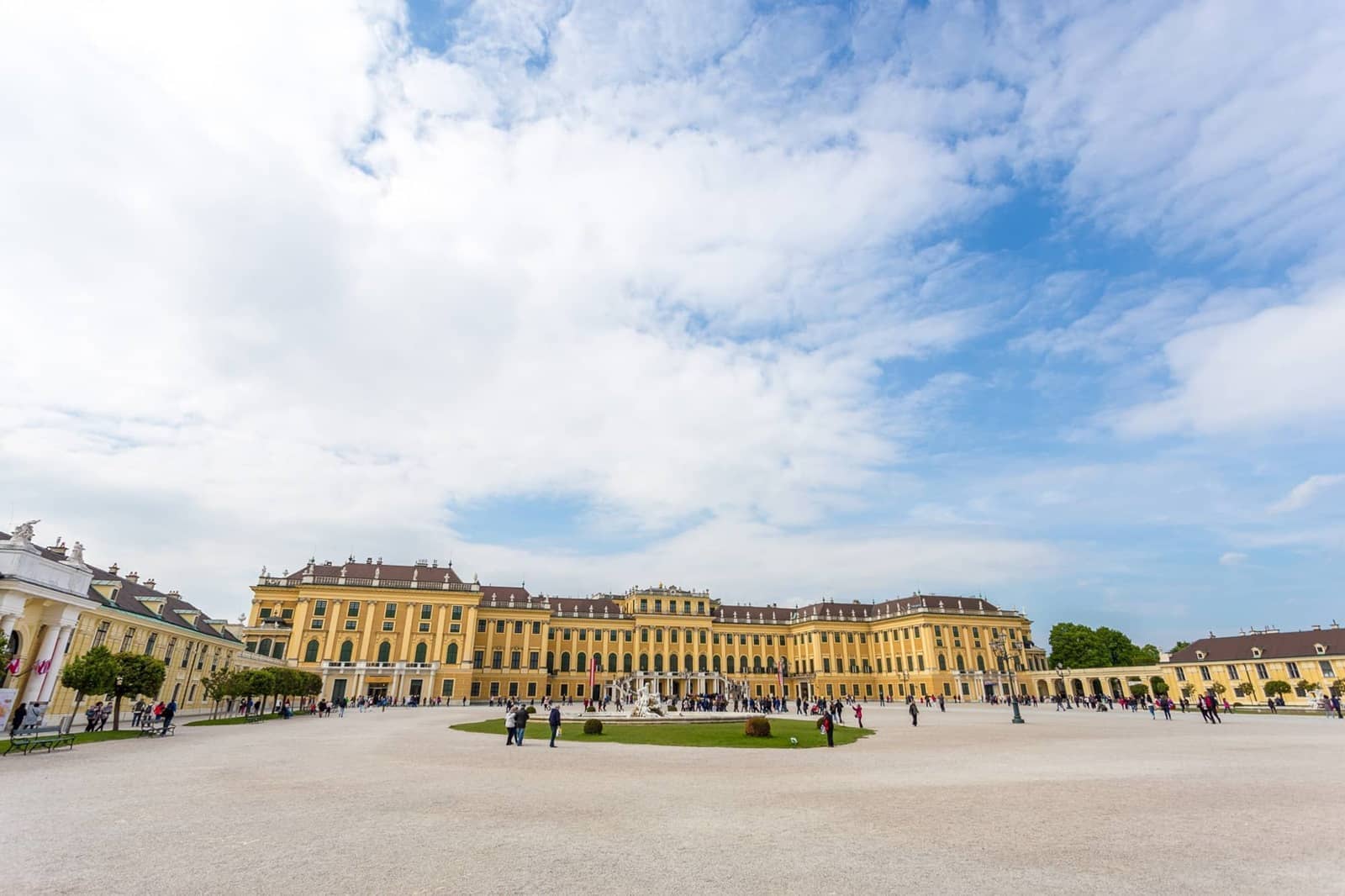
Schönbrunn deserves the whole of your second morning, and probably spills into lunch. This is the former summer residence of the Habsburg emperors, a UNESCO World Heritage Site, and one of the finest Baroque palaces in Europe. With over 1,400 rooms and several hundred acres of grounds, there is (to put it mildly) quite a lot to see.
Arrive when the palace opens. I’d strongly recommend this. We made the mistake on one visit of turning up at about 9:45am thinking we were being reasonably organised, only to discover the first available palace tour slot wasn’t until after noon. We killed the intervening time in the grounds, which are huge and excellent, so not wasted. But it was a frustrating avoidable mistake, and the palace is less crowded first thing.
There are three main self-guided tour options inside the palace itself, and the difference between them is just the number of rooms you see:
- Imperial Tour (about 22 rooms, roughly 40 minutes): focuses on the private apartments of Franz Joseph and Sisi. Good if you’re short on time or you’ve already been once.
- Grand Tour / Palace Ticket (about 40 rooms, roughly 60 minutes): adds the Maria Theresa rooms including the Great Gallery, the Chinese Cabinets, the Vieux-Laque Room, and the Millions Room. Only a few euros more than the Imperial Tour, and for first-time visitors this is the one I’d recommend.
- Highlight Tour (40 rooms plus the gardens, roughly 2 hours): same rooms as the Grand Tour but with a live licensed guide rather than the audio guide. Worth it if you want the stories and context rather than the self-paced version.
One thing to flag: at the time of writing, the Great Gallery is undergoing a restoration project scheduled to finish by the end of 2026. You can still walk through it as part of both the Grand Tour and the Highlight Tour, but some of the ceiling frescoes may be covered.
Tickets have fixed entry time slots, and in peak season (roughly April to October) walk-up queues at the ticket office can easily run 60-90 minutes. Book online in advance. You can book directly via the official Schönbrunn site, or for a guided tour with skip-the-line access there’s this well-reviewed 2-hour GetYourGuide option which bundles the ticket with a licensed guide.
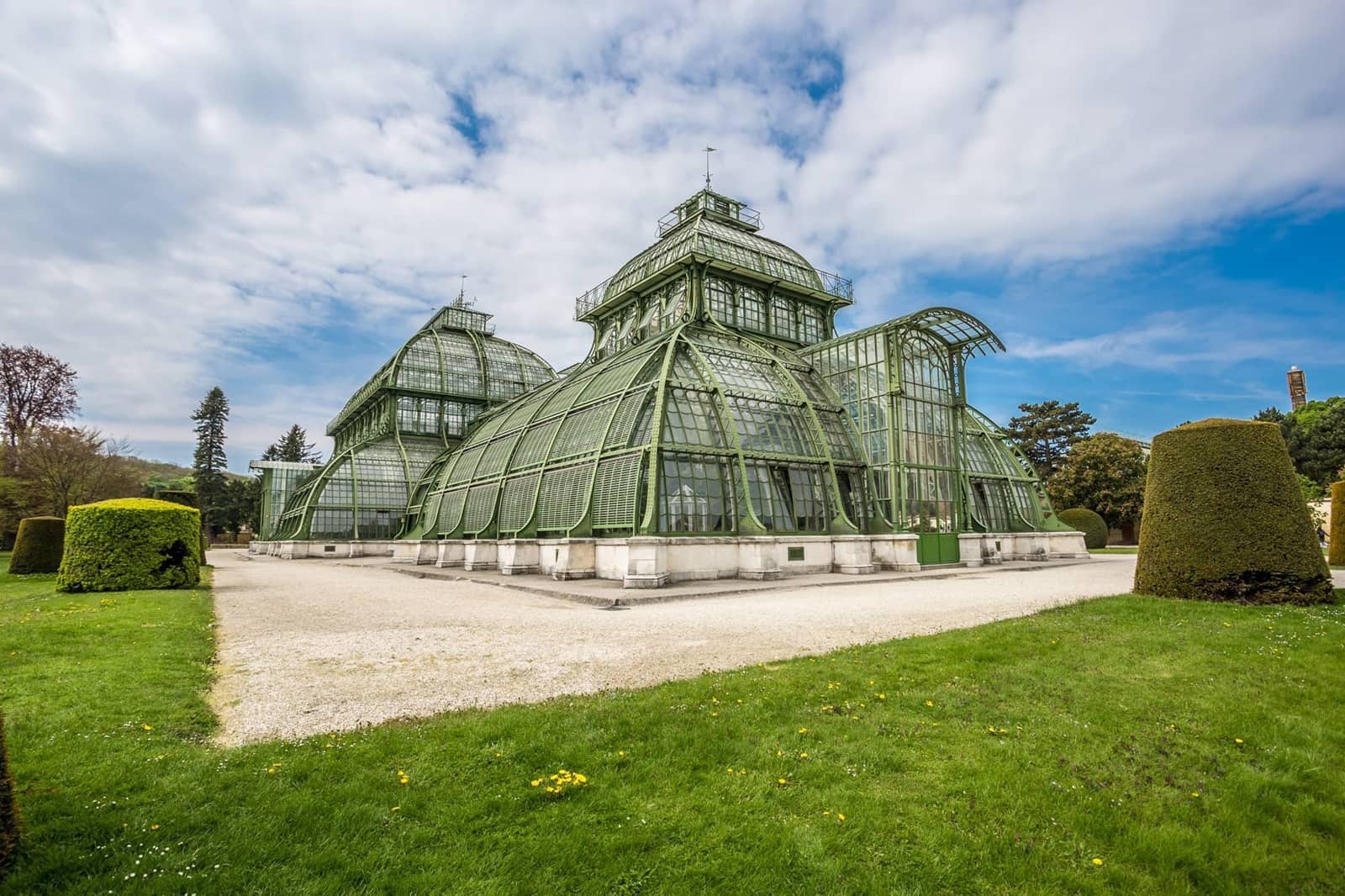
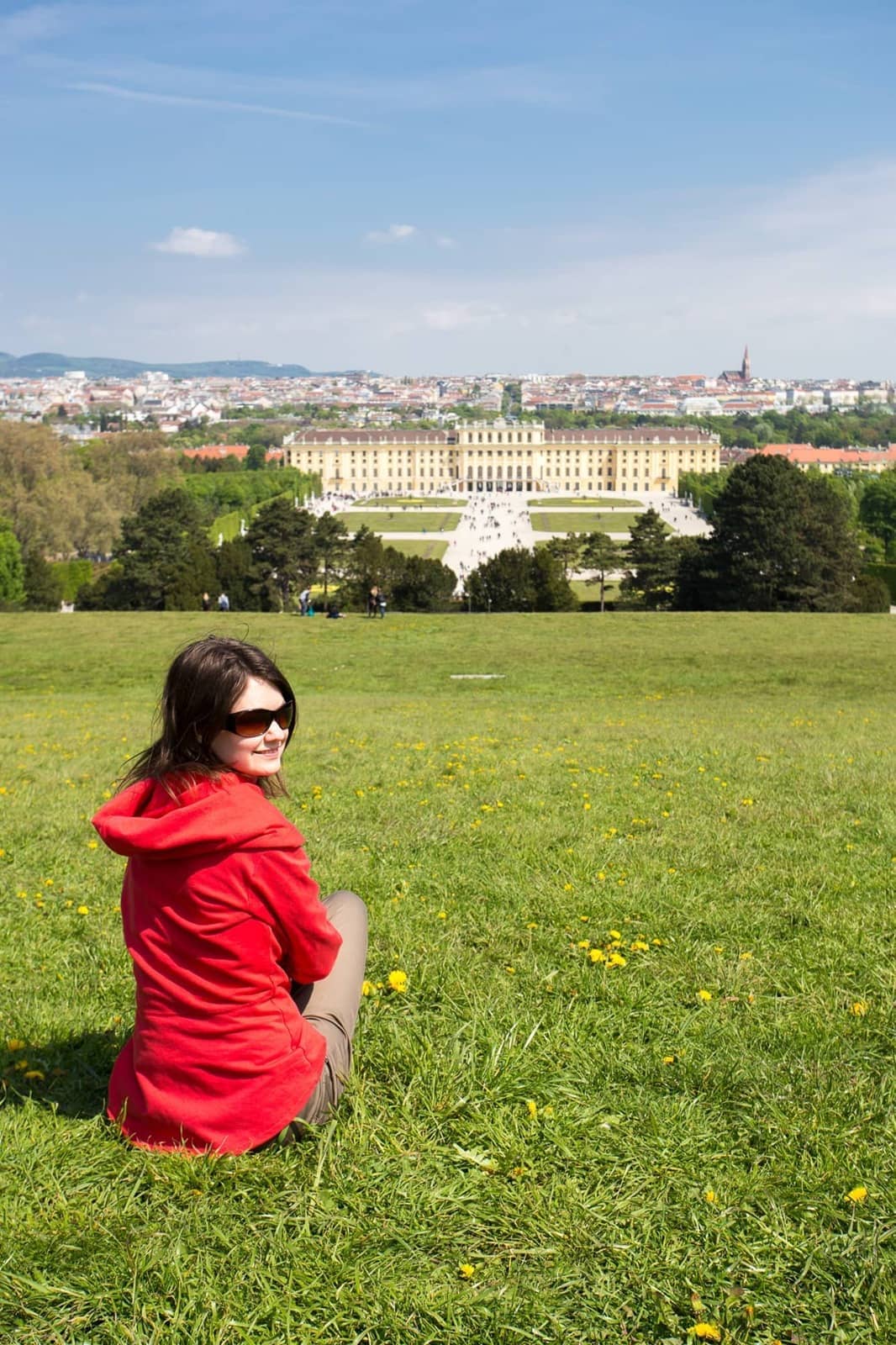
Beyond the palace itself, the grounds reward a few hours of unhurried wandering. The Gloriette, a colonnaded monument at the top of the hill behind the palace, is worth the climb for the views back down over the palace roof with the Vienna skyline behind. There’s a cafe inside the Gloriette now, which is both convenient and faintly absurd.
The Schönbrunn Zoo, on the grounds, is the oldest zoo in the world (founded 1752) and much better than its age suggests if that’s your thing. I’d flag that doing the zoo properly is a 90 minute commitment at minimum, so it’s really only a fit on a two day itinerary if you’re willing to cut the Military History Museum or shorten your Belvedere visit. But it’s a good option if you’re visiting with kids who might find more dusty palaces a bit of a challenge by this point.
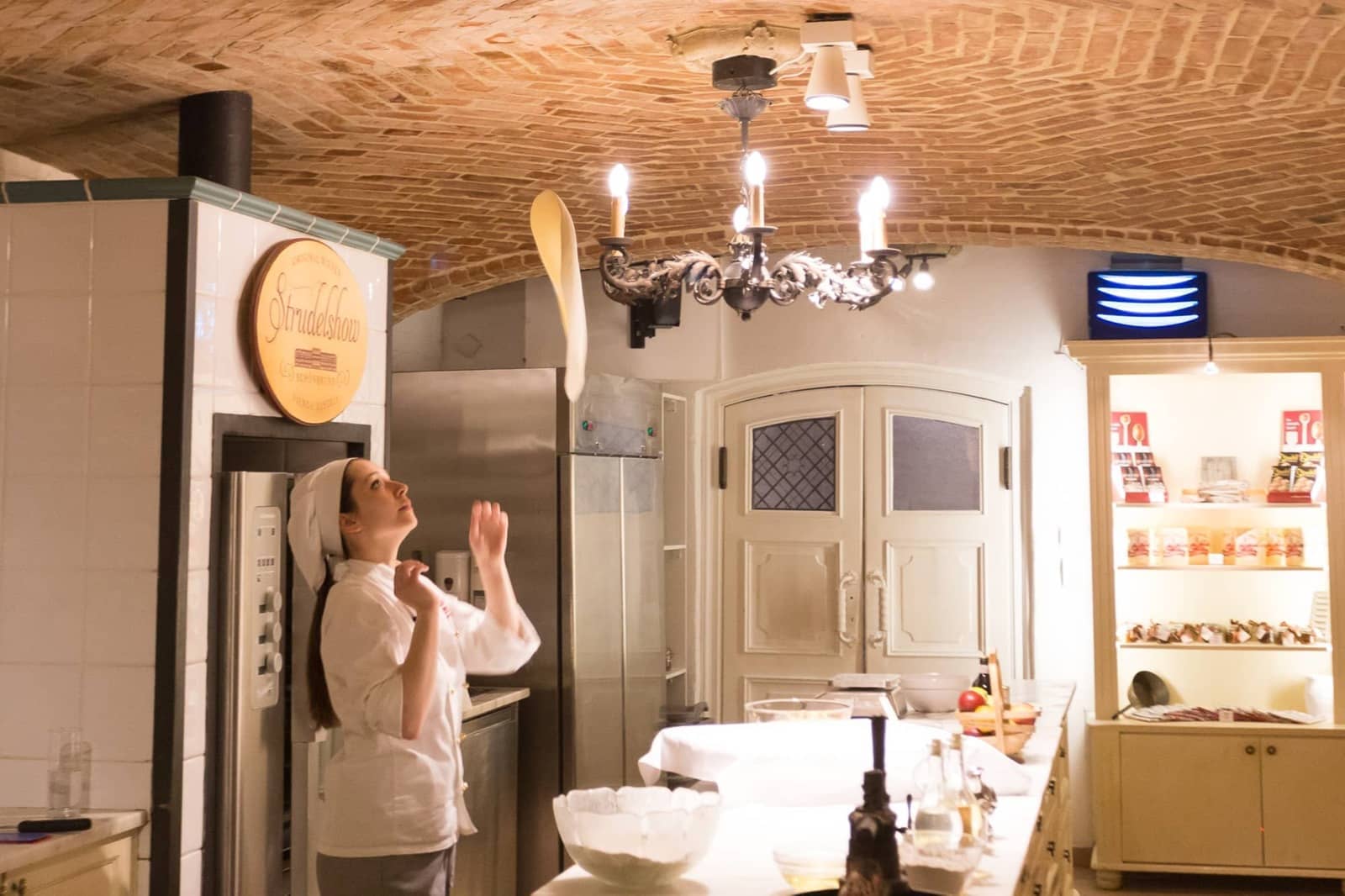
We particularly enjoyed the apfelstrudel show at the Cafe Residenz, which is a live demonstration of how to stretch strudel dough to translucent thinness, ending with a slice of the finished product. After a morning of walking around a 1,400-room palace, a warm slice of apfelstrudel is a very welcome development.
Schönbrunn is a few kilometres from the city centre, easily reached on the U4 metro (Schönbrunn stop, 7 minute walk to the palace gate). It’s also on the hop-on hop-off bus route if you’re using that.
Military History Museum (Optional)
If you tear yourself away from Schönbrunn by early afternoon, the Vienna Museum of Military History is a short hop-on hop-off bus ride away, on the route back toward the Belvedere. It is also included in the Vienna Pass.
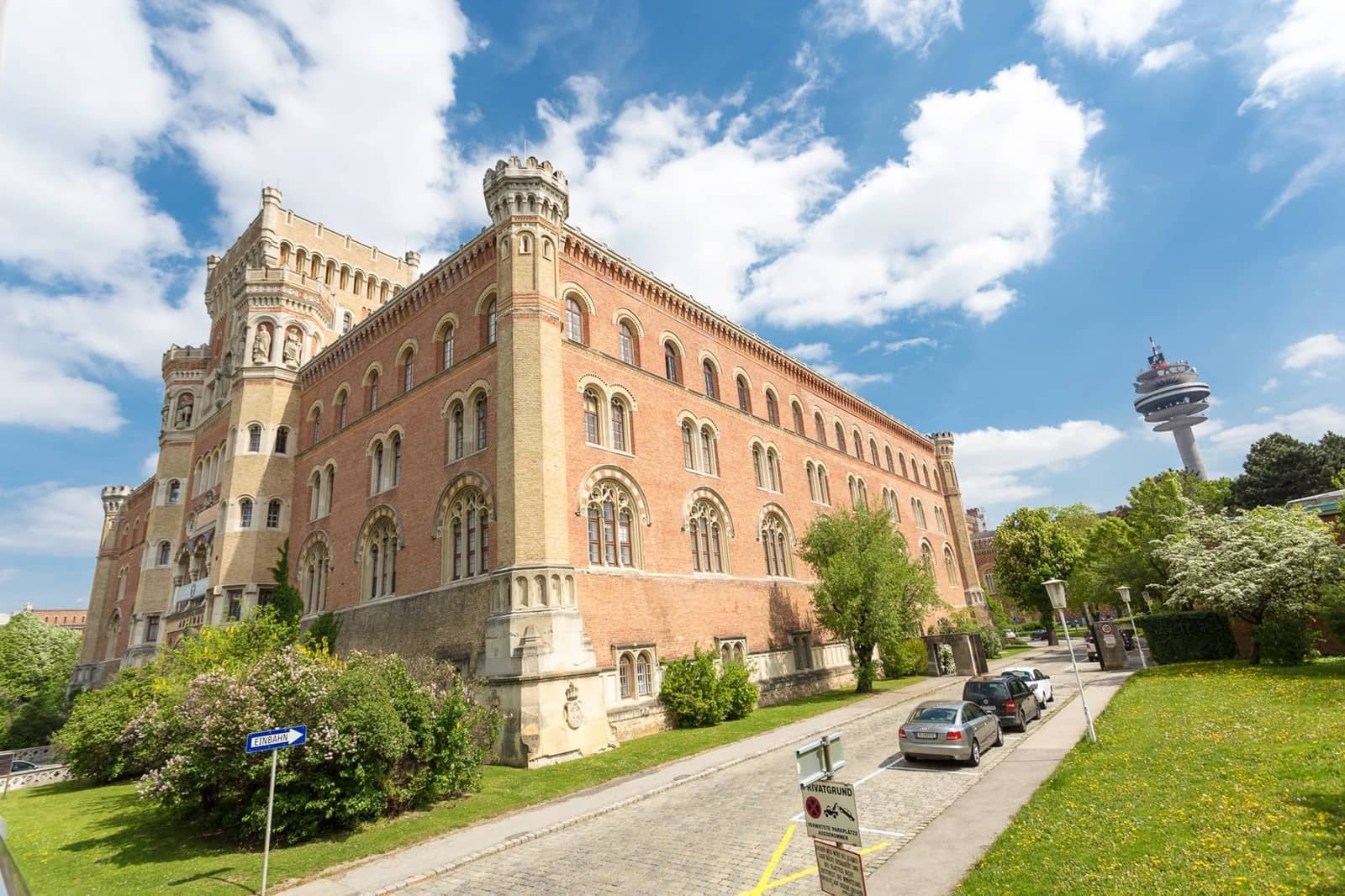
This covers the full sweep of Austrian military history from the 16th century to the present day. The collection that gets most visitors’ attention is the Sarajevo exhibit, which includes the actual car in which Archduke Franz Ferdinand was assassinated in 1914 (the event that kicked off the First World War) and the uniform he was wearing at the time. Whatever your feelings about military history, standing in front of that car is a remarkable moment.
The building itself is Vienna’s oldest purpose-built museum, which formed part of the city’s original arsenal complex, and is worth seeing on its own merits. Open daily 9am to 5pm with some public holiday exceptions, admission fee charged, details on the official site.
Skip this if palaces are more your thing than military history. Go straight to the Belvedere.
Belvedere Palace
A short walk or one bus stop on from the Military History Museum brings you to the UNESCO-listed Belvedere palace complex. Two palaces (Upper and Lower Belvedere) face each other across a landscaped formal garden, and together they house the Belvedere Museum.
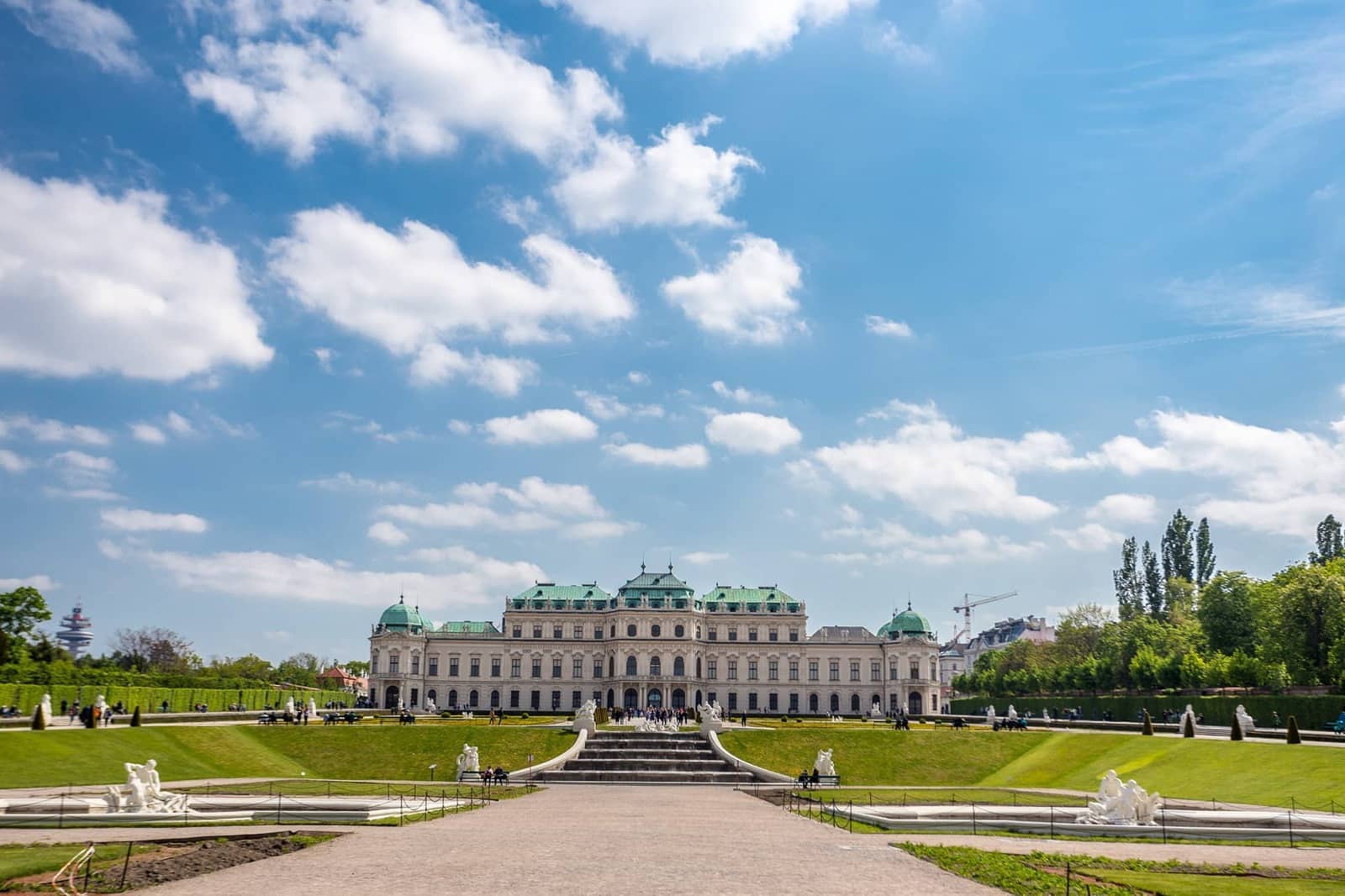
Built in the late 17th and early 18th centuries by Prince Eugene of Savoy as his summer residence, the palaces are a masterpiece of Baroque architecture. Today, alongside the grounds (free to wander), you can tour the palace interiors, which hold one of Vienna’s best collections of Austrian art. The undisputed star is Gustav Klimt’s The Kiss, hanging in the Upper Belvedere. If you visit one art museum in Vienna that isn’t the Albertina, this is probably the one.
A word of warning: the room containing The Kiss gets crowded. If you want to actually look at the painting rather than look at fifty other people looking at the painting, aim for either the first hour after opening or the last hour before closing.
The Upper Belvedere is open daily 9am to 6pm (until 9pm on Fridays); the Lower Belvedere opens at 10am, same closing times. Each palace has an individual entry fee, combined tickets available, details on the official site. Also included on the Vienna Pass, or book online in advance here.
Coffee, Cake, and a Rooftop Bar
By the time you finish at the Belvedere it’s late afternoon, which in Vienna means one thing: coffee. Hop on tram D back into the 1st district and head to Cafe Landtmann near the Burgtheater, which is the closest of the four classic cafes to the Belvedere and has reliably excellent Kaiserschmarrn. If you’d rather go to Cafe Central, Cafe Sacher or Cafe Sperl, the full rundown of each is a little further down the article. Whichever you pick, spend an hour there with a slice of Sachertorte or apfelstrudel and a Melange. This is not a footnote to a Vienna trip. It is the trip.
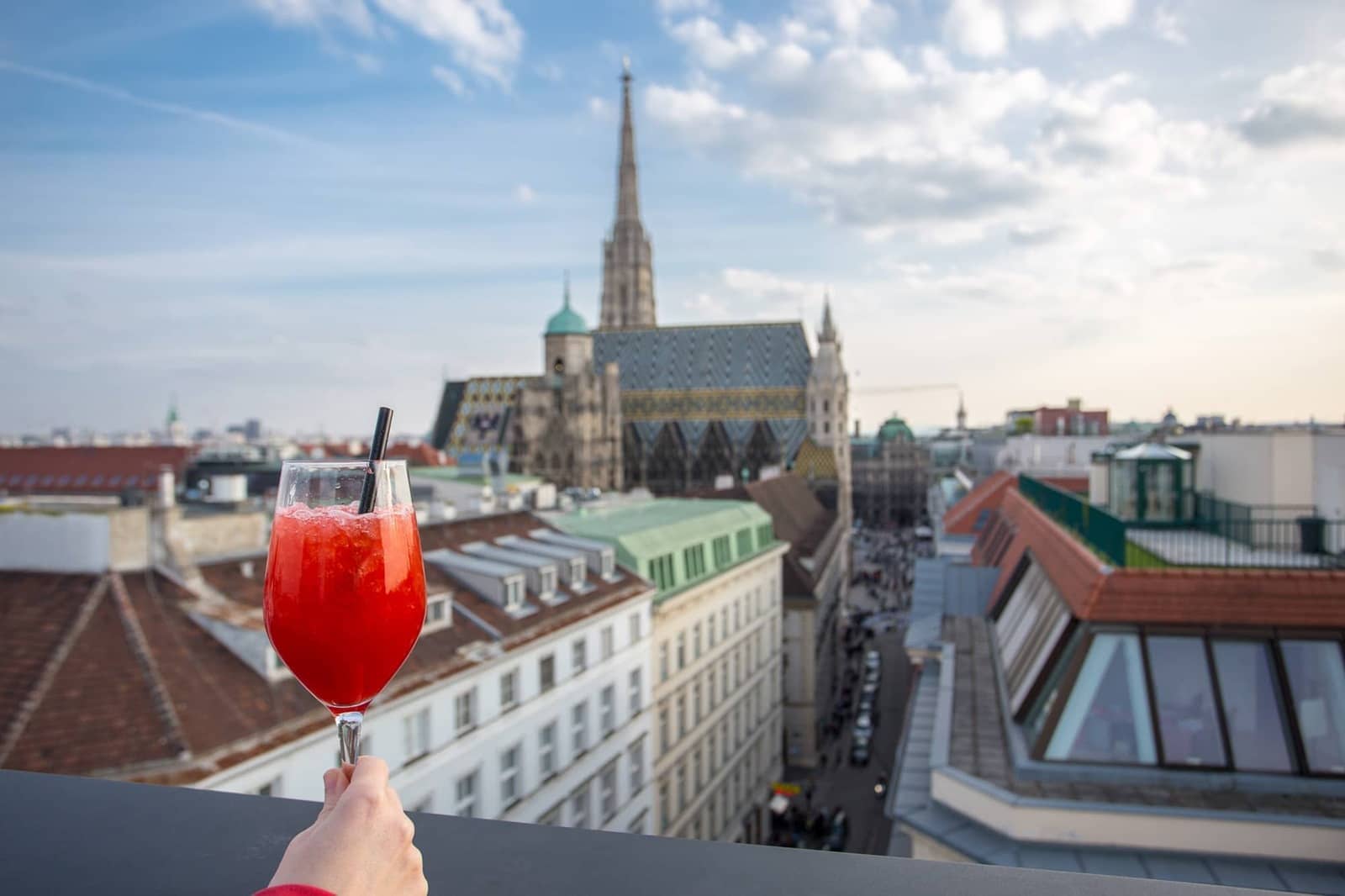
From there, if you still have energy and decent weather, one of Vienna’s rooftop bars is an excellent way to see the city skyline come on for the evening. We enjoyed cocktails at Cafe Bar Bloom with a view of Stephansdom and the sun setting over the rooftops. Das Loft at the SO/ Vienna (on the 18th floor, with the best panoramic views in the city) and Lamée Rooftop are the two other well-known options, both with equally good views and slightly higher prices.
For dinner, if you want to round the trip out with one more proper Viennese meal, Zwölf Apostelkeller (if you didn’t eat there on Day 1) is an easy pick and there is often live music in the evening. If you did eat there on Day 1, try Plachutta near the Stadtpark for what is widely considered the definitive tafelspitz in Vienna, or the fabulous-sounding but entirely reasonable Griechenbeisl, the oldest restaurant in Vienna (operating since 1447, if the signage is to be believed, which I choose to believe).
Viennese Coffee House Culture (Why This Matters)
UNESCO added Viennese Coffee House Culture to its list of Intangible Cultural Heritage in 2011, which is an elaborate way of saying that sitting in a Vienna coffee house drinking a cup of coffee and reading a newspaper is officially considered one of the cultural achievements of humanity. I am not going to argue with UNESCO here.
The Viennese coffee house is not, in most cases, a good place to get coffee quickly. It is a place to sit for an hour, or two, or three. The waiters (Herr Ober, traditionally) bring you coffee served on a small silver tray with a glass of water and a biscuit, and they leave you alone. You order what you want, you read the newspapers (which are mounted on wooden rods by the door), you write your novel, you argue with your friend, you stare into middle distance. The coffee house was the original coworking space, only with better furniture and chandeliers.
If you only have time for one coffee house on a two-day trip, make it one of these four:
- Cafe Central (1st district, near the Hofburg). Vaulted ceilings, marble columns, a papier-mâché Peter Altenberg permanently seated by the door (he was a poet and regular in the 1890s). Trotsky used to play chess here. Expect a queue on summer weekends; reservations strongly recommended.
- Cafe Sacher (1st district, opposite the State Opera). Home of the Sachertorte. Touristy, yes. Also the original, and the cake really is very good. Reservations recommended.
- Cafe Landtmann (1st district, near the Burgtheater). Freud’s regular cafe. Current-day cabinet ministers, journalists, and tourists. Excellent Kaiserschmarrn.
- Cafe Sperl (6th district, near the Naschmarkt). Opened 1880, almost entirely unchanged since, and much less of a tourist destination than the first three. This is the one I’d go to if I wanted the coffee house experience without the queue.
What to order, if you don’t want to just point at the menu: a Melange (the Viennese cousin of the cappuccino, espresso with hot foamy milk), a Kleiner Brauner (small black coffee with a little pot of milk on the side), an Einspänner (double espresso with a tower of whipped cream). Pair with Sachertorte, Apfelstrudel, or Kaiserschmarrn (shredded sweet pancake with plum compote). You’ll pay more here than at a regular cafe (a Melange is around €6-7, a slice of cake around €7-9) and you will get what you pay for.
Map of 2 Days in Vienna
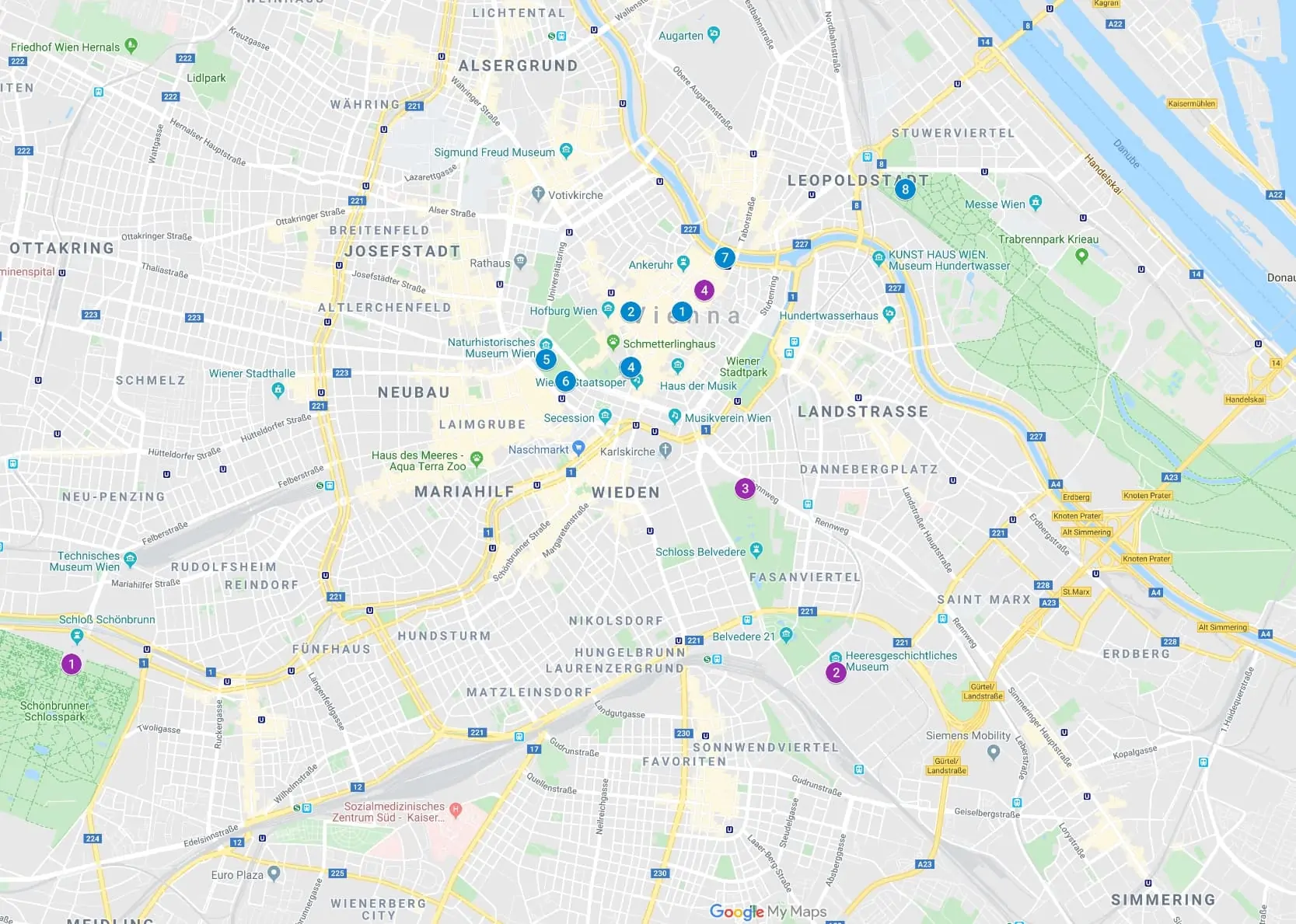
To help with your planning, this map shows all the attractions for this two-day Vienna itinerary. You can also see it on Google Maps here.
2 Days in Vienna Itinerary Overview
Day 1 covers the old city: St. Stephen’s Cathedral, the Hofburg Palace and Sisi Museum, lunch at Zwölf Apostelkeller, the Albertina, the Natural History Museum or Kunsthistorisches Museum, a Danube Canal cruise, and the Giant Ferris Wheel at sunset.
Day 2 covers the outer palaces: the whole morning at Schönbrunn, the Military History Museum (optional), the Belvedere Palace, coffee and cake in a proper Viennese cafe, a rooftop bar and dinner.
Reservations to Book in Advance
Vienna does not reward the last-minute planner in high season. The following all benefit from or require advance booking; in peak season (June to August and December) most of them require it.
- Schönbrunn Palace (timed entry, required): official site or GYG guided tour.
- Hofburg / Sisi Museum (timed entry, strongly recommended): official site or GYG guided tour.
- Belvedere (timed entry, recommended in summer): book tickets.
- Albertina (recommended, particularly for major rotating exhibitions): book tickets.
- State Opera performance (if you want to see an opera): official site. Tickets go on sale about two months in advance. Standing-room tickets (from around €15) are available on the day from the standing-room box office and are one of the great cultural bargains in Europe.
- State Opera guided tour (if you want to see the building without booking a performance): book on the State Opera site. 40 minutes, offered several times daily in English.
- Spanish Riding School (morning exercise and performances): official site. Performances sell out weeks ahead; morning exercise sessions (watching the Lipizzaners train) are more accessible but still worth booking.
- Cafe Central and Cafe Sacher: both take reservations and both benefit from one, particularly on summer weekends and in the run-up to Christmas.
If you’re going to use a city pass, the Vienna Pass covers most of the above and handles the timed-entry logistics automatically for the sights it includes.
Practicalities for Visiting Vienna
How to Get Around Vienna
Central Vienna is highly walkable. Most of the attractions for Day 1 sit inside the Ringstrasse, the boulevard that follows the line of the old city walls. You can walk the whole of Day 1 if you want to.
For Day 2, Schönbrunn and the Belvedere are outside the ring, and you’ll want public transport. The U-Bahn metro is the fastest option (U4 to Schönbrunn, tram D or 71 to the Belvedere from Karlsplatz). It’s clean, frequent, and signs are in English as well as German.
If you’ll be using public transport more than three or four times, a 24-hour, 48-hour or 72-hour travel pass is better value than per-journey tickets. Passes are sold at ticket machines in every U-Bahn station and cover all public transport including trams and buses.
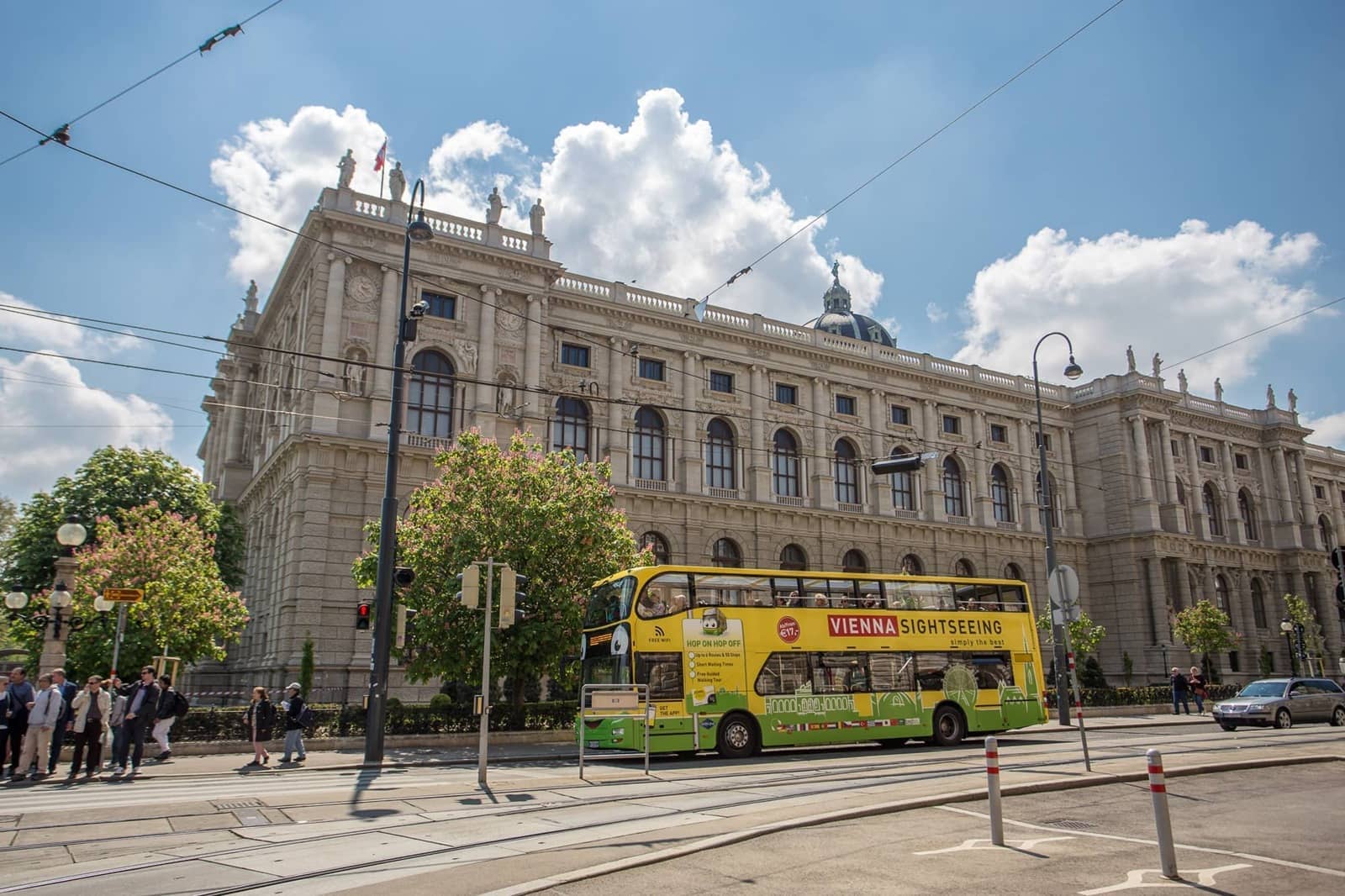
Alternatively, the hop-on hop-off sightseeing bus is a reasonable way to get between the more spread-out sights like Schönbrunn, the Military History Museum and the Belvedere without working out public transport. It’s included on the Vienna Pass.
A separate option worth knowing about is the Vienna City Card, which combines public transport with small discounts at various attractions. We’ve bought one on a previous trip and didn’t end up using it much because central Vienna is so walkable, but it makes more sense for longer stays and families.
When to Visit Vienna
Vienna works at almost any time of year, with each season offering something rather different.
Summer (June through August) is the busiest period. Warm, reliable weather, the outdoor spaces around the palaces are at their best, and the city has a pleasant lively atmosphere. The downside is that Schönbrunn in particular gets crowded, so booking in advance becomes more important. If you visit in July or August, arrive early at the popular sights and plan quieter activities for the hottest hours of the middle of the day.
Spring and autumn are arguably the best times to visit if you have flexibility. May and September give you good weather, manageable crowds, and accommodation prices that are noticeably more reasonable than peak summer. Vienna in early May, when the parks are in bloom and the outdoor cafe terraces are just opening but not yet swamped, is a particular pleasure.
Winter is when Vienna becomes an entirely different city. The Christmas markets are among the best in Europe and run from late November through to just before Christmas, filling the squares around the Rathaus, Schönbrunn and Belvedere with lights, mulled wine, and an atmosphere that’s difficult to manufacture elsewhere. It’s colder and darker, but the indoor life of Vienna (the coffee houses, the opera, the museums) really comes into its own when the temperature drops. We’ve been to Vienna in both summer and winter, and I couldn’t pick a favourite between them.
Internet Access in Vienna
Getting online in Vienna is easy. The city has good free WiFi in cafes, hotels and many public areas, and Austria is part of the EU roaming zone, which means most European mobile plans work here at no extra cost.
If you’re visiting from outside Europe, a travel eSIM is the easiest way to get online without hunting for a local SIM card on arrival. We use and recommend Airalo, which offers data plans for Austria and the wider Europe region at reasonable prices. You can read our full Airalo review here.
Where to Stay in Vienna
On previous trips we’ve opted for an apartment, which was right in the city centre and meant we had room to work, cook meals, and do laundry. For a weekend trip a hotel makes more sense than an apartment, but both are viable.
Of course, there are plenty of accommodation options in Vienna, from hostels through to five-star hotels. I’d recommend checking the Vienna listings on Booking.com, which usually return the widest choice and best deals. They also list apartments now alongside hotels.
Some recommended options across price points:
- wombat’s CITY Hostel Vienna. Found near the Naschmarkt and close to the Museum Quarter, a highly-rated hostel offering both dormitory and private rooms at a good price. For hostels, also consider CH-Hostel.
- CH-Budget Centre Rooms. At the budget end, a well-located guesthouse with free WiFi, private bathrooms and TVs, plus a good-value breakfast.
- Motel One Wien-Staatsoper. Just 100 metres from the Vienna State Opera, a three-star property that’s excellent value. Air conditioned en-suite rooms, WiFi throughout.
- Hotel Pension Suzanne. A small family-run pension a minute’s walk from the State Opera and Karlsplatz U-Bahn. Antique furniture, en-suite rooms, and a few studios with a kitchenette if you want the option to make your own breakfast.
- Hotel Domizil. A mid-range four-star on Schulerstraße, a couple of minutes’ walk from Stephansdom and the U-Bahn. Free WiFi throughout, en-suite rooms with mini-bar and kettle, 24-hour reception.
- Hotel Am Parkring. A highly rated four-star with views over the city from its high floor location.
- Hotel Kaiserin Elisabeth. A historic four-star just off Kärntnerstraße, steps from Stephansdom and the State Opera. Air conditioned rooms, full buffet breakfast, period interiors that lean into the old-Vienna setting.
- Hotel König von Ungarn. Vienna’s oldest hotel, a four-star with free WiFi, air conditioning, and a lot of history in the walls.
- Hotel Imperial. A five-star luxury hotel on the Ringstrasse with marble bathrooms and, at the top end, a butler service.
- Grand Hotel Wien. Highly rated, centrally located, five-star historic property with five restaurants, spa, and luxurious rooms. An excellent choice at the high end.
For more tips on getting the best deals on accommodation (and more), have a look at our travel resources page.
Where to See Live Music in Vienna
Vienna is a music city in a way that few others are, and if you’re here for two days you should consider spending at least one evening at a classical concert. The options range from the grand (the State Opera) to the smaller and more intimate (church concert venues, palace chamber music evenings).
Some of the more popular options include:
- Vivaldi’s Four Seasons at Karlskirche
- Mozart and Strauss at Schönbrunn Palace
- Classical Concerts at St. Anne’s Church
- Classic Ensemble Vienna at St. Peter’s Church
For a full picture of what’s on during your visit, the official Vienna tourism site has event listings for every type of musical event, and classical music fans should take a look at the classical music listings specifically.
You can also buy tickets for live music performances across Vienna via classictic.com.
How to Save Money on Your 2 Day Vienna Itinerary
Vienna is not a cheap city. But there are several ways to make your budget go further without sacrificing much.
The single most useful tool for most visitors is the Vienna Pass. It covers entry to a huge number of the city’s attractions, including Schönbrunn Palace, the Hofburg’s Imperial Apartments, the Albertina, the Kunsthistorisches Museum, the Giant Ferris Wheel, the Danube river cruise, and much more. Whether it’s worth buying depends on how many paid attractions you plan to visit, but if you’re following this two-day itinerary closely, it’s very likely to save you money.
To give you a rough sense of the maths: visiting all the major attractions listed in this itinerary individually would cost well over €200. Schönbrunn alone, across the palace tour, zoo, Gloriette viewing platform, and strudel show, adds up to almost €70 if you do everything.
A two-day Vienna Pass is €127 at time of writing and includes most of those. It also includes skip-the-line access at many of the busiest attractions, which in peak summer can save you an hour of queueing at Schönbrunn alone.
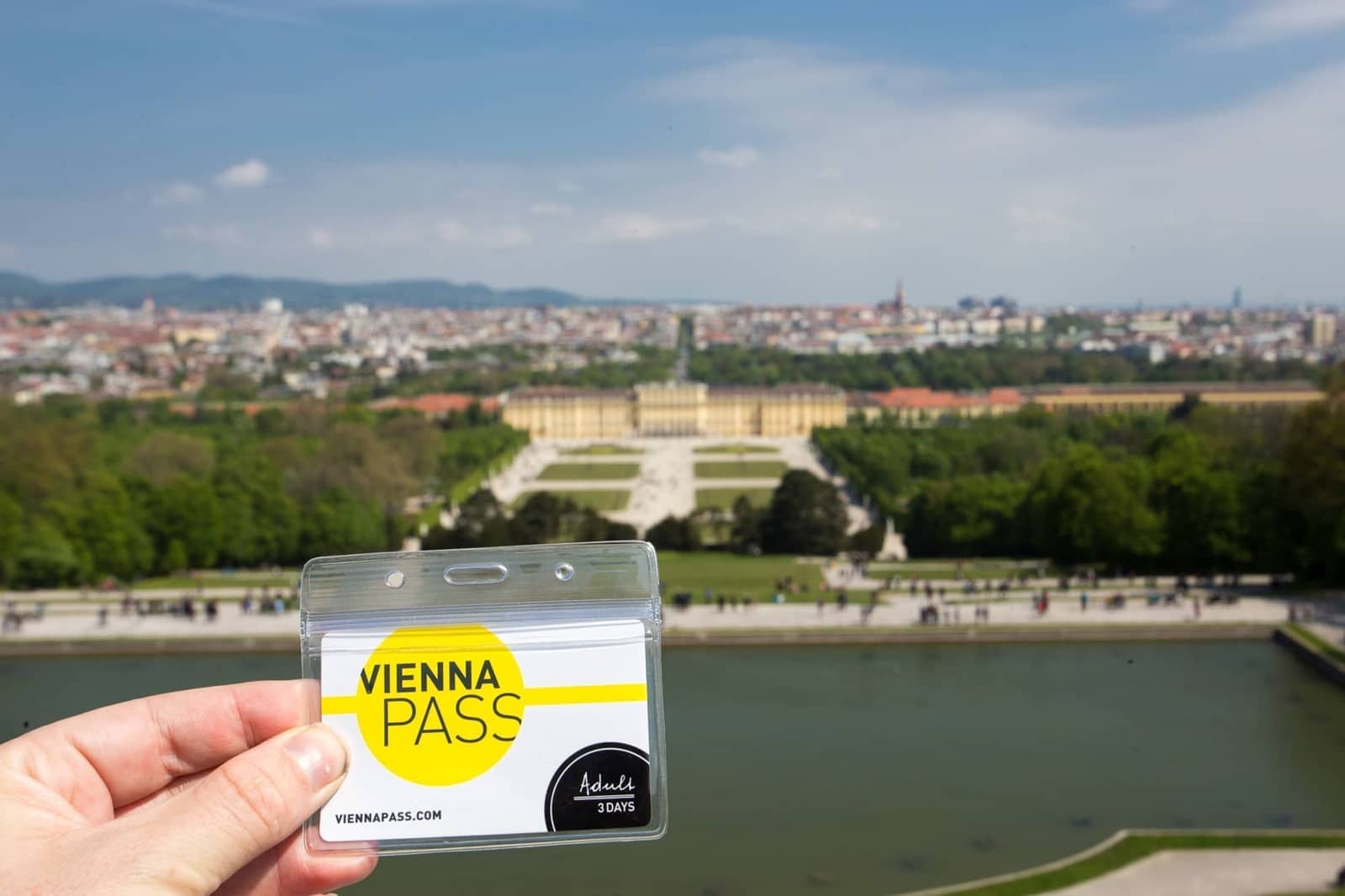
We’ve used city passes and museum cards in destinations around the world, and the Vienna Pass is one of the better ones we’ve come across. Reserve one in advance here.
If the Vienna Pass is more than you need, the Vienna City Card combines free public transport with smaller discounts at attractions. It makes more sense for visitors who don’t plan to go to lots of museums but do plan to move around a lot.
On food: lunch at a neighbourhood Gasthaus or standing at one of the city’s many Würstelstände (sausage stands) is both authentic and affordable. The tourist-facing restaurants right next to the major sights are markedly more expensive for the same food. A good schnitzel should cost you around €12-15 in a neighbourhood restaurant; the same dish will be twice that at a table overlooking the Stephansdom. The exception, which I will grudgingly allow, is a Melange and a slice of Sachertorte at Cafe Sacher. You are paying for the experience, and it is worth it.
Book attractions online in advance. Most of the major sights offer discounted online prices compared to buying on the door, and in peak season you skip queues that can be significant.
Frequently Asked Questions for Vienna
Is 2 days enough for Vienna?
Two days is enough to see the main highlights of Vienna, including St. Stephen’s Cathedral, Schönbrunn Palace, the Hofburg and Sisi Museum, the Albertina, and the Belvedere, and to get a real feel for the city.
It won’t be enough to do everything. Vienna has more museums and palaces than you can cover in a weekend, and you’ll miss things like the Spanish Riding School and the State Opera.
If you can stretch to three days, our three-day Vienna itinerary gives you a bit more breathing room and covers a few of the less-visited spots.
How many days do you need in Vienna?
For a first-time visit, three days is the version I’d recommend if Vienna is the main goal of your trip. Two days works well as part of a wider Central European trip where Vienna is combined with Salzburg, Budapest, Prague or Bratislava.
Anything more than three days and you start having time for the less-obvious things: the Vienna Woods, a day trip to Schloss Hof or the wine region south of the city, a full evening at the opera, a morning at the Spanish Riding School, a proper wander through the Museum Quarter. Four or five days in Vienna is a very pleasant trip.
What are the best things to see in Vienna in 2 days?
The six I would prioritise are St. Stephen’s Cathedral, the Hofburg (with the Sisi Museum and Imperial Apartments), the Albertina, Schönbrunn Palace, the Belvedere (for Klimt’s The Kiss), and a proper Viennese coffee house. Together those cover the religious, imperial, artistic, and cultural foundations of the city.
What is the best time of year to visit Vienna?
Vienna works year-round. May and September are the sweet spots for good weather and manageable crowds. July and August are warm but busy, with Schönbrunn in particular getting very crowded.
Winter, particularly late November through December, is when the Christmas markets run and the city has a distinctive atmosphere well worth experiencing. We’ve visited in all four seasons and each has its own appeal.
Is the Vienna Pass worth buying?
For most visitors following a two-day itinerary, yes. The pass covers entry to Schönbrunn, the Hofburg’s Imperial Apartments, the Albertina, the Kunsthistorisches Museum, the Giant Ferris Wheel, the Danube river cruise, and many more attractions. If you plan to visit three or more paid attractions it will save you money.
Do the maths for your specific plans before buying. Check the current list of included attractions against the sights on your list; if they cover less than two-thirds of the cost of the pass, skip it and buy individual tickets.
How do I get around Vienna?
The U-Bahn metro is the quickest and easiest way to get around. It’s clean, reliable, and covers all the main sights. A 24 or 48-hour travel pass is good value if you’ll be moving around a lot. Trams are more scenic for shorter journeys, and much of the old city is walkable. Taxis and rideshares are available but rarely necessary.
Do I need to book Vienna attractions in advance?
For most of the year, booking the main attractions online is strongly recommended rather than strictly essential. The exception is Schönbrunn Palace in summer, where timed entry slots for the interior tour can fill up hours in advance.
I’d suggest booking Schönbrunn, the Hofburg (Sisi Museum / Imperial Apartments), the Albertina, and any specific experiences like concerts or the Spanish Riding School ahead of your visit, particularly between June and August.
Where should I stay in Vienna?
Staying in or close to the 1st district (Vienna’s old city centre) puts you within walking distance of most of the Day 1 attractions and a short tram or metro ride from Day 2. It’s the most expensive area, but the convenience is worth it for a short visit.
The 6th and 7th districts are good alternatives at a slightly lower price point with easy metro access to the centre. Check current availability and prices on Booking.com.
Further Reading for Your Visit to Vienna
This post should give you nearly everything you need to plan a two-day Vienna itinerary. Some additional content and resources that might help:
- If you have a bit longer, check out our 3 days in Vienna itinerary
- If you liked this itinerary, check out our other detailed itineraries, covering cities, countries, and road trips around the world
- Visiting Vienna in summer? Have a look at our tips for visiting Europe in summer
- Looking for a guidebook? We used the DK Eyewitness Travel Guide to Vienna and found it useful
- Planning to stay in an apartment? Check out Jess’s guide to over 20 websites for booking apartments online
Vienna has a habit of making you feel like you haven’t quite finished with it by the time you leave. Two days gets you through the headline attractions, but the city has a depth that takes longer to appreciate: the coffee house culture the Viennese take very seriously, the side streets of the old city that reward aimless walking, the concert venues where the music is world-class rather than just historic. It’s a city that improves with repeat visits, and one trip is rarely the last.
If you have questions about the itinerary or want advice on adjusting it to fit your trip, leave a comment below and we’ll do our best to help.
Patty Abraham says
Thanks .We are traveling to Vienna in August 2022.Your article was very informative
Laurence Norah says
My pleasure Patty, have an amazing time in Vienna!
Sonam says
We will reach Vienna on 13th nov evening and leave for Budapest on 16th nov…just wanted to how’s hotel steigenberger hereenof Wien located…is it nearby to all the major attractions that you mentioned on your blog. And also please recommend what can we do on 13th as we just have the evening to explore the city and as we are short on time, how can we accommodate everything?
Laurence Norah says
Hi Sonam,
That hotel is well located, so that would work.
For the evening of the 13th, it’s really up to you. I’d recommend looking at our 3 day Vienna itinerary and seeing what extra activities you might be interested in. Just try to find some things that are open later in the winter time.
Have a lovely time in Vienna!
Laurence
Teresita Padilla says
I like to travel to Vienna but I’will be alone, 75 years old and is on a shoestring budget. Is it safe to stay in a hostel? Your article is very interesting and informative and it makes me want to go there!
Laurence Norah says
Hi Teresita
Vienna is a very safe city, and we think you will have no problem staying at a hostel. We’d suggest perhaps the My Mojovie Hostel which is well reviewed and quite central. However, the dorm rooms have an age limit of 50 so you would need to book a private room. Another option if you prefer a dorm is the Wombats City Hostel Vienna which has female only dorms and is also quite central 🙂
I hope you get to visit Vienna soon 🙂
Laurence
Anne Bond says
My friend and I are hoping to visit in October and looking at hotel in Schwedenplatz 3-4 area. Would this be a convenient area to stay near main attractions.
Laurence Norah says
Hi Anne,
Yep, that would be within walking distance of the city centre and most of the attractions on this itinerary 🙂
Have a great trip!
Laurence
Ashley says
How exactly does one book the strudel show at Schönbrunn? Can I do it in advance, or do I do it during my visit? If so, where do I go to register?
Laurence Norah says
Hi Ashley!
You can do it in person, which is what we did, however, if you prefer to book in advance you can just e-mail them: residenz@cafe-wien.at.
You can see more here: https://www.cafe-residenz.at/en/apple-strudel/strudel-show.html
Enjoy!
Laurence
Eddie says
I was always interested in Vienna, but now I’m sold. Your blog definitely encouraged me to go, lots of good info.
Laurence Norah says
Thanks very much Eddie – have a lovely trip and let us know how it goes!
Ashley says
What form of transportation did you rely on most for this itinerary? The hop-on/hop-off buses, the tram, or the subway?
Thanks!
Laurence Norah says
Hi Ashley!
It was a combination of walking and the hop on hop off bus. We did buy a Vienna travel card which was good for the subway and bus, but we ended up using those far less than we initially thought.
Let me know if you have any more questions 🙂
Laurence
Ashley says
Great! Thanks for your help!
Kanika Bakshi says
A superb article with a piece of very helpful information which really help all travelers who want to go to Vienna. Nicely done everything. Keep it up the best work.
Laurence Norah says
Thanks Kanika 🙂
Yoana Dimitrova says
How did you travel around Vienna,did it take you too much time to get around different places.Also did you get the Vienna travel card.
Laurence Norah says
Hi Yoana,
For the most part we walked, which was easy to do. For the palace, we took the hop on hop off bus which was included with the Vienna Pass, which took us straight there. For some of the other locations we took the metro. We did get a 3 day travel card, but to be honest, we didn’t use it enough to make it worth it as the hop on hop off bus was pretty good, and then we walked nearly everywhere else!
I hope this helps 🙂
Laurence
Azar says
I will be in Vienna Sep 8th at night and leave Vienna to Budapest on Sept 11th at 6:30 night. i bought two days Vienna pass for 9th and 10th. we are not found of musumes but love castles and other activites. would you be able to provide an itenary for two days and what to do without Vienna pass on 11th for more than half day.
Laurence Norah says
Hey Azar 🙂
I’d recommend checking out my 3 day itinerary as that has more attractions listed, and from that you should be able to put together a good itinerary:
https://www.findingtheuniverse.com/3-day-vienna-itinerary/
I’d definitely recommend Schönbrunn Palace, Prater Park and Ferris Wheel, St. Stephen’s Church and the state opera tour. I know you say you don’t really like museums, but Venice has some really amazing musuems, so hopefully you visit one or two of them 🙂
When you are looking for things to do without the pass, there’s the Naschmarkt, and also there are some really nice cafe’s that you might want to visit.
Afif says
I always check your blog before planning a trip – always extremely helpful.
Thanks a lot for all the effort you put into this.. Happy travels 🙂
Laurence Norah says
That’s lovely to hear Afif – pleased we could help out 🙂
Satish says
Hi,
I have purchased 1 day Vienna pass. What sightseeings can I cover along with Schonbrunn palace on that day? My thinking is: Schonbrunn palace,Hofburg,Ferry wheel at Prater and St. Stephen’s Cathedral Treasury. Do let me know if covering all this is possible in a day? Kindly provide some editing if this is not possible.(Note: Would like to cover mixture of architecture and history) Thanks.
Laurence Norah says
That sounds very possible to us – just don’t spend too long at Schonbrunn to be sure you see everything else you want to see.
Tarek Soliman says
Amazing description to Vienna attractions. thank you very much for making my trip easier and for saving too much of my limited time. I will follow your advice to enjoy my short two day trip to Vienna and sure, I will share my experience with you and your followers once returned. Greetings from Egypt
Laurence Norah says
Thanks very much Tarek! Have a great trip and do let us know how it goes 😀
Mayank says
One more thing I need clarity on, I will reach my hotel in Vienna on 13th August around 3:30 p.m. I will leave from Vienna to Innsbruck on 15th August at around 11:30 a.m. I am confused whether I should buy 24 or 48 hour Vienna pass.
Laurence Norah says
Hi Mayank,
The Vienna Pass lasts for only one full day, from midnight to midnight. So if you started using it at 3.30pm, that would count as a full day. So my advice is to take the one day pass, and just to use it on the 14th. Otherwise you don’t have enough time to take advantage of it on the afternoon of your first day, or morning of your last day.
Mayank says
Thanks for your reply. Just have few more questions, I will stay in 25hours Hotel MuseumsQuartier at Vienna. We have our evening free on 13th August and entire day of 14th August. What should be done on 13th Aug(assuming I do not take a Vienna pass for that day). Also can you pls suggest an itinerary for 14th August regarding sightseeing to be done. Thanks in advance.
Laurence Norah says
Hi Mayank! It’s really up to you what you do. A popular option in Vienna is to see a classical concert (see the post for instructions on how to find one of those). Some of the attractions are also open later in the day.
It’s hard to give individual itineraries without knowing what people like, so my suggestion is to pick from the two day itinerary, and from what is included on the Vienna Pass, those attractions which you are most interested in seeing, and then checking on the map to see how far apart they are. Then you can come up with a plan for what is feasible for your visit 🙂
Mayank Rathod says
Hi, I am visiting Vienna in mid August 2018. How is the climate/weather likely to be?
Laurence Norah says
Hi Mayank
August is likely to be pretty good, temperatures should be around 22C – 28C, and it should be sunny. Of course, rain is possible at any time of year, but is less likely in August. I hope this helps!
Mayank Rathod says
Thanks for your prompt response, however will the climate be too hot? We are visiting Swiss and Austria in mid August. I am from India.
Laurence Norah says
HI Mayank – I think it’s unlikely you will find it to be too hot, as Europe is not too humid. I haven’t visited India, but my understanding is that it is usually quite hot and humid there, so I think you will be fine!
Mayank says
Hi,
Should 1 day Vienna pass be taken?
Cyndi says
A 2nd question about a train from Munich to Austria. Are there various? If so pros/cons? If not, thanks.
Laurence Norah says
My pleasure Cyndi 🙂 There are a number of direct trains between Munich and Vienna (I assume you want to go to Vienna :)).
It takes between four and five hours, and there are around twenty per day. My advice is to book in advance so you get a cheaper ticket, with the best site for trains out of Germany being the official German trains ticket website, which has an English version here: https://www.bahn.com/en/view/index.shtml
There is also a night train service if you want to try a sleeper train. These can be a fun way to get around Europe, plus you save on a nights accommodation. The train service is called Nightjet and it takes around seven hours I think. You can book those on the DB website too, from here: https://www.bahn.com/en/view/offers/europe/nightjet.shtml
Happy to help with any more questions of course!
Cyndi says
My adult daughter and I are finishing our August 2018 trip in Vienna. I fantasize attending a Strauss concert (possibly with dinner) although the music is the priority.
Your thoughts???
Laurence Norah says
Hi Cyndi! This is quite a popular request, so I’ve updated the post with a little section on attending concerts in Vienna. In summary though, my suggestion is to check out the official city website for classic music event listings (https://www.wien.info/en/music-stage-shows/classic). A church concert is a popular option, but the cafe’s also host music if you want it accompanied by some food. I hope this helps – have a wonderful trip to Vienna!
Cyndi says
Thank you for your reply and link. Much appreciated.
Dr. Vikram Jain [eye surgeon] says
Hi, me and my co-brother [husbands of 2 sisters] are reaching Vienna by car from Salzburg via Melk on the evening of 12th June. We have 2 full days [13,14] before we drive off to Budapest. Your itinerary appears very useful and we will definitely keep it in mind all the advise u have given.
Laurence Norah says
Thanks Vikram – have a great trip!
Arline says
Going in Aug for 2 days. Would love to go to a concert as well as some of the other things on your itinerary . Any suggestions?
Laurence Norah says
Hi Arline,
Of course, there’s the Vienna opera house, but after that it very much depends – lots of the churches for example have live music performances, but it will depend on the timing of your visit as to what is on – also it will depend on what you are specifically interested in seeing! My advice would be to check out this page on the Vienna tourist board: https://www.wien.info/en/music-stage-shows/classic/church-concerts – which will give you more ideas for what is on and when 🙂
Have a great trip!
Arline says
Thank you very much. I am really interested in hearing Strauss waltzes so I will look into that venue.
Saby says
Thank u so much for the blog…very detailed and have all information i was looking for …one of t best vienna blogs i have read so far…going to vienna this may…thank u for all help!
Laurence Norah says
My pleasure – have an excellent trip!
Lynda Ellis says
What excellent information – thank you – I am so very excited about my forthcoming trip ( on the 15th March with my daughters – my Christmas Present from them!)
Laurence Norah says
That is a fantastic Christmas present – you’re going to have an amazing trip. Enjoy!
anna says
We are going next month, thank you for helping me plan our vacation!
Laurence Norah says
Our pleasure Anna – have a wonderful trip!