

I'm Laurence, a professional travel photographer since 2010. Jess and I write this site from our own travels.
Heading to New York City and trying to work out the best way to get around once you’re there? You’ve come to the right place. We’ve visited New York many times across the years, and we’ve used pretty much every mode of transport the city has to offer, from the subway to the AirTrain to the Roosevelt Island tram. This guide pulls all that together into one place, with current 2026 fares, mode-by-mode practical detail, and our take on what we actually use and when.
We’ll cover everything from the obvious (the subway, yellow taxis, walking) through to the slightly less obvious (the NYC Ferry, Citi Bike) and the rather more unusual (an aerial tram, helicopters if you’ve got money to burn). We’ll also cover how to get to and from the three major airports, since that’s usually the trickiest bit of any New York trip.
Once you’ve worked out how you’re getting around, you might also want to take a look at our detailed guide to spending 2 days in New York or 3 days in New York, both of which apply this transport advice to actual itineraries. Right then, let’s crack on.
Table of Contents:
Paying for transit in NYC: OMNY in 2026
Before we get into the modes themselves, a quick word on how you actually pay for them in 2026, because this has changed significantly in the last year and most older guides (including, until recently, this one) are out of date.
The MetroCard is gone. Or rather, it is going. Sales of new MetroCards stopped on 31st December 2025, and you can no longer buy or refill one as a visitor. If you’ve got an old one with money on it, you can transfer the value to an OMNY card at a customer service centre, but for any new visitor in 2026 the MetroCard isn’t a live option.
What replaces it is OMNY, which stands for “One Metro New York”. OMNY is the MTA’s contactless payment system. The basic idea is that you tap a contactless payment card (Visa, Mastercard, Amex), a smartphone wallet (Apple Pay, Google Pay, Samsung Pay), or a smart wearable (Apple Watch, Fitbit Pay) directly on the OMNY reader at the turnstile or on the bus, and your fare is charged to that payment method. There’s no separate transit card to buy, no top-up to remember, and no $1 issuance fee. This is a real improvement over the old MetroCard system, and as someone who has fumbled MetroCards at busy turnstiles more than once, I welcome it.
If you don’t have a contactless card or phone, you can buy a physical OMNY card for $2 at vending machines and load it with credit, but most visitors will find it easier just to tap their existing card or phone.
Here’s what the actual fares look like as of January 2026:
NYC transit fares 2026
| Mode | Fare (2026) | When to use it |
|---|---|---|
| Subway (single ride) | $3 | The default for most trips of more than 10 blocks. Fastest mode in most of Manhattan and to the boroughs. |
| Local / SBS bus | $3 | Crosstown trips in Manhattan and short borough hops. Slower than subway but you get to see things. |
| Express bus | $7 | Long commuter runs to outer boroughs. Visitors rarely need it. |
| Roosevelt Island Tram | $3 (same as subway) | For the Roosevelt Island view, or as a faster alternative to the F train at peak hours. |
| NYC Ferry | $4.50 | East River crossings to Brooklyn, Queens, the Rockaways. The skyline view is the bonus. |
| Staten Island Ferry | Free | Statue of Liberty views without a paid tour. That’s the use case. |
| AirTrain JFK | $8.75 | Cheapest JFK to Manhattan option, paired with the subway. |
| AirTrain Newark + NJ Transit | $15.75 | Cheapest Newark to Manhattan option (Penn Station). |
| Yellow taxi (JFK flat fare) | $70 + tolls + tip | Best for groups of 3-4 with luggage, or late-night arrivals. |
The really useful feature OMNY adds is the weekly fare cap. Once you’ve paid for 12 rides on the subway and local buses in a 7-day period (Monday to Sunday), every additional ride that week is free. That works out to a maximum of $35 in fares for the week. If you’re in NYC for four or five days and using the subway heavily, you’ll hit the cap and the rest of your rides cost nothing. You don’t need to do anything to enable this, you just have to use the same payment method every time.
A few things that catch first-timers out: tapping a different card on the way back doesn’t transfer your trip credit, so pick one card and stick with it. Free transfers between subway and bus (or vice versa) work within two hours of your first tap, but only if you use the same payment method. And the contactless reader sometimes takes a beat to register, so let your card sit on the reader for a full second rather than swiping it past.
The transport modes
Right, with payment out of the way, here are the actual ways of getting around the city.
1. Taxi
The iconic yellow taxi is one of the most recognisable things in New York. They’re easy to spot (they’re yellow, and they have a yellow light on the roof), and they’re the only vehicles allowed to pick up passengers anywhere in the city in response to a street hail.
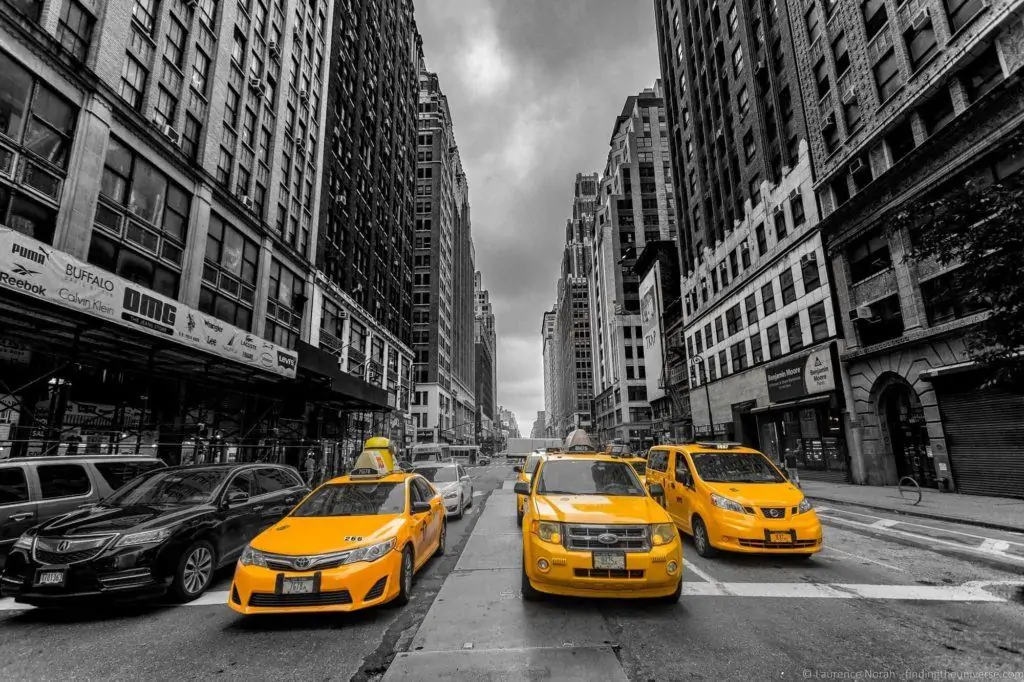
A taxi shows it’s available by illuminating the yellow light on the roof. To hail one, you stand at the kerb (not in the road, please), make eye contact with the driver, and signal with your hand. Once the cab stops, you tell the driver where you’re going. Fares are metered, with a starting flag-fall and then per-distance and per-time charges, plus various surcharges. You can pay in cash or with a credit/debit card, and tipping is expected (15-20% is standard).
We’ve taken yellow taxis a fair number of times in New York, mostly for late-night returns to a hotel after dinner, or when there’s been heavy rain and the subway has felt like the wrong call. They’re not always faster than the subway during the day (Manhattan traffic is what it is), but they come into their own after dark or with luggage. A good rule of thumb: if you’d be the only person on a quiet subway platform at 11pm, a cab is probably the right call.
There are of course alternatives to the yellow cab. Ride-sharing services such as Uber and Lyft are everywhere in New York and need to be booked through their apps. They generally work out a bit cheaper than yellow cabs for short rides and equal or slightly more for longer ones, depending on surge pricing. The advantage is you don’t have to hail one, you know the price up front, and you can split fares with travel companions through the app. The disadvantage is during surge times (rush hour, rain, after big events) the price can climb fast.
2. Bus
The New York Metropolitan Transportation Authority (MTA) operates a fleet of nearly 6,000 buses across more than 320 routes. Suffice to say, you should be able to find a bus that goes near where you want to go.
NYC buses come in three flavours: local buses (which stop frequently), Select Bus Service (SBS, which makes fewer stops along priority routes and lets you board at any door), and express buses (long-distance commuter routes from outer boroughs into Manhattan). For a visitor, you’ll mostly use local and SBS buses.
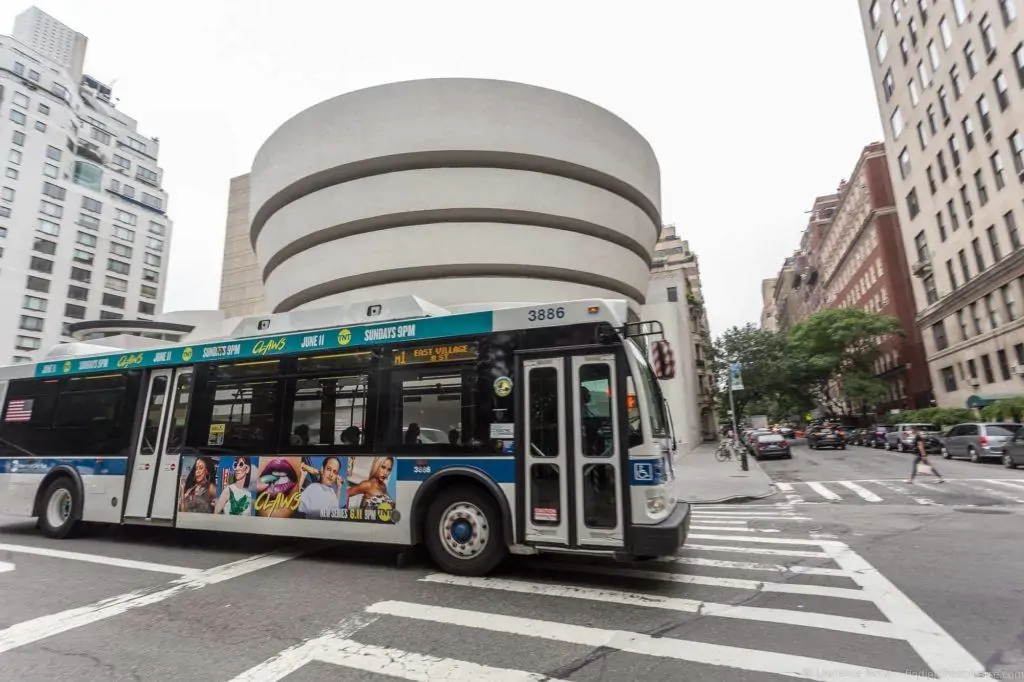
Bus stops are marked with blue MTA signs that list the routes that stop there, and most have shelters. To board a local bus, you stand at the stop and signal as the bus approaches. Pay by tapping your contactless card or phone on the OMNY reader as you board (or, on SBS buses, at a kerbside ticket machine before boarding). When you want to get off, press the yellow stop strip or button to signal the driver. Local buses are $3 with OMNY, the same as the subway. Express buses are $7.
The real advantage buses have over the subway is that you can see things. We’ve taken the M5 down Fifth Avenue purely to look at the buildings, and the M15 along First Avenue gives you a slow-rolling tour of the Lower East Side. They’re slower than the subway, especially in midtown traffic, so for getting from A to B in a hurry the subway wins. But for a leisurely move between two not-too-distant points, with a window seat and a view, the bus is a quietly pleasant way to travel.
One caveat for first-time visitors: NYC buses don’t have route maps inside them, and the announcements can be hard to hear. Use Google Maps or Apple Maps for navigation, both of which give live bus arrival times for NYC.
3. Subway
The New York City subway is the workhorse of the system. With 472 stations spread across 36 lines, it’s the largest subway network in the world by station count, and it runs 24 hours a day, every day of the year. There’s no zone system, so a single fare gets you anywhere on the network for as long as you’re inside the turnstiles.
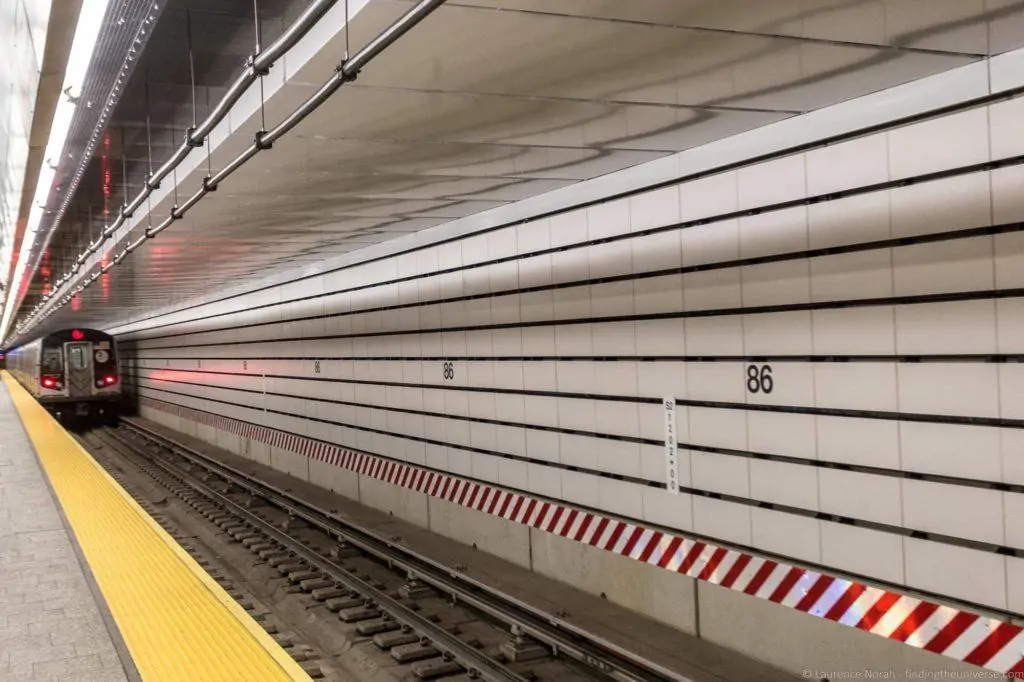
For visitors, the subway is the fastest way to get around most of the city most of the time. It’s the right answer for any trip of more than ten blocks or so, and especially for crosstown moves where surface traffic is unforgiving. The fare is $3 (with the weekly $35 cap if you’re staying long enough to hit it), payable by contactless tap at the turnstile.
A few subway-specific notes that catch first-timers out:
Subway lines are designated either by letters (the lettered lines, like the A, C, E, F, B, D, M) or numbers (the numbered lines, like the 1, 2, 3, 4, 5, 6, 7). Different colours represent different “trunk lines” running roughly the same route in Manhattan. The same colour doesn’t mean trains stop at the same stations, so always check the specific letter or number.
Trains come in two flavours: local and express. Local trains stop at every station; express trains skip stops. Express stops are marked on platform signs with a white circle; local stops with a black circle. If you want to go a long way, an express train can save you serious time. If you want a small move, an express may sail straight past you.
Late-night service can change. Some lines stop running, others run on different routes, others skip stops they normally serve. The MTA Trip Planner app or Google Maps will give you the live picture, but if you’re heading out at 2am, double-check your route.
The subway is generally safe for visitors. The trains and platforms are well lit, well used, and well staffed. Still, situational awareness applies as it does in any big city: keep your phone in your pocket if you’re alone on a quiet platform at midnight, and trust your instincts if a carriage feels off (you can always wait for the next one). My personal experience over many trips has been entirely uneventful, but the basic urban-travel rules apply.
4. Rail (commuter trains)
Beyond the subway, several rail systems serve New York and the surrounding region: the Long Island Rail Road (LIRR), Metro-North Railroad (heading north into Westchester and Connecticut), New Jersey Transit (heading west into New Jersey), the Staten Island Railway, and PATH (Port Authority Trans-Hudson, connecting Manhattan to Hoboken and Jersey City).
For most visitors, these aren’t part of the daily transport mix. They come into play for specific trips: a day out to Cold Spring or the Hudson Valley on Metro-North, getting to the Hamptons on the LIRR in summer, or commuting in from a Jersey City hotel on PATH. They also matter for airport transit, which we’ll cover in the airport section below.
Tickets for LIRR and Metro-North can be bought at station ticket machines, at staffed ticket windows, or through the MTA TrainTime app, which is available on Android and iPhone. PATH uses its own SmartLink card or accepts contactless tap-to-pay similar to OMNY. NJ Transit tickets can be bought at stations or via the NJ Transit Mobile App.
Fares vary by route and distance. As a rule of thumb, a one-way LIRR or Metro-North ticket from Manhattan to a nearby suburb runs $10-15 off-peak and a few dollars more at peak. PATH is $3 per ride.
5. Ferry
There’s a lot of water in New York, and a surprising number of ways to use boats to get around. The main ones are NYC Ferry, the Staten Island Ferry, NY Waterway, and New York Water Taxi.
NYC Ferry is the big one for visitors. Launched in 2017, it now runs six routes serving all five boroughs (Manhattan, Brooklyn, Queens, the Bronx, and Staten Island), with the Queens routes reaching as far out as the Rockaways. There are 25 landings and the boats are fast, frequent, and (in our experience) lovely to ride.

We’ve used NYC Ferry on a number of trips, both for actual transport (one stay in Brooklyn made the East River ferry the most efficient way back to Wall Street) and just for the view. The skyline run from Brooklyn Bridge Park up to East 34th Street, on a clear afternoon, is one of the best things you can do in the city for $4.50.
Single tickets are $4.50, payable through the NYC Ferry app, ticket vending machines at landings, or in person from a ticket agent. There’s also a 10-trip pass for $29, an unlimited 2-day pass for $15 (app only), and reduced fares of $1.45 for seniors, riders with disabilities, and students. NYC Ferry is separate from the OMNY system, so it has its own ticketing. Free transfers between ferry routes are valid for 120 minutes, but you can’t transfer to a subway or bus.

The Staten Island Ferry is a separate operation, run by the city, and it’s free. It runs between Manhattan’s Whitehall Terminal and St George on Staten Island, and the 25-minute crossing gives you a closer view of the Statue of Liberty than most paid harbour tours, plus the lower Manhattan skyline as you depart and return. We’ve taken it more than once purely for the views, then turned around and taken the next ferry back. If your time in New York includes any kind of harbour-photo ambition, this is the cheapest tripod-friendly platform you’ll find.
NY Waterway runs commuter ferries between Manhattan and points in New Jersey (Hoboken, Weehawken, Edgewater). New York Water Taxi runs sightseeing-style routes including hop-on hop-off harbour service. Both have their own ticketing. They’re niche, but for most visitors NYC Ferry plus the free Staten Island run covers everything you need.
6. Walking
New York is one of the great walking cities, and you should walk. A lot of what makes the city interesting is at the street-level: the architecture, the food smells, the pace, the conversations you overhear, the side streets. Pretty much everywhere south of Central Park is walkable, the grid is logical (in Manhattan above 14th Street, anyway), and Manhattan is for the most part flat enough that distances feel manageable.

A few notes from many trips of overdoing it on the walking front. Distances on a Manhattan street map are deceiving. The city blocks running north-south (between numbered streets) are about 80 metres long, which is fine. The blocks running east-west (between avenues) are roughly 270 metres, which is not so fine. Walking from Broadway to the East River is much further than the map suggests. Plan a sensible mix of walking and subway rides rather than trying to walk everywhere.
Locals walk fast and don’t take kindly to people who stop suddenly in the middle of the pavement to consult a map or take a photo. It’s commute logistics, not aggression. If you need to stop, step to the side, ideally near a building, and you’ll be left in peace. (We have, in our time, been the slow-walking tourists getting tutted at, so this is empathetic advice rather than judgement.)
If you’ve got mobility issues or just don’t fancy putting in 10-15 miles a day on foot, plan around the subway and the bus rather than relying on walking, and budget extra for short cab hops between sights. The city is doable in many configurations, but trying to walk everywhere when your feet aren’t up to it will make you miserable.
7. Bicycle and pedicab
NYC has a bike share programme called Citi Bike, which has stations all over Manhattan and well into Brooklyn and Queens. The premise is simple: you buy a pass through the Citi Bike app, find a docked bike at any station, unlock it through the app, ride it where you want to go, and dock it at any other Citi Bike station.
For visitors, the most useful option is the Day Pass at $25, which gets you 24 hours of unlimited rides on a classic bike, with each ride included up to 30 minutes. If a ride exceeds 30 minutes you pay $0.41 per minute over, and if you choose an electric Citi Bike there’s a $0.41 per minute upgrade fee on top of the day pass. Most short hops within Manhattan or across the Brooklyn Bridge come well in under 30 minutes, so for a tourist using the bike for one or two specific journeys (say, riding the Hudson River Greenway from Battery Park to Chelsea), the Day Pass is good value.
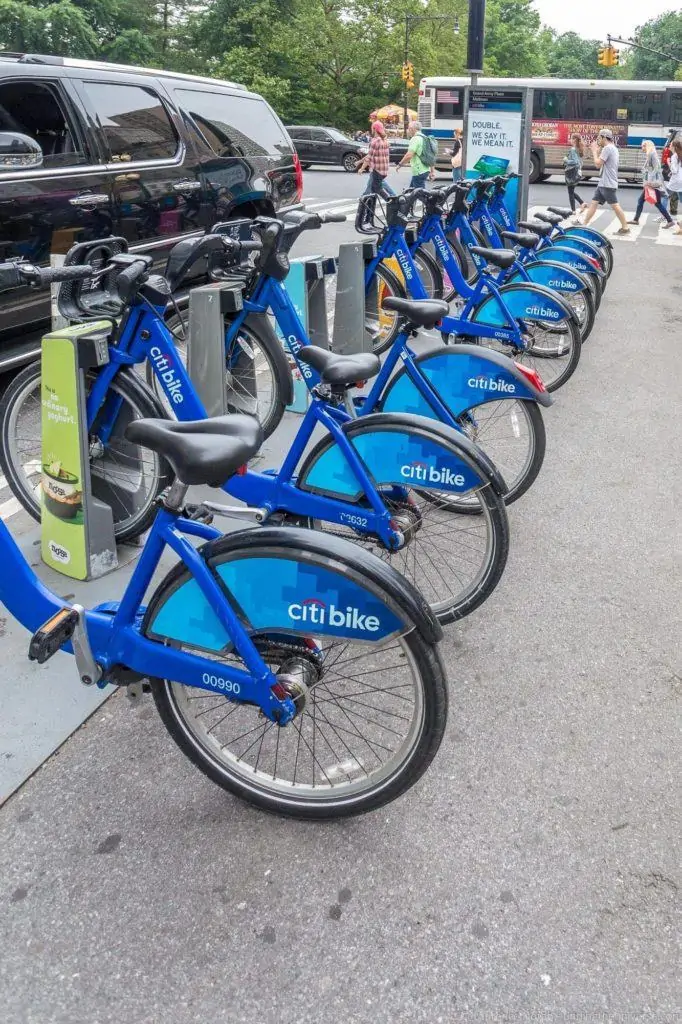
Manhattan does have some pretty good cycling infrastructure now. The Hudson River Greenway on the west side and the East River Greenway on the east side are both protected paths, and there are plenty of separated bike lanes in midtown and downtown. The flip side is that traffic in NYC is heavy and the etiquette is sharp-elbowed, so if you’re not a confident urban cyclist, stick to the protected greenways rather than mixing it up on Sixth Avenue at rush hour. Helmets are not provided with Citi Bikes, so if you’re particular about wearing one, bring your own.
Citi Bike is open to riders aged 16 or older, and you’ll need a credit or debit card to register. Cash isn’t accepted.
There are also pedicabs in New York, which are the three-wheeled human-powered cycle taxis you’ll see touting for business around Times Square, Central Park, and the High Line. Pedicabs are licensed by the city and have to display their fares clearly. Rates are per minute, and the meter has to be visible to the passenger. Pedicabs aren’t a budget option, and they aren’t a good way to actually get anywhere fast, but they are a perfectly fine way to do a Central Park loop on a nice afternoon if you don’t fancy walking it. Always confirm the per-minute rate before getting in, and ask the driver to start the meter visibly.
8. Helicopter
This is the bit where I admit I have not, in fact, taken a helicopter ride in New York City. But for completeness, and because they are a real transport option for people whose budget runs to it, here we are.
There are two heliports in Manhattan: the Downtown Manhattan Heliport (near Wall Street) and the East 34th Street Heliport (mid-east-side). They serve a mix of executive transport (mainly to and from JFK and to second homes in the Hamptons), and tourist sightseeing.
For sightseeing, you can book helicopter tours ranging from 15 to 30 minutes that loop the harbour, Statue of Liberty, lower Manhattan, midtown, and Central Park. These are pricey but the views are remarkable, and if you’re celebrating a special occasion (proposal, anniversary, a bonus that just landed), it’s a lovely thing to do.
For point-to-point transit, BLADE and a few other operators run shuttle helicopters from Manhattan to JFK in five or six minutes for around $200-300 per seat. Faster than the AirTrain by a long way. Not faster than the AirTrain by enough to justify the price for most travellers, but if you’re catching a tight international flight and the alternative is missing it, the maths can work.
9. Aerial tram
The Roosevelt Island Tramway is one of those quietly delightful pieces of New York infrastructure that most visitors don’t know about. It’s a cable car that runs between Roosevelt Island (in the East River) and the Upper East Side of Manhattan, hanging from a cable about 80 metres above the river, and the views from the cabin on a clear day are excellent.
The tram has been running since 1976, and was the first commuter aerial tram in North America. It was originally built as a stop-gap because the F train extension to Roosevelt Island was running late (the subway eventually opened in 1989, but the tram has stuck around). The cabin holds about 110 passengers, the trip takes around three minutes, and at peak hours it runs every 7-8 minutes, slowing to every 15 minutes off-peak.
The fare is $3, the same as the subway, and you pay by tapping your OMNY-enabled card or device on the reader at the station. Free transfers to the subway and bus apply within two hours, which makes the tram a useful piece of a longer journey rather than a tourist-only novelty. Operating hours are 6am to 2am Sunday to Thursday, and 6am to 3:30am Friday and Saturday.
We’ve ridden it both ways, mostly for the view. If you’ve got an hour in your itinerary and you’re anywhere near the Upper East Side, it’s a really small detour for a nice payoff.
10. Hop-on hop-off bus
If you’re new to New York and want to get a feel for the layout while crossing off a chunk of the major sights, a hop-on hop-off (HOHO) bus tour is worth considering. These are open-top buses that loop the city on fixed routes, stopping at all the obvious places (Times Square, Empire State, Battery Park, Central Park, Brooklyn Bridge, and so on). You pay for a 24 or 48-hour ticket and you can get on and off as often as you like.
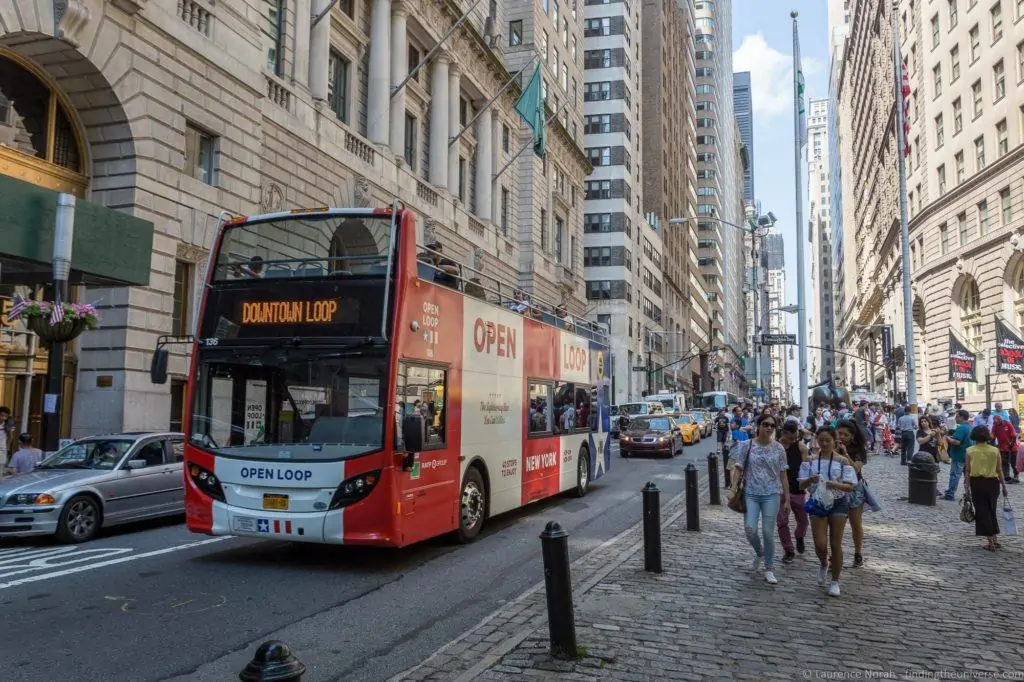
Now, a caveat. HOHO buses are not particularly fast, and they get caught in Manhattan traffic like everything else. As actual transport, they’re poor; the subway will outrun them on almost any route. As sightseeing, they’re a different story. The commentary is better than you’d expect, you get the open-top top-deck view, and you don’t have to think about routing yourself for a few hours. If your day involves getting between, say, the Empire State Building, Central Park, and Times Square, with no rush and a need for orientation, the HOHO bus is a perfectly good way to do it.
Where they really come in useful is on a first day in New York, when you’re still trying to make sense of the geography. Two or three loops while you take the city in is a useful piece of grounding before you try to find your own way around.
You can buy HOHO bus tickets in advance here, or they’re often included as a benefit on a New York City attraction pass. We’ve reviewed those at length in our guide to New York City attraction passes, where the HOHO inclusion is one of several factors that can swing the decision.
Getting from the airport to Manhattan
Three airports serve New York: John F. Kennedy (JFK), LaGuardia (LGA), and Newark Liberty (EWR). The transport situation is different at each, and the best route turns on where you’re heading, what time you’re arriving, how much luggage you’ve got, and your budget.
A general rule before we get into specifics: whichever airport you’ve flown into, ignore anyone touting for fares in the arrivals hall. These operators are unlicensed, the prices are made up on the spot, and the cars aren’t always insured for what they’re doing. The official taxi ranks and rideshare pickup zones are clearly signed at all three airports, and that’s where you want to be.
JFK to Manhattan
JFK is in southern Queens, about 15 miles from midtown Manhattan. Three main options.
AirTrain JFK plus subway is the cheapest and, outside of rush-hour traffic, the most reliable. AirTrain is a free internal-airport people-mover that becomes a paid system as soon as you exit at either Howard Beach or Jamaica station. Howard Beach connects to the A subway line; Jamaica connects to the E, J, and Z subway lines, plus the LIRR. The AirTrain fare is $8.75 paid via OMNY at the exit gate (tap a contactless card or phone), and once you’re on the subway it’s $3 to anywhere in Manhattan. Total: $11.75 to midtown. Time: 60-75 minutes from terminal to midtown, depending on subway connections. We’ve taken this route a number of times. It’s not glamorous, but it’s predictable, and it doesn’t get caught in expressway traffic.
The LIRR option is the fastest train route. From Jamaica AirTrain station you can switch to LIRR for the run into Penn Station, which takes about 20 minutes and runs every 10-30 minutes depending on time of day. LIRR fares vary, but a peak-hour Jamaica to Penn ticket is around $11 on top of the $8.75 AirTrain. Total: about $19.75 for the airport-to-Penn run, in roughly 35-40 minutes from Jamaica to Penn.
Yellow taxi (flat fare) runs $70 for the JFK to Manhattan trip plus tolls and surcharges. Taxis from JFK to Manhattan use a flat fare for any Manhattan destination (so the route doesn’t matter), but you’ll add roughly $6-$12 in tolls, $2.50 NYS Congestion Surcharge, $1 Improvement Surcharge, $0.50 MTA State Surcharge, plus a possible $5 rush-hour fee (weekdays 4-8pm), plus a tip of 15-20%. Realistically, expect $90-120 all-in. Time: 45-90 minutes depending on traffic. The flat fare covers up to four passengers to one Manhattan destination, which makes it good value for groups of three or four with luggage.
Uber, Lyft, and ride-share services pick up at designated areas at each terminal. Prices vary wildly with surge pricing; an off-peak ride to midtown might be $60-80, but rush-hour or weather-affected rides can hit $150 or more. Worth checking the app price before walking out to the rank.
Which to choose: If you’re solo or in a pair with carry-on luggage, AirTrain plus subway is the clear winner on cost and reliability. If you’re a family of four with cases, the yellow taxi flat fare gets close on cost per head and saves the luggage hassle. If you’re arriving at midnight, take a cab.
LaGuardia to Manhattan
LaGuardia is closer to Manhattan than JFK (about 8 miles) but historically has had worse public transport connections. That changed with the LaGuardia Link Q70 SBS bus, which most visitors don’t know about. Three options.
LaGuardia Link Q70 SBS bus is the unsung hero. The Q70 is a free SBS bus that runs between LaGuardia (all terminals) and the Jackson Heights / Roosevelt Avenue subway station in Queens, where you can transfer to the E, F, M, R, or 7 trains into Manhattan. The bus is free (no fare to board, no OMNY tap required) and takes about 12-15 minutes to reach the subway. From there, the subway run to midtown is another 20-30 minutes at $3. Total cost: $3. Total time: 45-60 minutes terminal-to-midtown. This is the cheapest option from any of New York’s airports and most travel guides under-mention it.
Yellow taxi or rideshare from LaGuardia to midtown runs $35-50 in normal traffic for a yellow cab (metered fare, no flat rate), with the same surcharge stack as JFK. Rideshare prices vary as usual. Time: 30-45 minutes off-peak, 60+ minutes at rush hour.
NYC Express Bus private services also run from LaGuardia to midtown for around $20 per seat. Less commonly used by visitors and not generally faster than the Q70 plus subway.
Which to choose: The Q70 plus subway combo is the best-value option from LaGuardia and almost as fast as a cab once you factor in traffic. If you’ve got a lot of luggage or you’re tight on time and willing to pay, take a cab. The Q70 itself accepts luggage just fine if you’ve got a normal-size case.
Newark to Manhattan
Newark Liberty (EWR) is in New Jersey, about 16 miles from midtown Manhattan. Two main options.
AirTrain Newark plus NJ Transit to New York Penn Station is the standard public transport route. AirTrain is the internal-airport people-mover, and you exit at Newark Liberty Airport Station, where you board NJ Transit (or, less commonly, Amtrak) for the run into Penn Station. The combined ticket is $15.75 and includes the $8.75 AirTrain access fee plus the NJ Transit fare. Buy the ticket at NJ Transit machines at the AirTrain station, or via the NJ Transit Mobile App. Time: about 35-45 minutes from terminal to Penn Station.
Yellow taxi or rideshare from Newark to midtown runs $70-100+ for a cab (metered fare plus a $20 New Jersey-to-New York surcharge, plus tolls, plus tip). Rideshare prices vary. Time: 30-50 minutes off-peak, longer in traffic.
Which to choose: AirTrain plus NJ Transit is the obvious pick for solo travellers and pairs. The journey ends at Penn Station, which is more central than where the AirTrain JFK route puts you, so onward connections are easy. For groups of four with luggage, the maths starts to balance with a taxi. If you’re staying near Penn Station or Times Square, the train is the obvious pick regardless.
What is the best way to get around New York?
The short answer: the subway is your daily workhorse for most visitors, with walking for short hops, the bus for crosstown moves, and a cab for late nights, adjusted by where you’re staying.
If you’re staying in Midtown: The subway is your default for any trip more than ten blocks. Walking covers most short hops. The bus is good for crosstown runs (especially east-west, which the subway handles less elegantly). A cab makes sense at night or with luggage. Citi Bike is enjoyable but not necessary.
If you’re staying Downtown (Tribeca, FiDi, SoHo, the West Village): Walking covers more of your day than you’d think. The subway is the default for getting to midtown or the Brooklyn Bridge area. The Staten Island Ferry is a fun half-hour outing. The Hudson River Greenway is a lovely Citi Bike ride.
If you’re staying in Brooklyn (DUMBO, Williamsburg, Park Slope, Cobble Hill): NYC Ferry suddenly becomes a serious player. The East River runs from Brooklyn into Manhattan are fast, scenic, and pleasant. The subway covers everything else. Don’t neglect walking the Brooklyn Bridge into Manhattan; it’s one of the great urban walks anywhere.
If you’ve got mobility issues or limited stamina: Subway and bus, with the OMNY weekly cap making heavy use cheap. Most subway stations are not fully accessible (only about a quarter have elevators and the MTA’s accessibility programme is ongoing), so plan ahead with the MTA’s accessibility map. The bus is fully accessible, but slower.
If you’ve got 24-48 hours and are trying to see the highlights: A HOHO bus on day one to orient yourself, the subway on day two for everything else, with walks woven in. A cab or Uber for evenings out.
The single best piece of transport advice for a New York visit is to mix modes deliberately rather than committing to one. The city rewards the visitor who walks the avenues they want to see, takes the subway for the long hops, hops a bus when the view’s the point, and isn’t above a cab when the rain comes in.
Frequently asked questions
Do I need OMNY or can I still buy a MetroCard?
You need OMNY in 2026. New MetroCard sales stopped on 31st December 2025, and you can no longer buy or refill one. OMNY accepts contactless payment cards (Visa, Mastercard, Amex), smartphone wallets (Apple Pay, Google Pay, Samsung Pay), and smart wearables, so most visitors don’t need to buy any kind of physical transit card. If you don’t have a contactless card or phone, you can buy a $2 OMNY card at vending machines.
How much does the subway cost in NYC?
A single subway ride is $3 in 2026, payable by tapping a contactless card or phone on the OMNY reader at the turnstile. Local buses are also $3, and there’s a free transfer between subway and bus within two hours of your first tap. If you take 12 paid rides in a 7-day period (Monday to Sunday), every additional ride that week is free, with a maximum weekly cost of $35.
Is the New York subway hard to use or intimidating for first-time visitors?
It looks more confusing than it actually is, and it’s perfectly manageable on a first visit.
The system is well signposted, the trains are clearly marked with their letter or number on the front and side, and Google Maps gives you live arrival times and exact routing including which carriage to board. Buy data on your phone or grab an eSIM before you arrive and you’ll find it as easy to use as the London Underground or the Paris Metro.
A few tips: always check whether the train you’re boarding is local (stops at every station) or express (skips stops), as that’s the easiest way to overshoot or undershoot. And if you’re unsure which platform you need, ask a station attendant; New Yorkers have a reputation for brusqueness but most are friendlier than that suggests when a visitor is actually stuck.
What’s the cheapest way to get from JFK to Manhattan?
The cheapest combo is AirTrain JFK plus the subway, at $11.75 total ($8.75 AirTrain plus $3 subway). It takes 60-75 minutes terminal to midtown. For a slightly faster option, AirTrain plus the LIRR to Penn Station runs about $19.75 in 35-40 minutes from the AirTrain station. A yellow cab is $90-120 all in but covers up to four passengers, so for a family of four it can be the better per-head deal.
Is the HOHO bus a good way to get around NYC?
Not really, no, at least not as actual transport. HOHO buses are slow, get caught in Manhattan traffic, and the subway will outrun them on almost any route. Where they earn their place is as orientation and sightseeing on a first day in the city, when you’re trying to make sense of the geography and crossing off the obvious sights with commentary. For getting from A to B once you know where you’re going, the subway is the right answer.
Is Citi Bike worth it for visitors?
For some trips, very much so. The Day Pass at $25 is good value if you’re going to use it for two or three rides over 24 hours, especially on the protected Hudson River Greenway or East River Greenway. For general getting-around the subway wins on speed and weather-proofing, so don’t expect Citi Bike to be your main mode. But for a sunny afternoon Hudson River ride, or for crossing the Brooklyn Bridge by bike, it’s a treat.
What’s the best way to get around New York City?
For the typical visitor, the best mix is the subway as your daily workhorse, walking for short hops, the bus for crosstown runs and slow-rolling sightseeing, and a cab or Uber for late nights and luggage. NYC Ferry is a worthwhile addition if you’re staying in Brooklyn or fancy a skyline-view ride from Manhattan. The OMNY weekly fare cap makes heavy subway and bus use cheaper than you might expect.
Further reading
Hopefully that covers everything you need to know about getting around New York City in 2026. A few more resources to help you plan your trip:
- Our detailed guide to spending 2 days in New York and 3 days in New York, both of which apply this transport advice to actual itineraries.
- Our guide to New York City attraction passes, which can save you money on sightseeing in the city.
- Our complete guide to visiting the Empire State Building.
- Our review of the WalksDevour New York walking tours, if you’d rather have someone else do the navigating.
- Wondering how much to budget overall? See our guide to how much it costs to travel in the USA.
- For the official transit picture, the MTA website has live service status, route maps, and the trip planner. The OMNY website has full payment details.
- If you’d like a physical guidebook to plan your trip, we can recommend Frommer’s New York City: The Complete Guide, which is the current edition and good on practical detail.
And that’s a wrap for our guide to public transport in New York. If you’ve got a trip coming up, we’d love to hear how you got on, or if you’ve got questions before you go, drop them in the comments below.
Kurt says
I was told that the HOHO bus is a very slow method of seeing the major sights.
Too much time spent in slow moving traffic.
We’ve never been on a subway and the thought of trying to navigate it is a little intimidating!
Due to medical conditions, long walks are not an option.
Any advise?
Laurence Norah says
Hi Kurt,
We’ve taken the HOHO bus in New York and it is a good experience, but it is more useful as a sightseeing tour than a means of transport between the sites, as it does take a bit of time due to the traffic, and you do obviously have to wait for the next bus to come. That said, it is one of the more convenient ways to do sightseeing, as most of the stops are at places you will want to visit.
The NYC subway is not too hard to navigate. The system is well laid out and there are lots of lines to choose from. Tickets are easily purchasable at every station, although I’d recommend buying a metrocard rather than individual tickets. Then you just swipe the metrocard to go in. Unlike some cities, the subway isn’t very deep, so you don’t have to worry about hundreds of steps.
Obviously the other option is the normal bus (lots of route, metrocard also accepted), or taxi. The latter will get you where you want to go, but will definitely be the most expensive option.
I’d probably go for the subway or HOHO bus personally 🙂
Have a great trip – let me know if you have any more questions!
Laurence
Louis Marotta says
Every so often, making my way through the mayhemed tangle of NYC’s cracked and potholed highways and roads , I see in dimmly lighted dots, the feeble and perhaps apologetic advice to “use mass transit” . I assume “car pools” are not solely implied here.
It makes me wonder though, if any of the people who were in any way connected to this NYC “public service message ”
are actually sacrificing the immediate comforts of thier automobiles despite the gridlock and toll rip offs to rise perhaps one or two hours earlier, walk the filthy sidewalks to the crowded little grime encrusted bus stand or dirty, foul smelling subway and cram thier way into what is undoubtedly the most vile, unsightly, and thankless mass transportation rides in the world.
Laurence Norah says
I take it you are not a fan 😉
Kyle William says
These above pictures look so fascinating and I really like your post. Thanks for sharing and keep up the amazing work.
Laurence Norah says
Thanks Kyle!
Martin says
Thanks so much for the information! Leaving for NYC in 5 days and this was awesome!
Laurence Norah says
Our pleasure Martin – have a great time!
Jane says
That’s the best article I could dream about! So much information. Thank you guys for your work
Laurence Norah says
Our pleasure Jane 🙂
Kim says
Great information compiled into a concise article. Thank you!
Laurence Norah says
My pleasure!