
Normally I’m rubbish with picking a favourite of anything. I tend to find the unique aspects of a thing, and assign it its own special award for being awesome in its own special way. But it’s now been more than a decade since we spent several weeks travelling around southern Thailand, and in all that time, our favourite Thai city hasn’t changed. I just loved Songkhla, and I still do.
Don’t get me wrong – I loved many other cities in Thailand too. The madness of Bangkok. The laid back vibes of Chiang Mai. The rustic backstreets of Phuket’s old town. The crumbling jungle ruins and mighty temples of Nakhon Si Thammarat. The… well, you get the idea. They’re all brilliant, in their own special way.
For various reasons though, Songkhla really stuck out in our minds. Let’s get on with explaining why. But first, the practical stuff.
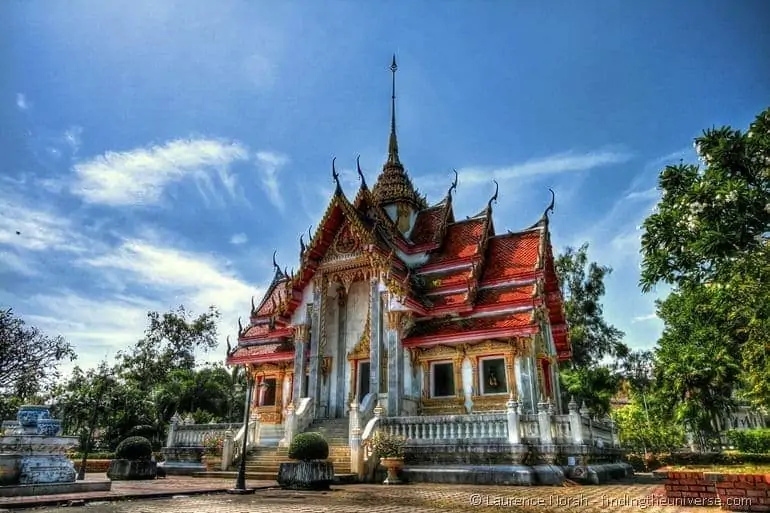
Table of Contents:
Songkhla at a glance
If you just want the essentials before the detail, here they are:
- Songkhla is a coastal town in far southern Thailand, around 1000km from Bangkok and 30km from Hat Yai. It sees far fewer visitors than Thailand’s big-name cities, which is a big part of the appeal.
- It’s worth one or two nights for the old town, the beaches, the monkeys, and an excellent weekend night market.
- Songkhla city sits outside the areas covered by UK and US government travel advisories for southern Thailand (more on this below).
- The easiest way in is a flight from Bangkok to Hat Yai, then a minivan for the last 30km.
Where is this Songkhla place?
Don’t worry if you’ve not heard of Songkhla, it’s not exactly on the standard tourist trail. It’s down on the south east coastline of Thailand, around 1000km from Bangkok, and fairly close to the Malaysian border.
There’s serious history here too: in the 17th century this was the Sultanate of Singora, a heavily fortified Malay port town with quite the reputation for piracy, until Siam razed it in 1680. The modern town was re-founded in the 18th century, largely under the stewardship of a Chinese trading family.
Like the city of Trang on the opposite coast, it has a large Chinese population, and its situation on the coast means that it was an important trading port for Indian, Arabian and Persian merchants, after those pesky pirates had been cleared out. These days it is the capital of the Songkhla province, and filled with interesting things to do. We’ll get to those shortly, but first, the question we get asked more than any other.
Is Songkhla safe to visit?
Thailand’s far south has a complicated reputation, so it’s a fair question. The three southernmost provinces – Pattani, Yala and Narathiwat – have seen a long-running insurgency, and both the UK and US governments advise against most travel to them.
The geography matters here, though. The UK Foreign Office advises against all but essential travel to four districts in the far south of Songkhla province – Chana, Thepa, Na Thawi and Saba Yoi, all down by the Malaysian border – plus the Hat Yai to Padang Besar train line into Malaysia. Songkhla city is in the north of the province, well outside all of them.
The US State Department advisory names only the three provinces above. Songkhla city doesn’t appear in either.
Our own experience matches that. When we visited, Songkhla felt as relaxed as anywhere we went in Thailand. It’s a low-key seaside town where the main hazards are over-confident monkeys and eating too much at the night market. We wandered everywhere on foot, day and evening, and never felt remotely uncomfortable.
Situations can change, of course, so do check the current advice from those links before you travel. This applies especially if you’re planning to continue overland into Malaysia – the train line caveat above is about that onward route, not the journey down from Bangkok.
What to do in Songkhla
There’s quite a lot packed into this small city, as it turns out. Here are our favourite things to do in Songkhla from our own wanderings, plus a few additions that have appeared in the years since our visit.
Visit the Chedi on Monkey Hill and see the monkeys
Towering over downtown Songkhla, Khao Tang Kuan is a hill which offers great views over the city peninsula and surrounds. At the top there is a chedi, traditionally said to date back to the days of the Nakhon Si Thammarat kingdom, though its true origins are uncertain. What stands there today is a 19th century restoration, carried out under Kings Rama IV and Rama V, and it houses relics of the Buddha.
You can make offerings here in a complex looking eight stage procedure, or, as we did, just enjoy the view.
The top of the hill can be reached via a 305 step Naga guarded staircase which starts at the west of the hill and ascends past a gorgeous Royal Pavilion to the top.
If the walking sounds like too much, there’s also a cable car (more of an inclined lift really) which goes up from the east side. It was 30 Baht a go when we visited; expect somewhere between 30 and 60 Baht now, and be aware it doesn’t always run. If it’s closed, the stairs await.
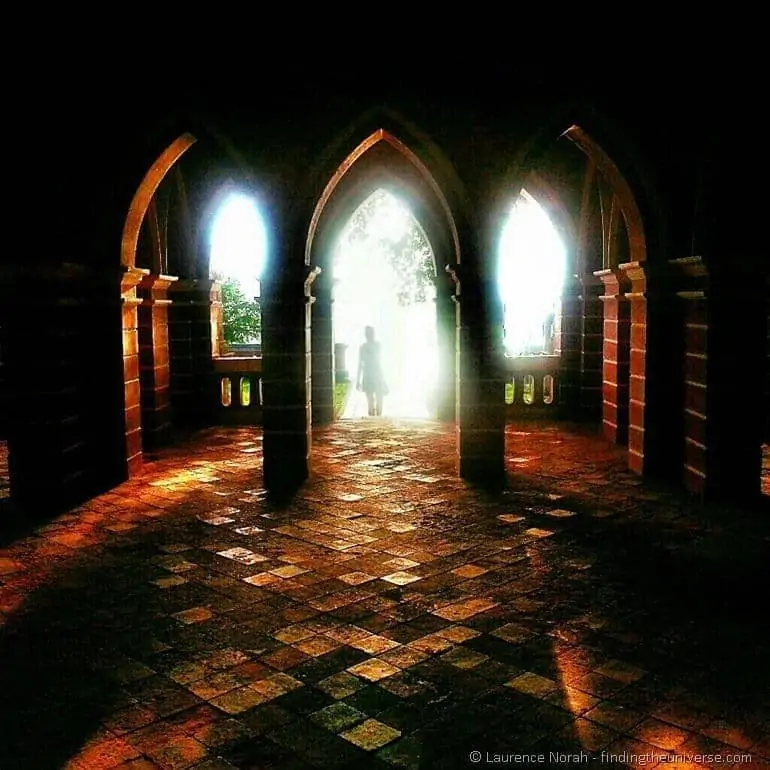
Around the cable car entrance are hundreds of monkeys, and you can buy food from nearby vendors to feed them. If you want guaranteed monkeys in Thailand, this is the place to come. There’s even a monkey bridge over the road to keep them out of harms way!
Visit the 3km long serpent: Nag
Ok, so it’s not really 3km long. The Giant Serpent Nag is a sculpture in three parts, with the head being situated 3km from the tail. But it’s not hard to imagine the rest of him being underground.
Nag is the deity of water as well as fertility, and was built to bring good fortune to the city of Songkhla. It’s a popular spot for locals, who regularly visit the various parts of the sculpture to pay their respects to the deity. The head, found at the tip of the Songkhla peninsula, jets water out into the bay, and represents the intelligence and wisdom of Songkhla’s inhabitants.
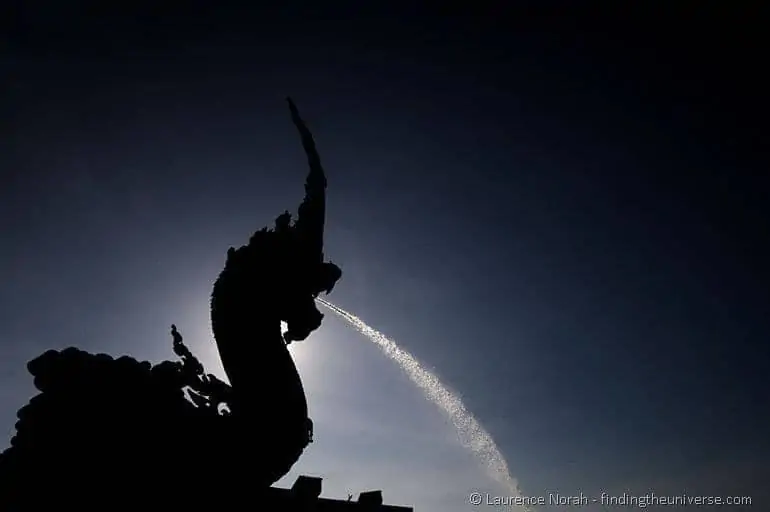
The middle section, the belly of the serpent, is found just north of Monkey Hill, and represents the wealth of the city, whilst the final part, found alongside Samila beach on Chalatad road, symbolises the charisma and strength of the people of Songkhla.
See the mermaid, cat and mouse statues
More statues, also with a story (of course!). Just offshore from the Songkhla peninsula sit the islands of Ko Nu and Ko Maeo, which translate as cat and mouse island. The legend has it that a dog, a cat and a mouse stole a wealthy merchant’s magic crystal whilst on his boat, and tried to swim ashore with it.
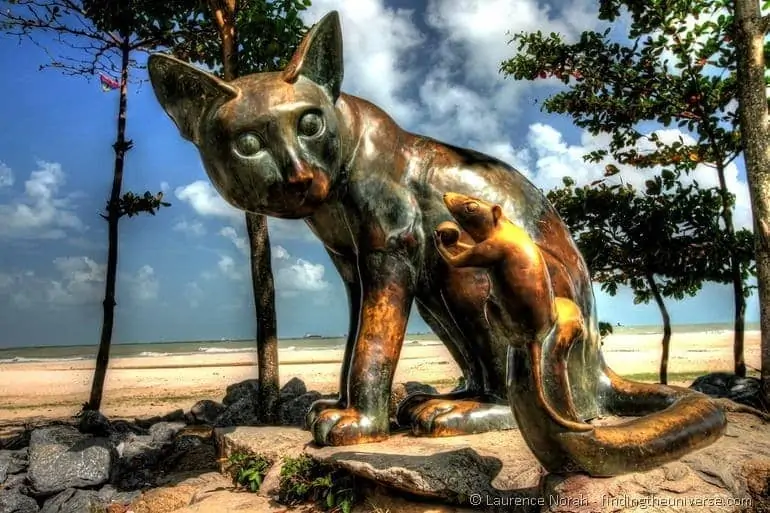
The cat and mouse drowned en route, and turned into the islands, whilst the dog made it to shore and died shortly thereafter (these tales never seem to go well). The dog became Khao Tang Kuan, whilst the crystal became the gorgeous white beach of Hat Sai Kaeo.
You can visit the cat and mouse, peering intently at one another, down by the beach, and wonder who it is who comes up with these tragic tales of woe.
And the mermaid? Well, she’s the symbol of Songkhla, and can be found just along the beach from the cat and mouse, stroking her hair, and thinking what a great deal she got compared to her frozen cousin in Denmark.
Head out to the giant boulder of Khao Kao Seng
About three kilometres south of Samila beach is the beach of Khao Kao Seng, one of the smallest and prettiest beaches in the area. Just near here, next to a temple, can be found a giant boulder, known as Hua Nai Raeng.
This boulder was where, in times past, locals stored treasures which were used for the construction of the fantastically impressive Nakhon Si Thammarat temple. These days the boulder has less on the treasure front and more on the ribbon front, being draped as it is in beautiful cloth and other offerings.
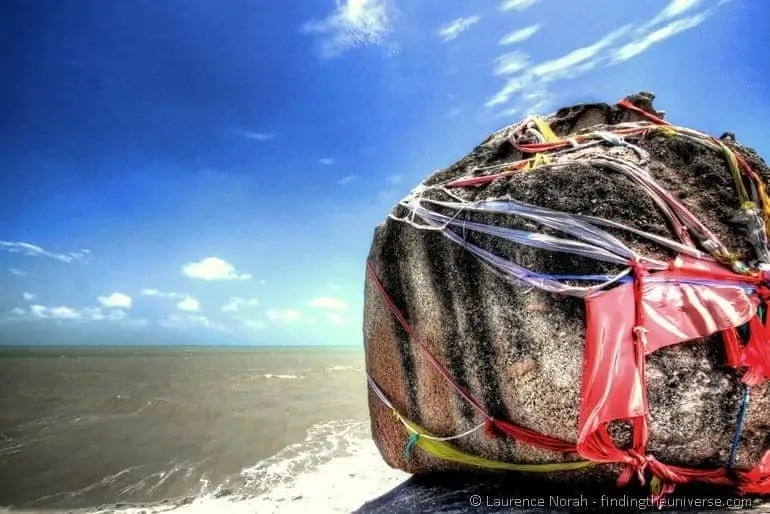
It’s a bit of a walk from the town, but you do pass a rather lovely little fishing village on the way, which is nice. We got a bit lost en route, but were saved by a kindly local with a motorbike. Which happened to us quite a lot in Thailand.
Walk on the beaches
A beach made from a magic crystal is obviously something to be seen, and the beach that runs down the length of the Songkhla peninsula, from the head of Nag to the giant boulder of Hua Nai Raeng, really is something special. Our favourite part was between Nag and the Mermaid statue, an almost deserted section of powdery white sand backed by an area of forest reserve and of course, that beautiful blue sea.
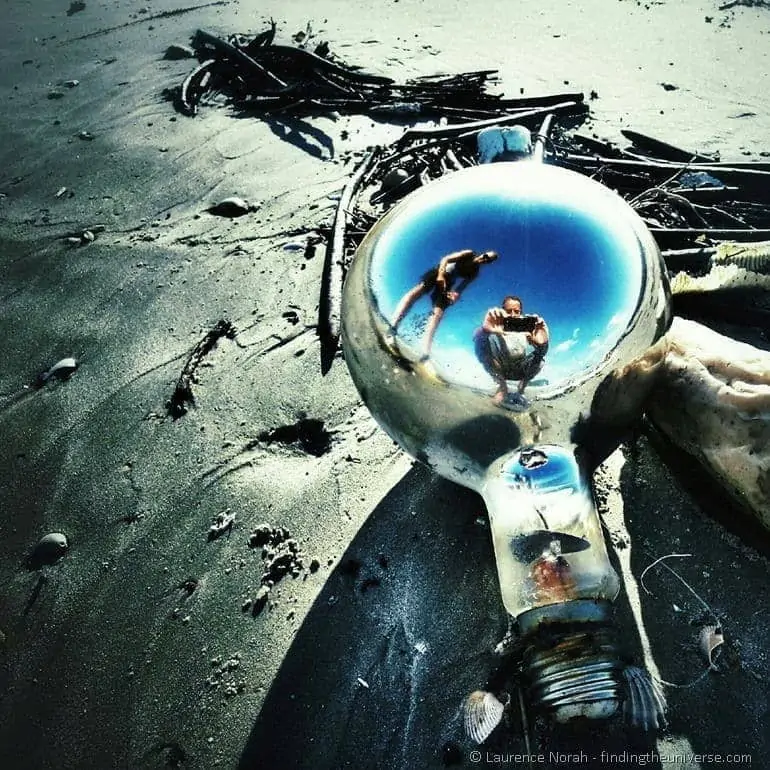
We spent happy hours wandering and discovering bits of flotsam and jetsam, like this photogenic lightbulb, and I see no reason why you couldn’t too. Plus, if you’re in the mood for seafood, there is no shortage of restaurants near the Cat and Mouse statues.
Visit the Museum
This part of the world is just full of history, and though I’m not really a big museum fan, we felt that we really had to get a grip on the history of Songkhla – a town that clearly had a lot of stories to tell.
The Songkhla National Museum is housed in a lovely 1878 Sino-Portuguese mansion, built as the residence of the city’s deputy governor and later used as the town hall. When we visited, the 150 Baht entry fee felt like money well spent, both for the building itself, and for the wealth of information it contained about the, at times contentious, history of Songkhla. Happily, the displays are also labelled in English.
One important update though: the main museum building is currently closed for renovation, with no confirmed reopening date. The grounds remain open and free to wander, and the mansion is still worth admiring from the outside, but check locally before making a special trip. Once it reopens, expect hours of Wednesday to Sunday, 9am to 4pm, and an entry fee of around 150 Baht.
Explore the Chinese Quarter
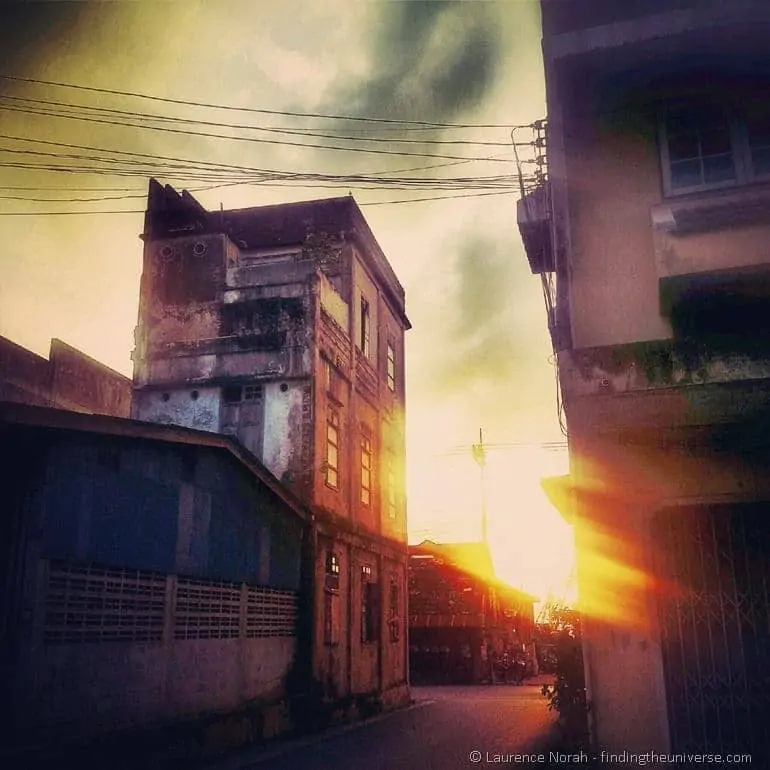
One of the more interesting parts of Songkhla to explore is the old Chinese quarter, which runs down three parallel streets. Here there are Chinese restaurants, a Chinese Opera, and all sorts of the things that you would expect to find in a small Chinatown. The buildings in particular are most impressive, some of them being hundreds of years old, with that crumbly feel to boot.
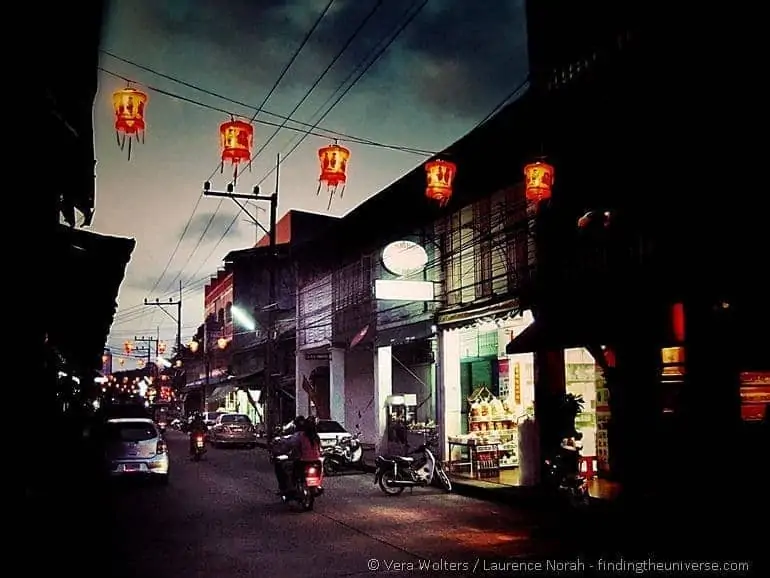
At the end of the Chinese Quarter is the city pillar, which was built in a Chinese style along with the rest of this area.
Take in the weekend night market
Like most Thai cities, Songkhla has an excellent night market. It now takes the form of a weekend walking street along Chana Road in the old town, running Friday and Saturday evenings from around 5pm to 10pm, near the old city wall which can now be found in the centre of the city (the city limits having expanded somewhat).
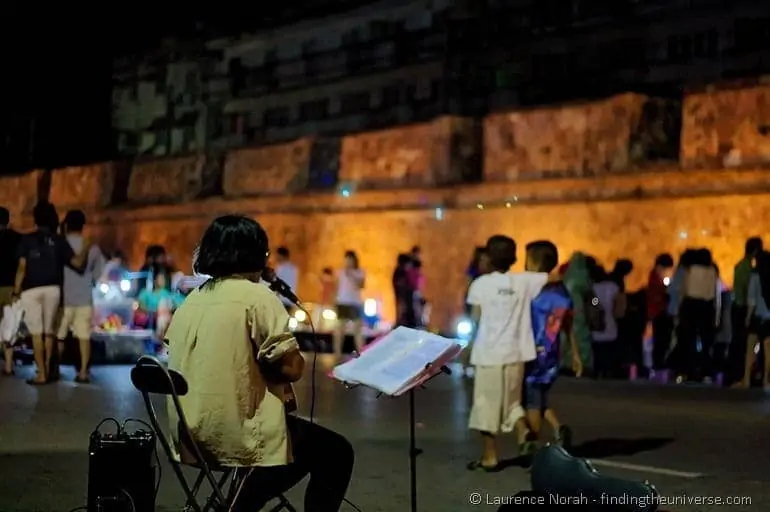
As well as tasty food (you have to try the giant buns, which are a speciality), there is live music, all kinds of electronic stuff, and inevitably, those people who throw glowing things into the air and make strange bird noises. By far the best place to be fed at the weekend!
Hunt down the old town street art
This one didn’t exist when we visited, so we can’t claim any first-hand mural spotting. In 2016, the province commissioned art students to paint a series of murals across the old town, on the same three streets as the Chinese quarter above (Nang Ngam, Nakhon Nai and Nok roads), inspired by the street art of George Town in Penang, just over the border.
There are over a dozen pieces to track down, with the teahouse mural on Nang Ngam Road probably the best known, and the collection has grown since.
Given how much we enjoyed wandering these streets before the murals arrived, we suspect they’ve only made the wandering better. Combine the hunt with the Chinese quarter and a coffee stop, and you have a very pleasant few hours.
Cross the bridge to Ko Yo Island
Another one we didn’t get to ourselves. Ko Yo is an island in Songkhla Lake, which is Thailand’s largest natural lake (technically a brackish coastal lagoon rather than a freshwater lake, if you want to win arguments). And if you read somewhere that visiting involves a boat, that’s out of date. Ko Yo is connected to the mainland by the road spans of the Tinsulanonda Bridge, Thailand’s longest concrete bridge, so you can drive or taxi across.
The island is known for its hand-woven cotton, a local craft going back a couple of centuries, and it’s also home to the Southern Thai Folklore Museum, plus hilltop viewpoints back across the lake. If we make it back to Songkhla, this is first on our list.
Visit Wat Matchimawat
Songkhla’s most significant temple sits on Saiburi Road in the old town. Wat Matchimawat, also known as Wat Klang, has origins in the late Ayutthaya period, and its ordination hall, built in the mid 19th century, holds murals mixing Thai, Chinese and western imagery. Look for the European figures and steam ships, painted by artists clearly keeping an eye on a changing world. There’s a small Buddhist art museum in the grounds too.
Entry is free, and the grounds are generally open through the day, though the ordination hall and museum keep more limited hours. We didn’t make it here on our visit, which I’m slightly embarrassed about given we managed to find a boulder wrapped in ribbons. Consider it your chance to out-explore us.
How to get to Songkhla (and away again)
The quickest way to reach Songkhla from Bangkok is to fly to Hat Yai, the much larger city around 30km inland, and take a minivan from there. Songkhla has no commercial airport or passenger train station of its own, so Hat Yai is the hub for pretty much all arrivals.
Getting to Hat Yai
From Bangkok, you have three realistic options:
| Option | Time | What to expect |
|---|---|---|
| Fly to Hat Yai | Around 1.5 hours | Budget carriers (Thai AirAsia, Nok Air, Thai Lion Air, Thai Vietjet) fly from Don Mueang; Thai Airways flies from Suvarnabhumi. Usually the cheapest option once you factor in your time. |
| Sleeper train to Hat Yai Junction | Around 14 to 16 hours | First and second class sleeping berths on the southern line. Book ahead via the State Railway of Thailand. |
| Direct overnight bus to Songkhla | Around 14 to 17 hours | VIP and express coaches from Bangkok’s Sai Tai Mai terminal, roughly 1,000 to 1,300 Baht. The only option that skips Hat Yai entirely. |
The overnight train is a classic Thai travel experience if you have the time, and note that the government advisory about southern rail travel only concerns the separate onward line from Hat Yai towards Malaysia, not the Bangkok to Hat Yai route.
Hat Yai to Songkhla
From Hat Yai, frequent minivans cover the 30km to Songkhla in around 30 to 45 minutes, for about 30 to 40 Baht. They leave from the main bus terminal, and from near the clock tower off Phetkasem Road, roughly between 6am and 7pm. Coming back, you’ll find them near the clock tower on Ramwithi Road in Songkhla. There’s nothing to book – just turn up, hop in, and wait for it to fill.
Where to stay in Songkhla
Songkhla has a good spread of reasonably priced city centre accommodation. Prices have risen since our visit, as you’d expect, but it remains excellent value: expect around 450 to 900 Baht for a budget double or guesthouse room, and around 900 to 2,000 Baht for a comfortable air conditioned hotel.
We can’t point you at our own guesthouse, as its name is long lost to our records (and possibly to existence). Based on current options and reviews though, these are the places we’d look at first:
Baan Nai Nakhon – a six room guesthouse in a restored century-old house right in the old town, with free bikes and a local breakfast included. If we were heading back to Songkhla, this is where we’d book.
BP Samila Beach Hotel & Resort – the established mid-range choice near Samila Beach, a short walk from the mermaid statue, with family rooms, balconies and free parking.
Wachi Hotel – a solid budget option with air conditioned rooms, free wifi and free parking, under ten minutes’ walk from Chalathat Beach.
You’ll find plenty more options on the Booking.com Songkhla page if none of those suit.
Frequently asked questions about Songkhla
Is Songkhla safe?
Songkhla city sits outside the areas covered by UK and US government travel advisories for southern Thailand. The advisories apply to four districts in the far south of Songkhla province (Chana, Thepa, Na Thawi and Saba Yoi) and the three provinces beyond them, all well away from the city. We felt entirely at ease during our visit, but do check the current government advice before you travel.
How do I get from Hat Yai to Songkhla?
Frequent minivans run the 30km from Hat Yai to Songkhla in around 30 to 45 minutes, costing about 30 to 40 Baht. They depart from Hat Yai’s main bus terminal and from near the clock tower off Phetkasem Road, roughly 6am to 7pm. No booking needed.
How many days do you need in Songkhla?
You can cover the main sights in a full day, but two nights is about right. That gives you time for the old town, the beaches and Monkey Hill without rushing, and if you time it over a Friday or Saturday, you’ll catch the night market too.
Is Songkhla worth visiting?
We think so. We rated it our favourite city in Thailand, and that was up against some serious competition. It has beaches, history, an atmospheric old town and excellent food, without the crowds that come with the famous names. If you want a Thai city that still feels like a Thai city, Songkhla delivers.
When is the best time to visit Songkhla?
Songkhla sits on the Gulf coast, where the driest weather generally runs from around January to April. The heaviest rain tends to fall between October and December, so we’d avoid those months if you can. We visited in the middle of the year and, as the photos here attest, mostly got blue skies.
Should I visit Songkhla or Hat Yai?
Chances are you’ll pass through Hat Yai anyway, so you can sample both. They’re quite different though: Hat Yai is a big, busy commercial city, while Songkhla is the seaside old town with the beaches, the history and the statues. If you’re only staying in one, we’d pick Songkhla without hesitation.
Further reading
If you’re planning a wider Thailand trip, a good guidebook still beats piecing everything together from blog posts (even ours). We’d go for the Lonely Planet Thailand, which covers the south as well as the tourist-trail north.
We also have more Thailand content on the site to help you plan:
- Why you might want to visit Nakhon Si Thammarat – Songkhla’s historical neighbour, and the source of that temple treasure
- Exploring Thailand’s gorgeous Trang – another under-visited southern city, over on the Andaman coast
- What to see in Ayutthaya – the ancient capital, an easy trip from Bangkok
- Hello Bangkok – our first impressions of the capital
- The friendliness of Thai people – including the motorbike rescue mentioned above
As for Songkhla, it remains in our minds the best city in Thailand that hardly anyone visits. Long may it stay that way. (Though perhaps not so few that they stop running the night market.)
Our time in Songkhla was self funded, but we would like to thank two lovely Thai ladies whom we met up in Chiang Mai who gave us lots of advice for our visit to their hometown. Thanks Oraluck and Wantanee!
cg says
thx
Laurence Norah says
Our pleasure 🙂
Cathy says
Just left Songhkla. Had to rehydrate and eat after a lovely day in the sun. I agree it is a very charming city. I was a little worried because Americans has also been cautioned against traveling to this province, but it was fabulous. A nice visit. Beautiful beach. Great food.
Laurence Norah says
Hi Kathy!
I’m delighted you found it so. There were the same travel warnings when we visited, but we found it to be just a lovely place 🙂 Thanks for stopping by to let us know!
Laurence
Frans Betgem says
Hi Laurence and Jessica,
Good morning. Thanks for this article. I have been to Songkhla five time last year and I am planning another trip next month. I agree that it is definitely the most interesting city in the South of Thailand. I love Songkhla. My government (the Netherlands) advices against all travel to Songkhla, Pattani, Narathiwat and Yala provinces. I have also been in those other three provinces last year. I drove myself and didn’t feel unsafe one moment. This is my story: https://www.travel-and-history.com/exploring-south-thailand/
I know for a fact that no one of our embassy has ever been in these four provinces, simply because they are not allowed to go there because of the advice of their own government……There are issues in this area (less so in Songkhla and Hat Yai) but it primarily affects government officials. Never has anyone rented a vehicle and drove it into crowds. Stick to the beaten path and you should be OK. Government advisories are seldom based on experience and they are certainly not unbiased. Keep up the good work!
Laurence Norah says
Hi Frans!
Thanks for your comment, and sharing your article, which is lovely. It’s nice to see that part of Thailand getting some love – I really enjoyed visiting it, and it was sad that so few tourists made it this far (although sort of nice too!).
Best
Laurence
Lawrence Westfall says
You might want to update that there have been recent bombings.
Laurence Norah says
Hi Lawrence!
Unfortunately, nowhere is truly safe in the world, and we have posts that cover a wide variety of destinations around the world, many of which have experienced terrorist attacks, including cities like Paris and London. We believe that everyone should make their own decisions regarding the safety of a destination, based on government advice rather than our opinion, at the time they choose to travel. As no-one was hurt in these bombings, and they don’t seem to be part of a wider campaign, I’m not sure adding this information to the post will be of much assistance to our readers, as it will quickly go out of date. We’re not here to report news or provide safety advice – there are far more qualified and useful sources for that, which we encourage folks to check out before planning any trip.
Best
Laurence
Charles says
For me Songkhla is my favorites in that area as well
Its a small town, but not to small like Satun
It has good sights like wild monkeys, museums, a nice little aquarium and one of asias best zoos. So there are a lot of things to do
It is of the beaten track, so you have the beaches almost for your self compared to langkawi, especially now in sommer town
Peoples friendliness. I dont have a driver licens and the Sungathew doesnt go to the zoo. But on the way people driving by asked me, if they could drive me for free to the entrace. How often do you meet friendliness like that in the west?
So if people say they want to go on beach holiday i recoment Songkhla
Laurence Norah says
Thanks Charles, we really liked it there too 😀
Victor Gonzalez says
Hello to Lawrence and Jessica, and to everyone.
Really happy to have found this site as I was surfing the internet.
My name is Victor and I’m Malaysian, based in Alor Setar (about 9 months already) which is about an hour’s drive to the Thai border at Danok.
I have driven to Songkhla (from Alor Setar) three times already. Took me about two and a half hours from Alor Setar.
Yeah…3 times…and many more trips to come.
Why am I so attracted to Songkhla?
I was trying to figure that out myself.
Then I realised that it was the peace and tranquility that touched my soul.
Maybe it’s the effects from the Songkhla Lake and the open sea.
And the people are friendly.
I will be driving to Songkhla again soon.
Cheers for now.
I can be reached at pplkch888@yahoo.com