
As part of our road trip through the Deep South (first stop Charleston), we spent time exploring Savannah, the oldest city in Georgia. We packed a lot into our visit: museums, historical homes, excellent food, musket firing demonstrations, and a face-to-face encounter with a mountain lion. Savannah has a lot going on.
This guide is built around a two-day itinerary, because that’s what works for most visitors. Day one covers the Historic District, where you can walk between most of the sights. Day two takes you beyond downtown to Tybee Island, Fort Pulaski, and a couple of places that are worth the short drive.
After the itinerary, you’ll find sections on where to eat, where to stay, tours, the Savannah Tour Pass, and practical information for planning your trip. If you have more than two days (and Savannah can fill them), there’s a section with more ideas at the end.
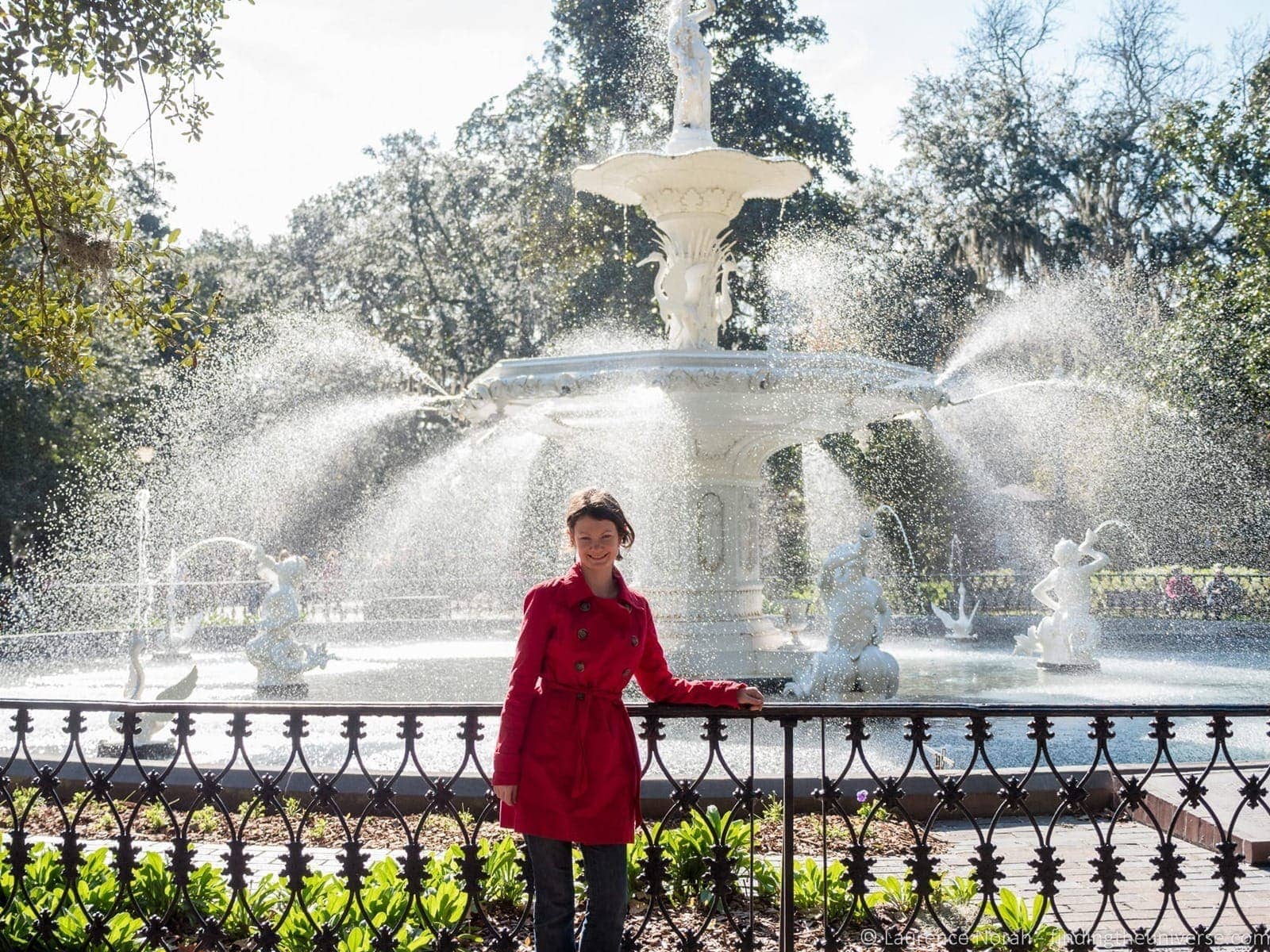
Table of Contents:
Day 1: Savannah’s Historic District
The Historic District is where you’ll spend most of your first day. It’s compact, walkable, and packed with things to see. Savannah’s original city plan, laid out by founder James Oglethorpe in 1733, is still intact, and you’ll wander through 22 leafy squares connected by streets lined with oak trees and Spanish moss.
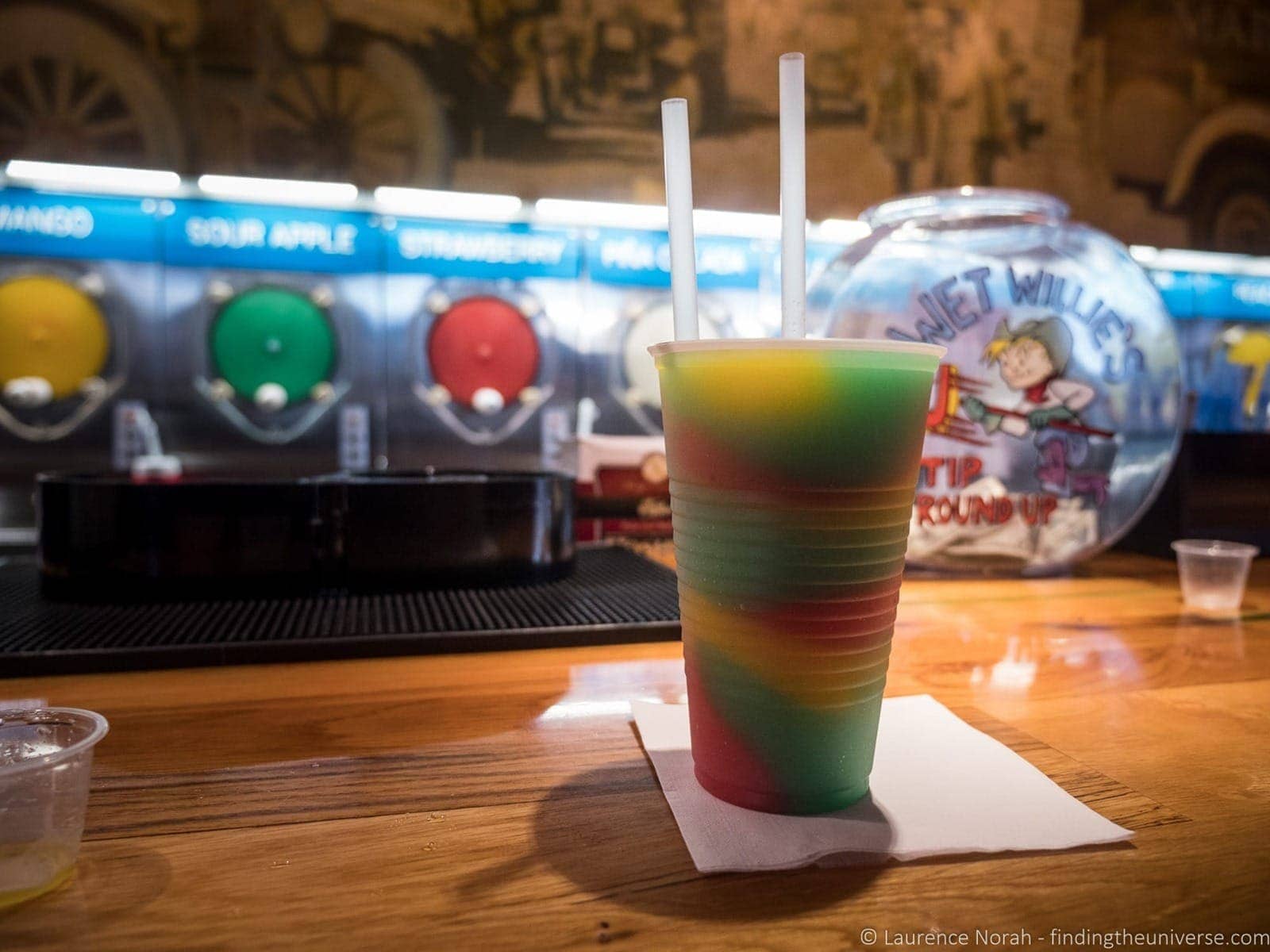
One quirk worth knowing: Savannah allows open containers of alcohol in the Historic District. You can walk the streets with a drink in a plastic cup (16 ounces max). It’s a fun touch, and you’ll spot plenty of people doing it.
Savannah History Museum and Battlefield Memorial Park
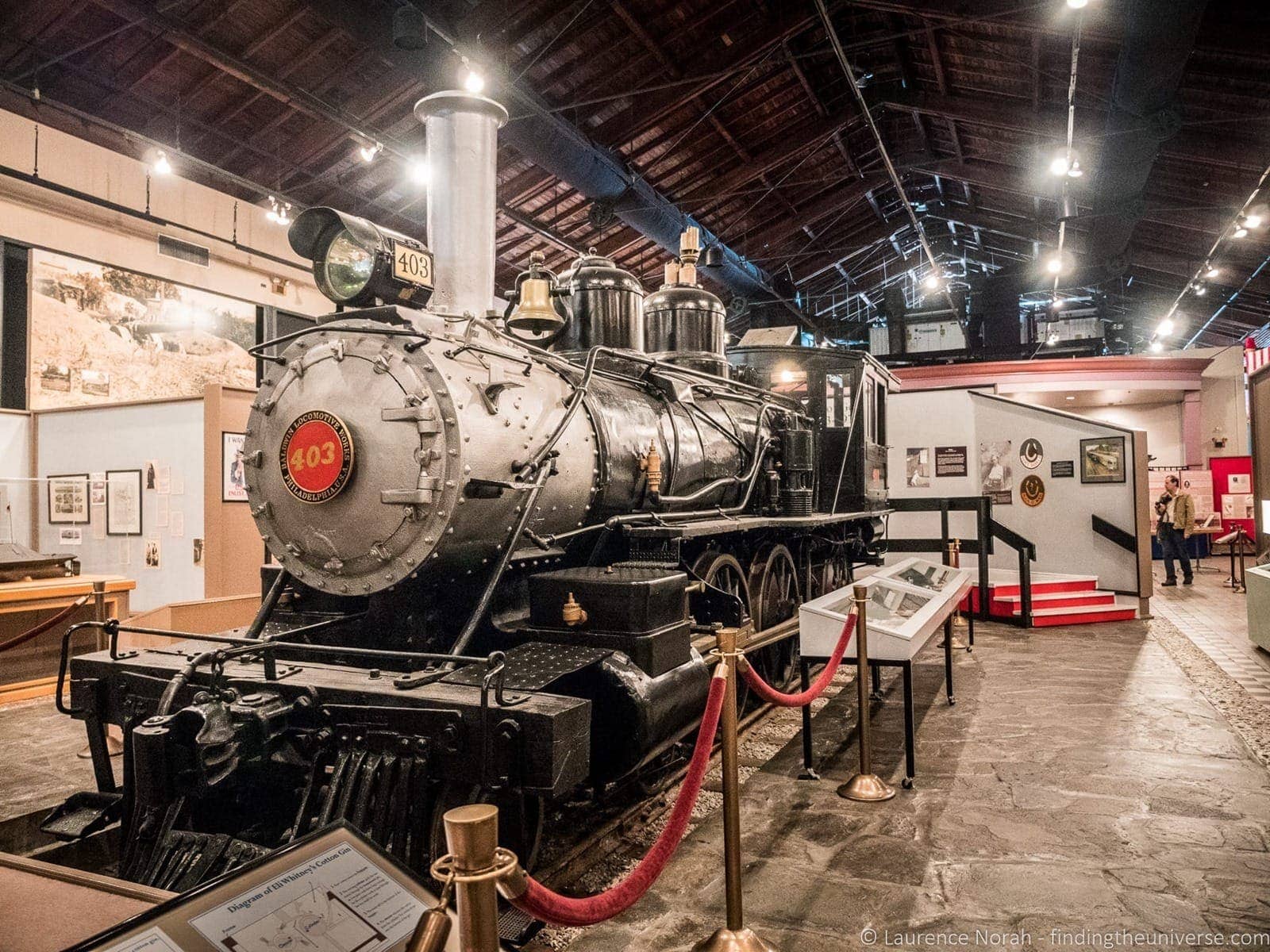
I’d start your day here. The Savannah History Museum is housed in a former railway shed and covers everything from the founding of the colony through the American Revolution, the Civil War, and the civil rights movement. It’s well laid out and the right size to keep you interested without wearing you out.
One of the benches from the Forrest Gump movie (filmed in Savannah) is on display, and there’s a section on Juliette Gordon Low, founder of the Girl Scouts.
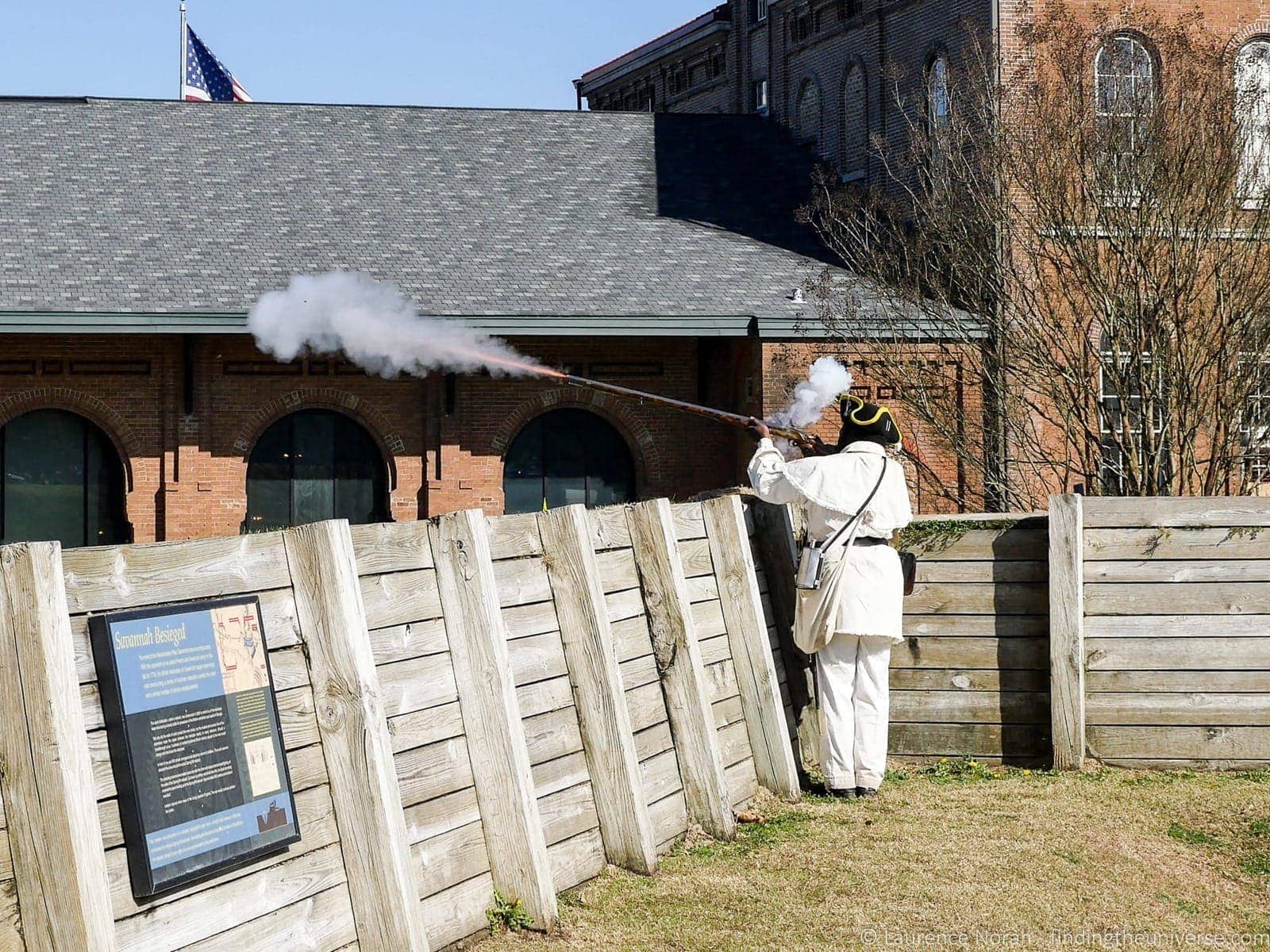
The best part of our visit was an interactive talk led by a Coastal Heritage Society Historical Interpreter, dressed in full Civil War era uniform. He walked us through the events that caused the Civil War and Georgia’s involvement, then led our group outside to the Battlefield Memorial Park.
This is where the second bloodiest battle of the American Revolution was fought. He explained how the battle unfolded, why so many men died, and then issued our group with wooden muskets for a re-enactment of the failed charge on the battlements. The whole thing finished with an actual musket firing demonstration.
If they’re running one of these talks when you visit, do go. It was one of the highlights of our time in Savannah.
The museum is open daily from 9am to 5.30pm, with some closures on public holidays. There’s a fee for entry, and full details are on the Coastal Heritage Society website. It’s also included on the Savannah Tour Pass.
Telfair Museums: Owens-Thomas House, Telfair Academy, and the Jepson Center
Savannah has an excellent museum scene, and the three Telfair Museums are at the centre of it.
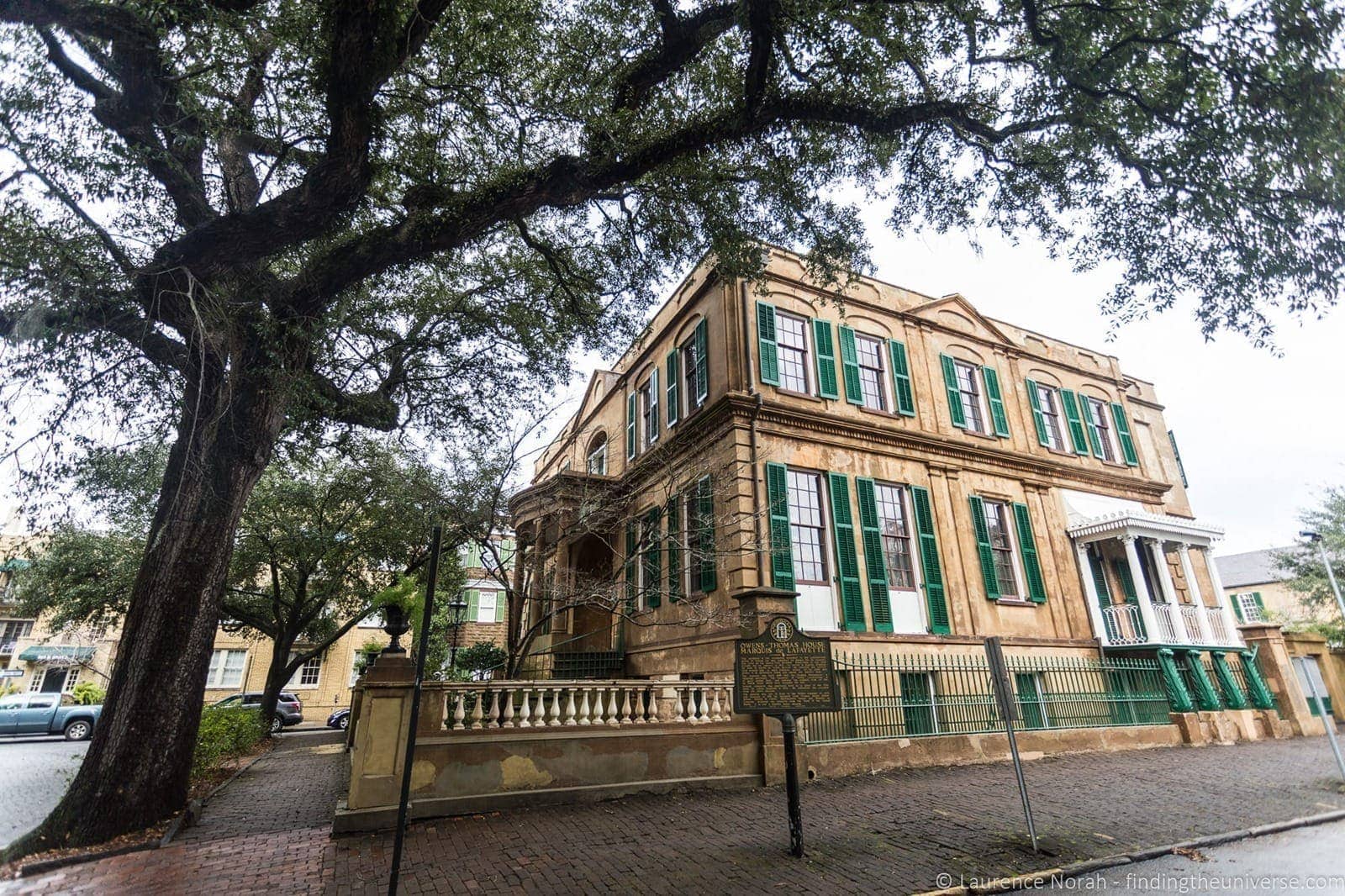
If you only have time for one, I’d pick the Owens-Thomas House & Slave Quarters. It’s one of the finest examples of English Regency architecture in the US, and the house is wonderfully preserved. The original carriage house still stands, and inside you can see some of the oldest intact slave quarters in the southern United States. It’s a powerful place to visit and gives you a much more complete picture of how Savannah’s wealth was built.
The Telfair Academy is set in a gorgeous early 19th century mansion and houses 19th and 20th century American and European art. Several rooms are laid out as they would have been originally, so you get a museum and a historical home in one. The art on display is excellent, and I really enjoyed this one.
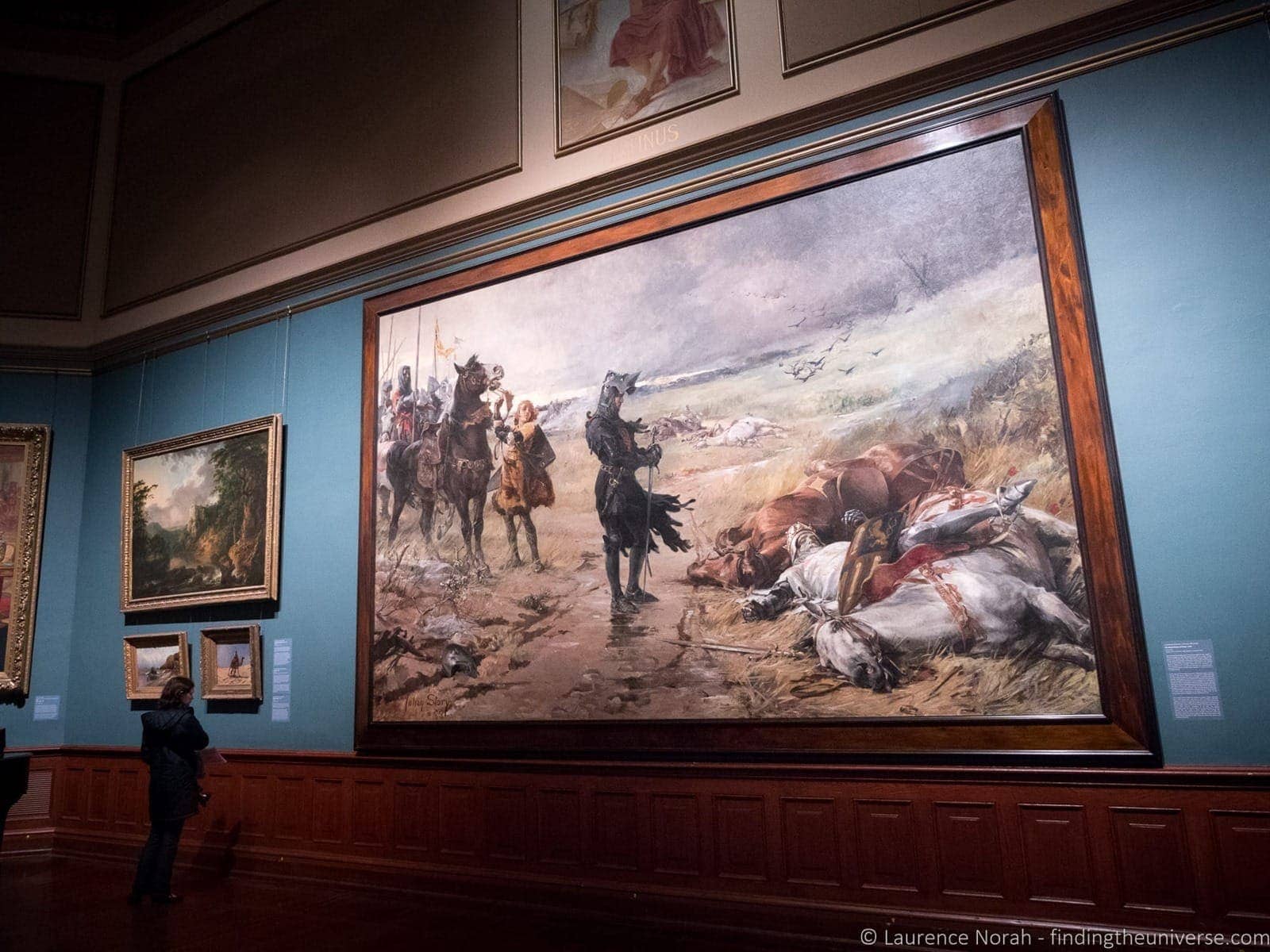
For modern and contemporary art, head to the Jepson Center. It hosts rotating exhibitions alongside permanent displays drawn from a collection of over 3 million items.
You can buy a combined ticket for all three Telfair Museums at a discounted price, which saves a bit of money if you’re planning to visit more than one. All three are also included on the Savannah Tour Pass.
Cathedral Basilica of St. John the Baptist
The Cathedral Basilica of St. John the Baptist is the oldest Roman Catholic church in Georgia, and it’s worth stopping in even if you’re not particularly religious. The building was almost destroyed by fire in 1898 but has been restored, and the stained glass windows and painted ceiling are impressive. Entry is free (there’s a suggested donation of a few dollars), and it’s right in the Historic District so easy to fit into your walking route.
Explore the Historic District on Foot (or by Trolley)
Beyond the specific museums and attractions, the Historic District is a place to wander. The 22 squares, each with their own character, are connected by streets shaded by oaks dripping with Spanish moss. It’s a very photogenic city.
You can explore on your own, or you can take a guided walking tour of the historic district, which is a good way to get oriented and pick up the stories behind the buildings you’re looking at.
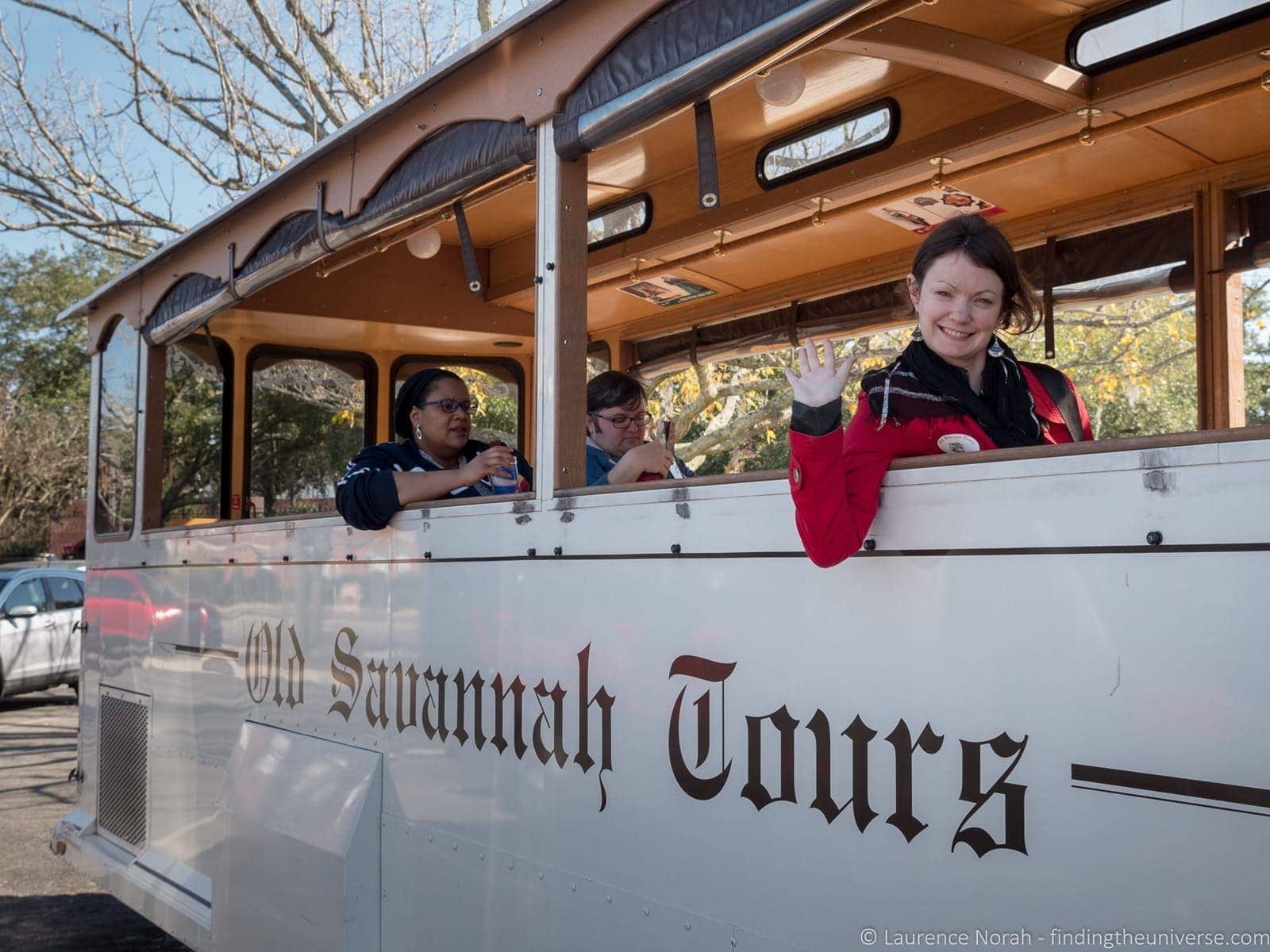
If your feet need a break, the hop-on hop-off trolley tour covers the major sights with narrated commentary and lets you jump off wherever you want to explore further. There’s also a free DOT shuttle that runs a loop through the Historic District, which is handy for getting between the northern and southern ends without walking.
If you fancy something a bit different, there’s a comedy trolley tour that covers the same ground with a lighter touch.
Forsyth Park
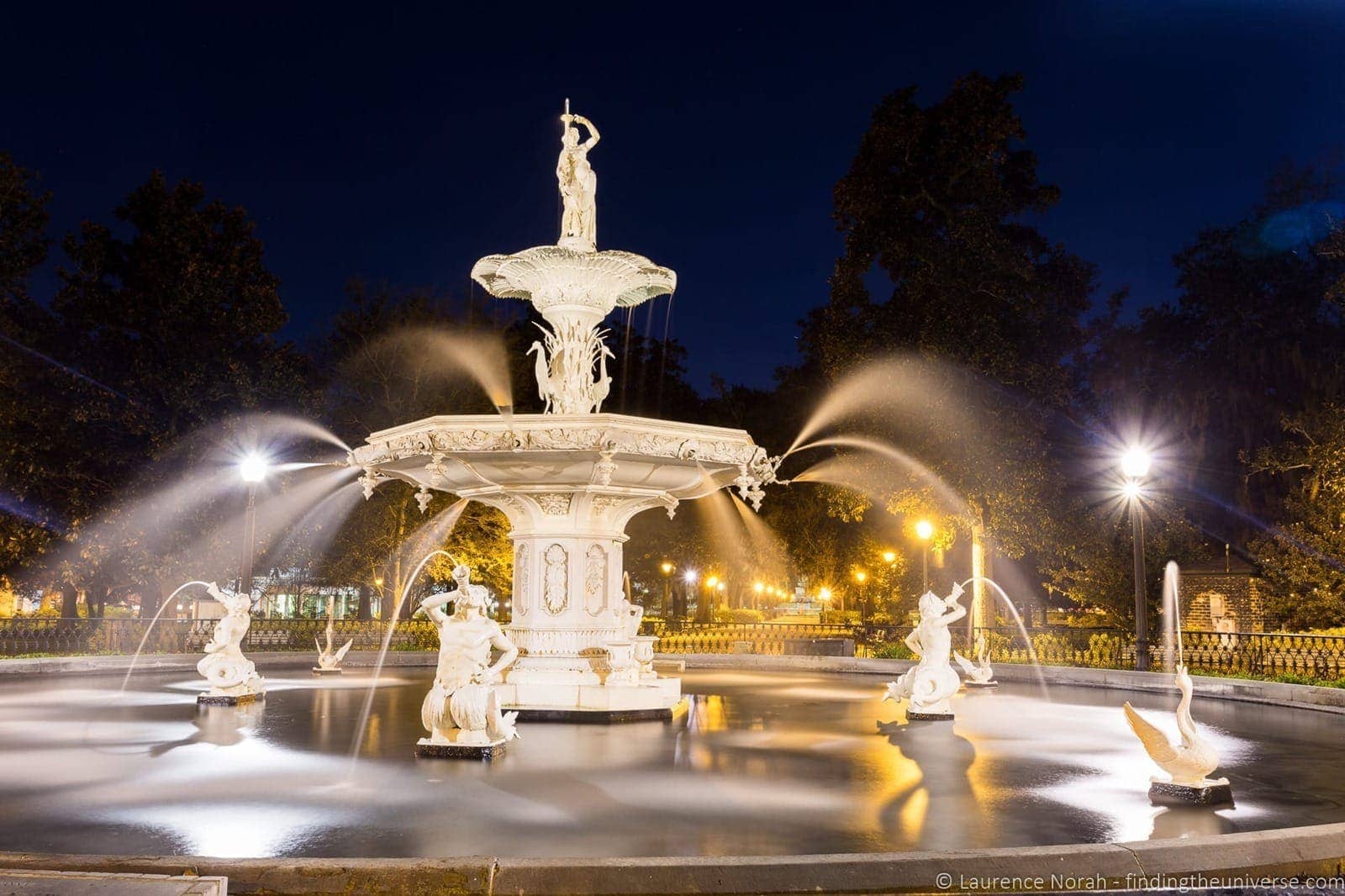
Forsyth Park is one of Savannah’s largest city parks and worth a visit for the spectacular Forsyth Fountain alone. The fountain dates from 1858 and was modelled after the fountain in Paris’s Place de la Concorde.
The park often hosts concerts and events (we caught a free concert during our visit), and on Saturday mornings there’s a popular farmers’ market at the south end. Check the Savannah event calendar to see what’s on during your trip.
River Street
River Street runs along the Savannah River and was once the trading heart of the city. Cotton shipped from here went to destinations around the world. The street was abandoned for over a century before being redeveloped in the late 1970s, and today it’s lined with shops, bars, restaurants and hotels, all set along cobblestone streets in converted cotton warehouses.
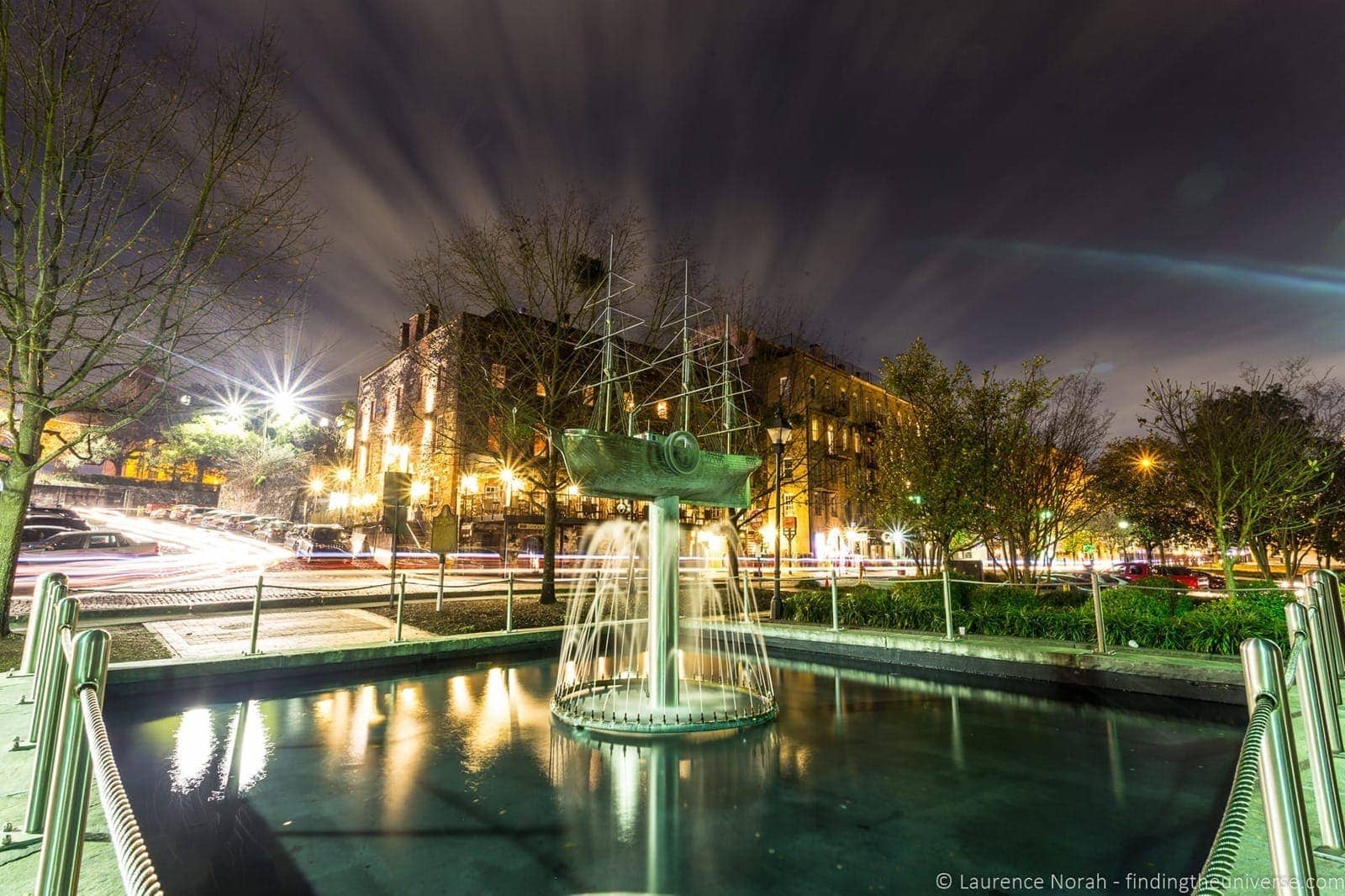
I particularly enjoyed coming down here at sunset and after dark, with the streetlights on and the waterfront buzzing. It’s a good spot to watch the huge container ships heading in and out of Savannah’s port, which is one of the busiest on the US east coast.
If you’d like to see the city from the water, you can book a sunset sightseeing cruise or a dinner cruise with live entertainment.
Ghost Tour
Savannah is famous as one of the most haunted cities in the USA, and a ghost tour is practically a rite of passage here. Most run at night, and the combination of Spanish moss, gas lanterns, and colonial-era buildings makes for a properly atmospheric evening.
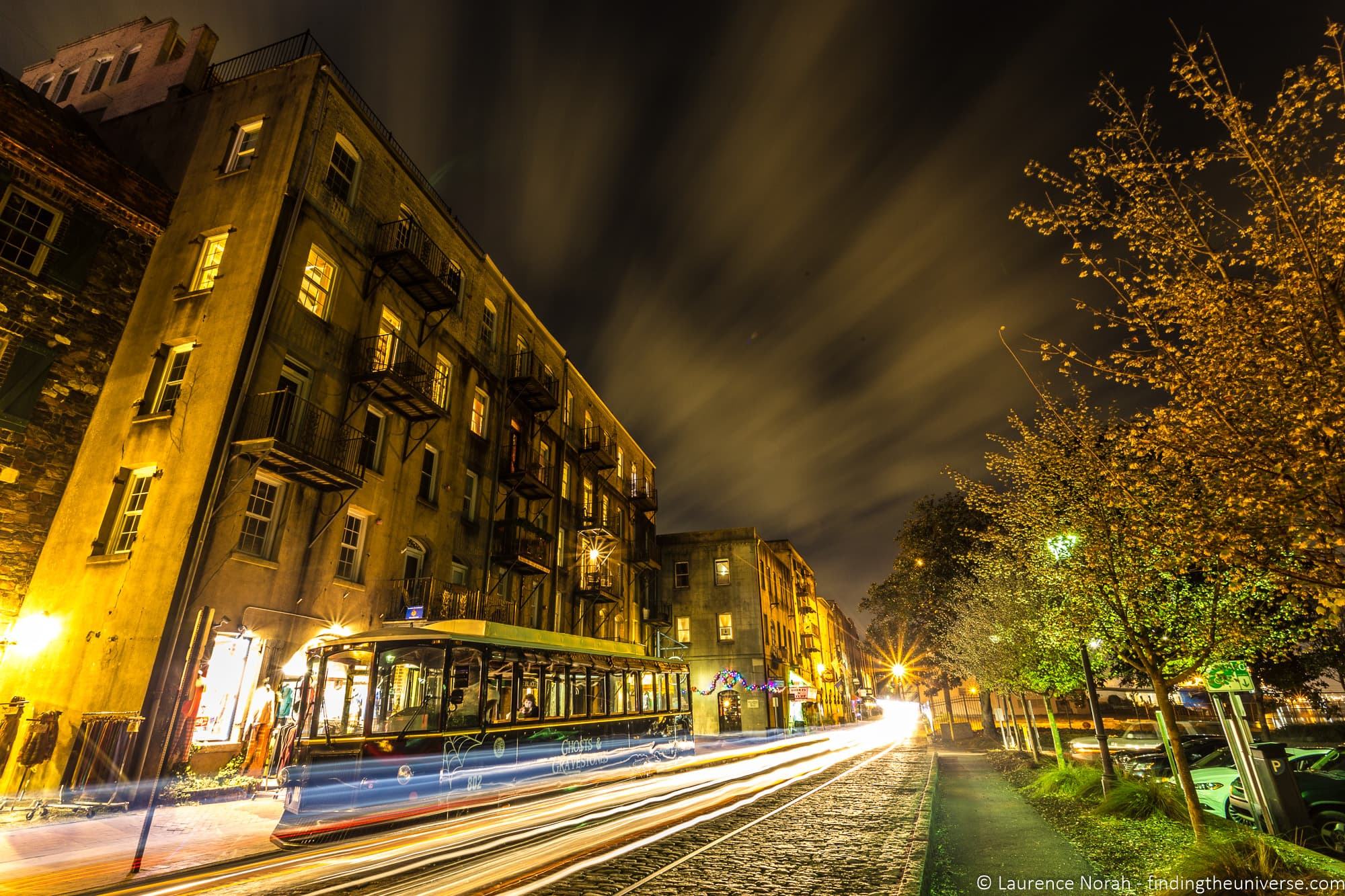
There are plenty of options. The Ghosts & Gravestones trolley tour takes you around the city on a trolley with stops at haunted locations including the Andrew Low House. If you’d rather walk and drink, there’s a haunted pub crawl that combines ghost stories with stops at some of Savannah’s older watering holes.
Both ghost tour options are also included on the Savannah Tour Pass.
Day 2: Beyond Downtown Savannah
Your second day takes you outside the Historic District. You’ll want a car for this (more on that in the getting around section below), though some of these can be reached by tour as well.
Wormsloe Historic Site
About half an hour south of downtown Savannah are the remains of Wormsloe, a colonial-era plantation. The main draw is the avenue of live oaks, a mile-long corridor of trees draped in Spanish moss that you’ve probably seen in photographs even if you don’t recognise the name. It’s framed by a beautiful stone archway at the entrance, and it’s one of the most photographed spots in Savannah.
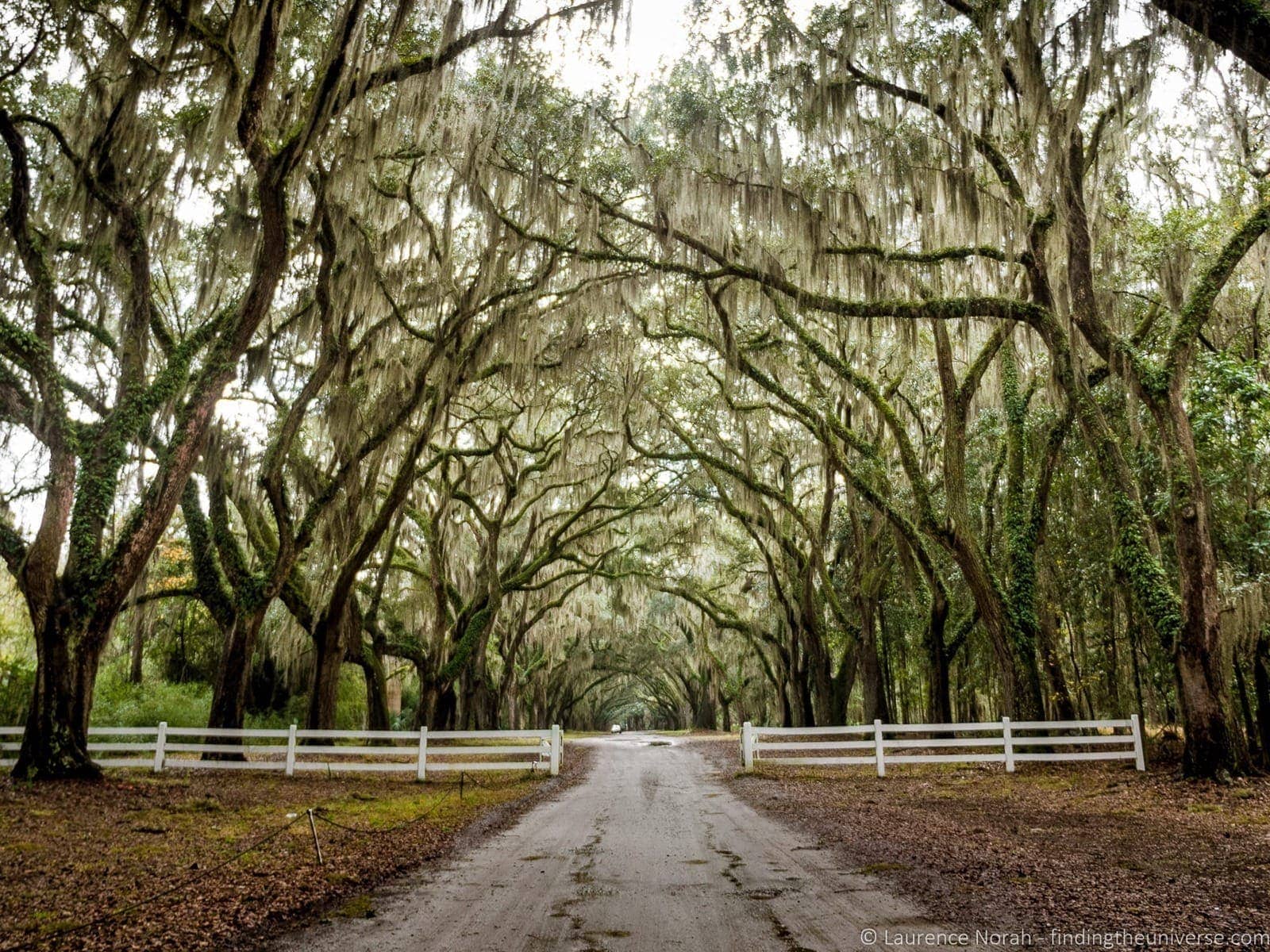
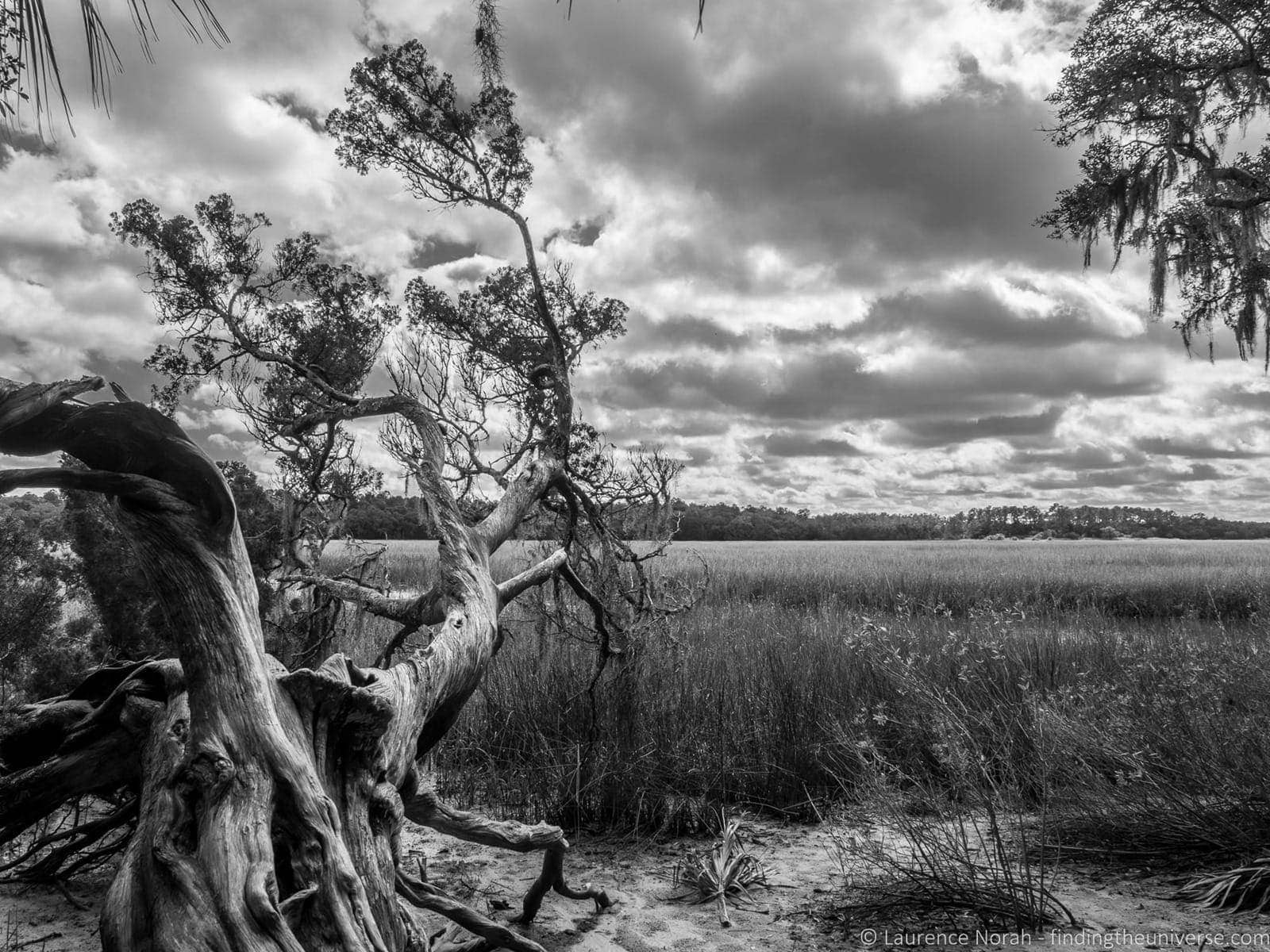
Beyond the avenue, there’s a visitor centre with information about the site’s history, the ruins of the oldest standing structure in Georgia, blacksmith demonstrations, and woodland trails. I’d say it’s worth visiting for the avenue of oaks alone, but there’s more here than most visitors expect.
You can visit with your own vehicle, or take a guided tour that includes Wormsloe and the Isle of Hope.
Bonaventure Cemetery
Bonaventure Cemetery is one of those places that sounds like an odd recommendation until you see it. This 160-acre cemetery is filled with moss-draped oaks, elaborate statues, and trails that wind through some of the most atmospheric scenery in the Savannah area. It’s beautiful, peaceful, and a bit surreal.
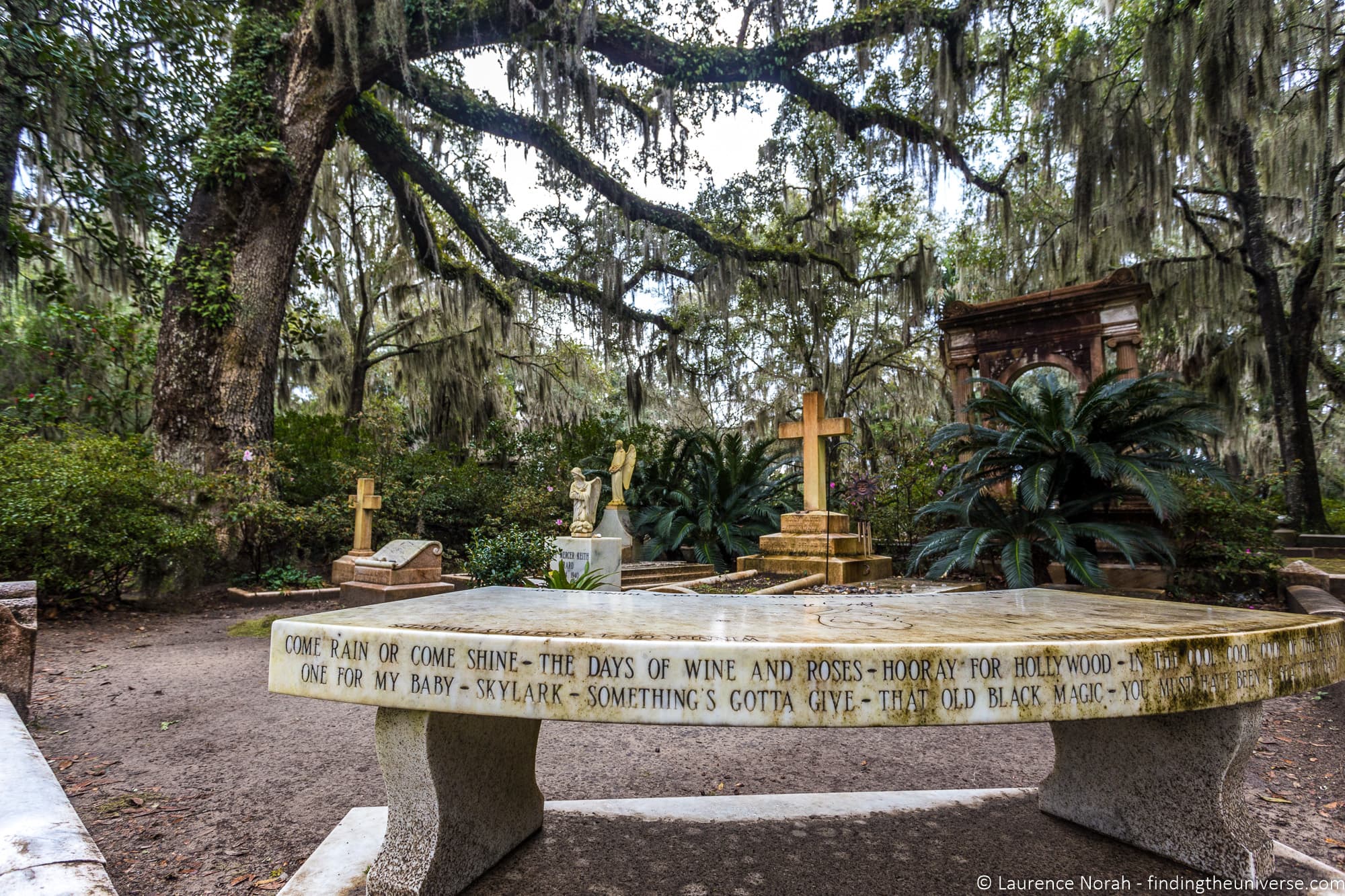
Notable graves include the songwriter Johnny Mercer and Gracie Watson, whose grave features a well-known statue. The cemetery also features heavily in John Berendt’s “Midnight in the Garden of Good and Evil,” which is set in Savannah and worth reading before your trip.
Fun fact: a cemetery and a graveyard are different things. A graveyard is attached to a church. A cemetery can be standalone.
You can visit on your own, or take a guided golf cart tour of Bonaventure Cemetery. The Savannah Tour Pass also includes a cemetery tour option.
Tybee Island
About a 30-minute drive east of downtown, Tybee Island is Savannah’s beach. It was the beach to visit in the early 20th century and it’s still a lovely, laid-back beach town. The lighthouse (with good views from the top), a museum housed in an old gun battery, and the beach itself are the main draws.
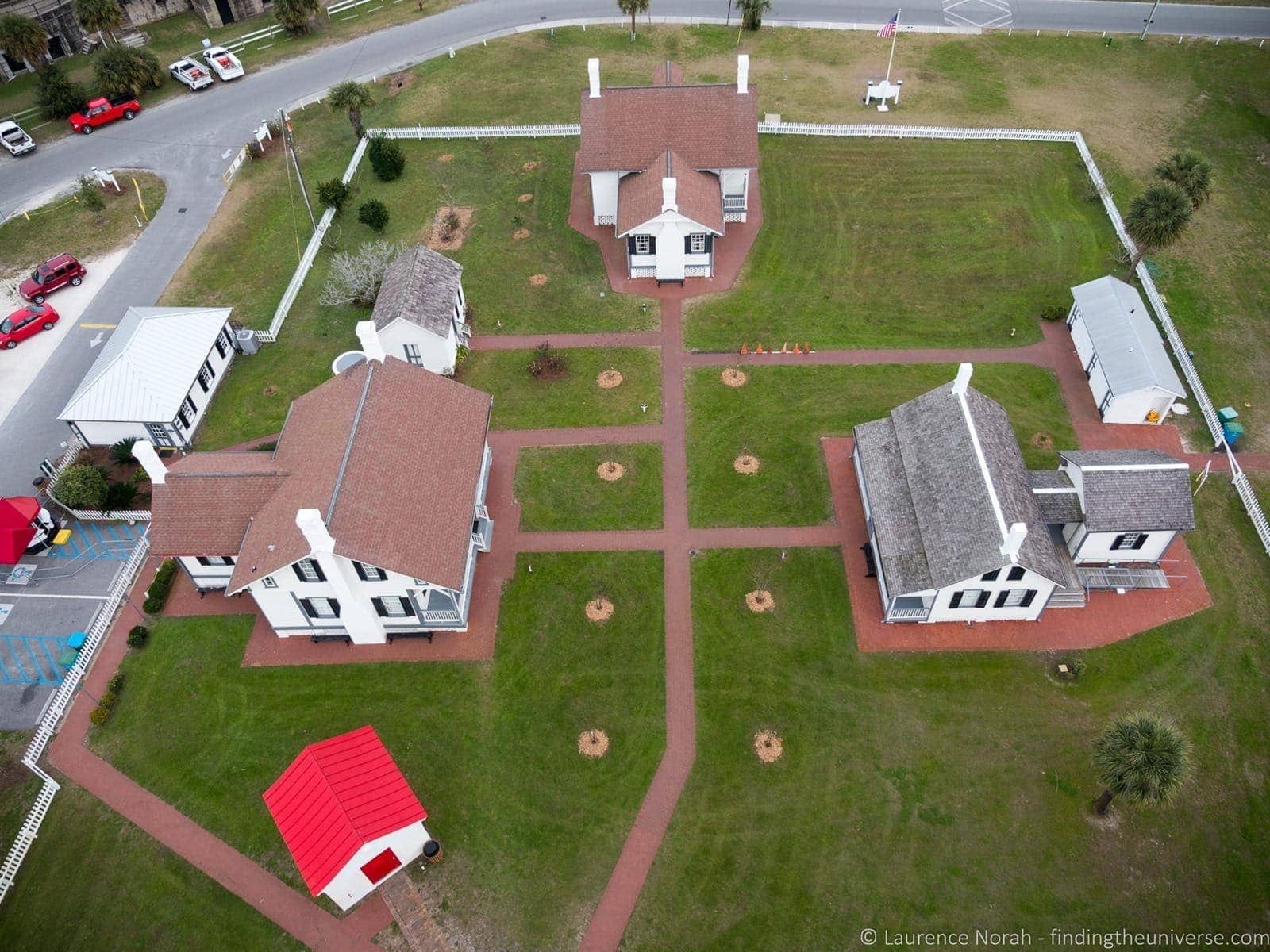
Tybee is a good option for an afternoon if you’ve had your fill of history, or as a base for a night or two if you prefer being near the water.
Fort Pulaski
Near Tybee Island, on the road between downtown and the coast, is Fort Pulaski. Named for Casimir Pulaski, a Polish cavalry officer who was mortally wounded fighting for American independence at the Battle of Savannah in 1779, this massive brick fortress was built as a coastal defence using around 25 million bricks and was considered impenetrable.
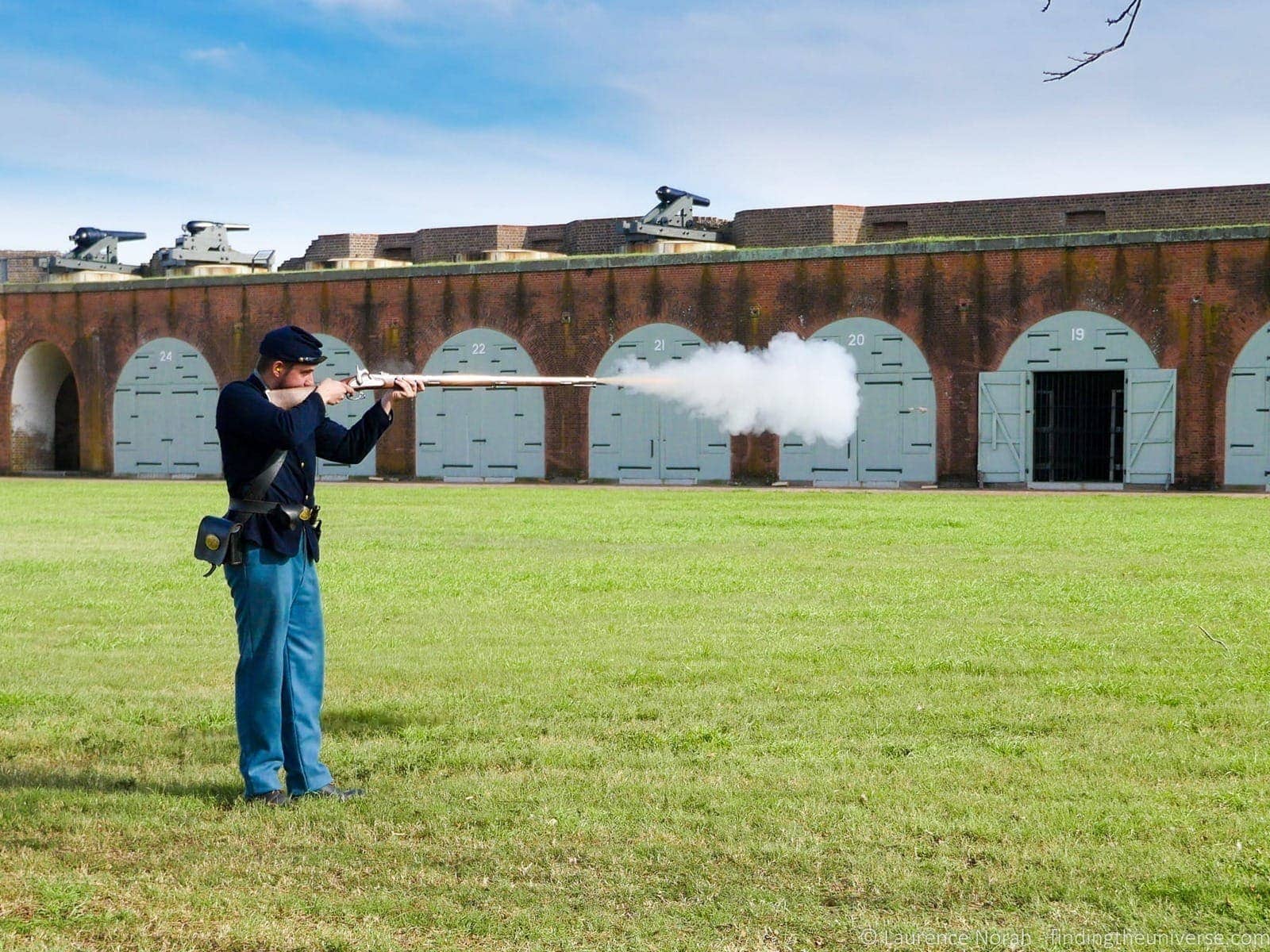
The invention of the rifled cannon changed that calculation, and during the Civil War it took just 30 hours of bombardment before the walls were breached and the fort surrendered to Union forces. Today it’s a well-preserved National Monument that’s fun to explore, not unlike Fort Jefferson in the Dry Tortugas. The rangers run musket firing demonstrations and there’s a good visitor centre.
Fort Pulaski also played an important role in the emancipation story. Enslaved people fled to the fort after its capture by Union forces, and some of the earliest Black troops in the Civil War were formed here.
Oatland Island Wildlife Center
An unexpected highlight. The Oatland Island Wildlife Center is a 100-acre environmental education centre with a two-mile nature trail through forest, salt marsh, and pond habitats, with animal enclosures scattered throughout.
We got very close to a gorgeous mountain lion, and also saw bobcats, wolves, red foxes, deer, bison, and various birds of prey. The whole place is shaded by a lovely canopy of trees, so it’s a pleasant walk even if you’re not that bothered about the animals (though I think you will be).
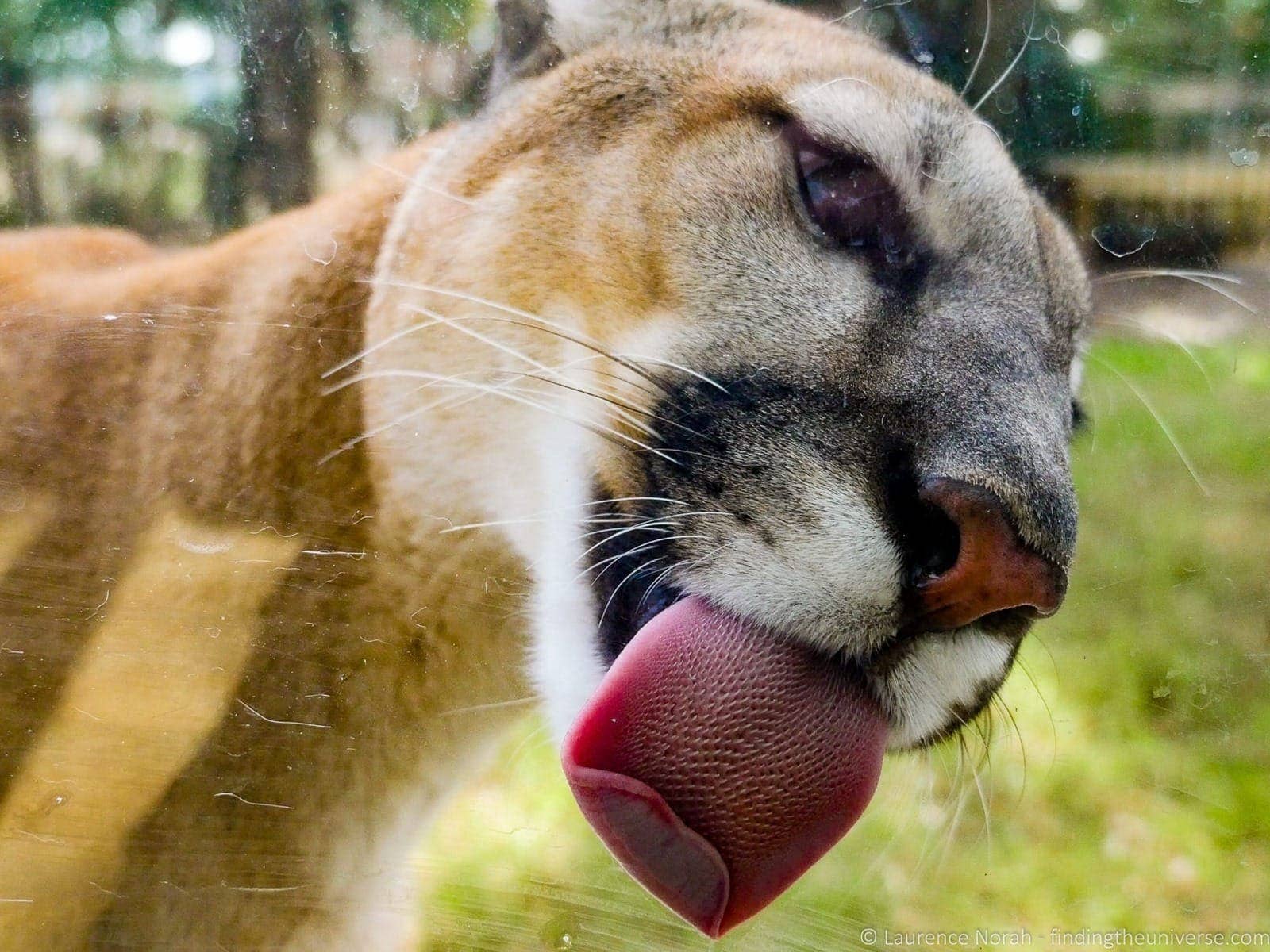
Entry is $5 per person, which makes it one of the best value attractions in the area. Open daily 10am to 4pm. More details on the Oatland Island website.
More Things to Do in Savannah
If you have a third day, or want to swap anything in the itinerary above, here are more ideas.
Massie Heritage Center
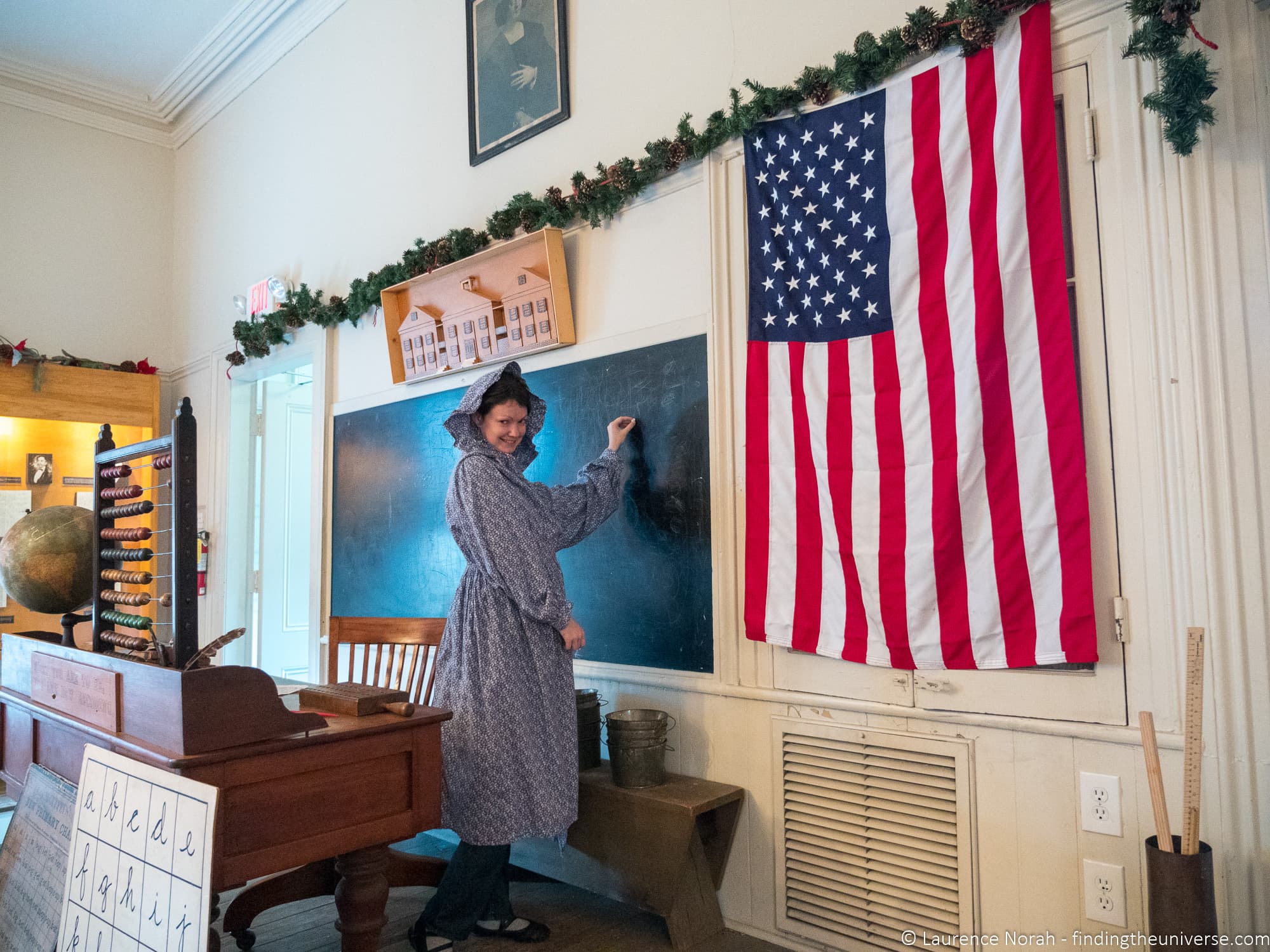
If you want to understand why Savannah looks the way it does, the Massie Heritage Center is the place to go. Housed in a former school building dating from the 1850s (built in the Greek Revival style), it has exhibits on Savannah’s city plan, its architectural styles, maritime history, and the history of public education in the city. There’s a 3D model of the entire Historic District with laser-lit narratives of the city’s history projected onto it, which is a clever touch.
Visit a Historical Home
Beyond the Owens-Thomas House mentioned above, Savannah has a number of preserved 19th century homes built by wealthy cotton plantation owners. The Historic Savannah Foundation has worked to preserve many of these, and several are open for tours.
You can also learn about these homes as part of a walking tour of the historic district that covers hidden gems and lesser-known stories alongside the famous spots.
Plant Riverside District
The Plant Riverside District is a development that opened in 2020 around a restored 1912 power plant on the western end of River Street. It includes the JW Marriott hotel, restaurants, bars, a rooftop lounge, and some quirky touches including a chrome dinosaur sculpture and a lobby that’s been set up like a natural history museum with geode exhibits. It has extended the River Street experience further west and added a more contemporary flavour to the waterfront.
City Market
City Market is a four-block area in the Historic District with restaurants, bars, shops, live music, and artists’ studios. It’s been a gathering place since the 1700s and has a good buzz in the evenings. If you’re looking for somewhere to eat or have a drink that’s a bit off the main tourist drag, it’s worth a wander.
First African Baptist Church
The First African Baptist Church, founded in 1773, is one of the oldest Black congregations in North America. The building dates from 1859 and was built by enslaved people who worked on it at night after completing their regular labour during the day. It’s an important part of Savannah’s history and offers guided tours.
Midnight in the Garden of Good and Evil
If you’ve read John Berendt’s 1994 book (or seen the Clint Eastwood film), much of Savannah will look familiar. The Mercer-Williams House on Monterey Square, where the events of the book took place, is open for tours. You can also take a dedicated Midnight in the Garden of Good and Evil walking tour that visits the key locations from the book.
Where to Eat in Savannah
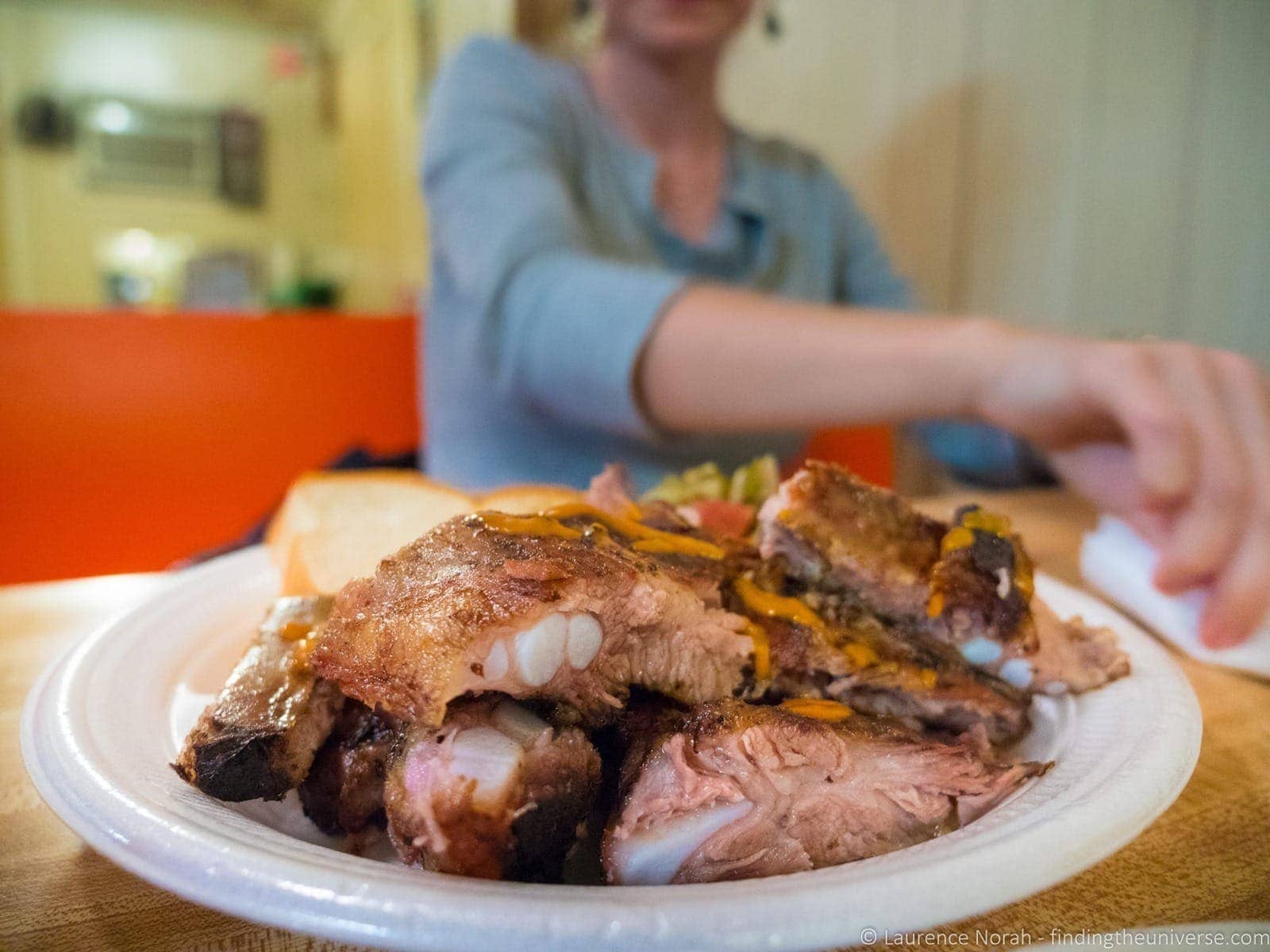
The food in Savannah (and across the Deep South generally) was one of the highlights of our trip.
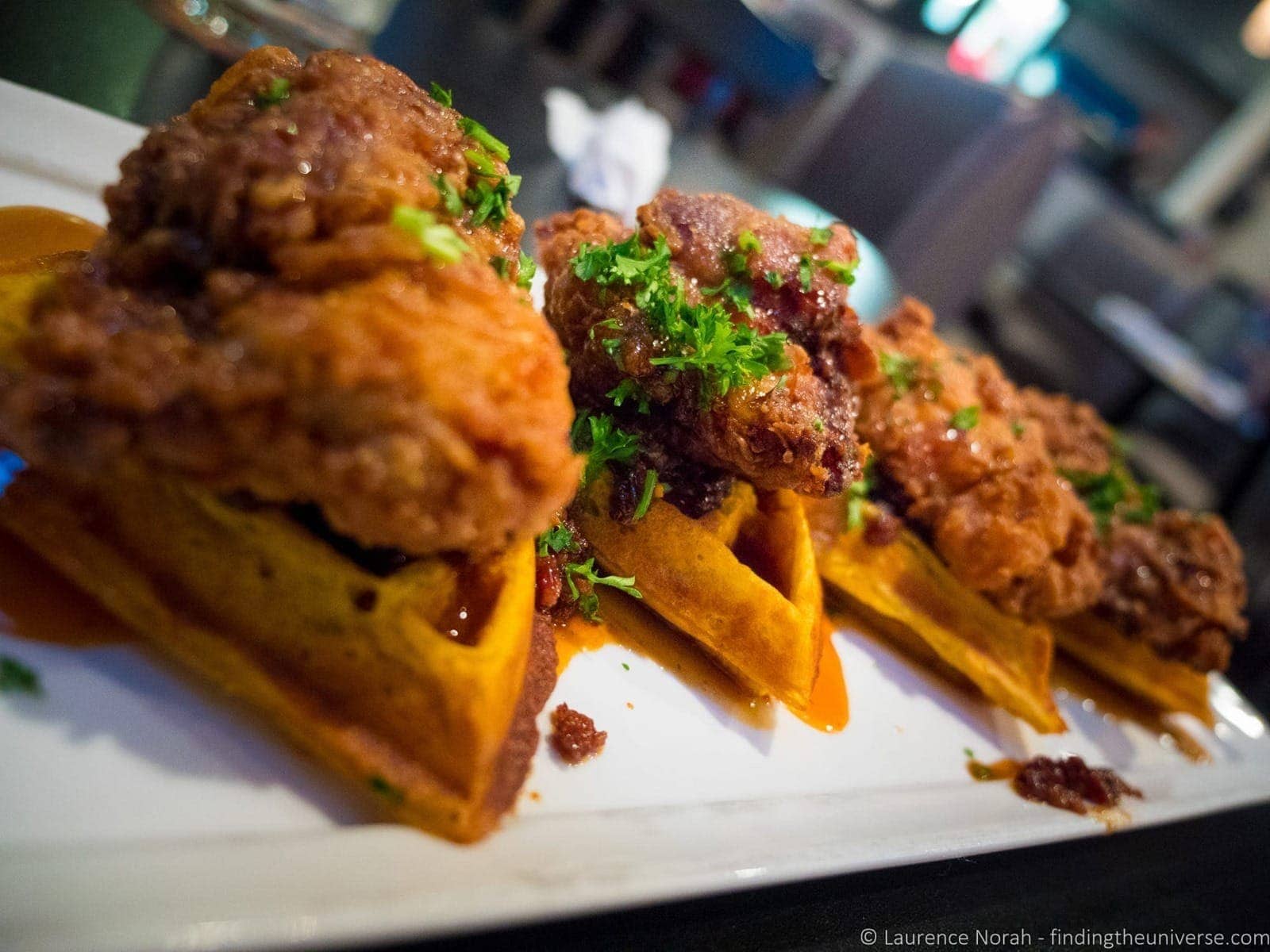
The Grey is one of Savannah’s most acclaimed restaurants. It’s set in a restored 1938 art deco Greyhound Bus Terminal and the food is Southern with a fine dining touch. If you’re going to treat yourself to one meal in Savannah, this is a strong pick. Book ahead.
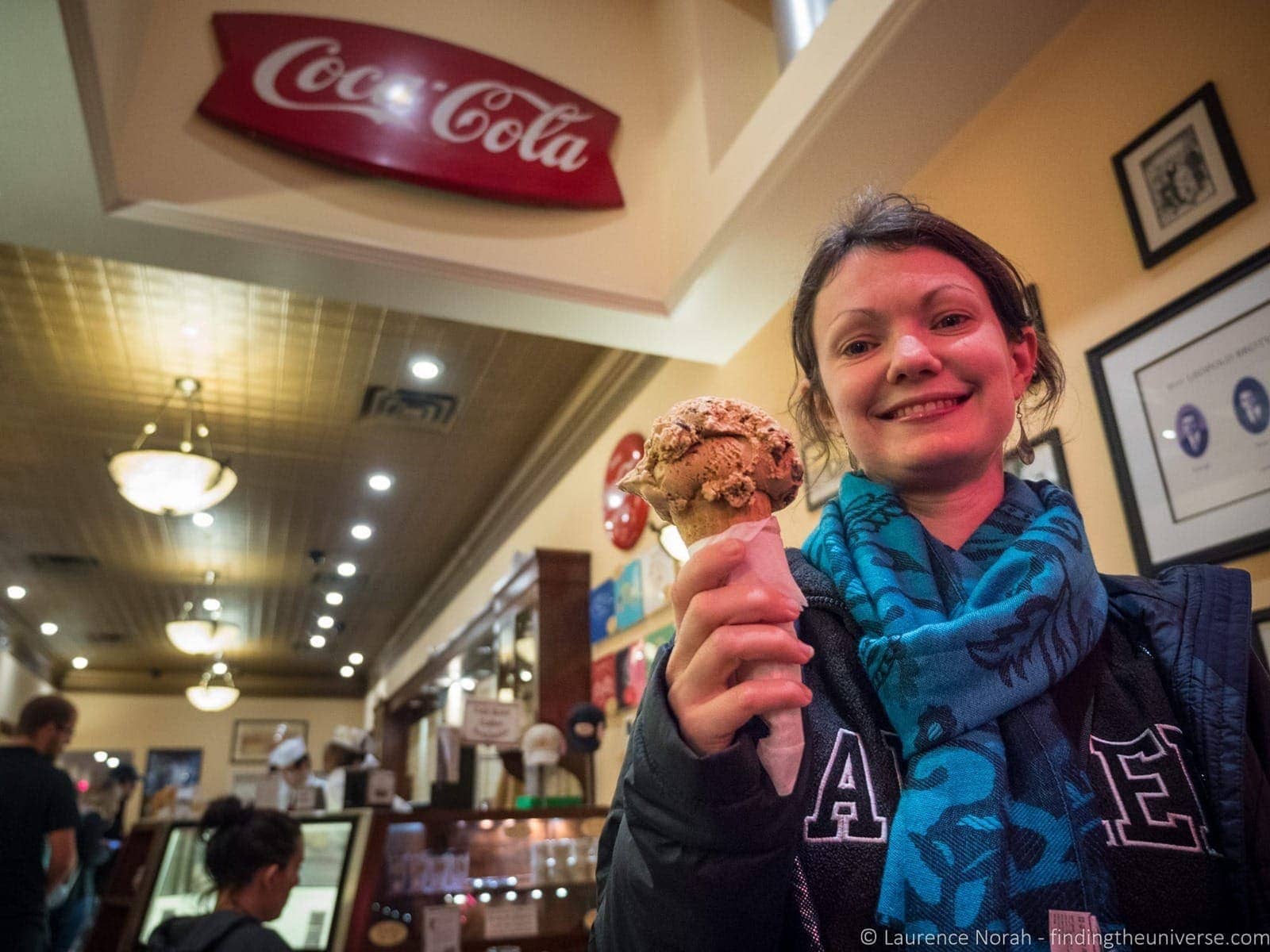
Leopold’s Ice Cream has been serving ice cream in Savannah since 1919. They’re excellent value and completely delicious. Worth sitting inside for the vintage decor. Expect a queue at peak times, but it moves fast.
A few other restaurants that come highly recommended (we haven’t eaten at these personally, but they consistently top the local lists): Mrs. Wilkes’ Dining Room on Jones Street is probably Savannah’s most famous restaurant, known for family-style Southern food served at communal tables. There’s typically a queue, so arrive early. The Olde Pink House is set in an 18th century mansion on Reynolds Square and is popular for shrimp and grits and other Lowcountry dishes. Crystal Beer Parlor has been open since the 1930s and does good burgers and shrimp and grits in a more casual setting.
If you’d rather try a bit of everything, a food tour like this one combines a walking tour with tasting stops at some of Savannah’s well-known restaurants. There’s also a food tour focused on the east side that covers some of the city’s lesser-known spots.
Savannah Tour Pass
The Savannah Tour Pass is a digital pass that gives you access to over 30 tours and attractions in Savannah. It works as a mobile pass on your phone, and includes options like the hop-on hop-off trolley, riverboat cruises, ghost tours, cemetery tours, and entry to museums and historical homes.
Passes are available from 1 to 3 days. The 1-day pass (currently $125 for adults) lets you choose 2 featured tours plus unlimited standard attractions. The 2-day pass ($188) gives you 3 featured tours, and the 3-day pass ($229) gives you 4. Multi-day passes can be used on non-consecutive days within a 10-day window, which gives you flexibility.
If you’re planning to do a trolley tour and a couple of other paid attractions, the maths tends to work out in your favour. You can check current pricing and see the full list of included attractions on the Savannah Tour Pass website.
Tours of Savannah
There’s no shortage of tour options in Savannah. Here’s a quick summary of the main categories to help you decide:
Walking tours: A history and culture walking tour is a good general introduction. For something more focused, there’s a Midnight in the Garden walking tour covering the famous book’s locations.
Trolley tours: The hop-on hop-off trolley is the practical option for getting around and sightseeing. The comedy trolley tour is a fun alternative.
Ghost tours: The Ghosts & Gravestones trolley tour is the most popular, and the haunted pub crawl is good if you prefer your ghosts with a pint.
Food tours: A food tour of the historic district is a solid way to sample the local food scene.
Water: Sunset cruises and dinner cruises on the Savannah River.
Day trips: A Wormsloe and Isle of Hope tour covers Day 2 attractions if you don’t have a car.
Where to Stay in Savannah
We stayed at the Quality Inn in downtown Savannah, which was well located for walking everywhere and included free parking, a big plus if you’re on a road trip. We also spent a couple of nights in a Homestay on Tybee Island, which was great for exploring the coast.
Here are a few more options across different budgets:
The Marshall House is Savannah’s oldest operating hotel, built in 1851 and located on Broughton Street right in the Historic District. It was used as a Civil War hospital and is reportedly haunted, which feels on-brand for Savannah. The rate includes breakfast and an evening wine reception.
River Street Inn is set in a converted cotton warehouse directly on the waterfront. If you want to be on River Street, this is the obvious pick.
JW Marriott Savannah Plant Riverside District is the upscale option, set in the Plant Riverside development around a restored 1912 power plant. Modern and polished, with restaurants, bars, and a rooftop lounge.
For more options, check the full list of Savannah hotels on Booking.com.
When to Visit Savannah
We visited Savannah in January, and it was a bit cool but comfortable. In the summer, temperatures and humidity can be very high (and the mosquitoes are enthusiastic), so the best time to visit is spring (March to May) or autumn (September to November) for the most pleasant weather.
If you like St. Patrick’s Day celebrations, Savannah hosts one of the largest in the US. It’s a big event, so accommodation prices go up and you’ll want to book well in advance.
Getting To and Around Savannah
The Historic District is compact and walkable. A free DOT shuttle runs a loop through the district, which is useful for saving your legs between the northern (River Street) and southern (Forsyth Park) ends. There are also trolley services covering the main sights.
For anything outside the Historic District (Wormsloe, Tybee Island, Fort Pulaski, Oatland Island), you’ll need a car. We usually hire through Discover Cars, which compares prices across multiple rental companies and tends to find good deals.
Savannah also has its own airport (Savannah/Hilton Head International), which is about a 20-minute drive from downtown.
Frequently Asked Questions About Visiting Savannah
How many days do you need in Savannah?
Two days is enough to cover the major highlights, including the Historic District, Forsyth Park, River Street, and a day trip to Tybee Island and Fort Pulaski. If you have three or four days, you can take things at a more relaxed pace and fit in attractions like Wormsloe, Bonaventure Cemetery, and the Oatland Island Wildlife Center without rushing.
We spent five days in the Savannah area and didn’t run out of things to do, but two full days will give you a solid experience of the city.
What is the best time of year to visit Savannah?
Spring (March to May) and autumn (September to November) offer the most comfortable weather for walking around. Summer in Savannah is hot and humid, which can make a full day of sightseeing on foot hard going.
If you visit in March around St. Patrick’s Day, you’ll catch one of the largest St. Patrick’s Day celebrations in the US, but expect higher hotel prices and crowds.
Is the Savannah Tour Pass worth it?
If you’re planning to take a trolley tour and visit two or three paid attractions, the maths usually works out in your favour. The 1-day pass costs $125 for adults and includes 2 featured tours (like the hop-on hop-off trolley or a riverboat cruise) plus unlimited standard attractions (museums and historic homes). The 2-day ($188) and 3-day ($229) passes add more featured tour choices and can be used on non-consecutive days.
Check the full list of included attractions on the Tour Pass website before buying, as the value depends on which specific tours and museums you want to visit.
Can you walk around Savannah with a drink?
Yes, but only in the Historic District. Savannah allows open containers of alcohol in the Historic District, provided your drink is in a plastic cup of no more than 16 ounces. Bars will pour you a “traveler” (a to-go cup) if you ask. This rule doesn’t apply outside the Historic District.
Do you need a car in Savannah?
Not for the Historic District, which is compact and walkable. There’s also a free DOT shuttle that loops through the district. You will need a car for attractions outside downtown, including Tybee Island, Fort Pulaski, Wormsloe, Bonaventure Cemetery, and the Oatland Island Wildlife Center. Some of these can be reached by guided tour if you don’t want to drive.
What food is Savannah known for?
Savannah is known for Lowcountry cuisine, which includes shrimp and grits, fried green tomatoes, she-crab soup, and pecan pie. Southern comfort food is everywhere, from family-style dining rooms to fine dining restaurants in historic mansions. Leopold’s Ice Cream, which has been serving ice cream since 1919, is a local institution.
Further Reading
We’ve written a number of other guides for destinations in the Deep South and beyond:
- Our trip to Savannah was part of a larger trip. See our Deep South road trip itinerary
- We’ve also written guides to New Orleans, Baton Rouge, and Charleston
- If you visit Charleston, check out these Charleston Plantations
- Our guide to how much it costs to travel in the USA
- Planning a road trip? Our tips for driving in the USA
- We’ve also written guides to San Antonio, Huntsville, Albuquerque, Cambria, and plenty more. See our complete USA content here.
- Lonely Planet’s guide to Louisiana and the Deep South
- Our guide to the best Airbnb alternatives
And that’s our guide to spending two days in Savannah! Have you been? Got any tips or favourite spots? Let us know in the comments below.
Gabe Mackelmore says
Thanks for the tips I will really put this into good use once we get to Tybee Island!
Laurence Norah says
My pleasure Gabe, have a great time on Tybee!
KrizzyM says
I appreciate this, Laurence! I admire savannah; there were several attractions like museums and parks (Forsyth is my first choice) that I love. I also recommend taking ice cream from Leopold’s; that’s our ultimate favorite and try The crab shack when you get a quick getaway at Tybee.
Laurence Norah says
Thanks very much Krizzy 🙂
Nicholl Spence says
Don’t miss out on 11!
Becca says
I live in Savannah, and I think this is a pretty good list. I would add that if you are on Tybee, you have to go to the Sugar Shack. And in town, eat at B&D Burgers. All the burgers are named after Savannah landmarks and it is delicious!
Laurence Norah says
Thank you very much Becca, and thanks for the suggestions! Will have to try out those burgers next time we visit 😀
BLM says
As a black woman (this ought to be good, right!), I had difficulty getting past the description of the first stop. Imagine if this was a review of Dachau or Auschwitz and a modern person, dressed in a Nazi uniform “explained” the significance of the Holocaust… People, understandably so, speak of the Holocaust with reverence and respect, yet American southerns and, apparently British-Americans, in this case, find black America’s own Holocaust “interesting” and neat to learn about, and what not.
I don’t believe this portion of the post was submitted maliciously. It is apparent, however, that privilege affords distance which permits spectacle. That, from my perspective, is disheartening.
Laurence Norah says
Hey there!
Thanks for your comment and perspective. I certainly didn’t mean to trivialise these events that have happened over many years, and indeed, still continue to happen today in various forms. My goal with the post was to provide a high level overview of the attractions in the area, and I think that learning about the history is important – but not as a trivial attraction to be checked off a list. I am sorry that my choice of words implied a lack of cultural sensitivity, and offer my sincere apologies for that.
Thanks again for sharing
Laurence
BLM says
Thanks, Lawrence, for your reply. As I mentioned, I do not believe you acted maliciously and I appreciate your consideration of my perspective.
Best,
BLM
Kem Fogt says
What is the best place to stay in Savanah? Clean but reasonably priced?
Thank you in advance!
Laurence Norah says
Hi Ken! “Best” is always going to be subjective, as is what you define as reasonably priced 😉 But here are a couple of options to consider. Note that prices will vary depending on time of year and number of people, so these are just an indicator.
The Fairfield Inn & Suites is well reviewed and around $140 a night for two people with breakfast.
http://www.booking.com/hotel/us/fairfield-inn-suites-by-marriott-savannah-midtown.html?aid=385205&no_rooms=1&group_adults=1&label=FTUSavannahComment
B historic is around $200 a night:
http://www.booking.com/hotel/us/country-inn-suites-savannah-historic.html?aid=385205&no_rooms=1&group_adults=1&label=FTUSavannahComment
We stayed in the Quality Inn Savannah which was well located, not quite as well reviewed, but certainly we thought it was fine.
http://www.booking.com/hotel/us/hotel-w-bay-st-savannah.html?aid=385205&no_rooms=1&group_adults=1&label=FTUSavannahComment
Hotels in the historic district tend to be a bit more expensive, so if you have a car and don’t mind a bit of a drive, you might find a better deal a little further out of the centre if price is a real consideration.
Jennifer Caminiti says
Correction needed. Savannah is not the oldest city in GA. That would be St. Mary’s, at the furthest SE corner, almost on the Florida line. St. Augustine, FL the only older, contnuously inhabited city in tbe USA.
Laurence Norah says
Hey Jennifer! Thanks for your comment. I’ve taken a fairly thorough look at this, and the internet seems fairly consistent in it’s belief that Savannah is the oldest city in Georgia. I appreciate that a myth can often overtake reality, but it seems that St. Mary’s was founded in 1787 (here’s a picture of the town marker: http://georgiainfo.galileo.usg.edu/images/uploads/markers/cityofstmarys.jpg). Savannah was founded in 1733 by General James Oglethorpe.
Kristin @ Camels & Chocolate says
So glad you had a fun trip to my part of the world!
Laurence says
It was awesome!