
I planned on spending two days in Kanchanaburi. I stayed eight, and I still left with a list of things I hadn’t got to. On that trip I walked across the bridge over the River Kwai early, before the tour buses rolled in, sat almost alone among the headstones at Chungkai War Cemetery, swam under the tiers of the Erawan Falls, and cycled a scooter out into the limestone countryside looking for a very big tree. I’ve been a travel photographer for over fifteen years, and every photo in this guide is one I took while I was there.
Kanchanaburi sits around 130km west of Bangkok, which makes it one of the easiest and most rewarding trips out of the capital. You probably know it already, even if the name doesn’t ring a bell, because of the 1957 film The Bridge on the River Kwai. The bridge is real, you can walk across it, and it’s still the headline. But there’s a lot more to the town than one span of steel: the sombre cemeteries and museums of the Thailand to Burma “Death Railway”, one of Thailand’s finest waterfalls, cave temples you reach by climbing through the mouth of a giant dragon, and a slow train that still rattles along the original wartime line.
Here’s what’s actually worth your time, how long to give it, and the best way to get there from Bangkok.
Table of Contents:
Is Kanchanaburi worth visiting?
Quick answer: Yes. Kanchanaburi is well worth visiting, and it’s one of the best trips you can make from Bangkok. The war history around the Death Railway is moving and important, and the countryside, waterfalls and temples give you a reason to stay longer than the day most people give it.
Day trip or overnight? You can see the bridge and the main war sites in a rushed day trip. But if you want the Erawan Falls, a proper ride on the railway, and time to take the cemeteries in without a coach driver tapping his watch, stay one night. That’s the trip I’d point most people towards.
Kanchanaburi is also a stop on our two week Thailand itinerary, so if you’re planning a longer trip it slots in neatly between Bangkok and the north.
How long do you need in Kanchanaburi?
It’s tempting to treat Kanchanaburi as a quick Bangkok day trip. You can do it that way, and plenty of people do, but you’ll spend more of the day in a minivan than at the sights, and you’ll skip the two things that make the town special: the Erawan Falls and riding the railway itself. Here’s how the options really compare.
| Trip length | What you’ll see | What you’ll miss | Rough cost |
|---|---|---|---|
| Day trip from Bangkok | The bridge, one war cemetery, and either JEATH or the Thailand to Burma Railway Centre. A quick look at the Death Railway. | Erawan Falls, Hellfire Pass, the cave temples and countryside, any real time on the train. | Around 1,200 to 2,000฿ on a group tour, less if you take the train yourself. |
| Two days, one night | Everything above, plus the Erawan Falls, a full ride on the railway to Nam Tok, and time to see the war sites without rushing. | Hellfire Pass and the outlying temples, unless you move fast. | Rooms from around 500฿ a night for something simple. |
| Three days or more | Add Hellfire Pass (a half day in itself), Wat Tham Sua, the dragon staircase at Wat Ban Tham, the giant tree, and time to slow down by the river. | Very little. | As above, per night. |
Two days and one night is the sweet spot. It’s long enough to give the war history the weight it deserves and still get out to the falls, without committing the better part of a week the way we accidentally did. If you’re only weighing up day trips from Bangkok, the other big one is the ancient capital at Ayutthaya, and you can read our guide to what to see in Ayutthaya to compare the two.
How to get to Kanchanaburi from Bangkok
Kanchanaburi is around 130km from Bangkok, and you’ve got four sensible ways to cover it.
By train. This is the home of the Death Railway, so arriving by train is the fitting way to do it, even if it isn’t the fastest. Ordinary State Railway of Thailand trains leave from Bangkok’s Thonburi station (not the main Hua Lamphong terminal, which catches a lot of people out) at around 07:50 and 13:55, reaching Kanchanaburi roughly two and a half hours later before carrying on up the line to Nam Tok. Foreigners pay a fixed 100฿ fare, it’s third class only, and you buy your ticket at the station about an hour before departure rather than online. The carriages are basic and the fans do the work of air conditioning, but the windows are wide open and the scenery is the point.
By minivan or bus. Minivans run frequently from Bangkok and are usually faster than the train, taking two to three hours depending on traffic. They’re cheap and they drop you in the centre of town. This is what I’d take if I were tight on time.
By private transfer. If you’d rather not deal with public transport, you can hire a private transfer that collects you from your Bangkok accommodation and takes you straight to Kanchanaburi. It costs more, but it’s door to door and saves you a lot of faffing.
By tour. If you want everything arranged for you, a guided trip is the low effort choice. This Kanchanaburi and Erawan day trip from Bangkok pairs the bridge and the Death Railway with the Erawan Falls in a single long day, while thistwo day River Kwai tour adds an overnight in a floating raft hotel and gets you out to the more distant sights.
The Death Railway: Kanchanaburi’s war history
The reason Kanchanaburi is on the map is a railway. In 1942 and 1943 the Japanese army forced Allied prisoners of war and conscripted Asian labourers to build a 415km line from Thailand into Burma, to supply its forces there. It was finished in around a year, at a human cost that earned it the name it still carries: the Death Railway.
Somewhere around 12,600 Allied prisoners of war died building it. Alongside them worked a far larger number of conscripted Asian labourers, the rōmusha, whose deaths were never officially counted but are estimated at somewhere between 75,000 and 100,000. That imbalance matters, and it’s easy to miss: the men remembered in the immaculate war cemeteries are only a fraction of everyone who died here.
The bridge over the River Kwai
You can’t visit Kanchanaburi and not go and see the bridge. It would be a bit like visiting London and not having a look at Buckingham Palace. Some things are just not done.
It’s a strange place to actually stand, though. There are party boats going up and down the river, hordes of people, and vendors selling trinkets all over the place, which sits oddly against what the bridge is a memorial to. Having visited plenty of sobering sites over the years, though, I’m not sure it’s the wrong approach. I don’t know how the men who built the original bridge would feel about how it’s remembered, but I’d guess the sound of Gangnam Style banging out over the water beats the sounds of gunfire and death.
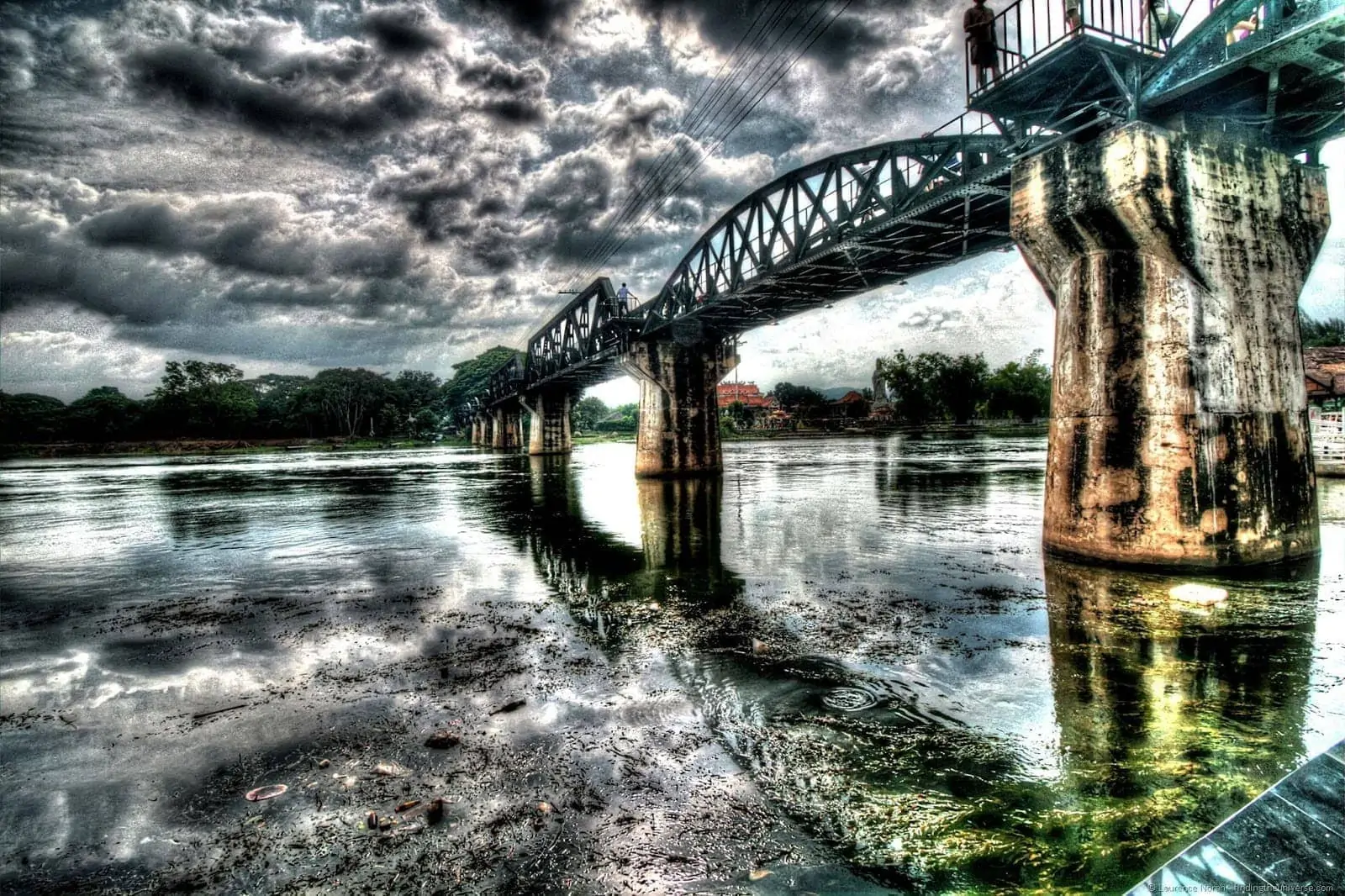
Two things are worth knowing before you go. The bridge you walk across today isn’t entirely the wartime original: Allied aircraft bombed it in 1945, and two of the central spans were destroyed. Look closely and you can see the difference, because the rounded, curved trusses are the originals, while the flat, angular central spans are post-war replacements supplied by Japan as reparations. And the “River Kwai” itself is a bit of a fiction. The river here was actually part of the Mae Klong, and when tourists started turning up after the film looking for a River Kwai that didn’t geographically exist, the Thai authorities simply renamed this stretch the Khwae Yai in 1960 to fit the story.
The war cemeteries: Kanchanaburi and Chungkai
There are two Commonwealth war cemeteries in town, and they’re the most moving places you’ll visit here.
The main one, Kanchanaburi War Cemetery (also called Don-Rak), is right by the town’s main road and holds 6,982 graves. A little way out of the centre, on a quieter riverside spot, Chungkai War Cemetery holds a further 1,739, mostly men who died in the base hospital camp nearby. Both are maintained by the Commonwealth War Graves Commission, and it shows.
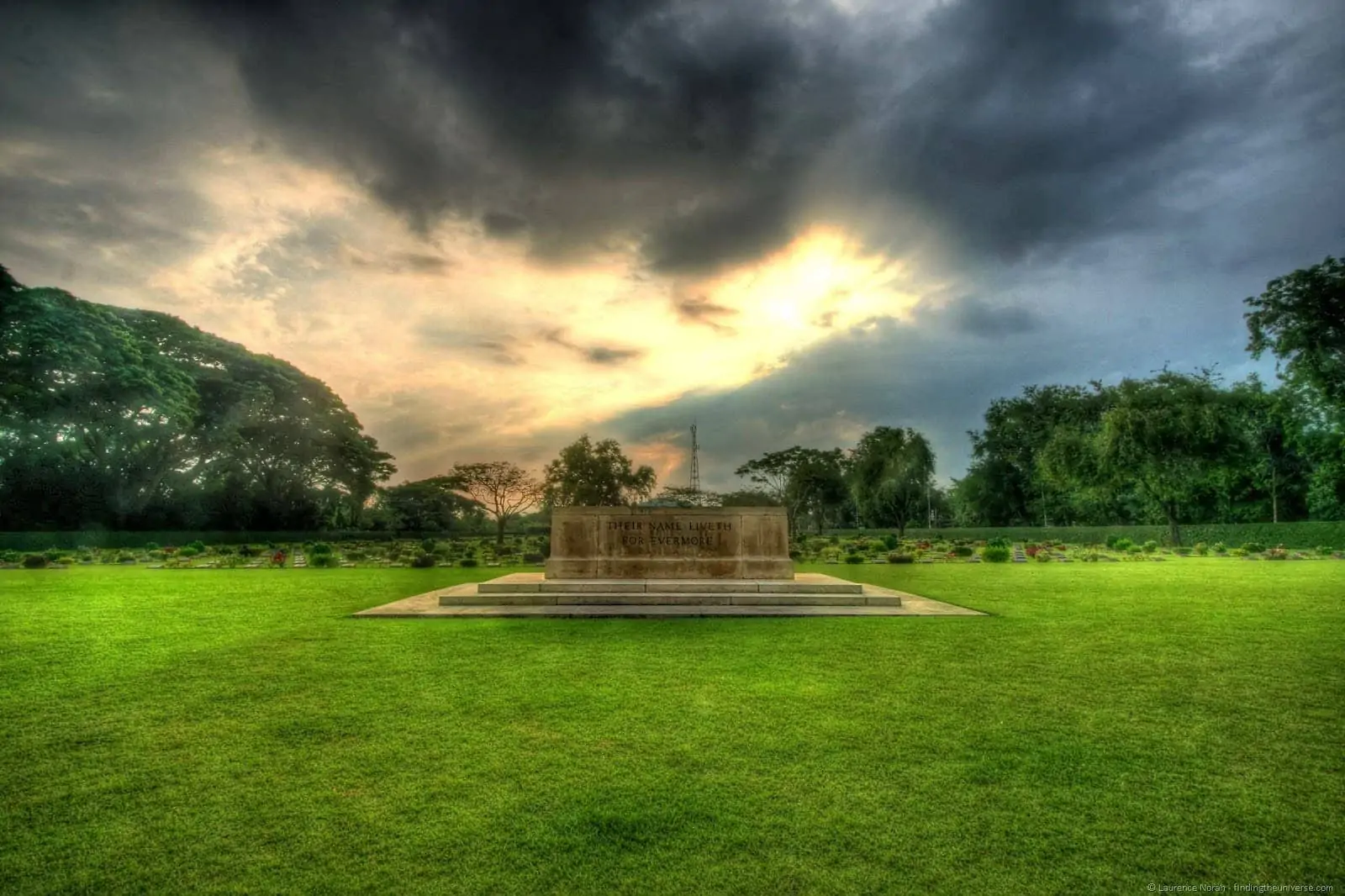
Walking between the rows of immaculately tended headstones lends a real sense of perspective to the loss of life this railway cost. It’s hard to take in. It’s harder still when you remember that these are Commonwealth and Dutch war graves only, and that the tens of thousands of Asian labourers who died have no equivalent memorial at all. Between them, these two cemeteries hold fewer than 9,000 graves, less than a tenth of everyone who died building the line.
The Thailand to Burma Railway Centre
Directly opposite the main cemetery is the Thailand to Burma Railway Centre, a modern, well-curated museum that opened in the early 2000s. If you only have time for one museum in town and you want the clearest overall telling of how the railway was built and at what cost, make it this one. It puts the cemetery across the road into context and is worth the small admission.
The JEATH War Museum
This is a more homespun, and in its own way more affecting, place. The JEATH War Museum sits in the centre of town (not next to the bridge, despite some misleading signs pointing you to a different museum), and its centrepiece is a bamboo hut built in the same style as the ones the prisoners were housed in during construction.
Inside you’ll find eyewitness accounts, newspaper clippings, photographs and as much detail on the railway and daily life under it as you can absorb. Along with the cemeteries, this was the place where the true horror of what happened here became real for us. There’s a token entry fee.
Hellfire Pass
About 80km northwest of town is Hellfire Pass, the most powerful war site in the area and the one most day trippers never reach. This is the Konyu Cutting, the deepest on the whole railway, dug largely by hand by prisoners working through the night by torchlight, which is where the name comes from.
Today it’s home to the excellent Hellfire Pass Interpretive Centre, run by the Australian government’s Department of Veterans’ Affairs. Entry is free and it’s open daily from 9am to 4pm, though the centre closes for a few weeks each May for maintenance, so check ahead if you’re travelling then. A walking trail takes you down into the cutting itself and along a stretch of the old railway formation. Standing in that rock cutting, knowing how it was made, is something you don’t forget. The DVA’s Anzac Portal is the authoritative source if you want to read the full history before you go. You’ll need a car, a scooter or a tour to get out here, so factor in the best part of a half day. A dedicated Death Railway and Hellfire Pass tour from Bangkok is the easiest way to combine it with the train.
Riding the Death Railway to Nam Tok
The most memorable thing you can do here is to actually ride the railway. The surviving stretch of line runs from Kanchanaburi up to the end of the track at Nam Tok, and the ride costs the same fixed 100฿ for foreigners.
The highlight comes at Tham Krasae, where the train slows to a crawl across the Wampo Viaduct, a wooden trestle bridge that clings to the side of a cliff directly above the river. It’s a real feat of engineering to look at, and a sobering one when you remember who built it and how. Sit on the river side of the carriage if you can.
Beyond the war: nature and temples around Kanchanaburi
The history of the town is bound up with the war, but there’s a great deal more to this area than that, which is why our trip stretched from two days to over a week. Take a bit of time to explore and you’ll find one of Thailand’s most impressive waterfalls, a seriously enormous tree, and a whole clutch of temples, one of which you enter through a dragon.
Erawan Falls
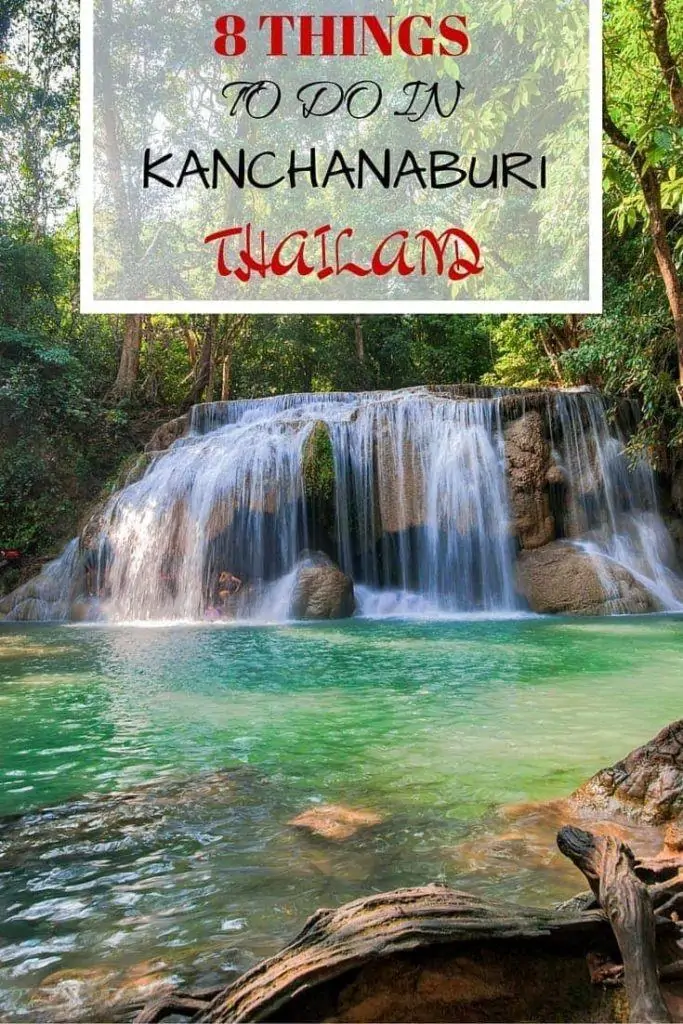
About 65km north of Kanchanaburi, inside Erawan National Park, are the Erawan Falls, a seven tiered waterfall and one of the most beautiful I’ve seen anywhere in Thailand. It’s roughly a 2km walk from the first tier to the top, and the pools at most levels are great for a swim, so it’s easy to spend a whole day here.
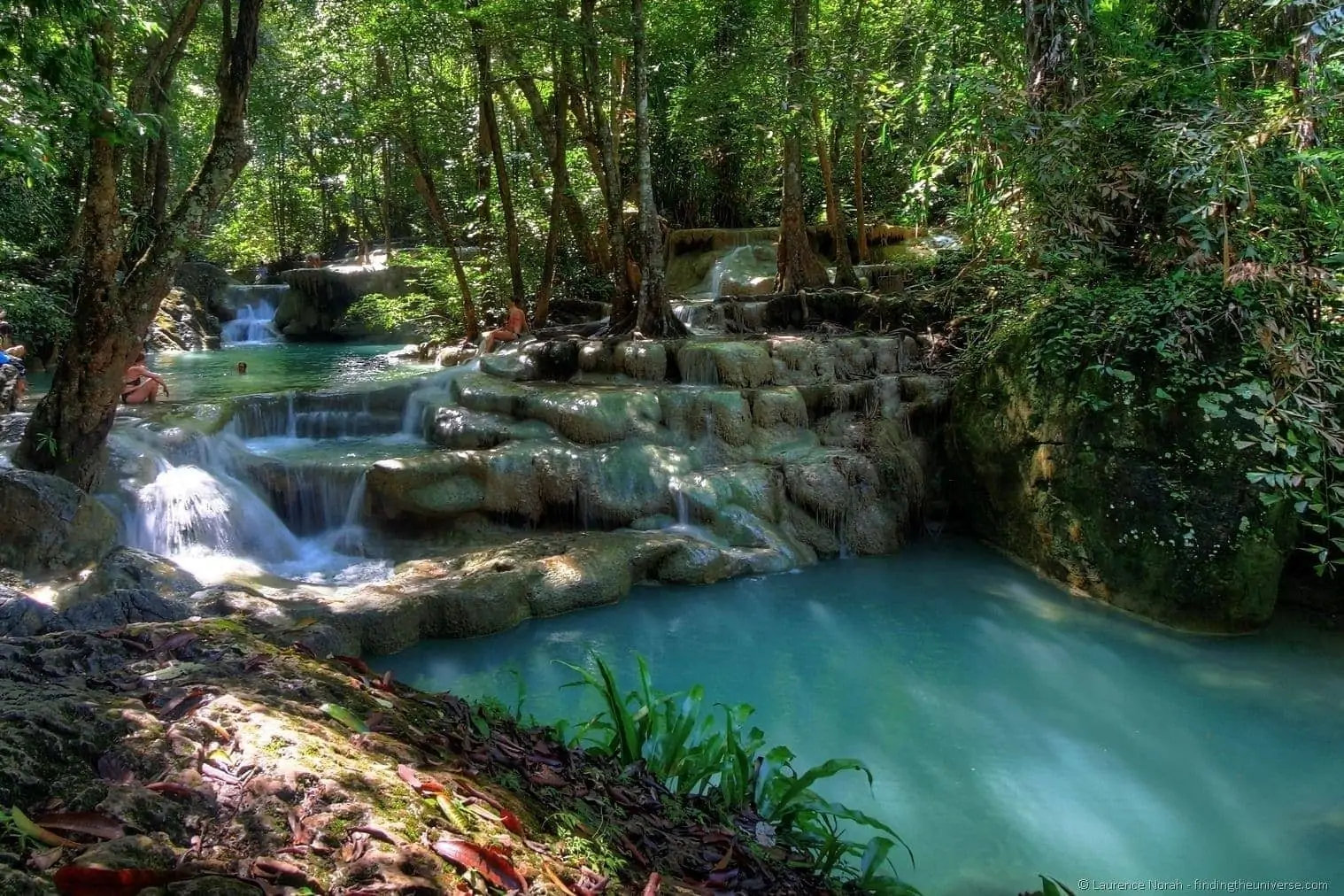
Foreigner entry is 300฿ for adults and 150฿ for children, which has crept up from the 200฿ I paid on my visit but is standard for Thailand’s national parks. The cheapest way out here is the public bus, which starts running from around 8am and is clearly marked for Erawan; you can flag it down on the main road through town. The falls are at their fullest and greenest in the wet season from roughly June to October, though the upper tiers can be slippery then. If Thailand’s wilder side appeals, we can also vouch for spotting wild elephants in Khao Yai National Park.
The Skywalk
A newer addition that didn’t exist on my first visit is the Kanchanaburi City Skywalk, a circular glass walkway that juts out over the confluence of the two rivers. It costs 60฿, it’s open daily until 7pm, and it’s a good, cheap half hour if you like a view straight down through your feet. Bring the shoe covers they hand out and you’re fine even if heights aren’t your thing.
Wat Tham Sua and a word on ethics
Wat Tham Sua, the Tiger Cave Temple, sits on a hilltop southeast of town and is crowned by a huge golden seated Buddha with sweeping views over the rice paddies below. It’s a real, working temple and a lovely spot in the late afternoon.
Worth clearing up the name, though, because it trips people up. Wat Tham Sua has nothing to do with the notorious Tiger Temple (Wat Pha Luang Ta Bua), which was shut down in 2016 after authorities removed more than a hundred tigers and uncovered evidence of wildlife trafficking. That place is closed, and it should stay closed. The same thinking applies to the elephant camps you’ll see advertised around town: give anything offering rides or animal selfies a miss, and if you want to see elephants, choose an ethical, no-riding sanctuary instead.
Wat Ban Tham: climb through the dragon
Wat Ban Tham is another cave temple, but with a twist. The cave sits halfway up a hillside, and you reach the entrance by climbing up through the mouth and the belly of an enormous dragon built into the staircase.
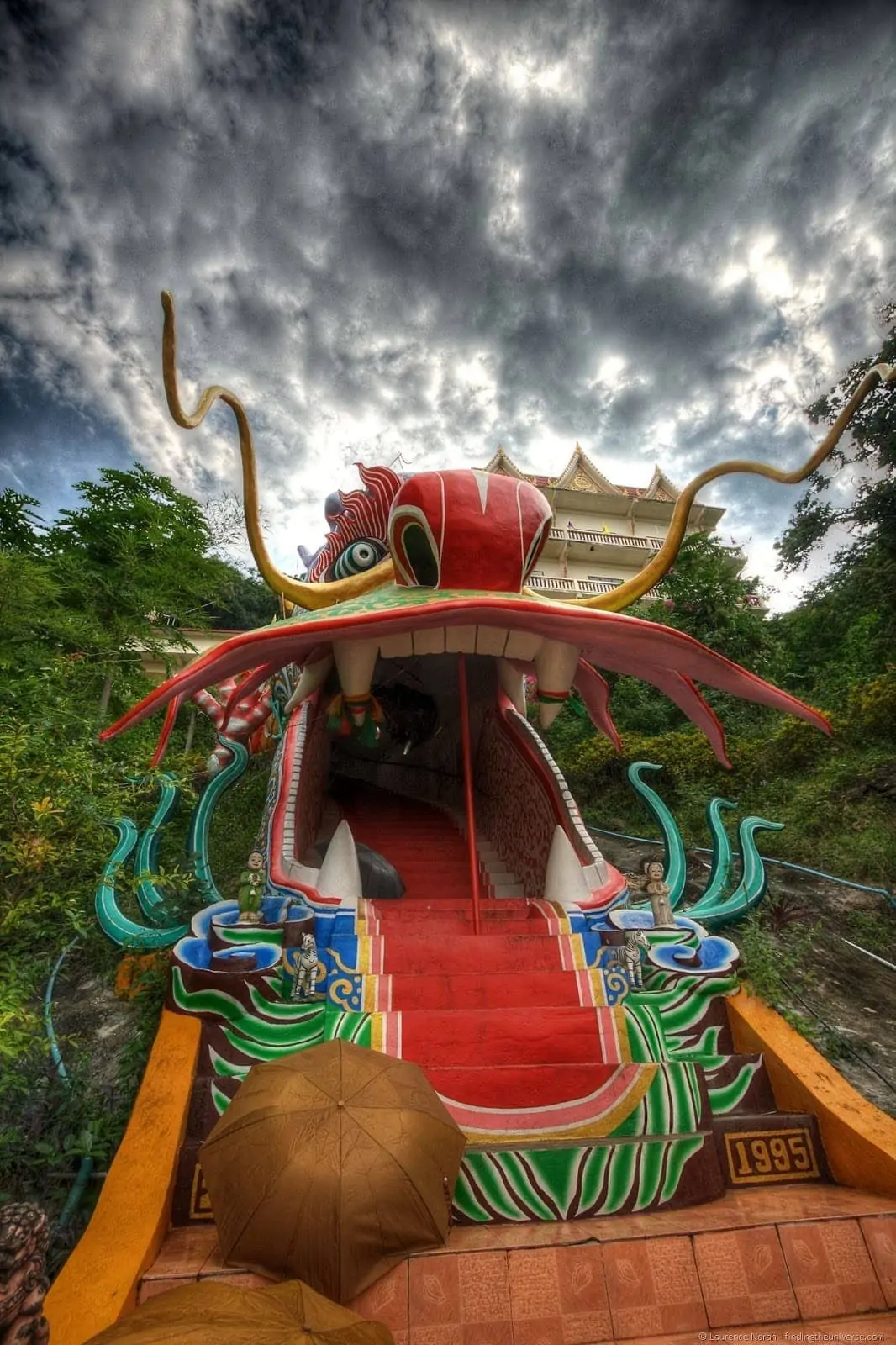
Scenes from the Buddha’s life are painted in detail on the walls inside, though I’ll admit I was mostly just excited about the whole climbing-through-a-dragon thing! At the top is the cave itself, home to a large Buddha and various shrines, and you can carry on further up the hill for a wide view across the countryside.
Wat Tham Khao Pun and the cave temples
Kanchanaburi is ringed by limestone peaks, which means caves, and some of the nicest have been turned into temples. Wat Tham Khao Pun, a few kilometres west of town, is a series of caves filled with Buddha statues, including a reclining Buddha near the entrance, and it’s well worth the minimal entry fee.
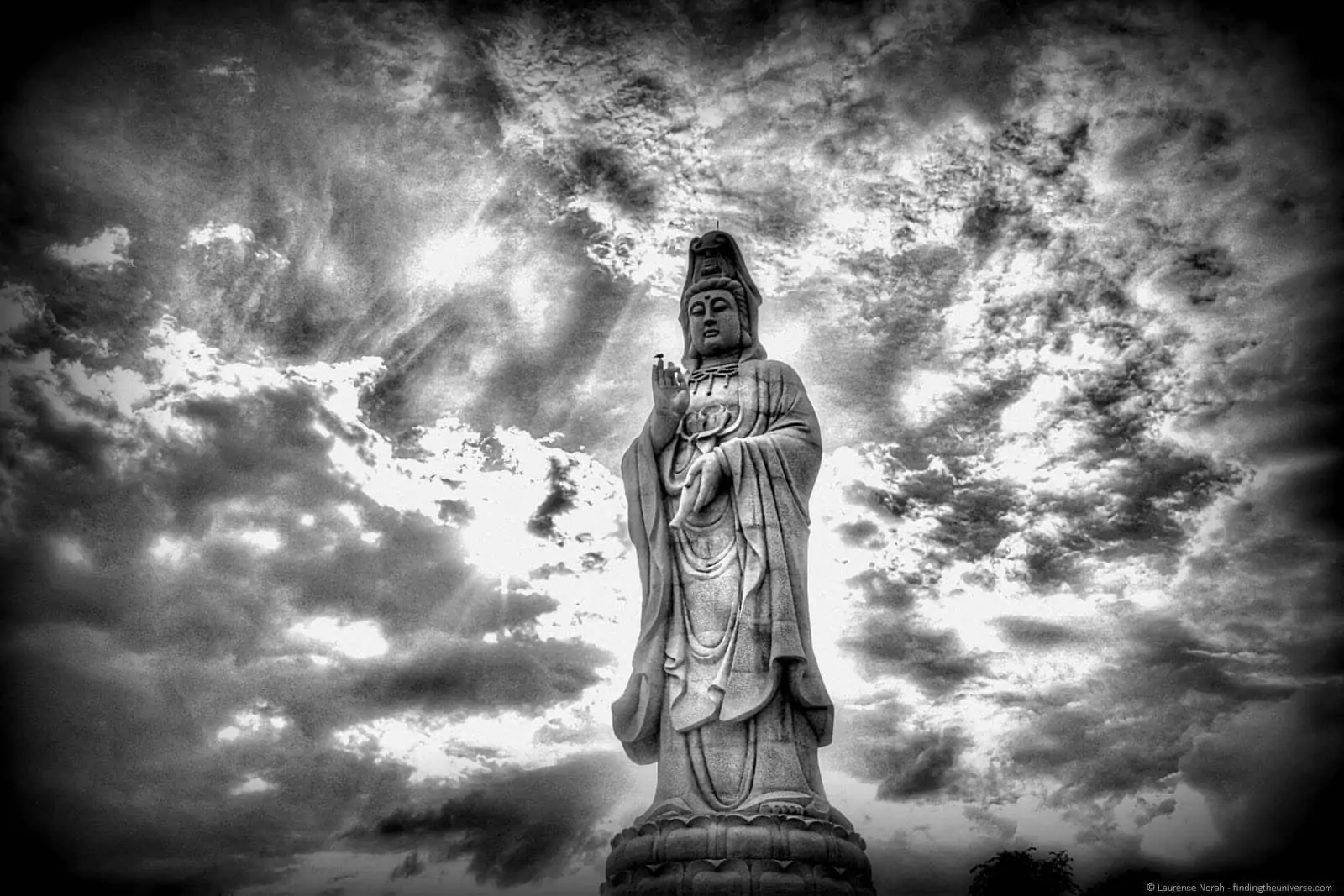
Head from the caves towards the river and you’ll find a lovely view over the surrounding country in the company of a giant sitting Buddha.
Cycle out to the giant tree
If you fancy getting into the gorgeous countryside around the town, a ride out on a bike or scooter is well rewarded. As soon as you leave the city you’re into a world of green, with limestone peaks and plenty of temples to poke around.
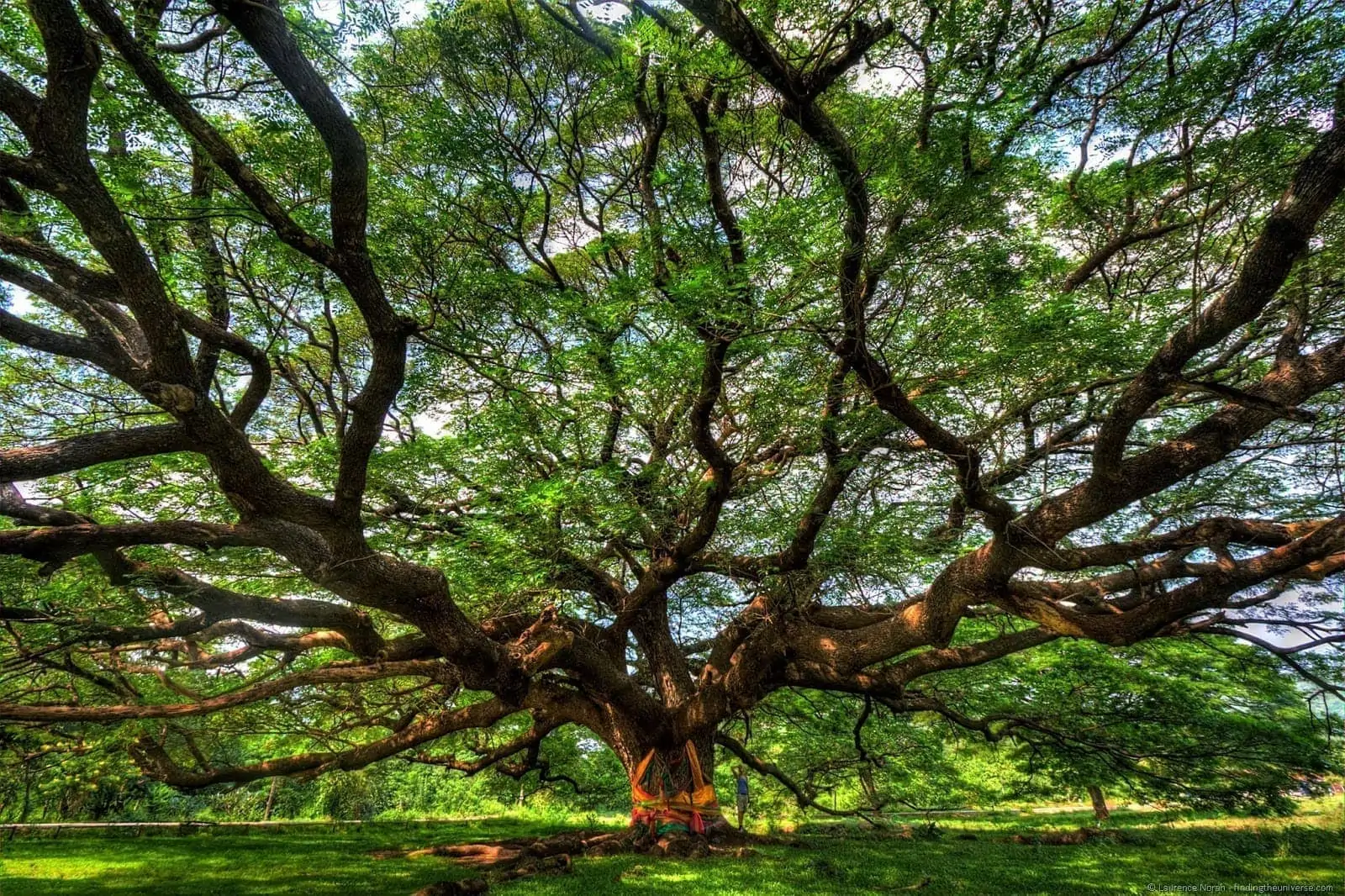
We cycled the whole way out to the giant monkey puzzle tree of Kanchanaburi, a 30km round trip that turned into quite the adventure, mostly because the map from the tourist office was vague to say the least. Plenty of people along the way pointed us back on track, and the tree really was enormous, so it was worth every wrong turn.
The night market
No town in Thailand is complete without a night market to gorge yourself silly at for next to nothing, and Kanchanaburi’s is no exception! You’ll find it near the main train station, with all the food you can eat plus the usual clothes, films and odds and ends. It’s the cheapest and most reliable dinner in town.
Best time to visit Kanchanaburi
The most comfortable time to visit is the cool, dry season from November to February, when daytime temperatures are manageable and the evenings are pleasant. This is peak season, so the bridge and the tours are busier, but it’s the easiest weather for cycling, walking the Hellfire Pass trail and sitting in cemeteries without wilting.
March to May is the hot season, and “hot” is doing a lot of work in that sentence: it can push well past 35°C, which makes the more active sights hard going. The trade off is thinner crowds. The wet, green season runs from around June to October, when short heavy downpours are common but the countryside is at its lushest and the Erawan Falls are at their most powerful. If the falls are your priority, the green season is quietly the best time to see them.
Getting around Kanchanaburi
Kanchanaburi is one of those towns that’s far longer than it is wide, stretching around 6km along the river in three loose clusters. The northern end is where you’ll find the bridge and its stalls; the middle is the main tourist strip, where most of the accommodation, restaurants and bars are, along with the main war cemetery and train station; and the southern end is the “proper” town, with the malls, the bus station, the tourist office and the JEATH museum.
If you’re staying in the middle, which is most likely, you’re looking at around a 3km walk to the bridge or the southern end. It’s all walkable, but renting a scooter for around 200฿ a day, or a bicycle for 50฿, makes life a lot easier, especially for the temples and sights out of town.
Where to stay in Kanchanaburi
Kanchanaburi isn’t short of places to stay, and most of them cluster in the central part of town near the food, the main cemetery and the train station.
A popular local option is a raft house on the river, where you’re gently rocked to sleep and rewarded with some spectacular sunsets. The downside is that, depending on the day, your sleep might be interrupted by the pounding beats of the party boats going up and down. They’re worse at weekends, but possible any night.
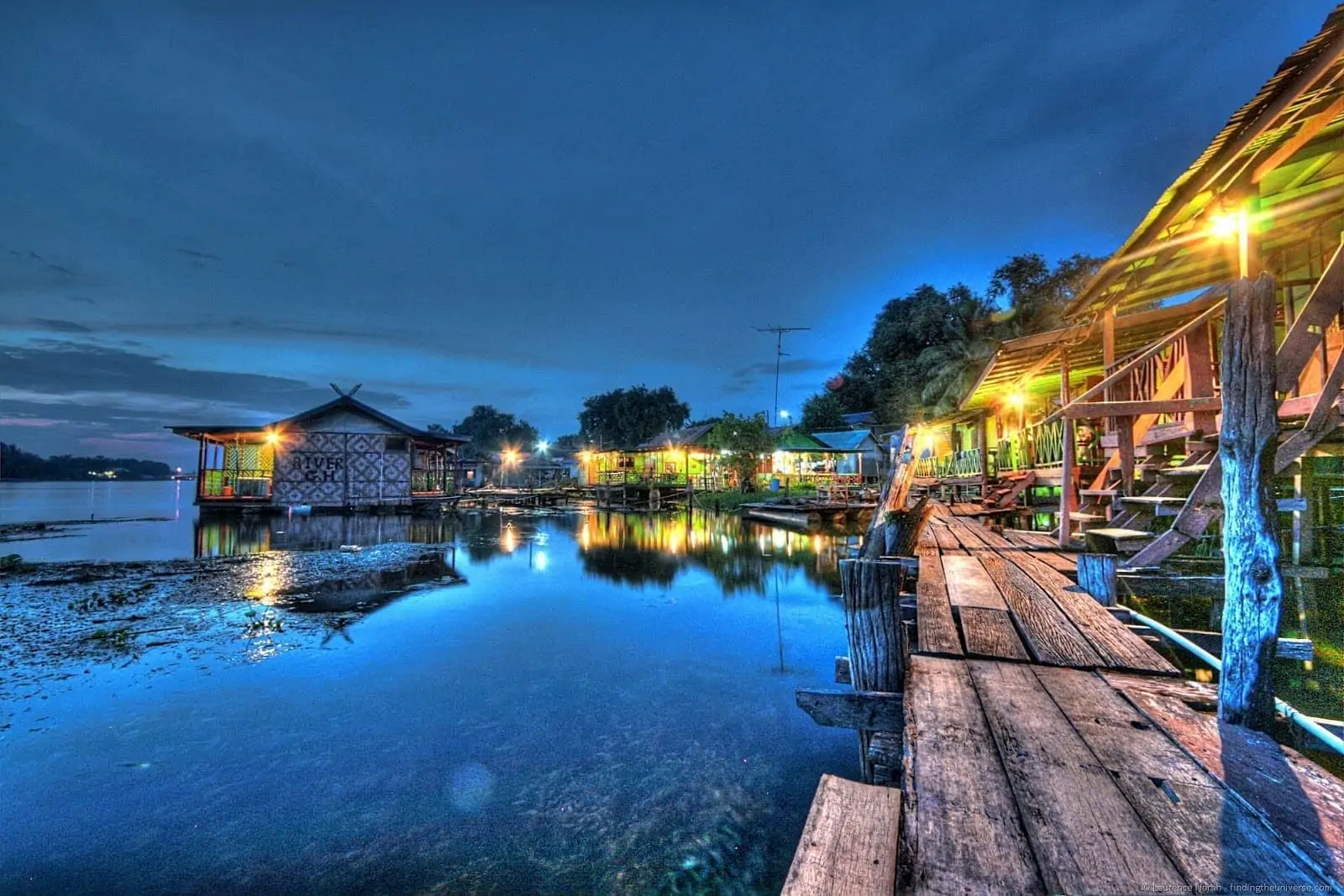
On a budget, we stayed at the River Guest House, which was rustic in the truest sense but wonderfully quiet, full of character, a real bargain, and an easy walk from the train station. When we visited we just turned up on the day. It won’t suit everyone, but we liked it.
For mid-range rooms, look at the stretch between the bridge at the northern end and the war cemetery, where a run of riverside hotels and guesthouses covers the two to three star range. For something smarter, a few larger resorts sit further out along the river, trading the easy walk into town for more space and quiet. Either way, rather than point you at a specific place I haven’t stayed in, I’d browse the current Kanchanaburi listings on Booking.com, filter by price and read a few recent reviews to get a feel for a place before you commit. If you’re arriving without a booking, dropping into a couple of places in person to compare rooms is still a perfectly good way to do it here.
Books and planning resources
If you like to plan with a proper guidebook, the Lonely Planet Thailand guide covers Kanchanaburi alongside the rest of the country and is a solid companion for a longer trip. And if this is one stop on a bigger Thailand adventure, our two week Thailand itinerary shows how it fits with Bangkok, the north and the islands.
That about sums up our thoughts on Kanchanaburi. It’s a town I’d tell you to give more than a passing glance, and one of the few places where a planned two days can quietly turn into eight. Have you been, or are you thinking about going? Anything you’d add? Let us know in the comments below.
Kanchanaburi FAQ
Is Kanchanaburi worth visiting?
Yes. It’s one of the most rewarding trips you can make from Bangkok, combining important Second World War history around the Death Railway with waterfalls, cave temples and easy countryside. Give it a night rather than a rushed day trip and you’ll get far more out of it.
Can you visit Kanchanaburi as a day trip from Bangkok?
You can, and many people do. In a single day you can see the bridge over the River Kwai, one of the war cemeteries and a museum.
What you’ll miss is everything that takes time: the Erawan Falls, Hellfire Pass, and a ride on the railway itself. If those appeal, stay overnight instead.
How do you get from Bangkok to Kanchanaburi?
The main options are the ordinary train from Bangkok’s Thonburi station, a minivan or bus, or a private transfer. Trains leave Thonburi at around 07:50 and 13:55, take roughly two and a half hours, and cost foreigners a fixed 100฿.
Minivans are usually a little quicker at two to three hours depending on traffic. A private transfer or a guided tour is the most hassle free choice if you’d rather have it all arranged.
How many days do you need in Kanchanaburi?
Two days and one night works best for most people. That gives you time for the war sites, the Erawan Falls and a ride on the railway without rushing.
A day trip works if you only want the bridge and the cemeteries, while three days or more lets you add Hellfire Pass and the outlying temples.
How much does it cost to enter Erawan Falls?
Foreigner entry to Erawan National Park is 300฿ for adults and 150฿ for children. There’s a small extra charge for a bicycle or car.
The falls are open through the day, and it’s worth arriving early to have the upper tiers to yourself before the tour groups reach them.
Is the bridge over the River Kwai the original bridge?
Mostly, but not entirely. Allied aircraft bombed the bridge in 1945 and destroyed two of the central spans, which were replaced after the war with angular steel trusses supplied by Japan as reparations.
The rounded, curved spans are the wartime originals. The river’s name is also a bit of a story: this stretch was renamed the Khwae Yai in 1960 to match the famous film.
Is the Tiger Temple in Kanchanaburi still open?
No. The Tiger Temple (Wat Pha Luang Ta Bua) was closed by Thai authorities in 2016 after more than a hundred tigers were removed and evidence of wildlife trafficking was uncovered. It has not reopened.
Don’t confuse it with Wat Tham Sua, the Tiger Cave Temple, which is an unrelated and perfectly legitimate hilltop temple worth visiting.
When is the best time to visit Kanchanaburi?
The cool, dry season from November to February is the most comfortable and the best for walking and cycling, though it’s also the busiest.
March to May is very hot but quieter, while the green season from June to October brings rain but also the fullest, most dramatic waterfalls.
David says
Thank you very much for this article! One question, could you be a bit more specific about the River Guest House as a budget option? It looks charming and I would like to stay there (with my girlfriend for one or two nights), at the same time I usually book an accommodation in advance so I know what to expect and how much to pay. Thank you 🙂
Laurence Norah says
Hey David – when we stayed here it was around 400 baht a night, but I’ve looked all over and can’t find a website for the property that lets you book in advance. So if you prefer to book in advance, then this might not be the one for you 🙁
Teresa says
I highly recommend doing a quick Google search of Tiger Temple before you decide to go and support them.
Laurence says
Agreed, I didn’t add it to the post as it wasn’t a place I was happy to recommend.
james riley says
I was at tiger temple in Chiang Mai years ago; and I thought it was an expensive ripoff. My wife realized she was afraid of the middleage selection she had made; and wanted to change. They were gonna make her pay all over again. It seemed like purely a profit motivated tourist trap; and the employees did not display the normal Thai courtesy. I do not recommend it…
Laurence Norah says
I would definitely not recommend the Tiger Temple. It was closed down for trafficking in Tigers (http://www.newsweek.com/tiger-temple-thailand-40-dead-cubs-tourism-465654), and there have been multiple reports of tigers being drugged well before that.
Teresa says
Headed there tomorrow for 5 days. Staying at the Sky Resort in town (it has a pool and I have a 5 year old – a match made in heaven). Would you recommend scootering to the falls? We’ve lived in Chiang Mai for the past 4 months and have scooters and take them everywhere. Just curious how long the drive is by bus/scooter and which makes more sense. Thanks for the great tips, by the way!
Laurence says
Hi Teresa! Sounds great. The bus ride, from memory, was around 45 minutes to an hour, so a scooter might be a little faster. Really up to you in terms of your comfort zone on a scooter 🙂