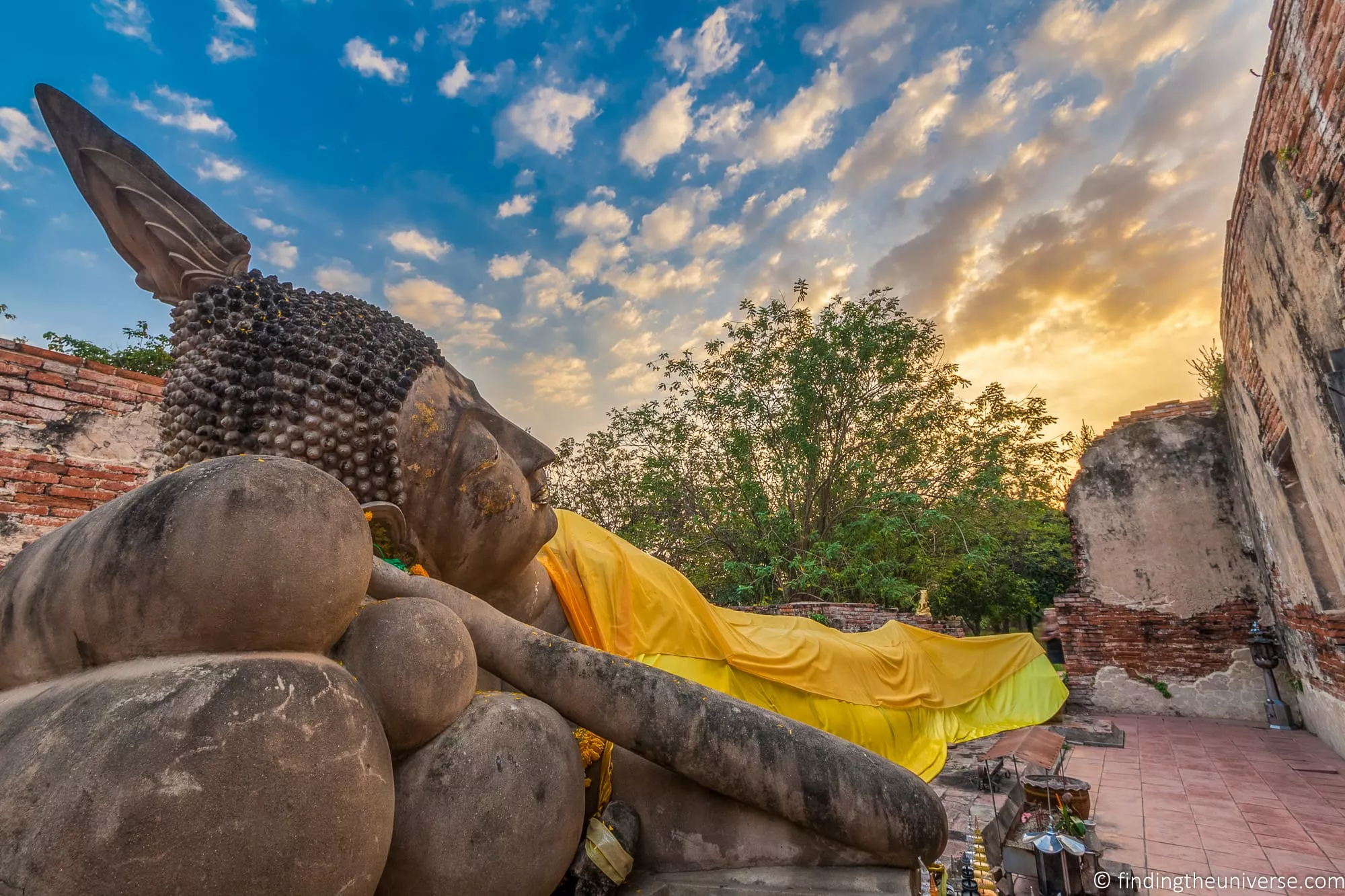
If I asked you to name the largest city in the world around the year 1700, I wonder where you might suggest. London? Paris? Beijing? Cairo?
I’m going to guess that the city of Phra Nakhon Si Ayutthaya (or simply Ayutthaya, as everyone calls it today) didn’t make your shortlist.
Well, by around 1700 Ayutthaya was the capital of the Ayutthaya Kingdom (the precursor to modern Thailand), and its population had reached roughly a million people, making it one of the largest cities in the world. Foreign traders from France, Holland, Portugal, China and Japan all maintained settlements here. It was an enormous, cosmopolitan, water-bound capital, and visitors from Europe wrote home in some amazement about it.
Unfortunately for the Kingdom of Ayutthaya, the Burmese-Siamese War culminated in the sacking of Ayutthaya in April 1767, after a 14-month siege. The majority of the city was burned to the ground, including the 14th-century Grand Palace, and the Burmese carted off the gold, the artisans and the royal artefacts. This marked the end of the Kingdom of Ayutthaya. The Siamese state moved its capital first to Thonburi and then to Bangkok, and Ayutthaya never recovered its former glory.
Today, the city still exists, and you can visit. It was re-founded in the years after the sack, and a new town grew up around and beside the remains of the original. Not a huge amount was left, admittedly. Much of the city had been made of wood, which didn’t survive the fires or the centuries that followed.
What remains was mostly brick and stone, which is to say: temples, prangs, statues, and the long shadow of a vanished royal capital. The whole historical park is a UNESCO World Heritage Site, inscribed in 1991 as the Historic City of Ayutthaya.
Being less than two hours by train from Bangkok, Ayutthaya is one of the most popular day trips from the capital, and it fits as a one-day or two-day block inside a broader 10-day Thailand itinerary or two-week Thailand trip.
We’ve spent four full nights there back in our pre-blog days, and didn’t regret a single one. I took the photos that follow on our visit. This guide covers the temples worth your time, a one-day plan if Bangkok is your base, the day-trip-or-overnight call, and the 2026 logistics, because the Bangkok station situation has changed.
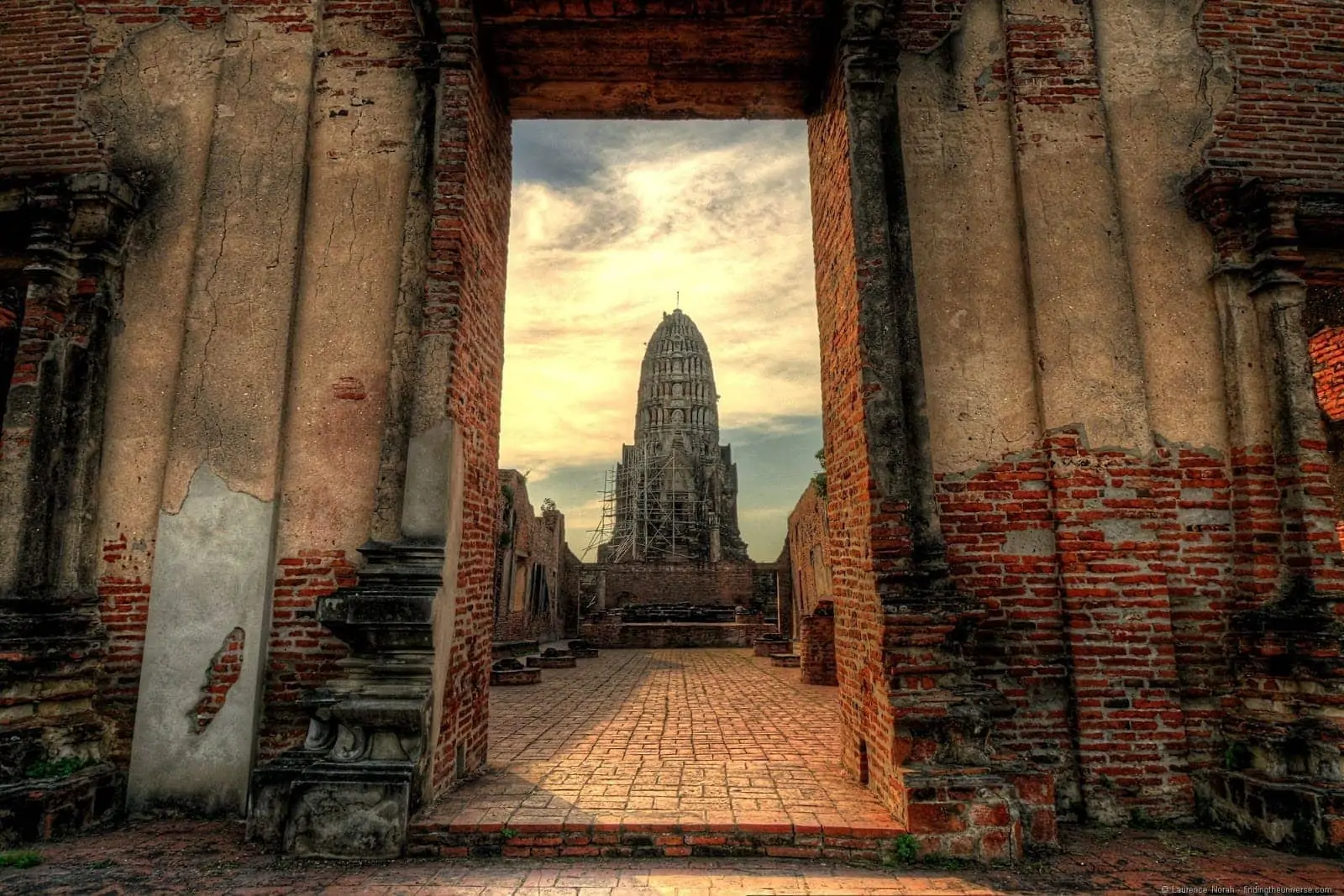
Table of Contents:
Quick Verdict: Ayutthaya in a Box
- Day trip or overnight: Day-trippable from Bangkok if you start early (06:00 to 07:00 train from Krung Thep Aphiwat) and commit to one sunset choice. An overnight is the better experience: you get Wat Chaiwatthanaram at dusk, cooler mornings, and a chance to see beyond the headline five temples.
- Essential temples: Six. Wat Mahathat, Wat Phra Si Sanphet, Wat Ratchaburana, Wat Chaiwatthanaram, Wat Phutthaisawan and Wat Yai Chai Mongkhon. A day fits them tightly; two days fits them comfortably.
- Cost for a day: Around 320 THB in temple fees if you buy the six-temple combo pass (220 THB) plus Wat Yai Chai Mongkhon (20 THB) plus a couple of off-pass extras. Bikes 50 to 100 THB a day, tuk-tuk half-day 800 to 1,200 THB negotiated.
- Best time to go: November to January for the cool dry season. Hot and humid the rest of the year, and the wet season afternoons are unreliable for the sunset shots.
- Sunset: Wat Chaiwatthanaram across the river from the opposite bank. The temple itself is closed at sunset for most of the year, but the riverbank view is the iconic shot. Inside-at-night access only runs during the cool-season “Ayutthaya Nawa” festival (typically late December to early February, dates announced by TAT each October).
Things to Do in Ayutthaya: The Essential Temples
Ayutthaya has hundreds of temples and ruins, of which several dozen are visitable and a handful are essential. Here’s our shortlist of the six you shouldn’t miss, plus the case for visiting the Tourist Office first.
The Tourist Information Office
I know, I know. Ayutthaya has all these crumbly epic ruins to see, and I’m suggesting a visit to the Tourist Office. But there’s a good reason for that.
First, you can pick up a free map of the city. Free is good, and the map lists all the highlights with a sensible suggested route. Second, and more importantly, the tourist office building also hosts an excellent exhibition on Ayutthaya, detailing the rise and fall of the city, with an overview of the food, the people and the sights. It’s a good place to get your bearings before setting off for the temples proper, and to pick up the historical facts that your school history lessons quietly skipped over.
The office sits near the main traffic circle close to the historical park, and is open daytime hours. As of 2026 it’s still operating, the exhibition is still free, and the maps are still where they ought to be.
1. Wat Phra Mahathat
Wat Phra Mahathat is famous for the Buddha head entwined in the roots of a banyan tree. You’ve seen the photo. Everyone takes it. It’s still worth taking yours.
There’s more to the temple than the head in the tree, though, despite what photos might lead you to believe. The complex covers a decent acreage of prangs, ruined chedis and dozens of weathered Buddha statues in various states of repair. The headless seated Buddhas along the eastern wall are quietly moving, in a way the busier banyan-tree corner can struggle to match.
Mahathat is included on the 220 THB six-temple combo pass, or 50 THB individually. Daily 08:00 to 17:00. If you want the head-in-tree shot without the queue, get there at opening (when we visited, we caught the morning light before the first coach groups arrived, which made the difference).

2. Wat Phra Si Sanphet
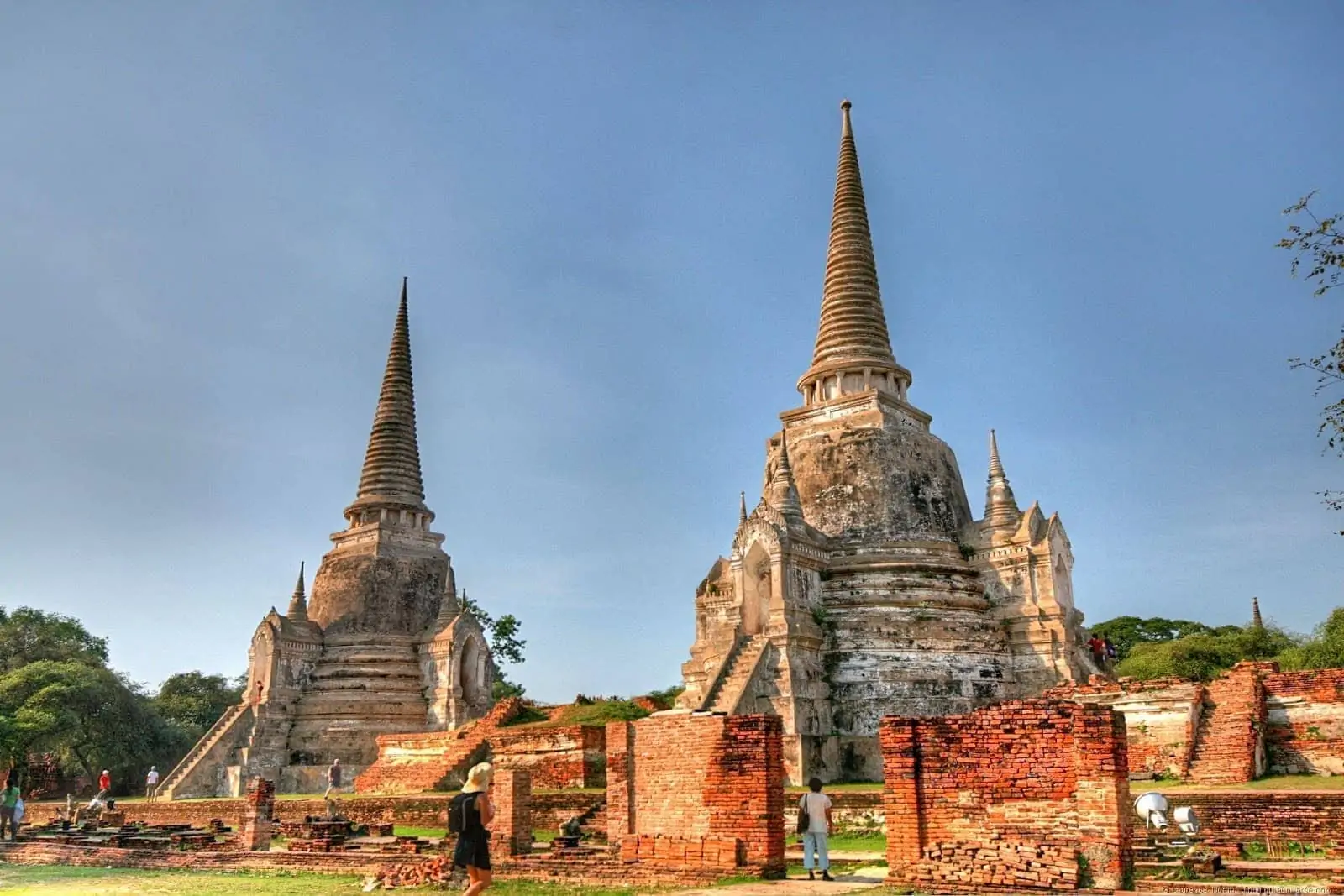
The largest temple in Ayutthaya, and the one you can’t really skip. The main draw is the three enormous bell-shaped chedis in a row, which you’ll see featured as the symbol of Ayutthaya on everything from souvenir mugs to the front of the historical park’s own brochure. They’re large, photogenic, and, depending on your lens, impossible to fit in a single frame.
Fun fact: this used to be the home of a giant Buddha covered in roughly a third of a tonne of gold! The Burmese invaders found that to be just too tempting, and melted it down as part of their pillaging. There’s a replica statue at the neighbouring Wihan Phra Mongkhon Bophit, just to the south, where a 12.5-metre seated Buddha sits in a more modern hall and is one of the largest bronze Buddha images in Thailand. Worth a five-minute detour while you’re already there.
Phra Si Sanphet is on the combo pass, 50 THB individually. Hours typically 08:00 to 18:00, though some sources say 08:00 to 17:00, so plan to be done by 17:00 to be safe. Wihan Phra Mongkhon Bophit is free and active (working temple).
3. Wat Ratchaburana
Wat Ratchaburana sits directly opposite Wat Mahathat, which makes pairing them sensible, and on a day-trip schedule, essential. The headline feature is the central prang, which you can climb up via a set of steep brick steps and then descend (via a seriously steep set of stairs) into a small crypt at its base.
The crypt is the bit most visitors don’t expect. Two levels, dark, narrow, with faded original frescoes still visible on the walls and, depending on visit timing, almost no one else inside. You’re standing in a 15th-century burial vault built for the ashes of a pair of brothers who killed each other in a royal succession fight (the temple was built in their memory). It’s the closest you’ll get to having a piece of ancient Ayutthaya entirely to yourself. If you’re claustrophobic or unsteady on stairs, view from the prang base and skip the descent.
Combo pass, 50 THB individually. Daily 08:00 to 17:00.
4. Wat Chaiwatthanaram
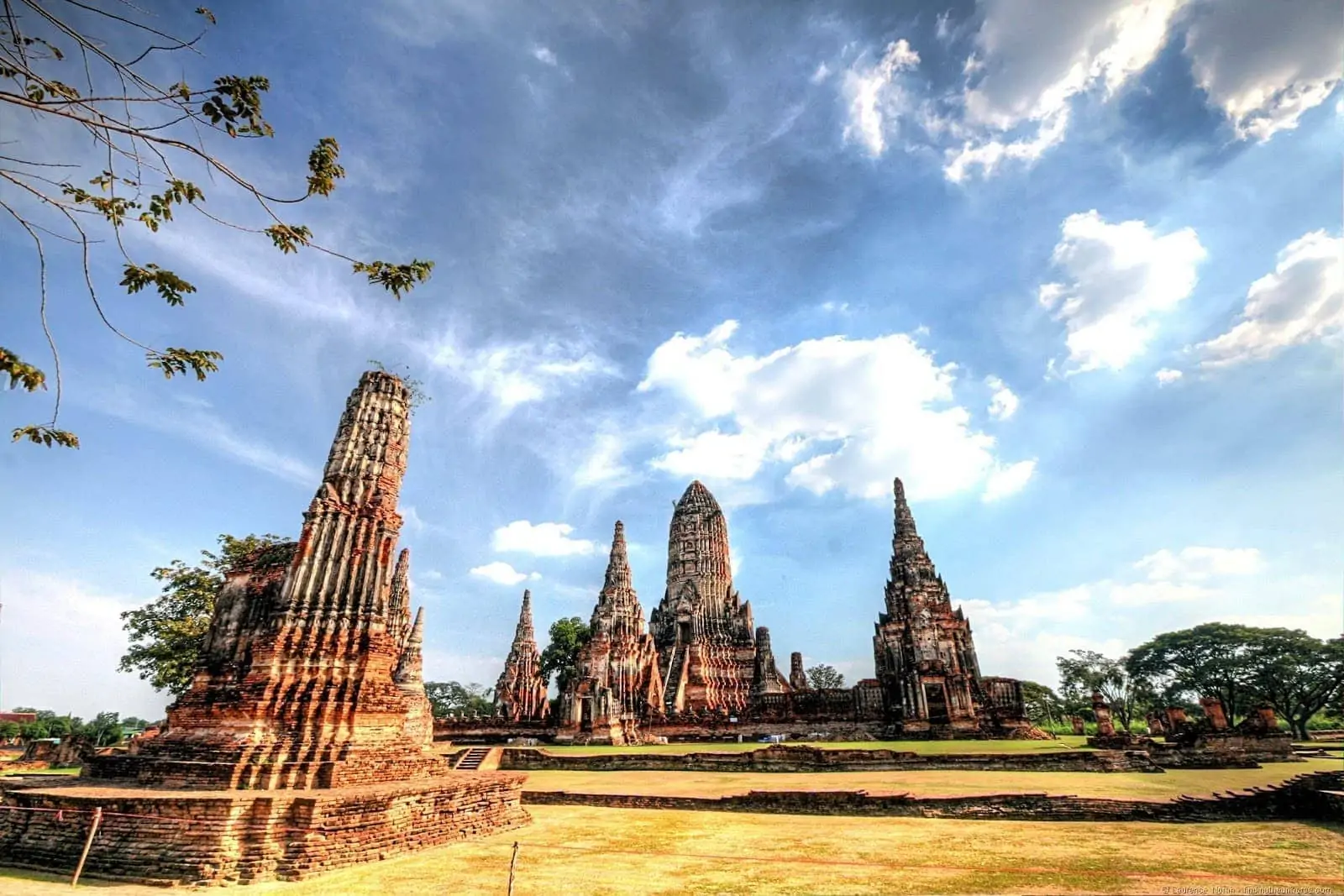
One of the most photogenic temples in Ayutthaya, sitting in Khmer style on the west bank of the river, with a tall central prang surrounded by four smaller prangs at the cardinal points, eight perimeter chedi-meru shrines, and rows of seated Buddha statues. Normally you can wander the perimeter, climb the lower base level, and get up close to the carvings.
When we visited, flood damage had resulted in the temple being closed. The bad news was we couldn’t climb anything. The good news was nobody else could either, so the pictures came out happily people-free. And the lack of access also meant the entry fee was waived. So it wasn’t all bad news.
A note on sunset, because this is one of the most-photographed sunset spots in Thailand and the expectation can run ahead of the reality. The classic sunset shot is taken from the opposite riverbank, looking back across the water at the temple silhouette. For most of the year, the temple itself closes at 18:00 or 18:30, so you’re viewing from across the river or from a boat. That’s the iconic shot.
The only time you can be inside the temple at sunset is during the annual “Ayutthaya Nawa” night-heritage programme, which typically runs daily from late December to early January, then weekends only through to early February. Dates change yearly, announced by the Tourism Authority of Thailand around October. If you’re in Ayutthaya outside that window, plan for the riverbank shot, not the inside one. There’s a small cluster of riverside cafés on the east bank that serve as decent sunset platforms.
For day-trippers who’ll need to be on the 17:00 or 17:30 train back, the better play is to swap the sunset for a morning visit when the temple is quiet and the light is east-facing on the prangs. Either decision is defensible, but trying to fit both kills the schedule.
Combo pass, 50 THB individually. Hours 08:00 to 18:00 (some sources say 18:30, but 18:00 is the safe assumption).
5. Wat Phutthaisawan (also written Wat Buddhaisawan)
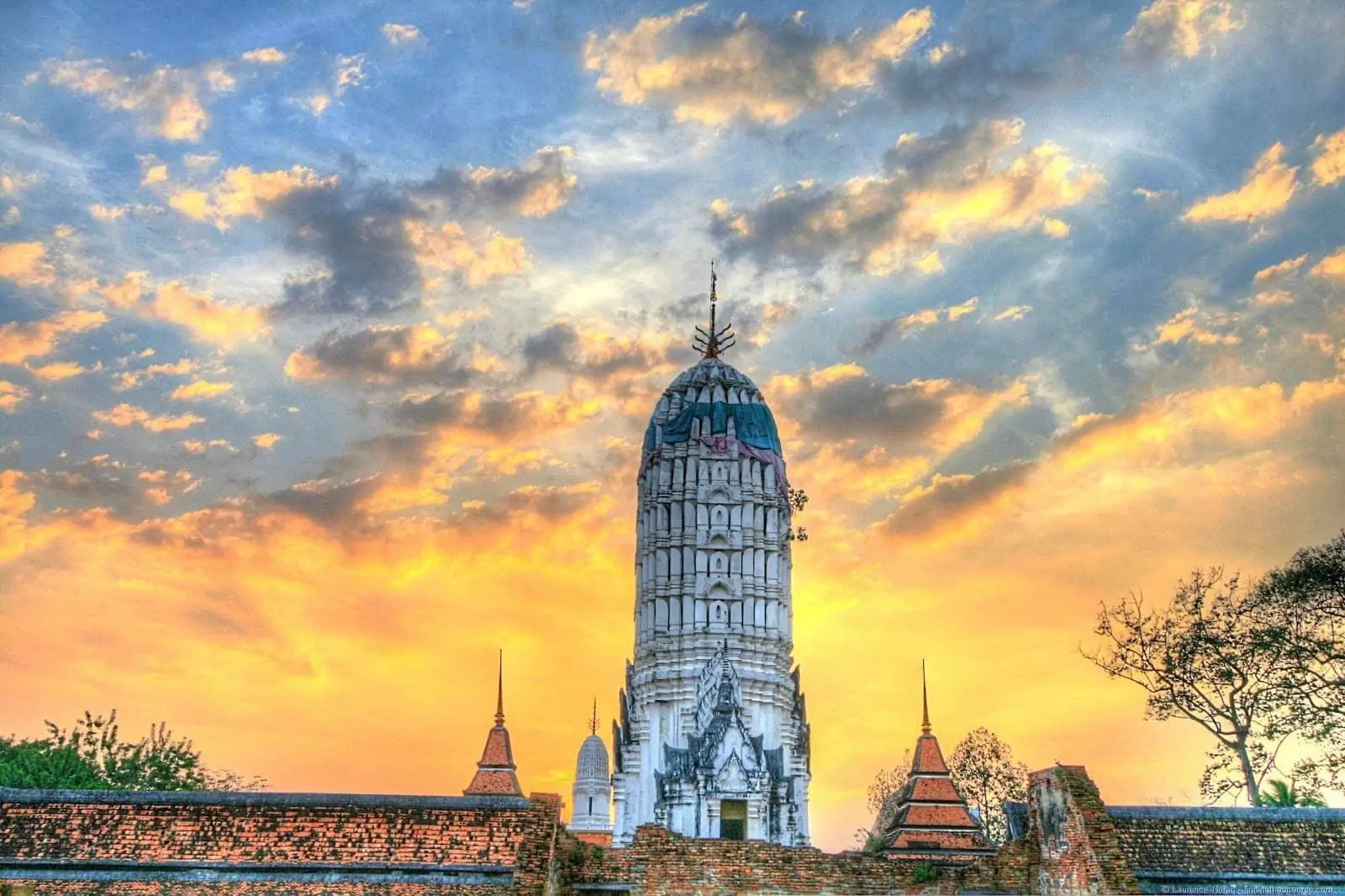
A bit out of the way on the south bank of the Chao Phraya, Wat Phutthaisawan is one of the few major historical-park temples that’s still an active monastery, which is why entry is free (it’s a working religious site, not a museum). The compound feels noticeably calmer than the central historical park, with a tall central Khmer-style prang, a lovely courtyard lined with rows of intact seated Buddha statues, and the King Naresuan Memorial in a hall to the side.
It’s a useful temple to visit if you want a sense of what the other ruins in Ayutthaya might have looked like before the Burmese sack. The Buddhas here have heads (which the temples in the central historical park largely don’t), the prang is intact, and the maintenance is current.
There’s a small ferry crossing from the north bank that gets you here for a few baht and saves the tuk-tuk fare. On our own visit, the ferry was as much of a highlight as the temple itself. Some ruined sections sit behind the main compound if you want to walk further.
Free entry. Active temple, so dress modestly (shoulders and knees covered).
6. Wat Yai Chai Mongkhon
South-east of the island and away from the historical park core, Wat Yai Chai Mongkhon is the temple most worth a tuk-tuk detour. It’s another working monastery, dominated by an enormous central chedi which you can (and should!) climb. The view from the top takes in the surrounding fields and the full row of saffron-robed Buddha statues at the base, worth the heat of the climb.
The standout feature is the reclining Buddha at the rear of the compound, draped in saffron cloth and a great deal larger than you expect. The chedi itself has a small relic chamber at the base. The atmosphere is closer to a living temple than to a tourist site, which is part of the appeal.
Entry is 20 THB (note: not on the 220 THB combo pass, it’s a separate ticket), and it’s daily 08:00 to 17:00. Allow 45 minutes to an hour, plus 15 to 20 minutes each way by tuk-tuk from the island.
Temple Fees in Ayutthaya
The majority of the temples in the historical park have an entry fee, paid at each temple’s entrance. The exception is active temples (Wat Phutthaisawan, Wihan Phra Mongkhon Bophit), which are free to enter.
Major historical-park temples are 50 THB for foreigners (free for Thais). Smaller temples can be 20 THB or free. The single best-value option is the six-temple combo pass, which costs 220 THB and is valid for 30 days from first use. It covers:
- Wat Mahathat
- Wat Phra Si Sanphet
- Wat Ratchaburana
- Wat Chaiwatthanaram
- Wat Phra Ram
- Wat Maheyong
The pass works out to 80 THB cheaper than buying individual tickets, so it pays for itself once you’ve visited four of the six. If you’re going to visit at least four (and most visitors do), buy the combo. Bought at the entrance to any of the included temples.
A couple of useful exceptions to know about:
- Wat Yai Chai Mongkhon: 20 THB, separate ticket, not on the combo.
- Wat Phutthaisawan: free, active monastery.
- Wihan Phra Mongkhon Bophit: free, active.
Keep your combo-pass ticket on you. Some temples scan or check on entry; others won’t, but it’s not worth the gamble.
A One-Day Ayutthaya Itinerary (Bangkok Day Trip)
This is what we’d plan if we were coming from Bangkok for the day. It’s tight but realistic: five temples (or six if you cut lunch shorter), a sit-down meal, and a sunset choice.
06:30. Depart Bangkok from Krung Thep Aphiwat (Bang Sue Grand Station) on a morning express train. Journey takes about 90 minutes door-to-door.
08:00. Arrive Ayutthaya. Cross the river by local ferry (a few baht) to the island. Negotiate a tuk-tuk for the day (target 800 to 1,000 THB for a half-day temple route) or hire a bike (around 50 to 100 THB).
08:30. Wat Mahathat. Get the head-in-tree shot before the coaches arrive. Allow an hour.
09:30. Wat Ratchaburana, right across the road. Climb the prang, descend into the crypt. Allow 45 minutes.
10:30. Wat Phra Si Sanphet plus Wihan Phra Mongkhon Bophit (the giant gold Buddha) next door. Allow an hour total.
11:30. Lunch. Pick somewhere indoors or with proper shade, because midday in Ayutthaya is brutal. Either head to one of the riverside restaurants on the south bank (boat noodles, grilled river prawns), or to the cluster of cafés near the historical park entrance. Allow 75 minutes (you’ll want it).
12:45. Hot tip: the midday hours are when you’ll be most tempted to power on. Don’t. Take the full lunch and drink more water than you think you need. The temples aren’t going anywhere.
13:00. Wat Yai Chai Mongkhon. Tuk-tuk south-east of the island (about 15 minutes). Climb the chedi, see the reclining Buddha. Allow an hour.
14:30. Wat Chaiwatthanaram. Tuk-tuk back across the river to the west bank (about 20 minutes). Walk the perimeter, climb the lower base level. The afternoon light on the prangs is the second-best photographic moment after the cross-river sunset itself.
16:00. Coffee or a cold drink at one of the riverside cafés on the east bank, looking back at Chaiwatthanaram. If you’re staying for sunset, this is your perch. If you need the 17:00 train, skip the sit-down and head straight to the station.
16:45. Tuk-tuk back to the station.
17:00 or 17:30. Train back to Bangkok. Arrive Krung Thep Aphiwat around 18:30 to 19:30.
That’s six temples, lunch, and a sunset view if you can swing it. Door-to-door from Bangkok it’s about 13 hours, which is a long day but not an unreasonable one. The traveller who tries to add a seventh temple, or to wedge in Bang Pa-In Palace on the same day, will end up rushing, hot and disappointed. Five or six is the day-trip ceiling.
Day Trip or Overnight?
Both are viable, but the overnight is the better experience, and here’s why each makes sense.
Day-trip from Bangkok if:
- You have a tight Thailand itinerary and Bangkok is your base for a few days
- You’re happy with the cross-river Chaiwatthanaram sunset rather than inside-the-temple access
- You’re a confident early-starter (06:30 train means 05:30 alarm)
- You want a tour to handle the logistics (we’d take a small-group tour over going solo for the day-trip version, especially if it includes lunch)
Stay overnight (one or two nights) if:
- You want Wat Chaiwatthanaram lit at night (a permanent feature, the perimeter is illuminated nightly from dusk even when the inside is closed)
- You want early-morning temple visits (Mahathat at 08:00 with no one else around is a different experience)
- You want to add Bang Pa-In Palace, the Million Toy Museum, or one of the second-tier temples without rushing
- You’re shooting photographs and care about the morning light
- You’d rather not run a 13-hour door-to-door day
We’ve been there for four full nights ourselves. We don’t think two are wasted, but we’d say two is the right number for most people. Of course, if you want to do a day trip and the schedule fits, it’s still the third- or fourth-most famous archaeological site in Thailand. You won’t leave empty-handed.
A Two-Day Ayutthaya Itinerary (Overnight)
If you’re staying over, the first day is the one-day plan above, finishing with the cross-river Wat Chaiwatthanaram sunset and a riverside dinner rather than the dash to the station. Then day two is for the second-tier sights.
Day two suggestions, pick three or four:
- Bang Pa-In Palace: 18 km south of Ayutthaya, the summer palace of Thailand’s royal family. A working royal residence with pavilions in Thai, Chinese and European styles, formal gardens, and a strict dress code (shoulders and knees covered, no leggings, jeans okay if not ripped). Sarongs and shirts available to hire at the entrance for a small fee. 100 THB for foreigners, daily 08:30 to 16:00 (ticket sales stop around 15:30). Allow two hours. Easy to wrap into the return-to-Bangkok leg if you’re train-hopping back via the Bang Pa-In station.
- Chao Sam Phraya National Museum: The main archaeological museum, holding most of the gold and decorative items recovered from the Wat Ratchaburana and Wat Mahathat crypts in the 1950s and 1960s. Well worth a visit for the context. Open 09:00 to 16:00, closed Mondays and Tuesdays (this catches a lot of visitors out). Foreigner fee around 150 THB, double-check on arrival.
- Million Toy Museum: An eccentric private collection across two floors, featuring Thai and imported toys from the late 19th century onwards. It sounds like a tourist trap and turns out to be quite brilliant. 50 THB adults, closed Mondays, open 09:00 to 16:00 Tuesday to Sunday.
- Wat Phra Ram: On the combo pass, a quieter ruin in the centre of the island, often under restoration but worth a quick wander. 50 THB or use the pass.
- Wat Maheyong: Also on the combo pass, off the eastern side of the island. Less photographed but still atmospheric. 50 THB or pass.
- An evening river cruise: Several operators run sunset and evening cruises around the island, taking in the riverside temples lit at night. Worth doing once if you’re staying over.
That’s plenty for a leisurely day two with morning and afternoon coffee breaks. A third day starts to feel completionist, although if you’re a photographer or a serious history buff, you’ll find things to fill it (we did).
How to Get Around Ayutthaya
Our preferred method when we stayed was on foot. Almost no one else in Thailand appears to travel by foot, so we were the odd ones out! But the historical park core is compact enough to manage on shoe-leather for the central temples, which saves the negotiation faff with a driver.
That said, you’ll want some sort of transport for the off-island temples (Phutthaisawan, Yai Chai Mongkhon) and for Wat Chaiwatthanaram on the west bank.
The options:
- Bicycle: 50 to 100 THB a day for a basic single-speed or geared bike, available from rental shops near the train station, along Naresuan Road, and at most hotels. Electric bikes are a newer option at 150 to 300 THB. Bikes work well for the island core, less well for the river crossings and the heat of midday.
- Tuk-tuk: Hire by the hour (200 to 300 THB) or half-day (800 to 1,200 THB) for a route that takes in three or four temples plus river crossings. The drivers at the train station tend to quote higher to walk-ups than the ones organised by hotels. Agree the price and the route before getting in.
- Songthaews: The covered pick-up trucks that act as local buses, with fixed prices and set routes. Useful if a route happens to fit yours, less useful if it doesn’t. Ask a local before flagging one down.
- Local ferry crossings: Several small ferry points along the river run inexpensive crossings (usually 4 to 5 THB). Not signposted in English, but ask any local for “ferry” and a finger will be pointed. The crossing from the north bank to the south bank by Wat Phutthaisawan is particularly handy.

Getting There and Away (2026)
Ayutthaya sits 85 km north of Bangkok, easy to reach. The Bangkok rail situation has changed since older guides were written, so a word on that first.
Train (the easy way)
From Bangkok’s main long-distance terminus, Krung Thep Aphiwat (formerly Bang Sue Grand Station, which took over long-distance services from Hua Lamphong on 19 January 2023), there are around 16 services to Ayutthaya per day on the Northern and North-Eastern lines. The fastest express and rapid services do the journey in about an hour. Fares run from around 15 THB for third-class ordinary up to roughly 345 THB for an air-conditioned second-class seat on a faster express.
From Hua Lamphong, Bangkok’s older central station, ordinary commuter trains still run to Ayutthaya. There are around 11 ordinary services a day. The trip takes around two hours because of more stops, but the fares are absurdly cheap (third-class can be under 20 THB), and the windows-open meander has its own appeal. Eastern-line services and certain special trains also still depart from Hua Lamphong, so don’t write the station off if your guidebook does.
Schedule and tickets are bookable in English via the State Railway of Thailand: dticket.railway.co.th. You can also walk up and buy on the day, which works fine outside peak holiday weekends.
Ayutthaya’s train station is on the east bank of the river. To get to the historical park on the island, cross by local ferry (a few baht) or by tuk-tuk over the bridge.
Minivan (the fast way)
The Bangkok-to-Ayutthaya bus service has mostly converted to minivans, which depart from the Mo Chit New Van Terminal at Chatuchak. Departures are roughly every 20 to 30 minutes (vans leave when full rather than to a fixed timetable), the journey is 1 to 1.5 hours depending on traffic, and the fare is 60 to 100 THB for the standard operators, more for the air-conditioned express vans. Multiple operators run the route (Win 91, Tara Tour and others).
Faster than the ordinary train, less comfortable than the express train, and the depot situation can be a bit chaotic during peak hours. Vans drop you in central Ayutthaya, which saves the river crossing from the train station.
Boat (the slow but lovely way)
If you’d rather travel by water, a few operators run river cruises from Bangkok up to Ayutthaya (or back, depending on which leg). These aren’t scheduled services but day-tour packages, usually combining bus one way with river boat the other. Expect to spend the best part of a day on the water, with stops at riverside temples on the way, and a meal on board.
It’s a beautiful way to travel if you’re not pressed for time or cash, and the river views are the whole point.
When to Visit Ayutthaya
Ayutthaya is hot and humid most of the year. The best time to visit (as with much of central Thailand) is between November and January, when daytime temperatures sit in the high 20s to low 30s and humidity is more manageable. That’s the cool dry season, and it’s the window when wandering the temples is actually pleasant.
February to May is the hot season. Temperatures push well past 35°C, with little relief in the shade. The temples still work, but you’ll spend the day chasing shade and water. June to October is the wet season, when afternoon thunderstorms are routine. The morning is usually fine, but plan for a sudden afternoon downpour at any point, and don’t bet the day on a sunset shot.
A couple of dated highlights to plan around:
- Loy Krathong: Usually in November (full moon of the twelfth lunar month). Ayutthaya holds an “Ancient City” version of the festival with thousands of candle-lit floats released on the rivers. Really beautiful, and worth scheduling around if your dates are flexible.
- Ayutthaya World Heritage Fair: Annual celebration in mid-December marking the UNESCO inscription. Light shows, performances, food stalls around the historical park.
- “Ayutthaya Nawa” night-heritage programme: The cool-season programme that opens Wat Chaiwatthanaram inside-after-dark. Typically late December into early February. Dates announced by the Tourism Authority of Thailand each October.
Where to Stay in Ayutthaya
If you do decide to stay overnight (good choice), there’s no shortage of accommodation across budgets. Most of the visitor-friendly options sit on the island itself, within walking or short tuk-tuk distance of the historical park core.
A few specific picks to consider:
- Muster House: A well-rated and centrally-located hostel, ideal if you’re after a budget option close to the temples.
- Kantary Hotel Ayutthaya: A reliable mid-range option with an outdoor pool, free parking and a strong reputation for hospitality (430+ Booking reviews, 8.8/10 last we checked). A pretty nice spot to collapse in after a day of temples.
- Sala Ayutthaya: A boutique riverside hotel sitting directly opposite Wat Phutthaisawan, with rooms looking out over the Chao Phraya and a rooftop restaurant we’d recommend for dinner. The premium option, and worth it if your trip can stretch.
A full sweep of Ayutthaya accommodation on Booking.com covers everything from hostel dorms to private villas. The market is generally good value compared with Bangkok. If you’re basing yourself in Bangkok and just day-tripping out, our Lub D Bangkok review covers the hostel-with-character pick we’d recommend for budget travellers.
Field Notes From Four Nights in Ayutthaya
A few bits of practical wisdom from our four-night stay, plus a couple of things we’d do differently if we were doing the trip again today. All of it learned the hard way.
The midday heat is the real schedule constraint, not the daylight. You can theoretically pack more temples into a day, but you’ll be miserable by 14:00. Build a proper lunch break in. Allow more time for shade, water, cold drinks. Pacing yourself saves you from hitting a wall at 16:00.
Don’t try to fit Bang Pa-In into a day trip. It’s a separate half-day at minimum, and adding it to a day trip from Bangkok turns a busy day into a frantic one. If you really want Bang Pa-In, stay over.
Negotiate tuk-tuks before getting in. Drivers at the train station tend to quote higher than the going rate, which is fair (they have a moment of bargaining power). Agree the route and the price. A half-day for three or four stops should sit in the 800 to 1,000 THB range. If a driver insists on 1,500 THB upfront, walk over to the next one.
Save the lower-priority temples for early or late. Wat Phra Ram, Wat Maheyong and the smaller chedis are quieter, and the light is better at the edges of the day. Mid-morning to mid-afternoon belongs to the headline temples.
If you’re shooting Wat Chaiwatthanaram at sunset, get there at least 45 minutes early. The riverbank fills up. The boats churn the river. There’s a small cluster of cafés on the east bank that work as shoulder-room platforms. Bring a wide lens if you have one.
Confirm the temple-fee combo math before paying. If you’re visiting four or more historical-park temples on the pass list, the 220 THB combo is the right call. If you’re visiting three or fewer, individual tickets at 50 THB each are cheaper. The pass is non-refundable.
Carry small notes. Most temple fees, ferry crossings and tuk-tuk fares work better in 20 to 100 THB notes than 1,000 THB notes. ATMs are around, but break the bigger notes at a 7-Eleven on arrival.
Tours to Ayutthaya from Bangkok
For day-trippers who’d rather not faff with logistics, a small-group day tour from Bangkok handles transport, temple fees and lunch in one ticket, and is the easiest way to do the day-trip version. We’d lean towards the small-group format over the full-bus coach version, because the smaller groups move faster between sights.
A few options to consider:
- A small-group day tour from Bangkok with lunch included: Our pick for the standard day-trip format. Round-trip transport, four to five temples, lunch, English-speaking guide.
- A full-day small-group tour of the historical park: Similar shape, slightly different itinerary, also lunch-inclusive.
- A private full-day tour by bus: For travellers who’d rather not share. More expensive, more flexibility on the route.
- A combination day tour to both Ayutthaya and Khao Yai National Park: A long day but covers two of central Thailand’s headline sights in one go. Worth it if you’re not coming back. See our guide to visiting Khao Yai, which is a lovely national park well worth the time.
- A Viator full-day Ancient Temples tour including lunch: Another reliable small-group option, similar price point, slightly different operator.
- For a multi-day itinerary that includes Ayutthaya alongside other Thailand sights like Kanchanaburi, browse the multi-day Ayutthaya options on TourRadar, which surfaces a range of operators and durations.
As always, read the reviews and compare a couple of options. The right tour for a confident solo traveller is different from the right tour for a first-timer in Thailand.
Frequently Asked Questions
How many days do I need in Ayutthaya?
One full day covers the six essential temples if you start early and pace it well. Two days lets you add Bang Pa-In Palace, a museum, and the second-tier temples without rushing, plus the proper sunset and a sit-down dinner. We stayed four nights and didn’t regret it, but two nights is about right for most travellers.
Is Ayutthaya better as a day trip or an overnight stay?
Both work. Day-trip if Bangkok is your base for a tight itinerary and you’re an early starter (06:30 train means 05:30 alarm). Stay overnight if you want Wat Chaiwatthanaram lit at night, morning temples without crowds, or to add Bang Pa-In or the museums. The overnight is the better experience; the day trip is the more efficient one.
What does it cost to visit the temples?
The 220 THB six-temple combo pass is the best-value option, covering Mahathat, Phra Si Sanphet, Ratchaburana, Phra Ram, Chaiwatthanaram and Maheyong. Individual tickets are 50 THB each. Wat Yai Chai Mongkhon is a separate 20 THB ticket (not on the combo). Active monasteries (Wat Phutthaisawan, Wihan Phra Mongkhon Bophit) are free.
How do I get from Bangkok to Ayutthaya in 2026?
Train from Krung Thep Aphiwat (Bang Sue Grand Station) for long-distance express services, around 60 to 90 minutes. Ordinary commuter trains still run from the older Hua Lamphong station, around two hours. Minivans from Mo Chit New Van Terminal in Chatuchak run every 20 to 30 minutes, 1 to 1.5 hours, 60 to 100 THB. The express train is the most comfortable option.
Can I be inside Wat Chaiwatthanaram at sunset?
Only during the annual “Ayutthaya Nawa” night-heritage programme, which typically runs in the cool season (late December to early February, dates announced by TAT each October). For the rest of the year, the temple closes at 18:00 to 18:30 and the iconic sunset shot is taken from the opposite riverbank looking back at the temple silhouette.
When is the best time to visit Ayutthaya?
November to January is the cool dry season and the most comfortable window. February to May is the hot season (temperatures regularly past 35°C). June to October is the wet season with reliable afternoon thunderstorms. The temples function year-round, but the cool season is the easiest weather.
Is there a dress code for the temples?
For the active monasteries (Wat Phutthaisawan, Wihan Phra Mongkhon Bophit) yes, you’ll want shoulders and knees covered out of respect. For the historical-park ruins it’s less strict, but the same advice covers the heat as well as the etiquette. Bang Pa-In Palace has a strict dress code (shoulders, knees, no leggings; sarongs available for hire at the entrance).
Is Ayutthaya safe to visit?
Yes. It’s a quiet provincial city with a strong tourist infrastructure, low crime, and no particular safety concerns beyond the usual hot-country sensible-precautions (sun, hydration, mosquito repellent in the wet season). The temple grounds are easy to walk around and well-policed.
More Thailand Reading from FTU
A few of our other Thailand guides that pair well with this one:
- Our 10-day Thailand itinerary for travellers slotting Ayutthaya into a wider Thailand trip.
- Our two-week Thailand itinerary for the slower-paced version that adds northern and southern Thailand.
- Practical tips for not getting scammed in Thailand (tuk-tuk negotiation included).
- If temples are your thing, the White Temple of Chiang Rai and the Black Temple of Chiang Rai are an entirely different style of Thai religious architecture, well worth pairing with Ayutthaya.
- For staying in central Thailand longer, our Viva Chiang Mai homestay review covers a memorable budget stay further north.
- Our broader ten favourite places in Thailand for cross-country trip planning.
Further Reading
If you’re after more practical Thailand planning, the Tourism Authority of Thailand is the official starting point. For the UNESCO listing and the canonical history of the site, the UNESCO Historic City of Ayutthaya page is the authoritative source, and Wikipedia’s Phra Nakhon Si Ayutthaya entry has a strong history section.
If you’d rather hold a guidebook, the Lonely Planet Thailand remains the standard traveller’s reference, and Amazon carries a selection of other Thailand titles if you want to compare.
And that about wraps up our tips for a visit to Ayutthaya. Have you been to this ancient city, or were you (like me, the first time) oblivious to its existence? As always, let me know in the comments below.
Andrew Comte says
I loved visiting Ayutthaya. Will definitely make it back to see some more of the city. Excellent choice for temple seekers and history buffs.
Laurence Norah says
We loved visiting too!
Prasanna says
Hi guys,
Lovely post! We have been to Ayutthaya twice so far and we love the place. Regarding the river cruise from Bangkok to Ayutthaya… do you have any contacts of a cruise company that I can check with?
Thanks!
Laurence Norah says
Hi Prasanna!
Thanks very much 🙂 I don’t have any direct contacts, but your comment inspired me to add a section to the post on various tours, which includes some boat options. Looking at the tours on offer, most of the day trips from Bangkok offer the boat cruise in one direction only, with a bus in the other direction, presumably to save time. If you were looking to go one way and stay overnight, I think you’d have to look at another option – I couldn’t find anything but I’m sure they’re out there!
Best
Laurence
Shoestring Travel says
I recently travelled for the 5th time in Thailand and finally went to Ayutthaya… I did it on a budget and spent under $30 to see entire Ayutthaya… Ayutthaya is a must visit place for anyone traveling to Thailand.
Btw Greetings from India and I am also a Travel Blogger – If you plan to visit India let me know would love to show my city and country.
Laurence Norah says
We agree, it’s such a fantastic city to visit 🙂 Thanks very much for the invite, we’ve never actually been to India but it’s on our wishlist 😀
Gia says
Hi lovely couple! We will also be visiting ayutthaya next month, are there entrance fees in each temple? Thanks!
Laurence Norah says
Hi Gia!
The majority of the temples iN Ayuttaya that are in ruins do have an entry fee. Fees are usually around 50 baht for the main temples. Alternatively, there’s a temple pass available, which costs 220 baht, and includes six temples. I believe these are:
Chai Watthanaram
Wat Phra Si Sanphet
Wat Mahathat
Wat Ratchaburana
Wat Phra Ram
Wat Maheyong
You can pick this up at the entry to any of the above temples. It’s not a massive saving, but if you plan on visiting all the temples it’s worth getting 🙂
Have a great trip, let us know how it goes!
Laurence
Kim says
Hi Laurence and Jessica! Do we need to book a tour just to go to Ayutthaya or is it okay if we just go there and explore?
Thanks!
Laurence Norah says
Hey Kim! You definitely don’t need to book a tour, the city is a city, so it’s easy to go and explore yourself 🙂
David says
Hello Laurence and Jessica, you recommend us to visit the Ayutthaya’s Tourist Information Office, the thing is, it seems there is more than one in Ayutthaya (https://www.google.cz/maps/search/Ayutthaya+Tourist+Information+Office). Which one is the right one with an exhibition? Thank you very much!
Laurence Norah says
Hi David! Sorry for the slow response, we’ve been travelling. It’s this one: https://www.tourismthailand.org/Attraction/Ayutthaya-Tourist-Center–6236
Have a great trip!
Nancy says
Your photos are SO SO SO SO beautiful! I was thinking of visiting Ayutthaya for only a day but your post has convinced me to stay for at least 2-3 nights
Laurence says
Thanks Nancy! It’s a beautiful place with lots to do, you won’t regret it 🙂