
The Cliffs of Moher in Ireland are probably best known to a certain generation (mine) as the Cliffs of Insanity from The Princess Bride. If you’re in that generation, you already know what they look like. If you’re not, picture a wall of rock rising 200 metres straight out of the Atlantic, and you’re most of the way there. There’s no six-fingered man up there, sadly. Only cliffs and crowds. And the kind of wind that makes you regret not bringing a proper jacket.
Jess and I have been to the Cliffs of Moher more than once over the years, but the trip I want to tell you about here is the day trip we took out from Dublin, because that’s how most people end up visiting them. If you’re basing yourself in the capital first, our 2-day Dublin city itinerary covers the highlights before you head out. I walked away with a photograph I’m really proud of, and a story involving a man named Roy who I briefly suspected of being an Irish cliff serial killer. I’ll get to both. But first, the practicalities.
Table of Contents:
Where Are the Cliffs of Moher?
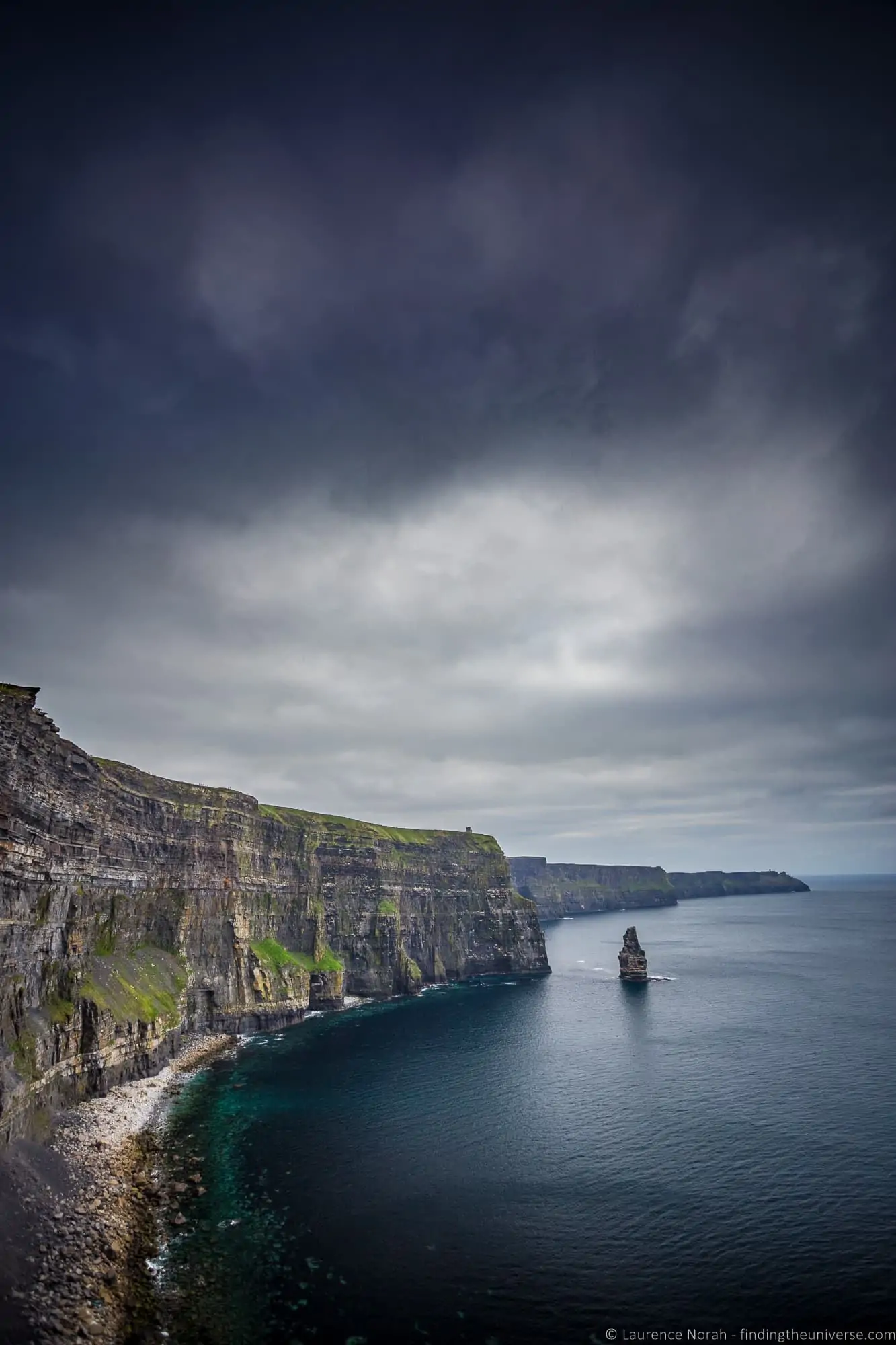
The Cliffs of Moher sit on Ireland’s west coast, in the Burren region of County Clare. They run for about 8 kilometres along the coast and reach 214 metres at their highest point, which is roughly where O’Brien’s Tower stands. On a clear day you can see the Aran Islands sitting out in Galway Bay, and if you’re lucky and the weather behaves, the Twelve Bens mountains of Connemara further north.
The closest towns are Lahinch (about 15 minutes drive south) and Doolin (about 10 minutes north). Either works as a base if you’d rather not do the cliffs as a day trip from somewhere further afield.
How Far Are the Cliffs of Moher from Dublin?
About 270 kilometres, or 170 miles. The drive takes around three hours each way, depending on traffic, and is mostly motorway. From Galway it’s a much shorter run, around 90 minutes. From Limerick or Shannon airport you’re looking at roughly 75 minutes.
It’s worth being honest with yourself about that distance from Dublin before booking anything. Six hours of driving for a few hours at the cliffs is a long day. Doable, definitely, but a long day.
How to Get to the Cliffs of Moher from Dublin
You have three realistic options.
1. Take a Day Tour from Dublin
The easiest by some distance, and what we did. Someone else handles the driving (the Irish roads on the west coast are not exactly motorway), you get a fair amount of time at the cliffs, and most tours throw in a few additional stops on the way back so the day doesn’t feel like one long bus journey punctuated by ninety minutes of cliff. This is a popular tour to look at as a starting point.
Specific tour recommendations are further down. If you’re booking now, just know that this is the option I’d pick if I was doing the trip again from Dublin without a car.
2. Public Transport
Possible, but it takes some patience. There’s no direct bus from Dublin. The route is Dublin to Galway first (by train or direct bus, 2.5 to 3.5 hours), then from Galway, take Bus Éireann’s Route 350, which runs from Galway to Ennis via Doolin and the Cliffs of Moher. The 350 takes a bit over two hours from Galway to the Cliffs.
There’s also a newer option, the TFI Local Link Route 351, which runs four daily services in each direction between Galway and the Cliffs and stops at coastal locations the 350 no longer covers. Useful to know if you want to combine the cliffs with a stop somewhere along the coast.
Doing this as a day trip from Dublin by public transport is, frankly, tight. You’d likely need to overnight in Galway either side. If that suits your schedule it’s doable, but if you’ve only got a day, the tour bus is the right call.
3. Drive Yourself
Best for flexibility, especially if you’re a group of two to five and the cost-per-head works out. The drive across is mostly motorway and not difficult, although the smaller roads around the cliffs themselves are properly Irish (narrow, walled, occasionally surprised by a tractor). I’d suggest checking Discover Cars for prices, as they compare a range of hire companies. Enterprise is also a solid direct option.
If you’re driving, book your Cliffs of Moher visitor centre and parking ticket online in advance. It’s both cheaper and faster than the gate rate, and you’ll save yourself the queue.
Best Tours to the Cliffs of Moher from Dublin
There are dozens of operators running this route. The differences come down to what else you fit into the day, the size of the group, and how much you’re willing to pay. Below are the ones I’d point people toward, but you can also browse the full list of Cliffs of Moher tours if none of these quite fit.
- This guided tour is one of the most popular options. You get the cliffs with visitor centre entry, time to explore Galway and Doolin, and a stop at the Burren National Park. A solid mix of scenery, town, and the headline attraction.
- This rail-based tour takes you out by train to Limerick and then by coach to Bunratty Castle, the cliffs, the Burren and Galway. It’s a long day but you cover a lot of ground, and starting on a train is a nicer way to begin than three hours on a bus.
- This is a private tour if you want to set your own pace and customise the day around what interests you. Not cheap, but worth it for small groups who want flexibility.
My advice when picking a tour: read recent reviews (the operators change drivers, vehicles and routes more often than you’d think), check that the cliffs visitor centre entry is included, and pick one with at least one or two extra stops worth getting off the bus for. Three hours each way of motorway is a lot of motorway. Anything that breaks it up helps.
Cliffs of Moher Tickets and Opening Hours
You don’t have to pay to look at the cliffs themselves. The Atlantic was here long before anyone built a car park, and it’s not going anywhere. What you pay for is the parking and the visitor centre, and these are bundled into a single ticket.
Current gate rates (walk-up, on the day) are €15 for adults, €12 for students and seniors, and €30 for a family ticket. Children under 12 go free with a parent (up to four). If you book online in advance through the official site, you’ll pay less, especially if you visit at off-peak times. Peak hours are 11am to 4pm, so if you can be there for opening or after 4pm you’ll save money and have a much more pleasant experience with fewer people.
Opening hours vary by season:
- November to February: 9am to 5pm
- March, April, September, October: 8am to 7pm
- May to August: 8am to 9pm
If you’re on a tour, parking and visitor centre access are usually included. Worth checking, but it’s standard.
What to Do at the Cliffs of Moher
Mostly: walk, look and take photos. The main appeal is the scenery, and the cliffs do not disappoint on that front. They rise sheer out of the Atlantic, and there’s almost no slope. If you suffer from vertigo (I do, mildly, although I tend to walk to the edge of things anyway just to see how it feels) the sheer drop is properly intimidating.
The site has 800 metres of paved, safe pathways, and that’s where most people stick. It’s where I’d advise sticking too, the cliffs have no fences and people do die here. It is a long way down, and not worth the risk for a potentially better photo. The viewing platforms are well placed and you don’t really need to leave the paved sections to get a sense of what you’re looking at.
O’Brien’s Tower
The squat little stone tower on the headland is O’Brien’s Tower, built in 1835 by enterprising local landowner Cornelius O’Brien essentially as a viewing point for tourists. He was, in that respect, ahead of his time. From the rooftop on a clear day you can see five counties, the Aran Islands, and a good chunk of Galway Bay.
Tower entry is included in your standard admission during normal operating hours. There’s a spiral iron staircase up to the rooftop. I’d skip the climb unless the weather is on your side, because from the cliff path right next to it the view is much the same. There’s a separate evening admission rate (currently €8 adult, €6 senior) if you come outside regular hours for one of their special access sessions.
The Visitor Centre
The visitor centre is built into the hillside, which is a clever bit of architecture (you barely notice it on approach). Inside you’ll find a self-guided exhibition on the geology and wildlife of the cliffs, an Atlantic Edge interpretive area, and “The Ledge”, a virtual reality experience that puts you on the cliff face. There’s also a café, toilets, free WiFi, and a phone charging area. They lend out binoculars and picnic blankets for free, which is a nice touch.
If the weather turns (and there’s a decent chance it will, this is Ireland after all), the visitor centre is a useful place to wait it out. Better than huddling against a wall for forty-five minutes hoping the rain stops.
The Coastal Walk
This is where I have to flag something. The Cliffs of Moher Coastal Walk used to run as a continuous trail from Doolin in the north all the way down to Hags Head near Liscannor in the south, about 20 kilometres one way. The southern section, the 6 kilometres from Liscannor up to the visitor centre, has been closed since 2024 due to safety concerns and remains closed as of April 2026. There’s no announced reopening date.
What’s currently walkable is about 3.5 kilometres around the visitor centre itself, including an 800-metre stretch north of O’Brien’s Tower that reopened after resurfacing in 2025. On the northern side, you can walk from Doolin as far as Surfers Path, but you cannot currently walk through from Doolin to the visitor centre. For up-to-date detail on what’s open, check the official coastal walk page before going. If you were planning a long linear hike, this might change your plans.
There’s a free shuttle bus called the Burren & Cliffs Explorer connecting the cliffs with nearby towns and villages. It only runs seasonally though, roughly late May to late September, so check the official page for this year’s dates. Useful if you want to pair the cliffs with a stop in Doolin, Liscannor, or Lahinch without a car.
Princess Bride and Harry Potter Spotting
If you (like me) grew up watching The Princess Bride more times than is reasonable, the cliffs are a nostalgia trip. They stood in for the Cliffs of Insanity in the film, although you may notice the actual top of the cliffs is rather more grass and rather less ruined castle than Vizzini’s version. The ruins were a studio set. The cliffs themselves are the cliffs.
Some scenes of Harry Potter and the Half-Blood Prince were also shot here, with Harry and Dumbledore apparating to a sea cave at the base of the cliffs in search of a horcrux. I write more about this and the other UK and Irish filming locations in our Harry Potter filming locations guide.
Birds
The cliffs are a designated Special Protection Area for birds, with around 30,000 breeding pairs using them as a nesting site. That includes puffins, which are the bird everyone wants to see. They breed between April and late July, mostly on the more inaccessible parts of the cliff face, so you’ll need binoculars and patience. Razorbills, guillemots, fulmars, and the rare chough also nest here.
If you’re a serious birder, the seasonal cruise boats from Doolin get you much closer to the colonies than you can manage from above.
Our Day Trip from Dublin to the Cliffs of Moher
So that’s the practical side. Here’s what actually happened.
We were picked up by our tour bus at 8am in central Dublin. An early start is normal for these tours; you have to cross the country and back in a day and flying cars are still 10 years away.
The bus had free WiFi, which made up for the fact that the clouds were low and ominous. I wondered if we’d see any cliffs at all. Friends had visited only the day before to one of those rare October days where the sky goes blue and stays blue, which felt unkind of them. Of course, clouds work well for the kind of photography I like to do, so all was not lost.
With a detour via Limerick, it took us four hours, with a bathroom break, to get to the cliffs. Our driver entertained us on the way, but if extended bus time is not your idea of a good day, this might not be for you.
Arriving at the cliffs, we were given ninety minutes and offered some fairly pointed warnings about the risks. People do fall off these cliffs with regrettable regularity, so the warnings seemed only fair. I imagined the driver sitting in his bus for ninety minutes wondering if today was going to be the day he went home with fewer passengers than he’d arrived with.
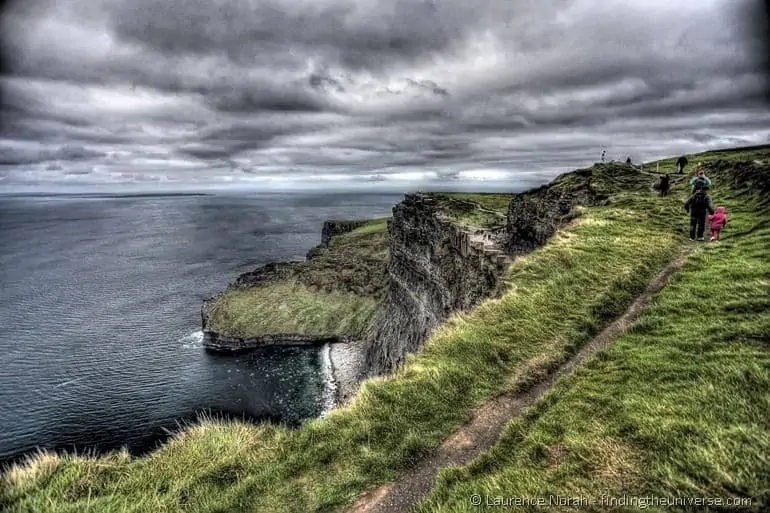
The thoughts were brief, because we walked up the path towards the top of the cliffs, and they were, I have to admit, mighty impressive. Even having seen countless pictures of them, I wasn’t quite prepared for how big they are when you’re standing next to them.
I am, as I mentioned, not great with heights. Although I tend to stand near the edge of things anyway, just to see how it feels. In this case Jess threatened me with a fate worse than death if I went too close to the edge, so I resisted the temptation. Watching the behaviour of my fellow travellers, who all seemed to want to get a shot as close to the edge as physically possible, it wasn’t hard to see why people died up here. One wrong foot and it’s a 200-metre trip onto an unforgiving surface.
I lugged my tripod around and tried to get the shot, which I was struggling with a bit. Setting my camera up for the umpteenth time, a chap approached me.
“Do you want to get the best shot?” he asked.
I indicated that yes, perhaps I did.
“Come over here,” he said, beckoning me right to the edge of the precipice.
I gulped, and looked around, wondering if this was some kind of Irish cliff serial killer who preyed on gullible photographers looking for the shot.
“Don’t worry, I just need to show you the spot,” he reassured me.
“It’s ok, it’s Roy, he built the walk!” chipped in one of Roy’s companions, who was, I noticed, standing a safe distance back from the cliff.
The opportunity to get a great shot overcame me, so I hopped (ok, inched) over to Roy, who was casually standing toe to toe with death on the cliff edge. Calling them the cliffs of insanity seemed apt.
“You see that sign over there?” said Roy, pointing off into the distance at a tiny white sign.
“That’s where you want to be. Good luck.”
And with that he resumed his cliff top walk with his companions, and left me to my own devices.
I consulted my watch. I had about half an hour left, and the sign looked to be about a kilometre away, and quite a way down. Still, I figured Roy seemed to know what he was talking about. He had a Cliffs of Moher rambling badge on and everything.
I threw my tripod over my shoulder, and set off towards the sign. After a bit of a scramble, clearly past the most popular part of the walk, and down a hillside that did contain the semblance of a path, I arrived at the sign.
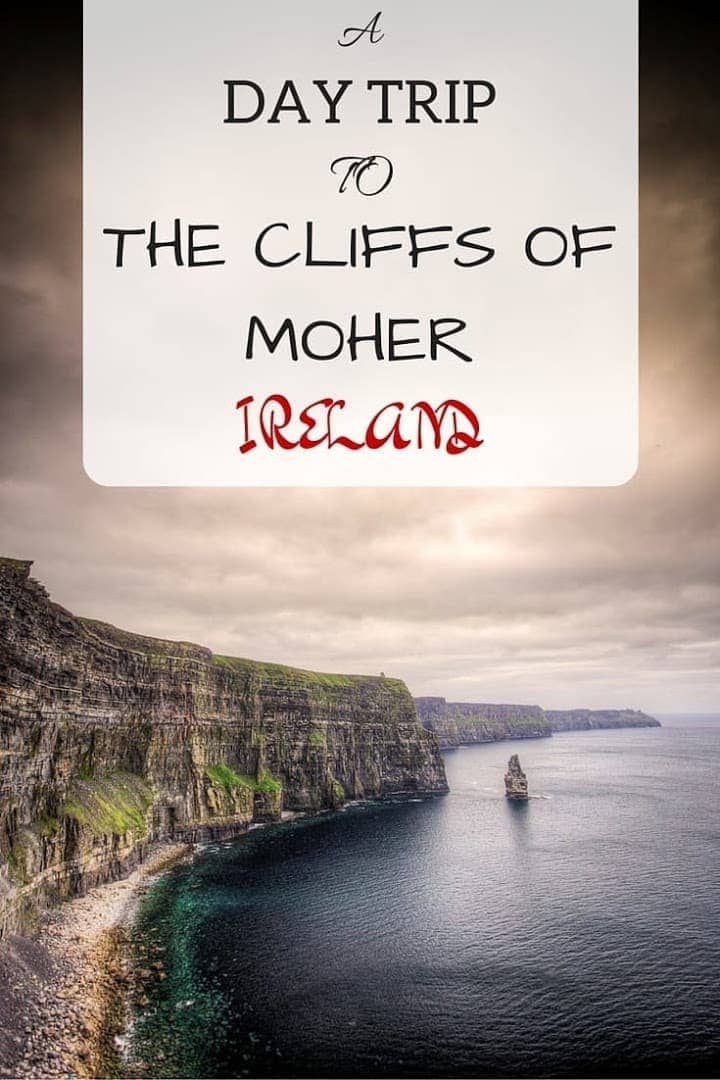
Which, I was rather delighted to discover, did contain a nice view. It looked like this:
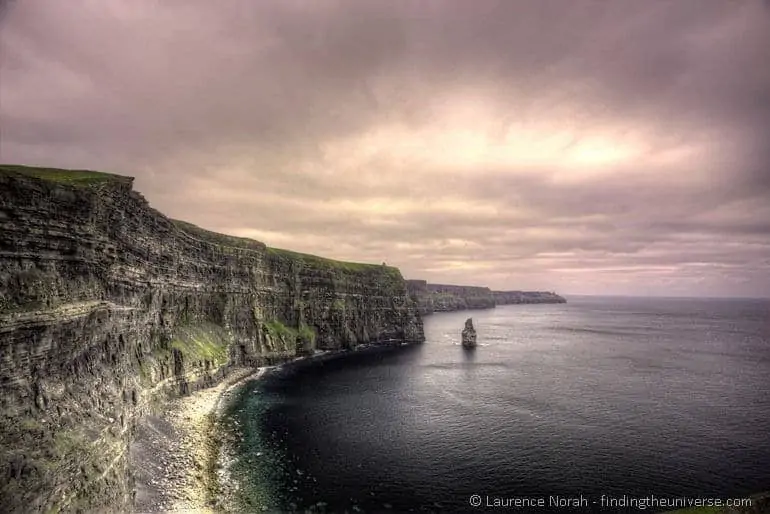
Pleasing clouds? Check. Cliffs disappearing away to the horizon? Check. Lack of anyone visible in the shot? Check. Worth the whole day, in my book.
Of course, that wasn’t the whole day. We legged it back to the bus, because we’d used up rather a lot of our time getting to the spot. From there we were taken to Doolin where we grabbed sandwiches, and then we explored more of the coastline.
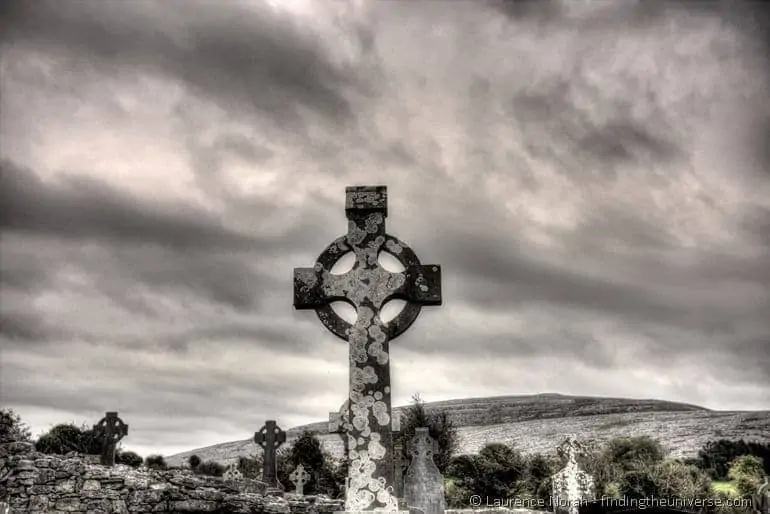
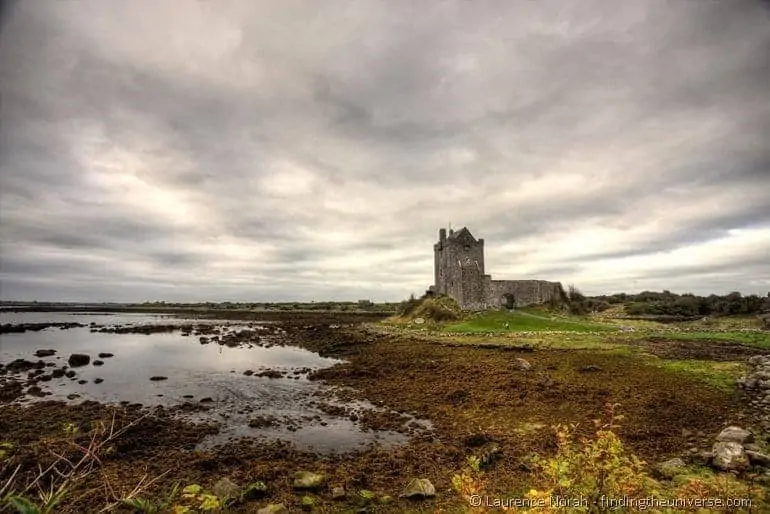
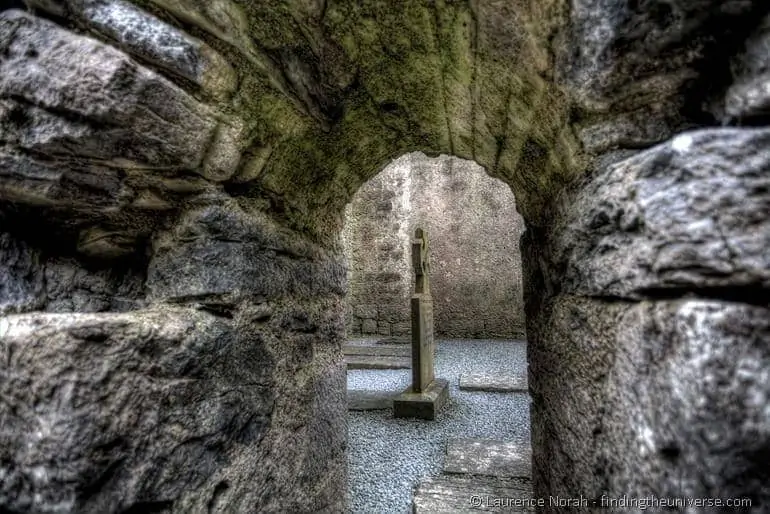
We stopped at a ruined church and Dunguaire Castle, both of which were very, well, churchy and castley. Everything you would hope from a beach-side castle and a ruined church.
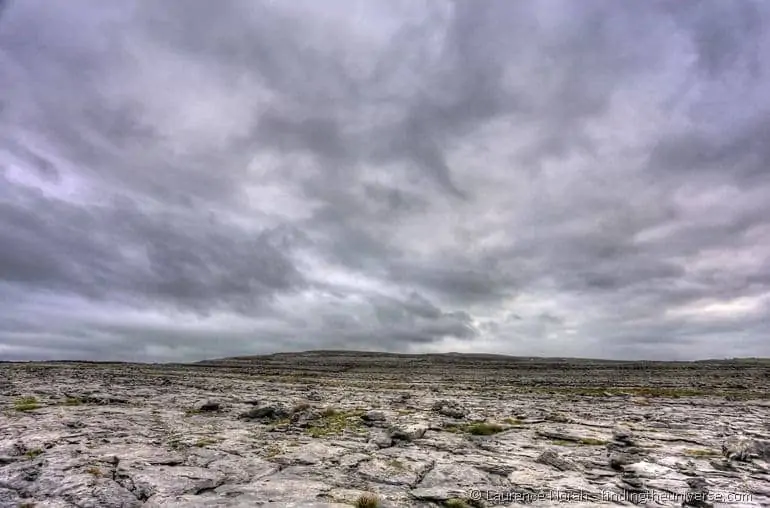
The highlight of the afternoon for me was the limestone landscape of the Burren. I’m normally averse to describing landscapes as moon-like, having not been to the moon, plus I’m fairly sure the moon is mostly cloud-free. But the Burren did have a lunar feel. A seemingly endless limestone plateau of nothing stretched out in all directions, with the “baby” Cliffs of Moher providing the line between land and sea. Naturally I took a whole bunch more photos.
Then it was the long ride back. Most slept on the bus, which after a full day of sightseeing is the sensible option. We rolled back into Dublin around 9pm.
The Secret Photography Spot
Since this is the bit that everyone really wants and I’ve buried it in a personal anecdote, here’s the practical version.
From the visitor centre, head right (north), past O’Brien’s Tower. Keep going along the path. Walk past the people who look like they’re about to fall off. Keep going. The path will eventually descend sharply for around 100 metres and then curve off to the left, where you’ll see a small white sign.
From that sign, you’ll get the view in my photograph above. It’s around a kilometre from the visitor centre and has a noticeable downhill section, so factor that into your time and your knees. It is, I promise you, worth it.
One caveat: with the recent path closures and ongoing safety work, the exact reachable extent of the northern path may change. Check the official coastal walk page before relying on this. The general area I describe should still be accessible, but the further-out sections may not always be.
Tips for Visiting the Cliffs of Moher
Things I’ve worked out from my visits, in no particular order:
Dress for weather you weren’t expecting. The cliffs are exposed Atlantic coastline. The wind can be ferocious even when it’s calm two miles inland, and rain can come from a clear sky. Bring a proper waterproof jacket. I’d also wear waterproof shoes (Allbirds or Vessi work well for this kind of day).
Time it for off-peak. The 11am to 4pm window is busy, expensive, and the visitor centre car park gets full. If you can arrive at opening or after 4pm, you’ll have a better experience and pay less.
Book online if you’re driving. Significantly cheaper than the gate rate, and you skip the queue.
Sunset is the best photography window. The cliffs face due west and they catch the late light beautifully. In summer, with opening hours running until 9pm, this is well worth planning around.
Don’t expect puffins unless you’ve come for them. They’re at the cliffs from April to late July, and you’ll need binoculars and luck. The Doolin boat cruises are a much better bet if puffins are the priority.
Allow more time than you think. Ninety minutes is enough to walk to a few viewpoints and have a quick look at the visitor centre. It is not enough to walk any meaningful distance along the path. If you have flexibility, give yourself half a day at the cliffs.
Should You Take a Day Tour from Dublin?
The truth is that it depends.
For an easy day where you don’t have to think about logistics, that takes in a few attractions on the way back, and where someone else handles the driving on the smaller Irish roads, a tour like the one we did is the right call. Our driver was friendly and funny, the bus was comfortable, and the day was well organised.
If you want flexibility (stopping where you want, staying as long as you want at any given spot, and adding in detours), hire a car. As above, Discover Cars compares prices across operators and is a sensible starting point.
And the cliffs themselves? Yes, they’re worth the trip. Even with the long bus ride, the unpredictable weather, and the slightly nervous feeling of standing 200 metres above the Atlantic, they’re one of those landscapes that earn their reputation.
Frequently Asked Questions
Is it worth visiting the Cliffs of Moher from Dublin as a day trip?
Yes, with one caveat. The cliffs themselves are spectacular and worth the trip.
However, it’s a very long day: roughly six hours of driving plus your time at the cliffs and any other stops. If you can build the cliffs into a longer Ireland trip with an overnight in Galway, Doolin or Lahinch, you’ll have a much more relaxed experience. As a one-off from Dublin, it works, but you’ll be tired by the end of it.
How long do you need at the Cliffs of Moher?
Most day tours give you 90 minutes to two hours, which is enough to walk a section of the cliff path, visit the viewpoints near the visitor centre, and look around inside.
If you’re driving and have flexibility, I’d allow at least three hours. That gives you time to walk further along the open sections of path, visit O’Brien’s Tower, see the visitor centre exhibition properly, and not feel rushed.
Do you have to pay to visit the Cliffs of Moher?
You don’t have to pay to look at the cliffs themselves, since they’re a natural feature of the coast.
What you pay for is parking and the visitor centre. As of April 2026, gate rates are €15 for adults, €12 for students and seniors, and €30 for a family ticket. Children under 12 are free with a parent. Booking online in advance is cheaper, and visiting outside of peak hours (11am to 4pm) is cheaper still.
What’s the best time of year to visit the Cliffs of Moher?
May to September is the most reliable for weather and gives you the longest opening hours (until 9pm in summer).
That said, there’s no bad time to visit. October (when I went) gave dramatic skies that worked well for photography. Winter visits mean shorter days and shorter opening hours, but far fewer people. The cliffs themselves are open year-round except Christmas Eve, Christmas Day, and St Stephen’s Day.
Can you walk the full Cliffs of Moher Coastal Walk?
Not currently. The southern section of the trail, from Liscannor up to the Visitor Centre, has been closed since 2024 due to safety concerns and was still closed as of April 2026. There’s no confirmed reopening date.
What is open are sections of the path north and south of the Visitor Centre (about 3.5 kilometres of safe walking in total), plus parts of the northern stretch from Doolin. Check the official site for current closure status before planning a long walk.
Were the Cliffs of Moher in The Princess Bride?
Yes. They stood in for the Cliffs of Insanity in the 1987 film. The actual cliff faces you see in the climbing scenes are the real Cliffs of Moher, although the ruined castle at the top was a studio set. The grass-topped headland in real life is rather more pastoral than the film suggests.
They were also used as a filming location for Harry Potter and the Half-Blood Prince, where Harry and Dumbledore visit a sea cave at the base of the cliffs.
Further Reading for Your Ireland Trip
Some additional resources for planning your trip, both our own and from elsewhere:
- If you’re spending a few days in Dublin, Jess has put together a detailed guide to spending three days in Dublin on Independent Travel Cats.
- We also have a guide to what to do in Dublin with more ideas.
- If you’re heading to Galway after the cliffs (sensible, given you’re already going that way), have a read of our Galway city guide and the slightly more eccentric Galway and its Hookers piece.
- For Game of Thrones fans, the Dark Hedges in Northern Ireland are a popular detour.
- Belfast is also worth a couple of days if you can fit it in. We’ve got guides to two days in Belfast, things to do in Belfast, the street art of Belfast, and a road trip guide for the Causeway Coastal Route from Belfast around the coast to Londonderry.
- Combining Ireland with the UK? Our two-week UK and Ireland itinerary is a good starting point.
- For more Ireland inspiration, browse all our Ireland posts.
- The official Visit Dublin website is a useful resource for events and current happenings.
- If you want a guidebook, the Rick Steves Ireland guide is the one I’d recommend. Covers the Cliffs and the surrounding area properly, and his writing has the right balance of useful and opinionated.
And that’s the lot. Hope it helps. Any questions, drop them in the comments below and I’ll get back to you.
John says
Downpatrick Head Co. Mayo is impressive with very few tourists and no entrance fees or parking fees. And if you are brave or stupid enough you can get right up to the cliff edge for that remarkable photo. Breathtaking.
Laurence Norah says
Thanks for sharing John, good tip! Will have to check it out next time we’re in Ireland 🙂
Andrea Pedersen says
Great place for info for our Dec. trip.
Laurence Norah says
Thanks Andrea!
Dottie Trufan says
We did a Paddywagon tour in October and the Cliffs were a wonderful stop. They are magical. Thanks for the reminder.
Laurence Norah says
My pleasure Dottie, thanks for stopping by and leaving a comment 🙂
Donna Leming says
Beautiful photography and Ireland is on my bucket list as a place of my heritage.
Thanks for the informative blog and the cliffs will be a must see when I get to go.
Laurence Norah says
My pleasure Donna – I hope that is sometime soon! 🙂
Jule says
Always love the cliffs and did the paddywaggon tour once. it’s nice to sit back and enjoy the landscapes on the road. but in june we’ll do a tour by ourselves with a rented car. there is just so much to see 🙂
P.S. i think i know that sign.. we walked a bit further and a Little downhill. my boyfried proposed there – so naturally i love youre Picture from the cliffs 🙂
Laurence says
What a lovely place to propose! Having a rental car will definitely help with seeing everything you want. Enjoy!