
On April 1st, 2026, the most powerful rocket ever built launched four astronauts on a ten-day trip around the moon. One of them, mission specialist Christina Koch, is a five-time Space Camp graduate. She became the first woman to travel around the moon, and she splashed down safely in the Pacific on April 10th.
I mention this because Jess and I have been to Space Camp. And whilst I can’t claim our experience had quite the same outcome (we did not go to the moon), we did get to train in some of the same simulators that Space Camp graduates like Koch have used on their path to actual spaceflight. Which is pretty cool.
If you’re not familiar with Space Camp, you might be familiar with a 1986 movie called Space Camp. Brief plot recap: some kids go to a summer camp to learn to be astronauts, accidentally end up in space when they press the wrong button, and then come home safely. Ok, that’s a bit abbreviated. You should go watch the movie.
It turns out that Space Camp is a real place, where you can take part in all kinds of space related activities, from simulated space shuttle landings to moon walks. And when Jess and I were invited to experience it for ourselves, we naturally leapt at the chance to find out what it’s like to train as an astronaut.
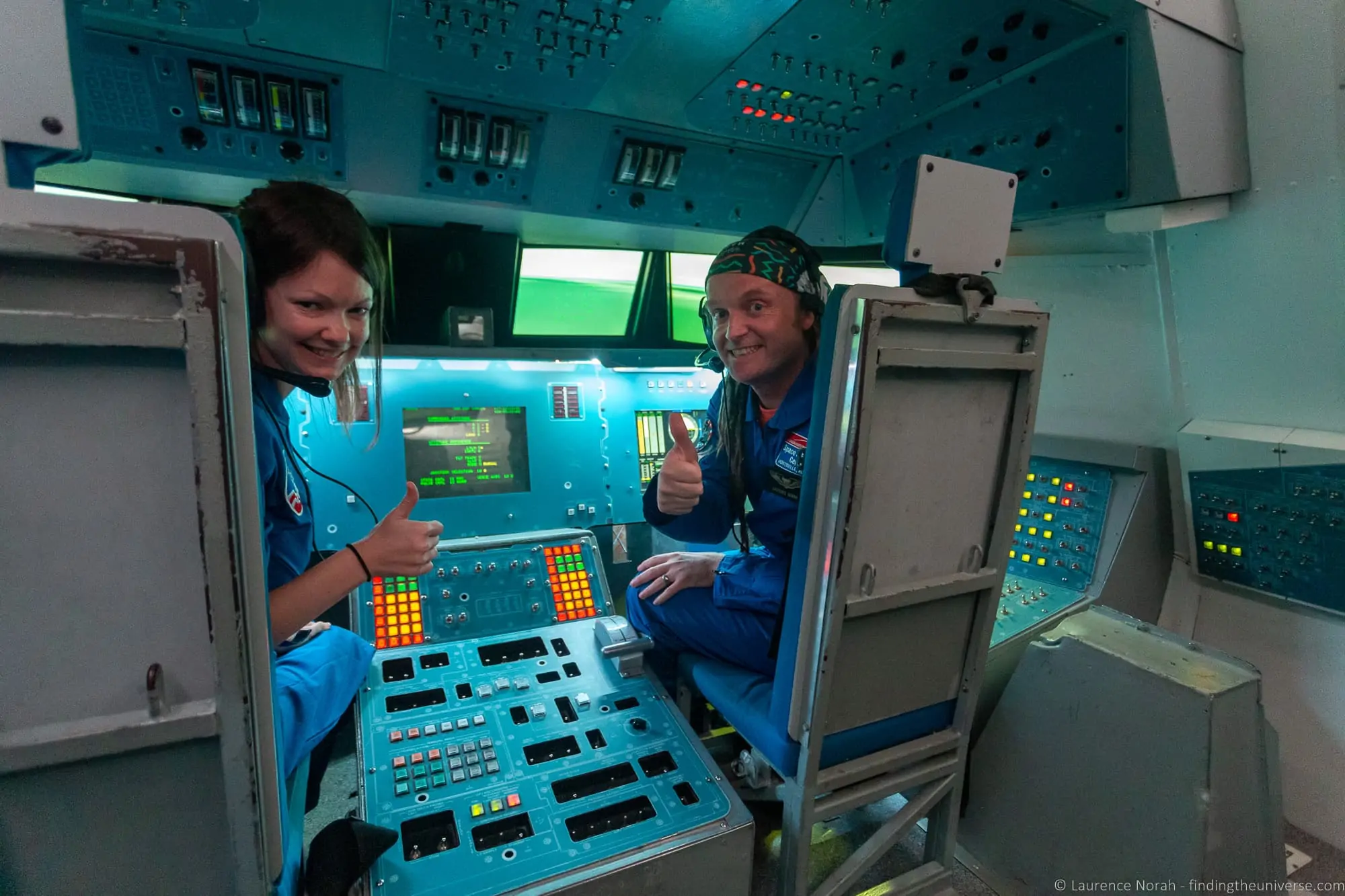
And with any luck, we might even press the wrong button and end up in space! Did that happen? Find out soon, where I detail our experience visiting Space Camp as adults. First though, some primer questions for you, as part of our detailed Space Camp guide!
Table of Contents:
A Guide to Space Camp USA
What is Space Camp?
Space Camp, formally known as United States Space Camp, is an educational camp programme operated by the U.S. Space and Rocket Center, with the goal of promoting science and maths learning in a space themed environment.
The camp was founded in 1982 after Wernher Von Braun, father of the modern space programme, noticed a group of students taking notes during a tour of the Rocket Center and suggested that a space camp might be a good way to get children excited about science. The first camp opened that year, and since then more than a million people have passed through the programme.
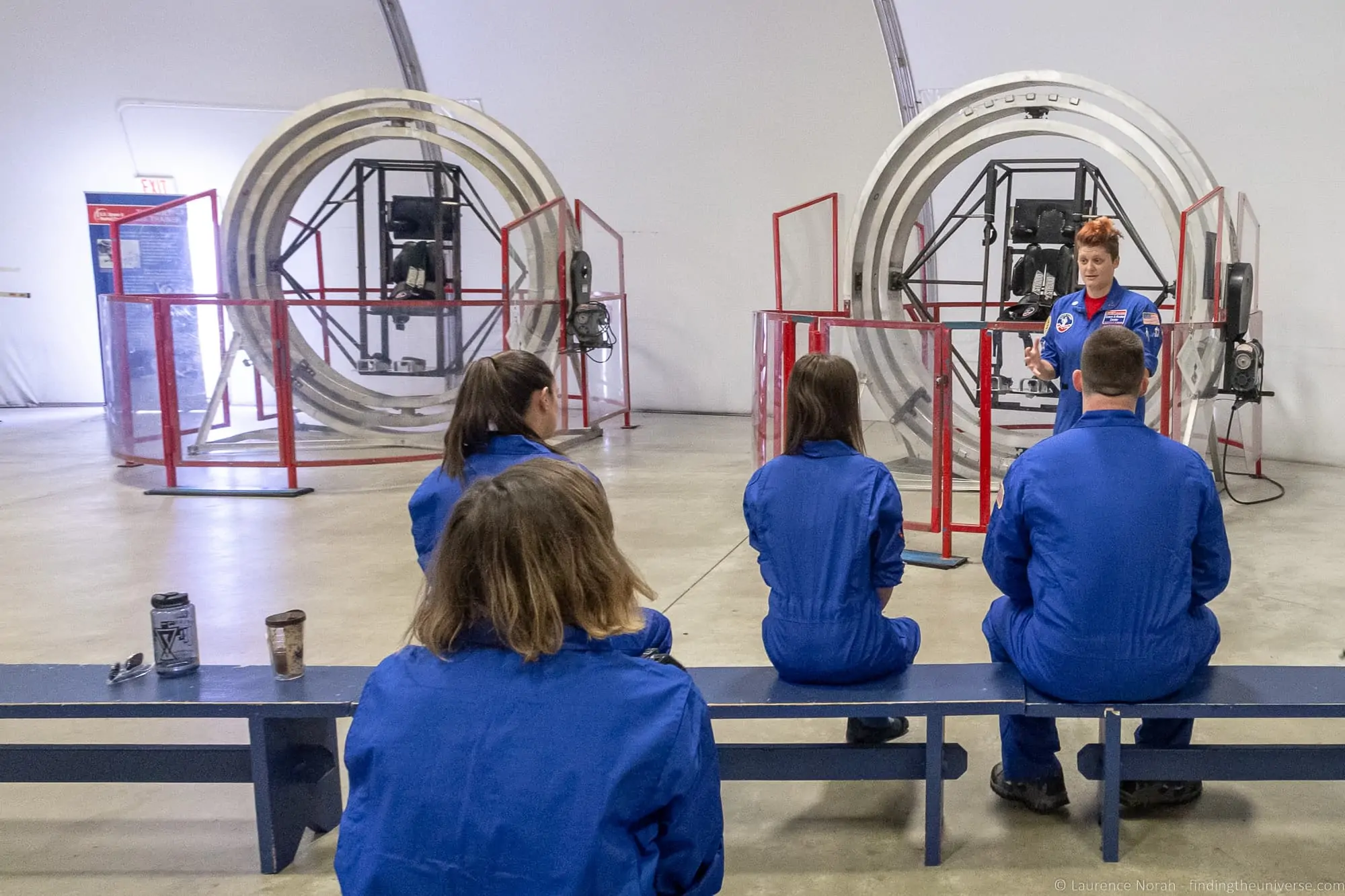
Space Camp runs for between 2 and 6 days, with participants taking part in various hands-on missions, a few of which we’ll go into a little further on in the post.
If you’re not familiar with the concept of a camp like this, here’s a quick overview. Camps in the USA are usually designed for both education and recreation, and involve an on-site stay of a few days or more, usually in a group of peers. They’re a fairly popular thing, with camps for everything from football to music to astronomy. They usually take place over the long summer break from school and are generally aimed at school age children, though many camps (including Space Camp) run throughout the year, and there are programmes available for adults too.
Space Camp has had attendees from all 50 US states, US territories, and over 150 countries. And a number of its graduates have gone on to become actual astronauts, including Christina Koch, who in April 2026 became the first woman to orbit the moon as part of NASA’s Artemis II mission. Koch is a five-time Space Camp graduate and was inducted into the Space Camp Hall of Fame in 2019.
Where is Space Camp?
Space Camp takes place in Huntsville, Alabama. If you are making a trip of it, the nearby town of Scottsboro is home to the Unclaimed Baggage Store, where the airlines’ lost luggage is sold off to the public. This is the home of NASA’s Marshall Space Flight Center, which was where Wernher Von Braun and his team designed the rockets that took humans to the moon, as well as the Space Shuttle and International Space Station.
Today, NASA Marshall is where the Space Launch System (SLS) rocket was developed. This is the same rocket that just launched the Artemis II crew around the moon in April 2026. As you might imagine, Huntsville is literally full of real-life rocket scientists.
What better place for Space Camp to be, practically next door to NASA and in the shadow of a Saturn V rocket?
Note that in the Space Camp movie, the camp takes place at Kennedy Space Center near Cape Canaveral, Florida. Presumably this was because that’s where shuttle launches actually took place, and that’s kind of a key plot requirement. The film was shot in part in Huntsville at the real-life Space Camp location, though.
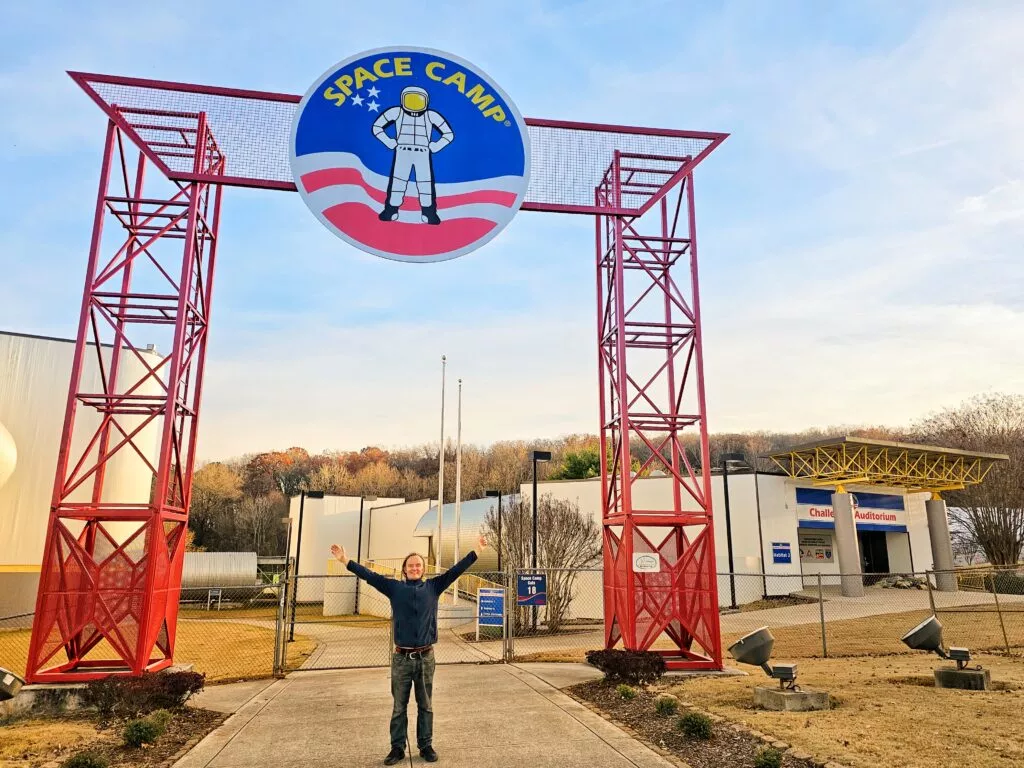
Is Space Camp for Adults?
You might think that Space Camp is aimed at children. And the majority of attendees are indeed aged 9 to 18. But as I was personally rather delighted to learn, there are programmes just for adults.
The main option is the Adult Space Academy, a three-day, two-night programme costing $799. You get to do simulated space missions, train on the Multi-Axis Trainer, build and launch model rockets, and generally live out your childhood astronaut dreams over a weekend. Accommodation and meals are included on-site.
If you want more, there’s also an Adult Advanced Space Academy which is a week-long programme costing $1,999. This includes everything from the shorter programme plus SCUBA diving in the Underwater Astronaut Trainer, extended-duration simulated missions, and jet aircraft simulators. It’s a more immersive experience if you can spare the time (and the budget).
There’s also a Space Academy for Educators at $1,199, designed for teachers who want to bring the experience back to their classrooms. And an Adult Aviation Challenge at $899, which swaps the space theme for military aviation with flight simulators and survival training.
You can see the full list of current programmes and dates on the official Space Camp website.
Can Families Attend Space Camp?
Yes! Space Camp runs a Family Space Camp programme for children aged 7 and up, with at least one adult attending. It’s a three-day experience costing $799 per person, and accommodation is included on-site.
For 2026, Space Camp is offering both onsite and offsite housing options for family campers. The onsite option puts you in the Space Camp Habitat facilities (so you get the full camp atmosphere), whilst the offsite option lets you stay at a nearby hotel and come in for activities during the day. If you’ve got a child who might find the dormitory-style sleeping arrangements a bit much, the offsite option is a good alternative.
How Much Does Space Camp Cost?
Space Camp prices vary depending on the programme and age of the attendee. Here are the current prices.
For children:
- Space Camp (ages 9-11): $1,799 for a 6-day programme
- Space Academy (ages 12-14): $1,899 for a 6-day programme
- Advanced Space Academy (ages 15-18): $1,999 for a 6-day programme
- Advanced Space Academy Elite (ages 17-18): by invitation only for graduates of the Advanced Space Academy. Registration is not available online.
For children, the programme includes meals and lodging on-site as well as all activities.
For adults:
- Adult Space Academy: $799 for a 3-day, 2-night programme
- Adult Advanced Space Academy: $1,999 for a week-long programme
- Space Academy for Educators: $1,199
- Adult Aviation Challenge: $899 for a 3-day, 2-night programme
For families:
- Family Space Camp (ages 7 and up, at least one adult must attend): $799 per person for a 3-day programme
There are also group programmes available, including the Pathfinder programme ($499 per person for groups) and various school-rate options. You can see all programmes and book on the official website.
Are There Scholarships Available?
Yes, there are scholarships available for Space Camp. If cost is a barrier, it’s worth checking the Space Camp scholarships page for details on eligibility, what’s covered, and how to apply.
Can You Sleep at Space Camp?
For programmes that are three days or longer, accommodation is provided on-site in dormitory-style single-sex rooms, and this is included in the price.
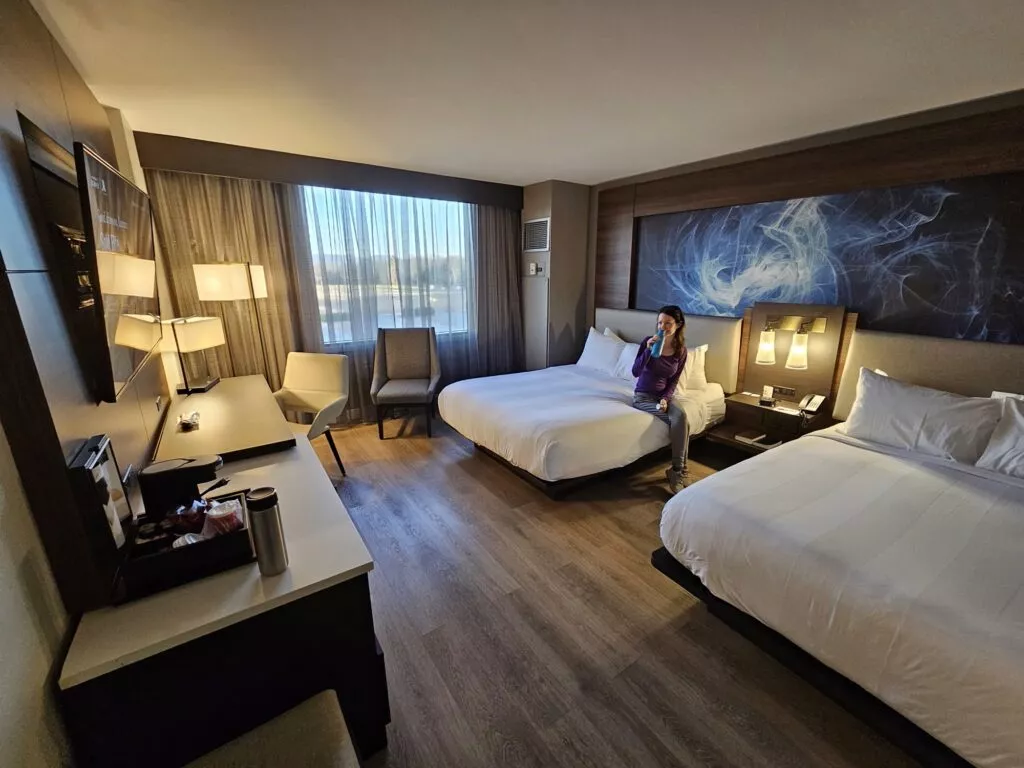
As an adult or family attendee, it’s also possible to stay off-site if you prefer. The closest hotel to Space Camp is the Huntsville Marriott at the Space & Rocket Center, which is the only hotel on the grounds of the U.S. Space and Rocket Center. We’ve stayed here on a separate trip to Huntsville and it was comfortable, though note that breakfast isn’t included by default.
See more on hotels near Space Camp below.
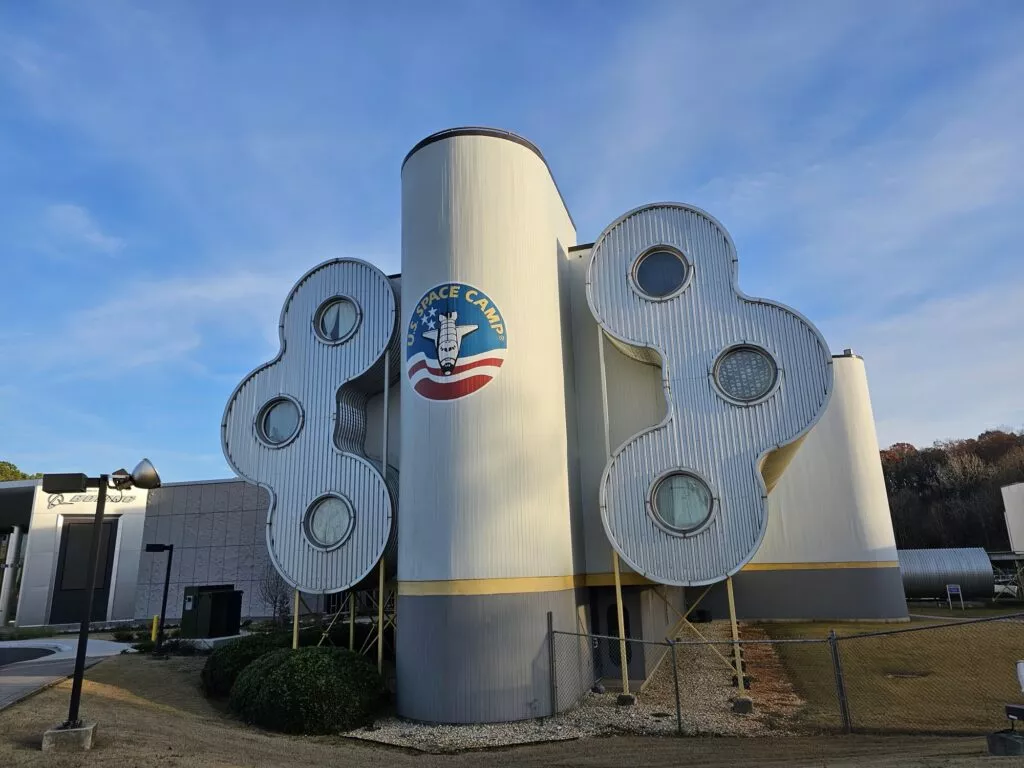
Hotels Near Space Camp
If you’re visiting as an adult or family, or simply want to stay near your child when they attend Space Camp, you have a number of options in the immediate area. Here are some to consider.
- Huntsville Marriott at the Space & Rocket Center – this is the closest hotel to the U.S. Space and Rocket Center, found on campus just a short walk from everything. We’ve stayed here and it was a comfortable experience, although note that breakfast isn’t included by default.
- Drury Inn & Suites Huntsville Space & Rocket Center – just across the road from the U.S. Space and Rocket Center, which you can see from the windows. Features private en-suite rooms and breakfast is included. This was where we stayed for our Space Camp experience, and we thought it was excellent.
- Hilton Garden Inn Huntsville Space Center – about a mile from the U.S. Space and Rocket Center, another close option to consider.
There was previously an RV park at Space Camp, but this is permanently closed as of the end of 2023.
There are also properties in downtown Huntsville, which is around a 10 to 15 minute drive away. Take a look at all the hotel options in Huntsville to see what’s available. For more on Huntsville itself, Jess has a comprehensive guide to the best things to do in Huntsville.
If you choose to stay off-site, you’ll be responsible for your own transfers to and from Space Camp.
Is Space Camp for Americans Only?
Absolutely not! Space Camp is open to all nationalities, and they’ve had attendees from over 150 countries. Each year, around 20% of visitors to Space Camp are from overseas.
The only requirement is a good understanding of English, as the programme is only offered in English. If you’re an international visitor, you’ll also need a visa for the USA, depending on your country of residence.
How Long is Space Camp?
It varies by programme. For children, the camp programmes are usually 6 days / 5 nights. For adults, the standard Adult Space Academy is three days / two nights (typically a Friday to Sunday), whilst the Adult Advanced Space Academy runs for a full week. Family Space Camp is three days.
What Other Camps Are Available?
Space Camp is actually the umbrella name for several different programmes. Beyond the space-focused camps mentioned above, the U.S. Space and Rocket Center also runs:
- Aviation Challenge – military aviation themed, with flight simulators and survival training. Available for both children (ages 9-18) and adults.
- Space Camp Robotics – focused on building and programming robots, for ages 9-18.
- U.S. Cyber Camp – cybersecurity and coding focused, for ages 9-18. Note that this programme is only open to U.S. citizens.
What Do You Need to Bring for Space Camp?
Space Camp is fairly similar to most other trips you might take in the USA, and you don’t need to pack anything particularly special.
Some things you’ll definitely want to pack include bed linen, a padlock for the provided lockers, and a water bottle.
You’ll also want comfortable clothing with enough changes for the duration. Bear in mind that some activities require a bit of physical activity, so you might get warm. Layers are always a good idea.
There isn’t a dress code exactly, but there are clothing requirements you should check on the official FAQ page before you pack. As a guide, loose comfortable clothing, layers, and comfortable close-toed shoes are what you want.
Some of the activities will be outdoors, so you’ll need a rain coat and/or sunscreen depending on the time of year. We’d also recommend a day pack to carry things between activities.
You’re allowed to bring cameras and phones with you, but you’re encouraged to minimise use of connected devices so as not to spoil the immersive experience. (I may not have been entirely successful at this.)
It’s also worth knowing that none of the physical activities (moon walking, the Multi-Axis Trainer, EVA training) are mandatory. If you have any mobility concerns, you can still attend and participate in everything else.
For more details on what to bring, check out the official FAQ page.
How to Book a Space Camp Experience
I’m sure all this information has got you excited about planning your own Space Camp experience. Well, it’s pretty easy! Just head over to the official Mission Control page where you can set up your profile and book your adventure.
For groups, you’ll want to head to the group page where you can request availability for the various programmes.
Spaces do fill up, particularly for the summer sessions, so booking well in advance is a good idea.
Our Space Camp Experience
Hopefully that answers many of your Space Camp questions. If not, head on over to the official FAQ page for lots more information! Now, I’m going to talk about our experience attending Space Camp.
We had a day at Space Camp as part of a press trip, with our experience based on the Adult Space Academy programme. We didn’t get the full multi-day camp, which usually includes more of a mission feel and team-based exercises. Instead, we got a highlights reel of the various experiences that trainees go through. Here’s what we did.
Suiting Up
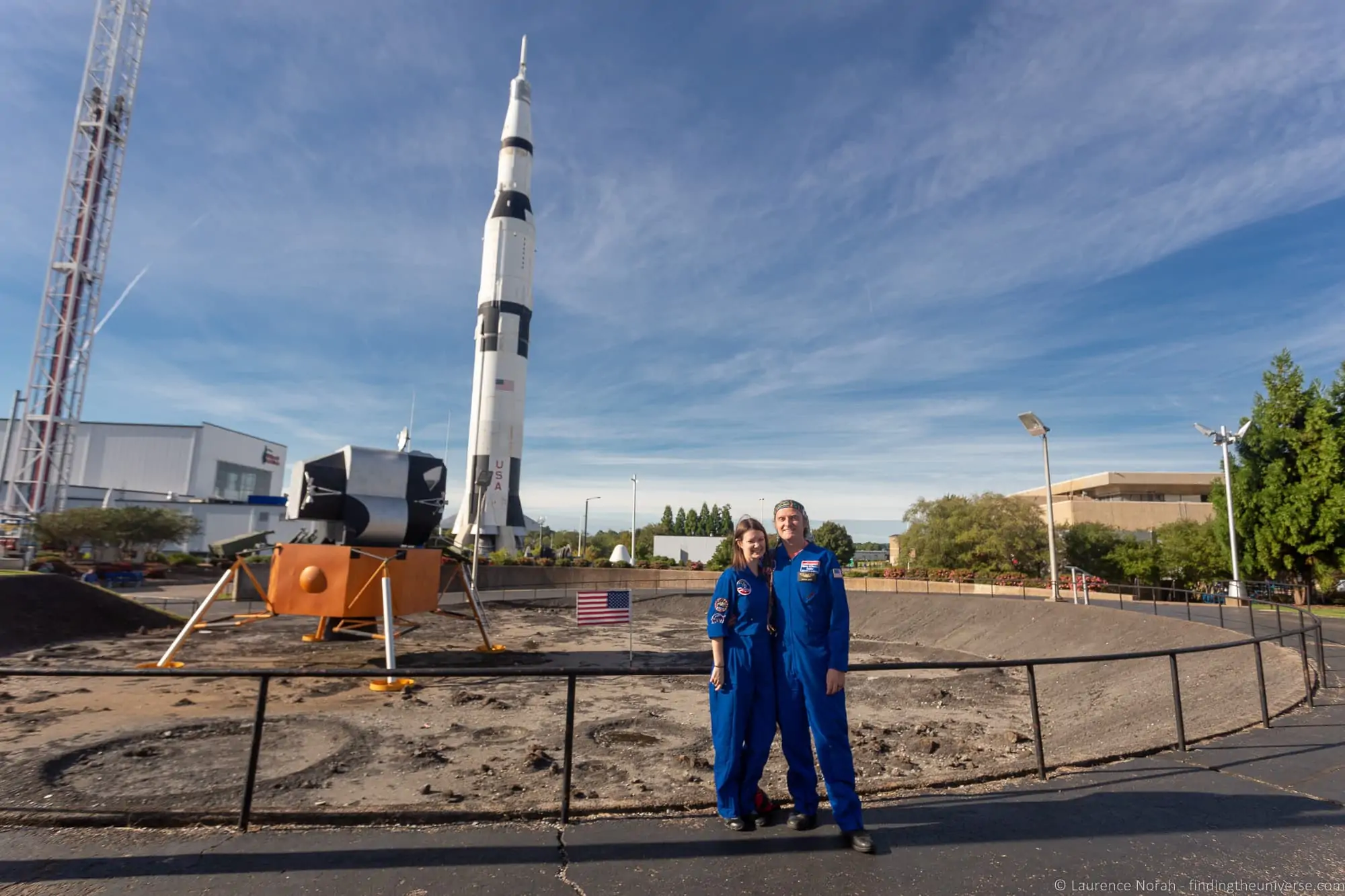
The first thing that happened after meeting our mission coordinators Moriah and Margie was we were issued with our flight suits!
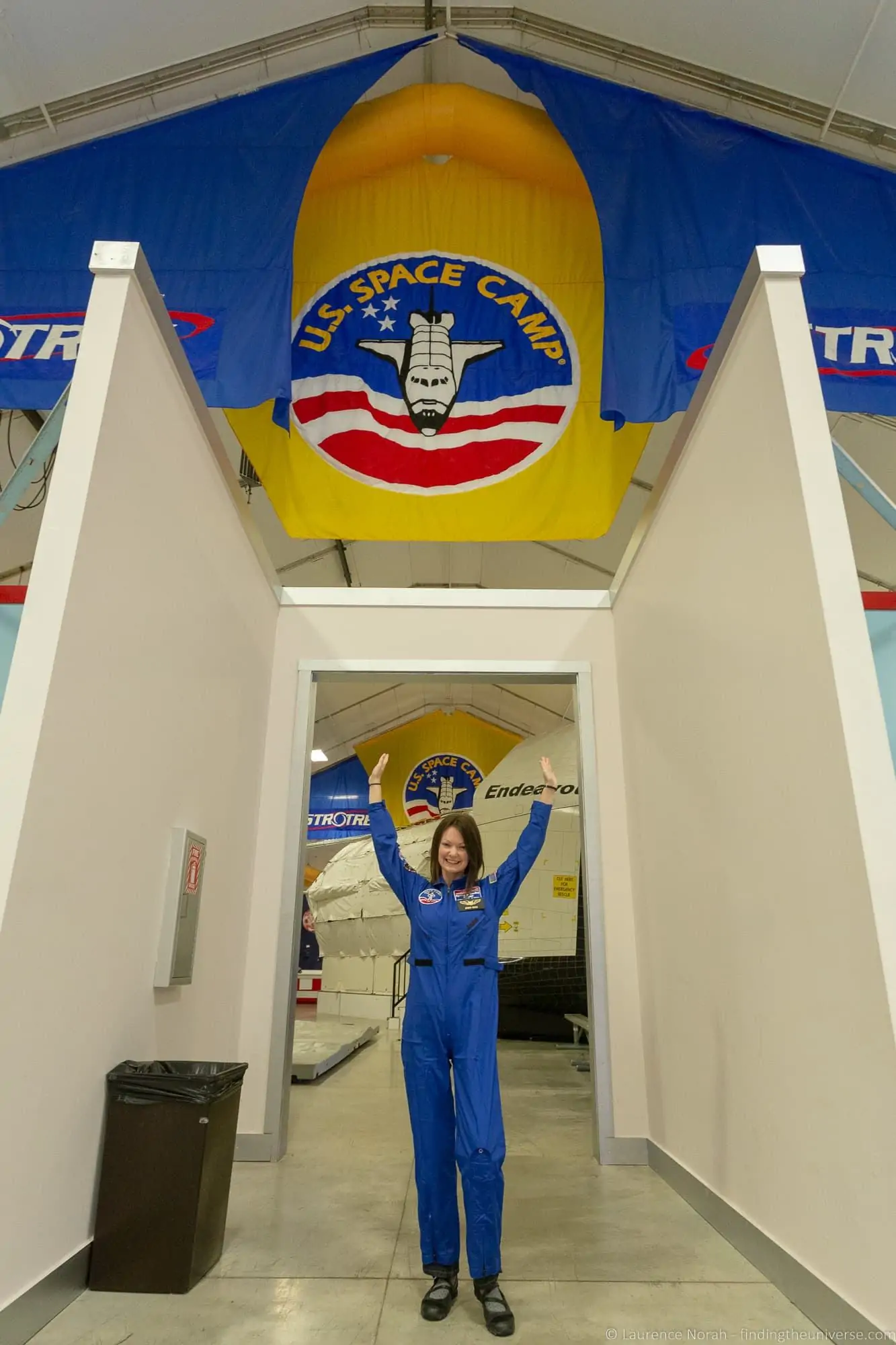
These were super cool all-in-one suits with loads of pockets, not to mention NASA badges and logos. They even came with our own custom leather name tag. We were thrilled to each get one to keep, and it put us all in the mood for some space activity training!
Multi-Axis Trainer
Our first adventure was a ride (I’m not sure I’m supposed to call it a ride, but there we are) on the Multi-Axis Trainer.
This is based on a trainer that was used for NASA’s first crewed space flight programme, the Mercury programme. It’s constructed of three large concentric rings with a chair in the middle. And then you get spun around and upside down as the rings move inside each other.
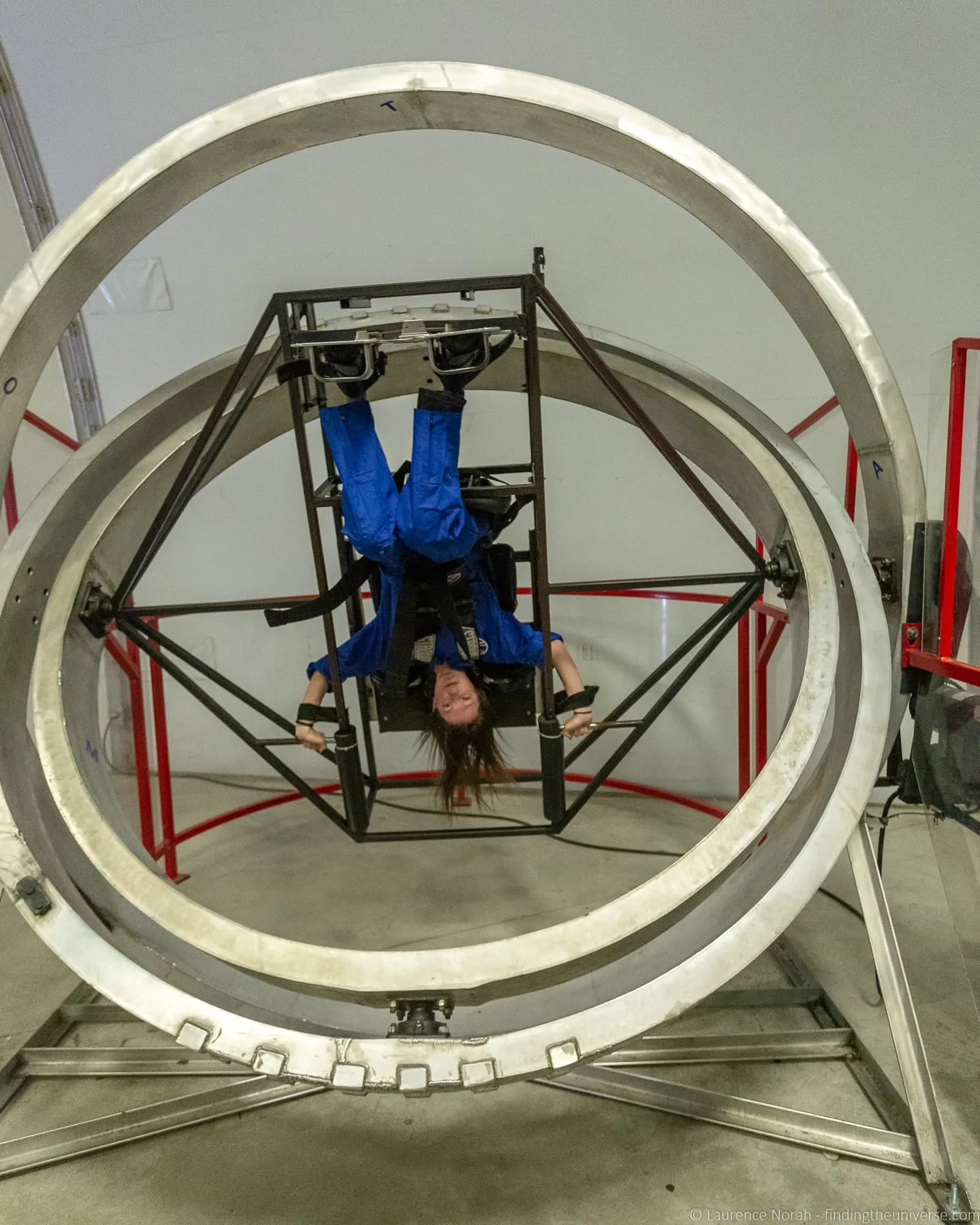
This may sound nausea inducing, but the simulator is specifically designed so your stomach stays centred, and it shouldn’t cause nausea. You don’t spin more than twice in any direction, so your inner ear fluid doesn’t move, meaning there’s no dizziness.
All of us who took part didn’t feel any ill effects from the movement. Instead, the trainer is designed to disorient the user, and NASA used it to help astronauts learn how to handle instruments in a fluid environment. We certainly enjoyed it!
Moon Walking
Our next adventure was moon walking! The simulator is called the 1/6 Chair, which alludes to the fact that it simulates a 1/6th gravity environment, the same as the moon.
To give you an idea of what this means: if you weigh 170lbs on earth, the simulator gives you an idea of what it would be like to weigh around 28lbs. Best diet machine ever.
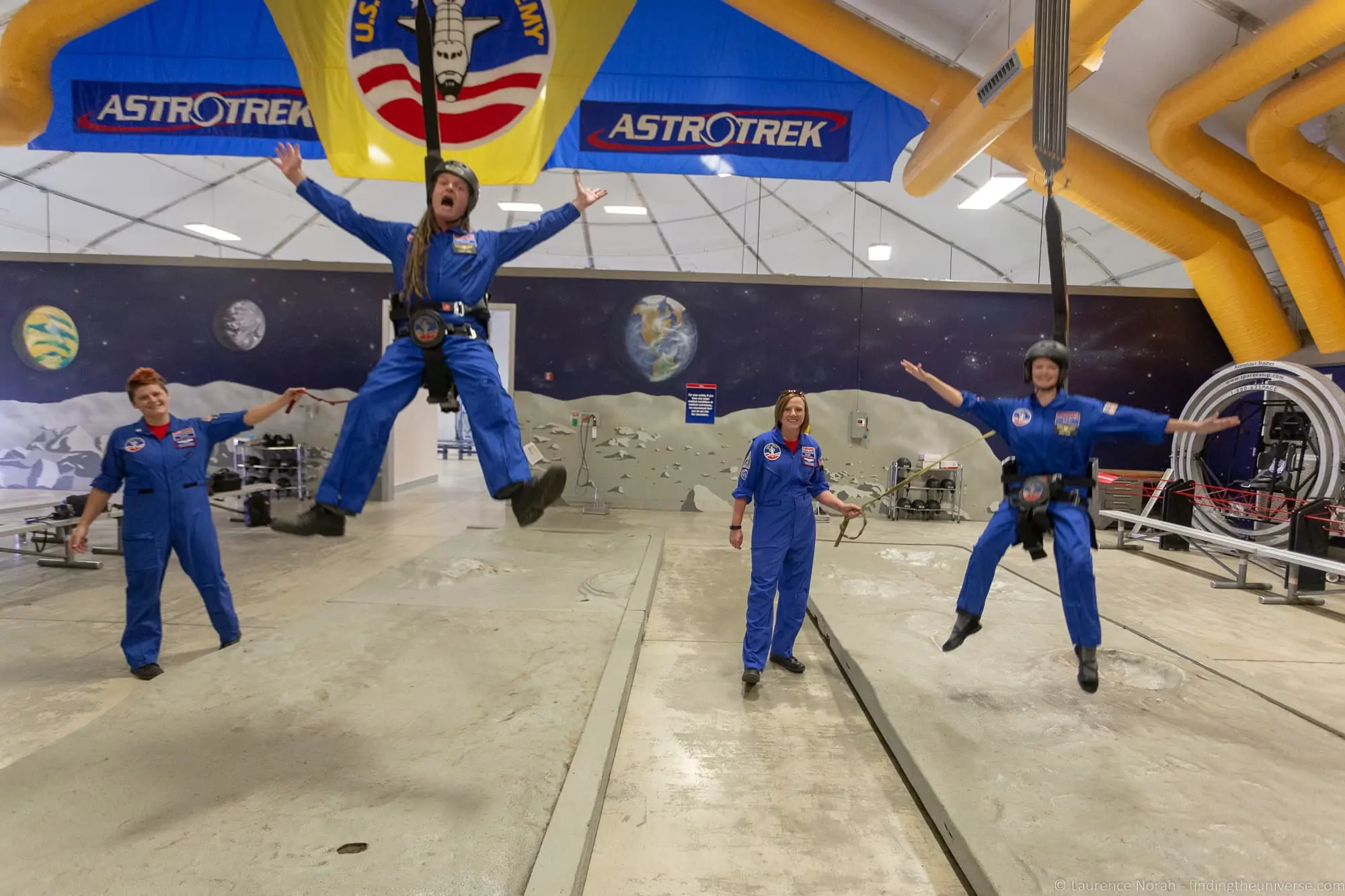
The simulator is set up above a surface that looks like the moon, and you get to practice “moon-walking”. No, not the Michael Jackson version. The version that actual astronauts did on the actual moon (and will hopefully do again soon, thanks to the Artemis programme).
This was one of my favourite activities of the day, although it did take a while to get used to. All I did in the beginning was bounce up and down very high, which whilst fun, didn’t actually get me anywhere. Once I figured out it was similar to walking but in slow motion, I did better.
Space Shuttle Flight
Whilst the space shuttle itself is no longer in operation, you can still get a feeling for what it might have been like to fly aboard this vessel in the space shuttle simulator.
This is a fairly accurate model of the space shuttle interior, complete with more buttons and switches than you can imagine, as well as a flight simulator style interface with joysticks.
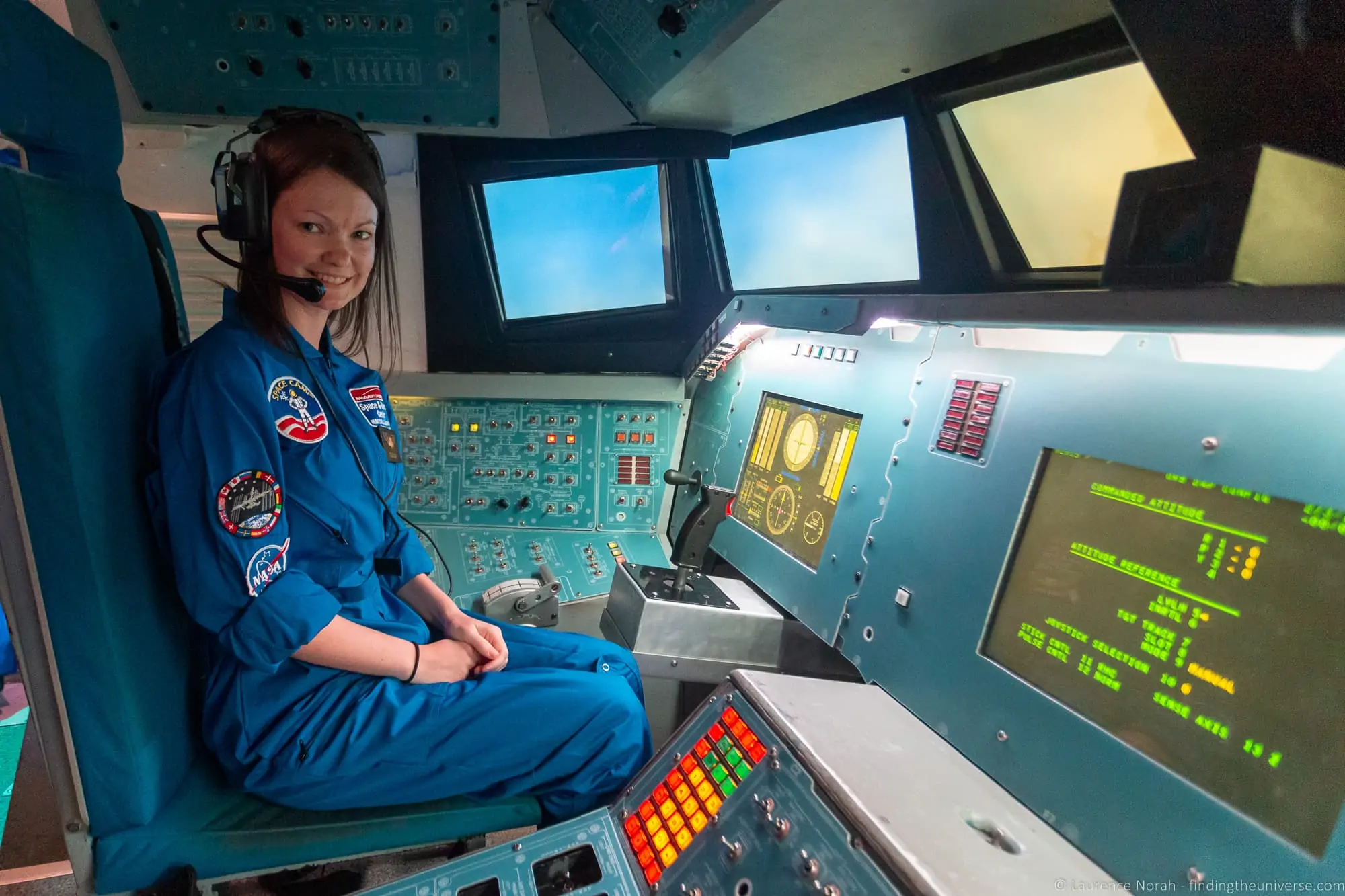
We ran through a few missions in the space shuttle. Jess was lucky enough to be the mission commander on this experience, and I got to be the pilot. Our first missions involved troubleshooting with mission control various simulated issues, which required us to find and locate various switches and enter commands into the command line interface.
The highlight was getting to land the space shuttle, which fell to Jess as shuttle commander. She definitely landed us near the runway, although I’m not sure we walked away without a few bumps…
Space Station Experiments
Our next mission had us inside a mock-up of the International Space Station, or at least, a part of it. Here, we were introduced to some of the science experiments that Space Camp attendees get to take part in when on mission.
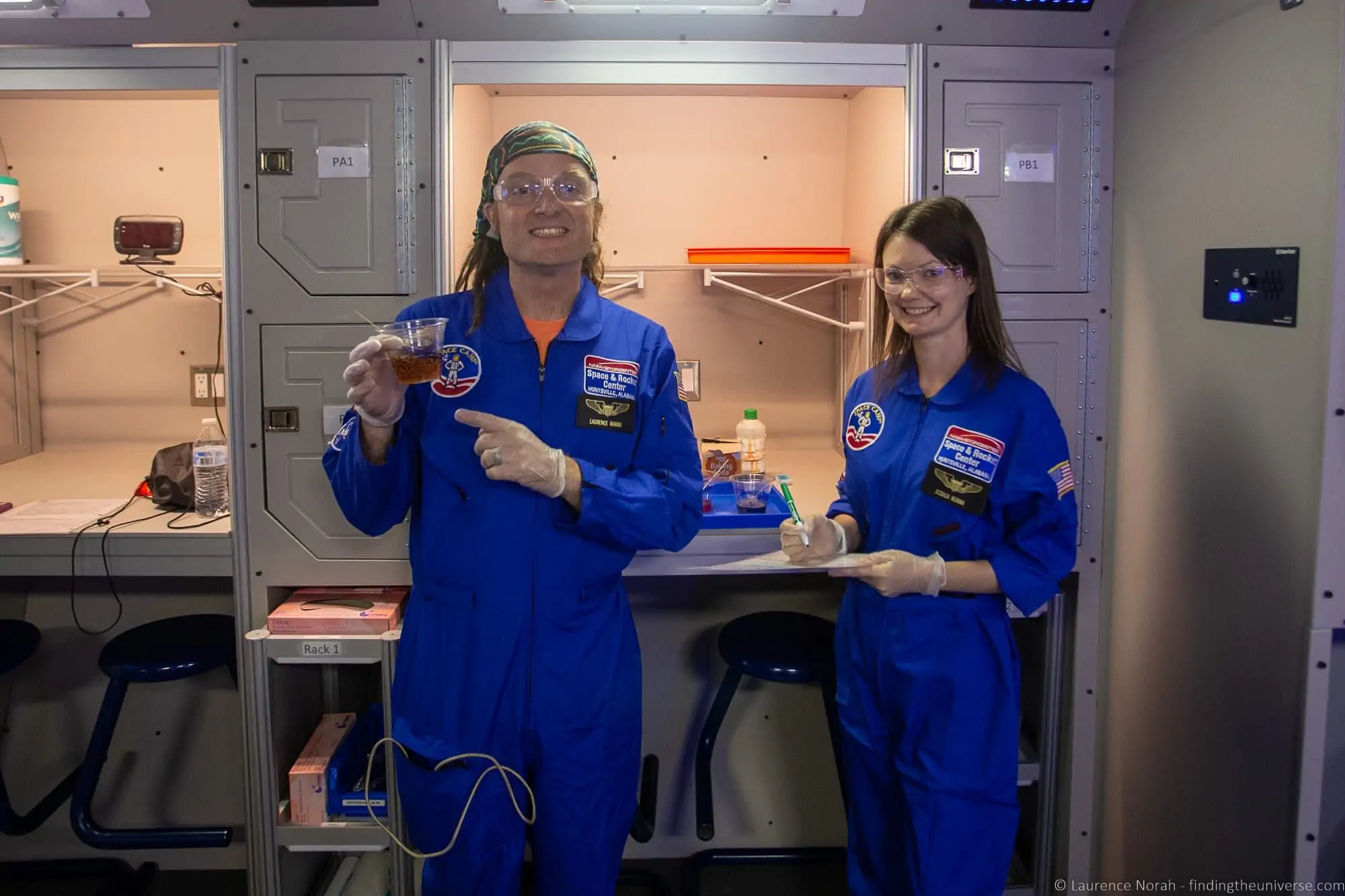
We had to locate a number of items inside the module (to give us an idea of how a space station is organised), after which we had to follow instructions to mix various liquids together and report our findings.
It was essentially a chemistry lesson, but as we were in “space”, it was a lot of fun. A lot of the work on the real International Space Station involves science experiments, so getting people hands on with this is a great idea.
Orion Spacecraft
This one feels a bit different now. When we visited Space Camp, the Orion spacecraft and the Space Launch System rocket were still in development. We got to sit inside a simulator of the Orion crew capsule, designed for up to four astronauts, and run through a simulated launch, earth orbit, and splashdown.
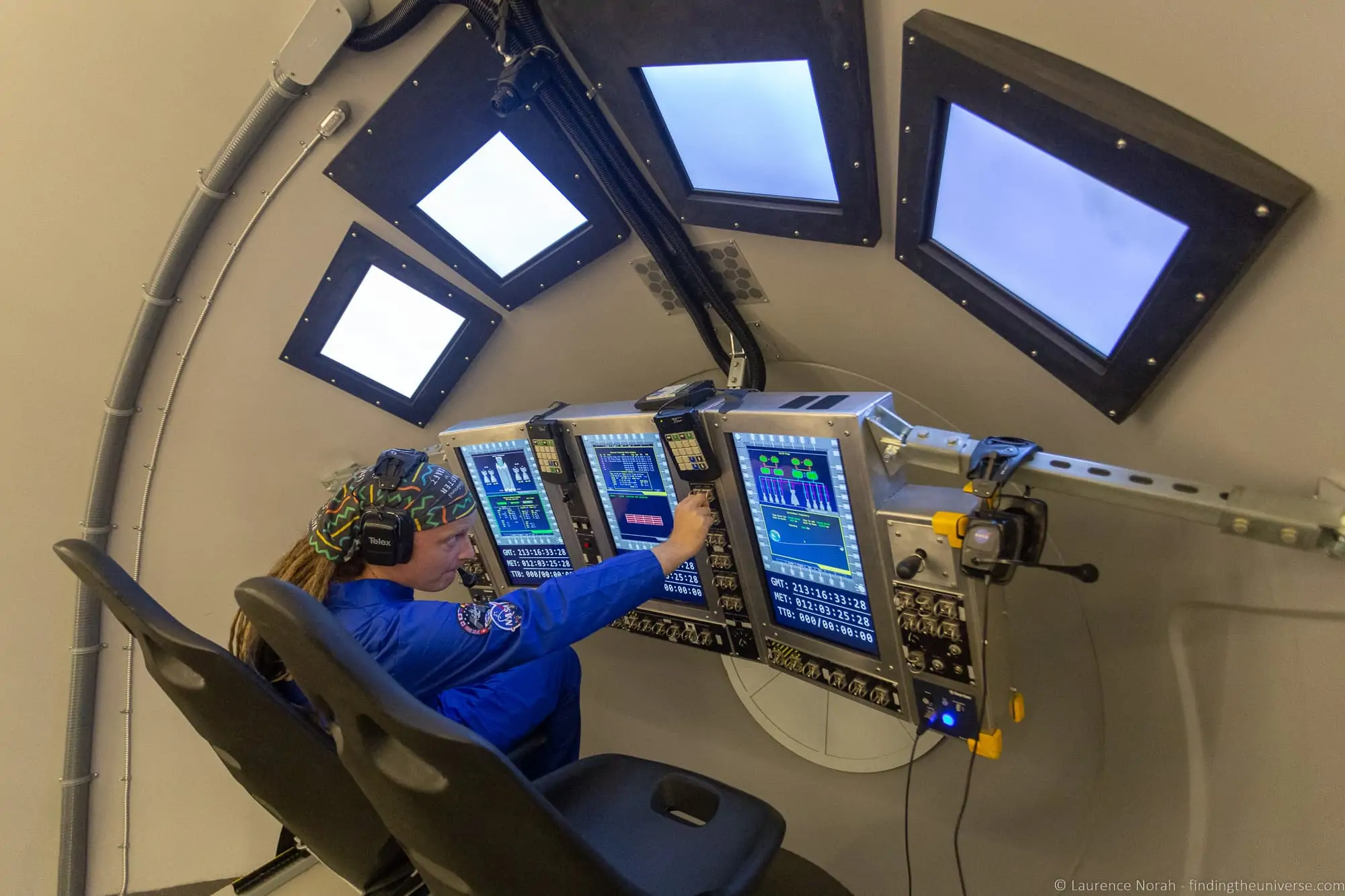
At the time, it all felt very future tense. The SLS was still being built. Orion hadn’t flown with a crew. Mars missions felt like science fiction.
And then, in April 2026, that exact rocket launched four astronauts around the moon. The SLS was developed right here in Huntsville, and Space Camp graduate Christina Koch was on board. It’s hard to overstate how much that changes the experience of sitting in the Orion simulator. What felt like a “maybe one day” experience now has a very real, very recent connection to actual spaceflight.
One thing that was fun about doing this experience was comparing it to the Space Shuttle simulator. Massive advances in computer technology have meant that so much more of these missions are automated now. Gone are the hundreds of buttons, switches and dials, replaced by more streamlined systems. This of course presents a new challenge for Space Camp: keeping things interactive and hands-on whilst staying true to the real experience.
EVA Practice
Another highlight of our time at Space Camp was our EVA mission. EVA, for those of you not familiar with the acronym, stands for Extra Vehicular Activity, and refers to the time when an astronaut goes outside their spacecraft to perform some sort of task.
Yes folks, I’m talking about a spacewalk.
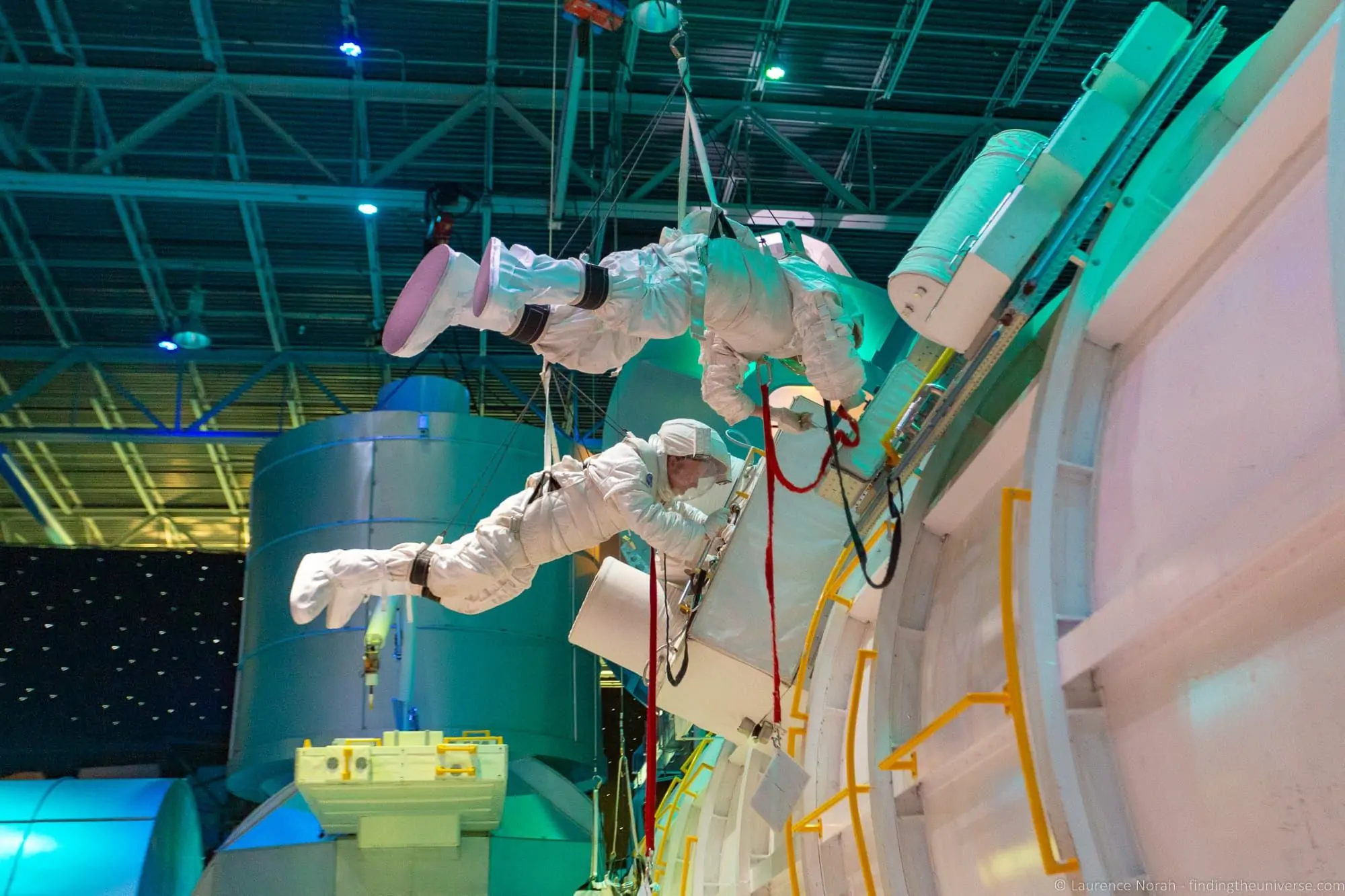
We didn’t get to go to actual space. But with the help of some impressive suits and various cable systems, Jess and I did get to have an idea of what it’s like to try and repair a section of a space station from the outside, and the various challenges that entails.
This included trying to manipulate fittings with bulky gloves on, stopping our gear and tools from “floating away” (or in our case, hitting our cable operators on the head), and working as a team in a high pressure environment.
This was fun but also definitely one of the more physically demanding activities. Who knew floating around outside the ISS could be so much work!
Food
It may be hard to believe, but with an early start, we somehow managed to fit all the above into a morning.
Which meant we got to have lunch at the on-site cafeteria. This featured a range of cuisines, which rotate based on the nationalities of people who have stayed on the ISS. When we visited, it was Vietnamese food, so we had noodle bowls for lunch!
Of course, there are lots of options, including a full salad bar, various classic American dishes (pizza, hamburgers), and various soft drinks and dessert options.
Touring the U.S. Space and Rocket Center
What’s really cool about Space Camp is that it’s on the same site as the U.S. Space and Rocket Center, a large museum dedicated to space flight and exploration. This can be visited as a separate attraction, and thousands of people do that every day.
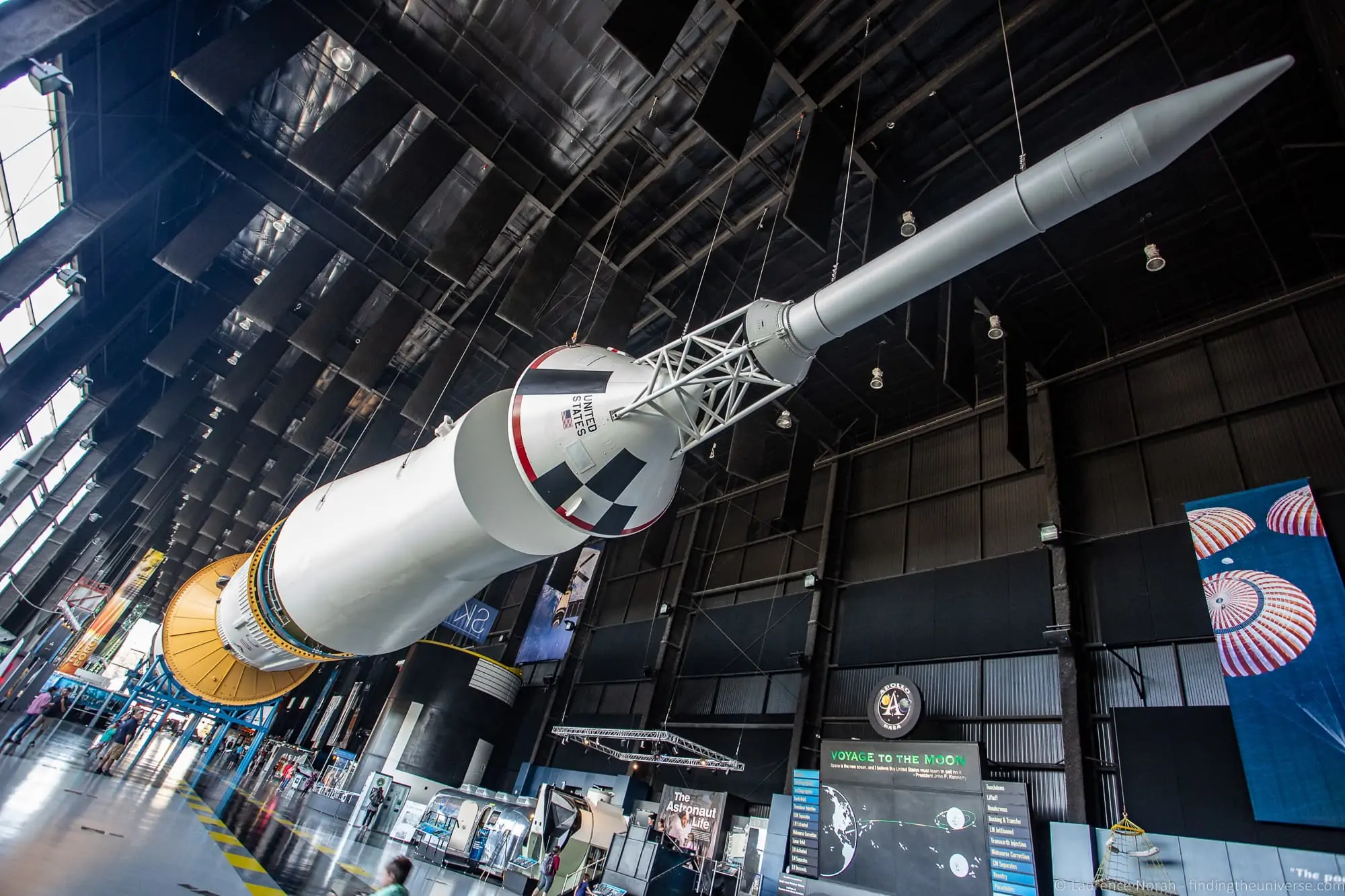
There are various exhibits here, ranging from the dawn of space flight right up to the present day and beyond. Perhaps most impressive are the two Saturn V rockets. One is a mock-up which sits outside in a vertical configuration. The other is a “real” Saturn V, which sits inside the Saturn V hall lying horizontally.
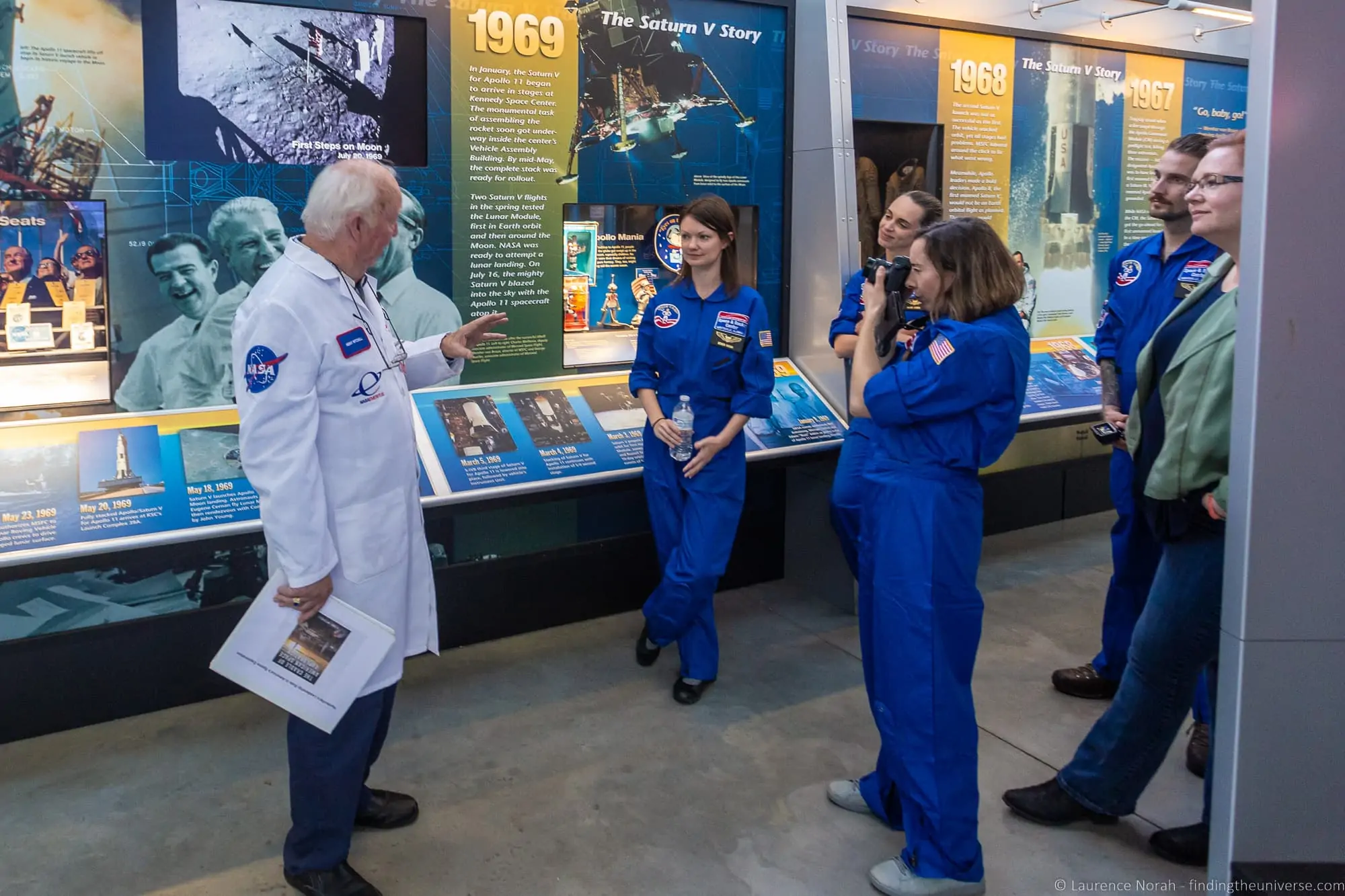
It’s here that you can see the immense scale of the rockets that sent humans to the moon, and understand the complexities involved in doing so. You can also take a tour with one of the centre’s docents, many of whom actually worked on the various NASA space programmes. Hearing their stories of life at NASA is pretty amazing.
There are also some fun rides, which are related to space. The two we tried were the Moon Shot and the G-Force Accelerator. The Moon Shot gives you an impression of rapid acceleration followed by a couple of seconds of actual Zero-G, by firing you up into the sky, covering 140 feet in 2.5 seconds!
The G-Force Accelerator is a huge centrifuge which spins you around to create a force equivalent to three G, which is quite a lot, and makes even simple activities like moving your arms around a lot of work.
There’s loads more to see here and enough to easily fill a whole day (we actually came back on a different day to see more, as the afternoon wasn’t enough!). There’s also an on-site gift shop (two in fact!), which is a must-stop for space fans.
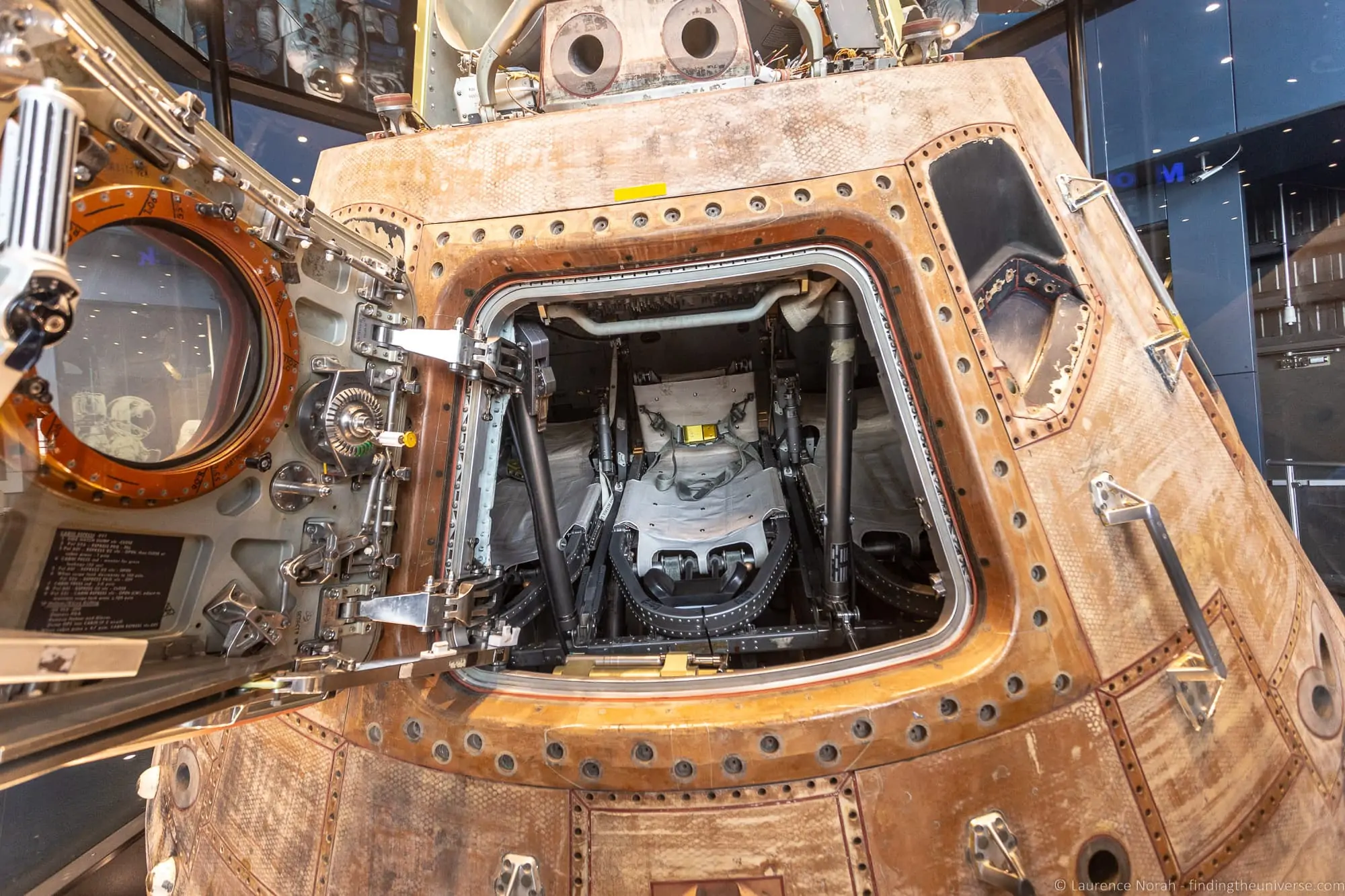
Even if you don’t do a Space Camp experience, a visit to the U.S. Space and Rocket Center is definitely recommended! You can read about our experience visiting the U.S. Space and Rocket Center here.
Our Verdict on Space Camp
As you can hopefully tell from this post, we had an amazing time at Space Camp. Even Jess, who by her own admission isn’t nearly as interested in space stuff as me, really enjoyed herself.
The learning experiences and hands-on activities were a lot of fun, and everyone we met was enthusiastic, knowledgeable, and fun to be around.
If you’re thinking of going to Space Camp as an adult, we can highly recommend it. Even though we only had a short version of what’s available, it got us excited for how much fun it must be to do a fuller programme with a real mission structure.
Learning to be an astronaut whilst having fun. I mean, what could be better than that?
What Else Is There to Do in Huntsville?
We appreciate that a lot of folks bring their families along to Space Camp but don’t attend themselves, and so you might be wondering if there’s anything else to do in Huntsville. After all, you don’t want to be sitting in a hotel for six days!
The good news is that there’s loads to do in Huntsville, from quirky restaurants to art museums to hiking and more. There’s so much to do in fact that we put together a comprehensive guide to the best things to do in Huntsville. We’d definitely recommend checking that out.
Frequently Asked Questions about Space Camp
How much does Space Camp cost?
Space Camp prices range from $799 to $1,999 depending on the programme. For children, the 6-day programmes cost $1,799 (ages 9-11), $1,899 (ages 12-14), or $1,999 (ages 15-18). The Adult Space Academy is $799 for three days, whilst the Adult Advanced Space Academy costs $1,999 for a full week. Family Space Camp is $799 per person.
Meals and lodging are included in all multi-day programmes. Scholarships are also available.
Can adults go to Space Camp?
Yes! Space Camp runs several programmes specifically for adults. The most popular is the Adult Space Academy, a three-day weekend experience for $799 that includes simulated missions, astronaut training simulators, and on-site accommodation. There’s also a week-long Adult Advanced Space Academy for $1,999 and an Adult Aviation Challenge for $899.
Is Space Camp worth it?
We went to Space Camp and thought it was brilliant, even though we only had a condensed version of the full programme. The hands-on simulators, the mission experience, and the proximity to actual NASA history at the U.S. Space and Rocket Center all made it a day we won’t forget. If you or your kids have any interest in space, science, or just want a unique experience, we’d say it’s well worth it.
What do you do at Space Camp?
Activities vary by programme, but for the space-focused camps you’ll typically experience simulated space missions (with assigned roles like commander and pilot), astronaut training simulators including the Multi-Axis Trainer and the 1/6 gravity moon walk simulator, EVA (spacewalk) practice, rocket building and launching, space station experiments, and tours of the U.S. Space and Rocket Center museum. The week-long programmes include additional activities like SCUBA diving in the Underwater Astronaut Trainer.
Can families attend Space Camp together?
Yes, Space Camp runs a Family Space Camp programme for children aged 7 and up with at least one adult. It’s a three-day experience costing $799 per person, with both onsite (dormitory-style) and offsite (hotel) housing options available.
Do you need to bring anything to Space Camp?
You’ll want to bring bed linen, a padlock for the lockers, a water bottle, comfortable close-toed shoes, and clothing suitable for light physical activity. Layers are a good idea as some activities are outdoors. Check the official FAQ page for the full packing list and any clothing requirements.
Further Reading
Hopefully you’ve enjoyed reading about Space Camp! Here are some more resources to help you plan your trip.
- The official website for Space Camp has loads of information about visiting. This is also where you can book your experience.
- Space Camp is operated by the U.S. Space and Rocket Center, which is also very much worth a visit. You can read about our experience visiting the U.S. Space and Rocket Center here.
- Both of the above are located in Huntsville. Check out the official visitors portal for Huntsville for more information on what to do in the area, and read our guide to the best things to do in Huntsville.
- I am a bit of a space fan, so this isn’t my first space post. Check out my guide to getting into space as a tourist, my guide to New Mexico’s Space Trail, and our guide to visiting Space Center Houston for more space related fun!
- We have loads more content on the USA to help you plan your visit. Check out our guides to how much it costs to travel in the USA and driving in the USA as starting points.
- Huntsville is in the south, so a visit here could form part of a longer US road trip like this.
And that’s it for now! As always, we’re happy to answer any of your questions or hear your feedback about the above. Just use the comments section below to get in touch.
So you know: We were invited to experience Space Camp by the Visit Huntsville CVB in partnership with the U.S. Space and Rocket Center, and they covered our accommodation, food, transport and experiences whilst in the area. As always our opinions are our own, and getting excited about space is something we do naturally. For more information on how we choose partners to work with and what that means, you can read our code of ethics.
Hank Grover says
Thanks for the great blog! I graduated from Adult Space Academy a few years back and I recommend it to all space buffs. I did all the optional training – moon walking, multi-axis trainer and EVA. To those of you who want to attend Space Camp / Academy, please know that none of the above are mandatory, if you have problems with mobility.
Later I visited Kennedy Space Center, and next week I take the VIP tour at Space Center Houston.
Cheers,
Hank Grover
Laurence Norah says
Hey Hanks!
Thanks very much, and thanks for sharing your experiences! It sounds like you had an awesome set of space related adventures 😀 We’ve also done the Space Centre tour but not the VIP version, although we were lucky enough to get a behind the scenes tour at NASA Johnson Space Centre which was really cool.
Best
Laurence
Morris Solomon says
My grandson went to the 5 day onsite camp this summer in Huntsville. He wants to go back next summer.
However, wouldn’t he have the same experience in 2023 as he had in 2022?
Laurence Norah says
Hi Morris,
It depends on his age. Space Camp has different programs for different age groups, 9-11, 12-14 and 15-18. So if between this year and next year his age switches groups then he will have a different experience tailored to his age group. However, you are otherwise correct, if he doesn’t change age groups then his experience will be the same I believe.
Best
Laurence
Desiree says
This is SUPER informative thanks! Me and my kiddo are attending a family space camp this summer but my question is…is it better to stay in the Habitat or is the hotel an option? My child has some special needs and I’m not sure if sleepover style in bunks with others is going to be too stressful for him!
Laurence Norah says
Hi Desiree,
This is a great question! So, I believe that for 2022 the 2 day space camps don’t include accommodation on-site but the 3 day Family Space acadamy does.
I’m not sure which one you have booked, but I will assume it’s the latter and you have accommodation included. Honestly, it is hard for me to answer your question. I think that as you are already thinking that the hotel might be a better option, and you know your child’s needs best, it sounds like that might be the option you are leaning towards and I generally think going with your gut is a good option. There are hotels both on-site and within very close distance of the centre, and whilst the cost is extra, it might result in a better all-round experience for you both. The lodging at Space Camp is fairly straight forward, (it’s not really space themed or anything), so I don’t think you’d be missing out on a lot other than hanging out with the other kids at night. You can see the lodging options on-site here: https://www.spacecamp.com/camp/lodging
I hope this helps, have an amazing time at Space Camp whatever you decide to do!
Laurence
Archana Murali says
Do we get any scholarship to attend the camp??
Laurence Norah says
Hi Archana,
Yes, there are scholarships available. You can read more about them, who is eligible, what they cover and how to apply for a space camp scholarship here:
https://www.spacecamp.com/scholarships
All the best
Laurence
Lohan Alam says
Amazing!! It’s just wow!! Thanks for the brief information ??
Laurence Norah says
My pleasure Lohan 🙂
Joan says
I would like to have my granddaughter attend space camp.
Do you have a overnight camp for
A week or more .
She is 11 years old.
Is that possible?
Thank you in advance.
Laurence Norah says
Hi Joan,
Thanks for your comment. We don’t actually run Space Camp, we just wrote this guide based on our experiences. You’ll want to visit the official website to book a trip which you can do here:
https://www.spacecamp.com/missioncontrol
There is also contact information on that page.
I hope your granddaughter has a great trip!
Laurence
Sherry Erhard says
I really want to send my adult sons to space camp in Huntsville, AL . It sounds like its a three day , two nite experience. I lived there in Huntsville on base in 1969 70 and would love to make this possible for them. My question is , how to get ahold of the camp and inquire about pricing, etc. I wanted to make this a surprise, but don’t know if I can pull this off. One would be coming from Ohio and one from Texas. My older son says he always wanted to go, but we really never realized this when he was young. He has watched StarTrek since he was 8 and he is now 39, and has his own Star Trek Christmas tree. Also has the huge lego rocket. ..just really enjoys space . I would like a number to call to inquire further about this. Thank y ou
Laurence Norah says
Hi Sherry – the best option is to contact Space Camp directly, and they should be able to help. Their contact details are:
1.800.637.7223 or email camps@rocketcenter.com
Good luck!
Laurence
Dave Garofalo says
MY 10 YEAR OLD GRANDSON WILL PROBABLY ATTEND NEXT YEAR. What can he do, we do, to better prepare him? Any suggested reading, knowledge, etc. He is in a Gate program, does well in school – just wnat to do what we can to help him have a GREAT experience…
Laurence Norah says
Hi Dave,
It depends on his interests of course, but there are a number of films, documentaries and books that he might find interesting to build up his knowledge about space in general. The recently released Apollo 11 documentary for example is a good option.
That said, Space Camp has all the information already and will teach him a lot, so you don’t need to worry about him being underprepared 🙂 An enthusiasm for all things space should suffice!
Laurence
Kashish says
I wanna join this camp
Pls tell me how to apply
Laurence Norah says
Hi Kashish,
You can apply online – the details are in the post above, in the section on how to go to Space Camp 🙂
https://www.findingtheuniverse.com/space-camp-usa-huntsville-alabama/#How-to-arrange-a-Space-Camp-Experience
Good luck!
Laurence