
Jess and I have been going back to Barcelona since 2012, and on every trip I end up in the same place: the Gothic Quarter, camera in hand, taking the same wrong turns I took the last time and being quietly pleased about it. I’ve photographed a lot of old cities over the years, and the Barri Gòtic is still one of my favourite places in Europe to wander with a camera. I’ve already shared my photos of Gaudí’s Barcelona. This is the older, gloomier sibling, and the whole place still drips in gothic. Bram Stoker would be proud.
The Gothic Quarter (Barri Gòtic in Catalan) is the oldest part of Barcelona, a dense tangle of narrow streets between La Rambla and Via Laietana, built over the Roman town of Barcino. The essentials, which you can comfortably walk in two to two and a half hours, are the Cathedral, the Pont del Bisbe, Plaça de Sant Felip Neri, the old Jewish quarter of El Call, Plaça del Rei, Santa Maria del Pi and Plaça Reial.
Below is the exact route I walk, in order, with photography notes for the signature spots, current prices and free entry windows, what I’d skip, and three places that get sold as “Gothic Quarter” despite being nothing of the sort. One promise before we start: you will get lost at some point. It’s part of the fun.
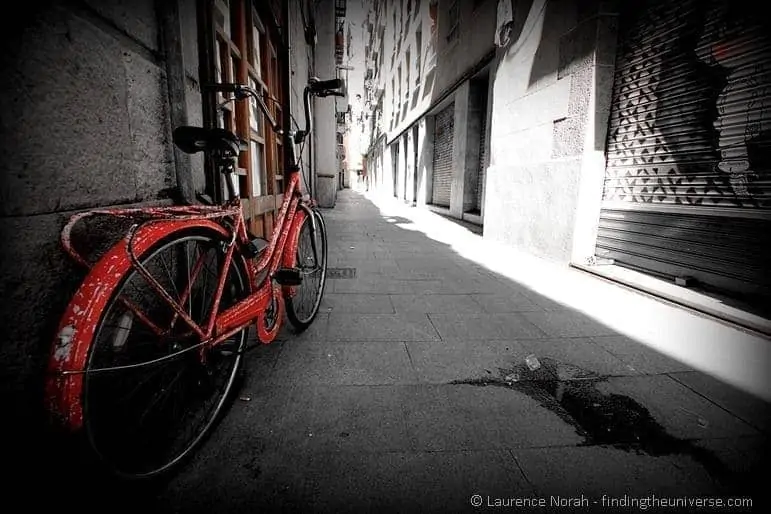
The Gothic Quarter rewards detail hunters. This bike had clearly seen better days, but against that peeling wall it made the photo. If a scene stops you, shoot it before you talk yourself out of it.
Table of Contents:
A Quick History (and Why It’s Less Medieval Than It Looks)
The Gothic Quarter sits on top of Barcino, the Roman colony founded under Augustus in the late 1st century BC. You can still see Roman walls and towers at Plaça Nova, and an entire Roman street grid survives underground at Plaça del Rei, which we’ll get to. The medieval city grew over the Roman one, and most of the big Gothic architecture went up between the 13th and 15th centuries, when Barcelona was one of the leading cities of the Crown of Aragon.
A surprising amount of the “medieval” Gothic Quarter is barely a century old. The name Barri Gòtic itself was coined in the early 20th century, and in the years around the 1929 International Exposition the city carried out a huge programme of restoration and outright invention to make the old town look more romantically medieval. The Pont del Bisbe, one of the most photographed “medieval” bridges in Spain, was built in 1928. The Cathedral’s grand front is roughly the same age as the Eiffel Tower, and its central spire wasn’t finished until 1913.
None of that makes the place fake. The Roman and medieval bones are real, and plenty of what you’ll see is original. But once you know that some of it is stage dressing, spotting the joins becomes a game you can play as you walk, and I find it makes the quarter more interesting rather than less.
My Self-Guided Gothic Quarter Walking Route
This route has ten stops and takes two to two and a half hours at a wandering pace, not counting time inside the Cathedral or museums. Start at Plaça Nova (a five minute walk from Jaume I metro station, or ten from Plaça de Catalunya) and finish at Plaça Reial, next to Liceu metro station.
Don’t bother with turn by turn directions in here, they don’t survive contact with the alleys. Each stop below is on Google Maps by name, and no two consecutive stops are more than a few minutes apart. When you lose the thread, and you will, just aim for the next stop name.
If you’d rather not have your phone out the whole walk, you can download this Gothic Quarter walking route as a PDF to print or save offline. Given the pickpocket note further down, that’s not the worst idea.
1. Plaça Nova and the Roman Towers
Plaça Nova is the front door of the Gothic Quarter, and it opens with the oldest thing you’ll see all day: two semi-circular Roman towers flanking what was one of the four gates of Barcino, with a reconstructed stretch of aqueduct alongside. Just inside the gate is the Casa de l’Ardiaca, the old archdeacon’s house, with a quiet courtyard and a fountain. Look for the marble letterbox by the entrance, carved with swallows and a tortoise. The story goes that the swallows represent how fast the post should travel, and the tortoise how fast it actually did.
Before you plunge into the alleys, turn around. The modern building opposite the Cathedral is the Architects’ College, and the frieze scratched across it was designed by Picasso. Most people walk straight past a public Picasso the size of a building, which I find quite funny.
Photography note: this square gives you the widest sightline to the Cathedral façade you’ll get anywhere in the quarter, so if you want the classic front-on shot, take it here. Late afternoon light and blue hour, when the floodlights come on, both work well.
2. Barcelona Cathedral (La Seu)
The Cathedral of the Holy Cross and Saint Eulàlia is the Gothic Quarter’s centrepiece, built mostly between the late 13th and mid 15th centuries. The façade came much later: built between 1887 and 1890 with the spire finished in 1913, a neo-Gothic front bolted onto a medieval church.
Inside, the cloister is the bit to seek out. It houses thirteen white geese, one for each year of Saint Eulàlia’s life before she was martyred by the Romans. They’re louder than you’d expect.
The cultural visit costs €16, which includes the choir, the museum and the roof terraces, reached by a small lift. The roof gives you a view across the old town’s towers and spires that you can’t get anywhere else in the quarter. You can also step inside free for prayer outside the paid tourist hours, generally early morning and evening, but the roof and cloister treasures need the ticket. Current hours are on the official Cathedral website, which is also the sensible place to book. Resellers charge €19 to €22 for “skip the line” entry to a queue that rarely takes ten minutes on a weekday.
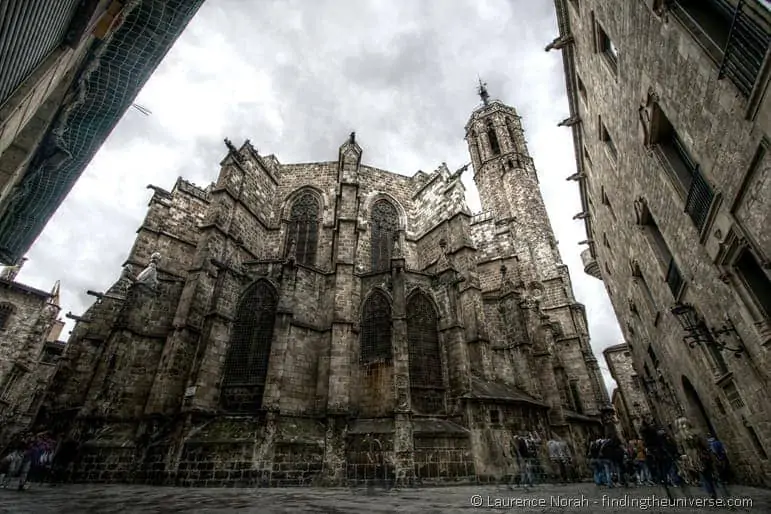
The Cathedral’s rear end, which I’d argue is more photogenic than the famous front. The medieval stonework back here is the real thing, and the tight angles force more interesting compositions than the head-on postcard view.
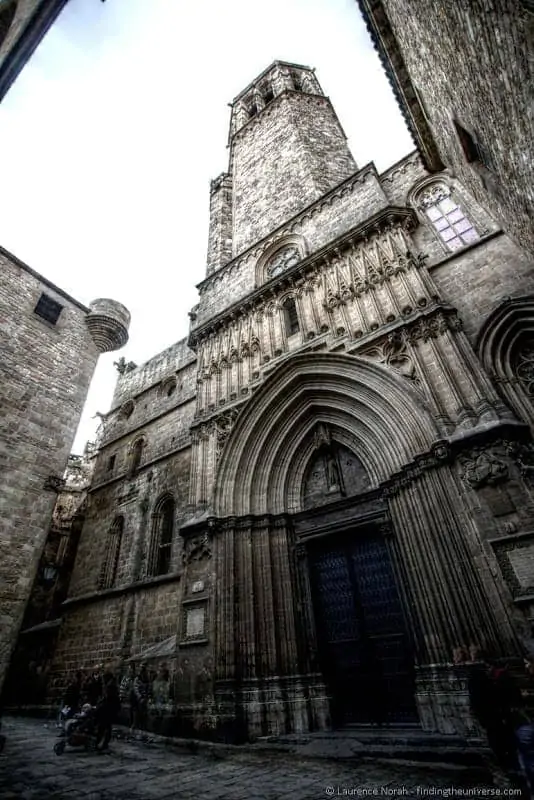
The side entrance. Shoot vertical in the Gothic Quarter: the buildings are tall, the streets are narrow, and fighting that with a landscape frame is usually a losing battle.
A couple of minutes north of the Cathedral on Carrer de Montsió is Els Quatre Gats, the Modernista café where Picasso had his first exhibition in 1900. It opened in 1897, closed for most of the last century, and since reopening has traded hard on the Picasso connection. My advice is to enjoy it on the cheapest possible terms: have a coffee in the front room, admire the tilework, and eat your actual meals elsewhere. You’re paying for the room, and the room is worth a coffee.
3. Plaça de Sant Felip Neri
Two minutes behind the Cathedral, this small octagonal square is the quietest and saddest place in the quarter. On the morning of 30 January 1938, during the Civil War, Italian aircraft flying for Franco bombed it. A first bomb hit the church where children were sheltering, and a second exploded in the square as rescuers arrived. 42 people were killed, many of them children. The shrapnel scars are still all over the church façade. For decades the Franco regime claimed the marks were bullet holes from executions carried out by the other side, a cover story that only fully unravelled after his death.
Today there’s a school here, and if you come at break time the square is full of playing children, which is its own kind of memorial. Come early in the morning if you want it still. The light in here is soft and indirect at almost any hour, and it’s a place to photograph quietly or not at all.
4. Carrer del Bisbe and the Pont del Bisbe
Carrer del Bisbe runs from the Cathedral to Plaça de Sant Jaume, and halfway along it you’ll hit one of the most photographed spots in the old town: the Pont del Bisbe, a lace-like stone bridge spanning the street between two government buildings. It looks fourteenth century. It was built in 1928, by Joan Rubió i Bellver, one of Gaudí’s collaborators, as part of that Exposition-era medievalising I mentioned. Underneath it there’s a carved skull pierced by a dagger, and legend has it the bridge carries a curse connected to it. Legends aside, the skull is real and most people photographing the bridge never spot it.
Photography note: by mid morning there’s a queue of phones under this bridge, and by noon it’s a scrum. Come before 9am for an empty street, or lean into it and use the crowd for scale. Shoot from a low angle looking up the street and the bridge frames itself against the strip of sky. This is also where you should be most aware of your pockets, for reasons covered further down.
5. Plaça de Sant Jaume
This open square was the crossroads of Roman Barcino, and it’s still where Catalonia gets governed. The Palau de la Generalitat, seat of the Catalan government, faces the Ajuntament, Barcelona’s City Hall, across the square, which means two thousand years of continuous local politics in one spot.
Both open to visitors free of charge, with catches. The City Hall opens every Sunday except public holidays from 10am to 1pm, and the Gothic Saló de Cent inside is one of the quarter’s real highlights. The Generalitat opens on the second and fourth weekends of each month, except August, and you must book ahead online. Don’t just turn up on a random Saturday expecting to walk in.
6. Temple d’August
Off the corner of Plaça de Sant Jaume, up the narrow Carrer del Paradís, a millstone set into the pavement marks the top of Mont Tàber, the small hill the Romans built on. Step through the doorway at number 10 and you’re in the courtyard of a hiking club, the Centre Excursionista de Catalunya, staring at four Corinthian columns nine metres tall. They’re the corner of the Temple of Augustus, built in the late 1st century BC. Three of them still stand exactly where the Romans put them; the fourth was reassembled and moved into place in 1956. A 2,000 year old temple inside a hiking club’s stairwell remains one of my favourite sentences to type.
Entry is free, and most of the crowds streaming between the Cathedral and Plaça de Sant Jaume have no idea it’s there.
7. Plaça del Rei and the Barcelona History Museum (MUHBA)
Plaça del Rei is the best preserved medieval square in the city, a tight three-sided box of palace, chapel and watchtower with a fan of steps in the corner. It’s also the entrance to the best €7 you’ll spend in Barcelona: the MUHBA, where a lift drops you four metres below the square onto the actual streets of Roman Barcino. You walk on glass and gantries over a fish sauce factory, laundries and wine vats. Entry is €7, it’s free on Sunday afternoons after 3pm and all day on the first Sunday of the month, and it’s closed Mondays.
Photography note: the square itself is all geometry, steps and shadow. It works in harsh light when the rest of the quarter doesn’t, so save it for the middle of the day if you’re walking this route in the morning.
8. El Call (the Old Jewish Quarter)
West of Carrer del Bisbe, the streets shrink to their narrowest and darkest, and you’re in El Call, the medieval Jewish quarter, home to one of the most important Jewish communities in medieval Spain until the pogrom of 1391 and the expulsions that followed. On Carrer de Marlet you’ll find the Sinagoga Major, said to be one of the oldest synagogue sites in Europe, built over Roman-era foundations. It’s tiny, and the archaeology is debated, but it’s a moving little place. The MUHBA also runs a small interpretation centre nearby, MUHBA El Call, if you want the fuller story.
Photography note: these are the alleys that made you want to photograph the Gothic Quarter, and they’re the hardest to shoot. The light down here is dim even at noon, with hard bright stripes where the sun sneaks in. Expose for the highlights and let the shadows go dark. Moody beats muddy.
On your way out towards Plaça del Pi, the little shop-café Caelum, on Carrer de la Palla, sells sweets and pastries made in convents and monasteries around Spain, and its basement room sits over the site of the Call’s medieval Jewish baths. Coffee and a marzipan cake on top of a piece of the Call is a pretty good use of fifteen minutes.
9. Santa Maria del Pi and Plaça del Pi
Santa Maria del Pi is what the Cathedral would look like if it had been left alone: single-nave Catalan Gothic, built between 1319 and 1391, with a plain, massive façade and a rose window ten metres across, the largest in Catalonia. In keeping with this article’s running theme, today’s window is a faithful 20th century reconstruction by Josep Maria Jujol, another Gaudí collaborator, after the original was destroyed by fire early in the Civil War.
The three little squares around the church are some of the most pleasant places in the quarter to just sit for a bit, and the pine tree that gives the church its name (“pi” is Catalan for pine) is still there, or at least its latest replacement is.
10. Plaça Reial
Finish at Plaça Reial, the grand arcaded square just off La Rambla, all palm trees and porticoes, a complete change of register from the alleys. The twin lamp posts in the middle were designed by a young Antoni Gaudí, one of his first commissions, and they’re a nice full-stop for the walk given how much of his later work waits elsewhere in the city.
Two warnings. First, the terrace restaurants under the arcades are some of the most tourist-priced tables in Barcelona; have a drink for the setting if you like, but eat elsewhere. Second, the square gets rowdy late at night. In daylight and early evening it’s lovely.
For the eating elsewhere: Can Culleretes, on Carrer d’en Quintana two minutes back towards Plaça del Pi, has been serving Catalan food since 1786, which makes it Barcelona’s oldest restaurant and the second oldest in Spain. It’s old-school cooking at fair prices. And if you keep walking south to Carrer de la Mercè, La Plata is a tiny standing-room bar that’s been frying tiny fish and pouring cheap wine since 1945, with a menu you can count on one hand. I mean all of this as the highest praise.
Three Places That Aren’t Actually in the Gothic Quarter
The name “Gothic Quarter” gets stretched over half the old town by tour companies and, occasionally, by travel bloggers who should know better. Three regulars:
La Boqueria market fronts La Rambla, which is the Gothic Quarter’s western boundary, and the market itself sits on the Raval side of the line. Go anyway if you like markets, ideally before 10am when it’s still mostly food shopping rather than smoothie tourism, but you’re not in the Gothic Quarter when you do.
El Born is across Via Laietana in La Ribera, a separate neighbourhood with its own history. It’s well worth your time, with the Picasso Museum and Santa Maria del Mar, and it makes a natural afternoon after a Gothic Quarter morning. It just isn’t the Gothic Quarter, whatever the tour listing says.
The Palau de la Música Catalana is in Sant Pere, a few minutes north. It’s Modernista rather than Gothic, built 1905 to 1908, UNESCO-listed, and the guided tour is worth the detour. I have a personal stake in this correction:
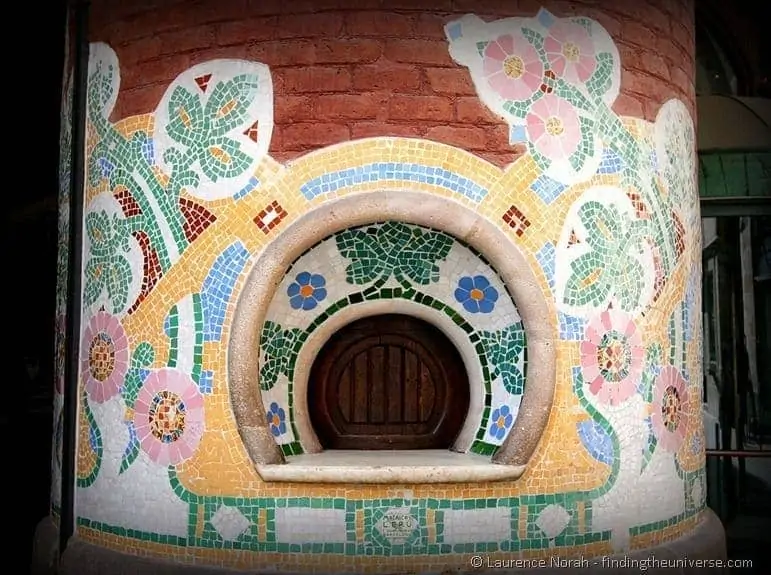
The Palau’s original ticket booth, which looks like a hobbit hole and is one of my favourite doors in Barcelona. I first published this photo in a post about the Gothic Quarter, which is exactly the mistake this section exists to prevent. It’s in Sant Pere. We all learn.
What to Skip (and How Long You Need)
The walking route above takes two to two and a half hours. Add the Cathedral interior and the MUHBA and you’ve got a very good half day. I wouldn’t plan more than that; the quarter is compact, and past the half-day mark you’re mostly walking the same alleys again, which is pleasant but doesn’t need scheduling.
If you only have an hour, do Plaça Nova, the Cathedral (outside), Sant Felip Neri, the Pont del Bisbe and Plaça del Rei. That’s the heart of it.
Things I’d skip: reseller “skip the line” Cathedral tickets (book direct or just walk up on a weekday), full meals at Els Quatre Gats and on the Plaça Reial terraces (both covered above, both fine for a drink), and the souvenir alley shops selling the same fridge magnets at four different prices. The quarter’s actual shopping strength is the little independent workshops, guitar makers and candle makers, which you’ll stumble into without my help.
Photographing the Gothic Quarter
I’ve been shooting this neighbourhood on and off since 2012, and it’s an education in difficult light. What works:
Go early. Before 9am you’ll have the alleys and the Pont del Bisbe more or less to yourself, and the low light raking down the lanes is the best of the day. By 11am you’re photographing other photographers.
Overcast is your friend here, which is handy advice for the days Barcelona doesn’t deliver postcard weather. The streets are narrow canyons, and on a sunny day the contrast between a lit wall and a shaded one is really more than any camera wants to handle. A cloudy sky turns the whole quarter into a giant softbox. If you do have harsh sun, expose for the highlights and let the shadows fall to black.
For the Cathedral, come back at blue hour. The façade is floodlit, and the half hour after sunset balances the lights against the sky. Set up in Plaça Nova.
Lens-wise, something in the 24-70mm range does nearly all of it. There’s no room to back up, so long lenses spend the day in the bag. And shoot vertical more than feels natural; the whole quarter is taller than it is wide.
Finally, look up, and hunt details: balconies, lamps, door knockers, saints in niches, the odd defiant bicycle. Some of my favourite photos from the quarter aren’t of anything famous:
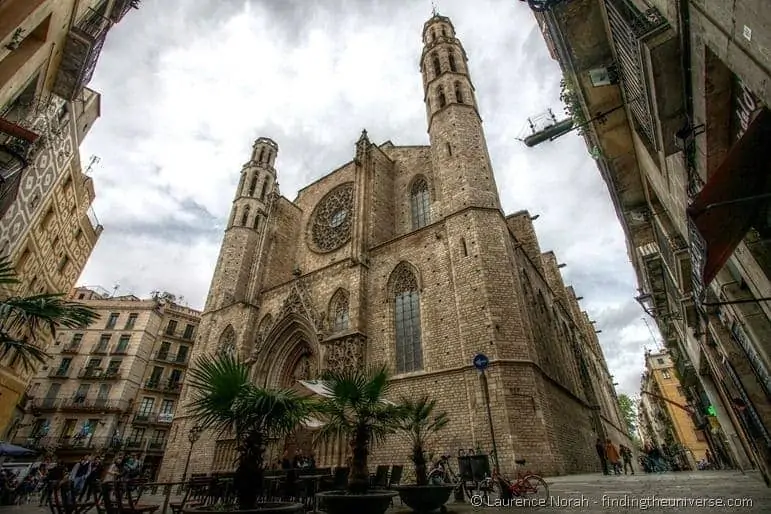
One of the quarter’s smaller churches. I photographed this on an early visit and I still couldn’t tell you with certainty which one it is, which I’ve decided is part of the neighbourhood’s appeal.
I’ve got a full guide to photography locations in Barcelona covering the rest of the city. And if you’d like to get better at this kind of shooting generally, my online travel photography course covers everything in this section in much more depth, including reading light and composing in awkward spaces.
Tickets, Prices and Free Entry Windows
Prices below were checked in July 2026. The pattern to notice: almost everything here is either free or has a free window, so with a little planning the Gothic Quarter is a very cheap half day.
| Place | Price | Free option |
|---|---|---|
| Barcelona Cathedral | €16 (includes choir, museum and roof terraces) | Free entry for prayer outside tourist hours (early morning and evening); no roof access |
| MUHBA (Plaça del Rei) | €7 | Sundays after 3pm, and all day the first Sunday of the month |
| Temple d’August | Free | Always |
| City Hall (Ajuntament) | Free | Sundays 10am to 1pm, except public holidays |
| Palau de la Generalitat | Free | Second and fourth weekends of the month (not August), advance booking required |
My booking advice: reserve the Cathedral online a day or so ahead if you’re visiting in peak summer, book the Generalitat if you want it, and walk up to everything else. This is one of the few corners of Barcelona where you don’t need to plan a week out.
Prefer a Guide?
This article is built around walking the quarter yourself, but a good guide adds a layer of story you won’t get from plaques, and if that’s your preference there are two I’d point you at. One filter worth applying to any tour you consider: several popular “Gothic Quarter” tours spend half their time on La Rambla and at La Boqueria, which, as covered above, is not the Gothic Quarter. Both of the below stay inside the quarter proper.
The Gothic Quarter walking tour with optional tapas (from €24) covers the core of the route above with the food angle bolted on at the end, which solves dinner at the same time. Alternatively, the two hour Gothic Quarter walking tour (from €27) is the pure history version, running from Roman Barcino through to the medieval city.
Getting There and Staying Safe
The Gothic Quarter is walkable from most of central Barcelona. By metro, Jaume I (L4, yellow) drops you at the eastern edge two minutes from Plaça Nova, Liceu (L3, green) puts you on La Rambla by Plaça Reial, and Plaça de Catalunya covers the northern end plus airport train connections.
On safety: the Gothic Quarter is safe in the sense that matters most, violent crime against visitors is rare. Pickpocketing is the real issue, and it’s persistent, especially in the crush under the Pont del Bisbe, on La Rambla and around the Cathedral. Keep your phone out of your back pocket, wear bags across your body, and I’d suggest a camera strap you trust. We’ve walked these streets on every visit since 2012 without trouble, but of course we also don’t make it easy for anyone.
Frequently Asked Questions
Is the Gothic Quarter worth visiting?
Yes, and I’d put it in the top three things to do on a first Barcelona trip alongside the Sagrada Família and Park Güell. It’s the oldest part of the city, it’s compact, it’s free to wander, and it’s the best couple of hours of atmosphere Barcelona has. It’s also the part of the city most people wish they’d given more time.
How long do you need in the Gothic Quarter?
Two to two and a half hours covers the walking route in this guide at a relaxed pace. Add the Cathedral interior and the MUHBA underground ruins and it becomes a solid half day. More than that is lovely but not necessary; the quarter is small.
Is the Gothic Quarter free to visit?
The streets and squares are free, and so is the Temple d’August. The Cathedral’s cultural visit costs €16, and the MUHBA museum is €7, with free entry on Sunday afternoons and all day on the first Sunday of the month. City Hall and the Generalitat both open free on a limited schedule. You can easily have a really good visit here without spending anything at all.
Is the Gothic Quarter safe at night?
Broadly yes. It’s busy well into the evening and violent crime is rare. Pickpocketing is the main risk day and night, and the area around Plaça Reial gets rowdy in the small hours. Normal city sense applies: bag across your body, phone out of your back pocket.
What is the difference between the Gothic Quarter and El Born?
They’re separate neighbourhoods divided by Via Laietana. The Gothic Quarter is the oldest core, built over Roman Barcino, with the Cathedral at its centre. El Born, part of La Ribera, is medieval too but has a different character, home to the Picasso Museum and Santa Maria del Mar. They pair well: Gothic Quarter in the morning, El Born in the afternoon.
Is the Gothic Quarter actually medieval?
Partly. The street plan and many buildings are Roman and medieval, but a lot of the most “medieval” looking details were added in the late 19th and early 20th centuries, when the city restored and embellished the area around the 1929 International Exposition. The famous Pont del Bisbe dates from 1928, and the Cathedral’s façade was built between 1887 and 1890. The history is real; some of the costume is newer.
Further Reading
That should be everything you need for a very good few hours in Barcelona’s oldest neighbourhood. If you’re putting a longer trip together, these should help:
- Our 2 day Barcelona itinerary and 3 day Barcelona itinerary, both of which give the Gothic Quarter the time it deserves
- Our complete guide to visiting the Sagrada Família
- Day trip guides to Montserrat and Girona and Figueres
- Jess’s detailed comparison of the Barcelona discount passes, useful if you’re doing several paid sights
- Her guide to 20 Gaudí sites in Barcelona, for when you’re done with the Gothic and ready for the curvy stuff
- My guide to the best photography locations in Barcelona, and a related guide to the best viewpoints across Barcelona
- My guide to Barcelona’s street art scene, if you want a change of pace from the old town
- For a guidebook, we use and like Rick Steves Barcelona
Have you been to the Gothic Quarter, or is it on the list? If you’ve got a question about the route, or a favourite corner I’ve missed, let us know in the comments below. We read them all!
Leave a Reply