
If you’re visiting Barcelona, there’s a good chance the Sagrada Familia is on your list. It was on ours the first time we visited, and we’ve been back many times since.
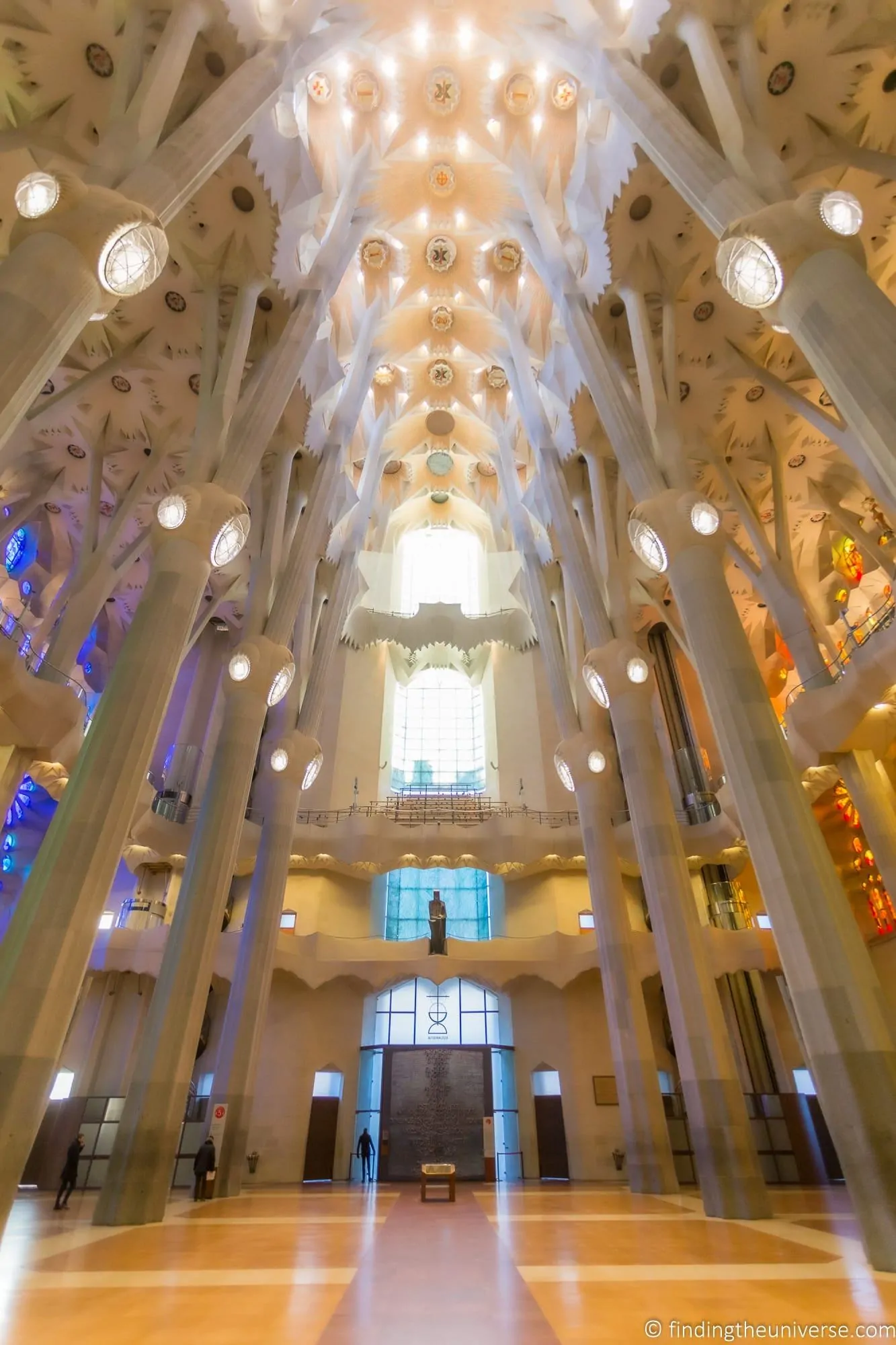
The Basilica de la Sagrada Familia is one of those buildings that you have to see to believe. Photos don’t do it justice, particularly the interior. We’d go as far as to say it’s one of the most impressive buildings we’ve ever visited, anywhere in the world.
Because it’s so popular, you do need to plan ahead. At busier times of year, tickets sell out weeks in advance. There are also choices to make before you buy your ticket, including whether to add a tower visit or guided tour.
We’d also note that in 2026, the Sagrada Familia is going through a particularly exciting period. The Tower of Jesus Christ has just been completed, making it the tallest church in the world, and it was officially inaugurated on 10 June 2026. So if you’re visiting Barcelona this year, expect extra buzz around the building, and book tickets as far in advance as you can.
This guide covers everything you need to know: history, tickets, pricing, towers, what to see inside, and all the practical details for planning your visit. We’ve kept it as up to date as possible based on our own visits and the latest information from the official website.
Table of Contents:
What is the Sagrada Familia?
The Sagrada Familia is a huge Roman Catholic church in Barcelona. It’s classified as a minor basilica, and was consecrated as such by Pope Benedict XVI in 2010.
This is the masterpiece of Antoni Gaudí, a Catalan architect responsible for a number of impressive buildings across Barcelona and the wider region. He was a devout Catholic and worked in the Modernisme, or Catalan Modernism style.
Some of his other most popular works in Barcelona include La Pedrera, Casa Batlló, and Park Güell. You can see a full list of his work in Barcelona in our guide to Gaudí sites in Barcelona.
Construction of the Sagrada Familia started in 1882. Gaudí took over the project in 1883 and led it until his death in 1926, after which work was interrupted by the Spanish Civil War in 1936. It resumed in 1940, and has been ongoing ever since.
Funding for the Sagrada Familia is entirely private, with no support from the government or Church. It was initially funded by private donors, but today much of the income comes from visitor ticket sales. So when you visit, your money goes directly towards helping finish the building.
When Will the Sagrada Familia Be Finished?
2026 is a landmark year for the Sagrada Familia. The exterior of the Tower of Jesus Christ was completed in February 2026, when the final section of the four-armed cross was lifted into place. At 172.5 metres, this makes the Sagrada Familia the tallest church building in the world.
The Tower of Jesus Christ was officially inaugurated on 10 June 2026, which was the 100th anniversary of Gaudí’s death. Pope Leo XIV presided over the blessing ceremony during an apostolic visit to Barcelona.
It’s important to know that this does not mean the Sagrada Familia is “finished.” The inauguration marks the completion of all six central towers (Jesus Christ, the Virgin Mary, and the four Evangelists), which is a huge milestone. But the Glory Façade, which will be the main entrance when complete, still needs to be built. Current estimates put the full completion of the Glory Façade between 2032 and 2035.
The fun thing about visiting a building that is still under construction is that every time you visit, it looks a bit different. The downside is that, well, it is an active building site. Expect to see workers, cranes, and scaffolding, particularly around the Glory Façade side of the building.
Following the inauguration, the Tower of Jesus Christ is expected to open to visitors, with a viewpoint inside the cross at 164 metres offering what will be the highest panoramic view in Barcelona. As of June 2026, tickets for this tower aren’t yet on sale. We’ll update this section with more details once visiting arrangements are confirmed.
Where is the Sagrada Familia?
The official address for the Sagrada Familia is Carrer de Mallorca, 401, 08013 Barcelona, Spain. You can see it here on Google Maps.
The Sagrada Familia takes up an entire city block in the Eixample district, a little to the north east of the city centre. It’s sandwiched between two small parks, Plaça de Gaudí to the northeast and Plaça de la Sagrada Família to the southwest.
How to Get to the Sagrada Familia
The Sagrada Familia is about a 30 minute walk from Plaça de Catalunya (roughly 2.4 km / 1.5 miles), so walking is a reasonable option if the weather is good.
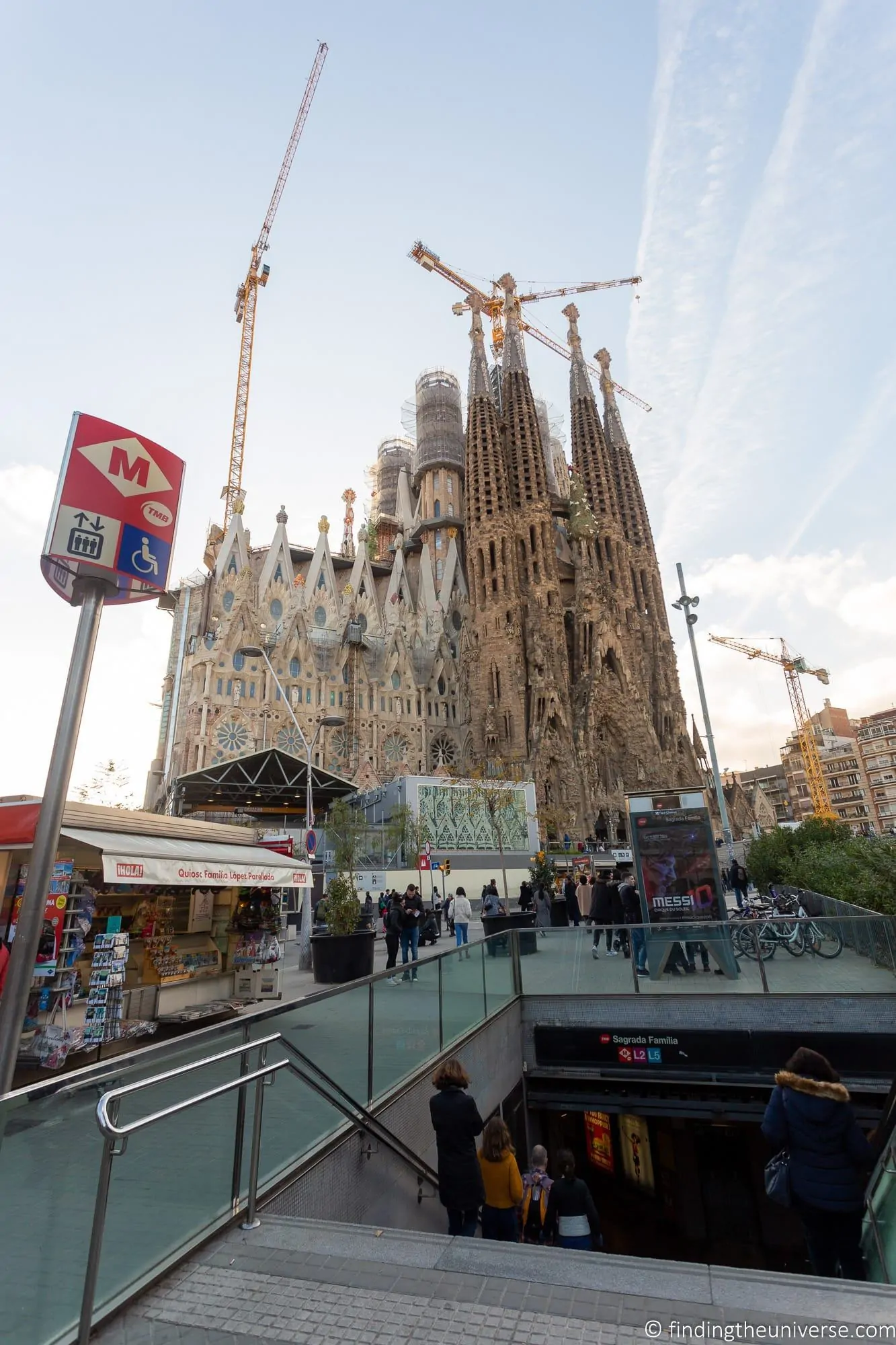
The easiest option is the metro. There’s a station called Sagrada Familia right next to the church, served by lines L2 and L5. From most stops in central Barcelona, you can be here in 15 to 20 minutes.
You can also take the public bus, although traffic means it will likely take a little longer than the metro, around 30 minutes on average.
Taxis are widely available in Barcelona. The fare from central Barcelona to the Sagrada Familia will vary, but expect to pay between €6 and €10. Look for the yellow and black licensed cabs with green lights in the windows when free.
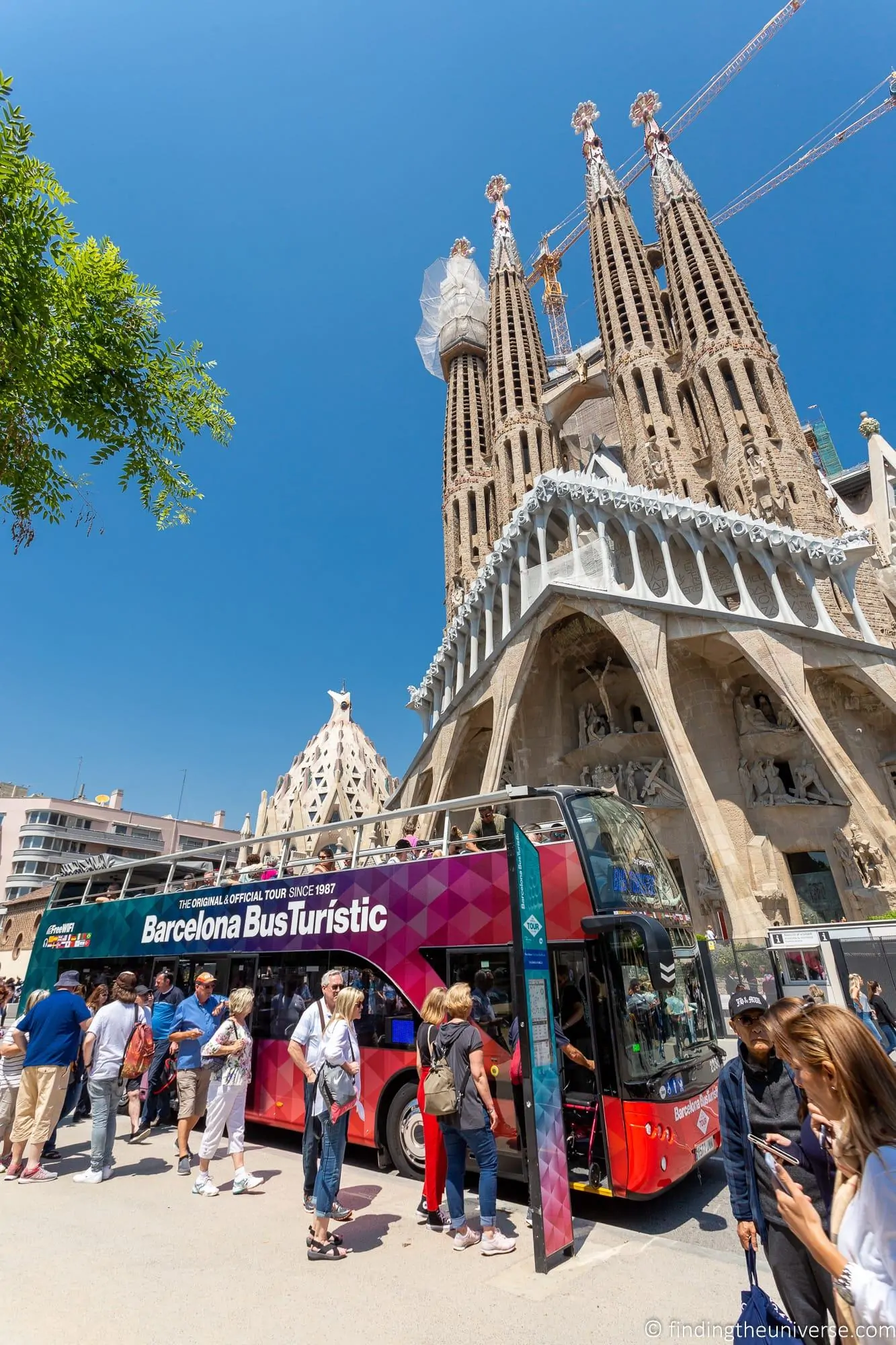
Finally, the Barcelona Bus Turístic (Hop on Hop off bus) has a stop directly outside the Sagrada Familia. This bus route also includes stops at Sant Pau Recinte Modernista and Park Güell, and is a good way to get around the main sights.
You can buy the Barcelona Bus Turístic ticket directly from Tiqets here, or get it as part of a sightseeing pass. It’s included on the Barcelona City Pass and the Go Barcelona Pass.
These passes have a variety of inclusions and benefits, which you can read more about in our guide to the various Barcelona City Passes here.
Sagrada Familia Opening Times
The Sagrada Familia is open every day of the year, including Christmas Day and New Year’s Day. Hours vary by season:
- January to February: Monday to Saturday 9 am to 6 pm. Sundays 10.30 am to 6 pm.
- March: Monday to Saturday 9 am to 7 pm. Sundays 10.30 am to 7 pm.
- April to September: Monday to Saturday 9 am to 8 pm. Sundays 10.30 am to 8 pm.
- October: Monday to Saturday 9 am to 7 pm. Sundays 10.30 am to 7 pm.
- November to December: Monday to Saturday 9 am to 6 pm. Sundays 10.30 am to 6 pm.
Exceptions are 25 December, 26 December, 1 January, and 6 January, when opening times are 9 am to 2 pm.
Since February 2026, the Sagrada Familia has a designated “Quiet Hour” from 9 am to 10 am every day. During this time, visitors must use earphones for audioguides and mobile devices, and are asked to keep noise to a minimum. It’s a nice window if you prefer a more contemplative experience.
Always check the official website here for the latest opening times before planning your visit, as they can change due to special events or construction work.
Can You Attend Mass at the Sagrada Familia?
Yes. The Sagrada Familia is an active place of worship, and masses are held throughout the week.
As an international visitor, you’ll most likely want to attend one of the multilingual masses held in the main basilica:
- Every Saturday and on the eve of holy days of obligation at 8 pm.
- Every Sunday and on holy days of obligation at 9 am.
The Sagrada Familia also hosts extraordinary masses at various times throughout the year, which usually require an invitation. For full details, see the official calendar of masses here.
Attending mass is free and on a first come, first served basis. You’ll enter on the Nativity Façade side (Carrer de la Marina), with doors opening from 8.30 am for morning masses and 7.30 pm for evening masses. We’d recommend arriving well before these times, as it fills up. Appropriate attire and behaviour is expected, and photography is not permitted during the service.
Daily masses are also held in the Sagrada Familia Crypt in Catalan and Spanish. See the Crypt section below for more details.
What Can You See at the Sagrada Familia?
There is a lot to see at the Sagrada Familia, so expect to spend between 90 minutes and 3 hours on site depending on how much time you want to take. All of the below is included with a standard entry ticket, except the tower climb, which requires a separate ticket.
Exterior of the Sagrada Familia
The Sagrada Familia is impressive from any angle. Whether you see it from afar as you walk through the Eixample, or get your first close-up view as you emerge from the metro station, the building demands your attention.
Gaudí combined Gothic, Catalan Modernism, and Art Nouveau styles, with signature elements like hyperboloid and paraboloid structures. The result is a building that looks like nothing else on earth.
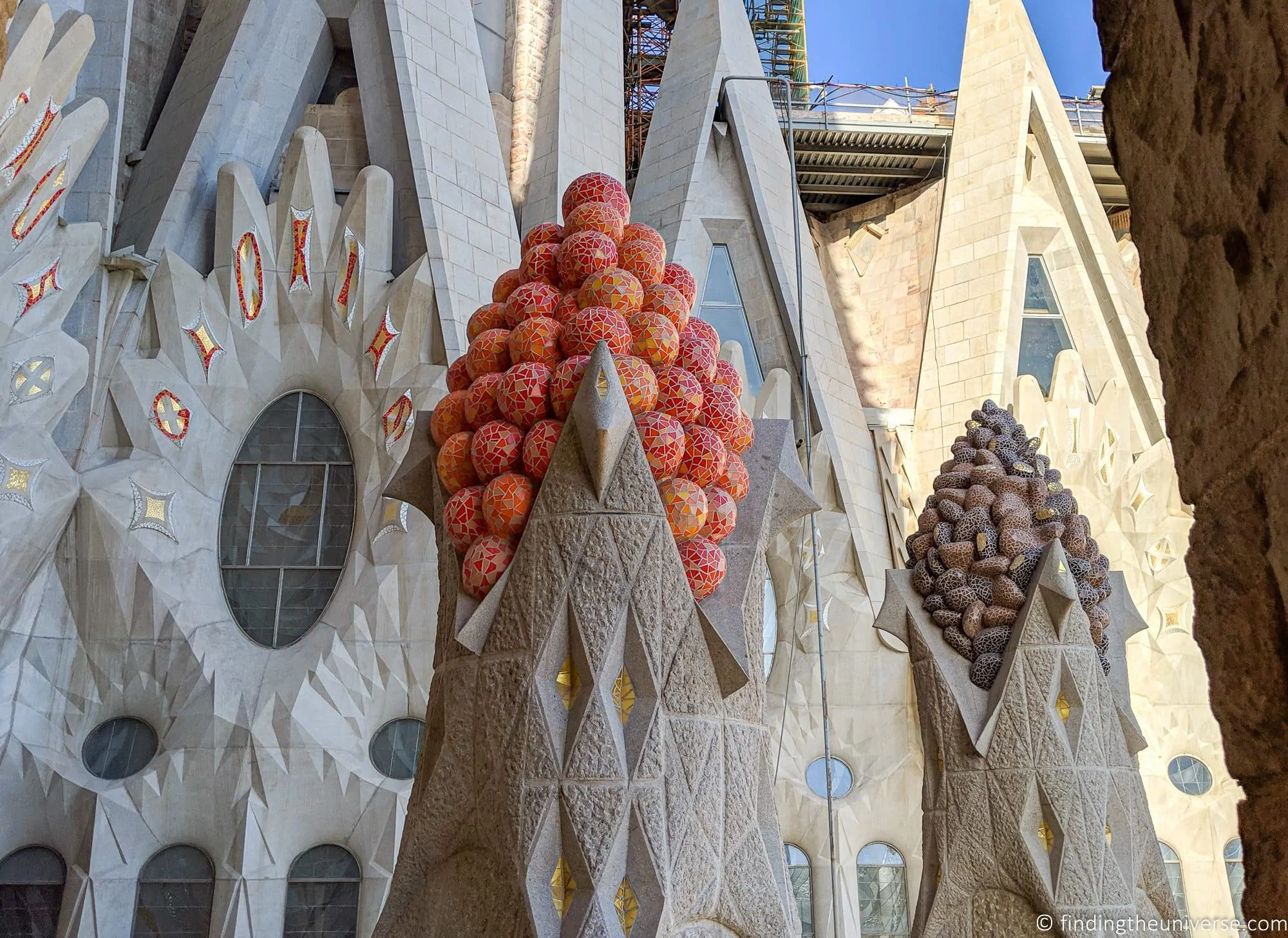
The most detailed sections of the exterior are the three façades. Two are complete: the Nativity Façade and the Passion Façade. The third, the Glory Façade, is still under construction and will eventually be the main entrance to the church.
Each façade tells a different part of the story of Jesus Christ. The Nativity Façade, which is the oldest and the one Gaudí had the most control over, depicts the birth of Christ in an organic, flowing style. You’ll get an up-close view of this as you enter the church, as the main visitor entrance is on this side.

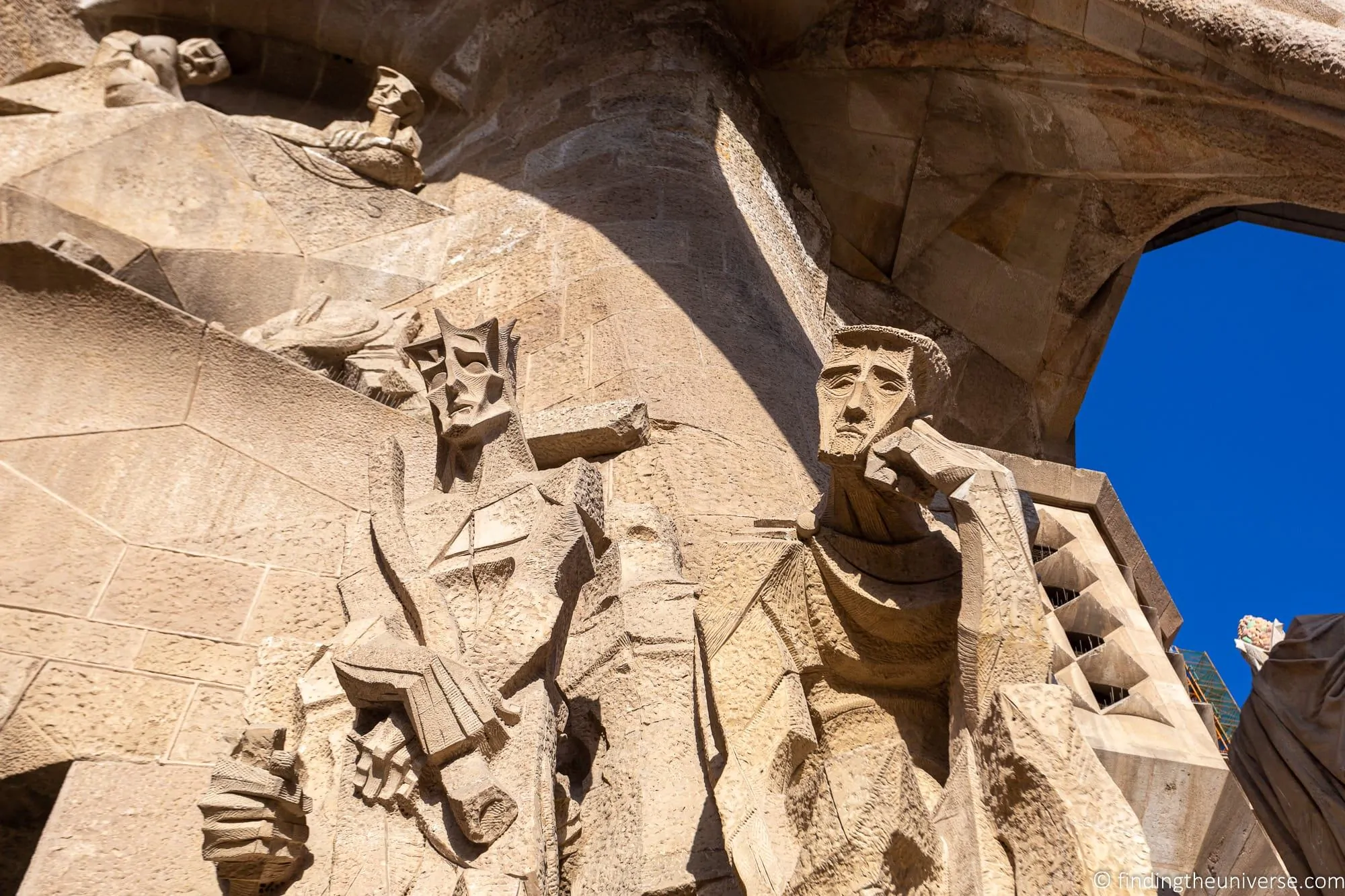
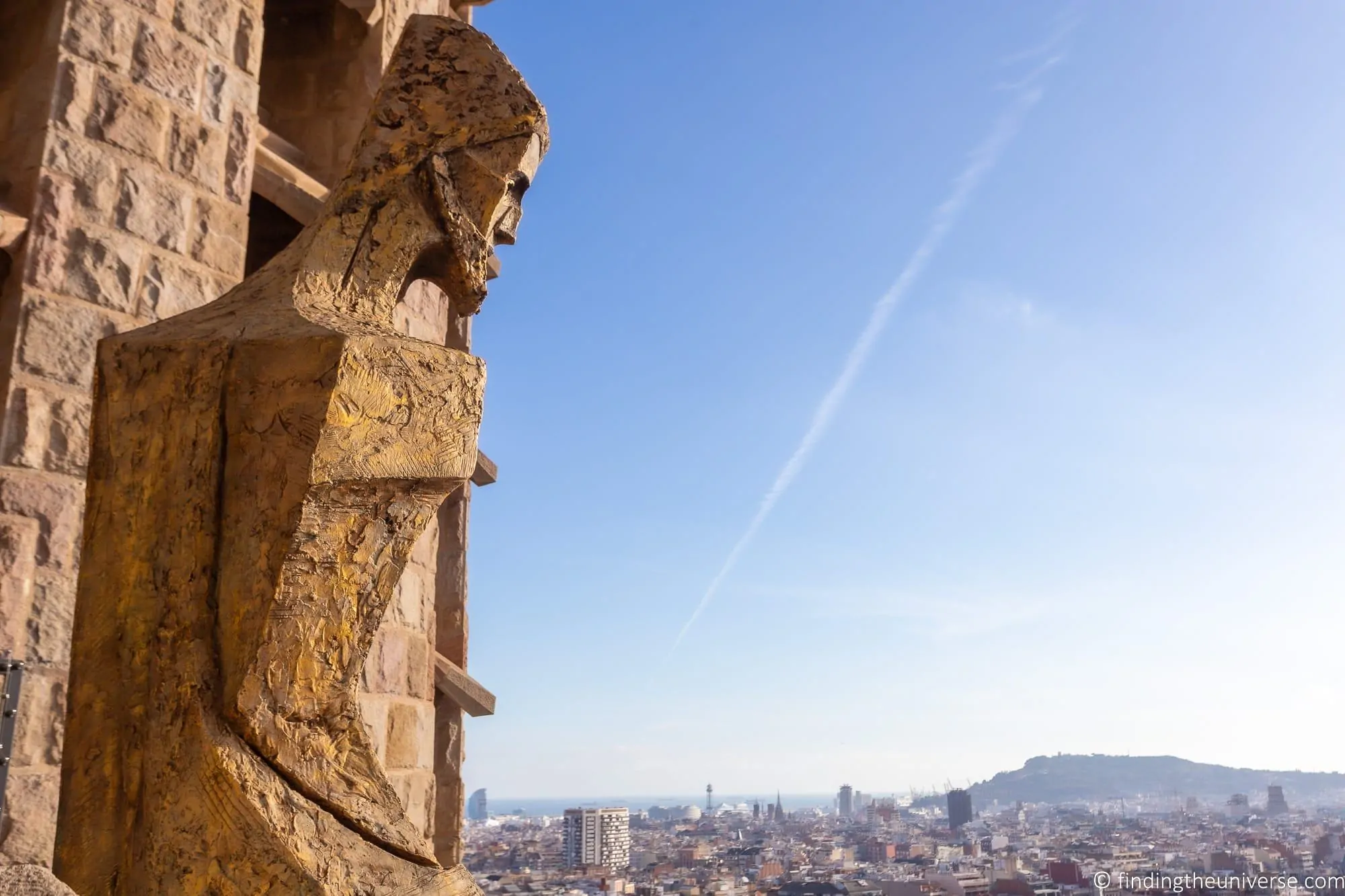
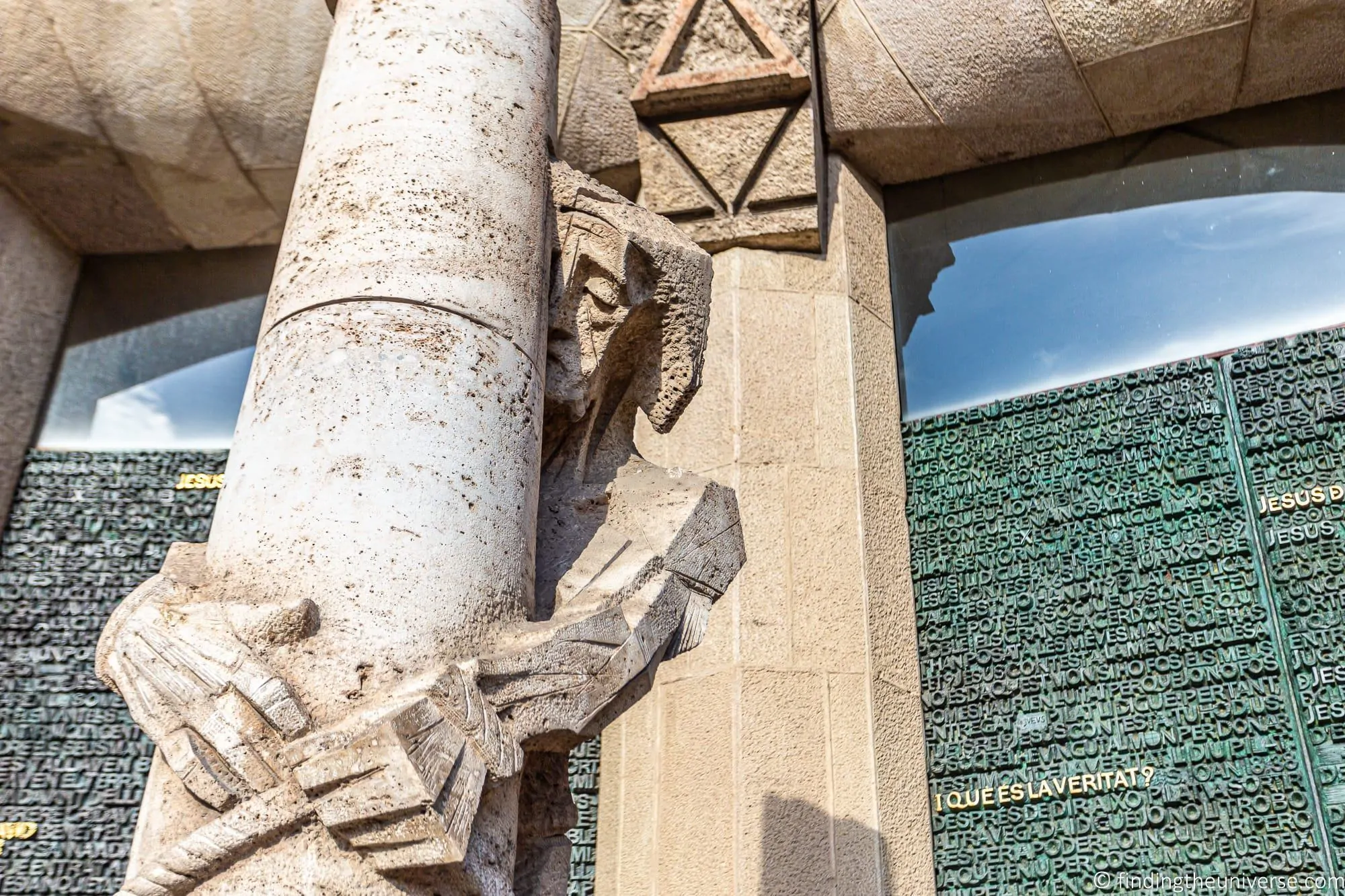
The Passion Façade is much more austere, with sharp angles and stripped-back stone. It focuses on the crucifixion of Christ and has a completely different feel. You’ll see this one close up as you leave, as it’s where the visitor exit currently is.
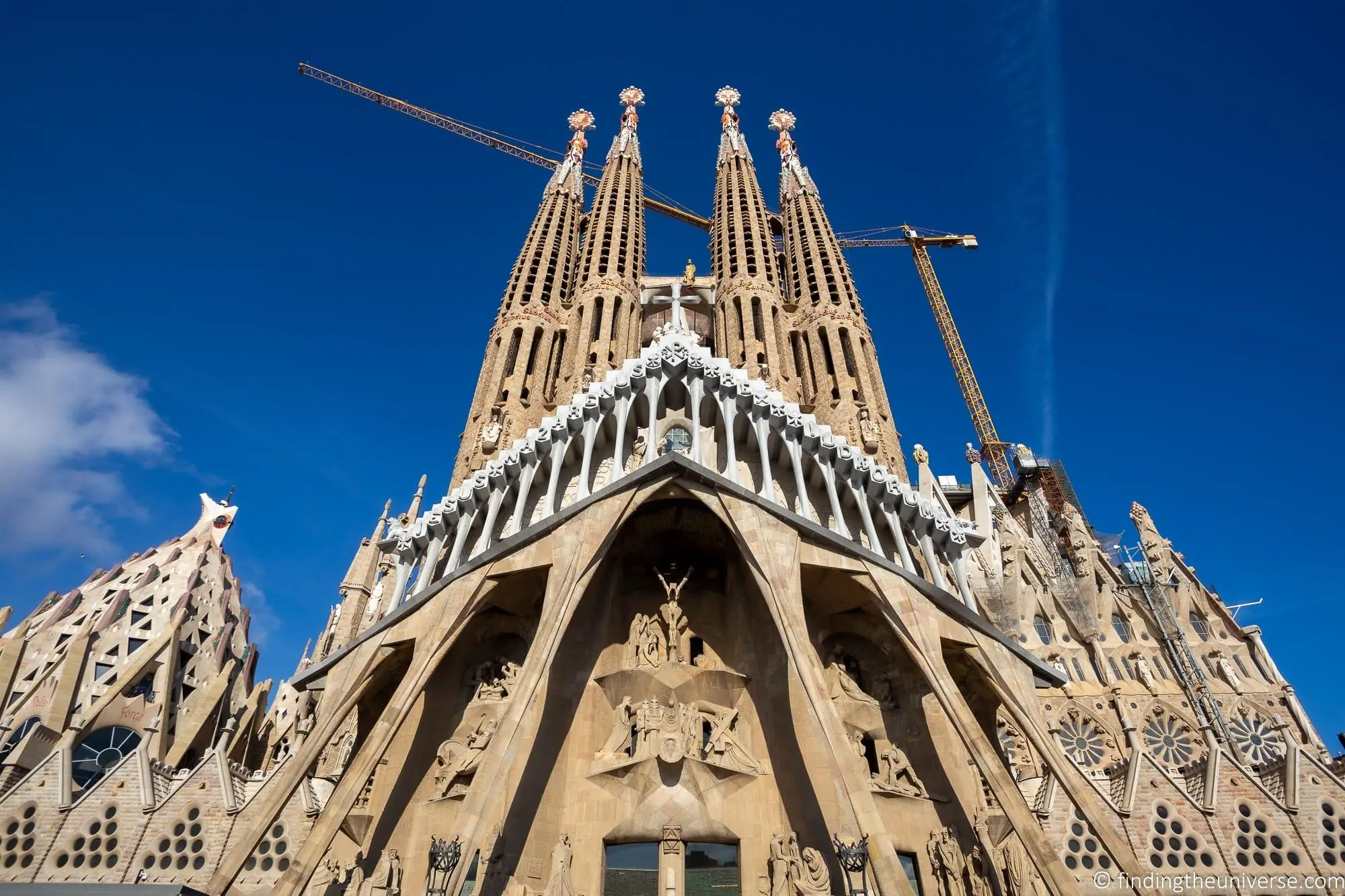
Don’t rush straight inside. We’d recommend arriving a little before your timeslot so you can appreciate the exterior first, then join the entry queue a couple of minutes before your time.
Nave and Main Interior of the Sagrada Familia
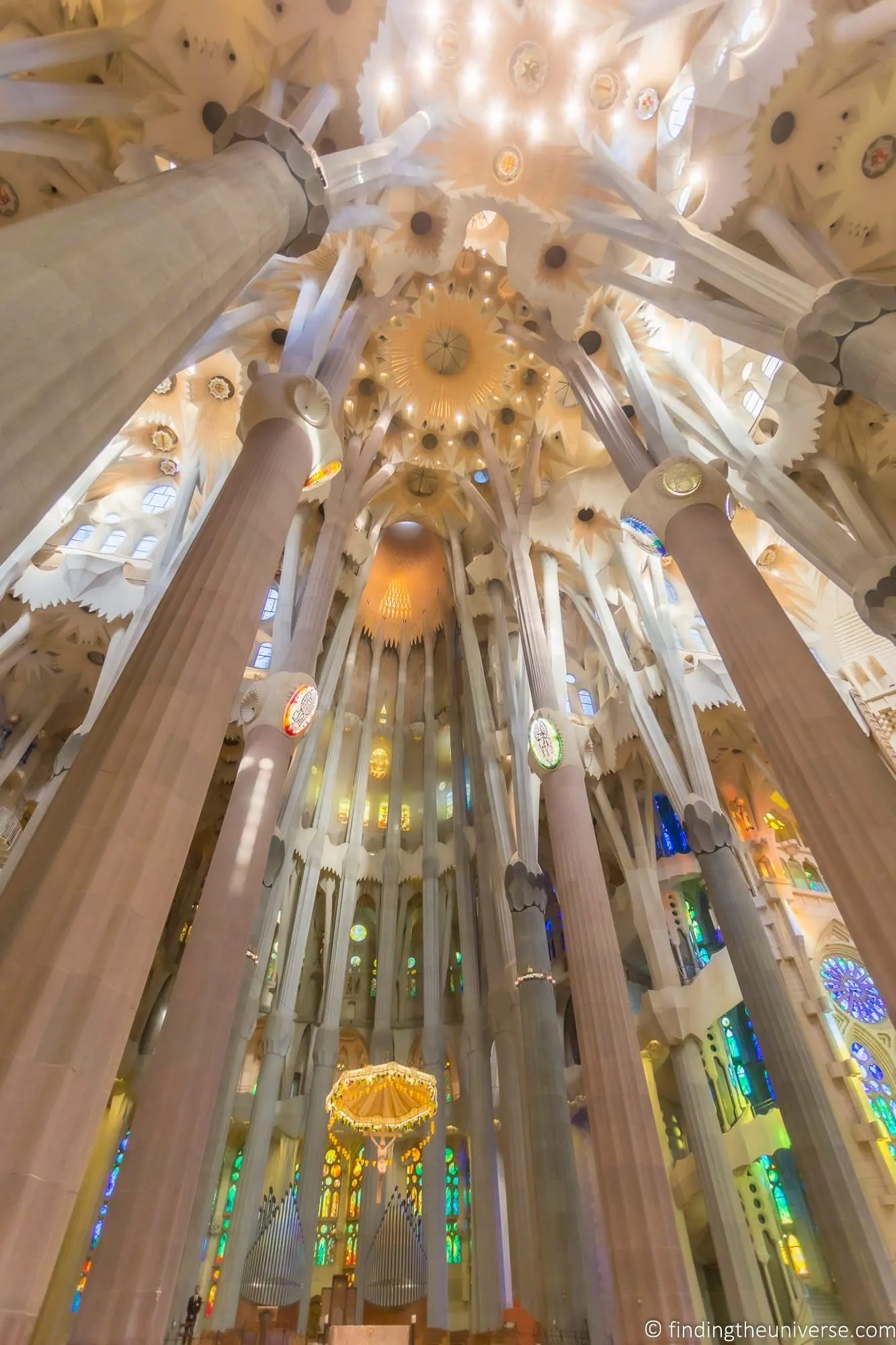
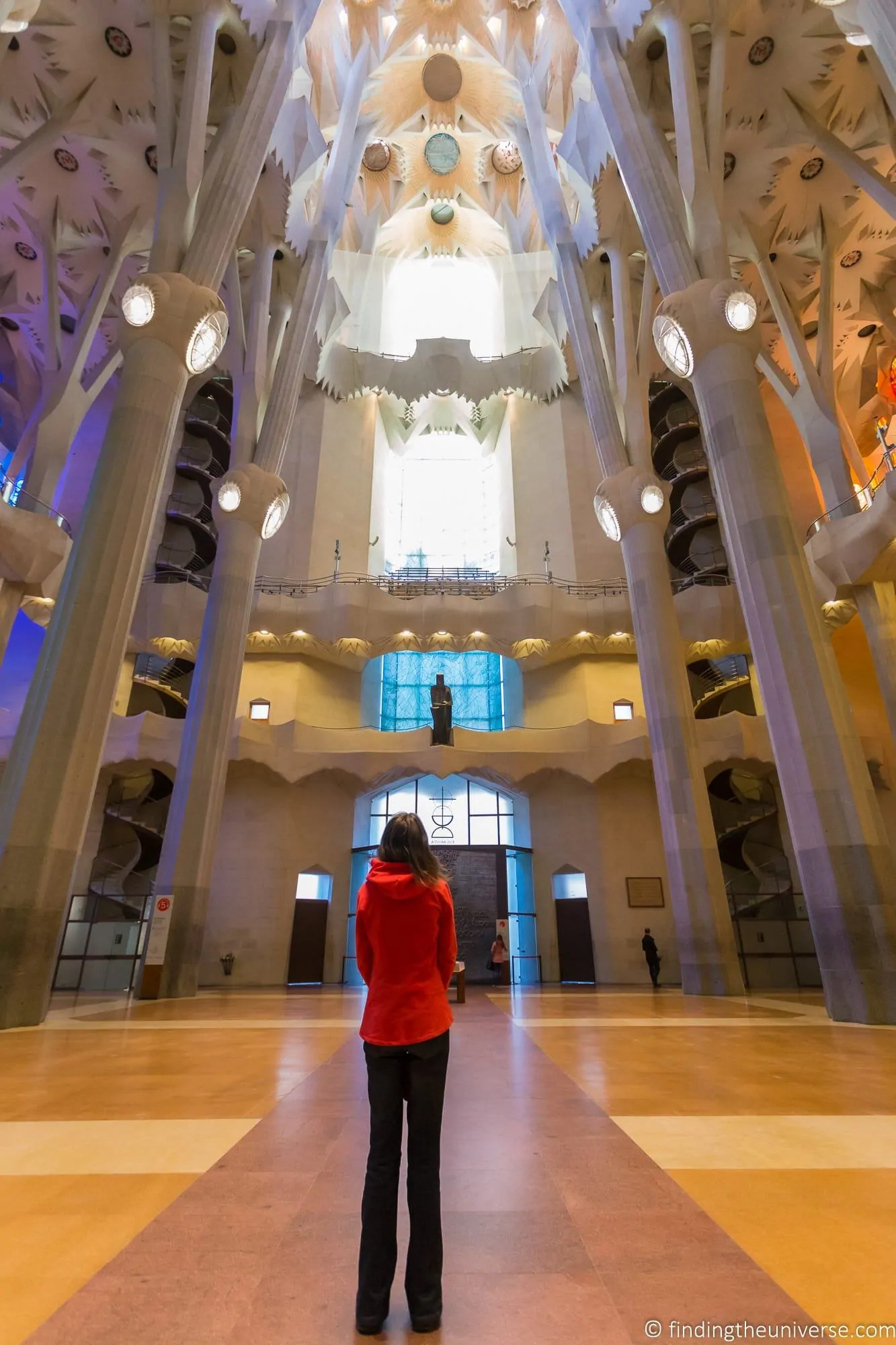
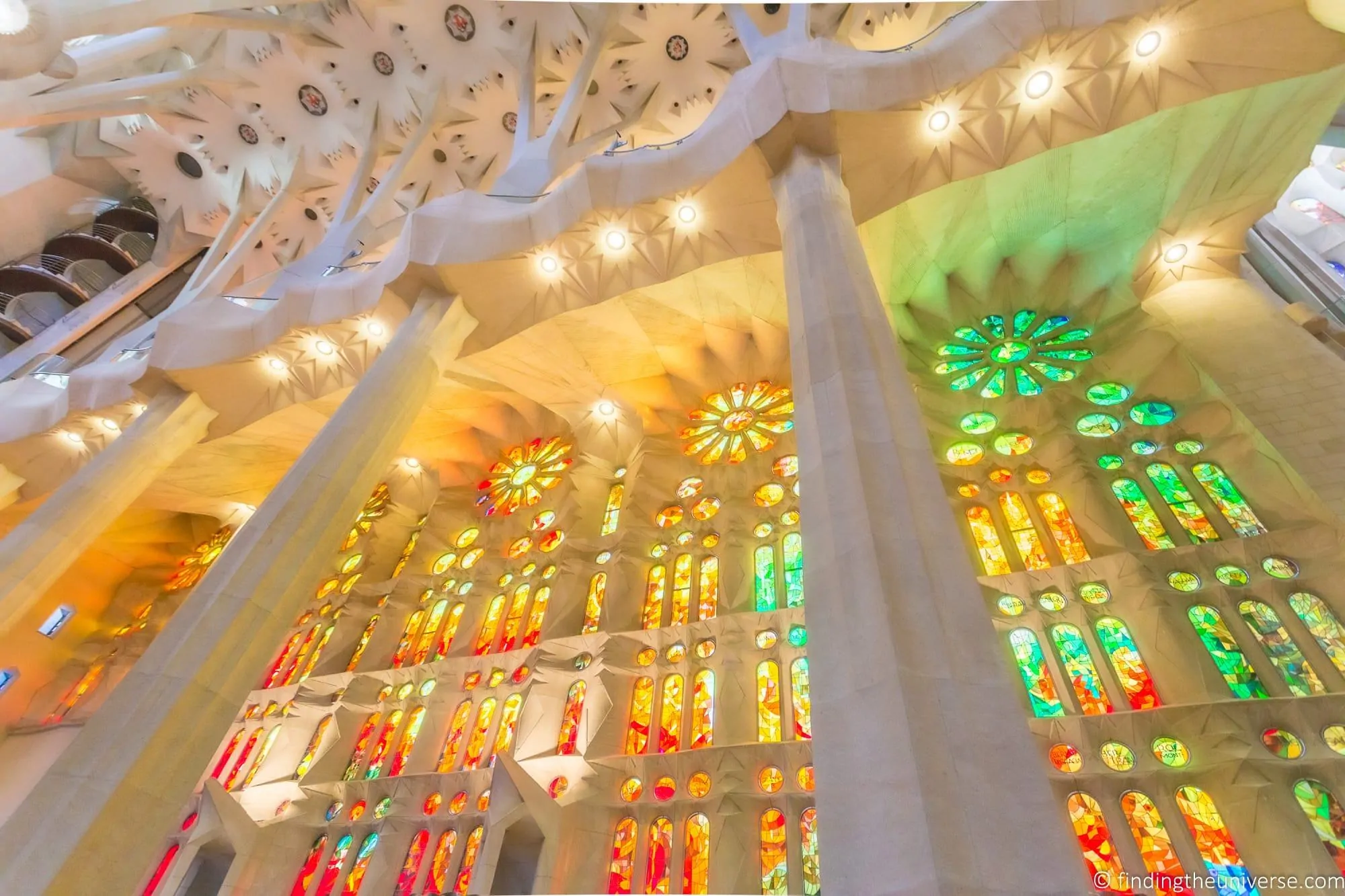
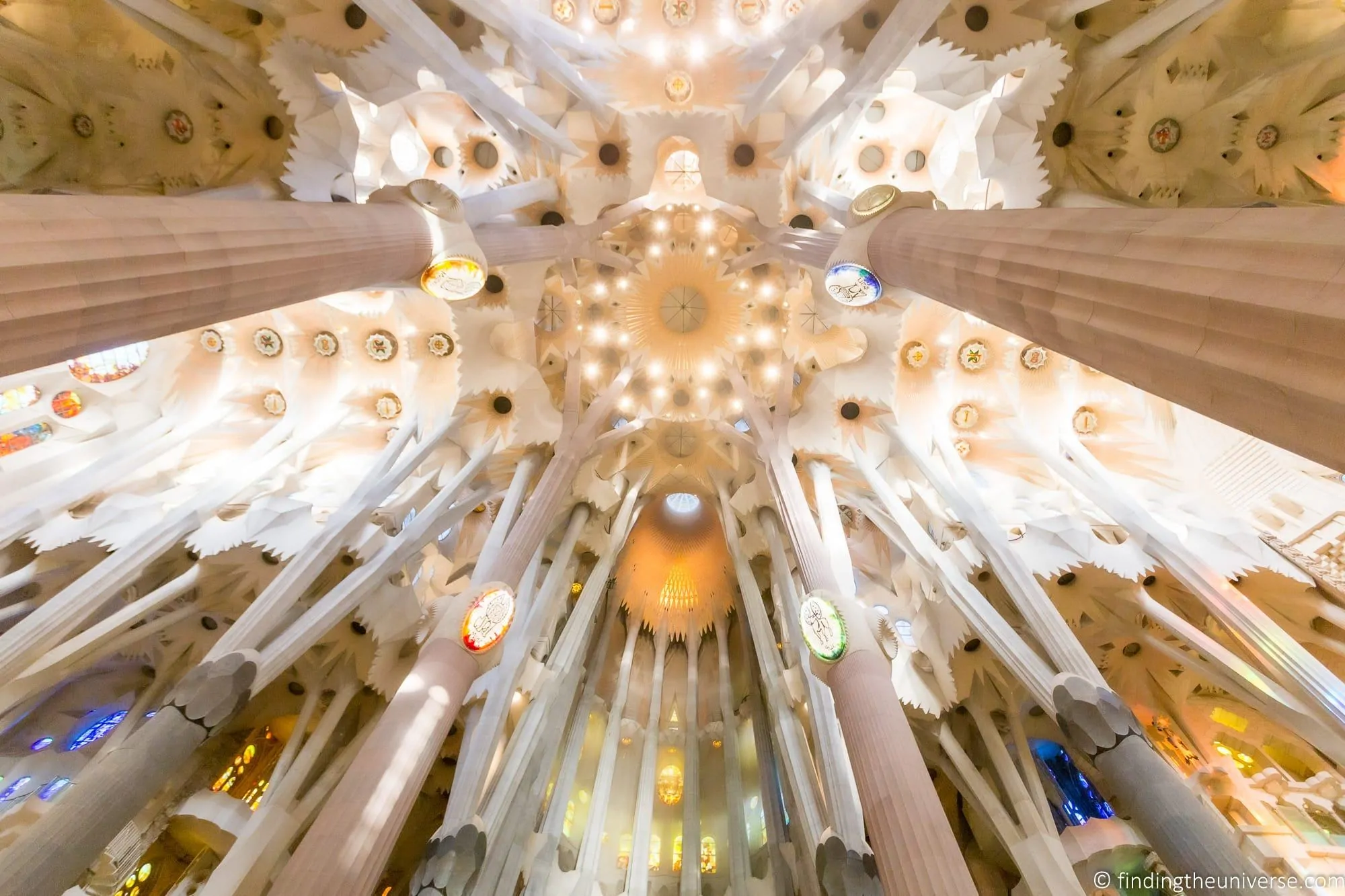
If you thought the outside was impressive, wait until you walk in. The interior is a massive five-aisled nave, with the roof supported by giant tree-like columns that branch outwards as they reach the ceiling. Coloured light pours through the stained glass windows and fills the whole space.
It feels like walking into some kind of surreal forest, which was exactly the effect Gaudí was going for. He pulled it off.
A tip for photographers: the morning light comes through the blue and green windows on the east (Nativity) side, while the afternoon sun lights up the warm orange and red windows on the west (Passion) side. If you have a preference, time your visit accordingly. I’ve visited at both times and each creates a completely different atmosphere.
Once you’ve taken all that in, there’s plenty more to explore, including the transept and the apse with its seven chapels. If you’ve got an audioguide or a guided tour (and we’d recommend one of the two), it’ll help you understand the symbolism behind what you’re seeing.
Sagrada Familia Crypt
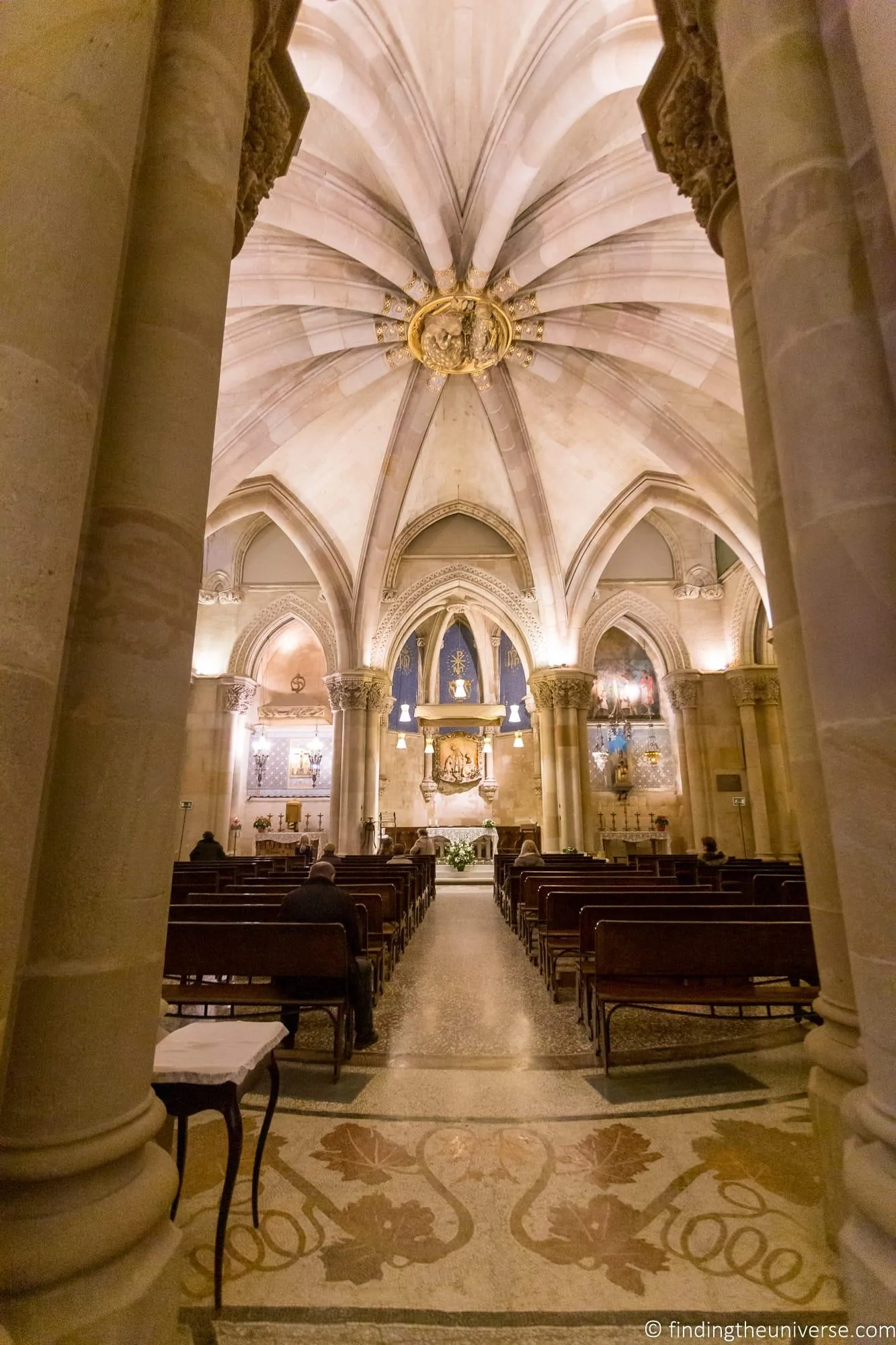
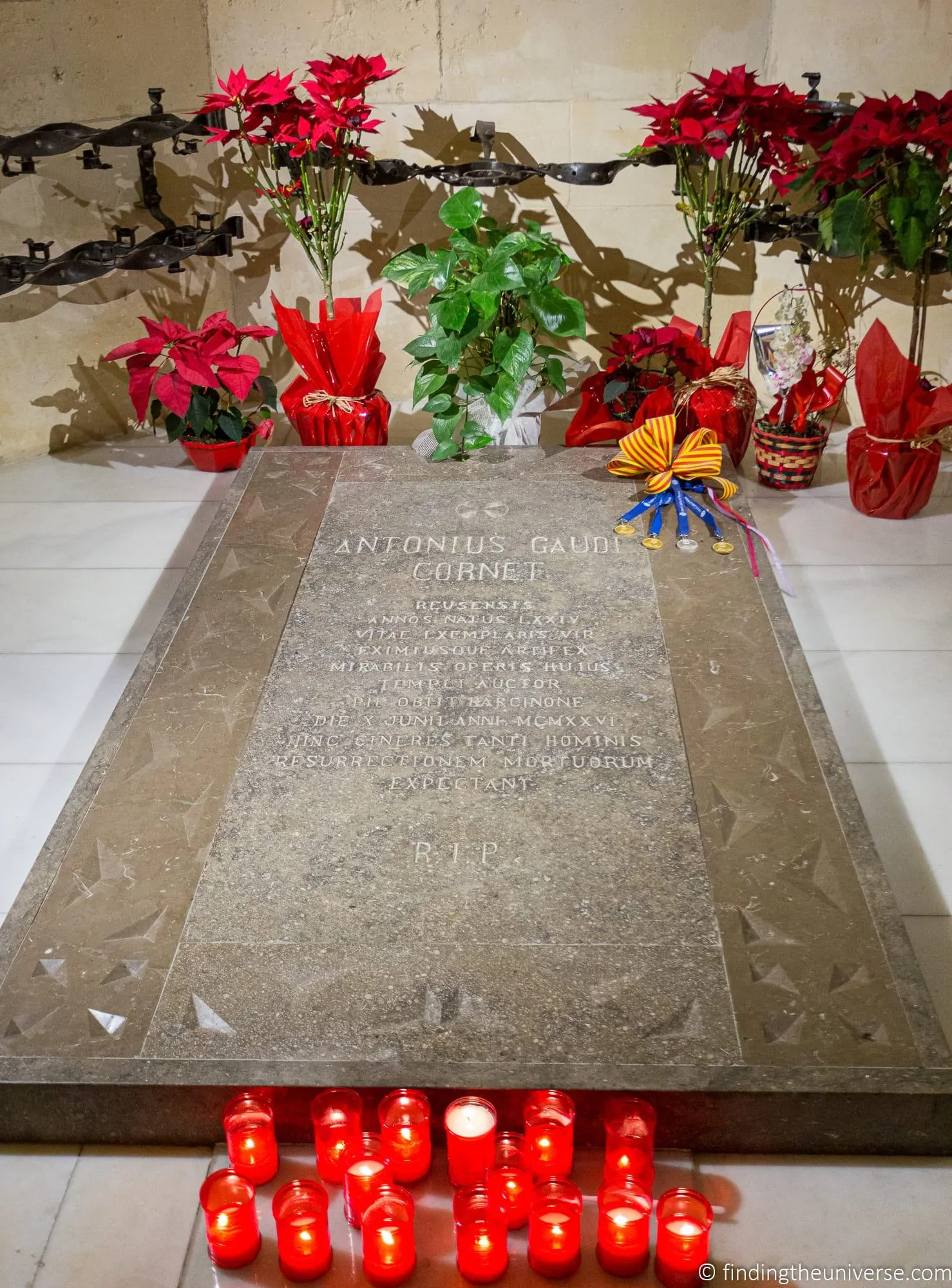
The Crypt lies underneath the main apse and is where Gaudí himself is buried. It was completed during his lifetime, making it one of the few areas of the church he saw finished.
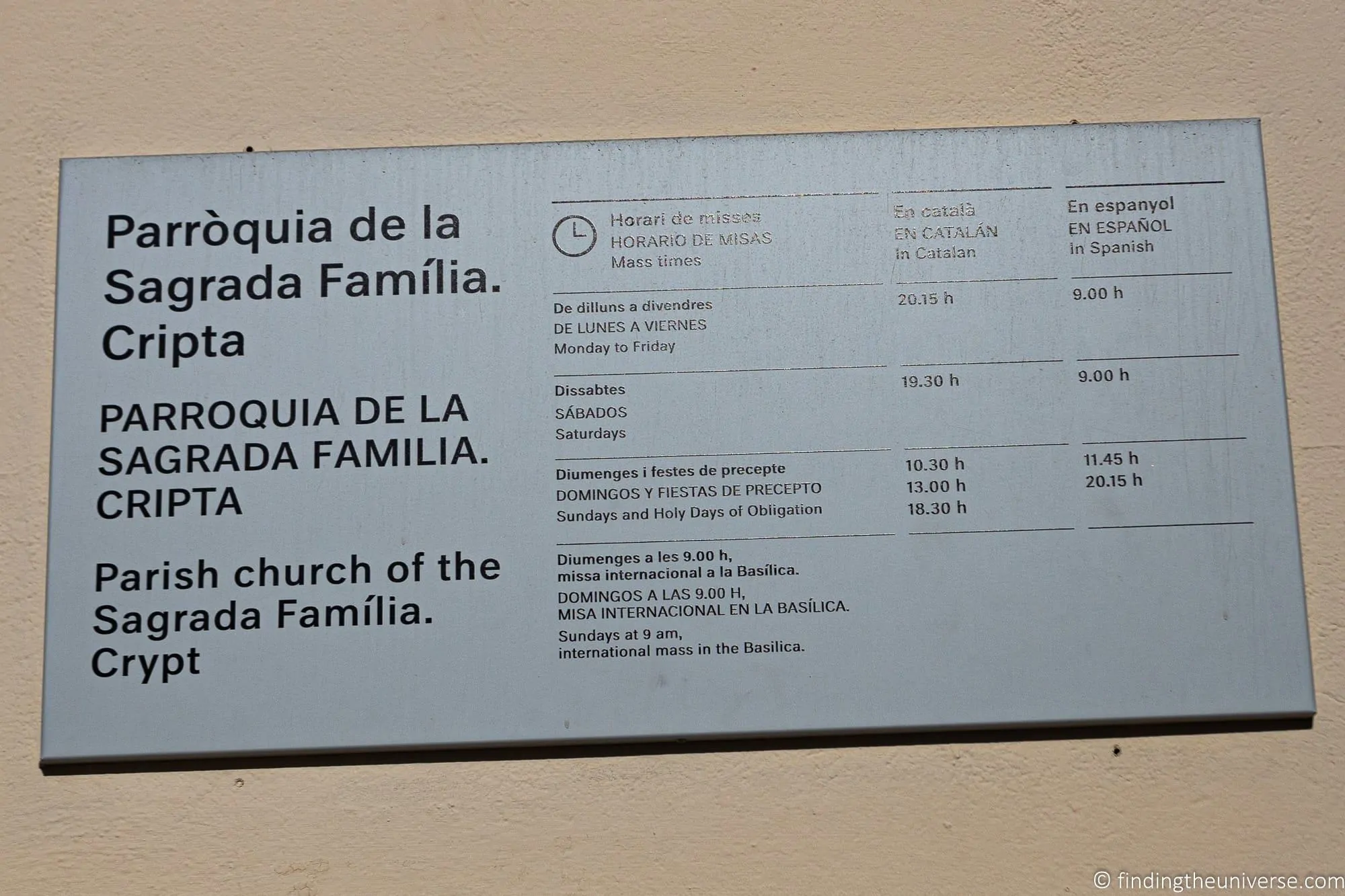
The Crypt is also a parish church, and mass is held here daily in Catalan and Spanish. It is only open around mass hours:
- Monday to Friday: 9 am to 10 am and 6 pm to 9 pm
- Saturday, Sunday, and public holidays: 9 am to 2 pm and 6 pm to 9 pm
If you want to see the Crypt without attending mass, time your visit between the services. Mass is held at the following times:
- Monday to Friday: 9 am (Spanish) and 8.15 pm (Catalan)
- Saturday: 9 am (Spanish) and 7.30 pm (Catalan)
- Sunday: 10.30 am, 1 pm, 6.30 pm (Catalan) and 11.45 am, 8.15 pm (Spanish)
Based on those timings, the best windows to visit the Crypt without attending mass are roughly 6 pm to 8 pm on weekdays, 10 am to 2 pm or 6 pm to 7.15 pm on Saturdays, and 9 am to 10.15 am on Sundays.
Along with the Nativity Façade, the Crypt is a UNESCO World Heritage Site, part of the “Works of Antoni Gaudí” listing which includes seven locations in Barcelona.
Sagrada Familia Museum
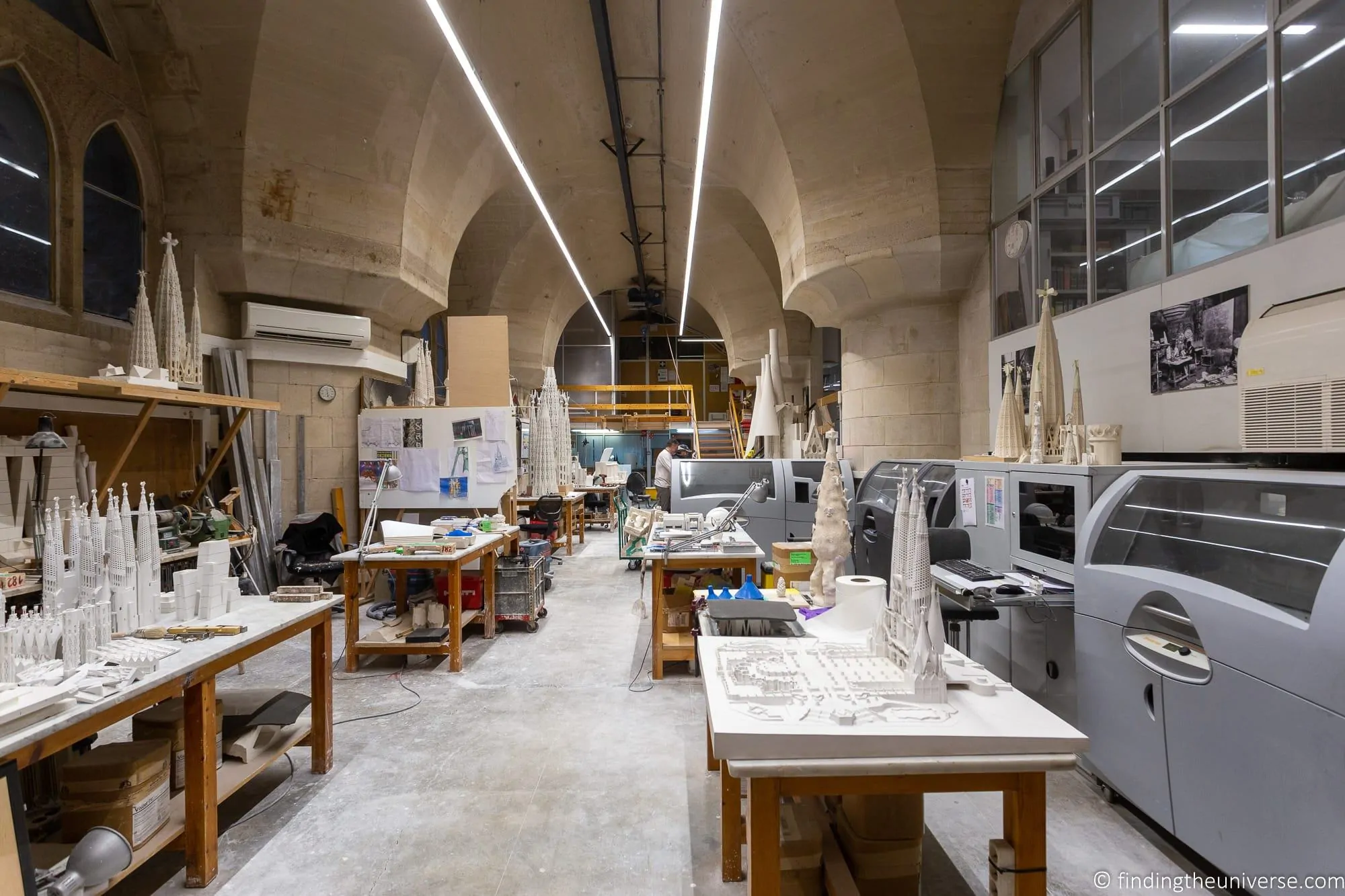
The museum is on the ground floor underneath the main church, and it’s a great place to learn more about Gaudí and the construction of the building. There are original drawings, models, photographs, and explanations of the building techniques used. Don’t rush through this section; there’s more to see here than you might expect.
Sagrada Família Schools
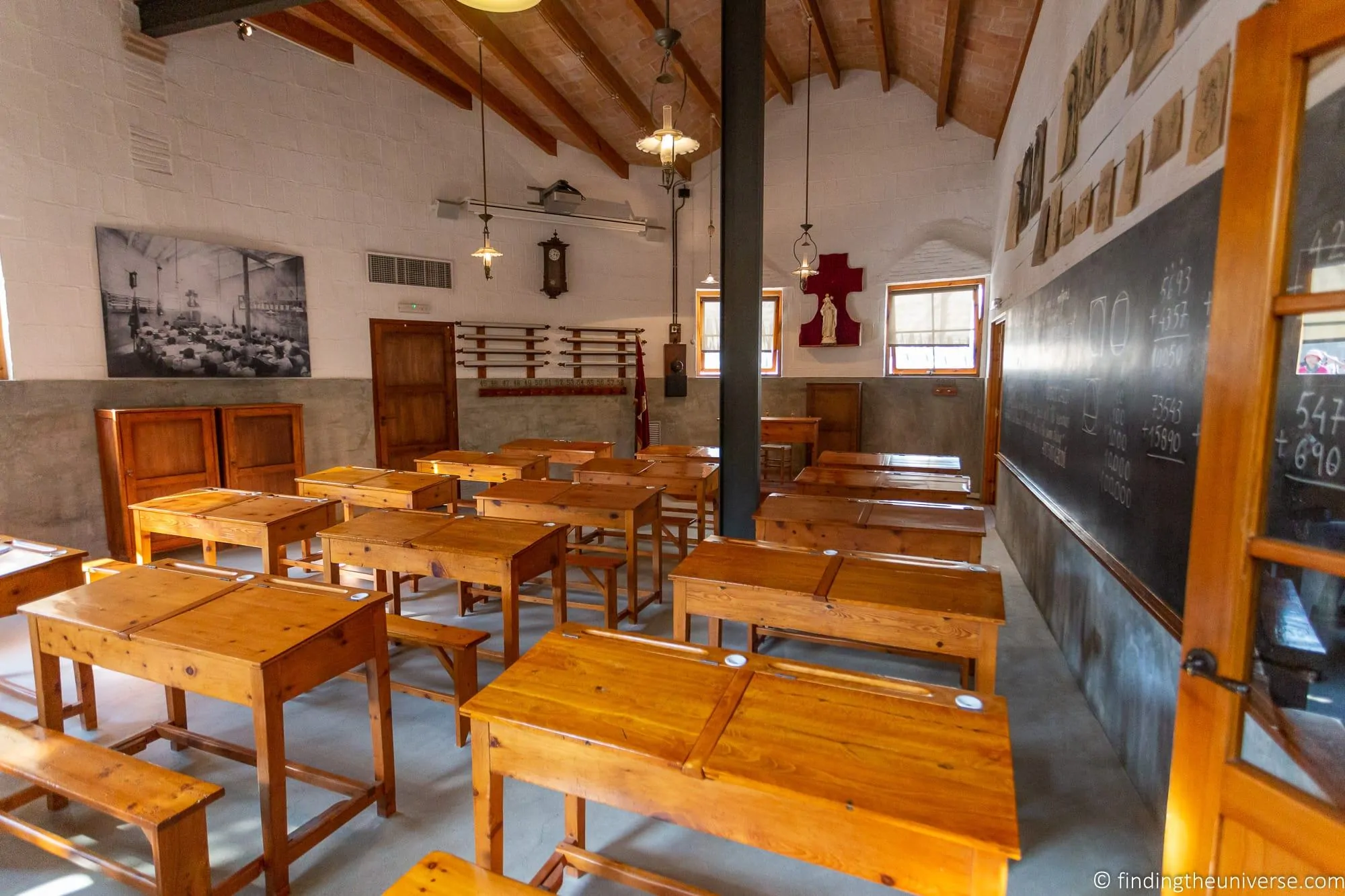
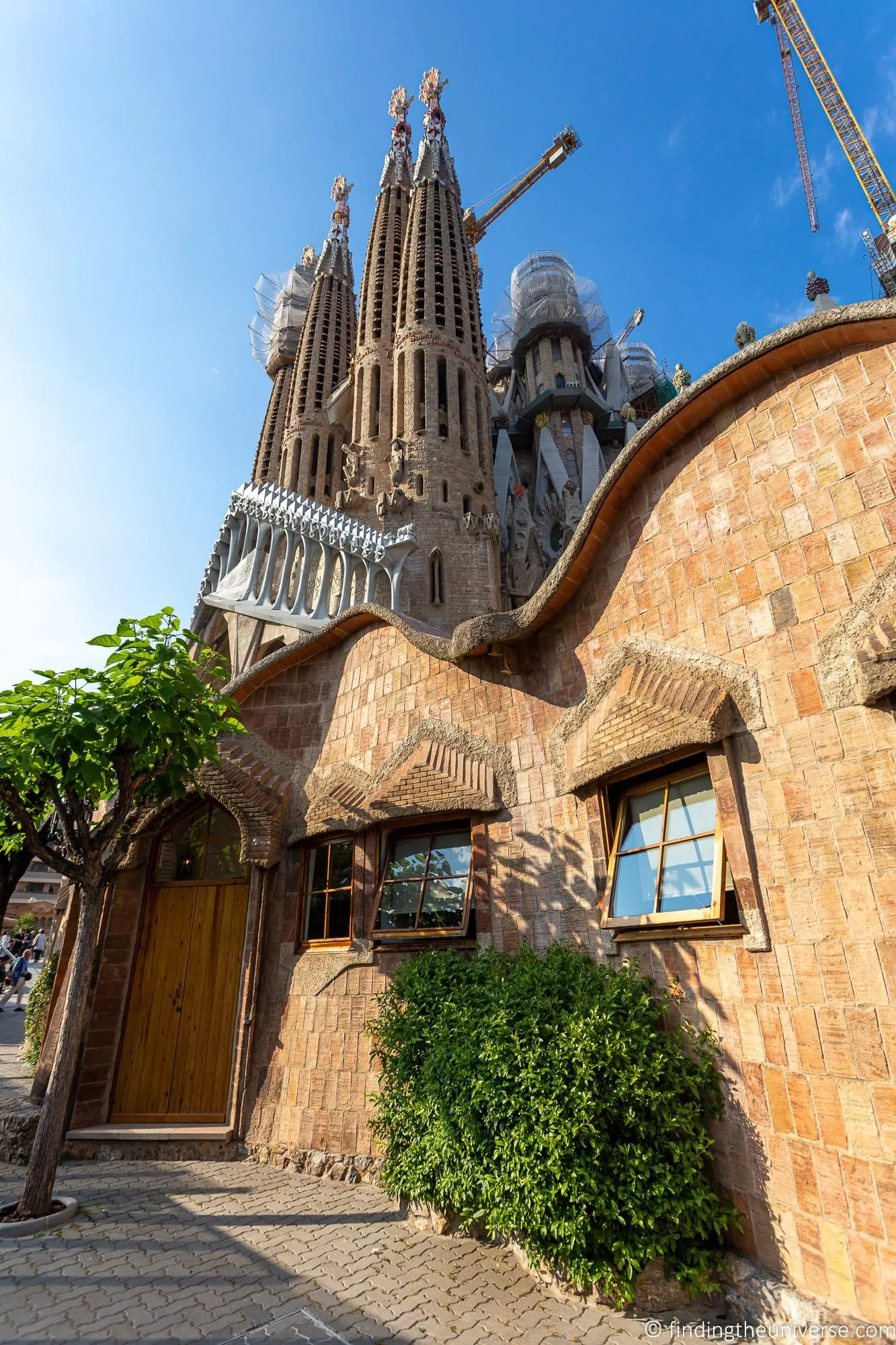
On the Passion Façade side of the building, tucked away in the southern corner, you’ll spot a small building with an organic-looking wavy roof. This is the Sagrada Familia Schools building.
In 1909, Gaudí had this constructed on site as a school for the children of the construction workers. It’s been moved from its original position during construction and was badly damaged in a fire, so most of what you see is a careful reconstruction. Today it houses models used in the construction, and a room set up as a period school room.
It’s sometimes closed to the public when in use for school groups, but if it’s open, it’s worth a quick look.
Sagrada Familia Gift Shop
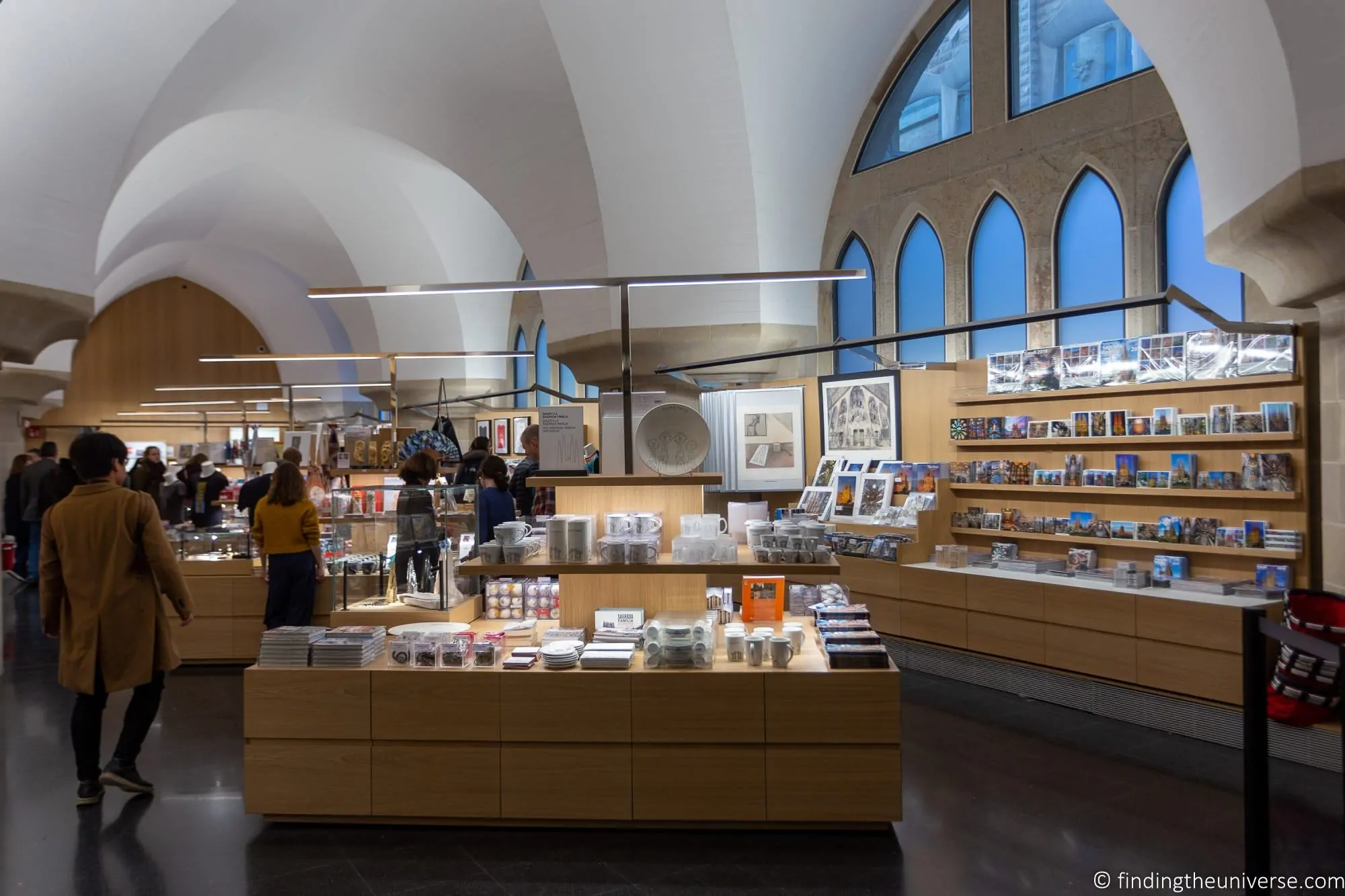
There are two gift shops. One is in the museum (only accessible to ticket holders) and another on the Nativity Façade side near the group entrance, which anyone can visit.
Be aware that when you enter the Nativity Façade gift shop, you’re leaving the ticketed area. Only do this when you’re ready to leave, as you won’t be able to get back into the church without buying a new ticket.
Climb Inside the Towers
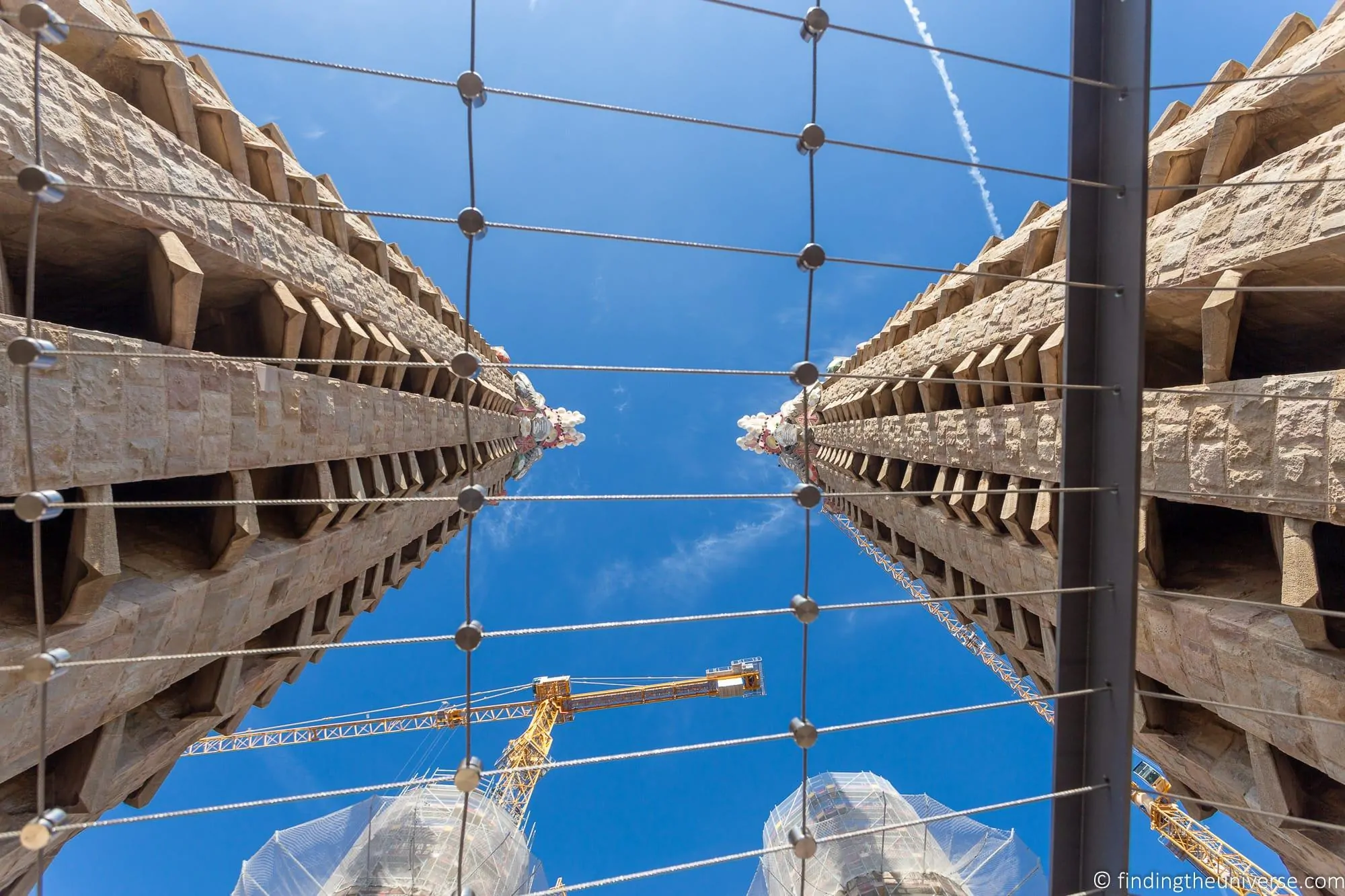
When complete, the Sagrada Familia will have 18 towers in total: 12 for the apostles, four for the Evangelists, one for the Virgin Mary, and the central Tower of Jesus Christ at 172.5 metres.
Currently, two towers are open to visitors: the Passion Tower and the Nativity Tower. These require a special ticket (see the pricing section below). Now the June 2026 inauguration has taken place, the Tower of Jesus Christ is also expected to open to visitors, with a viewpoint inside the cross at 164 metres that will be the highest accessible point in Barcelona.
We’ll cover which tower to choose in a dedicated section further down.
Do You Need a Ticket to Visit the Sagrada Familia?
Yes, you need a ticket, and all tickets are timed. You’ll be assigned a specific time slot when you book, and you need to be in the entry queue during that window. If you miss your slot, you’ll generally need to buy a new ticket.
Tickets are also nominative, meaning you’ll need to show official photo ID (passport, driving licence, or national ID card) at the entrance.
The only exception is if you’re attending mass, which is free and doesn’t require a ticket.
How Much Does it Cost to Visit the Sagrada Familia in 2026?
Here are the current ticket prices from the official website. Prices are correct as of April 2026. We’ll do our best to keep this updated, but always check the official website for the latest.
- Sagrada Familia (includes audioguide app): €26
- Sagrada Familia with guided tour (includes audioguide app): €30
- Sagrada Familia with towers (includes audioguide app): €36
- Sagrada Familia with guided tour and towers (includes audioguide app): €40
A few notes on these tickets.
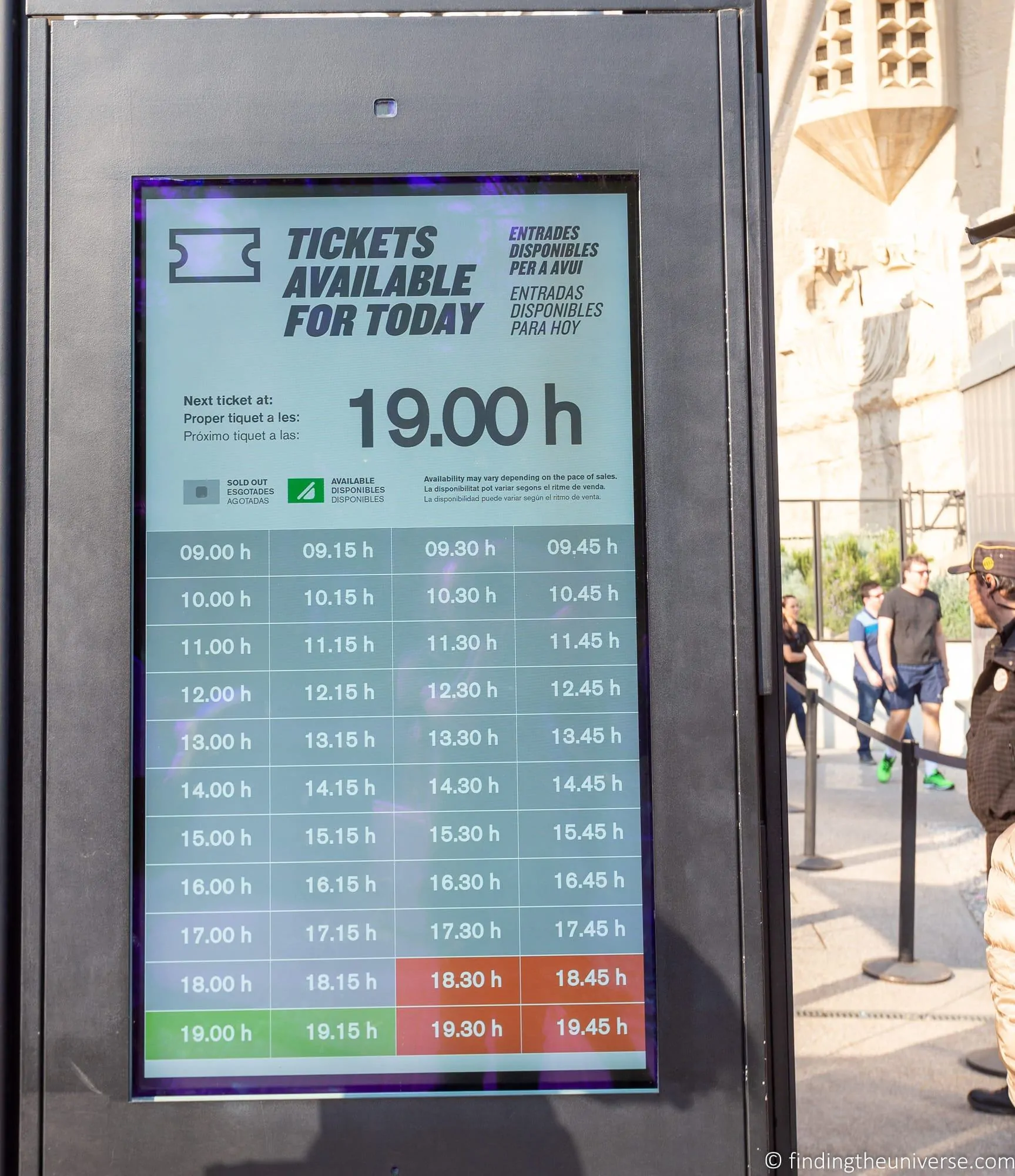
Tickets can only be purchased online. There is no physical ticket office at the Sagrada Familia. If you’re already there without a ticket, you’ll find QR codes posted around the exterior of the building that let you check availability and buy online from your phone, but availability is subject to what’s left for the day.
The basic ticket includes the audioguide, which you download via the official Sagrada Família app before your visit. It’s available in 19 languages plus sign language guides in Catalan, Spanish, and International Sign. The standard audioguide lasts about 45 minutes, with an express version at 25 minutes. It also includes a “What you don’t see” augmented reality feature that lets you explore hidden areas of the building on your phone.
Official guided tours are available in several languages and last around 50 minutes with groups of up to 30 people. After the tour you can continue exploring on your own.
Tower tickets include the audioguide plus access to one tower (you choose which one when you book). See the section below on which tower to choose.
You can also buy a combined ticket for the Sagrada Familia and the Gaudí House Museum in Park Güell, which saves a few euros compared to buying separately.
Are There Concessions for the Sagrada Familia?
Yes. Here’s a summary of the main concessions:
- Children under 11 enter free with an adult (a ticket is still required to book a timeslot). Children under 3 do not need a ticket at all.
- Under 30s and students pay €24 for basic entry or €28 for the guided tour (€2 discount per ticket). Students need a valid student card; under 30s need proof of age.
- Under 30s can also get 50% off tickets on Wednesdays to Fridays for the last two hours of the day.
- Seniors (65+) get larger discounts: €21 for basic entry, €23 for guided tour, €28 for towers, €32 for guided tour with towers.
- Visitors with a proven disability can visit free in the last two hours before closing. One companion also enters free for the basic ticket, or at reduced rates for tower tickets (€10) and guided tower tickets (€14). A ticket is still required for the timeslot.
For full details and current amounts, check the official FAQ page.
Where to Buy Sagrada Familia Tickets
1. Official Website
The best place to buy tickets is the official Sagrada Familia website here. There are no booking fees, you get real-time availability, and tickets are available up to two months in advance. All concession ticket types are available here too.
If you’re visiting in peak season (April to September) or around Easter and Christmas, we’d recommend booking as far in advance as possible. Four to six weeks ahead is sensible for summer dates.
2. Third Party Booking Sites
There are also third party websites that sell Sagrada Familia tickets. These usually charge a small booking fee or commission, so the official site is cheaper. But they’re worth checking if the official site is sold out.
Our recommended option is Tiqets, which offers real-time availability and all ticket types.
You can also find tickets through GetYourGuide and Viator. GetYourGuide tickets have the advantage of free cancellation up to 24 hours before your visit, which is useful if your plans might change.
3. Tour Companies
Another option is to book a guided tour through a third party tour company (see the Tours section below) or to buy an attraction pass like the Go Barcelona Pass which includes Sagrada Familia entry along with other attractions.
Sagrada Familia Sold Out? Your Options
The Sagrada Familia is one of the most visited attractions in Europe, and tickets sell out regularly. This happens most often around Easter, during summer, and over the Christmas period. Here’s what to try if tickets are unavailable for your preferred date.
Check Other Days or Ticket Types
First, check the official website for other days during your trip, or try a different ticket type. Sometimes a guided tour or tower ticket has availability when the basic entry is sold out.
Check Third Party Sites
Try Tiqets, GetYourGuide, and Viator. If the official site is sold out, standard tickets on third party sites usually will be too, but it’s worth a look.
Book a Tour (Most Likely to Succeed)
Your best bet when the Sagrada Familia is “sold out” is to book a guided tour with a third party company. Tour operators buy group ticket allocations separately from individual tickets, so they often have availability when individual tickets are gone.
You’ll pay more than a standard ticket, but you also get the benefit of a guide. See the tours section below for our recommended options.
Attend Mass
If all else fails, you can attend mass in the main basilica for free. These are held on Saturday evenings and Sunday mornings. See the mass section above for details. Be aware that photography and wandering around are not permitted during the service.
Tours of the Sagrada Familia
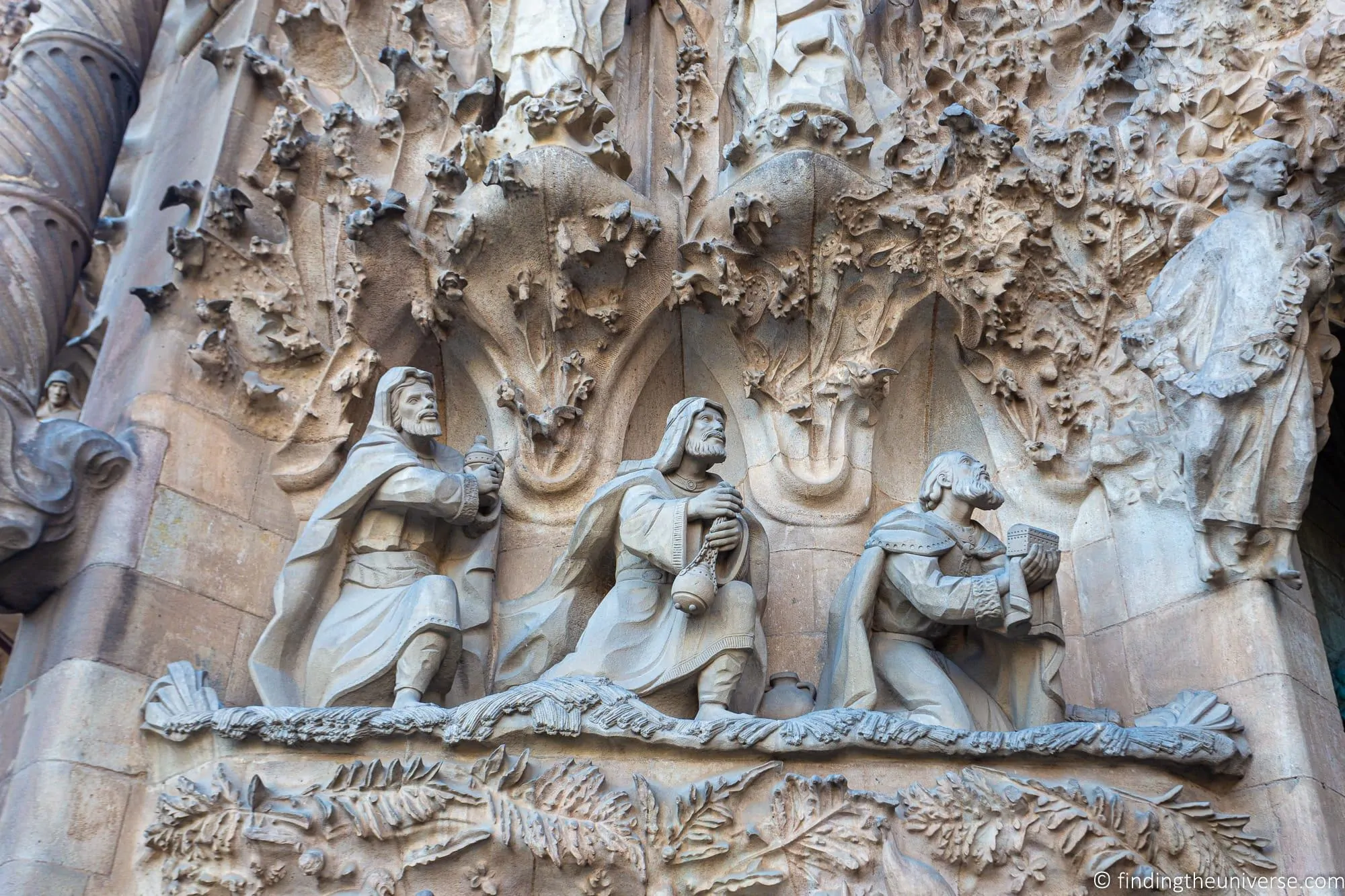
We’d strongly recommend some kind of tour or audioguide for the Sagrada Familia. There isn’t much signage inside the building, and without context you’ll miss most of the symbolism in the architecture. The building is packed with meaning, and a good guide will transform your experience.
The official guided tours (bookable on the official website) last about 50 minutes with a maximum group size of 30. These are the best value option.
We’d also recommend considering one of the third party tours below. These tend to be longer, with smaller groups, and are specifically geared towards English-speaking visitors. All include entrance to the basilica. When comparing prices, check what’s included (tower access, transport between sites, other attractions).
- Go Barcelona Pass: Includes a guided tour of the Sagrada Familia plus access to over 40 attractions across the city. Great value if you’re planning to visit several sights.
- Sagrada Familia Highlights Tour: A 1.5 hour small group tour (max 22 people) with skip-the-line access. This is a great option if you just want a focused Sagrada Familia experience with a knowledgeable guide.
- Sagrada Familia Evening Tour: A 2 hour tour that starts with a cava toast on a nearby rooftop with views of the church, then takes you inside as the day crowds thin out and the evening light hits the stained glass. One of the more memorable ways to experience the building.
- Complete Gaudí Tour: A 5.5 hour tour covering Casa Batlló (or Casa Vicens), Casa Milà, Park Güell, and the Sagrada Familia, all with skip-the-line access. The most comprehensive Gaudí experience in Barcelona, with a max group size of 15.
- Barcelona in a Day: A 6+ hour tour covering the Gothic Quarter, Montjuïc Hill, Park Güell, and the Sagrada Familia with private transport between sites. Good if you want an efficient overview of the whole city.
- Sagrada Familia Guided Tour (Tiqets): A 1.5 hour guided tour, worth checking as different companies sometimes have availability when others are sold out.
- Sagrada Familia Guided Tour (GetYourGuide): A 1.5 hour tour with a relatively small group and free cancellation up to 24 hours before.
- Sagrada Familia Small Group Guided Tour (Viator): A 1.5 hour tour with up to 30 people and over 3,000 reviews.
If you want to combine the Sagrada Familia with Park Güell, this Park Güell and Sagrada Familia combo tour on Viator covers both with skip-the-line access and private transport between them (4 hours, over 6,000 reviews).
Every standalone Sagrada Familia tour will usually finish inside the building, so you have time to explore and take photos at your own pace once the guided portion is over.
Do We Recommend an Audioguide or Guided Tour?
We’d recommend one or the other. There is very little signage inside the building, so without any kind of context you’ll miss a huge amount of what makes the Sagrada Familia special.
The official audioguide (included with every ticket) is a good option if you prefer to go at your own pace. If you want a deeper understanding and the chance to ask questions, a guided tour is the way to go. See the tours section above for options.
Where is the Entrance to the Sagrada Familia?
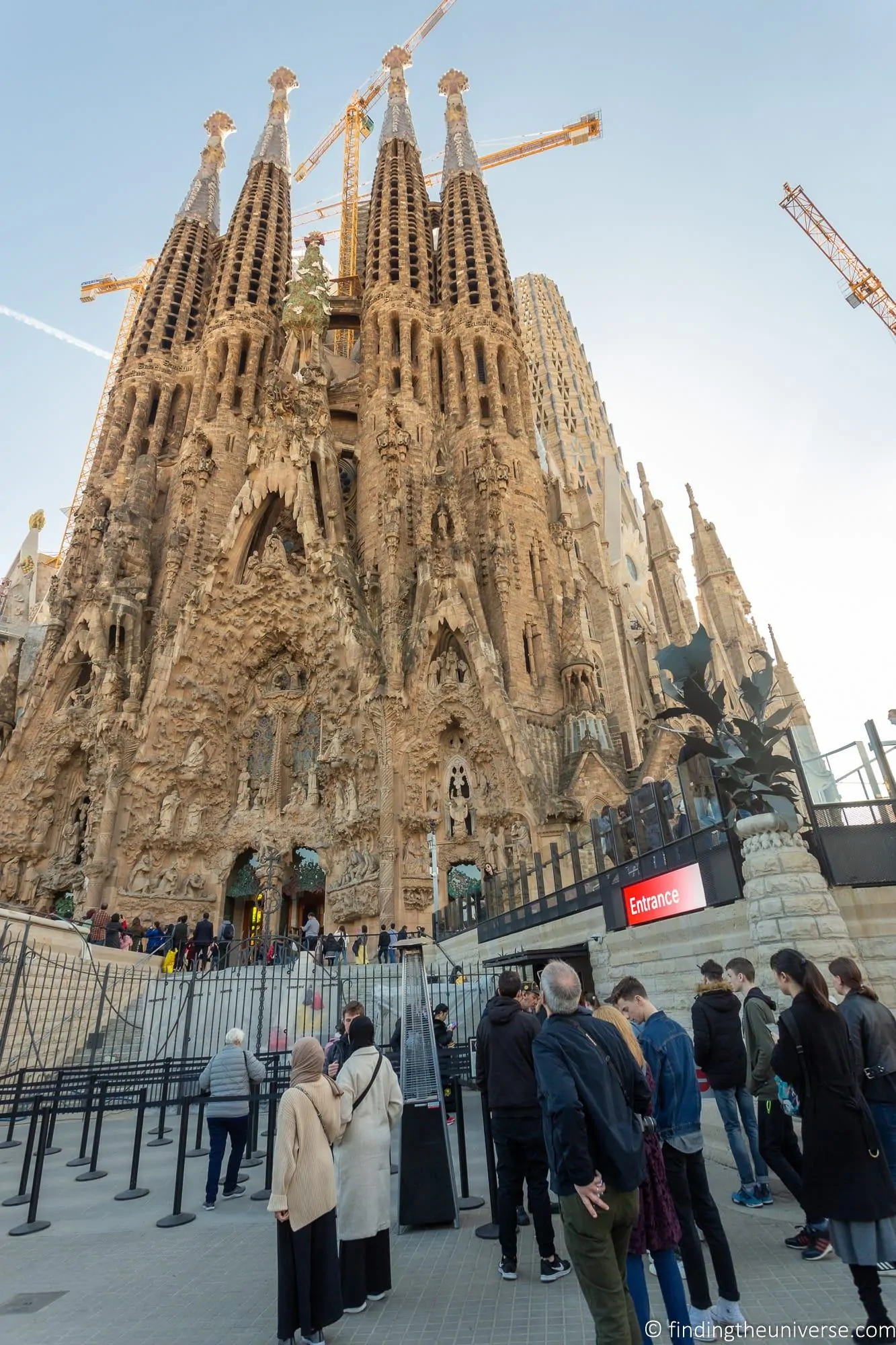
The main visitor entrance is under the Nativity Façade, on Carrer de la Marina. As you face the church, the general entrance is to the right, the group entrance to the left, and the accessible entrance is further left near the main gift shop.
If you’ve booked an individual ticket on the official website, including one with a tour, you’ll enter via the general entrance and join the tour once through security. Only groups can use the group entrance.
The entrances are well marked, and on-site staff check tickets before you join the queue. All tickets operate on timed entry, so you need to be in the queue during the window marked on your ticket.
If you’ve booked through a third party tour company, they’ll send you separate meeting instructions. Pay attention to these, as there are a lot of guides and people around the building and you want to know exactly where to go.
Can You Skip the Lines at the Sagrada Familia?
Sort of. If you buy your ticket online (which is the only way to buy tickets), you skip the ticket queue because there is no ticket queue. Everyone buys online.
What you can’t skip is the security screening, which is airport-style with bag and body scanners. But because entry is controlled by timeslot, the security queue is never very long. In my experience it moves quickly and efficiently.
When you see tours advertising “skip the line” access, they’re generally referring to the fact that tour groups have a separate entrance. This can be slightly faster during peak times, but the difference is not dramatic.
Is It Worth Visiting One of the Sagrada Familia Towers?
There are currently two towers open to visitors: the Passion Tower and the Nativity Tower. The Tower of Jesus Christ, inaugurated in June 2026, is expected to open to visitors at a later date. Tower visits are self-guided and require a special ticket.
You don’t need to visit a tower to have a great experience at the Sagrada Familia. The main church and museum are more than enough on their own. But the tower visit gives you something you can’t get otherwise: city views from inside the building, and an up-close look at the facade details and the architectural structure from above.
If you enjoy getting up high and you’re interested in the architecture, the tower visit is worth the extra cost. If views of Barcelona are your main motivation, there are also other options around the city, including Santa Maria del Pi in the Gothic Quarter. See more in our guide to where to get a great view of Barcelona.
I think the main draw of the tower visit is seeing the facades and the building itself from a completely different perspective. For that reason alone, I’d say it’s worth it if you have the time and budget. But it’s not essential.
Which Sagrada Familia Tower Should You Visit?
Both the Passion Tower and Nativity Tower are worth visiting, and you might find that when you come to book, only one has availability, so the decision gets made for you. Here’s a quick comparison to help if you do get the choice.
The Nativity Tower is the older of the two and was completed during Gaudí’s lifetime. It’s on the Nativity Façade side, offering views east across the city towards the mountains, and up-close views of the organic, nature-inspired Nativity Façade. The exit staircase is slightly wider than the Passion Tower, so it’s a better choice if you’re uncomfortable in tight spaces.
The Passion Tower is on the newer, more angular Passion Façade side. Views from here are across the city centre and out to sea. When I visited, there was quite a lot of construction activity visible around this tower, but that may change as work progresses.
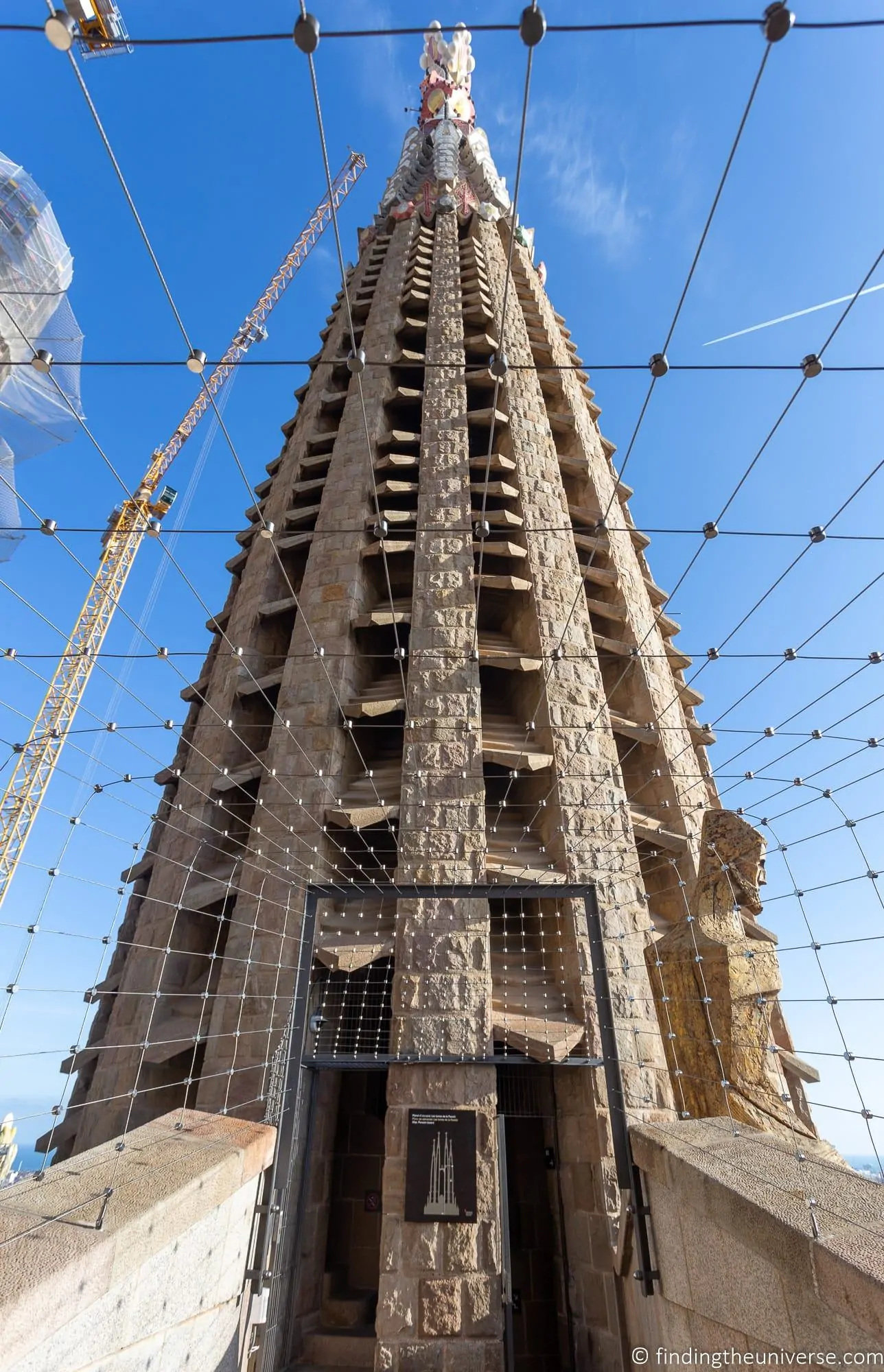
Both towers have a bridge linking the two main spires on each façade. When I visited, both bridges were open, offering an open-air view of the city (surrounded by safety wire).
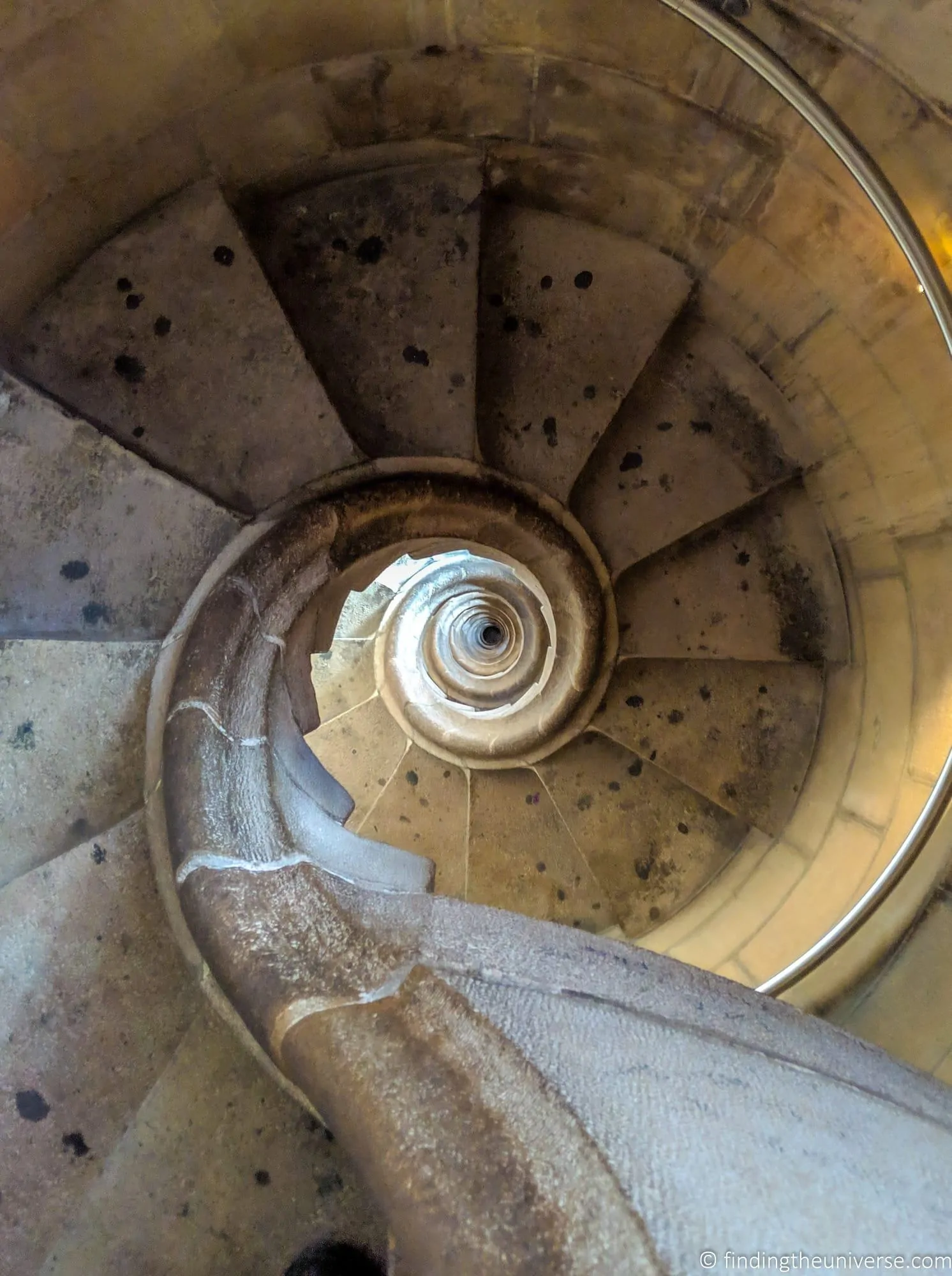
Both towers use a lift to get up and stairs to get down. The stairs are steep spiral staircases with hundreds of steps and no central handrail. You can see straight down through a small hole in the centre of the staircase. It’s too small to fall into, but if you suffer from vertigo, it can be unsettling. There’s no accessibility access to the towers, as even with the lift there are additional stairs to climb.
In our experience, the Nativity Tower tends to sell out first. If you want tower access and tickets are sold out, third party tours often include it. The Complete Gaudí Tour is one option that includes a tower climb.
What is the Dress Code at the Sagrada Familia?
The Sagrada Familia is a place of worship, so visitors need to dress appropriately:
- Shoulders must be covered.
- Shorts and skirts must come down to at least mid-thigh. We’d recommend knee length to be safe.
- Swimwear is not permitted.
- Fancy dress or matching celebration outfits (e.g. for a hen or stag party) are not permitted.
- See-through clothing is not permitted.
- Hats are not allowed inside, except for religious or health reasons.
- Visitors must be wearing footwear.
If you’re visiting in summer, throw a light scarf or shawl in your bag to cover your shoulders. It takes two seconds and saves you the hassle of being turned away at the door.
Other Forbidden Items at the Sagrada Familia
- Food and drinks must be consumed and disposed of before entering.
- Professional photography equipment, including tripods, is not permitted.
- Smoking is not permitted anywhere on the grounds.
- Dangerous items (weapons, sharp objects, knives) will be held at security and returned after the visit.
- Banners, signs, or flags intended as a protest are not allowed.
- Chemical products that could harm people or the building are not allowed.
- Animals are not permitted except for service dogs.
Can You Take Photos in the Sagrada Familia?
Yes, you can take photos and videos inside the Sagrada Familia with a few restrictions.
Photography is not permitted during masses or holy day events. Professional photography equipment, including tripods, is not allowed. If you want to shoot commercially, you’ll need written permission from the press department in advance.
Flash photography is also not permitted, although the church is so large that a flash wouldn’t do much anyway. We have a guide to disabling the flash on a camera if you need help with that.
I’ve visited multiple times with full-frame cameras and large lenses without any issues. The restriction on “professional equipment” is aimed at people doing photoshoots with models, lighting rigs, and tripods. A tourist with a nice camera is not a problem.
Are There Free Days at the Sagrada Familia?
There are no regular free days at the Sagrada Familia.
Barcelona Attraction Passes that Include the Sagrada Familia
If you’re planning to visit several sights in Barcelona, an attraction pass can save money and simplify logistics. Not all Barcelona passes include the Sagrada Familia, so check before you buy. Here are the ones that do.
If you buy a pass that includes the Sagrada Familia, purchase it at least 48 to 72 hours before you want to visit. You’ll need to confirm a timeslot for your visit after buying the pass, and this takes a day or two to process.
Go Barcelona Pass
The Go Barcelona Pass comes in two formats: an all-inclusive version and an explorer version. Both include a guided tour of the Sagrada Familia with skip-the-line access. The all-inclusive version includes access to over 40 attractions, making it good value if you’re spending several days in the city.
You can see the full list of included attractions here, and our full review of the Go Barcelona Pass here.
Barcelona City Pass
The Barcelona City Pass includes the Sagrada Familia, Park Güell, an airport bus transfer, and a 1 or 2 day Hop on Hop off bus ticket. It also includes a city audioguide and a 10% discount on other attractions. You can choose which Sagrada Familia ticket type you want (basic through to towers), and book your timeslot for both the Sagrada Familia and Park Güell through the pass.
The Gaudí Bundle
The Gaudí Bundle includes Sagrada Familia entry with an audioguide, plus Park Güell entry with an audioguide. If you’re planning to visit both (and most people should), this is a convenient way to do it in one purchase.
Where to Get a Good Photo of the Sagrada Familia
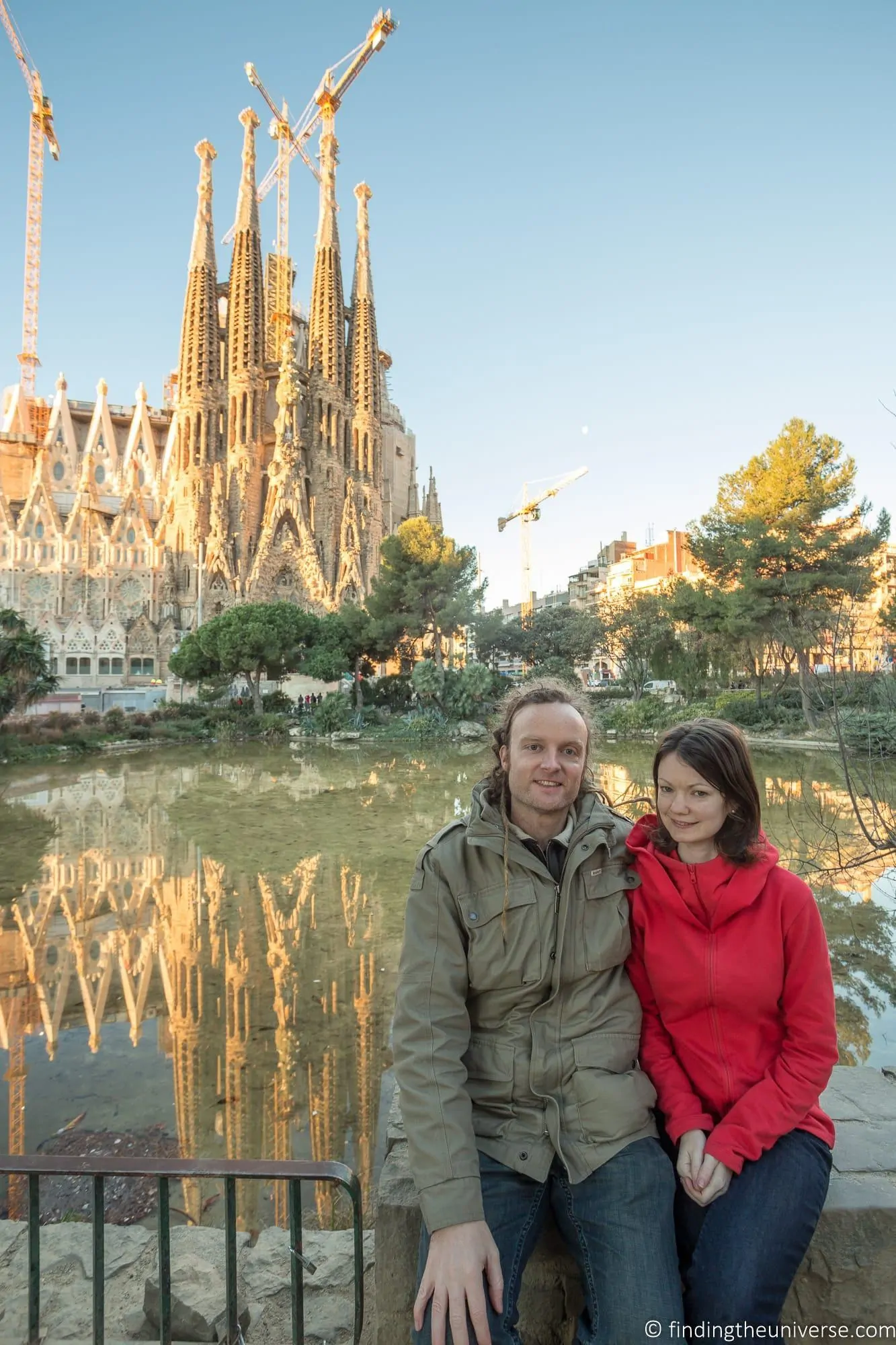
My favourite spot for photographing the exterior is from Plaça de Gaudí, the small park to the northeast of the building. There’s a pond that gives you a nice reflection shot, although you’ll need a wide-angle lens (I use my 16-35mm) to fit the whole church and its reflection in frame.
As an active construction site, you will get cranes and netting in your photos. That’s just part of the Sagrada Familia experience for now.
Being the tallest building in Barcelona, you can also see the Sagrada Familia from the rooftops of some of Gaudí’s other buildings, including La Pedrera. You’ll need a longer lens for that, as it’s about a mile away.
Practicalities for Visiting the Sagrada Familia
Facilities at the Sagrada Familia
The Sagrada Familia has toilets on site. Food and drink are not permitted inside, and there’s nowhere to buy them on site either. There are plenty of snack stalls and cafes just outside the entrance and exit points though.
Security at the Sagrada Familia
The Sagrada Familia operates airport-style security with bag and body scanners. Forbidden items will either be confiscated or held at security until your visit is over. We’d recommend not bringing large bags to speed up the process.
Accessibility at the Sagrada Familia
All public areas of the Sagrada Familia are fully accessible except for the towers. The towers have lifts going up, but there are additional stairs beyond what the lift covers, and you can only go down by stairs. As a result, the towers are not accessible for visitors with mobility issues.
Adapted audioguides with sign language and audio description are available in Catalan, Spanish, and English. There are accessible toilets on site. The accessible entrance is near the gift shop on the Nativity Façade side (Entrance B on Carrer de la Marina).
Luggage Storage Near the Sagrada Familia
There is no luggage storage at the Sagrada Familia. The only lockers are small ones by the tower lifts for visitors who are climbing the towers, and bags must be collected immediately after the tower visit.
You can bring bags inside (they’ll be scanned at security), but we wouldn’t recommend bringing anything large. Consider leaving luggage at your hotel or using a luggage storage service near the Sagrada Familia.
Things to Do Near the Sagrada Familia
The Sagrada Familia may be the main draw, but there’s plenty more to see nearby:
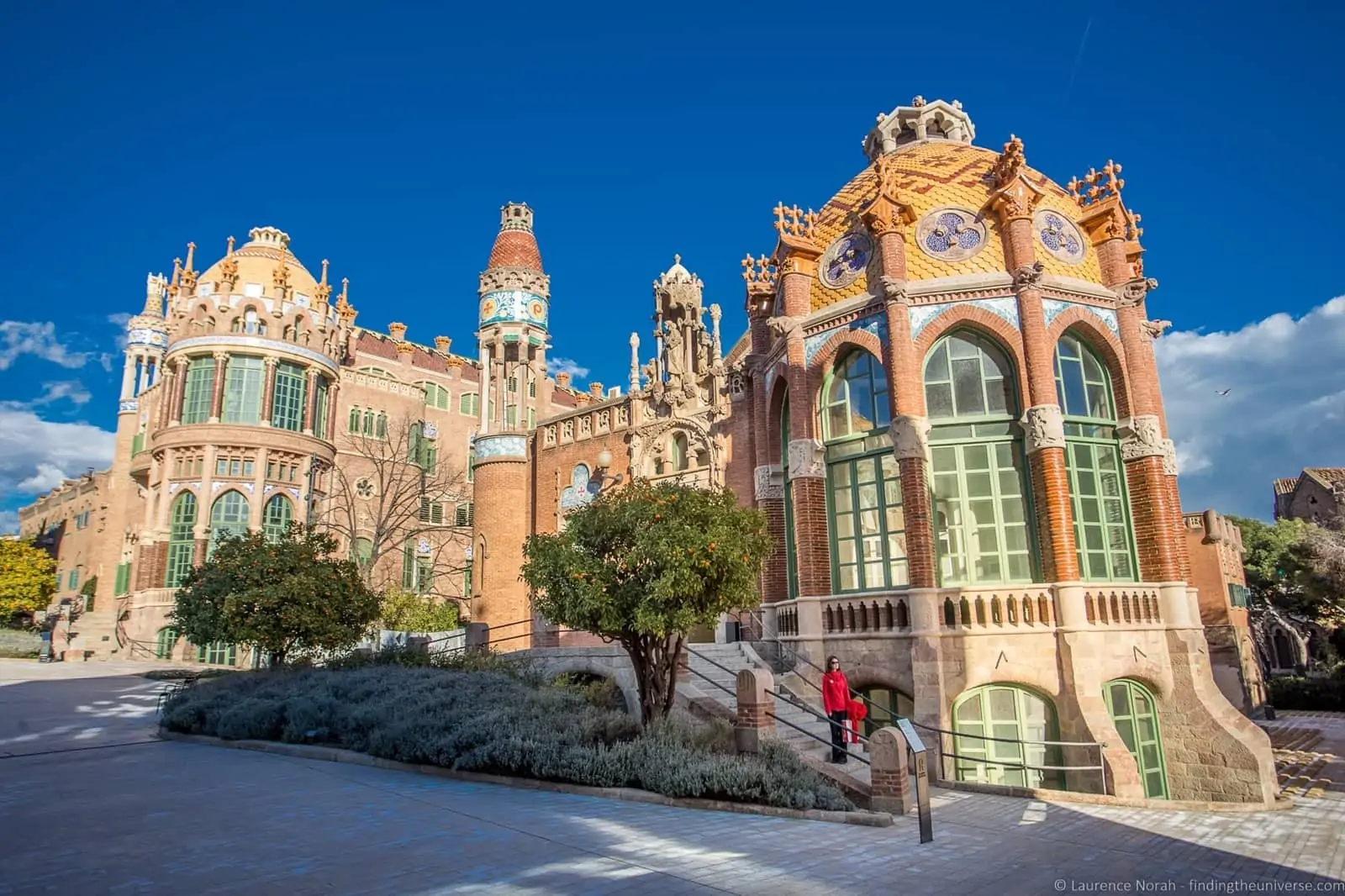
- Recinte Modernista de Sant Pau: About a 10 minute walk northeast, this collection of Art Nouveau hospital buildings is one of the finest examples of the style in Europe.
- Casa Milà (La Pedrera): Another of Gaudí’s works, famous for its rooftop chimneys. About a 20 minute walk from the Sagrada Familia.
- Gaudí Experiència: An interactive 4D exhibition about Gaudí’s life and works, located next to Park Güell. About 30 minutes’ walk or a short bus ride. Note that recent reviews for this attraction are mixed, so set expectations accordingly.
- Park Güell: Another Gaudí creation, with a large park area, the famous mosaic benches, and the Gaudí House Museum where Gaudí lived. If you’re visiting both this and the Sagrada Familia, you can save a few euros with a combination ticket from the official site.
For more ideas, see our guide to spending 1 day in Barcelona, as well as 3 days in Barcelona.
Where to Stay Near the Sagrada Familia
If you’d like to stay within walking distance of the Sagrada Familia, here are some options across a range of budgets. All are within a five minute walk. Pricing varies by season and demand, so always check for your dates.
- Barcelona & You Hostel Sagrada Familia: Three minutes’ walk, dormitory-style accommodation with breakfast, coffee/tea, and WiFi included.
- Hostemplo Sagrada Familia: Just 200 metres away, a well-reviewed design guesthouse with private en-suite rooms.
- Ibis Barcelona Centro (Sagrada Familia): A few minutes’ walk, comfortable air-conditioned en-suite rooms.
- Boutique Hostemplo Sagrada Familia: On a pedestrian street just 100 metres from the Sagrada Familia, a 3-star boutique hotel.
- Hotel Sagrada Familia: A 3-star hotel a couple of blocks away, with private en-suite rooms.
- SM Hotel Sant Antoni: Five minutes’ walk, a well-rated 3-star hotel.
- Hotel Barcelona 1882: 450 metres away, a very well-reviewed 4-star hotel with a pool.
- Ayre Hotel Rosellón: 200 metres away, a 4-star design hotel with a rooftop terrace and views of the Sagrada Familia. If you want to see the building from your hotel, this is the one.
If you’d prefer an apartment, we’d recommend Plum Guide, which carefully curates its listings so quality is consistently high. One thing to know about apartment rentals in Barcelona: they need to be registered with the city and have a licence number. If you’re booking an apartment, pick one that displays this licence number on the listing.
For more apartment options, see our guide to the best alternatives to Airbnb.
Further Reading for Visiting Barcelona
We’ve explored Barcelona many times, as well as other parts of Spain’s Catalonia region. Here are some of our other guides that might help with planning your trip:
- For Barcelona: our 3 day Barcelona itinerary, our 2 day Barcelona itinerary, our guide to spending a day in Barcelona, our review of the Barcelona Pass, and our guide to Gaudí sites in Barcelona.
- Day trips from Barcelona: Besalú, Montserrat, and Girona.
- Salvador Dalí fans: our guide to Dalí attractions in Costa Brava.
- We’ve been hot air ballooning twice in this region: see our guide to hot air ballooning in Costa Brava.
- Our guide to things to do in Palamós, one of our favourite fishing towns in the Costa Brava.
- Staying in the city itself? Our guide to the city’s best murals and street art covers where to look.
- For mountains and skiing: our guide to the Spanish Pyrenees and guide to skiing in the Spanish Pyrenees.
- Specific Pyrenees regions: La Garrotxa, El Ripollès, La Cerdanya, and the Vall de Núria.
- For a book about the Sagrada Familia, this is a detailed guide to the history and future of the building.
- For a Barcelona guidebook, we’d suggest the DK Eyewitness guide to Barcelona and Catalonia.
And that’s our guide to visiting the Sagrada Familia! As always, we’re happy to answer your questions in the comments below, and if you visit and notice anything in this guide that needs updating, do let us know.
Jill says
Hello, do you know how the timed entries work for purchasing tickets to enter the church as well as go up in one of the towers? When I go to the official website, the first option is to choose a date, then a timed entry for the tower of your choice. The second option is to choose a time for the church. I like to do the earliest times possible to get tours done before they get too busy. If I select the 9am time for the tower, the first choice that comes up for the church is 9:15am. I’m not sure if I am supposed to estimate how long it takes to do the tower visit and then select a later time to do the church tour? Obviously the tower can’t be completed in 15 minutes, so I’m unsure how to select an appropriate time for each part of the ticket. Any advice would be appreciated! Thanks so much
Laurence Norah says
Hey Jill,
So just to clarify you are booking the ticket which includes a guided tour of the church and which includes the tower? Or are you just booking for tower and church entry? Because it works slightly differently. With the guided tour you normally do the guided tour first and then the tower afterwards I think, but without the tour component you can visit the church around your tower visit. Once you are inside you go to the tower, and then you can further explore the church when you come back down.
Let me know if this helps or if you need further clarification, and I’ll do my best to help out!
Laurence
Jill says
Thank you. We are planning to do the self-guided tour with the audioguide (church and tower). When I choose this option, and select the earliest possible time for the tower (9:15am), the only option I can select for the church afterwards is 9:00am. So I am assuming that the church entry is first, then as you said, we would go up the tower first at 9:15, then back down to do the self guided tour of the church. Does that sound right?
Thank you for your help!
Laurence Norah says
Hi Jill,
Yep, that is what would happen! The tower entry is inside the church, so you would go into the church first and head towards the tower entry. After the tower visit, you can explore the rest of the church at your leisure.
Have an awesome time, do let me know how you enjoy it 🙂
Laurence
Garry Matheson says
Hi,
Thanks for the very helpful and detailed guide.
I’m not a professional photographer by any means but love travelling with my full-frame camera.
Just wanted to clarify about ‘forbidden’ items…what constitutes ‘Professional photography equipment’?
I’ll be travelling with a Sony A73 which is bigger than a pocket camera. The lenses are zooms, so quite bulky in comparison. Will they allow entry?
Also more generally, is it common for cathedrals, museums and places of interest in Europe where ‘professional’ cameras aren’t allowed?
Laurence Norah says
Hi Garry,
This is a good question. I have visited many times with my full frame cameras, sometimes two at the same time, and I’ve not had an issue. I believe they are primarily trying to stop people from doing photo shoots, so things like wedding shoots or influencer style shots with models is what they are against. A tourist with a nice camera isn’t really an issue. They also don’t like tripods or lighting setups.
In general, “professional” cameras are fine across Europe. Some locations won’t allow photography at all, although this is changing as most locations realise the benefit of free publicity on social media from visitors. Westminster Abbey for example had a long policy against photography, which changed only last year. In some places they might charge a nominal fee to allow you to take photos, I believe in Edinburgh for example it’s a couple of quid for a photography permit. Flash and tripod photography though is almost universally banned.
Hopefully this helps!
Have a great time in Europe!
Laurence
Katie D'Agostino says
This article is SUPER helpful! Thank you.
I cannot seem to find how you purchase tower tickets on the Sagrada Familia website. I only have that option through a tour I was looking to book. Are tower tickets normally available on the Sagrada Familia website or am I just missing it?
Also, we are staying at the Ayre Rosello for those great views you speak of. Any great places to eat in that area? We’ve included breakfast in our SF View Room, but we’d love lunch and dinner suggestions.
Thank you!
Laurence Norah says
Hey Katie!
Thanks for your comment 🙂 So the Sagrada Familia has been a challenging attraction to keep on top of in terms of what is and what isn’t open and to who for the last couple of years! You are correct that right now the towers aren’t on the official website, and yes, they normally are as that’s how I booked them last time we visited. I have reached out to a partner who sells tour tickets to find out if it’s just tour partners who have access at the moment to the towers. I know that for a time they were only allowing guided tours of the towers as it let them control numbers, but I want to confirm if that’s still the case and when I hear back I’ll comment again. I’m not sure if they are actually open at all. If you have found a tour that includes them, definitely reach out to confirm that is the case if climbing them is important to you.
Food wise, I haven’t eaten a lot in that area and to be honest we don’t normally recommend restaurants as it’s hard to keep up with changes. The only place I am comfortable to recommend in general in Barcelona is L’Alcoba Blava, which is an amazing Tapas place in the Gothic Quarter and well worth visiting if you are in that area. It doesn’t look like much from the outside (we always walk right past in when looking for it), but the food speaks for itself.
I’ll get back as soon as I hear about the towers!
Laurence
Laurence Norah says
Hi Katie,
I’ve been told that the tower tickets are due to be back online in March, but I’m not sure exactly when.
Cheers!
Laurence