Two days in Verona is enough. You can comfortably tick off the Arena, the Romeo and Juliet circuit, and the big-hitter piazzas on Day 1, then move on to Castelvecchio, San Zeno, and Giardino Giusti on Day 2. Add an Arena opera if you’re visiting between mid-June and mid-September; even if you’re not an opera fan, the venue is the experience.
Stay inside the walls if your budget allows, near Porta Nuova station if it doesn’t. On the ticket question: the Verona Card wins on price the moment you’re doing the daytime Arena tour plus at least two paid museums; the Four Historic Churches ticket is the better play if you’re seeing an opera and skipping the daytime Arena tour. We’ll walk you through the math below.
We visited Verona for two days in August 2022 as part of an Italy-by-rail trip, with no car and a packing list that erred on the side of “as little as possible.” We saw an opera at the Arena, which we’ll come back to in some detail. I’m the photographer, so the camera-related rambling is on me; Jess does most of the heavy lifting on logistics, museums, and remembering which restaurant we ate at on Day 2.
Table of Contents:
Verona at a Glance
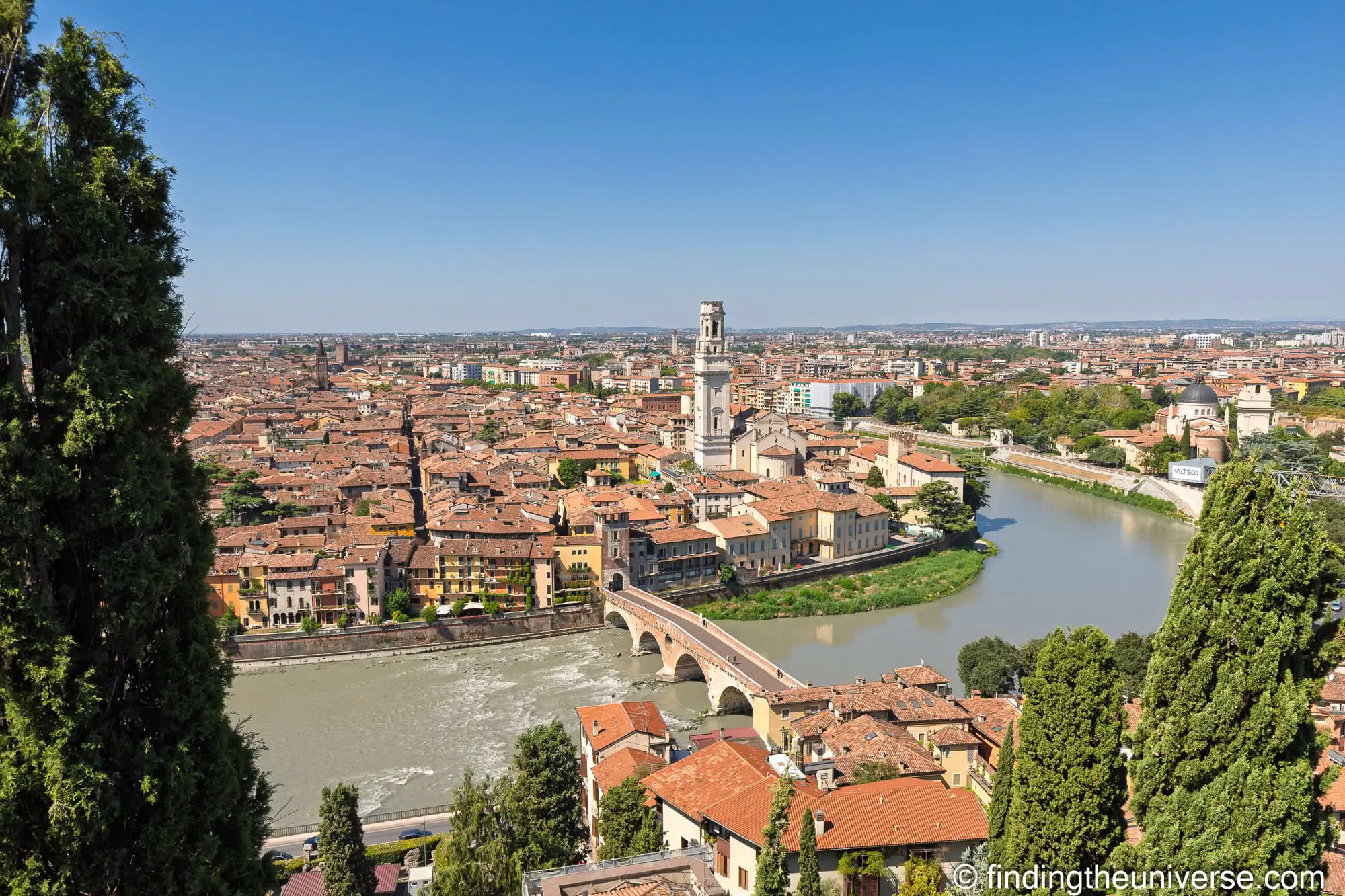
Verona sits in the Veneto region of northern Italy, about two hours by train from Milan and an hour and a quarter from Venice. The walled historic centre wraps around a tight bend in the Adige river, which is a useful piece of geography to keep in your head: most of what you’ll want to see is inside that bend, and the rest is a short bridge crossing away.
It’s a walkable city. We didn’t use a bus, taxi, or scooter once during our visit, and we covered everything in this itinerary on foot. The one stretch where you might want a lift is the climb up to Castel San Pietro on the far side of the river. There’s a funicular running from the base near Ponte Pietra to the hilltop terrace, and we’ll come back to that when we get there. Everything else is a comfortable walk.
Verona is best known internationally as the setting for Romeo and Juliet, which has produced an entire cottage industry around a balcony attributed to a fictional teenager.
The Arena, a Roman amphitheatre older than the Colosseum in Rome and still hosting opera performances every summer, is the other headline attraction. Beyond those two, there’s a clutch of substantive churches, a moody medieval castle on the river, and one of the loveliest gardens we’ve visited in Italy. It fits comfortably into a two day visit. Three would work but a day trip to somewhere like Lake Garda would make more sense. If you’d rather a city than a lake, Padua and its Giotto frescoes are an easy Veneto train hop, and our guide covers a day in Padua end to end. One would feel rushed. Verona also works well as a day trip from Venice: the two cities are 65 minutes apart by fast train.
The Verona Card vs the Four Historic Churches Ticket
Most 2-day visitors face a ticket decision: the Verona Card, the Four Historic Churches ticket, or buy attractions à la carte. Which ticket wins hinges on what you actually want to see. We’ll walk you through the numbers so you can match the ticket to your trip.
What Each Ticket Covers
The Verona Card (€27 for 24 hours / €32 for 48 hours via the official site) covers daytime entry to the Arena, Juliet’s House museum, Castelvecchio, Torre dei Lamberti, the four historic churches, plus discounts at a long list of other attractions and unlimited ATV city bus use. There’s also a version sold through GetYourGuide and Tiqets for €30 / €35 that adds a digital audio guide for the city centre and Lake Garda in seven languages, and the upcharge is worth it if you like curated commentary as you wander.
The Four Historic Churches ticket (“Biglietto di visita alle quattro chiese storiche,” operated by Associazione Chiese Vive) is €8 for adults (€7 concession), valid for 90 days from issue, and covers San Zeno Maggiore, Sant’Anastasia, the Cathedral Complex (Duomo + Sant’Elena + Baptistery), and San Fermo Maggiore. You can buy it at the first church you visit, and a single-church entry on its own is €4.
À La Carte Prices (the Comparison Set)
The headline single-attraction prices on the Verona Card list are:
| Attraction | À la carte price |
|---|---|
| Arena (daytime tour) | €15 walk-up, or €18 for priority access via Tiqets |
| Castelvecchio Museum | €9 |
| Torre dei Lamberti | €8 |
| Juliet’s House museum | €12 |
| Four Churches combined | €8 |
Note that the Arena opera ticket (if you want to see an actual performance) is separate from both the Verona Card and the daytime Arena tour. The Card gets you into the Arena during daytime visiting hours; a show ticket is its own line item via arena.it. If you’re seeing an opera, you can either skip the daytime tour (you’ll have seen the inside by night) or do both (the daytime visit shows the architecture; the show shows the venue alive).
Doing the Math
Here’s how it shakes out across the most common 2-day plans, all compared against the €32 48-hour Verona Card:
| Your plan (over 2 days) | À la carte cost | Verona Card 48h | Winner |
|---|---|---|---|
| Daytime Arena + Castelvecchio + Lamberti + Juliet’s House museum + 4 churches | €52 | €32 | Card by €20 |
| Daytime Arena + Castelvecchio + Lamberti + 4 churches | €40 | €32 | Card by €8 |
| Daytime Arena + Castelvecchio + 4 churches | €32 | €32 | Break-even |
| Daytime Arena + 4 churches only | €23 | €32 | À la carte by €9 |
| Opera (not daytime Arena) + Castelvecchio + Lamberti + 4 churches | €25 | €32 | À la carte by €7 |
| Opera + 4 churches only | €8 (just the church ticket) | €32 | Church ticket by €24 |
The pattern: the Verona Card pays off the moment you’re doing the daytime Arena tour and any two of the other paid stops (Castelvecchio, Lamberti, Juliet’s House museum). If you’re seeing an opera and using your daytime hours for churches and walking (which is what we did), the Four Churches ticket plus à la carte Castelvecchio is the cheaper play.
A couple of nuances:
- The 24-hour card (€27) only makes sense for a one-day Verona stop, since the Arena, Castelvecchio, and most museums all need to be slotted into a single day. For a 2-day visit, go straight to the 48-hour version.
- Add the audio-guide version if you like guided context. The €3 upcharge for the GetYourGuide bundle buys you commentary covering the city centre and Lake Garda, which is fair value if you’d otherwise pay for a walking tour.
- The ATV bus inclusion isn’t a meaningful Verona Card sweetener for a 2-day visit. The historic centre is a kilometre and a half across; you’ll walk it.
What We Bought, and Why
We bought the Four Historic Churches ticket. We were seeing Carmen on our first evening (so the Arena was on the books separately), we wanted to see Castelvecchio and all four churches, and we’d already decided we weren’t going to do every city museum in two days.
The à la carte total for our plan worked out cheaper than the Card, and the church ticket on its own paid for itself the moment we walked into our second church. If you’re broadly making the same trade-offs, that’s your pick. If you’re doing the daytime Arena tour and the full museum sweep, buy the Card.
Day 1: Roman Verona and the Romeo and Juliet Circuit
Morning (Around 9 am to Noon): The Arena
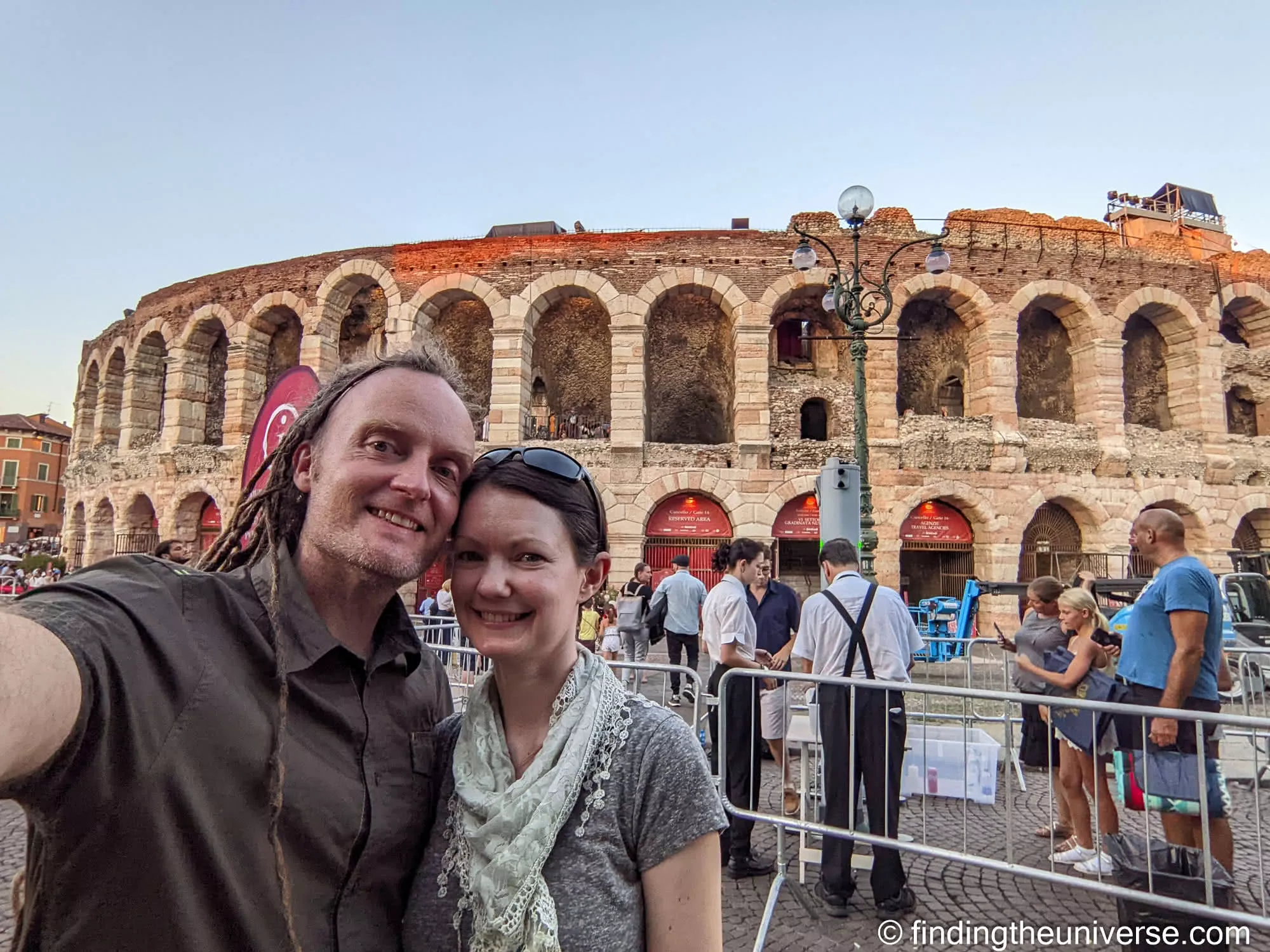
Start at the Arena. The Roman amphitheatre is the architectural heart of the city, it’s where Day 1 wants to begin, and it tends to get busier as the morning goes on, so showing up at opening is the move.
The Arena is open Tuesday to Sunday from 9 am to 7:30 pm (last entry 6:45 pm), closed Mondays unless a Monday falls on a holiday. Daytime entry is €15 if you walk up and buy direct at the ticket office, or €18 for priority access via Tiqets. During opera season, and especially on opera-performance days, the priority option earns its three-euro premium pretty fast.
Inside, you can walk the lower tiers, look at the stage rigging that’s permanently in place for opera season, and climb up to the upper tier for a perspective on the whole bowl. We spent about an hour and a quarter in total. The Arena rewards a slow look more than a fast one; if you’re not booked into an opera that evening you may want to give it another half hour to sit in the upper tier and take it in.
A note on the dating: the Arena predates the Colosseum in Rome by around four decades, which is the kind of fact that earns Verona a meaningful headline against its larger Roman cousin. It also tells you something about how seriously the Romans took entertainment in their northern colonies.
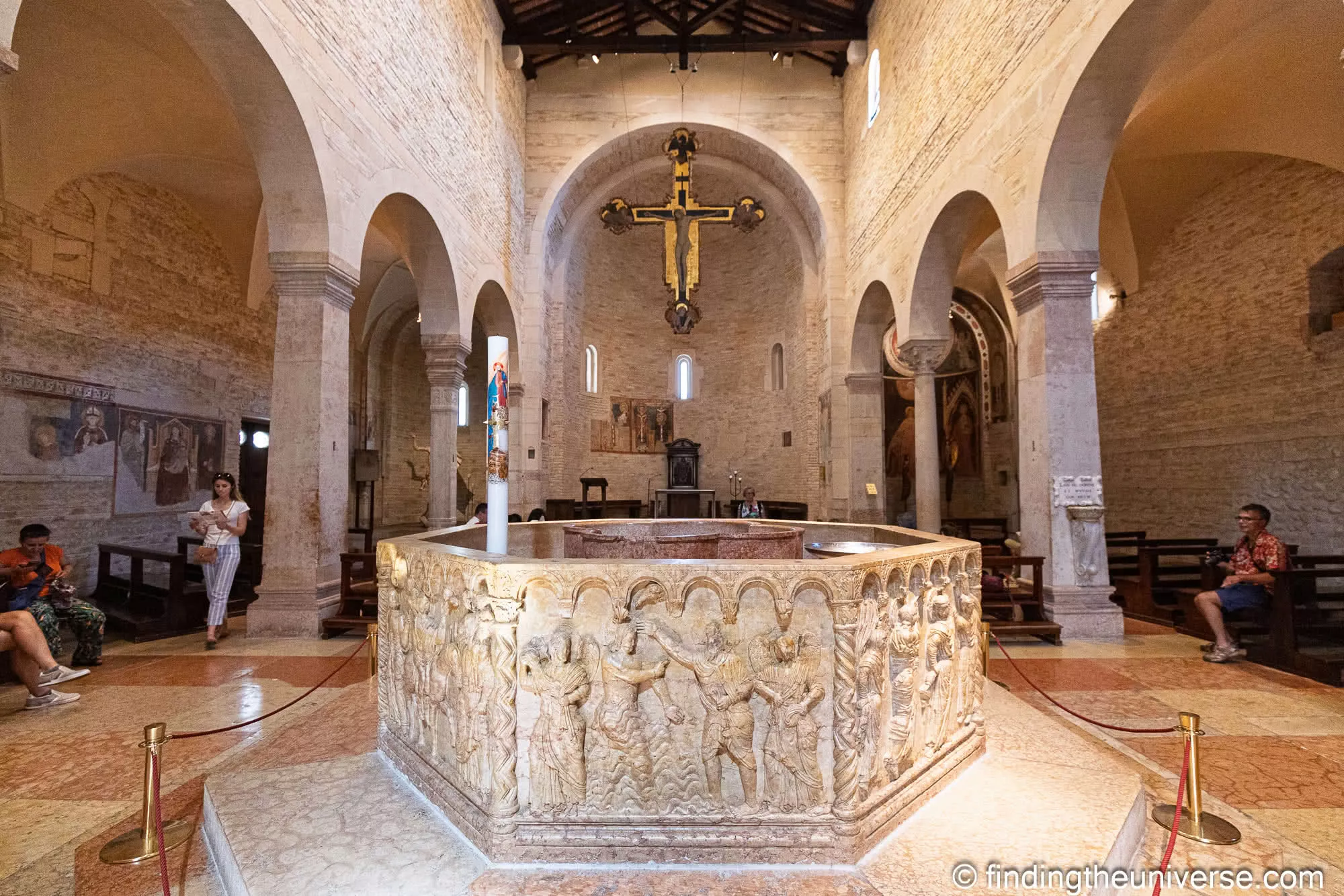
Seeing an opera tonight? Consider swapping the daytime tour. If your Day 1 evening is already booked at the Arena, you’ll see the inside of the amphitheatre in dramatic production lighting that evening, and the daytime tour ends up partly redundant. A good alternative for the morning is to walk fifteen minutes north from Piazza Bra to the Cathedral Complex (the Duomo of Santa Maria Matricolare, the smaller chapel of Sant’Elena, and the Baptistery of San Giovanni in Fonte clustered around the river bend), all included on the Four Historic Churches ticket and easily filling two hours together. The Cathedral has a striking Romanesque façade in alternating bands of stone, the Baptistery houses a remarkable medieval baptismal font, and Sant’Elena is a small early-Christian chapel that’s quietly atmospheric. Pair this morning with the Day 1 afternoon walk below and you’ll have three of the four churches done before dinner.
Lunch (Around Noon to 2 pm): Risotto all’Amarone Near Castelvecchio
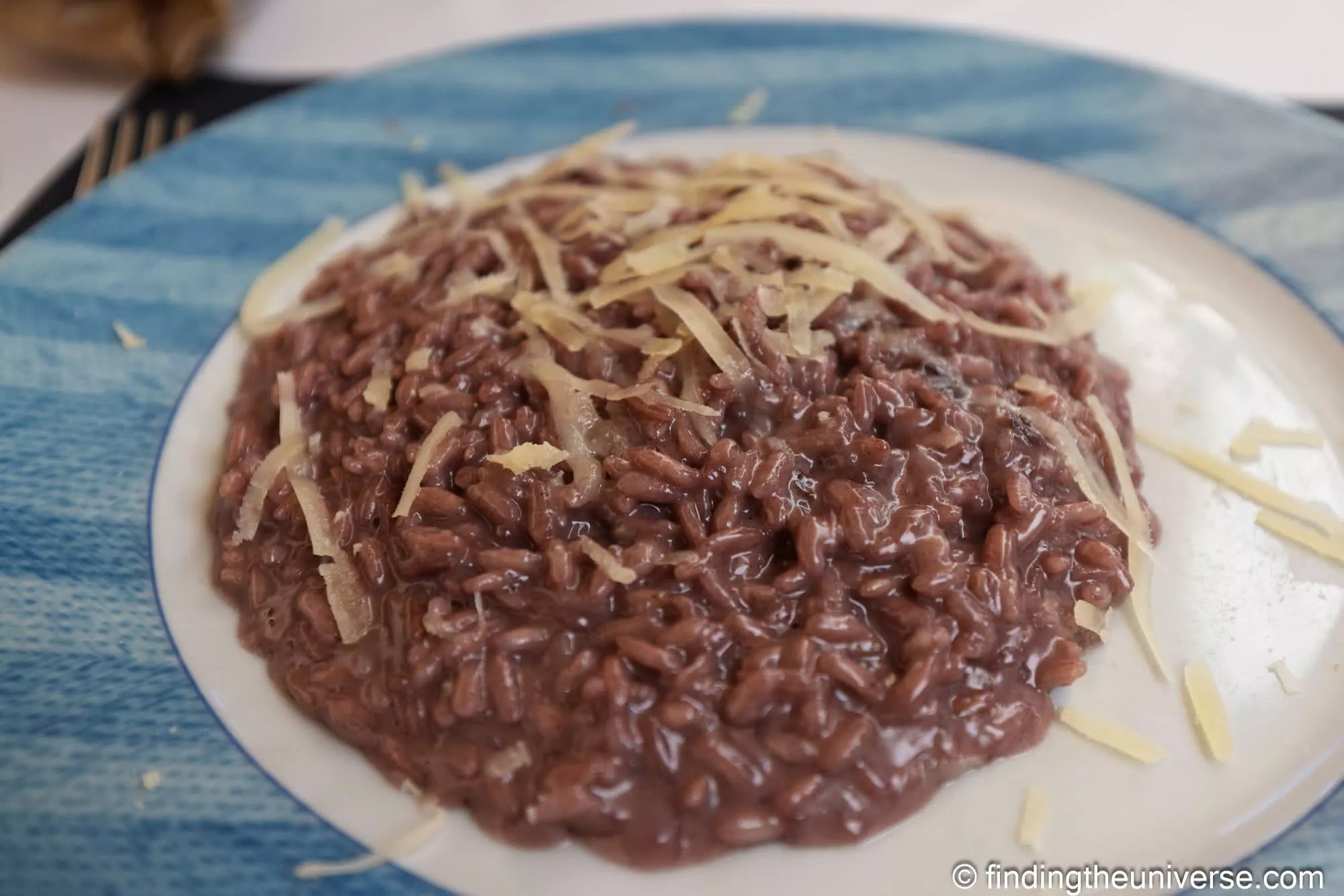
Walk west out of Piazza Bra along Corso Cavour and you’ll come to two adjacent trattorias on the same block, almost across the road from Castelvecchio. We ate at Osteria Il Ciottolo (Corso Cavour 39C), where the risotto all’Amarone is a signature dish and pretty close to the platonic ideal of what you want at lunchtime in Verona in August.
Amarone, in case you haven’t met it, is a powerful local red wine made from partially dried grapes from the Valpolicella region just north of the city. It tastes of plum and dried cherry and faintly of leather (in a good way) and it stands up to slow-cooked everything. Cook it into rice and you get a risotto that is roughly the colour of a wine stain, faintly sweet, deeply savoury, and quietly demanding that you order a glass of the same wine to drink alongside it. We obliged. We were on holiday.
If Il Ciottolo is full when you arrive, Trattoria Arco dei Gavi is literally two doors down at Corso Cavour 43 and does similar Veronese cooking with a similarly serious wine list. Both are well-loved, both are open as of 2026, both will treat you fine.
Afternoon (Around 2 pm to 6 pm): The Romeo and Juliet Circuit
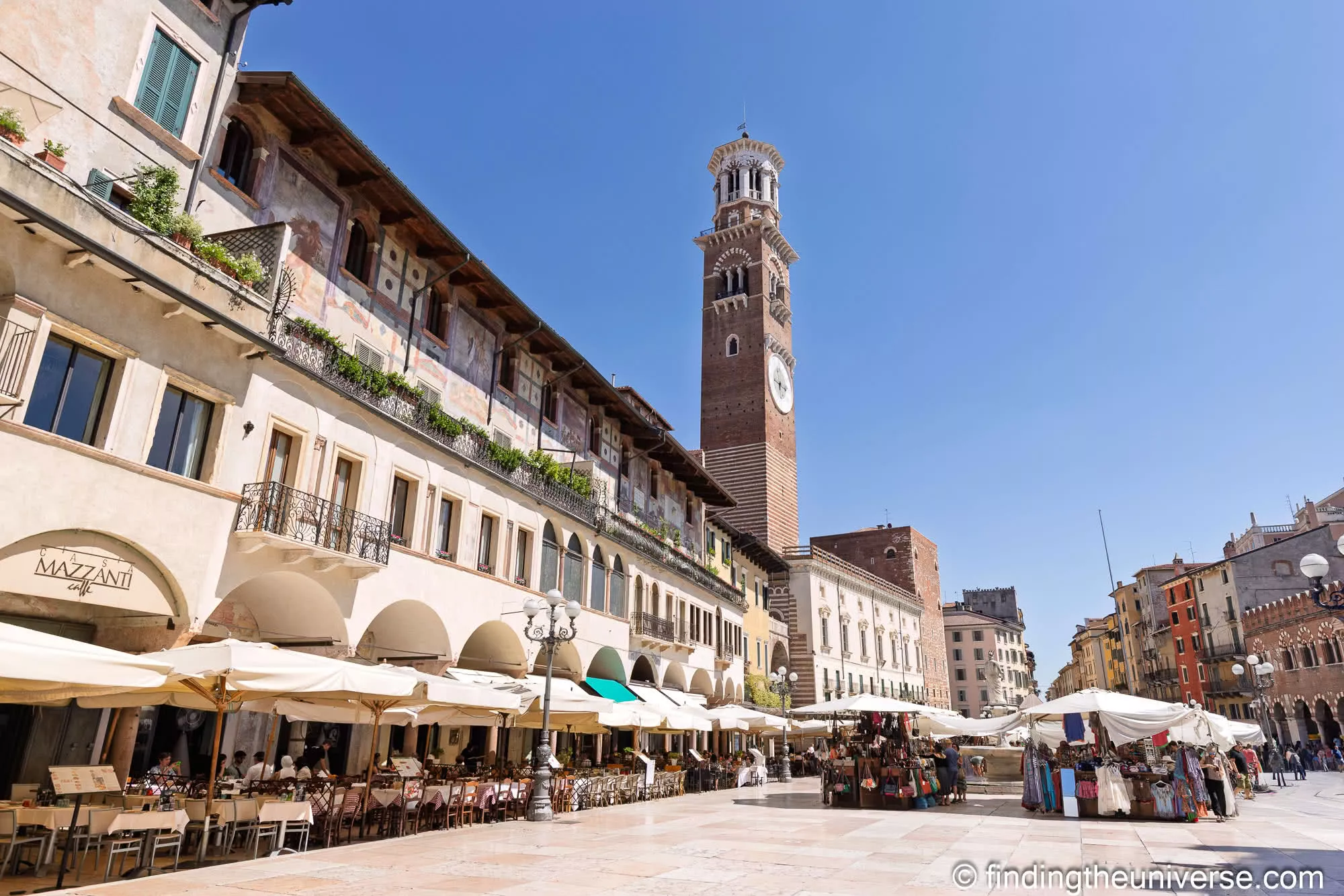
A short walk from lunch lands you at the heart of medieval Verona: Piazza delle Erbe, the city’s historic market square, with the Madonna Verona fountain at its centre and the painted façade of Casa Mazzanti running along one side. Wander it slowly. There’s a market that runs through the middle most days, selling a mix of fruit, souvenirs, and slightly weary umbrella stands, but the architecture is the headline.
Through the arch at the northern end you’ll find Piazza dei Signori, which is quieter and more formal: this is where the city’s medieval rulers (the Scaligeri family, who you’ll start seeing references to everywhere once you notice them) ran the show. The statue of Dante in the middle is here because he was exiled to Verona by Florence after a political falling-out and spent rather more of his life here than the average tourist board wants to admit.
Tucked into a small courtyard just off the square is one of the city’s quieter highlights: the Arche Scaligere, the elaborate Gothic tombs of the Scaligeri family, sheltered behind a wrought-iron fence and grouped around the tiny Chiesa di Santa Maria Antica. The tombs are extraordinary (pinnacled, canopied, scaled like miniature churches), and they sit in the open courtyard where you can study them at close range for free. It’s the kind of detail Verona quietly rewards: a major piece of medieval funerary art in a backstreet, with no queue.
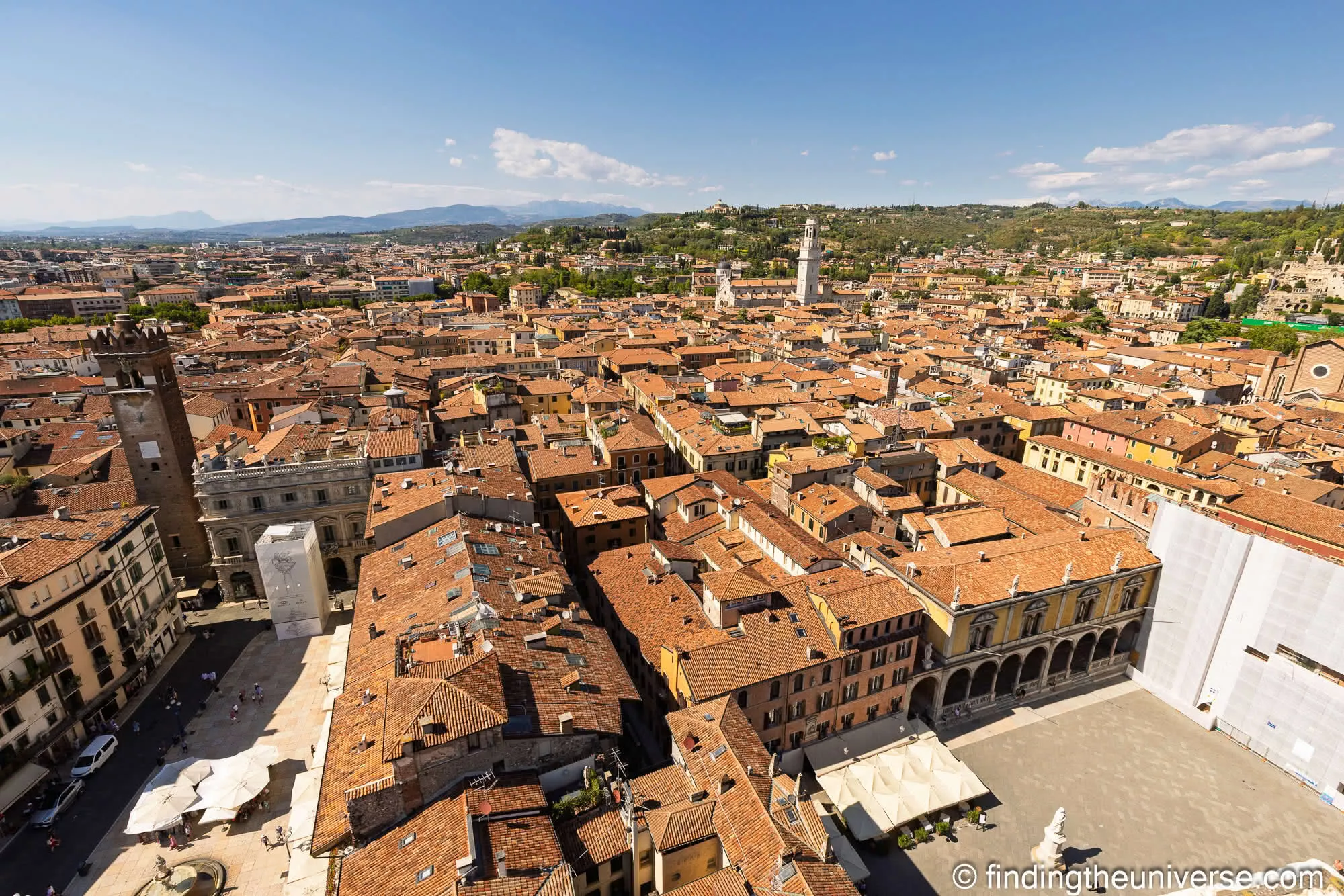
Torre dei Lamberti is on the same square and is the city’s tallest tower at 84 metres. €8 buys you entry, and there’s a lift if you’d rather not do the 368 steps. I climbed it; Jess sat with a coffee on Piazza dei Signori and watched the world go by. I loved the view: the whole historic centre, the Arena to the south, the bend of the river to the north, the red rooftops everywhere in between, plus a long line of sight out to the hills surrounding Verona. It’s the best viewpoint in the city that doesn’t require a hill climb, and worth the climb whether your travel partner joins or not.
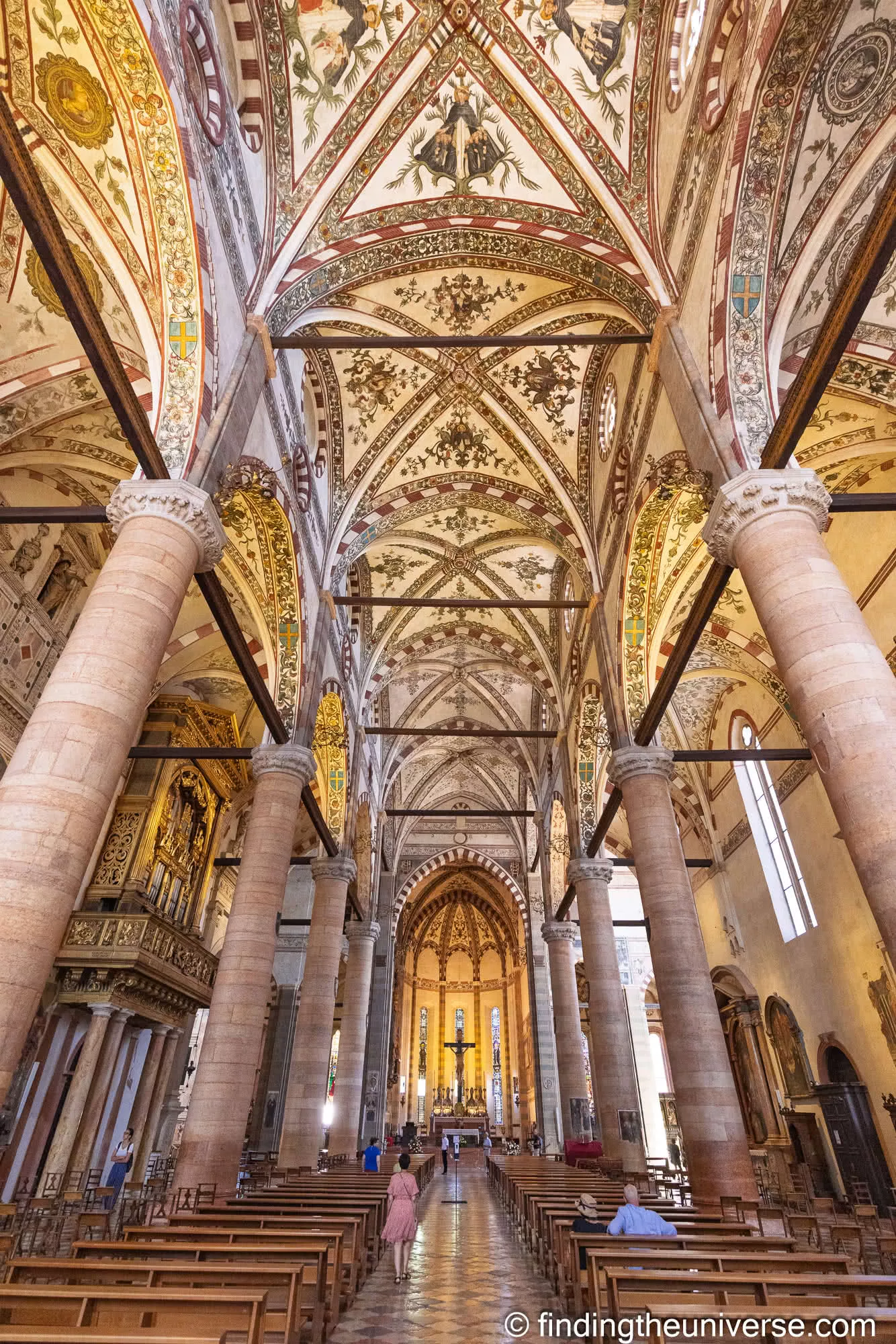
From Lamberti, a five-minute walk north brings you to Basilica di Sant’Anastasia, a soaring Gothic basilica that we’d happily rank as the second-best church in Verona after San Zeno (which you’ll see on Day 2).
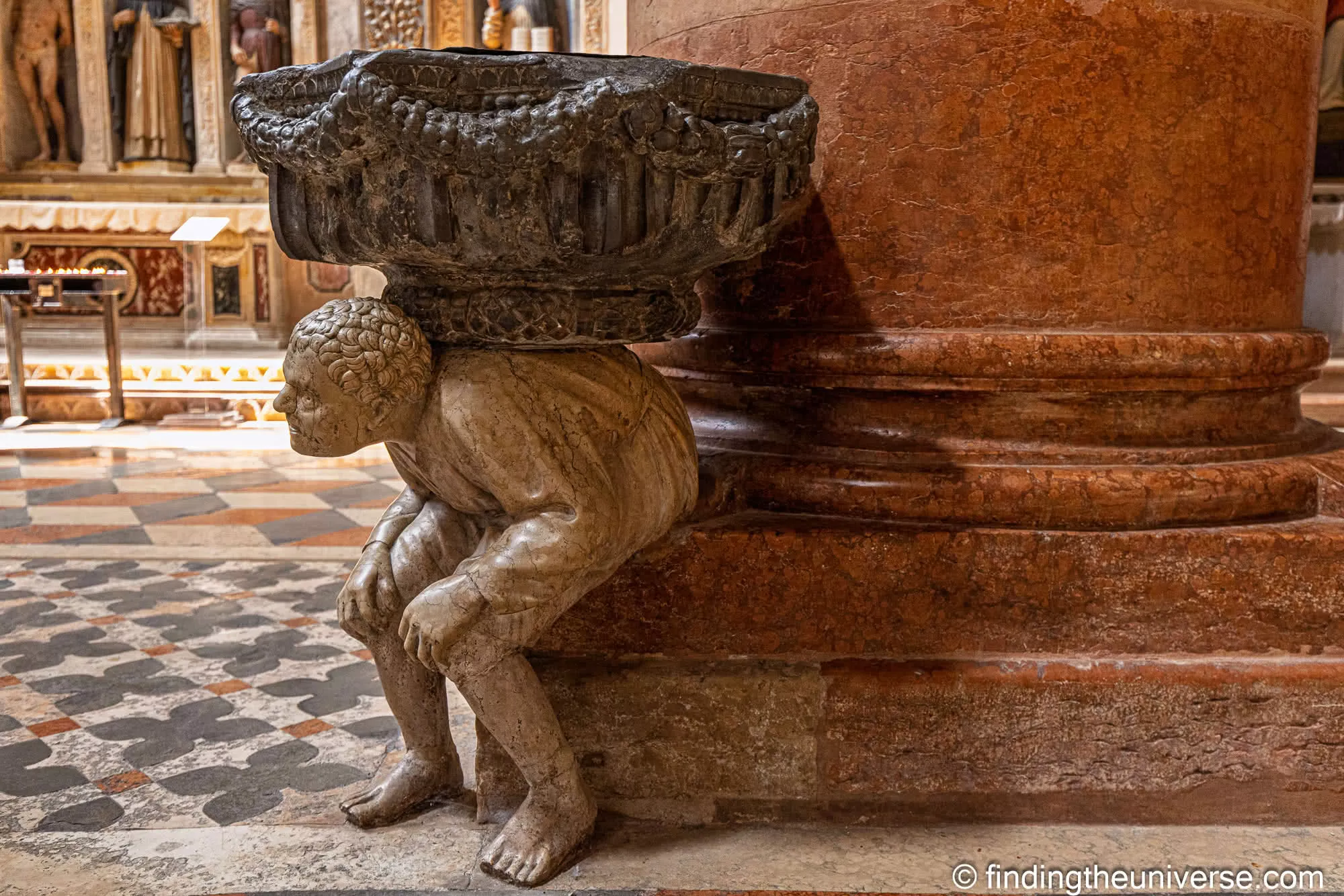
The interior is enormous, the painted vaulted ceiling is one of the most beautiful in the city, and the two stoups at the entrance (held up by figures known as gobbi, the hunchbacks) are the kind of small detail you’d miss without slowing down. Allow 45 minutes. It’s included on the Four Historic Churches ticket.
From Sant’Anastasia it’s a short walk south to Casa di Giulietta, Juliet’s House. We need to talk about this one.
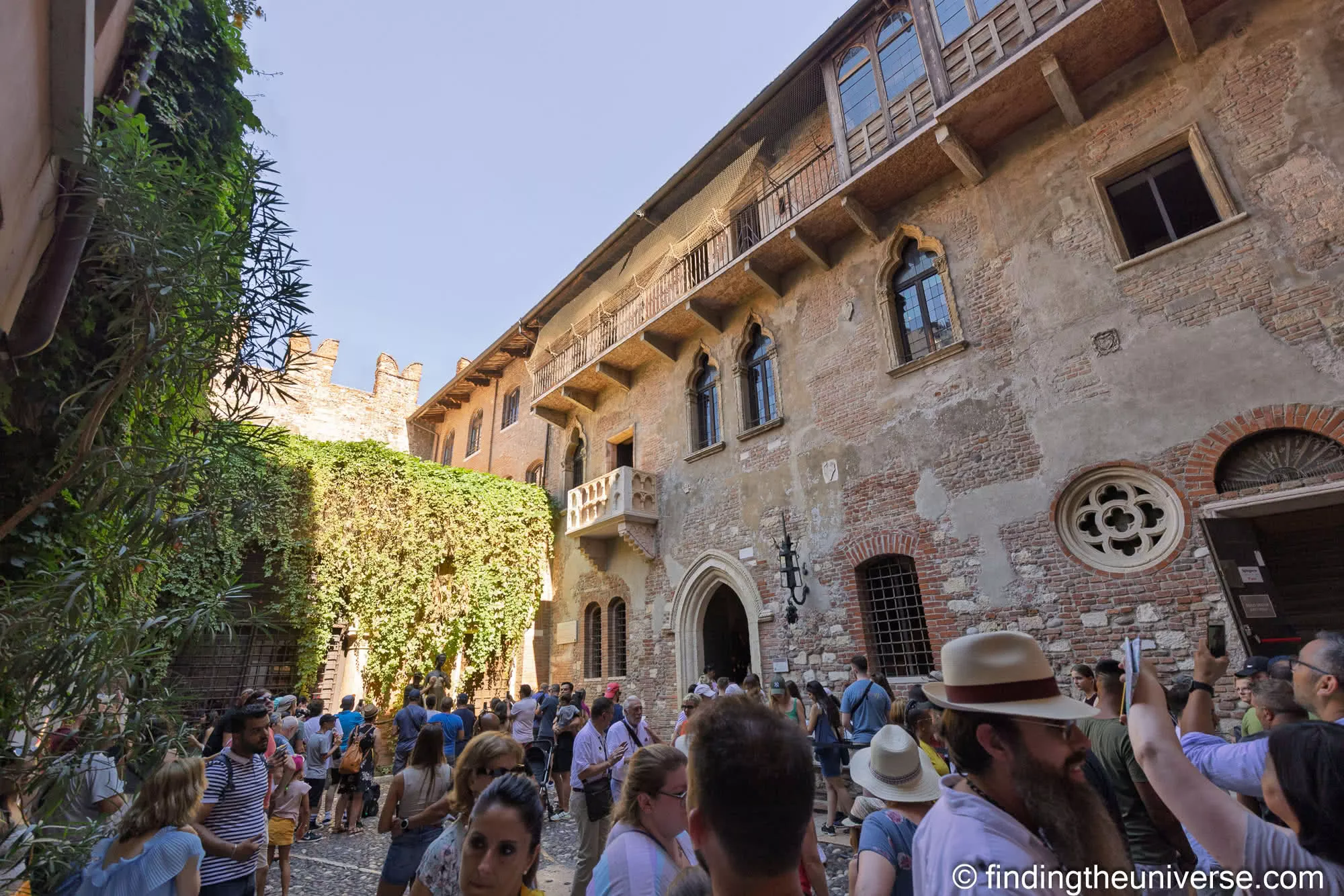
The “balcony of Juliet” is a 1930s addition to a 13th-century building that may or may not have been associated with the Cappello family (Shakespeare’s Capulets) but almost definitely wasn’t associated with anyone who said “wherefore art thou Romeo.” The bronze statue of Juliet in the courtyard has been rubbed shiny across both breasts and a fair amount of her upper torso by visitors hoping for romantic luck, and the practice shows no signs of slowing down. The walls of the entrance passage are covered, periodically scrubbed clean, and immediately recovered with love-note graffiti.
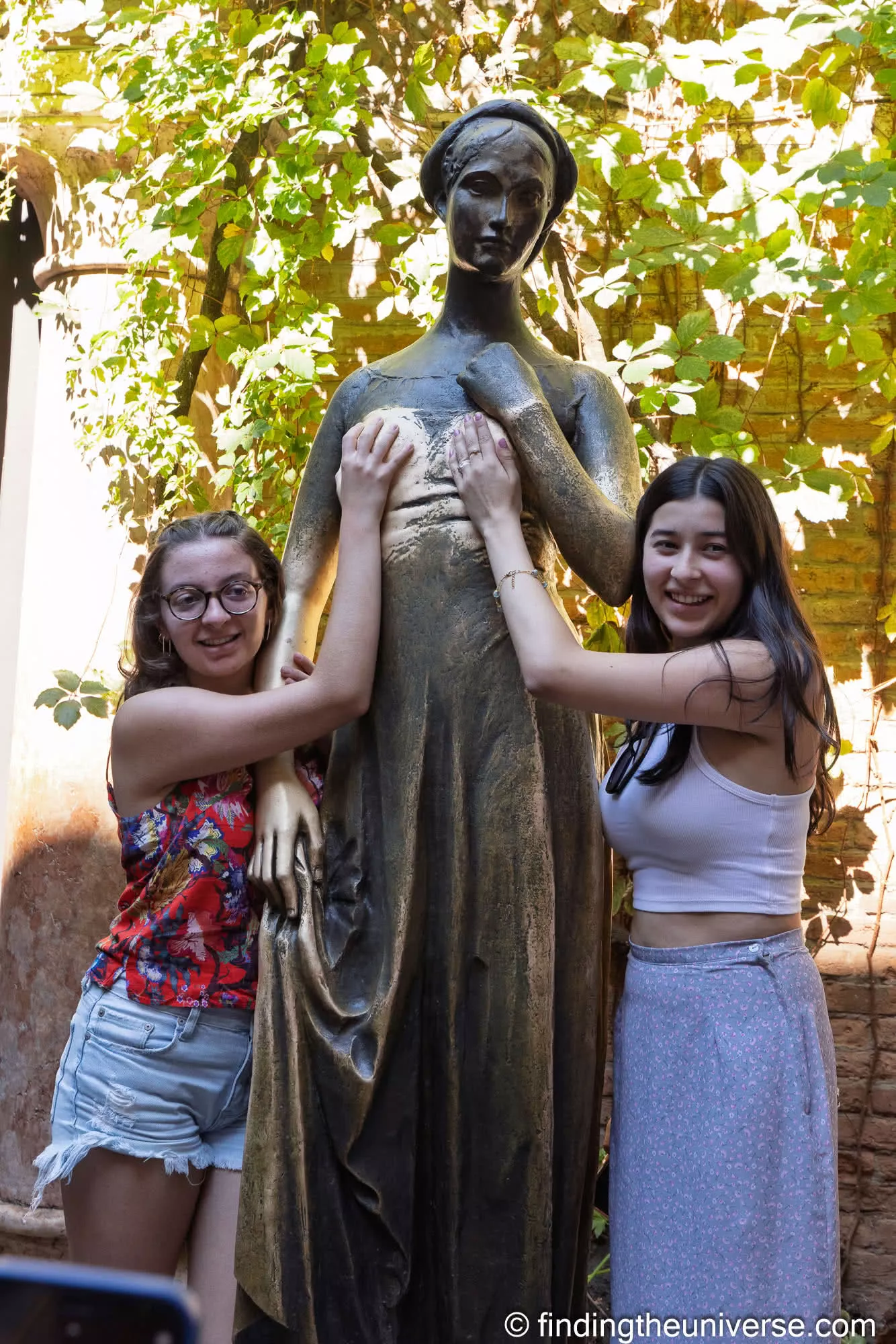
We took photos in the courtyard, which is free to enter, and skipped the museum (€12, online-only as of April 2026, which includes the balcony). We don’t think this is a controversial call. The literary connection is thin, the balcony is younger than your grandparents, and the courtyard photo is the photo.
If you’re keen to see the inside, the museum is fine but not essential; the Romeo and Juliet guided walking tour on GetYourGuide bundles the entry with proper context if you’d rather get the full Romeo-and-Juliet experience with a guide who can explain which bits are true.
Evening: The Arena Opera (in Season) or Castel San Pietro at Sunset
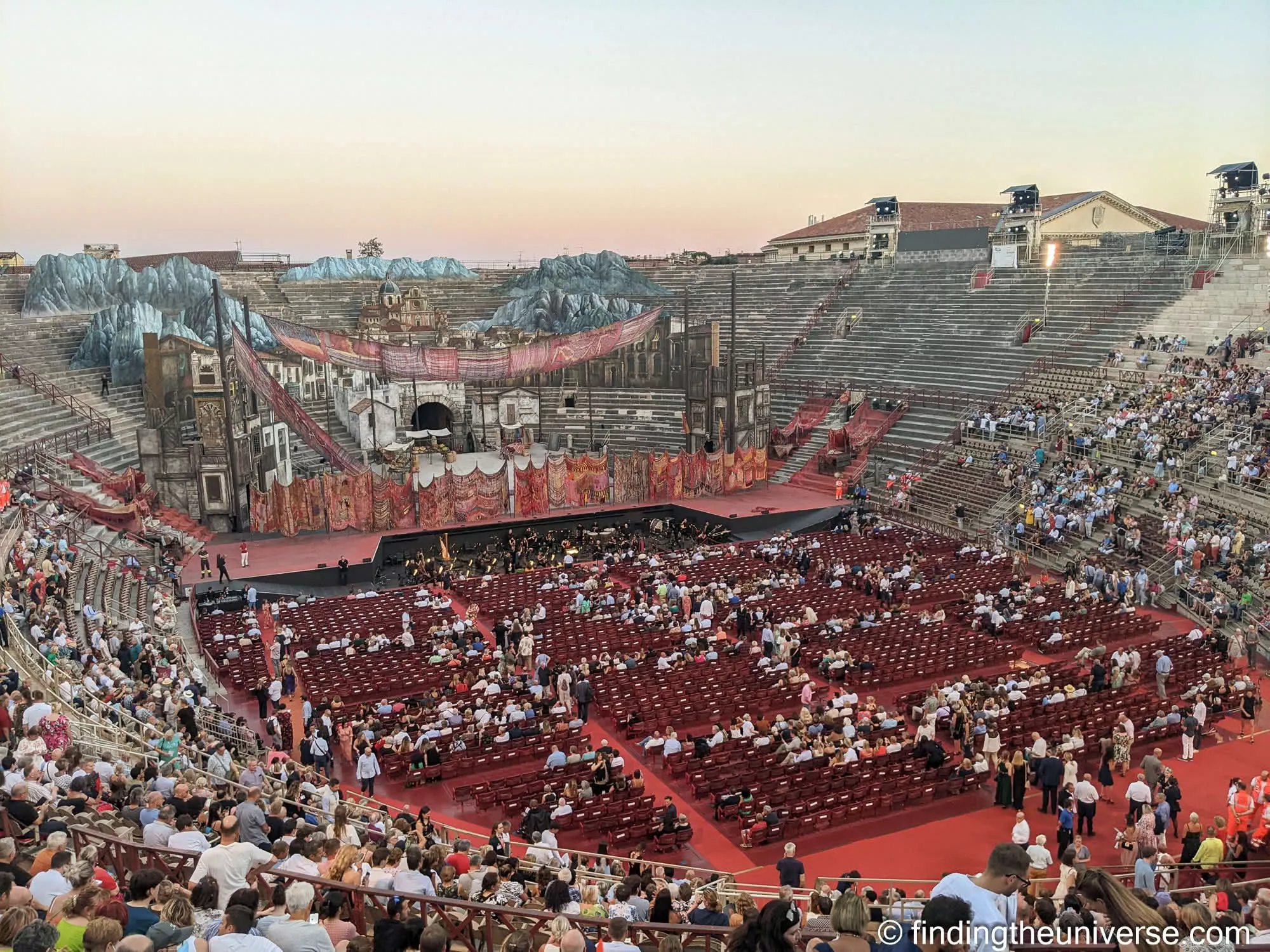
If you’re visiting between mid-June and mid-September, you can see an opera at the Arena. The 103rd Arena Opera Festival runs from 12 June to 12 September 2026, with productions of La Traviata (opening night, in a new Paul Curran production reportedly inspired by Moulin Rouge), Aida (two competing productions, a Zeffirelli classic and a new staging by Stefano Poda), Nabucco, La Bohème, and Turandot in a Zeffirelli centenary production. Tickets via arena.it.
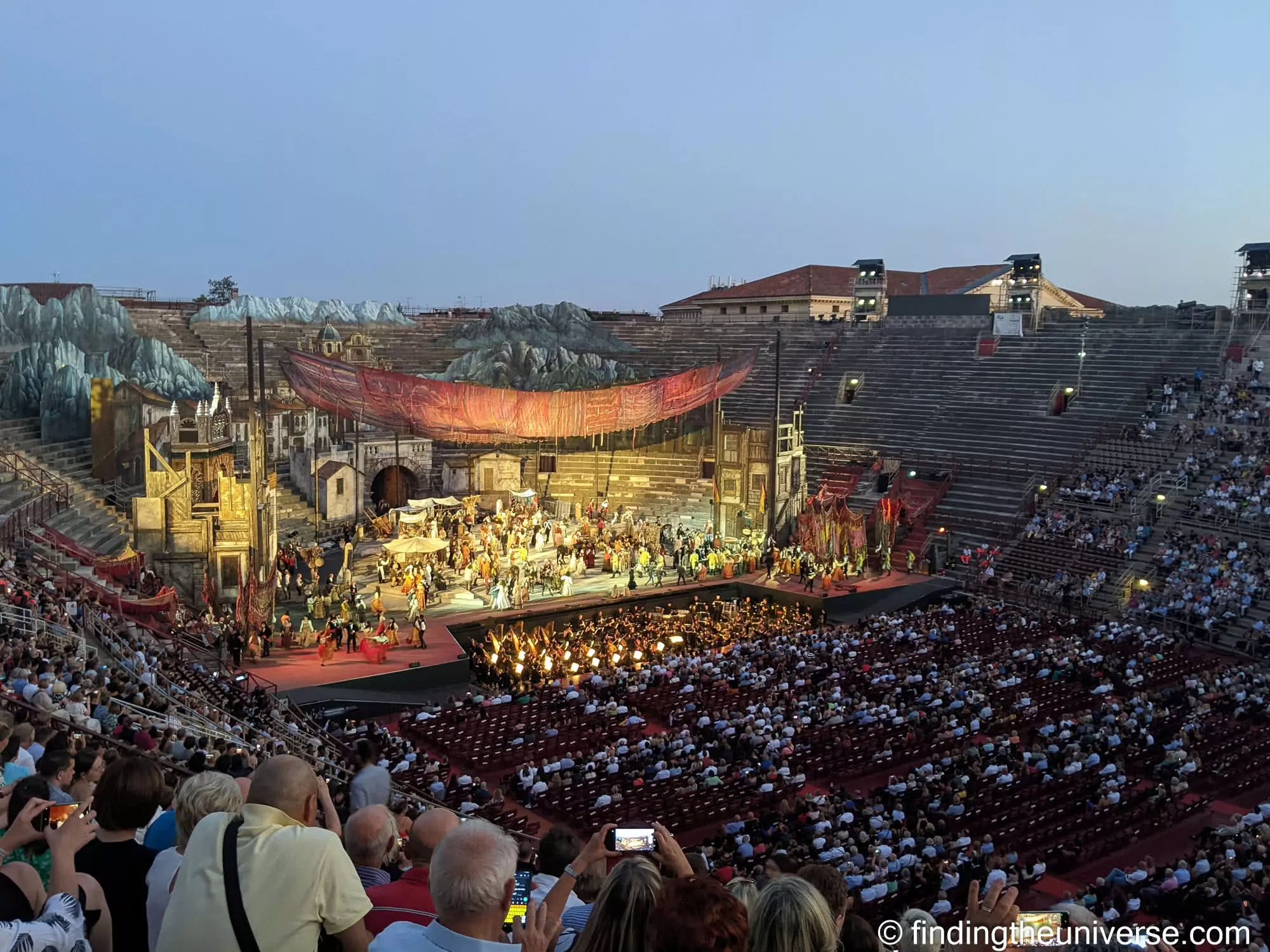
We saw Carmen in August 2022. We sat in the VI Settore Gradinata Numerata, which is the numbered stone-seat tier, and the performance started around 9 pm, as the light was going. It was lovely. The opera was very good (although I should note we are not exactly opera experts), the lighting on the production was spectacular, and the venue is the venue.
Now, the actual experience. Neither of us is really an opera fan. We went for the experience of seeing a performance in an amphitheatre that has been hosting performances for, give or take, the last two thousand years. The stone seats are hard, we made the mistake of not renting cushions (you can rent them from vendors before the performance starts, this is well worth doing), and we left around the interval. The show was very good. Anyone actually into opera would have stayed all the way through. We wanted the venue, not the production, and we got the venue, and we left while we were still loving it.
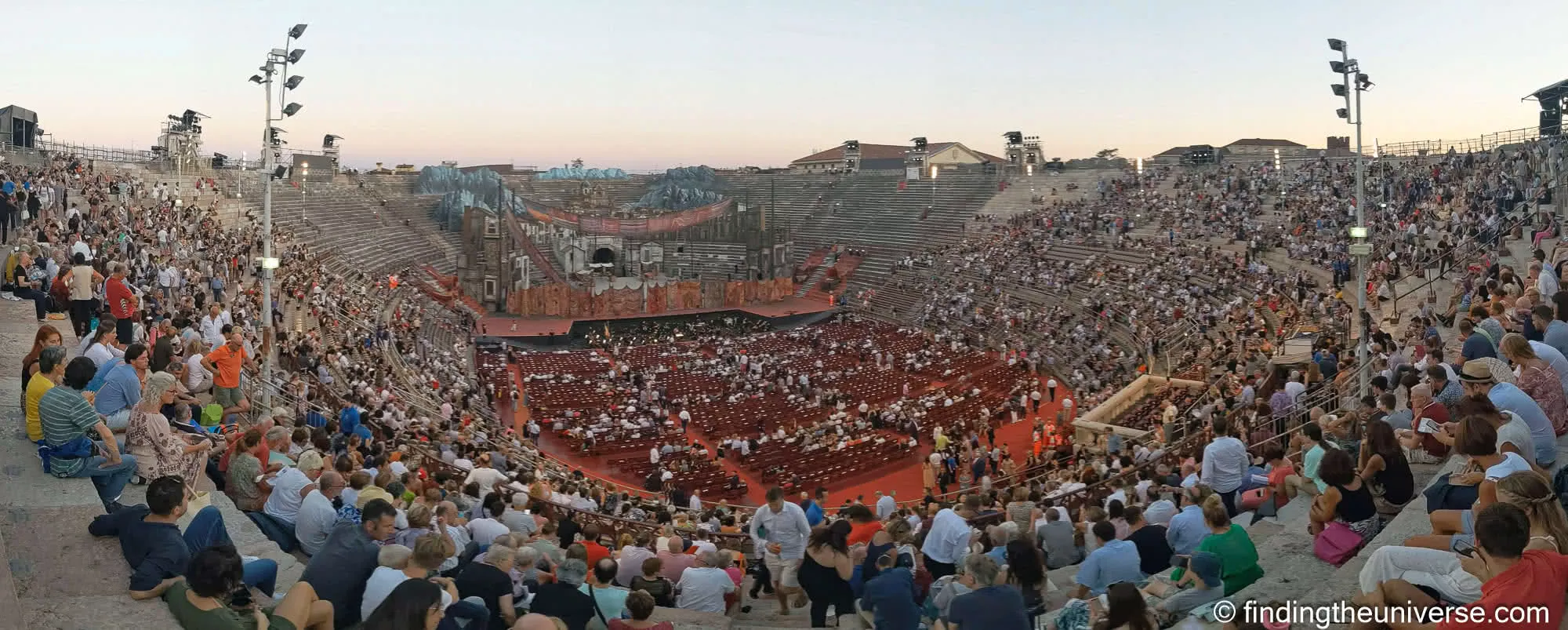
So: book the Arena opera if you have any interest at all in the experience of seeing live performance in a Roman amphitheatre. Rent the cushions. Bring a light layer, because the temperature drops once the sun goes down even in August.
Don’t feel obligated to stay all the way to the end if it’s not landing for you; nobody minds, and the city is yours afterwards. The Verona-Carmen-stone-seat experience is one of the most distinctive evenings we’ve had on any Italy trip, and we’d do it again. Just with cushions.
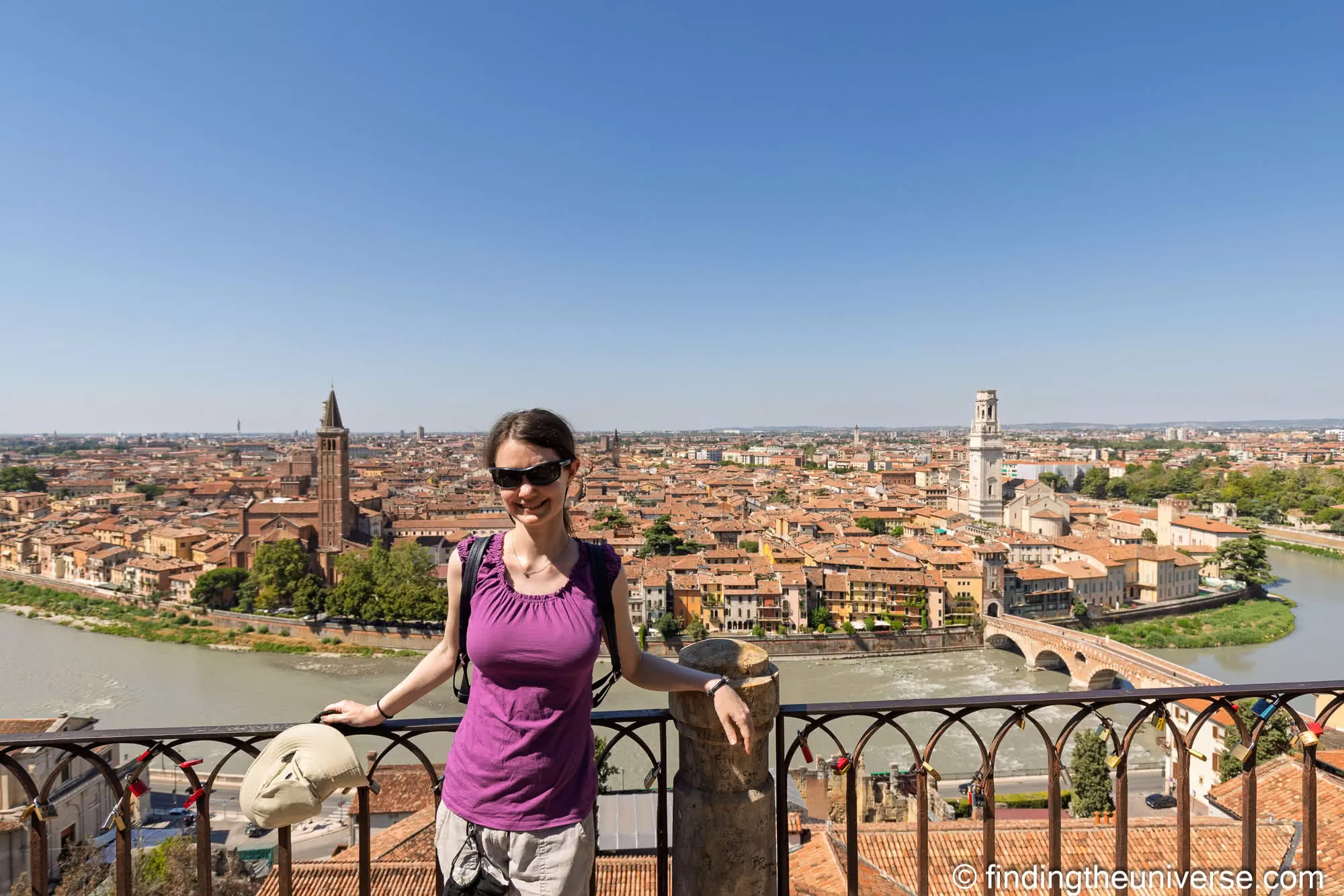
If you’re not visiting in opera season, or you simply don’t fancy it, head across Ponte Pietra to Castel San Pietro for sunset. You’ve got two options: a fifteen-minute uphill walk with a few sets of stairs, or the Funicolare di Castel San Pietro, which lifts you from a station near the foot of Ponte Pietra straight up to the terrace.
Tickets are €2 one way or €3 return, and the funicular runs daily, 10 am to 9 pm in summer (April to October) and 10 am to 5 pm in winter. It’s the more comfortable option in August heat, and the view from the cabin is part of the experience. We took the funicular up and walked back down on our second day; the views from the top across the river and city are wonderful.
Day 2: The Substantive Verona
The Romeo and Juliet circuit is done; Day 2 is the day Verona stops being a backdrop for a Shakespeare play and starts being itself. Castelvecchio, San Zeno, the Cathedral complex, and one of the loveliest Renaissance gardens in northern Italy are all on the table.
Morning (Around 9 am to 1 pm): Castelvecchio Museum
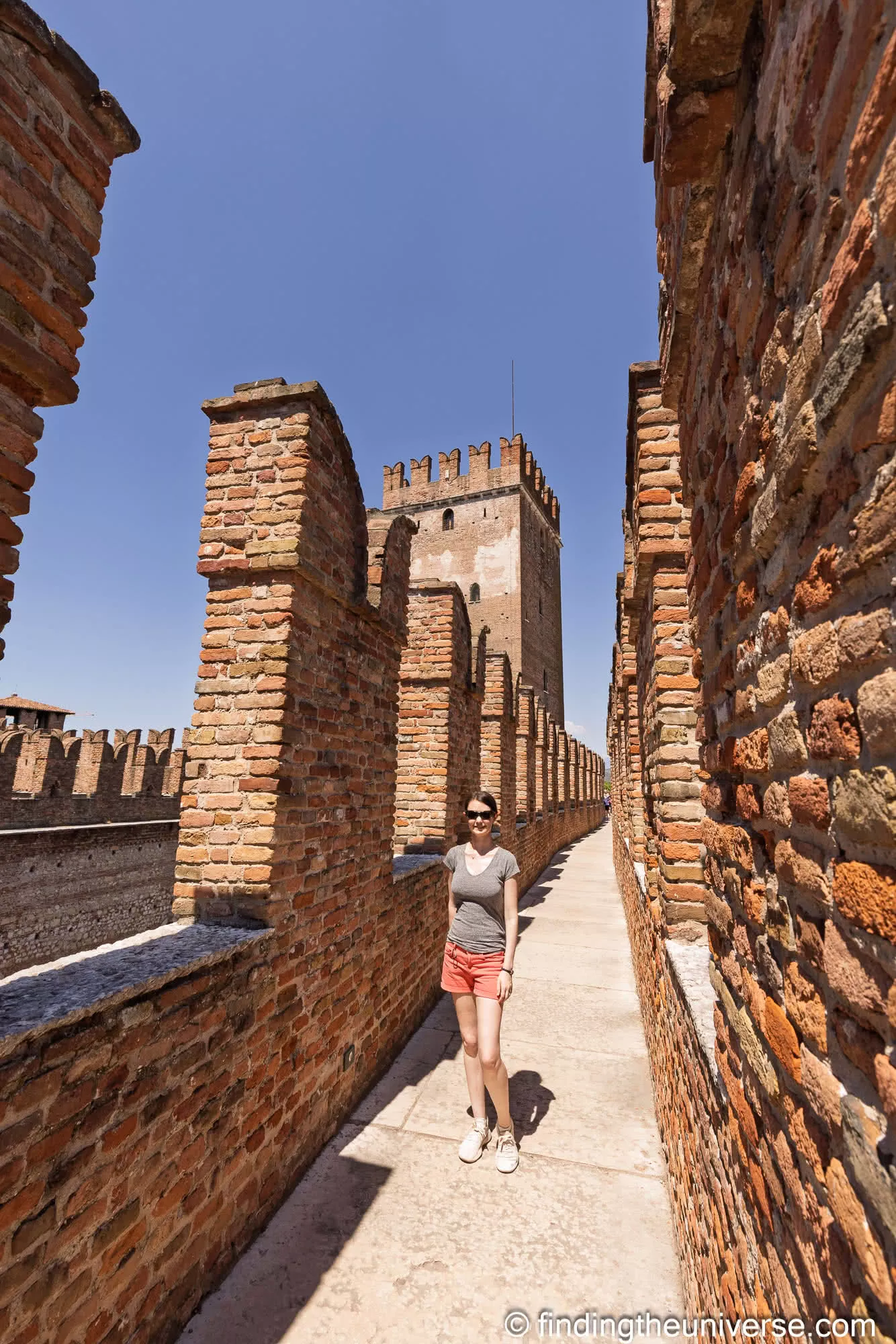
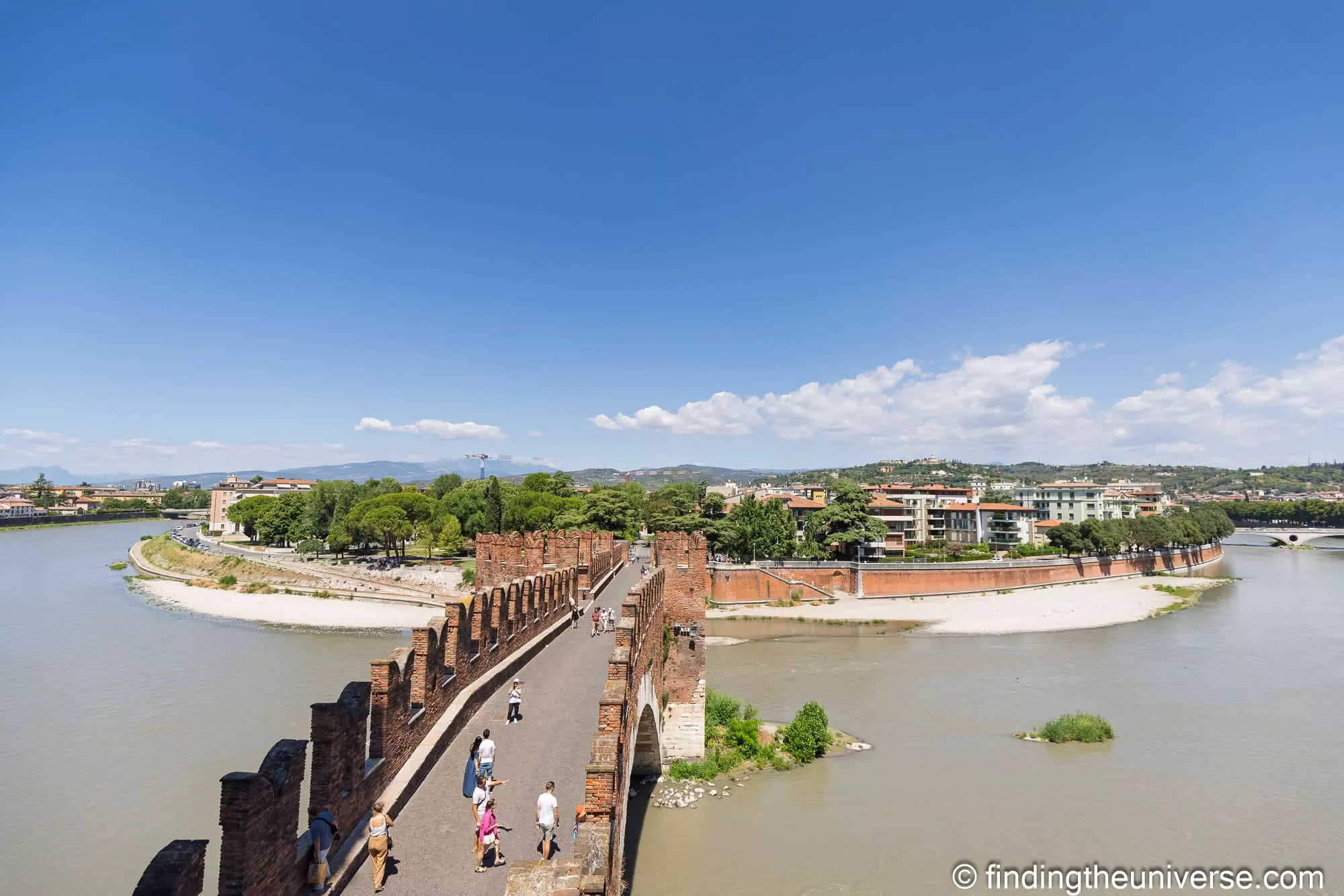
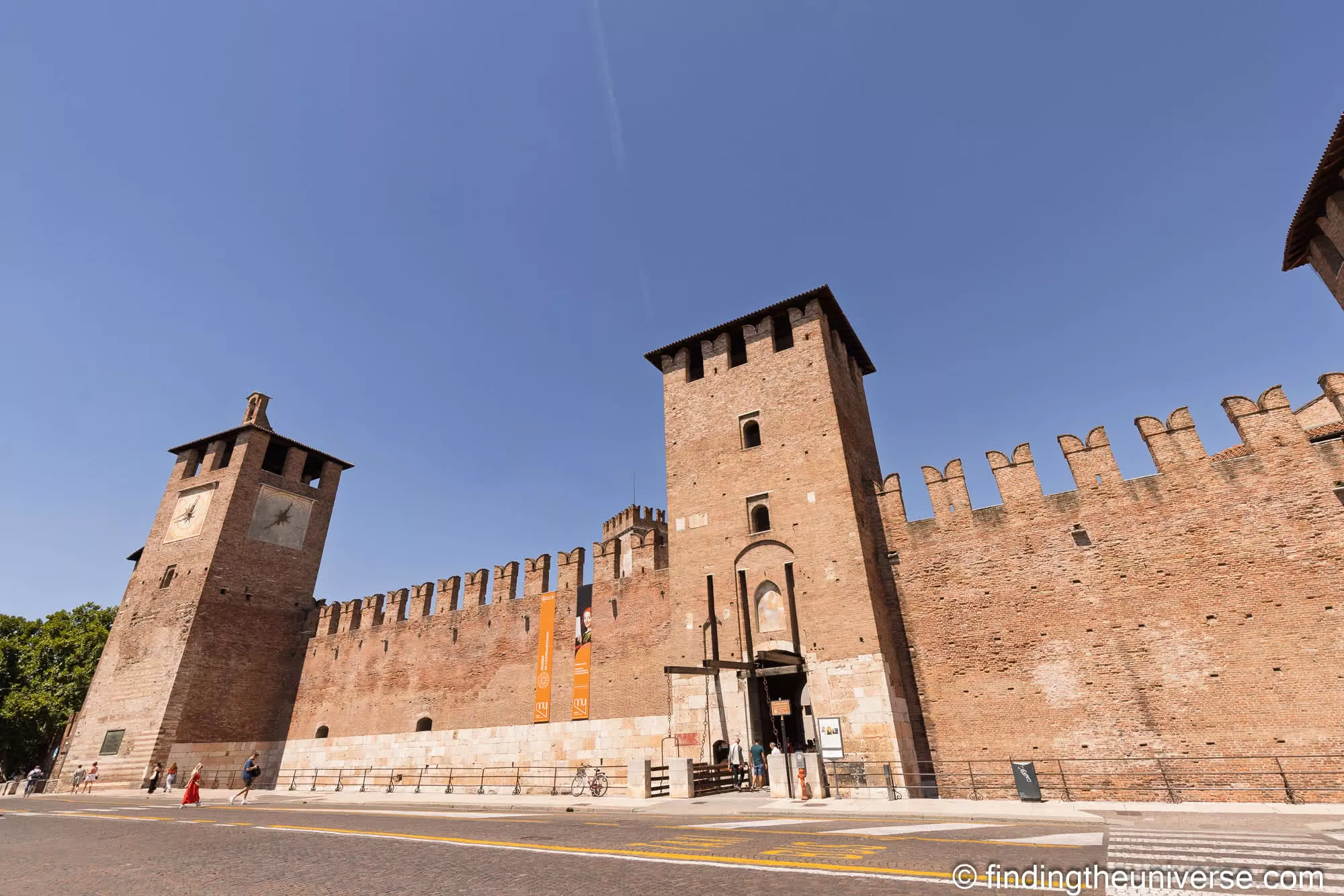
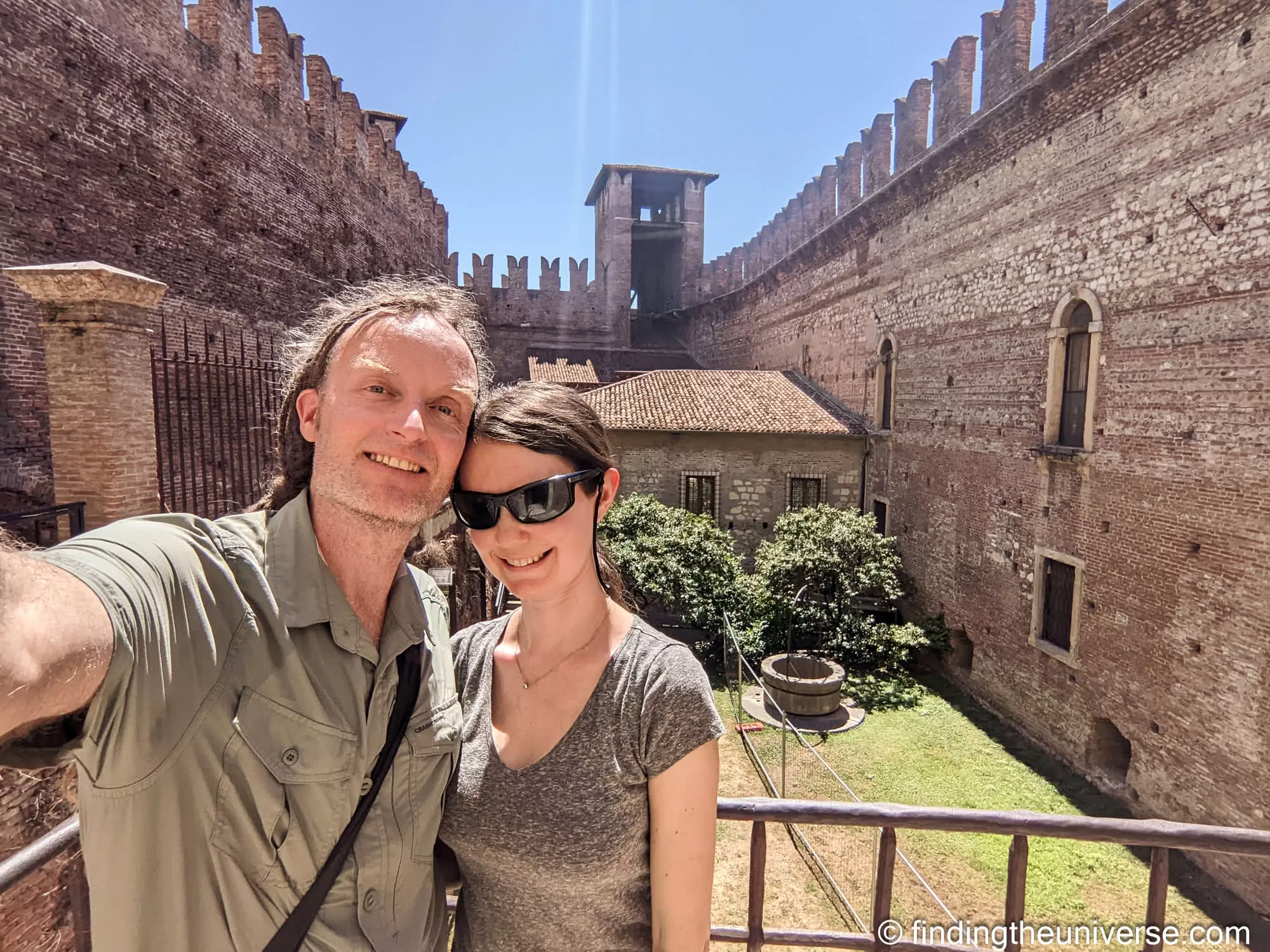
Castelvecchio is the moody, brick-red medieval castle you saw across the road from lunch yesterday, and it was our favourite museum-style experience in Verona. Built in the 14th century by the Scaligeri family (those Verona rulers again), it has the M-shaped Ghibelline crenellations along the walls, the fortified Ponte Scaligero bridge spanning the Adige beside it, and inside, one of the loveliest small museum collections in Italy.
The collection itself is arranged across what used to be the residential and ceremonial rooms of the castle, with the Carlo Scarpa redesign from the 1960s being a kind of star in its own right. Scarpa was the Italian architect who specialised in adapting historic buildings for modern museum use, and his work at Castelvecchio is considered one of the great examples of the genre. You’ll walk through rooms where the medieval brickwork and the modernist concrete and steel co-exist without arguing. It’s well worth seeing on its own terms.
The collection runs heavy on Veronese painters from the medieval and early Renaissance period (the area’s school of painting was a serious one), plus armour, sculpture, and a famous equestrian statue of Cangrande della Scala which is mounted on a striking modernist plinth that lets you walk around and underneath it.
Don’t miss the wall walk. You can climb up onto the castle’s outer wall and walk a section of the ramparts, with views back over the courtyard and down onto Ponte Scaligero and the Adige beyond. It’s one of the best free-with-entry experiences in the city, a working medieval fortification with a postcard view of the bridge from above.
Entry is €9 for adults, free with the Verona Card. Allow two hours minimum, three if you slow down at the Scarpa-designed spaces (which you should) and the wall walk. The Ponte Scaligero bridge is free to walk across and worth it for the views back over the castle from the far bank.
Lunch (Around 1 pm to 2 pm): Bollito Misto at Torcolo
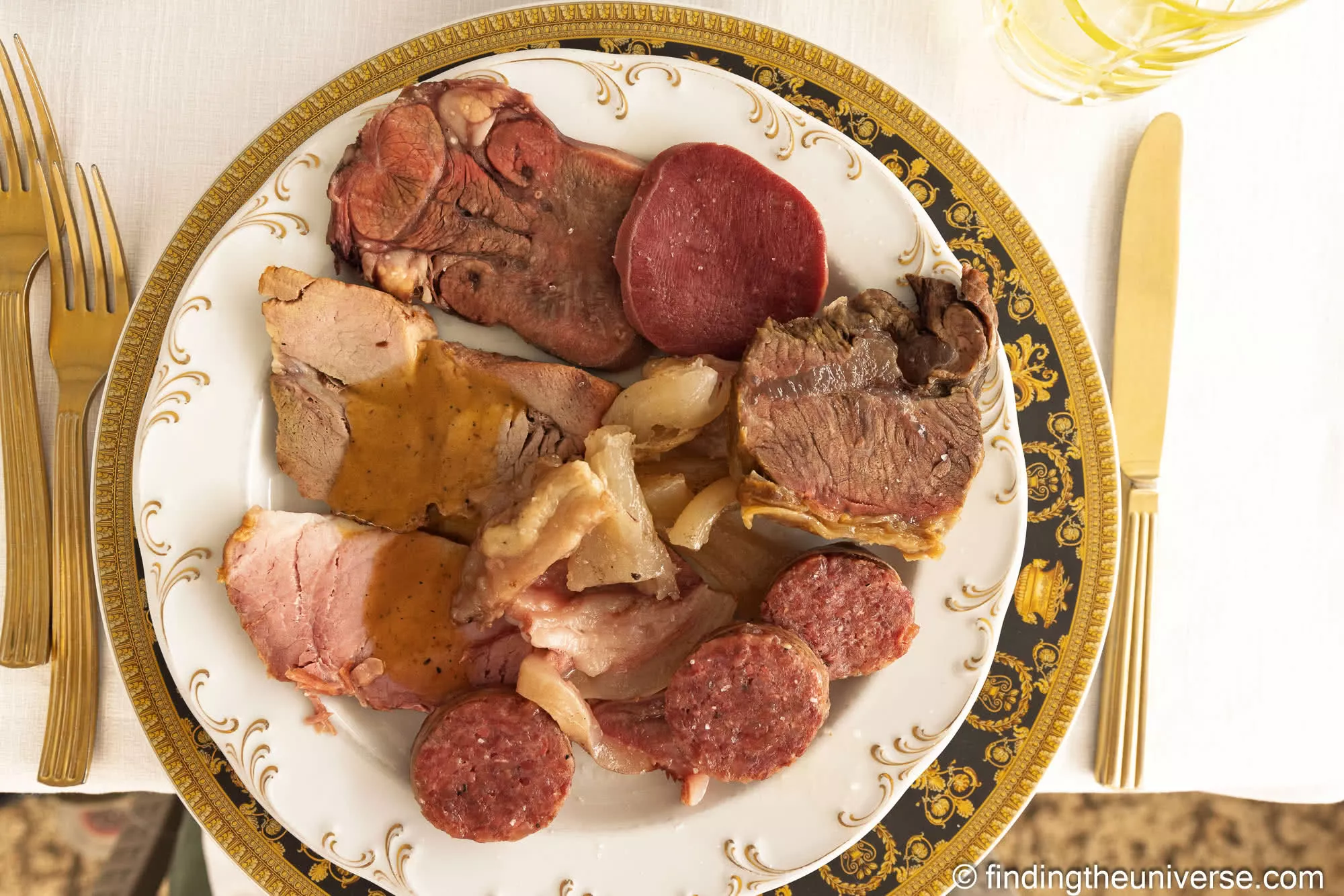
Walk back into the city centre and find Ristorante Torcolo at Via Carlo Cattaneo 11. We ate bollito misto here on our second day. Bollito misto is, in practical terms, a giant plate of mixed boiled meats: several different cuts brought to the table on a trolley by the staff, sliced in front of you, and served with salsa verde and a few other condiments. If you’re a meat-eater this is one of the great northern-Italian classics, and Torcolo’s version is excellent. If you’re not, or you’re travelling in summer and the idea of a heavy meat lunch in 30°C heat makes you wilt a bit, the menu has plenty of lighter options too.
Torcolo has been run by the Barca family for decades; it’s the sort of place where the menu changes seasonally, the wine list is taken seriously, and you can tell from the soundtrack of clinking glasses that most of the lunchtime clientele are local. We were the obvious tourists that day, but nobody seemed to mind, and the food was as good as anywhere we ate in Italy that trip.
Afternoon (Around 2 pm to 6 pm): The Western Churches and Giardino Giusti
Day 2 afternoon is built around three more of Verona’s serious churches and the city’s loveliest garden. The walking adds up (you’ll cover three or four kilometres in total), but the pacing is generous and you’ll be sitting down for two of the stops.
Basilica di San Zeno Maggiore (free to enter the precinct; church interior on the Four Churches ticket) is a fifteen-minute walk west from the centre, slightly off the main tourist trail, and is comfortably the most beautiful church in Verona.
The bronze doors are the headline. They date from the 11th and 12th centuries, they’re covered in relief panels depicting Old Testament and New Testament scenes plus various Veronese saints, and they are extraordinary at close range. Some of the panels are stylised, almost cartoonish, and some are more naturalistic; the contrast suggests they were made by different artists over more than a century. Pay them proper attention; you can take in the whole set in about fifteen minutes if you go slowly.
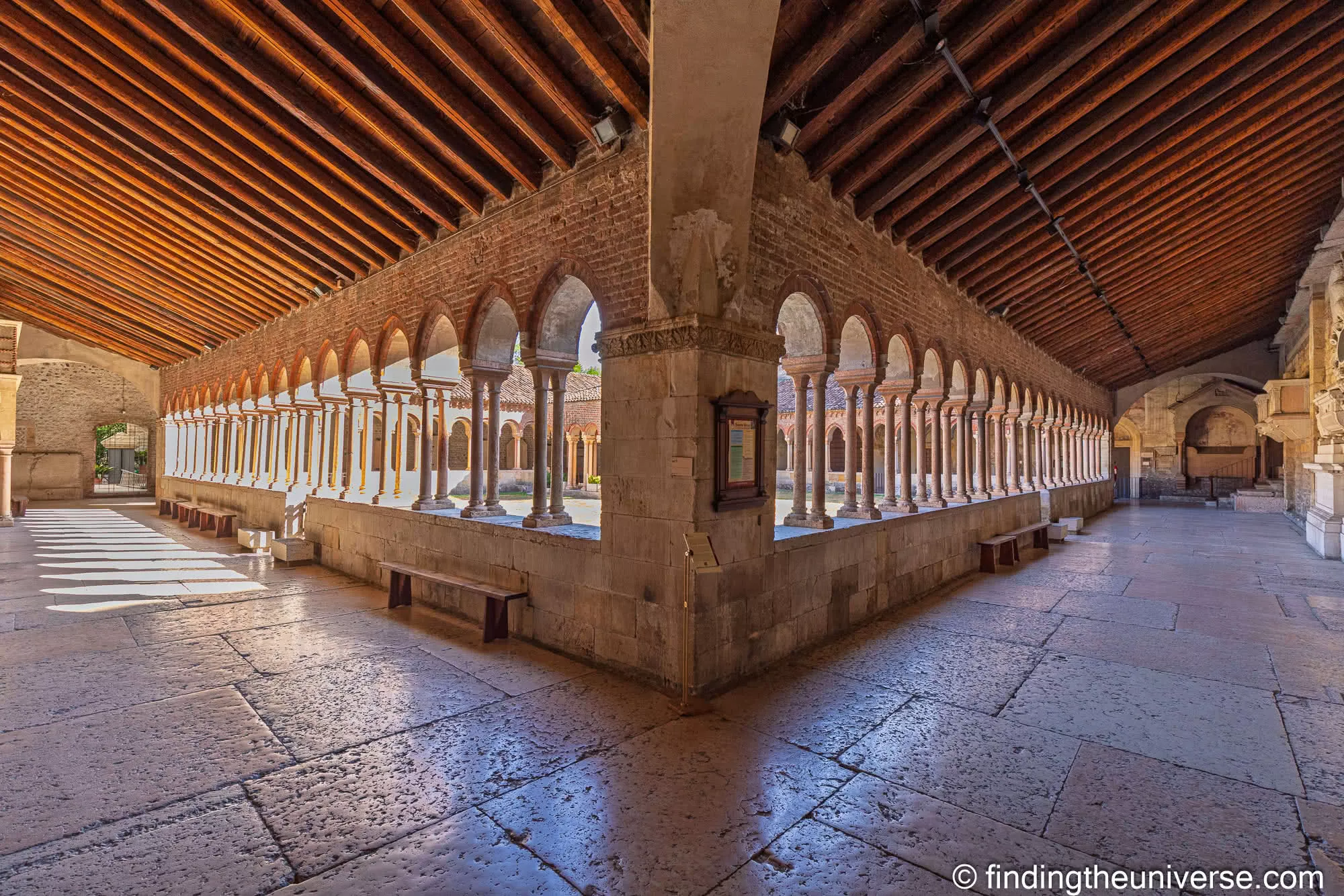
Inside, the basilica is the standard San-Zeno experience: tall, plain, beautiful in the Romanesque way of being beautiful by leaving things simple. Mantegna’s Madonna and Child with Saints altarpiece is at the far end of the nave, behind the altar, and you’ll have to walk down to see it properly. It’s worth the walk. The crypt beneath is small but interesting. Don’t skip the cloister on the way out, either. It’s peaceful, arched, and planted, the kind of space you wish you had at home. Allow an hour for everything.
Walk back east towards the centre. If you have time and energy, Basilica di San Lorenzo is a small Romanesque church on Corso Cavour that you can drop into on the way for fifteen minutes. It’s not on the Four Churches ticket and has a small entry fee, but the twin cylindrical bell towers flanking the entrance and the modest, light-filled interior are quietly worth the detour.
If you skipped the opera-goer Day 1 morning alternative, this is the slot for the Cathedral Complex (Duomo + Sant’Elena + Baptistery of San Giovanni in Fonte) on the river bend, a fifteen-minute walk north-east from San Lorenzo or San Zeno through the centre. The cluster is on your Four Churches ticket and rewards an hour. If you did do the Day 1 alternative, skip this and head straight to San Fermo.
Cross the river (or take the bridge south past Piazza Bra) to Basilica di San Fermo Maggiore, the fourth of the Four Churches and the most architecturally unusual: two churches stacked on top of each other, a Romanesque lower church beneath a Gothic upper. The wooden ship’s-hull ceiling of the upper church is the headline; it looks more like the inside of a galleon than a basilica.
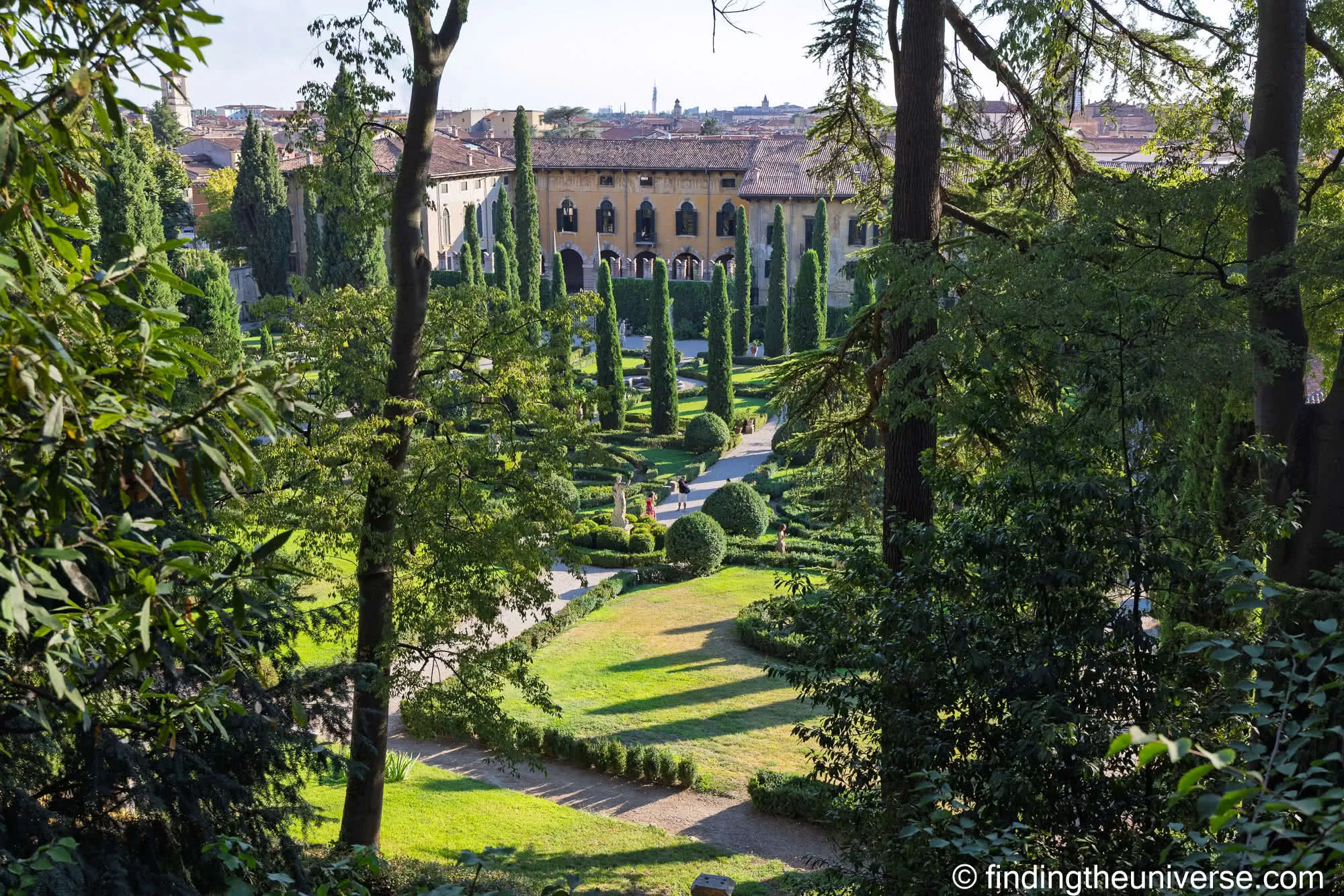
From San Fermo, a fifteen-minute walk east across Ponte Navi takes you to Giardino Giusti, the Italian Renaissance garden that most weekend visitors miss. The garden was laid out in the 16th century by the Giusti family, who built their palazzo on the lower slope and extended a formal Italian garden up the hillside above. Cypresses run along the central axis, there are box-hedge parterres at the lower level, grottos and a labyrinth at the middle level, and a viewpoint at the top with a sweeping look down over the gardens and the city beyond.
It’s one of the best Renaissance gardens in northern Italy. Goethe visited and was moved enough to write about the cypresses. Cosima Wagner came here. We sat at the top of the gardens for about twenty minutes and didn’t speak much. Entry is around €10.
If this afternoon feels like a lot, it is. You’ve got two big basilicas, a smaller church or two, and a hilltop garden in a single block. Trim where you need to. The non-negotiables in our view are San Zeno and Giardino Giusti; the middle stops are easy to drop or shorten if you’d rather sit down with a coffee for half an hour.
Evening: Ponte Pietra at Golden Hour and Aperitivo
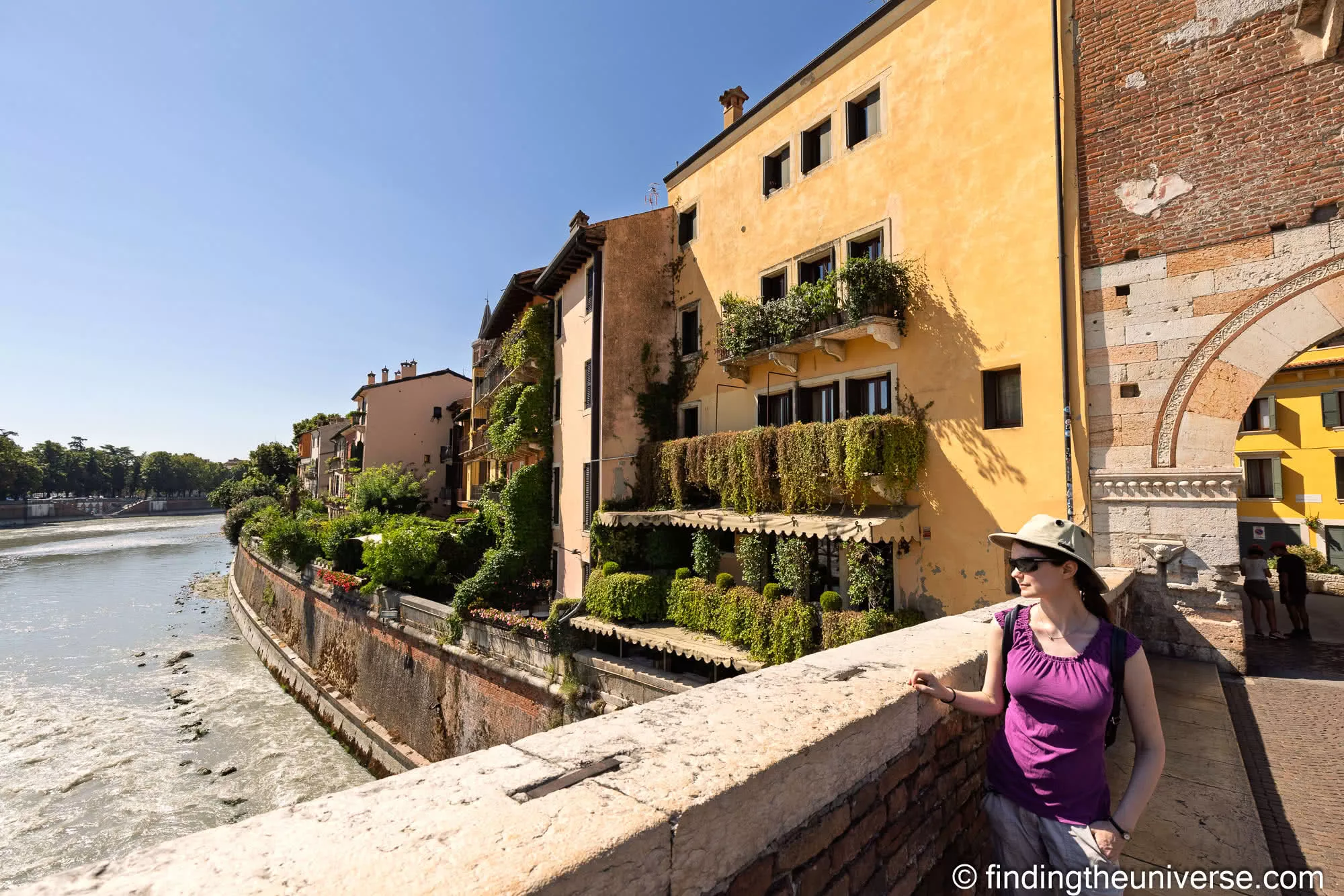
If you didn’t do Castel San Pietro on Day 1, do it now. Either way, end your day with a walk along the Adige to Ponte Pietra at golden hour. The bridge, partly Roman, partly medieval, rebuilt after damage in the Second World War using the original stones recovered from the river, is the photogenic prize of the city, and you’ve got the river, the bridge, and the warm-light hour-and-a-half before sunset to work with.
We had aperitivo at one of the small bars at the foot of the bridge, sat outside, watched the light go. I’m a Campari spritz drinker (the slightly bitter end of the spritz spectrum is where I like to land), and Jess sticks with the classic Aperol. Either works. This is the part of the trip you’ll remember in five years.
A Note on Lake Garda, Sirmione, and Valpolicella
A lot of 2-day Verona itineraries try to wedge a day trip to Lake Garda into the schedule. We don’t think this works, and we’d politely push back on it.
We’ve done Lake Garda. We day-tripped to Sirmione from Milan a few years before our Verona trip, and it’s a lovely lake worth visiting. But we did Sirmione from Milan, not Verona, which means our practical experience of the Verona → Garda routing comes from research, not direct experience. What we can say is: yes, you can train from Verona to Peschiera del Garda in about fifteen minutes and connect to a boat across the lake. That part is real. But what we can’t tell you with first-person authority is how the Verona-to-Sirmione day reads end-to-end. Take that for what it’s worth.
If you do want to do it, the Sirmione + Lake Garda boat with spritz tasting from Verona is the right shape: it sorts the transport, lands you on the lake with a guide, and gets you back into Verona for dinner. We’d recommend going this route over trying to DIY the connections.
Our advice for a 2-day visit: prioritise Verona. There’s enough here that adding a day-trip means cutting San Zeno, or Castelvecchio, or Giardino Giusti, which would be a mistake. If you want Garda, give it its own day, ideally from a separate base.
Valpolicella, similarly, is gorgeous wine country half an hour north of Verona and deserves its own half-day at minimum. We didn’t go on this trip. We’ve heard good things, and the Valpolicella and Amarone wine tasting tour is the natural way in if you can spare the time, it’s a Verona-based food walking tour with Amarone tasting that pairs cleanly with the Day 1 lunch theme above.
Where to Stay in Verona
Verona has a strong hotel scene across all budget bands. Inside the walls is best for first-time visitors; the Veronetta neighbourhood across the river is quieter and cheaper; near Porta Nuova station works well for rail-first trips like ours.
Our Pick (Arriving by Rail): Novo Hotel Rossi
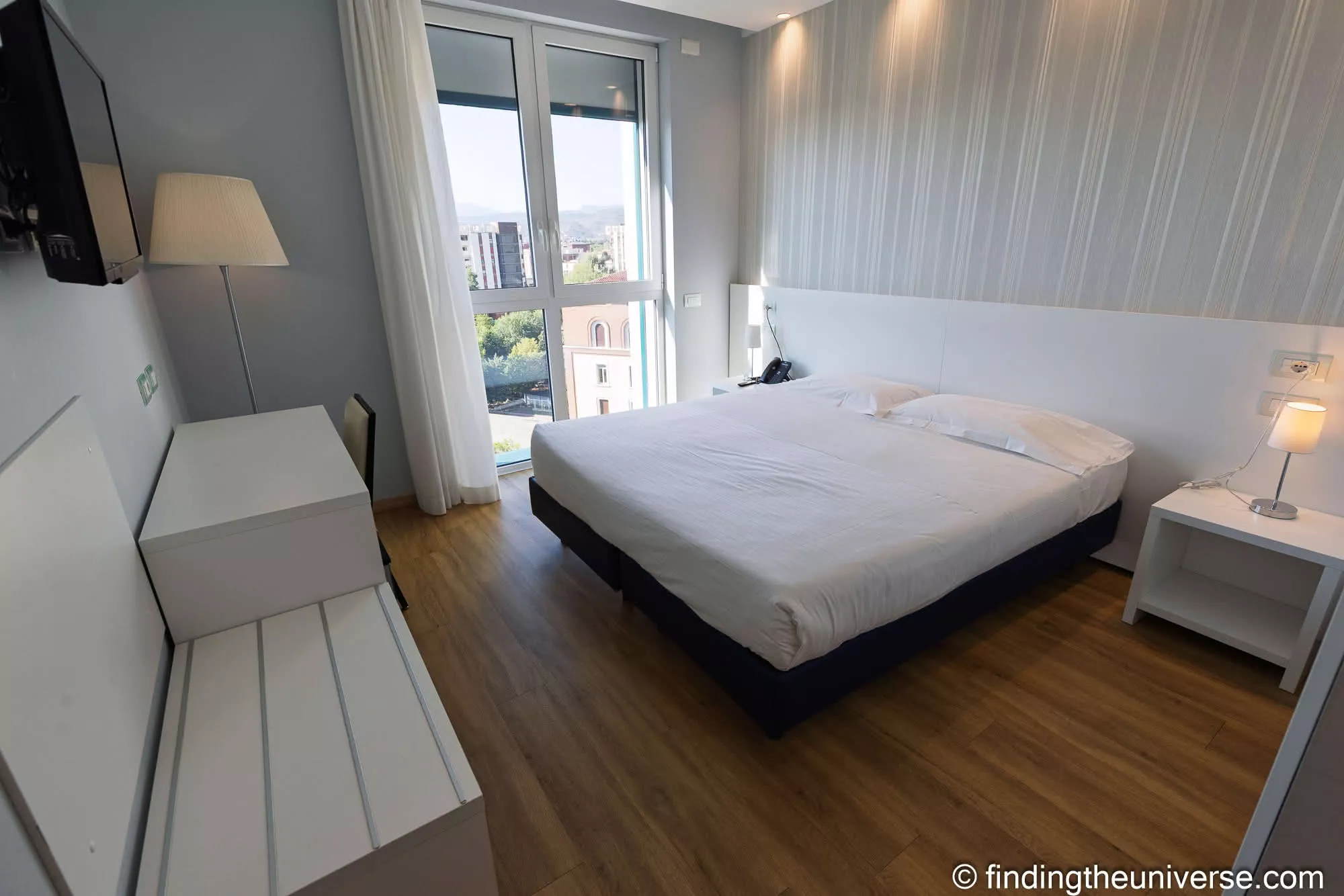
Novo Hotel Rossi is where we stayed. It’s a three-star hotel a couple of minutes’ walk from Verona Porta Nuova station, with clean rooms, a fine continental breakfast, and free bike rental that we did not use but quite admired.
It’s about a fifteen-minute walk to Piazza Bra and the Arena. The rooms are not spectacular, there’s a cheerful sort of nothing about them, but every other practical thing was exactly what we wanted on a no-car rail trip. We’d book again for a similar trip.
Luxury Inside the Walls
If you have the budget and want to be in the historic centre, three properties stand out:
Due Torri Hotel is Verona’s best-known five-star. It sits next to Sant’Anastasia, five minutes from Juliet’s House, with period furnishings, an Art Nouveau restaurant, and a panoramic terrace that earns its name. The hotel is the classic luxury anchor of the city and reads like a piece of history in its own right.
Hotel Gabbia d’Oro sits on a corner of Piazza delle Erbe, in an 18th-century building with wooden ceilings, frescoes, and proper period furnishings. It has eighteen rooms (so it feels much more like a private mansion than a hotel) and a winter-garden lounge called the Orangerie. The atmosphere is opulent in a quiet, old-Verona way.
NH Collection Palazzo Verona is the contemporary alternative, a 14th-century palazzo on Corso Porta Borsari, with Roman ruins visible in the basement, but rooms that are clean-lined and modern. If you want luxury but find the period-furniture thing oppressive, this is your pick.
Mid-range Centro Storico
Corte Realdi Suites Piazza Erbe is twelve suites spread across historic buildings overlooking Piazza Erbe, including in the UNESCO-listed Casa Mazzanti. They give you Italian breakfast, Prosecco on arrival, kitchens, and jetted tubs. The Booking rating sits around 9.3, which is unusually high. This is what we’d book at the mid-range tier if we were going back as a treat rather than a rail trip.
Albergo Mazzanti is a three-star superior sandwiched between Piazza delle Erbe and Piazza dei Signori, with sixteen rooms across two floors and a 9.0 Booking rating. It’s about 250 metres from Juliet’s House and 500 metres from the Arena. Excellent location, good breakfast, no nonsense.
Self-Catering Alternative
If you’d rather have an apartment than a hotel, which can be the sensible choice for families, longer stays, or if you’d like to do an aperitivo on your own terrace, Plum Guide’s Verona collection is worth a look. Plum Guide curate the top 3% of vacation rentals in their cities, which is a useful filter when the alternative is doom-scrolling Airbnb listings.
Getting to Verona and Getting Around
Verona Porta Nuova is the main train station, about a fifteen-minute walk south of Piazza Bra and the Arena. It’s well-served by direct trains from across northern Italy. From Milan, the fast Frecciarossa trains do the run in about an hour and twenty; from Venice in about an hour and a quarter; from Bologna in about an hour; from Rome in about three hours. We book European train travel through Trainline, which compares fares across the Italian operators (Trenitalia and Italo) in one search and handles the booking in English. If you’re flexible on dates, the regional trains are cheaper but slower.
Once you’re in the centre, walk. We can’t stress enough how walkable Verona is, the historic core inside the walls is about a kilometre and a half across at its widest point, and you’ll cover the whole thing comfortably on foot. The ATV public bus network handles connections to outlying areas, and the Verona Card includes free unlimited use if you do end up buying one. Taxis exist and are easily flagged at piazzas, but you won’t need one for this itinerary.
Verona airport (Valerio Catullo, code VRN) is about fifteen minutes from the centre via the 199 Airlink shuttle bus (€7, runs every 20 minutes to Porta Nuova station). Most visitors will fly into Milan, Bergamo, or Venice and train in.

When to Visit and What to Expect
Verona is busy from late May through mid-September, with the peak being July and August during opera season. It’s the right trade-off if you want to see an Arena performance; it’s a hot, crowded trade-off if you don’t. August temperatures regularly hit 30°C+ during the day, and the limestone of the piazzas radiates heat well into the evening. We visited in August 2022 and broadly loved it, but we were drinking a lot of water and finding shade by mid-afternoon.
Spring (April to early June) and early autumn (mid-September to October) are the best windows for a non-opera visit: warm enough for outdoor aperitivo, not punishingly hot, and the crowds back off a bit once the opera season closes. Winter is quiet and cold; the city has a Christmas market that’s worth visiting if you’re in northern Italy in December, but most outdoor activities are weather-dependent.
The Arena Opera Festival 2026 runs from 12 June to 12 September. If you want to see a specific production, book early, the Zeffirelli classics in particular sell out months in advance, and check the official Arena schedule before locking in dates.
What We’ve Learned About Visiting Verona
A few hard-won notes from our trip that we wish someone had told us:
Rent the opera cushions. We’re not making the same mistake again. They’re not expensive, they’re sold by vendors right at the entrance, and stone seats for three-plus hours of opera are a different proposition from stone seats for fifteen minutes of sightseeing. Bring a layer too, the temperature drops once the sun goes down, even in August.
Show up at the Arena when it opens. The morning queues are short, the light inside is best, and you’ll have the upper tiers nearly to yourself for the first half-hour. By 11 am the tour groups arrive and the whole experience changes.
Work out which ticket suits your priorities before you book. The Verona Card pays for itself the moment you tour the daytime Arena and at least two of the city’s paid museums. If you’re seeing an opera in the evening and using daytime hours for churches and walking, the Four Historic Churches ticket plus à la carte attractions almost always works out cheaper. The decision depends on a few specific stops; we’ve broken the math down higher up in this article.
Castelvecchio rewards an early Day 2 start. It’s not on most weekend visitors’ radar, which means it’s also rarely crowded, but it does open later (10 am) than most attractions, so plan your morning around that.
Restaurants get fully booked in opera season. If you’re visiting between mid-June and mid-September, book lunch and dinner reservations a few days ahead, especially for the popular places near the Arena and Castelvecchio. We learned this on our first day.
Don’t try to do Lake Garda or Valpolicella in two days. It will not work. Pick one or the other, and give it the proper time on a different trip.
Photography Tips for Verona
This section is mine, and I’ll caveat upfront: two days in August with a single camera isn’t enough to claim definitive knowledge of a city’s photography. With that out of the way:
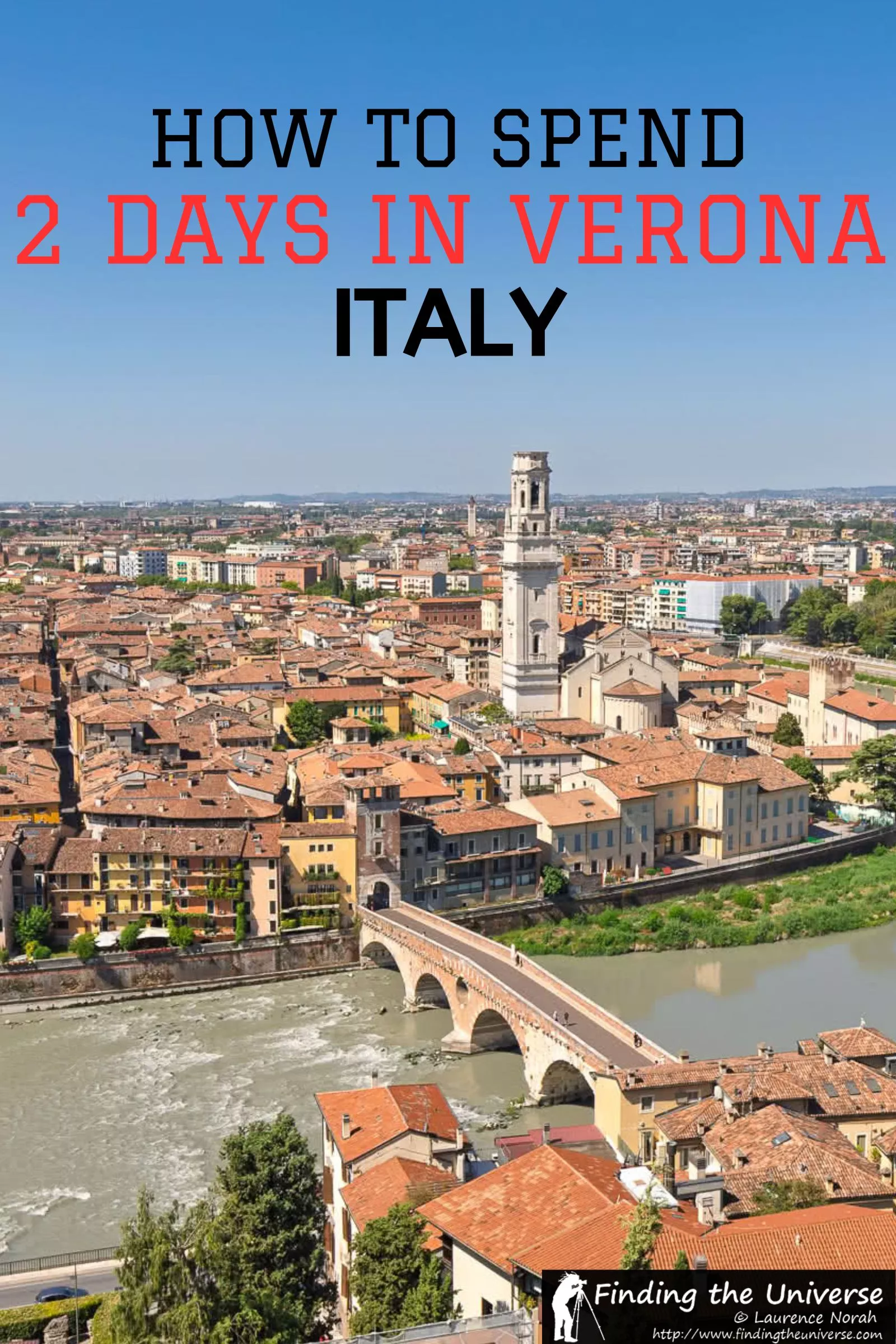
Castel San Pietro at sunset is the most-shot view in Verona for good reason. The hilltop gives you a clean line down the Adige with Ponte Pietra in the foreground, the cathedral spire to the right, and red rooftops layered into the distance. I shot mine in the wrong direction (north, at midday, when we were up there during Day 2) and was kicking myself by Day 3. Go up in the hour before sunset, bring a longish lens (70-200mm is plenty), and shoot the bridge from the upper terrace.
The Arena interior is much harder than it looks. The bowl is enormous, the upper tiers are bright while the lower tiers are in shade, and the dynamic range is brutal during the day. Shoot during opera-performance setup if you can, the production lighting balances the contrast and gives you the venue’s photogenic version. If you’re shooting from the upper tier, a wider lens (24-70mm range) handles the scale.
Piazza delle Erbe is the city’s best Instagram square. The painted Casa Mazzanti façade lights up beautifully in late afternoon, the market umbrellas add foreground colour, and the Madonna Verona fountain anchors the middle of the frame. Don’t be afraid to shoot tighter than your instinct suggests; the wide shot rarely works as well as a tighter composition that picks out two or three architectural details.
Bronze doors of San Zeno Maggiore. Bring a longer lens for the relief panels (85-135mm range is right) and bracket for the contrast between the dark bronze and any bright sky behind. The doors face roughly west, so they catch decent light in the afternoon.
If you want to seriously up your travel-photography game beyond the basics, my online travel photography course goes deep on this kind of thing.
Frequently Asked Questions
Is 2 days enough in Verona?
Yes, comfortably. Two days lets you cover the Arena, the Romeo and Juliet circuit, the major piazzas, Castelvecchio, San Zeno, and Giardino Giusti without rushing. Three days would let you add Lake Garda or Valpolicella; one day means cutting at least one of Day 2’s substantive sights, which we wouldn’t recommend.
Is Verona worth visiting?
Yes. It’s one of the most rewarding small cities in northern Italy, combines Roman, medieval, and Renaissance architecture in a walkable centre, and offers something properly distinctive in the summer opera season. We’d rate it alongside Bologna in the “second-tier Italian cities that beat their reputation” bracket.
Should I buy the Verona Card?
That comes down to how you’ll spend your daytime hours. The Card pays for itself the moment you do the daytime Arena tour plus two paid museums (€32 covers it). If you’re seeing an opera in the evening instead and using your daytime hours for churches and walking, the €8 Four Historic Churches ticket via Chiese Vive plus à la carte Castelvecchio comes out cheaper. The math is fully broken down higher up in this article. If you do want the Card with an audio guide, the GetYourGuide version is three euros more but includes commentary for the city centre and Lake Garda, usually worth it.
Can I see an opera at the Arena di Verona?
Yes, during the summer opera season (mid-June to mid-September). The 2026 season runs 12 June to 12 September with productions of La Traviata, Aida, Nabucco, La Bohème, and Turandot. Tickets via arena.it or via GetYourGuide for combo Arena-plus-priority-entry options.
How much does the Arena opera cost?
Numbered stone seats in the upper tier (Gradinata Numerata Settore VI, which is what we sat in) start around €30 for standard performances, climbing to €38 for premiere nights. Reserved seats with proper backs (Poltronissima, in the stalls) run €165 to €230 standard, with the platinum tier reaching €265 to €365 for premiere productions. Check the official Arena rates page for current numbers, since they vary by production and day.
When is the Arena di Verona opera season?
The festival runs each summer from mid-June through mid-September. For 2026 specifically, the dates are 12 June to 12 September. Performances are typically every Tuesday to Sunday during the season, with the major productions rotating night by night.
Is Juliet’s House worth visiting?
The courtyard is free and worth a five-minute look. The museum and balcony cost extra (€12 online-only as of April 2026) and are skippable for most visitors. The literary connection is a 20th-century construction rather than a historical site, but the courtyard is lovely and the photo of the bronze statue is one of the city’s signatures. We took photos in the courtyard and skipped the rest.
Can you day-trip to Lake Garda from Verona?
Yes, Peschiera del Garda is about fifteen minutes by train from Verona Porta Nuova, and connects to ferries across the lake. The Sirmione + Lake Garda boat trip from Verona sorts the logistics if you’d rather not DIY. That said, we don’t recommend doing Garda on a 2-day Verona trip, there’s enough in Verona to fill both days. Save it for a longer trip or a separate base.
What’s the best time of year to visit Verona?
Late April to early June, or mid-September to mid-October, are the best windows for a non-opera visit: warm enough for outdoor activities, not punishingly hot, and crowds are manageable. July and August are peak opera season and peak heat. Winter is quiet and atmospheric but most outdoor experiences are weather-dependent.
Is Verona better than Venice or Milan?
It’s not really a competition, they’re different. Venice is unique and unmissable (we covered it in our 2 days in Venice itinerary); Milan is the business and shopping hub with serious culture (see our 2 days in Milan itinerary and what to do in Milan); Verona is the small-but-substantive Roman-and-medieval city that pairs well with either. If you’re doing a northern Italy trip we’d recommend all three, see our 10-day Italy itinerary for one way to combine them.
Planning Resources
If you’re planning a wider Italy trip, we travel with the Rick Steves Italy guidebook, current edition is the 28th, published June 2025. It’s Jess’s favourite travel guide brand, and we don’t tend to leave home for Italy without it. There’s something about a well-written physical book that still earns its place in our luggage even in the era of every-app-on-your-phone.
Pair the guidebook with this itinerary, the Chiese Vive site for the churches, arena.it for opera tickets, and you’ve got everything you need to plan a Verona weekend.
And if Verona’s whetting your appetite for more northern Italy, here’s what we’d point you to next: our 2 days in Venice itinerary, 10-day Italy itinerary, and 2-day Rome itinerary are good places to start.
Safe travels, and if you do go to the opera, please rent the cushions.
Dana says
Fabulous! We will go for sure 🙂
Laurence Norah says
Enjoy, let me know if you have any questions when you do!