
Quick answer: After years of travelling full-time and working our way through more travel adapters than we can count, our pick for most travellers is the EPICKA Universal, a reliable GaN all-rounder with three USB-C ports that covers over 200 countries. If you want to charge a laptop straight from the adapter, step up to the EPICKA TA-105 Max (75W). If you’re based in the UK or Europe and want the safest grounded option, the MyTravelPal Pro is the one we travel with. And if you’re heading to South Africa, you’ll need a Type M adapter, as most “universal” models skip it.
We travel full-time, and between us we’re usually carrying two phones, a laptop, a couple of cameras, a drone, various chargers, and whatever other gadgets have found their way into our bags. When a socket is out of reach, a good travel power bank keeps everything topped up. Keeping all of that charged across different countries, with different plug types and different voltage standards, is something we’ve had to figure out through a lot of trial and error.
Over the years we’ve owned more travel adapters than I can count. Some have been brilliant. Others have melted (literally, in one case), fallen apart, or turned out to be incompatible with the one country we actually needed them for. A friend of ours borrowed one of our adapters for a trip to Italy and, despite our warnings, plugged her American hair dryer straight into the wall. She destroyed both the adapter and the hair dryer in about three seconds flat.
So I’ve put together this guide to what we think are the best travel adapters available right now, along with everything you need to know to choose the right one. I’ll cover what to look for, which plug types you’ll encounter around the world, and the important difference between a travel adapter and a voltage converter.
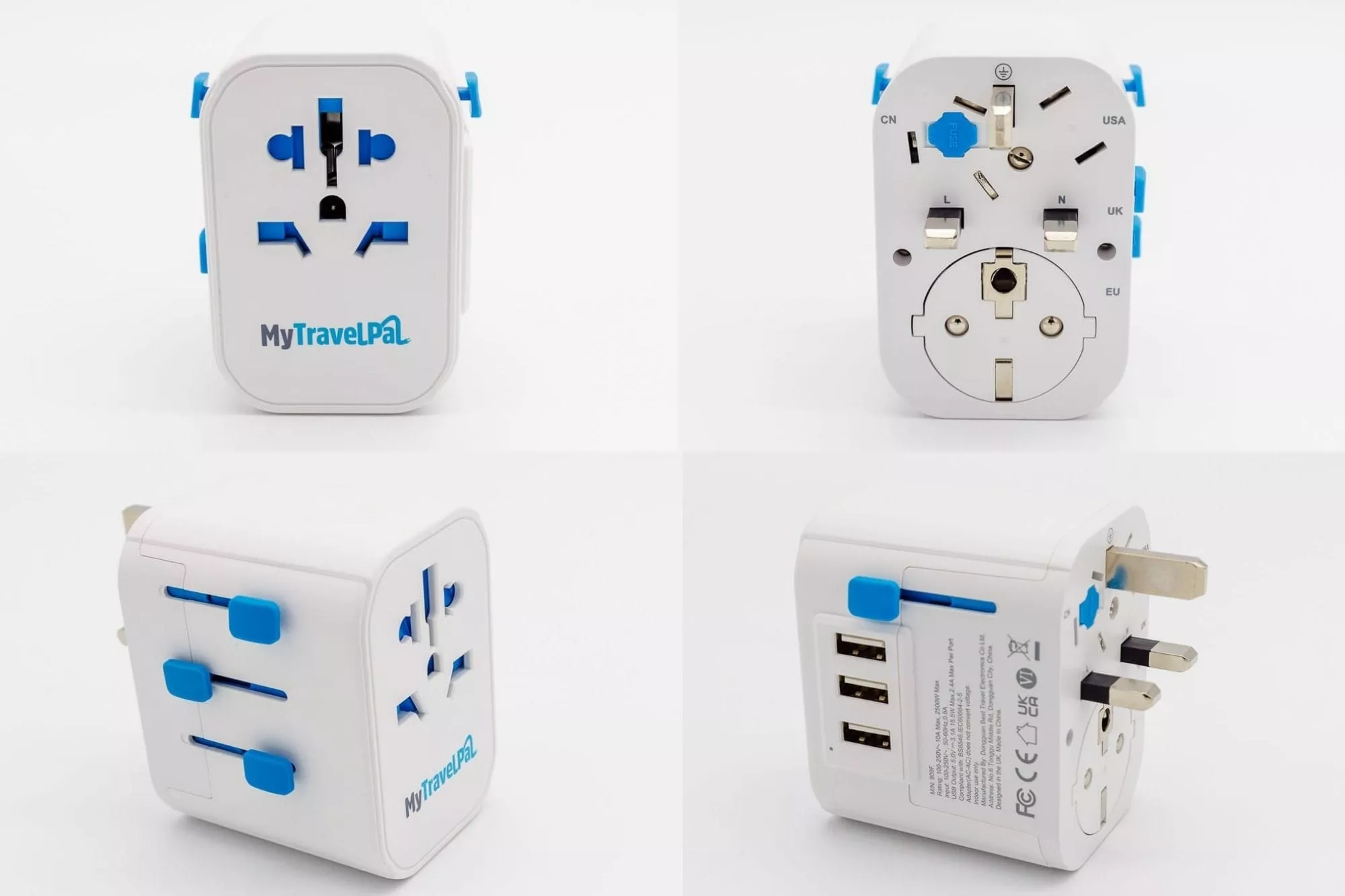
Table of Contents:
What Is a Travel Adapter and Why Do You Need One?
A travel adapter is a small device that lets you plug your electrical devices into wall sockets in countries that use a different plug shape from your own. That’s all it does. It changes the physical shape of the plug so it fits the socket.
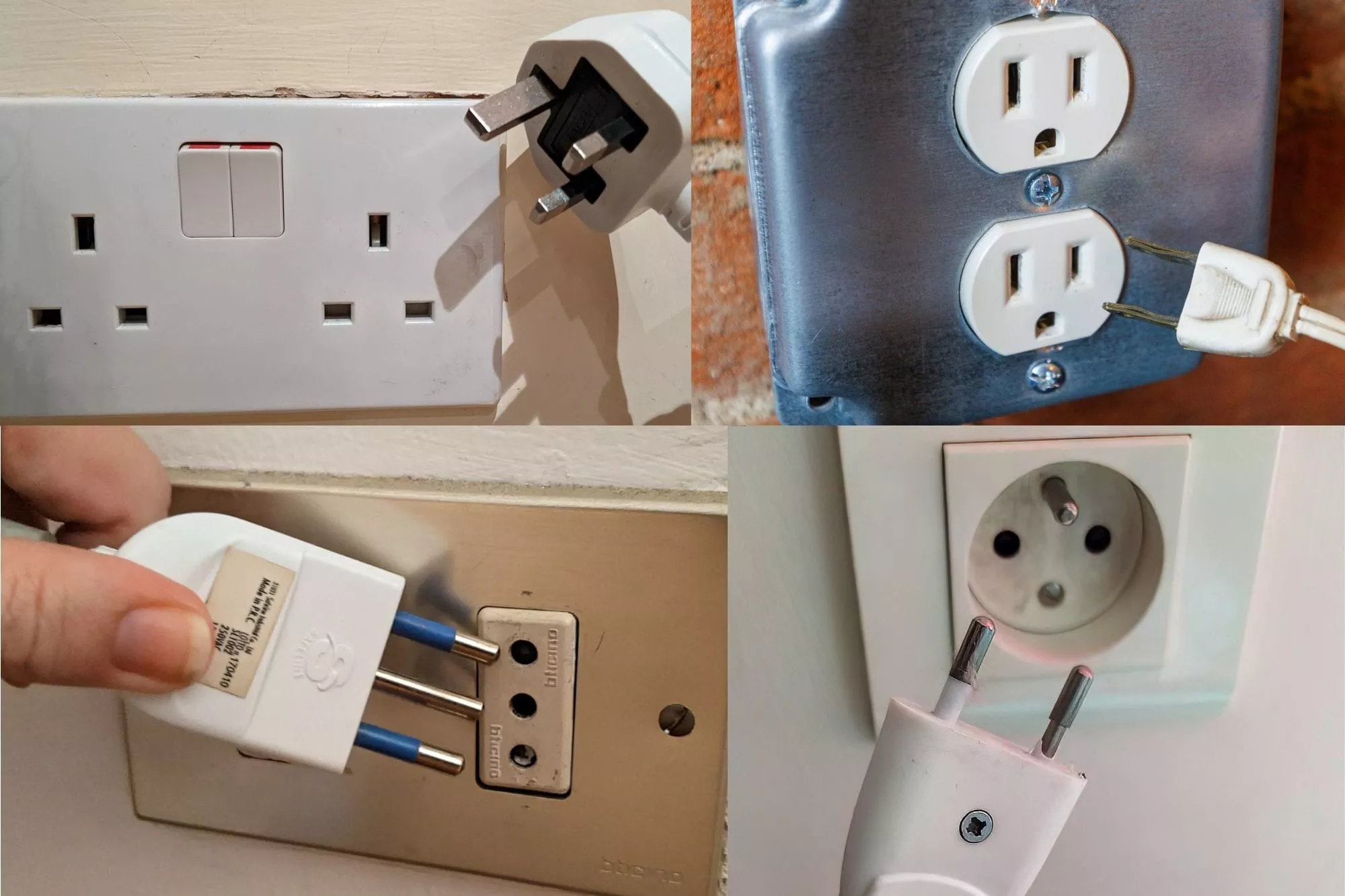
There are 14 different plug types used around the world, categorised as Type A through Type N. You can check which plug type any country uses on this IEC website, and I’d recommend doing so before every trip.
Here’s a quick example. If you’re travelling from the US to the UK, your flat-pronged Type A or Type B plug won’t fit into a British Type G socket (the one with three rectangular prongs). A travel adapter bridges that gap. You plug your device into the adapter, then plug the adapter into the wall.
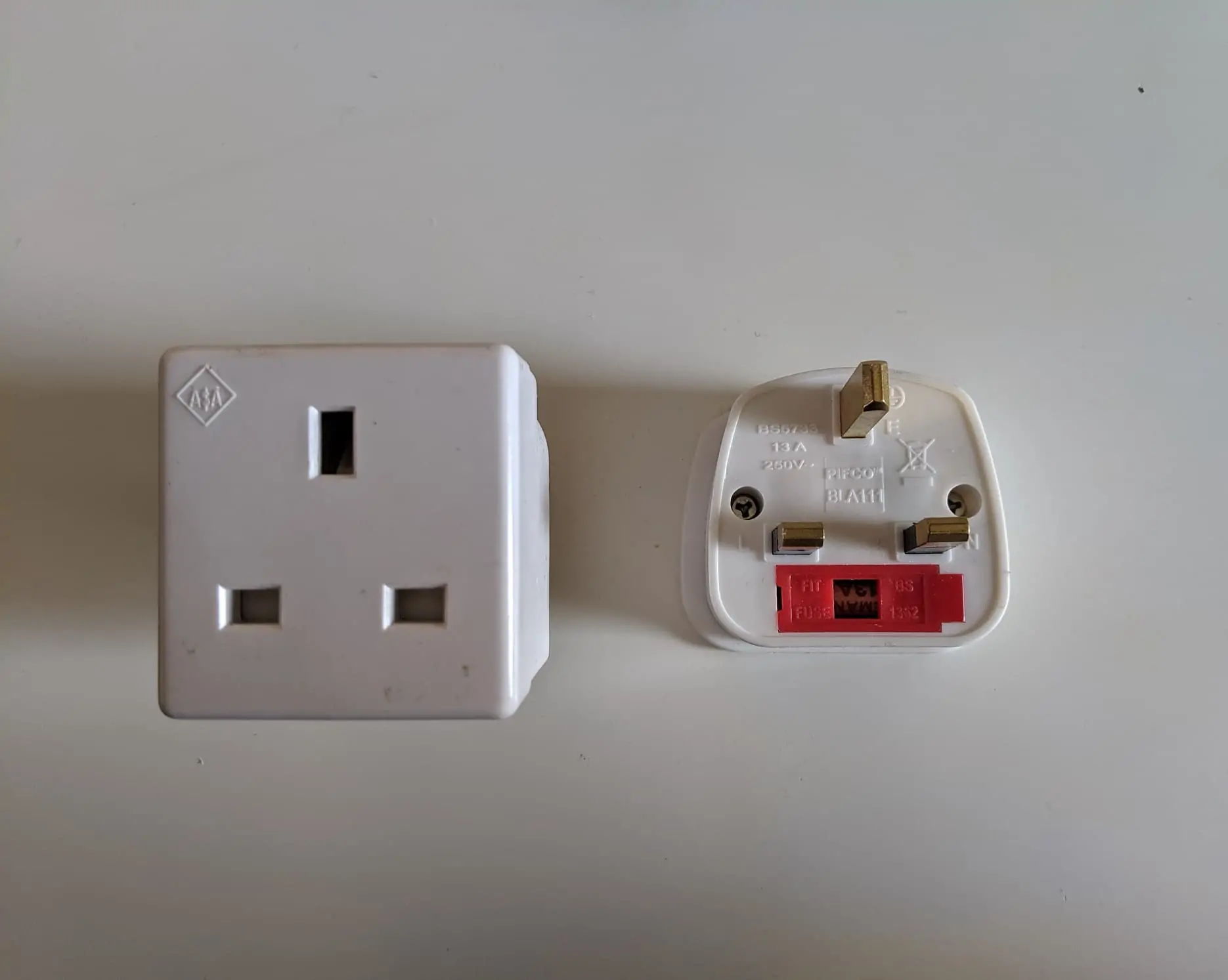
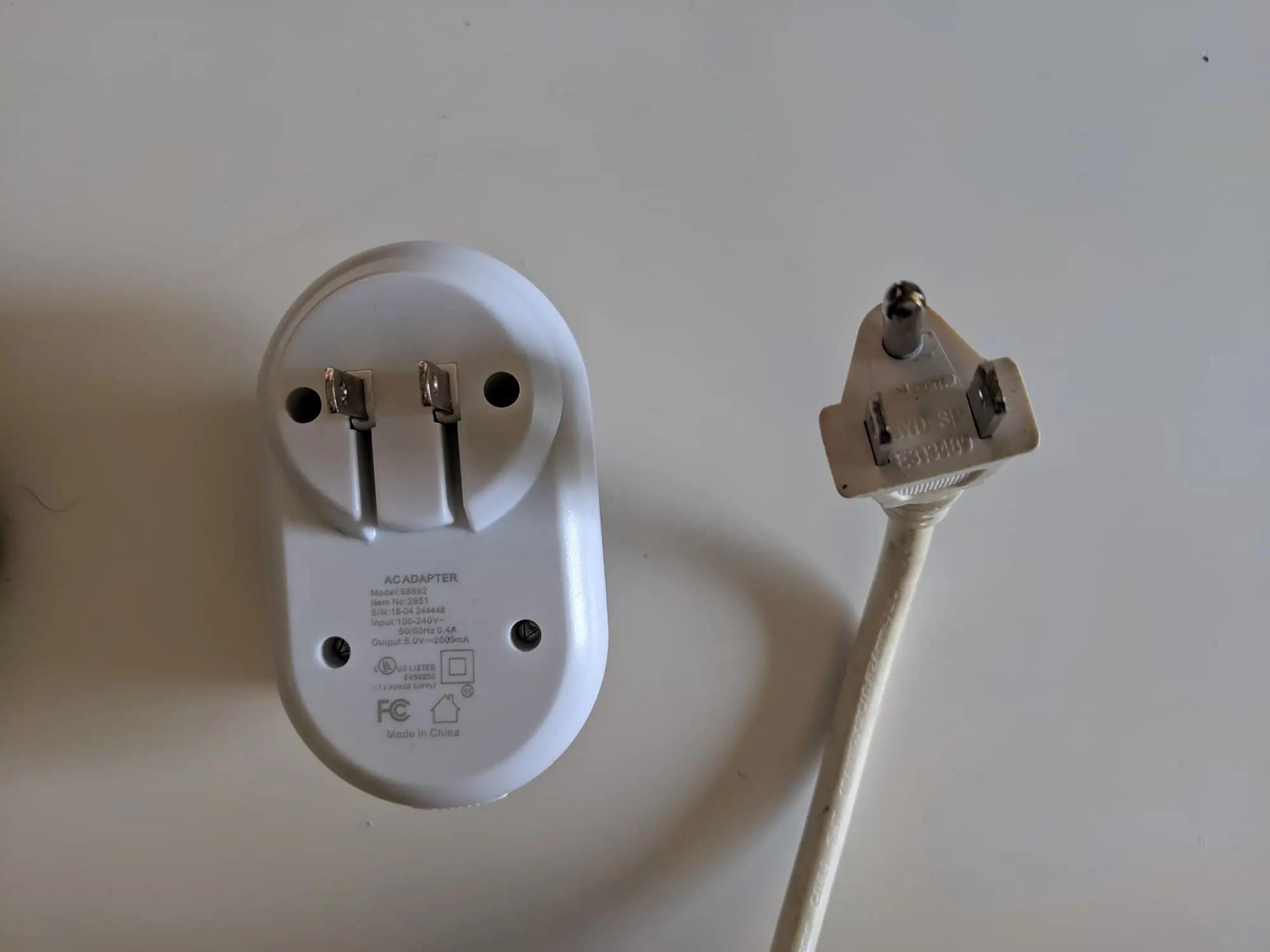
The key thing to understand is that most travel adapters do not convert voltage. I’m going to say this several times in this article because it’s that important. A standard travel adapter only changes the plug shape. If you need voltage conversion as well, you’ll need a specific product designed for that, and I’ve included one in my recommendations below.
World Plug Types by Country
Here’s a quick overview of plug types for some of the most popular travel destinations:
- USA, Canada, Mexico and Japan: Type A and B
- Most of Europe (excluding UK): Type C, E and F
- UK, Ireland, and many Middle Eastern and East African countries: Type G
- Italy: Type C and L
- Australia, New Zealand and China: Type I
- India, Pakistan and Bangladesh: Type D
- South Africa and Botswana: Type M
- Switzerland: Type C and J
There are plenty more, but that covers the majority of popular destinations. Always check before you go, because turning up without the right adapter is not a fun way to start a trip.
Voltage: The Thing Most People Forget About
The shape of the outlet isn’t the only thing that varies between countries. Voltage standards are different too. North America runs on 110-120V, while Europe and most of the rest of the world use 220-240V. Plugging a device rated for 110V into a 220V outlet won’t just fail to work. It can overheat, catch fire, or destroy the device entirely. I mentioned our friend and her hair dryer earlier. That’s exactly what happened.
The good news is that most modern electronics handle this automatically. Laptops, phone chargers, camera battery chargers, and tablets are almost always rated for 100-240V input, which means they’ll work anywhere in the world with just a plug adapter.
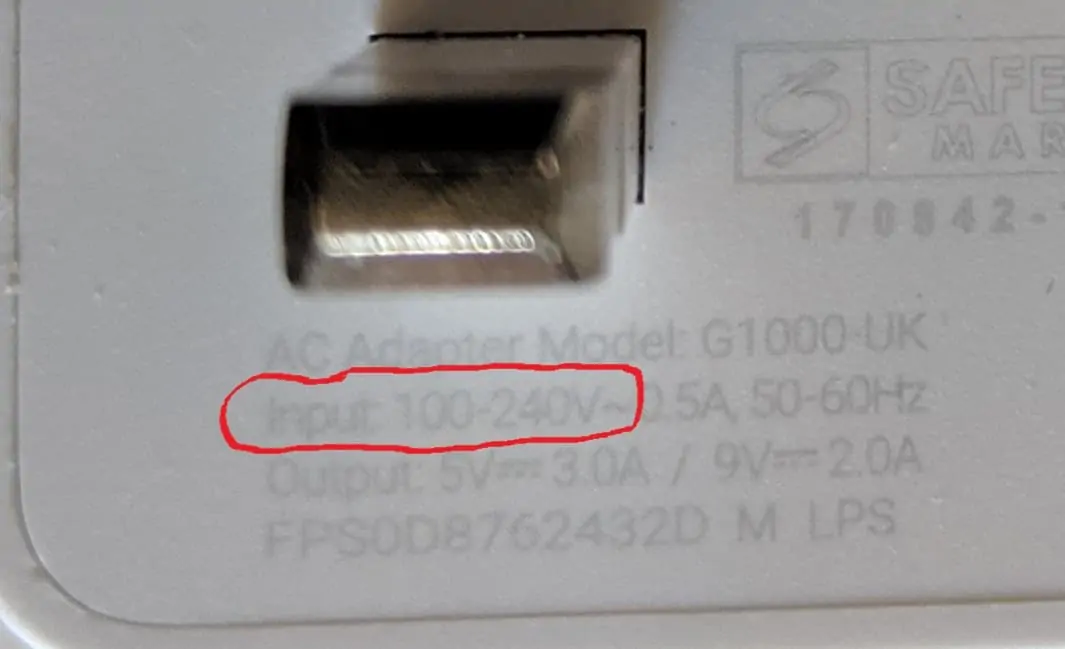
You can check this by looking at the small print on your charger or power brick. If it says “Input: 100-240V, 50/60Hz”, you’re fine. Just remember to check this is at home before you pack, not in your hotel room in Rome at 11pm after you’ve just gotten out of the shower.
The devices that cause problems are high-powered appliances like hair dryers, straighteners, curling irons, and electric kettles. These are often rated for only one voltage. If you must travel with your favourite hair dryer, you have two options: buy a dual-voltage travel version of it, or use a dedicated voltage converter (I’ve recommended one below). Don’t just assume your adapter will sort it out, because it won’t.
What to Look For in a Travel Adapter
Not all travel adapters are the same, and buying the wrong one can be frustrating at best and dangerous at worst. Here’s what I look for after years of buying and testing these things.
Country Compatibility
First and most obviously, check that the adapter works in the countries you’re visiting. Many adapters bill themselves as “universal”, which usually means they cover Type A, B, C, E, F, G, and I sockets. That gets you through North America, most of Europe, the UK, Australia and China.
But “universal” almost never includes Type D (India) or Type M (South Africa), so if you’re heading to those countries, you’ll need something specific.
USB Ports and Charging Speed
This is where the market has changed enormously in the last few years.
Older adapters came with a couple of USB-A ports that charged your phone at a glacial pace. Current models should have USB-C ports with at least 20W output for decent phone charging speed.
If you want to charge a laptop directly from the adapter’s USB-C port (which means you can leave your laptop power brick at home), look for one with 65W or higher USB-C PD (Power Delivery) output. This usually means the adapter uses GaN (Gallium Nitride) technology, which is more efficient and generates less heat.
Number of Ports and Outlets
Think about how many devices you actually need to charge at once. Jess and I typically need to charge two phones, a laptop, and at least one camera battery every evening. An adapter with one AC outlet and a few USB ports covers that nicely. A few newer models now include two AC outlets, which helps if you travel with a partner and both have mains devices to plug in. If you’re travelling solo with just a phone and a tablet, you can get away with something much simpler.
Safety Features
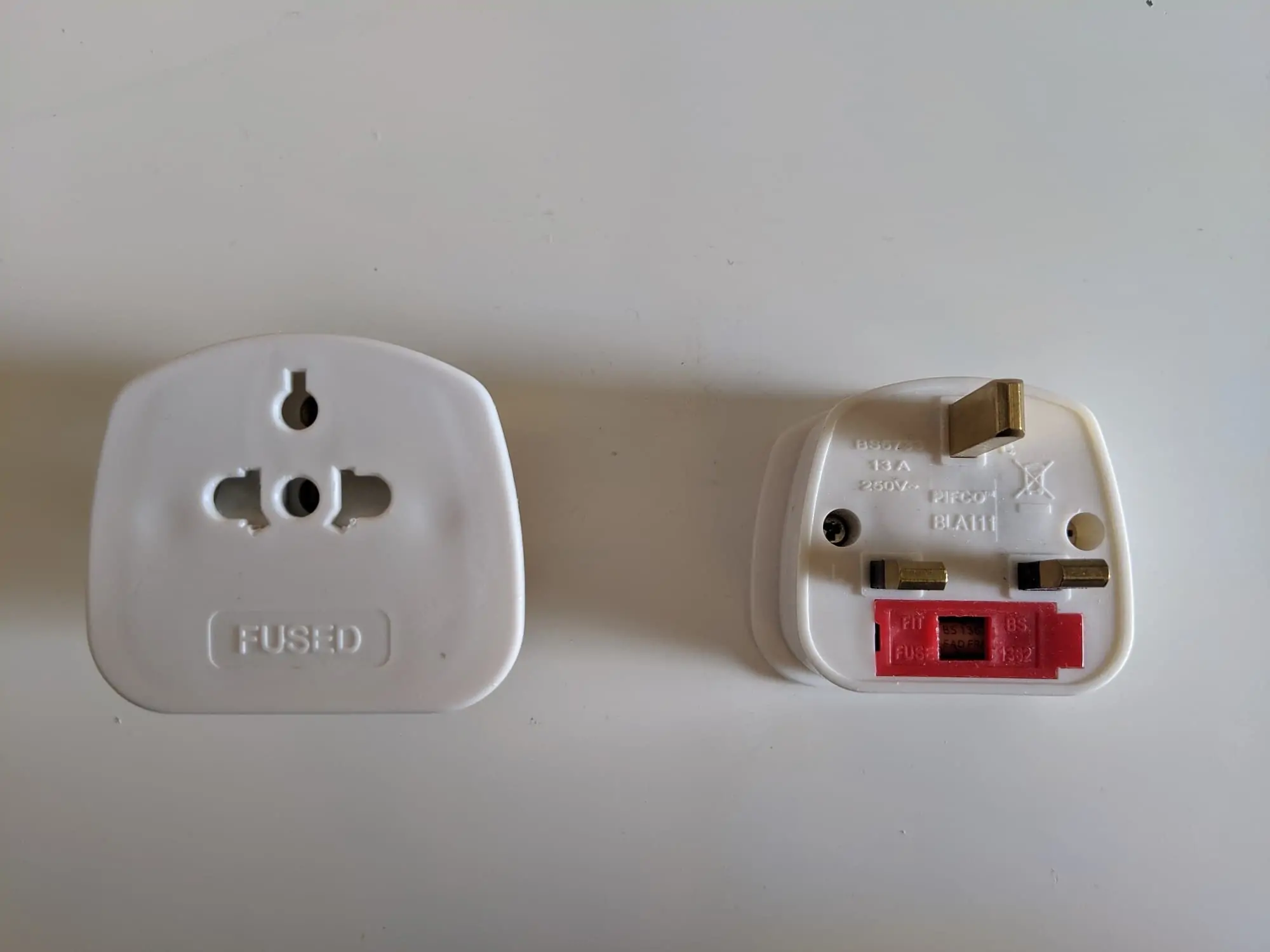
At a minimum, look for a built-in fuse and CE/FCC certification. Better adapters also include surge protection, safety shutters on the socket, and a grounded (earthed) connection. The grounding is particularly important if you’re plugging in a laptop or other device with a three-prong plug, because without it, you might notice a slight tingling when you touch a metal surface on the device. That’s current leaking through the ungrounded chassis, and while it’s usually not dangerous, it’s not ideal.
The gold standard for safety is BS8546 certification, a British standard specifically written for travel adapters. Only a handful of adapters on the market meet it, and I’ve noted which ones do in the recommendations below.
Size and Weight
Travel adapters range from tiny single-purpose plugs that weigh almost nothing to chunky multi-port devices that take up real space in your bag. There’s a trade-off between features and portability, and the best pick is really about how you travel. I tend to carry one good multi-port adapter plus a couple of cheap basic ones as backup.
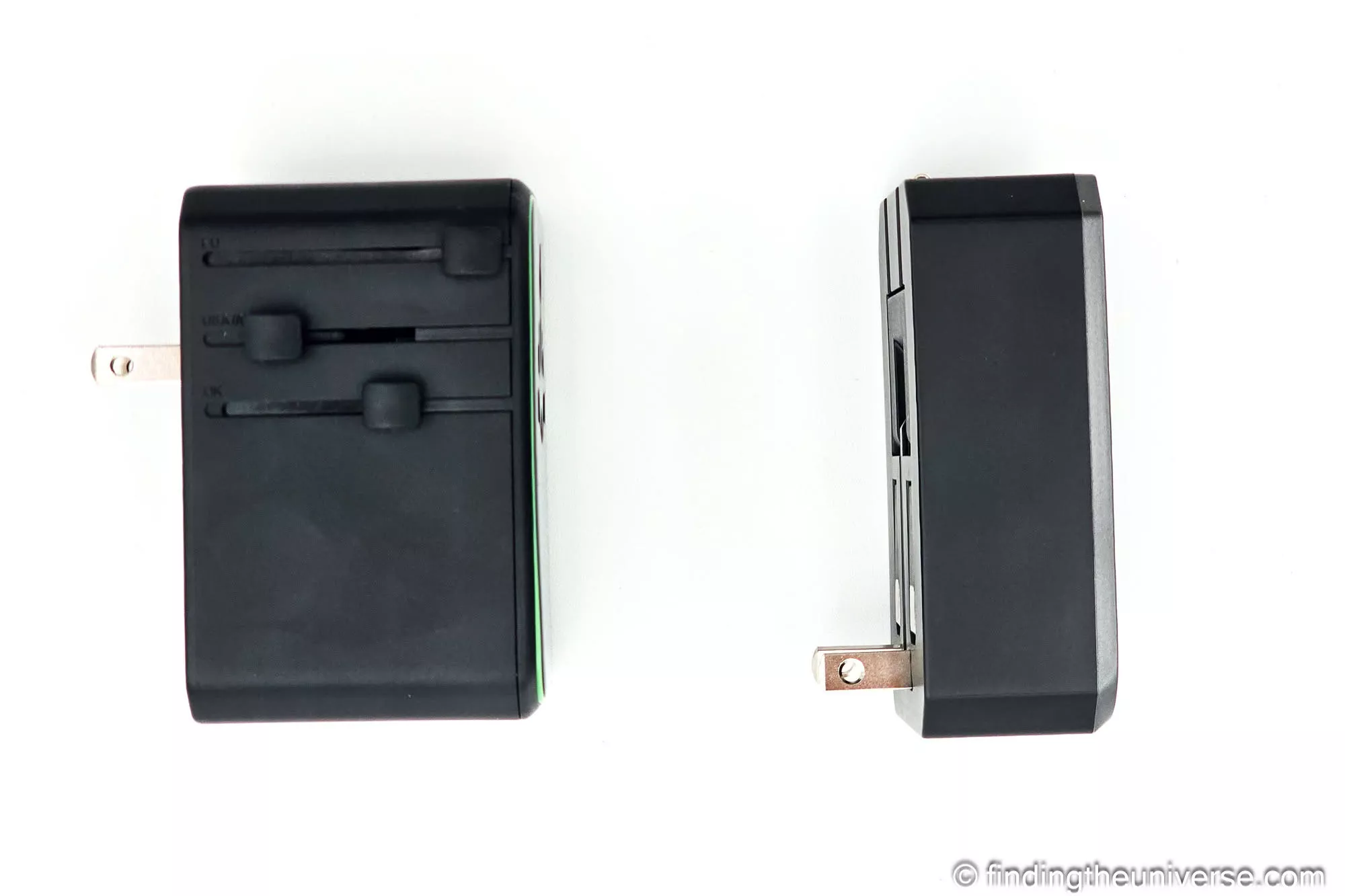
Here’s the trade-off in the flesh. The EPICKA Pulse Duo, with its slide-out plugs, weighs 259g and packs in two AC outlets and a screen. Beside it, the Air 65W is 149g and about as slim as a universal adapter gets, but its AC socket won’t take a UK plug.
The Best Travel Adapters
Here are our picks for the best travel adapters you can buy right now. We own or have tested products from every brand on this list, and I’ve organised them by use case to make it easier to find what you need.
Best All-Rounder: EPICKA Universal
We’ve owned various EPICKA adapters over the years, and they’ve always been solid performers for the price. This is their current model, and it’s the adapter I’d recommend if you want something reliable without spending too much.

It has three USB-C ports and two USB-A ports alongside a universal AC outlet, and it covers over 200 countries with four slide-out plug types. The adapter uses GaN technology to deliver fast charging at up to 45W across the USB ports, with support for both PD and QC.
It has a 10A fuse, safety shutters, and a plug lock system that prevents the prongs from retracting while you’re using them (a small but useful feature). It’s CE and FCC certified, comes with spare fuses, and EPICKA offer a two-year warranty. Like most adapters in this price range, it’s not grounded and doesn’t convert voltage.
This one doesn’t have surge protection, and it has a single AC socket. If you’re cruising, that combination matters more than you’d think, though not for the reason most sites give. I’ve been through what the major lines actually publish and there’s a section on it further down.
Key features: 3x USB-C, 2x USB-A, 1x AC outlet. GaN, 45W fast charging. 10A fuse. Safety shutters. Plug lock. 200+ countries. Not grounded.
Price: Check price
Best for Laptop Charging: EPICKA TA-105 Max
If you travel with a USB-C laptop and want to leave the power brick at home, this is the EPICKA to look at. It steps up from our all-rounder pick to 75W of GaN fast charging, and a single USB-C port delivers up to 67W on its own. That’s enough to charge a MacBook Air, most ultrabooks, and many other USB-C laptops directly. EPICKA makes our top pick too, and their adapters have been dependable for us over the years, so the Max is an easy one to recommend when laptop charging is the priority.

It has three USB-C ports and two USB-A ports alongside a universal AC outlet, and like the rest of EPICKA’s range it covers over 200 countries with four slide-out plug types. All five USB ports handle PD and QC fast charging, and the GaN design keeps everything compact despite the extra power. The safety side mirrors our top pick: a 10A fuse with spares included, safety shutters, a plug lock, CE and FCC certification, and a two-year warranty. As with the all-rounder, it isn’t grounded and doesn’t convert voltage.
It costs more than the all-rounder, which is the trade-off for the higher wattage and the extra USB-C port. But if you want to charge a laptop and a handful of other devices from a single adapter, that’s what it’s built for.
If 75W is more than you need, or you’d rather spend less, the TESSAN Universal Travel Adapter is a pretty solid lower-cost alternative. You get 65W of USB-C charging rather than 75W and one fewer port (two USB-C and two USB-A), but it’s still GaN, covers the same plug types, and includes a 10A fuse with a spare, plus CE and FCC certification. For charging a single laptop, 65W is plenty.
Key features: 3x USB-C, 2x USB-A, 1x AC outlet. GaN, up to 75W fast charging. 10A fuse. Safety shutters. Plug lock. 200+ countries. Not grounded.
Price: Check price
Best Premium Option: EPICKA Pulse Duo 140W
The newest adapter in my bag, and yes, the third EPICKA on this list. They’re making the best universal adapters at the moment, and the Pulse Duo is their new flagship. It’s also the first universal adapter I’ve come across with a screen built in.

I assumed the screen would be a gimmick when I ordered it. Having used it, I’m a convert. You can cycle through readouts showing how much power each device is drawing, the adapter’s temperature, and what’s plugged in where. If your laptop is charging slowly, you can see the actual wattage and swap ports to fix it, rather than guessing.
A small detail I appreciate even more: the screen switches itself off after about a minute. I’m one of those people who can’t sleep with a light glowing in a hotel room, and charging gear is a repeat offender here, so a screen that goes dark on its own means this can stay plugged in by the bed overnight.
The other rarity is two AC outlets, one universal and one US-style. Almost every multi-port adapter gives you a single AC socket, so getting two is a big deal if you travel as a couple, or if you’re a photographer with a battery charger and a laptop brick competing for the same socket.
Power-wise, it’s a 140W GaN charger. Two of the three USB-C ports can each deliver up to 140W on their own, which is enough to fast-charge a 16-inch MacBook Pro, and there’s a 20W USB-C and an 18W USB-A alongside. It covers the same 200+ countries as the other EPICKAs and has the same two-year warranty. The safety side is familiar too: a replaceable 10A fuse with a spare included, plus CE and FCC certification.
You also get a little carry case and a USB-C to USB-C cable in the box. The cable is rated to 240W, comfortably more than the adapter can deliver, so it’s one less thing to buy or remember to pack, and the case keeps the whole kit together in your bag.
The trade-offs are price and bulk. At 259g it’s a chunky thing, and it costs about twice as much as the TA-105 Max. Like the other EPICKAs it isn’t grounded and doesn’t convert voltage. If you don’t care about the screen or the second outlet, the TA-105 Max is still the better value for laptop charging. But if you want the most capable universal adapter you can currently buy, this is it.
One thing to flag if you cruise: this is the only adapter here with two AC outlets, which puts it closest to the multi-outlet hardware some lines restrict. Have a read of the cruise section below before you pack it.
Key features: 3x USB-C (two at up to 140W each), 1x USB-A, 2x AC outlets. GaN, 140W total. Colour display with auto-off. 10A fuse with spare. 200+ countries. Not grounded.
Price: Check price
Best for Safety: MyTravelPal Pro (UK / Europe only)
We’ve also been using this travel adapter for several years now, and one we travel with regularly. The MyTravelPal Pro is one of the very few all-in-one travel adapters that meets the BS8546 safety standard, and it has a grounded connection on all four plug types, which most competitors skip.
It covers over 150 countries with support for plug types A, B, D, E, F, G, I, K and O. The 10A AC outlet means you can plug in high-powered devices like hair dryers and laptops without worry (assuming they’re compatible with the local voltage, of course). It also has a USB-C port and two USB-A ports for charging phones and smaller devices, plus a resettable fuse and surge protection.
It’s not the most feature-packed adapter on this list. It doesn’t have GaN fast charging or a 65W USB-C port. But for reliability, safety, and the confidence that it’ll work wherever we go, it’s been our favourite for a while. The carry case is a nice touch too.
One thing to be aware of: MyTravelPal is a UK-based brand and currently only ships to the UK and Europe. If you’re based in the US, you won’t be able to order this one easily. For US-based travellers who want a great all-round option, I’d go with the EPICKA Universal instead.
Key features: 1x USB-C, 2x USB-A, 1x 10A AC outlet. BS8546 certified. Surge protection. Resettable fuse. Grounded. 150+ countries.
Price: Check price (Amazon UK)
Best Compact Option: Anker Nano Travel Adapter (North America only)
If size is your top priority and you want something that’ll disappear into a pocket, the Anker Nano is impressively small. It’s about 43% smaller than traditional travel adapters and has foldable, retractable pins that keep it compact in your bag.
Despite the small size, it packs in five ports: two USB-C (one with 20W output), two USB-A, and one AC outlet. The 20W USB-C port will fast-charge an iPhone or similar phone, though it’s not powerful enough for laptop charging. It covers the major plug standards (US, EU, UK, AU) and has built-in temperature control that shuts it down if it overheats.

There are a couple of important limitations. The Anker Nano uses a two-pin design, which means it’s not grounded. And the AC socket only accepts US-style flat-prong plugs (Type A/B), so it’s really designed for American travellers heading abroad.
If you’re based in the UK or Europe and want to plug your own devices into the AC outlet, this isn’t the one for you. But for US-based travellers who primarily charge via USB and want something tiny, it’s excellent.
Key features: 2x USB-C (20W max), 2x USB-A, 1x AC outlet (US plugs only). Foldable pins. Temperature control. Compact. Not grounded.
Price: Check price
If you want that compactness without the US-only socket, the EPICKA Air 65W is worth a look. We weighed ours at 149g on our own scales, against 250g for the TA-105 Max and 259g for the Pulse Duo, so around 40% lighter than either of the two adapters here that can charge a laptop. It’s 1.19 inches deep against the TA-105 Max’s 2.2, which is the difference between a bulge in your packing cube and something that slides down the side of it.
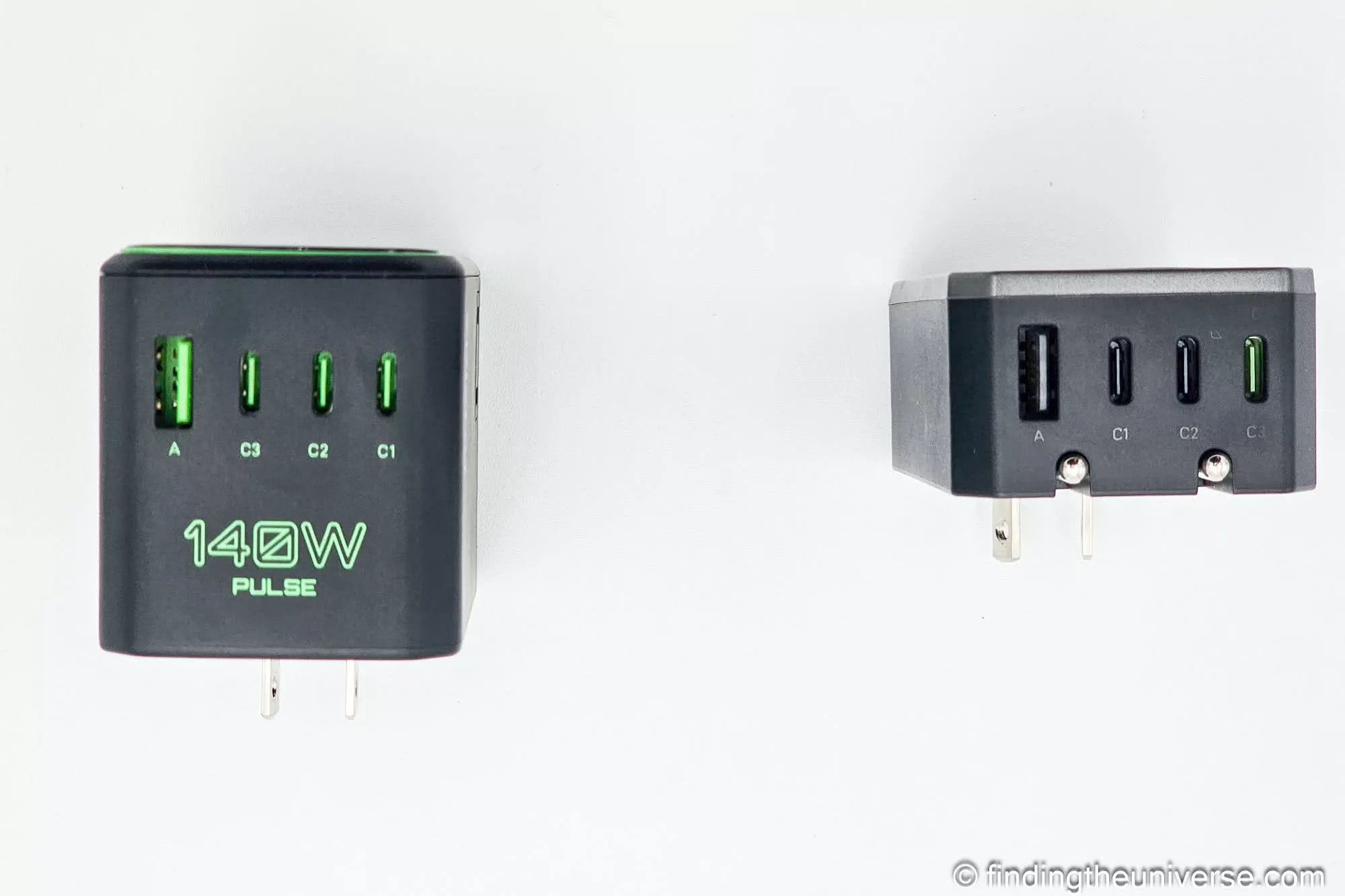
Power comes from a USB-C port rated at 65W on its own, dropping to 40W when you have several things plugged in at once, so a MacBook Air or most ultrabooks will charge from it without the brick. There are three USB-C ports and one USB-A alongside the AC socket, and the same four slide-out plugs as the rest of the EPICKA range, so no Type D for India or Type M for South Africa.
One caveat. The AC socket takes US and European plugs, not UK ones. Both US variants fit, the two-pin and the three-pin, and EPICKA’s own comparison chart on Amazon calls it a “US/EU socket” rather than a universal one, so it fixes the European half of the Anker’s limitation and leaves the British half where it was. Fly out of the UK with a Type G plug on your charger and you’ll be charging over USB.
It does have a fuse, even though nothing on the box or EPICKA’s website says so. We asked, and EPICKA confirmed a built-in 10A fuse, then sent through the internal diagram showing where it sits. The catch is that it’s sealed in. The Universal, the TA-105 Max and the Pulse Duo all take a fuse you can change yourself, with spares in the box, so on those a blown fuse means fitting a new fuse, where on the Air it means a new adapter. That still clears the safety minimum we set out above, a built-in fuse plus CE/FCC certification, and the box carries CE, FCC and VI marks. If you charge almost everything over USB and you’re counting grams, the Air is the one I’d pack.
Best for South Africa: Ceptics Type M Adapter with USB
Most “universal” travel adapters don’t include South Africa’s Type M plug, which catches a lot of travellers out. If you’re heading to South Africa, Botswana, or any other country that uses Type M, you’ll need something specific, and the Ceptics CTU-10L is a good solution.

It has one grounded socket that takes a standard American two-pin or three-pin plug, plus two USB-A ports sharing 2.4A. The relatively compact size makes it easy to pack alongside your main adapter. It’s CE certified and RoHS compliant, has a maximum load rating of 13A at 250V, and comes with a lifetime warranty.
It doesn’t have USB-C, surge protection, or any of the fancier features on the other adapters in this list. It’s a simple, functional adapter for a specific purpose, and for that purpose it works well. The input takes American plugs only, so it’s the right pick if you’re flying from the US and the wrong one if you’re coming from the UK or Europe.
Key features: 2x USB-A (2.4A shared), 1x grounded outlet. Type M output. CE certified, RoHS compliant. Lifetime warranty.
Price: Check price
Best Simple Adapter Set: Ceptics International Travel Plug 5-Piece Set
Sometimes simple is best. This set of five individual adapters covers most of the world, and because they’re separate pieces, you can just grab the one you need for your destination and leave the rest at home. Each one is small, light, and labelled with the region it’s for.

The set includes adapters for Type A, C, E/F, G, and I sockets, which covers most of Europe, the UK, the Middle East, Asia, North and South America, Australia, New Zealand, and parts of Africa. They accept two-pin input plugs only, so a US Type A or a European Type C plug fits, but a three-pin grounded Type B plug does not. If your charger has an earth pin, you need a grounded adapter instead.
There are no USB ports, no grounding, no surge protection, and no fuse. These are just plug shape converters, nothing more. But the warranty runs three years, they’re incredibly compact, and they come in a nylon zipper pouch. I keep a set of basic adapters like these as backup in our luggage at all times, because they weigh almost nothing and have saved us more than once when a fancier adapter had issues.
Key features: 5 individual adapters covering most of the world. Compact. Three year warranty. No USB. Not grounded, no surge protection.
Price: Check price
Best Voltage Converter: Ceptics 2000W Travel Voltage Converter (LX-C2000)
Remember my friend and her hair dryer? This is the product that would have saved her. The Ceptics LX-C2000 is a dedicated voltage converter that steps 220-240V down to 110-120V, and unlike most converters in this price range, it can actually handle a hair dryer.
It has a clever design with three separate outlets. There’s a dedicated 2000W outlet specifically for high-powered devices like hair dryers, and two standard 200W US outlets for lower-powered electronics like curling irons, straighteners, and electric toothbrushes. On top of that, it has three USB-A ports and a USB-C port with QC 3.0 fast charging, so you can charge phones and tablets at the same time. In total, you can connect up to seven devices.

The kit includes interchangeable plug attachments for Type A, B, C, E/F, G and I sockets, which covers most of Europe, the UK, Australia and Asia. It’s compact for what it does (about 5.9 x 3.3 x 1.4 inches) and comes with a 5-foot detachable cable and a carry pouch.
There are some important limitations to know about. The 2000W outlet works with traditional hair dryers that use mechanical controls (brands like Revlon, Conair, and Remington), but it will not work with digital or electronic hair dryers like Dyson or Shark FlexStyle.
If you have one of those, you’re out of luck with any portable voltage converter. Your best option in that case is to buy a dual-voltage travel hair dryer (this Conair is a well-reviewed option), or just use whatever the hotel provides. Dual-voltage hair driers are pretty cheap and while Jess definitely prefers to use her Dyson at home, the dual voltage model is a good stand-in for travel use only.
Safety features include a silent cooling fan to prevent overheating, and Ceptics say the USB ports have surge, short-circuit, and overload protection. The unit is CE certified and RoHS compliant, and Ceptics offer a 24-month warranty.
Key features: 1x 2000W hair dryer outlet, 2x 200W US outlets, 3x USB-A, 1x USB-C (QC 3.0). 220-240V to 110-120V conversion. Type A/B/C/E/F/G/I plug attachments included. Grounded.
Price: Check price
Quick Comparison
Here’s how our eight picks and the EPICKA Air compare at a glance:
| Adapter | Best for | Ports | Max charging | Countries | Grounded / safety |
|---|---|---|---|---|---|
| EPICKA Universal | All-rounder (most travellers) | 3x USB-C, 2x USB-A, 1x AC | 45W GaN | 200+ | No; 10A fuse, shutters, plug lock |
| EPICKA TA-105 Max | Laptop charging | 3x USB-C, 2x USB-A, 1x AC | 75W GaN (67W single port) | 200+ | No; 10A fuse, shutters, plug lock |
| EPICKA Pulse Duo 140W | Premium pick (display + two AC outlets) | 3x USB-C, 1x USB-A, 2x AC | 140W GaN (140W single port) | 200+ | No; 10A fuse + spare, temperature readout |
| MyTravelPal Pro | Safety (UK / Europe only) | 1x USB-C, 2x USB-A, 1x 10A AC | Standard USB | 150+ | Yes; BS8546, surge protection |
| Anker Nano | Compact (US travellers) | 2x USB-C (20W), 2x USB-A, 1x AC (US plugs) | 20W | US / EU / UK / AU | No; temperature control |
| EPICKA Air 65W | Lightest laptop charging (US / EU plugs) | 3x USB-C, 1x USB-A, 1x AC (US/EU plugs) | 65W (65W single port) | 200+ | No; 10A fuse (not replaceable), CE/FCC |
| Ceptics Type M | South Africa / Botswana | 2x USB-A (2.4A) | USB-A only | Type M (accepts A/B input) | One grounded outlet; CE/RoHS |
| Ceptics 5-Piece Set | Simple backup | None (plug only) | n/a | A/C/E/F/G/I | No; no fuse or surge protection |
| Ceptics LX-C2000 | 110V appliances in 220V countries | 3x USB-A, 1x USB-C (QC 3.0) | 220-240V to 110-120V converter | A/B/C/E/F/G/I | Yes; CE/RoHS, cooling fan, USB surge protection |
Travel Adapters and Cruises: What You Can Actually Take
If you’re cruising, the rule that matters is about form factor, not surge protection. What the policies name is power strips, extension cords and multi-outlet boxes, and surge protection is the deciding test at exactly one of the five major lines I read.
This guide used to say the opposite: that a lack of surge protection was a bonus on a cruise, because cruise lines confiscate adapters with surge protectors. That’s the line you’ll find on most sites, and it doesn’t survive contact with the policies.
Here’s what each of them publishes, as of August 2026:
| Cruise line | What its published policy restricts | The part that affects adapters |
|---|---|---|
| Royal Caribbean | Extension cords, power strips and multi-plug outlets, prohibited outright. Surge protection is not the test. | Its one electrical exception is “device and USB chargers marked with a recognized U.S. or European conformity certification” |
| Princess | Electrical devices with surge protectors, including multi plug box outlets/adaptors and power strips. | Non-surge equivalents are allowed, but only after inspection by the onboard electrical department |
| Carnival | Lists power strips, multi-outlet adapters and extension cords without surge protection among items generally permitted. | All of them “may be removed if deemed unsafe” |
| MSC | Electrical extension cords, unless approved via its accessibility and medical requests form. Surge protection is not mentioned anywhere. | Outlet adapters can be requested from the Information Office once you’re onboard |
| Norwegian | Its prohibited items list doesn’t mention power strips, extension cords or adapters at all. | Nothing published either way, so don’t read that as permission |
None of these five prohibited-items lists names a travel plug adapter. Not one. The restrictions are aimed at the hardware that turns one socket into six, which is a different object from the thing that makes your plug fit the wall.
That’s why a single-socket adapter is the one least likely to earn you a conversation at the gangway, and it’s why I’d pack the EPICKA Universal or the Air on a cruise rather than the Pulse Duo, which is the only adapter in this guide with two AC outlets.
Taking the surge protection out doesn’t automatically make something acceptable, either. Royal Caribbean’s ban on power strips and multi-plug outlets has no surge qualifier attached to it, so a non-surge power strip is still on the wrong side of that policy even though Carnival and Princess would let it through.
You’ll also see “cruise friendly” printed on adapter boxes, including on the Air’s. No cruise line runs an approval scheme, so that phrase is the manufacturer’s rather than a policy verdict, and EPICKA puts the same tick against every adapter in its own comparison chart on Amazon, twin-socket models included.
The explanation everyone repeats, that this is all about fire risk in a ship’s electrical system, is not something any of these five lines actually say. Their published wording is generic: items may be removed if deemed unsafe. It may well be the real reason. It just isn’t published as one, so treat it as folklore rather than policy.
What I’d do: pack one adapter with a single AC socket, read your own line’s prohibited-items page before you pack rather than trusting any guide including this one, and if you need more sockets in the cabin then ask at guest services when you board rather than packing a strip and hoping.
Tips From Experience
A few things we’ve learned from years of dealing with power in different countries:
Always check your device labels before you travel. Look for “Input: 100-240V” on every charger you’re packing. If it says “120V” only, it’s not safe to use with just a plug adapter in a 220V country. This takes two minutes and can really save you a very expensive mistake.
Carry a small power strip. Most multi-port adapters only give you one AC outlet; the Pulse Duo above is a rare exception. A compact power strip that plugs into your adapter lets you connect several devices at once, which is useful if you and your travel partner both need to charge laptops overnight. We always have one in our bag. The one exception is cruising: power strips are the item those policies restrict most consistently, so check your line’s rules before you pack one, and see the cruise section above.
Pack a basic backup adapter. Fancy adapters can fail, and you really don’t want to be hunting for a replacement in a foreign airport at midnight. A cheap, simple adapter that weighs next to nothing is worth carrying for peace of mind. It’s the same logic behind our long haul flight essentials list, where the cheap backups are the ones that end up saving the trip.
Don’t trust hotel USB ports. Many hotels now have USB outlets built into the bedside table or desk. They’re convenient, but the charging speed is usually painfully slow. Your own adapter with decent USB ports will charge your devices much faster.
For photography gear, charge everything every night. This might seem obvious, but after a long day of shooting it’s tempting to put it off. We’ve learned the hard way that the one time you skip it is the time you wake up to a dead camera battery and a sunrise you can’t shoot. A travel adapter with enough ports to charge camera batteries, phones, and a laptop simultaneously is invaluable for photographers. We actually bought a specific charger for our camera batteries that works over USB so we don’t need to take up the main AC socket on our travel adapter.
An adapter is also one of the few bits of travel kit that makes a good present, because it’s useful on every trip and almost nobody buys a decent one for themselves. It’s the first pick in our guide to tech gifts for travellers for exactly that reason.
And that’s our guide to the best travel adapters in 2026. If you have any questions about choosing the right adapter for your trip, drop a comment below and I’ll do my best to help!
Frequently Asked Questions About Travel Adapters
What is the best universal travel adapter?
For most travellers, the EPICKA Universal is the best universal travel adapter. It’s a GaN adapter with three USB-C and two USB-A ports, up to 45W of fast charging, and slide-out plugs that cover more than 200 countries, all at a reasonable price. If you need to charge a laptop directly, the EPICKA TA-105 Max steps up to 75W, and UK or Europe-based travellers who want a grounded, BS8546-certified option should look at the MyTravelPal Pro.
Do I need a travel adapter or a voltage converter?
If your device’s charger says “Input: 100-240V, 50/60Hz” (most phones, laptops, cameras and tablets do), you only need a travel adapter. A voltage converter is only necessary for devices rated for a single voltage, like some hair dryers, straighteners and electric kettles. Check the label on your charger or power brick before you travel.
Can I use my hair dryer abroad with a travel adapter?
Only if your hair dryer supports dual voltage (100-240V). Most standard hair dryers are rated for a single voltage and will be damaged or destroyed if you plug them into a higher voltage outlet with just an adapter. If your hair dryer only supports 110-120V and you’re travelling to a 220-240V country, you need a voltage converter rated for at least 2000W, or a dual-voltage travel hair dryer.
What plug type does the UK use?
The UK uses Type G plugs, which have three rectangular prongs. This is the same plug type used in Ireland, Hong Kong, Singapore, Malaysia, and several Middle Eastern and East African countries. Most universal travel adapters include a Type G option.
What plug type does Europe use?
Most of mainland Europe uses Type C, E, or F plugs, which all have two round prongs. Type C fits into both E and F sockets. Italy also uses Type L alongside Type C, and Switzerland uses Type J alongside Type C. The UK and Ireland use a different plug type (Type G).
Are universal travel adapters really universal?
Not quite. Most “universal” adapters cover Type A, B, C, E, F, G, and I, which gets you through North America, most of Europe, the UK, Australia, and China. But they almost never include Type D (India) or Type M (South Africa). Always check the specific plug types supported before buying.
What does GaN mean in a travel adapter?
GaN stands for Gallium Nitride, a semiconductor material used in newer chargers and adapters. GaN adapters are more efficient than traditional silicon-based ones, which means they can deliver more power (like 65W USB-C laptop charging) in a smaller, lighter package that generates less heat.
Can I charge a laptop from a travel adapter’s USB-C port?
Only if the adapter has a USB-C port with Power Delivery (PD) rated at 65W or higher. Standard USB-C ports on most budget adapters output only 5-15W, which isn’t enough for a laptop. Adapters with GaN technology like the EPICKA TA-105 Max can deliver 65W or more, which is enough for most ultrabooks and MacBook Airs.
Is it safe to use a travel adapter without a ground connection?
For most consumer electronics like phones and tablets, an ungrounded adapter is fine. For laptops and other devices with three-prong plugs, an ungrounded adapter can cause a slight tingling sensation on metal surfaces due to current leaking through the chassis. It’s usually not dangerous, but a grounded adapter is safer for these devices.
Ian says
I am from Dublin in Ireland and travelling to Dubai, Zimbabwe, South Africa & Egypt later this year (if pandemic subsides) on a long series of business trips. Which travel adapter would you recommend for me – is there one that will work in all 4 countries? Need something durable and reliable. do I need more than one for each device or can I join them with some sort of travel power strip? sorry for all the questions, have not travelled outside UK/Europe before and although your tips are good, feeling a bit overwhelmed.
Laurence Norah says
Hi Ian,
It is certainly understandable to be feeling overwhelmed – there are a lot of options out there! You also have picked some interesting countries to travel to in terms of plug types 🙂 Let’s go through them.
Coming from Ireland, you’ll be used to the three pin plug known as Type G.
The countries you are visiting use the following plug types:
UAE: Type D and Type G
Zimbabwe: Type D and Type G
South Africa: Type C, Type M and Type N
Egypt: Type C and Type F
The good news is that all the countries use the same voltage you are used to, so you don’t need to worry about voltage conversion.
The bad news is that this is quite a range of plug types! You will notice that all of them also have multiple plug types, just to confuse matters. In my experience, this usually means that a location might have both types of plug available, but this isn’t always the case. It also means that in Dubai and Zimbabwe, your Irish Type G three pin plugs will work.
For your trip, you need a solution that provides an input for your 3 pin Type G plug, and supports Type C, D, F, M, N. Unfortunately, I do not know of an all in one adaptor which covers all of those, so you are going to have to get a couple of products. South Africa in particular is a challenge, as the majority of “all-in-one” travel adaptors unfortunately do not include Type M and Type N.
I would therefore suggest the following:
This Type M adaptor for South Africa. South Africa are moving to the Type N system, which is compatible with the European style two pin plugs, but this is new as of 2018 so is not necessarily widespread. The Type M plugs should be available across the country
I would then say any of the more general travel adaptors in the list should cover you for Egypt, which basically uses the EU style adaptor. The MyTravelPal is a personal favourite because it is very safe, and has 4 high powered USB ports. It supports plug Types A/B, E/F, G and I.
Between these two adaptors you will have support for everything except plug type D. Type C, as used in SA and Egypt, are compatible with the EU plugs. In my experience though, in most situations (especially business hotels), you should have access to both plug types if a country has more than one.
I appreciate this was a lengthy reply and I hope it has helped rather than hindered.
For your second part of the question, the adaptor will only let you plug in one device at a time. In the case of the Travelpal, you can plug in one device and up to 4 USB devices at the same time.
So my advice is to get a simple extension cord with multiple outlets. This is what we do – we travel with one adaptor and then a basic multi-socket extension. I’d advise getting one with surge protection.
I hope this all helps. Please let me know if I can offer any further assistance, and have a great series of trips!
Laurence