
I’ve been buying, and wearing out, travel power banks since 2016. These days the one that lives in my camera bag is an INIU P63, a 25,000mAh brick I chose partly because it sits right around the airline carry-on limit, so I never have to think twice at security.
Before that I carried an older INIU B62 for years, and before that a Poweradd that died on me in a way I’ll come back to. None of that makes me a battery engineer. It does mean I’ve learned, the slow and occasionally annoying way, which features actually matter on the road and which ones are marketing.
This guide is built around two questions: which power bank won’t get pulled out of my bag at the airport, and which size fits the kind of trip I’m taking. A city break where you only bring your phone, a long-haul flight where both weight and the battery rules bite, and a road trip where you don’t care how heavy the thing is are three different problems.
I’ve sorted my picks by those problems rather than by a spec sheet, as that’s what I think is important.
Table of Contents:
My top picks at a glance
Most people travel with a phone and not much else. For that trip the INIU P50 is plenty of bank: 10,000mAh, about 160g, and one and a half to two full phone charges, which is a day out with margin to spare. If every gram counts, the featherweight Nitecore NB10000 saves you another 10g, and if budget is the main consideration, the Anker 313 does the job for less than almost anything else from a brand you’ve heard of.
Size up to the INIU P63 if you are charging a laptop as well, or keeping more than one device alive through a long day. It is the biggest capacity you can carry without tripping the airline limit, and it’s the one I fly with myself. It also weighs 400g, which on a city break is weight you are carrying for nothing.
And if you’re not flying at all, on a road trip or living out of an RV, you can ignore the airline limit and go big: the 60,000mAh Anker 548 is the one to size up to.
Here’s the full lineup, including the column that matters most for travel and too often gets left off a spec table: whether each bank is actually legal to bring on a plane.
| Power bank | Capacity | Energy (Wh) | Max output | Weight | Ports | Wireless | Flies? | Best for |
|---|---|---|---|---|---|---|---|---|
| INIU P63 | 25,000mAh | 90Wh | 100W | ~400g | 2× USB-C, 1× USB-A | No | Yes | Best all-round, still flies |
| INIU P50 | 10,000mAh | 36Wh | 45W | ~160g | 2× USB-C, 1× USB-A | No | Yes | Everyday and city breaks |
| Nitecore NB10000 Gen 2 | 10,000mAh | 38.5Wh | 20W | ~150g | 1× USB-C, 1× USB-A | No | Yes | Lightest bank worth buying |
| Anker 313 | 10,000mAh | ~37Wh | 15W | 213g | 1× USB-C, 1× USB-A | No | Yes | Cheapest sensible pick |
| Anker Laptop Power Bank | 25,000mAh | ~92.5Wh | 165W | 595g | 3× USB-C, 1× USB-A | No | Yes | Laptops and several devices |
| UGREEN Nexode 145W | 25,000mAh | 90Wh | 145W | ~513g | 2× USB-C, 1× USB-A | No | Yes | Road trips, charge everything |
| Anker MagGo 10K | 10,000mAh | 38.5Wh | 27W wired, 15W wireless | 250g | 1× USB-C (plus Qi2) | Yes (Qi2) | Yes | Magnetic wireless for iPhone |
| ELECOM Nestout 15000 | 15,000mAh | ~55.5Wh | 32W total | 365g | 1× USB-C, 2× USB-A | No | Yes | Rough conditions (IP67) |
| Anker 548 (PowerCore Reserve) | 60,000mAh | 192Wh | 87W | ~2.3kg | 2× USB-C, 2× USB-A | No | No | Road trips and RVs (no flights) |
Almost every bank in that table is under the 100Wh airline limit and legal to carry on. The one exception is the Anker 548 on the last row, which is deliberately too big to fly: I’ve put it in for road trips and RV travel, where you’re not boarding a plane and a much bigger battery is worth the bulk. For the rest of the kit worth bringing on a US road trip, see our road trip essentials guide.
The oversized banks beyond even that, the ones nobody can board with, I left out, because for most travel they’re no use. More on exactly where that line sits next.
Will my power bank be allowed on the plane?
Yes, as long as it’s rated at 100 watt-hours or less, which works out to roughly 27,000mAh and covers almost every travel power bank on sale. The thing to understand is that airlines measure batteries in watt-hours (Wh), not the milliamp-hours (mAh) printed in big numbers on the box. Three tiers apply on effectively every passenger airline, and the FAA, the international airline body IATA, and the carriers themselves all line up on them:
- Up to 100Wh is allowed in your carry-on with no special approval and no real quantity limit for personal use. This is where almost every consumer travel bank sits, including every pick in this guide.
- From 100Wh to 160Wh is allowed only with the airline’s approval, and you’re limited to two such banks or spare batteries. Some airlines, like easyJet, approve this band automatically. Others, like British Airways, want you to declare it at check-in.
- Over 160Wh is not permitted on a passenger aircraft at all.
The rules and the approval procedures vary by carrier and have been tightening, so always check your specific airline’s dangerous-goods page before you fly. The thresholds themselves are universal, but the paperwork around the middle tier is not.
Carry-on only, never the hold
This part is not negotiable on any airline. A power bank is treated as a spare lithium battery, and spare lithium batteries are banned from checked baggage. They must travel in the cabin with you.
The reason is simple: if a battery overheats in the hold, nobody is there to deal with it, whereas in the cabin the crew can. So never pack a power bank in a bag you’re checking, even by accident in a rush at the desk.
The 2025 rule changes, explained properly
You may have seen headlines through 2025 about airlines “banning” power banks. They haven’t. What’s actually happened, after a couple of high-profile cabin fires, is that a number of airlines have tightened the rules on using power banks in flight and on where you keep them.
A wave of mostly Asian carriers, including Singapore Airlines, Korean Air, Cathay Pacific, Thai Airways and AirAsia among others, now ask you not to charge from or into a power bank during the flight, and to keep it somewhere accessible instead of buried in an overhead bin. US carriers are following with lighter versions of the same idea: American limits you to two units, and United wants yours kept within reach from March 2026.
None of that stops you bringing a power bank. A bank under 100Wh is still allowed in your carry-on essentially everywhere. The changes are about how and where you use it on board, and they’re still evolving, which is one more reason to glance at your airline’s current guidance before a trip.
Read the watt-hours on the label, not the mAh
Here’s the trap. To convert capacity yourself, the rough formula is watt-hours equals mAh divided by 1,000, multiplied by 3.7.
So a 26,800mAh bank comes out around 99Wh, just under the cap, and that’s why 26,800mAh is the largest capacity you tend to see marketed as “travel” or “airline-safe”. A 25,000mAh bank is about 92.5Wh and a 20,000mAh bank about 74Wh, both comfortably clear.
That formula assumes a standard 3.7V cell. Some banks use 3.6V or 3.85V cells, which changes the maths, and a 26,800mAh bank built on 3.85V cells works out over 100Wh.
The number airlines go by is the Wh figure printed on the bank itself, so reputable brands print it. Read that, and only fall back to the formula when the label doesn’t show it. It’s a useful habit to get into before you buy a bank near the top of the range.
For what it’s worth, my own P63 is the practical example of this. INIU positions it right at the airline limit. The standard 3.7V maths puts 25,000mAh at about 92.5Wh, but the label on the unit itself reads 90Wh, because INIU rates its cells at 3.6V. Either way it clears the cap, and the printed figure is the one that counts at a check-in desk. That’s the whole reason I bought a 25,000mAh bank rather than a bigger one.
The official references worth bookmarking are the FAA PackSafe page on lithium batteries and the TSA power banks entry. Both are kept current and both back up the tiers above.
How to choose the right capacity for your trip
Start with what the bank actually has to charge, because these days it’s a lot more than a phone. Mine keeps my phone, my headphones and my laptop going, and increasingly my cameras: the Canon R5 charges over USB-C, my pocket Sony over plain USB, and a small third-party charger tops up my spare camera batteries from the same bank. At home it does just as much, quietly topping up our white noise machine and a drawerful of other USB gadgets. Pretty much everything small charges over USB now, which is what makes one good bank so useful, and it’s why the size you buy deserves a moment’s thought, not a guess.
Capacity is where most people overspend, usually by buying a bigger bank than they’ll ever use. A bigger bank weighs more, costs more, and takes longer to recharge, and most travellers never touch the extra. Match the size to the trip instead.
It helps to know what a charge is worth in practice. A 10,000mAh bank gives you somewhere between one and a half and two full phone charges in the real world, not the three you might expect from the raw numbers. You lose perhaps 30 to 40 per cent of the rated capacity to voltage conversion and heat, so figure on about 60 to 70 per cent reaching your phone. That’s normal and true of every bank, not a sign of a bad one.
With that in mind, three brackets cover almost everyone:
- 10,000mAh suits a trip where you only need to charge one device, like a phone. One and a half to two top-ups is plenty for a long day of maps, photos and boarding passes, and a 10k bank is small and light enough to carry without noticing. This is the size most people should buy.
- 20,000 to 25,000mAh covers a mixed-device trip or a long flight. It will keep a phone, earbuds and maybe a tablet going across a travel day and into the next, with a couple of laptop top-ups in reach if the bank does USB-C Power Delivery. It’s the size I’d pick for most longer trips, and it still flies.
- Around 26,800mAh is the ceiling, the practical maximum that stays under the 100Wh airline limit. Beyond it you’re into banks you can’t legally board with, which defeats the point if you’re flying.
Notice there’s no “as big as possible” option here, at least not if you’re flying: cross the airline limit and you have a bank you can’t bring, which for that trip makes it a worse bank, not a better one. The one exception is a road trip or an RV where you never see an airport. There the limit stops applying and a bigger battery pays for itself, which is why there’s a 60,000mAh Anker in the lineup below. For everything that flies, match the size to the trip and stop there.
The picks
Nine banks, sorted by the job you need doing. I’ve flagged the two I own. For the rest, the recommendation is my judgement based on the specs that matter and each brand’s record, not personal long-term use, and I’ve said so on each one.
INIU P63: the best all-round bank that still flies (and the one I carry)
This is the bank I reach for, and the one I’d point most travellers towards first. It packs 25,000mAh into something a little under 400g, puts out a full 100W from its top USB-C port, and has two USB-C ports plus a USB-A, so it will fast-charge a laptop and a phone at once. There’s a small display that tells you the actual percentage left, which matters more than you’d think when you’re deciding whether to top up before a long day out.

The detail I’ve come to love is the detachable cable that doubles as a carry strap. It sounds like a gimmick and it isn’t: it means I always have a USB-C cable with the bank instead of hunting for one in the bottom of my bag.
There are no extra features like a torch or phone stand on the P63, unlike other INIU power banks I’ve owned. For travel, though, the combination of laptop-capable output and a capacity that sits just under the airline limit is exactly what I want, and after carrying it daily I have no real complaints. It’s the obvious first choice.
INIU P50: the everyday pocket bank for trips where you only bring a phone

If the P63 is more bank than you need, this is the little sibling I’d buy. The P50 is a 10,000mAh bank that weighs about 160g and pushes a surprising 45W out of either USB-C port, which is fast for something this small. It carries the same trick I like on the P63, a detachable cable that doubles as a strap, plus the same style of percentage display.
I don’t own the P50 myself, but it comes from the brand whose banks I’ve trusted for years, and the design language is lifted straight from the P63 I do use daily, so I’m pretty comfortable recommending it.
What it doesn’t have is a torch, a kickstand or wireless charging. That’s fine for what it is, a fast, light, no-nonsense bank for keeping a phone alive on a city break. If you want those extras, read the “what to look for” section below, because that’s where I’d steer you rather than here. For most people taking a phone and not much else, the P50 is plenty of bank.
Nitecore NB10000 Gen 2: the lightest bank actually worth carrying
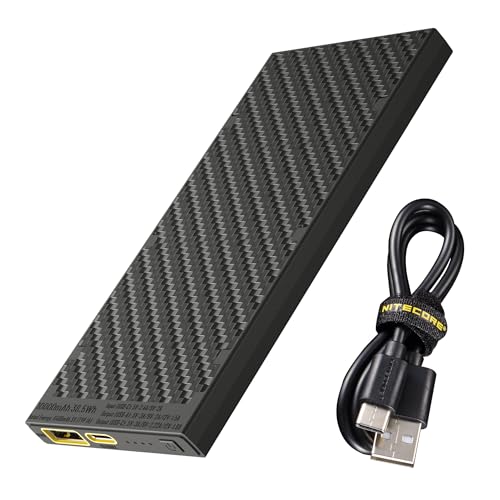
When every gram counts, on a long hike or a carry-on-only minimalist trip, this is the one to look at. The NB10000 Gen 2 holds 10,000mAh in a carbon-fibre body that weighs about 150g, which is quite remarkable for the capacity.
But it has one USB-C port and one USB-A, not the dual USB-C some listings imply, and its output tops out at 20W, so it’s built for phones and small devices rather than laptops. It’s also rated IPX5, which means it shrugs off rain and splashes but isn’t something to drop in a river. For ultralight travel where weight is the whole point, none of that really bothers me. For anything else, one of the heavier picks gives you more.
Check the Nitecore NB10000 Gen 2 on Amazon
Anker 313: the cheapest pick I would still trust

Sometimes you just want a reliable 10,000mAh bank for as little as possible, and the Anker 313 is where I’d stop looking. It’s a plain 213g bank with one USB-C and one USB-A, charges at up to 15W, and has no display or extras. Anker is the brand most people land on for a reason: their cheaper banks are dependable, and I’d sooner buy this than a no-name bank at the same price.
The trade-off is fair enough: 15W is quite a bit slower than the INIU and UGREEN picks, and there’s no screen, so you’re guessing at the charge level from a row of lights. For a spare bank, a backup for a family member, or a first power bank you’re not sure you’ll use much, it’s hard to argue with.
Anker Laptop Power Bank: for laptops and a bag full of devices

If you travel with a laptop and want one bank to feed everything, this is the heavy hitter. It holds 25,000mAh, has three USB-C ports plus a USB-A, and can deliver up to 165W when two of the USB-C ports are in use, dropping to around 130W when you have three or four devices plugged in. It even has retractable USB-C cables built into the body, so you’re less likely to be caught without one, and a smart display that shows what each port is doing.
It weighs about 595g, which you’ll feel, and it sits at roughly 92.5Wh, so it still clears the airline limit. This is a lot of bank for a phone-only weekend. Where it makes sense is for a working traveller charging a laptop, a phone and a tablet on the move, and few banks do that job better.
Check the Anker Laptop Power Bank on Amazon
UGREEN Nexode 145W: the road-trip workhorse

On a road trip, weight stops mattering. The bank lives in the car, and what you want is the capacity to keep a carful of phones, a tablet and a camera going for days between proper charges. The UGREEN Nexode 145W is my pick for that: 25,000mAh, 145W of total output across two USB-C ports and a USB-A (the top port alone does 140W), and a clear display. It’s about 513g, so it’s no featherweight, but for charging in the car or back at a motel it doesn’t need to be.
The reason I chose this over a bigger brick is that it stays under the airline limit, so the same bank that powers your road trip also comes on the flight home. If your trips mix driving and flying, it’s a smart single bank to own.
Check the UGREEN Nexode 145W on Amazon
Anker MagGo 10K: magnetic wireless, with one big caveat

For an iPhone, snapping a bank onto the back and skipping the cable is a real convenience, and the Anker MagGo does it well. It’s a 10,000mAh bank with 15W Qi2 magnetic wireless charging, a foldable kickstand so you can prop the phone up while it charges, and a display. It’s MagSafe-compatible, so it clicks onto recent iPhones without a case adapter.
The caveat, and it’s the important one, is that wireless charging is slower and less efficient than a cable. The MagGo charges at 15W wirelessly but 27W over its USB-C port, and you’ll lose more energy to heat going wireless. There’s also only the one USB-C port and no USB-A. I’d buy this for the convenience of magnetic charging on an iPhone, with clear eyes about the fact that the cable in the box is the faster way to use it. If wireless isn’t a priority for you, one of the cheaper picks gives you more for your money.
Check the Anker MagGo on Amazon
ELECOM Nestout 15000: the one for rough conditions

Most travellers don’t need a rugged bank, and I wouldn’t steer you to one by default. But if you’re kayaking, camping in the wet, or working somewhere full of dust and grit, the ELECOM Nestout is the one to have. It holds 15,000mAh, carries an IP67 rating, and has one USB-C and two USB-A ports with 32W of total output and a battery indicator. It weighs about 365g.
One thing to be precise about, because gear roundups routinely get it wrong: IP67 means water-resistant, not waterproof. It’ll survive rain, splashes and a brief accidental dunk, but it’s not designed to be used underwater, and I wouldn’t describe it as waterproof. For the kind of trip where a normal bank would worry me, it’s reassuring to have. For a city break, it’s more protection than you’ll ever use, and the plainer picks are lighter and cheaper.
Check the ELECOM Nestout on Amazon
Anker 548 (PowerCore Reserve): the big one for road trips and RVs

Everything else in this guide is built to fly. This one isn’t. The Anker 548 holds 60,000mAh, which works out to 192Wh, comfortably over the airline limit, so it stays in the car rather than the carry-on. For a road trip or an RV where weight and flight rules simply don’t apply, that buys a lot of breathing room: it keeps a couple of phones, a tablet and a laptop going for days between charges, across two USB-C ports at up to 60W each and two USB-A.
The cells are LiFePO4 (lithium iron phosphate) rather than the standard lithium-ion in the rest of these picks. LiFePO4 takes far more charge cycles before it fades, often several thousand where a normal bank is good for several hundred, and it runs cooler and more stable.
The trade is weight: it’s heavier and bulkier for the same capacity, so the carry-on banks here stick with standard lithium-ion, where every gram counts. In something that lives in a vehicle the weight doesn’t really matter, so the longer life is the better deal. It’s the same chemistry the larger power stations increasingly use, for the same reason.
It leans into off-grid use too. There’s a bright LED light with an SOS mode, a digital display, a carry handle, and you can top it back up from a solar panel, which matters more in a camper than in a hotel. At about 2.3kg it’s heavy, but in a vehicle you won’t notice. Anker backs it with a three-year warranty, reassuring for a battery you’re leaning on away from the grid. If your trips never see an airport, it’s the bank I recommend.
What to look for when you are choosing
If none of the picks above is quite right for you, these are the things that actually separate a good portable charger from a forgettable one, roughly in the order I’d weight them.
The spec I care about most, and the one cheap banks skimp on, is charging speed over USB-C Power Delivery. A bank that does 45W or more will put a real charge into a phone in the time it takes to grab a coffee, and will actually charge a laptop. A 10W or 15W bank only trickles. If you look at one number beyond capacity, make it the USB-C output wattage.
Ports come next. Two USB-C ports are far more useful than one USB-C and one USB-A in 2026, because almost everything worth charging fast now takes USB-C. Check that at least one port delivers the full rated wattage, since some banks only hit their headline figure on a single port. And if you often charge in a hotel room with a single socket, look for pass-through charging, which lets the bank feed a device while it’s charging from the wall itself. Not every bank does it.
A percentage display beats a row of four lights every time. It tells you whether you have enough left for the day or need an overnight top-up, and it’s the feature I miss most on the banks that lack it. Keep your expectations realistic on capacity too: expect roughly 60 to 70 per cent of the rated mAh to reach your device, so a bigger headline number isn’t a lie, but it’s not what you actually get out either.
One more thing I’ve started checking, and it’s easy to miss on a spec sheet: the warranty. My INIU banks come with a three-year warranty, about as long as power-bank cover gets and unusually generous, especially in the US where a single year is a common default. Most others land between one and two years: Anker covers most of its banks for around 18 months, UGREEN for two years, and the cheap no-name banks often for twelve months or nothing at all. This matters because the failure I describe below, a charging port that works loose after months of daily use, is exactly what a warranty is there for. So check the cover before you buy, register the bank if the brand asks you to, and of course keep your receipt. The longer warranties tend to come from the brands building the sturdier banks, so a good one doubles as a quality signal.
Finally, the extras. The specs above are what you need to be looking out for, but brands need to do something to stand out in a crowded market, so extra features are often bolted on. Some of these are useful. Some can be firmly labelled as gimmicks.
One example is my current P63, which has a carry strap that’s also a USB-C cable. This is really neat, and means I don’t need to remember to pack another USB-C cable (although I have no shortage of them, I think they may be breeding in my office drawer!). It’s not technically a built-in cable, which some power banks also come with, although I am wary of those as it’s another thing to break. This is totally separate and can be removed if you don’t want it.
Other examples of additional features include a built-in torch or a slide-out phone stand. My old INIU B62, which I still have, has both. Being able to use the power bank as a little stand for my phone while watching a movie on a plane or train is definitely a nice feature.
Mind you, my current P63 and the P50 have neither of these features. Personally I treat a torch or a stand as a nice bonus to watch for rather than a deciding factor. If a model you like happens to include one and the rest of its specs stack up, that is a reason to prefer it. Just don’t pay extra for features you won’t use.
Beyond travel: a power bank in your emergency kit
One use that doesn’t get mentioned enough: a charged power bank is one of the most useful things to have when the power goes out at home. We keep ours topped up for exactly that. When a storm knocks the electricity out, a good bank keeps phones alive long enough to check on people and find out what’s going on, and the ones with a built-in torch double as an emergency light.
We have a couple of USB-rechargeable lanterns and a small weather radio that top up from a power bank too, which means the same kit that travels with us also covers us at home.
We learned the value of this the hard way during a stretch of severe weather a few years ago, when a tornado warning had us sitting in the dark with the power down for the better part of a day. Having charged banks on hand turned a stressful situation into a manageable one. It’s a cheap bit of insurance, and the bank you already own for travel does the job.
One caveat on scale. If what you actually want is to ride out a long camping trip or a multi-day outage, running a fridge or charging laptops for days, a power bank is the wrong tool. That’s the territory of a portable power station, the Bluetti and Jackery sort of thing, which holds many times the capacity and has wall sockets on it.
Those are a different and much less portable category than the banks in this guide, and they won’t fit in your carry-on. For keeping phones, lights and small devices going, whether on a trip or through a power cut, a travel bank is exactly right. For powering a campsite or a house, look at a power station instead.
A note for photographers and creators
I shoot for a living, so this is the use case closest to home. Modern mirrorless cameras increasingly charge over USB-C, which changes what a power bank can do for you on a trip. My Canon EOS R5 will take a USB-C Power Delivery charge straight into the body, so a bank with a proper PD output can top up a camera battery between shoots without me carrying the mains charger at all. The same goes for a lot of recent Sony, Fujifilm and Nikon bodies.
If that’s your plan, the wattage matters even more than it does for a phone. A 45W or 100W USB-C Power Delivery bank like the P63 will charge a camera at a sensible rate, while a 10W bank will barely keep up.
A 25,000mAh bank is enough to get several camera-battery top-ups out of a day in the field alongside your phone, which for a long shoot somewhere without a socket is the difference between getting the shot and packing up early. If you want the full rundown of what I carry, it’s in our photography gear guide, and for the kit side of hiking with a camera there is our camera for hiking and backpacking guide.
How to get the most out of your power bank
A few things I’ve picked up over the years, and a few failures I’d rather you avoided.
The most useful lesson came from a Poweradd bank I owned years ago, before I settled on INIU. Its charging port worked loose and failed at about the nine-month mark, which on a bank is effectively the whole unit, because a power bank you can’t recharge is a paperweight. The takeaway wasn’t that one brand is bad. It was that the port is the part that gets handled most and the first thing to go, so a sturdy, well-reviewed bank from a brand that stands behind it is worth a little more than the cheapest option. It’s the one thing I now check the reviews for.
Lithium batteries also like to be looked after. They last longest kept somewhere between roughly 20 and 80 per cent rather than constantly run flat or held at 100 per cent, and they hate heat, so a bank left on a sunny dashboard or in a hot car is being slowly worn out. If you’re storing one for a while, leave it part-charged rather than empty. Treated reasonably, a decent bank will give you years of trips.
And the warning I give everyone: the free power bank from a conference goody bag or a phone-shop promotion is pretty much never worth carrying. They tend to be old cells in a cheap shell, the real capacity is often a fraction of the printed number, and the charging is slow. I’ve owned a few forgettable ones and they all ended up in a drawer. Buy one decent bank that fits your trips, look after it, and you’re sorted for a long time.
Frequently asked questions
Is a portable charger the same as a power bank?
Yes. Portable charger, power bank, battery pack, portable battery: they’re four names for the same object, and manufacturers and retailers use them more or less interchangeably. Every pick on this page is a portable charger.
Wall chargers are the exception. Those are the small bricks with prongs that plug into a socket, and they hold no battery at all, so they only work where there’s power already. If that’s what you’re after, our travel adapter guide covers them. A portable charger is the one that works when there’s no socket.
What size power bank can I take on a plane?
Anything rated at 100 watt-hours (Wh) or less, which is roughly 27,000mAh, and that covers almost every consumer travel power bank. Banks between 100Wh and 160Wh are allowed only with airline approval and you can carry a maximum of two of them. Anything over 160Wh is banned from passenger aircraft.
Always check the Wh figure printed on the bank rather than working it out from the mAh, and glance at your airline’s dangerous-goods page before you fly, because the approval rules for larger banks vary by carrier.
Can I put a power bank in my checked luggage?
No. Power banks count as spare lithium batteries, and those are banned from checked baggage on every airline. They must travel in your carry-on, in the cabin with you.
The reason is fire safety: in the cabin, the crew can deal with a battery that overheats, whereas in the hold nobody can. So keep your bank in your hand luggage, and double-check you haven’t left one in a bag you’re about to check.
How many times will a power bank charge my phone?
A 10,000mAh bank will give most phones between one and a half and two full charges in the real world. You don’t get the three charges the raw numbers might suggest, because around 30 to 40 per cent of the rated capacity is lost to voltage conversion and heat.
If you want two or more full charges with margin to spare, or you’re also charging other devices, step up to a 20,000mAh or 25,000mAh bank. Both still fly.
Can you use a power bank during a flight?
On most airlines you can still use one, but a growing number, especially in Asia, now ask you not to charge from or into a power bank while in flight and to keep it accessible rather than in an overhead bin. This followed a couple of cabin fires in 2025.
It’s not a ban on bringing a power bank, only on how and where you use it on board. The rules are changing quickly, so check your airline before you travel.
Are solar power banks worth it for travel?
For most travellers, no. Solar panels small enough to clip to a bank charge very slowly, often needing a full day of strong, direct sun for a fraction of a charge, so they work best as a slow trickle top-up on a multi-day hike far from any socket rather than as your main power source.
If you’re doing serious off-grid time, a solar panel can be a useful backup. For ordinary travel, a regular bank you recharge from the wall is faster, lighter and more reliable.
Do power banks use GaN technology?
Mostly no, and it’s not something to look for when buying one. GaN (gallium nitride) is a charger technology: it lets the plug-in wall chargers and travel adapters that turn mains power into USB run smaller, cooler and at higher wattage.
A power bank’s job is to store power and feed it back out over USB, so the chemistry of its cells and its USB-C output wattage matter far more than whether GaN is involved. A few high-output banks use it in their internal electronics, but it’s a selling point on chargers, not a box to tick on a power bank.
What is the best travel power bank overall?
It depends what you are charging, and for most travellers that is a phone. A 10,000mAh bank like the INIU P50 or the ultralight Nitecore NB10000 gives you one and a half to two full charges, weighs 150 to 160g, and costs less. On a city break or a day out that is the sensible buy.
Step up to the INIU P63 if you are charging a laptop as well, or covering more than one person. At 25,000mAh it stays under the airline limit so it always flies, and it’s the bank I carry myself, but it is 400g in your bag whether you need the capacity or not.
Further reading
If you are putting together your travel kit, a few of our other guides go well with this one:
- Pair your bank with the right plug: our guide to the best travel adapter covers which one to buy for where you are going.
- Everything I carry to shoot on the road: our photography gear guide.
- Packing for a longer working trip: the digital nomad packing list.
- Carrying a camera into the backcountry: our camera for hiking and backpacking guide.
- Shopping for a present rather than yourself: our guide to tech gifts for travellers covers what actually gets used, by price band.
Leave a Reply