
If you want a winter trip that involves snow up to your knees, dogs who very much cannot wait to run, and the small possibility of standing in a frozen field watching the sky do something extraordinary, Finland is hard to beat.
I’ve spent two trips up there in winter, both times with Jess, both times slightly under-prepared for how cold it actually gets when the temperature drops past minus twenty. I’ve stayed in a glass igloo, ridden an icebreaker out into the frozen Gulf of Bothnia (with a bracing dunk in the sea, drysuit notwithstanding), gone husky sledding with one of the best kennels in Lapland, and spent more hours than I’d like to admit watching the sky for Northern Lights that may or may not have shown up that particular night.
This guide is a 7-day winter itinerary for Finland, covering Helsinki, Rovaniemi, and a couple of options for getting deeper into Lapland (Saariselka in the far north, or Kittilä for skiing and snow hotels). It works for travellers driving themselves and for those relying on flights, trains, and tours. I’ve designed it to be ambitious but not exhausting, which sounds obvious until you spend a day trying to do four winter activities back-to-back and discover that putting on a snowsuit four times before lunch is a workout in itself.
A note on cost before we start: this is not a cheap trip. Lapland in winter is one of the more expensive weeks of travel you can do in Europe, and prices have climbed sharply in the last few years. I’ll flag costs throughout, including the bits where you can save money and the bits where you really can’t.
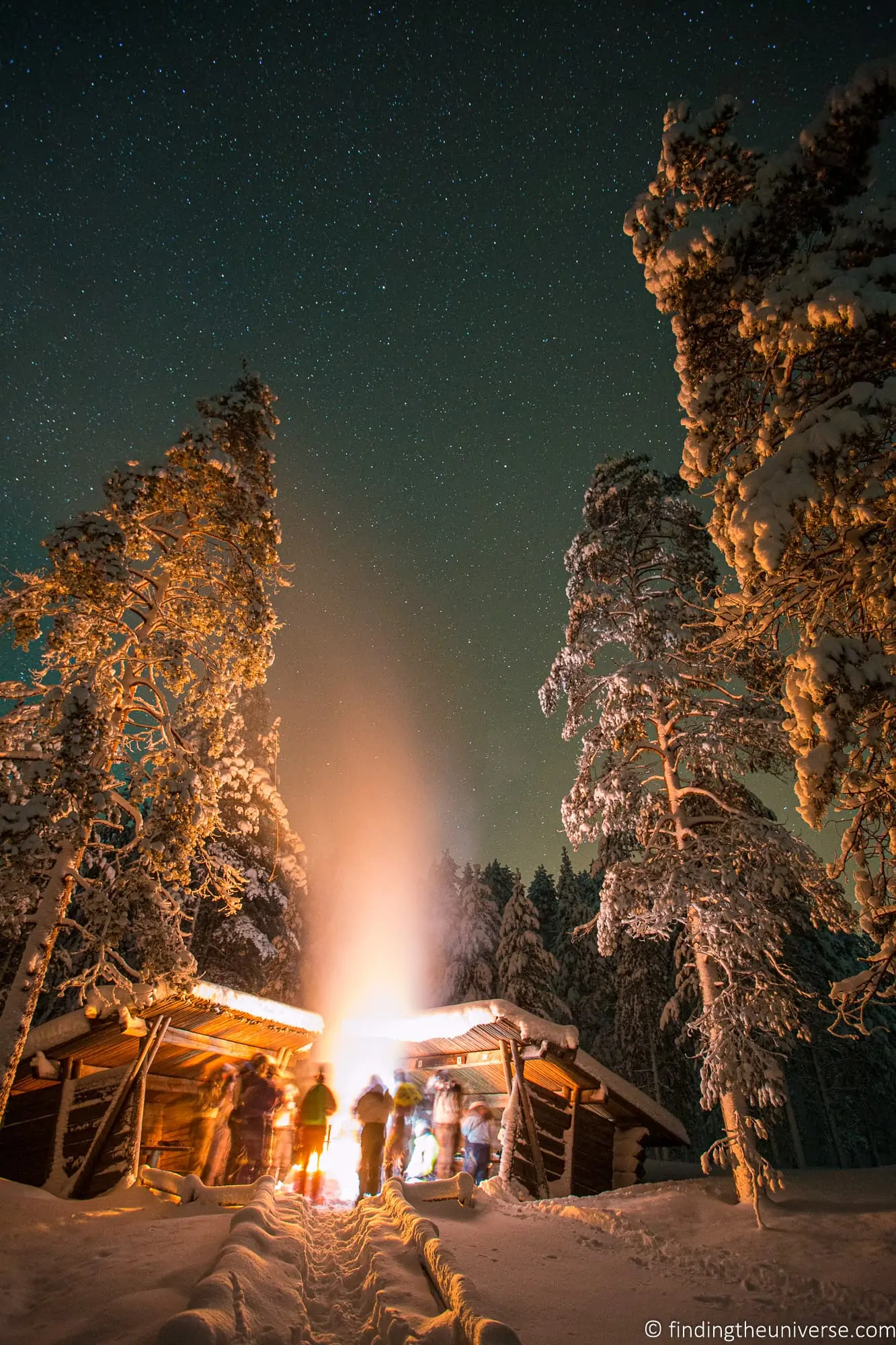
Table of Contents:
Quick Take: 7 Days in Finland in Winter
A summary of the decision points, before the day-by-day detail.
Best months are late January through mid-March. December is magical but expensive and dark; March gives you more daylight and slightly warmer temperatures (slightly).
Realistic budget per person is around €1,500-2,000 for a careful trip, €2,500-3,500 for mid-range, and €4,500+ for glass igloos and a lot of activities. International flights extra.
Transport verdict: fly Helsinki to Rovaniemi (1h 25min, often cheaper than the train if you book ahead), or take the Santa Claus Express overnight sleeper for the experience. Self-drive within Lapland if you’re comfortable with snow driving; otherwise local tours and buses cover everything.
The hardest decision is whether to head to Saariselka (remote, more aurora-friendly, glass igloos) or Kittilä/Levi (ski resort, more infrastructure, snow hotel) for the back end of your trip. Pick based on what you most want to do, not where the prettiest hotel photos are.
If you’re tight on time, cut a Helsinki day rather than a Lapland day. The Lapland end of the trip is what makes it worth coming.
Book first: the Sampo icebreaker cruise (sails 3-4 days a week, sells out weeks ahead in peak), and any glass igloo accommodation (3-4 months ahead minimum, more for Christmas).
Finland Winter Itinerary: 7-Day Overview
- Day 1 – Arrive Helsinki, light city exploring
- Day 2 – Helsinki day, evening flight or overnight train to Rovaniemi
- Day 3 – Rovaniemi: Santa Claus Village, Arktikum, Northern Lights attempt
- Day 4 – Day trip to Kemi for the Sampo icebreaker cruise
- Day 5 – Rovaniemi activity day, pick two from husky sledding, snowmobiling, ice fishing, snowshoeing, or the Korouoma frozen waterfalls
- Days 6-7 – Head north to Saariselka (glass igloo, remote wilderness) or west to Kittilä/Levi (ski resort, snow hotel)
If you’re trying to compress this into less than 7 days, the easiest cut is Helsinki: trim it to a single day or skip it entirely if you can fly into Rovaniemi (some European routes do this directly). If you have more than 7 days, the obvious add is more time in Lapland rather than more time in Helsinki.
Day 1: Arrive in Helsinki
Most international flights to Finland land at Helsinki Airport (HEL), and most arrive in the afternoon. Realistically, by the time you’ve cleared immigration, found your bag, taken the HSL bus 600 into the city centre (€4.80, around 40 minutes from the airport to Helsinki Central), and checked into your hotel, it’s late afternoon. Don’t try to do too much.
What I’d recommend: drop your bags, then walk out and have a look at Senate Square and the white-domed Helsinki Cathedral. The square is free to wander and the cathedral itself is open until early evening. After that, head down to the harbour for the Old Market Hall (open until 6pm most days, good for picking up smoked fish and Finnish snacks), grab dinner, and call it a night. You’re going to need the rest.
If you want a longer stay in Helsinki than this 7-day trip allows, we have a much more detailed guide to things to do in Helsinki with everything from the Suomenlinna sea fortress to Helsinki’s saunas.
Where to Stay in Helsinki
A few options across price points that we’ve either stayed at ourselves or recommend regularly:
- Hostel Diana Park – well-rated central hostel, good for budget travellers
- Radisson Blu Plaza Hotel – mid-range chain, reliable, central
- Hotel Katajanokka – the most interesting option in the city, a former prison from the 1880s converted into a hotel. The cells are now rooms, which is exactly the kind of thing I find irresistible.
Day 2: Helsinki Day, Then North
With one full day in Helsinki, the highlight is Suomenlinna Sea Fortress, a UNESCO World Heritage site spread across six islands at the mouth of the harbour. It’s reached by a regular ferry from Market Square (15 minutes each way, included in the standard HSL transit ticket). Allow at least three hours to explore; you can easily do a half day or a full day depending on how interested you are in fortress history.
In winter, wrap up. The wind off the Baltic is unforgiving, the paths can be icy, and there’s not a lot of indoor space to retreat to between the museums.
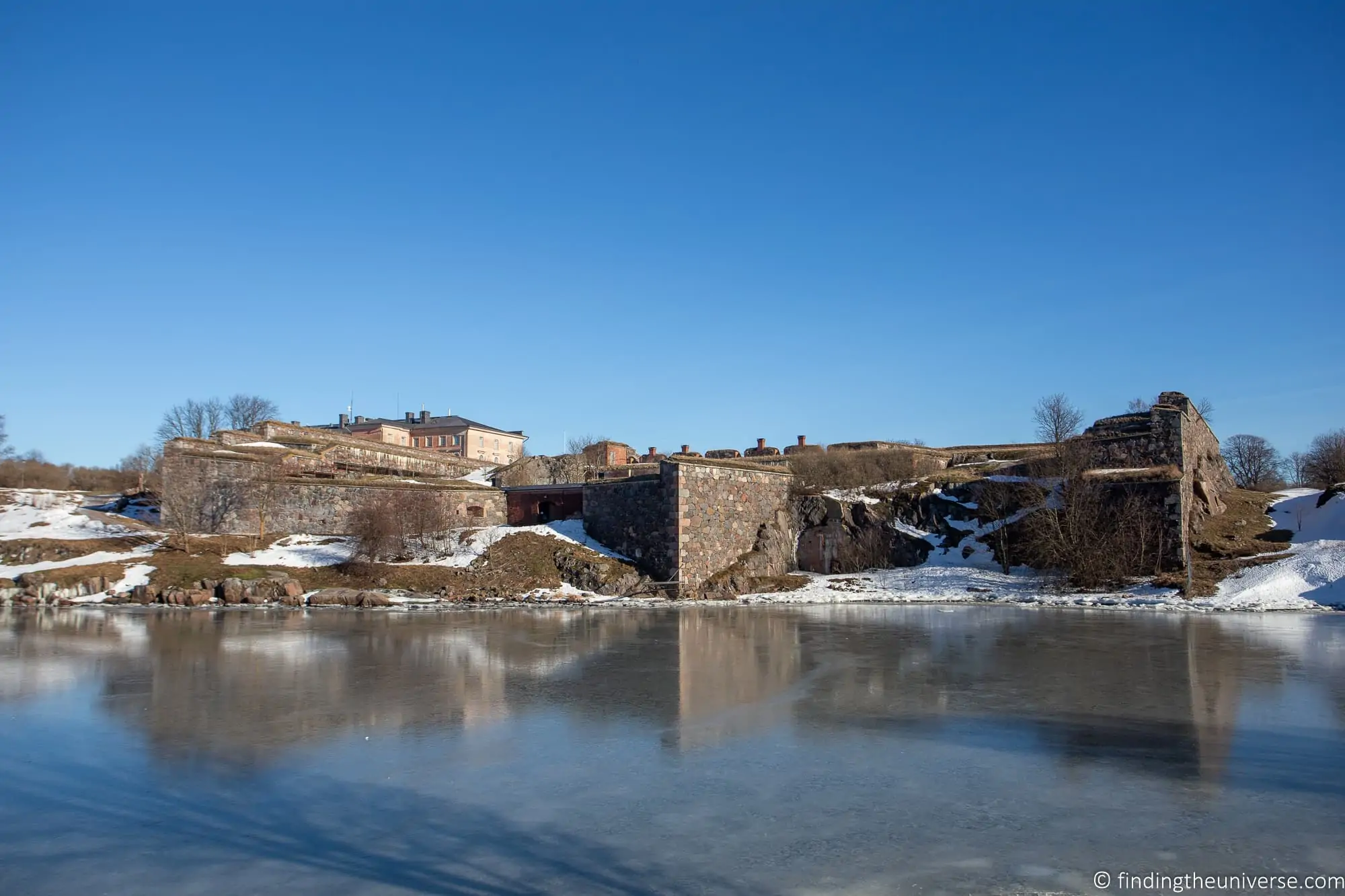
Of the museums on the island, the Suomenlinna Museum is open year-round and is the one I’d prioritise; it covers the history of the fortress and of Helsinki’s relationship with Sweden, Russia, and (eventually) independent Finland. There’s a small entry fee.
Back on the mainland in the afternoon, the Helsinki City Museum is free and worth an hour if you want more context on the city. The National Museum of Finland would normally be my other recommendation here, but it’s currently closed for major renovation and not due to reopen until spring 2027. If you want a sauna while you’re in Helsinki, the standout option is Löyly on the seafront, which combines a serious traditional sauna with a wood-fired kitchen and a sea-pool plunge. Booking ahead in winter is essential.
We have a much more detailed 1 day Helsinki itinerary if you want to plan this day in more depth, including timings, restaurant recommendations, and what to skip.
How to Get from Helsinki to Rovaniemi
You have three serious options for the journey north, plus driving (which I don’t really recommend for this leg).
Option 1: Fly
Fastest by a long way. The flight is around 1h 25min, and there are multiple departures a day with Finnair and Norwegian. Booked in advance, fares often come in cheaper than the overnight train. Rovaniemi airport is small and a 15-minute taxi or shuttle bus from town (the shuttle is around €8). You can check flight times and prices on Skyscanner.
If you’re flying, take an evening flight on Day 2 after you’ve had your full Helsinki day, or fly on the morning of Day 3 if you want a leisurely breakfast first.
Option 2: The Santa Claus Express overnight train
The most atmospheric option. Departs Helsinki Central around 7:50pm and arrives in Rovaniemi around 8am. Sleeper cabins are comfortable and reasonably priced (around €100-150 per person depending on cabin type). There’s a dining car and you can pre-book breakfast delivered to your cabin for the morning.
Practical advantage: it saves you a hotel night. Practical disadvantage: you arrive in Rovaniemi a bit fuzzy after a night on a train, which can make the first morning a slow start.
You can book the Santa Claus Express on the VR website.
Option 3: Bus
The bus from Helsinki to Rovaniemi takes around 13 hours and costs less than the train. Unless budget is the deciding factor, I wouldn’t take it; you lose a full day of your trip to a bus seat. Matkahuolto handles bus bookings.
Option 4: Tour package
If you’d rather have someone else handle the planning, you can take a guided multi-day tour that covers Helsinki, the train or flight to Rovaniemi, accommodation, and a selection of activities. TourRadar lists a range of Finland tour options from various operators at different price points, which is a reasonable way to see what’s available.
Day 3: Welcome to Rovaniemi
Rovaniemi sits right on the edge of the Arctic Circle, which is the kind of geographical detail that sounds dramatic until you realise you’ve crossed it accidentally on the bus from the airport. There’s a marker for the line at the Santa Claus Village, in case you’d like to make a thing of it.
The city itself is functional more than charming. It was almost completely destroyed in the Second World War and rebuilt from a plan by Alvar Aalto, which gives it a low-slung, slightly utilitarian feel. The reason to come is everything you can do from here: husky tours, snowmobile safaris, ice fishing, the Sampo icebreaker day trip, Northern Lights viewing, and a couple of properly good museums. You don’t need a car for any of this if you don’t want one, though it gives you flexibility if you’ve got the confidence to drive on snow and ice.
For your first day in Rovaniemi, my suggestion is the obvious one: Santa Claus Village, then the Arktikum museum. Both are walkable from town with a bit of bus help.
Santa Claus Village
About 8km outside Rovaniemi, on the way to the airport. You can get there by Santa’s Express bus (a regular service from town, schedule on the Santa Claus Village website), local bus, taxi, or driving yourself.
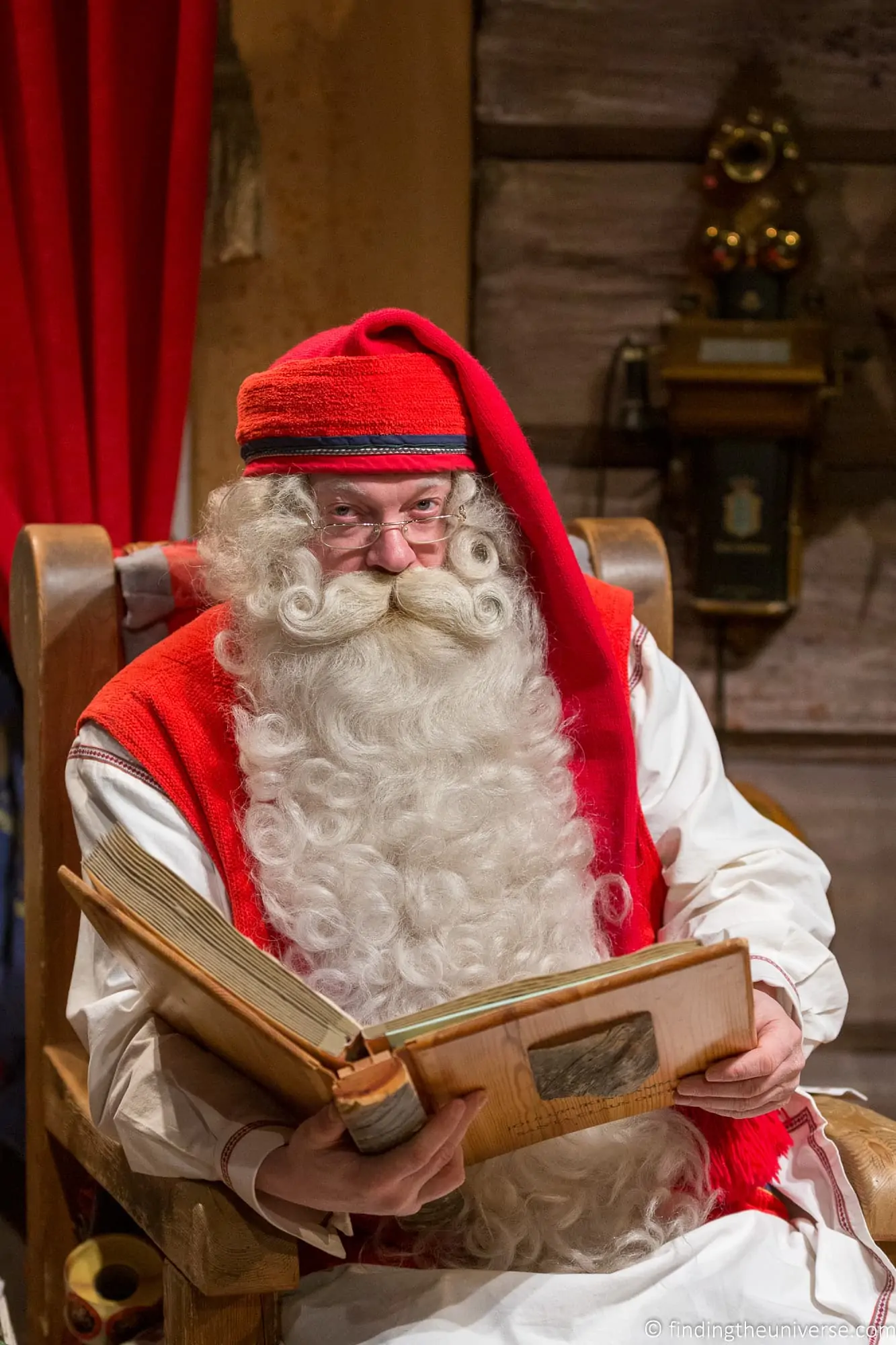
It is, to be clear, a tourist village. If you’re allergic to anything that feels engineered for tourists, you may roll your eyes. But it’s done well, and the moment when you actually meet Santa (who is sitting in a slightly imposing throne room at the back of the main building) is, even for a couple of cynical adults, more charming than I expected. He spoke perfect English, asked good questions, and didn’t break character once. There’s no entry fee to meet him; you only pay if you want a photo or video, which the elves take and sell back to you afterwards.
Beyond Santa, the village has Santa’s Post Office (you can post a Christmas card from here that will be held and sent at Christmas, which is a nice touch even if you visit in February), a marker for the Arctic Circle line, and a number of cafes and gift shops. There are also activity operators on site if you want to combine the visit with a husky ride, reindeer sleigh, or snowmobile experience: this combined Santa Village + snowmobile to reindeer farm tour is a popular all-in-one option.
Allow about 3 hours, longer if you’re doing an activity from here.
Arktikum Museum
Back in town, the Arktikum is a science centre and cultural museum on the bank of the Ounas River. It covers the history, ecology, and people of the Arctic, and includes one of the better Northern Lights exhibits I’ve seen anywhere. The building itself is gorgeous, a long glass tube pointing at the river, and it gets dark early enough in winter that you’ll feel like you’ve spent the whole day there even if you arrive at 3pm.
There’s an entry fee, and the museum is closed on Mondays in winter. Allow at least two hours. The riverside outside Arktikum is also one of the better aurora-viewing spots if you don’t want to leave the city.
Northern Lights Attempt: Evening
On any clear night during your stay in Rovaniemi, it’s worth at least going outside and looking up. The aurora is a real thing that happens regularly here, and it’s also, frankly, not guaranteed. I’ve spent nights staring at a perfectly clear sky and seen nothing; I’ve also stepped out of a restaurant in Lapland and seen the whole sky go green for forty minutes.
A few practical things that help. First, get away from city lights. The riverside by Arktikum is the easiest spot in Rovaniemi if you don’t have a car. With a car, you only need to drive 10-15 minutes out of town to get a properly dark sky.
Second, install an aurora forecasting app on your phone. I use My Aurora Forecast Pro on Android or on iOS. It’s accurate enough that I trust it and doesn’t drain your battery.
Third, if you want to maximise your chances, take a dedicated Northern Lights tour. The advantage is that the guides know which way to drive based on cloud cover and aurora activity, so you’re not stuck staring at a closed sky. The downside is it’s expensive (€100-180 per person) and the aurora is still not guaranteed. Some good options:
- Forest sauna and hot tub Northern Lights tour – combines the aurora hunt with a traditional firewood sauna, so even a cloudy night isn’t a write-off
- Northern Lights photography tour – a dedicated photography-focused trip with a guide who’ll help you set up your camera
You can browse all Rovaniemi Northern Lights tours on GetYourGuide for more options.
If you do want to photograph the aurora yourself, I have a complete guide to photographing the Northern Lights that covers cameras, settings, and the practical realities of trying to use a tripod when it’s minus twenty. Worth a read before you go; it’s not the kind of thing you want to figure out for the first time at 11pm in a snowy field.
Where to Stay in Rovaniemi
We’ve stayed at a few places in Rovaniemi across our two trips. Some options at different price points:
- Hostel Cafe Koti – well-rated central hostel with a good cafe attached
- Guesthouse Borealis – convenient for the train station, good value
- Santa’s Hotel Santa Claus – centrally located 3-star, reliable mid-range option
- Arctic Light Hotel – boutique hotel in the city centre, good if you want something with a bit more character
- Arctic TreeHouse Hotel – the unique option, just outside Santa Claus Village, with cabins on stilts looking out over the forest
- Apukka Resort – a 15-minute drive outside town with glass-roofed igloos, multiple saunas, and an in-house activity centre. Worth considering as a Rovaniemi base if you want the wilderness feel without committing to the further-north lodges
Day 4: The Sampo Icebreaker Day Trip
This is one of the most distinctive things you can do in Finnish winter, and it’s one of my favourite memories from both trips. The Sampo is a working icebreaker built in 1961, retired from active duty in 1987, and now operating as a tourist cruise out of Kemi on the Gulf of Bothnia. She’s roughly 75 metres long, weighs over 3,000 tonnes, and breaks ice with the kind of authority that you don’t quite appreciate until you’re standing on her bow watching it happen.
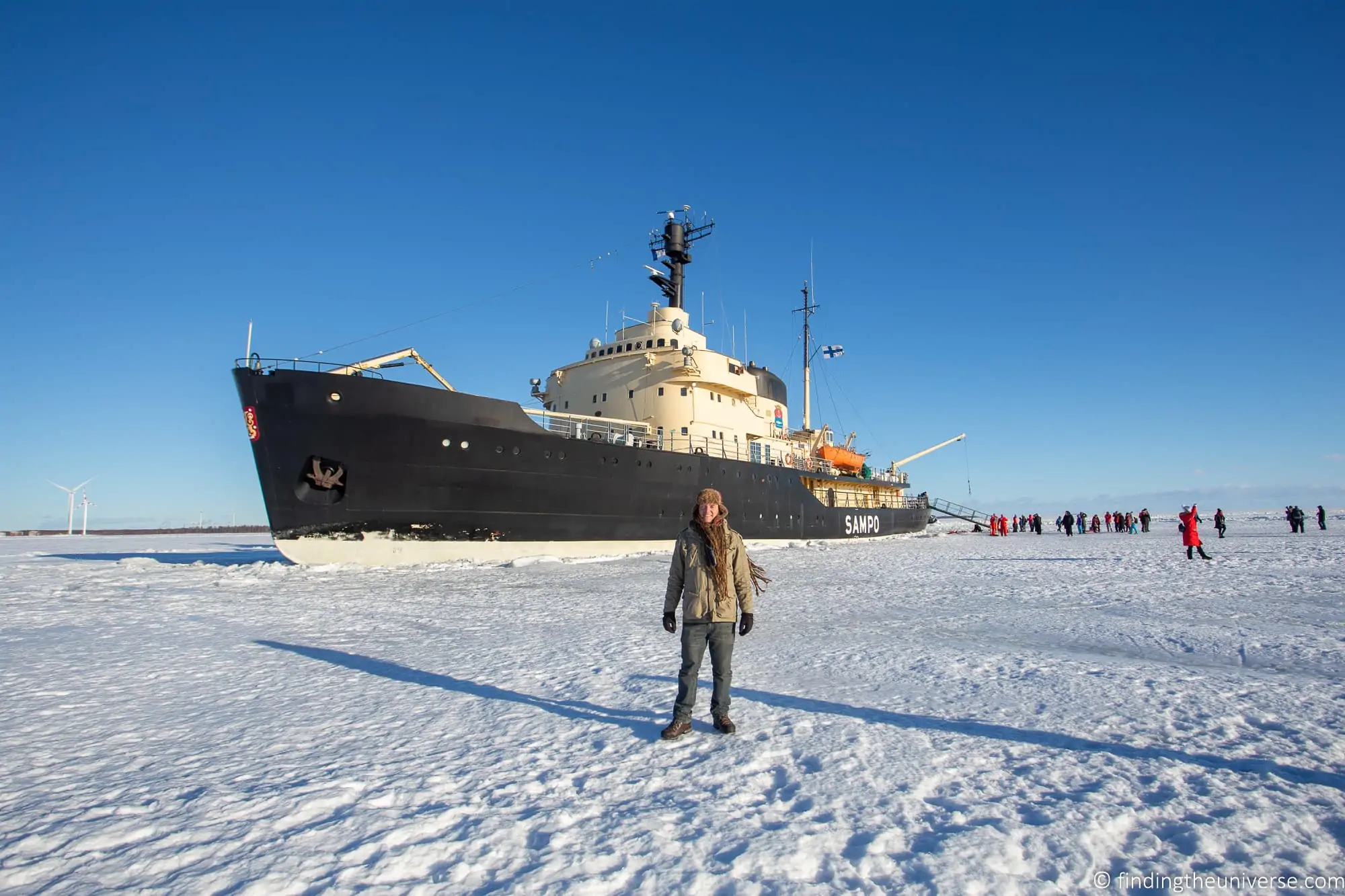
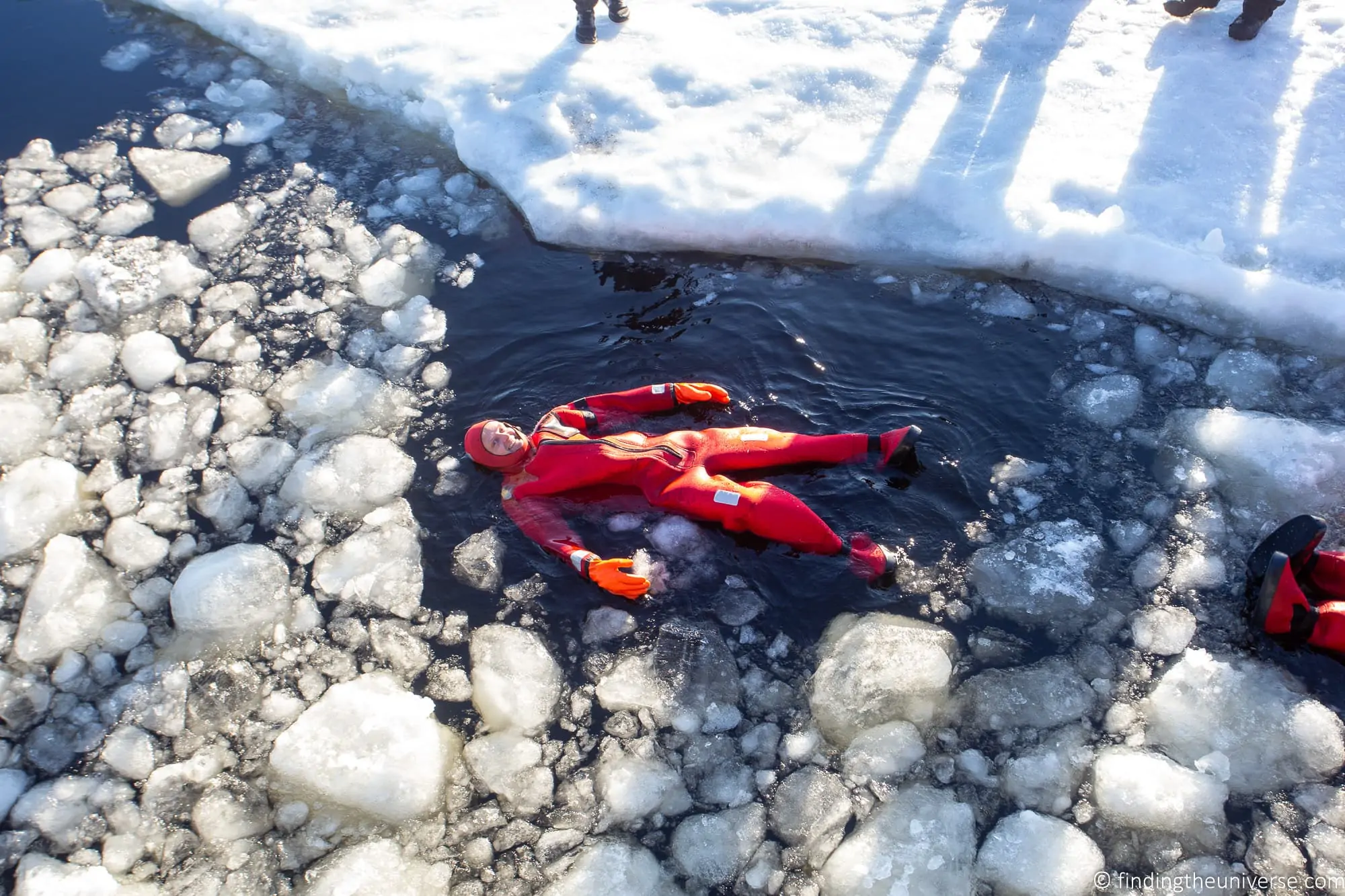
The cruise is around 3.5 hours on the ship, and includes a guided tour, a non-alcoholic welcome drink, and (the best bit) a stop where they cut a hole in the ice and let you put on a full drysuit and float in the frozen sea. It is exactly as ridiculous as it sounds. You don’t really swim; the suit is buoyant enough that you essentially bob, with your face the only thing exposed. It is also extremely cold around the face, and your hands lose feeling within about three minutes despite the gloves. But you’ll be describing it to people years later.
There’s also time to walk on the snow-covered ice next to the ship while the float is happening. I’d recommend it; the noise of the icebreaker engine combined with the otherwise complete silence of a frozen sea is something I won’t forget.
Practical Realities of the Sampo Cruise
A few things that have changed since I did this trip, and some that haven’t.
The operator is now Icebreaking.com (it used to be Experience365). Cruises run roughly December to early April, three to four days a week, and they sell out a long way in advance for peak season (Christmas, New Year, February school holidays). Book this before you book the rest of your trip and plan everything else around it.
You can no longer drive yourself. When I did the trip I drove from Rovaniemi (about 90 minutes each way), parked at the SnowCastle area in Kemi, and met the ship there. The booking flow has since changed and there’s now a mandatory shuttle from designated bus stops in Rovaniemi, Kemi, Haparanda, or Tornio. If you do want to self-drive, my suggestion is to contact Icebreaking directly before booking and ask whether you can meet the cruise at the SnowCastle area. Otherwise, factor in the shuttle pickup times.
Two cruise options:
- Morning cruise – shuttle pickup from Rovaniemi around 5:45-6am, on the ship from 9am to 12:30pm, back in Rovaniemi by about 4:30pm.
- Afternoon cruise – pickup from Rovaniemi around 9:30am, on the ship from 1:30pm to 5:30pm (lunch on board included), back in Rovaniemi by 8pm.
The afternoon cruise is more civilised if you don’t fancy a 5am alarm, but it also means you’re at sea during the brief afternoon daylight window, which has its own appeal. The morning cruise gets you back to Rovaniemi early enough that you’ve still got the evening for an aurora attempt.
2026/27 season pricing: approximately €496-522 per person for the round-trip from Rovaniemi (depending on date), or €392-418 per person from Kemi if you’re already further south or driving yourself partway. This is not a cheap day out. But for the right kind of traveller, it’s also one of the few unrepeatable winter experiences in Europe, and for the right traveller it’s worth the money. You can check current schedules and prices on the Icebreaking website.
What’s included: the cruise itself, transfers from Kemi to the harbour, a guided ship tour, the welcome drink, the ice float and frozen-sea walk (weather permitting), and a certificate of participation that I still have somewhere. Lunch is extra unless you’re booked on the afternoon cruise.
Day 5: Activity Day in Rovaniemi (Pick Two)
Here’s the thing about Rovaniemi: there are about a dozen winter activities you could realistically do, and almost every guide you’ll read will list all of them as Day 5 options without acknowledging that you cannot, in fact, do all of them in one day.
The actual constraint is daylight (around 4-6 hours in deep winter, 8-10 hours by mid-March), travel time between activity providers (most are 15-30 minutes outside town), the time it takes to put on and take off the snowsuit and boots they give you (more than you’d think), and the fact that being outdoors in extreme cold is properly tiring.
My recommendation: pick two. One major activity (3-7 hours), and one smaller one (1-2 hours, often in the evening). Or pick one full-day activity and call it done. Trying to do husky sledding in the morning, snowmobiling at lunchtime, ice fishing in the afternoon and a Northern Lights tour at night sounds great on paper and is, in practice, a recipe for arriving home exhausted and underwhelmed by everything.
Here’s the realistic menu.
Husky Sledding (highly recommended)
The headline experience. A husky team is usually six to eight dogs harnessed to a sled, with a driver standing on the back to steer and brake and a passenger sitting in the sled. Most operators let you swap halfway through. The dogs are thrilled to be running; the moment the brake comes off, they go.
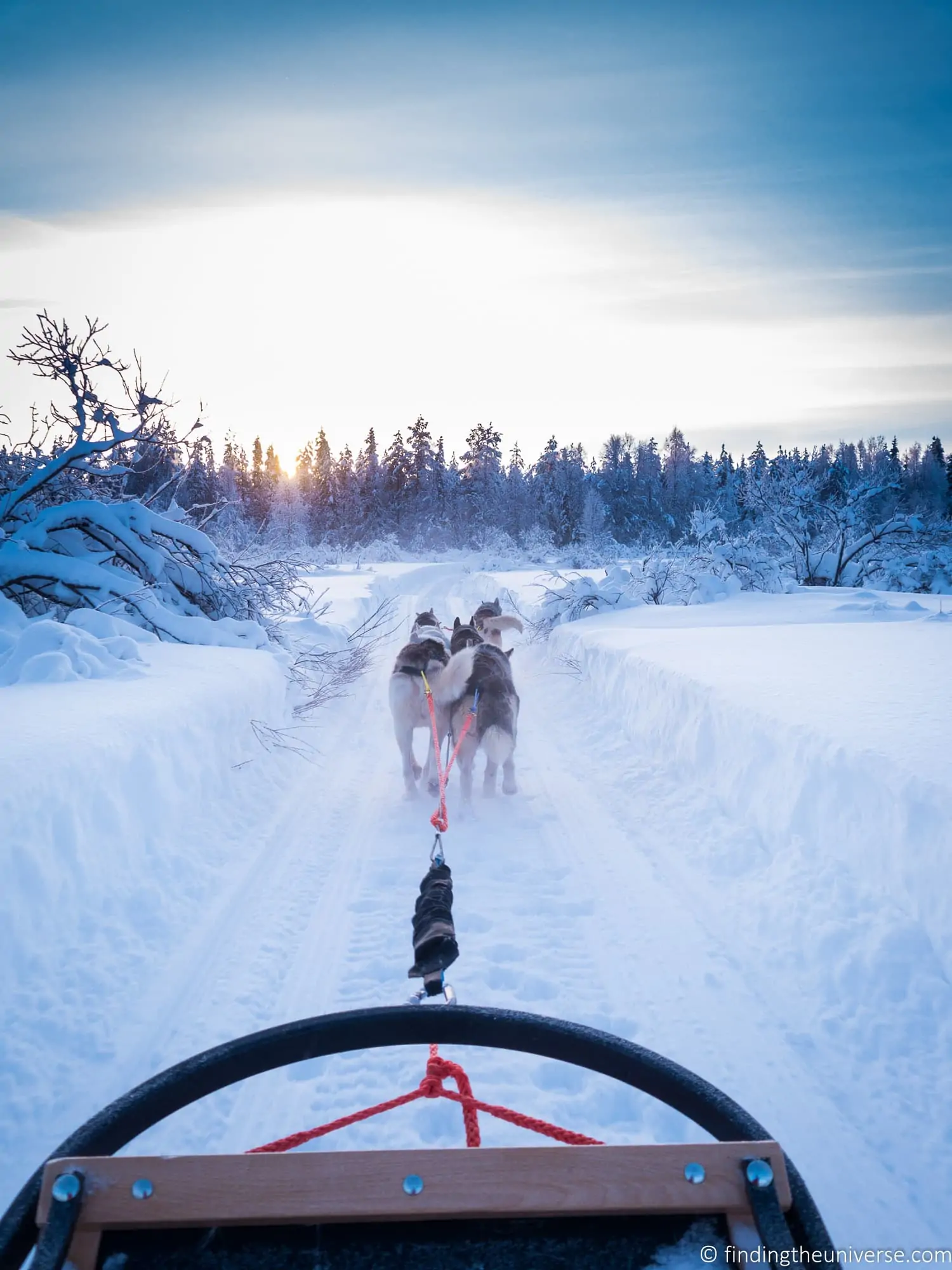
I went with Bear Hill Husky on one of my trips, on a two-day safari that I wrote about in detail in my post on dog sledding in Lapland. They’re a no-kill, no-abandonment kennel with a number of welfare and sustainability accreditations, and the connection between the guides and the dogs was obvious from the moment we arrived. If you only do one operator-recommendation in this whole article, this is the one to take.
For shorter experiences, Bear Hill Husky offer a 5km husky ride and kennel tour through GetYourGuide, which is a good intro experience including time meeting the dogs. For longer safaris (full day or multi-day), you can book directly via the Bear Hill Husky website.
Snowmobiling
If husky sledding is the meditative option, snowmobiling is the loud one. They’re fun. I love them. They’re also, more practically, a useful way to combine other activities: ice fishing, Northern Lights viewing, or visiting reindeer farms are all routinely paired with the snowmobile ride that gets you there.
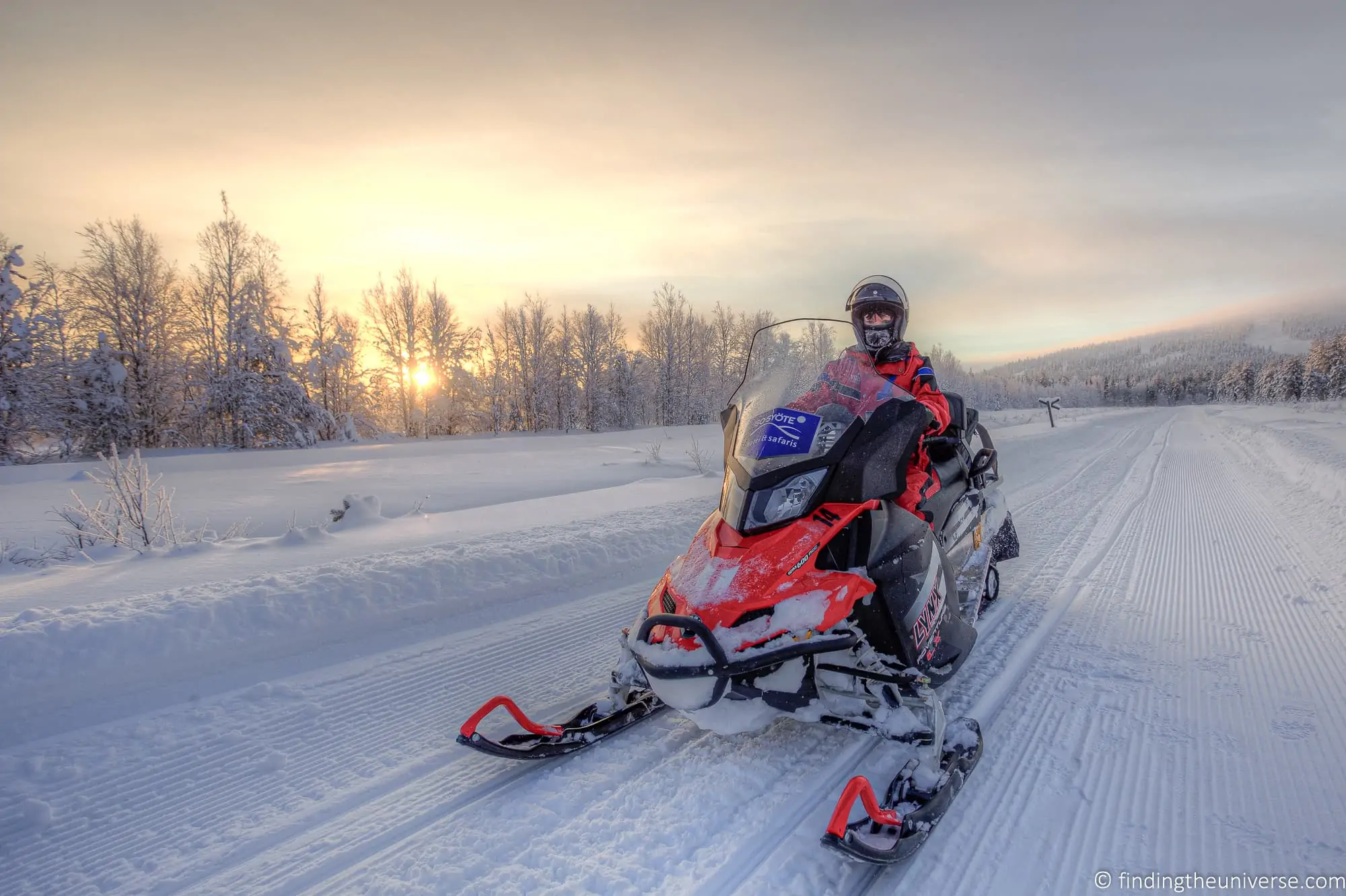
A few practical things. Most snowmobiles are two-up: one person driving, one passenger. Tours typically let you swap, and you can usually pay a small supplement to ride solo. Children under 15 generally can’t drive, and rules on whether children can ride as passengers vary by operator, so check before booking if travelling with kids.
Some good options:
- Rovaniemi snowmobile safari adventure – a simple snowmobile experience, good for first-timers
- Snowmobile + reindeer + husky farm half-day – a busier tour combining several activities
- Snowmobile + ice fishing + lunch – half-day with snowmobile transit out to a frozen lake, ice fishing, and a campfire lunch
- Evening snowmobile + Northern Lights – the evening option, with a Lappish BBQ included
Ice Fishing
A traditional Finnish winter pursuit involving a hand-drilled hole in the ice, a small rod, and a long quiet wait for a fish that may or may not arrive.
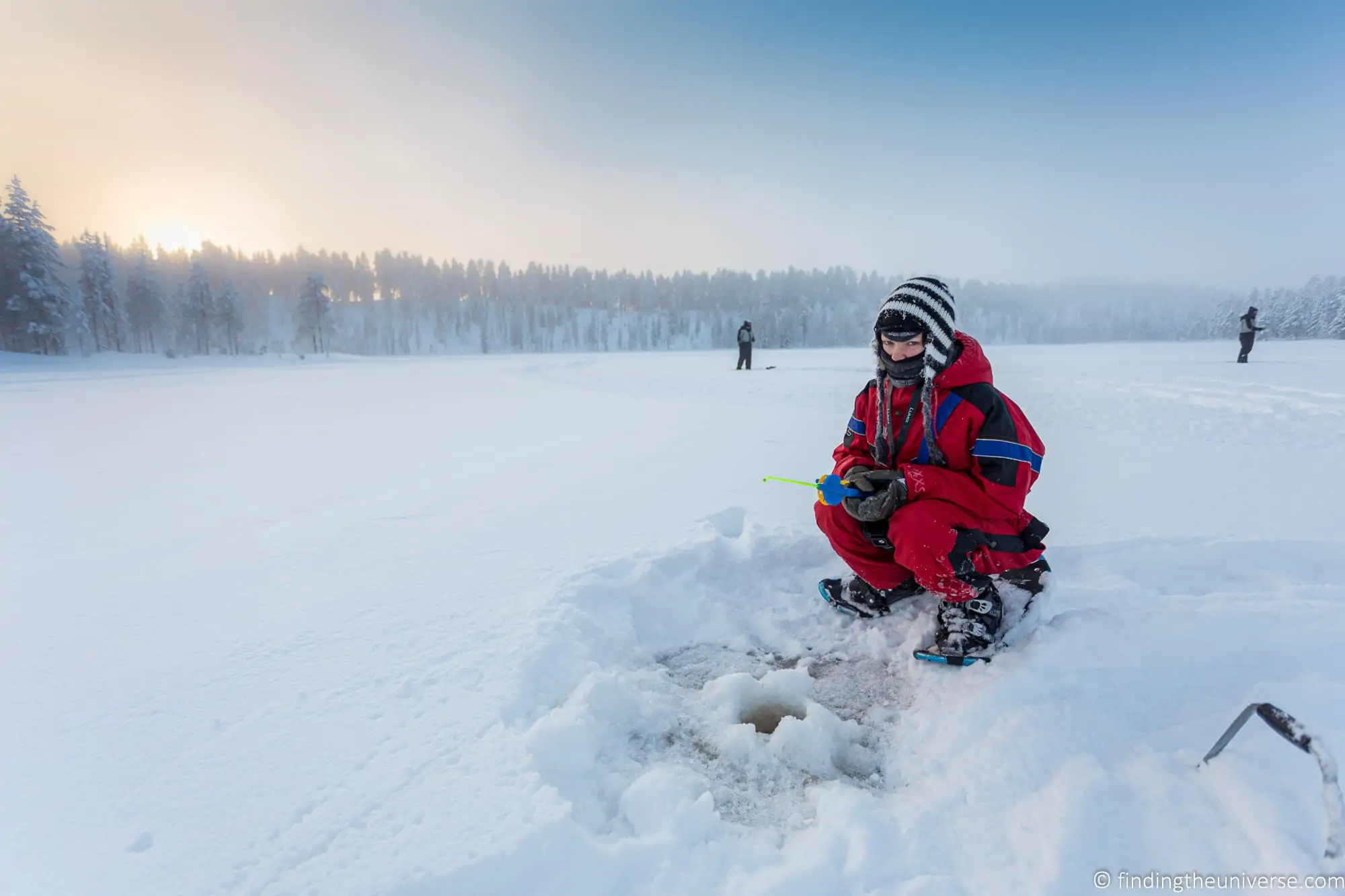
I have, across three separate ice fishing trips, never caught a single fish. Other people on my tours have, and at least one of my guides has caught what looked like a small whale, so the technique presumably works. I have nonetheless enjoyed every trip. There’s something quietly satisfying about standing on a frozen lake in the silence with a hot drink, even if the fishing itself is a polite fiction.
Tours that focus on ice fishing tend to include hot drinks and a cooked lunch over a fire, which is half the appeal. Options include a 2.5-hour ice fishing experience for a quick taste, or a 4-hour combined snowshoeing and ice fishing tour if you’d like to combine it with something else.
Snowshoeing or Korouoma Frozen Waterfalls
Snowshoeing is the sneaky-good option. You strap large flat shoes onto your boots and walk on top of the snow rather than sinking into it, which means you can get into terrain that’s otherwise impassable. It’s relatively low-intensity, you can do it in any reasonable winter clothing, and it gets you out into properly quiet forest in a way the other activities don’t.

For something more ambitious, the Korouoma canyon (about 115km from Rovaniemi, around 90 minutes’ drive) is one of the more spectacular hiking destinations in southern Lapland, with a 5km circular trail that takes in three substantial frozen waterfalls (Charlie Brown, Mammoth Fall, and Brown River). It’s a long drive for a day trip but the photos are worth it. Best done as a guided tour with transport included: Korouoma hike with a wilderness barbecue or full-day Korouoma tour. I haven’t done Korouoma myself but it’s one of the more popular Day 5 options for visitors who want a serious hike.
Amethyst Mine at Lampivaara
A working amethyst mine on top of a hill in Pyhä-Luosto National Park, about 90 minutes’ drive from Rovaniemi. You take a tracked vehicle up the mountain to the mine, and once there you can learn about amethyst mining and have a go at finding your own. The amethyst you find, you keep (within reason; there are size limits).
It’s a reasonable choice if you’ve already done the headline activities and want something different, or if you’re travelling with kids. The 90-minute drive each way is the limiting factor; book directly via the Amethyst Mine website.
For more options on what to do in and around Rovaniemi, see our broader guide to things to do in Rovaniemi.
Days 6 & 7: Head North into Lapland
For your last two days, my strong recommendation is to leave Rovaniemi and get further into Lapland proper. You’ll get darker skies for the aurora, more remote landscapes, the option of staying somewhere unusual (a glass igloo, a snow hotel, a wilderness lodge), and a better sense of just how empty northern Finland is.
You have two main directions to choose from, and you should pick based on what you most want to do. There isn’t a wrong answer, but they offer different trips.
Saariselka vs Kittilä: How to Choose
Pick Saariselka (further north, near Ivalo) if:
- The Northern Lights are your number-one reason for the trip – Saariselka is well inside the Arctic Circle and the aurora odds really do improve with latitude compared with Rovaniemi
- You want the classic glass igloo experience – this is where the concept originated and where the most photographed examples are
- You like remote and quiet over busy and convenient – it’s much more rural than Levi
- You want to learn about Sámi culture – the area around Inari (a short drive further north) is the cultural centre of Finland’s Sámi community
Pick Kittilä/Levi if:
- You want to ski or snowboard – Levi is Finland’s largest ski resort with proper slopes, lifts, and ski rental
- You want more infrastructure – more restaurants, more shops, more options for evening activities
- You want to stay in the famous SnowVillage snow hotel – it’s near Levi, rebuilt every winter from ice and snow
- You’re flying directly from Helsinki and want a slightly easier transit – Kittilä airport has more direct flight options than Ivalo
If you can’t decide, my personal preference is Saariselka, mainly because the remoteness is a feature rather than a bug. But Levi is the right call for skiers and for anyone wanting more amenities at the end of a tiring trip.
You can do both if you’ve got a car and don’t mind the driving (Saariselka is 260km north of Rovaniemi, Levi is 150km west), but pick one and do it properly rather than rushing between two.
Option A: Saariselka and the Glass Igloos
Saariselka is a small village in the far north of Finnish Lapland, about 3.5 hours’ drive from Rovaniemi or a 30-minute flight via Ivalo airport. There’s also a regular bus service from Rovaniemi if you don’t want to drive.
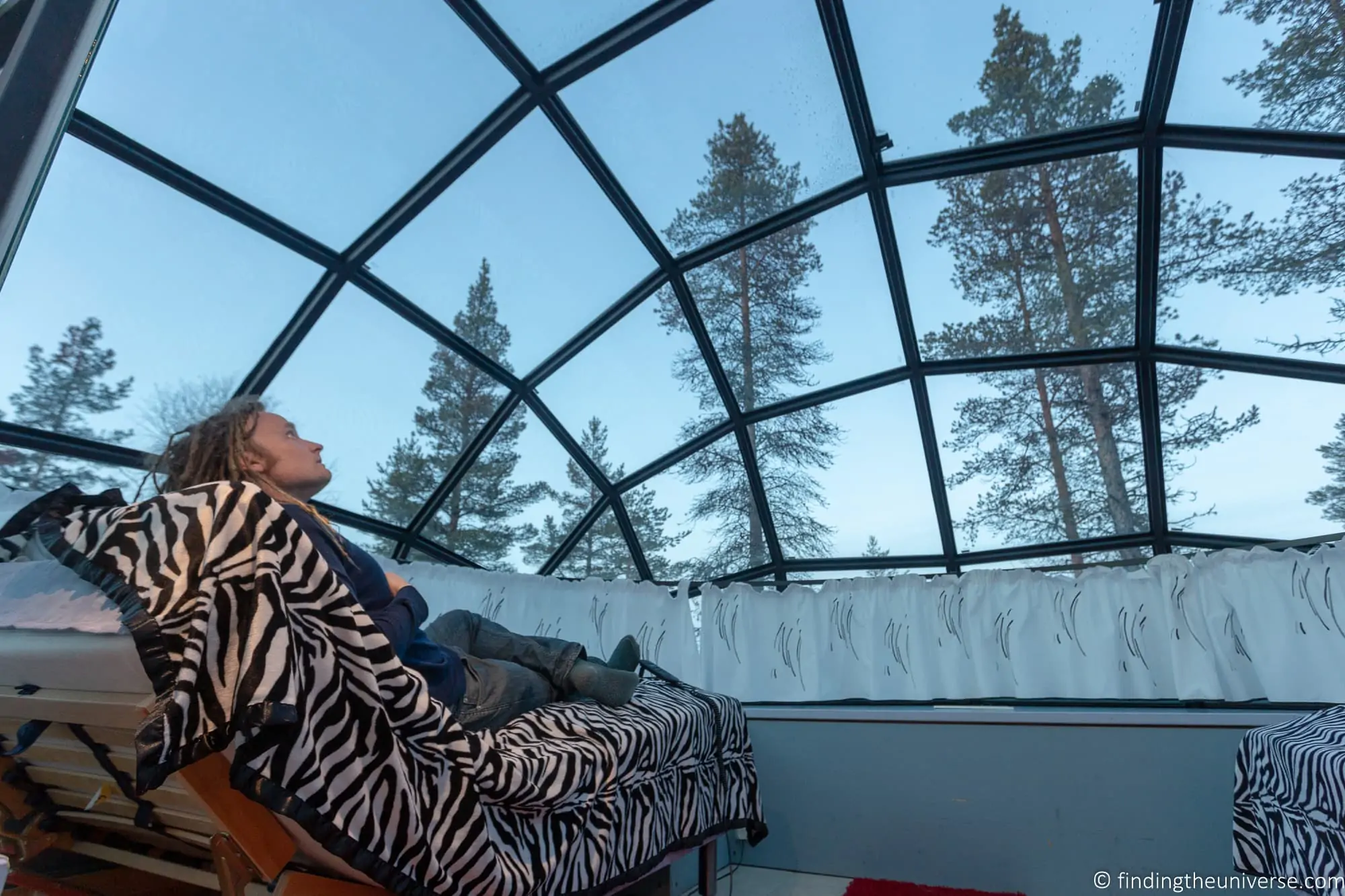
The reason most people come here is to stay somewhere with a glass roof and watch the sky from bed.

When we visited, we stayed at Kakslauttanen Arctic Resort, which is the original glass igloo hotel and probably still the most famous. I have a full review of Kakslauttanen with my full take. The short version: the glass igloo experience itself is something special, the location is remote and beautiful, and the Northern Lights from bed (when they oblige) are a memory you’ll keep for life. The longer version is that prices have climbed steeply since I stayed, and at €800-1000+ per night in peak season it’s no longer the easy recommendation it once was. There are now several alternatives in the area worth considering, particularly if budget is a factor.
Where to Stay in Saariselka / Ivalo Area
- Kakslauttanen Arctic Resort – the famous original. Bucket-list level expensive in peak winter.
- Aurora Village Ivalo – a smaller and more personal alternative we’d happily recommend; glass-roofed cabins with reindeer wandering the property and consistently strong reviews. Better value than Kakslauttanen for the same kind of experience.
- Wilderness Hotel Muotka & Igloos – well-reviewed cottages with glass-domed ceilings and private saunas
- Northern Lights Village – glass-roofed cabins with private bathrooms, on-site reindeer paddock, full activity programme
- Log House Kuukkeli – traditional log cabin guesthouse, much more affordable than the igloo options
- Saariselkä Kuukkeli Inn – good budget-oriented option in the village itself
Most of the resort accommodation in this area can arrange your activities for you (snowmobiling, ice fishing, husky tours, Northern Lights tours), which makes it an easy place to relax into for your last couple of nights.
If you have time on Day 7, consider a half-day trip up to Inari, a further 30 minutes north. The Siida museum there covers Sami culture and Arctic nature in real depth, and it gives the rest of the trip useful context. Open Tuesday to Sunday in winter, with an entry fee.
Option B: Kittilä and Levi
Kittilä is the western alternative, 150km from Rovaniemi by car (about 2 hours), or a direct flight from Helsinki via Kittilä airport (around 1h 30min). This is where you come for skiing, snowboarding, more developed infrastructure, and the Snow Village hotel.
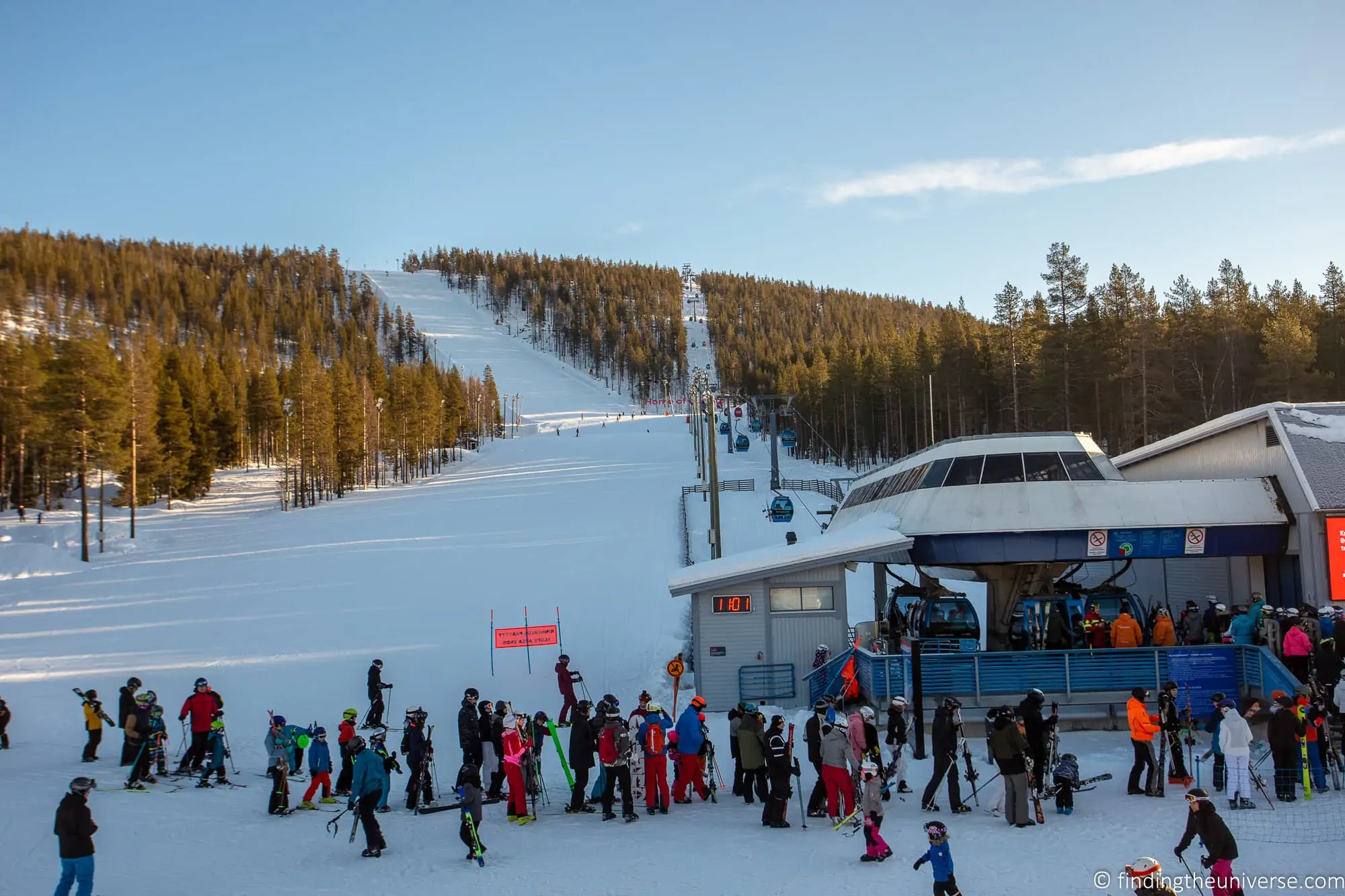
The main town here is Levi, which is built around the ski resort of the same name. It’s Finland’s largest ski area, with extensive cross-country trails, a network of slopes for downhill, ski schools, and equipment rental. If you want to fit any skiing into your trip, this is where you do it.
Beyond skiing, Kittilä is a popular base for the same range of winter activities as Rovaniemi: ice fishing, snowmobile safaris, husky sledding, snowshoeing, Northern Lights tours. The Pallas-Yllästunturi National Park nearby is also one of the better cross-country skiing and winter hiking areas in Finland.
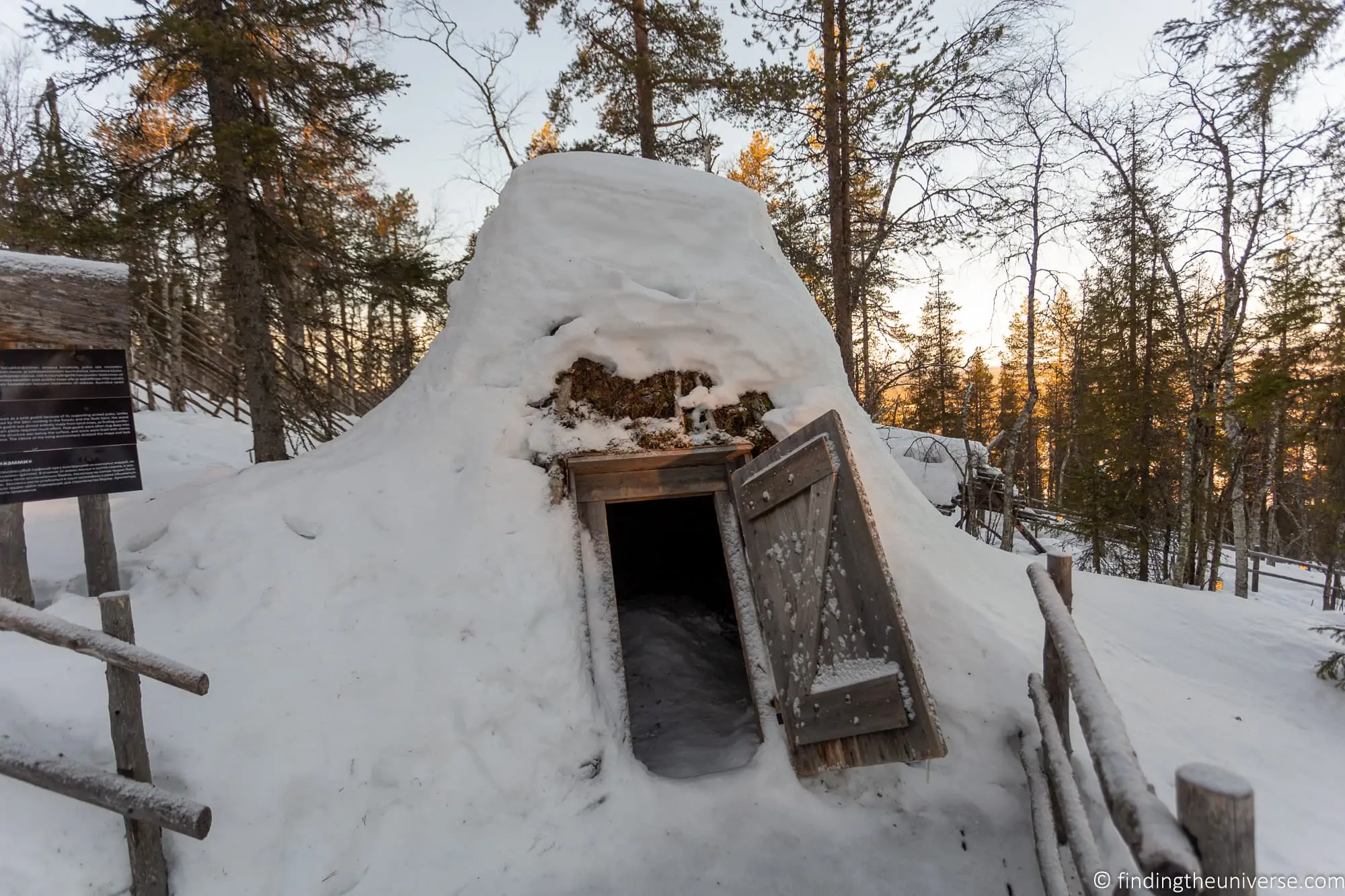
The standout overnight experience here is the Lapland Hotels SnowVillage in nearby Lainio, about 35 minutes from Levi. It’s an entire village of snow and ice rebuilt every winter (different theme each year), including a hotel where every room is sculpted from ice and you sleep in heated sleeping bags on ice beds. You can stay overnight or just visit during the day. Whether the overnight stay is “fun” or “endurance test” depends on your tolerance for sleeping in a room that’s, by definition, around minus five degrees. I’d suggest one night maximum.
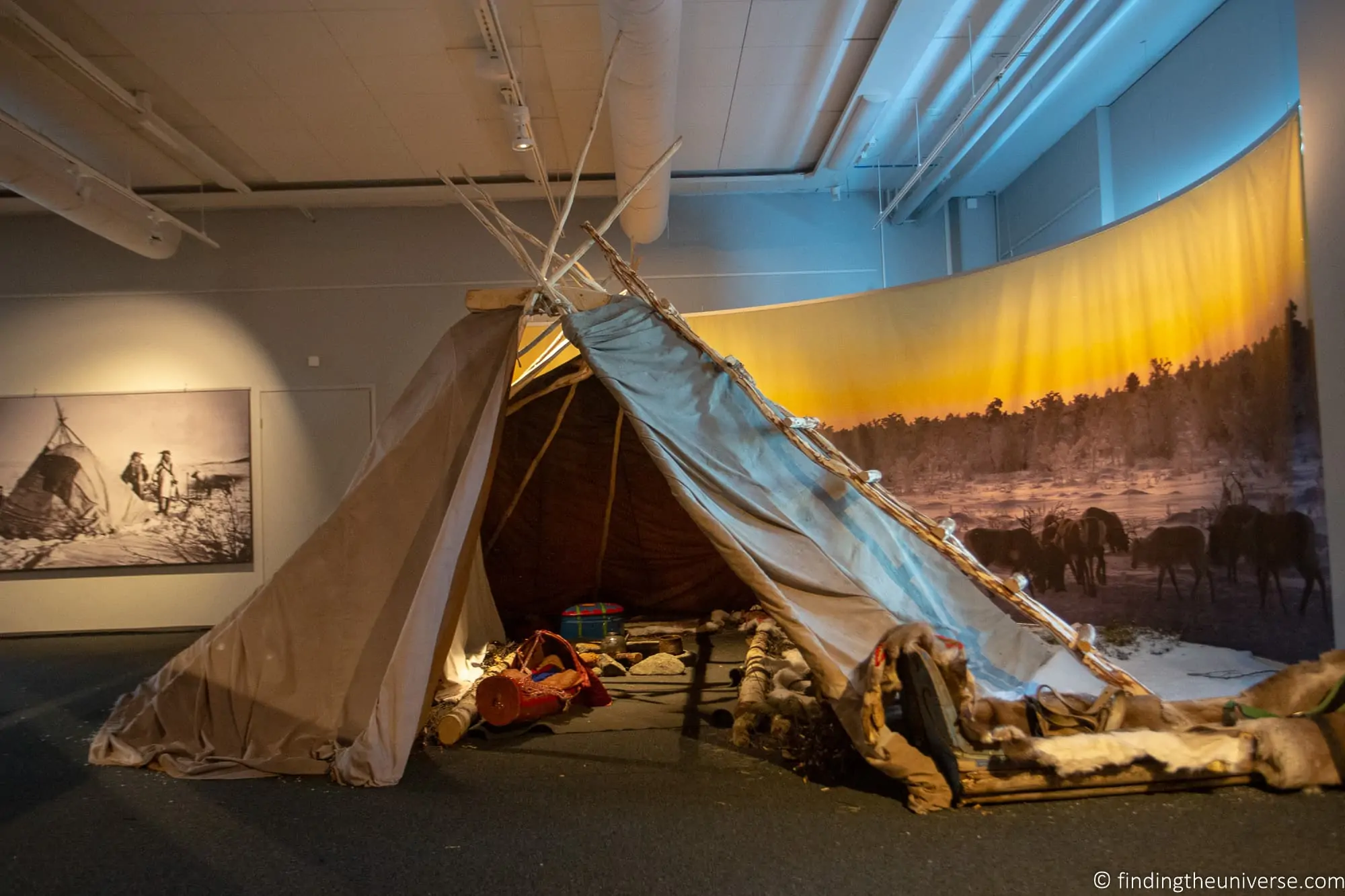
The other thing worth doing in Levi is Samiland at Levi Summit, accessible via a chairlift from the resort. It’s a small but well-curated indoor and outdoor exhibit on Sámi people, history, mythology, and traditional architecture. Worth an hour or two; small entry fee.
Where to Stay in Kittilä / Levi
- Design Hotel Levi – stylish hotel right at the foot of the Levi resort ski lifts. Best for skiers
- Lapland Hotels SnowVillage – the snow hotel itself. The bucket-list overnight option
- Golden Crown – Levin Iglut – widely considered the best glass igloo stay in Levi, perched high on Utsuvaara fell with sweeping views over Lapland
- Reindeer Manor Levi (formerly Levi Northern Lights Huts) – on a former reindeer farm, glass-roofed huts
- Hotel Kittilä – 15 minutes from the Levi ski resort, good value mid-range option
- Guesthouse Golden Goose – in the village centre, small guesthouse with on-site sauna
Heading Home
On Day 7 (or whenever you’re flying out), the practical question is how you get back. If you’re flying internationally, you’ll most likely need to connect via Helsinki, and most international routes from Helsinki leave in the morning, which can mean an extra night in Helsinki to make the connection.
This is worth flagging early because it can quietly extend the trip from “7 days in Finland” to “7 days plus a Helsinki night to catch your flight.” If you’re tight on holiday allowance, factor it in when you book.
The fastest options:
- Direct flight from Ivalo or Kittilä to Helsinki (around 1h 30min), then international connection
- Drive back to Rovaniemi, fly to Helsinki, connect
- Some carriers run direct seasonal flights from Rovaniemi or Kittilä to other European cities (Dublin, Frankfurt, Paris, Amsterdam, Barcelona, Rome and others) – worth checking your home airport’s options before defaulting to Helsinki
How Much Does a Week in Finland in Winter Actually Cost?
This is the question I get asked most often about Lapland trips, and the answer that’s usually given (a vague “it’s expensive!”) doesn’t really help with planning. So here’s a more useful breakdown, based on a 7-day trip in peak winter season (December-February), per person, sharing a double room. Excludes international flights to and from Finland.
Budget trip (€1,500-2,000 per person):
- Hostels in Helsinki and Rovaniemi, log cabin or guesthouse in Lapland
- Train (Santa Claus Express, sleeper) instead of flying internally
- One major activity (a husky tour or snowmobile safari)
- Mostly self-catering, supermarket meals, occasional restaurant
- Public transport and walking, no rental car
- No glass igloo, no Sampo icebreaker
Mid-range trip (€2,500-3,500 per person):
- 3-star hotels throughout, one night in a glass-roofed cabin
- Mix of trains and flights internally
- Two or three activities including the Sampo icebreaker
- Mix of restaurants and self-catering
- Possibly a rental car for the Lapland portion
Luxury trip (€4,500-7,000+ per person):
- Boutique hotels in Helsinki and Rovaniemi, two or more nights in a premium glass igloo (Kakslauttanen, Aurora Village, or similar)
- Internal flights instead of trains
- Four or more activities including private Northern Lights tours and the Sampo icebreaker
- Restaurant dinners throughout
- Rental car
A few notes on what’s actually expensive. The activities are the biggest line item that catches people out. Tours run €100-300 per person and they add up quickly if you do several. The Sampo icebreaker alone is now €400-500+ per person depending on pickup point. The glass igloo accommodation in peak season (especially Christmas and New Year) can hit €800-1500 per night per cabin. Restaurant meals in Lapland are expensive by European standards: expect €30-50 per person for a sit-down dinner with a drink.
Things that are reasonably priced relative to expectations: train tickets, internal flights if booked ahead, public transport in Helsinki and Rovaniemi, food at supermarkets, and beer at non-restaurant prices (this is Finland, after all, and there’s a cultural rule about making alcohol awkwardly priced in restaurants).
If you’re trying to bring the cost down, the easiest cuts are: choose the train over the plane (or vice versa, depending on which is cheaper for your dates), pick one major activity instead of three, stay in cabins rather than glass igloos, and self-cater at least some meals. Going outside the absolute peak season (so January or March rather than late December or mid-February) also makes a noticeable difference to accommodation prices.
What to Cut if You Have Less Than 7 Days
If you’ve got less time, here’s how I’d compress this itinerary.
5 days: Cut Helsinki to a single day (or skip entirely if you can fly directly to Rovaniemi or Kittilä from your home airport – some routes do this seasonally). Spend 2 days in Rovaniemi (Santa Claus Village, Arktikum, one Day 5 activity), 1 day on the Sampo icebreaker, and 1 day in Saariselka or Levi.
4 days: Skip Helsinki entirely. Fly directly into Rovaniemi if possible, or transit through Helsinki without staying. 2 days in Rovaniemi (Santa Claus Village, one major activity, Northern Lights attempt), 1 day on the Sampo, and 1 day in a glass igloo.
Long weekend (3 days): Skip the wider Lapland trip. Fly into Rovaniemi, do Santa Claus Village, the Sampo, and one major activity. Stay one night in a glass igloo if budget allows. Fly out from Rovaniemi.
The thing not to do is try to fit Helsinki + Rovaniemi + Saariselka + Levi into 5-6 days. The travel time eats your trip and you arrive home exhausted.
If You’re Visiting at Christmas or New Year
A quick warning if you’re considering the December peak. Christmas and New Year in Lapland are spectacular and sell out a long way in advance, often 9-12 months ahead for the popular glass igloo properties. Prices are at their absolute peak (often double the January rate). The Santa Claus Village is wonderful at Christmas but also the busiest it ever gets, with families from all over Europe descending on Rovaniemi.
If you’re set on a Christmas trip, book everything (flights, accommodation, the Sampo, the major activities) by March or April of the same year at the latest. Otherwise, the second half of January or early March will give you almost the same experience for around half the price and a fraction of the crowds.
Driving in Finland in Winter
A few practical points if you’re considering hiring a car.
In winter, all rental cars in Finland come fitted with studded winter tyres by law. The roads are generally well maintained and snow-cleared, including the major routes north. Petrol stations are common around Rovaniemi and the larger Lapland towns but can be sparse on the longer rural stretches; don’t let your tank get too low.

The real question is your own comfort with driving on snow and ice, in conditions where it can be dark for most of your driving day, and where reindeer or moose can wander into the road without warning. If you’re up for it, a rental car gives you proper flexibility (especially for Northern Lights chasing, where you can drive 10 minutes out of town to get a properly dark sky). If no, public transport and tours cover everything in this itinerary.
For pickup, I’d recommend hiring at Rovaniemi airport rather than collecting in Helsinki. The Helsinki to Rovaniemi drive is 9-10 hours and a long way to do in winter for very little gain. You can compare car rental prices on Discover Cars.
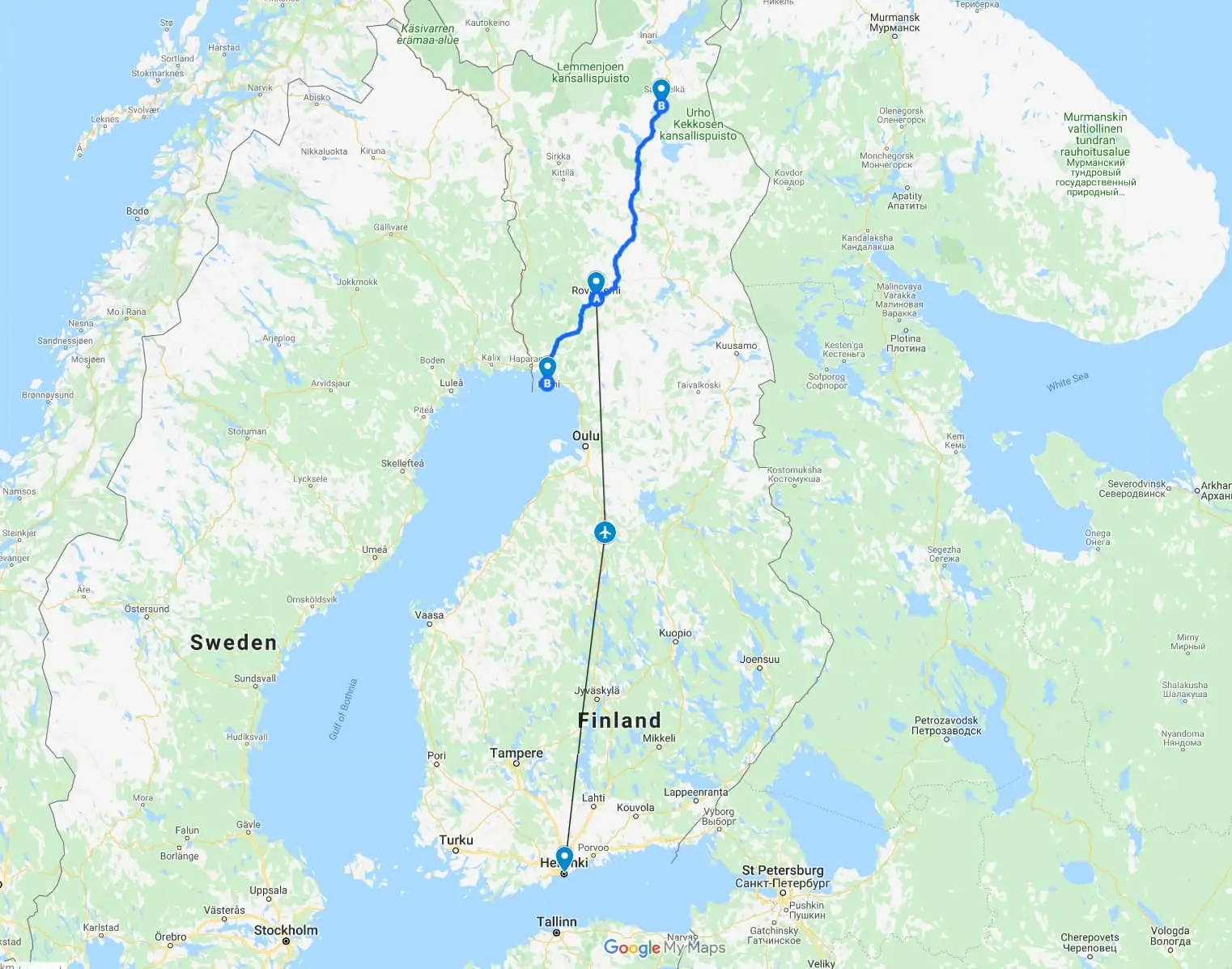
Map of the 7-Day Finland Winter Itinerary
To help visualise the route, here’s a map showing the main stops covered in this itinerary. You can also view the map on Google Maps.
Frequently Asked Questions
How many days do you need in Finnish Lapland?
For a winter trip focused on Lapland, four to five days in Lapland itself (separate from any time in Helsinki) is a good minimum. That’s enough for one full Rovaniemi day, the Sampo icebreaker day trip, an activity day, and one or two nights in a glass igloo or snow hotel further north. Less than that and you’re rushing.
If you can stretch to a full week in Finland (this 7-day itinerary), you can include Helsinki at the start without compromising the Lapland portion.
When is the best time to visit Finland for Northern Lights?
Late August to early April for visibility (you need dark skies, which Finnish summers don’t provide). For the combination of Northern Lights, snow, and winter activities, late January through mid-March is the sweet spot. December and early January have maximum darkness but also peak prices and limited daylight for activities. March gives you more usable daylight and noticeably warmer temperatures.
Can you see the Northern Lights from Helsinki?
Rarely, and not reliably. Helsinki is in southern Finland, well below the auroral oval, and has significant light pollution. To see the aurora properly you need to be north of the Arctic Circle (Rovaniemi or further north). Helsinki is a great city to visit, but don’t plan a trip there if Northern Lights are your primary goal.
Is Kakslauttanen worth it?
The glass igloo experience itself is something special and (if the aurora obliges) one of the best nights of accommodation you’ll ever have. But Kakslauttanen has become very expensive in recent years, often €800-1000+ per night in winter peak. There are now several alternatives in the same area (Aurora Village Ivalo, Wilderness Hotel Muotka, Northern Lights Village) offering similar experiences at lower prices, and many guests report similar or better experiences at these alternatives. I have a fuller take in my Kakslauttanen review.
Is the Sampo icebreaker worth it?
Yes, in my opinion, if the budget works. It’s expensive (€400-500+ per person) and a long day, but it’s also one of the more unrepeatable experiences in European winter travel. Walking on a frozen sea and floating in the Gulf of Bothnia in a drysuit is the kind of thing you’ll talk about for years.
Should I take the overnight train or fly to Rovaniemi?
Both work. The train (Santa Claus Express) saves you a hotel night and is an experience in itself; you board in Helsinki around 8pm and wake up in Lapland. The flight is faster (1h 25min) and often cheaper if you book ahead. I’d take the flight if I wanted to maximise time in Lapland and the train if I had a flexible schedule and wanted to make the journey part of the trip.
Do I need a car for this itinerary?
No. You can do everything in this itinerary using flights, the train, public buses, and tours. A car gives you more flexibility (especially for Northern Lights chasing, where being able to drive 10 minutes out of town to escape light pollution helps) but it’s not necessary, and winter driving in Finland is not for everyone.
How cold is Finnish Lapland in winter?
Cold. December to February temperatures in Lapland regularly drop to minus 20°C and can hit minus 30°C or lower in cold snaps. Helsinki is milder, generally minus 5 to minus 15°C in the same period. You need proper winter clothing: insulated boots, base layers, mid layers, an outer shell, a warm hat, gloves you can use in extreme cold. We have a full Finland winter packing guide on our sister site that goes into proper detail.
Can I visit Finland in winter without going on tours?
You can, but you’ll see less. Tours in Lapland are expensive but they’re how you access the activities (husky sledding, snowmobiling, ice fishing, the Sampo) that make the trip worth taking. Building your own ice fishing kit and finding a frozen lake on your own isn’t really an option unless you’re already an experienced winter outdoorsperson. Build at least a few activities into your budget.
Further Reading for Visiting Finland in Winter
A few more resources we’ve put together that should help with planning.
- For a deeper look at the city: things to do in Helsinki and our 1 day Helsinki itinerary
- For Rovaniemi: a full guide to things to do in Rovaniemi
- For winter activities: a comprehensive guide to winter activities in Finland
- For packing: a detailed Finland winter packing guide
- For Helsinki day trips: visiting Porvoo
- For other Finnish destinations: Iso Syote, Oulu and Rauma
- For glass igloos: our review of the original Kakslauttanen Arctic Resort
- For huskies: my account of husky sledding in the Arctic Circle
- For aurora photography: a complete guide to photographing the Northern Lights
- For summer trips: visiting Finland in summer
- For a guidebook: the Lonely Planet guide to Finland or the Insight Guides Finland
And that’s the 7-day winter Finland itinerary. As always, questions in the comments and we’ll do our best to answer.
Becky says
Do you think this itinerary would still be viable in early April?
Laurence Norah says
Hey Becky!
Great question. So the majority of winter activities in Finland are generally scheduled and bookable through to the end of April. So in theory early April would be fine. That said, everything depends on the weather and climate, so if it warms up earlier than expected there is of course a risk the snow melts earlier. The further North you go the better your chances are generally. Sorry I can’t give a definitive response, but I would say your chances are reasonably good 🙂
Have a great trip whenever you decide to go!
Laurence
Nigel says
Amazing and beautifully written
thanks for sharing!!!!!
Laurence Norah says
My pleasure Nigel, have a great time in Finland!
Edimilson says
Hello, I am considering going to Finland this year, however I can only go in the first half of December, Do you think that the weather will be snowy enough at that time for a proper winter vacation? Thank you for your post, it is very helpful and informative!
Laurence Norah says
Hi Edimilson,
This is a great question. So the further north you go in Finland, the more likely you are to get snow in December. Helsinki is less likely, but Rovaniemi and further north into the Arctic circle is more likely. However, it is not guaranteed, just likely. I can’t give you an exact chance unfortunately. The Finnish Meteorlogical website shows that there is always a white Christmas in Lapland, but as you are going earlier in December this does slightly lower your chances. I think the best option would be to go as far north as possible for the best chances.
Sorry I can’t be more definitive!
Laurence
Cyndi Puah says
may i know itinerary and the cost of the package
Laurence Norah says
Hi Cyndi,
The itinerary is laid out in the guide above, and it’s designed for people to follow themselves, it’s not a guided experience. If you’d like a guided tour of Finland, I can recommend checking out the options on TourRadar for Finland here, they have lots of tours at different prices from many operators, so you can choose one that suits your needs.
Have a great time in Finland!
Laurence
Ron says
Do you have any suggestions on extending this to Northern Norway. Perhaps a 10-14 day trip?
Laurence Norah says
Hi Ron,
You absolutely could extend this trip to Northern Norway and that would make for a wonderful adventure. However as we’ve only visited southern Norway, we don’t have any specific advice for you. We hope you have a great trip though!
Laurence
Susan says
hi, thanks for the detailed blog. do you have any contacts for local private driver that we can engaged to bring us around or see northern lights?
thanks
Laurence Norah says
Hi Susan,
We don’t have any personal contacts for drivers, however, there are plenty of operators who can drive you to see the northern lights. Here is a list of some examples. So this is definitely a service you can book! If you wanted a longer tour, over multiple days, I’d suggest checking on sites like Viator or TourRadar to see what is available.
Have a great time in Finland!
Laurence
Pearlyn says
Hi Laurence, this is really a great post that summarises what I need ! I’m planning to head to rovaniemi and lapland for 8 days ,would you recommend signing up tours from websites like nordic visitor etc? Do you have a recommended tour that covers both rovaniemi and lapland ? if the transport is included then that will really make it a lot more fuss free
Thank you !
Laurence Norah says
Hi Pearlyn!
Thanks very much! So I’ve not used Nordic Visitor before but I am aware of them and they get good reviews I believe, so that should be fine. What I would suggest is taking a look at the Finland tours on TourRadar here – they list tours from most of the companies who run tours, and you can filter by duration and price. So that should help you narrow down your options. For example, a tour like this might be an option, but there are quite a few to choose from 🙂
Have a great trip!
Laurence
Shelly says
Hi,
So I’m really interested in the ice breaker tour but if I go in Dec. would the tour be mostly be in the dark? Would we be able to see the ice and things around us?
Laurence Norah says
Hi Shelly,
Great question. So daylight hours in December are definitely limited. A great website is this one, where you can plug in a location and it will show you the sunrise and sunset times, as well as the dawk/dusk times (civil twilight).
For December it shows that you are looking at sunrise between 10am and 10.45 (depending on when in December), and sunset between 2.17pm and 2.50pm. Dawn and dusk add just under two hours to that, so it won’t be totally dark, but it will be definitely be darker.
So yes, you should be able to see the ice around you, and you will also get either a sunrise or sunset from the boat, depending on which cruise you take.
Let me know if you have any more questions!
Best
Laurence
Shelly Mcintosh says
Thank you so much! In your opinion what is the best time to go? What gives me the best chance to see the northern lights and also do all the wonderful winter activities. I was planning a trip in Nov but I see the ice breaker doesn’t start till dec and I see Dec has Limited daylight.
By the way this was by far the best blog I have come across! So useful and informative.
Laurence Norah says
My pleasure Shelly, and thanks! So we have visited Finland in December and the days are definitely quite short, especially in the northern areas. My favourite time is February, there is more guarantee of snow, the days are already a lot longer and there is still a good chance of seeing the northern lights. My best Northern lights experience was actually in February. So if that’s an option that would be my preference.
Have a wonderful trip, and feel free to ask any more questions as you plan!
Laurence
Louis says
Hi Laurence and Jessica,
This is amazing blog I have never come across. It’s so detailed and to the extend you’d brought me into Finland while reading. Phenomenal!
I am planning to make a December family trip with 3 children from age 11 to 15. Your itinerary definitely suit to my plan. I am wondering how easy of the public transportation like bus from point to point as you’ve mentioned? It’s unlike other EU countries where we can get train easily.
Laurence Norah says
Hi Louis,
Thanks very much, we’re glad you found it helpful 🙂 So the public transport is pretty easy to use in Finland. You will just want to check schedules for where you plan on going. If you are following this itinerary, then the easiest option is to take the train (or fly) from Helsinki to Rovaniemi. If you plan on going further north, you’ll need to take a bus. We’ve taken a few long distance buses in Finland and they have all been fine. Let me know if you have any more questions!
Laurence
Samir Patrawala says
Dear Laurence,
I am Sameer from Explorus Travel, India. Just read your detailed itinerary for Finland in Winter. It’s a kind of encyclopaedia for me. Amazing!
I have a question: Most of the photos on this page are clicked in daylight (they are bright, sunny pics). But what I read is that Sun almost doesn’t rise at all in Dec / Jan in Rovaniemi. So how can one get an opportunity to click such sunny and bright photos in absence of sun light / day light? Isn’t the stay experience in Dec boring and dull in absence of light? I mean how much can one enjoy darkness without good photos?
Or are your photos clicked during those two hours when there’s little day light?
Many thanks in advance.
Kind regards
Laurence Norah says
Hi Samir,
Great to hear from you! So these photos are from a few different visits, some in January and some in February. The experience of how much light there is will vary depending on where you are in Finland. In Rovaniemi, the darkest day of the year is the 22nd December, where there’s only 2.5 hours of sunlight. However, there is still sunlight. If you visit in mid-February, you get 8.5 hours between sunrise and sunset. So there is plenty of light. I would generally suggest not visiting over the very darkest days in December, but it quickly changes and the days get longer if you visit in February or even late January.
Hope this helps!
Laurence
Sameer Patrawala says
Thank you so much for your prompt and satisfactory response.
Would you recommend Northern Norway for Northern Lights in December last week or Rovaniemi Finland? I am asking in terms of maximum available day-light.
Kind regards
Sameer Patrawala
Explorus
Laurence Norah says
My pleasure 🙂
So Northern Norway is way inside the Arctic Circle. In the last week of December, or in December at all in fact, you won’t get any sunlight. You can see sunrise and sunset times for a place like Tromso in Northern Norway here: https://www.timeanddate.com/sun/norway/tromso?month=12&year=2021
Rovaniemi is on the edge of the Arctic circle, which is why you don’t get the permanent darkness. If you are looking for the northern lights, then usually the further north you go the better your chances. However, I have seen incredible displays from southern Finland too, so it’s all just a question of luck really. If you want some sunlight though, northern Norway in December might not be the best option!
Laurence
Trizzy says
Hi Laurence and Jessica,
First off, amazing and detailed itinerary! This is the type of blog I love to read when researching- keep it up! 🙂
Also, would you say early November is a good time to visit Finland and see the northern lights?
Many thanks again!
Laurence Norah says
Thank you very much Trizzy! So yes, November would be a fine month to see the northern lights. The only thing to bear in mind is that there might not be snow everywhere in early November (this changes each year of course), so if you wanted snowy landscapes as well as the northern lights, it’s something to keep in mind. Of course, there could also be lots of snow! But it’s not guaranteed.
I hope this helps!
Laurence
Jessica says
Hi Laurence and Jessica,
I am following your travel blog for a while now. Love your content and photos. I am actually planing to visit Finland later this year as soon as this quarantine is over and I have one question. Do you recommend visiting smaller cities in Finland? For example this town Sastamala – I have friend there and don’t know what to expect as it is small town and there isn’t as much information online.
Laurence Norah says
Hi Jessica!
Thanks very much. So the smaller cities in Finland are worth visiting, we have been to places like Oulu, Rauma and so on. There is usually something of interest in each town or city, and if you have a friend there they should be able to give you some advice as to what there is to do and see 🙂 So I would check with them and see what they say!
have a great trip when you get to go, and stay well!
Laurence