
I'm Laurence, a professional travel photographer since 2010. Jess and I write this site from our own travels.
Rovaniemi sits right on the Arctic Circle in Finnish Lapland, and it is the place most people mean when they say they’re going to see Santa. We’ve been in January, when the sun managed about four hours above the horizon. I went back alone in late February, when it managed nine, and the city changes character a surprising amount between the two.
Most people come in winter, so this guide starts there, with the Santa options, the activities worth paying for and what changes in December. Summer is further down, because Rovaniemi under the midnight sun is a much quieter place and still worth the trip.
Prices and opening dates in this guide were checked in October 2026, with links to the operator pages so you can confirm them before you book.
If you’re short on time, here’s the version I’d give a friend over a pint. Go in January or February if snow and aurora are the point and you don’t need Christmas week itself. Meeting Santa is free and open every day of the year, so don’t pay for a package just to see him. If you book one paid activity, make it a husky ride. And plan your outdoor hours around the light, because in midwinter there are only a few of them.
Table of Contents:
Things to Do in Rovaniemi in Winter
Rovaniemi has been a winter destination for a long time, and most of what follows needs snow. The season proper runs from late November to the end of March, with December the busiest and priciest stretch by a long way.
Visit Santa at Santa Claus Village
Rovaniemi’s most famous resident is Santa Claus. He keeps an office at the Santa Claus Village, about eight kilometres north of the city centre, and he is in it every single day of the year. We met him on a January morning, and I have to admit it was a lot of fun, elves included.
Meeting Santa at the Santa Claus Office is free. You queue, you go in, you have a chat, and nobody asks you for money unless you want the photos or video, which start at €57 for a downloadable set for up to five people. There’s no obligation to buy. The office is open 10am to 5pm or 6pm for most of the year, and stretches to 8am to 8pm from the end of November to early January.
As far as I can tell it’s Christmas all year round at the Village. The lights are on and the music is playing in the middle of July, which is either comforting or slightly unsettling depending on your tolerance for these things.
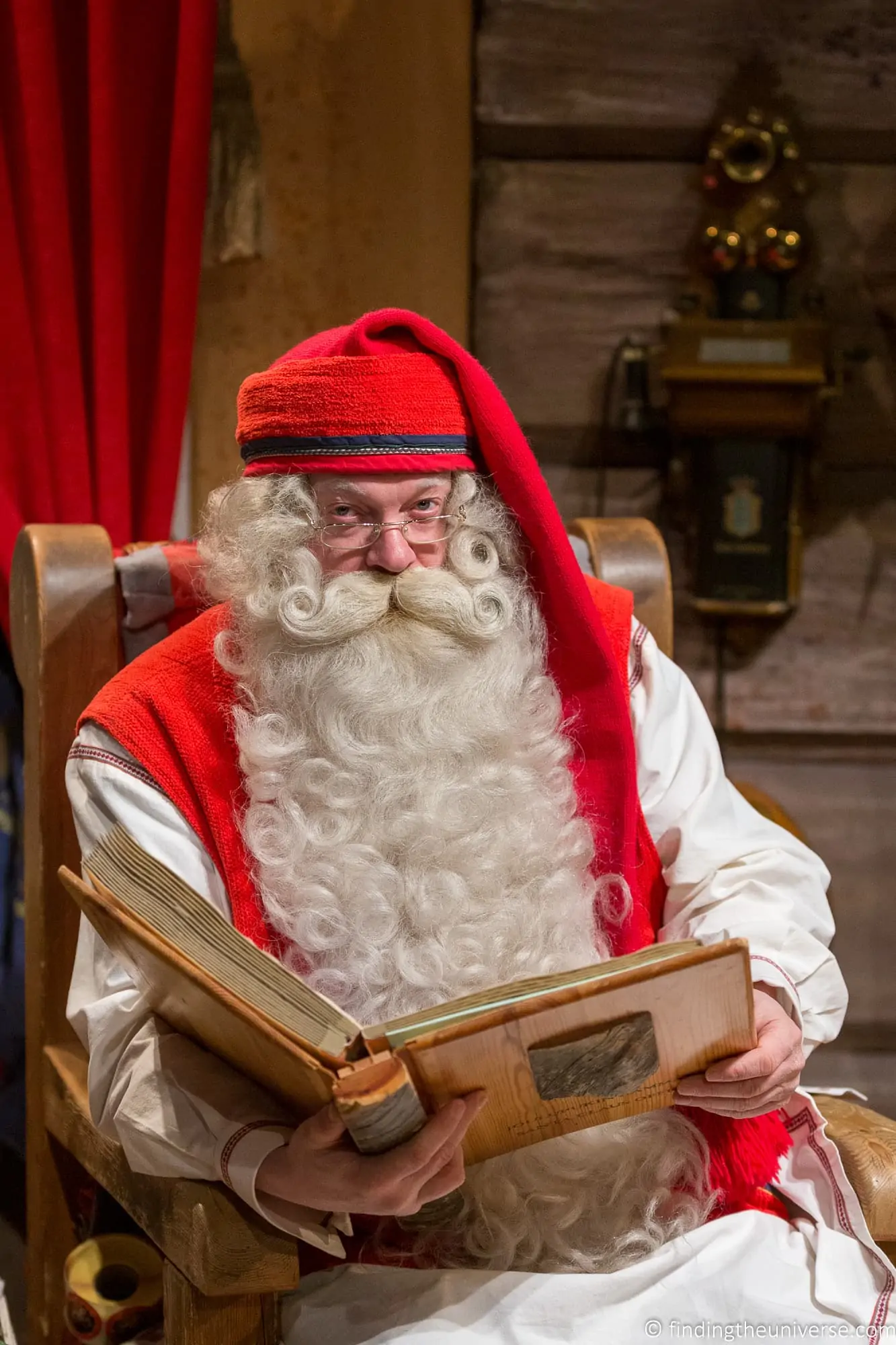
After meeting Santa, you’ll probably want to visit his post office. This is the heart of the operation, and if you write a letter to Santa, this is where it ends up.
The post office sells cards, gifts and stamps, and there were two things I really liked. First, you can order a Santa Claus letter, which Santa sends just before Christmas to any address in the world. It makes a really fun gift for a friend or relative. Second, you can write your own Christmas cards and drop them into the special red post box, and they’ll be held and mailed just before Christmas. So you can get all your Christmas wishes sent in advance!
Whichever you choose, Santa’s elves stamp it with the Arctic Circle postmark so the recipient knows where it came from.

So what else can you do at the Village? Quite a lot.
First, you can take your picture standing on the Arctic Circle line, which is painted across the central square. The Arctic Circle is the line of latitude above which you get at least one day a year when the sun never sets, and one when it never rises.
One pedant’s note: the painted line marks where the circle was in 1865. The real circle drifts north by around 14.5 metres a year as the Earth’s tilt changes, so it has crept a couple of kilometres up the road since then. Your photo will still say Arctic Circle on it, and that’s what counts.
Once you’ve had your photo, there are a few more activities on site. Availability varies by season, but you can meet Santa’s reindeer, take a reindeer sleigh ride, do a short husky ride, or go snowmobiling. In summer there are no rides, but you can still meet the huskies and the reindeer.

There’s also Snowman World, a snow and ice play park with an ice bar, slides and skating that opens for the 2026 season on 6 December and runs to 17 March 2027 (€35 per person, under twos free, weather permitting). Plus a snowmobile museum, shops, restaurants and a number of accommodation options including glass igloos.
Getting there is easy. Local bus 8 runs year round from the railway station and the city centre to the Village, and a single is €3.60 from the driver or €3.30 in the Waltti app. There’s also the Santa’s Express shuttle, and of course taxis.
Suffice to say, there is a lot to do at the Santa Claus Village, and it’s a good option as a base if you want the activities on your doorstep.
Which Santa? Santa Claus Village vs SantaPark vs a Package
This is the question that trips up more families than any other, because there are three different ways to “see Santa” in Rovaniemi and they cost wildly different amounts.
The first is the one above. There’s no charge to walk around Santa Claus Village or to meet Santa in the Santa Claus Office, which is open every day of the year. You pay only for photos, rides and food.
The second is SantaPark, which is a different thing in a different place: an underground Christmas theme park built into a cavern about a kilometre and a half from the Village, next to the Arctic TreeHouse Hotel. It’s ticketed, with an elf school, a gingerbread bakery, an ice gallery and its own Santa, and it’s seasonal.
For 2026/27 it opens on 31 October and closes on 23 January, and tickets start from €42 for adults and €37 for children aged three to twelve, plus a booking fee, with prices moving by date.
We’ve been inside, and it’s a well put together indoor half day: warm, properly themed, and the obvious choice for a wet day or a minus-25 one. If you’ve got children under about ten, it’s a good shout. You can book official SantaPark tickets here.
The third is a package. If you’re in the UK you’ll have seen the “Santa’s Lapland” style day trips and short breaks sold by the big operators, which fly you in, bus you around a private Santa meeting, a reindeer ride, a husky ride and a snowmobile go, and fly you home. We’ve not taken one. They’re a bundle, and bundles cost more than the parts, but the part you’re paying for is somebody else doing the logistics in minus 20 with a six-year-old.
| Option | Cost | Season | What you get | Best for |
|---|---|---|---|---|
| Santa Claus Village (Santa Claus Office) | Free to meet Santa; photos from €57 | Every day of the year | A chat with Santa, the post office, the Arctic Circle line, rides and shops on site | Everyone, and anyone on a budget |
| SantaPark | From €42 adult / €37 child | 31 Oct 2026 to 23 Jan 2027 | Indoor theme park: elf school, bakery, ice gallery, shows, Santa | Children under about ten; very cold or wet days |
| UK package (day trip or short break) | Premium, varies by operator and date | Late Nov to early Jan | Flights, transfers, private Santa, reindeer, husky and snowmobile tasters bundled | Families who want zero planning and don’t mind paying for it |
My call: meet Santa at the Village, which is free, and spend what a package would have cost on the activities you really want instead. Add SantaPark if you’ve got young children and a spare half day. The exception is the family who really doesn’t want to organise anything, for whom a package is a perfectly sensible way to buy their way out of the admin.
Northern Lights Watching
If you visit Rovaniemi between late August and early April, then you’re going to want to try and see the aurora borealis, also known as the Northern Lights.
The lights can be seen from all over Finland, but the further north you are, the better your chances. Being on the Arctic Circle, Rovaniemi is a very good place for Northern Lights watching, and because the city is small you don’t have to go far to escape its glow.
To see the Northern Lights, you need a few things. You need a clear sky, you need recent solar activity, and you need to be away from man-made light.
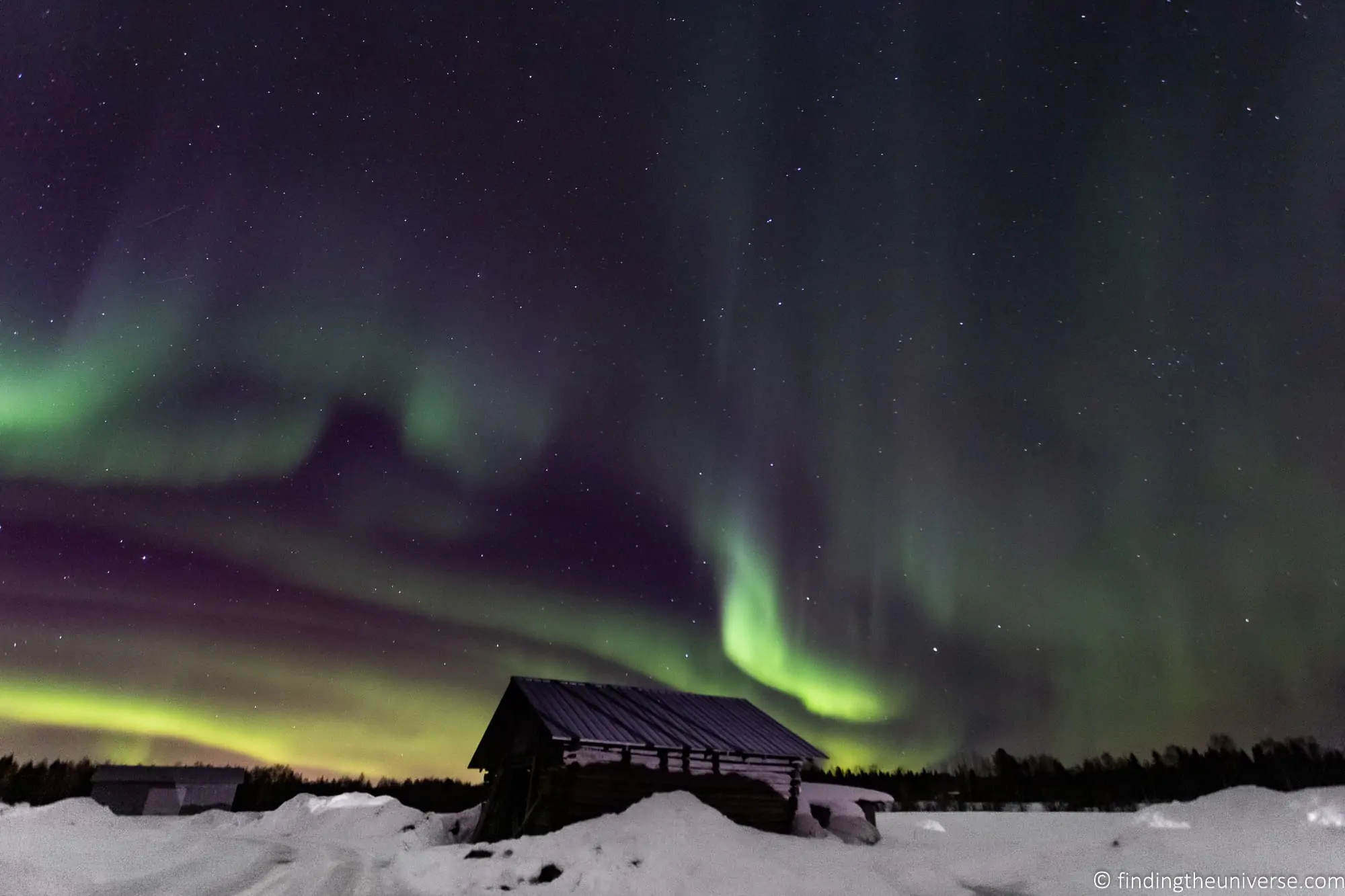
If you want to photograph the Northern Lights, you’ll also want a camera that can take long exposures, like a mirrorless camera or DSLR camera, and a tripod. I have a full guide to photographing the Northern Lights that covers camera settings and suggested equipment.
If you’re in Rovaniemi, you don’t need to go far out of the city to see the lights. The riverbank by Arktikum is a good spot, and it’s a ten minute walk from the centre. Just wrap up very warmly, as it gets seriously cold in Finland in winter. See our guide to what to pack for Finland in winter for tips on what to bring to keep you warm.
A better option is to take a tour. There are quite a few, and they should all get you to a dark viewing spot away from the city where you have an unobstructed view of the sky. Some tours include warm clothing as well.
I took a snowmobiling tour in Rovaniemi to see the Northern Lights, which was a lot of fun. Driving a snowmobile is really fun anyway, and using one to get to a good viewpoint for the Northern Lights is just a bonus.
It’s also possible to go by other means, from snowshoes to reindeer sleds. Here are some Northern Lights tours from Rovaniemi to consider.
- An ice floating tour (from around 2.5 hours, with longer combo options) where you watch for the Northern Lights whilst floating in a frozen lake in a survival suit
- A sauna, ice plunge and dinner evening where you look for the lights between rounds in a traditional wood-fired sauna
- An aurora snowmobile safari with a campfire, which is the closest thing to what we did
- A photography focused Northern Lights tour, a good option for the shutterbugs amongst you
- There are lots more Northern Lights tours from Rovaniemi to choose from, which you can see here
Another popular way to see the lights is to sleep under them in a glass igloo like these, which have a clear roof over the bed. There’s more on those in the snow hotel and igloo section below.
Whatever you choose, even on a tour, there’s no guarantee of seeing the Northern Lights. You need clear skies and solar activity on the same night, and in a cloudy Lapland winter that’s far from certain. We’ve had plenty of nights looking at cloud.
Some tours offer a free second attempt if the first is unsuccessful, but this isn’t always the case, especially for tours that combine several activities.
Snowmobiling
One of my favourite winter experiences in Finland was snowmobiling. The first place I tried it was in Rovaniemi, on a night tour to see the Northern Lights, and I’ve since taken a number of day and night tours, including during our time at Iso-Syote.
Every time I thoroughly enjoyed it, and I’m pretty sure you will too.

There’s no shortage of snowmobiling tours in Rovaniemi. Many of them bundle in other activities, like a reindeer farm visit, Northern Lights viewing, ice fishing or meeting huskies.
So the main decision is how long you want to go for, and which extras you want. We’d recommend a tour of at least two hours so you actually get to enjoy the driving.
Also bear in mind that most snowmobiles seat two, with one driving and one as passenger. A longer tour gives you both a decent turn at the handlebars, or you can usually pay a supplement for a snowmobile to yourself.
Here are some options to consider.
- A 2 hour tour which focuses on the snowmobiling itself, and is a good introduction
- A husky and reindeer experience with a snowmobile ride, a good way to tick off a lot of activities in one go
- A longer tour which includes snowmobiling, ice fishing, a campfire and lunch
Note that snowmobiles generally can’t be driven by anyone under 15, and there are restrictions on children as passengers too. If you’re travelling as a family, check the tour allows children, like this one.
Alternatively, the Snowmobile Park at Santa Claus Village runs short safaris from the Village itself and has a mini snowmobile track for younger children.

Husky Sledding
Next on the winter list is another of our favourites, husky sledding.
Huskies are a very energetic breed. They love to run, and with the right training they work in teams to pull sleds across the snow, which is how subarctic communities got around for centuries.

We’ve been husky sledding a number of times in Finland, and I’ve written all about my experience dog sledding in Lapland here.
In Rovaniemi there’s no shortage of husky operators. The company I’ve used and can recommend is Bearhill Husky. They get very good reviews and care a great deal about the welfare of their dogs, which you’ll notice within about a minute of arriving. Their winter season runs from 16 November 2026 to 4 April 2027, and they offer a range of tours, including:
- Running with the Pack, a 5 km husky ride plus a kennel tour, with around two and a quarter hours at the kennel including time to meet the dogs. Great for families or anyone wanting a first taste of husky sledding.
- Longer, adults-only safaris on the Bearhill Husky site that take you further into the forest.
There are also a number of other husky operators in and around Rovaniemi. Here are some other options.
- A husky trek that includes time at the kennel and professional photos of you on the sled
- This evening tour which combines a husky ride in the forest, a hunt for the Northern Lights and a Lappish barbecue with hot drinks
- This 2.5 hour tour from Rovaniemi which includes both a husky sled ride and a reindeer sleigh ride
Hopefully one of these works for you. Husky sledding itself is a winter activity, but you can usually meet the huskies year round.

Ice Fishing
A popular pastime in Finland in winter is ice fishing. You drill a hole through a frozen lake and use a short ice fishing rod to try and catch what’s living underneath, with perch and pike being the two you’re most likely to meet.
We went ice fishing in Finland, and whilst we didn’t catch anything, we did have a great time learning the process, drilling our little ice holes, and drinking large quantities of hot coffee to stay warm.

The Finns are very keen on their right to roam, and ice fishing is classed as a public access right, so anyone can do it without a licence. All you need is an ice drill, a rod, and plenty of warm clothing.
In theory you could rent the kit and walk out onto a frozen lake. We’d advise against it. Frozen lakes are a hazard if you don’t know how to read them, and a tour is the safe way to do this.
A number of companies from Rovaniemi offer ice fishing, and as with everything on this page, some of them combine it with other winter activities. When we went, it was as part of a snowmobile tour.
Here are some ice fishing tours from Rovaniemi to consider.
- This 3.5 hour tour which focuses on ice fishing, with a campfire on which your fish gets cooked if you catch one
- This 4 hour tour which includes both snowshoeing and ice fishing, with a campfire and snacks
- This 3 hour tour is a small group trip with equipment, hotel pick-up and a campfire barbecue of grilled sausages and hot juice
- There are also snowmobiling tours with ice fishing, for example this snowmobile and ice fishing day
As you can see, there’s no shortage of ice fishing options in Rovaniemi.

Sauna and Ice Swimming
Whatever time of year you visit Rovaniemi, you’ll want to try a Finnish sauna, but winter is when it earns the drama.
The sauna is pretty much at the heart of Finnish life. It’s a social activity and a cultural institution, and the tradition is believed to go back thousands of years.
Historically, the sauna was the first part of a Finnish home to be built. This was quite practical if you think about it. Saunas are warm, you can use them for washing, and they were a clean place for giving birth.

Saunas today aren’t used for quite all of that, but they’re still a central part of Finnish life. There’s estimated to be one sauna for every two Finns.
There are a number of ways to have a sauna in Finland. Most likely your accommodation will have one, so that’s the easy option.
For the brave, a winter Finnish sauna also includes a dip in a frozen lake between rounds. We’ve done this, and can confirm it is both rejuvenating and cold.
If that sounds like fun, this tour from Rovaniemi includes a traditional sauna, ice swimming and a Lappish dinner. If you’re lucky, you might even see the Northern Lights.
Snow Hotels and Glass Igloos
Rovaniemi is one of the easier places in Lapland to sleep in something built out of snow, or under a glass roof with the aurora overhead. I’ve done both, and I’ve written about the glass igloo experience in detail in our Kakslauttanen Arctic Resort review, and about how to fit these stays into a trip in our one week Finland winter itinerary. Here’s the short Rovaniemi-specific version.

A snow hotel is rebuilt every winter, the rooms sit at around minus five, and you sleep in an expedition sleeping bag on reindeer hides. It’s colder than you expect walking in and warmer than you expect once you’re zipped up. Most people do one night and are glad they did it, and equally glad it was one night.
- Arctic SnowHotel & Glass Igloos is about 30 minutes from Rovaniemi. The snow hotel opens on 15 December 2026 and runs to the end of March, and the glass igloos are open from September to the end of March. If you don’t want to sleep there, you can visit during the day for a look round (€35 adult, €17 child), or take this tour from Rovaniemi which includes the snow hotel visit and dinner in the ice restaurant.
- Apukka Resort is 15 minutes from the city and is first and foremost a glass igloo and aurora cabin resort, with an ice cabin offered in winter as an add-on night for guests staying in one of the warm rooms. Good restaurant, and activities run from the resort.
- Kätkävaara Aurora Apartments and Igloos, about an hour’s drive away, has glass igloos year round and builds proper snow igloos in winter. I’ve slept in a snow igloo, and it’s a similar experience to a snow hotel but somehow cosier for being a structure of your own.
- Santa’s Igloos Arctic Circle at the Santa Claus Village are chalet-style rooms with a glass igloo sleeping area, and the Glass Resort, also in the Village, has floor to ceiling glass in every room.

One thing to be realistic about: a glass roof helps you see the aurora from bed only if the aurora turns up, and the roof frosts over on the coldest nights. Book the igloo for the experience, and still go out and look up.
Korouoma Canyon and the Frozen Waterfalls
Korouoma is a 30 km canyon around 115 km from Rovaniemi, and in winter its waterfalls freeze into walls of blue ice that make it Finland’s best-known ice climbing site. For the rest of us, the 5 km Koronjää circular trail from the Saukkovaara car park takes you down into the canyon.
The drive, the kit and the forest in minus 15 are a lot to organise yourself, so we’d do it as a tour. For example, this is a full day tour to the frozen waterfalls with transport from Rovaniemi.
Ranua Wildlife Park
Ranua isn’t in Rovaniemi, but it’s about an hour’s drive south and it’s where you go to see the Arctic animals you won’t meet on a snowmobile track.
The park is home to Finland’s only polar bears, plus around 50 other northern species including brown bears, wolves and reindeer, and it’s open every day of the year. Winter is a good time to visit, as this is when a lot of the residents are in their element.
Ranua Wildlife Park is open 10am to 4pm from September to May and 10am to 6pm in summer. Adult tickets are €26.50 at the gate or €24.50 online, with children four to fourteen at €22 or €20, and a family ticket for two adults and their children at €80 or €74. There are buses from Rovaniemi that stop right by the park. Alternatively, there are tours from Rovaniemi such as this one which includes transport, entry and lunch.
Things to Do in Rovaniemi Year Round
Before I get carried away with the winter, I do want to be clear that there’s a good deal to do in Rovaniemi whatever the month. The museums in particular are far better than a city of this size has any right to.
Arktikum
First of these, and the one I’d put at the top of any list, is Arktikum. It’s both a museum and a science centre, and the building itself, a long glass arcade pointing north out of the hillside towards the river, is worth the walk on its own.

There are a number of exhibitions. Northern Ways tells the story of the people and history of Lapland, and of the animals and landscape of the region. Arctic Change looks at life in the most northerly region of the world and the pressures on it, from climate change to globalisation. There are temporary shows too, and a café.

Arktikum is open all year. From March to November it’s closed on Mondays, and from December to February it’s open daily, with the exception of Christmas Eve. Current opening hours are here. Admission is €22 for adults, €10 for children aged seven to seventeen, and €54 for a family of four, with under sevens free.
If you plan to visit both Arktikum and Korundi, the Rovaniemi Culture Pass covers the two for €30 and is valid for seven days from your first visit. You can buy it at either museum or online.
If you’re visiting more of Finland, including Helsinki, you might instead want the Finland Museum Card (Museokortti). It’s €86, covers 360 museums across the country, and is valid for twelve months from your first museum visit. Arktikum, Korundi and the Forestry Museum of Lapland are all on it, so it covers every museum in Rovaniemi you’re likely to want.
Korundi House of Culture
If you’d like some art whilst you’re in Rovaniemi, then head for the Korundi House of Culture, a converted 1930s post bus depot that is one of the few buildings in the city to survive the war.
It’s home to two institutions, the Lapland Chamber Orchestra and the Rovaniemi Art Museum. The orchestra performs across Finland and abroad, and naturally at Korundi, so if you’d like some live orchestral music while you’re in town, their schedule is on the site.
The art museum is the main one in Rovaniemi. It focuses on Finnish contemporary art and on art from the northern latitudes, and holds one of the best collections of Finnish contemporary work anywhere, with over 3,000 pieces.
The museum is open Tuesday to Sunday, 11am to 6pm, and closed Mondays. Admission is €13 for adults and €7 for children aged seven to seventeen, and it’s included on both the Culture Pass and the Museum Card.
Rovaniemi’s Architecture
Lovers of architecture will enjoy Rovaniemi. The city was almost razed to the ground at the end of World War 2, and out of that destruction came a new city plan.
Many of the buildings you see today were designed by Alvar Aalto, Finland’s best known 20th century architect. He laid out the post-war street plan in the shape of a reindeer’s head (the stadium is the eye, if you look at a map) and was responsible for the Aalto Centre, which includes the City Hall, the City Library and the Rovaniemi Theatre.

Other buildings worth a look are Arktikum, designed to represent the Arctic itself, Korundi, the timber Pilke House next to Arktikum, which holds the Rovaniemi offices of Metsähallitus, the Finnish forestry agency, and housed its forestry science centre until October 2026, and the Lumberjack’s Candle Bridge over the Kemijoki, which is lit at night to look like the traditional split-log torch it’s named after. We also liked Rovaniemi’s church.

You can do a self-guided architecture walk. Just visit the Rovaniemi tourist information office on Lordi’s Square in the centre of town for a map.

Where to Eat in Rovaniemi
All of these activities are bound to make you hungry. The good news is that Rovaniemi has plenty of places to eat, and the local ingredients, reindeer, Arctic char, cloudberries and the like, are the point of most of them.

There are quite a few options, but here are a few we’d suggest.
- Cafe & Bar 21 specialises in savoury and sweet waffles, and I found the food here good value and really tasty
- Pure Burger is the place to come if you want a burger whilst you’re in Rovaniemi, with a reindeer burger on the menu for the full Lapland experience
- Hostel Cafe Koti is a hostel, but the café and lunch buffet here are very good and great value too
- Rakas, in the main building of the Arctic TreeHouse Hotel next to SantaPark, is the one to book for a proper Lappish dinner of local ingredients
Another popular food activity in Finland is foraging for berries and mushrooms. This is something you’ll want to do with an expert, as picking the wrong mushroom can be fatal.
If you’re interested, tours such as this one run in the summer months and have you out in the woods gathering food, then eating it, with a sauna thrown in.
Visiting Rovaniemi at Christmas
My two visits were in January and February rather than December, so this section is planning advice from the operators’ own calendars rather than a report from Christmas week. It’s the fortnight most of you are asking about, so here’s what it looks like on paper.
Everything is open. SantaPark is in season from 31 October to 23 January, Snowman World opens on 6 December, the Arctic SnowHotel opens on 15 December, and Bearhill’s husky season starts on 16 November, with their family tours from 30 November. The Santa Claus Office runs its longest hours of the year, 8am to 8pm every day from 30 November to 3 January, Christmas Eve and Christmas Day included. Arktikum is open daily through December with one exception, Christmas Eve, when it’s closed.
It’s also the most expensive and most crowded fortnight of the year. Rooms in the two weeks around Christmas cost far more than the same bed in March, flights fill months out, and the popular tours sell out, so if you’re set on Christmas week, book the accommodation and the one or two activities you really want as early as you can. The queue for Santa is longest in the middle of the day. Go first thing or in the last hour.
If you want a Christmas market, Rovaniemi’s traditional one is a single weekend, 5 and 6 December 2026, at the Santasport sports institute rather than in the city centre. The Santa Claus Village has its own Christmas opening event in the run-up, and on 23 December Santa formally sets off from the Village on his rounds, which is the event the local tourist board builds the week around. Dates for both are on Visit Rovaniemi’s Christmas events page.
On snow: December usually has it, but it isn’t guaranteed, and early December in particular can be thin. If snow is the whole point of the trip, January and February are the safer bet, which brings me to the next section.
January vs February: Deep Winter First-Hand
My two Rovaniemi visits, the first with Jess and the second on my own, were in the middle of January and at the very end of February, and if you’re choosing between the post-Christmas months, the difference between them is bigger than it looks on a calendar.
In mid-January the sun rises a little after 10am and sets around half past two, which is about four and a quarter hours of actual sun. It never gets high. It skims the tops of the trees, the light is gold then pink then blue for the whole of the afternoon, and by 4pm it’s dark.
The cold is the real thing, with daily averages around minus 10 to minus 12 and nights that go well below minus 15, and the snow is deep enough for everything to run. The Christmas crowds have gone home, the prices have dropped back, and the Village feels like a village again. For aurora watching, the long nights are an advantage.
By the last week of February you have well over nine hours of sun, from before 8am to after 5pm, and the day length grows by about seven minutes every single day through this period. It’s just as cold on average, often colder at night, but you can do a morning activity and an afternoon activity and still have light left over, which in January you simply can’t.
The snowpack is at its deepest in late February and March, so this is the best time for the long husky and snowmobile trips. The trade-off is shorter, lighter nights for aurora hunting, though still plenty dark enough.
If I had to pick one for a first visit, I’d pick late February. If I had to pick one for photographs, I’d pick January, because that low light is unlike anything you get further south. Both are a lot cheaper and calmer than December.

Planning Your Day Around the Light
This is the section I wish someone had given me before our January trip. Rovaniemi’s winter day is short, but the couple of hours of sun come wrapped in a long, deep twilight, and if you plan for the twilight rather than the sun you get far more out of each day.
| Date | Sunrise | Sunset | Sun up | Usable light (civil twilight) |
|---|---|---|---|---|
| 21 December | 11:07 | 13:22 | 2 h 14 min | 09:16 to 15:13 (about 6 h) |
| 15 January | 10:19 | 14:34 | 4 h 15 min | 08:56 to 15:57 (about 7 h) |
| 25 February | 07:48 | 17:13 | 9 h 25 min | 06:54 to 18:07 (about 11 h) |
Those are the 2026/27 figures from timeanddate.com, and they move by a minute or two from year to year.
Here’s how I’d use them. Put the thing you most want to see in daylight, which for most people is the husky ride or the reindeer farm, in the sun window, and book it for the earliest slot that starts after sunrise. In January that means a late morning start, not an 8am one.
Do the museums, SantaPark and Snowman World in the dark hours, since they’re indoors or lit anyway. Keep the hour after sunset free, because that’s the best light of the day for photographs: the snow goes blue, the sky goes violet, and the Village lights come on while there’s still colour in the sky. And eat late, because dinner is the one thing that doesn’t care whether the sun is up.
For the aurora, you want full dark, which in January is any time after about 5pm, and you want to be away from the city. The lakeside by Arktikum is the easy option on foot. Anything further out needs a car or a tour. Check the forecast, dress for standing still rather than walking, and give it a couple of hours rather than twenty minutes. Our full guide to photographing the Northern Lights covers the camera side.
Free, Cheap and Splurge: What to Actually Book
Rovaniemi’s activity menu is long and almost all of it is priced per person, so a family of four can burn through a lot of money in two days without trying. Happily, the best free things here are really good, and you only need one or two of the expensive ones.
| Tier | What | Rough cost per person |
|---|---|---|
| Free | Meeting Santa at the Santa Claus Office; the Arctic Circle line; walking the river and the Lumberjack’s Candle Bridge after dark; aurora watching from the Arktikum shore; the Christmas market weekend | €0 |
| Cheap | Bus 8 to the Village; Arktikum; Korundi; the Culture Pass for both; Snowman World; a day visit to the Arctic SnowHotel; SantaPark | €3 to €45 |
| Splurge | Husky sledding; snowmobile safaris; reindeer sleigh rides; ice floating; guided aurora tours; the frozen waterfalls day | Roughly €100 to €250 |
If you only book one, book the husky ride. It’s the activity people talk about on the flight home, and the short family versions are enough to get the point.
If you book two, add a snowmobile safari, because it covers ground the dogs can’t and doubles as an aurora hunt if you take the evening one. A reindeer sleigh ride is lovely but slow and short, so I’d take the one bundled into a farm visit or the Village rather than booking it on its own.
When to Visit Rovaniemi
The main question is what sort of trip you want.
If you’re after a snowy adventure with Northern Lights, husky sledding and snowmobiling, then you want winter. Snow is possible from October through to April, and you’ll want to visit between late November and the end of March for the best chance of a proper snow cover, with the deepest snow in February and March.
Daily average temperatures in December, January and February sit around minus 8 to minus 12, nights are commonly below minus 15, and cold snaps go a good deal lower than that, so pack properly.
If you’re choosing between December and the quieter months after it, the Christmas and January vs February sections above cover the trade-off. March is bright, snowy and underrated.
The Northern Lights season runs from late August to early April, so autumn and early winter count too, with the bonus in September and October of open water, no snow and far lower prices.
If you want the midnight sun, outdoor museums, hiking and time on the river, then come in summer, which runs from June to early September. It’s very green, the mosquitoes are real, and you’ll have the Village almost to yourself.
Rovaniemi in Summer
Summer in Rovaniemi is a quieter, greener and much cheaper place, and the main event is the light.
The Midnight Sun
From roughly 7 June to 6 July the sun doesn’t set in Rovaniemi at all. Either side of those dates it dips below the horizon for a short while, and it never gets properly dark from late May into August. You can watch sunset and sunrise within minutes of each other, which is pretty cool, and the long low light is lovely for photography.
The one downside is sleep. Not every place you stay will have blackout blinds, and if you find it hard to sleep in a bright room, bring an eye mask. We love our eye mask from Manta Sleep, which is the only one we’ve found that is both comfortable and blocks all the light, though there are lots more options online.
Forestry Museum of Lapland
If you prefer your museums outdoors, the Forestry Museum of Lapland is 3.5 km from the centre and open through summer and early autumn, roughly June to October, with visits by arrangement in winter.
It tells the story of forest work in Finnish Lapland through a collection of buildings and equipment from the logging camps, and what’s particularly nice is that you can go inside all the buildings to see what they were for. Admission is €10 for adults and it’s on the Museum Card.
On the Water
Once the rivers thaw, you’ll want to spend some time on them. You can take a sauna boat cruise, which gets you two Finnish experiences in one, or take a fishing trip for pike and perch on the nearby lakes, or go canoeing and visit a reindeer farm.
Snowmobiling isn’t possible in summer, obviously, but you can go quad biking on a tour like this, which is also a lot of fun!
Hiking and Cycling
I’ve listed this under summer, but with snowshoes or a fat bike you can do both in winter as well. For most people though it’s a warm-weather activity, if only because you don’t need to prepare for the cold quite so carefully.
There are lots of trails close to the city. A popular option is the Koivusaari nature trail on Koivu island, an easy walk and a nice way to see some local wildlife, especially birds. Further out, Pyhä-Luosto National Park is within a 90 minute drive and has proper fell walking, as well as the amethyst mine, which is open year round, and skiing in winter.
Where to Stay in Rovaniemi
Rovaniemi has a wide range of accommodation, and we’ve stayed in both hotels and apartment rentals in the city.
The snow hotels and glass igloos are covered above, so this list sticks to the more conventional options, ordered roughly from budget to more expensive.
- Hostel Cafe Koti is known for its café, and is also a central and very well rated hostel with its own sauna and kitchen, and both private and dormitory rooms.
- Santa’s Hotel Santa Claus is a well rated mid-range hotel in the centre of Rovaniemi with three restaurants on site.
- Arctic Light Hotel is a well rated boutique hotel in the middle of town, with a range of room types including some with private saunas. Breakfast is included.
- Arctic TreeHouse Hotel is just outside the Santa Claus Village, next to SantaPark, with glass-fronted cabins set into the hillside among the pines. The rooms look out over the forest and the night sky, and Rakas, one of the better restaurants in Rovaniemi, is in the main building.
Hopefully that gives you a good idea of what’s available. We can also recommend seeing what’s available on Vrbo in the city if you’d prefer an apartment, which is what we did on one of our visits.

How to Get to Rovaniemi
Rovaniemi is well connected and fairly easy to get to, both from inside Finland and from elsewhere in Europe.
By plane, you can fly directly to Rovaniemi from Helsinki several times a day, year round, and the flight is around an hour and a half.
In winter there are also direct flights from more than 20 European cities. From the UK that includes London, Manchester, Birmingham, Bristol, Liverpool, Edinburgh and Belfast, with a new easyJet route from Newcastle starting on 25 November 2026, and there are direct winter flights from Ireland, Belgium and Turkey as well. Most of these are seasonal, running from late November into the new year. You can check flight times and prices and book online here.
If you’re already in Finland, the train from Helsinki is the romantic option. VR, the national rail company, runs the overnight Santa Claus Express, which leaves Helsinki in the evening and arrives in Rovaniemi the next morning after around twelve hours, with private sleeper cabins. Daytime trains do it in a little over eight. You can see timetables and book here.
Finland also has a good long-distance bus network, and you can reach Rovaniemi by bus from a number of cities. Check times and book tickets here.
Finally, you can drive. From Helsinki it’s around nine and a half hours, which given the winter roads is a long day. If you want a car in Rovaniemi, we’d generally fly or take the train up and then rent one locally. You can compare car rental prices on Discover Cars here.

How to Get Around Rovaniemi
Despite its city status, Rovaniemi is not very big, and the centre can easily be walked.
Many of the attractions though, the Santa Claus Village above all, are a little out of town, so you’ll need a bus, a taxi, a tour pick-up or a car to reach them.
The local bus network is called Linkkari, and line 8 runs year round from the railway station through the centre to the Santa Claus Village and the Arctic Circle. A single is €3.60 from the driver, by cash or contactless, or €3.30 in the Waltti app, where a 24 hour ticket is €9. Timetables are here. There’s also a dedicated Santa’s Express shuttle to the Village in season.
We aren’t aware of any ride sharing services in Rovaniemi, but there are several taxi firms, including Lähitaksi and Taksi Rovaniemi, and the tourist board lists their numbers.
If you rent a car, be aware that most of central Rovaniemi has parking charges, and some places require a parking disc, so pay attention to the signs.
What We’d Change Next Time
A few things from our own two winters that I’d do differently, and that I’d suggest you plan around.
Book the husky ride for daylight. On our January trip the light was gone before the afternoon slot got going, and husky photos in the blue hour are atmospheric but mostly dark. Take the first slot after sunrise and keep the evening for the aurora instead.
Don’t try to do Santa, a tour and an aurora hunt in one January day. Four hours of sun means one daylight activity, and the Village deserves a couple of hours on its own. Give it its own afternoon, and arrive in time for the lights coming on.
Spend at least one night outside the city. The aurora from the Arktikum shore is fine, but a night at a resort or an igloo out in the dark, with nothing to do but look up, is a different proposition, and if you only get one clear night, you want to be somewhere it counts.
And bring the tripod. Every time I’ve left it behind to save weight I’ve regretted it on the first clear night.
Tours from Rovaniemi
Throughout this post we’ve recommended a number of tours. Here’s a summary of some of them for convenience.
- A photography focused Northern Lights tour, a good option for the shutterbugs amongst you
- A 2 hour snowmobiling tour, a good introduction to snowmobiling
- A longer snowmobiling tour with ice fishing, a campfire and lunch
- Official SantaPark tickets and Snowman World entry, for the Christmas-season crowd
- A quad biking tour, perfect for visiting Rovaniemi in summer
- A 3.5 hour ice fishing tour
- A short husky sledding tour with our recommended husky company, for those wanting a taster
- A food foraging tour for those who want to get out into the woods and learn to source their own food
- A tour which includes a Finnish sauna, a swim in a frozen lake and a Lappish dinner
- A canoeing tour combined with a visit to a reindeer farm
That should give you plenty to do when you visit Rovaniemi.
Frequently Asked Questions About Visiting Rovaniemi
Is Rovaniemi worth visiting in December?
Yes, if Christmas itself is the point of the trip. Everything is open, the Village is at full tilt, SantaPark and Snowman World are in season, and the atmosphere is exactly what you’d hope for.
The price you pay is a literal one. The two weeks around Christmas are the most expensive and the most crowded of the year, and snow isn’t guaranteed in early December. If you want the winter without the Christmas premium, January or February give you deeper snow and far fewer people, and Santa is still there.
Is 2 days in Rovaniemi enough?
Two full days is enough for the essentials: Santa Claus Village on one, a husky or snowmobile tour and Arktikum on the other, with an aurora attempt on both evenings.
In midwinter, with only a few hours of light, three days is more comfortable, and if you want a night in a snow hotel or igloo as well, plan on three or four.
Will it snow in Rovaniemi in December?
Usually, but not reliably in the first half of the month. Snow cover normally builds from late November, and by Christmas week there’s almost always snow on the ground, but early December can be thin or patchy in a mild year.
If snow is the whole point, January to March is the safer window. February and March have the deepest snow of the winter.
What is the best month to visit Santa Claus Village?
December, if you want the Christmas atmosphere and don’t mind the crowds and the prices. The Village runs its longest hours and all the seasonal attractions are open.
For a calmer visit with snow, go in January or February. Santa is in his office every day of the year, meeting him is free, and the queue is a fraction of the December one. Summer visits are quiet and green, with no rides but the huskies and reindeer still there.
Is Santa’s Lapland worth the money?
For most families, no, unless the thing you’re really paying for is having no planning to do. The UK package day trips and short breaks bundle flights, transfers and short tasters of the Santa meeting, reindeer, huskies and snowmobiles, and you’re paying a premium for somebody else to run the day for you in minus 20 with small children.
Doing it yourself is cheaper. Meeting Santa at the Village is free, and one or two tours booked directly give you longer, better versions of the same activities. If you want zero planning, a package is a reasonable way to buy that. If you’re happy to book a hotel and two tours, you’ll get more for less.
Do they speak English in Rovaniemi?
Yes, almost universally. Rovaniemi has hosted international visitors for decades, and everyone you deal with at hotels, museums, tour companies and restaurants will speak good English. Signs and menus are in English too. A “kiitos” (thank you) goes down well all the same.
Is Rovaniemi worth visiting?
Yes, and I say that as someone who’s been in the darkest part of the winter and gone back. It’s the easiest base in Finnish Lapland, with an airport, trains, good museums and every winter activity within half an hour, and it does the Santa thing without being only the Santa thing.
Go in winter for the full experience, pick January or February unless Christmas week is non-negotiable, and book one great activity rather than five average ones.
Further Reading
Hopefully this guide has covered everything you need to plan a visit to Rovaniemi. It’s a great base for a winter trip to Finland, and a quietly lovely one in summer.
We’ve written a few more guides to help you plan your time in Lapland and beyond, which we think you’ll find useful.
- Our guide to winter activities in Finland, with lots of ideas for the rest of the country
- A detailed itinerary for 1 week in Finland in winter, to help you plan a longer winter adventure
- If you visit Finland in winter, you need to dress for it. We have a detailed guide to what to pack for Finland in winter to help
- Our guides to visiting Porvoo, visiting Oulu and visiting Rauma
- Helsinki is the capital, and well worth a couple of days. See our guide to things to do in Helsinki, a suggested 1 day Helsinki itinerary, and our review of the Helsinki Card
- Another of our favourite winter spots in Finland is Iso-Syöte. See our guide to visiting Iso-Syöte here
- Finland is a great summer destination too. See our guide to visiting Finland in summer for more
- If you’d like a guidebook, the current editions of the Lonely Planet guide to Finland and the Insight Guide to Finland both cover Lapland well

And that’s it for our guide to things to do in Rovaniemi. As always, we’re happy to answer your questions, just pop them in the comments below and we’ll get back to you as soon as we can.

Leave a Reply