
The INIU P63 is the power bank that lives in my camera bag, and we already recommend two INIU packs in our guide to the best power banks for travel. So when INIU asked if I’d review the RG-10000, their first rugged power bank, I was curious to see what a sealed, tougher version of a pack I already trust would be like.
It’s been in my bag for over a month now, including three weeks of travelling around Central Europe, and I’ve been through the box, the printed manual and a long email exchange with INIU about the things the listing doesn’t tell you.
Disclosure first. INIU sent me this unit and paid me to write this review. They haven’t seen it before you, they had no say over what’s in it, and the verdict is mine. The buy links in this post are Amazon affiliate links, so I also earn a small commission if you buy through one, at no cost to you. We were recommending INIU’s P50 and P63 in our power bank guide before any of this was arranged, units we paid for ourselves, and that guide isn’t part of it.
The INIU RG-10000 is a 10,000mAh power bank that charges at 45W, which is more than twice the speed of either rugged pack I compare it to further down, with a sealed port cover, a camp light and a tripod thread.
It’s tougher than a normal power bank. It isn’t the toughest pack you can buy for the money, and INIU don’t claim it is. If your risks are a rain shower, a dusty trail and a bag that gets thrown into the back of a car, it fits. If you’re planning to cross rivers with it, buy something else, and I’ll tell you which.
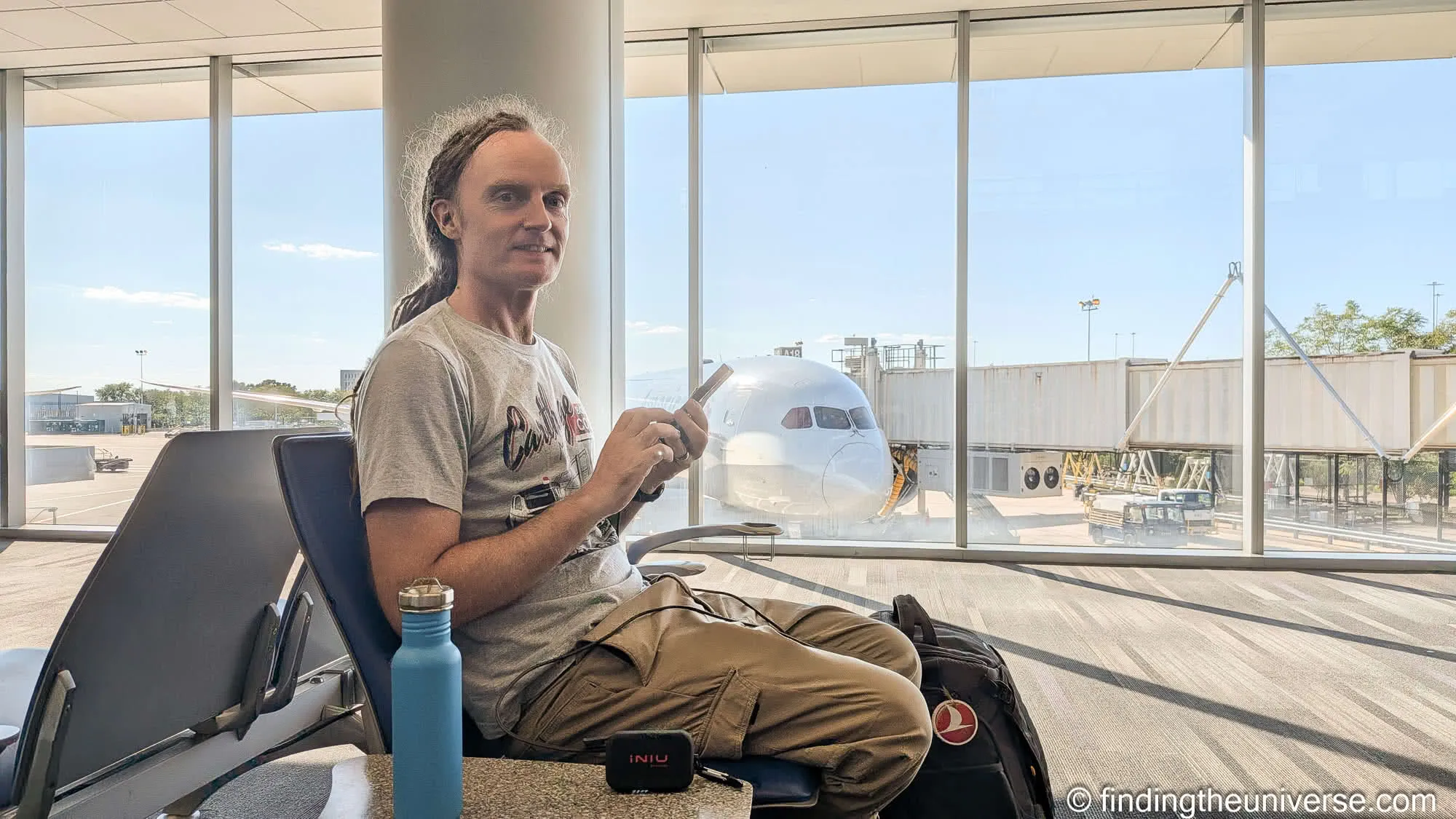
Table of Contents:
INIU RG-10000 Review: My Verdict
It’s a good power bank with a sealed cover. The charging speed is the reason to buy it, and the reason I’m going to be taking it on most of my trips from now on. The ruggedness is what stops you worrying about it.
On paper the rugged specialists publish firmer ratings, and one of them costs much the same. In practice, for most trips where I don’t need the big 25,000mAh P63, this is going to become the power bank I carry.
The essentials, at a glance:
- 10,000mAh, 45W output over USB-C, two USB-C ports under a sealed cover, no USB-A
- IP67 rated, with the cover shut
- Camp light, 1/4-inch tripod thread, detachable D-ring and carabiner
- Weight: 195 g, according to INIU’s own site
- Five-year warranty
- Check price on Amazon
What I Liked
- 45W charging with PPS support, so a modern phone gets a fast charge from it rather than a trickle
- The rubber shell is grippy, and the port cover is a thick slab of rubber that still seats cleanly after more than a month of opening and closing it. It doesn’t slip off an airplane tray table
- The camp light is a handy thing to have, and the tripod thread means it can sit on a tripod or a clamp
- Five-year warranty, and INIU told me in writing that a failure after normal rain with the cover properly closed is a warranty claim
- INIU answered my awkward questions with numbers rather than brochure sentences, which is rarer than it should be
What to Be Aware Of
- The IP67 protection only applies with the cover shut, so it doesn’t cover charging your phone in the rain
- NESTOUT publishes a firmer set of ratings for similar money, and Dark Energy goes deeper still. Neither charges anywhere near as fast
- No display, just four LEDs, and no USB-A port
- Recharging the pack itself slows down a lot below about 15°C
- INIU’s own documentation disagrees with itself in a few places, the weight included

You can check the current price and buy the RG-10000 on Amazon here.
Who the RG-10000 Is For
INIU’s own copy describes this as a pack for “day hikes and weekend trails”, which is a modest claim and a fair one.
When I asked them who they’d actually built it for, they gave me a long list running from kayakers to firefighters, and then said something I didn’t expect a brand to put in writing: “If the product is mainly used in everyday urban environments, there may indeed be no need to pay extra for rugged protection.” They went further: “our goal is not to prove that the rugged version is worth the premium for everyone.”
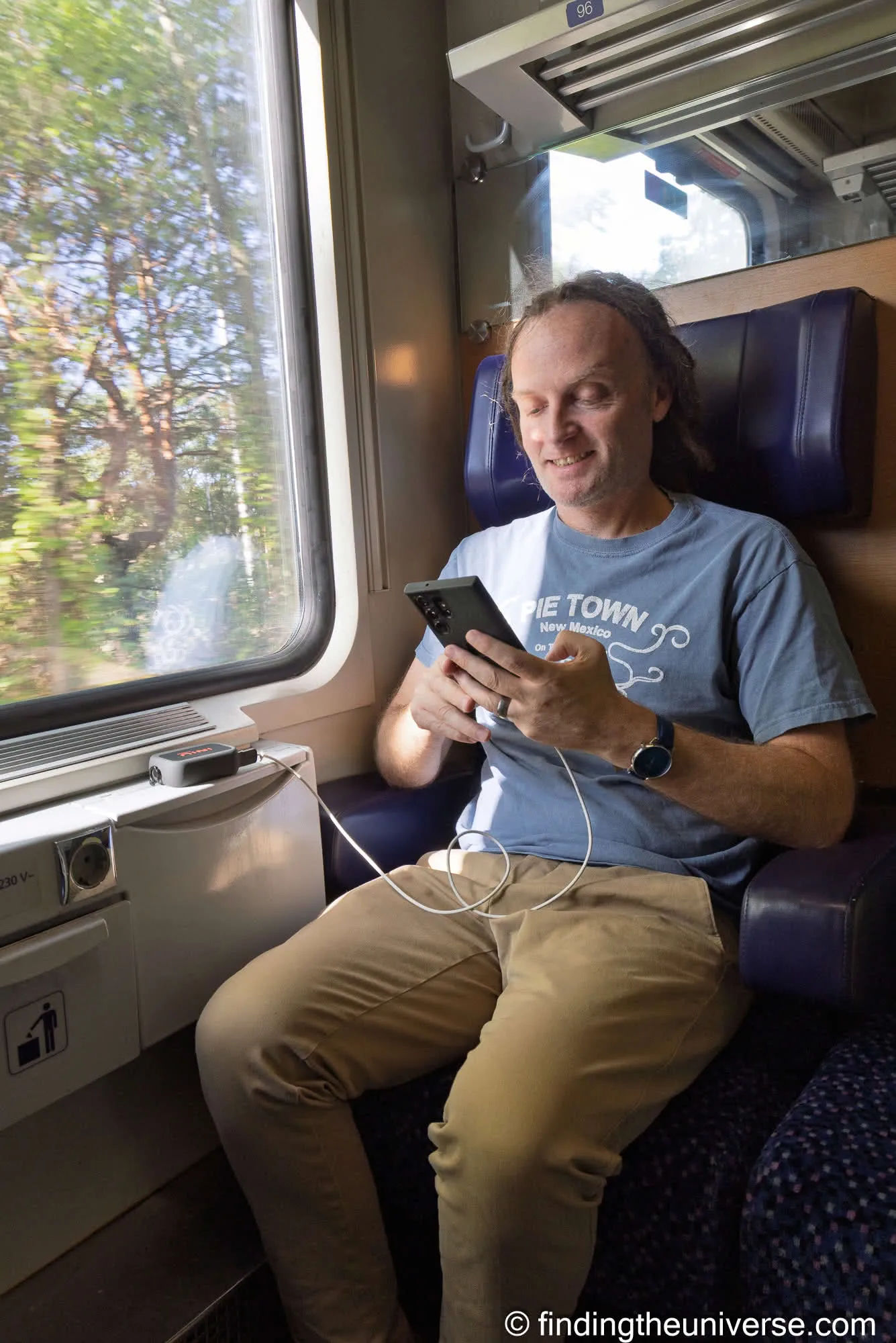
I think the buyer is narrower than that list. It’s a traveller who wants a power bank that will survive a bit of rough and tumble and the odd rain shower. It’s a neat little device with some ruggedness to it. You probably wouldn’t take it up Kilimanjaro. But your kids might struggle to break it, and it’s built for an accidental drop or two and a rainstorm, which covers most of what happens to a power bank on a trip.
If you camp seriously, do a lot of paddling, or want a pack you can leave in a wet pocket without a second thought, the rugged specialists further down are probably a better fit, and you should read that section carefully. If you mostly want a fast charger that doesn’t need babying, this is the one.
What You Get in the Box
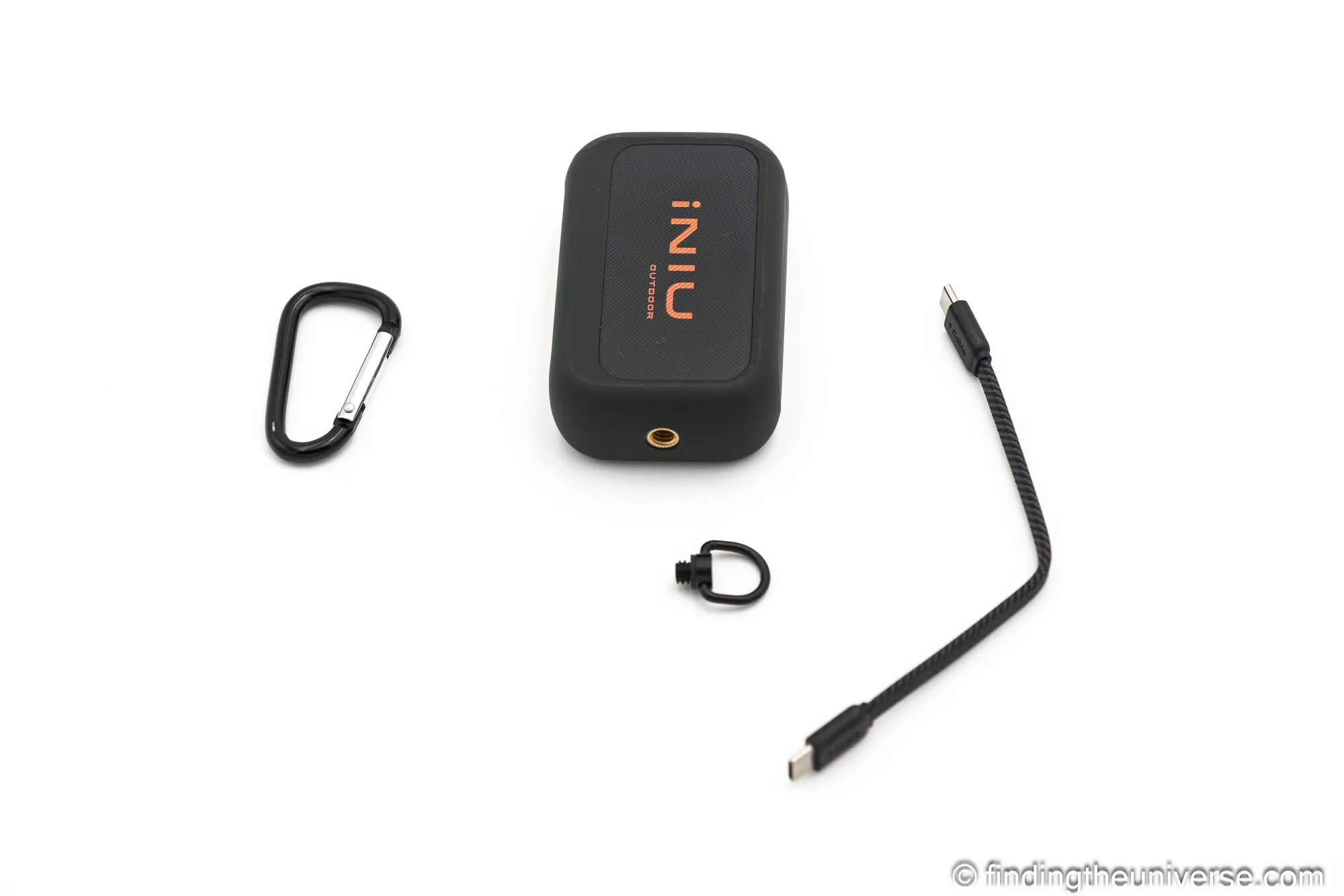
In the box you get the power bank, the detachable D-ring screw and carabiner, a short USB-C cable and a printed manual.
The manual is worth a look for once, because it carries some numbers that appear nowhere on the listing, including the operating temperature range I come back to below. The print is tiny, though, and it says nothing at all about the light.
Design and Build
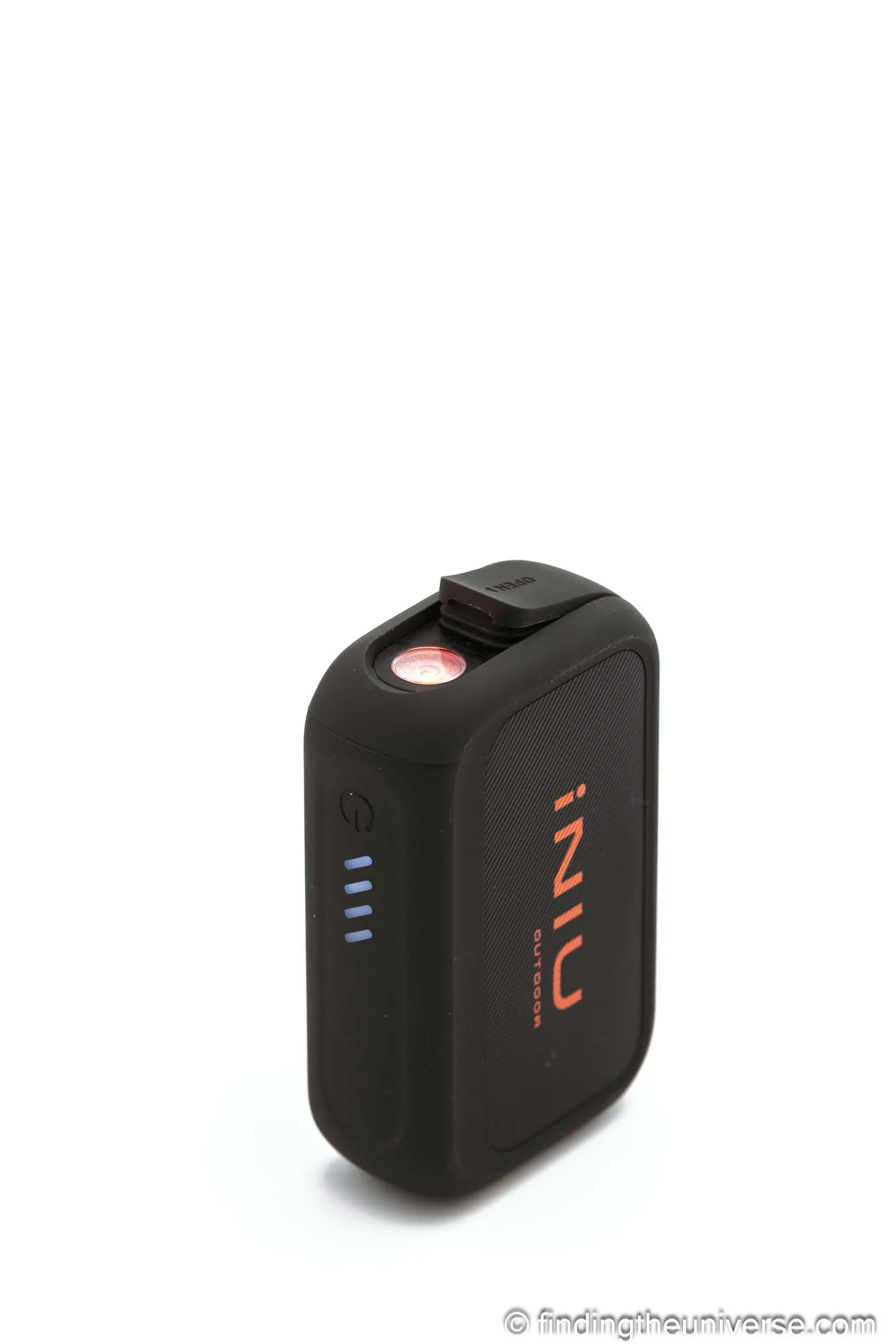
The whole thing is wrapped in a thick rubber shell. It’s grippy, which sounds like a small point until you’ve fumbled a smooth plastic power bank off a café table, and it’s the main reason I stopped worrying about where I put it down. As Jess will attest to, I am clumsy, and this is one less thing for us to worry about me breaking.
INIU say the pack has been through a hundred-drop tumble test from a metre and a free drop from 1.25 metres onto each face and edge. That’s their in-house protocol rather than a military standard, and they said so themselves without my asking. I haven’t dropped it deliberately and I’m not going to, so take that as INIU’s claim. I haven’t checked it.
The two USB-C ports sit under a rubber port cover. It’s a proper slab of rubber that looks built to last, and after more than a month of regular use it still seats cleanly with no gap. There’s no USB-A port, so anything you plug in needs a USB-C cable.
There’s also no display. You get four LEDs on the front, each standing for a quarter of the charge, which is less information than the little screen on the P50, but it’s one less thing to break and really, the lights tell you everything you need to know.
The feature I find most interesting is the 1/4-inch thread. It’s the standard 1/4″-20 thread you’ll find on the bottom of every camera, so it fits pretty much any tripod, clamp or phone mount you already own.
Screw it onto a small tripod and you’d have a camp light on a stand rather than one propped against a water bottle, and a battery sitting next to whatever you’re powering. I haven’t used it that way myself, as it’s mostly lived in a bag pocket, but for a photographer it’s a more interesting extra than the carabiner.
INIU volunteered that the thread has no published load rating. In their words, “thread specification does not equal rated load capacity”, and they listed why: the material, how much thread is engaged, how strong the housing is, and for bike mounts the vibration and leverage involved. So mount a phone or a light on it, and don’t hang the pack upside down off a moving bike. The carabiner is an accessory clip for attaching the pack to a bag. It isn’t climbing hardware and shouldn’t be clipped to anything that matters.
How Rugged Is It? What the IP67 Rating Covers
INIU’s Amazon listing calls this an IP67 power bank that “helps handle rain, splashes, dirt, trail dust, and everyday bumps”, and INIU’s own site, which only listed the pack while I was writing this, gives the same rating as IPX7 for water and IP6X for dust. IP67 means dust-tight, and able to sit in a metre of water for half an hour.
The rating isn’t printed on the box, in the manual, or on the spec sheet INIU sent me, so I asked them directly. They confirmed it in writing. They didn’t send a test report or a certificate number, and they told me one colourway was tested with the other five assumed to match because the structure is the same. Testing one representative unit and applying the rating to variants that share the same enclosure is standard practice in IP certification.
There’s a condition, and INIU state it themselves on the listing: “IP67 protection applies only when the port cover is fully closed.” That’s how every sealed power bank works, of course.
It does mean the protection applies when you’re carrying the thing, not when you’re using it. Charging a phone in the rain means the cover is open and the ports are exposed, which is exactly the moment you’d want the rating most.
INIU told me there’s an internal sleeve behind the cover as a second barrier, and then said, twice, that a large amount of water getting in with the cover open “may cause a short circuit”. A small amount, they say, you can dry out. So charge under a jacket or in the tent, and not out in the open in a downpour.
What the sealed cover buys you is rain, spray, dust, sand, and dropping it in a puddle and picking it up again. What it doesn’t buy you is a pack you can leave underwater, or one you can charge from with the flap hanging open in a storm. If you’re heading somewhere properly wet, it doesn’t replace a dry bag, which is the same advice I give about weather-sealed cameras.
I haven’t dunked it and I haven’t thrown it down a hillside. I did ask INIU whether water damage would void the warranty before deciding whether to try the metre-of-water test, and in the end I decided not to.
What I can tell you is how it’s held up after more than a month rattling around in a camera bag, which I think tells you more than one staged bath would. It’s been fine. The rubber is as grippy as it was on day one and the cover still shuts properly. A month isn’t a long test, though, so I can’t tell you how the seal will look in a couple of years.
One useful thing did come out of the email exchange. If the pack fails after normal rain with the cover properly closed, INIU told me in writing that it “would be treated as a warranty claim, rather than being excluded simply as liquid damage”. Their published warranty terms don’t spell that out, so I’ve quoted it. More on the warranty below.
INIU RG-10000 vs NESTOUT and Dark Energy
If what you want is a rugged power bank, there are two others you should look at, and one of them costs much the same as this does. I haven’t used either, so this is a comparison of what each brand publishes, checked against their own pages rather than a retailer’s.
| INIU RG-10000 | NESTOUT 10000 | Dark Energy Poseidon Pro | |
|---|---|---|---|
| Output | 45W | 20W | 18W |
| Capacity | 10,000mAh | 10,000mAh | 10,200mAh |
| Ingress rating | IP67, cover closed | IPX7 water, IP6X dust, MIL-STD-810G 516.6 drop test | IP68, 6 feet for 45 minutes |
| Weight | 195 g (INIU) | 238 g (8.4 oz) | 272 g (9.6 oz) |
| Price | Check price on Amazon | Check price on Amazon | Check price on Amazon |
NESTOUT is the direct rival. Same capacity, similar money, and a firmer set of published claims: it’s rated IPX7 for water and IP6X for dust, which adds up to IP67, and its drop resistance is tested to a named standard, MIL-STD-810G 516.6, where INIU quote their own in-house protocol. NESTOUT don’t publish a depth or a duration for the water rating, so the metre-for-half-an-hour figure is the definition of IPX7 rather than a NESTOUT number.
It has a USB-A port as well as USB-C, which some people will want. What you give up is speed, 20W against 45W, so less than half the charging rate, and it’s the heavier pack.
Dark Energy’s Poseidon Pro is the serious rugged option. Their landing page rates it IP68 and says it can be submerged to six feet for 45 minutes, which is quite a different class of protection. It costs more than either of the other two, it’s the heaviest of the three, and it charges at 18W, the slowest here.
One oddity you’ll hit if you go looking: Dark Energy’s buyable product page doesn’t mention IP68 at all, and gives a slightly different capacity from the landing page that does. Same company, two pages, two sets of numbers.
While I’m on documentation: all three brands are a bit of a mess to compare, and INIU isn’t the outlier. INIU’s Amazon listing gives the weight as 6.9oz in the bullet points and 160 g in the technical table on the same page, which is more than 30 g apart. Their own site, which went up while I was writing, says 195 g, which matches the 6.9oz figure.
NESTOUT publish a rating with no depth or duration behind it. Dark Energy’s two pages disagree with each other. That’s what you actually run into trying to compare these things, so I’ve said whose figure each number is.
Plenty of good travel power banks carry no rugged rating at all. Nitecore’s NB10000 Gen4 publishes IPX7, which means it’s water-tested but not dust-tested (that’s what the X is). Anker’s 313 Power Bank, the PowerCore 10K, model A1229, publishes no ingress rating. Neither is a worse product for it.
There’s a pattern in that table. The tougher the pack, the slower it charges. The RG-10000 is more than twice as fast as either rival. If your real risk is a rain shower, a dusty trail and a bag that gets thrown around, you’re getting the fastest charger of the three and giving up protection you were unlikely to use. If you’re crossing rivers, buy the Dark Energy.
Personally, I found the fast charge to be a very useful feature. 20 minutes of topping up my smartphone meant I could get through the rest of the day without the phone being tied to the powerbank, which was really nice.
Against INIU’s Own Packs
The sharpest comparison is with INIU’s own non-rugged packs, because the specs are so close. The INIU P50 has the same 10,000mAh and the same 45W, adds a little display and a built-in cable, weighs 160 g, and costs roughly half as much. The INIU P63 I carry is a 25,000mAh, 100W laptop-class pack for about the same money as the RG-10000.
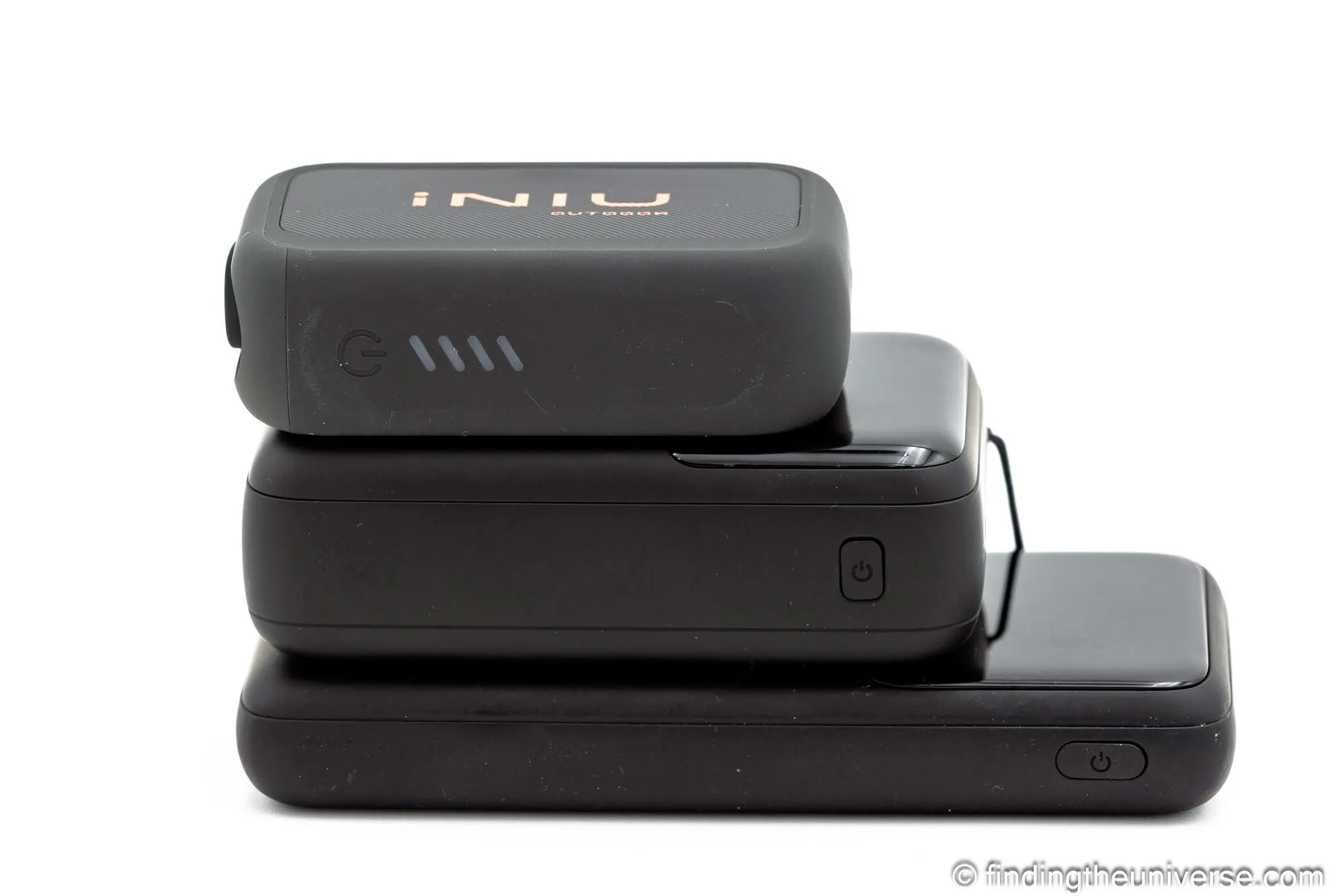
So the premium here buys you the sealed cover, the rubber shell, the light and the thread, and nothing else. INIU said as much to me. Whether that’s worth it depends entirely on where the pack is going to live.
How It Behaves in the Cold
The printed manual gives an operating range of 10 to 40°C, or 50 to 104°F, which made me pause, because 50°F is just a cool spring morning. So I asked INIU whether that was a hard floor. It isn’t.
Giving out power holds up well. INIU say output drops from 45W at room temperature to about 12W at 0°C, and only stops at minus 20°C. Twelve watts at freezing still charges a phone at a reasonable rate, so for the thing you’ll actually do on a cold day, topping up a phone, it’s fine.
Taking power in is another story. Charging the pack itself starts slowing at 15°C, which isn’t cold at all, from 20W down to 6W. At 5°C it’s about 3W, a trickle, and at 0°C it stops altogether. That last one is deliberate, and correct: charging a lithium cell below freezing damages it, and a pack that refuses is doing the right thing. The practical version is that you won’t refill this overnight in a cold tent. Charge it in the car, the hut, or your sleeping bag.
The cold affects every lithium cell, of course. Throttling the charge and refusing it at zero are design choices on INIU’s part. The manual also mentions a 2,000 metre limit, which turned out to mean that’s the altitude they’ve tested to, rather than a ceiling it stops working above.
Charging Performance
INIU’s listing says the pack takes an iPhone 17 Pro to 63% or a Galaxy S26 Ultra to 61% in 30 minutes, and their FAQ puts the usable capacity at “an estimated 6000mAh-7000mAh” of the 10,000mAh on the label. That last figure is pretty normal for the class, since converting the cell’s voltage up to what your phone wants loses some along the way. Treat those as the manufacturer’s reference values.
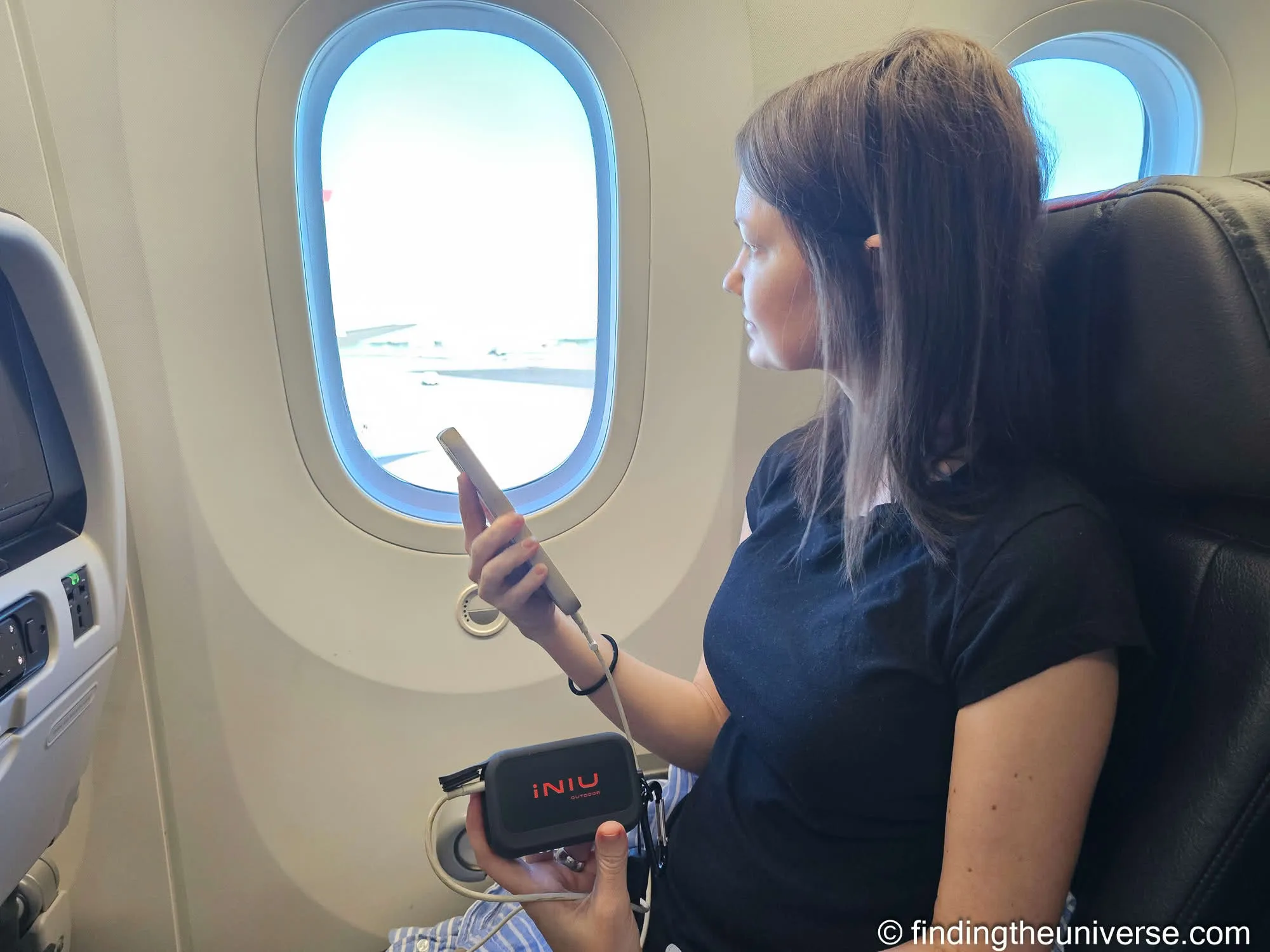
Under the hood it’s USB PD 3.0 with PPS support at 5 to 11V and up to 4.5A, which INIU confirmed to me by email. In plain English, a Samsung phone only uses its Super Fast Charging modes when the source supports PPS, and plenty of power banks don’t. INIU say a Galaxy S26 Ultra pulls close to 40W from this, which is the Super Fast Charging 2.0 tier. I couldn’t measure the peak output myself, as I don’t have an inline PD meter, so that 40W is their figure.
INIU’s own page now gives the split when both ports are in use, and it’s a big drop: 7.5W per port, 15W in total. If you need the fast charge, plug in one device at a time.
Recharging the pack: INIU quote about two hours from a suitable USB-C charger. In a cool room it’ll take longer, since charging slows from 15°C, as covered above.
The test I care about most as a traveller is the low-current one. A lot of power banks switch themselves off when they see a tiny load like a watch or a pair of earbuds, because they assume nothing’s plugged in.
On this trip the RG-10000 charged my earbuds without cutting out, which is a good sign.
The Camp Light
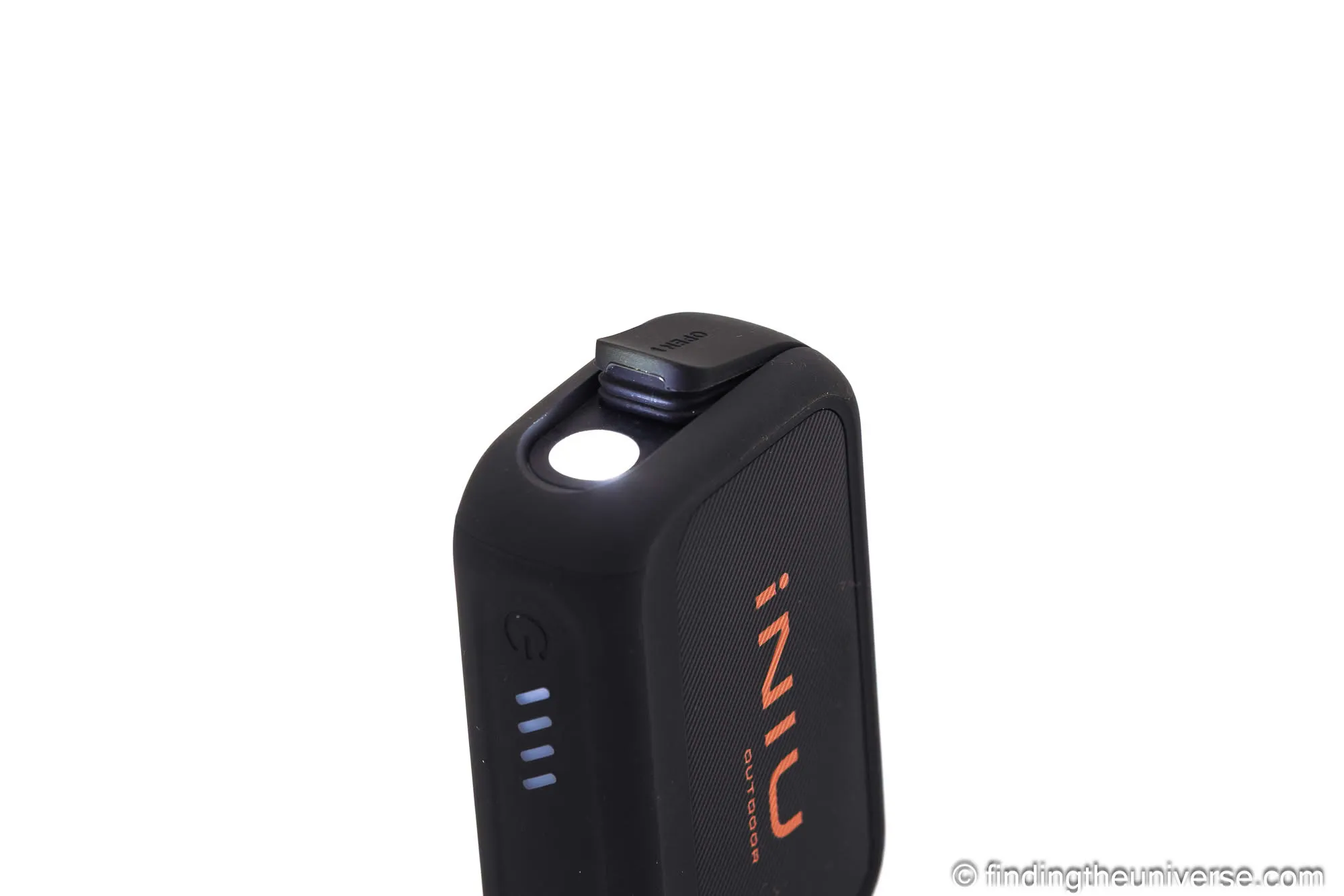
The light is an LED behind a translucent cover. Double-tap the power button and it comes on, which took me a while to work out. INIU’s product page lists three modes, a steady white, a steady red and a flashing red. I’ve used the white and the red, but I haven’t found how to get to the flashing red, and the manual didn’t tell me. The double-tap does mean it’s hard to switch on by accident, and it hasn’t once come on in my bag.
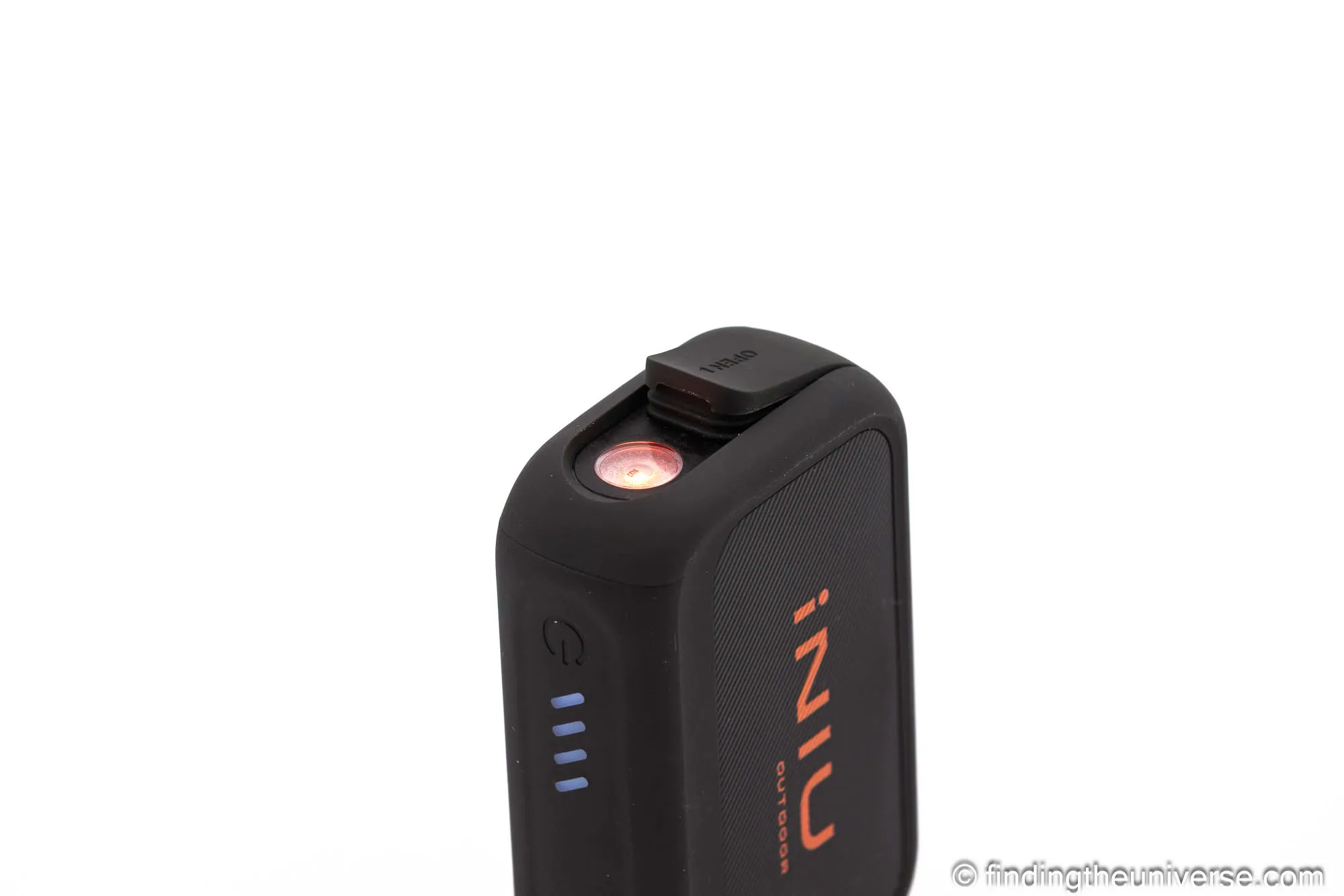
INIU don’t publish brightness or runtime figures for it, but they gave them to me when I asked. The LED itself is rated at 80 lumens. Through the cover, measured in an integrating sphere, it’s 43 lumens, so nearly half the light is lost in the diffuser.
I don’t own an integrating sphere, so I’m not going to give you my own lumen figure.
Runtime on white is about 65.5 hours on a full charge, according to INIU. They haven’t tested the other two modes and said so. I haven’t timed a full run to empty either, so that’s their number.
In a tent, remember the light and your phone draw on the same battery, so a long night of light is charge your phone won’t get in the morning.
INIU RG-10000 Specifications
| Spec | INIU RG-10000 |
|---|---|
| Capacity | 10,000mAh (INIU estimate 6,000 to 7,000mAh usable) |
| Output | 45W max, USB PD 3.0, PPS 5 to 11V at up to 4.5A |
| Ports | 2x USB-C under the cover, no USB-A |
| Battery indicator | Four LEDs, no display |
| Weight | 195 g on INIU’s site (the Amazon listing gives 6.9oz and 160 g) |
| Dimensions | 9.1 x 5.75 x 2.76cm (3.6 x 2.3 x 1.1in) |
| Water and dust | IP67 (IPX7 water, IP6X dust), cover closed only |
| Drop testing | INIU in-house: 100-drop tumble test at 1 m, plus a 1.25 m free drop on six faces and four edges. Not MIL-STD-810 |
| Operating temperature | 10 to 40°C (50 to 104°F) per the manual. INIU say output continues to minus 20°C at reduced power and charging stops at 0°C |
| Storage temperature | -10 to 50°C (14 to 122°F) per the manual |
| Camp light | 80 lumen LED, 43 lumens through the cover; about 65.5 hours on white (INIU figures) |
| Extras | 1/4″-20 tripod thread (ISO 1222), detachable D-ring screw, carabiner |
| Recharge time | About 2 hours (INIU) |
| Warranty | 5 years (early boxes print 3 years; INIU say 5 applies) |
| Price | Check price on Amazon |
Is the INIU RG-10000 Part of the INIU Recall?
No. The recall covers a different model, the BI-B41, which INIU sold on Amazon between August 2021 and April 2022. The RG-10000 launched this year and isn’t part of it.
It’s a reasonable thing to ask, though, and if you own an older INIU pack it’s worth two minutes of your time. In December 2025 INIU recalled about 210,000 BI-B41 power banks in cooperation with the US Consumer Product Safety Commission, after 15 reports of overheating that included 11 fires, three minor burn injuries and more than $380,000 of property damage. The CPSC recall number is 26-135.
How to Check a Power Bank You Already Own
Only four production batches are affected, so you can rule yours out quickly:
- The model number is printed on the back, at the bottom. If it doesn’t say BI-B41, you’re clear.
- Affected units are black or blue with a paw-print LED on the front. Colour alone doesn’t settle it, because plenty of INIU packs are black or blue.
- The serial number is on the back too. Only serials beginning 000G21, 000H21, 000I21 and 000L21 are included.
If yours matches, stop using it and register on INIU’s recall page for a full refund.
One thing the CPSC is firm about: don’t put a recalled lithium-ion battery in your household bin, in kerbside recycling, or in the battery collection boxes you see in shops and DIY stores. It needs to go to a municipal household hazardous waste centre, and CPSC advises ringing ahead to check they’ll accept a recalled cell.
Recalls have hit the whole category, including over 1.6 million Anker packs across two 2025 recalls. Casely re-announced its 2025 recall after a death in a fire involving a pack whose owner hadn’t acted on the first notice, which is the best argument I know for going and checking the one in your drawer.
The Warranty
The RG-10000 carries a five-year warranty. I’m being specific because my box says three years, and INIU’s published policy, until recently, said three years for everything. When I asked which one governed, INIU told me in writing that the outdoor line gets five years and that the three on the box is a packaging error they’re correcting. The Amazon listing now says five, and their policy page now gives five years to “select Outdoor Series products”, though it doesn’t name them. So if you’re holding a box that says three, five is what applies.
Registration isn’t required, the terms are the same in the US and Europe, and Amazon is a listed official channel, so a purchase there is covered. The published exclusions are written in general electronics language and list “liquids” and “falls” among the things not covered, which reads oddly on a product sold on a water rating and a drop test.
INIU’s written position to me is more generous than the page: normal rain with the cover properly closed counts as a warranty claim. It doesn’t stretch to immersion, and I wouldn’t assume it does.
Should You Buy the INIU RG-10000?
If you want the toughest 10,000mAh pack for the money, no. NESTOUT publishes firmer ratings for similar money, Dark Energy will survive things this won’t, and I’ve said so above.
If you want a fast power bank you don’t have to think about, yes, and I suspect that’s most of the people reading this. It charges more than twice as fast as either rugged rival, the sealed cover means a wet day or a dusty one isn’t a worry, and the light and the thread are the kind of extras that turn out to be useful more often than you’d expect.
For me, it’s a really neat little device that I’ve enjoyed using, and it’s likely to become my main power bank for most trips where I don’t need the big one. A month isn’t a long test, so it’s staying in the bag. But on what I’ve seen so far, for a traveller who wants a fast pack that doesn’t need babying, I’d buy it.
You can check the current price and buy the INIU RG-10000 on Amazon here.
Frequently Asked Questions
Is the INIU RG-10000 waterproof?
It’s rated IP67, which means dust-tight and able to survive a metre of water for half an hour, but only with the port cover fully closed. INIU say that on the listing and confirmed the rating to me in writing.
With the cover open, which is how you charge anything, there’s no water rating, and INIU told me a large amount of water getting in that way could cause a short circuit. So rain and puddles are what the rating is for, but don’t charge your phone from it in a downpour, and don’t treat it as a substitute for a dry bag.
Is the INIU RG-10000 part of the INIU recall?
No. The December 2025 recall (CPSC number 26-135) covers the BI-B41, a different model sold on Amazon between August 2021 and April 2022, and only units with serial numbers beginning 000G21, 000H21, 000I21 or 000L21.
The RG-10000 is a new model launched in 2026. If you own an older INIU pack, the model and serial number are printed on the back, and INIU’s recall page will tell you in seconds whether yours is affected.
Can you take the INIU RG-10000 on a plane?
Yes, in your carry-on. Power banks go in hand luggage, never in checked bags, and if your carry-on gets checked at the gate, take the power bank out first. The limit airlines apply without needing approval is 100 watt-hours. A 10,000mAh pack like this is comfortably under that.
How cold can the INIU RG-10000 go?
The manual gives an operating range of 10 to 40°C (50 to 104°F), but INIU told me that isn’t a hard floor. Output continues at reduced power down to minus 20°C, at about 12W at freezing, so it’ll still charge a phone on a cold day.
Recharging the pack itself is the weak spot. Charging power starts dropping at 15°C, is down to a trickle at 5°C, and stops at 0°C to protect the cell. Recharge it somewhere warm.
How many times will the INIU RG-10000 charge a phone?
INIU estimate that 6,000 to 7,000mAh of the 10,000mAh rating reaches your devices, which is normal for a pack this size. I haven’t run a controlled test of my own, so treat that as their figure.
Does the INIU RG-10000 have a display?
No. It has four LEDs that show the charge level in quarters. INIU’s non-rugged P50 has a small screen if you want a percentage readout.
Will the INIU RG-10000 charge earbuds or a watch?
It charged my earbuds without switching itself off, which not every power bank manages with a small load. I haven’t tried it with a watch.
How long does the INIU RG-10000 camp light last?
INIU say about 65.5 hours on the white mode from a full charge. They’ve measured the light at 80 lumens from the LED itself and 43 lumens through the cover. I haven’t timed a full run myself, so treat those as INIU’s figures.
What’s the warranty on the INIU RG-10000?
Five years. Some early boxes, mine included, print three years. INIU told me in writing that’s a packaging error and that five years applies to the outdoor line, and the Amazon listing now says five. Registration isn’t required, and an Amazon purchase is covered.
INIU RG-10000 or NESTOUT 10000, which should I buy?
If ruggedness is the point, the NESTOUT. It publishes IPX7 and IP6X ratings and a MIL-STD-810G drop test, for much the same money. If charging speed is the point, the INIU. It charges at 45W against the NESTOUT’s 20W, which is more than twice as fast, and it’s the lighter pack. For most travellers I’d take the speed.
Further Reading
If you found this useful, a few more of our guides you might like:
- Our guide to the best power banks for travel, where the INIU P50 and P63 both feature
- Our pick of the best travel adapters, since a power bank is only as useful as what you charge it from
- Our guide to camera backpacks for hiking, for the bag this is going to live in
- Our digital nomad packing list, for everything else that needs charging
And that’s it for our review of the INIU RG-10000. If you’ve got one, or you’re weighing it against something else, let me know in the comments below!

Leave a Reply