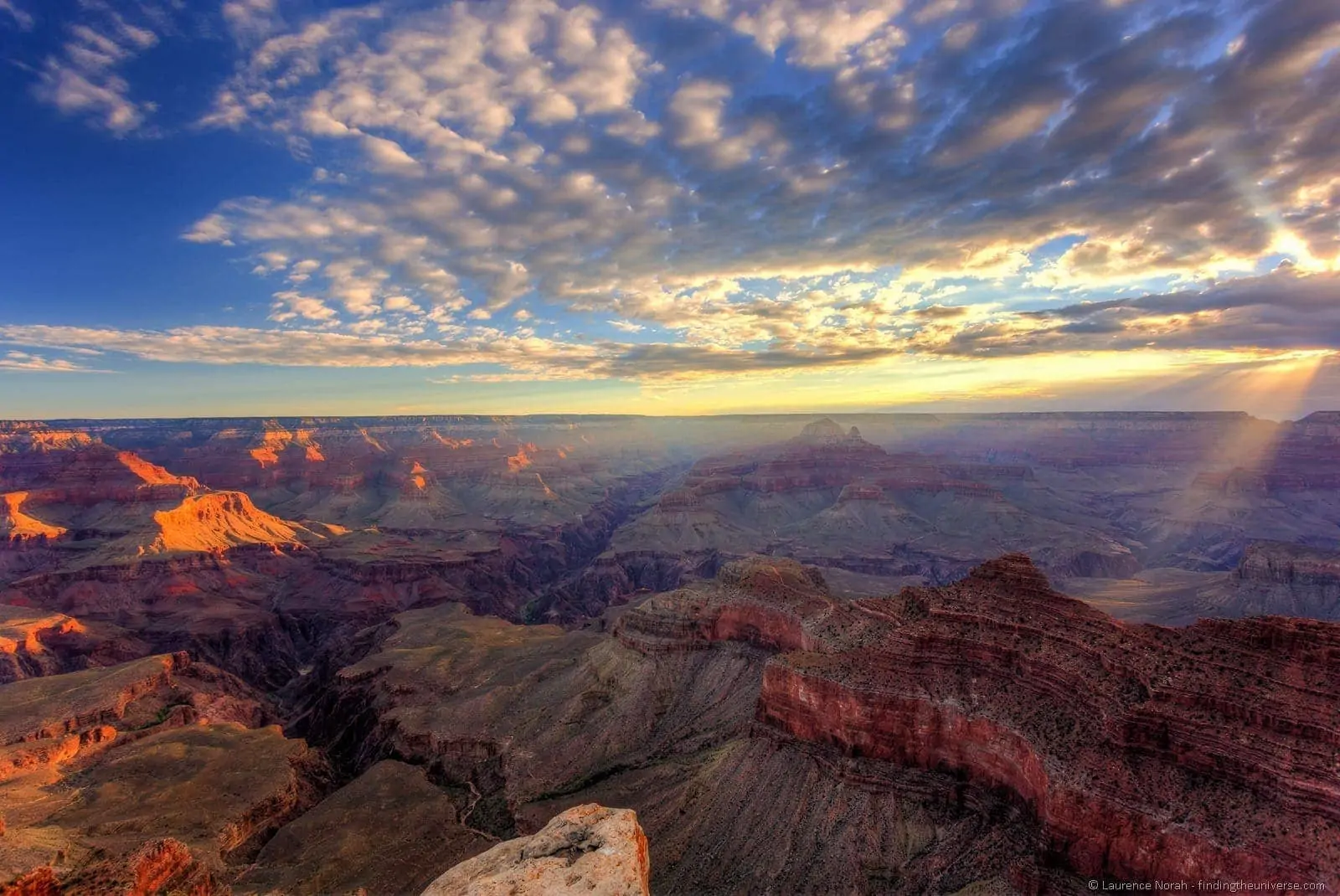
We’ve been to the Grand Canyon a couple of times now, and the first time we went, I was completely unprepared for how it would photograph. The scale is almost impossible to process in person, let alone through a viewfinder. I spent the first half hour just staring at it.
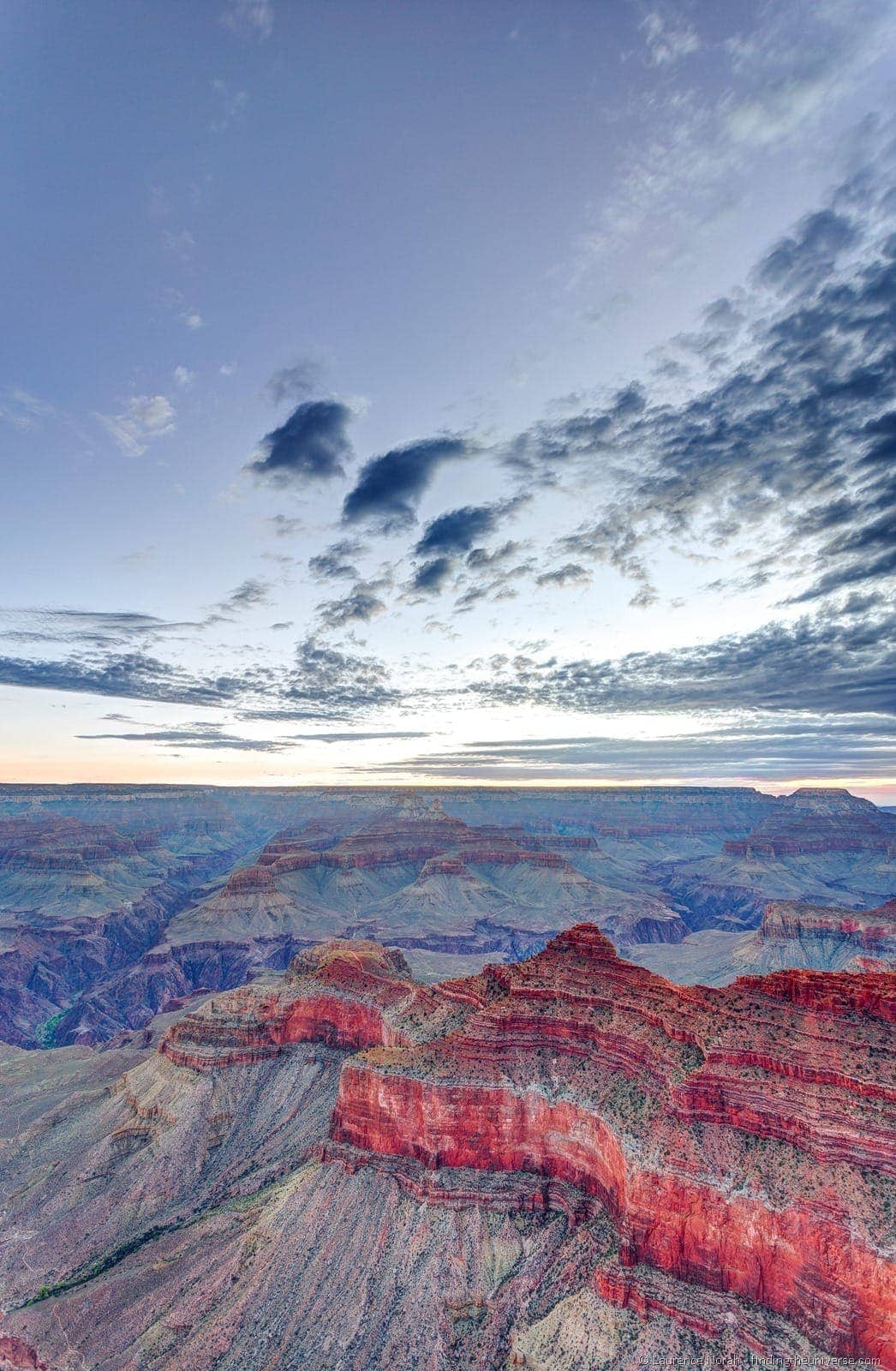
I got over that fairly quickly, though, because we’d allocated two full days at the South Rim and I was determined to shoot the place properly. Sunrise, sunset, midday, the lot. There was some research involved (both online and via the park rangers, who were brilliant), and I’m happy to say the results were worth the effort. (Landscape photography is a big part of what I teach on my online photography course, so the pressure was on.)
This guide covers the best spots I found for photography at the Grand Canyon South Rim, with a focus on sunrise and sunset (where the light is best), plus tips on shooting during the day, after dark, from the air, and practical advice on getting around.
Table of Contents:
Best Sunset Spots at the Grand Canyon
Hopi Point
Hopi Point was the spot the rangers recommended for sunset, and I can see why. It juts out into the canyon far enough that you get an unobstructed view in both directions, which is exactly what you want.
The key thing to remember when shooting sunset at the Grand Canyon is that you want to be pointing your camera away from the sun. I know that sounds wrong. But the contrast as the sun drops low is enormous, and shooting into it won’t show you much of the canyon below. Turn around, though, and the light on those rock layers is something else entirely.
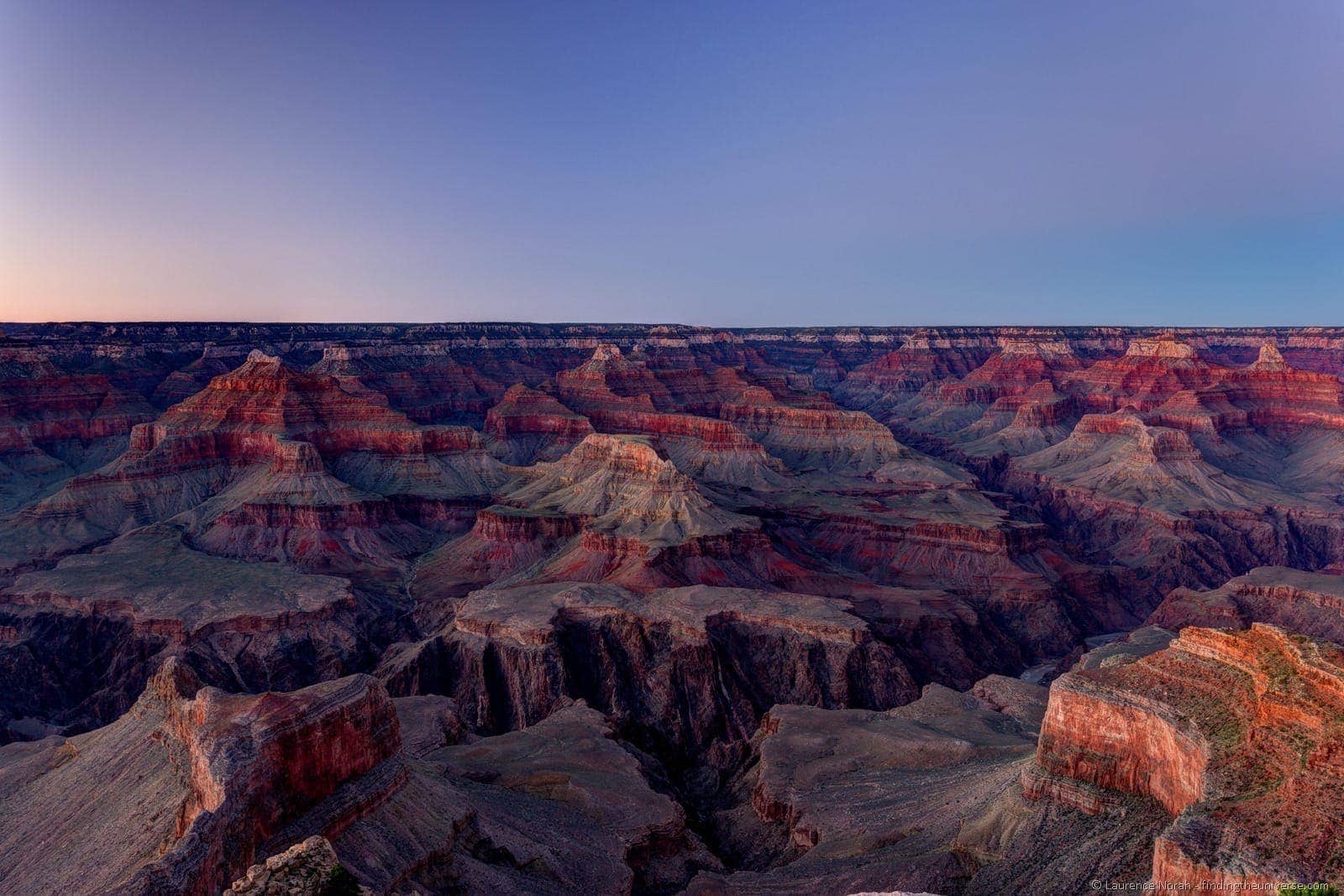
Now, one thing about Hopi Point: it’s popular. Very popular. Sunset draws huge crowds, and the main viewing area gets packed. The good news is that you only need to step a little way from the fenced area to find your own quiet patch of rim with equally good views. Do be careful, obviously, because the drops are real and there’s no railing where you’ll be standing. People do die here, so please stay well back from the edge.
I went a little way east of the main area and was very happy with the results. One practical advantage of Hopi Point being so popular is the transport: because everyone’s there, the park runs plenty of shuttle buses to get you home after the sun goes down.
Hopi Point is on the Hermit Road (Red Route), which is closed to private vehicles from March through November. You’ll need the free park shuttle to get there. The last bus runs about an hour after sunset, but do check the current shuttle schedule before you go.
Yavapai Point
The other spot I tried for sunset was Yavapai Point, which is a short walk from the visitor centre (or one shuttle stop on the Kaibab/Orange Route). Yavapai sits on a rocky outcrop with excellent views up and down the canyon, and it’s less hectic than Hopi Point.
I found myself a spot along the rim with a clear line of sight in both directions, set up my tripod, and waited.
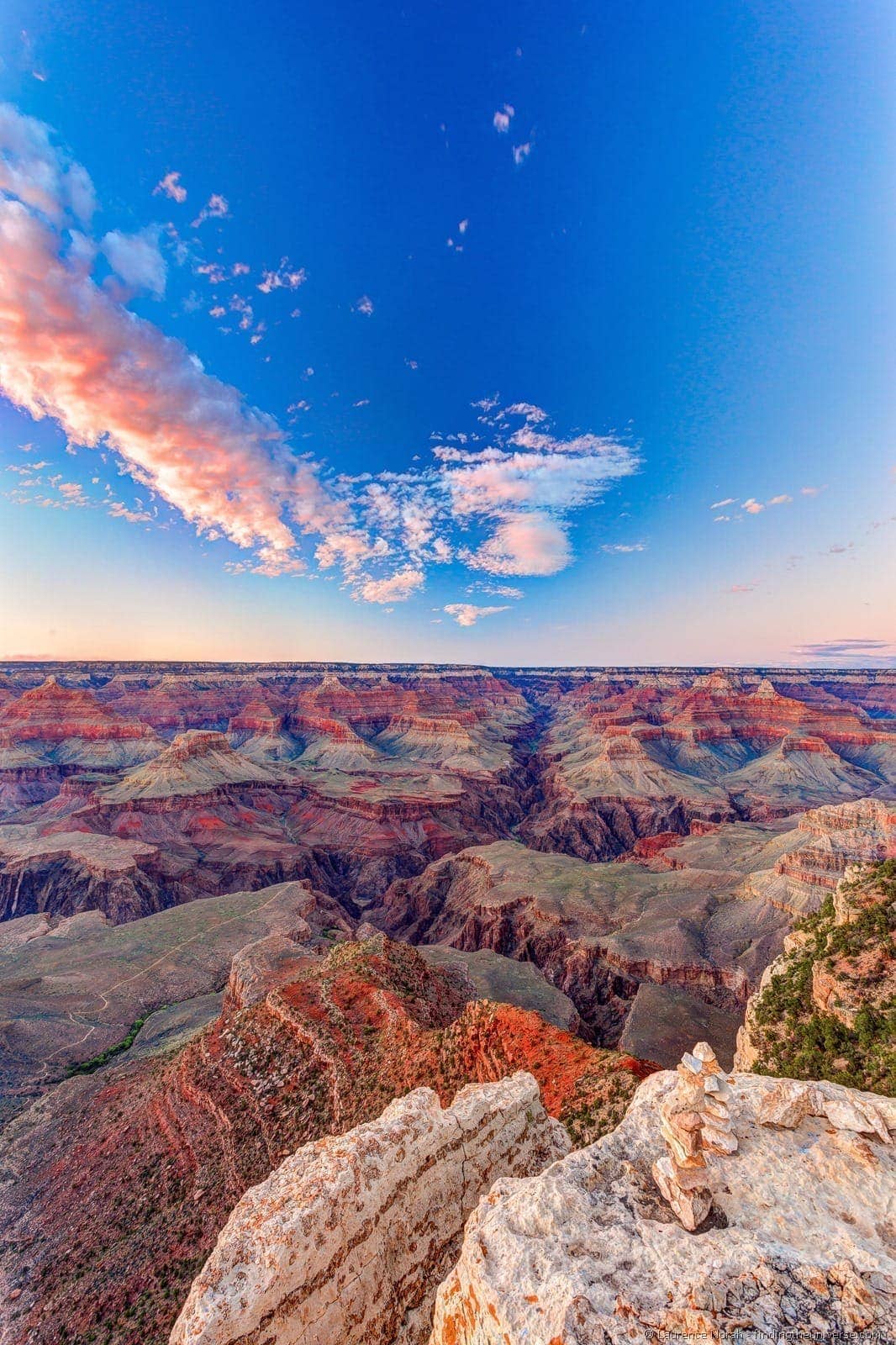
As you can see, what happened was rather lovely. The mile-deep drop was terrifying, I won’t pretend otherwise, but the light on the canyon walls (again, shooting away from the sun until it actually set) was magnificent.
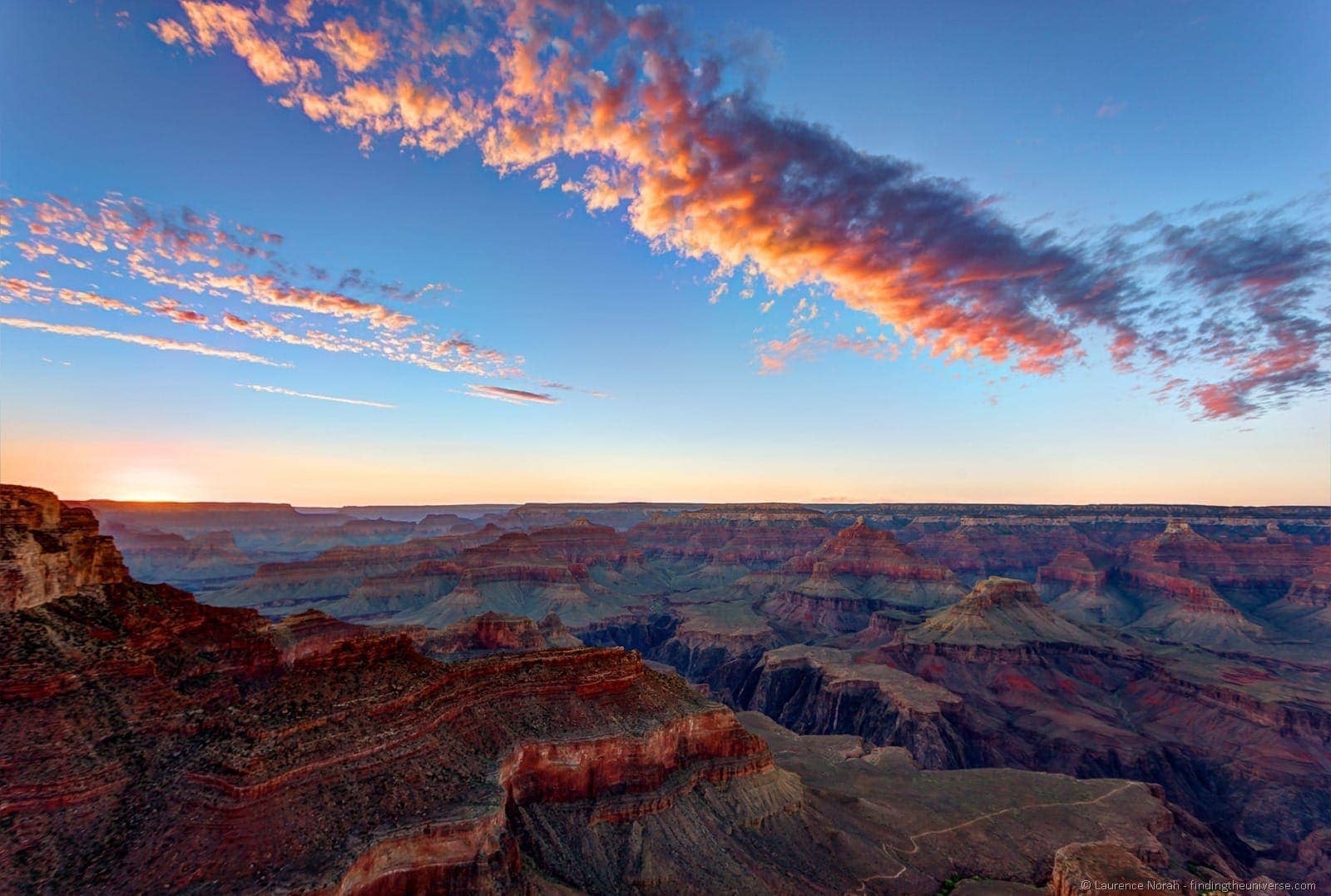
Yavapai also has the Geology Museum next to it, parking, and toilets, which is a nice practical bonus. If you want a sunset spot that’s easy to reach and not quite as much of a scrum as Hopi Point, this is a solid choice.
Other Sunset Options
There are plenty of other sunset viewpoints along the South Rim that I didn’t get to. Mohave Point and Pima Point (both on the Hermit Road, a stop or two past Hopi Point) are well regarded, and Pima Point in particular offers views down to the Colorado River. They’re also a lot quieter, since most people pile off the shuttle at Hopi and don’t go any further.
Lipan Point on the Desert View Drive has wide views both east and west, and you can drive there yourself. It’s further from the village, though, which means a longer drive in the dark afterwards. Further along the same road, the Desert View Watchtower is worth a stop if you have time. The stone tower itself makes for an interesting subject, and the surrounding views are some of the widest on the South Rim.
Best Sunrise Spot at the Grand Canyon: Mather Point
I will freely admit to a major flaw as a photographer: I hate early mornings. Given that the best light of the day is at sunrise and sunset, that means I’m missing about fifty percent of my shooting opportunities purely out of laziness.
Well, the Grand Canyon fixed that. I’m going to spoil it for you: the sunrise here was easily the best I’ve ever seen, and entirely worth the 4am alarm.
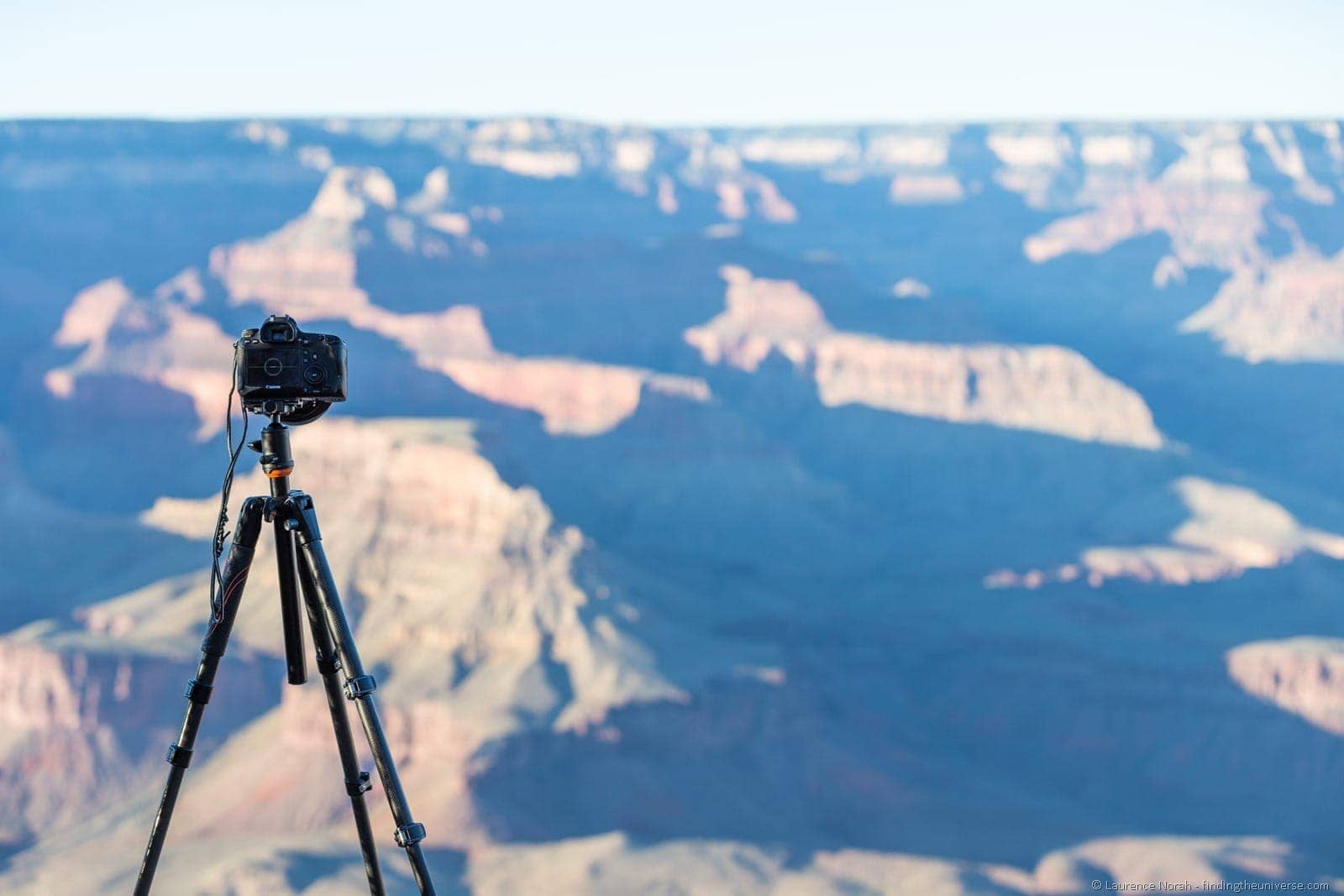
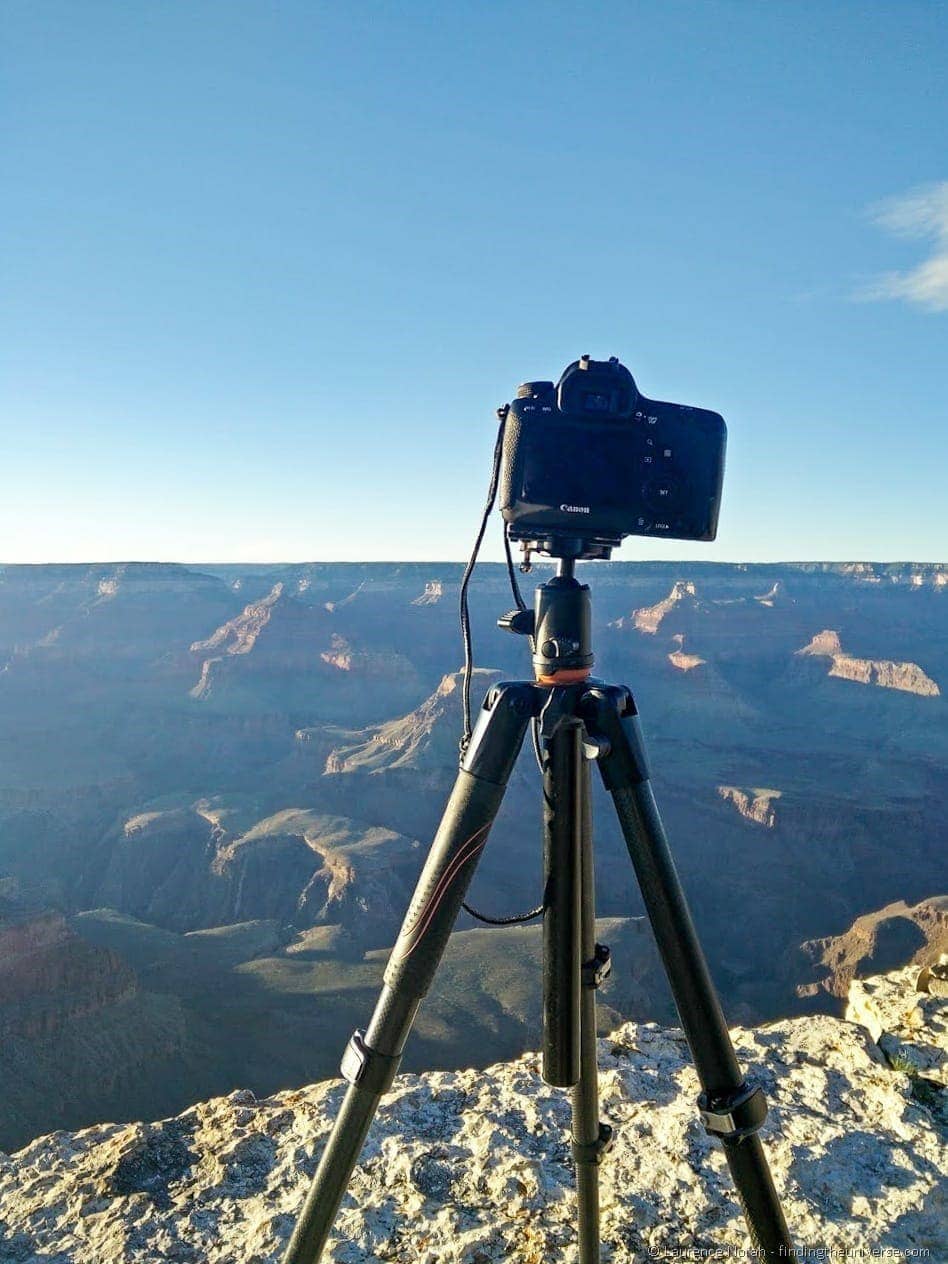
Mather Point is the most popular sunrise spot, and for good reason. It’s right next to the visitor centre with easy parking, and it faces east with a clear view across the canyon. Here’s how popular it is at sunrise:
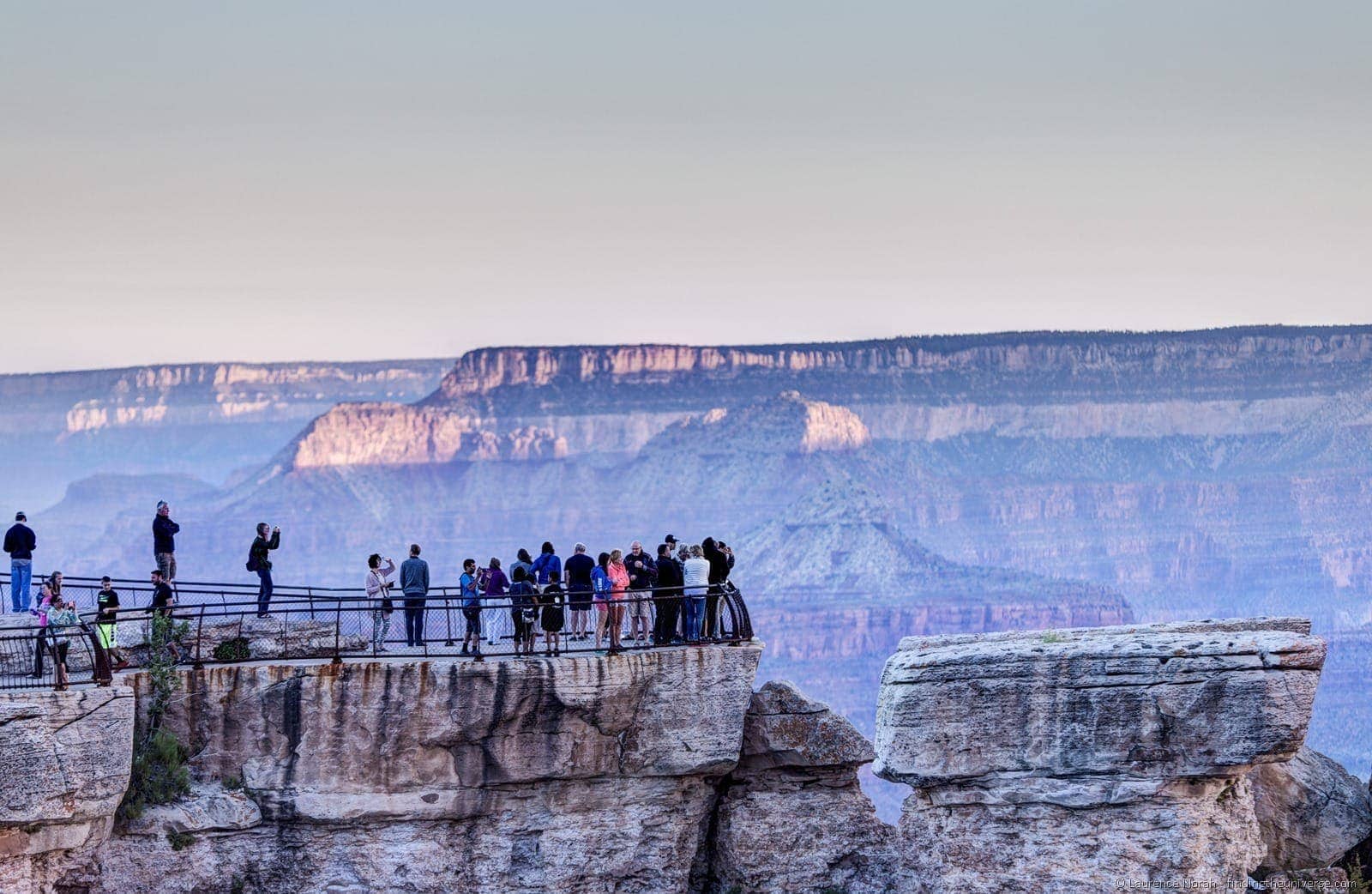
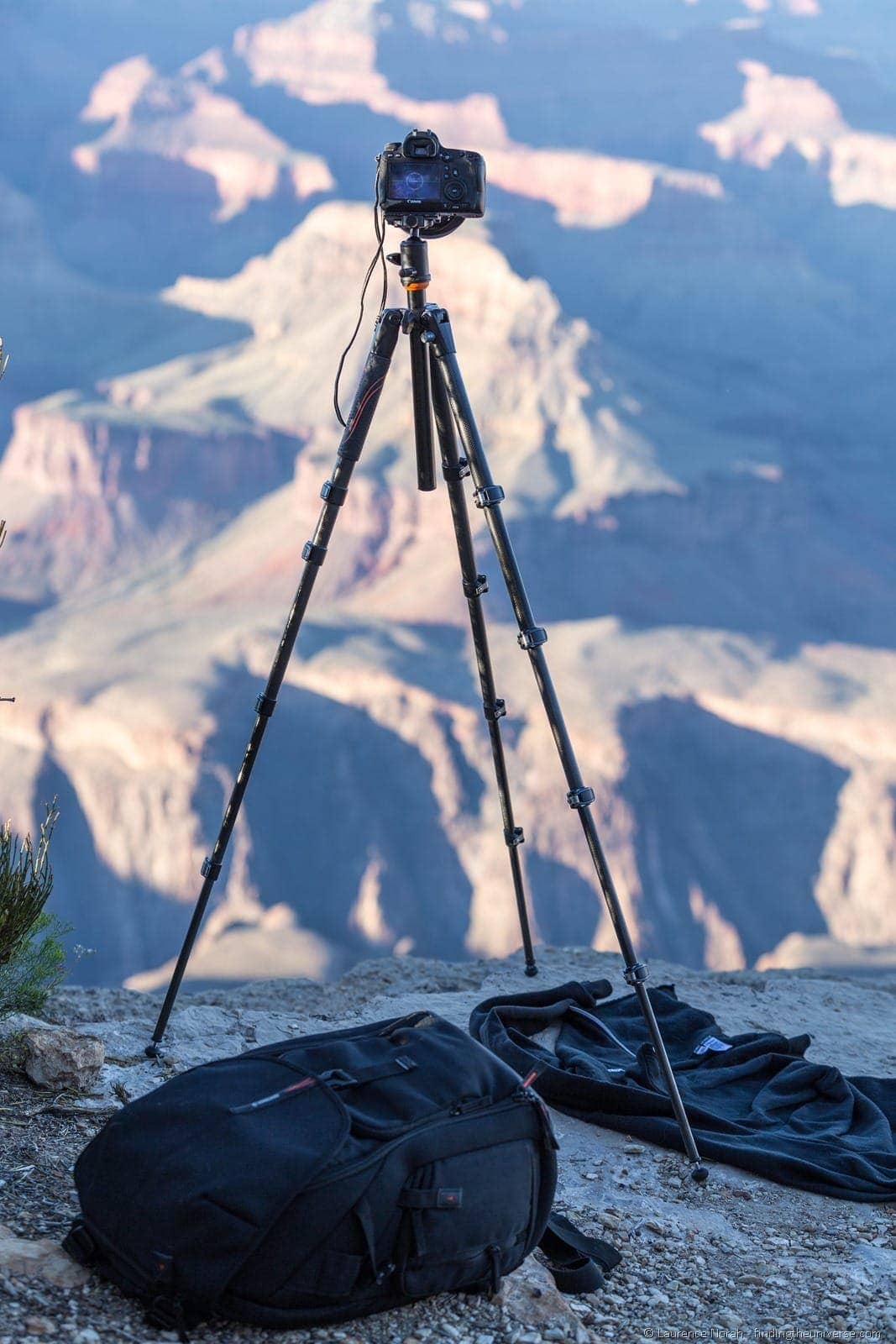
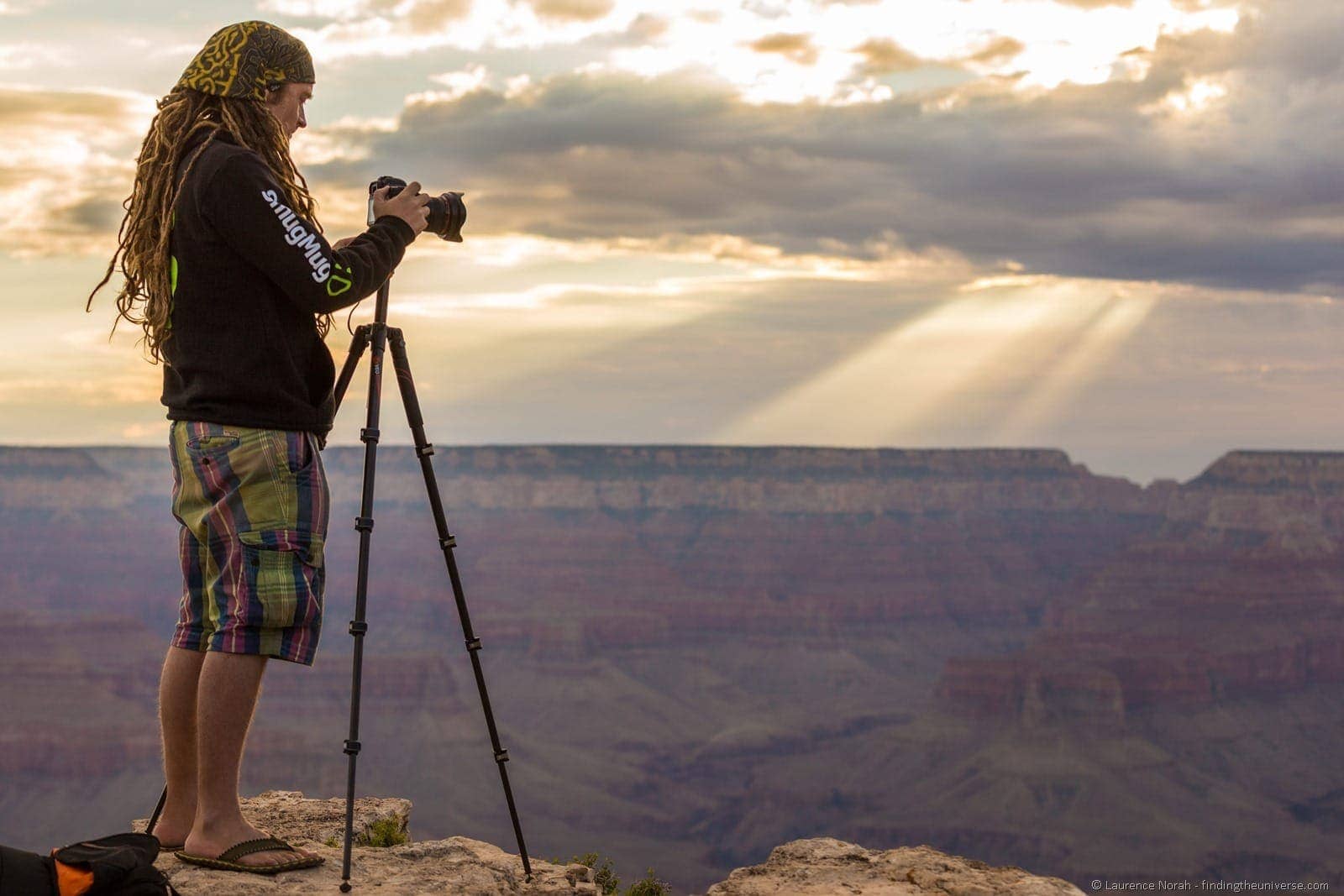
I didn’t fancy battling that lot for the shot. So I headed east along the rim trail, about 300 metres past the main viewing platform, and found myself a quiet spot away from both people and railings. I took a quick tripod selfie to show you where I ended up:
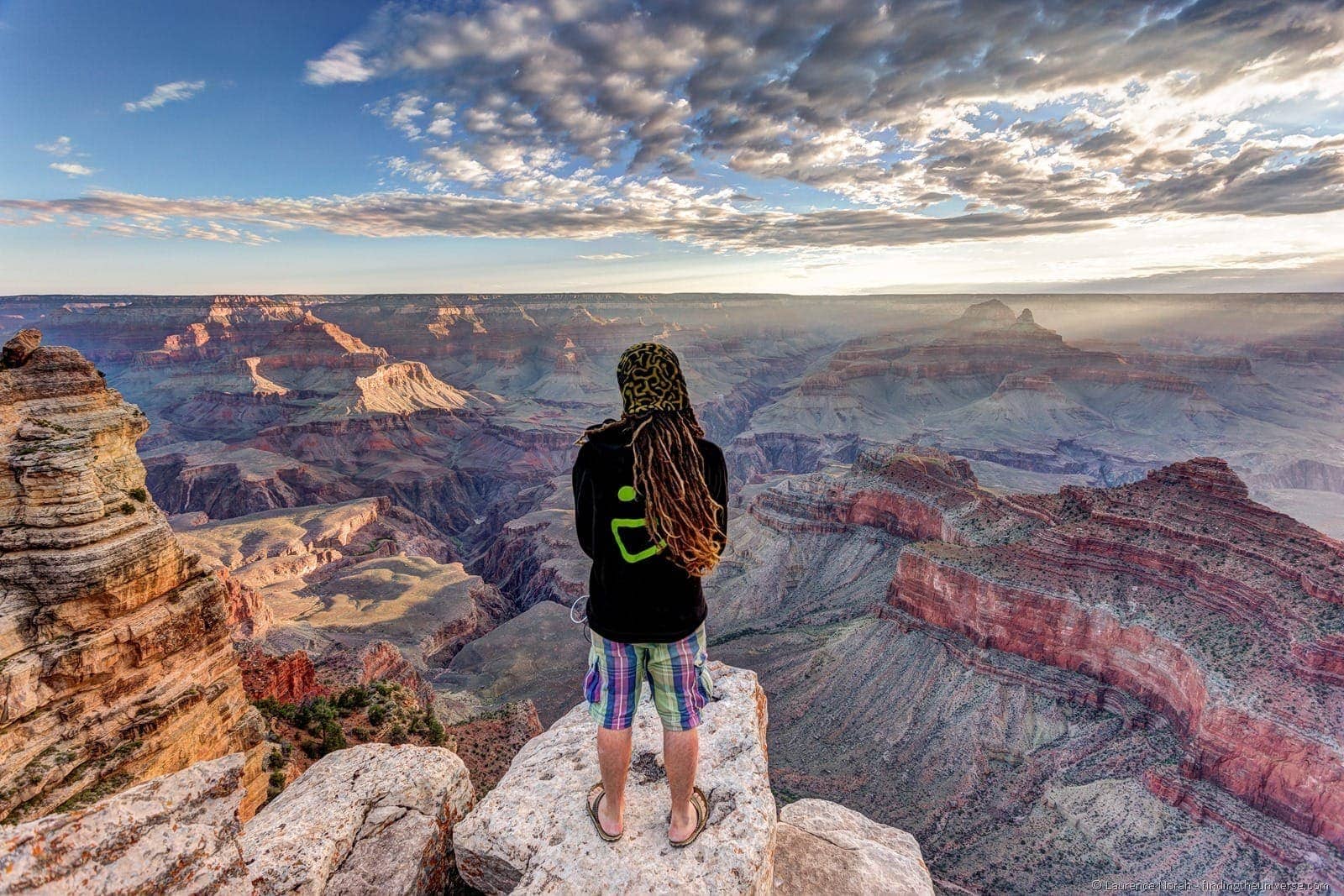
Not a bad spot. And here’s what I got:
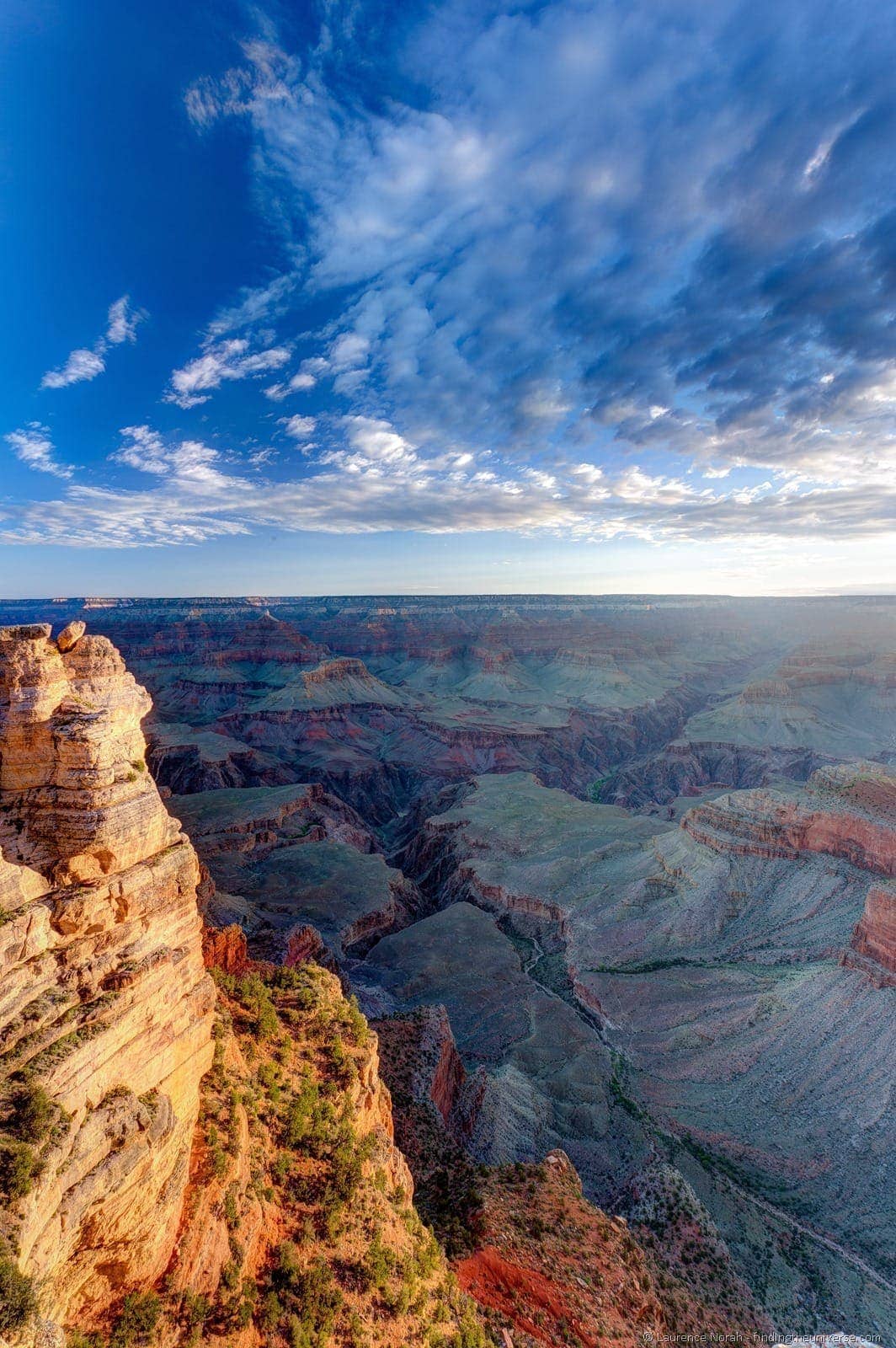
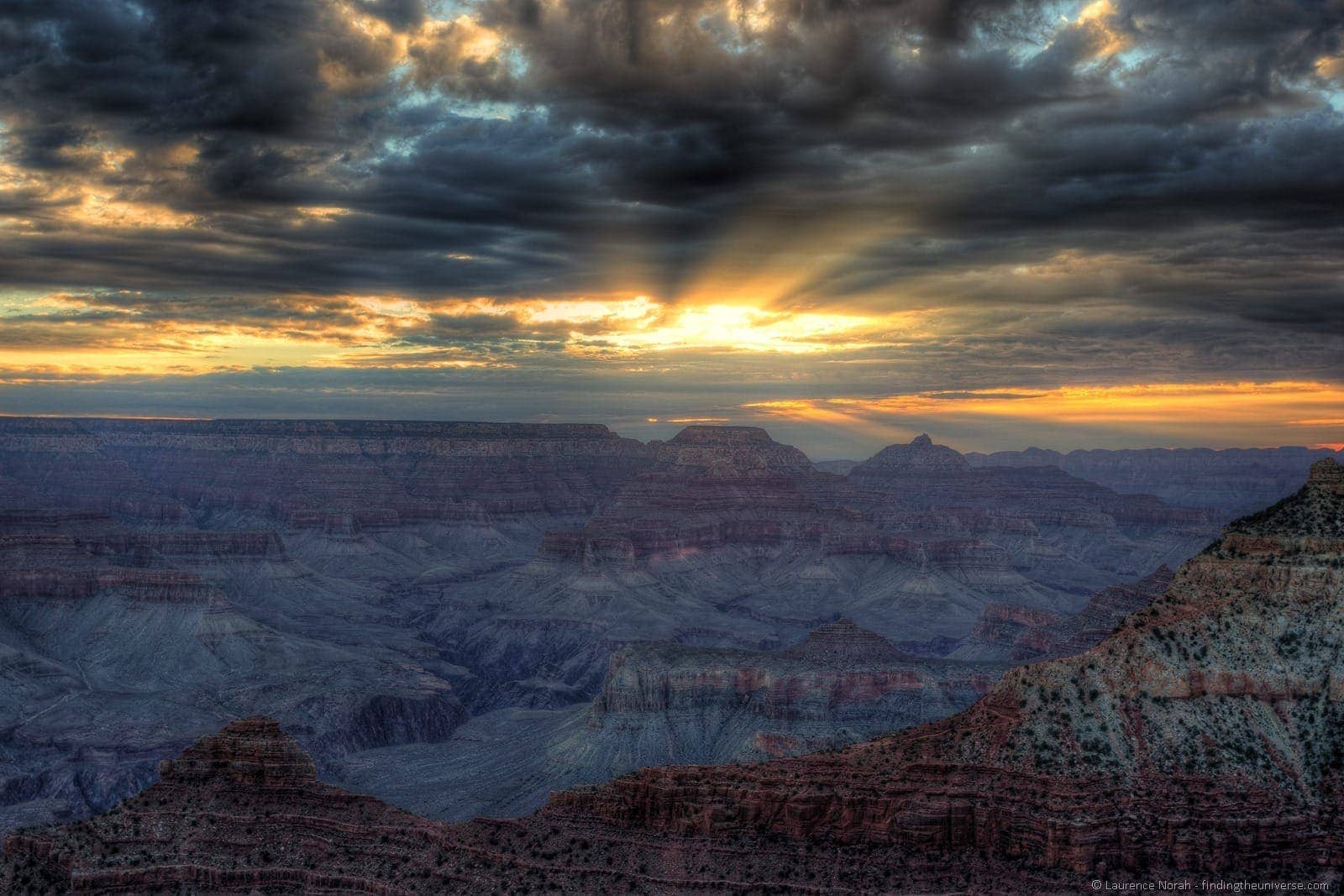
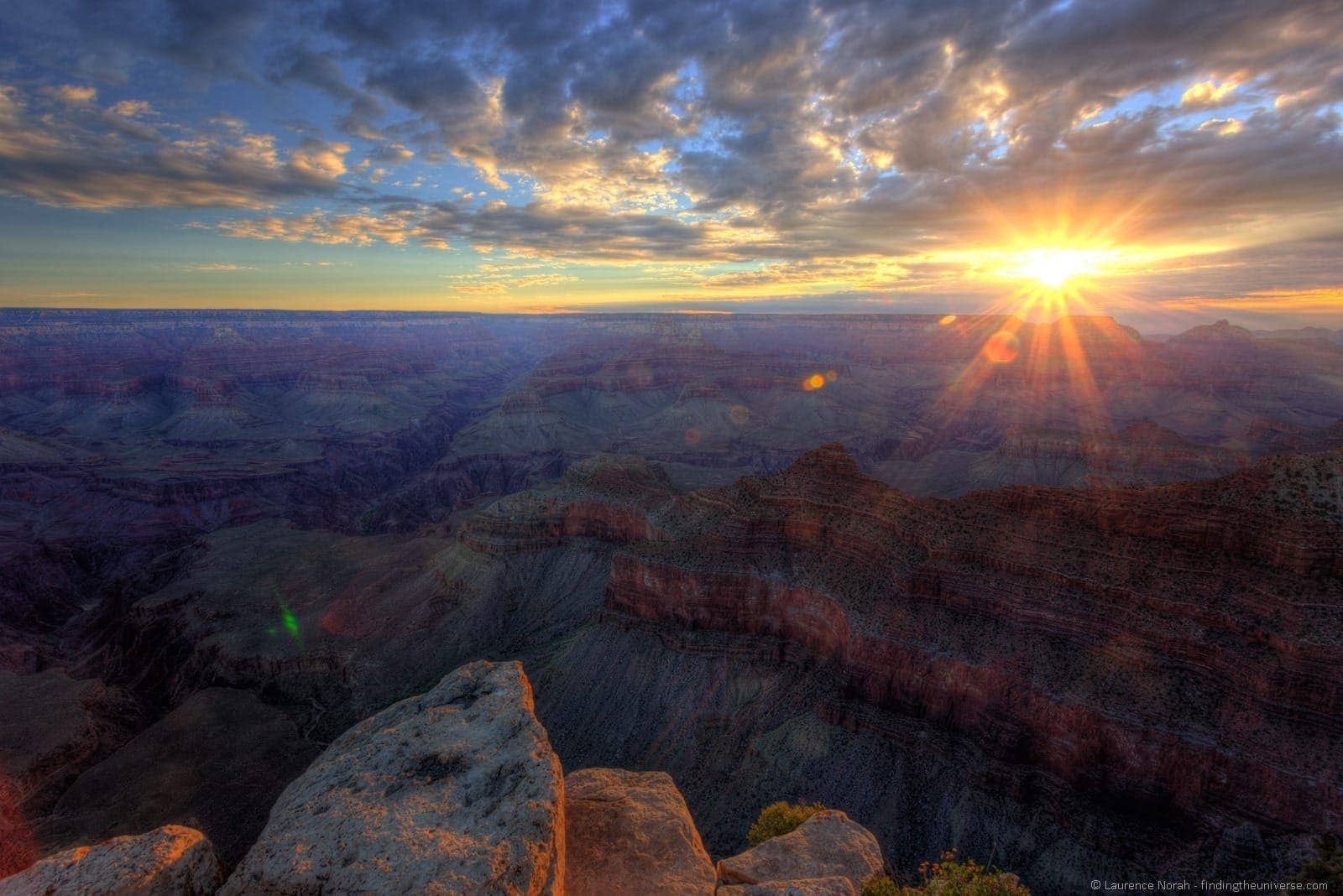
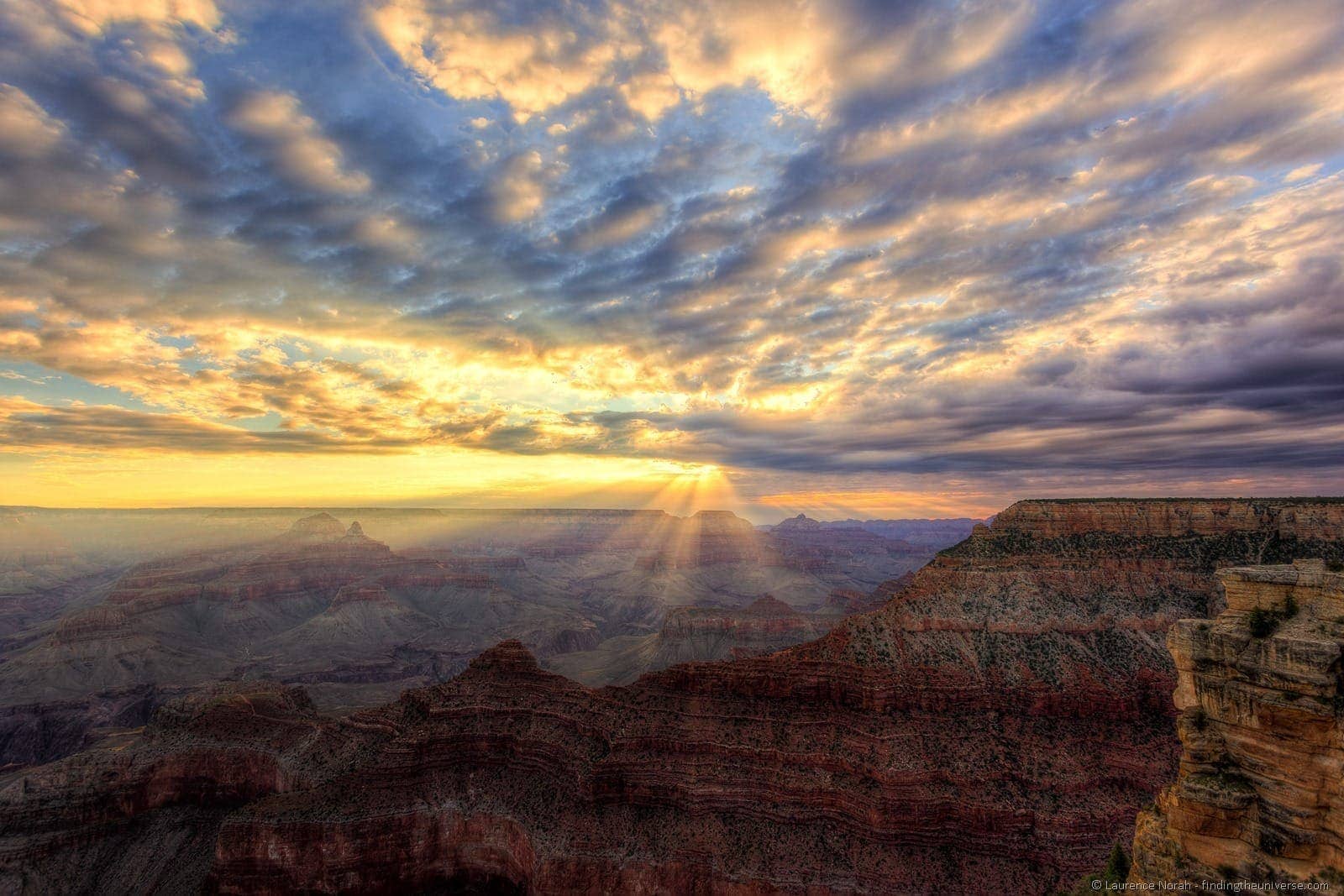
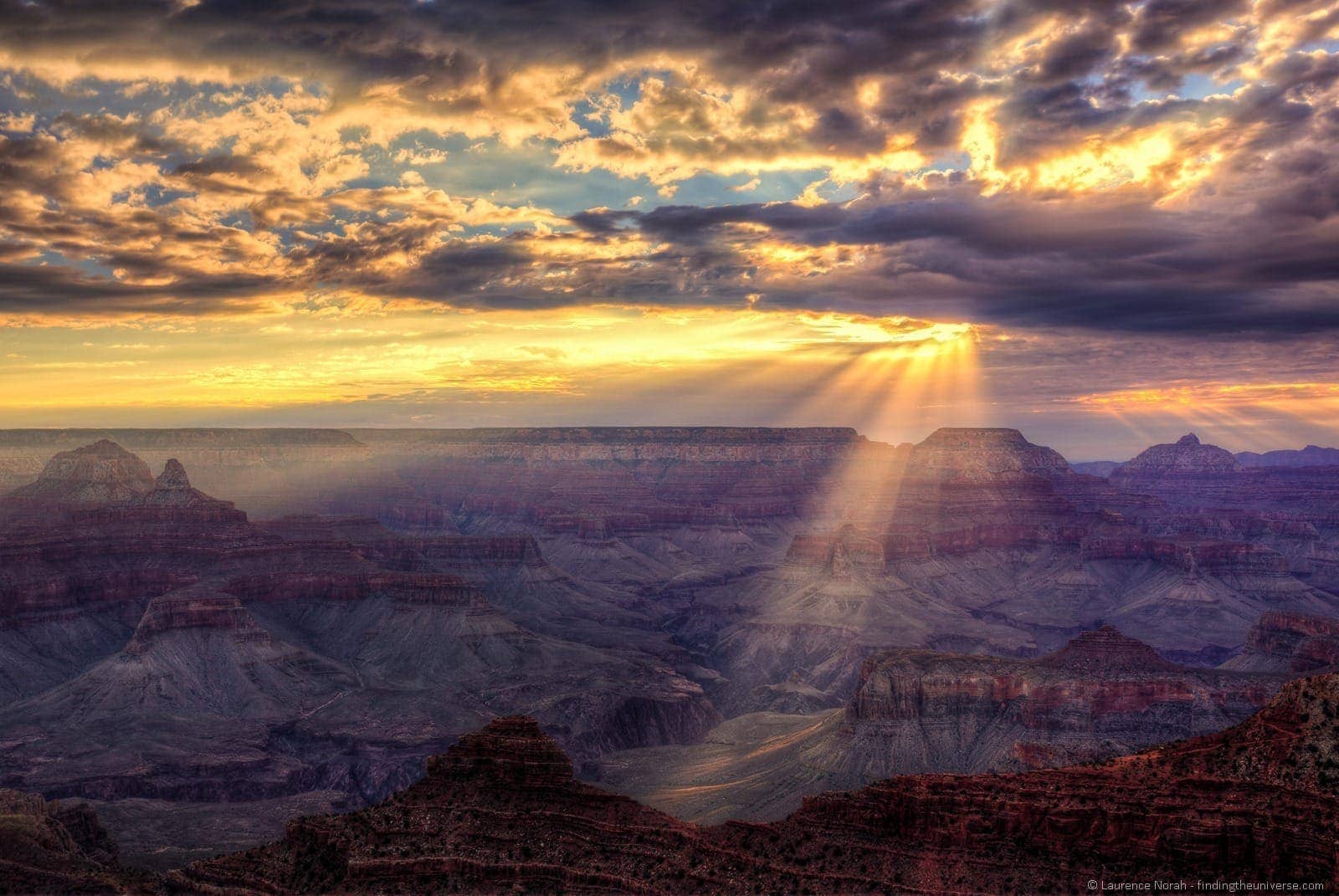
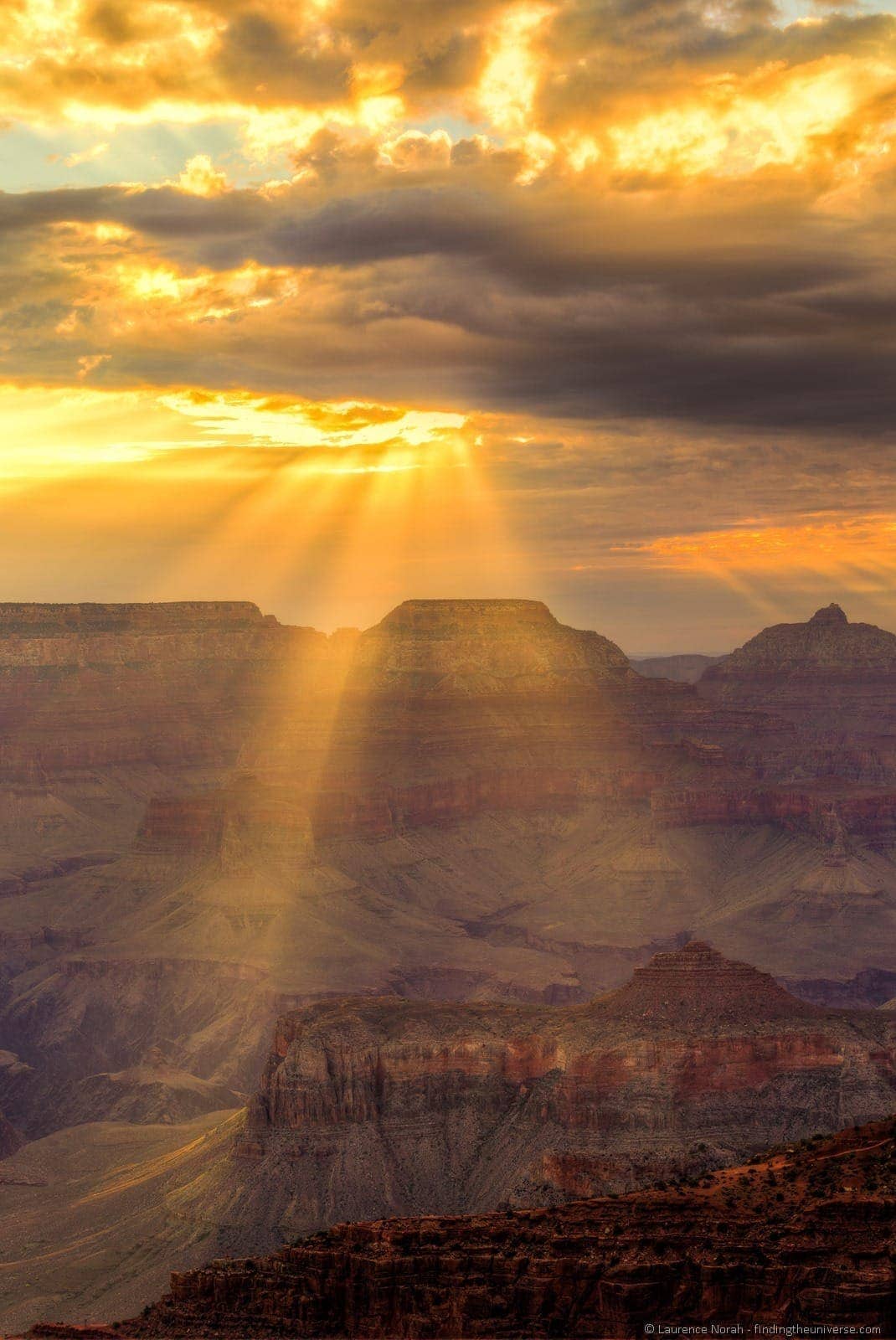
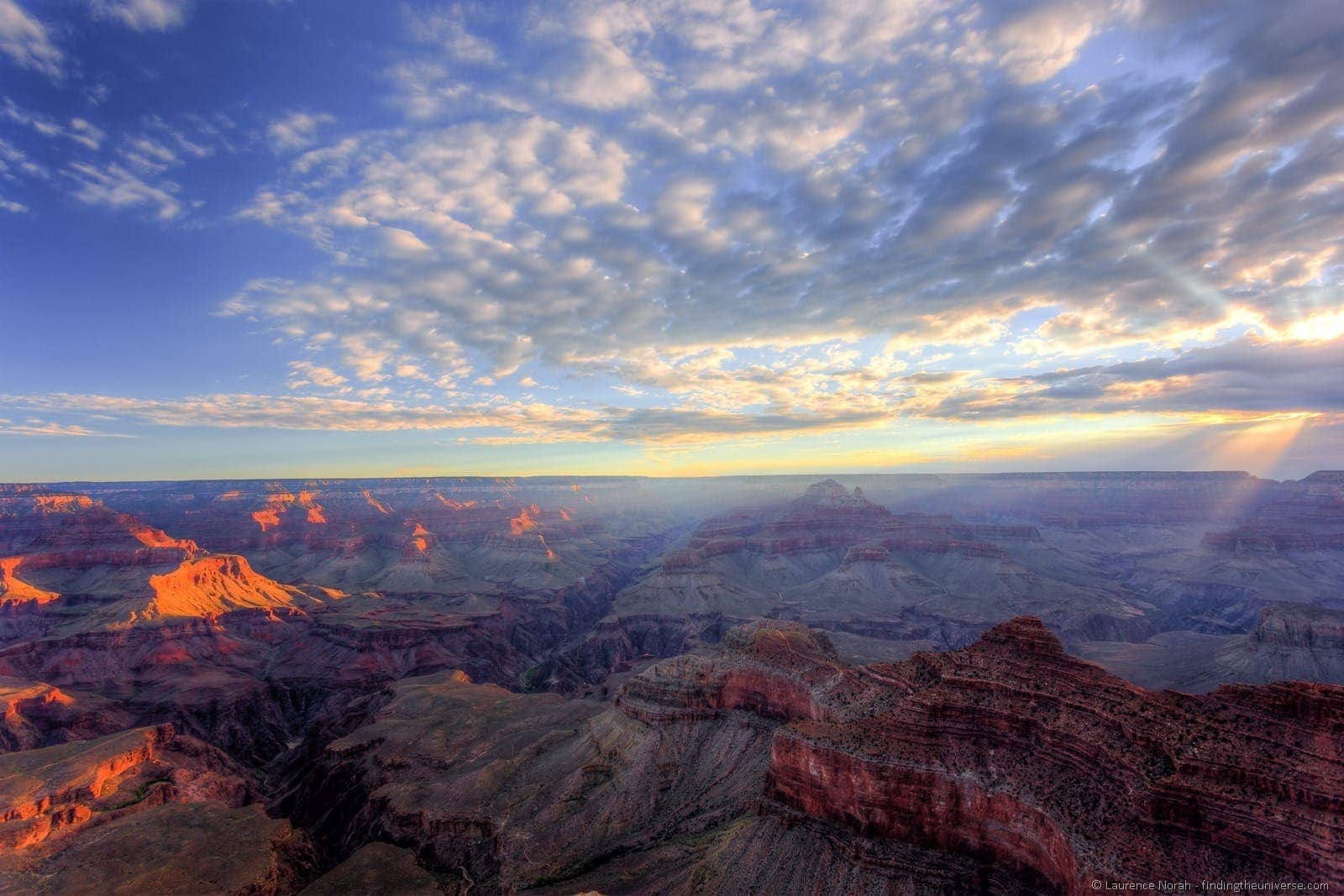
I was, as you might imagine, quite pleased.
Other Sunrise Options
If you want to avoid even the small pre-dawn crowds at Mather Point, Yaki Point is another excellent sunrise option. It faces east with jagged canyon formations in the foreground, and it’s only accessible by shuttle (the Kaibab/Orange Route) or on foot, which keeps the numbers down. The first shuttle runs at 6am from the visitor centre area during spring and summer.
For a quieter option still, Grandview Point on Desert View Drive is a favourite among photographers for its elevated views and interesting foreground. You can drive there yourself, but it’s about a 20-minute drive from the village, so factor that into your pre-dawn timing.
If you’re up for a short hike, the first section of the South Kaibab Trail drops below the rim and gives you a completely different perspective. Ooh Ahh Point (the name is accurate) is about a 20-minute hike down and offers sunrise views from inside the canyon rather than from the top. You’ll need the Kaibab/Orange Route shuttle to reach the trailhead, and do bear in mind you have to hike back up.
Photography Tips for the Grand Canyon
A few things I picked up from shooting here that might save you some frustration:
Shoot away from the sun at golden hour. I’ve said this already, but it’s the single most important tip. The canyon’s colour and depth come from side-lit and back-lit rock, not from shooting into the sun. Save the sun-facing shots for when it’s well below the horizon and the contrast has dropped.
Bring a tripod. You’ll want one for sunrise (it’s dark when you arrive) and for long exposures at sunset. It also makes a rather good selfie stick, as I proved at Mather Point.
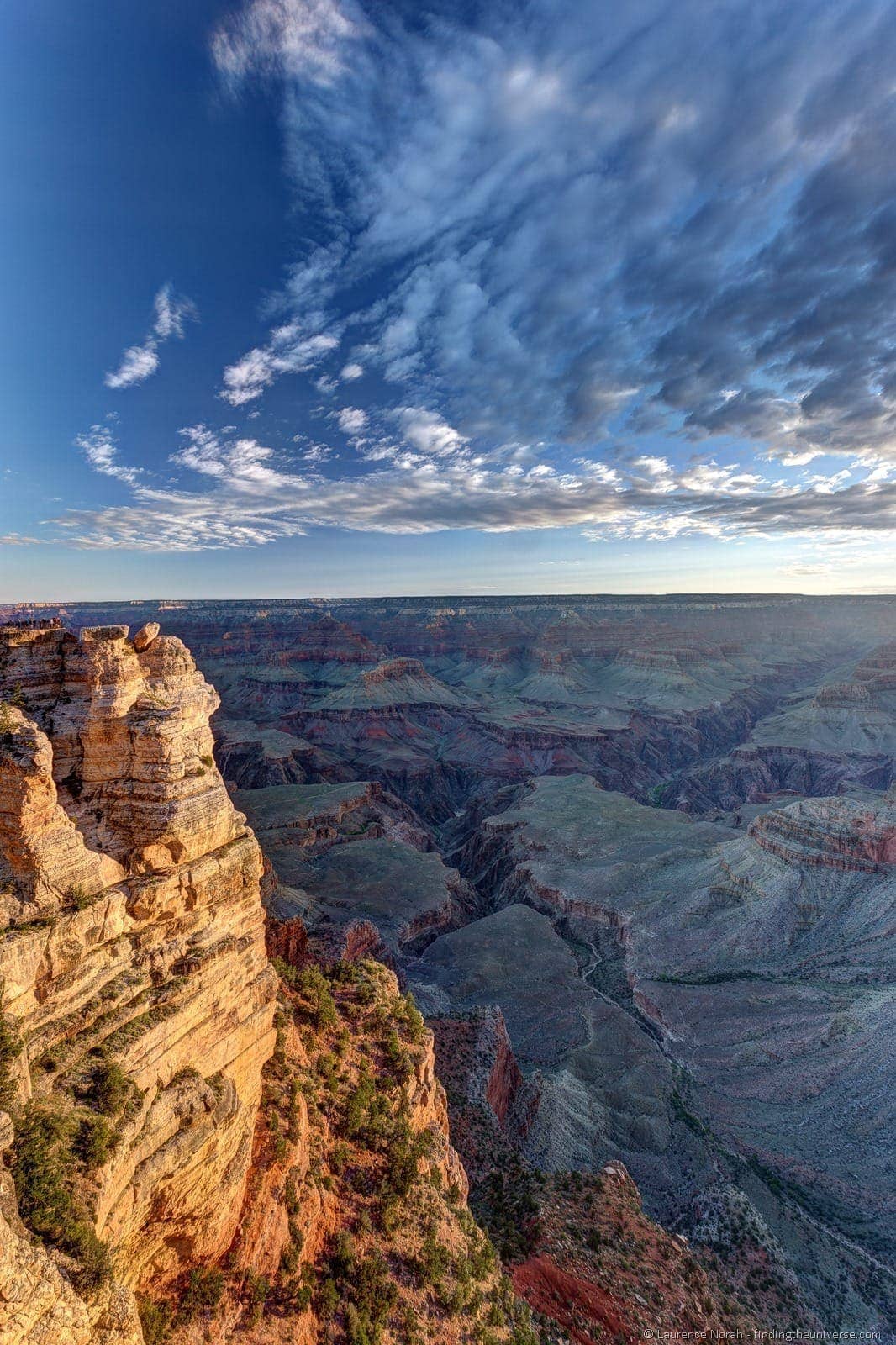
Look for foreground interest. The canyon is vast, and without something in the foreground to anchor the composition, photos can feel flat. Rock formations, twisted trees, or even the rim edge itself work well. We found Duck Rock (below), which is said to look like a duck. I wasn’t entirely convinced, but it made for a nice composition.
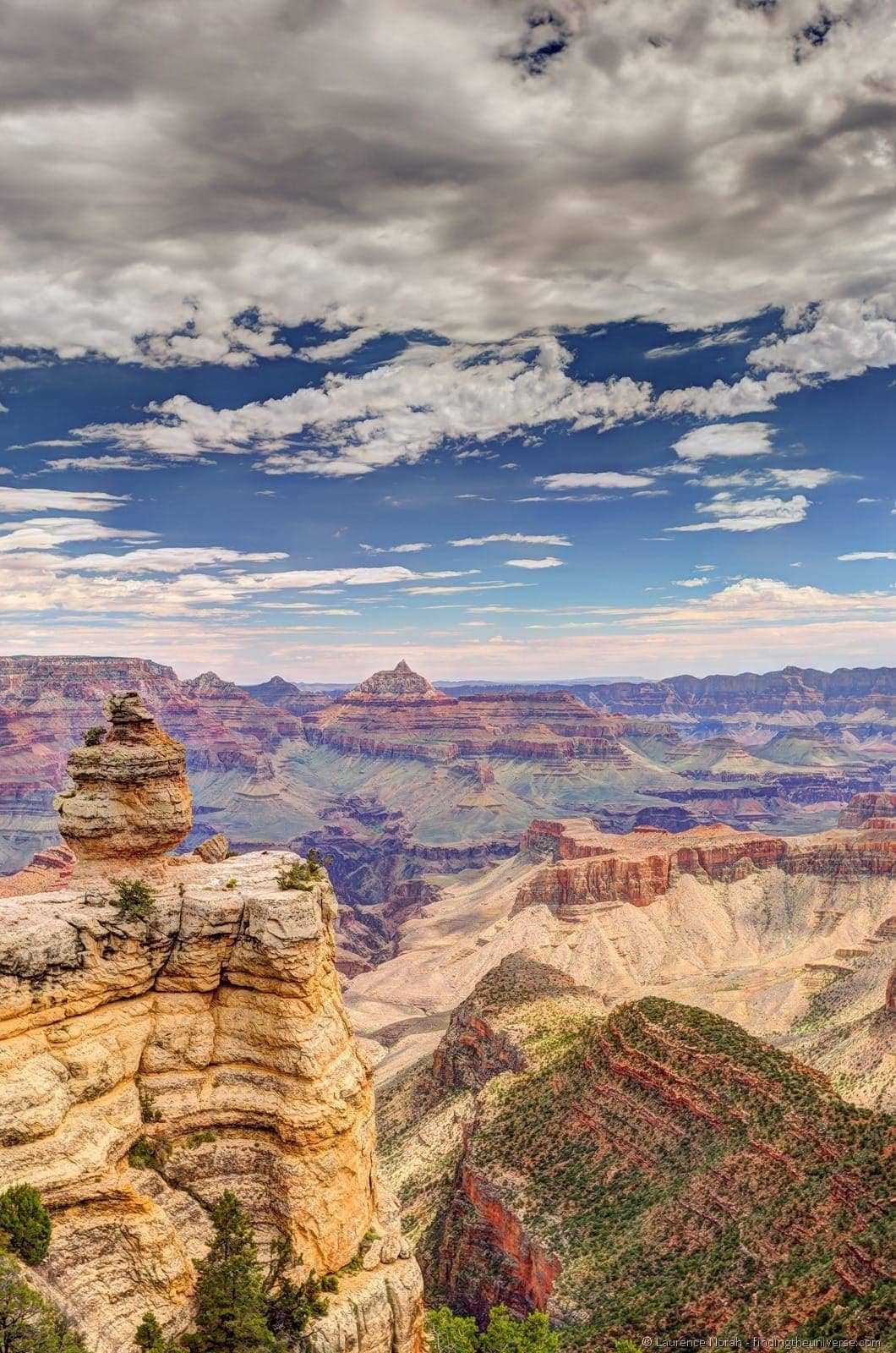
Pray for clouds during the day. Midday at the Grand Canyon can be a bit flat photographically. If you’re shooting in the middle of the day, cloud cover adds drama and helps create depth through light and shadow.
A wide-angle lens is your friend. I used a 16-35mm for most of my canyon shots. You’ll want the width to capture the scale. A telephoto is useful too for picking out individual formations and the river far below, but the wide-angle does the heavy lifting here.
Settings that work. For sharp landscape shots across the canyon, f/8 to f/11 gives you plenty of depth of field. Keep the ISO low (100-200) and let the shutter speed follow. At sunrise and sunset you’ll be shooting at slower speeds, which is another reason you want that tripod. If the dynamic range is extreme (bright sky, dark canyon floor), bracket your exposures and blend later, or use a graduated ND filter if you have one.
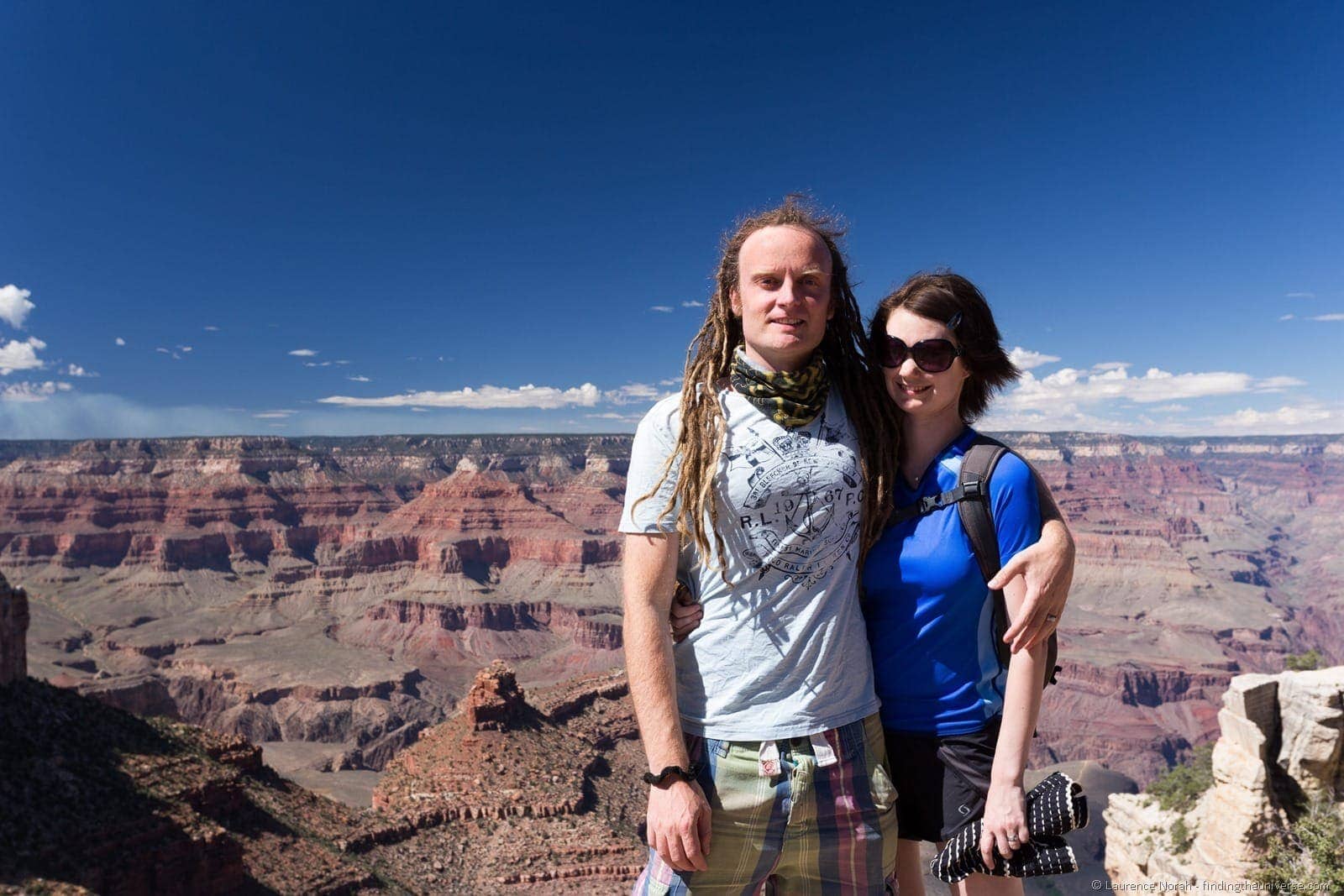
Use people for scale. The canyon is so vast that photos can lose all sense of depth. A person standing on the rim, even as a tiny figure, immediately gives the viewer something to measure against. Some of my favourite shots from the trip have Jess as a small silhouette on the edge.
Move away from the crowds. At both sunrise and sunset, the main viewing platforms get busy. Walk 200-300 metres along the rim trail in either direction, and you’ll likely have the place to yourself. I specifically asked a ranger about this, and she confirmed I was fine to go anywhere along the rim as long as I stayed on the right side of the safety signs. Most of the Grand Canyon is unfenced.
If you want to see the canyon from a completely different perspective, a helicopter flight from the South Rim is hard to beat. Flights depart from Grand Canyon Airport in Tusayan (just south of the park entrance), and the 25-45 minute tours take you over the Dragon Corridor, the North Rim, and the Colorado River. The aerial view gives you a sense of the canyon’s scale that’s impossible to get from the rim. It’s not cheap, but if you’re a photographer, it’s worth every penny.
You can also book 45-minute helicopter flights over the canyon that cover both rims.
Stay for the stars. The Grand Canyon has been an International Dark Sky Park since 2019, and if you’re already out shooting sunset, you’re in the right place at the right time. On a clear, moonless night, the Milky Way is visible to the naked eye from the rim. Mather Point and Yavapai Point both work well for night sky photography, and the Desert View Watchtower is a popular foreground subject for astrophotography. If you’re interested in shooting the night sky, I have a full guide to astrophotography that covers everything you need to know.
Want to Take Better Photos?
I’ve been teaching an online travel photography course since 2016, and over 2,500 students have taken it so far. It covers everything from how your camera works through to composition, light, and editing, with feedback from me as you go. One payment, lifetime access.
Grand Canyon Sunrise and Sunset Times
One thing that catches a lot of visitors out: Arizona does not observe Daylight Saving Time. The Grand Canyon stays on Mountain Standard Time (MST) all year round. If you’re driving in from Utah, Nevada, or anywhere else that switches clocks, double-check the time difference before setting your alarm.
Sunrise and sunset times vary a lot through the year. In midsummer, the sun comes up around 5:15am and sets around 7:45pm. In midwinter, you’re looking at roughly 7:30am and 5:20pm. I’d recommend arriving at your chosen spot at least 30 minutes before sunrise and at least an hour before sunset (sunset spots fill up much faster).
Check the NPS Grand Canyon weather page for exact sunrise and sunset times on your dates.
Practicalities for Visiting the Grand Canyon
Getting Around
The South Rim has a free shuttle bus system with four routes, and for sunrise and sunset photography, you’ll be using it a lot. The main ones to know are:
The Hermit Road (Red) Route runs along the rim to the west, stopping at Hopi Point, Mohave Point, Pima Point, and other viewpoints. This road is closed to private vehicles from March through November, so the shuttle is your only option during those months. The Kaibab Rim (Orange) Route connects the visitor centre to Yaki Point and the South Kaibab Trailhead, and Yaki Point Road is closed to private vehicles year-round.
The Village (Blue) Route links the visitor centre with the lodges, campgrounds, and the general store. The Tusayan (Purple) Route runs between the town of Tusayan and the visitor centre.
For sunrise, the first shuttles start running around 6am (earlier in summer). For sunset, the last buses run about an hour after sunset. Check the current shuttle timetable on the NPS website for your travel dates, because schedules change seasonally.
At popular times (particularly pre-sunset at Hopi Point), there can be queues for the shuttle. Arrive at the bus stop well in advance so you don’t miss the light.
Most visitors reach the South Rim by car, usually as part of a wider Arizona or Southwest road trip, with the nearest airports at Flagstaff, Phoenix and Las Vegas. If you need a vehicle for the drive, it is worth comparing rental car rates before you travel.
Entry Fees and Passes
Entry to Grand Canyon National Park costs $35 per private vehicle, $30 per motorcycle, or $20 per person on foot or bicycle. That ticket covers seven days and gives access to both the South Rim and North Rim.
If you’re visiting more than one national park on your trip (and you probably should), the America the Beautiful Annual Pass costs $80 and covers entry to all US national parks and federal recreation sites for a year. If you’re heading to Zion, Bryce Canyon, or any of the other parks in the Southwest, it pays for itself fast.
One significant change from 2026: non-US residents now pay a $100 per person surcharge on top of the standard entrance fee at the Grand Canyon and ten other popular parks. If you’re visiting from overseas, the Non-Resident Annual Pass ($250) covers that surcharge for up to four adults and is the better deal if you’re visiting more than one affected park. Check the NPS fees page for the latest details.
The park is now cashless at all entrance stations, so bring a card.
Where to Stay
The Grand Canyon is a hugely popular destination, so book your accommodation well in advance. In-park options include several lodges (Bright Angel Lodge and El Tovar are the most popular) as well as campgrounds. In peak summer, campgrounds can fill up months ahead.
We camped, which is a good option for sunrise photographers because you’re already in the park and don’t need to drive in through the entrance gate in the dark. The main campground, Mather Campground, is near the visitor centre and can be booked through recreation.gov.
The town of Tusayan, just outside the park entrance, has a range of hotels. It’s about a 10-minute drive from the visitor centre, which is manageable for sunset but means a very early start for sunrise.
For more lodging options and to book, see the NPS lodging page.
Summer Heat and Water
In summer, the South Rim can get seriously hot. It’s cooler than the canyon floor (you’re at about 7,000 feet elevation), but daytime temperatures still push into the 80s and 90s Fahrenheit. Stay hydrated. Know the signs of dehydration. There’s a good grocery store in the village area along with food outlets, a bank, and a post office, so you’re well covered for supplies.
Further Reading
If you’re planning a trip to the Grand Canyon or looking for more photography inspiration, these might help:
- Our two-week USA road trip itinerary includes the Grand Canyon as a major stop
- We have a detailed guide to hiking Havasu Falls, which is also within the Grand Canyon area on the Havasupai Reservation
- The Grand Canyon isn’t far from Las Vegas, so see our guide to things to do in Las Vegas and our picks for the best day trips from Las Vegas
- Check out my other photography location guides for the best spots in destinations around the world
- If you’re looking for a new camera, I have a comprehensive guide to the best travel cameras with something for every budget
- I run an online travel photography course covering everything from composition basics to advanced editing. You get direct feedback from me as you work through the modules, and there’s a community of over 2,000 photographers sharing their work and learning together
If you’ve shot sunrise or sunset at the Grand Canyon, I’d love to hear about it in the comments, particularly if you’ve found a great viewpoint I haven’t mentioned.
Frequently Asked Questions
What is the best time of day to photograph the Grand Canyon?
Sunrise and sunset, without question. The low-angle light picks out the colour and depth of the rock layers in a way that midday sun simply can’t. Of the two, sunrise tends to produce slightly better light on the eastern formations and draws far fewer crowds.
Midday can work if you have cloud cover, which adds drama and shadow. Clear midday skies make the canyon look flat. After dark, the Grand Canyon is an International Dark Sky Park, and the Milky Way is visible to the naked eye on moonless nights.
What camera gear do I need for Grand Canyon photography?
A wide-angle lens (something in the 16-35mm range) does most of the heavy lifting here. You need the width to capture the scale. A telephoto is useful for picking out individual formations and the Colorado River far below, but it’s a secondary lens.
Bring a tripod. You’ll need it for sunrise (it’s dark when you arrive), long exposures at sunset, and night sky shots. It also doubles as a selfie stick, which I can confirm from personal experience.
Where is the best place to photograph sunrise at the Grand Canyon?
Mather Point is the most popular and most accessible sunrise spot on the South Rim. It’s right next to the visitor centre, it faces east, and the views are excellent. The downside is that it draws crowds even at 5am in summer.
My tip: walk 200-300 metres east along the rim trail from the main viewing platform. You’ll find quieter spots with equally good (sometimes better) views, and you won’t be fighting for elbow room with fifty other tripods.
Yaki Point and Grandview Point are also excellent alternatives with fewer people.
Where is the best place to photograph sunset at the Grand Canyon?
Hopi Point is the classic sunset spot and for good reason. It extends out into the canyon, giving you views in both directions. The light on the rock layers as the sun drops is spectacular.
If the crowds at Hopi Point put you off, Mohave Point and Pima Point (both one or two shuttle stops further along the Hermit Road) are quieter alternatives with equally good light. Yavapai Point near the visitor centre is another solid option.
Is sunrise or sunset better for Grand Canyon photography?
Both are brilliant, but if I had to choose one, I’d say sunrise. The light is just as good (arguably better, with the way the eastern formations catch the first rays), and you’ll have far fewer people to contend with. Sunrise at the Grand Canyon was the best I’ve ever photographed, and the 4am start was completely worth it.
Sunset is more convenient (no alarm clock involved), and the western viewpoints like Hopi Point catch the light beautifully. If you can do both, do both.
Does Arizona observe Daylight Saving Time?
No. Arizona stays on Mountain Standard Time (MST) all year round. This catches a lot of visitors out, especially if you’re driving in from Utah or Nevada where the clocks do change. Always double-check the time difference before setting your sunrise alarm.
How much does it cost to enter Grand Canyon National Park?
For US residents, it’s $35 per private vehicle, $30 per motorcycle, or $20 per person on foot or bicycle. This covers seven days at both rims. The America the Beautiful Annual Pass ($80) covers all US national parks for a year.
From 2026, non-US residents pay an additional $100 per person surcharge. The Non-Resident Annual Pass ($250) is the better option if you’re visiting multiple parks.

Kody M says
Tank you so much for all the info! I’m taking my wife and kids in a couple weeks. I plan on making the drive from CO to the south rim over night (13ish hours). If all goes well, we will catch the sunrise at the spot you were! Thanks for posting the GPS cords! OMG! I’m so excited! This has been on my bucket list since I knew what one was! Safe travels to you and yours!
P.S. I don’t have any sort of fancy camera, just an iPhone. But I still can’t wait!!
Laurence Norah says
My pleasure Kody! I hope you have a great trip and I’m sure you’ll get some great photos regardless of your camera 😀
Rhonda Johnson says
Awesome site👍. We live in lake havasu city, been to GC many times but you offered great photo tips. Ty for sharing.
Laurence Norah says
Thanks very much Rhonda! It’s always lovely to hear from locals that I’m getting it right 🙂 Stay well!
Johanna says
Stunning pictures and a lot of very helpful and detailed tips! Thanks a lot for this, the article is really helpful 🙂
Laurence Norah says
My pleasure Johanna, I’m pleased you liked it 🙂
Jacob Forsythe says
I’m curious how far off the trail you had to go for your sunrise location? I was trying to find your spot! Love the overlook!
Laurence Norah says
Hi Jacob!
It wasn’t far off the trail, the exact co-ordinates I took the sunrise photos from was here: 36°3’38.886″ N 112°6’24.539″ W
which you can see on Google Maps here: https://goo.gl/maps/nTUhrfU8yNN2
I would very much advise caution of course, wherever you choose to go, and especially if you leave the marked trail. There are very large drops in the Grand canyon and many unfenced sections. So please do take care 🙂
Have a great trip!
Laurence
yasmin says
hey! great guide! do you recommend using an ND? i was considering purchasing one but have read that graduated filters can be better for the canyon. i don’t have the budget to get a fixed and a graduated filter. i would mostly if not exclusively be using it for sunrise/sunset shots. did you use one? what do you recommend?
Laurence Norah says
Hi Yasmin!
So I didn’t use an ND filter. The only reason to use it would be if you wanted to do longer exposure of the cloud movements. I would say though that a graduated filter would definitely be useful. The difference between the brightness in the sky and the darkness of the canyon makes for challenging photography, and a graduated filter can help with this. I didn’t have one, so I used exposure blending to achieve this in post, but a graduated filter would definitely have made this easier 🙂
Have an awesome trip! Would love to see your photos when you are done, we have a facebook group you are welcome to join here: https://www.facebook.com/groups/travelloversandphotography/
Laurence
yasmin says
thanks for the quick response! do you have any guides on exposure blending in lightroom? i have lightroom but am definitely less than proficient in it.
Laurence Norah says
My pleasure! So I don’t have a guide for Lightroom for exposure blending, but to be honest there’s not a lot to it. The key is to get the exposures in the first place, for which you’ll obviously need a tripod and a camera that supports exposure bracketing (although you can do it manually). In Lightroom, you then select the images you want to blend and press “HDR merge”, and it’ll do it for you.
Photoshop is actually better for this as it gives you control over the layers and the blending, but I find the HDR merge tool in Lightroom works pretty well, and despite the name, the results are not too HDR’y 🙂
Nicole Nieto says
Thank you so much for all this great information. It was incredibly helpful! I’ll be in the area this coming Wednesday/Thursday. I’m getting my itinerary together and just have a few ?s
Wednesday Sunset – Yavapai/Hopi Point? do getting to these require walks/hikes or more of an actual lookout point near the road?
Thursday Sunrise/hike – Mather’s Point. I checked that it should be around 6:30am. Same question, is it close to the road or there’s a hike to where you want to be? what time do you suggest we get there?
Also, I have approx 3-4 hours for a hike after that so any suggestions on which direction to head or trail?
Your suggestions are so appreciated!
Laurence Norah says
Hi Nicole
So neither of the locations require a hike as there are shuttle buses that run to both of them. The only reason you might hike is if the shuttle bus is full. For sunset, Hopi point for example is a popular spot, so you will want to arrive at the shuttle bus in plenty of time. My advice is to walk a bit away from the main lookout point for both options as they will be more crowded – even just a five minute walk will get you to more peaceful spots where you can enjoy the view with less of the crowds 🙂
In terms of a hike, personally I liked just walking along the rim – either direction is good! The trails run right along the edge and the views are spectacular. You could also try descending into the canyon if you prefer – just be aware it will take you longer to come up then to go down 🙂
Have a great trip, and do drop in to our facebook group to share your photos and feedback, we’d love to see them! You can find that here: https://www.facebook.com/groups/travelloversandphotography/
Laurence
Nicole Nieto says
Thanks so much and I definitely will follow up with my shots!! We would like to actually hike and get a little bit of a workout in, I see South Kaibab Trail is popular, but if you have a rec for any other trail to hike down, thinking down for 1-1.5 hours and back.
Again, I really appreciate all the information I’ve gotten here and your suggestions as well!
Thanks for getting back to me so quick,
A panicing/last minute east coaster 🙂
Laurence Norah says
My pleasure Nicole 🙂 So I haven’t actually done the trails into the canyons, but friends of mine have done both the South Kaibab Trail and the Bright Angel trail. The latter is a little easier with more shade, whilst the former is a bit steeper. Both are very popular trails though, and I’m sure you’ll enjoy either 🙂
Jannette Bradley says
Greetings! First off, your photos are AMAZING! You and your wife have quite an eye for the camera. Thank you for the advice,tips, and photos on this blog. I’m wondering if you can answer a few questions for me: I plan to visit the South Rim in June. I googled the time of the sunrise (it’s around 5:12am) and we are staying in Flagstaff. I’m thinking we should leave FS around 3:45 to get to the Canyon on time? Do you recommend parking at the visitor center and walking to Mather Point? How “early” before actual sunrise should we arrive? Also, since it will be dark, is the road to the visitor center well marked to direct us to the appropriate area to park and get to Mather Point? Any advice on taking the perfect sunrise picture?
Thank you in advance for the help and thanks again for this very informative blog.
Peace and light to you both,
Jannette
Laurence Norah says
Hi Jannette,
Thanks very much!
I would definitely say you will need to park at the visitor centre and walk to Mather point. It’s the closest (and pretty much only!) parking available. I would say you will want to be there at least 30 – 40 minutes before actual sunrise as the pre-sunrise light can also be magical, plus the canyon photographs really well when the sun isn’t up as the canyons are less contrasts. The visitor centre is well marked as I recall, but I have to admit that I drove there in daylight. But there aren’t a lot of roads so I think you will be fine. I would suggest having a GPS or downloading an offline Google Map of the area for reference.
In terms of photographing the event, my advice is to use a tripod if you possibly can, especially before the sun comes up, as it will be quite dark. We also have loads of tips on photography across the site, I’d suggest starting here and reading up on composition etc 🙂
https://www.findingtheuniverse.com/category/photography/photography-tips/
Have an awesome trip!
Laurence
Karyn Curtis says
We will be visiting the Grand Canyon in July. We are not camping; will be at a hotel in Flagstaff. I want to capture the sunrise. I know we’ll have to head out very early. Once we are there do we get on a shuttle to take us to these specific spots you recommended? Thanks
Laurence Norah says
Hi Karyn,
For parking for Mather Point, which is one of my recommended sunrise locations, you will be able to park at the visitor center. It should not be too busy if you arrive that early! You can see a map of parking locations here:
https://www.nps.gov/grca/planyourvisit/parking_sr.htm
If you aim for P2, you should be just a short walk from the rim 🙂
Enjoy!
Laurence
Karyn says
Thanks! Because we are going that early we shouldn’t need the shuttle then, correct? Also since it will be dark I’m nervous about the hike down to Mather Point with kids. What do you think? Thanks again!
Laurence Norah says
Hi Karyn,
That should be correct! The hike down to Mather Point is on a well marked and level path, and there are fences at Mather Point itself, so I don’t think you’ll have any trouble as long as your kids stay to the path 🙂
Karyn Curtis says
Thank you for all your help!
Chris says
Hi Lawrence, Jessica,
“Wow” photos!!! I will take your advice, may struggle to get up at 4am! I would be most grateful for any recommendation about taking beautiful photos in Cuba, including diving photos?
Thanks,
Chris
Laurence Norah says
Hey Chris!
Thanks very much 🙂 Unfortunately I’ve not been to Cuba, so I wouldn’t be able to help 🙁 Have a great trip though!
Laurence
Henry AT fotoeins says
Hi, Laurence. I found your post in a search as I’m accumulating best practices and wisdom online for viewing sunrises and sunsets at the Grand Canyon. I’m looking forward to witnessing at least one with the naked eye; the rest will be left to a choice of camera!
Laurence Norah says
Thanks Henry! Let me know if you have any specific questions I can help with, and have a great trip! It’s an incredible sight to see for sure 😀
Ras Jarborg says
Thanks so much for this post! We just arrived at Grand Canyon and managed to drive into the park by 07.30am to bear the crowds. I was looking for tips on sunset and sunrise photography posts when Google led me straight to your post. I’m now signed up for your newsletter. Thanks again!
Laurence Norah says
Awesome – have a wonderful time! It’s a stunning place 🙂 Thanks for signing up, we look forward to having you be part of our adventure!
becky says
Hey Laurence and Jessica, love this post! What stunning photos!! Amazing!
I am off to LA and also the Grand Canyon next week, I’m really excited and looking forward to using plenty of your great tips’ thank you so much!
Also not looking forward to the 4am start but I know it will be worth it!
Will we be able to drive and park nearby the sunrise spots?
Thank you!!
Becky
Laurence Norah says
Hi Becky! My pleasure. For the sunrise spots, the best option is to take the shuttle *assuming you are camping*, as this runs from very early in the morning and will take you to where you need to go. There is very limited parking around the park 🙂
Yoshi says
Hi Laurence, really helpful post and the photos are AMAZING! Soo excited to go for the first time! My husband’s a photographer and I’m a festival fashion designer so when we travel we usually do photoshoots for my clothing line . I’m planning to drive to the Grand Canyon after a festival in Cali and wanted to do sunrise/sunset photoshoots with possibly studio lights set up and drone footage. Is there any place you would recommend that’s not fenced off? I notice that a lot of the viewpoints have fences but ideally wanted to shoot somewhere more natural where we could just climb on a rock or have the models actually interact with the scenery without a big crowd coming to look.
Laurence Norah says
Hi Yoshi!
Thanks very much! So, I have good news and bad news. The bad news – you can’t use drones in the Grand Canyon (or any US national park). You can see the rules here: https://www.nps.gov/grca/learn/management/lawsandpolicies.htm
The good news is that it is very easy to find unfenced areas, in fact, most of the grand canyon is unfenced – it’s just the very popular spots that have fences, and these aren’t very long. I specifically asked a ranger about where I was allowed to go, and she said I was fine to go anywhere. So you won’t have a problem. I did a lot of photography and had no problems, you should be able to easily find a spot with no crowds (sunrise is better than sunset for this) and shoot unhindered.
Have a great trip!
Katie BH says
Hey Lawrence! Firstly photos are amazing! I was in the canyon November 2017 and managed to get sunrise and sunset photos. My favourite one (https://www.facebook.com/photo.php?fbid=10159654560950494&set=a.10159551659225494.1073741869.644015493&type=3&theater) of the sunrise was taken from Moran Point just off desert view drive – i was aiming to get to desert view point but didnt make it out of bed in time to get there – still pretty awesome photo ops from there 🙂 feel free to flick through the rest on my facebook page and I’m heading back there in May this year so will check out Yavapai point for the sunrise 🙂
Katie
Laurence Norah says
Hey Katie!
Thanks for sharing. For some reason I can’t see the image (possibly it’s not set to a public audience on facebook?), but I’m delighted you had a good time anyway. I’d love to take a look at your facebook page and see what you got from your adventure though! Good luck in May!
Chris Víllanueva says
hey Laurence! i just stumbled on your page and i think your photos are amazing! i just have a quick question as to one of the photos, the “selfie” that you took with your tripod after walking down 300m from mathers point east…how did you get on that rock? did you have you climb over the safety railing in order to get that photo? or do the railings stop after awhile? and your just free to go onto the edge of the rocks? i am curious because i want to go on a trip at the end of this year, and one of my main goals is to recreate a photo like that one of you standing on the rock overlooking the grand canyon!
Laurence says
Hey Chris!
When I was there there are points where there are fences, and then huge stretches without fences. I made the point of checking with a park range their policy on this, and she told me I was fine to go wherever I wanted, even the other side of the fences, and it was on me if I fell off. So yes, you’re free to go on the edge of rocks, but please exercise caution and be careful – some of those rocks are on the edge of mile high drops 😉
Have a great trip!
Duke Mantee says
Enjoyed your article and photos. I saw Grand Canyon for the 1st time this summer and am determined to go back next year.
Ford Quarterman says
I recently just returned from my first jaunt to the Grandaddy Canyon, & couldn’t put down the camera! You’ll have to try out the north rim next time – much less people, higher in elevation & more “foresty.” Even the iPhone shutterbugs can get stunners there, but thanks for these brilliant pro shots of one of our planet’s gems!