
I grew up on a small island in the Seychelles called Bird Island, which was home to a handful of people and several million nesting seabirds. Just about every adult I knew had a pair of binoculars within reach, and a decent chunk of my childhood was spent having the finer points of noddies and frigate birds explained to me through borrowed glass.
Since then there have been multiple African safaris, a trip to the Galapagos, and a lot of birdwatching. These days Jess and I own two pairs of binoculars, which between them have covered our safaris and most mornings’ birdwatching at home. So choosing binoculars for safari is a subject I’ve spent rather more time on than is probably normal.
If you just want the quick answer: buy the Vortex Diamondback HD 8×42. It’s one of the two pairs we own, and it has the widest view of anything on this list. If you’d rather have real ED glass, the Vanguard VEO HD2 8×42 is the one, and it’s cheapest bought direct from Vanguard, where the code FindingTheUniverse takes 20% off. On a tighter budget the Celestron Nature DX 8×42 gets you most of the way there for a lot less money.
Below are our full picks across a range of budgets, all of which you can actually buy without remortgaging anything, including the story of why the pair I’d stopped recommending is back at the top of the list.
Table of Contents:
Do You Need Binoculars for Safari?
Yes, you should bring binoculars on safari. I’d put them just behind a hat and sun cream on the list of things you’ll regret leaving at home.
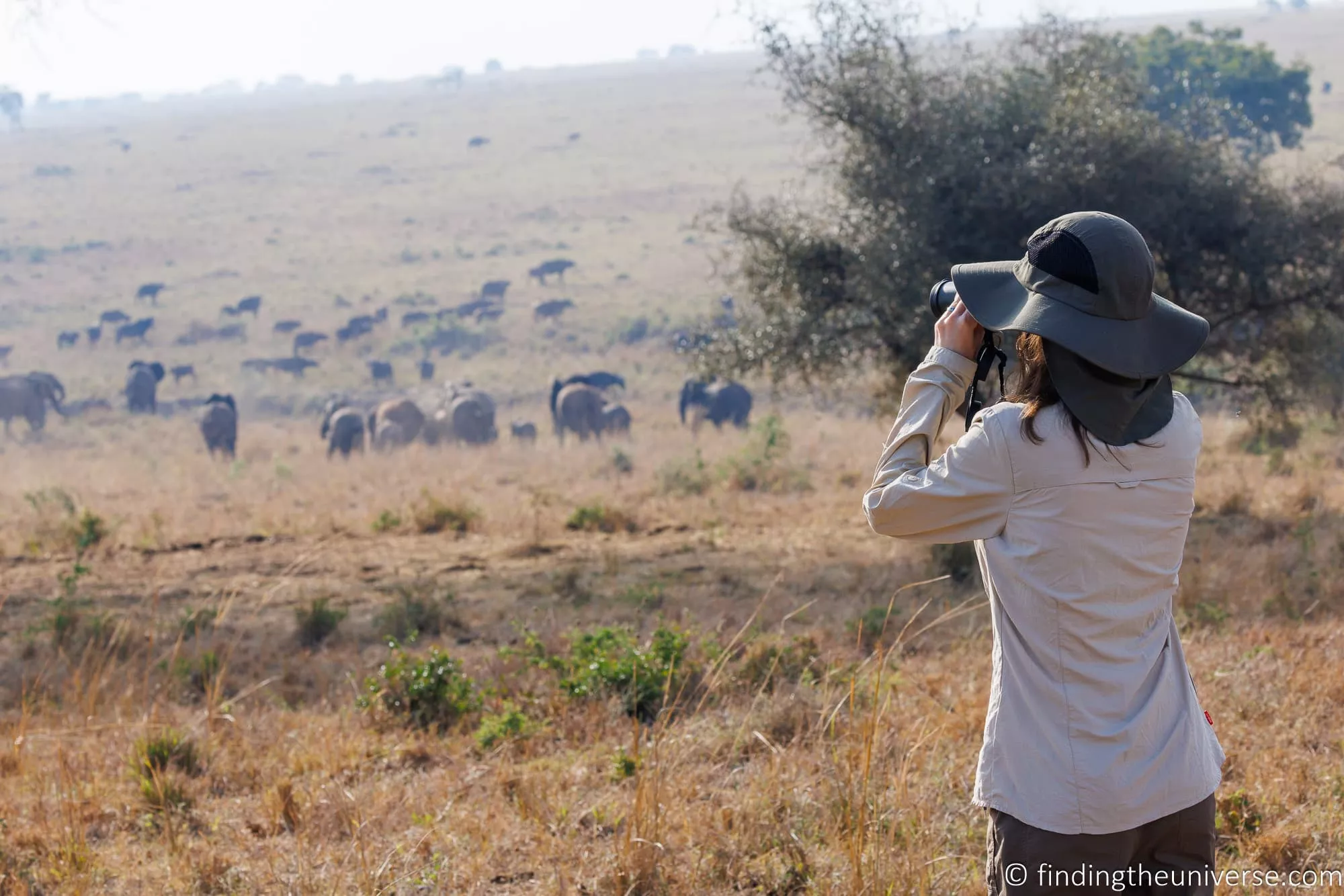
The reality of a game drive is that a lot of the best sightings happen at distance. The leopard is draped over a branch 150 metres away, the cheetah is on a termite mound across the plain, and the lions are doing what lions do best (sleeping) in grass that hides everything but an ear. To your naked eye these are beige smudges. Through decent binoculars, they’re the reason you came.
Your guide will usually have a pair, of course, but a shared pair in a vehicle of six people means everyone gets a brief look at something that may not wait around. We recommend one pair per person, even if the second is an inexpensive compact. It’s also why binoculars sit near the top of our safari packing list.
Safari Binoculars Comparison Table
Here’s the whole lineup at a glance. Price bands: $ is under $200, $$ is $200 to $400, $$$ is over $400. Live prices are listed where available in the detail section of each pick further down, or you can click through if you’re in a hurry!
| Binoculars | Spec | Field of view (ft @ 1000 yds) | Weight | Waterproof | Price band | Best for |
|---|---|---|---|---|---|---|
| Vortex Diamondback HD 8×42 | 8×42 | 393 | 21.8 oz / 618 g | Yes | $$ | Best overall, widest view |
| Vanguard VEO HD2 8×42 | 8×42 | 377 | 25 oz / 709 g | Yes | $$ | Best ED glass |
| Celestron Nature DX 8×42 | 8×42 | 388 | 22.2 oz / 629 g | Yes | $ | Best budget |
| Nikon Monarch M5 8×42 | 8×42 | 335 | 22.2 oz / 629 g | Yes | $$ | Glasses wearers |
| Nikon Monarch M5 10×42 | 10×42 | 293 | 22.6 oz / 641 g | Yes | $$ | Open plains, long distances |
| Vanguard Vesta 8×25 | 8×25 | 340 | 8.5 oz / 241 g | Yes | $ | Ultra-light backup |
| Zeiss Terra ED 8×42 | 8×42 | 375 | 25.6 oz / 725 g | Water resistant | $$$ | Premium step up |
The Best Binoculars for Safari
A quick word on how this list was put together. Every pair here is from an established manufacturer, is the current generation of its line, and was in stock when I checked. I’ve deliberately kept to the price range where most safari-goers actually shop, so you won’t find any four-figure alpine glass below. Lovely as that stuff is (more on that in a moment), you really don’t need it to have a brilliant safari.
1. Vortex Diamondback HD 8×42: The Best Safari Binoculars Overall

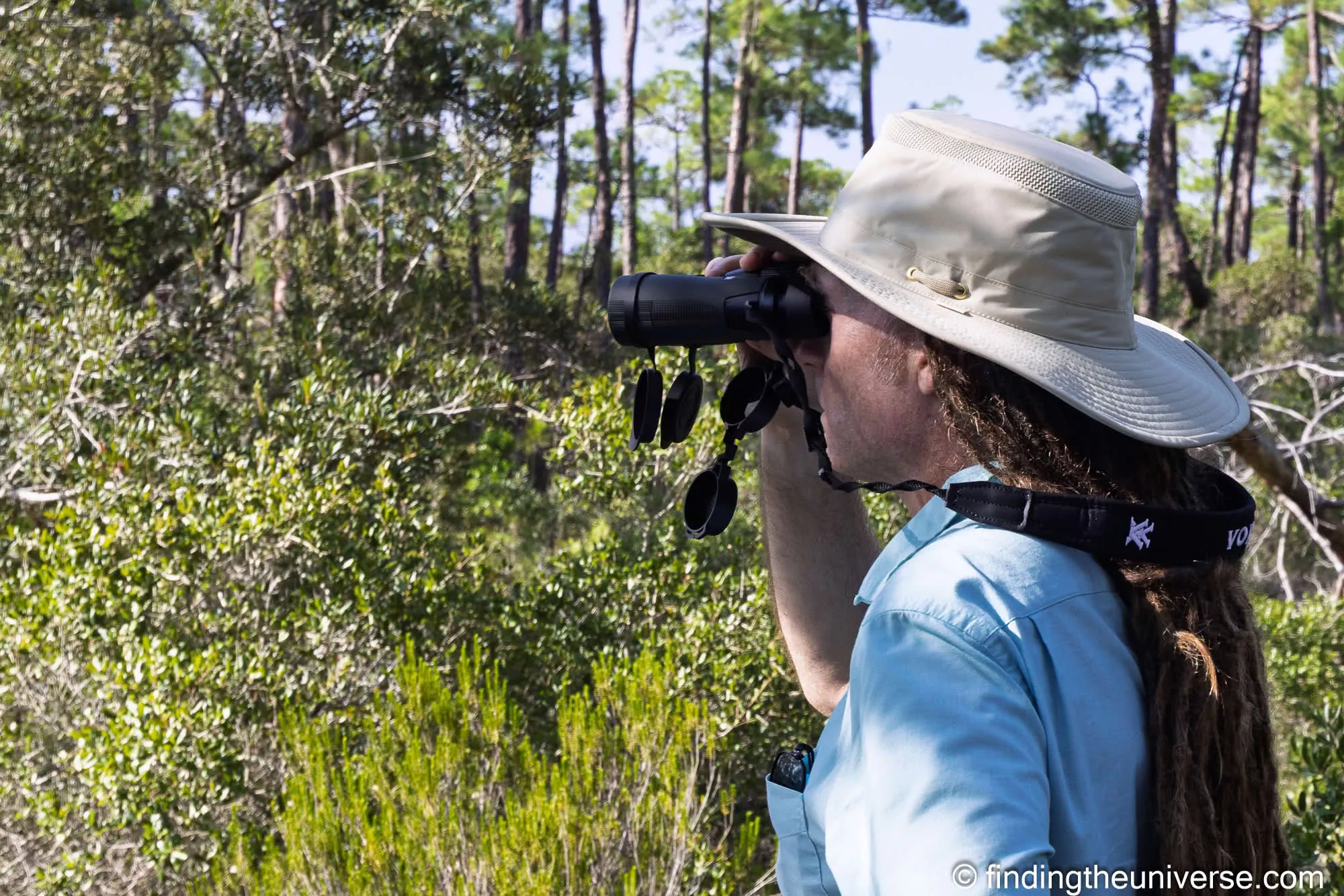
This is one of the two pairs we own, and for the first time in a while it’s the one I’d tell you to buy. We bought ours a few years back, took them to Africa, and they’ve been faultless ever since. The 393 ft field of view is the widest of any full-size pair here, which makes finding and following animals noticeably easier, and at 21.8 oz they’re also the lightest of the 42 mm options.
For a couple of years I moved this pair down the list, because the price climbed well past what we paid and stock at the big retailers kept drying up. Both of those have now sorted themselves out, and nothing else here comes close on value. The Vanguard below does have real ED glass, but even at its best direct price it costs a good third more, which is a lot to pay for a difference I struggle to see in the field.
Worth being straight about one thing: Vortex brands this glass as their “HD Optical System”, which is very good, but it isn’t ED glass, whatever the name suggests.
The other reason ours have never left the kit bag is the warranty. Vortex covers these with what they call an unlimited, unconditional lifetime warranty. You don’t need a receipt or a registration, and they don’t ask questions. If you’re the sort of person who drops things off vehicles (no judgement, I photograph from vehicles for a living), that promise is worth real money.
- Magnification and objective: 8×42
- Field of view: 393 ft at 1000 yds
- Weight: 21.8 oz / 618 g
- Eye relief: 17 mm
- Waterproof and fogproof: yes, argon purged
- Warranty: unlimited, unconditional lifetime
Stock is the one thing to watch with these. They’re on Amazon now, but the listing has come and gone before. If it’s showing as unavailable when you look, B&H carry them too.
2. Vanguard VEO HD2 8×42: The Best ED Glass Alternative

This is the other pair we own, and for a couple of years it was my top pick here. The headline feature is the ED glass, which Vanguard sources from HOYA in Japan. In practice, ED glass means noticeably less colour fringing around high contrast edges, which on safari translates to a crisp line between a dark animal and a bright sky rather than a purple halo. Once you’ve compared ED and non-ED glass side by side, it’s quite hard to go back.
The view is wide at 377 ft, the focus wheel is smooth enough for tracking a moving animal, and the whole thing is waterproof and fogproof. At 25 oz it’s a little heavier than some rivals, though I’ve never found that to matter on a game drive, where it spends most of its time on your lap or a strap. It also comes with Vanguard’s no-fault lifetime warranty.
I’ve been a Vanguard ambassador for a number of years, so make of that what you will, but we bought these with our own money, and they’ve since spent years being used almost daily. My parents, who are also avid birdwatchers (they plan whole trips around watching birds), also have a pair of Vanguard binoculars which they rate highly.
- Magnification and objective: 8×42
- Field of view: 377 ft at 1000 yds
- Weight: 25 oz / 709 g
- Glass: HOYA ED glass, BaK4 roof prisms
- Waterproof and fogproof: yes
- Warranty: lifetime
Direct from Vanguard the VEO HD2 is $399.99, and the code FindingTheUniverse takes 20% off, which brings it to around $320. That is usually the best price, and reliably in stock direct even when Amazon runs low. You can also buy it on Amazon here, though the price there moves around with stock.
Check price on Amazon
3. Celestron Nature DX 8×42: The Best Budget Safari Binoculars

If your budget is tight, this is where I’d send you. The Nature DX gives you the full 8×42 safari specification, a wide 388 ft field of view, phase-coated BaK-4 prisms, and a fully sealed, nitrogen-filled waterproof body, at a price that usually undercuts everything else on this list.
What you give up is the fancy glass. There’s no ED element here, so you’ll see a bit of colour fringing on high contrast edges, and the image doesn’t have quite the bite of the pricier picks. For a first safari, or for a second pair so nobody has to share, that’s a trade I’d happily make. Eye relief is a comfortable 17.5 mm, so it works well with glasses too.
One buying note: Celestron also sells a separate, more expensive Nature DX ED model. This pick is the standard version, which is the one that hits the budget sweet spot.
- Magnification and objective: 8×42
- Field of view: 388 ft at 1000 yds
- Weight: 22.2 oz / 629 g
- Eye relief: 17.5 mm
- Waterproof and fogproof: yes, nitrogen filled
- Warranty: limited lifetime
Check price on Amazon You can buy it on Amazon here.
4. Nikon Monarch M5 8×42: The Best for Glasses Wearers

The Monarch M5 is the pick I’d point glasses wearers at. Its 19.5 mm of eye relief is the most generous here by some margin, which means you can keep your glasses on and still see the full image. It also has real ED glass, dielectric prism coatings, and a body that Nikon rates as submersible, so the build quality concerns are nil.
The trade-off is field of view. At 335 ft it’s noticeably narrower than the Vanguard or the Vortex, which makes initially finding an animal a touch harder. Once you’re on the subject the image itself is lovely, and if you wear glasses, the eye relief matters more than the width. That’s the maths that puts it at number four rather than higher.
One thing to watch when ordering: Nikon still sells the older Monarch 5 (no M) alongside this model, and the two get mixed up in listings constantly. You want the M5. Check the name carefully before you click buy.
- Magnification and objective: 8×42
- Field of view: 335 ft at 1000 yds
- Weight: 22.2 oz / 629 g
- Eye relief: 19.5 mm
- Glass: ED glass, phase-corrected roof prisms
- Warranty: lifetime limited on the optics
Check price on Amazon You can buy it on Amazon here.
5. Nikon Monarch M5 10×42: The Best 10x for Open Plains

If you’ve read the 8x versus 10x section below and decided your safari really does call for more reach, this is the 10x I’d buy. It’s the same current-generation Monarch M5 as the pair above, with the same ED glass, the same submersible build, and still a very usable 18.4 mm of eye relief.
The numbers to go in with open eyes on: field of view drops to 293 ft, and the smaller exit pupil gives up some brightness in dawn and dusk light, which is exactly when a lot of the good stuff happens. On wide open country like the Serengeti or Etosha, where animals can be a very long way out and the sightlines run to the horizon, that trade can easily be worth it. In thicker bush, I’d take the 8×42 every time.
- Magnification and objective: 10×42
- Field of view: 293 ft at 1000 yds
- Weight: 22.6 oz / 641 g
- Eye relief: 18.4 mm
- Glass: ED glass, phase-corrected roof prisms
- Warranty: lifetime limited on the optics
Check price on Amazon You can buy it on Amazon here.
6. Vanguard Vesta 8×25: The Best Ultra-Compact Pair

At 8.5 oz, the Vesta weighs about a third of everything else on this list, and it disappears into a day pack or a jacket pocket. It’s still waterproof and fogproof, the 340 ft field of view is actually pretty respectable, and the price makes it an easy add-on rather than a big decision.
It is, though, a portability compromise rather than a small miracle. The 25 mm objectives mean a much dimmer view at dawn and dusk, the 12.5 mm eye relief is tight if you wear glasses, and the warranty is five years rather than lifetime. As your only pair on a once-in-a-lifetime safari, I think you’d regret it. As the second pair that means nobody is wrestling over one set of binoculars while a cheetah does something interesting, it’s exactly right!
- Magnification and objective: 8×25
- Field of view: 340 ft at 1000 yds
- Weight: 8.5 oz / 241 g
- Eye relief: 12.5 mm
- Waterproof and fogproof: yes
- Warranty: 5 years
Check price on Amazon You can buy it on Amazon here, or direct from Vanguard here with the 20% code FindingTheUniverse.
7. Zeiss Terra ED 8×42: The Premium Step Up

I haven’t used the Terra ED myself, so this pick comes from the spec sheet and Zeiss’s reputation rather than field time. I have, however, spent a couple of years with premium European glass. Swarovski Optik once lent me a pair of their binoculars for a review and then apparently forgot about them, and by the time they asked for them back (to my considerable dismay) I understood exactly what the top-tier money buys: a level of brightness and clarity that’s hard to describe until you’ve looked through it.
The Terra ED is the sensible way to get a taste of that world. It’s Zeiss’s entry line, with ED glass, a hydrophobic coating that sheds rain and dust, and a 375 ft field of view. It’s the heaviest pair here at 725 g, and Zeiss rates it as water resistant rather than fully submersible, which is worth knowing even if it’s unlikely to matter in a Land Cruiser.
Do you need it? No. The VEO HD2 does the job for less. But if you want the nicest glass on this list and a badge that will outlast several safaris’ worth of gear envy, this is the ceiling I’d stop at. If you like the idea of spending up but not quite to Zeiss money, there’s also the Vanguard VEO HD IV 8×42, the flagship of the same line as the HD2 we own: the same HOYA ED glass with upgraded SK-15 prisms and a magnesium body, at around $399 with the code FindingTheUniverse. Past this point you’re into four-figure territory, and I’d rather you spent that on more days in the bush.
- Magnification and objective: 8×42
- Field of view: 375 ft at 1000 yds
- Weight: 25.6 oz / 725 g
- Glass: ED glass with hydrophobic multi-coating
- Water resistance: nitrogen filled, water resistant
Check price on Amazon You can buy it on Amazon here.
8x or 10x Binoculars for Safari?
For most people, on most safaris, 8×42 is the better choice. Both pairs we own are 8×42, which is what I’ve settled on after multiple trips.
The case for 8x comes down to three things. First, field of view: compare the 393 ft of the Vortex 8×42 with the 293 ft of the Nikon 10×42 above. That extra width is the difference between finding the leopard your guide is describing and still sweeping the tree while everyone else makes appreciative noises.
Second, steadiness. At 10x, every wobble of your hands is magnified too, and a game vehicle with the engine running (or five other people shifting in their seats) is not a stable platform. Third, brightness at the edges of the day.
That last one deserves numbers. Divide the objective size by the magnification and you get the exit pupil, the little disc of light the binoculars deliver to your eye. An 8×42 gives you 5.25 mm; a 10×42 gives you 4.2 mm.
Because light gathering scales with the area of that disc, the 8×42 delivers roughly 55% more light to a dark-adapted eye. At dawn and dusk, when your pupils are wide open and the predators are actually moving, that’s a visibly brighter image.
In the middle of the day the advantage disappears, and if you’re over 50 or so your pupils may not open wide enough to use all of it, but the golden hours are precisely when you want the help.
And the case for 10x: if your safari is mostly wide open country with enormous sightlines, think the Serengeti short grass plains or Etosha’s pans, the extra reach does help, especially if you have steady hands or something to brace against. Plenty of experienced safari-goers choose 10x for exactly this reason. They’re optimising for different terrain, and for that terrain they’re right. If that’s you, get the Monarch M5 10×42 and skip the guilt.

How to Choose Binoculars for Safari
If you’re weighing up pairs beyond this list, or just want to understand what you’re buying, these are the specifications that actually matter on safari.
What the Numbers Mean
Every pair of binoculars is described by two numbers, like 8×42. The first is magnification: an 8x pair makes things look eight times closer. The second is the diameter of the objective lenses (the big ones at the front) in millimetres. Bigger objectives gather more light, which means a brighter image, at the cost of size and weight. For safari, 8×42 is the standard for good reason, and everything in this guide is a variation on that theme.
Objective Size: 42 mm vs 32 mm vs 25 mm
A 42 mm objective is the safari default because it keeps the image bright in early morning and late evening light, when game is most active.
A 32 mm pair is a fair middle ground: usefully lighter, with only a modest low-light penalty, and a well-made 8×32 can match a 42’s field of view because width is set by the eyepiece design rather than the objective. A 25 mm compact like the Vesta is a real compromise in dim light, which is why I’d only carry one as a backup.
If you’re choosing a single pair for safari, make it a 42.
Field of View
Field of view is how wide a scene you see, usually quoted in feet at 1000 yards. Wider is better for wildlife: you find animals faster, and you can follow them when they move. A good 8×42 typically gives you 350 to 450 ft. There’s no official minimum, but from my own use I’d treat anything much under about 330 ft as frustrating for tracking moving animals, which is one more quiet argument for 8x over 10x.
Waterproofing, Fogproofing, and Dust
Everyone asks about rain. On safari, the bigger enemy is dust. Game drives are hours of fine red grit billowing through an open vehicle, and it gets into everything that isn’t sealed, including focus mechanisms, where it does permanent damage.
The good news is that the fix is the same one: a fully sealed body purged with nitrogen or argon is waterproof, fogproof and, by the same seals, dustproof. Every full-size pick on this list is built that way. I’d still keep them in a case or under a buff between sightings, and clean the lenses with a blower rather than your shirt.
Eye Relief (Important if You Wear Glasses)
Eye relief is how far your eye can sit from the eyepiece and still see the whole image. If you wear glasses on safari, you need around 15 mm or more, plus twist-down eyecups. The Monarch M5’s 19.5 mm is the standout here; the Vesta’s 12.5 mm is the one to avoid if you’re keeping your glasses on.
Roof vs Porro Prisms
Every pick in this guide is a roof prism design, the straight-barrelled shape that packs smaller and seals better. The older porro design (the classic zigzag shape) actually delivers a brighter image for the same money, because roof prisms need expensive phase-correction coatings to catch up. If you find a porro pair at a bargain price it isn’t automatically junk, but for travel the compactness and easier weatherproofing of roof prisms wins, which is why the whole market has moved that way.
Weight and Straps
A 42 mm pair runs 600 to 730 g, which sounds trivial until it’s hung off your neck on a corrugated road for six hours. It adds up, and it’s one reason I don’t chase ever-bigger objectives. If your itinerary includes walking safaris, weight matters double, and it’s worth swapping the manufacturer’s thin strap for something wider or a harness. Your neck will send its thanks by day three.
Binoculars and Camera Gear on Safari
There’s a side to safari binoculars that we ran into on our first safari with camera gear: if you’re also carrying a camera with a big lens, the two compete for the same hands, the same lap, and the same few seconds of a sighting.
Here’s the workflow we’ve settled into. The binoculars are for finding and deciding: scan, locate, watch, and work out whether what’s happening is worth photographing at all. When it is, the camera and lens make the difference, which is the subject of my bird photography camera guide. The camera comes up only when it is. Plenty of sightings, and this took me years to accept, are better through binoculars than through a viewfinder, because you’re actually watching the animal rather than a focus point. My photos improved when I stopped shooting everything, which is also the core of our safari photography tips.
Practically, this is the strongest argument for one pair per person. When I’m behind the camera, Jess has the binoculars, and she’s usually the one who spots what I should be shooting next.
It’s also why I favour lighter 8x42s over anything bigger: my weight budget is already spoken for by a telephoto lens (you can see what’s in my bag in our guide to the best safari camera lenses). And if you’re bracing binoculars or a lens on the vehicle, a simple bean bag beats any strap trick, which we cover in our guide to photography bean bags for safari.
Common Binocular Buying Mistakes (and How to Avoid Them)
Safari kit is one of my favourite subjects, and binoculars are where I’ve watched the most money wasted. All of these mistakes are easy to avoid once you know they exist.
The most common one is buying more magnification than you can hold. The instinct is that bigger numbers see further, so 12x must beat 10x must beat 8x. In practice, past 10x the image shakes so much handheld that you see less detail, not more. If a listing leads with “high power zoom”, walk away.
The second is going too cheap. Below roughly $80, no-name binoculars tend to arrive with misaligned barrels, plastic optics and a headache after ten minutes of use. The Nature DX and the Vesta exist precisely so you don’t have to gamble there. A decent pair is a once-a-decade purchase at worst; both of ours are still going strong after years of use.
Then there’s ignoring the fit with your face. Glasses wearers buying short eye relief is the classic version, but the same applies to the diopter adjustment, the little dial that balances the two barrels to your eyes. Set it up at home, not in the vehicle.
And finally, unboxing them at the airport. Give yourself a week or two of practice before the trip. Learn to bring them up to your eyes without losing the thing you were looking at, ideally on birds in the garden, which are faster and less forgiving than most safari animals. None of these mistakes is fatal, and every one of them is fixable before you fly.
Further Reading for Your Safari
Half the joy of binoculars on safari is what they do for the birds, which most first-timers don’t expect to care about and then very much do. East Africa is home to well over a thousand species, and a field guide turns “small brown thing” into a lifer.
The one to get is Birds of East Africa by Terry Stevenson and John Fanshawe, the standard field guide for the region, now in its second edition.
For years we travelled with the little Pocket Guide: Birds of East Africa, which is sadly out of print now, although you can still find it in Kindle form. Its companion Pocket Guide to the Mammals of East Africa is still available and just as good.
And for everything else you should be packing, from camera kit to the right kind of bag, our full safari packing list has the lot.
Frequently Asked Questions About Safari Binoculars
Finally, quick answers to the questions we get asked most about binoculars for safari.
Do I really need binoculars on safari, or will the guide have some?
You really do. Most guides carry a pair, but it’s shared between the whole vehicle, and wildlife rarely waits its turn.
A sighting often lasts seconds, and passing one pair between six people means somebody misses the leopard. One pair per person is our firm recommendation, even if the second pair is an inexpensive compact.
Are 8×42 or 10×42 binoculars better for safari?
8×42 is better for most safaris. You get a wider field of view for finding animals, a steadier image from a vehicle, and a brighter view at dawn and dusk when game is most active.
10×42 makes sense on wide open terrain with very long sightlines, like the Serengeti plains or Etosha, if you can hold it steady. If in doubt, choose 8×42.
What do the numbers like 8×42 actually mean?
The first number is magnification: 8x makes everything appear eight times closer. The second is the diameter of the front lenses in millimetres: 42 mm lenses gather plenty of light for bright images at dawn and dusk.
Together they also set the exit pupil (42 divided by 8 gives 5.25 mm), which is a good shorthand for how bright the view will be in low light.
Are compact binoculars good enough for safari?
As your only pair, I wouldn’t. Compact 25 mm models give a much dimmer view at dawn and dusk, which is when a lot of the best wildlife activity happens.
They’re brilliant as a lightweight second pair though, so couples don’t have to share, and a good one like the Vanguard Vesta 8×25 costs little and weighs almost nothing.
Do binoculars need to be waterproof for safari?
Yes, but mostly because of dust rather than rain. A sealed, nitrogen or argon purged body keeps out the fine dust that billows through open safari vehicles, which would otherwise work into the focus mechanism over time.
The same sealing handles rain showers and stops the internal fogging you’d otherwise get on cold mornings.
How much should I spend on binoculars for safari?
For most people, somewhere between about $100 and $450 is right. At the lower end you get a fully sealed, waterproof 8×42 that will serve you well; towards the top you add ED glass, which visibly sharpens the image and cleans up colour fringing.
Spending four figures buys glass that’s better again, but the improvement per dollar drops off steeply, and you don’t need it for a great safari.
Is it worth bringing binoculars if I’m carrying a camera with a zoom lens?
Yes. Binoculars and a camera do different jobs. Binoculars give you both eyes, a wide field of view and zero setup, so they’re far better for scanning, finding and simply watching wildlife.
The camera comes up once you’ve decided something is worth photographing. We carry both on every game drive, and the binoculars get far more use.
Final Thoughts
Binoculars are the one piece of safari kit that improves every single sighting, from the lion pride at the far edge of the plain to the lilac-breasted roller on the termite mound next to the track. Get the Vortex Diamondback HD 8×42, the Vanguard VEO HD2 8×42 if you want ED glass, the Celestron Nature DX 8×42 if budget is tight, and one pair per person either way.
If you’ve got a question about any of these pairs, or you own something you think deserves a spot on this list, let me know in the comments below. Enjoy every minute out there, and I hope you spot everything you’re hoping for, plus a few things you weren’t!
Leave a Reply