I spent a year living in New Zealand, and I still think the North Island deserves far more time than most visitors give it. Everyone knows the South Island is the pretty one. So people land in Auckland, drive to Rotorua for a day of geothermal sightseeing, and hurry south to the ferry, past volcanoes, glowworm caves, kauri forests and a cape where two oceans visibly collide.
That year gave me time to take the North Island slowly. I climbed its volcanoes, drove its emptiest coastal roads, dug my own hot pool on a beach, and photographed most of it along the way. This guide is the result: the twelve places I’d actually build a North Island trip around, arranged north to south so the list works as a route.
For each one I’ve included what it is, why it’s worth your time, and the practical details you need to slot it into a plan. Where we’ve written about a place in more depth, I’ve linked to that too. And if you want the full trip plan rather than the highlights, we also have a complete one month New Zealand itinerary that covers both islands.
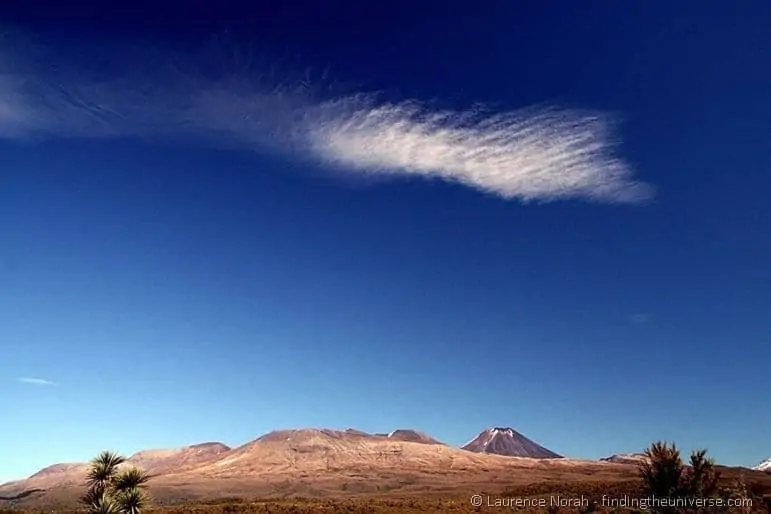
Table of Contents:
The North Island in Brief
The short answer first. The North Island’s highlights fall into three zones: the beaches and kauri forests of the far north, the volcanic and geothermal centre around Rotorua, Taupō and Tongariro, and Wellington at the southern tip. The volcanic centre is the part you shouldn’t cut. It has no equivalent on the South Island, or really anywhere else I’ve travelled.
With a week, fly into Auckland and focus on the middle: the Coromandel, Rotorua, Taupō and the Tongariro Alpine Crossing. With two weeks, add the Bay of Islands in the north and Wellington in the south. If you are weighing that against giving the fortnight to the South Island instead, how a fourteen day trip actually splits is worked out in full there. Three weeks buys you the detours I’d argue are the best bits, which are Taranaki, the East Cape and Hawke’s Bay.
Here’s the whole island at a glance, in the same north to south order as the guide:
| Highlight | Best for | Rough time | My verdict |
|---|---|---|---|
| Bay of Islands and the Far North | Beaches, boat trips, kauri forests, Cape Reinga | 2 to 3 days | Go if you have 10+ days |
| Auckland and Waiheke Island | Arrival city, volcano views, wine | 1 to 2 days | A day or two, no more |
| Coromandel Peninsula | Cathedral Cove, Hot Water Beach | 1 to 2 days | Go, check track status first |
| Hobbiton | The Lord of the Rings movie set | Half a day | Go if you love the films |
| Waitomo and Raglan | Glowworm caves, surf town | 1 day | Waitomo is worth the stop |
| Rotorua | Geothermal parks, Māori culture, adventure sports | 2 days | Unmissable |
| Lake Taupō | Huka Falls, lake, skydiving | 1 day | Easy stop between Rotorua and Tongariro |
| Tongariro National Park | The Alpine Crossing, volcano scenery | 2 days | Unmissable, weather permitting |
| Taranaki | The mountain, the Surf Highway | 2 days | My favourite detour in the country |
| The East Cape | Remote coastal road trip | 2 to 3 days | Go if you want NZ without the tourists |
| Hawke’s Bay and Napier | Art Deco, wine, gannets | 1 to 2 days | Go if wine or architecture appeal |
| Wellington | Te Papa, food, ferry to the south | 2 days | The best city on the island |
Highlights of the North Island, North to South
The order below runs from the tip of Northland down to Wellington, so if you’re driving, you can more or less follow it as written. New Zealand is very much a self-drive country. Most of what follows is hard or impossible to reach by public transport, so you’ll want your own wheels (we compare rental prices on Discover Cars, which includes the local NZ firms as well as the big brands). Several stretches of this route also feature in our guide to the most scenic drives in New Zealand.
1. The Bay of Islands and the Far North
The top of New Zealand feels subtropical, and it’s where the country’s history starts. The Bay of Islands is the centrepiece: a drowned river valley scattered with 144 islands, best explored by boat from the little town of Paihia. We took the cruise out to Piercy Island to see the Hole in the Rock, a natural tunnel the boats nose through when the swell allows, with dolphins along the way. You can book the same cruise here.
Paihia is also next door to Waitangi, where the treaty between the British Crown and Māori chiefs was signed in 1840. The treaty grounds are the best place in the country to get to grips with that story, and I’d rate them above any museum on this list except Te Papa.
Push further north and things empty out quickly. Cape Reinga, the northernmost point you can actually drive to, is where the Tasman Sea meets the Pacific, and on a windy day you can watch the two swells collide below the lighthouse. In Māori tradition this is where spirits depart for the ancestral homeland, and it’s a suitably end-of-the-world sort of place.
Nearby you’ll find Ninety Mile Beach, which is actually 88 kilometres long (whoever named it was an optimist, and possibly on horseback), and the giant sand dunes at Te Paki, which we wrote about in our post on the dunes at the end of the world.
On the west coast, the Waipoua Forest is home to Tāne Mahuta, the largest living kauri tree in the country at 51.5 metres tall with a girth of nearly 14 metres. Photos don’t prepare you for the scale. These trees were here before most of European history happened, and standing in front of one is quietly humbling. More on those in our guide to the ancient trees of New Zealand’s far north.
On the drive back south, stop at Kawakawa for the Hundertwasser public toilets, which made our list of New Zealand’s most scenic toilets. Yes, we have one of those.
2. Auckland and Waiheke Island
Chances are you’ll land in Auckland, and it’s a pleasant enough place to shake off the jet lag for a day or two. My advice is not to linger much longer than that, because nothing else on this list is in a city.
While you’re there, the best things to do involve volcanoes, which is a theme you’d better get used to. Walk up Mount Eden for a free 360 degree view over the harbour and the crater at your feet, or take the ferry out to Rangitoto, the young volcanic island in the gulf, and climb it for the view back over the city. The Sky Tower is fine if you want the observation deck experience, but Mount Eden gives you most of the view for nothing.
Out west, the gannet colony at Muriwai is a good half-day trip for photographers, especially between August and March when the birds are nesting.
The Auckland stop I’d actually plan around is Waiheke Island, 40 minutes away by ferry. The island is given over to wine, with vineyards draped over hills above swimmable beaches, and tasting your way across it makes for a very good day indeed. We enjoyed it rather more than the Sky Tower.
3. The Coromandel Peninsula
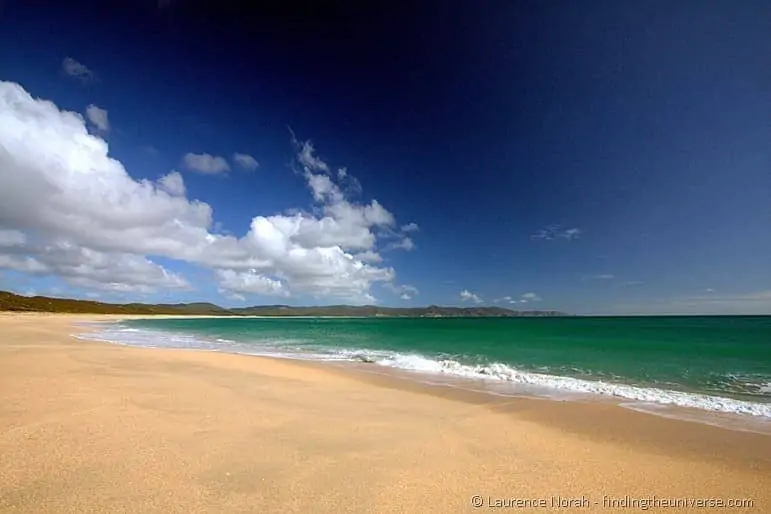
A couple of hours east of Auckland, the Coromandel is the classic first road trip stop: forested hills down the middle, white sand coves around the edges. We’ve covered it before in our Coromandel Peninsula post, but the two famous stops sit within ten minutes of each other on the east coast.
The first is Cathedral Cove, the huge rock arch on the beach that you’ll recognise from half the country’s marketing. A word of caution here, because the situation has changed and plenty of guides haven’t caught up. The walking track was closed for nearly three years after storm damage in 2023, and only reopened at the end of January 2026.
Access is now from the top of Grange Road in Hahei, where there’s no parking, so you park at the Hahei Visitor Carpark and walk up or just take the shuttle. The old connecting walk from Hahei Beach is closed, as are the side tracks to Gemstone Bay and Stingray Bay.
The area is unstable ground and short-notice closures are possible after heavy rain, so check the DOC track page before you commit. If the track is shut, kayak and boat trips from Hahei still get you there, and arriving from the water is arguably the better experience anyway.
The second stop is Hot Water Beach, where a geothermal spring runs under the sand. Turn up within two hours either side of low tide, hire a spade from a local café, and dig yourself a personal hot pool in the beach. The water comes out of the sand at over 60°C in places, so you mix in seawater until you stop yelping. It’s exactly as ridiculous and as fun as it sounds.
4. Hobbiton
An hour and a half south of the Coromandel, outside the farming town of Matamata, sits the most famous film set in the world. Hobbiton is where Peter Jackson built the Shire for The Lord of the Rings and The Hobbit, and unlike most film sets, it was rebuilt in permanent materials and simply left in place, forty-four hobbit holes and all.
I’ll admit I turned up expecting a tourist trap and left rather won over, enough that the visit prompted a whole post on what Hobbiton taught me. The set is beautifully kept, the guides know their stuff, and the included drink at the Green Dragon Inn at the end is a nice touch. The catch is that it’s a guided-tour-only affair and it books out, particularly from December to February, so reserve your slot before you build a day around it. You can book Hobbiton tickets here.
Of course, if you have no attachment to the films at all, this is one you can skip without regret. For everyone else it’s a well-run half day out.
5. Waitomo Glowworm Caves and Raglan
West of Hobbiton, the Waitomo region is riddled with limestone caves, and the ceilings of those caves are covered in glowworms. The classic way to see them is the boat trip through the main Glowworm Cave: your guide poles you through the dark in silence, and above you thousands of tiny blue-green lights map out the cave roof like a false night sky. It sounds twee. It isn’t. Drifting through the dark down there, it’s not hard to imagine falling over Gollum. You can book the glowworm cave boat trip here.
If you want something more energetic, the black water rafting operators will float you through the caves on an inner tube, wetsuit and all. Cold, dark, and great fun.
An hour north west, the surf town of Raglan is the North Island’s best place to slow down for a day: black sand beaches, a famous left-hand break at Manu Bay, and a main street of cafés that runs at half the speed of Auckland. If surf towns are your thing, build in a night here.
6. Rotorua
Rotorua is the geothermal capital of New Zealand, and you’ll smell it before you see it. The whole town sits on a thin crust above a volcanic system, so steam rises from parks, drains and back gardens, and the air carries a permanent whiff of sulphur. The locals call it Rotovegas, half in mockery of the motel strips, half in affection. Give it two days and it repays both.
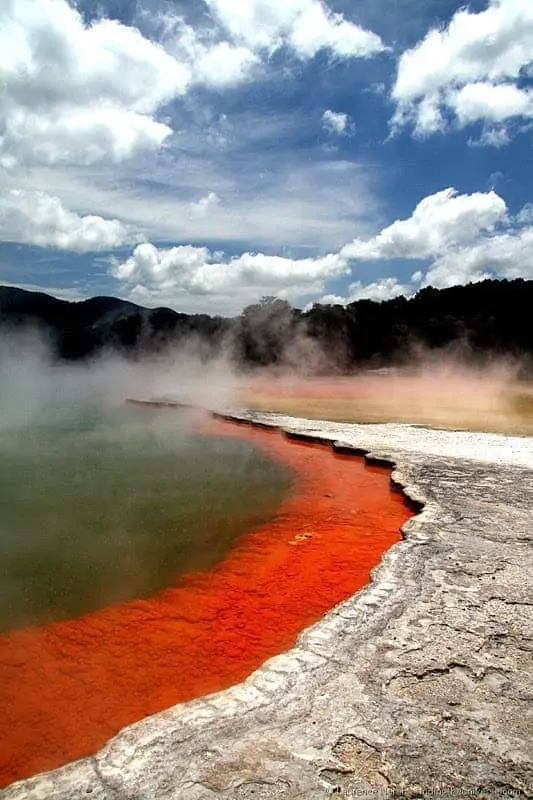
The geothermal parks are the headline. Wai-O-Tapu, which translates as Sacred Waters, has the Champagne Pool, an absurd orange and turquoise crater lake that looks colour graded in real life.
Te Puia in town combines the boiling mud and geysers with the national Māori carving and weaving schools, and its Pōhutu geyser, the largest active geyser in the Southern Hemisphere, fires up to 30 metres. If you’d rather not drive it all yourself, there’s a full day tour covering Wai-O-Tapu, Waimangu and Te Puia. We wrote up the geothermal side in more detail in our post on volcanic Rotorua.
Rotorua is also where we had our best Māori cultural experiences, from the carving schools to a hāngī feast cooked in the ground, and the night market is a good shout if you’re there on a Thursday. And it’s the North Island’s adventure hub: we went zorbing down a hillside in a giant inflatable ball (a New Zealand invention, of course) and white water rafting on the Kaituna River, which drops over a seven metre waterfall. In a raft. It remains one of the better decisions I’ve made.
7. Lake Taupō and Huka Falls
An hour south of Rotorua, Lake Taupō is the caldera of a supervolcano, filled in with water. It’s roughly the size of Singapore, and the drive along its eastern shore, with the Tongariro volcanoes rising across the water, is one of my favourite stretches of road on the island.
Just north of town, the Waikato River squeezes through a narrow rock channel at Huka Falls and exits as a churning, unnaturally blue torrent. It’s just a five minute walk from the car park, and it’s free. The nearby Craters of the Moon walkway adds a steaming geothermal valley if you haven’t had your fill at Rotorua.
Taupō also happens to be the skydiving capital of New Zealand, with jump views over the lake to the volcanoes. I kept my year in New Zealand aeroplane-exit-free, so I can’t give you a first-hand review of that one, but the town makes a pretty likeable overnight stop between Rotorua and Tongariro either way.
8. Tongariro National Park and the Alpine Crossing
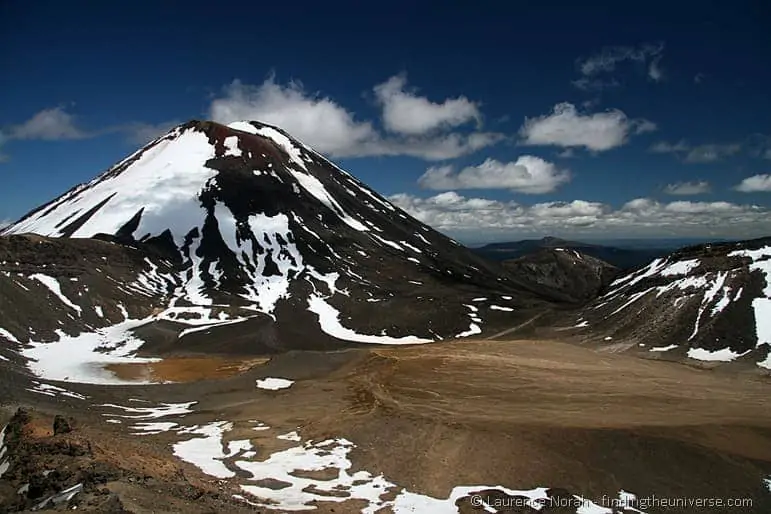
This is the big one. Tongariro was New Zealand’s first national park, gifted by Ngāti Tūwharetoa in 1887, and it’s one of only three UNESCO World Heritage sites in the country, listed for both its landscape and its cultural significance to Māori, whose stories about these mountains we covered in our post on Māori mountain myths. Three volcanoes dominate it: Ruapehu, the North Island’s highest point at 2,797 metres and its main ski field in winter; Ngauruhoe, the near-perfect cone that played Mount Doom; and Tongariro itself.
The Tongariro Alpine Crossing is the reason most people come, and it’s the best day hike in the North Island. Around 19.4 kilometres one way (some current signage says 20.2 kilometres after a 2024 re-route), it takes you up between Ngauruhoe and Tongariro, across the South Crater, past the Emerald Lakes and down through steaming vents on the far side. Allow 7 to 8 hours.
These are active volcanoes, complete with steam, and the landscape is as close to walking on another planet as you’ll get with a packed lunch. I climbed Ngauruhoe itself as a side trip, which we wrote about in climbing Mount Doom.
The Crossing is one way, so you need transport at both ends. The simplest fix is a shuttle transfer from National Park village or the trailhead car parks. Check the forecast and go on the clearest day you can wait for. The route is exposed, and in bad weather you’ll see the inside of a cloud for eight hours.
If the full Crossing sounds like too much, the park has plenty of shorter walks. The two hour loop to Taranaki Falls is the one we’d pick, and there are more in our posts on the lakes and mountains of Tongariro and the best day hikes in New Zealand. We based ourselves at the holiday park near the mountains, which kept the pre-dawn hiking starts almost civilised.
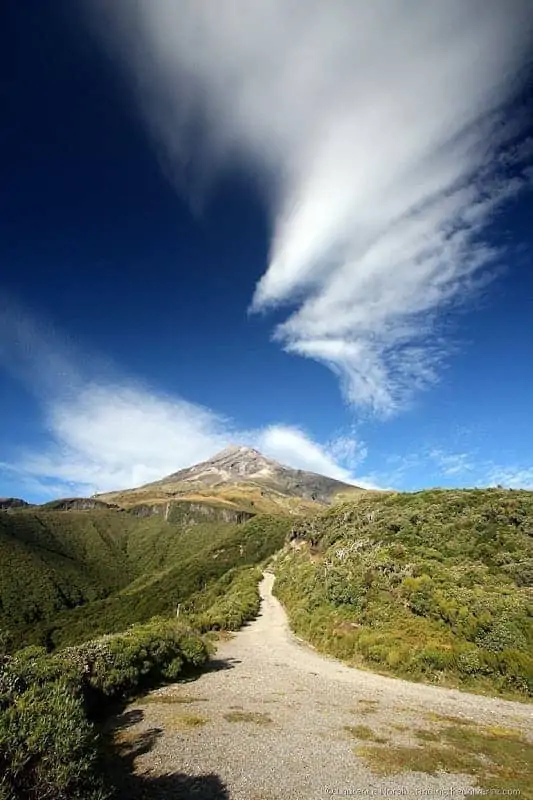
9. Taranaki Maunga and the Surf Highway
Here’s my bias, declared upfront: this was my favourite corner of the North Island. Taranaki Maunga (long known as Mount Taranaki, and officially renamed in 2025) is a 2,518 metre volcanic cone rising improbably from flat, surf-fringed farmland on the island’s western bulge. It’s so symmetrical it stood in for Mount Fuji in a Tom Cruise film, and because the peninsula is round, you get sea views from the summit in every direction.
The summit climb is a serious, full day undertaking in good conditions only, and it remains my absolute favourite day hike in New Zealand. We covered it photo by photo in climbing Mount Taranaki in photos. If you’d rather admire the mountain than sweat up it, the Pouākai Tarns walk gives you the classic reflection view, and the roads through Egmont National Park get you high onto its flanks with much less effort.
Around the coast, Surf Highway 45 runs 105 kilometres from New Plymouth to Hāwera past a string of black sand surf breaks. We drove it, stopped far too often, and wrote it up in our guide to New Zealand’s surf coast highway. Very few overseas visitors make it out here, which for a region this good borders on a scandal.
10. The East Cape
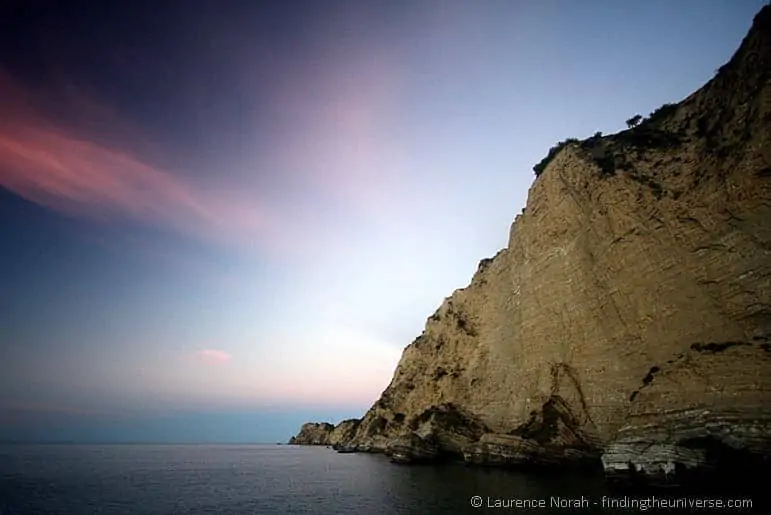
Fewer than one percent of New Zealand’s visitors make it around the East Cape, and that statistic is the whole pitch. State Highway 35 loops 330-odd kilometres around the island’s easternmost bulge between Ōpōtiki and Gisborne, through tiny Māori communities where the marae is still the centre of town, past empty surf beaches, horses on the road and pōhutukawa trees leaning over the sand.
There are a few sights you can name: the 660 metre wharf at Tolaga Bay, the lighthouse at the East Cape itself (up 800 steps, and one of the first places in the world to see the sunrise), and the carved church at Tikitiki. But this is really a place you go to watch New Zealand happen without an audience.
Fill the tank when you can, book the few beds that exist ahead of time, and give it two unhurried days. We made the case at length in our post on New Zealand’s spectacular East Cape, and a decade on I’d still rank it above several of the bigger names higher up this page.
11. Hawke’s Bay and Napier
On 3 February 1931, an earthquake flattened Napier. The town rebuilt itself in two years flat, in the architecture of the moment, and the result is one of the most complete Art Deco townscapes anywhere: pastel façades, sunburst motifs, the lot. Walking the centre feels like wandering onto a very well kept film set, and if you’re here in February the Art Deco Festival fills the streets with vintage cars and people dressed for 1932.
Hawke’s Bay around it is one of New Zealand’s oldest and best wine regions, particularly for reds and chardonnay, with cellar doors strung between Napier and Havelock North. Many are within cycling distance of each other, which is a very agreeable way to structure an afternoon. Add the gannet colony at Cape Kidnappers, one of the largest mainland colonies in the world (best from September to April), and you have an easy, indulgent day or two that balances out all the volcano scrambling further inland.
12. Wellington
New Zealand’s capital is compact, walkable, caffeinated and frequently windswept, and it’s comfortably my favourite city in the country. Two days here at the end of the drive south works perfectly, because the ferry to the South Island leaves from the harbour.
The essential stop is Te Papa, the national museum on the waterfront, which manages to be world class without being stuffy. One thing to know before you go: entry is no longer free for everyone. New Zealanders and residents still enter free, but since 2024 international visitors aged 16 and over pay NZ$35, with under 16s free and the ticket valid for 48 hours (details on the Te Papa website). It’s open daily 10am to 6pm, and the Gallipoli exhibition alone justifies the ticket, with its 2.4 times life-size figures built by Weta Workshop.
Beyond Te Papa, ride the red cable car up from Lambton Quay and walk back down through the Botanic Garden, tour Weta Workshop out in Miramar if the film side of New Zealand has got under your skin, and give an evening to the bars and restaurants around Cuba Street, the best eating strip on the island.
Zealandia, the fenced eco-sanctuary ten minutes from the centre, is the easiest place in the country to see wild kākā and tūī, and takahē if you’re lucky. From here, the South Island is a ferry ride across Cook Strait.
What We’d Prioritise (and What We’d Skip)
Twelve highlights is still a lot of country, so here’s how I’d triage it after a year of trial and error.
If your time is short, protect the volcanic centre. Rotorua, Taupō and the Tongariro Alpine Crossing are the North Island at its most distinctive, and they conveniently sit in a line down the middle of the island. Add the Coromandel on the way south from Auckland and you have a very strong week.
The first things I’d cut are the city days. Auckland is a pleasant arrival buffer, but a third day there costs you Waitomo or Hot Water Beach, and that’s a bad trade. I’d also drop Hobbiton before anything else on the list if you’re not a Tolkien person, and save Hawke’s Bay for trips where wine ranks above walking.
The harder call is the one I’d push you towards rather than away from: if you have the days, take the East Cape and Taranaki over a longer stay in the famous spots. They’re the two places on this list where we felt we were seeing the country rather than its highlights reel, and they’re the ones I still think about. A fortnight that ends Tongariro, Taranaki, Wellington beats a fortnight that does Rotorua twice.
One thing not to skip: the weather margin. The Alpine Crossing in particular needs a clear day, so build a spare day into the middle of your plan rather than booking every night in advance. Our first-timer’s guide to New Zealand covers this and the rest of the practical side in detail.
Getting Around and When to Go
You’ll want a car or campervan for almost everything here; only Auckland, Wellington and Rotorua are realistic by intercity bus. Roads are good but slower than the map suggests, as most are two-lane and windy, so trust the signposted times over your navigation app’s optimism. The full loop described here is comfortably over 2,000 kilometres of driving if you do all twelve stops.
Season-wise, summer runs December to February and is the busiest and most reliable window, though it’s also when Hobbiton, the ferries and everything on the Coromandel books out. My pick is February to early April: settled weather, warm sea, fewer people. Spring, from October to November, is greener and quieter still, at the price of more changeable skies.
Winter, June to August, rules out most of the alpine walking but is fine in the subtropical north, and it’s ski season on Ruapehu. The official newzealand.com site has good regional weather rundowns if you want to fine-tune.
Frequently Asked Questions
What are the best places to visit on New Zealand’s North Island?
The four I’d protect in any plan are Rotorua for the geothermal parks and Māori culture, Tongariro National Park for the Alpine Crossing, the Coromandel Peninsula for Cathedral Cove and Hot Water Beach, and the Bay of Islands in the far north.
If you have time beyond those, my personal picks are the two most visitors skip: the East Cape road trip and Taranaki Maunga. Both feature in the full list above, in north to south road trip order.
How many days do you need for the North Island?
Ten days to two weeks is the comfortable range for the highlights in this guide. That’s enough for the volcanic centre, the Coromandel, the Bay of Islands and Wellington without daily five hour drives.
With one week, focus on the middle of the island between Auckland and Tongariro. With three weeks you can add the East Cape, Taranaki and Hawke’s Bay, which is the version of the trip I’d actually recommend.
Which is better, the North Island or the South Island?
For pure mountain scenery, the South Island wins, and if I could only ever go back to one, it’d be the south by a nose. But the North Island wins on everything geothermal, on Māori culture, on beaches you can actually swim at, and on food and wine.
They’re different trips. If you have three weeks or more, do both and let the ferry connect them. If you’re choosing, pick south for landscapes, north for culture, warmth and variety. We’ve written up the South Island’s highlights too, so you can compare.
What is the North Island known for?
Volcanoes and geothermal activity, mostly: the geysers and hot springs of Rotorua, Lake Taupō’s supervolcano crater, and the active cones of Tongariro National Park.
It’s also the heart of Māori culture, home to the country’s two biggest cities in Auckland and Wellington, the Waitomo glowworm caves, the Hobbiton film set, and the subtropical beaches of Northland and the Coromandel.
When is the best time to visit the North Island?
February to early April is my pick: summer weather without the December and January school holiday crowds, and the sea at its warmest.
December to February is peak season and everything runs, but book Hobbiton, the Alpine Crossing shuttles and Coromandel accommodation well ahead. Winter, June to August, is quiet and still pleasant in the north, and turns Ruapehu into the island’s ski field, but it’s the wrong season for the alpine hikes.
Do you need a car to get around the North Island?
For this list, yes. Buses connect the main cities, but the East Cape, the Coromandel beaches, Taranaki and the far north are all places where your own vehicle is the only practical option.
We drove the island in our own van, and a rental car or campervan is the way most visitors do it. Book ahead for December to February, and see our guide to buying a vehicle in New Zealand if you’re staying long enough for that to make sense.
Further Reading for Your New Zealand Trip
We lived in New Zealand for a year and have written about it extensively. Alongside the posts linked throughout this guide, start with our one month New Zealand itinerary, our tips for your first trip to New Zealand, and our guide to the best day hikes in New Zealand.
For the trip itself, a paper guidebook still pays its way when you’re out of signal on the East Cape. We’d go for the Lonely Planet New Zealand guide for planning depth, or the DK Eyewitness New Zealand guide if you prefer something more visual.

And that’s the North Island as we’d plan it: twelve stops, north to south, heavy on volcanoes and light on regret. If you make it around the East Cape, do let us know in the comments. You’ll be in select company!
Sam @ Green Global Travel says
Great List! I have only been on the South Island, but desperately want to go back to NZ to explore the North Island. These places will definitely be on my list.
Anonymous says
NZONE Skydive (Queenstown) – the only way to go !!!
Kees den Hartigh says
We were in the North Island in January for the first time in 30 years. Love it and your photos are magnificent!
Wends of Journeys and Travels says
I love the photos you have here and much more than a sight, I wished I can be in NZ to enjoy this too. I have never been to NZ and this one inspires me to include it on my bucketlist though.
Cheers 🙂
Jeremy Branham says
These are pretty awesome! I would definitely do three out of the five. The two hikes and Northland definitely appeal to me. I would do the first two hikes and then go to Northland to rest we aching body 🙂
Randall Goya says
I hear skydiving in New Zealand is a great way to see the landscape ‡¡‡
Cole @ Four Jandals says
All great spots but you should have had Mount Maunganui and also the Coromandel Peninsula 🙂
Leona Sky says
Been there, done that =)
Ready top go back anytime =)
NZ simply is an awesome country!
Bryan Murphy says
i need to go now that i have been on this blog.. Love it!!
Tiffany says
These pictures are great!
DES Daughter says
Simply superb, Laurence, as always 🙂
Wayne Hurlbert says
New Zealand is such a gorgeous country.
Meetu says
Tongariro alpine crossing hike wins for me. Lovely place. Great article. Thanks for sharing.
Reza Ahmed says
Wow what a paradise to be in !!
Tiffany says
These pictures are great!
Laurence says
Hey Mica 🙂 Flights certainly are cheap, there are a number of carrier that fly from major cities in Australia (such as Melbourne, Sydney and the Gold Coast) to NZ. Try Jetstar, Air New Zealand, Pacific Blue etc.. There are some very budget options and if you book in advance you can get flights for very little. Grabaseat.co.nz is also a good way to get a bargain flight 🙂
Mica Ivealis says
I love volcanic spots. Are NZ flights cheap from OZ? I’m headed to aussie land next june on a working visa and I’d love to go to NZ.
Laurence says
Thanks very much Peter 🙂 It’s a stunning place to be sure.
Pete @ whichwayto.com says
Those photo’s are absolutely amazing! I love the “East Cape” one.
Laurence says
Thanks very much Henry. Picking highlights is always a challenge, but it really makes me think about the stand out experiences. And yes – the south island is going to be a real tricky one to do!
Henry Lee says
So very beautiful, the pictures. I bet it was very difficult to pin down just five highlights, even for the North Island. Thanks for your post!