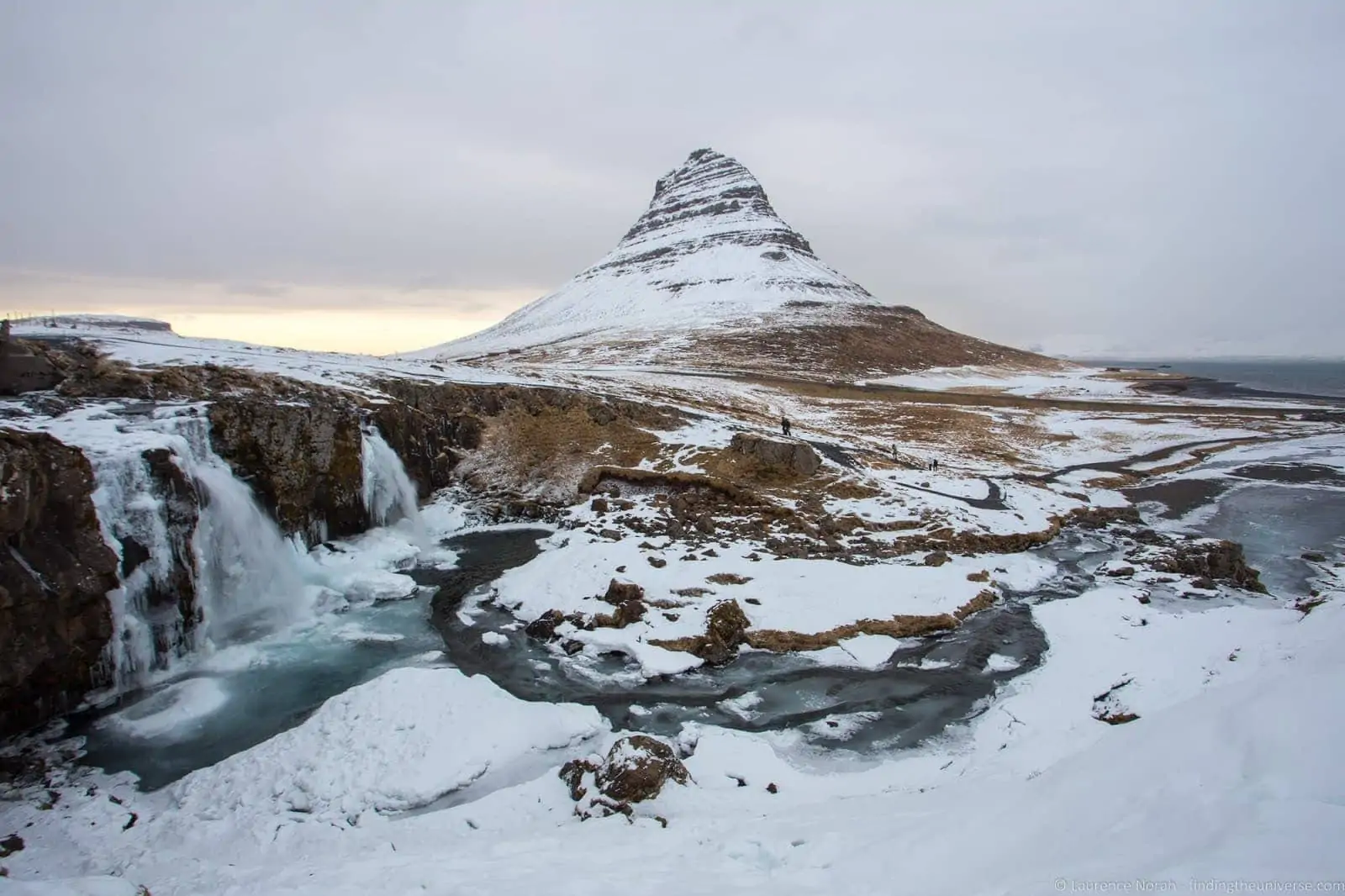
Iceland is a spectacularly photogenic country, and it’s been on my photography bucket list since long before I first visited. I’ve now been multiple times, in both summer and winter, and I keep finding new locations I want to shoot. I’ve been a professional travel photographer since 2010, and I also teach an online photography course, so I have a good excuse to keep going back.
In this guide, I’m sharing 25 of my favourite photography locations in south and west Iceland. This is the area most first-time visitors explore, and for good reason. It’s where you’ll find the iconic waterfalls, glaciers, black sand beaches, and landscapes that make Iceland one of the best photography destinations in the world.
I’ve arranged the locations roughly in the order you’d encounter them driving a loop from Reykjavik: up the Snæfellsnes peninsula, back through Reykjavik, then east along the south coast to the glacier lagoon. The numbers follow this route, not a quality ranking. Every location on this list is worth visiting.
I’ve also included practical information for each stop: parking fees (which have become common across Iceland in recent years), how long you’ll need, and tips for getting the best shots. For help planning the rest of your trip, check out our Iceland planning guide, and for route ideas, we have a 5 day itinerary, a 7 day Ring Road itinerary, and a 7 day winter itinerary.
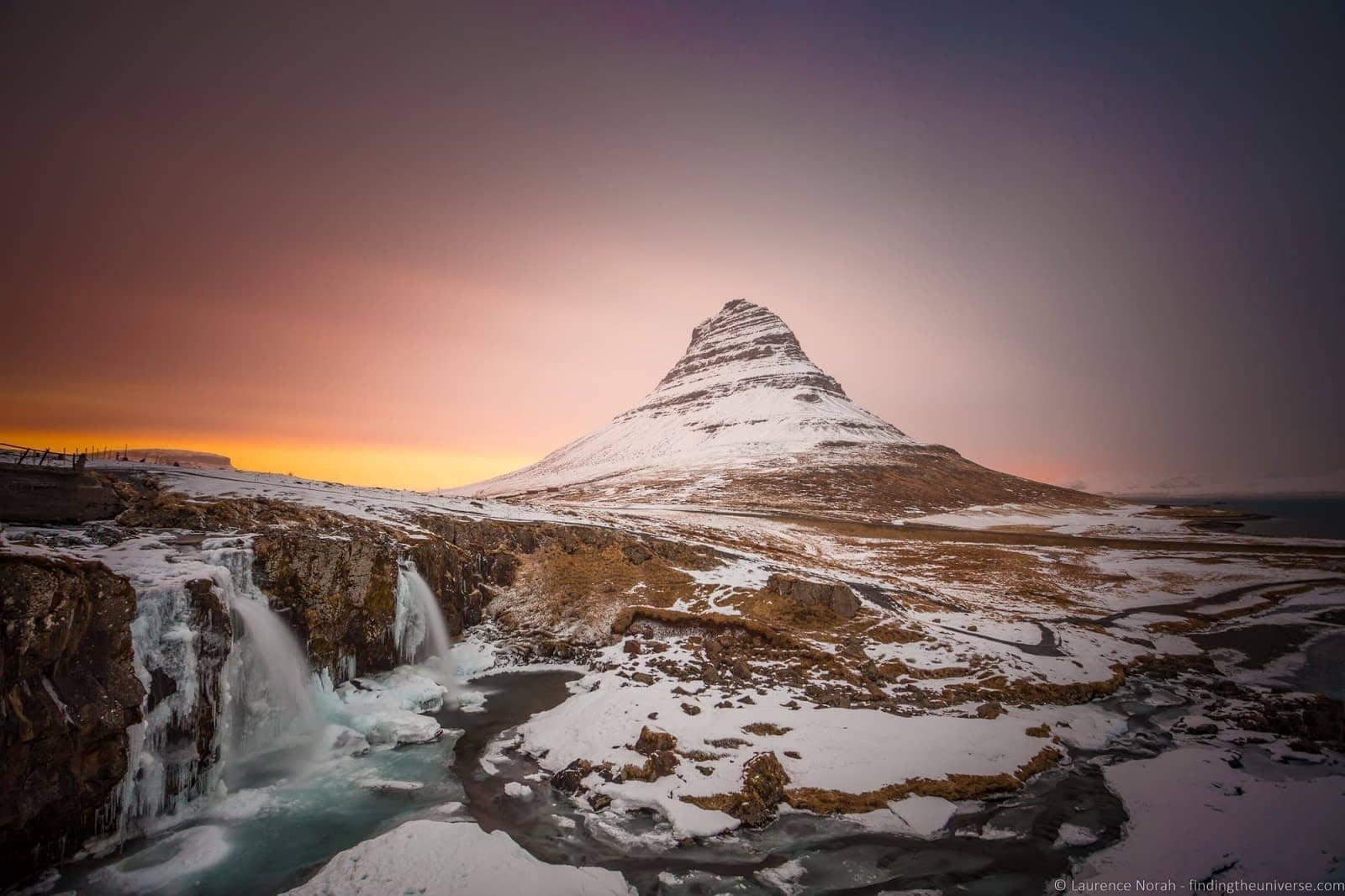
Table of Contents:
The Best Photography Locations in Iceland
Below are some of my favourite photography locations in Iceland. I’ve placed these in order, running from the east of the country to the Glacier Lagoon on the south coast.
Of course, there are many more beautiful spots in Iceland, and stumbling upon the less popular spots is always a rewarding exercise.
But this list should cover the majority of the highlights of south and western Iceland that you’d be interested in visiting and photographing, and should make a great starting point for any photographer planning a trip.
1. Kirkjufell
Kirkjufell is one of the most iconic (and photographed!) locations in Iceland, so much so in fact that it was even on our Iceland Travel tote bag. It’s found up on the Snæfellsnes peninsula, about a two hour drive north of Reykjavik.
The peninsula is definitely worth visiting, either as a tour from Reykjavik or ideally over a couple of days, which will give you plenty of time to explore everything on offer.
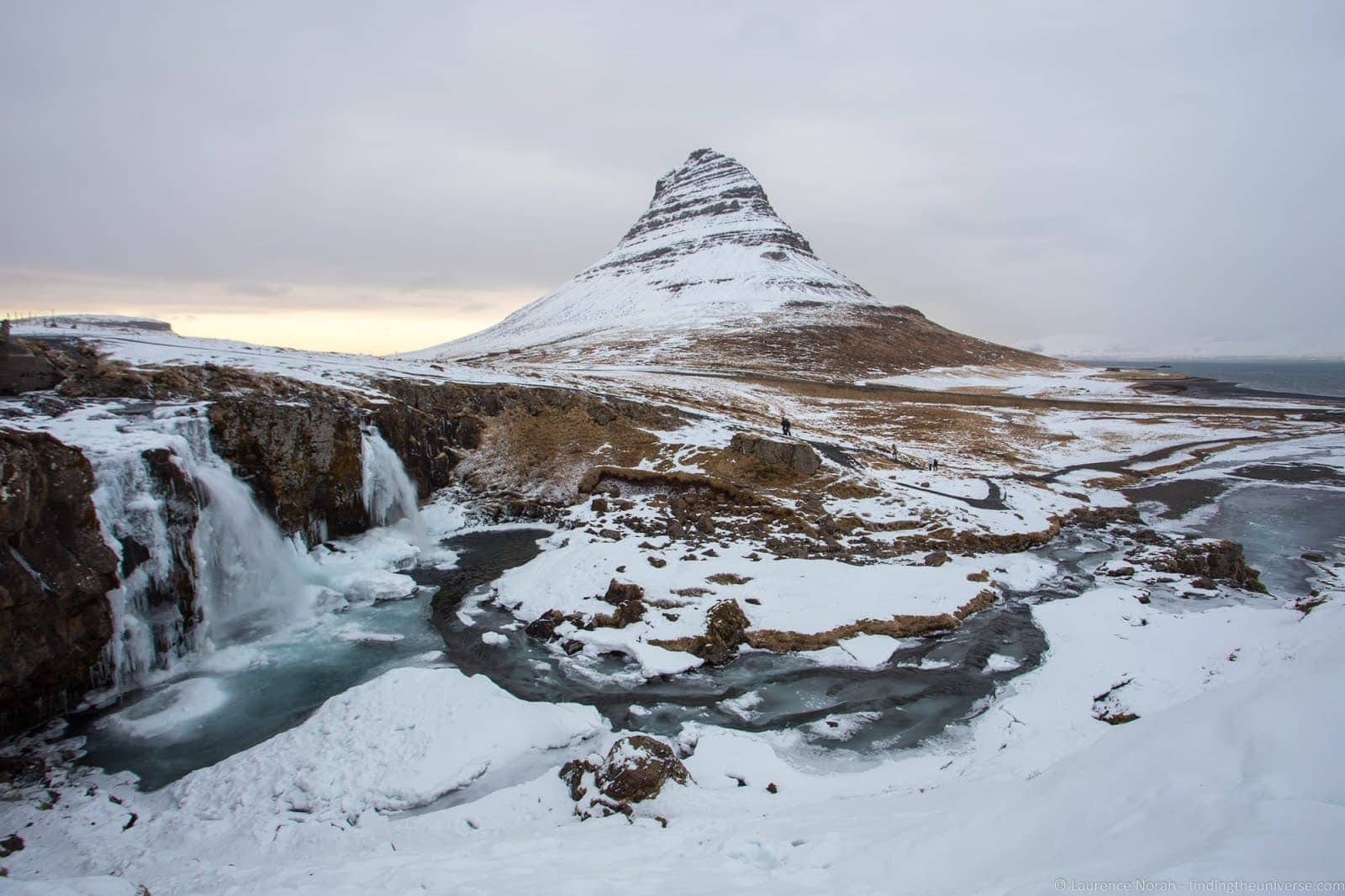
Kirkjufell itself is a wonderfully symmetrical mountain with a handy set of waterfalls (Kirkjufellsfoss) right beside it, and most people take the shot to include the waterfalls and the mountain.
There are of course other angles to shoot it from, including some great reflection opportunities from the shore if the weather is calm .
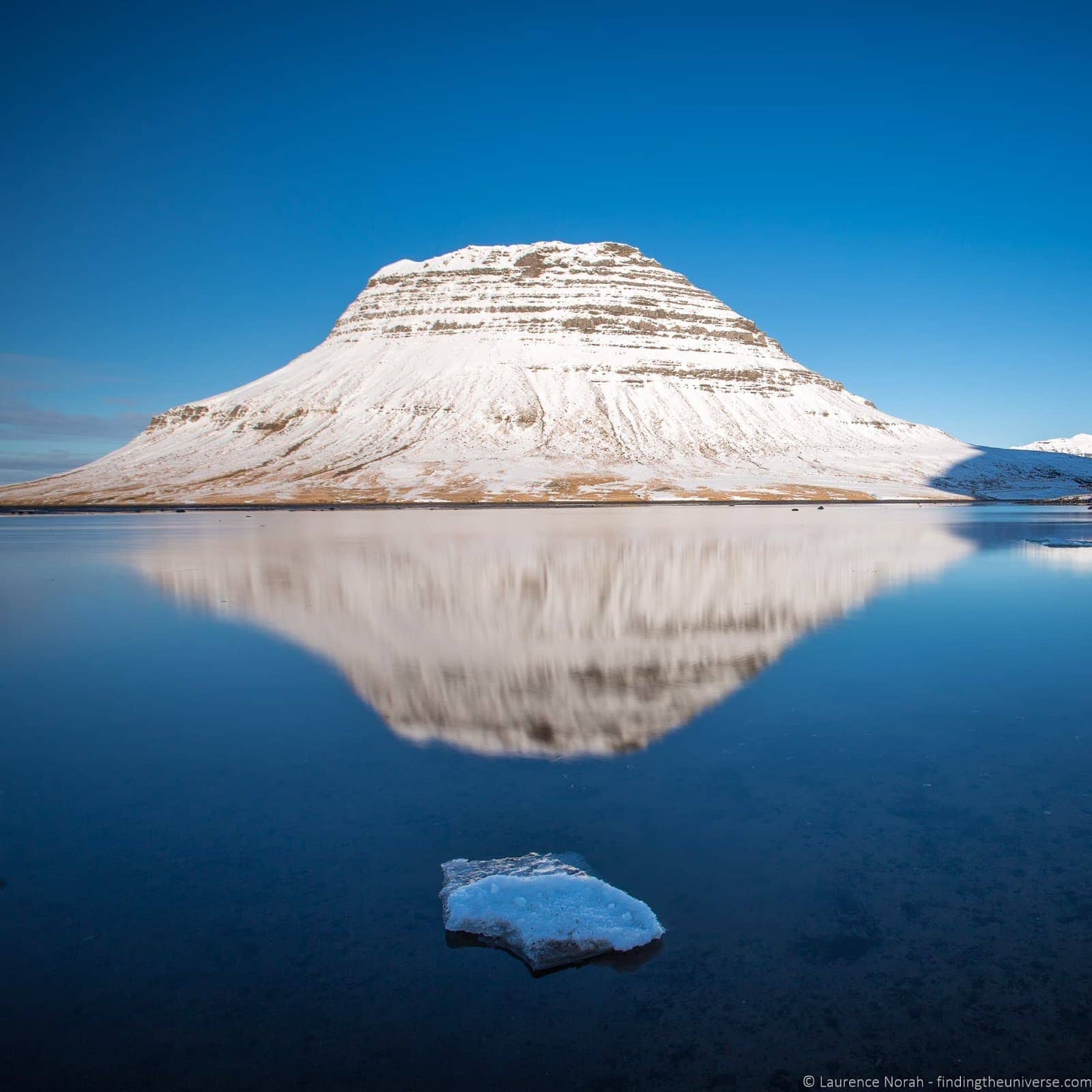
Depending on the time of year you visit, you can get the sun in shot during sunset. Sunrise is also good as the light illuminates the mountain side. Finally, if you’re lucky and have clear skies and aurora activity, this would make a wonderful shot of the northern lights.
We weren’t so lucky, but I was happy with my shots nonetheless! There’s free parking on site, and it’s about a five minute walk from the car park up to the falls – just be careful in Winter as it can get icy up here (yes, I fell over).
Note that this was also a filming location for the Game of Thrones TV show, as were many other locations in Iceland. If you want to see more of these, see our guide to the GoT locations in Iceland.
2. Búðakirkja
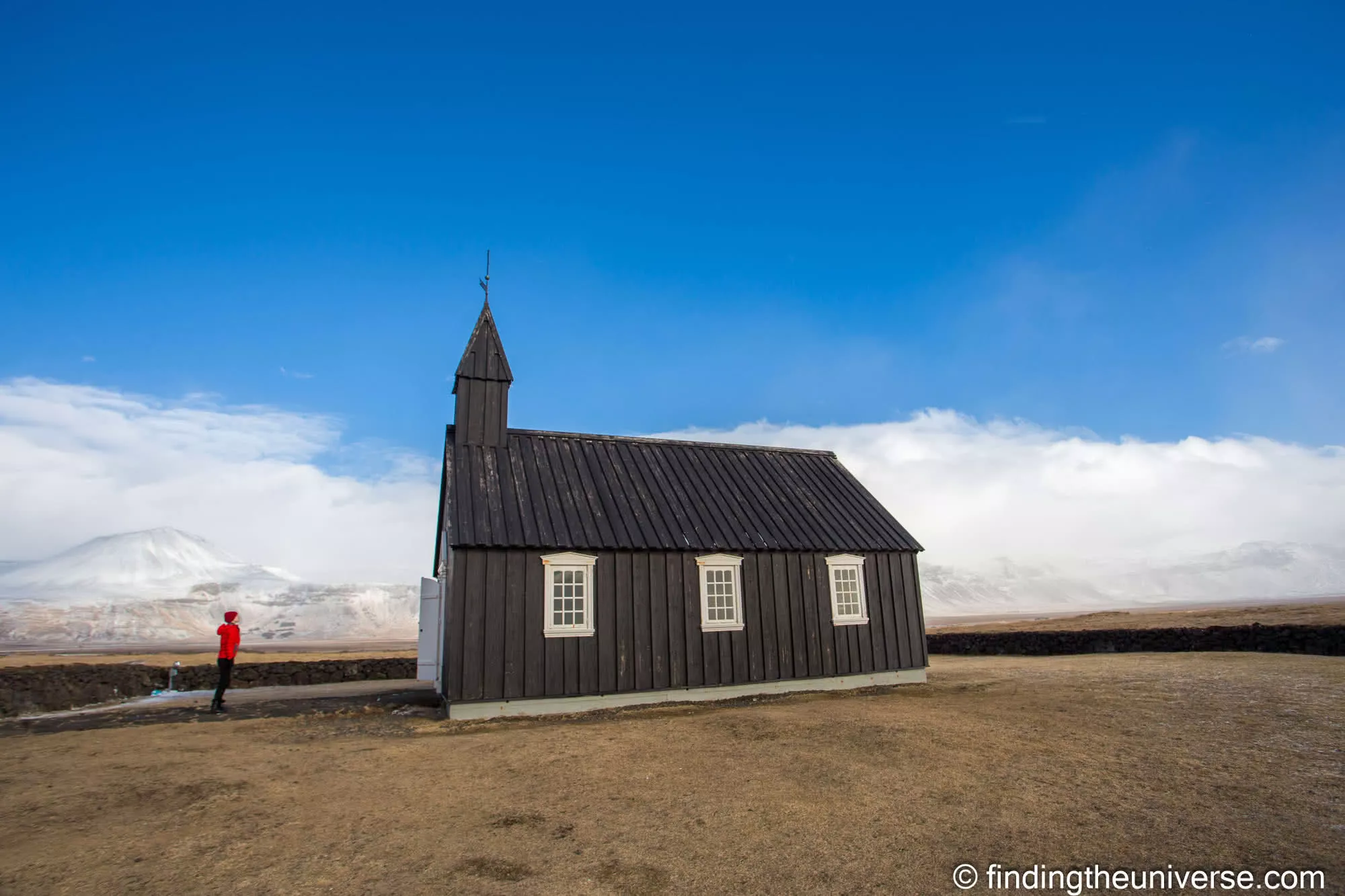
While you’re on the Snæfellsnes peninsula, make sure to stop at Búðakirkja. This tiny black wooden church sits alone in a lava field near the hamlet of Búðir, and it’s become one of the most photographed buildings in Iceland.
It’s the contrast that makes it work: the jet black church against the green (or snow-covered) landscape, with mountains behind and the ocean nearby. It’s a simple composition, but it works in pretty much any weather and light condition.
The church is easy to find on the road along the south coast of the Snæfellsnes peninsula, and there’s a small parking area right next to it. Be respectful when visiting as it’s a working church, and try to keep people out of your shots if you want that isolated look (patience helps here, as it can get busy in summer).
3. Hraunfossar
One of the more unusual waterfalls I’ve seen, Hraunfossar is a series of falls that emerge from underneath a huge lava expanse and flow down the sides of a gorge into the below river. It’s quite the sight, spanning some 900m, and worth visiting. There are actually two falls here – Hraunfossar and Barnafossar.
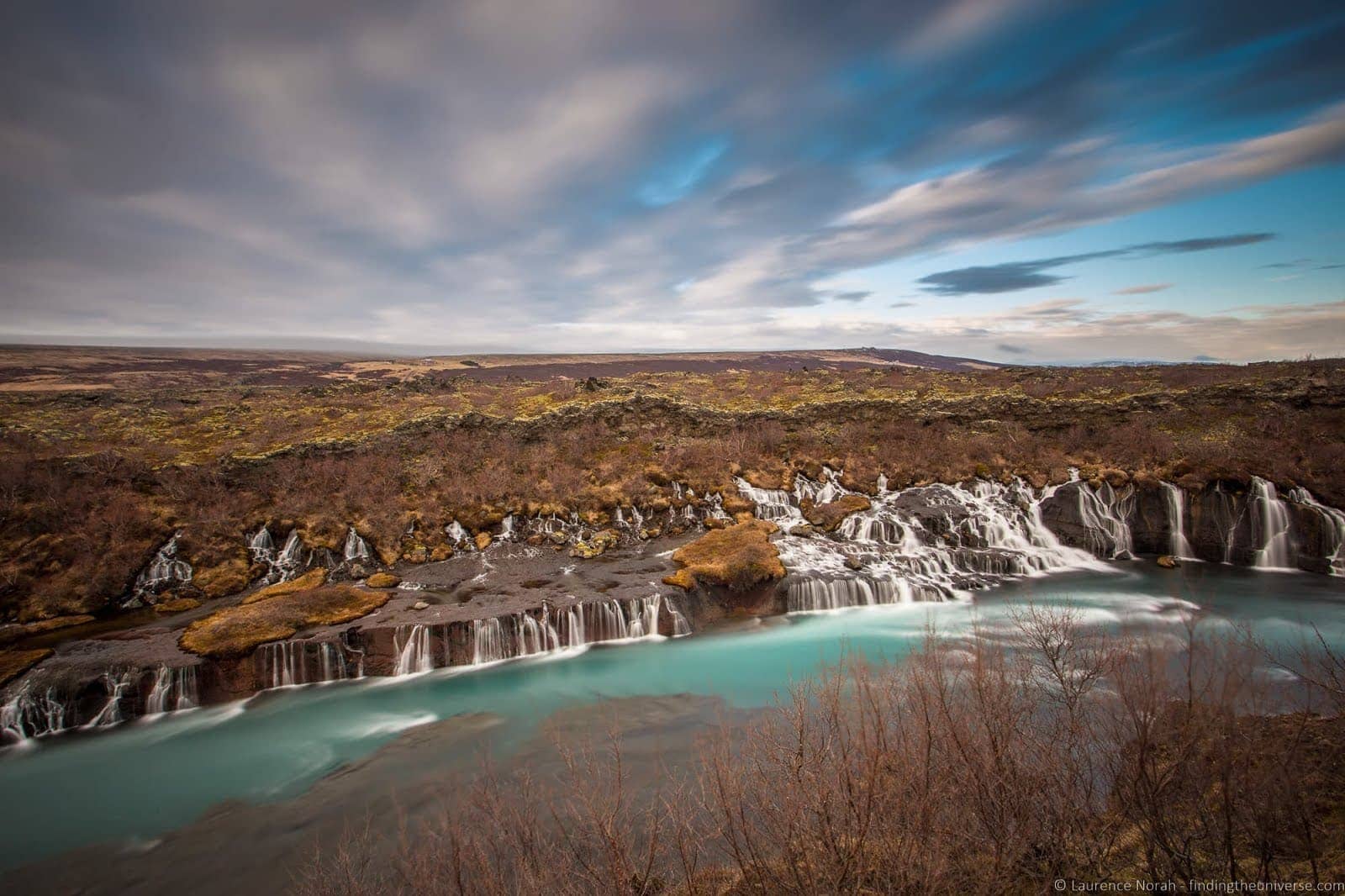
Barnafossar is a more traditional waterfall, with the water rushing through and down a narrow gorge. When we visited the water was in full flow, so it was less of a waterfall and more of a raging torrent, but impressive nonetheless.
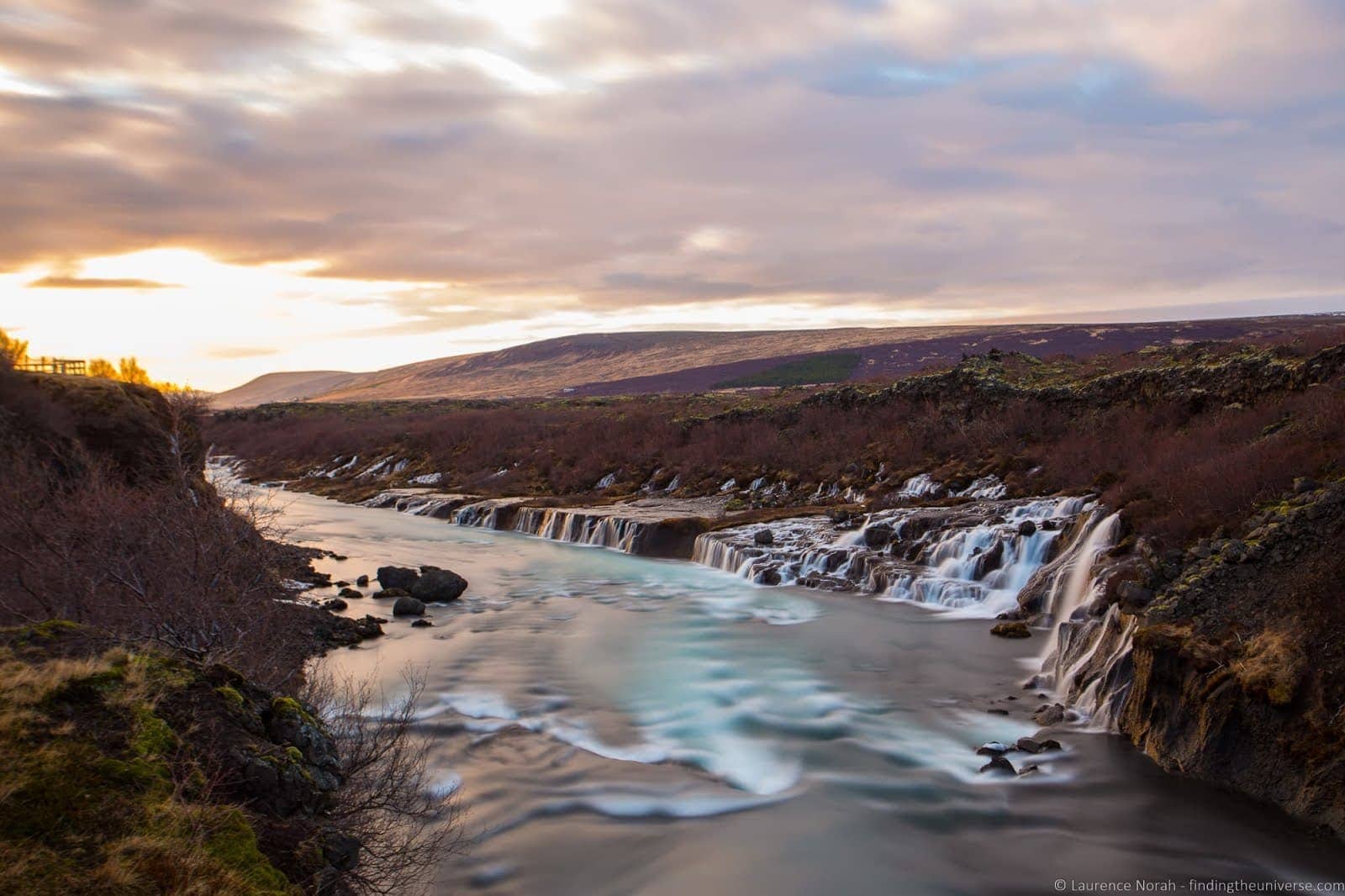
Hraunfossar is about an hour and a half north west of Reykjavik by car. There’s free parking on site and it’s less than a minutes walk from the car park. There are also a number of tours departing from Reykjavik which include these falls, such as this one.
4. Glymur Waterfall
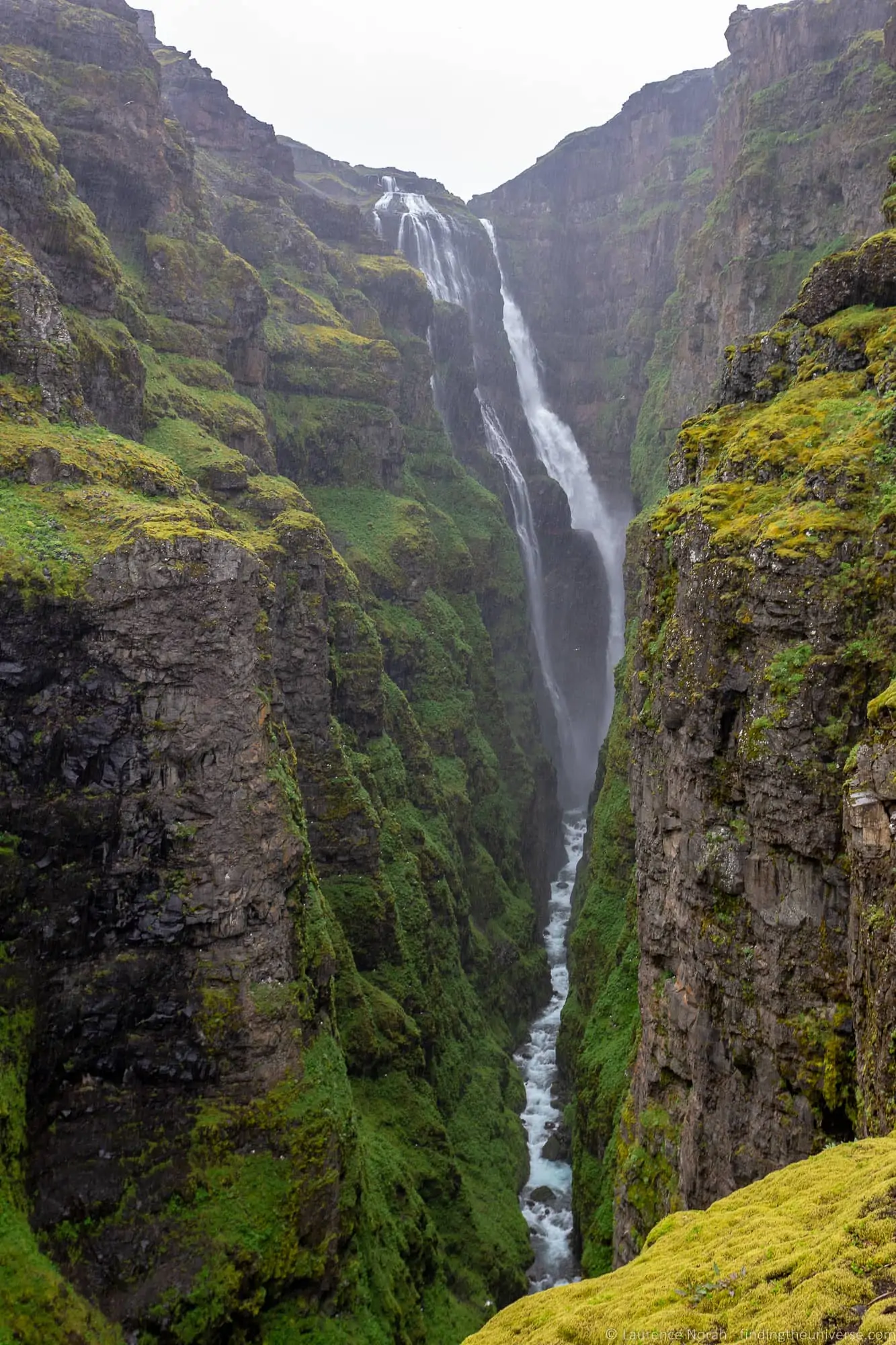
For a long time, Glymur was known as the highest waterfall in Iceland. Then some scientists came along and found a higher waterfall on a glacier somewhere, and poor Glymur was demoted to second place.
Still, it’s likely the highest accessible waterfall in Iceland, and the hike up to the falls is stunning, so I’d still recommend a visit.
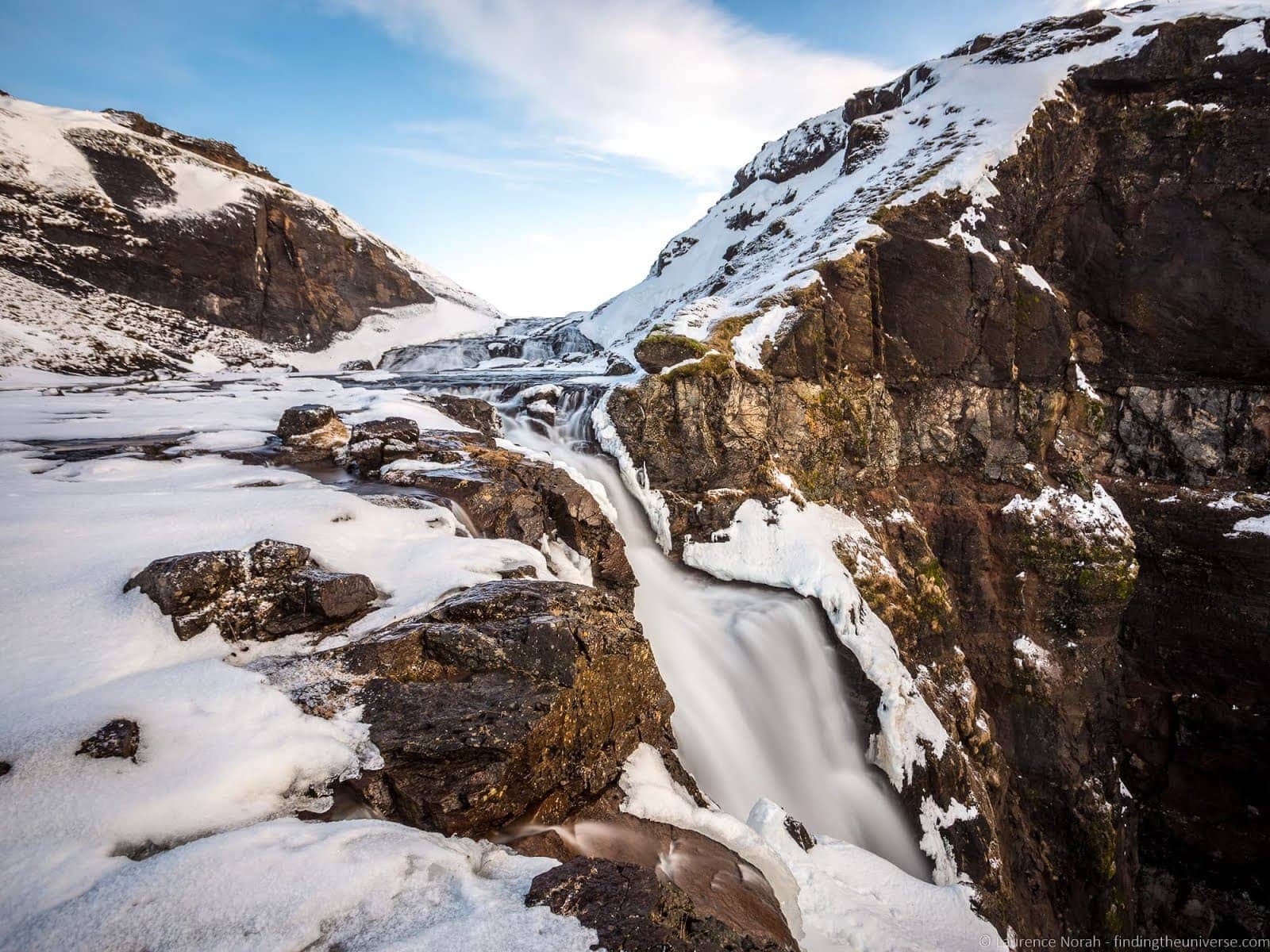
There are two routes up to Glymur, one on the south side of the river and one on the north side. If you visit in Winter like I did, you’ll struggle to get to the south side as there’s a river crossing which requires you to walk over a log, and the log is removed in Winter. I tried to find a safe crossing point and failed – other, braver (more foolhardy?) people than me succeeded.
On that trip this was a bit of a letdown for me as the best view of the falls is said to be from the viewing area on the south side of the river, but as I climbed all alone to the top of the falls, I concluded it wasn’t such a bad thing.
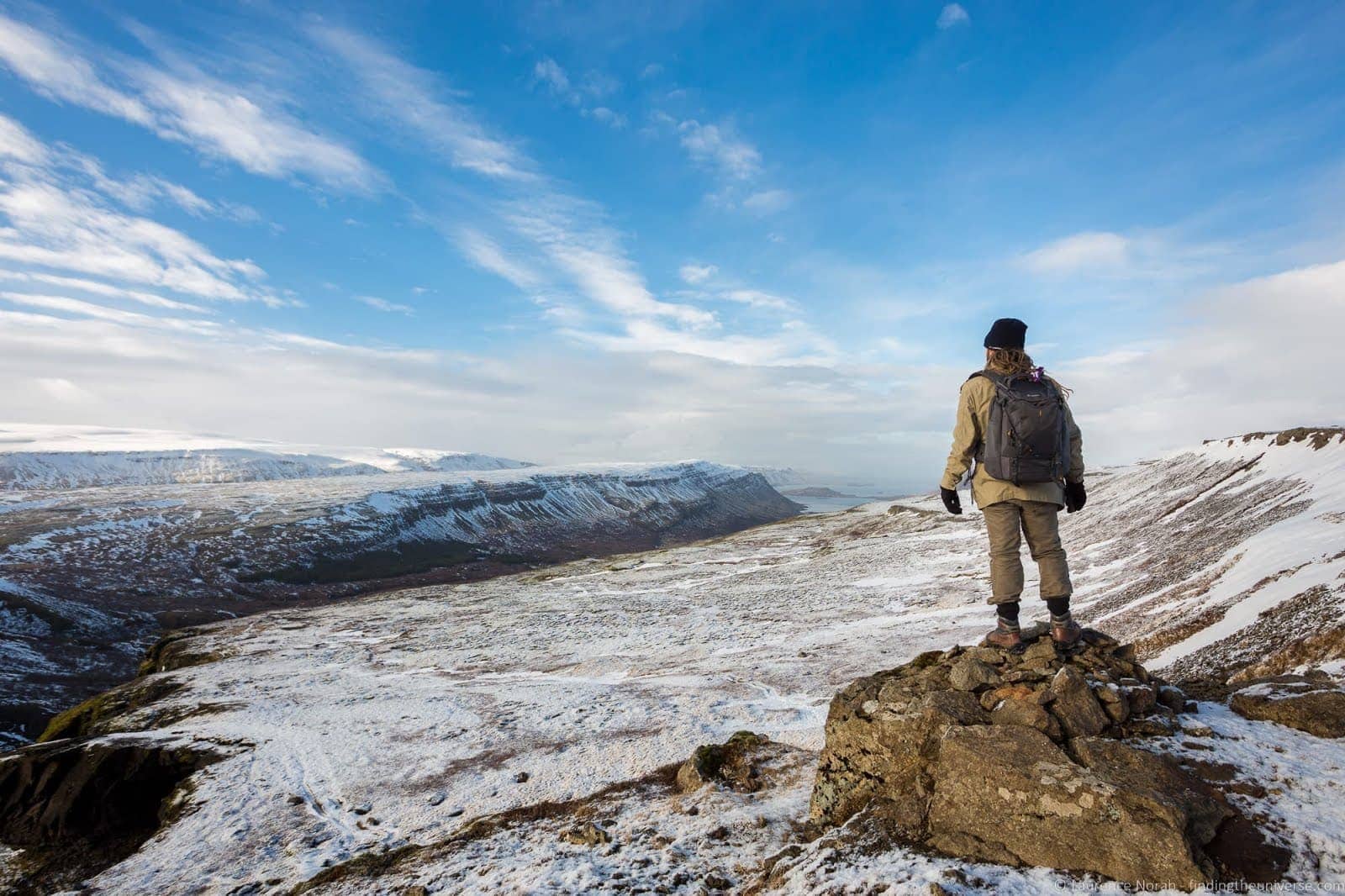
A giant gorge fell off to my right, seabirds circled, and the view back down to the fjord and ocean was spectacular. Plus, I loved the top of the waterfall, even if I couldn’t quite see the whole thing.
The good news is that I also returned to Glymur in summer on another trip, and I got my shots from the other side. You do definitely get a better view of the falls from the south side, so I would go for that if you have the choice and the river crossing is safe.
This is a fairly strenuous hike which is approximately a three hour round trip from the car park. It’s well marked, but does have steep drops without barriers, so you need to be careful. Definitely worth it though.
5. Thorufoss (Þórufoss) Waterfall
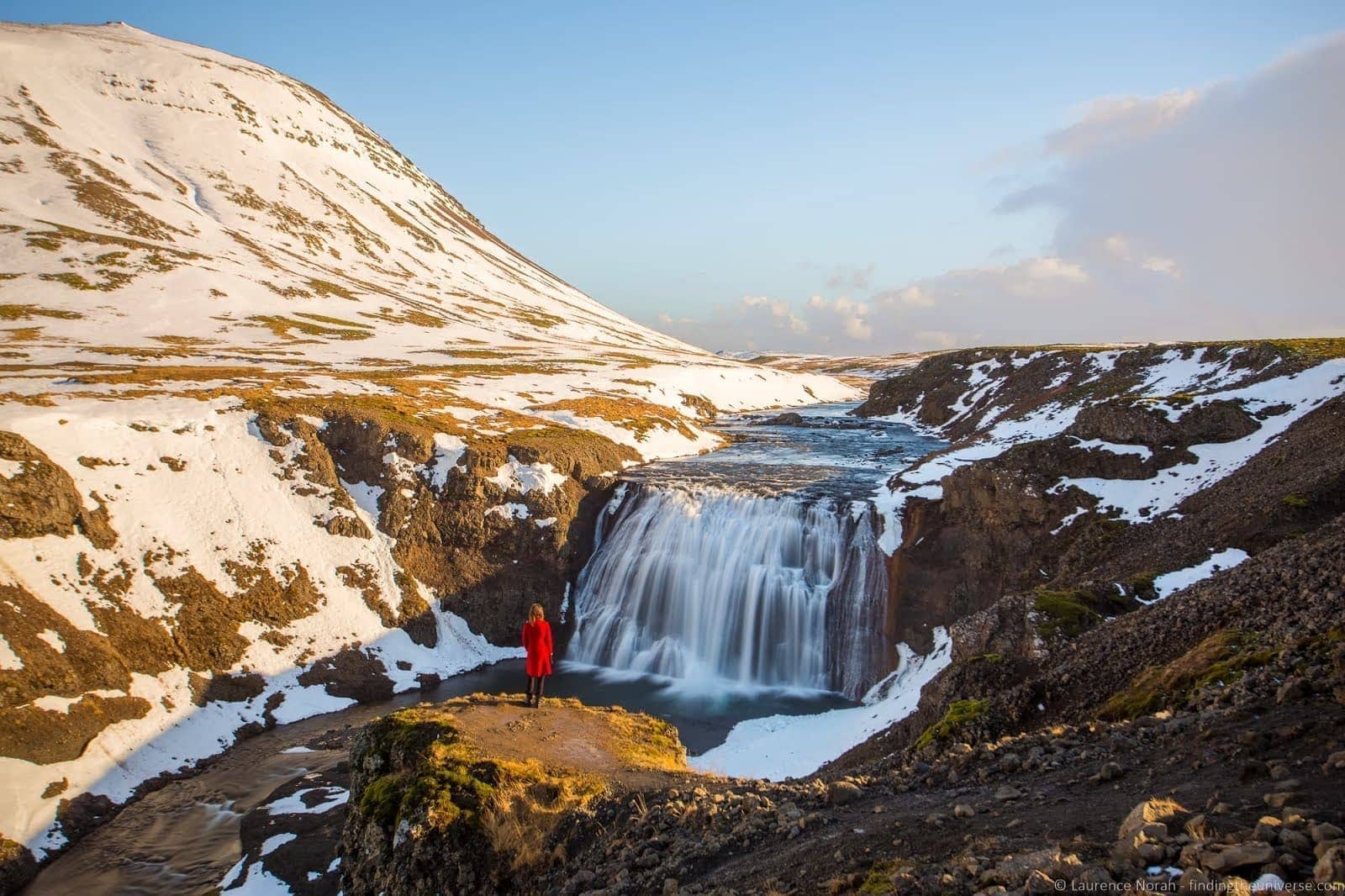
This was one of those waterfalls that we happened upon as part of our travels when taking a shortcut on a gravel road. We were so glad we did, because we had these incredible falls all to ourselves, and it was definitely a highlight for both of us on our trip.
It was even possible to walk down to the falls via a steep path, although we didn’t have time to do that. Still, we got lots of photos.
Thorufoss is on the 48, about a half hour drive to Reykjavik. If you’re driving yourself, you could visit either on your way up to Glymur, or it’s a ten minute detour from the famous Golden Circle, although again, you’d likely have to drive yourself.
There’s a parking spot just off the road and it’s a two minute walk to the falls.
6. Sun Voyager Statue, Reykjavik
Whilst many people base themselves in Reykjavik, the city is often overlooked as folks rush out to immerse themselves in Iceland’s natural beauty.
We’d suggest that’s a mistake – there’s a lot to see and do here, and we will be writing a whole post soon on what to see and do in Reykjavik.
In the meantime though, from a photography locations perspective, there are plenty of opportunities for photography in the city.
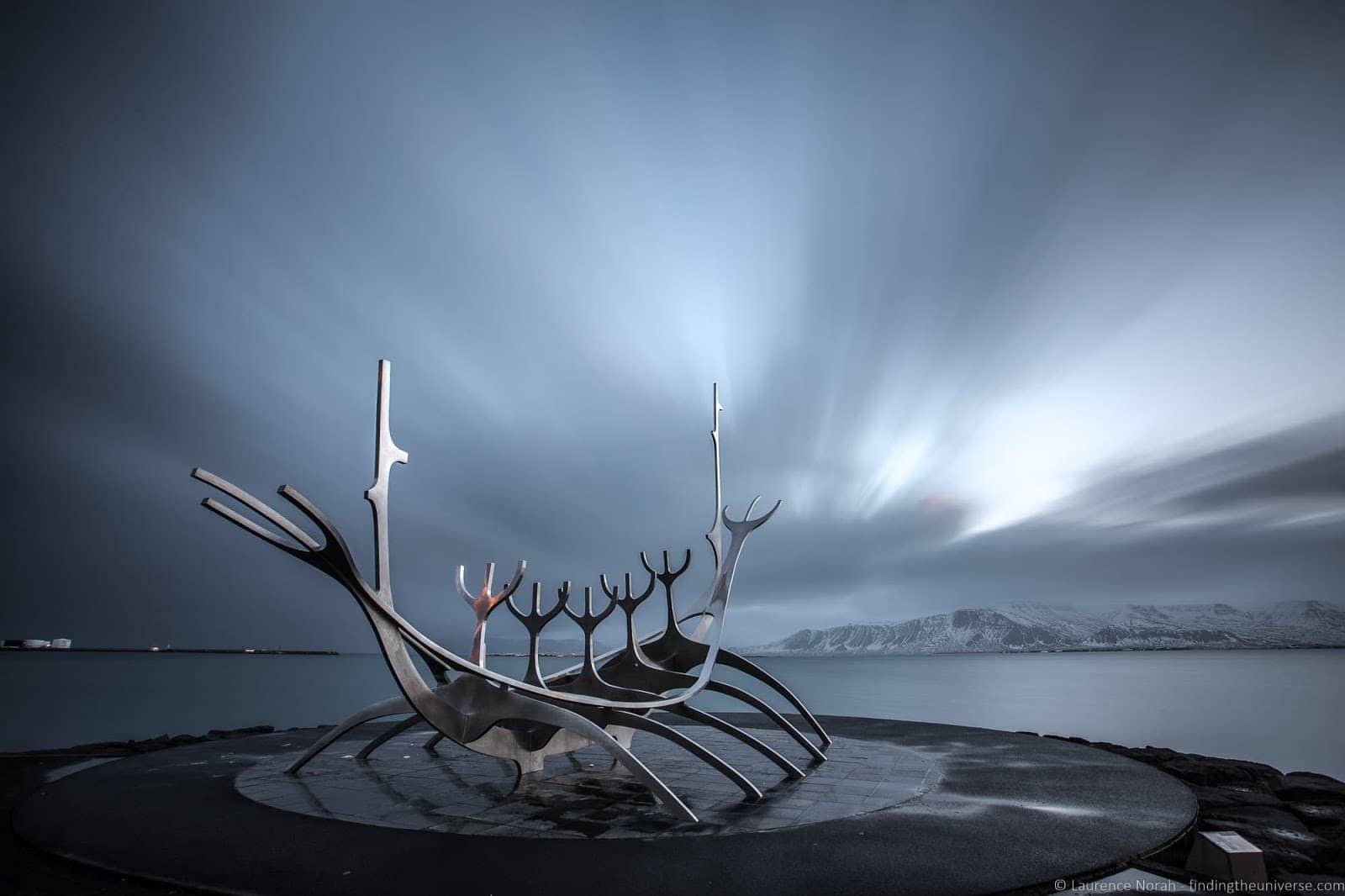
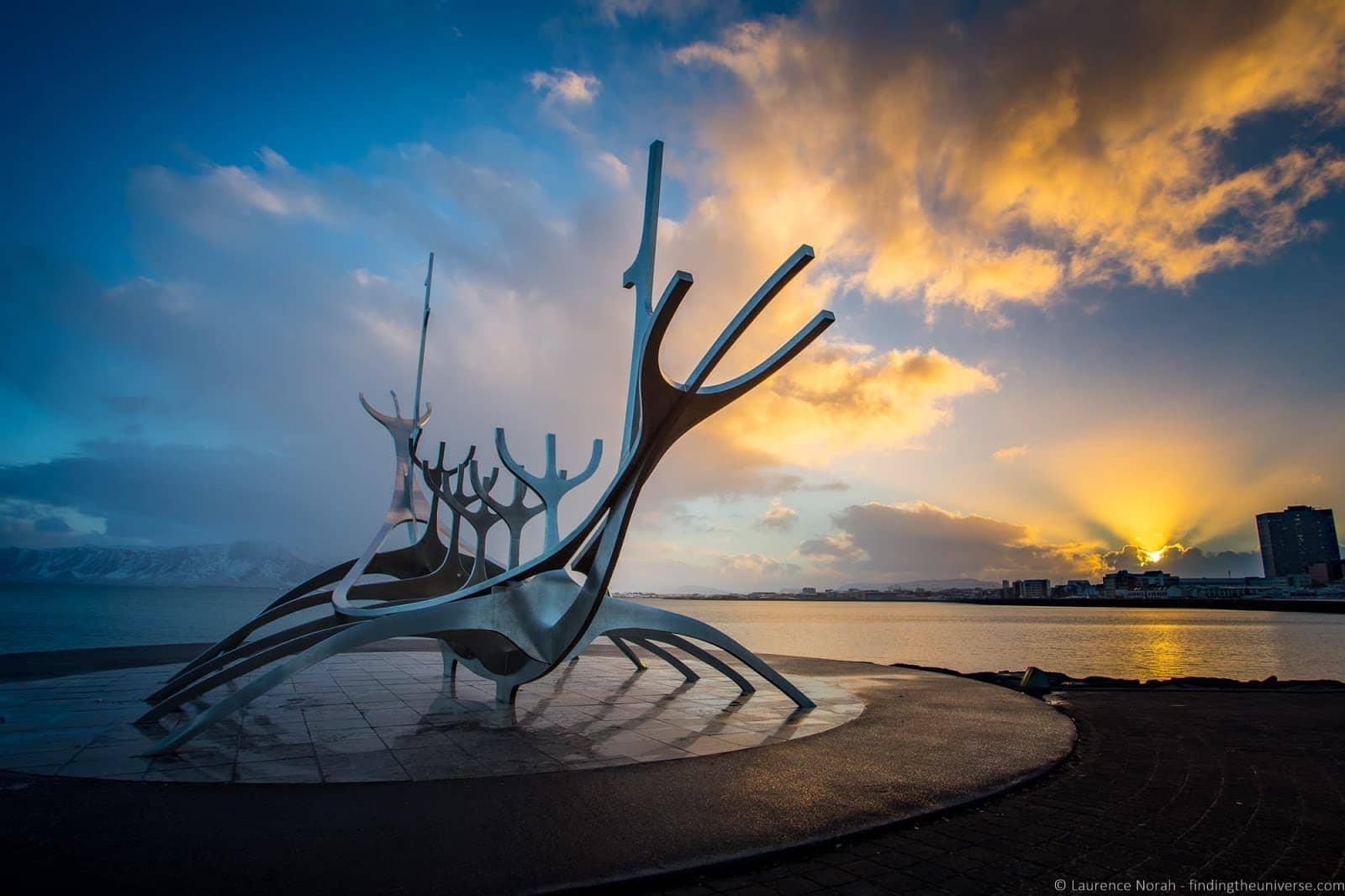
One of my favourites for both sunrise and sunset is the Sun Voyager statue, found on the waterfront on the city’s north coast. This statue, created by a local artist, is sculpted out of stainless steel, and represents a voyage following the sun.
It’s an easy walk to get here from most parts of the city, and is definitely best for either sunrise or sunset when the light reflects wonderfully off the steel frame.
7. Hallgrimskirkja, Reykjavik
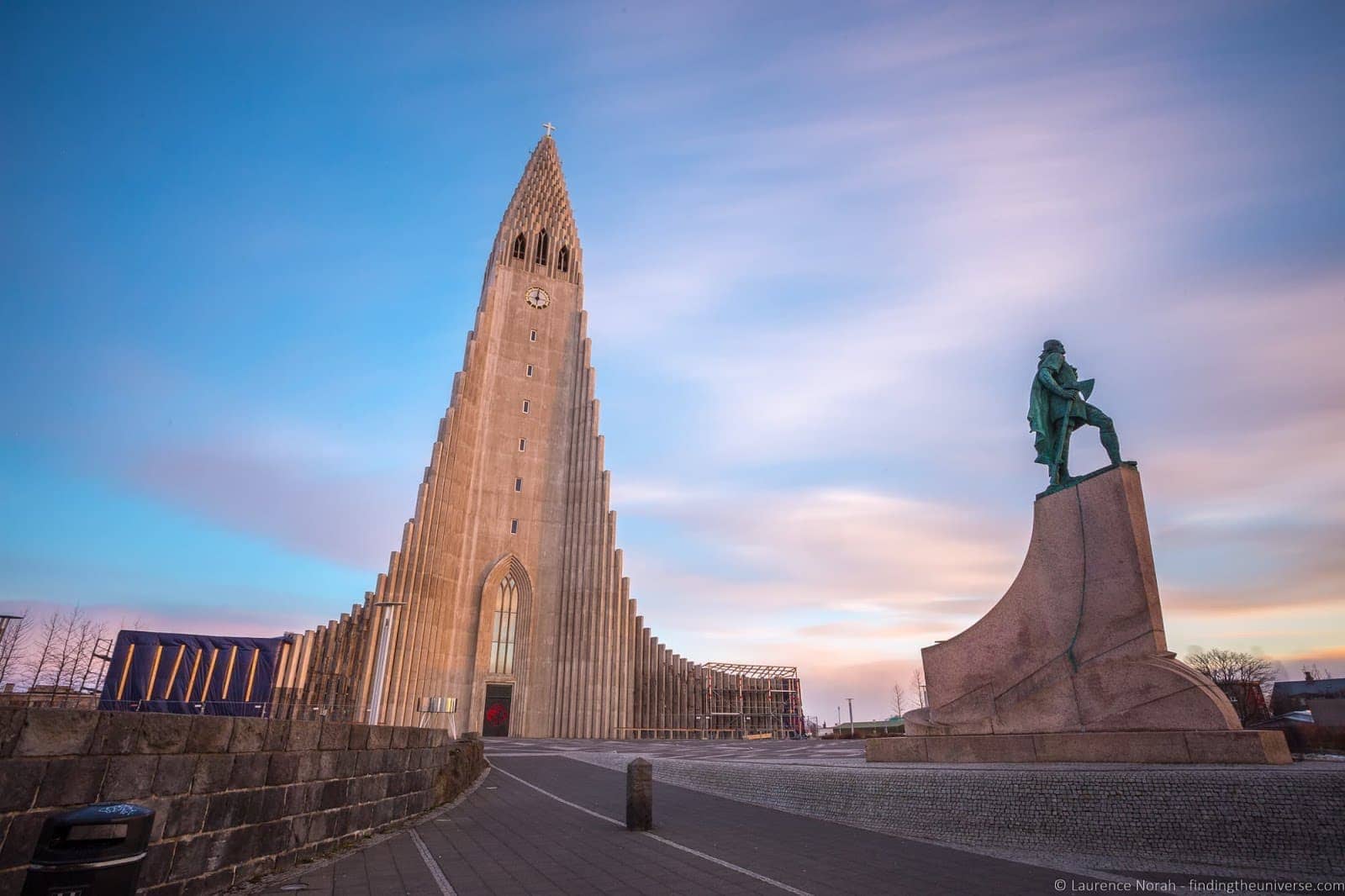
The other sight that most people get a photo of in Reykjavik is the Hallgrimskirkja, Iceland’s tallest church. It’s 73 metres tall, and sits atop a hill in the centre of the city, meaning you can see it from pretty much everywhere.
The church has a design that reflects some of Iceland’s best known features, namely its mountains and basalt rock columns. It’s also home to a statue of Leif Eriksson, the Icelandic explorer who is believed to be the first European to journey to North America.
As well as the view from the front of the church, it’s worth taking the trip up to the top of the tower (fee required) for the panoramic views over the city. In particular, I loved photographing the colourful houses that make up the main streets of Reykjavik’s city centre.
8. The Blue Lagoon
If you’re near Reykjavik, the chances are that you will visit the Blue Lagoon! This geothermal hot spring is probably the most famous in Iceland, and is particularly convenient as it’s near the airport, meaning you can often include it as part of your transfer.
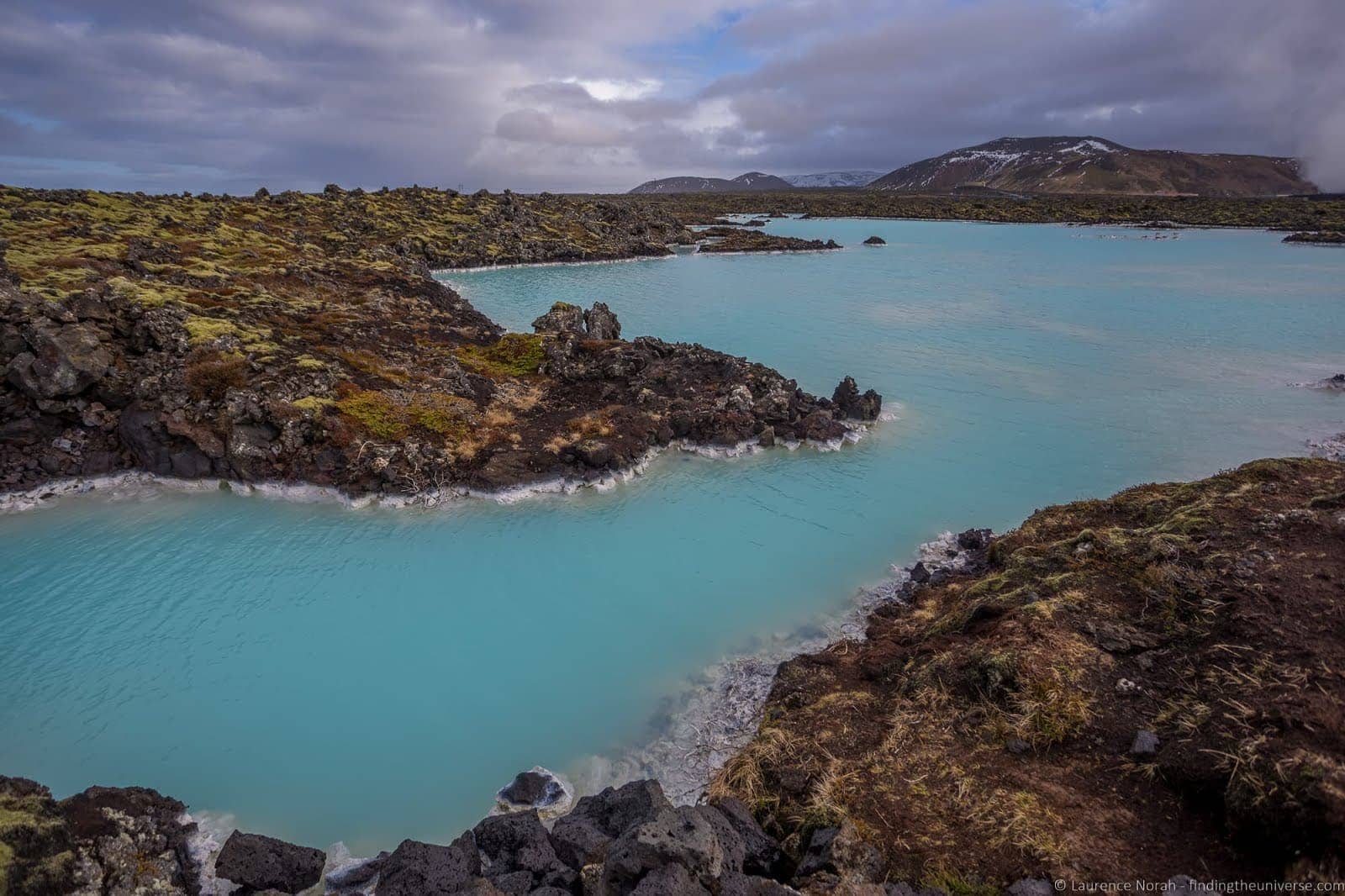
In terms of photography opportunities, there are two main options. First, outside the Blue Lagoon facility itself there’s a path where you can wander around and get shots of the incredibly blue water against the green moss covered lava. That’s pretty much my favourite Blue Lagoon shot right there, and it’s even free.
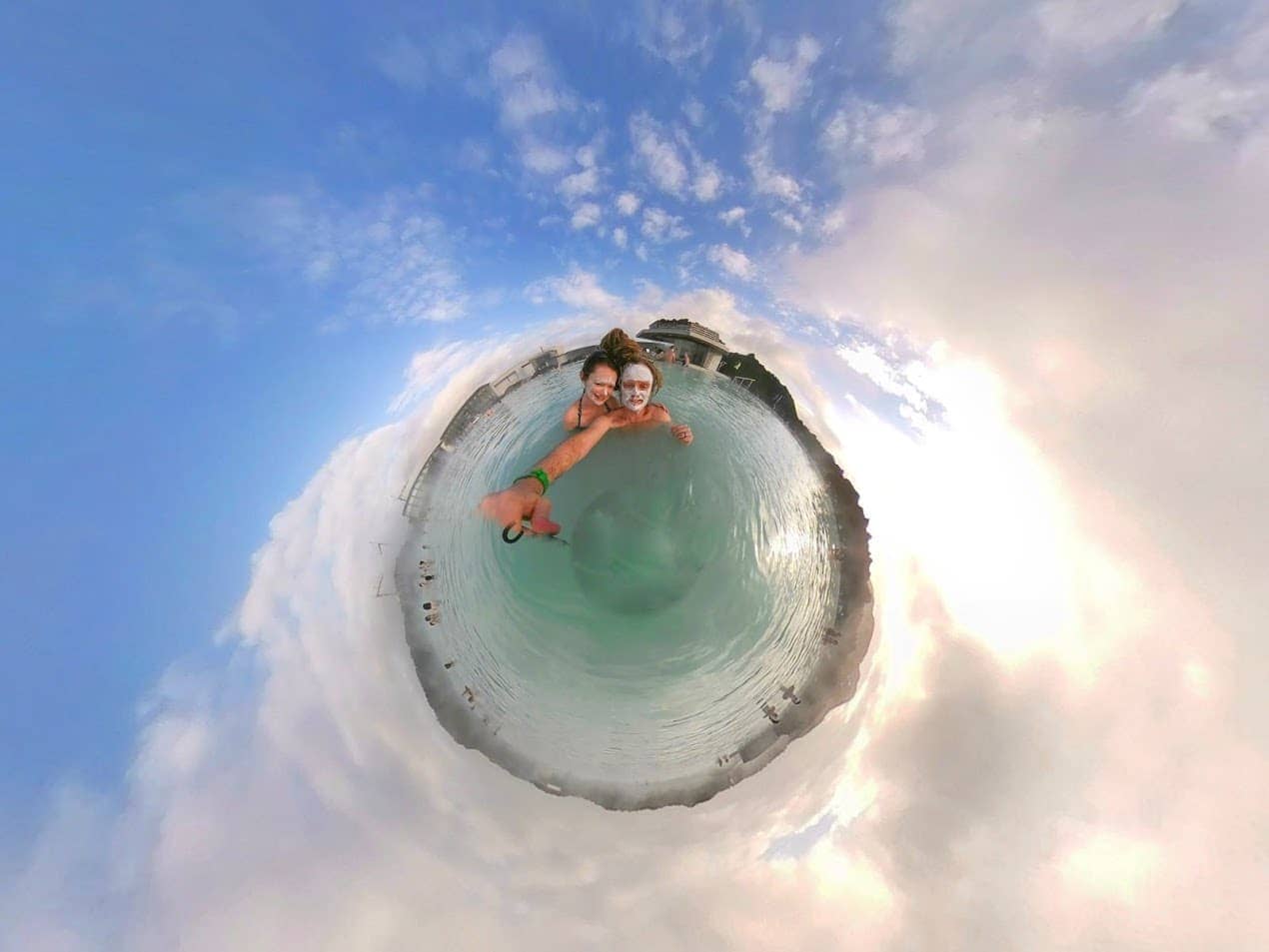
Then, of course, there’s the obligatory selfie of you *in* the Blue Lagoon. Which of course we did, mud masks and all!
One thing to be aware of: the Reykjanes Peninsula has experienced ongoing volcanic activity since 2023, and the Blue Lagoon has been temporarily closed several times as a result. Check bluelagoon.com and SafeTravel.is for the latest before booking. Sky Lagoon in Reykjavik is a good alternative if the Blue Lagoon is closed.
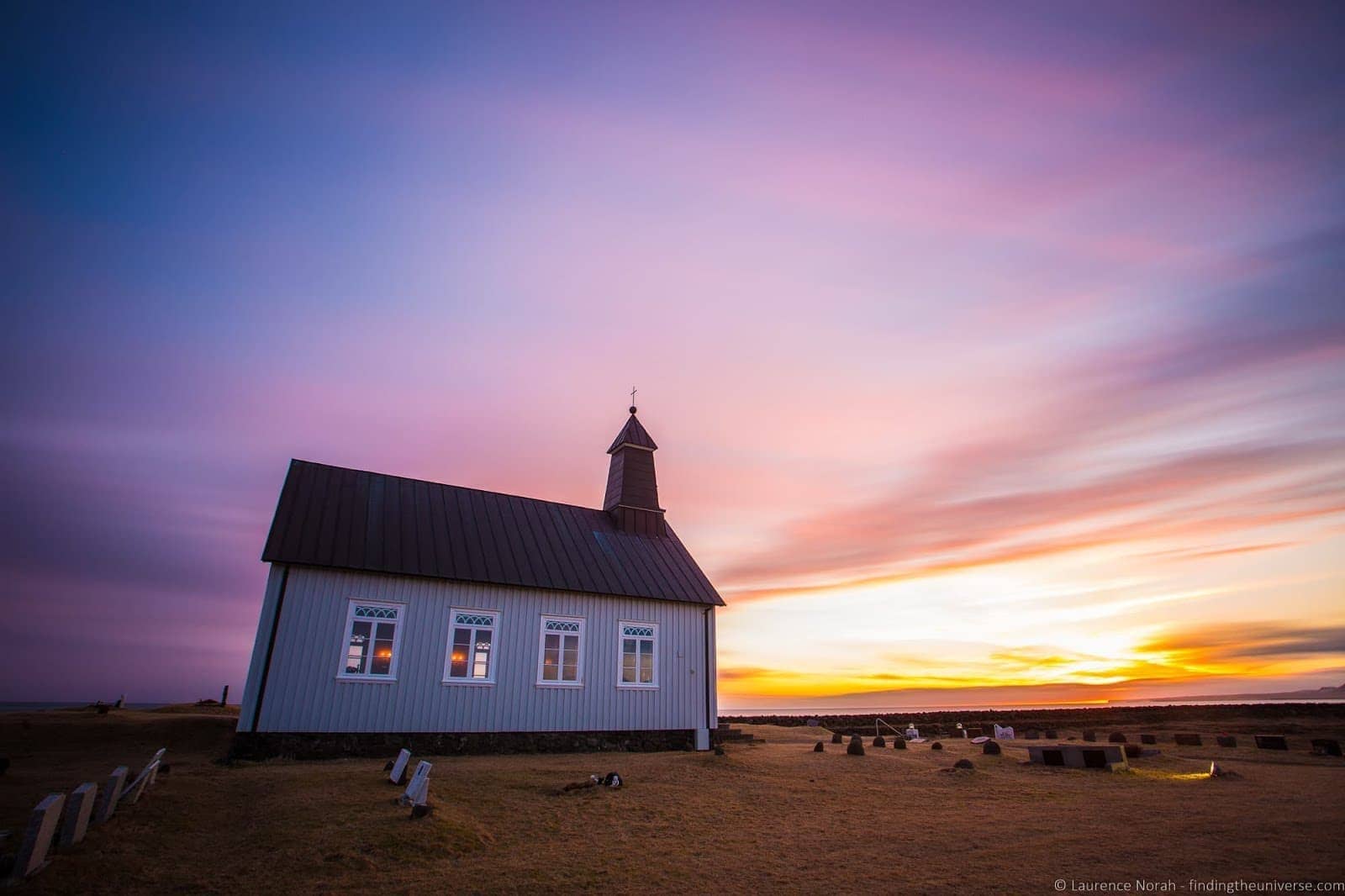
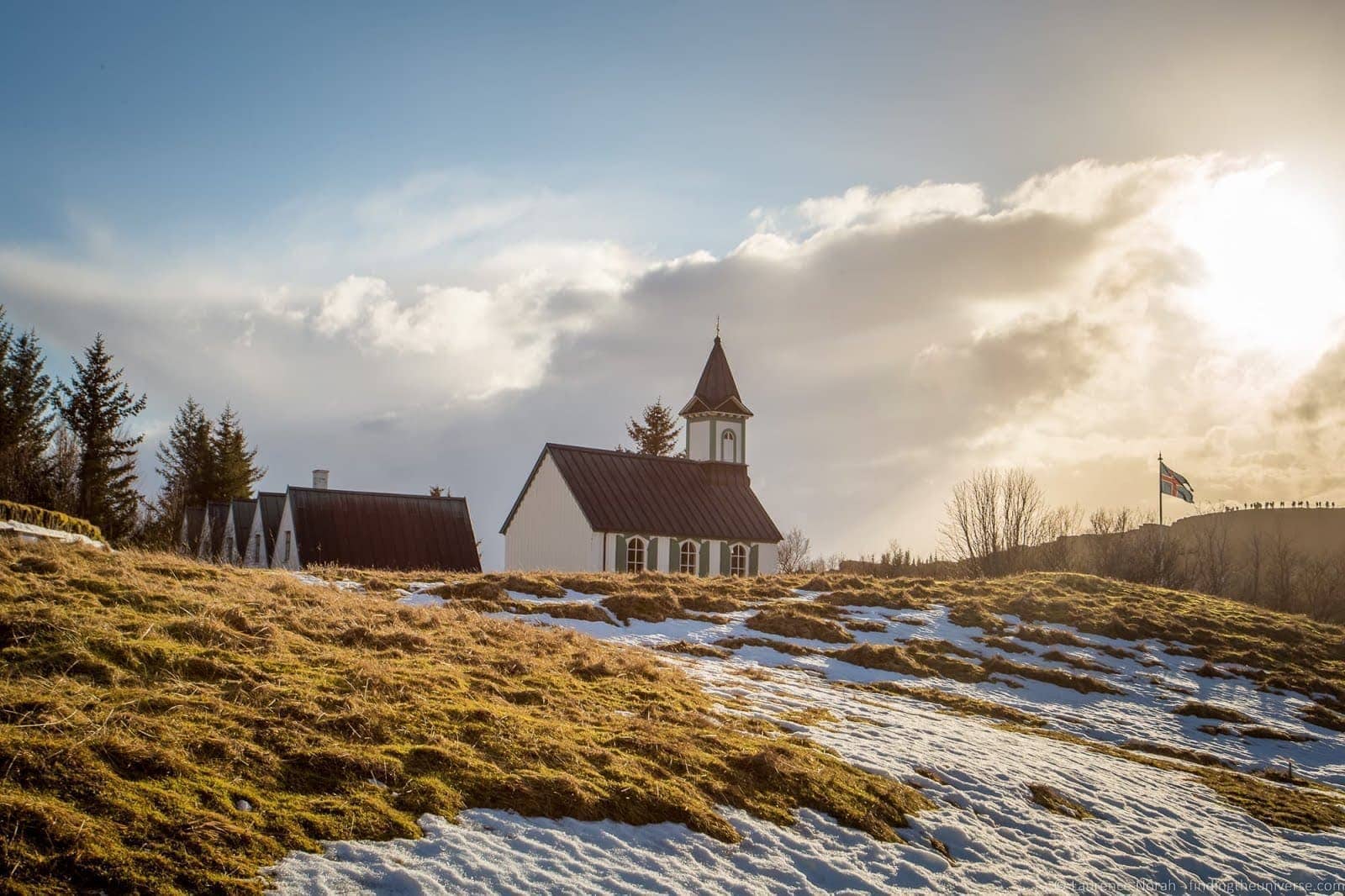
9. Strandakirkja
About a forty minute drive south of Reykjavik you’ll find the beautiful little church called Strandakirkja. Iceland certainly has no shortage of pretty little churches, but I particularly liked the lonely location of Strandakirkja, and its position on the south coast makes it particularly good for visiting at either sunrise or sunset.
The church is locally famous for having divine powers, and dates to the 12th century, with the original having been built by sailors who, so the story goes, were guided to the spot through treacherous seas by an angel. To give thanks, they built the church. Today’s structure is a little less old, but I’m sure, no less spectacular. Parking is free.
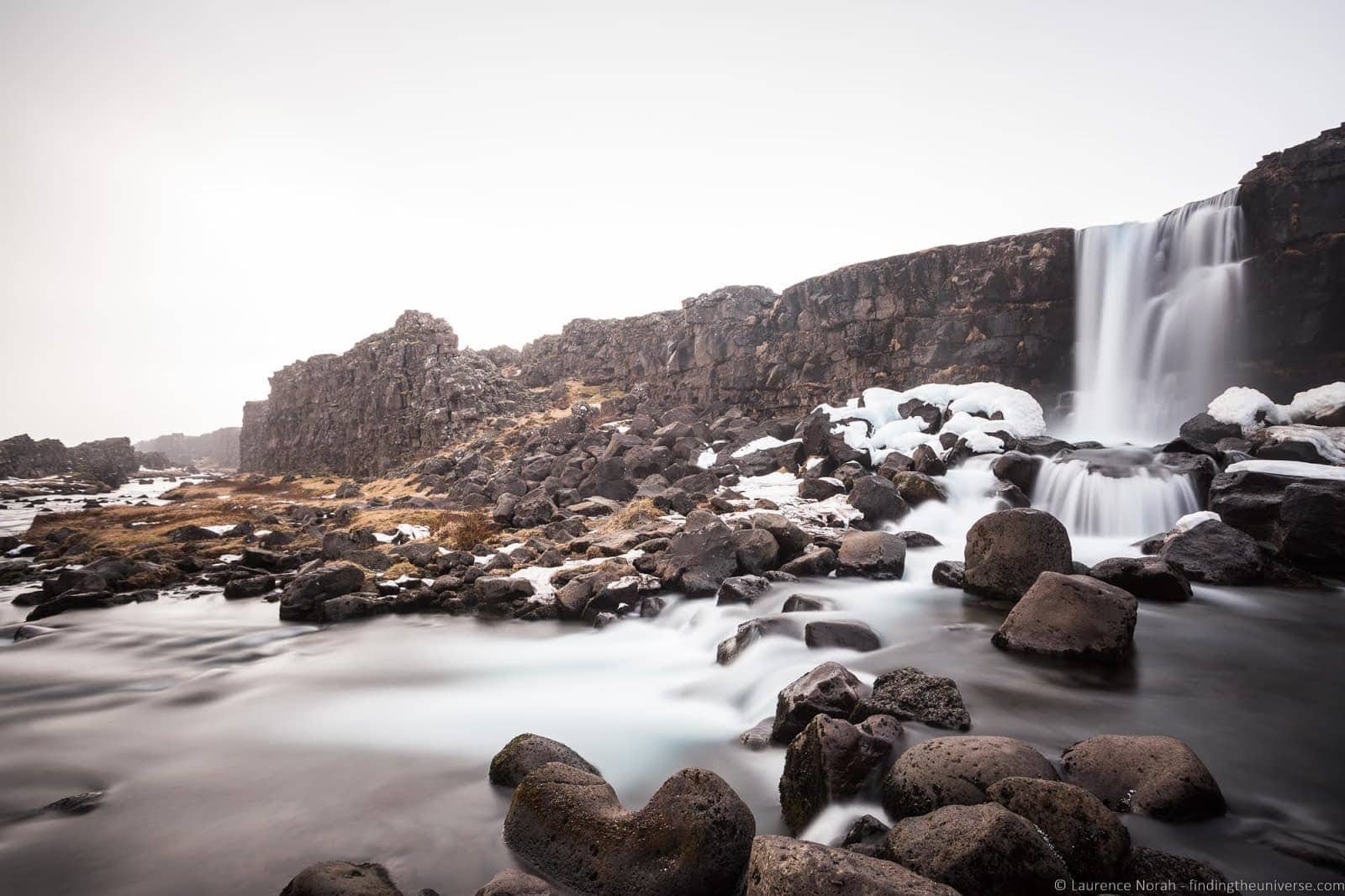
10. Öxarárfoss Thingvellir (Þingvellir) National Park
Thingvellir National Park is a UNESCO world heritage site, and the most important cultural site in Iceland. It was here that the original Icelandic peoples would meet for an annual assembly, and it was here that the Icelandic parliament is said to have been founded.
There’s also plenty to see here from a photography perspective, with a highlight for me being the beautiful waterfall of Öxarárfoss.
Whilst it was unfortunately somewhat grey and cloudy when I visited, I still enjoyed shooting this waterfall. It’s about a ten minute uphill walk to visit from the closest car park, but I’d definitely recommend spending some time exploring the surrounding area.
Öxarárfoss and Thingvellir are about a 40 minute drive from Reykjavik. Entry is free, but there is a parking fee of 1,000 ISK payable at machines on site or via checkit.is, valid all day across all park car parks.
We’d suggest visiting as part of a golden circle tour – see more information on this as part of the Gullfoss waterfall entry below.
11. Geysers
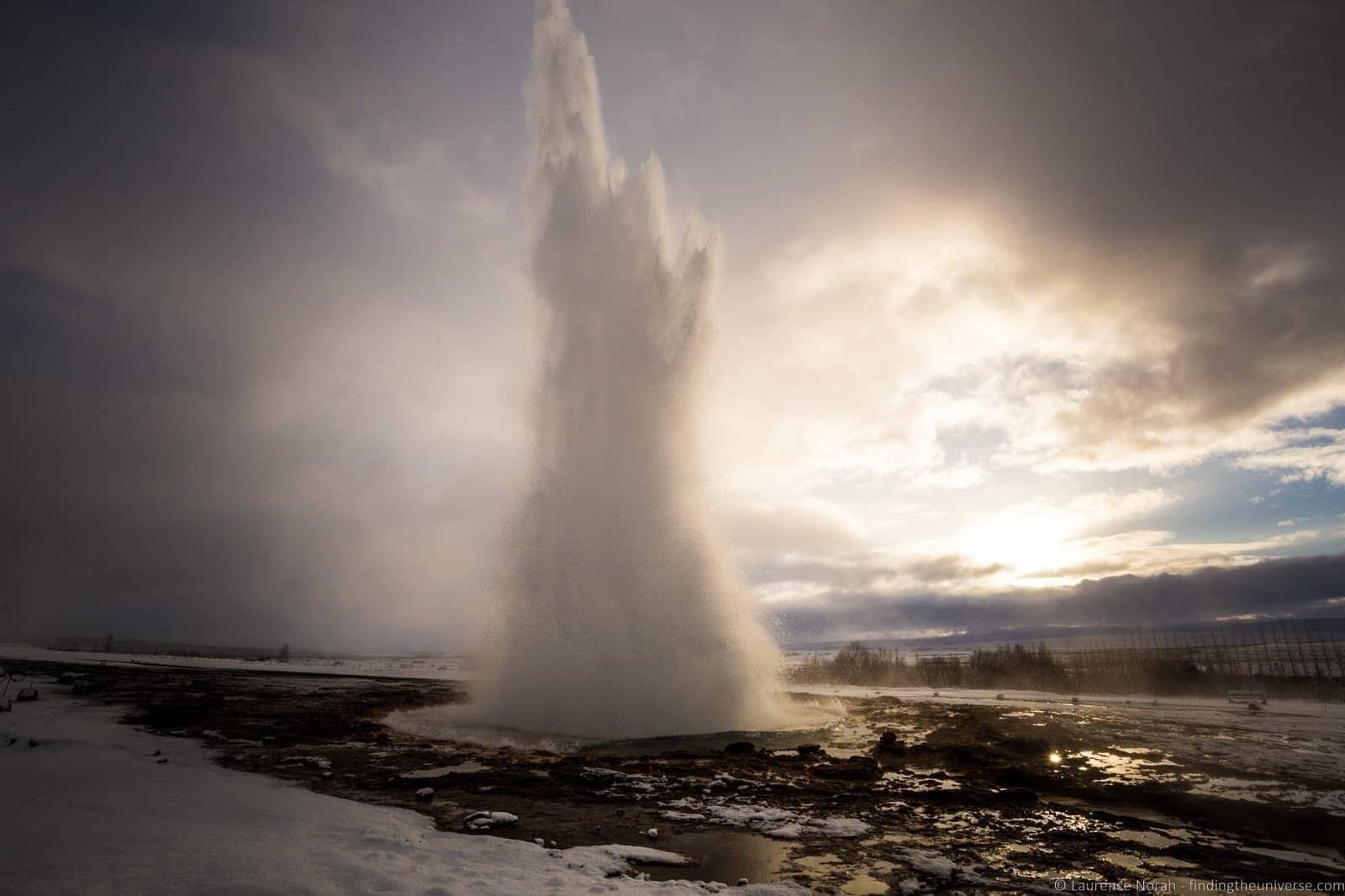
Here’s a fun fact that I learnt on our visit to Iceland – the word Geyser derives from the Icelandic “Geysir”, which is the name of an actual Geyser in Iceland – the first to be known by Europeans.
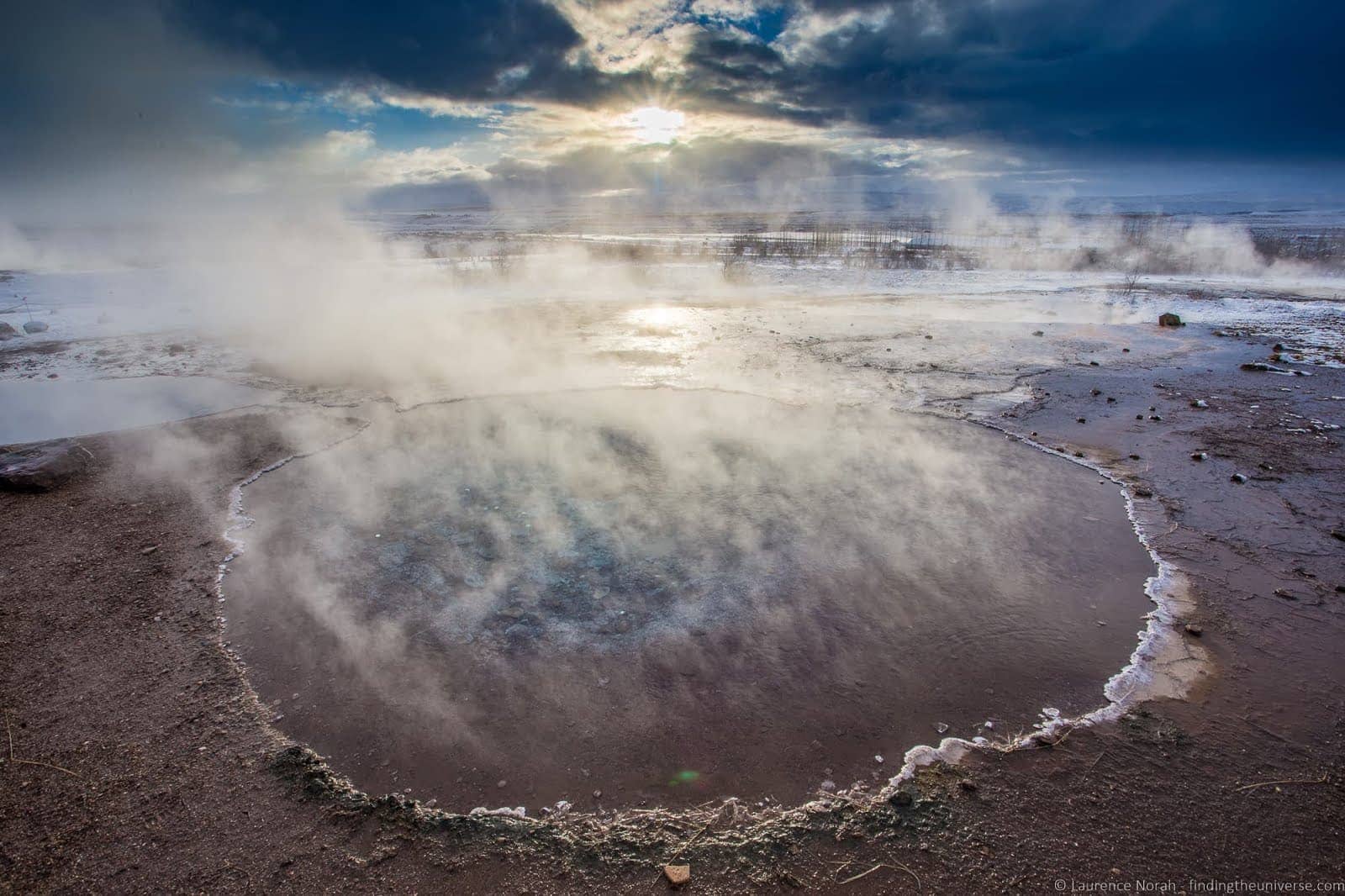
Geysir is now a part of the Geysir Hot Spring Area, a popular stop for visitors in Iceland, and a place where you can wander amongst bubbling pools and steam filled landscapes.
Whilst the Great Geysir itself is currently somewhat dormant, the nearby Strokkur Geyser goes off every few minutes, giving you plenty of opportunity to photograph this wonderful sight, along with those bubbling pools and steamy landscapes!
Parking at Geysir is 1,000 ISK via the Parka app.
12. Gullfoss waterfall
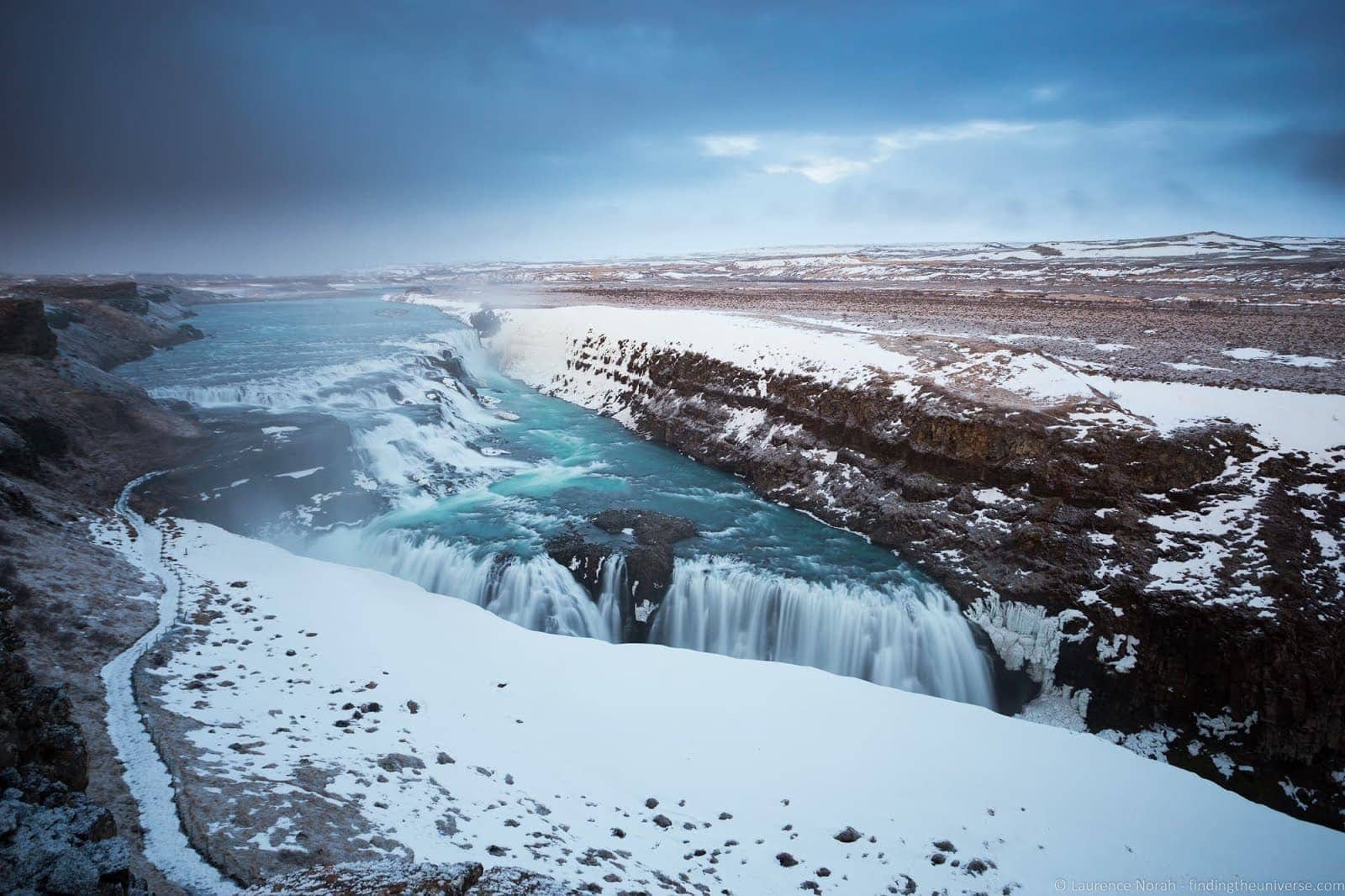
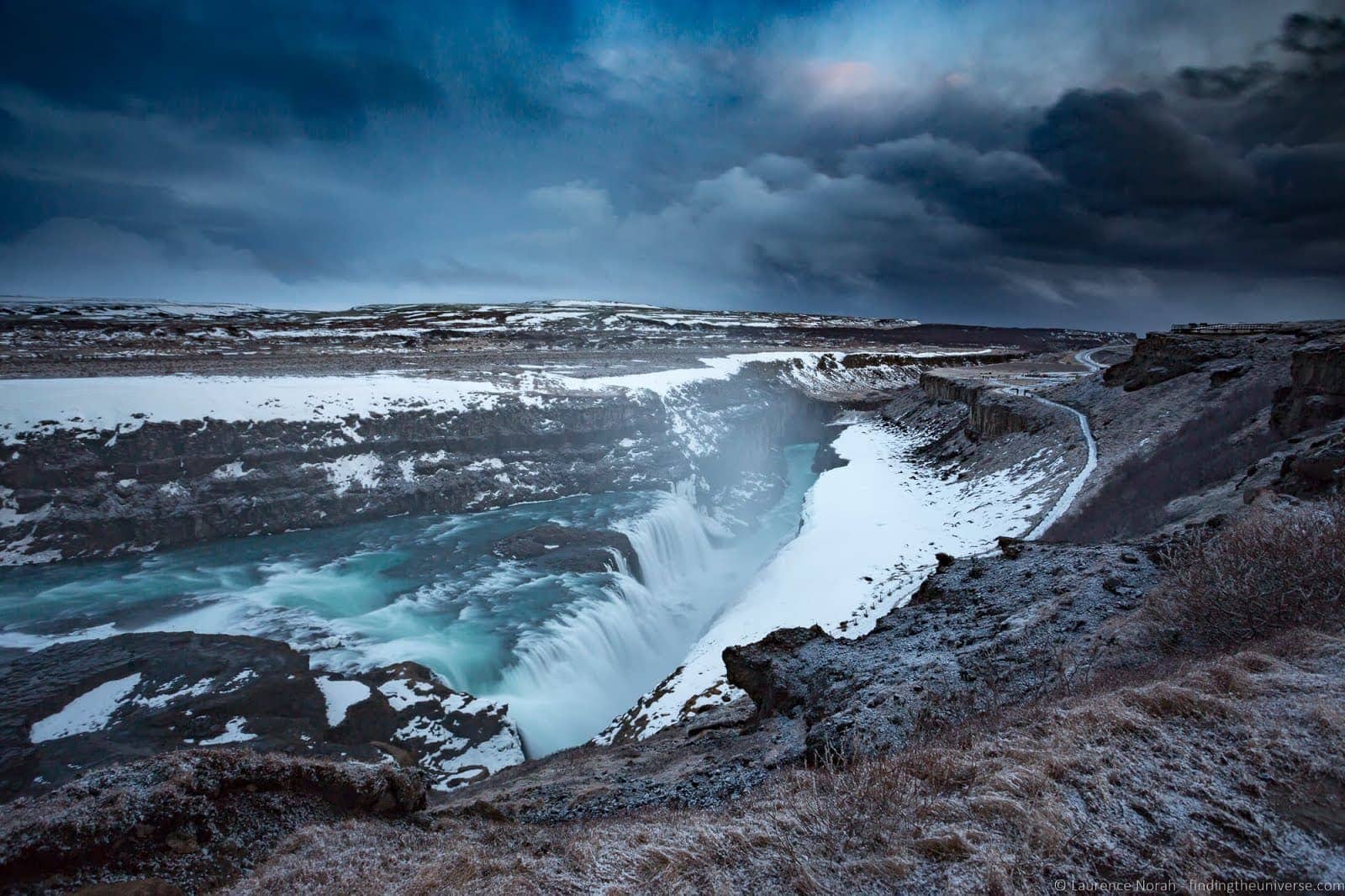
One of Iceland’s most well known and spectacular waterfalls, Gullfoss (which means Golden Falls), is an incredible multi-tiered waterfall that appears to vanish into the earth.
There are multiple viewing angles of the falls as you walk along the river, plus you can view it from a couple of different heights, and you will want to spend some time here photographing.
Gullfoss is around a ninety minute drive from Reykjavik, and has a large on-site car park. Whilst it is very popular with visitors, I found that I had the place almost to myself for sunrise, and even sunset wasn’t that busy.
There is an on-site restaurant and shop, although these are only open during the day. Parking is free, which is increasingly rare in Iceland.
The three photography locations above, Thingvellir, the Geysers and Gullfoss, form what is known as the “Golden Circle”, a loop road that you can drive yourself from Reykjavik, or as part of a Golden Circle Day tour.
This was on our self-drive itinerary, and is on the majority of self-drive itineraries in Iceland, so we don’t think you’ll be missing these attractions easily!
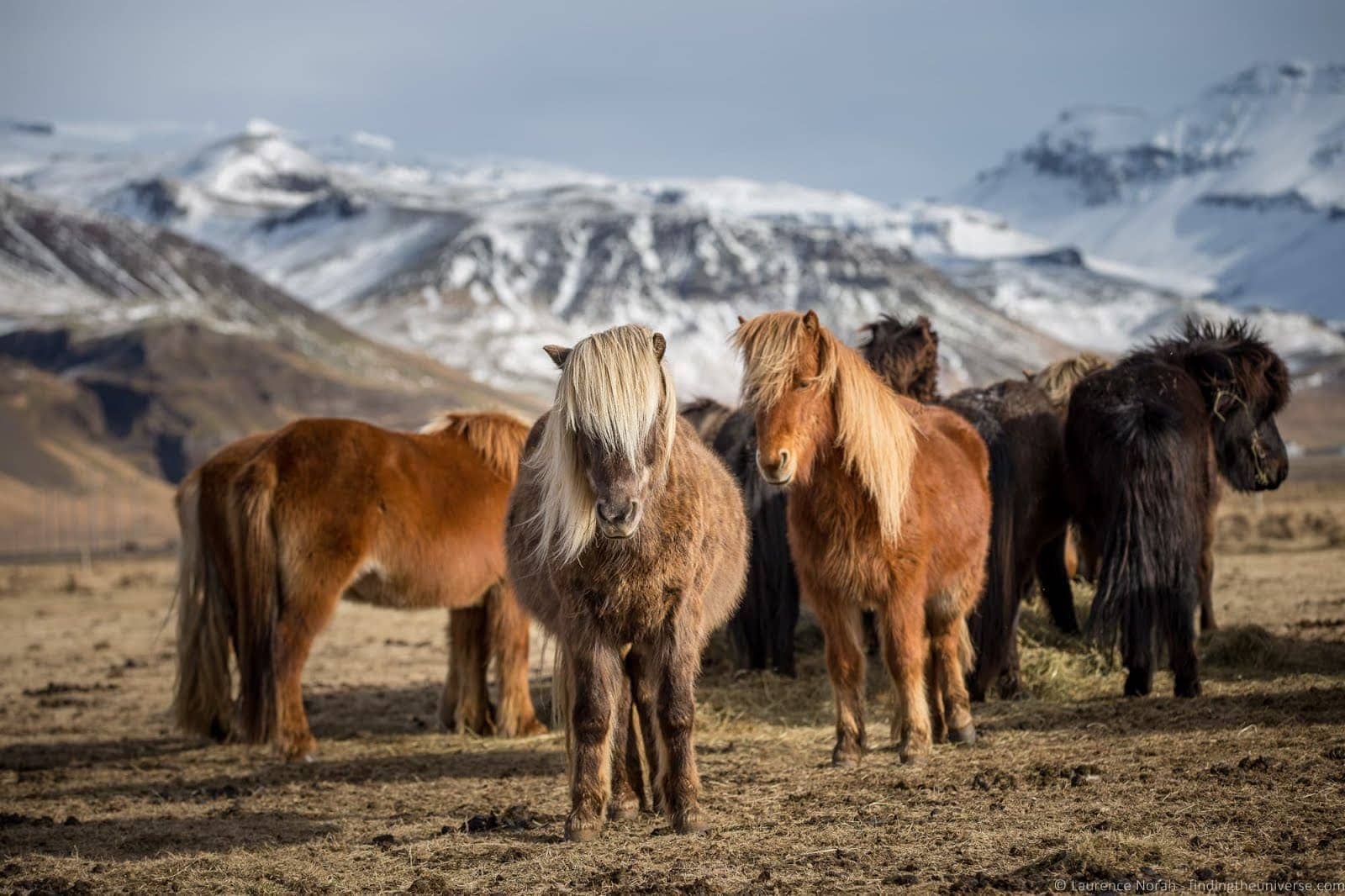
13. The Icelandic Horses
Definitely something Jess and I were both looking forward to on our visit to Iceland were the beautiful Icelandic horses.
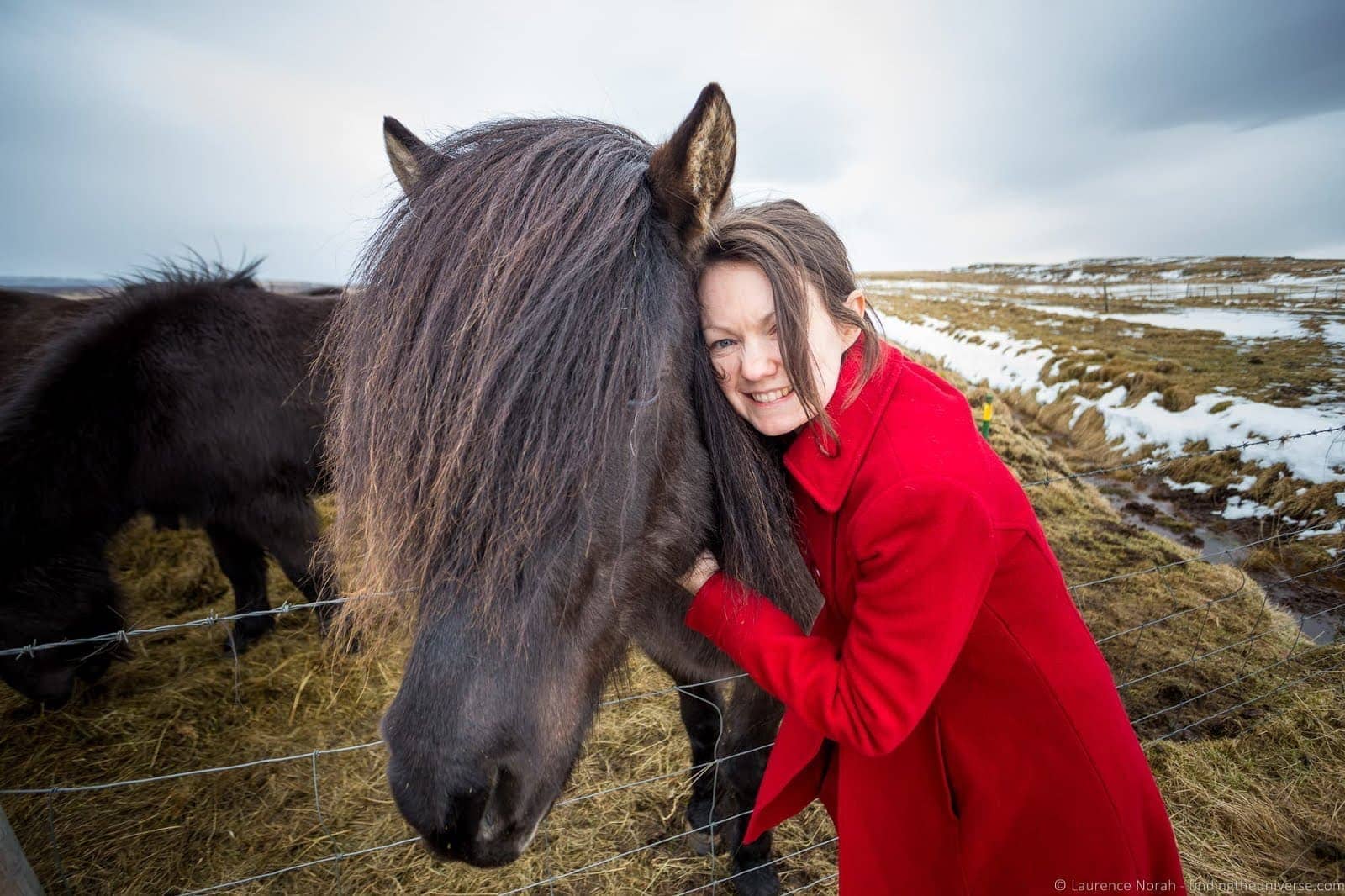
This incredibly tough breed have really thick fur and beautiful long manes, and are able to withstand incredibly harsh environments. They’re also both friendly and wonderfully photogenic!
We initially wondered how easy it would be to get photos of them, the answer – quite easy! You’ll find them all around Iceland in the fields, and we were able to find easy parking spots off the road from where we could get some nice photos of them.
Don’t panic if you see a group of horses with no safe parking – just keep driving and you’ll find another group somewhere else.
We’d definitely suggest avoiding parking on the shoulder of the road, especially on Iceland’s main roads, as passing traffic might throw up stones that will damage your vehicle. Also, it’s best not to feed the horses, and of course, don’t trespass on private property to get the shot!
We found plenty of opportunities to shoot them from safe, public property, and we’re sure you will too. Ok, safety lecture over.
14. Seljalandsfoss Waterfall
We’re firmly on the south coast of Iceland now, which has to be one of the most incredible drives in the world from a photography perspective – this 200 mile stretch of road from Selfoss to Jökulsárlón is home to everything from unbelievable waterfalls to lava fields, glaciers and black sand beaches.
We were delighted that we’d chosen a self-drive tour – it meant we could stop when, where, and for however long we wanted to get the shots we were looking for.
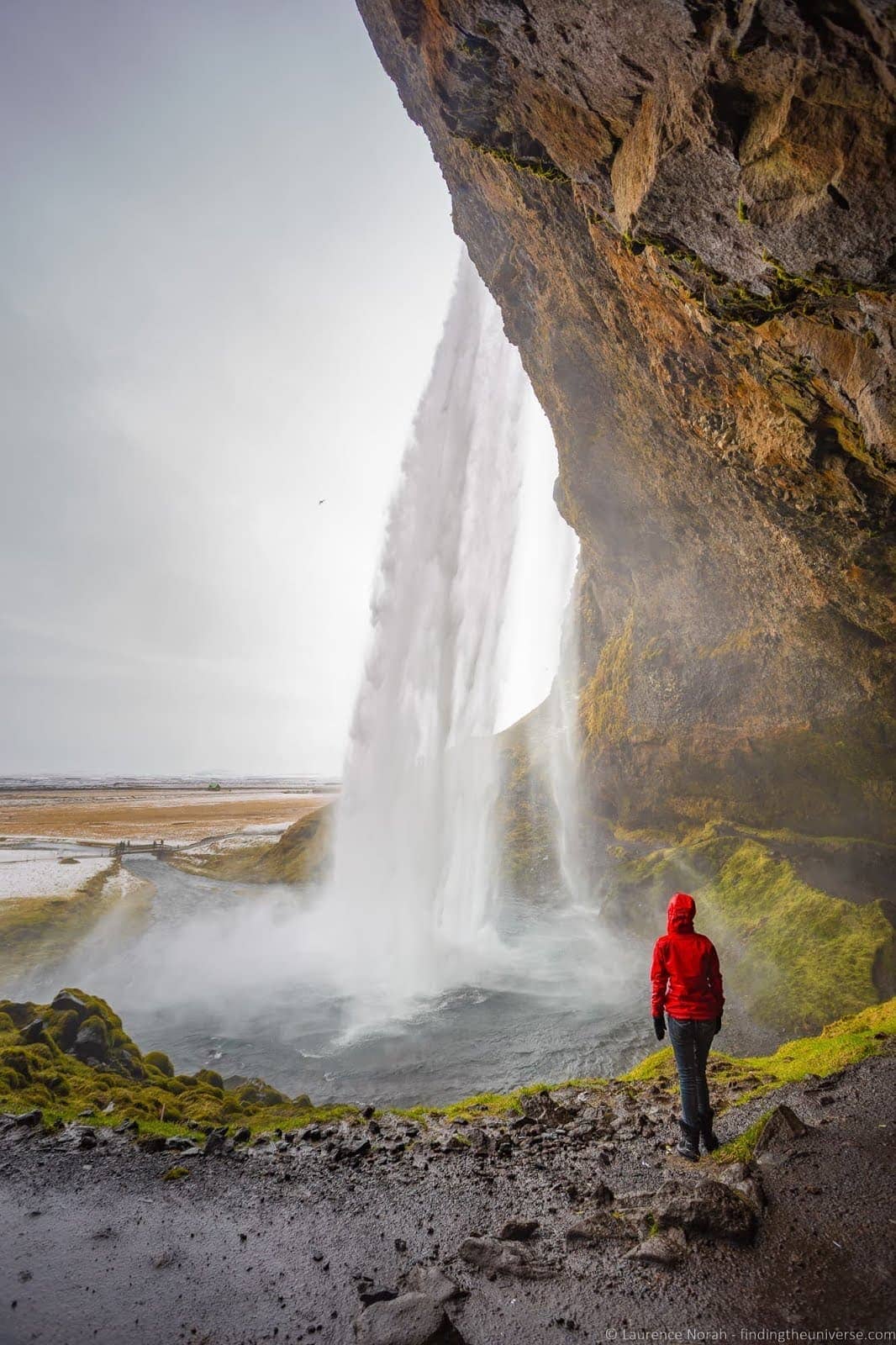
The first major stop along the route is the Seljalandsfoss Waterfall. With a sixty metre drop, it’s definitely one of the more popular waterfalls in the country.
It’s also interesting because you can actually walk behind the falls, which makes for some interesting photography opportunities.
If you’re going to do this, I highly recommend investing in a camera bag with a rain cover (see our photography gear list for what we use), or at least some plastic bags to put over your gear.
Even a small amount of wind can have the spray blowing everywhere, and wet lenses don’t make great photos – assuming your camera survives the experience! I’d definitely recommend doing this though, as going behind a waterfall makes for both a fantastic experience and a wonderful photography opportunity. Just be prepared to get wet!
Parking is 1,000 ISK, payable at card machines on site or via checkit.is.
15. Gljúfrabúi
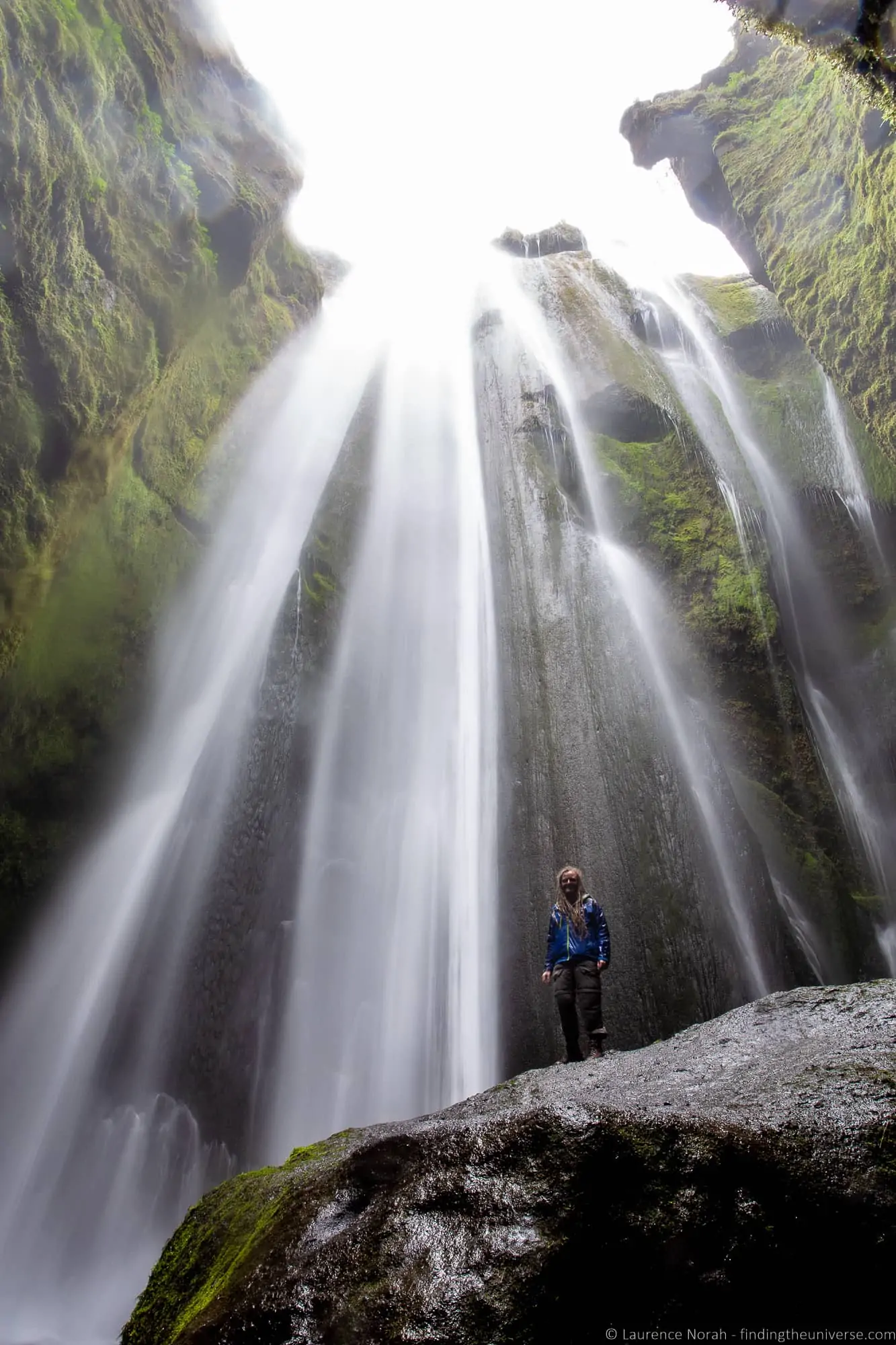
About a ten minute walk along a paved path from Seljalandsfoss, you’ll find Gljúfrabúi, a waterfall hidden inside a small canyon. To see it properly you need to wade up a shallow river a few metres, which puts a lot of people off. That’s part of what makes it special.
Once you’re inside, you’re surrounded by mossy green walls with water crashing down in front of you. It feels like being inside a waterfall, which is because you more or less are.
From a photography perspective, the challenge is keeping your gear dry (waterproof covers are a must here) and dealing with the low light inside the canyon. A tripod helps, but it’s tricky to set up on the uneven, wet rocks.
Gljúfrabúi is covered by the same parking fee as Seljalandsfoss (1,000 ISK via checkit.is or card machines). Make sure to wear waterproof shoes and be prepared to get wet.
16. Kvernufoss
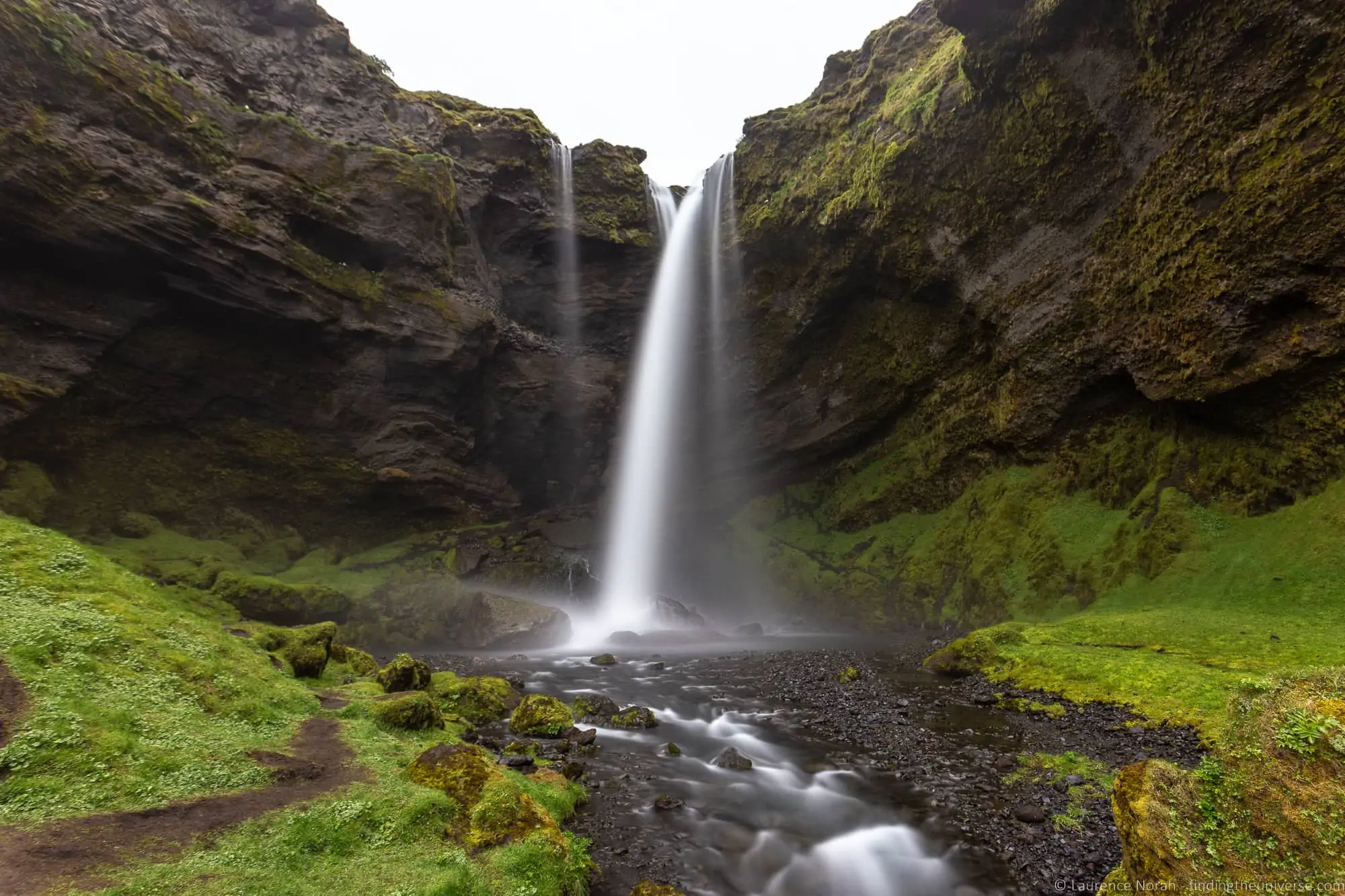
Very close to Skogafoss but far less visited, Kvernufoss is about a twenty minute hike from the Skogar Museum car park. It’s tucked away in a narrow gorge, and like Seljalandsfoss, you can walk behind it (or at least partially behind it, depending on conditions).
I really liked Kvernufoss because it felt like a secret compared to the crowds at Skogafoss just down the road. The gorge setting gives it a more intimate feel, and the surrounding cliffs add dramatic framing to your shots. A wide angle lens works well here.
Parking at Skogar Museum is 750 ISK via the Parka app, valid until midnight. Please stay on the marked path to avoid damaging the vegetation.
17. Skogafoss Waterfall
From Seljalandsfoss the road continues past a number of other beautiful waterfalls (again, lots of opportunities to stop for photos!) until you get to Skogafoss, another of Iceland’s hugely famous waterfalls.
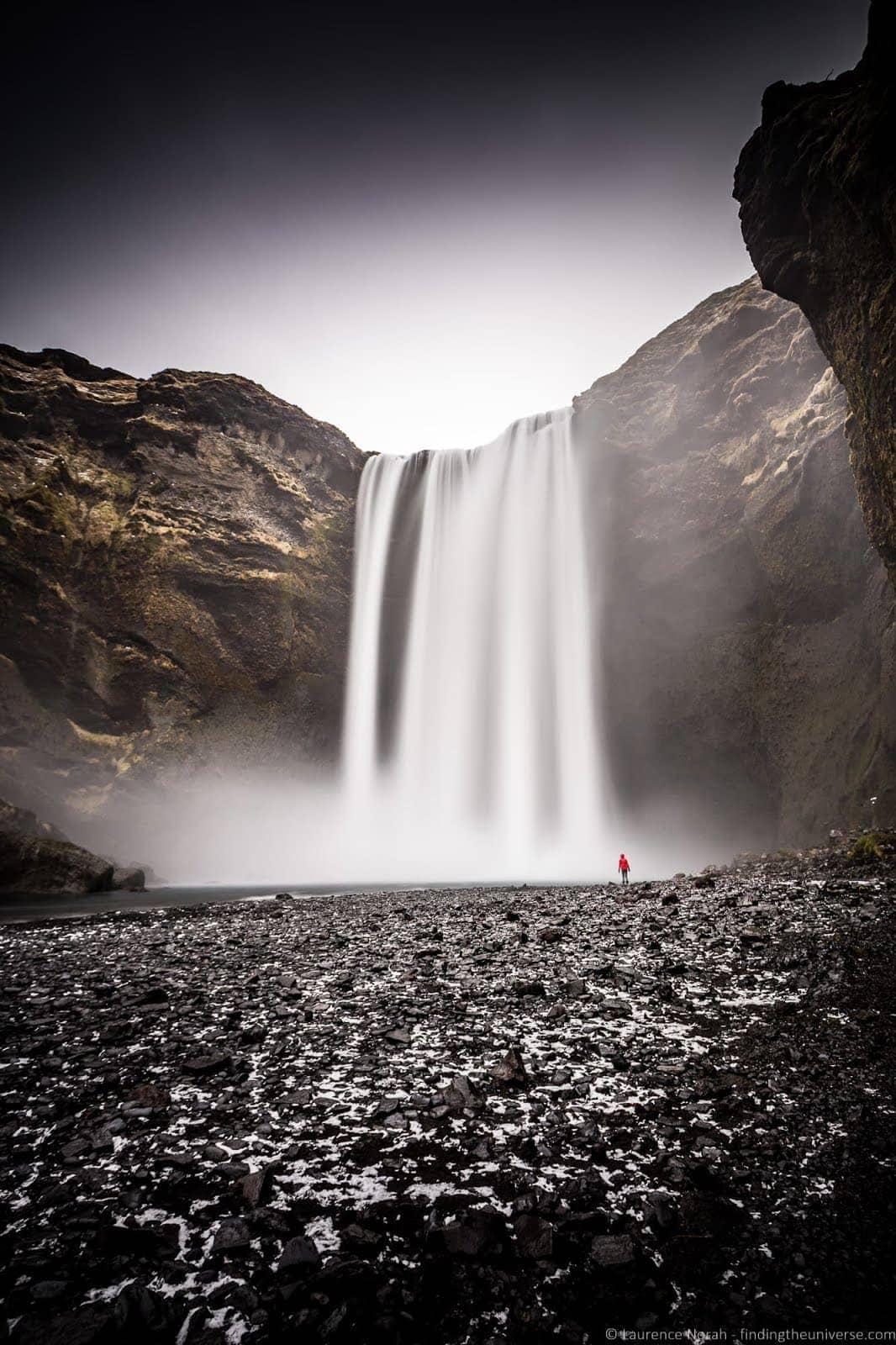
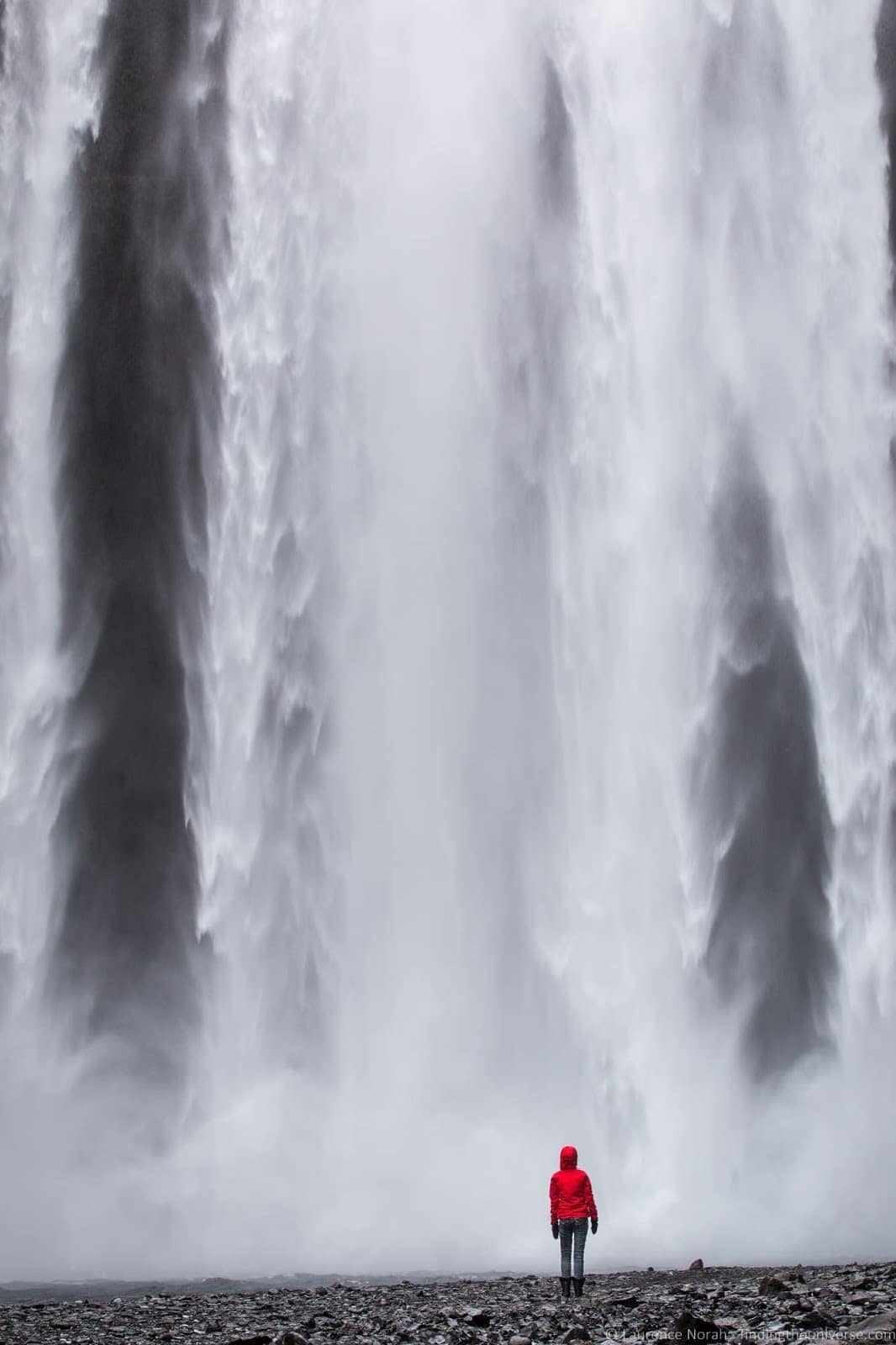
Like Seljalandsfoss, this has a drop of 60 metres, however there is a far greater volume of water, making for a hugely impressive sight.
We loved that you can walk right up close to the base of where the falls crash into the pool below. With a telephoto lens, this gives plenty of opportunity for placing your subject seemingly right into the falls themselves, which can be a lovely shot.
With a wide angle lens, you can also get the whole of the falls, which are just beautiful. Finally, there’s a staircase that will take you right up to an overlook at the top of the falls.
Parking is 1,000 ISK via the Parka app, valid for 8 hours. It’s a five minute walk to the base of the falls, and a bit longer up to the viewing platform.
18. Reynisfjara Black Sand Beach
A break from waterfalls now, although, as you drive along highway 1 you’re going to find plenty more locations you’ll likely want to stop at to take pictures.
My next favourite photography location along highway 1 was the Reynisfjara black sand beach.
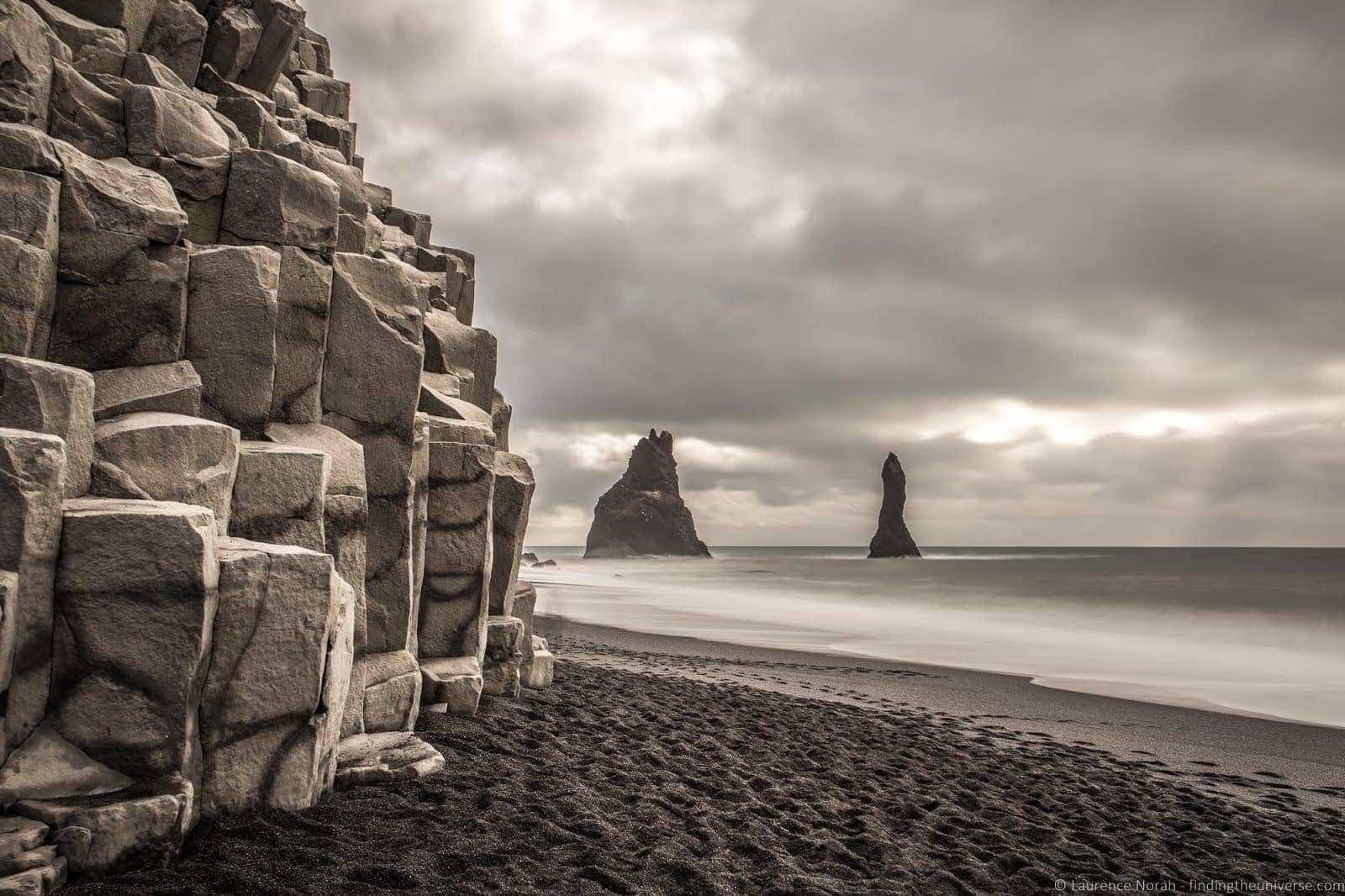
Most of the beaches in Iceland are of black sand, so that’s not too special, but Reynisfjara is notable because there are basalt rock columns right on the beach which make for great photography foreground, as well as rock columns in the sea that make for great background.
All you have to do is time the tide right (at mid to high tide the beach past the rock columns is largely impassable) and then wait for the crowds of people to give you a break for shooting.
It’s also worth noting that storms and erosion can significantly alter the look of the area. In January 2026 for example, the majority of the beach was entirely eroded away by storms, making it impossible to access the rock columns. So your experience may vary depending on when you visit.
A word of caution: sneaker waves at Reynisfjara are extremely dangerous. Several visitors have died after being swept into the sea by waves that surge much further up the beach than expected. Stay well back from the waterline and pay attention to the colour-coded warning system at the entrance. Check SafeTravel for current conditions.
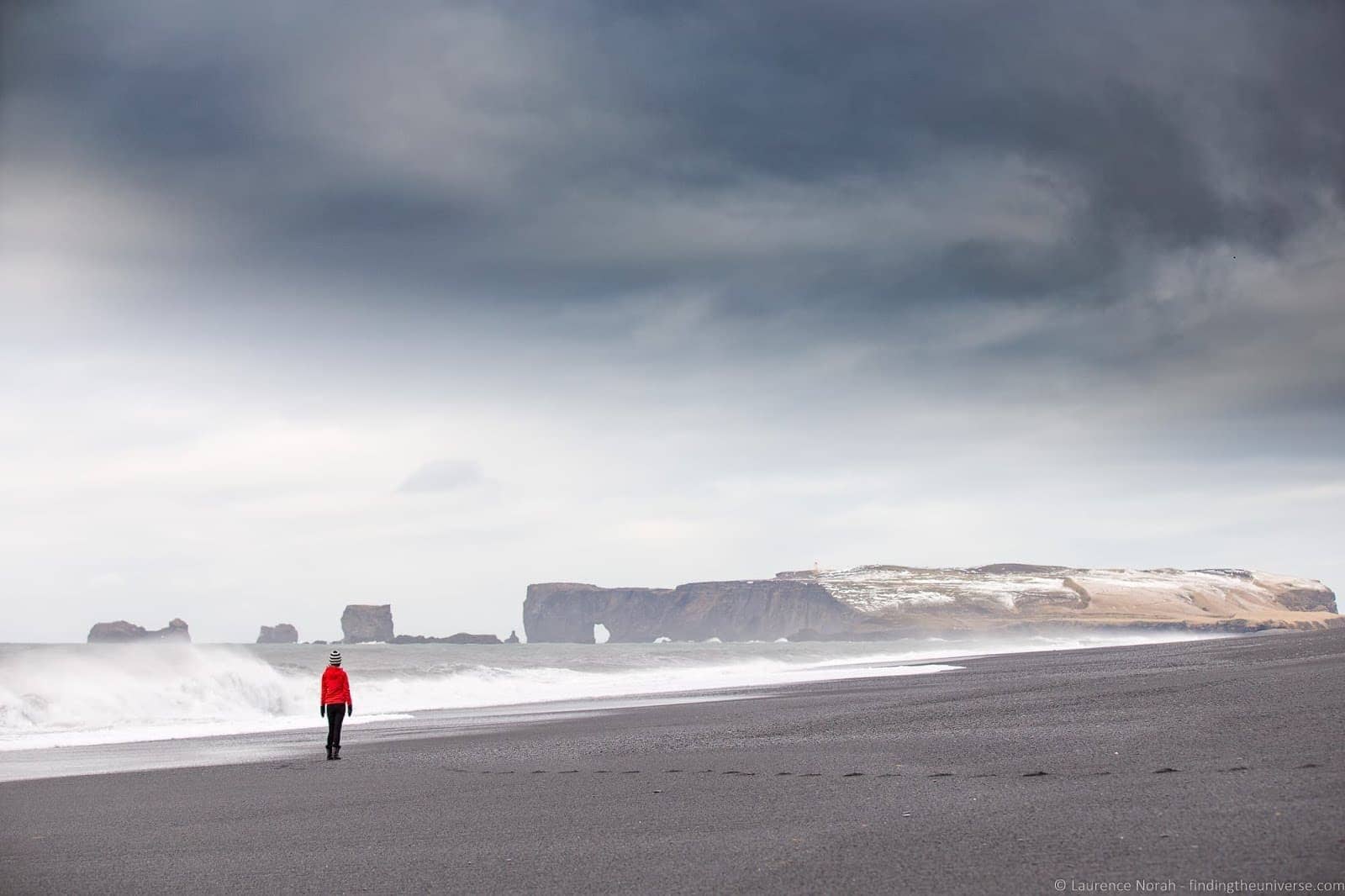
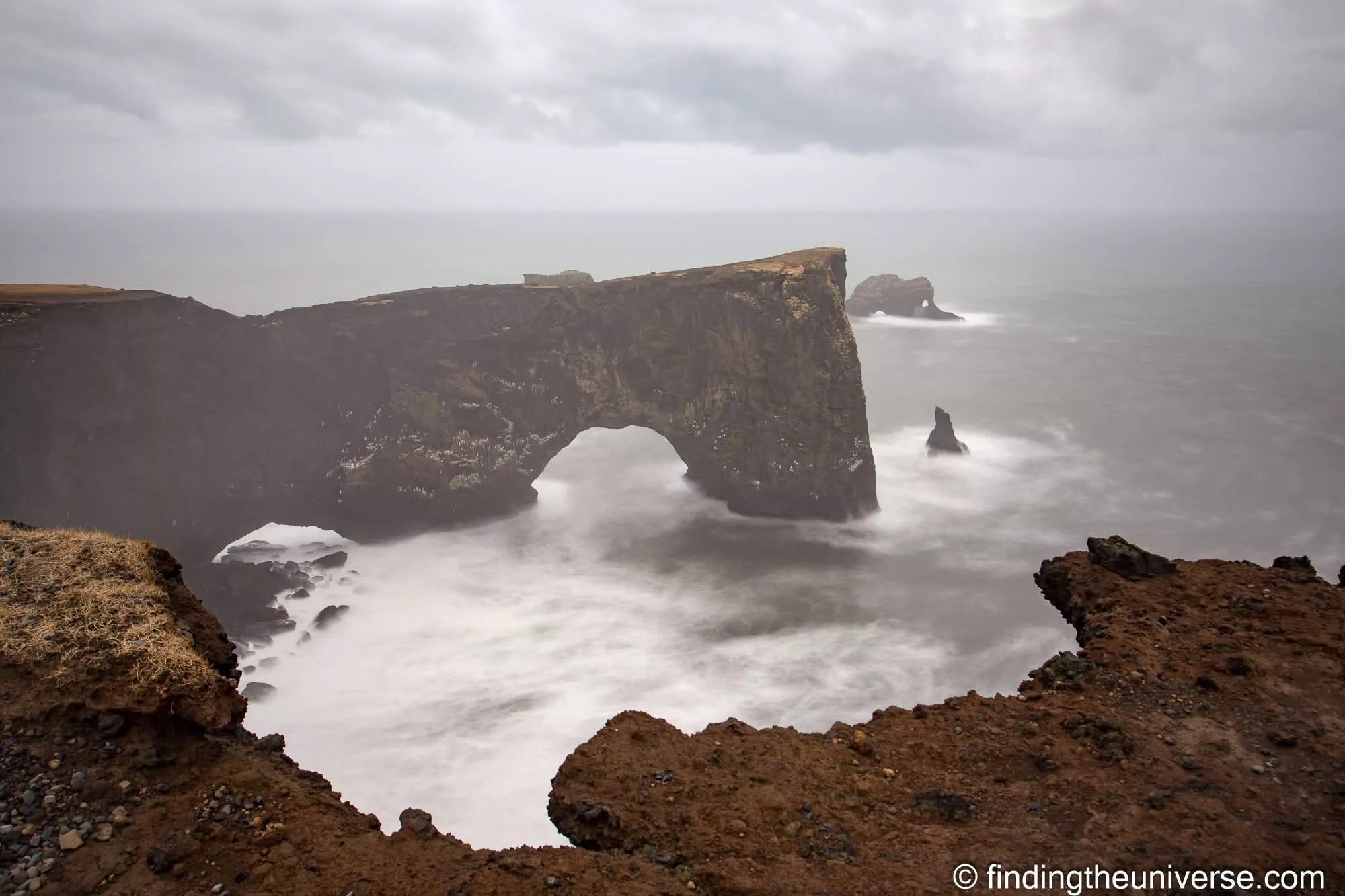
Also near here is the huge rock arch at Dyrholaey. You can actually drive right to the top of the cliff top here for wonderfully panoramic shots along the beach, with the mountains of Iceland in the background. Both are definitely a worthwhile stop.
Parking is 750 to 1,000 ISK via the Parka app.
19. Dyrhólaey
Dyrhólaey is the dramatic cliff and natural rock arch just west of Reynisfjara. You can drive up to the top of the headland for panoramic views along the black sand coast, with the Reynisdrangar sea stacks visible to the east and the mountains of Iceland to the north.
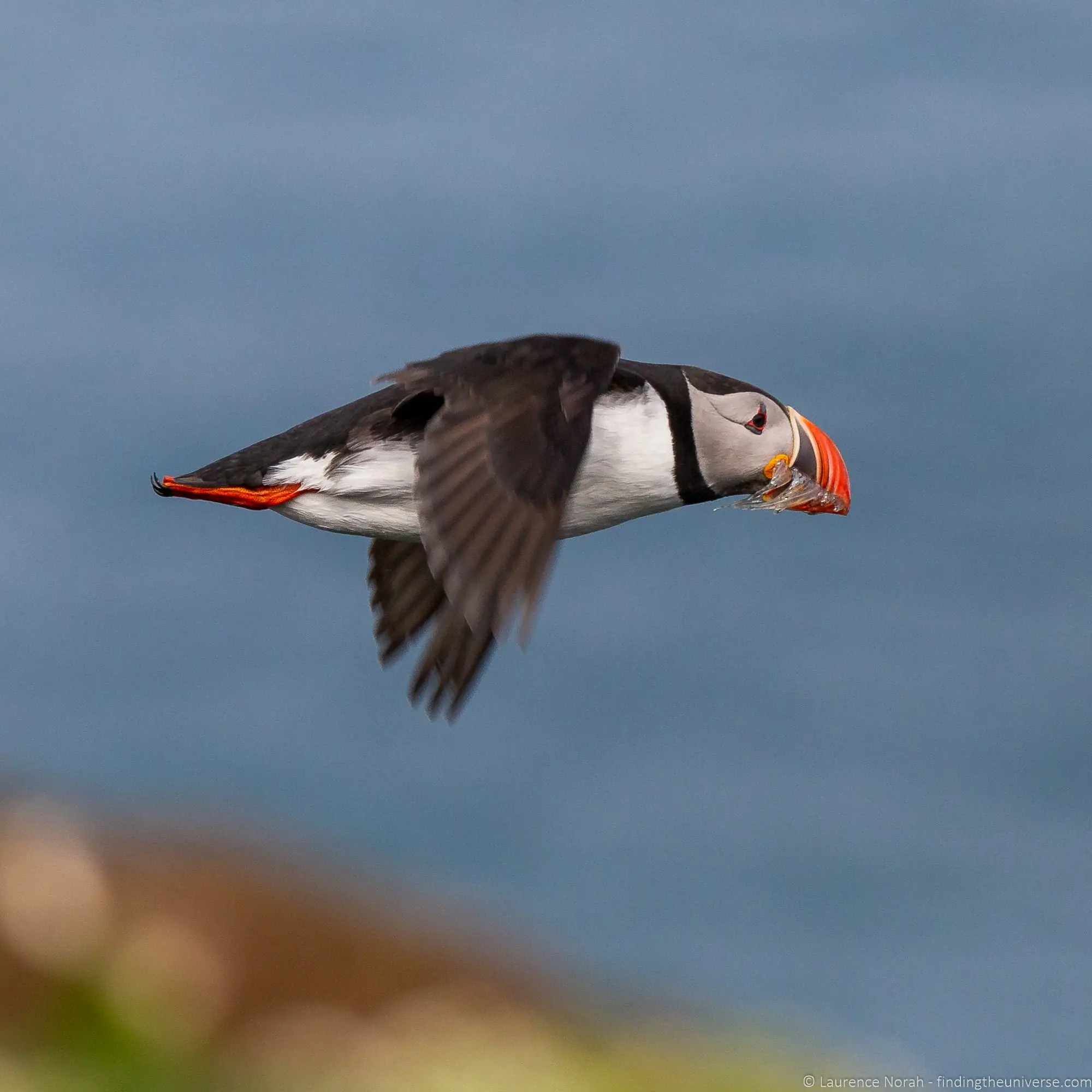
This is one of the best sunset spots on the south coast outside of summer, when the sun sets further south and lights up the cliffs and the arch. In summer, it’s a popular spot for photographing puffins, as they nest on the cliffs here. The arch itself is a great subject from multiple angles.
Parking is 750 ISK via the Parka app. There are two car parks here: one at the lower level near the beach, and one at the top of the headland. Both are worth visiting for different perspectives.
20. Skeiðará Bridge Monument
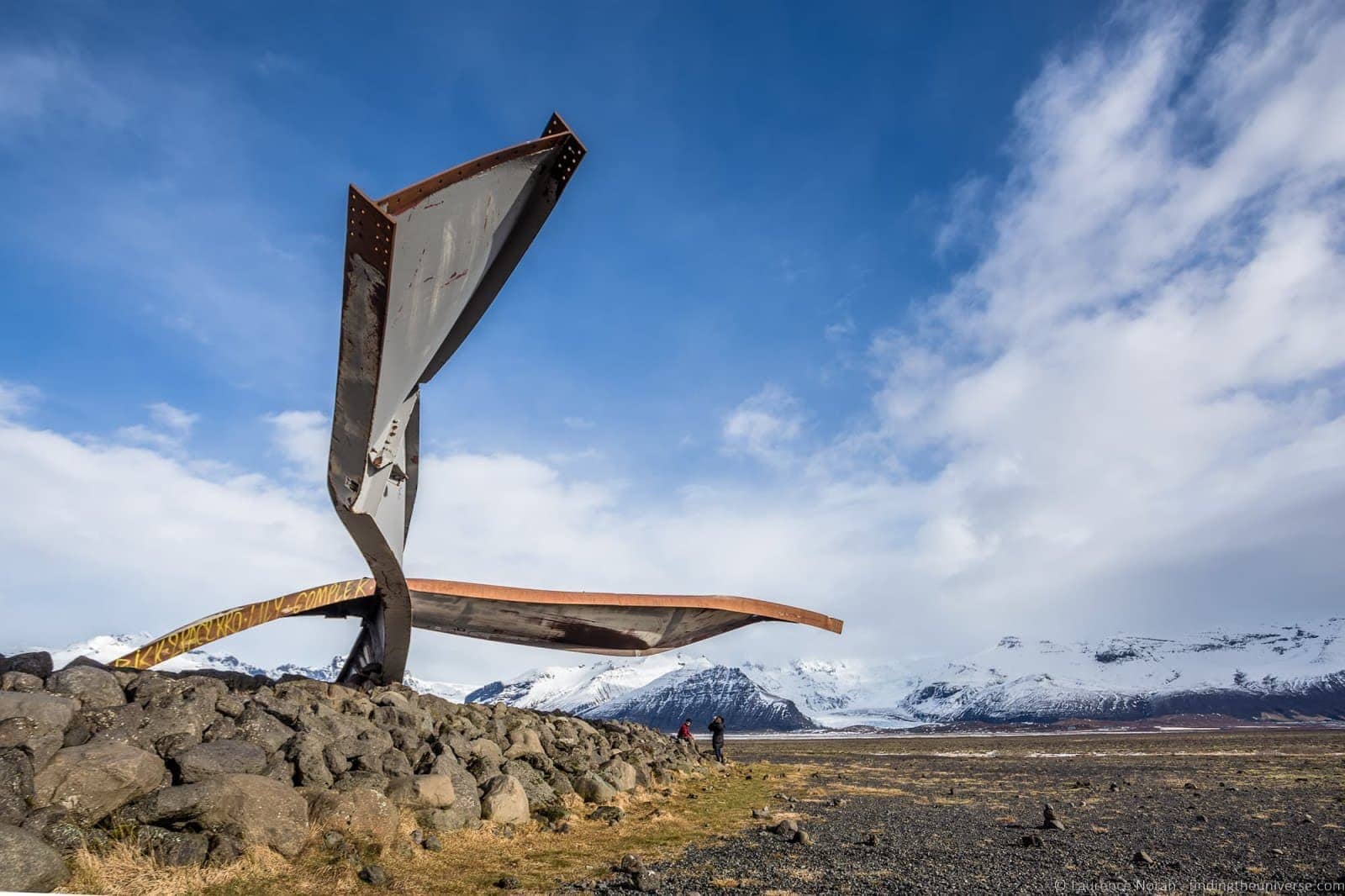
As you head towards the huge glaciers of Vatnajökull National Park you’ll cross the plain of Skeiðarár Sandur, a wide stretch of black volcanic sand where the run-off from the Skeiðarárjökull glacier runs.
In 1996, the Vatnajökull volcano exploded in spectacular fashion, causing a huge glacial flood complete with house sized icebergs. No engineer on earth had foreseen the scale of the flood, and chunks of the ring road were just washed away, including what was then the longest bridge span in Iceland – the Skeiðará Bridge.
I’m telling you all this so you can appreciate the photography opportunity that is the twisted remains of two girders from this bridge, which have been placed together as a monument to the power of nature.
21. Sólheimasandur Plane Wreck
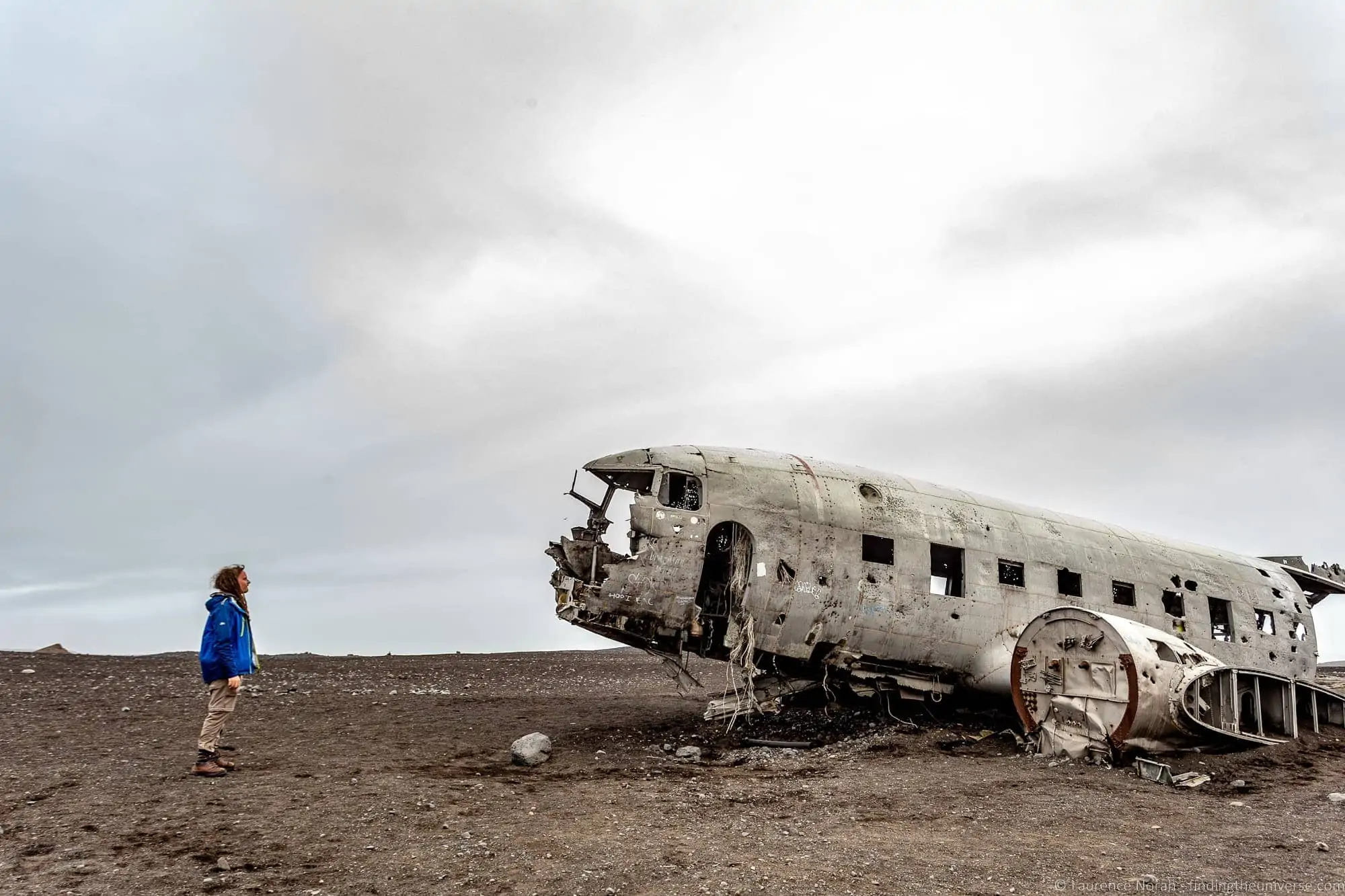
The wreck of a US Navy DC-3 on the black sand plain of Sólheimasandur has become one of Iceland’s most photographed subjects. The contrast of the silver fuselage against the endless black sand is unlike anything else I’ve shot.
I’ll be honest though: this is primarily a photography location, and for many visitors the reality of a 2-hour round trip walk across flat, featureless terrain to see a stripped-out fuselage may not be the best use of limited time. There’s now a daily shuttle bus that makes it much more practical if you don’t want to walk. The plane has also deteriorated over the years from weather and visitor damage, though a second DC-3 was added to the site in 2025.
If you do visit, come early or late for the best light and fewer people. A wide angle lens works well to capture the plane against the vast landscape, and a tripod with an ND filter can help you do long exposures to remove people from the shot. For help choosing one, see our travel ND filter guide. Parking is 750 ISK via the Parka app. For the full guide including shuttle details, parking, and whether it’s worth the trip, see our complete guide to visiting the Iceland plane wreck.
22. Svartifoss Waterfall
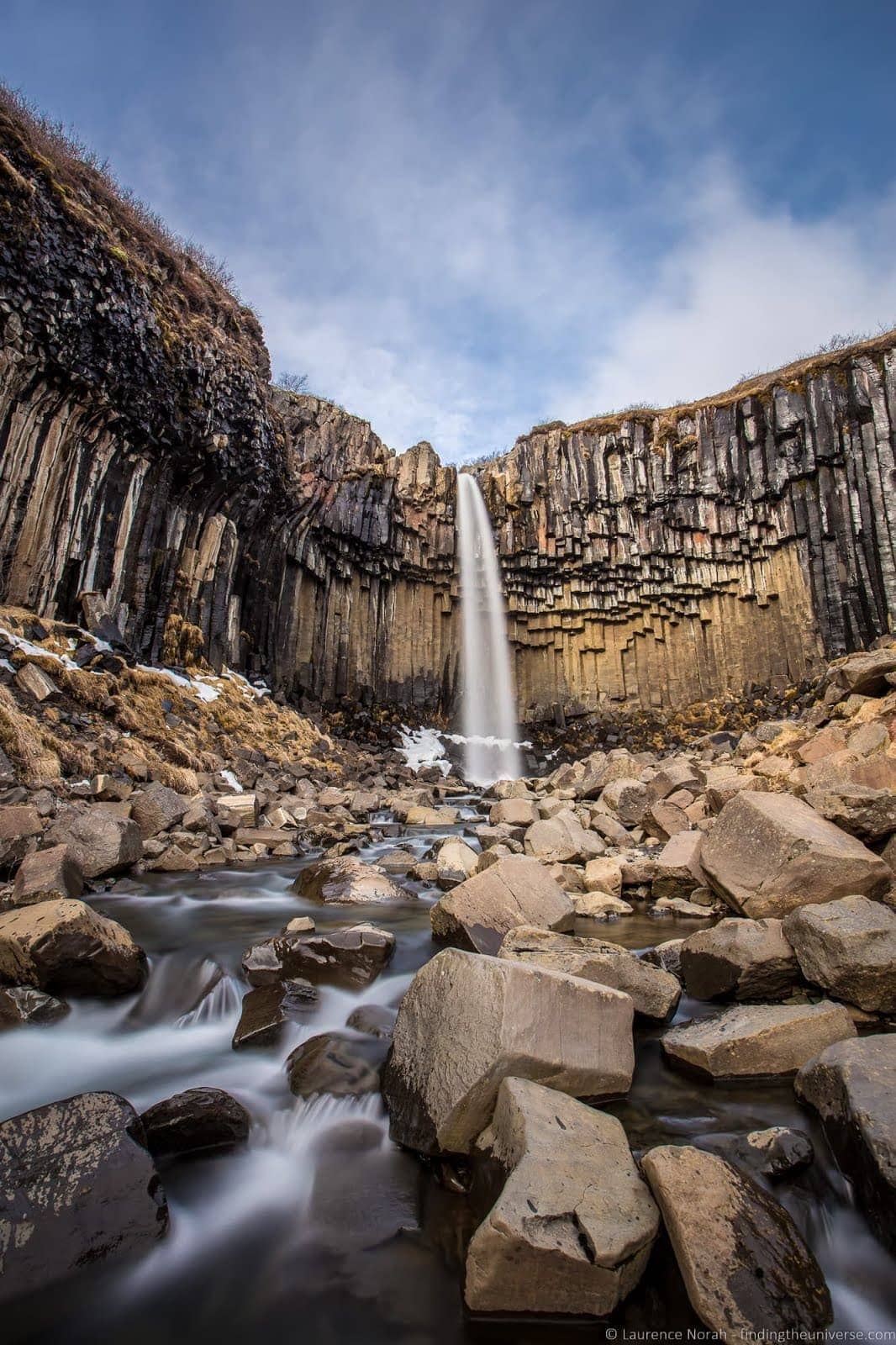
Ok, that was a long enough break from waterfalls, right? The next stop on our photography tour of Iceland is Svartifoss, or the Black Falls.
Found in Vatnajökull National Park, these falls are named for the dark lava columns which surround them, giving them a fairly unique look of all the falls in Iceland, which warrants their inclusion on this list.
It’s about a forty-five minute largely uphill walk to these falls from the visitor centre, and you can either choose to view them from a viewing point a few hundred metres back, or you can get pretty close.
We did both, and personally I preferred the up close shots. Like many of Iceland’s attractions, this is a popular stop for independent travellers and group tours, so you may need to exercise a little patience to get the shot you want.
Parking at the Skaftafell visitor centre is 1,040 ISK via the Parka app. If you also visit Jökulsárlón the same day, you get a 50% discount on one of the two fees. There’s information on additional hiking trails at the visitor centre, plus sandwiches and snacks for energy before the walk.
23. Svínafellsjökull
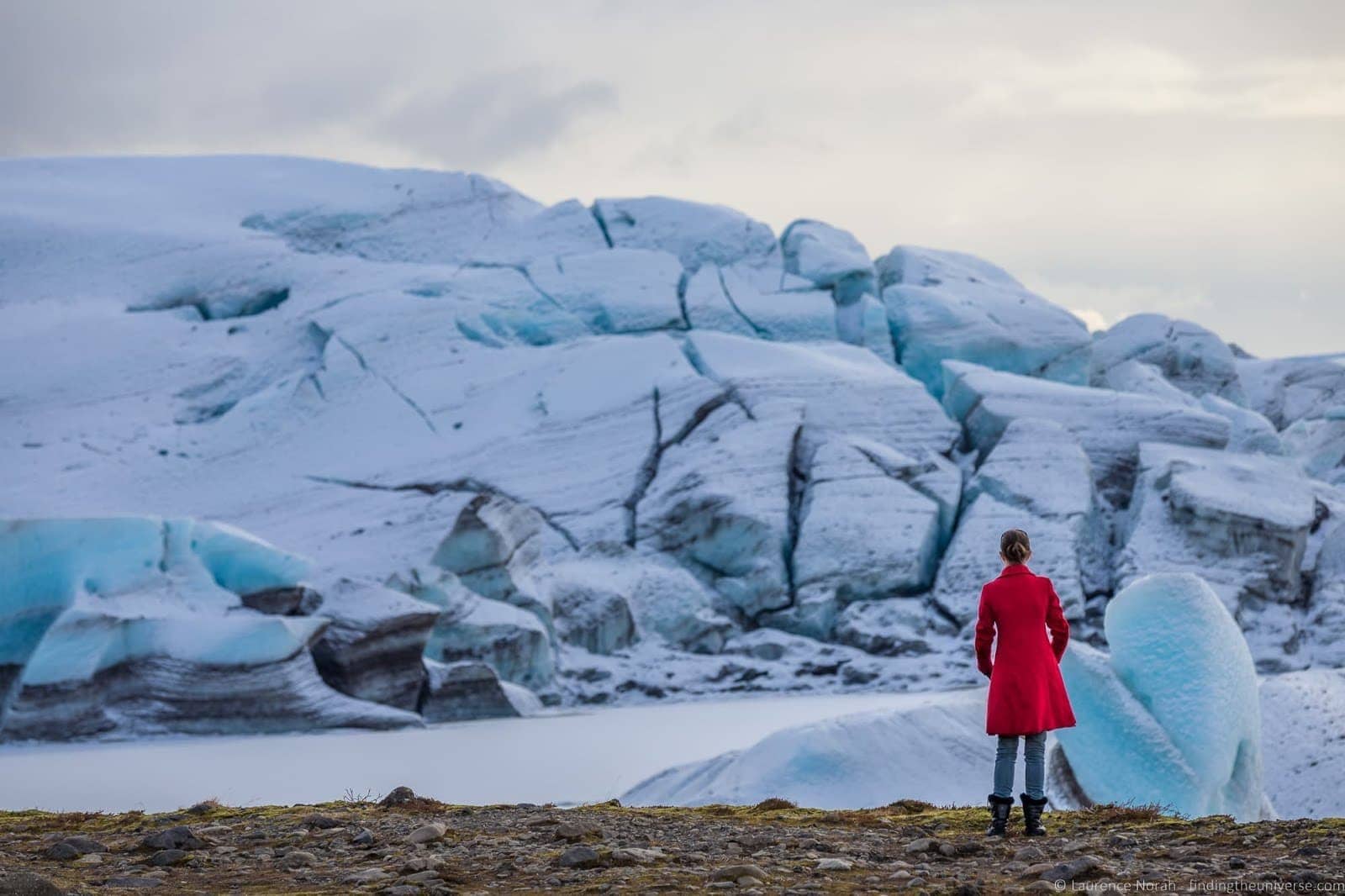
An outcrop of the massive Vatnajökull glacier, Svínafellsjökull is a relatively easy glacier to visit and get close to, letting you get some great up close shots of a glacier.
There’s about a two mile dirt road to access the parking lot, from where a short five minute walk will have you gaping at giant chunks of blue hued ice.
The path continues along the side of the glacier, and you can explore at your leisure. We would however advise against trying to get onto the glacier itself unless you’re on a dedicated tour with the correct equipment – glaciers are somewhat treacherous environments!
Last time we checked parking was free here, but check for parking fees on arrival as this may change.
24. Fjaðrárgljúfur Canyon
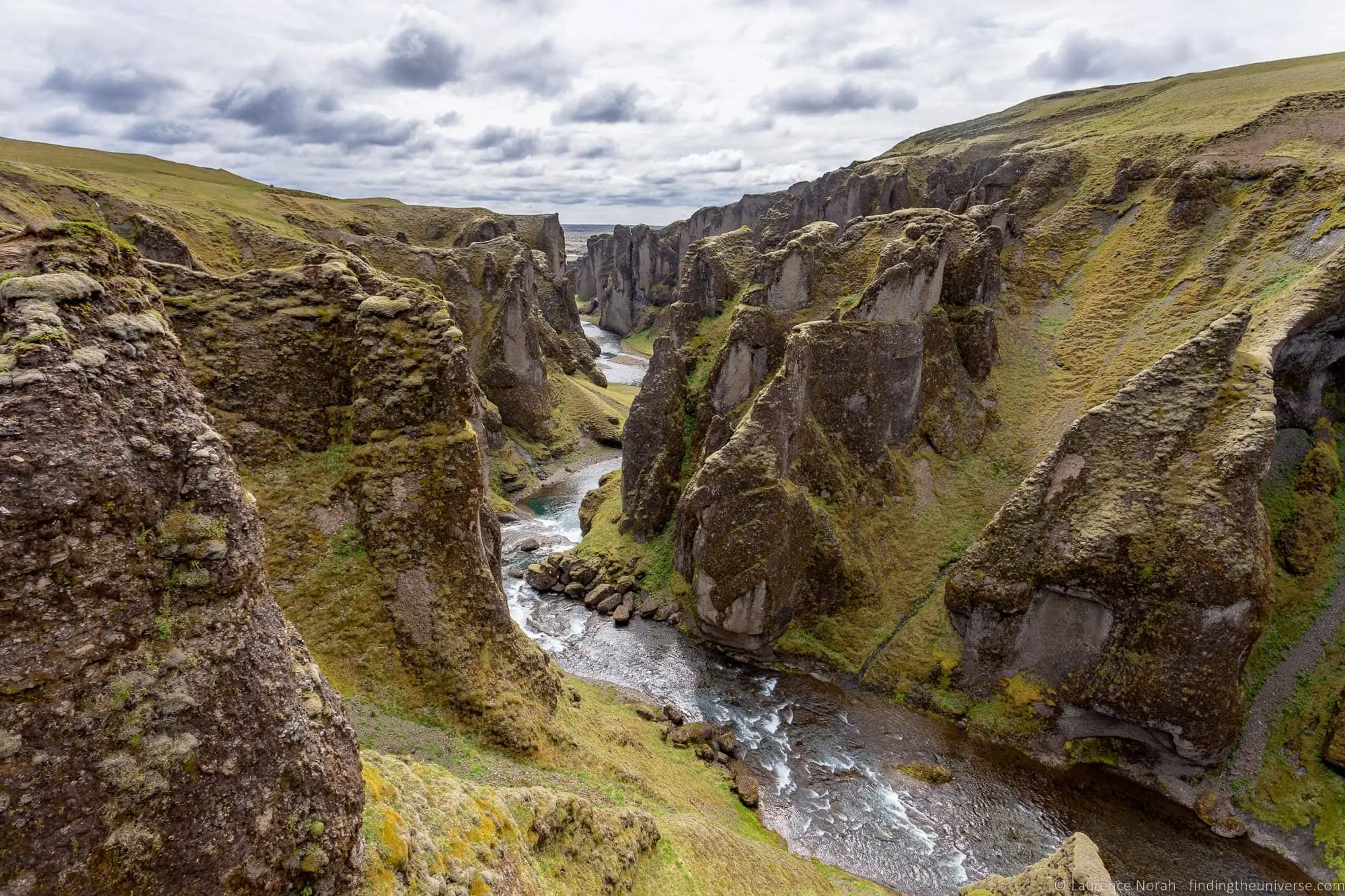
This 100 metre deep canyon, carved out by glacial rivers over thousands of years, is one of the more dramatic landscapes on the south coast. There’s a walking path along the rim with several viewpoints, and the winding turquoise river at the bottom makes for great compositions from above.
Fjaðrárgljúfur is just off Route 1, about 7 km west of Kirkjubæjarklaustur. The walk along the rim takes around 30 to 45 minutes if you visit all the viewpoints, and it’s not particularly strenuous. The most photogenic viewpoints are towards the far end of the trail, so make sure you walk the full length if you can.
Parking is 1,000 ISK via the Parka app. Note that the trail can be closed in winter or when conditions are wet, to protect the fragile vegetation.
25. Jökulsárlón Lagoon
At the far end of our adventure along Route 1 you will come to the amazing Jökulsárlón Lagoon. This is a glacial lagoon, formed as the Breiðamerkurjökull glacier started to melt. It’s now the deepest lake in Iceland, and is full of gorgeous blue toned icebergs, which are the main attraction.
It’s wonderful to just wander along the shore of the lake here and find yourself some beautiful spots for photography, watching the icebergs slowly drift around the lake with the winds and the tide. There are also sometimes seals in the lagoon, as well as birdlife. Like Diamond Beach below, and many of Iceland’s other attractions, this is a fantastic spot at both sunrise and sunset.
Parking is 1,000 ISK via the Parka app, and the lagoon is a few metres walk from the car park, from where you can wander as far as you like. At some times of the year you can also take boat tours on the lagoon, depending on how much ice there is.
26. Diamond Beach
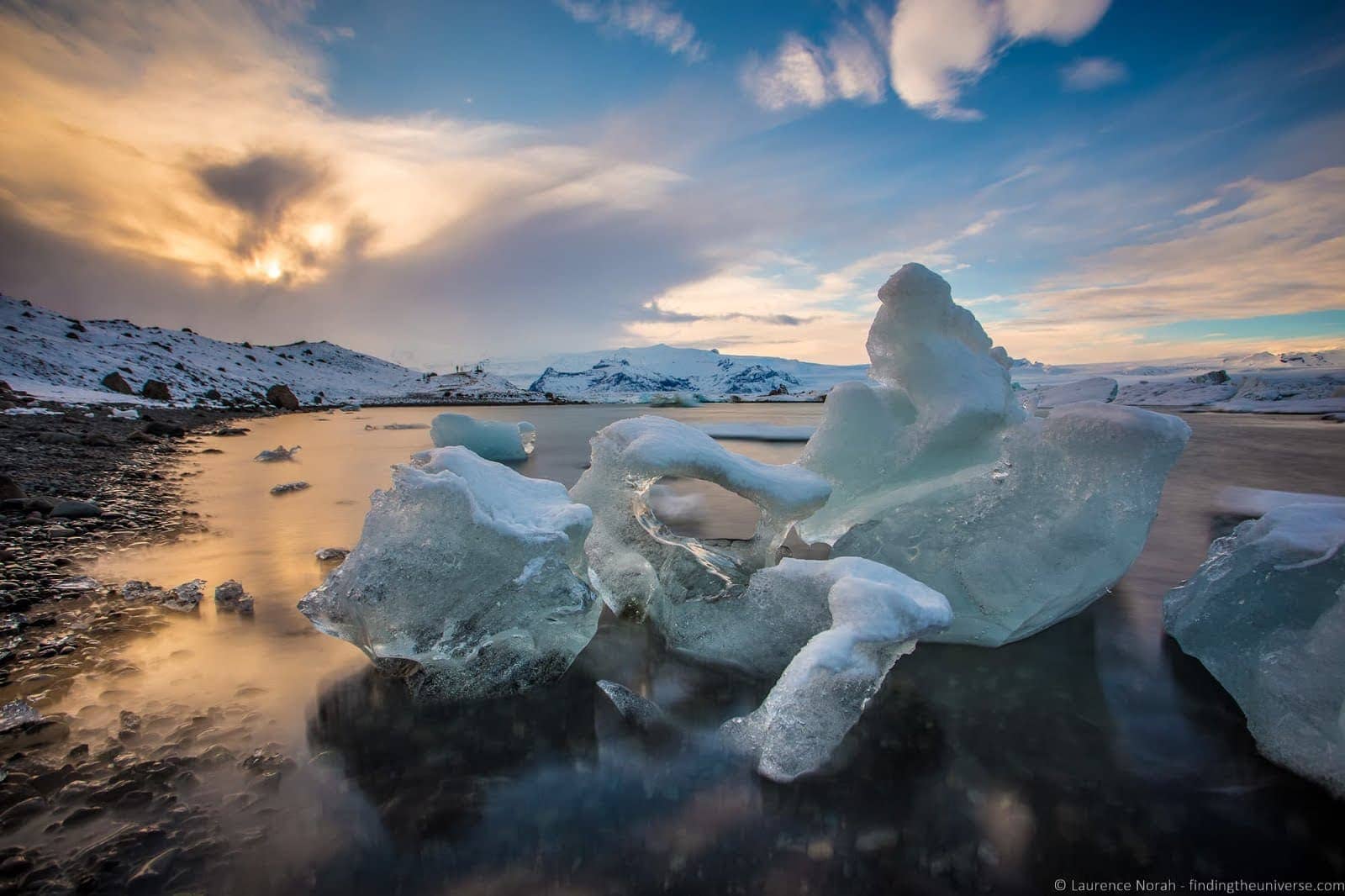
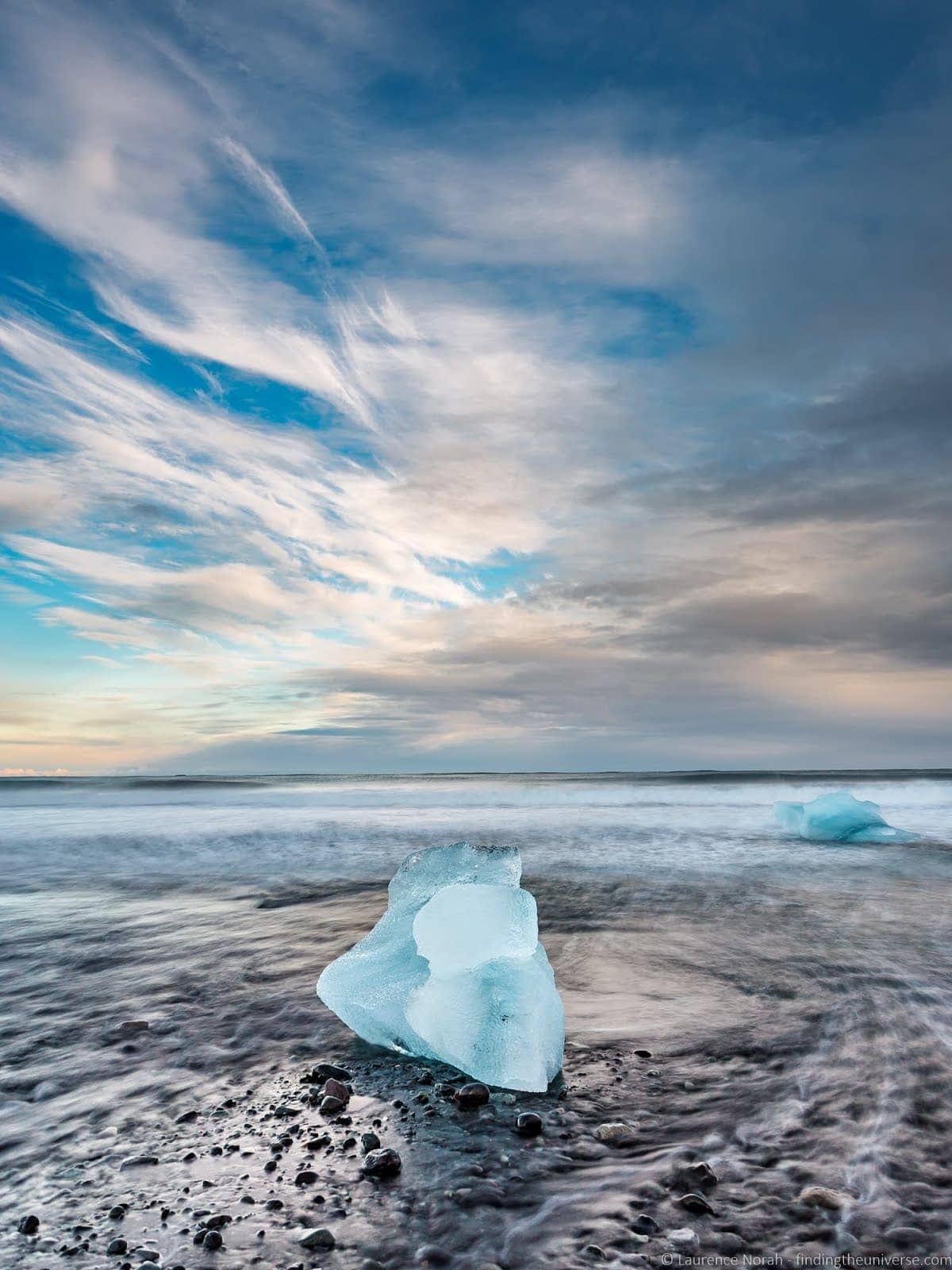
Right next to the Jökulsárlón Lagoon is the Diamond Beach. This is a truly epic photography location, definitely one of my favourite spots in Iceland. As the icebergs in the lagoon melt, they drift out to sea, with many then washing up on the shore. I’ve never seen so much ice on a beach, and the colours and patterns are just fantastic.
This is a magnificent place for both sunset and sunrise, as the light works its magic through the ice. I’m also told this is one of the best spots in Iceland for viewing the aurora, although we weren’t lucky enough to see them on our visit. Still, I can only imagine what that must be like.
Definitely expect to spend some time here shooting the icebergs on the beach, and I’d recommend both a tripod and a Neutral Density filter to get the best results from your photos. Enjoy!
Parking is 1,000 ISK via the Parka app.
Worth the Detour: Vestrahorn and Stokksnes
If you’re continuing east beyond the glacier lagoon, or have an extra day on your itinerary, Vestrahorn is worth the drive. This dramatic mountain on the Stokksnes headland has become one of Iceland’s most iconic photography subjects, particularly the view across the black sand dunes with the mountain reflected in the shallow water.
I have to be honest: I’ve been to Vestrahorn multiple times and every single time the weather has been terrible. I still don’t have a good photo of it, which is frustrating but also a reality of photography in Iceland. The weather does what it wants, and sometimes you just have to accept that and come back another time.
If you get lucky with clear skies, particularly at sunrise or sunset, the compositions here are spectacular. There’s an access fee to drive onto the Stokksnes headland (payable at the nearby Viking Cafe), and it’s about a 30 minute drive east of Jökulsárlón.
If You Have More Time: Studlagil Canyon
Studlagil Canyon in east Iceland has become increasingly popular with photographers in recent years, and with good reason. The hexagonal basalt columns lining a canyon with a blue glacial river running through it make for an incredible shot.
It’s well outside the south and west Iceland focus of this guide, but if you’re driving the full Ring Road and have time, it’s worth the detour. It’s about a 2 hour drive north of the Ring Road from the east coast. Check road conditions in advance, as access can be limited outside of summer.
Getting Around Iceland for Photography
For photography, a hire car is by far the best option. It lets you stop where you want, stay for golden hour, and return to locations at different times of day. We’d recommend a 4×4 if you’re visiting in winter or planning to access any gravel roads. For car hire options, check out Discover Cars.
If you prefer not to drive, there are day tours from Reykjavik that cover many of these locations, though you’ll have less flexibility with timing. See our guides to day trips from Reykjavik and guided group tours of Iceland for options.
For detailed planning advice including budgeting, accommodation, and when to visit, see our comprehensive guide to planning a trip to Iceland.
Where to Stay in Iceland
Accommodation in Iceland is expensive but there are options across all budgets, from hostels and guesthouses to hotels. For the south coast, I’d recommend splitting your stay between a base near Vik and another near the glacier lagoon area, which gives you the best access to early and late light at the key locations. We cover accommodation recommendations in detail in our 5 day itinerary and Ring Road itinerary.
When to Visit Iceland for Photography
For the locations in this guide, summer (June to August) gives you the longest days, green landscapes, and midnight sun opportunities. It’s also the busiest time, which means more people in your shots. The shoulder months of May and September offer a good balance of light and fewer crowds.
Winter (October to March) brings shorter days but dramatic light, the chance of northern lights, and snow-covered landscapes that completely change the look of these locations. Many of the waterfalls look completely different when surrounded by ice. The trade-off is that some locations become harder to access, weather can be severe, and you’ll have far fewer hours of shooting light.
I’ve photographed Iceland in both seasons and both have their advantages. For a first trip focused on the locations in this guide, I’d recommend summer. Our summer packing list goes into keeping a camera working through the rain that comes with it. For more on seasonal planning, see our Iceland planning guide. If you visit in winter, our winter packing list and cold weather photography tips will help you prepare.
Quick Tips for Photographers in Iceland
A few practical notes that are particularly relevant for photographers visiting Iceland:
- Many popular locations now charge parking fees (typically 750 to 1,040 ISK). Download the Parka app before your trip as it covers most sites. A few locations use checkit.is or card machines instead.
- You’ll need mobile data for parking payments and weather checking. We’d recommend getting an eSIM before you arrive. See our Airalo eSIM review for our recommendation.
- Weather changes fast. Check vedur.is for forecasts and SafeTravel.is for road and safety conditions before heading out each day.
- As of 2026, car rental companies add a per-kilometre road tax of 6.95 ISK/km to your final bill. Budget for this alongside fuel costs.
- Waterproof everything. Rain and spray from waterfalls are constant. I’d recommend dedicated camera rain covers rather than just a zip-lock bag (I learned this the hard way in Iceland).
- Credit cards are accepted everywhere. You rarely need cash.
Want to Take Better Photos?
I’ve been teaching an online travel photography course since 2016, and over 2,500 students have taken it so far. It covers everything from how your camera works through to composition, light, and editing, with feedback from me as you go. One payment, lifetime access.
Further Reading for Your Visit to Iceland
We’ll be writing a lot more about Iceland across our two blogs in the coming months, so this list will be updated as we go. In the meantime, here are some great resources to get you started with planning your trip.
- Jess has put together a detailed post outlining a 7 day winter Iceland itinerary to give you some route ideas. We also have a detailed five day Iceland itinerary if you have a little less time and a complete Iceland ring road itinerary.
- I’ve put together a post on planning your Iceland trip, to help you get the most from your visit.
- If you’re visiting Iceland in Winter, check out our guide to the best winter activities in Iceland, as well as our guide to driving in Iceland in Winter
- We have detailed packing guides for what to pack for Iceland in summer and what to pack in winter
- On a budget? Here’s a guide to visiting Iceland on a budget to help you make the most of your trip
- If you want to base yourself in Reykjavik, we’ve put together a list of the best day trips from Reykjavik, which will get you to the majority of the locations above.
- We’ve also got a guide to some of the best multi-day guided tours of Iceland to give you an idea of what’s available for everything from 2 days two weeks, across a variety of price points
- We have a guide to visiting the Blue Lagoon
- If you’re specifically looking to photograph the northern lights, check out my guide to how to photograph the northern lights
- The weather in Iceland can be fickle – the best website for real-time cloud cover is this one from the Icelandic Met Office.
- We have a complete guide to visiting the Golden Circle, which has a map, suggested itinerary, and more.
- Whilst Iceland is a safe country to travel in when it comes to things like crime, the country itself is home to extreme conditions and all sorts of seismic activity. So to stay safe as you go, check out the safetravel Iceland page
- If you’re not sure what camera gear to take with, take a look at both our guide to picking a travel camera, and our personal travel photography gear
- Finally, if you’re visiting in winter, you’ll want to read through my tips for cold weather photography.
And that finishes up my guide to some of the best photography locations in Iceland! I hope you enjoyed it. Is Iceland on your list? Let us know in the comments below!
Frequently Asked Questions About Photography in Iceland
What is the best time of year for photography in Iceland?
Summer (June to August) gives you the longest days and green landscapes, plus midnight sun opportunities. Winter (October to March) brings dramatic light, northern lights, and snow-covered scenery but shorter days and tougher conditions. Both are excellent for photography. For a first trip focused on the south coast, I’d recommend summer.
Do you need a 4×4 for photography locations in Iceland?
For the locations in this guide, most are accessible by regular car in summer. A 4×4 is useful for gravel roads and strongly recommended in winter when roads can be icy. If you’re planning to visit highland locations like Landmannalaugar, a 4×4 is required.
Are there parking fees at photography locations in Iceland?
Yes, most popular stops now charge parking fees, typically 750 to 1,040 ISK. Download the Parka app before your trip as it covers most sites. A few locations like Thingvellir and Seljalandsfoss use card machines or checkit.is instead. Gullfoss and Kirkjufell are still free.
What camera gear should I bring to Iceland?
A wide angle lens is the most useful for Iceland’s landscapes. I’d also recommend a tripod, neutral density filters for long exposure waterfall shots, and waterproof covers for your camera. Rain and spray from waterfalls can be very persistent. If you plan to shoot puffins, a good telephoto lens is also recommended. See our photography gear list for what we use.
What are the best photography spots on Iceland’s south coast?
The south coast from Seljalandsfoss to Jökulsárlón has the highest concentration of great photography locations in Iceland. The top spots include Skogafoss, Reynisfjara black sand beach, Svartifoss, the Jökulsárlón glacier lagoon, and Diamond Beach. All are accessible from Route 1 and could be covered in 3 to 5 days of driving.
Lars Roes says
Hi Noah – really informative post and I enjoyed your breakdown on photography locations. Your shots look great! We are off to Iceland for 2 weeks this September and would like to know what you recommend for a suitable neutral density filter – 3 stops? I have a drone that would like to get some air but I read that opportunities are very much restricted and I can understand why being such a popular tourist destination. Can you shed any light on this?
Thanks,
Lars
Laurence Norah says
Thanks Lars! So for waterfall photography in daylight I usually use a 10 stop filter on my camera, which is a full frame Canon. I would definitely suggest something between 6 stops and 10 stops. I have a full guide to ND filters here, which explains why 🙂
For drones – many of the very popular locations do have signs up forbidding drones – this is just for safety I believe. Drones are generally allowed in Iceland (although you’ll want to read up on specific rules). However, as you get away from the bigger sights, particularly the large waterfalls on the south coast, you will see less signs forbidding drones, so you should be fine 🙂
JohnB says
Experts say the equinoxes have the best Northern Lights. If one went in Sept, that could easily cover that date. Many vloggers do the Ring Rd in Nov. and most show the Lights. What were the dates of your trip or trips?
Laurence Norah says
Hi John,
We’ve travelled in Iceland in late February, when there was definitely northern light activity, and then in June, when it was light nearly all the time.
The lights may be viewable in September, you just need to be aware that the days are still long in September so it won’t be truly dark until much later than in the winter months, which reduces the viewable time.
eileen says
Thanks for the guidance. it will come in handy as i will be travelling to Iceland next January 19.
do you know where is the place where i can find the bridge which look like a sword? very beautiful place.Would like to visit the place.
Saw a photo posted by someone in the instagram.
Please advise.
thanks
Laurence Norah says
Hi Eileen – my pleasure!
We’re just back from four weeks travelling around Iceland and I have to admit I’m not familiar with the bridge you mean – can you share the photo so I have an idea of what it might be?
Thanks!
drew says
This post is so awesome.
We are driving ourselves and will likely be getting a zero deductible insurance from the rental agency.
Question: Do we need a 4×4 in late January?
Thanks again!
Laurence Norah says
Hey Drew!
Thanks very much. I’d very much recommend a 4×4 in January, the roads are likely to be icy, and you need to be prepared for them to be closed – definitely check the safetravel.is website for the latest road conditions when you’re out there. Also bear in mind that some of the mountain roads in Iceland (nothing on this post requires mountain road access!) aren’t accessible even with a 4×4 – you need one of the super 4×4 vehicles with massive tyres and high clearance and I’m not sure you can rent those 🙂
We travelled in March and it was snowy and icy. We had a 4×4 saloon car with studded tyres, and it was fine, occasional snow drifts on the road but nothing too serious that careful driving couldn’t cope with 🙂
Have a great trip!
drew says
Thanks! The whole rental car thing is daunting, with the insurances and everything else. It’s stressing me out!
I appreciate your quick reply and thanks for the advice.
Laurence Norah says
My pleasure 🙂 Iceland has an unbelievable number of insurance cover options, my advice is get everything that covers you – assuming you don’t have a travel credit card or something similar that already covers you. In January, driving wind can blow ash / ice over the car and damage the paintwork, and there’s always the risk of window chips. So definitely worth paying for peace of mind I think – car repairs are very expensive in Iceland unfortunately.
Richard Rubicam says
Your photos really entice me to add Iceland to my bucket list but I’d probably have to get a bumper sticker that says, “I’m spending my kid’s inheritance”.
Aaron Teoh says
Stunning pictures of Iceland, feels totally out of this world! I’d definitely love to be back some day. We went in October a few years back and met with bad weather, ending up with our car being blown off the road. Wrecked the car, missed a couple of sights, and now looking at these photos, think I have more than enough reasons to add Iceland to my list! Though unlikely in a car next time 😀 Thanks for sharing these amazing pictures, as usual 🙂
Laurence says
Oh wow, that sounds like quite the experience! At least you were ok. Hopefully you make it back and have a better time on the next adventure!
Aaron Teoh says
Yup glad to make it out fine. I hope so too!