
We love visiting Paris. The city has so much to offer, from iconic sites like the Eiffel Tower, through to world class museums like the Louvre and famous shows like the Moulin Rouge.
Then there are the neighbourhoods to wander, the food, the cafes. The list goes on.
Paris isn’t exactly compact though, so when you visit, you are going to need a plan for how to get around. While you certainly can walk, you will be able to fit more sights in if you take advantage of one of the many transport options available.
Paris transport isn’t complicated once you know the system, but a lot of the advice floating around online is out of date. The system is entirely electronic, there are two different single-ticket types, airport fares work differently, and the pass that most guidebooks recommend is usually the wrong one to buy. Here’s what actually works in 2026, including how to get to and from the airports (the first hurdle most visitors face).
If you just want the short version: buy a Navigo Easy card (€2) at any metro station, load it with individual tickets (€2.55 each for the metro and RER, €2.05 for buses and trams), and you’re good to go. Most visitors will spend €8 to €10 a day on transport this way. Read on for the detail.
This guide accompanies our other Paris content, which includes itineraries for Paris, guides to where to eat in Paris, and many other posts. See more of these in the resources section at the end of the post.
Table of Contents:
Public Transport Zones in Paris
Before jumping into the individual transport options, here’s a quick overview of the zone system in Paris so you have an idea of how this works.
Like many cities, the public transport system in Paris is divided into zones. There are five transport zones, formed as concentric circles. Zone 1 is the inner zone covering the city centre, and the zones radiate outwards to Zone 5.
Zones 1 to 3 cover the majority of the city centre and most attractions that visitors will want to see.
Some locations are outside of zones 1 to 3. Versailles and Orly Airport are in Zone 4. CDG Airport, Disneyland Paris, and Château de Fontainebleau are in Zone 5.
One important thing to know: unlike a city like London, the fare zones in Paris do not affect individual metro ticket pricing. A single metro ticket is good for any journey, regardless of zones covered. The fare zones do apply to RER trains, buses, trams and commuter trains when travelling outside Zone 1.
How to Buy Tickets for Public Transport in Paris
Paris public transport is entirely electronic, so there are no paper tickets.
To use public transport in Paris, you need either a physical Navigo Easy card or a smartphone app.
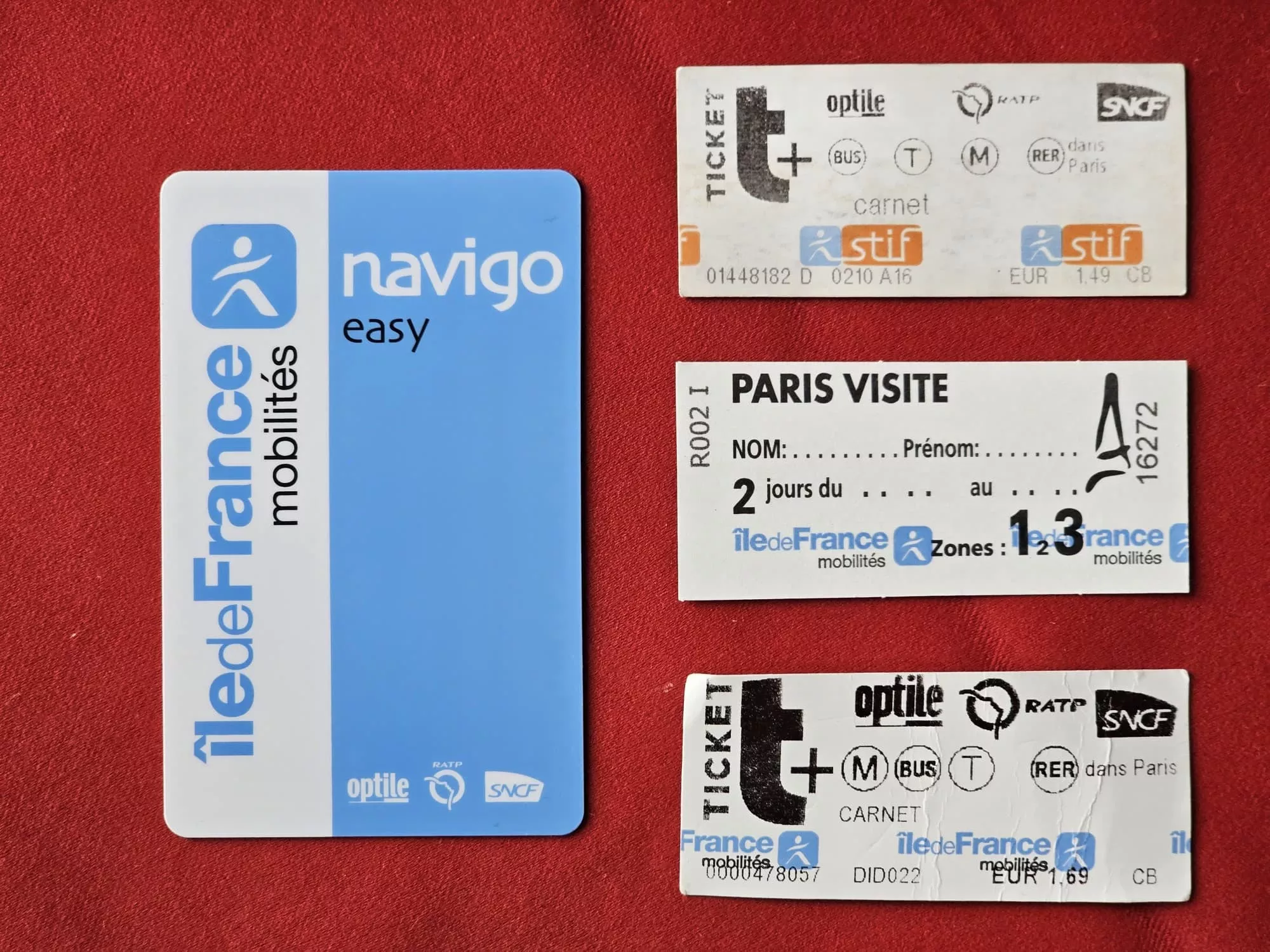
If you have old paper t+ tickets from a previous trip, they are no longer any use. The window to exchange them for electronic versions at RATP and SNCF ticket offices closed on 1 September 2026.
The Navigo Easy Card (Our Recommendation)
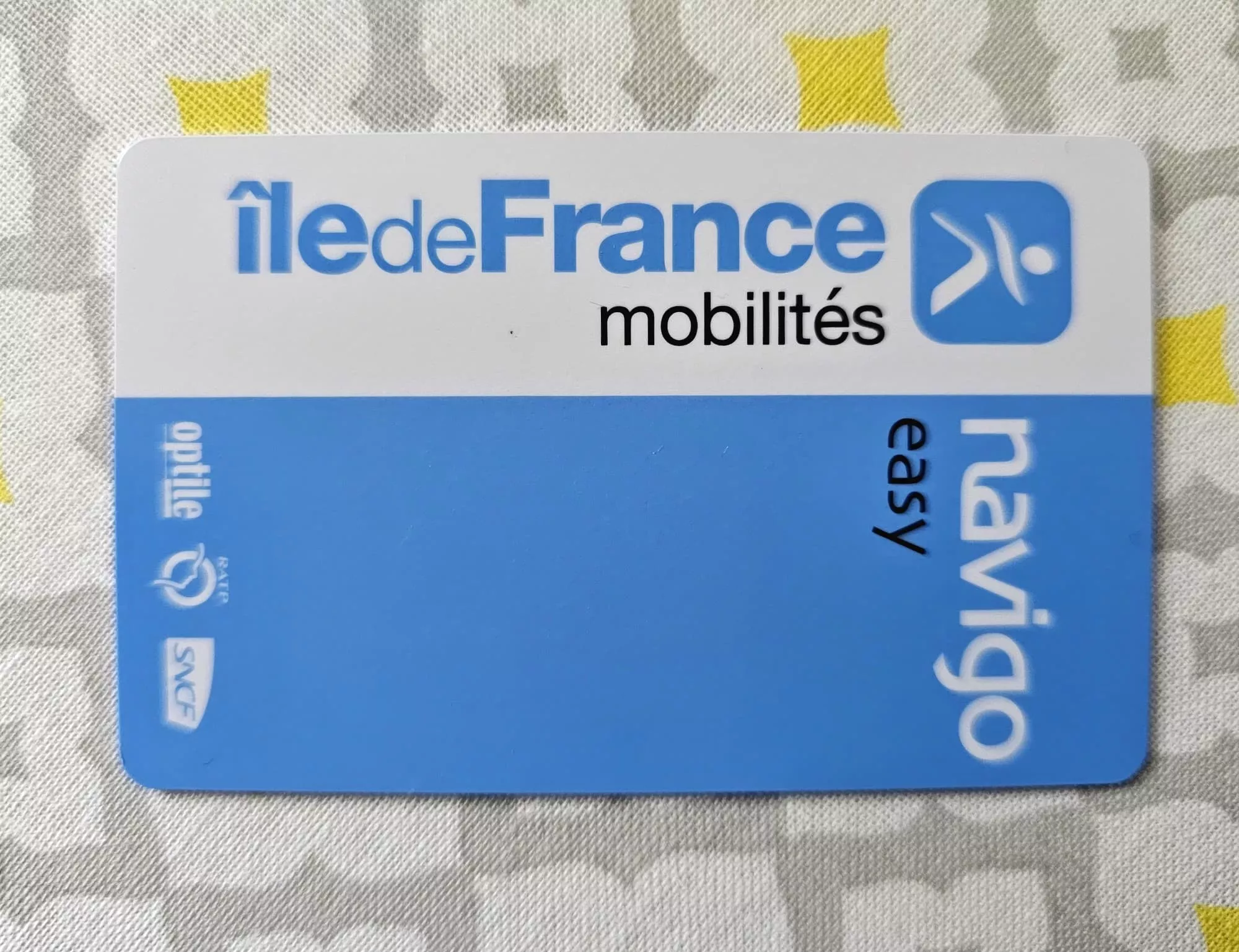
The Navigo Easy card is a small plastic contactless card that you load with tickets. It costs €2 to buy, doesn’t require a photo or registration, and can be purchased at ticket offices and vending machines at metro and RER stations.
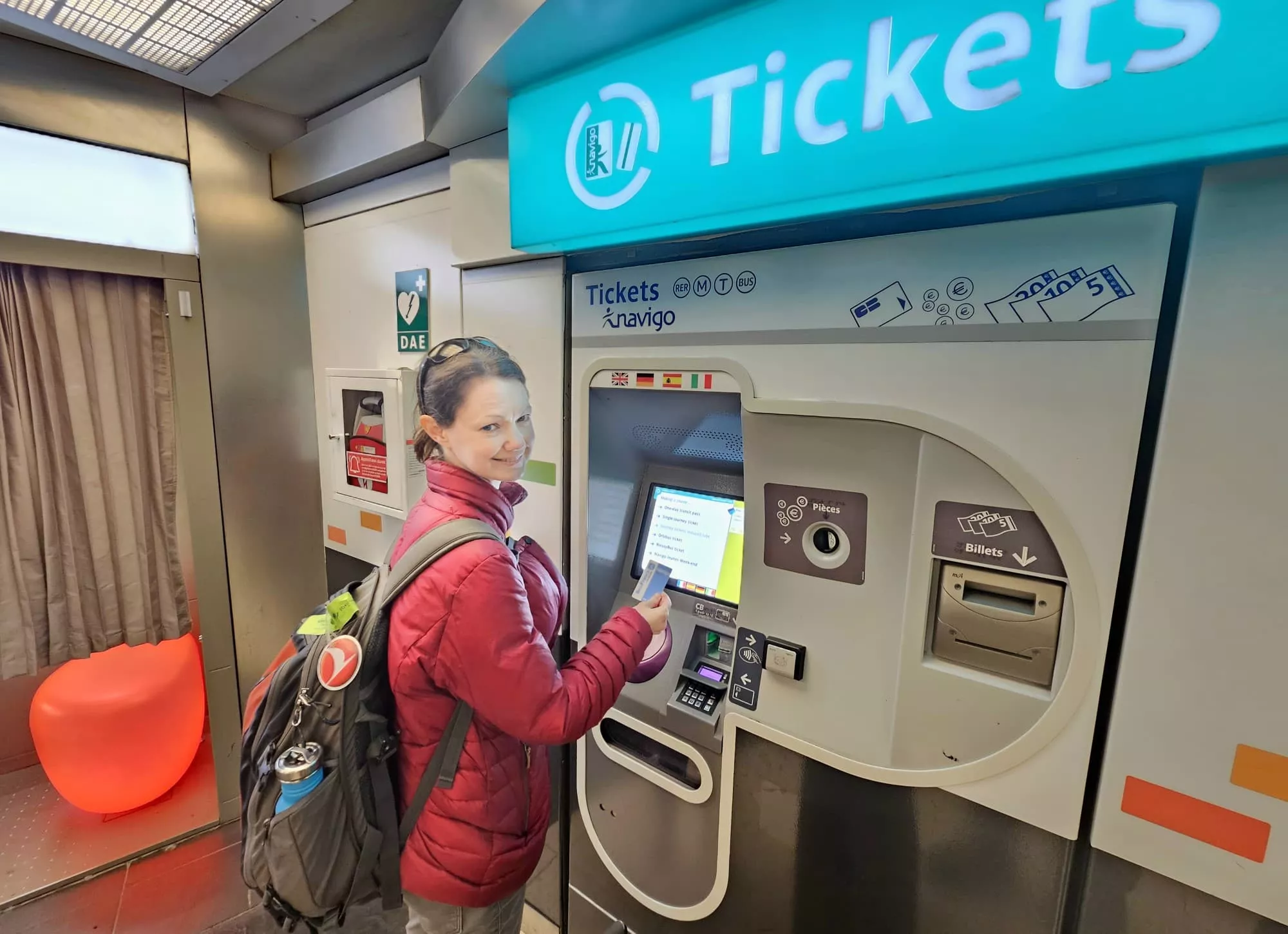
Once you have the card, you load tickets onto it at the vending machines in any station. These machines accept card and cash payments and can be switched to English.
Look for the purple machines marked “Rechargement Navigo” for reloading, or the green-screened machines for both buying new cards and loading tickets.
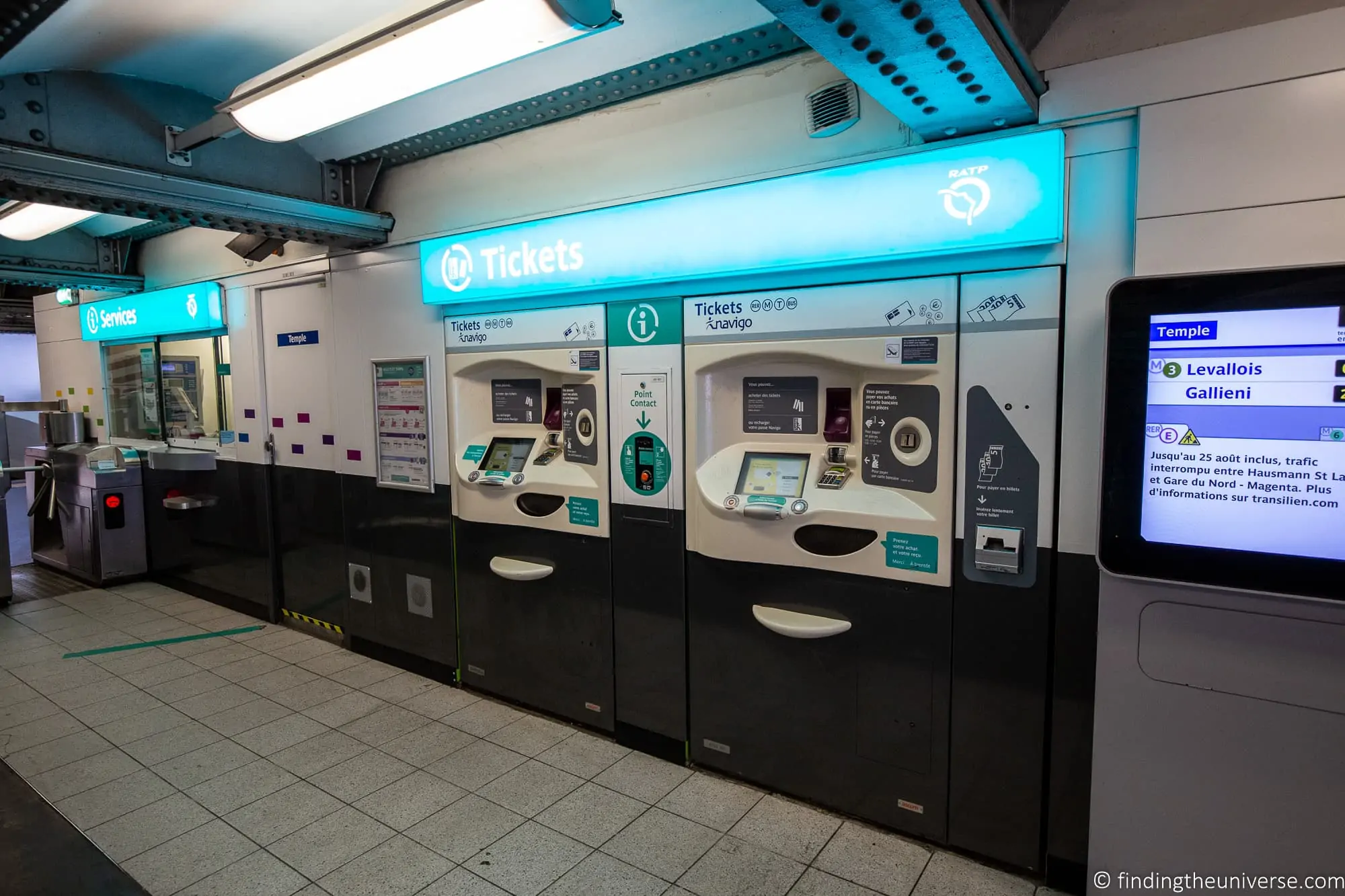
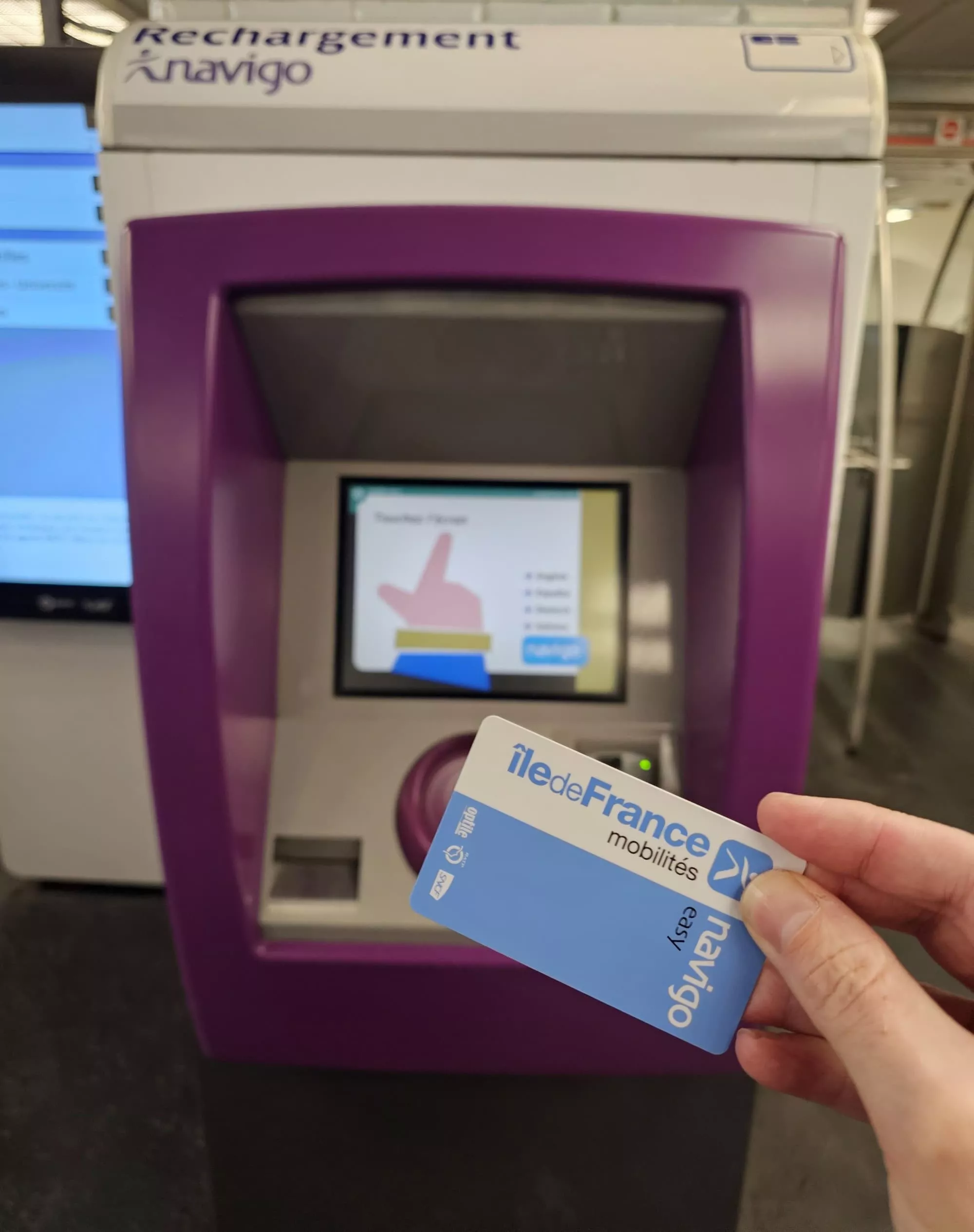
We have used both the physical Navigo Easy card and the RATP smartphone app, and the card is a lot easier to use in our experience. I’m pretty technically savvy (I have a bachelor’s in computer science!) and even I found the app process rather convoluted and confusing. The €2 for the card is well worth it for the simplicity.
That said, if you would prefer to use your smartphone, you can download the Bonjour RATP app. This can be used instead of a Navigo Easy card and saves you the €2 fee. The app is available in English, though you do need a compatible smartphone with NFC. Some users report difficulties getting it to work, particularly with non-European phone numbers. You may also need to install an additional app like Mes Tickets Navigo.
Once you have the Bonjour RATP app up and running, you can preload it with tickets for the same price as preloading a physical Navigo Easy card. The app also includes journey planning and offline mapping, which is handy.
Note that to top up cards and purchase tickets your device will need an internet connection.
Ticket Types and Prices (2026)
This is where it gets a bit confusing, so pay attention. Paris has two separate types of single ticket. You can’t use one in place of the other, and you can’t transfer between the two on the same ticket.
The Metro-Train-RER ticket costs €2.55 for an adult (€1.30 for children aged 4 to 9, free for under 4s). This ticket is valid for:
- A single journey on the metro in any zone, with line changes allowed within 2 hours of validation. You can also transfer to the RER for Zone 1 travel.
- Zone 1 travel on the RER
- A single ride on the Montmartre Funicular
The Bus-Tram ticket costs €2.05 for an adult. This ticket is valid for:
- A bus journey of up to 90 minutes from first to last validation, including bus changes and transfer to the tram
- A tram journey of up to 90 minutes from first to last validation, including changing to another tram
The important thing to understand is that these are separate tickets. If you take the metro to a station and then want to catch a bus, you will need to tap a Metro-Train-RER ticket for the metro and a separate Bus-Tram ticket for the bus. There is no free transfer between the rail and surface networks on single tickets.
You can buy a Bus-Tram ticket when boarding a bus by paying €2.50 in exact change to the driver (the 45c premium over the standard €2.05 fare is essentially a convenience charge for buying on the bus). You can also get a Bus-Tram ticket by texting “Bus” followed by your bus line number to 93100. The SMS you receive is your ticket, which you show to the driver.
Throughout 2026, Paris is rolling out the ability to pay by tapping your Visa or Mastercard directly on buses. This is not yet available on the metro.
There is no volume discount for loading multiple tickets. Ten tickets simply cost 10 × €2.55 = €25.50, and the old discounted carnet (a book of 10) no longer exists in any form.
Passes for Travel in Paris
If you are going to be doing a lot of travelling in a single day, there are pass options that might save you money.
Navigo Jour (1 Day Card) costs €12.30 as of 2026 and covers unlimited travel on metro, RER, bus, tram and funicular across all zones for one calendar day (midnight to midnight, not 24 hours). It can be loaded onto a Navigo Easy card or smartphone app. It breaks even at about 5 metro rides or 6 bus rides, so most visitors following one of our Paris itineraries will find individual tickets cheaper. One important note: the Navigo Jour does not include travel to or from CDG or Orly airports.
Paris Visite Pass is available for 1, 2, 3 or 5 consecutive days and covers unlimited travel across all zones, including airports, Disneyland Paris and Versailles. The 2026 prices are: 1 day €30.60, 2 days €45.40, 3 days €63.80, 5 days €78.00 (children 4 to 9 half price). It must be loaded onto a Navigo Easy card or smartphone app.
To be direct: the Paris Visite pass is poor value for most visitors. A 1-day pass at €30.60 means 12 metro rides to break even. Over 3 days at €63.80, that buys you about 25 individual tickets. Unless you are doing multiple day trips to airports, Versailles and Disneyland, you will spend less buying individual tickets. It also counts calendar days, not 24-hour periods, so activating at 8pm wastes a full day by midnight. If you do buy it, activate it first thing in the morning.
Navigo Week Pass (Navigo Semaine) costs €32.40 as of 2026 and gives unlimited travel on all zones (including airports) from Monday to Sunday. It requires a Navigo Découverte card (€5, requires a passport-sized photo) rather than a Navigo Easy card. It can also be loaded via smartphone.
This is excellent value if your trip lines up with a Monday to Sunday week. It includes CDG and Orly airports, which alone would cost €28 in airport tickets for a return trip. Be aware that as of August 2025, CDG Airport train stations no longer sell Navigo Découverte cards. You’ll need to buy one at a metro station in central Paris, or use the smartphone app.
There is also the Navigo Liberté+, a pay-as-you-go option that charges €2.04 per metro ride and €1.64 per bus ride (a 20% discount over standard tickets), with a daily cap of €12.30. You are charged at the end of each month. It requires a French bank account or a European mobile phone number to set up, so it won’t be practical for most short-term visitors from outside France.
Our Recommendation
For most visitors to Paris, our recommendation is simple. Buy a Navigo Easy card (€2) at any metro station when you arrive. Load it with Metro-Train-RER tickets (€2.55 each) and Bus-Tram tickets (€2.05 each) as you need them. If you know you’ll have a day of heavy transport use (5+ metro rides), load a Navigo Jour day pass (€12.30) for that day instead.
If your trip aligns with a Monday to Sunday week and you plan to visit locations outside central Paris (Versailles, airports, Disneyland), look at the Navigo Week pass (€32.40 + €5 for the Découverte card). At €37.40 total, it’s a bargain for a full week of unlimited travel including airport transfers.
Skip the Paris Visite pass unless you have a very specific reason to buy it. The maths rarely works out in your favour.
Tickets for Airport Travel
If you plan to travel to or from CDG or Orly airports by public transport, you will need a separate Paris Region Airports ticket costing €14. This ticket is valid on the RER B to CDG and on Metro Line 14 to Orly. It can be loaded onto a Navigo Easy card.
One thing to note: loading a Paris Region Airports ticket and standard Metro-Train-RER tickets on the same Navigo Easy card at the same time has been reported to cause issues. If this happens to you, the suggested workaround is to use a second Navigo Easy card (another €2) or use the smartphone app for one type and the card for the other.
All Paris Visite passes (1 to 5 days) include airport travel and cover all zones. The Navigo Week pass also includes airport travel.
How To Get Around Paris
There are many options for getting around Paris. Below I’ll go through each of these so you can pick the right one for your needs.
The public transport options (metro, bus, RER, tram) are all operated by RATP, and you can find full fare information and schedules on the RATP website.
Metro
The Paris Metro is our preferred way to get around central Paris. It’s fast, affordable, runs frequently, and covers the majority of the attractions you’ll want to visit.
The metro system has 16 lines and 308 stations, primarily covering transport zones 1 and 2. Wherever you are in central Paris, you shouldn’t be too far from a metro stop.

Each line has a number (1 to 14, plus 3bis and 7bis) and its own colour. The entrance to each station will usually have signs showing which lines it serves, with the line number in a circle matching its colour.
When you enter a station, you need to know which direction to travel. This is indicated by the station at the end of the line. So you need to know which end of the line you want to head towards.
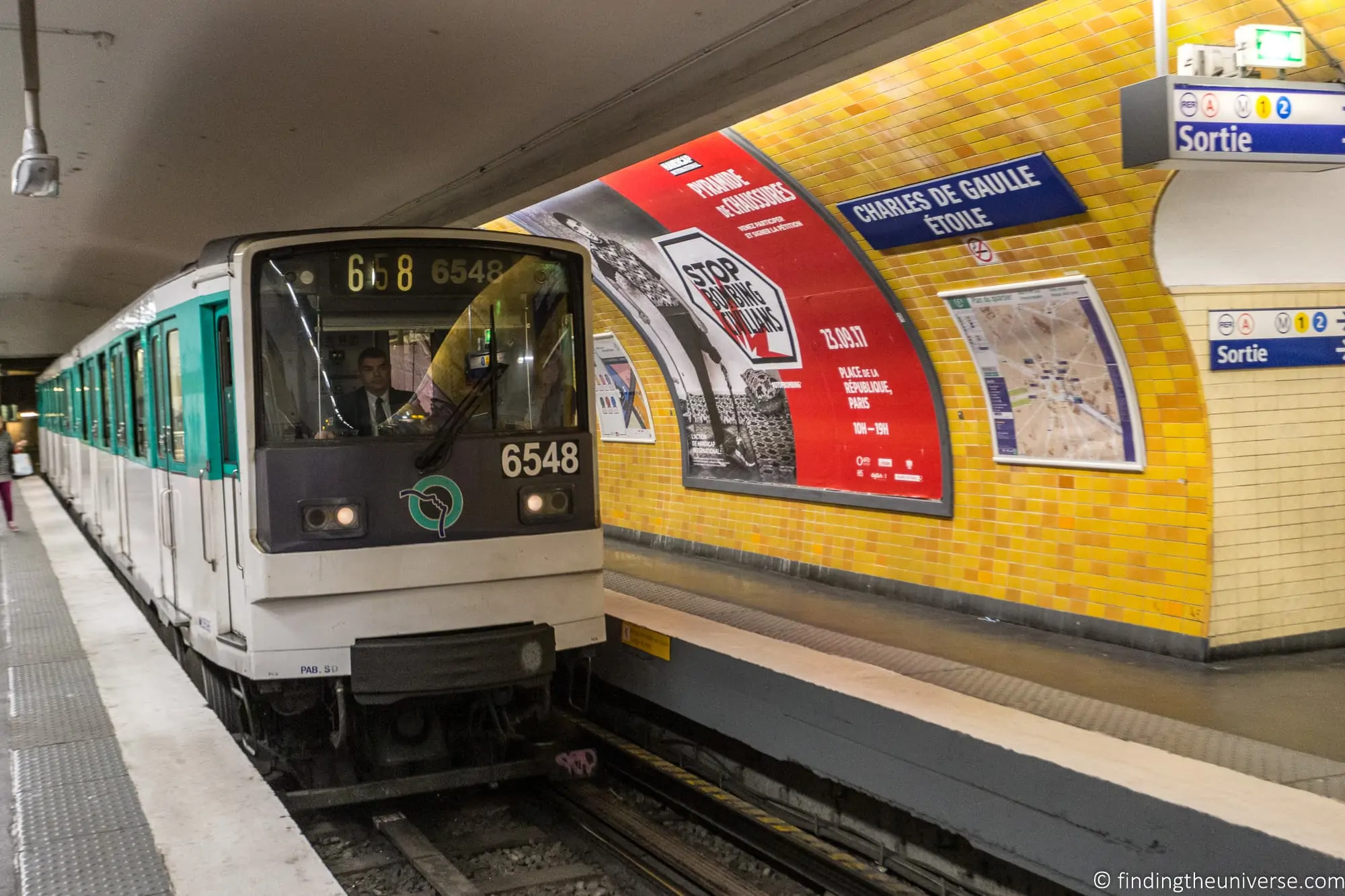
For example, to travel from the Arc de Triomphe to the Louvre, you would take metro Line 1 (yellow). You’d enter at Charles de Gaulle – Étoile station and follow signs for Line 1, direction Château de Vincennes (the eastern end of the line).
To enter the platform, tap your Navigo Easy card on the turnstile reader. Keep your card or ticket until you exit the station. Inspectors can check anywhere in the system, and fines for not having a valid ticket typically start at around €35 to €50 if you pay on the spot, and can go significantly higher if you delay payment. RATP announced fines could rise to as much as €120 in 2025, so it’s not a risk worth taking.
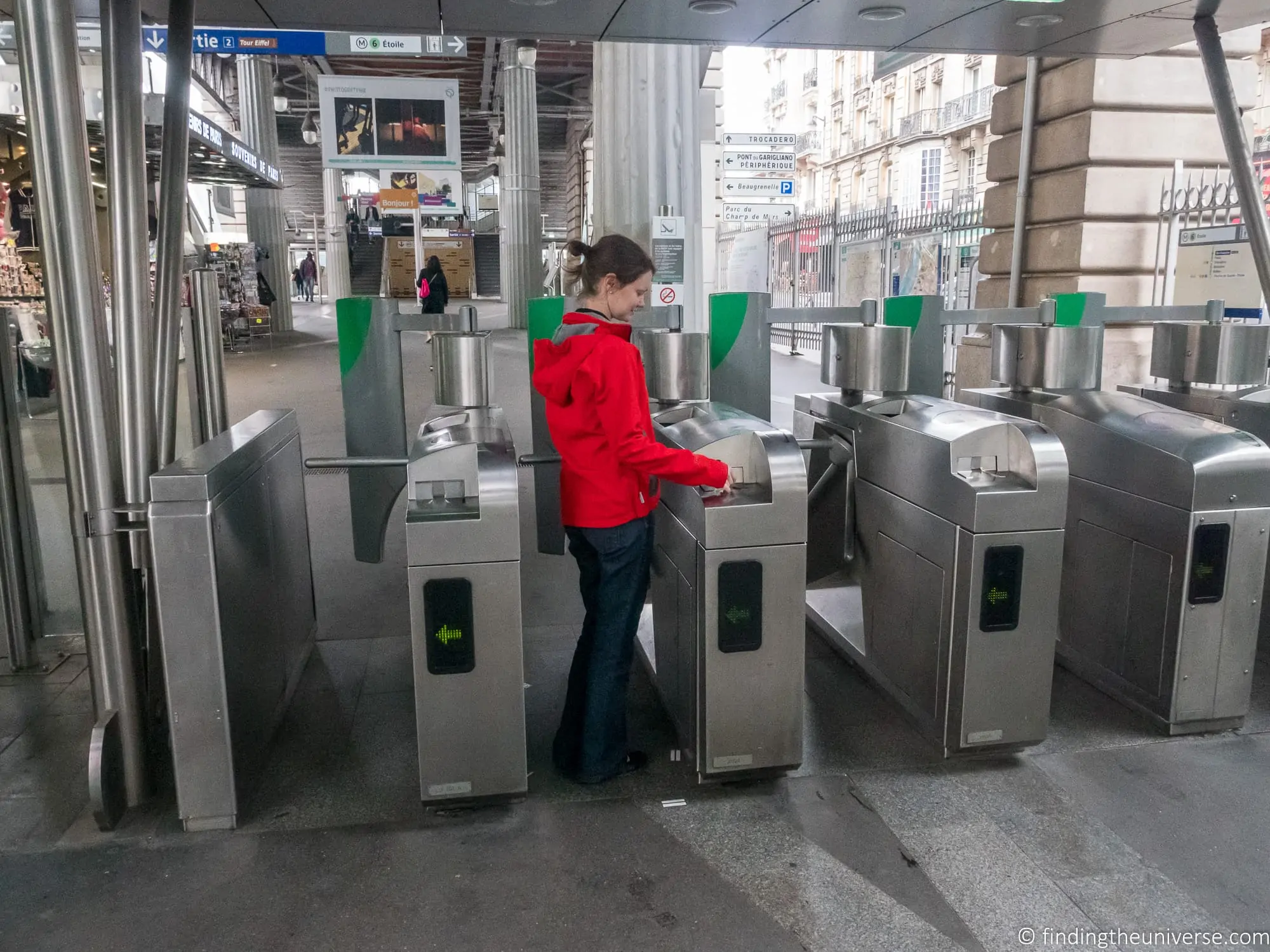
A few practical things to know about the metro:
The doors on most trains do not open automatically. You need to press a green button or lift a metal latch. The newer trains on Lines 1, 14, and the new MF19 trains rolling out on Lines 3 and 10 in 2026 have automatic doors, air conditioning and wider accessibility.
Stand on the right side of escalators and walk on the left. Parisians take this seriously.
The metro runs from around 5:30am until approximately 1:00am Sunday to Thursday, and until around 1:15am on Fridays and Saturdays. The “last metro” time refers to when the last train leaves the end of the line, so the last train through your specific station could be 15 to 30 minutes earlier. Always check the official timetables for your station.
After the metro closes, the Noctilien night bus network operates limited routes across the city from around 12:30am until 5:30am.
Accessibility: Due to the age of the metro network (most stations are over 100 years old), the majority of stations are not accessible for wheelchair users. The exception is Line 14, which is fully automated and 100% accessible with lifts at every station. If accessibility is a priority, the bus network (100% low-floor with ramps) and tram network are much better options. You can find information on accessible travel in Paris and download a map of accessible stations from Île-de-France Mobilités. The RATP website also has a guide to accessibility across their network.
Bus
There are around 70 bus routes across central Paris, primarily covering zones 1 to 3. You can see a full map of the bus network here.
Depending on your route, the bus can sometimes be faster than the metro, especially if you can find a direct bus route that replaces an indirect metro journey. You also get a much better view of the city from the bus than you do underground.
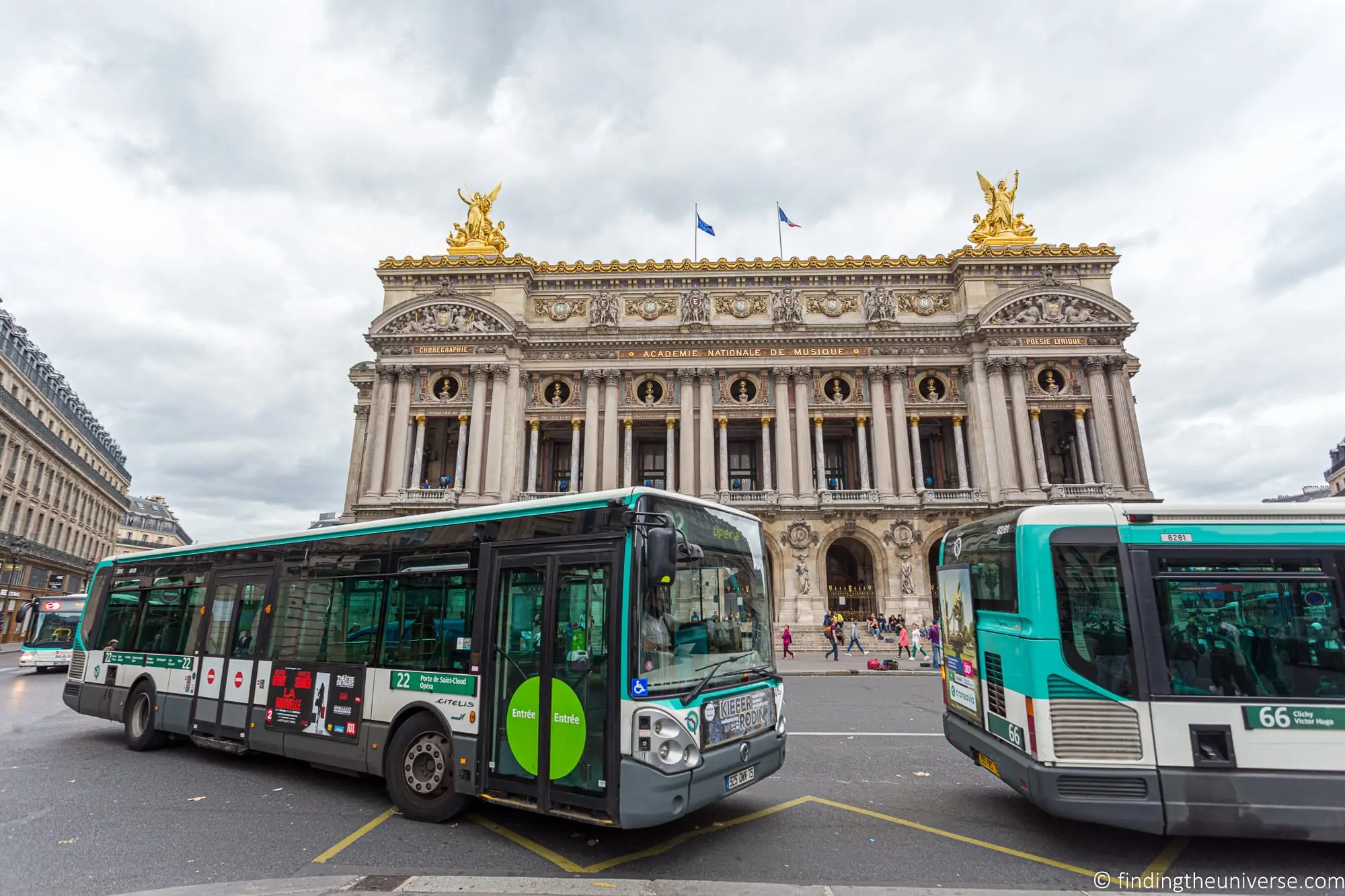
Nearly every bus in Paris is wheelchair accessible with electric ramps, which is a significant advantage over the metro for those with mobility needs.
To use the bus, find a bus stop (each will have signs showing which routes serve it) and when you see your bus approaching, signal the driver with a raised arm. Many stops are request-only.
The bus uses Bus-Tram tickets (€2.05). If you’re using a Navigo Easy card, validate it on the purple reader when you board. If you don’t have a ticket, you can usually buy one from the driver for €2.50 in exact change. You can also text “Bus” plus your line number to 93100 and receive an SMS ticket. We recommend having tickets loaded onto your card before boarding to avoid any hassle.
The bus service runs from roughly 5:30am until midnight. Night buses (Noctilien) continue a limited service through the night.
RER and Train Lines
As well as the metro, there is a regional rail network across Paris. The RER (Réseau Express Régional) and Transilien commuter trains primarily connect the suburbs with the city centre. In the centre they run underground and share some stations with the metro, so it’s important to be able to tell them apart.
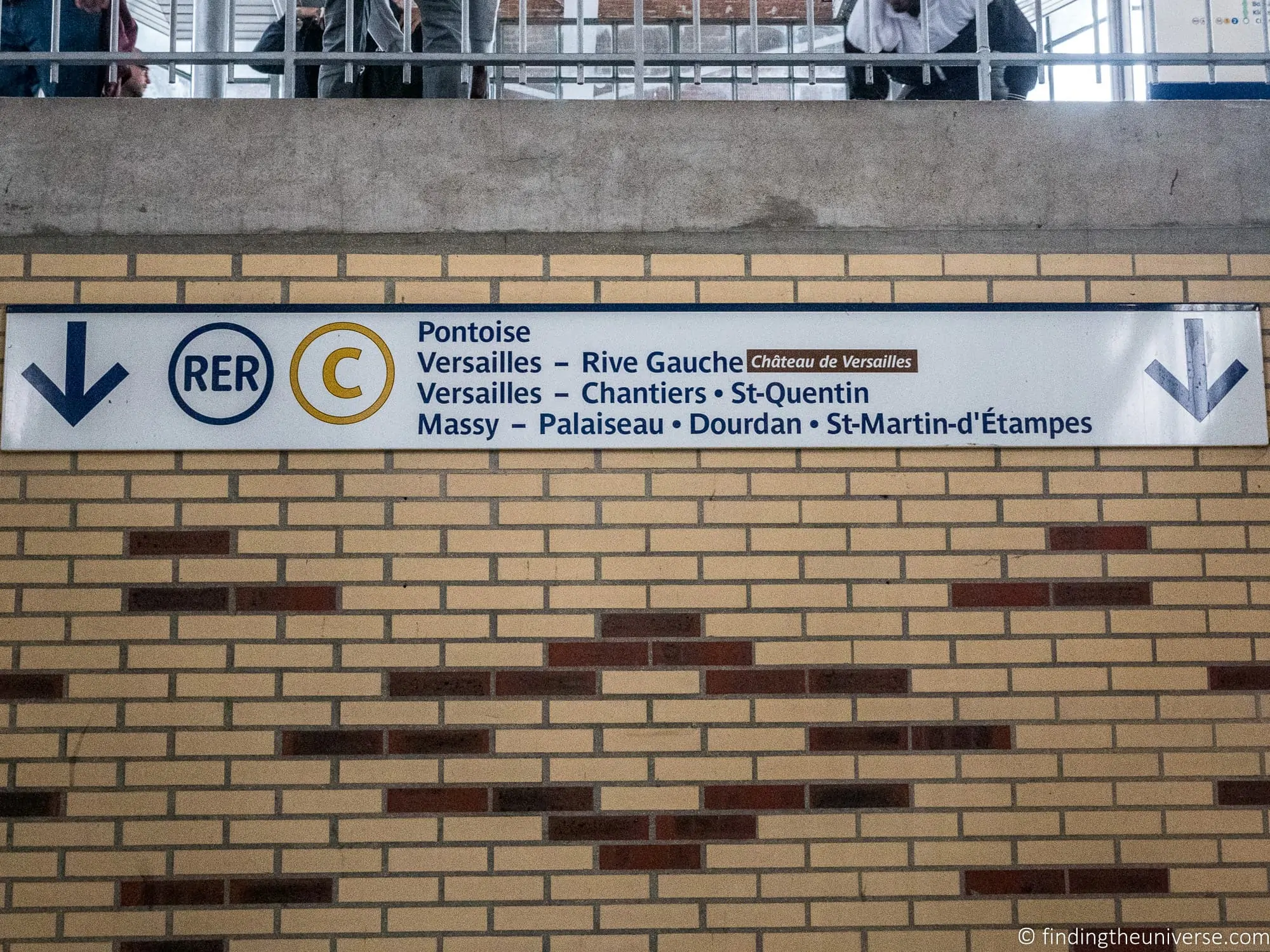
There are five RER lines (A to E) and eight other commuter train lines (H, J, K, L, N, P, R and U). RER lines have their letter inside a coloured circle, usually accompanied by the letters “RER” in blue inside a blue circle.
There are far fewer RER stops in central Paris than metro stops, so most journeys by visitors will be on the metro. But you’ll use the RER for specific destinations:
- Versailles: RER Line C to Versailles Château Rive Gauche
- CDG Airport: RER Line B
- Disneyland Paris: RER Line A to Marne-la-Vallée Chessy
- Orly Airport: Metro Line 14 (extended in 2024, now the fastest option at about 25 minutes from Châtelet)
For travel within Zone 1 on the RER, you can use a standard Metro-Train-RER ticket (€2.55). For travel outside Zone 1, you’ll need a destination-specific ticket. The vending machines at all metro and RER stations can issue the correct ticket when you enter your destination.
RER trains run from around 5am until just after midnight. You can see timetables and maps on the Transilien website. Many RER and Transilien stations are fully accessible. You can see a map of accessible routes here.
Tram
Paris has 10 tram lines, the majority of which operate in the suburbs. Most visitors to the city centre are unlikely to use the tram or even be aware that there is a tram system.
The tram is actually the oldest public transport rail network in Paris, dating from 1852. Back then it was pulled by horses, and by 1914 there was a fully electrified system with over 100 lines. The rise of the car killed the tram off in 1937, but a resurgence of interest in green transport brought it back in the 1990s.
The tram system is operated by RATP and accepts Bus-Tram tickets (€2.05). Tram lines each have a number and colour, displayed in a circle matching the line colour, prefixed with a blue circle containing the letter T.

If you’re using a Navigo Easy card, validate on the purple readers on board. All tram lines are 100% accessible with level boarding, making them a good option for travellers with reduced mobility.
Funicular
Paris has one funicular (technically a double inclined elevator these days), and it’s in Montmartre. The Montmartre Funicular takes you from the bottom of the hill to the top, saving you the steep climb up to Sacré-Cœur.
It has two stations (lower and upper) with about 40 metres of vertical distance between them. Two cabins operate independently.
The funicular uses the same Metro-Train-RER ticket (€2.55) as the metro. Tap your Navigo Easy card at the turnstile before boarding. Note that you can’t “transfer” to the funicular from a metro journey. It will use a separate ticket.
There aren’t many ticket machines at the funicular stations, so have tickets loaded onto your card before you arrive, especially if it’s busy.
Taxi
Paris has an extensive taxi network. Licensed taxis are officially marked with a “Taxi Parisien” light on the roof. If the light is green, the taxi is available. If amber, it’s occupied.
For airport transfers, taxis have regulated flat fares set by the Paris Police Prefecture:
- CDG Airport to Paris Right Bank: €56
- CDG Airport to Paris Left Bank: €65
- Orly Airport to Paris Left Bank: €32
- Orly Airport to Paris Right Bank: €37
These are fixed regardless of traffic or journey time. The minimum fare for any taxi ride is €8. If you book in advance, there’s a €7 booking fee (€4 for immediate bookings). From the 5th passenger, there’s a €5.50 surcharge per person.
All taxis are supposed to accept credit cards, but some drivers will claim their machine is broken. Ask before you get in the car if you want to pay by card.
Be wary of unsolicited offers from anyone claiming to be a taxi driver, particularly at airports and train stations. Always go to the official taxi stand. The G7 app is a reliable way to book official Parisian taxis in advance or on demand.
We have found taxi pricing to be reasonable for shorter journeys around Paris, and the flat-rate airport fares take the stress out of that particular trip.
Rideshare Apps
Paris has several rideshare services. The three main options are Uber, Bolt, and Free Now. All three operate similarly: you book via the app, get an upfront fare estimate, and pay through the app.
Prices vary by time of day and demand. It’s worth checking all three apps before booking, as one will often be cheaper than the others for the same route. We’d recommend downloading Citymapper as well, which compares fares across rideshare apps and also plans metro and bus routes. It’s a very useful app for getting around Paris.
One thing to keep in mind: rideshare prices can surge during peak hours or bad weather. Taxis have the advantage of being able to use dedicated bus and taxi lanes, which sometimes makes them quicker.
Hop on Hop off Bus
One popular way to get around a new city is a hop on hop off sightseeing bus service. These are open top buses that visit major attractions on a loop route, and you can get on and off as many times as you like during your ticket’s validity period (usually 24 or 48 hours).

Most hop on hop off buses come with audio narration, making the ride an attraction in itself. On a nice warm day, riding an open top bus and seeing all the sights is a great way to spend a couple of hours, even if you don’t get off.
The downside is that buses can be slower than public transport due to traffic, and they’re more expensive than a metro ticket. Routes are also limited compared to the full metro network.
There are a number of hop on hop off bus services in Paris, including Big Bus Paris, which is the one we’ve used.
A hop on hop off bus pass is also included with the Paris Pass, which you can buy here.
Riverboat
The River Seine runs through the centre of Paris, passing directly by the Eiffel Tower, Musée d’Orsay, the Louvre and Notre Dame. You can actually get around Paris by river.
There are two ways to do this. The first is a sightseeing river cruise, where you stay on the boat for a round trip. These aren’t transport as such, but they’re a lovely way to see the city from the water.

If you are interested in sightseeing cruises, see our guide to taking a Seine River Cruise for a full rundown of your options. We also have a dedicated guide to Seine River dinner cruises. A Seine river cruise is also included with the Paris Pass, which you can buy here.
If you actually want to use the river as transport, the Batobus service is what you want. This is a hop on hop off boat with 9 stops around the city (including stops near the Eiffel Tower, the Louvre, Notre Dame and the Jardin des Plantes). A 1-day pass costs around €23 and a 2-day pass around €27.
It’s a nice way to combine sightseeing with getting around, and you skip road traffic entirely. Boats run approximately every 15 to 25 minutes depending on season. There’s no audio commentary on the Batobus, unlike the dedicated sightseeing cruises.
You can buy hop on hop off tickets for the Batobus here.
Cycle
One of the cheapest options for getting around Paris, other than walking, is to cycle.
The largest bike hire scheme is Vélib’ Métropole, which has been in operation since 2007. Tens of thousands of bikes are used via this scheme every day, including standard bikes and electric bikes.
For occasional users, the simplest option is a Ticket-V single ride pass at €3, which includes 45 minutes on either a classic (green) or electric (blue) bike. If you want more than one ride in a day, the 24-hour Classic Pass is €5 (unlimited classic bike rides with the first 30 minutes free each time) and the 24-hour Electric Pass is €10 (unlimited classic plus up to 5 electric bike trips of 45 minutes). There’s also a 3-day Pass at €20. Go over the included time on any pass and you’ll pay €1 per 30 minutes on a classic bike or €2 per 30 minutes on an electric bike.
There are Vélib’ bike stations all over the city. You’ll need a credit or debit card to rent a bike and will need to register at a Vélib’ machine or through the app (iOS / Android). The app also helps you find available bikes nearby.
Beyond Vélib’, there are various electric bike and scooter rental services available through apps like Lime and Bolt. These services change frequently, but the general model is the same: find a bike or scooter, scan the QR code with the relevant app, and ride. They’re scattered around the city.
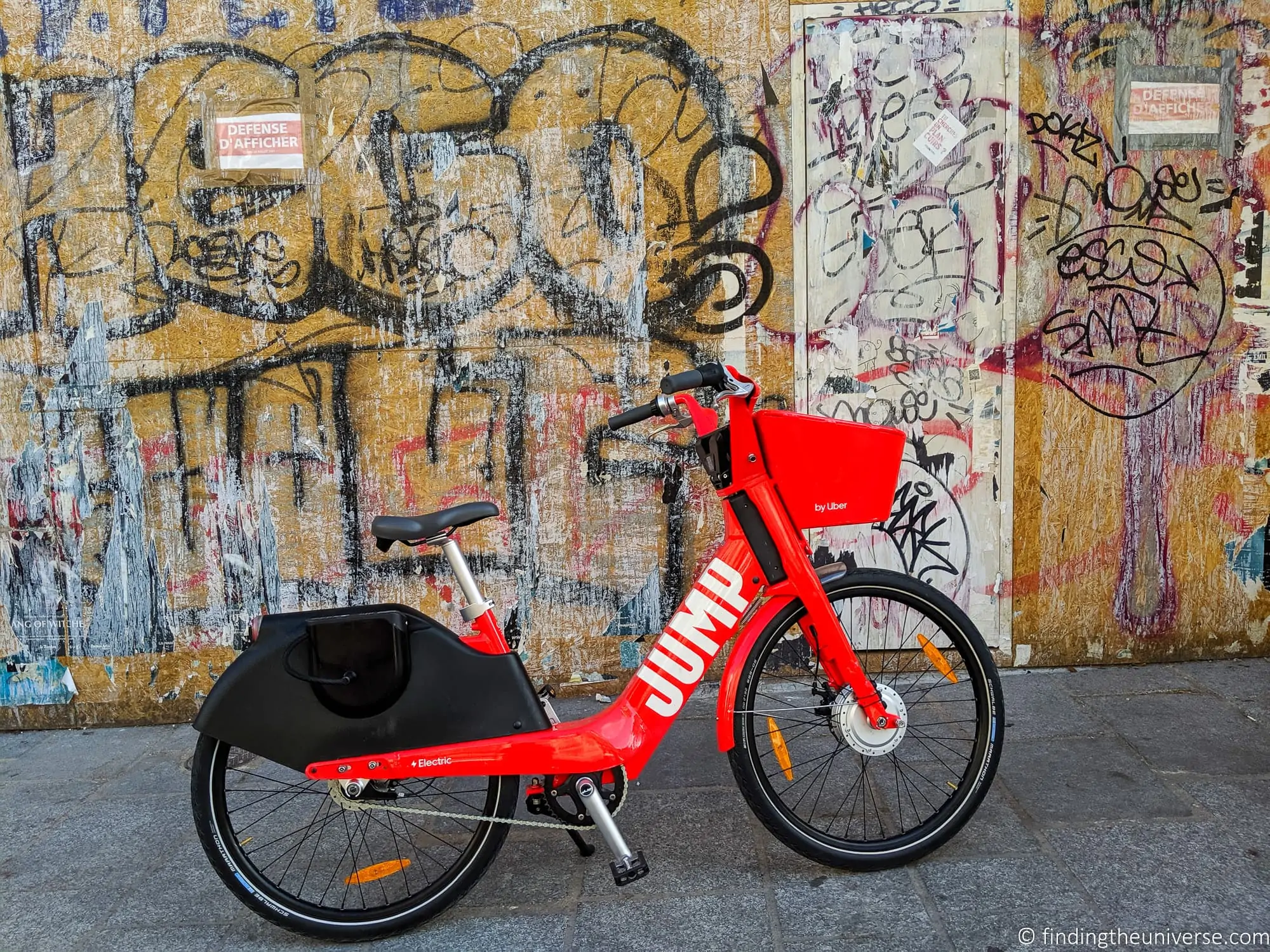
Please be careful when riding in Paris. Cycle lanes aren’t available everywhere and drivers are not always looking for cyclists. Read up on the rules regarding where you can and cannot ride.
Bike tours are also a popular option and a great way to see the city. Some options to consider:
- This four hour bike tour that visits the highlights of the city
- A four hour tour using electric bikes to cover the city highlights
- This day tour from Paris that visits Versailles by bike
Car
You can, of course, get around Paris by car. You can drive your own car (if in Europe) or rent one at the airport or in central Paris.
I would suggest you don’t! The roads are busy, parking is expensive, and it’s going to be far more stressful than pretty much any other option on this list.
If you do drive, you need to make sure your vehicle meets the Paris clean air standards and has the correct Crit’Air sticker in the window. You can read more about this here.
When we travel to Paris by car, we park in a long term lot outside the city centre and use public transport from there. We use the Parclick service to find parking.
On Foot
One of our favourite ways to get around any city is on foot, and Paris is a fairly walkable city for the most part. Distances between major sights aren’t too great, and there is so much to see just wandering the streets.
Nothing beats strolling along the Left Bank, exploring the Tuileries Gardens, or getting lost in the backstreets of Montmartre. If you can, we definitely recommend spending at least some of your time in Paris on foot.
If you are looking for guided walks, two of our favourite walking tour companies in Paris are WalksDevour and Context (10% discount on Context walks with our link). You can also find many more options here.
Some examples to consider:
- A full day walking tour of Paris which includes many of the highlights, including the Louvre, the Eiffel Tower, and a Seine River Cruise
- A three hour tour that includes Sainte-Chapelle and the area around Notre Dame
- A food tour of Paris, which includes some of the best flavours of the city
- There are also many more tours in Paris, see all the options here
Getting To and From the Paris Airports
Getting between the airports and central Paris is one of the first challenges visitors face, so here’s a dedicated breakdown of your options.
Charles de Gaulle (CDG) Airport
CDG is about 25km northeast of central Paris. Your main options:
RER B train: The most popular option. Takes around 35 to 50 minutes to Gare du Nord. Costs €14 (Paris Region Airports ticket). Trains run roughly every 10 to 15 minutes from around 5am to midnight. Note: this is a commuter train and can be very crowded at rush hour, and some travellers find it stressful with heavy luggage. There are also occasional issues with pickpockets on this route.
Bus line 9517: This new service replaced the old RoissyBus (which was discontinued in March 2026). It runs from CDG to Saint-Denis-Pleyel, where you can connect to Metro Line 14, Line 13, and the RER D. This is a newer route and may be less crowded than the RER B.
Taxi: Flat rate of €56 to the Right Bank, €65 to the Left Bank. Takes 45 to 60 minutes depending on traffic. Available 24/7 from the official taxi ranks outside each terminal. The most convenient option, especially with heavy luggage or if you’re arriving late at night.
Rideshare (Uber/Bolt): Available at CDG. Prices vary by demand but typically €45 to €70. Can surge during peak times. Be aware that pickup points are designated areas, not at the terminal doors.
CDG Express (coming 2027): A direct express train from CDG to Gare de l’Est is scheduled to open in March 2027. This will be the fastest option at around 20 minutes.
Orly Airport
Orly is about 15km south of central Paris.
Metro Line 14: This is now the fastest way to get from Orly to central Paris, taking about 25 minutes to Châtelet. Costs €14 (Paris Region Airports ticket). This extension opened in 2024 and is a significant improvement over the old options.
Orlyval + RER B: The Orlyval shuttle connects Orly to Antony station on the RER B line. From there you can take the RER B into central Paris. This is now the slower option compared to Metro Line 14.
Taxi: Flat rate of €32 to the Left Bank, €37 to the Right Bank. Available 24/7.
Beauvais Airport
Beauvais is about 80km north of Paris and is used mainly by budget airlines like Ryanair and Wizz Air. It’s a long way from the city. The only practical option is a shuttle bus from Beauvais to Porte Maillot in Paris, which costs about €18 one way and takes around 1 hour 15 minutes depending on traffic.
Where to Stay in Paris
Paris has no shortage of accommodation options. We’ve stayed in a variety of places, from hotels to homestays to apartments.
Ideally you want to be fairly central to minimise travel time. Our suggestion is to take a look at the listings for Paris on booking.com. They’re our favourite booking engine when we travel, usually giving us the best choice and prices. Here are some options we suggest, depending on your budget.
- Hôtel Dress Code, a highly reviewed centrally located 4 star hotel a few hundred yards from the opera house
- Hôtel Eiffel Turenne, a well rated 3 star hotel within a ten minute walk of the Eiffel Tower
- Ateliers de Montmartre, an apartment in Montmartre with views of the Sacré-Cœur
- The People Paris Marais, a modern hostel in Le Marais with both dorms and private rooms
If you prefer an apartment, we recommend Plum Guide. They carefully curate their listings so their options tend to be high quality across a range of price points. See their listings for Paris here.
If you can’t find what you want on Plum Guide, we wrote a whole post on the best alternatives to Airbnb which you should check out.
We also have a page full of travel resources, including our tips for getting the best deals on accommodation, which you can find here.
Frequently Asked Questions
Can I use the same ticket on the metro and the bus?
No. Paris has two separate ticket types: a Metro-Train-RER ticket (€2.55) and a Bus-Tram ticket (€2.05). If your journey involves both metro and bus, you’ll need to tap two separate tickets. There is no free transfer between the rail and bus/tram networks on single tickets.
What is the best ticket option for tourists visiting Paris?
For most visitors, the best option is a Navigo Easy card (€2 at any metro station) loaded with individual tickets. At €2.55 per metro ride and €2.05 per bus ride, a typical tourist doing 3 to 4 rides a day will spend around €8 to €10 on transport.
If you know you’ll have a heavy day of transport (5+ metro rides), load a Navigo Jour day pass (€12.30) for that day. The Paris Visite multi-day pass is poor value for most visitors, as the maths rarely works out in your favour.
How do I get from CDG Airport to central Paris?
The most common option is the RER B train to Gare du Nord (about 35 to 50 minutes, €14). For a taxi, there are flat rates of €56 to the Right Bank and €65 to the Left Bank. Uber and Bolt are also available at CDG, though prices vary by demand.
If you’re arriving late at night after the last RER (around midnight), you’ll need a taxi or rideshare.
Do I need to keep my ticket after entering the metro?
Yes. Inspectors can check your ticket anywhere in the system, including on platforms, in trains, in corridors and at exits. The fine for not having a valid, validated ticket is €50. Always keep your ticket or Navigo Easy card on you until you’ve left the station.
Are paper metro tickets still valid in Paris?
No. Paris transport is entirely electronic, and there are no paper tickets to buy. You need either a Navigo Easy card or the Bonjour RATP smartphone app. If you still have old paper t+ tickets or paper Paris Visite passes from a previous trip, they are no longer any use. The window to exchange them at RATP and SNCF ticket offices closed on 1 September 2026.
Is the Paris metro wheelchair accessible?
Most of the Paris metro is not wheelchair accessible. The system is over 100 years old and most stations have only stairs. The exception is Line 14, which is fully automated and 100% accessible with lifts at every station.
If you need accessible transport, the bus network is your best bet. All buses in Paris are low-floor with electric ramps. All tram lines also have level boarding. The RATP website has a detailed guide to accessibility across their network.
Further Reading
That’s it for our guide to how to get around Paris! We’ve visited the city a number of times, and we hope our experiences have helped you figure out how to get around when you visit.
We’ve also written lots of other Paris content, which we think you’ll find useful for your trip. There are also some third party resources we recommend.
- The official RATP website, which is useful for fares, timetables, and updates on any delays that might be affecting the Paris public transport network.
- To help you make the most of your time in Paris, we have a series of itineraries covering spending a day in Paris, 2 days in Paris and 3 days in Paris
- If you’re looking for good photos, we have a guide to the best photography locations in Paris
- We have detailed guides to choosing a Seine River cruise, choosing a Seine River dinner cruise, buying Paris opera tickets, attending a fashion show in Paris and saving money on Michelin starred restaurants in Paris
- We have a detailed review of the Paris Pass to help you decide if it might save you money
- If you like afternoon tea, check out our definitive guide to the best afternoon tea locations in Paris
- We have a detailed guide to attending the famous Moulin Rouge show in Paris
- Coming from London? We have a detailed guide to the best way to get from London to Paris
- For walking tours in Paris, we recommend both Context Tours (link gives 10% off) and WalksDevour who both offer tours in Paris
- If you want a guide book, we always like to recommend the Rick Steves guides. Here’s the Rick Steves Paris edition. We also recommend the Lonely Planet guides, and they have a guidebook on Paris.
And that’s it! As always, if you have any questions or comments about this guide to getting around Paris, just let us know in the comments below. We’ll get back to you as soon as we can!

Jamie Lee says
Hi Laurence,
I’m still having trouble deciding which ticket option is best for me, but I’ve narrowed it down to two:
Paris Visite travel pass
Navigo Easy Travel Card
Here’s my situation:
I’m flying to Paris on Friday evening (20/6), landing at CDG around 11:30 pm. My Airbnb is near Le Bourget Airport. I plan to attend the Paris Airshow on Saturday (spending most of the day there), and possibly explore central Paris in the evening and most of Sunday. My return flight to London is around 8 pm on Sunday.
Given these details, which travel card would you recommend?
Laurence Norah says
Hi Jamie,
Thanks for stopping by! So just to clarify, the Navigo Easy Travel Card isn’t a ticket in itself, it’s a travel card that you load tickets onto electronically. Those can be single journey tickets, or you can load a Paris Visite Pass onto the Navigo Easy Travel card. So you can certainly go with the Navigo easy card and load tickets onto it individually for your trip if you prefer. Depending on how much you will be using public transport this may or may not be more cost effective than buying some sort of pass.
In terms of passes, with the Paris Visite as of 2025 this now covers all the zones in Paris (there used to be a cheaper version that only covered zones 1-3 but this is no longer the case). Le Bourget is in zone 3 but CDG is in zone 5. For three days this pass is €62.30 as of 2025.
A better option for you in terms of price is likely going to be the Navigo Week pass (Navigo Semaine). This gives unlimited transport on zones 1-5 so should get you where you need to go. It runs from Monday – Sunday so would work well for your trip. It can be bought at CDG airport, and costs €31.60 for the week pass as well as a €5 fee for the physical Navigo card. You also need to provide a color headshot that is attached to the card. You can see more details on buying this card here.
Finally, a simpler solution might be the Navigo Jour 1 Day Card. This can be loaded onto a Navigo Easy card and covers all your transport in Paris for a day for €12 (as of 2025). That might be the easiest option for you as you don’t need to get the special Navigo card with a photo on it for the Navigo Semaine pass. Just note that it doesn’t include CDG airport, for which you would need a seperate ticket.
I hope this helps, enjoy your time at the Paris airshow and let me know if you still have questions!
Laurence
Jamie says
Hi Laurence,
Thank you so much for the detailed explanation!
Getting anything for more than 2 days is not worth it. I am literally there for one and half day.
It’s a shame it’s not like the Oyster card, which covers almost all public transport.
If I preload 10 tickets, will that work on the metro, RER, bus, and tram? I likely won’t use the bus or tram, but to get from Le Bourget to Paris, I’ll probably need both the RER and metro—so I need a pass that covers both.
Since we’re traveling as a group, we might just take an Uber back to the airport from Le Bourget.
Also, can I get this Navigo Easy card at CDG around midnight?
Laurence Norah says
Hi Jamie,
I’m happy to help! And yes, I was just discussing this with my wife yesterday, the Oyster card is such an easy to use product in that it just calculates the best fare for you. It would defintely be simpler if other cities had a similar system in place! So to answer your questions:
– the replacement for the old t+ ticket is called the Ticket Metro Train RER. It’s a digital ticket you load onto the Navigo Easy card and it costs €2.50 per ticket for an adult. As the name suggests, yes, it works on the RER and metro 🙂
– you should be able to get the Navigo Easy card at CDG at midnight as you can buy them from machines (they’ll be marked something like Vente Navigo. The alternative would be to use the Ile de France mobility app, which is available for both Android and iPhone but in my experience can be a bit finicky
You may already be aware of this, but just in case, you are arriving pretty late into CDG, later than the last RER train departs I believe. So transport to your Airbnb might need to be an Uber.
Enjoy Paris, even briefly!
Laurence
Michelle says
I’m trying to understand what type of ticket we will need, but it is tricky! We are arriving at CDG and staying close to Disney. We are planning to travel into Paris for a few days. We do have the Paris Pass, so one day will be Hop on Hop off Bus. We then plan to head to Normandy for a couple days before flying out of Beauvais. I know we need something that covers all of the zones, but if we decide on train to Normandy, what will we need for that??
Thanks!
Laurence Norah says
Hi Michelle!
So if you are going to be using public transit in Paris then the easiest option is to buy a Navigo Easy travel card, which is a plastic card you can purchase at stations for €2. You then load the card with tickets. A standard ticket is €2.50 which covers one jounrey on a train, bus or RER within Paris (not to the airport). It also includes Marne La Vallee Chessy, which is the RER station by Disneyland Paris. You can also buy a set of 10 tickets and load that onto the card, last time I checked this was €16.90. There’s also the option to buy a 1 day pass. So it will really all depend on how much you will be using public transport. It sounds like you will be using it at least twice a day to go in and out of the city from your hotel, and then likely inside Paris as well, so at least a t10 would make sense. All the machines take major credit cards, you’ll just want to be sure your credit card provider doesn’t charge foreign transaction fees.
For Normandy, you would need to buy a seperate train ticket as that’s quite a way from Paris and not covered by Paris transport. It’s about a 2.5 hour train ride. I’d suggest looking on the trainline website for train tickets as you can book them in advance. You just have to be sure you take the train you book, as seats are allocated and you have to travel on the train you book. You definitely want to book in advance as trains can book out, and once they are full that is it.
Let me know if you have any more questions I’d be happy to help. Have a great time in Paris!
Laurence
Juliet says
At last, clear well written information . Well done and thank you . What a con we’re visiting for the Olympics so will be paying premium fares!
Laurence Norah says
Thanks Juliet! Yes, I have to agree that it’s a bit mean for Paris to increase the prices so much for the Olympic period, seems a bit counter intuitive if trying to get people to use public transport! Anyway, I hope you have a good time in Paris anyway, and if you have any questions do let me know!
Laurence
Emran says
Thanks a lot for great article….i was wondering, is it possible to buy different types of tickets at a time and pay the total bill ?
Laurence Norah says
Hi Emran,
Yes, the ticket machines normally let you add multiple tickets to your basket and then buy them all together. They also can be changed to multiple languages to make things easier 🙂
Have a great time in Paris, let me know if you have any further questions!
Laurence
Dave C. says
If you get one of the Navigo cards for the metro, you’ll need to get a photo to put on it. It can be as simple as a copy of your driver license photo.
DO NOT blow this off. You are likely to be asked to show your pass, and if you don’t have your photo on it, that will be a 35 Euro fine on the spot.
Laurence Norah says
Hi Dave,
I think this depends on the type of Navigo card you get. I recommend the Navigo Easy as it’s the easiest way to get the T10+ tickets which are what we find easiest and is aimed more at visitors. The Navigo Decouverte card is the one which can hold passes and has the requirement for a photo which needs to be put on the associated paper card as described here. For shorter visits to Paris I think it’s easier to skip the ND card and just get the Navigo Easy, but it’s up to each individual of course.
Vandy says
Hi. Thanks for the detailed information. I also ready your Paris Pas blog. You have mentioned in it that as of 2021, the transport pass is NOT included in the Paris Pass but am getting contradictory information from other sites and has confused me. Would you be able to confirm if the transport pass is included or not in the Paris Pass please? Thanks
Laurence Norah says
Hi Vandy
It’s our pleasure. So the Paris Pass definitely doesn’t include a transport pass. They removed it in 2021 and as of 2023 it’s still not included. Unfortunately many sites have not been updated to reflect this change. A hop on hop off bus is included.
I’d also add that there are ongoing changes to the pass in terms of inclusions, most importantly right now only the 4 and 6 day Paris Pass currently includes the Paris Museum Pass. We have tried to keep our content up-to-date but since December 2022 things have changed so often that we are currently waiting on more information from the folks at the Paris Pass.
Have a great time in Paris and let me know if you have any more questions!
Laurence
vandy says
Hey Laurence, many thanks for the response and noted on the same. Shall reach out should I have any more questions :-).
Cheers!
Vandy
AD says
Hi Laurence and Jessica,
Thank you both for running this wonderful site with very useful contents. I have gone through your posts regarding Paris and I have few queries for my upcoming trip. Following are points where I’m a bit confused and need your help –
– The carnet is nowadays a plastic card or a bunch of physical tickets?
– Can the 10 t+ carnet be used by multiple persons? For example, to make 1 trip on the metro by 3 persons, instead of buying 3 carnets, can the 3 persons use up 3 tickets from 1 carnet and use it up for the same? If it can be done, then in case of a single plastic card, how to do it?
– Regarding validity of of 1 ticket, it is mentioned that its 2 hours from first validation. Does it mean that the journey must get over in 2 hours?
Hoping for your insights on these,
Best regards,
Laurence Norah says
Hi AD!
So the paper carnet tickets were phased out by the end of 2022, I need to update the content but was waiting until we were in Paris next month to make sure everything is accurate! However, as far as I understand it, the t10+ cards are now plastic and you need one per person.
For the travel, my understanding is that from validation you can take a single, one-way trip lasting up to two hours. So yes, after two hours the journey should be finished.
Thanks for your input, and I’ll be updating this post soon!
Laurence
Heather says
Kia Ora! We are travelling to Paris in a weeks time. We have purchased a Paris Pass. I read on some site that the paris pass no longer is valid for amount of days you purchase. It actually works on consecutive hours. So if you buy a three day pass and activate it Monday 12pm it would expire 72hrs from this time and not the Wednesday. Does the Museum pass also work like this? Any feedback appreciated.
Thank you
Laurence Norah says
Hi Heather!
This is a great question. So I will respond with the information I have, but I have also reached out for clarification to the Paris Pass.
As you probably know, the Paris Pass is made up of two parts, the Paris Pass itself, and then the Paris Museum Pass.
The main Paris Pass is valid for consecutive days, so if you activate a 2 day Paris Pass on a Monday, it will work on the Monday and the Tuesday.
The Paris Museum Pass changed in 2019 to be valid for consecutive hours. So a 2 day (48 hour pass) activated at 2pm on a Monday should be valid until 1.59pm on the Wednesday.
As I said, I have reached out to confirm this is correct, but as far as I am aware the above is the current situation. I’ll update when I hear back from the Paris Pass 🙂
Let me know if you have any more questions!
Laurence
Laurence Norah says
Just to add that I have heard back from the Paris Pass folks and what I have posted is correct 🙂
Laurence
Sandeep says
Hello Jessica and Laurence!
Am visiting Paris this May and came across your very useful content on the transport system. I have a question, ans that is, if I buy a single ticket, can I use it for multiple modes of transport, within its validity period? For example, if I am travelling from point A to point B and there is no direct connection between them, can I travel from A to C by metro and from C to B by tram, on the same ticket?
Thank you!
Laurence Norah says
Hi Sandeep!
Glad you find our content useful! The good news is that yes, with a single ticket you can use multiple modes of transport. For the metro / RER it’s 2 hours from the first validation, and on the bus / tram for 90 minutes. So as long as your journey falls within the time limit, you can do it. You can see more details in English on the official RATP site here. Hopefully this answers your question – let me know if I can help anymore and have a great time in Paris!
Laurence