
I lived in France for three years and, a little shamefully, did barely any sightseeing while I was there. So when a gap opened up to spend a couple of days in Normandy, Jess and I took it. We had two specific things in mind: Mont-Saint-Michel, the medieval abbey-island that looks like something out of a fairy tale, and the D-Day landing beaches a little further along the coast. Those are the two things almost everyone wants from a short trip to Normandy. The snag is that they sit about two hours’ drive apart, and Mont-Saint-Michel is technically just over the border into Brittany.
Yes, two days is enough to do both, as long as you give each one a full day of its own. We spent Day 1 entirely at Mont-Saint-Michel and Day 2 on the American-sector D-Day beaches, basing ourselves in a little guesthouse within walking distance of the Mont. That works, and it’s the trip we describe below. The one thing to plan around is the drive: whichever way you arrange it, one of your two days has a couple of hours of driving built into it. If you’d rather not do that, you can split your two nights, sleeping near the Mont first and then near Bayeux, which sits right in the middle of the D-Day sites. We cover both options under where to base yourself.
We did this trip from the UK, taking the overnight Brittany Ferries crossing from Portsmouth to St-Malo, which lands you about an hour from Mont-Saint-Michel. I’m a photographer, and I liked the Mont so much I went back to shoot it at sunset two evenings running. What follows is the trip laid out the way we’d plan it again, with a straight answer to the question that decides everything: is two days actually enough?
Let’s start with how the two days fit together, because that’s the part the geography makes slightly awkward.
Table of Contents:
2 days in Normandy
The two anchors of any short Normandy trip pull in slightly different directions. Mont-Saint-Michel sits at the western edge of the region, right where Normandy meets Brittany. The D-Day landing beaches run along the coast to the north-east, with the American sector, the part most short visits focus on, an hour and three-quarters to two hours’ drive away.
That distance is the whole planning problem, and it has a simple solution: treat each anchor as its own day rather than trying to weave them together. Give Mont-Saint-Michel all of Day 1. Give the D-Day beaches all of Day 2. Don’t try to squeeze a beach into your Mont day or the abbey into your beaches day, because the drive between them eats whatever time you think you’re saving.
We based ourselves near Mont-Saint-Michel for both nights, which made Day 1 relaxed and Day 2 long, with that two-hour drive at each end of it. It worked, and if photographing the Mont at sunset is a priority, as it was for me, staying put has its rewards. But if you’d rather not spend Day 2 in the car, the better arrangement for most people is to move: one night near the Mont, one night near Bayeux. More on that under where to base yourself.
Day 1: Mont-Saint-Michel
Day 1 is the easy day. There’s really only one place to be, and you have it from morning until after dark if you want it. We arrived off the overnight ferry at around 9am, dropped our bags at the guesthouse, and were walking towards the Mont by mid-morning. A relaxed pace gets you the village, lunch, the abbey and a wander, with the evening free for dinner and sunset. Even in summer, when the light lasts until close to 10pm, the day never feels rushed.
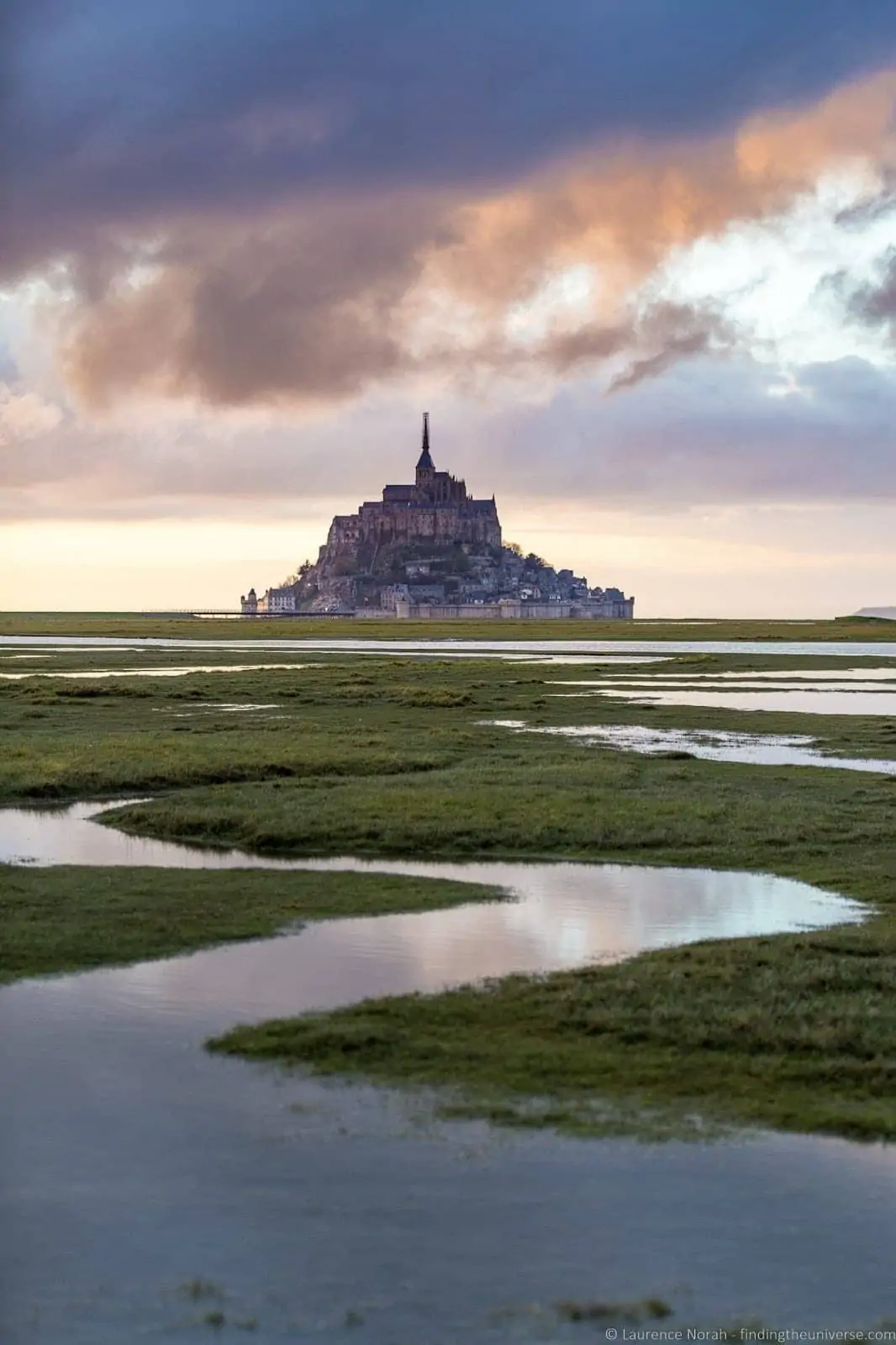
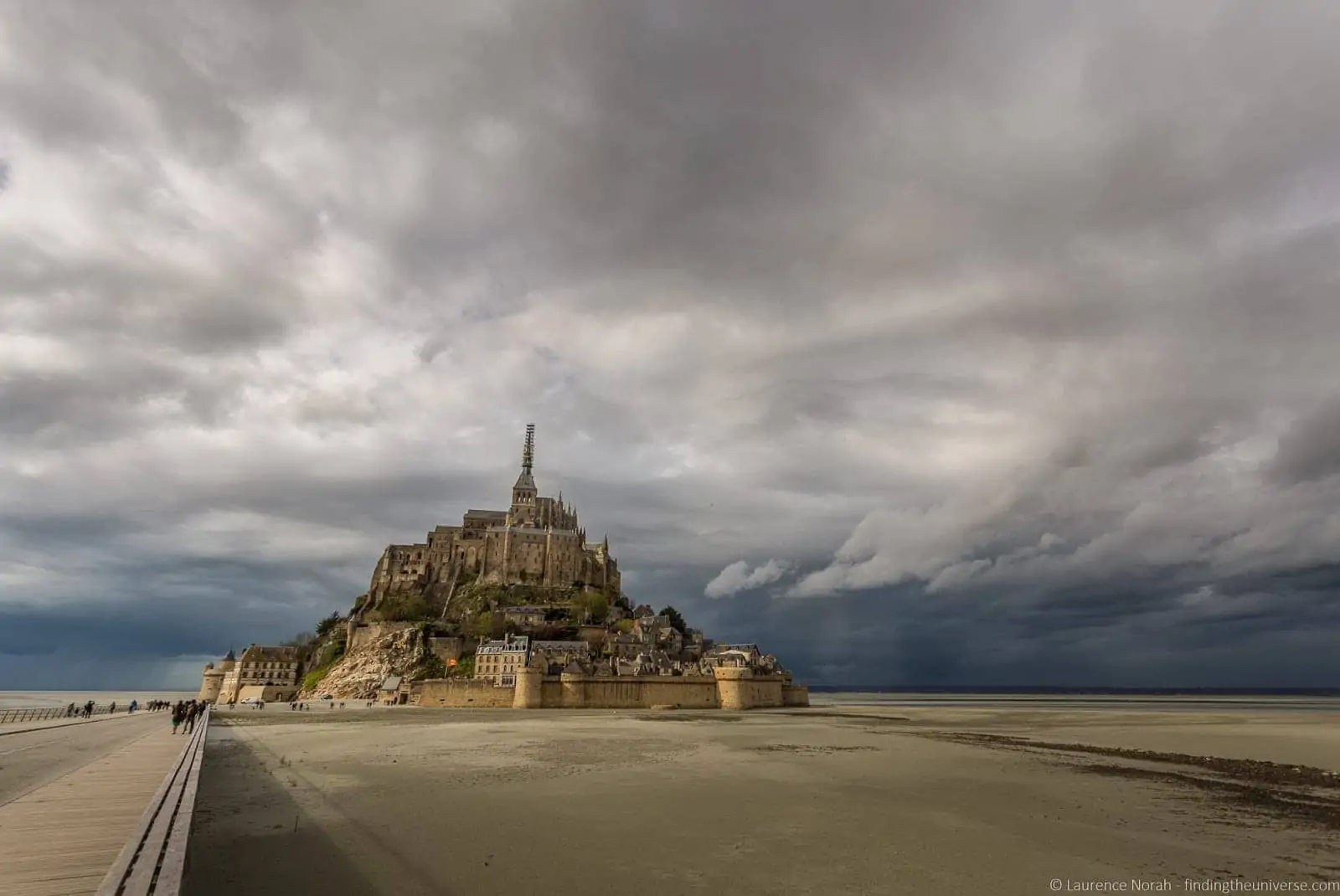
We stayed within walking distance of the Mont, which I’d recommend if you can manage it. There’s no driving onto the island itself. You park on the mainland, around two and a half kilometres away, and either walk or take the free Le Passeur shuttle bus across.
Mainland parking runs from roughly €6 per 24 hours in the quiet months to around €12.50 in July and August, with the first half hour free. You can check current parking and shuttle details on the Mont-Saint-Michel tourist office site. Staying within walking distance sidesteps the parking question entirely, and means you can be out for sunrise or sunset without moving the car.
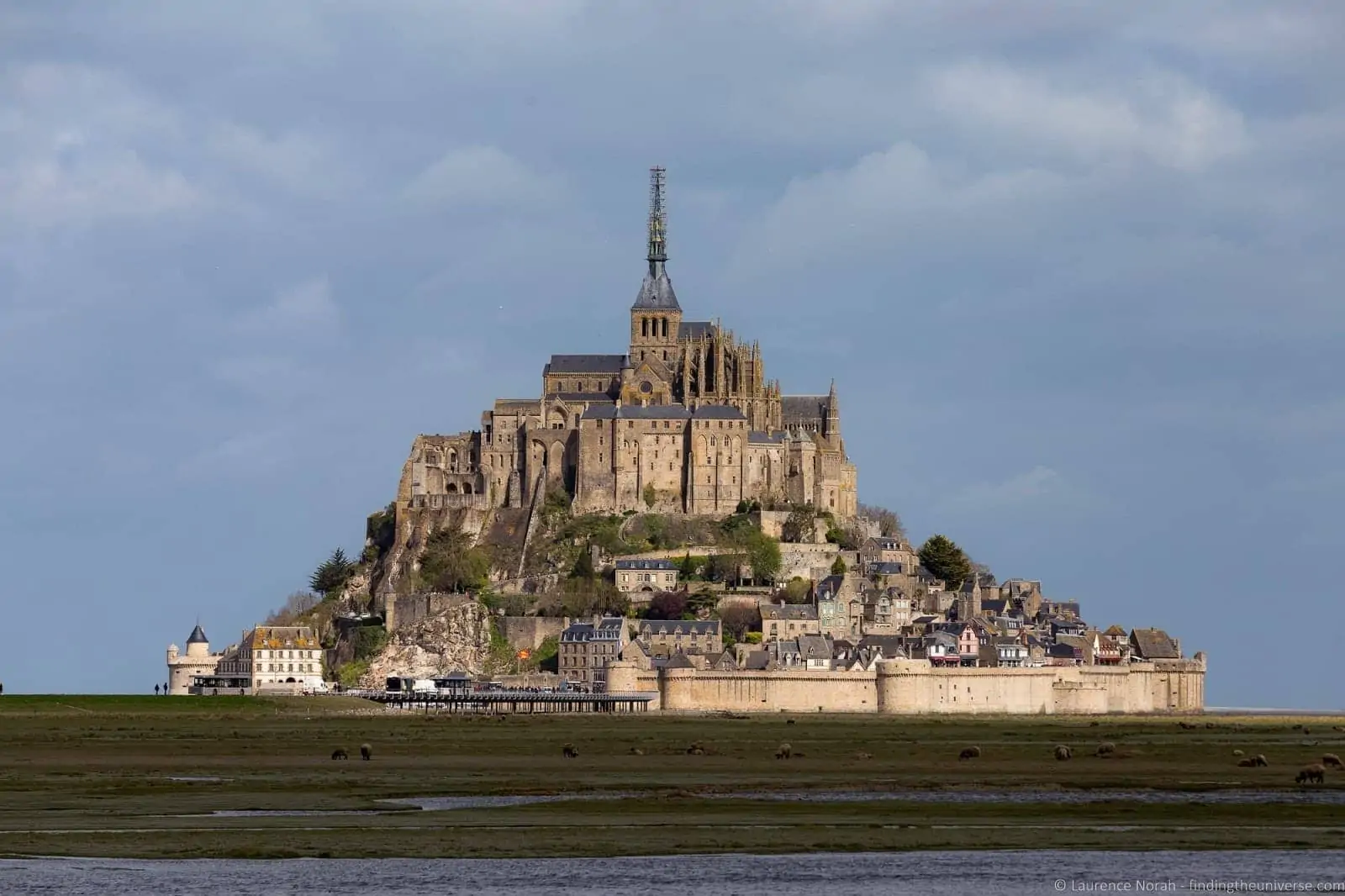
There’s a causeway out to the island, and that free shuttle runs the length of it. For your first crossing, though, I’d walk. The views are lovely the whole way, and the Mont grows in front of you as you get closer, which is half the experience. Save the shuttle for the walk back, when your legs have done a day.

The island has more on it than I expected. There’s a whole village inside the walls, with shops, a couple of cash machines, restaurants, and no shortage of places to buy a souvenir. There are even a handful of hotels on the island, so you can stay over and have the Mont to yourself once the day visitors leave. The streets are narrow and they get pretty busy.
We visited on a quieter-than-average day and it still felt tight in places, so in peak summer expect crowds, especially through the middle of the day.

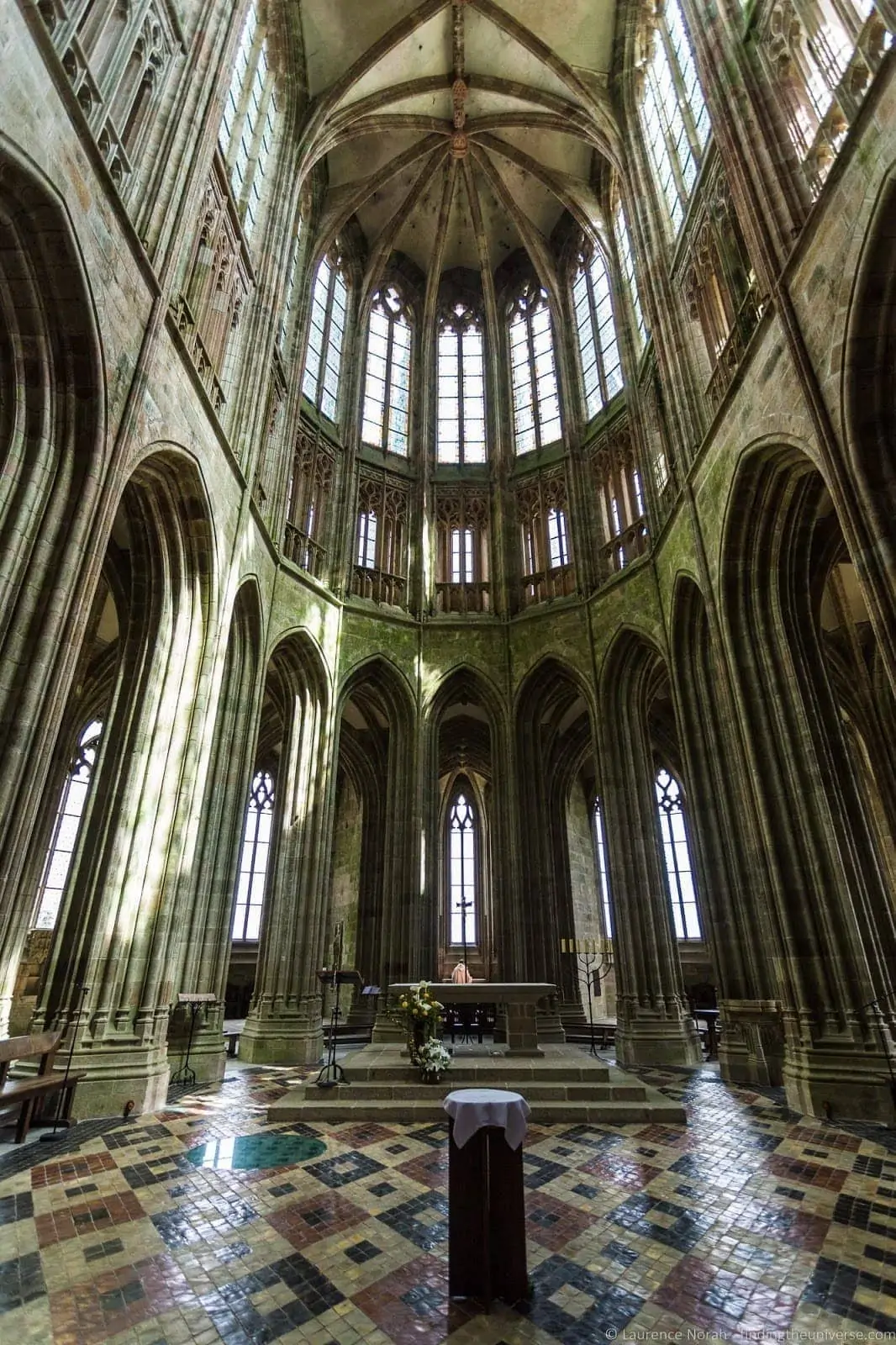
We stopped for lunch partway up. Several places on the island do a set lunch menu, which is usually the sensible choice for France in general. Then we followed the main street up to the abbey that crowns the hill. The abbey is the reason the Mont exists: a place of pilgrimage for well over a thousand years, and still the focal point of the island.
Visiting the abbey isn’t free, and the hours change with the season. As of 2026 it’s open 9am to 7pm from May through August, and 9.30am to 6pm the rest of the year, with last entry an hour before closing. Admission is €16 from April to September and €13 from October to March. You can check the current hours and prices on the abbey’s official site. Buy your ticket in advance online to skip the queue; the online price is the same as at the door, and you can book your Mont-Saint-Michel and abbey ticket here.
Standard admission comes with a free audioguide in several languages, including English, which is the easiest way to make sense of what you’re looking at. When we visited we joined an English-language guided tour of the abbey, a lovely way to learn its history. Live guided tours now run as a separate paid option, which the abbey calls conference visits, so if having a guide matters to you, look that up before you go rather than assuming one comes with your ticket.
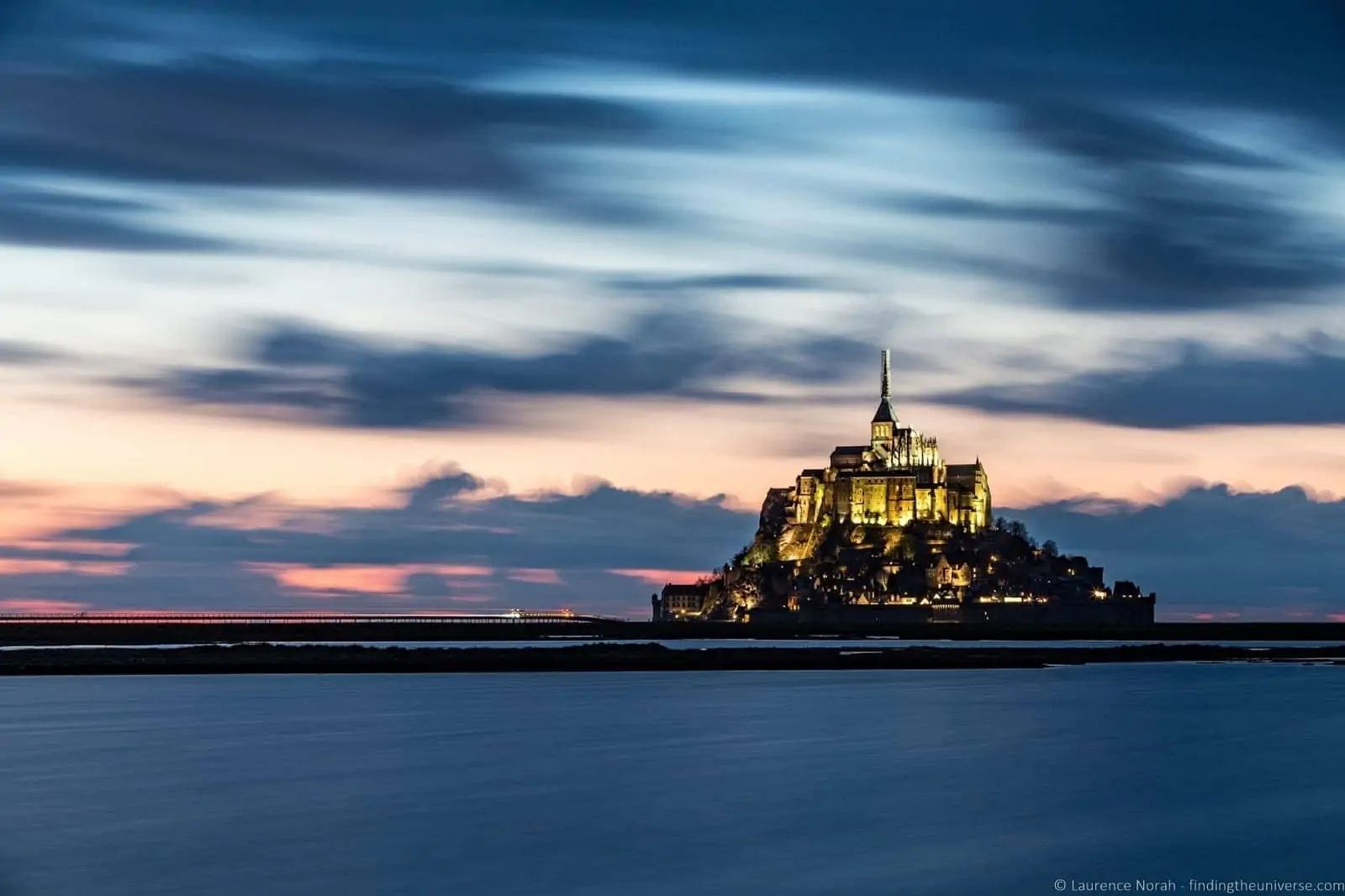
With the abbey done, we took the shuttle back to the mainland for dinner and a glass or two of the local cider, which Normandy does very well. Then I went out to photograph the Mont at sunset. It was so good the first evening that I went back and did it again the next. If you have any interest in photography, build that into your plan: the Mont lit up against a darkening sky earns the trip on its own.
Day 2: the D-Day landing beaches
Day 2 is the bigger day, and it pays to start it early. From a base near Mont-Saint-Michel you’re looking at around two hours’ drive to reach the first stop, and a similar drive back, so the four sites below sit inside what is realistically a twelve-hour day. If you’ve moved to Bayeux for the night, that changes completely: the drives shrink to short hops and the day becomes relaxed. Either way, this is the route we took, and we think it gives you a strong sense of the American landing sector in a single day.
A word on the order. The four stops run roughly east along the coast, so you’re never doubling back. Build in more time than you think for lunch, because French lunch service is unhurried, and check opening hours for the museums and visitor centres before you set off. We learnt that one the hard way, as you’ll see at Pointe du Hoc.
1. Utah Beach and the D-Day Museum
We started at Utah Beach, the westernmost of the five landing beaches, where there’s a museum dedicated entirely to the landings on this stretch of sand.
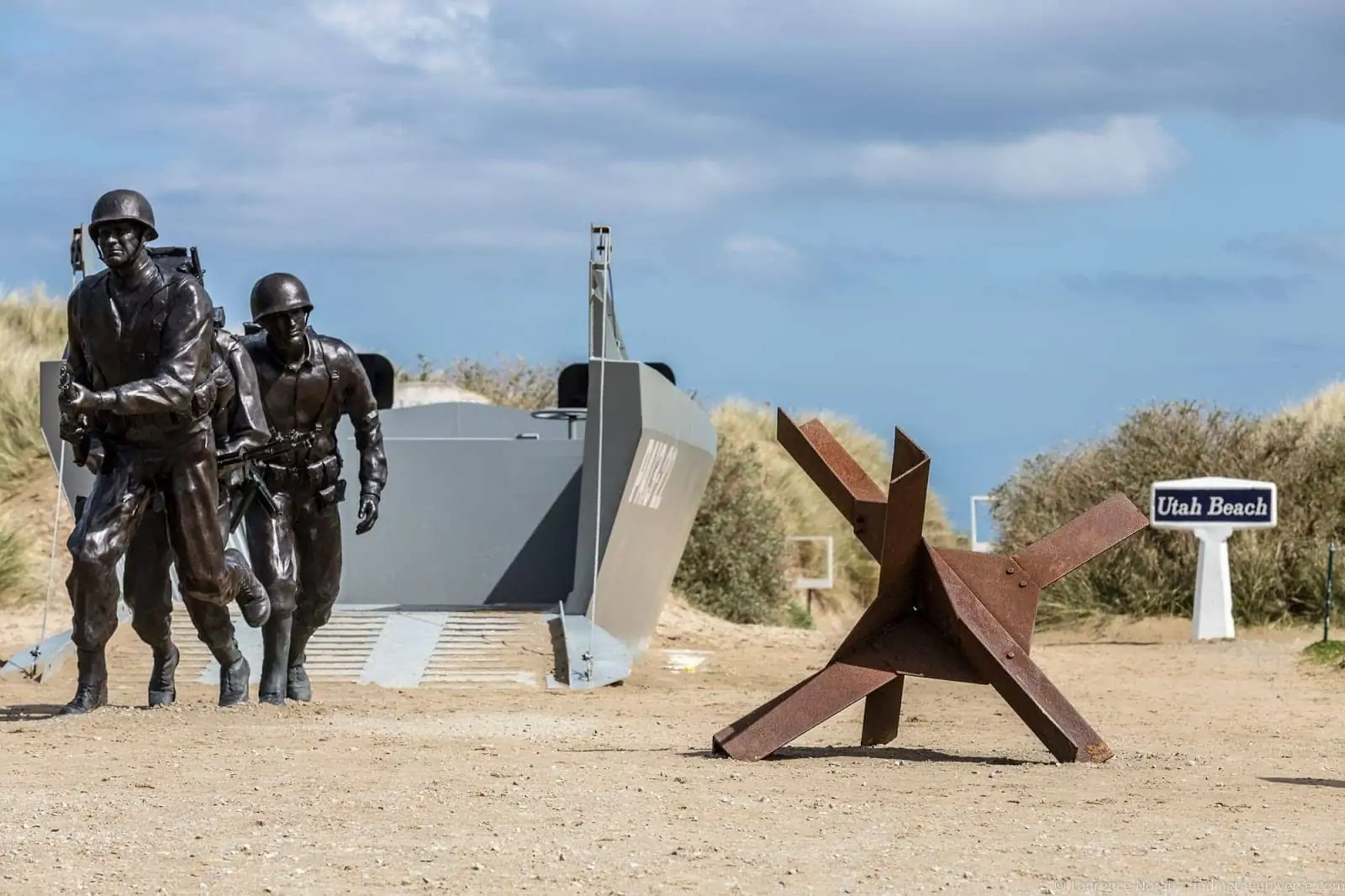
The Utah Beach D-Day Museum is open year-round. As of 2026 it runs 9.30am to 7pm from May to September and 10am to 6pm the rest of the year, with ticket sales closing an hour before. Adult admission is €10, with reduced rates for students and children and free entry for under-sixes. From our research it was rated one of the best of the D-Day museums, and although we didn’t have time to visit any others to compare, it was a strong way to begin the day.
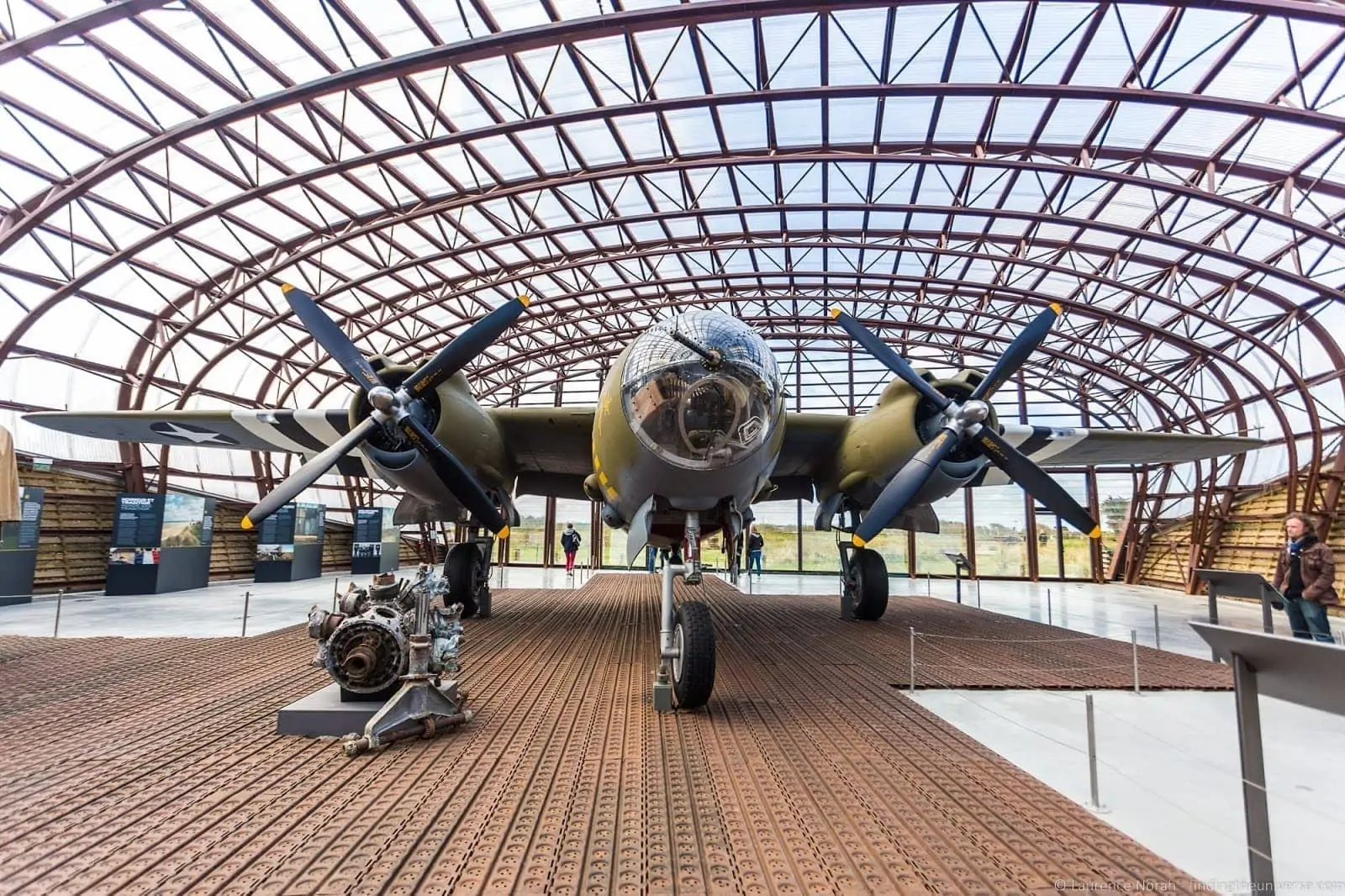
The museum focuses tightly on what happened at Utah Beach on 6 June 1944: the planning that led up to it, and the story of the day itself. There’s a film, oral histories from people who were there, and original objects and vehicles. The standout is a B-26 Marauder bomber, one of only a handful left anywhere in the world, of the type that flew the bombing runs over the beach in the hours before the troops landed. The aircraft on display is painted to represent one of those D-Day bombers.
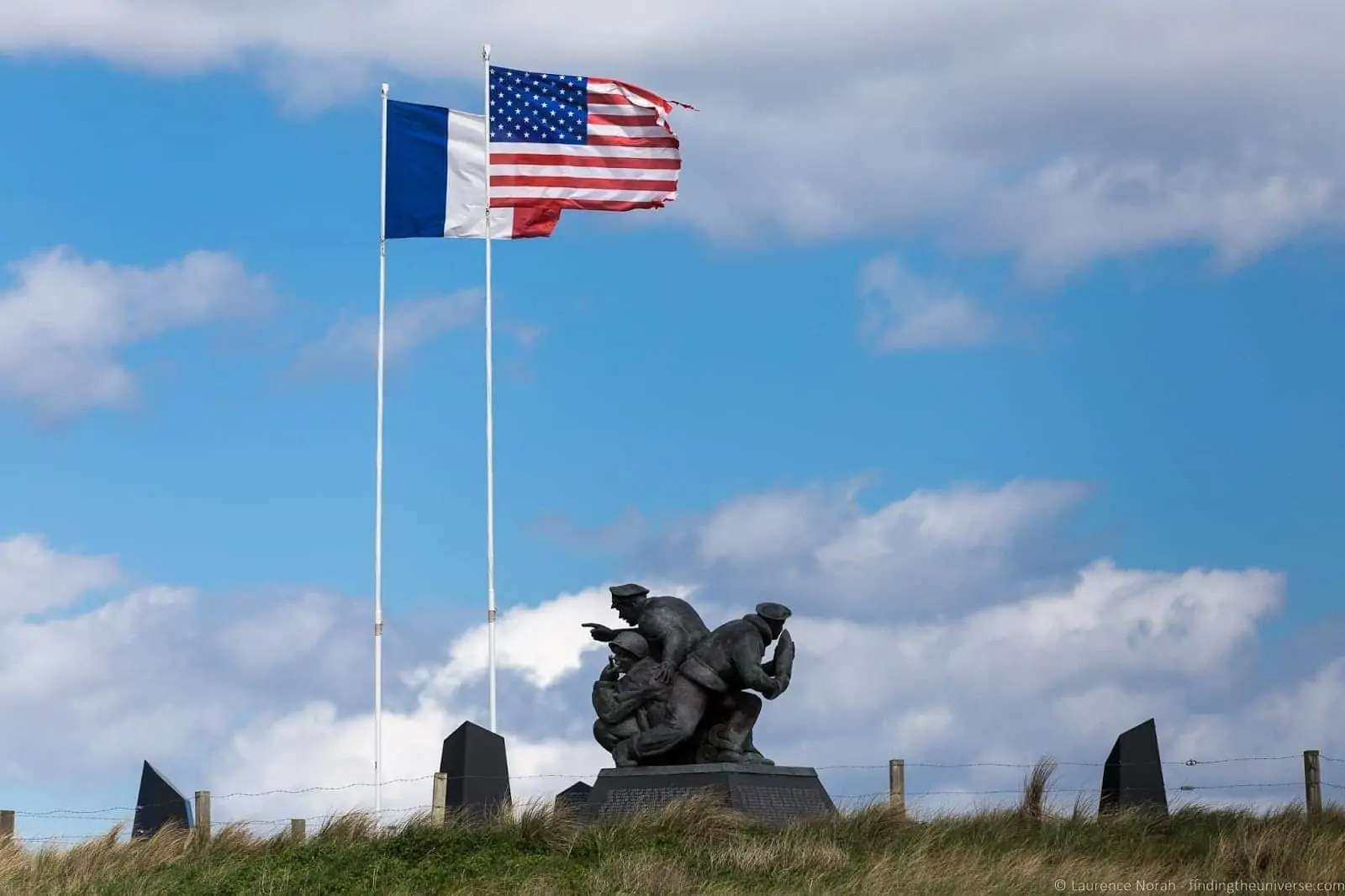
We then spent some time on the beach itself and at the memorials along it. Standing there, it’s hard to picture what the place looked like on the morning of the invasion. Starting at the museum first gives you the context to fill in the quiet, ordinary-looking beach in front of you.
From Utah we stopped for lunch at Le Roosevelt, a café built around a former German bunker that once housed a communications post and later served as a US Navy communications centre after the landings. Then we drove on.
2. Normandy American Cemetery and Memorial
The Normandy American Cemetery and Memorial sits at Colleville-sur-Mer, on the bluff directly above Omaha Beach, and is managed by the American Battle Monuments Commission. It is the resting place of 9,389 American service members, most of whom died during the D-Day landings or in the fighting in the days and weeks that followed. A further 1,557 names are recorded on the Walls of the Missing, for those who were never found.
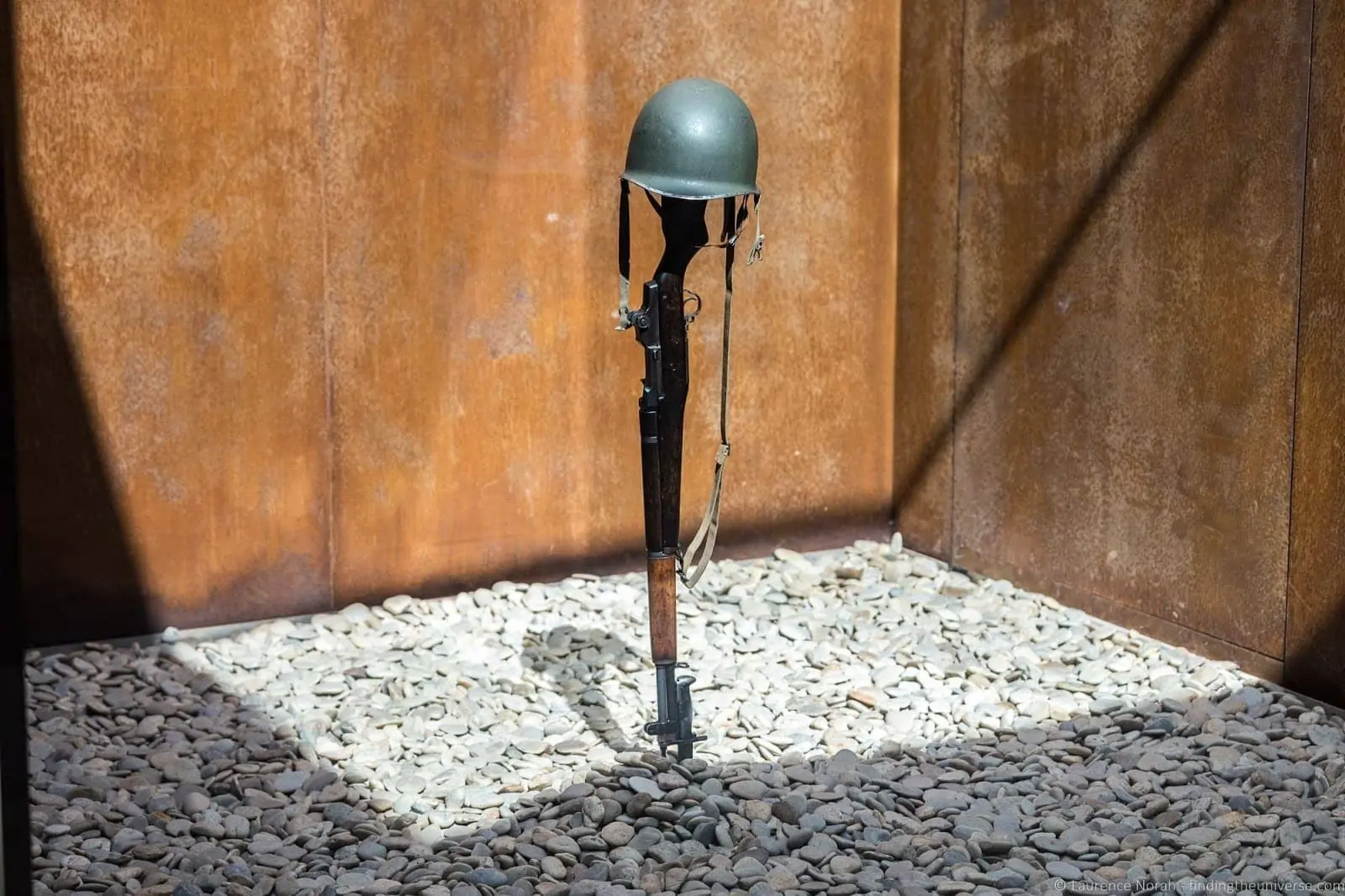
This was the first American cemetery on European soil in the Second World War. It began as a temporary burial ground on 8 June 1944, two days after the landings started, a grim necessity given the casualty rates, particularly at neighbouring Omaha Beach, the most heavily defended of all the landing sites. The permanent cemetery and memorial you see today were dedicated in 1956.

There’s a visitor centre, a memorial, a chapel and the cemetery itself, and all of it is free to visit. As of 2026 the site is open 9am to 5pm daily, closed only on 25 December and 1 January. The visitor centre tells the story of the landings through the people who were part of them, with a focus on the personal losses, and give it an unhurried hour if you can. The cemetery itself, row after row of white marble, needs no explanation.
3. Omaha Beach and Les Braves
From the cemetery we dropped back down to Omaha Beach and the memorials on the sand. There are two of them here. The first is the large official monument to the landings. The second is Les Braves, a sculpture of seventeen tall stainless-steel elements rising straight out of the beach, created by the artist Anilore Banon and unveiled on 6 June 2004 for the sixtieth anniversary of D-Day.
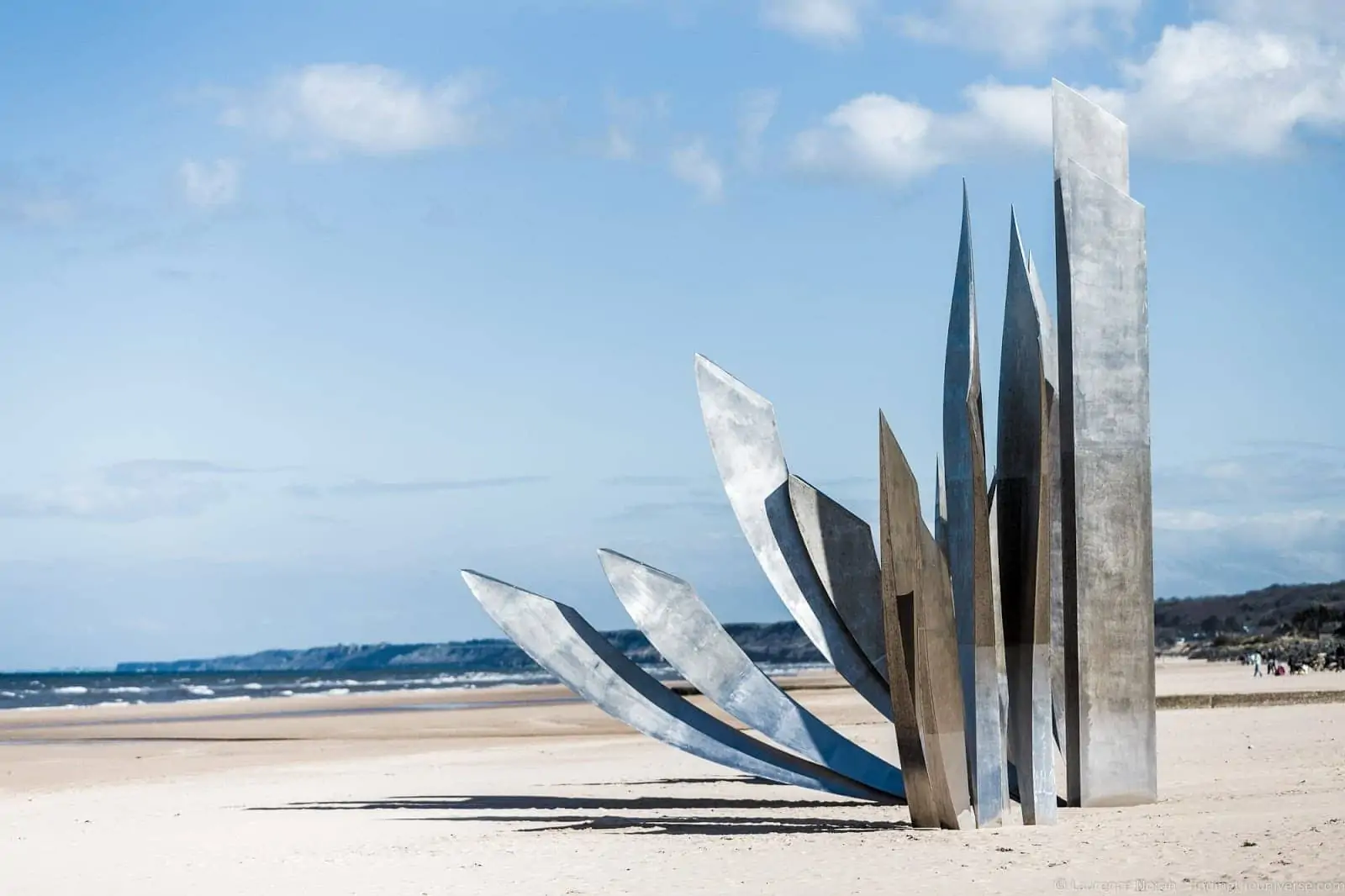
Both are worth your time, and so is the beach itself. Omaha is a long, open stretch of sand, and it’s quiet now in a way that makes the history hard to hold in your head. Standing on it and casting your mind back across the decades is, for many people, the most affecting part of the whole day.
4. Pointe du Hoc
Our last stop was Pointe du Hoc, a rocky clifftop between Utah and Omaha beaches and the highest point of land between the two. During the war it was a heavily fortified German position and observation point.
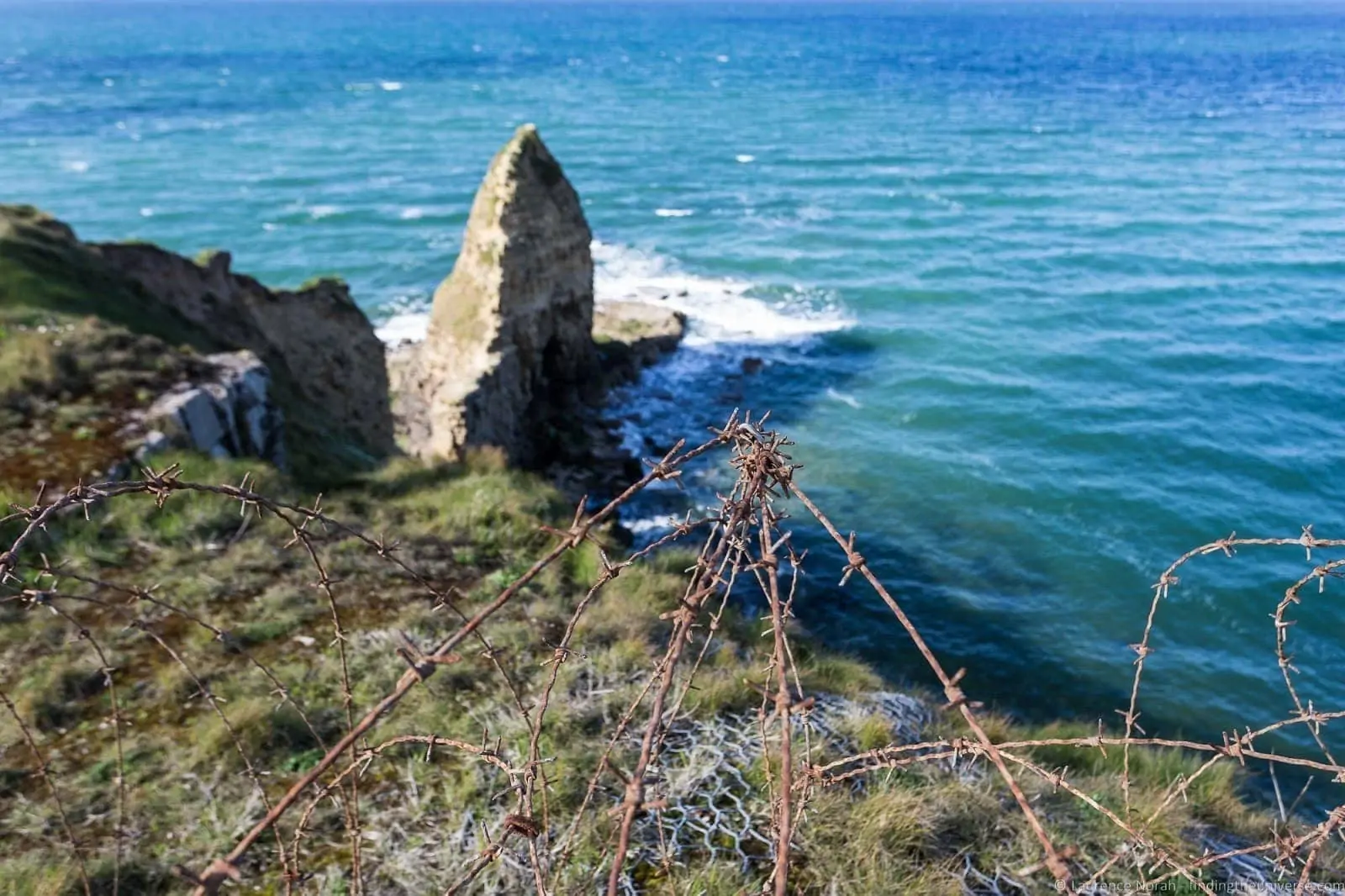
Allied command believed that taking Pointe du Hoc was critical to the success of the landings. Six 155mm guns were thought to be installed here, and from this height they could have caused devastation to the forces coming ashore at both Utah and Omaha. To deal with the threat, a force of around 225 US Rangers was sent in during the early hours of 6 June, with orders to scale the roughly 100-foot cliffs and destroy the guns.
As it turned out, the guns had already been moved inland to a camouflaged position in an orchard, to protect them from Allied bombing. The Rangers found them there and disabled them, so the danger was never quite what had been feared. The fighting for Pointe du Hoc was brutal all the same: of the roughly 225 men who took part, only about 90 were still able to fight by the end of the two-day action. It was judged a success, but at a heavy cost.
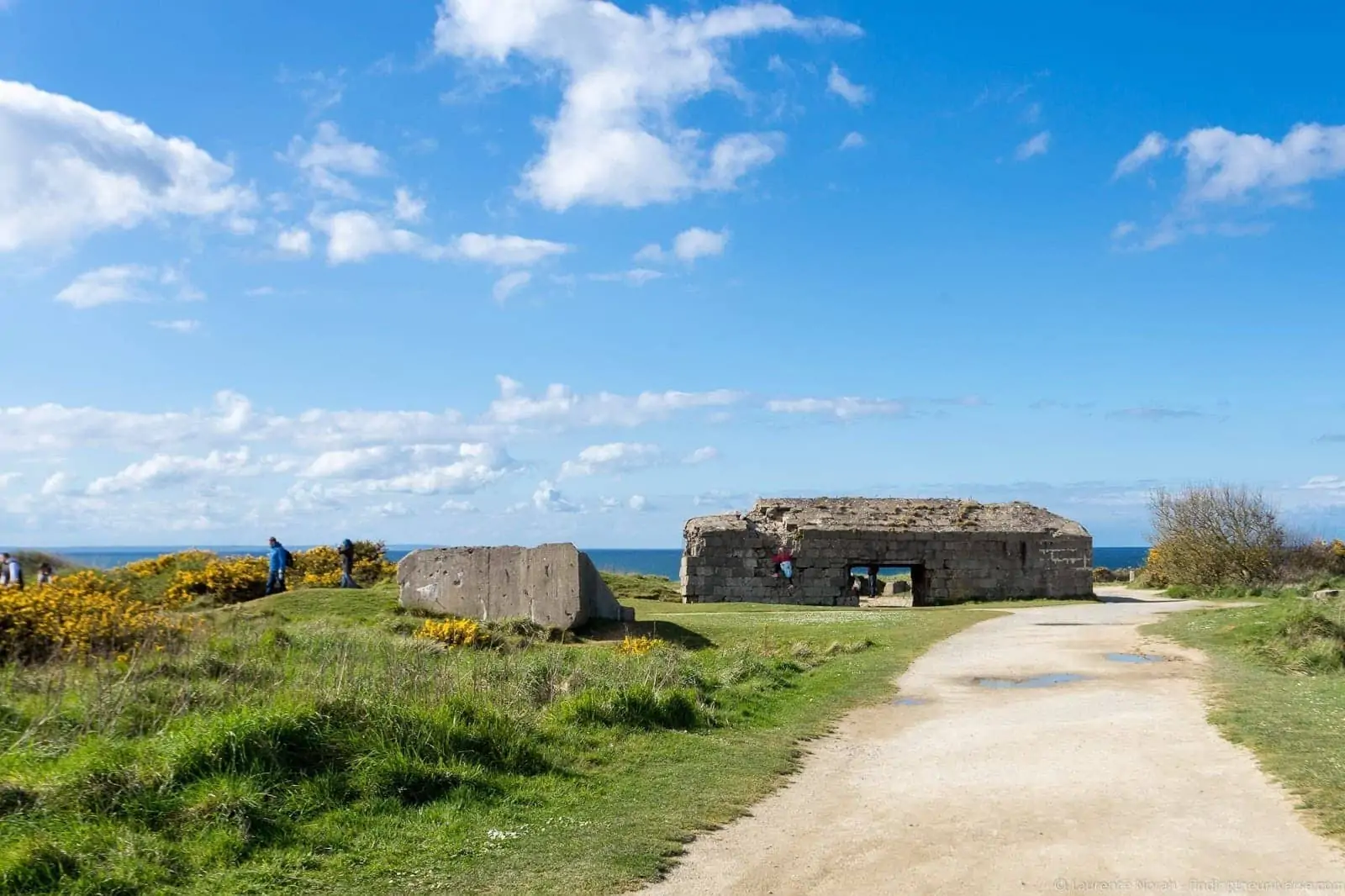
Today Pointe du Hoc is a monument to those Rangers. Apart from nature slowly reclaiming it, the site has changed remarkably little since 1944. Many of the original concrete bunkers, the bomb craters and the gun emplacements are still here, and you can wander freely among them. Doing so brings home what the men landing below were up against: the rough sea, those cliffs, the barbed wire.
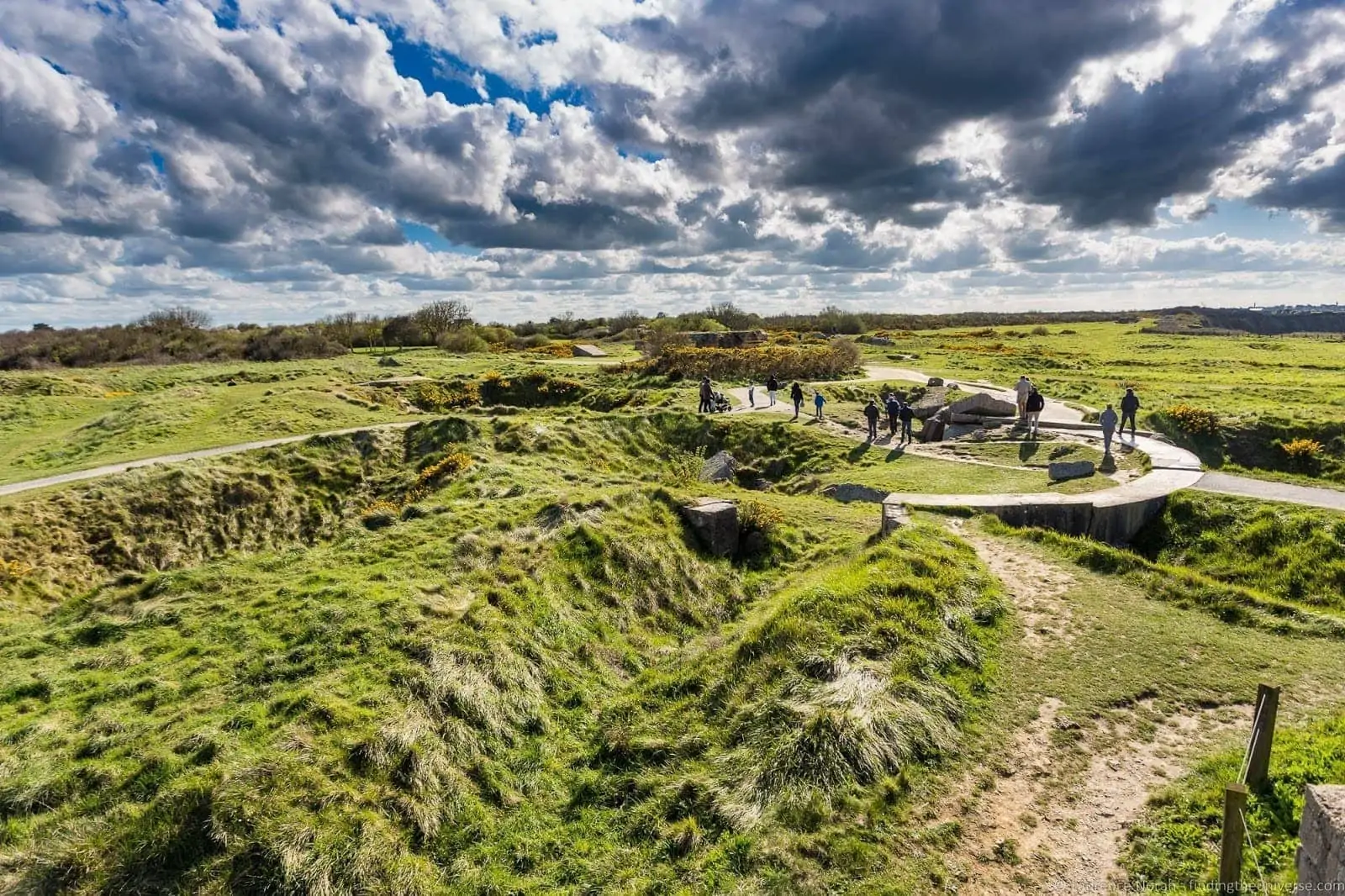
There’s a visitor centre too, though it had closed for the day by the time we arrived. The clifftop site itself stays open and is freely accessible, but if the centre is part of why you’re coming, check the opening hours and plan your day so you reach it in time. As of 2026 it runs 9am to 6pm from April to September and 9am to 5pm the rest of the year.
Pointe du Hoc was the last stop on our tour of the D-Day beaches. It wasn’t the sort of day that fills you with joy, but I learnt a great deal, and left with a heightened sense of admiration and respect for the many people who gave their lives so that Europe and the world could be free.
Where to base yourself in Normandy
Where you sleep makes a real difference to how Day 2 feels, so it’s worth a bit of thought.
We based ourselves near Mont-Saint-Michel for both nights. We found a small chambre d’hôtes, which is the French version of a bed and breakfast, a half-hour walk from the Mont and, more importantly to me, a ten-minute walk from the spot where I took the sunset photos. It was superb value, breakfast included, and there were two or three others like it close by. You can see the guesthouse we stayed at here, or browse guesthouses and hotels in the Mont-Saint-Michel area for your dates.
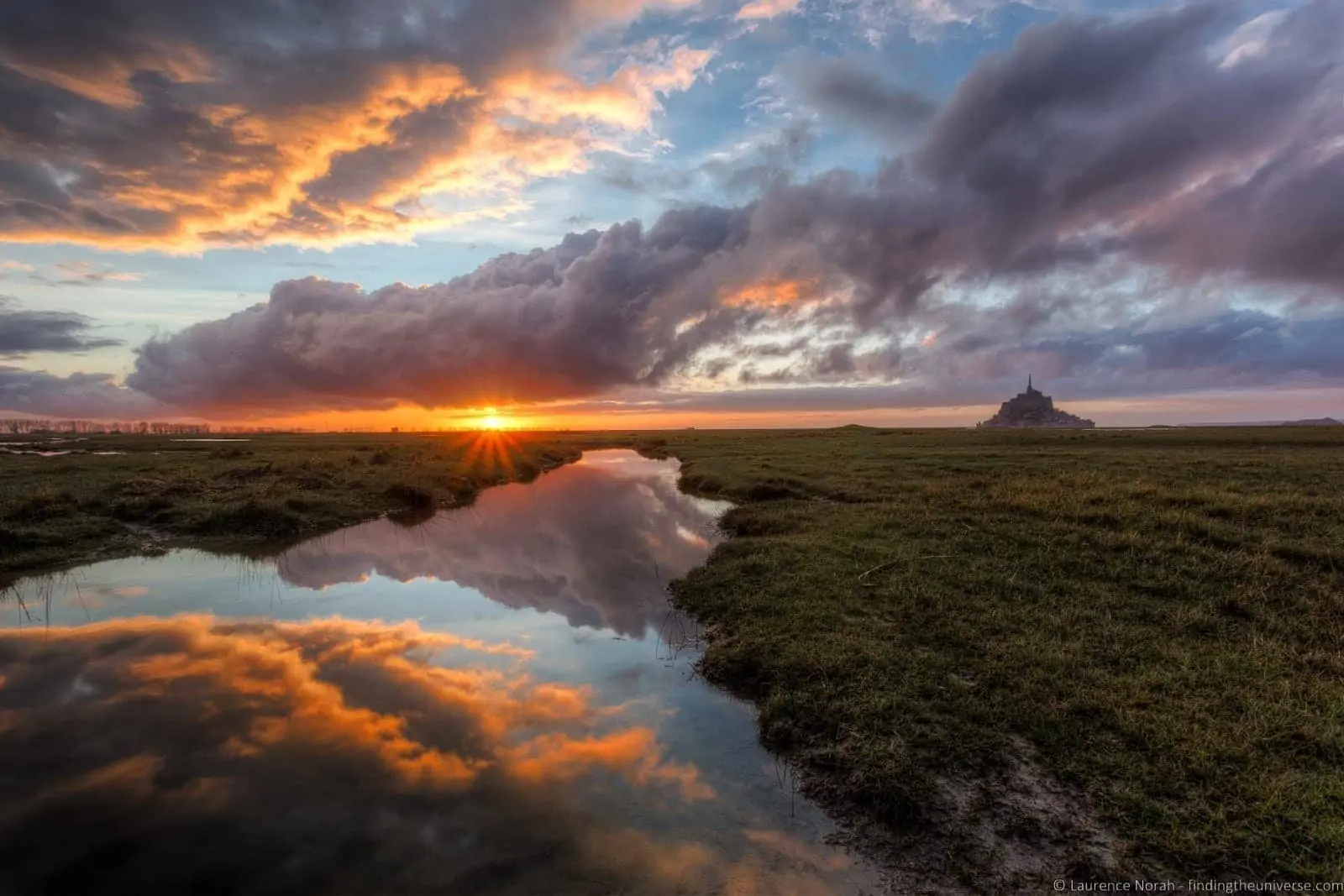
Basing yourself there for both nights is the simplest plan, and it’s what we did. The downside is Day 2: you’ve got that two-hour drive to the D-Day coast in the morning and another two hours back in the evening, which makes for a long day.
The alternative, and the one we’d suggest for most people, is to split your two nights. Spend the first night near Mont-Saint-Michel, then drive across and spend the second night in or near Bayeux. Bayeux is a lovely small city that sits right in the middle of the American D-Day sites, around an hour and a quarter to an hour and a half from the Mont.
Doing it this way turns Day 2 from a long out-and-back into a short, relaxed loop, and it puts you within easy reach of more of the sector if you decide to add a third day later. Bayeux has plenty of places to stay. Two that rate well with guests are the eighteenth-century Hôtel d’Argouges, set back from the street around a quiet garden, and the five-star Villa Lara, which looks straight out at the cathedral.
One more option: staying on the island of Mont-Saint-Michel itself. A handful of hotels sit inside the walls, among them the long-established La Mère Poulard, whose restaurant has served its omelettes here since 1888, and the half-timbered Auberge Saint-Pierre on the way up to the abbey.
They aren’t cheap and the rooms are small, but you get the Mont in the early morning and late evening, after the day visitors have gone, which is quite a special thing. For one night of a two-night trip, it’s a memorable splurge.
Is two days enough for Normandy?
Two days is enough for Normandy if you’re clear about what you’re using it for. It’s enough to do Mont-Saint-Michel and the American D-Day beaches well, one full day each, at a pace that doesn’t feel like a race. That’s a strong trip, and it’s the one this guide describes.
What two days won’t do is let you see everything. Normandy’s D-Day story spans five landing beaches, the British and Canadian sectors as well as the American one, plus major museums at Caen and Bayeux and the harbour remains at Arromanches. Trying to add those onto a two-day trip means spending your time in the car instead of at the places themselves. If your heart is set on the full sweep of the D-Day sites, you want three or four days, not two.
So who is two days right for? It suits a first visit, where the goal is to see the two headline sights and get a feel for the region. It suits anyone fitting Normandy into a longer France trip, which is how we did it. And it suits travellers coming over from the UK or from Paris for a long weekend. If that’s you, resist the urge to cram in a fifth or sixth stop. The trip works because it’s focused. If you want to go deeper into the D-Day history specifically, give yourself the extra day and base in Bayeux.
Getting to Normandy
From the UK by ferry
We travelled to Normandy from the UK, and the ferry made the whole trip really easy. We took the overnight Brittany Ferries crossing from Portsmouth to St-Malo, which meant a full night’s sleep and an arrival into France at around 9am, an hour or so from Mont-Saint-Michel.

We had a four-berth cabin on both crossings, which was handy on the overnight leg, and each cabin has its own sink, toilet and shower, so you arrive feeling human. The ship was well set up: we had a good dinner on board on the way out and a relaxed lunch on the day crossing home. After dinner one evening we caught the cabaret show and made use of the bar, Jess going for a sizeable cocktail and me for a more modest beer.

Jess also got pulled into the magic show, which seems to happen to her wherever we go, and a man alarmingly appeared to put a sword through her throat. It was good fun. Taking the car across on the ferry meant we could see everything on our own schedule, which on a trip this spread out is a real advantage.

Brittany Ferries runs several routes from the UK to this part of France. For a trip like ours, the three to look at are Portsmouth to St-Malo, which lands you closest to Mont-Saint-Michel; Portsmouth to Caen, which lands you closest to the D-Day beaches; and Portsmouth to Cherbourg, a shorter daytime crossing of around three hours. There are other routes too, including from Poole and Plymouth. Crossing times and fares change through the year, so check the current options when you book.
From Paris
Plenty of people visit Normandy from Paris, and it’s a reasonable base if you’re already spending time in the city. There are three ways to do it.
The first is to drive. You can pick up a hire car in Paris and make your own way over; Normandy is around three hours from the city, and a car gives you the same freedom we had.
The second, and the one we’d suggest if you’d rather not drive the whole way, is to take the train and hire a car when you arrive.
Trying to do this itinerary on public transport alone doesn’t really work. The D-Day sites in particular are spread along the coast with little connecting them, so you’d lose most of your two days waiting for buses. Far better to take the direct train to Bayeux or Caen, around two and a half hours from Paris, and pick up a hire car there for the parts that need one. The third option is a guided tour, which we cover in the next section.
If Paris is part of your trip, it helps to plan your time there too. We have a 2 day Paris itinerary and a 3 day Paris itinerary, a guide to spending a single day in Paris if time is tight, and a rundown of the common scams to watch for in Paris.
Getting around once you’re there
However you arrive, you’ll of course want a car for the trip itself. We had ours from the ferry, and it meant we could see everything at our own pace and on our own timetable. The D-Day sites simply aren’t set up for visitors without one.
If you need to hire a car, we use and recommend Discover Cars, which compares prices across a range of rental companies so you can find a good deal for your dates.
Tours of Normandy and the D-Day beaches
If you’d rather not plan the logistics or drive yourself, you can see both Mont-Saint-Michel and the D-Day beaches on a guided tour. A guide also means someone on hand to explain the significance of what you’re looking at, which adds a great deal at sites like these.
Most tours run from Paris, as that’s where most visitors start. A day trip from Paris will realistically only cover one of the two anchors, either Mont-Saint-Michel or the D-Day beaches, since doing both in a day from Paris isn’t practical. To see both, you want a two-day tour. A few options:
- A Mont-Saint-Michel day trip from Paris by coach, with transport and your entry ticket included.
- A D-Day beaches day trip from Paris, covering transport, museum entry and a guide.
- A two-day Normandy tour from Paris taking in Saint-Malo and Mont-Saint-Michel, with transport, an overnight stay, some meals, a guide and entrance fees. This is the one we’d choose from Paris if you have the time, as it covers much of the ground in this guide.
If you’d rather be based in Normandy itself, there are tours from Bayeux, which you can reach by train from Paris in around two and a half hours. From there, the sensible approach is a separate day tour for each anchor:
- A day tour of Mont-Saint-Michel from Bayeux, including transport and a guide, or a private version of the same tour. There’s also a comparable private tour that runs from either Caen or Bayeux.
- A small-group tour of the American D-Day sites, focused on the beaches the US forces landed on.
There are far more tours than we can list here. You can browse the full range on GetYourGuide or on Viator and filter by your dates and departure point.
If you have more time in Normandy
Our trip kept tight to two anchors, but Normandy’s D-Day coast holds far more, and if you can stretch to a third or fourth day there’s plenty to add. We haven’t visited the places below ourselves, so treat this as a pointer rather than a personal review.
The American sector we describe is only part of the story. To the east are the British and Canadian landing beaches, Gold, Juno and Sword, each with their own memorials and museums.
At Arromanches, on Gold Beach, you can still see the remains of one of the Mulberry harbours, the temporary ports towed across the Channel to land supplies after the invasion. Bayeux makes a natural base for all of this, and the town has its own draws beyond the war: it is home to the famous Bayeux Tapestry and to one of the largest Commonwealth war cemeteries in France. And for the fullest account of the campaign, the Caen Memorial is a major museum covering the whole period, from the occupation through to the Battle of Normandy and beyond.
What we’d do differently
We were happy with how our two days went, but a few things stand out looking back, and they’re the kind of thing it helps to know before you go.
The big one is where we slept. Staying near Mont-Saint-Michel for both nights kept Day 1 lovely and relaxed, and it gave me those two evenings of sunset photography. But it loaded Day 2 with four hours of driving. If we were doing it again and photography wasn’t the priority, we’d move: one night near the Mont, one near Bayeux. It turns the D-Day day from a long haul into an easy loop.
We’d also start Day 2 earlier. The day is full, and an early start buys you slack for the things that always run long, chiefly French lunch, which is never a quick affair. And we’d check visitor-centre hours in advance. We reached Pointe du Hoc to find its centre already closed for the day, and a quick look at the hours beforehand would have let us reorder the stops and catch it.
None of this took the shine off the trip. Two days in Normandy, done at this pace, is a memorable short break, and these are simply the adjustments that would make a good trip an even smoother one.
Normandy 2-day itinerary FAQ
What’s the best way to get to Normandy?
From the UK, the Brittany Ferries crossings from Portsmouth are the easiest option, especially the overnight ones, as you arrive rested and can bring your own car. St-Malo lands you closest to Mont-Saint-Michel and Caen closest to the D-Day beaches.
From Paris, you can drive, which takes around three hours, or take the direct train to Bayeux or Caen in about two and a half hours and hire a car there. Either way, you’ll want a car for the trip itself, as the D-Day sites are spread out and poorly served by public transport.
When is the best time of year to visit Normandy?
Late spring through early autumn, roughly May to September, gives you the longest days and the best chance of settled weather, which matters for a trip with this much time outdoors. It is also the busiest stretch, and Mont-Saint-Michel in particular gets crowded through the middle of summer days, so visiting either side of the school holidays helps.
June carries an added significance: the D-Day anniversary falls on the 6th, and the beaches see commemorations and higher visitor numbers around that date. Normandy weather is changeable whenever you go, so pack for rain.
Is it better to visit Normandy on a tour or to drive yourself?
Driving yourself gives you the most freedom, and it’s what we’d recommend if you’re comfortable with it. You set the pace, you linger where you want, and you’re not tied to a group.
A guided tour makes sense if you’d rather not drive, if you’re not confident on French roads, or if you want an expert telling the story as you go, which adds a lot at the D-Day sites. From Paris, a day tour covers one anchor; a two-day tour covers both.
Does the tide cut off Mont-Saint-Michel?
Not for visitors arriving today. The modern bridge-causeway that opened in 2014 keeps the Mont accessible on foot at any state of the tide.
The bay does have some of the largest tidal ranges in Europe, and on the highest spring tides the sea sweeps right around the Mont, which is a remarkable sight if you can time your visit for one. You park on the mainland regardless, so the tide affects the view far more than it affects your access.
Can you drive right up to Mont-Saint-Michel?
No. There’s no public parking on the island itself. You park on the mainland, about two and a half kilometres away, and then either walk across the causeway or take the free Le Passeur shuttle bus.
Mainland parking is paid, costing roughly €6 to €12.50 per 24 hours depending on the season, with the first half hour free. If you’re staying at a hotel near the Mont, or on the island itself, ask about access and parking when you book.
Can you visit Normandy’s D-Day beaches without a car?
It’s difficult. The D-Day sites stretch along a long section of coast with very little public transport linking them, so seeing several of them in a day without a car is close to impossible.
If you don’t want to drive, the practical answer is a guided tour, which handles all the transport. You can reach the town of Bayeux by train and use it as a base, but you’ll still want either a hire car or a tour to reach the beaches and memorials themselves.
Further reading for your trip to Normandy
We’ve written plenty more about visiting France to help you plan. A few guides you might find useful:
- Our guide to the best photography locations in Paris, if you’re a photographer pairing Normandy with the capital.
- A review of the Paris Pass and a guide to using the Paris Museum Pass, both of which can save you money in the city.
- A guide to afternoon tea in Paris, and one on choosing the best Seine river cruise.
- For the wider trip, we always travel with a good guidebook, and for France the Rick Steves France guide is the one we’d point you to.
And that wraps up our two days in Normandy. Have you visited Mont-Saint-Michel or the D-Day beaches, or are you planning to? Let us know in the comments below.
A note on how we work: this guide contains some affiliate links. If you book through them we may earn a small commission, at no extra cost to you, and it never affects what we choose to recommend. Brittany Ferries hosted our first crossing to Normandy back when this guide was first written; we’ve sailed with them since on our own bookings, and still happily recommend them. You can read our full code of ethics here.
Claire says
This was an incredibly helpful post. Thank you!
Laurence Norah says
Glad to be able to help Claire! Have a good time visiting Normandy and do let me know if you have any questions 🙂
Laurence
Michael Giblin says
Hi Jessica
Thanks for the interesting article, especially the links to other information. We plan to go to France in Septembers, spend 6 nights in Paris then take the train to Bayeux rent a car and spend 3 days visiting the Normandy sites then spend 3 nights in Tours visiting the Loire Valley. Then take the train To Paris and head home. Your travel log is really helpful because after reading yours and many travel logs, we realize we can rent a car and do self-guided tours and go at our own pace. My wife speaks French so that will be a big help. Thank you.
Laurence Norah says
It’s our pleasure Michael, have a wonderful trip to France and do let us know if you have any questions!
Eileen Cowley says
I love all this wonderful and insiteful information about a 2 day Normandy visit. We will visit Mont St. Michel on the 1st day, and the beaches you recommended on the second. Should we stay 2 nights in the hotel close to St. Michel. or check out, visit the beaches and choose another location close to Point de Hoc? Thank you!
Laurence Norah says
Hi Eileen,
Thanks very much! So I would probably recommend checking out and moving on so you don’t have to drive backwards and forward so much. Of course, it will depend a bit on your overall itinerary, but personally I’d find somewhere closer to where you’ll be visiting on your second day.
Have a lovely time in France, let me know if you have any more questions!
Laurence
Linda Karol says
Hello! My so is in the Air Force and was recently involved in the DDay Reinactment. I will go onto your Facebook site and post some of his pictures for you.
Laurence Norah says
Thank you very much Linda 🙂
karen says
we are staying in Dol De Bretagne for a week ( arriving in st Malo) then driving up to normandy on the Friday so we can see the D Day beaches etc before getting the ferry on the Sunday from Caen back to the UK.
we will have 2 days and your itinerary has been big help , where do you think the best place to stay is please ? Caen ? Bayeux , or somewhere else. we need to be at Caen for 7.30 on the Sunday morning for the ferry so don’t want to have to travel too far to get there.
we are leaving Dol early fri morning so will have 2 full days .
thanks for your help
Laurence Norah says
Hi Karen,
I think either Caen or Bayeux would work. Caen would obviously be easier for your early morning ferry, so I might opt for that, and it’s not too far to the majority of beaches. There are also lots of accommodation options in Caen as you can see here.
Have a great trip and let me know if you have any more questions!
Laurence
Nicolas Mata says
Very educational. By the way, how did you create your own blog?
Laurence Norah says
Thanks Nicolas! I created it initially back in 2010 using Google’s free Blogger service. Then I migrated to a paid service using WordPress. We actually have a complete guide to starting a blog, which you might find interesting 🙂
Patricia says
Fantastic comments and beautiful photos. Thank you
Laurence Norah says
Thanks very much Patricia!
Stuart Robertson says
As the majority of troops to land on D-Day were British, it’s a shame you visited exclusively American sites. For information, Omaha was not the most heavily defended beach, Sword was.
Laurence Norah says
Hi Stuart,
Thanks for your comment! As my wife is American and had family members who took part in the landings, those were the beaches we chose to visit as they had the most personal connection to us. My grandfather was British, but I believe his war was primarily in Italy. Of course we are grateful for all their service, but don’t feel they would think any the less of us for which beach we visited. Hopefully we will be able to return soon and see more of the landing locations.
In terms of Omaha vs Sword, do you have a citation for that? The Imperial War Museum website here state that Omaha was the most heavily defended of the beaches, but I would add I am happy to change the information if there’s a more authoritative source.
Thanks again for your comment!
Laurence
Linda Hyers says
We are going to Paris mid July and want to go to Normandy & St Michel. Looks like most of the tours leave on Thurs. we need to tour on Tues-Friday. Any ideas?
Laurence Norah says
Hi Linda!
Hmm, that is a bit of a conundrum. I have a few options for you, depending on your budget.
First, there are a number of private tours you can take, where the day is less relevant. However, these are definitely more pricey. There are quite a few options listed on Viator, such as this one.
You might also try reaching out to Context Travel who do custom private tours of Normandy here. You get a 10% discount with our link too.
If the above options are out of budget, I have another idea.
You could take a 1 day tour of the Normandy Beach locations, like this one.
The advantage of the above tour is that is actually starts in Caen train station, not Paris, so you are not paying for a return trip to Paris as part of the tour. Instead, you would need to book your own train ticket to Caen. The fastest train takes around 2h – 2h30, so if you get an early train you can be in Caen by 9am.
You would then take the full day tour of the D-Day beaches and sights, which are harder to see without a tour or if you don’t have your own transport. You can then overnight in Caen, or head on to Mont St. Michel.
There’s a direct bus from Caen to Mont St. Michel, which takes around 3 hours. You can book this online. You can then spend the day exploring Mont St. Michel before heading back to Paris.
I appreciate this would be a bit more work on your end, but it would be much more cost effective than a private tour, and you would only need to book your train / coach tickets. You can book both of those in advance here.
Let me know if you need any further advice, I’m happy to help!
Laurence
Maria says
Hi !!! Love the way you write and off course your photografy! My soon to be 15 year old son wants a trip to the D day beaches. We will be in London for 6 days then Paris for two days then we plan to be in Normandy for two days and we want to make sure we see Mt St Michel and the D day beaches! (Great suggestions from you on the aviator tours for 1 day only on those- we most probably book that) Is any way we can go from there back to London (to depart to the US) with out going back to Paris? Somebody suggested the ferry but then is there a train to London ? We obviously won’t have a car.
Laurence Norah says
Thanks very much Maria!
So yes, you can definitely take a ferry from Normandy or Brittany to the UK. Ferries depart from Caen, Cherbourg, Le Havre or Saint Malo and go to Portsmouth, and then it’s easy to take a train from Portsmouth directly to London, it takes around 2 hours. There’s also plenty to see in Portsmouth!
A couple of guides you might find useful:
This guide to getting from Paris to London, which actually has ferry information for all the major ports you should find helpful:
https://independenttravelcats.com/how-to-get-from-london-to-paris/
This guide to things to do in Portsmouth:
https://www.findingtheuniverse.com/things-to-do-in-portsmouth-uk/
Let me know if I can help any more, and have a great trip!
Laurence
Kristi says
This info is fantastic. We’re planning a trip in June from London into Paris, then Normandy. Frankly, Normandy is to be our highlight, as its my husband’s 50th and its a bucket list item. We are taking our three kids (8,12, 14) and all love history. I’m doing my homework and came across your site. Thank you for this info. I’m still trying to figure out the best way to see both MSM and the American beaches/cemetery/museum. should we have a hub in Caen? We do want to take our time in the Normandy region and not be too rushed. Thank you!!
Laurence Norah says
Hi Kristi,
Thanks very much! I would definitely recommend having a base somewhere so you can have at least two days to explore. You’ll need at least a full day for the D-Day sites, and at least half a day for MSM. We based ourselves near MSM, but that was purely because I love photography, so I wanted to be within walking distance of the Mount at sunset and sunrise! Caen would make a great base for both, easy for the beaches and other D-Day sites, and within easy driving distance of MSM. It’s also accessible by direct train from Paris in 2 hours, which is going to be the fastest way to get there, and then you can hire a car in Caen.
Let me know if you have any more questions, I hope you have a wonderful trip and happy birthday to your husband 😀
Laurence
Michelle says
We are traveling from Paris to Rennes by train. Renting a car and driving to Mont St Michel. I would love to see Dinan but it may possibly be to far “out of the way” and I don’t want to rush MSM but a few hours should be plenty there…? I would like to stay somewhere near MSM for one night. Then the next morning drive to Bayeux and DDay beaches staying in Caen to return car and hop on the train back to Paris. Any suggestions of towns to visit or see along the route from MSM to Bayeux? Also any suggestions of towns to stay in near MSM.
Laurence Norah says
Hi Michelle!
Sorry for the slow response! We’ve been moving house, which has been a bit time consuming, and left us without internet for a while.
Anyway, you are correct, a few hours at Mont St Michel would be more than enough. It’s around an hour from Mont St. Michel to Dinan, so that would be theoretically doable in the same day.
From MSM to Bayeux is only 1h 38 minutes. So I would suggest just heading up that way and straight to the coast and the beaches, which run for a fair distance along the coast north of Bayeux.
For accommodation near MSM, well, you can either stay on the Mont itself, or one of the nearby villages. If you look at the map on this page, you should get an idea of nearby accommodation options 🙂
Have a great trip!
Laurence
Susan Haydon says
Hi Laurence,
We are off to Normandy this coming weekend. Do you have an approximate cost of entry fees to museums etc. or can you point me in the right direction to find these? Also, I would love to print this article to take with us. Is there a way to print it without all the ads?
Thank you to you and Jess for the excellent coverage of this wonderful location.
Laurence Norah says
Hi Susan!
So we don’t have a print feature like that – the best option would be to temporarily install an ad blocking extension I think. Alternatively you could copy the text into a word document and delete the ads / images.
For the museums, the prices are quite well hidden, if you can even find the website 😉 They vary, but i would estimate between €8 and €12 euros on average. For example, here are the Utah Museum prices:
https://www.utah-beach.com/information/?lang=en
Have a wonderful trip, do let us know how you get on 🙂
Laurence
Susan Haydon says
Many thank, will do ????
Laurence Norah says
Hi Susan,
I hope you had a great trip. This is too late for your Normandy trip, but in case you use our site in the future, I just wanted to let you know that we finally figured out how to implement a print feature, so you can now print ad and image free versions of all our pages from the print button on the site.
Enjoy!
Laurence
stephane yao says
Hi Laurence,
we plan to take on 1 day trip from the mont st michelle to the destination deauville. During this day, is it possible to follow your 3 landing location in 1 day by a rented car?
sincerly
Stéphane
Laurence Norah says
Hi Stéphane,
This is definitely possible as Jess and I did exactly this 🙂 So you shouldn’t have any problems,
Best
Laurence
Mai says
Hi there im heading to st.malo at the end of this month with hubbie is there a tour bus r train that culd take us to utah beach and the ww11 memorial that u mentioned thankyou
Laurence Norah says
Hi Mai,
It’s around a 2.5 hour drive to the D-Day beaches from St. Malo, so most tour companies instead operate from nearer locations like Cherbourg. From St. Malo, most tours are focused instead on Mont St. Michel. So the best option is likely to rent a car and drive yourself as I have not been able to find a tour from St. Malo. It is of course possible that they exist, but you might have to contact the local tourism office in St. Malo for information.
Best
Laurence
Mai says
Thankyou Laurence
betseysheprow says
is it possible to get a group guided tour of normandy and is it worth it?
Laurence Norah says
Hi there,
It is certainly possible, here are two options, this one from Caen, and this one from Paris.
We have never done a tour like this so I can’t comment if it is worth it, but the reviews are positive, and we think that having a guide to help walk you through some of the history can only be a good thing 🙂
Have a great trip
Laurence
Stuart Robertson says
Do bear in mind its a 9 hour round trip drive from central Paris to Utah Beach. A day trip from Paris is doable but it’s much better to get an early train from St Laxare to Carentan (depart 7am & 2.5 hrs) and then get a tour commencing there (look up Allan Bryson – a great guide).
Laurence Norah says
This is absolutely true. We definitely feel the train is a better option and ideally folks should spend at least one night as well in the area if possible, if not more!