
I’ve been flying with camera gear professionally since 2010. These days that means a Canon EOS R5, a second body and a bag of L glass, and that kit has been on safari in Uganda, up to Iceland in winter, and around Europe on more budget short-haul flights than my shoulders would like. In all that time nothing has been stolen and I’ve never had to make an insurance claim, which I’d like to think isn’t entirely luck.
Some of it is luck, of course. A good friend of mine had his entire camera setup stolen in Barcelona. Another one had their drone confiscated on arrival in Morrocco. So I’m well aware of how quickly it can go wrong. But most of what keeps your gear safe comes down to a small set of rules and habits: what goes in the cabin, how batteries are regulated, what your insurance actually covers, what you need to leave behind, and how you prove your kit is yours when you bring it home.
If you only take one thing from this page, make it this: your cameras, lenses and every spare battery travel in the cabin with you. Spare lithium batteries are required to be in the cabin by law, and everything else that’s valuable or fragile should follow them. The detail below is about making that plan work at a real airport, with a real gate agent, on a real budget airline. And if the answer to all of this is to carry less camera, our guide to the best compact cameras for travel covers the smaller bodies that make the whole exercise easier.

Table of Contents:
Key Rules for Flying with Camera Gear
Here are the rules that matter most when flying with camera equipment, correct as of August 2026. Everything in this table comes from the regulators themselves, and I’ve linked the primary sources through the rest of this guide so you can check the current wording yourself.
| Rule | The detail |
|---|---|
| Spare lithium batteries | Cabin baggage only, never in the hold. This one is law, and it applies on every airline. |
| Batteries up to 100Wh | No set quantity limit for personal use. Nearly every camera battery is in this band. |
| Batteries over 100Wh up to 160Wh | Airline approval required, maximum of two spares per person. |
| Batteries over 160Wh | Not allowed in passenger baggage at all. |
| Power banks | Two per passenger on international routes, and no recharging them on board. In the US your airline sets the number, and Southwest allows one. New rules since 27 March 2026. |
| Battery terminals | Must be protected against short circuits. Tape, a case or the original packaging all count. |
| Cabin bag weight | Varies enormously by airline: 8kg at Lufthansa, 15kg at easyJet, no weight limit at Delta. Check yours. |
| Undeveloped film | Ask for a hand check. New CT scanners damage film at any ISO. |
Should You Check Camera Gear or Carry It On?
Carry it on. Of all the questions in this guide, this is the one with a clean answer. Camera bodies, lenses, filters, memory cards and batteries all belong in the cabin with you.
For spare batteries you don’t actually get a choice, as they’re prohibited from checked baggage everywhere. For the rest, it’s about risk. A checked bag gets thrown, stacked, left on tarmac in the rain and occasionally sent to the wrong continent, and you won’t know anything happened until you’re standing at a carousel a long way from home. There’s also a nasty insurance angle to checked camera gear, which catches a lot of people out and which I’ll come back to.
What can go in the hold: tripods, light stands, chargers, cables and anything else that’s heavy, awkward and hard to steal value from. The only time I’ve ever been stopped at airport security with camera kit, it was over a tripod. I ended up walking back to check-in and putting it in the hold. Policies on tripods in hand luggage vary by airport and airline, so if yours is full-size, plan for it to travel checked and save yourself the walk when a security officer decides it could be used as a dangerous weapon.
As for the bag itself, I travel with a Peak Design Travel Backpack 45L, having used Peak Design products since 2015. Peak Design sizes it to meet international carry-on standards in its default 35L configuration, and the expansion zips add another 10L when I need the room. If you’re flying with it expanded, treat it as a checked bag. The back-panel access means the main opening sits against my back while I’m wearing it.

You can check the current price of the Peak Design Travel Backpack on Amazon here (Check price on Amazon). For more options across budgets and styles, I’ve put together a full guide to the best camera bags for travel.
The Cabin Bag Weight Trap
Your bag fits the sizer, you’ve followed all the advice about carrying your kit into the cabin, and then the agent at a European gate puts it on a scale. A camera body, three or four lenses and a laptop is 8 to 10kg before you’ve packed a single pair of socks.
There’s no single number to pack to, because the limits are all over the place. Lufthansa allows 8kg in the cabin (55 x 40 x 23cm). Ryanair’s Priority cabin bag is 10kg (55 x 40 x 20cm), while its free under-seat bag (40 x 30 x 20cm) has no stated weight limit at all. easyJet allows a remarkably generous 15kg, qualified with “as long as you can lift and carry it yourself”. British Airways publishes its own allowances on ba.com, and they’re worth checking directly before you book.
Cross the Atlantic and it’s a different question altogether. Delta publishes dimensions (22 x 14 x 9 inches, 45 linear inches total) and no weight limit whatsoever, which is broadly the US pattern.
European carriers weigh your cabin bag, US carriers measure it, and the gap between Lufthansa’s 8kg and easyJet’s 15kg is the lens you leave at home. Check the number for your specific airline and fare type, then pack to the lowest limit on your itinerary.
For what it’s worth, I’ve never actually been pulled up on weight at a gate, and that’s mostly because of that last habit. But if you are standing there with an overweight bag, you have more options than paying the fee:
- Wear the weight. Put the camera around your neck and the heaviest lens in a jacket pocket, because nothing you’re wearing goes on the scale.
- Use your personal item. Most fares include a small second bag, and a body and a lens in an under-seat bag takes 2kg out of the main one.
- Pay for priority or an extra bag in advance. It’s usually quite a bit cheaper online than at the gate, and on a gear-heavy trip it’s often the right call anyway.
The wearable option is why I’ve had a SCOTTeVEST travel vest since 2012. It’s essentially a wearable camera bag, with pockets that will swallow a lens, a battery pouch and a fair amount of dignity. You can check the latest price on Amazon here, or buy direct from SCOTTeVEST.
One more thing for the sixty seconds when a full flight means your cabin bag gets gate-checked into the hold: take the batteries out first. The UK CAA is explicit that if your cabin bag is moved to the hold before boarding, lithium batteries and devices need to come out and stay with you. Camera around your neck, batteries in a pocket, and let the rest of the bag go.
Lithium Battery Rules for Flying
Battery rules feel like the most intimidating part of flying with camera gear, but the system is actually pretty sensible once you know it. The watt-hour bands trace back to a single ICAO rulebook and are the same in the US, the UK and the EU. What varies is quantity, and that’s where a new rule arrived in March 2026.
The Watt-Hour Bands
Every lithium battery has a watt-hour rating printed on it somewhere. If you can only find volts and amp-hours, multiply them together to get watt-hours.
Up to 100Wh, the FAA sets no quantity limit for batteries carried for personal use, and standard camera batteries are nowhere near the line anyway. Over 100Wh and up to 160Wh, you need airline approval and you’re limited to two spares per person. Over 160Wh, batteries are forbidden from passenger baggage entirely and travel as dangerous goods cargo, which in practice only affects big video and broadcast batteries.
Two universal rules sit on top of the bands. First, every spare battery flies in the cabin. The CAA’s packing guidance makes it clear: never pack them in checked luggage, they can overheat and cause a fire. Second, the regulator’s floor is not your airline’s ceiling. The FAA notes that airlines “may have stricter quantity and Wh limits”, regardless of watt-hour capacity, so a quick look at your carrier’s dangerous goods page is worth the two minutes.
The New Power Bank Rules (Since 27 March 2026)
From 27 March 2026, under new ICAO restrictions, you can carry a maximum of two power banks per passenger on international flights regardless of their size, you must not recharge them on board, and you shouldn’t use them to charge other devices during the flight either. The US is the exception worth knowing about. The FAA hasn’t adopted the quantity cap, so below 100Wh there’s no federal limit on how many you carry, and it’s your airline that sets the number instead. Southwest has been the strictest since 20 April 2026, at one power bank per passenger.
That means camera batteries and power banks are no longer treated the same way. Your spare camera batteries have no regulator quantity cap for personal use; your power banks are capped at two on most international routes, and by your airline in the US. The watt-hour bands remain the same everywhere, but power bank quantity and in-flight charging are where your airline and route now matter, so check before you fly, especially on long-haul connections through different jurisdictions.
The power bank I travel with is the INIU P63, which at a labelled 90Wh sits under the 100Wh line while still recharging a mirrorless body several times over. On an international flight it still counts as one of my two. Lately I’ve also been carrying INIU’s smaller RG-10000, a 10,000mAh bank rated IP67 with its port cover closed. INIU sent me that one and paid me to review it, and my INIU RG-10000 review covers how it got on.

You can check its current price on Amazon here (Check price on Amazon). I’ve covered how I choose and pack chargers and batteries in more detail in my travel photography kit, and there’s a full roundup of the best power banks for travel if yours is due for replacement.
Protecting Battery Terminals
The rule here is an outcome, not a method. ICAO and the CAA require spare batteries to be “individually protected so as to prevent short circuits”. Taping over the terminals satisfies that, but so does a case or the original retail packaging, so you don’t have to fly with sticky tape on £80 camera batteries.
A small case is the tidy answer, and it solves the finding-things problem at security too. Something like this JJC battery and card case holds camera batteries and memory cards in one box JJC calls shockproof, with each battery in its own slot so they can’t touch each other.

You can check the current price on Amazon here (Check price on Amazon).
While you’re at it, check the condition of what you’re packing. The CAA also requires devices to be protected from accidentally switching on, and a damaged, swollen or overheating battery shouldn’t fly at all. Bin it before you leave and buy a replacement at the other end.
Camera Gear and Airport Security
Digital cameras go through airport scanners with no special handling. You’ll find plenty of worry online about X-rays and camera sensors, but the actual warnings from the people who would know, which is to say the TSA, Kodak and Ilford, are all about undeveloped film. TSA’s screening guidance singles out film specifically; there’s no equivalent warning for digital sensors or memory cards from any of them.
In practice, the security-lane problems with camera gear are more mundane: a bag so densely packed the operator can’t read the scan, batteries buried under everything else, and the tripod question I covered earlier. Pack so the electronics can come out quickly, keep batteries and cards in one place, and you’ll clear most lanes without a secondary search.
Film and CT Scanners: The Old Advice Is Now Wrong
If you shoot film, the rules changed under everyone’s feet.
The old advice said hand-luggage X-ray machines were safe for film below about ISO 800. That was true for the older machines. Ilford confirms conventional cabin scanners were safe for everything except its fastest film, Delta 3200. But airports have been replacing those machines with CT scanners, and Ilford’s guidance on these is blunt: they are “unsafe for any of our ILFORD and KENTMERE film products irrespective of ISO speed rating”. Kodak agrees, warning the newer scanners “will fog and ruin unprocessed film of any speed, whether exposed or not”.
CT scanners are already widely deployed across US airports and are spreading in the UK, so you cannot assume the machine in front of you is the old kind. The ISO 800 rule of thumb belongs to a previous generation of hardware. Treat every lane as a CT lane.
The fix is a hand check. In the US, this is actually what the TSA recommends: take undeveloped film to the checkpoint and ask for a hand inspection. In the UK and Europe there’s no published equivalent right, so you’re relying on the goodwill of security staff. Ilford’s own advice is that most airports will do it but that it “varies between airports and countries”, and Kodak notes there’s no guarantee your request will be granted. Kodak’s practical tips raise your odds considerably: carry film in clear resealable bags so it’s easy to inspect, and bring a changing bag so an inspector can check inside light-sealed items without ruining anything.
Two more film rules. Never put film in checked baggage, as the hold scanners are more powerful than the cabin ones and Ilford recommends against it outright. And buy or develop locally where you can, because every pass through a scanner compounds.
I haven’t flown with film for years. The last hand check I remember asking for was in about 1995, coming home from a six-week family safari with rolls of it in my bag, and the machines have changed completely since. The manufacturer guidance above is what I’d follow today.
Protecting Your Photos in Transit
Your gear is insured and replaceable. The photos on your cards are neither, so they get their own rules.
Memory cards travel in the cabin, full stop, and ideally split across places: cards in use with the camera, filled cards in a case in a different pocket or bag. If your camera has dual card slots, use them. My R5 writes to both cards at once, so a card failure or a snatched bag doesn’t automatically mean lost photos.
Then back up as you go. On longer trips I copy cards to a laptop or portable SSD each evening, and let anything important sync to cloud storage whenever the wifi is good enough. It’s a five-minute habit that has to pay off only once to justify itself, and don’t format cards until the copies exist in two places. See my guide to photo backup for my complete process.
If you’re choosing cards, my guide to the best memory cards for photography covers speeds and reliability in detail.
Keeping Camera Gear Safe from Theft
My friend’s Barcelona theft took his whole setup in one go: bag, bodies, lenses, everything. That’s the pattern with camera theft. Nobody steals one lens; they take the bag. So most of what works is about the bag.
Keep it on you or attached to something. In cafés and restaurants, the strap goes around a chair leg or my knee, not over the back of the chair. On trains, it stays at my feet rather than in the overhead rack, and I never leave gear visible in a parked car. That last one matters twice over, since a car window is cheap to break and, as you’ll see in the insurance section, an unattended-vehicle clause may mean the loss is entirely yours.
A bag that doesn’t advertise itself helps too. Camera bags that look like camera bags are a shopping list to the wrong pair of eyes, which is one reason I lean toward low-key designs. Taping over logos is mostly theatre, but choosing a bag without OBVIOUS CAMERA BRAND written across it is free.
For hotel rooms without a safe, and for anywhere you have to briefly step away, a cable lock turns a two-second grab into a noisy job with witnesses. It won’t stop a thief with tools and time, but that’s not the thief you’re usually up against. Something like this Lewis N. Clark retractable cable lock gives you a 30-inch braided steel cable and a resettable combination, which is enough to loop a bag to a railing or a chair leg.
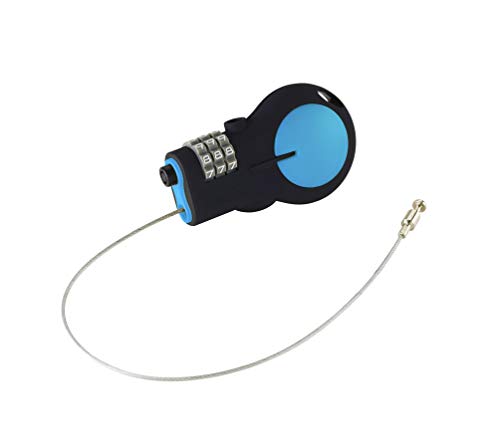
You can check its current price on Amazon here (Check price on Amazon).
I also keep a tracker in the camera bag (ours are Samsung SmartTags, since we’re an Android household). A tracker won’t prevent a theft, but it changes the first hour afterwards from guesswork to a map pin, and it’s equally useful when an airline mislays a checked tripod. I’ve compared the options in my guide to the best luggage trackers for travel.
Finally, spend ten minutes before you leave photographing your kit, its serial numbers and its receipts, and put the lot in a cloud folder. It costs nothing, and it’s the difference between a vague police report and a specific one. The same folder does double duty at customs, which is coming up shortly.
Insuring Camera Gear for Travel
Our camera kit is insured through our home policy rather than through travel insurance, and that wasn’t an accident. Once you read what travel policies actually say about cameras, it’s often the conclusion they themselves point you to.
Here’s the line that convinced me the industry agrees. True Traveller’s own policy wording says items of value “may be more appropriately covered under a household All Risks Section or a separate All Risks policy where the full replacement value may be insured”. When a travel insurer suggests a different product for your camera, take the hint.
The structural problem is that travel policies treat photographic equipment as a “valuable”, and valuables get capped twice: once per item, and again as a combined valuables total.
The per-item numbers vary by policy rather than being one published figure, so you’ll need to read your own Summary of Cover instead of trusting a comparison site.
Where numbers are published, they’re small. True Traveller’s gadget add-on covers £450 per gadget on its standard policy, or £750 on its top tier, for a maximum of three items. Staysure’s total baggage limits run from £300 on Basic to £2,500 on Comprehensive and £5,000 on Signature, with a £100 sub-limit for phones showing the general house style.
Set any of that against a professional body and lens worth £2,000 to £4,000, and Staysure’s Basic baggage limit wouldn’t replace one of my lenses.
So whatever policy you hold, these are the four clauses that decide whether you’re actually covered:
- The single-item limit. Find the per-item cap and compare it to your most expensive body or lens.
- The valuables total. Add up your kit and compare it to the combined cap, which is usually much lower than the headline baggage figure.
- The unattended and vehicle wording. Many losses happen from cars and luggage racks, exactly where cover is commonly excluded or restricted.
- Whether you’ve ever been paid. Aaduki, a specialist photographic insurer, draws the line at “any form of payment for your services” as the point where you should consider professional cover. If you’ve ever sold a print or shot a wedding for money, read your policy wording with that sentence in mind.
And one exclusion earns a special mention because it connects straight back to the gate-check problem. photoGuard, another specialist insurer, excludes “theft of an insured item whilst under the responsibility of a transport provider”. Read that twice: cover can vanish in the hold, at exactly the moment a gate agent makes you check the bag. So if a bag does have to go, take the batteries and the camera out first, and photograph what’s left inside it before you hand it over.
I’ve never had to make a claim on our policy for camera gear, and I’d like to keep it that way, so I treat insurance as the backstop rather than the plan. For the broader question of picking a policy in the first place, see our travel insurance guide for UK travellers.
Bringing Camera Gear Home: Customs and Proof of Ownership
There’s a quiet anxiety that comes with carrying several thousand pounds of kit through the “nothing to declare” channel: will anyone believe I owned all this before I left? The good news is that both the US and the UK have boring, free-of-drama answers, and neither involves buying anything.
If you’re a US resident, the tool is CBP Form 4457. Before you fly, you bring your gear to a CBP office, an officer compares the items against the form and signs it, and that’s your proof of prior possession on every future re-entry. Completing it is, in CBP’s own words, strictly voluntary, the certificate isn’t transferable, and it remains valid “for as long as the document is legible”.
If you’re returning to the UK or EU with your own gear, you’re covered by Returned Goods Relief, which relieves both import duty and VAT. The conditions are that the goods come back within 3 years, that the exporter and importer are the same person, and that they return in an unaltered state. Servicing and repairs are fine, but the goods “cannot have been upgraded to increase their value”, which contains a real trap for photographers: a lens serviced abroad comes home free, a body upgraded abroad is a new import.
There’s no monetary threshold to worry about; the gate is time, identity and condition. And if you’re ever asked to evidence any of it, invoices and receipts count as alternative evidence of export, which is precisely why that cloud folder of receipts and serial numbers from the theft section earns its place.
You may also run into mentions of the ATA carnet, a customs document for temporarily importing professional equipment. For a personal kit, you don’t need one: the London Chamber of Commerce charges £215 plus VAT to issue one for members (£355 plus VAT otherwise), on top of a security bond scaled to your gear’s value, destinations and trip length, all to solve a problem Returned Goods Relief solves for nothing. The carnet exists for “professional equipment used abroad under personal supervision”, meaning a working pro on a commercial shoot with a flight case, and if that’s you, you already have a production manager who knows about carnets.
Frequently Asked Questions About Travelling with Camera Gear
These are the questions I’m asked most often about moving camera kit around the world. If yours isn’t here, pop it in the comments and I’ll do my best to answer.
Can you take camera gear in hand luggage?
Yes, and you should. Cameras, lenses, memory cards and batteries all belong in the cabin, and spare lithium batteries are actually required to be there, as they’re banned from checked baggage worldwide.
The practical limit is weight rather than permission. European carriers can cap cabin bags as low as 8kg, which a camera bag reaches quickly, so check your airline’s number before you pack.
How many spare camera batteries can you take on a plane?
For standard camera batteries under 100Wh, regulators set no fixed quantity limit as long as they’re for your personal use. They must be in your cabin bag with the terminals protected against short circuits.
Individual airlines can and do set stricter caps, so if you’re planning to fly with a big stack of spares, check your carrier’s dangerous goods page first. Batteries between 100Wh and 160Wh are limited to two spares and need airline approval.
How many power banks can you take on a plane?
It depends where you’re flying. On international flights, an ICAO rule in force since 27 March 2026 caps most passengers at two, regardless of their capacity. Inside the US the FAA sets no quantity limit at all below 100Wh, so the binding constraint is whichever airline you’ve booked, and Southwest has allowed a single power bank per passenger since 20 April 2026.
Wherever you’re flying, they must travel in the cabin, you can’t recharge them during the flight, and you shouldn’t use them to charge other devices on board either. Anything over 160Wh doesn’t fly in passenger baggage at all, and 100 to 160Wh units need airline approval.
Do airport scanners damage digital cameras or memory cards?
The scanner warnings that exist from TSA, Kodak and Ilford all concern undeveloped film, not digital equipment. There’s no manufacturer or regulator warning about airport scanners harming digital sensors or memory cards.
I still recommend cards travel in your cabin bag, but that’s about theft and loss rather than scanners.
Can you take a tripod in hand luggage?
Sometimes, and that’s the problem: it varies by airport and airline, and security has the final say on the day. I’ve been made to go back and check mine exactly once, which was once more than I’d planned for.
If your tripod is full-size, the reliable plan is to pack it in checked luggage. A small tabletop tripod rarely raises an eyebrow.
Will I have to pay import duty on my own camera gear when I come home?
Not if you can show it’s yours. UK and EU residents are covered by Returned Goods Relief, which waives duty and VAT on your own equipment returning within 3 years in unaltered condition. US residents can register gear on CBP Form 4457 before departure for the same peace of mind.
In both cases, receipts, invoices and serial numbers are your evidence, so keep copies in a cloud folder you can open at the desk.
Does travel insurance cover camera equipment?
Usually yes, but with caps that fall well short of professional kit. Travel policies class cameras as valuables, with per-item and total-valuables limits that are often in the hundreds of pounds, and exclusions for unattended items, vehicles and gear in an airline’s care.
Check the single-item limit, the valuables total, the unattended wording, and whether any paid work voids your cover. For a camera worth thousands, a home contents policy with all-risks cover away from home is often the better instrument.
Can you take camera film through airport security?
Yes, but don’t let it go through the newer CT scanners, which Ilford and Kodak both confirm will damage unprocessed film at any ISO. Ask for a hand check instead. In the US the TSA explicitly recommends requesting one; elsewhere it’s at the discretion of security staff, so allow extra time.
Carry film in clear resealable bags to make inspection easy, and never put it in checked baggage, where the scanners are stronger still.
Further Reading
This guide is about moving your kit; these are the companion guides for choosing and using it.
- The best camera bags for travel – the full roundup, including low-key options that don’t advertise their contents
- My travel photography kit – exactly what I pack and why, including chargers and power
- Our photography gear – the complete list of what Jess and I shoot with
- The best memory cards for photography – speeds, reliability and which cards I trust
- The best ND filters for travel photography – small, fragile and very much cabin baggage
- The best luggage trackers for travel – for the bags that do go in the hold
- Travel insurance for UK travellers – the wider policy question beyond camera cover
And if you’d like to get better use out of the gear you’re now transporting so carefully, my online travel photography course covers everything from camera basics to post-processing.
Safe travels, and may your bag always be under the limit! If you’ve got a question about travelling with camera gear that I haven’t covered, pop it in the comments below and I’ll do my best to help.
Leave a Reply