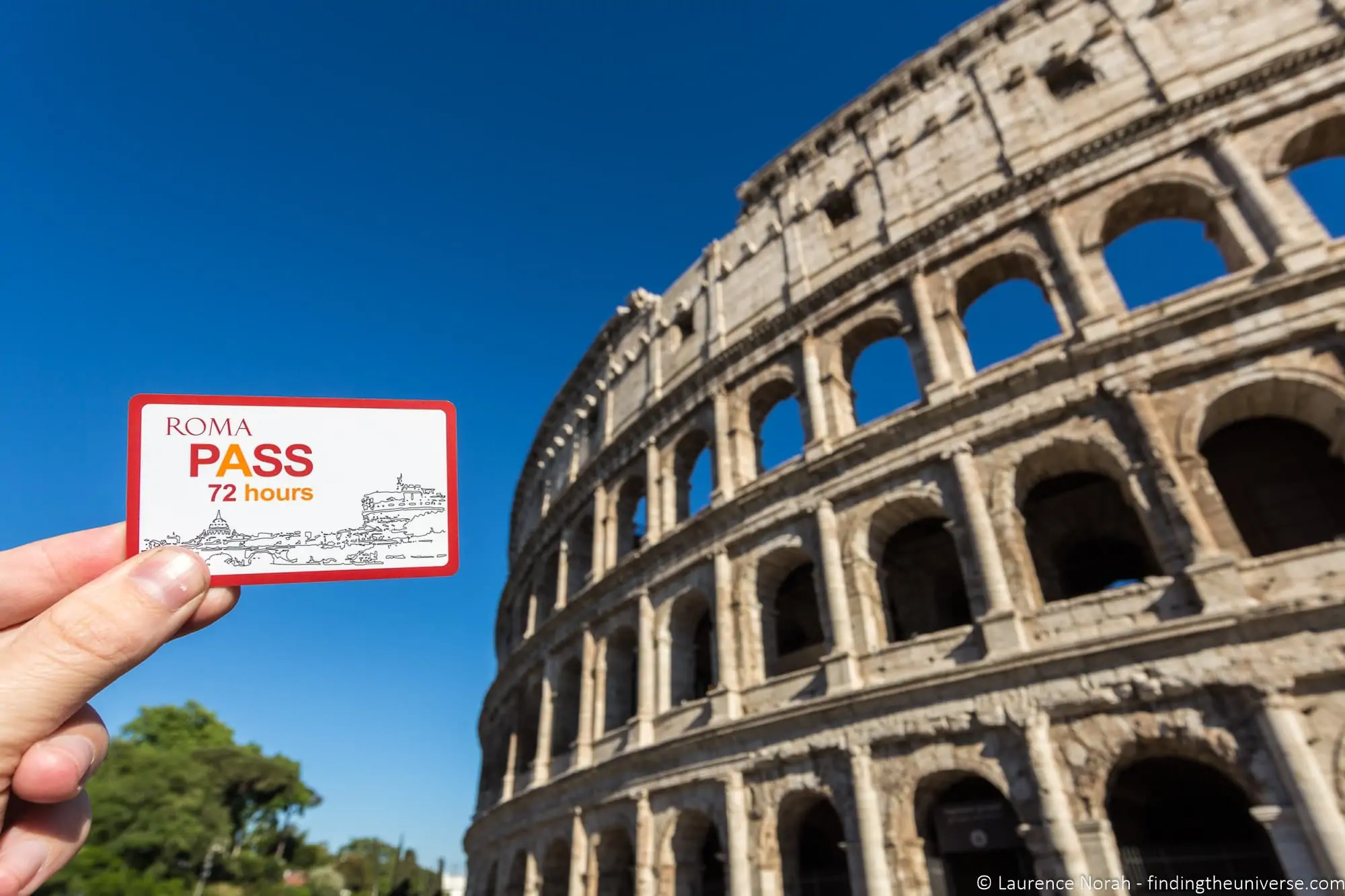
We bought the Omnia Vatican & Rome Card on one of our many trips to Rome (it cost us about €130 at the time), and on another visit we bought a Roma Pass on its own. So this is not a desk-research comparison. We’ve held these cards, used them for public transport, and stood in the timed-entry queue at the Colosseum working out whether they actually saved us anything.
The answer up front, because Rome pass advice online is a mess of affiliate funnels that bury the one thing you need to know: most first-time visitors don’t do enough paid sightseeing to make any pass pay off, and the ones who would benefit are usually sold the wrong card.
The names don’t help either. Roma Pass, Omnia, Go City, plus a handful of reseller bundles with near-identical names, and almost nobody tells you plainly which are official and which are marketplace repackages with a margin on top.
So let me do that first. Here’s the quick version, by the kind of trip you’re taking:
- First-timer doing the classic 2 to 3 day Colosseum, Vatican and Pantheon trip? Skip the passes and book those tickets directly. The maths almost never clears, mostly because no single official card covers both the Colosseum side and the Vatican.
- Doing the full Vatican and Catholic Rome (Vatican Museums, St John Lateran, the hop-on bus, plus a city day)? The Omnia Vatican & Rome Card (72-hour, €149) is the only pass that covers the Vatican and the city in one, and it’s the card we actually bought. But it only pays off if you do pretty much everything it covers.
- A civic-museum completist (Borghese, the Capitoline Museums, Castel Sant’Angelo, lots of transit, Vatican done separately)? The Roma Pass (72-hour, €62.90) pays for itself here, and almost nowhere else.
- Cramming four or more paid attractions or guided tours fast? Price up the Go City Rome Explorer Pass (from €89) against your list.
- Travelling with kids, or only doing one or two paid sites? Skip a pass entirely. Children’s tickets are cheap or free, and Rome’s centre is small enough to walk.
The rest of this guide is the working behind those calls: which companies run each pass, a side-by-side table, the real per-trip break-even maths, and the booking traps that catch people out even when they’re holding a valid pass. Prices are in euros and current as of September 2026.
Table of Contents:
Who actually runs each Rome pass
This may seem a bit inside baseball, but it’ll help make the rest of this guide make sense, so bear with me! Two of the passes in this guide are official. The rest are commercial products and resellers.
Roma Pass: the official city card
The Roma Pass is the official card of Roma Capitale, the city of Rome, run with the Italian Ministry of Culture. It covers Rome’s civic and state sites and the city’s public transport.
The big thing to understand, and the misunderstanding I see most often, is that the Roma Pass does not cover the Vatican.
The Vatican is a separate sovereign state, the Vatican Museums sell their own tickets, and no Roma Pass entry will get you in. Hold that thought, because it drives almost all of the maths later.
Omnia Vatican & Rome Card: the official Vatican-side bundle
The Omnia Vatican & Rome Card is run by Opera Romana Pellegrinaggi, the official pilgrimage agency of the Vicariate of Rome (part of the Holy See), in partnership with Roma Capitale.
The Omnia gets lumped in with Go City a lot, partly because you buy it through a Go City-linked site, but Go City doesn’t run it; the two are separate. That distinction matters: because Opera Romana Pellegrinaggi partners with the city, the 72-hour Omnia is able to bundle a real 72-hour Roma Pass inside it, which is what makes it the one card covering both the Vatican and the city. You can buy it at romeandvaticanpass.com.
One important catch, which trips a lot of people: there are two Omnia cards. The 72-hour card (€149) is the full one with the Roma Pass bundled. The 24-hour card (€69) is Vatican-focused and has no Roma Pass component at all. They are not the same product at half the duration, and I’ll come back to that.
Go City Rome Explorer Pass: the commercial pick-and-choose pass
The Go City Rome Explorer Pass is a commercial attraction pass, not an official city card. You pick a number of attractions (anywhere from 2 to 7), pay accordingly, and have 30 days from first use to get through them.
In most other cities where Go City operates, they also sell an all-you-can-visit “All-Inclusive” pass as well, but in Rome there’s only the Explorer (we compare the Go City passes across cities in our city-by-city Go City guide). We believe this is because GoCity handles the Omnia Vatican and Rome Pass, and an all-inclusive pass would directly compete.
We haven’t used the Go City explorer pass in Rome ourselves, so the section on it below is built from its current attraction list and pricing rather than first-hand use.
The reseller bundles (Turbopass, “Rome Tourist Card” and friends)
Search “Rome pass” and the top results are often none of the above. They’re third-party bundles with names like Turbopass, the “Rome Tourist Card” or the “Rome Essentials Pass,” sold through ticket marketplaces.
These “passes” basically package up the same Colosseum and Vatican tickets you’d buy anyway, usually with a markup, and dress it up as a single pass. Some are fine, none are essential, and you can almost always do better by buying the official cards or the individual tickets. I’m naming them so you recognise them in the search results, not because I’d point you at one.
Rome pass comparison: Roma Pass vs Omnia vs Go City
Here’s the side-by-side. The “Run by” column is the one to read first, because official versus commercial is the divide that actually matters.
| Pass | Run by | Price from | Validity | Vatican Museums? | Rome civic sites? | Public transport? |
|---|---|---|---|---|---|---|
| Roma Pass (48h) | Roma Capitale (official city card) | €38 | 48 hours | No | Yes (1 free entry + discounts) | Yes (unlimited, 48h) |
| Roma Pass (72h) | Roma Capitale (official city card) | €62.90 | 72 hours | No | Yes (2 free entries + discounts) | Yes (unlimited, 72h) |
| Omnia Vatican & Rome (72h) | Opera Romana Pellegrinaggi (Vatican) + Roma Capitale | €149 | 72 hours | Yes (+ Sistine Chapel) | Yes (bundled 72h Roma Pass) | Yes (Roma Pass + hop-on bus) |
| Omnia 24h | Opera Romana Pellegrinaggi (Vatican) | €69 | 24 hours | Yes (+ Sistine Chapel) | No (no Roma Pass) | Hop-on bus only |
| Go City Rome Explorer | Go City (commercial pass company) | €89 (2 attractions) | 30 days from first use | Via a guided-tour option | Some (from its own list) | Hop-on bus is an option |
| Reseller bundles (Turbopass, “Rome Tourist Card”) | Third-party marketplaces | Varies | Varies | Repackaged tickets | Repackaged tickets | Varies |
The Omnia 72-hour price flexes a little with promotions, and the Go City “from €89” is the 2-attraction tier, rising to €204 at 7 attractions. The Roma Pass prices are fixed and official.
Does a Rome pass actually save you money? The break-even maths
This is the bit the affiliate funnels never do, because the honest answer often loses them a sale. I’ll build it from the real à la carte prices, then run it against the kind of trip you’re taking.
The headline numbers you’re working against, all current as of September 2026:
- The Colosseum, Roman Forum and Palatine combined ticket is €18 (the timed slot has to be booked online, even with a pass).
- The Vatican Museums and Sistine Chapel are €20 at the door, or €25 booked online to skip the ticket queue.
- The Pantheon is €7 to go inside (the price rose from €5 on 1 July 2026).
- A single ATAC public transport ticket is €1.50, valid for 100 minutes.
- Rome’s other big civic sites (the Borghese Gallery, Capitoline Museums, Castel Sant’Angelo and so on) mostly run between €5 and €20 each.
Notice what that means before we even pick a scenario. Rome’s centre is walkable, so transport rarely adds up to much. I can count on one hand the number of times I’ve opted to take public transport over walking in Rome. But if you do opt for public transport for some journeys, even a fairly active three days is maybe six to ten single tickets, so €9 to €15.
This means that while the “free unlimited transport” that resellers lean on hard is real, in reality it’s a small part of the value.
And because the two free entries on a Roma Pass are capped at two no matter how much you see, you need those two to be expensive sites for the card to clear its price on entries alone. In practice that means planning your days around the pass instead of around Rome, which is probably more hassle than it’s worth.
Scenario 1: First-timer, 2 to 3 days, Colosseum + Vatican + Pantheon
This is the most common Rome trip by a wide margin, and it’s the one where a pass usually doesn’t pay. À la carte you’re looking at the Colosseum (€18), the Vatican (€25 online), the Pantheon (€7) and a handful of transport tickets (call it €9). That’s around €59.
Now try to beat it. The Roma Pass can’t cover the Vatican, so even the cheaper 48-hour card (€38) still leaves you buying the €25 Vatican ticket and the €7 Pantheon yourself, which lands you at €70. That’s more than just buying everything individually! The Omnia (€149) covers the lot, but you’d be paying €149 to save yourself a €59 outlay, which only makes sense if you bolt on a lot more Vatican-side sightseeing.
So for the classic first-timer trip, skip the passes. Book the Colosseum and Vatican tickets directly, walk to the Pantheon, and put the difference towards a food tour or some very good gelato.
Scenario 2: The full Vatican and Catholic Rome trip
This is where the Omnia stops looking so expensive. If your trip is built around the Vatican Museums and Sistine Chapel, plus St John Lateran, the Mamertine Prison, the hop-on-hop-off bus to get between them, and then a city day using the bundled Roma Pass for the Colosseum and one more civic site, the à la carte total climbs past €149 quite quickly once you add the bus and the audio guides.
This is the card we bought, for roughly this kind of trip. It cost us about €130 at the time (it’s €149 now). It paid off for us because we did the full Vatican day plus the Colosseum on the bundled Roma Pass, and the hop-on bus really did save our legs across a hot few days.
What I’d flag: the bus is the slow, scenic kind, the audio-guide content is fine rather than essential, and you have to actually use most of the components for the maths to work. If you’d skip the bus and St John Lateran (as many people do), you’re paying for things you won’t touch.
So this is the trip where the Omnia 72-hour card is more likely to be the right pass, and it’s the only one that covers both the Vatican and the city. Just make sure you want the full Vatican-side programme rather than only the Museums.
Scenario 3: The civic-museum completist
If you’re the kind of traveller who wants the Borghese Gallery, the Capitoline Museums, Castel Sant’Angelo, the Baths of Caracalla and a stack of smaller sites, and you’re doing the Vatican separately or not at all, the Roma Pass is finally in its element. The 72-hour card (€62.90) gives you two free entries plus discounts on everything after, and unlimited transport to ferry you between sites that are a fair way apart.
The trick is to spend your two free entries on the priciest things you’ll visit. Use one on the Colosseum and one on the Borghese, say, then take the discounts on the rest. We bought the Roma Pass on its own for exactly this kind of museum-heavy stretch, and it earned out, mostly on the discounts and the not-thinking-about-transport convenience rather than the two free entries alone.
That makes the Roma Pass 72-hour your card, used deliberately on expensive sites. If you’ll only see one big civic site, drop to the 48-hour (€38) or skip it.
Scenario 4: The attraction and tour hopper
If your idea of Rome is doing a lot, fast, and a chunk of it is guided experiences, open-bus tours and bookable attractions rather than the state museums, the Go City Rome Explorer Pass is the one to price up. You pick the number of attractions, and the per-attraction cost of course drops the more you bundle. From €89 for two, up to €204 for seven, with 30 days to use them.
The catch, and the reason I’d price it carefully rather than assume: it only wins if the attractions you’d actually visit are on Go City’s Rome list, and if you’d have paid for most of them anyway. We haven’t used it in Rome ourselves, so I’d treat its own attraction list as the thing to check before you buy, not the marketing total. For the standard Colosseum-and-Vatican trip it’s usually not the cheapest route.
If you’re doing four or more paid attractions or tours, price up the Go City Explorer Pass against your own list. Otherwise the official cards or individual tickets win.
Scenario 5: Budget trip, short stay, or travelling with kids
If you’re in Rome for a couple of days, walking everywhere, and only paying to enter one or two sites, no pass will beat buying those one or two tickets. And families should do the sums carefully before buying any pass, because children get reduced or free entry at most Rome sites, and under-18s of any nationality go free at Italy’s state museums, so the per-person pass price often doesn’t add up for kids.
So skip the pass, buy the handful of tickets you need, and spend the rest on the city itself.
A pass does not skip every queue: the booking reality
This catches people out constantly, so let me be blunt. A Rome pass gets you admission. It does not automatically get you a time slot, and at the headline sites you cannot get in without one.
The Colosseum needs a timed-entry slot that is mandatory even for Roma Pass holders, and you book it online. Slots are capped and the popular times sell out, so book a couple of weeks ahead rather than turning up on the day. Our full guide to visiting the Colosseum walks through exactly how the slots work.
The Vatican Museums require timed entry too, even with the Omnia. You reserve a date and time and receive an official Vatican voucher, usually within 24 hours of your slot, which you need to get in. Don’t leave this to the morning of your visit.
The Borghese Gallery is the one that surprises people. It can be one of your two free Roma Pass entries, and is therefore covered by the Omnia’s bundled Roma Pass too, but it still needs a separate mandatory timed reservation with a €2 booking fee, even with the pass. It runs a handful of two-hour slots a day with a hard cap, and they vanish fast, so book it the moment you know your dates.
So the pass saves you the ticket-buying step at the sites it covers, and at busy sites it can save you the longer general queue. It does not let you walk up and stroll in unbooked.
What trips people up when buying a Rome pass
A few patterns we’ve picked up, from our own trips and from watching other people get caught out:
- It’s easy to overvalue the free transport. It’s a real perk, but Rome’s centre is compact and you’ll walk most of it, so across three days the transport you’d actually buy is rarely more than €15. Don’t let it tip a pass decision on its own.
- Don’t assume the Roma Pass covers the Vatican. It doesn’t, ever, so if your trip is Vatican-heavy the Roma Pass on its own is the wrong card.
- Don’t buy the €69 Omnia 24h thinking it’s a cheaper version of the €149 card. It’s a different, Vatican-only product with no Roma Pass inside, and it’s the mistake we very nearly made ourselves!
- Be wary of a reseller “Rome Tourist Card” just because it ranked first. It’s a marketplace bundle, not the official Roma Pass, and you’re usually paying a margin for one tidy checkout.
- Don’t assume a pass means no planning. The timed slots are the real constraint, not the tickets, so the pass you buy matters far less than booking the Colosseum and Vatican slots early.
So which Rome pass should you buy?
If I had to compress three days of pass-juggling into four lines: most first-timers should buy individual tickets and not bother with a pass. If you’re doing the full Vatican-and-city programme, the Omnia 72-hour card is the only one that covers both, and it’s the one we bought. Just prepare to do a little planning with your itinerary so you get the benefit of the highest value attractions the Roma Pass includes.
If you’re a civic-museum completist skipping or separating the Vatican, the Roma Pass 72-hour is your card. And if you’re hammering through a lot of bookable attractions and tours, price up the Go City Explorer Pass against your actual list before you commit.
Whichever way you go, book your Colosseum and Vatican time slots as early as you can. That single decision will do more for your trip than the pass ever will. If you want the deeper background reading, the Rick Steves Italy guidebook is the one we keep going back to for Rome planning.
Frequently asked questions
What’s the difference between the Roma Pass and the Omnia Card?
The Roma Pass is the official city card of Rome (Roma Capitale). It covers the city’s civic and state sites plus public transport, but not the Vatican.
The Omnia Vatican & Rome Card is run by the Vatican’s pilgrimage agency in partnership with the city. The 72-hour Omnia covers the Vatican Museums and Sistine Chapel and bundles a full Roma Pass inside it, which is why it’s the only card that covers both the Vatican and the city.
Does the Roma Pass include the Vatican?
No. The Vatican is a separate sovereign state and the Vatican Museums sell their own tickets, so no Roma Pass entry will get you in.
If you want one card for both the Vatican and Rome’s city sites, you need the 72-hour Omnia Vatican & Rome Card, which has a Roma Pass built into it.
Is the Roma Pass worth it?
For most short first-time trips, no. The free entries are capped at two, so unless you spend them on expensive sites and visit several more, you won’t clear the €62.90 price of the 72-hour card on entries alone.
It’s worth it if you’re a museum-heavy visitor doing several of Rome’s pricier civic sites, where the free entries, the discounts and the unlimited transport add up. Use it deliberately, not as a default.
Is the Omnia Card worth it?
It’s worth it for one specific trip: the full Vatican-and-city programme using the Vatican Museums, the hop-on bus, the extra basilicas and the bundled Roma Pass for the Colosseum and one more site. We bought it for roughly that trip and it paid off.
It’s poor value if you only want the Vatican Museums, or if you’d skip the bus and the extra sites. In those cases buy the individual Vatican ticket instead.
Do I still need to book timed slots if I have a pass?
Yes. A pass covers admission, not your entry time. The Colosseum and Vatican Museums both require a mandatory timed slot booked online even with a valid pass.
Popular slots sell out, so book the Colosseum and Vatican a couple of weeks ahead. The Borghese Gallery needs its own separate timed reservation and €2 fee on top, even when a pass covers admission.
Which Rome pass is best for first-timers?
For a standard 2 to 3 day first visit built around the Colosseum, the Vatican and the Pantheon, the best option is usually no pass at all: book those tickets directly and walk between the rest.
A pass only starts to make sense once you’re either doing the full Vatican-side programme (the Omnia) or visiting several of Rome’s pricier civic museums (the Roma Pass).
Is the Rome Tourist Card the same as the Roma Pass?
No. The Roma Pass is the official card run by the city. The Rome Tourist Card, along with names like Turbopass and the Rome Essentials Pass, are third-party bundles sold through ticket marketplaces.
They repackage the same Colosseum and Vatican tickets you could buy yourself, usually with a markup, and they aren’t the official Roma Pass.
How much are the Colosseum and Vatican without a pass?
The combined Colosseum, Roman Forum and Palatine ticket is €18, booked online. The Vatican Museums and Sistine Chapel are €20 at the door, or €25 booked online to skip the ticket queue.
So the two headline sites together cost €43 booked online, which is the number to beat when weighing up any pass.
Does any Rome pass cover the Borghese Gallery?
Sort of. The Borghese Gallery can be one of your two free Roma Pass entries, which means it’s covered by the Roma Pass and by the Omnia’s bundled Roma Pass.
The catch is the booking. The Borghese requires its own separate, mandatory timed reservation with a €2 fee, even when a pass covers the admission. It runs only a handful of two-hour slots a day with a hard cap, and they sell out fast, so reserve it the moment your dates are set.
Roma Pass 48 hours or 72 hours?
The 48-hour card (€38) gives one free entry plus transport and discounts; the 72-hour card (€62.90) gives two free entries. The extra €24.90 only makes sense if your second free entry is an expensive site you’d visit anyway.
If you’re only doing one big civic site, take the 48-hour. For two or more pricey ones across three days, the 72-hour wins.
Further reading for your Rome trip
A few of our other Rome guides that pair well with this one:
- Is the Go City pass worth it? Our city-by-city verdict for how the Go City passes stack up beyond Rome.
- Our complete guide to visiting the Colosseum, including how the timed slots work.
- How to see Rome in a day if you’re tight on time.
- Our 2-day Rome itinerary and 3-day Rome itinerary for full day-by-day plans.
- The best food tours in Rome and where to find the best gelato for when you’ve had enough of museums.
Leave a Reply