
I’ve been brewing coffee on the road for about as long as I’ve been travelling full time, which is a good while now. I used a moka pot for a year when I lived out of a Toyota Landcruiser on a camping road trip around Australia, then a year in New Zealand.
These days the AeroPress in the photo below has been to more countries than I care to remember, and a little stainless steel coffee straw called the JoGo has come with me all around Europe because it weighs nothing and lives in a side pocket.
I’m a professional travel photographer, which mostly means I’m up before sunrise standing in a field waiting for the light, long before any café is open. At that hour, decent coffee is the difference between getting the shot and going back to bed.
Our recommendations below are based on what Jess and I actually pack, what we’ve tried (and given up on), and what has survived years of being dropped, packed wet, and shoved in the bottom of a suitcase.
I’ve organised our recommendations two ways: a grid that matches a brewing method to how you’re travelling, then a pick-by-pick rundown with current prices and weights. If you want one sentence to take away, it’s this: for most travellers, most of the time, the AeroPress is the best travel coffee maker there is, and almost everything else here is about the cases where it isn’t.
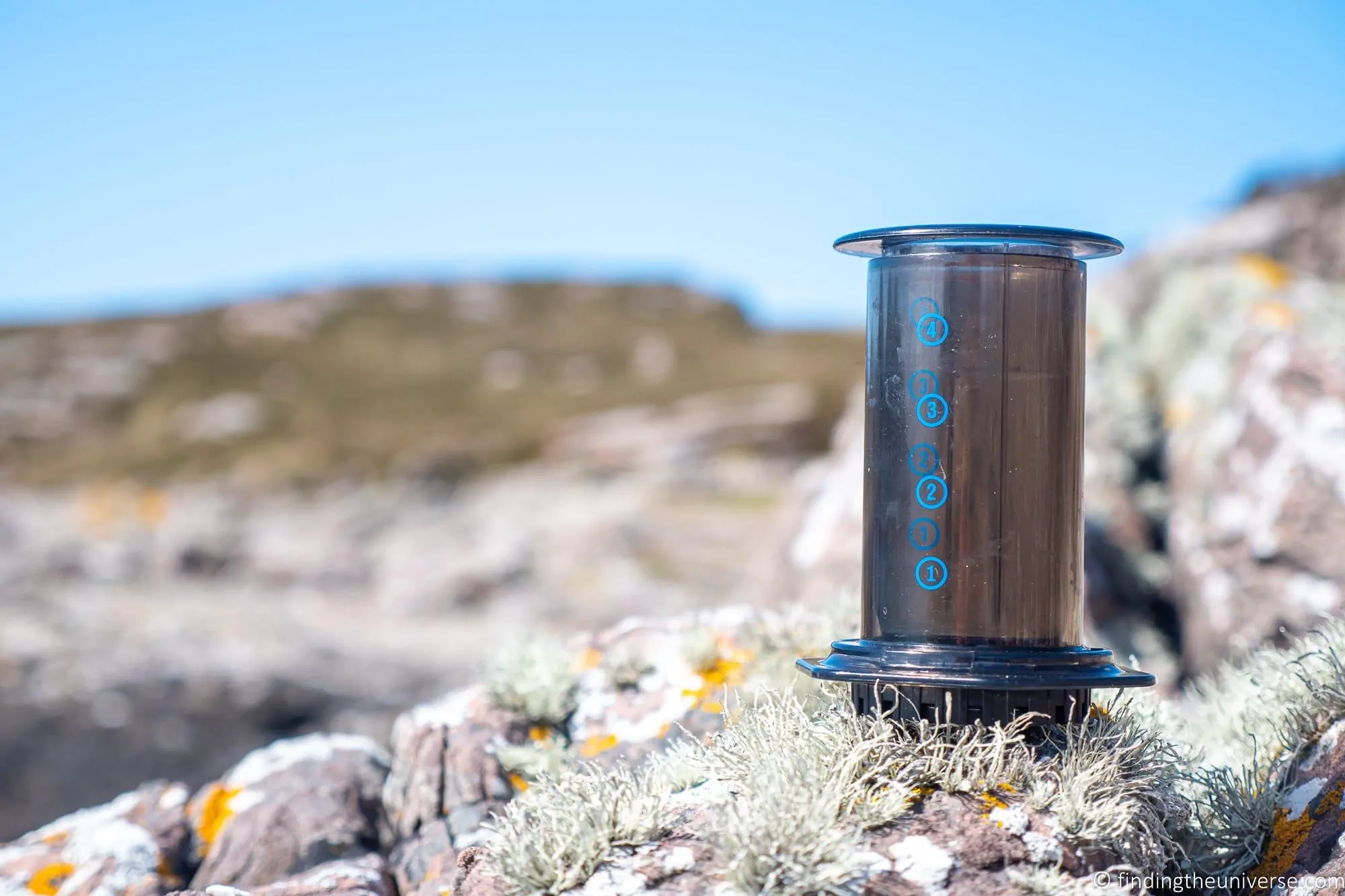
The quick version, if you’re in a hurry. Best all-rounder: the AeroPress. Best real espresso without a plug socket: the Wacaco Nanopresso. Lightest thing that makes coffee at all: the JoGo coffee straw. Best for a campervan or a campsite with a hob: the GROSCHE Milano moka pot. Best for a hotel room: an AeroPress and the kettle that’s almost always already there. Everything below is the detail behind those calls.
Table of Contents:
The Best Travel Coffee Makers at a Glance
There are two usual ways to sort travel coffee makers, and each leaves you half-stuck. You can sort by brewing method (espresso, pour-over, French press) and ignore how you’re actually travelling, or you can sort by trip type (backpacking, camping) and end up steered towards one brand. A real decision crosses both. You’ve usually settled on roughly what coffee you want and roughly how you’re travelling, and you want the maker that sits where those two lines meet.
So here’s the grid I wish someone had handed me years ago. Find your brewing method down the side, your kind of trip across the top, and the maker in that cell is the one I’d pack.
| Method | Backpacking | Hotel room | Campervan / road trip | Camping | Carry-on, no power |
|---|---|---|---|---|---|
| Espresso | Wacaco Nanopresso | Nanopresso | Nanopresso (or an electric maker if you have 12V) | Nanopresso | Nanopresso* |
| AeroPress / immersion | AeroPress Go | AeroPress Original or Clear | AeroPress Original | AeroPress Go | AeroPress Go* |
| Pour-over | Kuissential SlickDrip | SlickDrip | SlickDrip | SlickDrip | SlickDrip + filters* |
| French press | Heavy, I’d skip it | Bodum Travel Press | Bodum Travel Press | Bodum Travel Press | Bodum Travel Press* |
| Moka pot | No (needs a stove) | No (no hob) | GROSCHE Milano | GROSCHE Milano | No |
| Instant / no kit | JoGo straw or instant | Instant | JoGo straw | JoGo straw | JoGo straw or instant |
A note on the asterisks and the blanks, because they matter. Anything marked with a * still needs hot water from somewhere, a café, a plane galley, a kettle in the room, so on a long flight you’re relying on cabin crew handing you a cup of hot water.
The blanks are deliberate. A moka pot simply can’t work without a heat source, so it has no place in a hotel room or a carry-on. A French press is real glass-free coffee but it’s bulky and heavy, so I leave it off the backpacking list on purpose. Showing you where a method does not fit is half the value of a guide like this.
Here’s the same set of picks laid out by the numbers, so you can compare weight, what they need to run, and what they currently cost. Prices are shown live where possible, in US dollars; I haven’t added currency conversions, because exchange rates move.
| Maker | Type | Power needed | Packed weight | Makes | Price |
|---|---|---|---|---|---|
| AeroPress Original | Immersion | None (add hot water) | 220 g (7.75 oz) | 1 to 2 cups | Check price on Amazon |
| AeroPress Go | Immersion | None (add hot water) | 323 g | 1 cup | Check price on Amazon |
| Wacaco Nanopresso | Manual espresso | None (hand pump) | 336 g | 1 shot (80 ml) | Check price at Wacaco |
| Bodum Travel Press | French press mug | None (add hot water) | Not listed | 15 oz / 0.45 L | Check price on Amazon |
| GROSCHE Milano | Moka pot | Hob (not induction) | Not listed | 6 espresso cups | Check price on Amazon |
| JoGo CoffeeStraw | Steep and sip | None (add hot water) | 1 oz / 28 g | 1 cup | Check price on Amazon |
| Kuissential SlickDrip | Pour-over cone | None (add hot water) | 227 g (0.5 lb) | 1 to 2 cups | Budget |
| Chulux travel maker | Single-serve pods | Mains power | 1.09 kg (2.4 lb) | 1 cup | Check price on Amazon |
AeroPress: The Best All-Round Travel Coffee Maker
If you make me pick one, it’s the AeroPress, and it’s not close. I’ve travelled with mine for years (the photos in this article are my own kit, not stock shots), and it does the thing no other maker on this page manages: it makes really good coffee, it’s close to unbreakable, it weighs very little, and you clean it by pushing the puck into a bin and rinsing the rubber seal.
That last point sounds minor until you’ve tried to clean a cafetière in a hostel bathroom with no sink plug!
The reason it gets its own section, rather than a line in the grid, is that the AeroPress is no longer one product. The line has grown a lot. It’s easy to picture the AeroPress as it was back in 2019, when the Go was the only real travel option, but that’s well out of date now. Here’s the current line-up, with the specs straight from AeroPress, so you can see which one actually suits your trip.
| Model | Brews | Material | Packed weight | Price | Best for |
|---|---|---|---|---|---|
| Original | 10 oz, 1 to 2 cups | Polypropylene | 7.75 oz | Check price on Amazon | The default. Cheap, light, proven |
| Original XL | 20 oz (~591 ml), 2 to 4 cups | Polypropylene, Tritan carafe included | Not listed | Check price on Amazon | Two of you, or one big cup |
| Go | 8 oz, 1 cup | Polypropylene + silicone | 11.4 oz / 323 g | Check price on Amazon | Backpacking, packs into its 15 oz mug |
| Go Plus | 10 oz, 1 to 2 cups | Tritan + insulated stainless tumbler | 0.56 kg | Check price on Amazon | You want the coffee to stay hot |
| Clear & Colors | 10 oz, 1 to 2 cups | Tritan (see-through) | Not listed | Check price on Amazon | The Original, in clear plastic |
| Clear XL | 20 oz, 2 to 4 cups | Tritan | Not listed | Check price on Amazon | The XL, in clear plastic |
| Steel | 12 oz (360 ml), 1 to 2 cups | 304 stainless, vacuum-insulated | Not listed | $169.95 direct | Near-bulletproof and insulated |
| Premium | 10 oz, 1 to 2 cups | Borosilicate glass + steel + aluminium | Not listed | Check price on Amazon | A handsome home brewer, not for travel |
My advice on which to buy is short. For almost everyone reading a travel guide, the standard AeroPress Original is the one to get. It’s the cheapest, the lightest of the full-size models, and it does everything. If you’re counting grams for a long hike, the AeroPress Go packs down into its own mug, which is a lovely bit of design, though you give up a little brewing capacity for it. The Go Plus is worth the extra if you want your coffee to stay hot in a cold campervan.
The two I’d steer most travellers away from are the ones the marketing pushes hardest. The Steel is a beautiful object and very nearly indestructible, but it costs more than four Originals, and I’ve never managed to actually break an Original in years of abuse.
The Premium, despite the price, has a borosilicate glass chamber and is hand-wash only. It’s a gorgeous thing for your kitchen and the wrong tool for a rucksack. I haven’t travelled with either the Steel or the Premium myself, so I’m going on the specs and the design rather than lived experience there.
Because the AeroPress deserves more than I can give it here, I’ve written a full AeroPress review that goes model by model, covers the recipes I actually use on the road, and gets into the inverted-brew debate. If you’ve settled on an AeroPress and just want to know exactly which one and how to get the best out of it, start there.

The Best Manual Espresso Maker for Travel: Wacaco Nanopresso
If what you miss on the road is a proper short, thick espresso rather than a mug of filter coffee, the maker to get is the Wacaco Nanopresso (also on Amazon). It’s a hand-pumped espresso maker about the size of a large pepper grinder, it weighs 336 g, holds 80 ml of water, and the redesigned pump pushes up to 18 bar of pressure, which is enough to pull a shot with real crema.
There’s a catch, and it tends to get glossed over. You still need hot water, and you need to grind fine and tamp evenly, so it’s a bit more faff than dropping a pod in a machine. But it needs no power at all, it cleans up in seconds, and a Nanopresso plus a small hand grinder is the only way I know to get café-standard espresso in a tent.
Wacaco make a confusing number of models now. The older Minipresso is fine but the Nanopresso superseded it, the Picopresso is a step up for enthusiasts who want a naked portafilter, and the Cuppamoka is a pour-over rather than an espresso maker, so don’t get them muddled.
One question I get a lot is whether there’s an electric version, for people who travel by campervan or car and have a 12V socket to play with. There is. Wacaco added the battery-powered Pixapresso to the range in 2025, and there are self-heating 12V machines from brands like Conqueco that both pump and boil from a battery. They’re heavier and pricier and another thing to charge, so I’d only bother if you have reliable power and really can’t face hand-pumping.
If you do travel with any battery-powered maker, pack the spare lithium battery in your carry-on rather than your checked bag, which is the airline rule for loose lithium cells.

The Best Travel Pour-Over: A Collapsible Dripper
Pour-over is my favourite way to make coffee when I have the space and a couple of spare minutes, because it’s forgiving, easy to clean, and makes a clean cup. At home we have a Chemex pour over, but the all glass construction and size mean it isn’t a practical option for the road.
For travelling, the one I reach for is a collapsible silicone dripper. The Kuissential SlickDrip folds flat to under an inch, costs very little, and makes one to two cups, which makes it the easiest pour-over to justify packing whatever the trip. You do need to carry paper filters for it, which is the one real trade-off, but it disappears into a pack in a way a rigid dripper never will. It’s not a thing of beauty and it won’t last a decade, but it’s a clever bit of cheap kit that has earned its place in my bag.
For years my pick here was the Stanley Classic Perfect-Brew Pour Over Set, a stainless steel cone with a built-in reusable filter that sat on top of a 12 oz camp mug, so there were no paper filters to run out of. It’s still a lovely bit of kit if you already own one, but Stanley have wound the set down and it’s now hard to find in stock, so I can’t point you at a reliable place to buy it. If a reusable metal filter matters more to you than pack size, that’s the feature to shop for.
The Best Travel French Press: Bodum Travel Press
If you like a fuller-bodied, French press style coffee, the Bodum Travel Press is the long-standing answer and still the one I’d buy. It’s a vacuum-insulated, double-walled stainless steel mug with a plunger built into the lid, it holds 15 oz (0.45 L). You spoon in grounds, add hot water, wait, plunge, and drink straight from the same vessel, which means there’s nothing extra to wash up.

Two caveats. The lid isn’t fully leak-proof, so I wouldn’t throw it in the top of a bag mouth-down and expect to stay dry. And like any French press it puts a little sediment in the bottom of the cup, which some people love and some don’t. It’s heavier than an AeroPress and makes a different, muddier style of coffee, so this is a pick for people who specifically want French press rather than a default recommendation. If that’s you, buy it.
The Best Travel Moka Pot: GROSCHE Milano
There’s something about a stovetop moka pot bubbling away that no plastic gadget quite matches, and if you’re travelling somewhere with a hob, the GROSCHE Milano is a brilliant, affordable way to make strong, espresso-style coffee for more than one person. It’s a classic aluminium moka pot, and the 6-cup makes six small espresso-sized servings. For a campervan with a gas hob, a campsite with a camp stove, or a self-catering flat, it’s easily my favourite way to make coffee for a group.
The important thing to know, and the question a reader asked me years ago that still comes up, is induction. The standard Milano is aluminium, and aluminium doesn’t work on an induction hob. GROSCHE themselves are clear that it runs on gas, electric, propane, and glass stovetops but not induction. If your campervan or holiday flat has an induction hob, GROSCHE sell a Milano Induction version with a stainless steel bottom chamber that brews on every stovetop type including induction, or you can put a small magnetic adapter disc under an aluminium pot. On a gas camp stove, which is of course what most campers actually have, you’re fine.

The Lightest Option: JoGo CoffeeStraw and Instant
This is the one that surprises people. The JoGo CoffeeStraw is a stainless steel straw with a fine mesh filter on the end. You tip ground coffee straight into a cup, add hot water, let it steep, and then drink through the straw, which filters the grounds as you sip. It weighs 1 oz and is made of food-grade stainless steel and silicone. There’s nothing to assemble and nothing to break.
I’ve carried mine all around Europe, precisely because it weighs nothing and takes up no room. It lives in a pocket of my camera bag and comes out on train journeys and in hotel rooms where I can’t be bothered to set anything up.
Is the coffee as good as an AeroPress? No. You get a slightly heavier cup and the occasional fine grain through the mesh. But for the weight and the simplicity, nothing else comes close, and it’s the answer to all those searches for the lightest or smallest travel coffee maker.
And the lightest option of all is good instant coffee and no equipment whatsoever. Instant has come a long way, the better freeze-dried sachets and the Starbucks Via-style sticks are perfectly drinkable, and on a fast-moving trip where I’m changing location every day I’ll sometimes just take those and the JoGo straw and call it done. There’s no shame in it!

The Best Single-Serve Maker: Chulux for Hotel Rooms
If you want to drop a pod in, press a button, and have coffee with zero technique, and you’ll be somewhere with a mains socket, a small single-serve maker like the Chulux travel coffee maker does the job. It takes standard K-Cup style pods, sits happily on a hotel desk, and asks nothing of you. Prices vary depending on the model, and the line rotates fairly often, so check you’re buying a current version.

This is not how I travel. It only works where there’s power, it’s the bulkiest thing here for the coffee it makes, and pods generate a lot of waste for one cup. But I include it because plenty of readers just want the no-effort option, and for a work trip lived out of one hotel room it’s a reasonable shout. If you go this route, you’ll also want a supply of coffee pods that fit it.
Coffee Accessories for Travel
The maker is only half of it. A few small extras make a real difference to the coffee you actually get, and these are the ones that travel with me.

A Hand Grinder
Coffee is best ground just before you brew it, and a small hand grinder lets you carry beans rather than a bag of grounds that goes stale. The JavaPresse manual grinder is the budget classic, cheap and reliable, with an adjustable ceramic burr. If you’re already an AeroPress devotee and want to go further, AeroPress now make their own GP100 Manual Grinder, with 60-plus grind settings and burrs that store inside the plunger, though it’s a serious purchase for serious coffee people only. For most travellers the JavaPresse is plenty.
An Insulated Travel Mug
If you’re making coffee to take with you, a good insulated mug keeps it hot for hours. The Contigo Stainless Steel Travel Mug with its AUTOSEAL lid is the one I trust not to leak in a camera bag, which is high praise given what else is in there. Contigo have updated the line over the years, so the current West Loop is the model to look for.
A Milk Frother
If you can’t do without a flat white or a latte, a tiny battery-powered handheld milk frother like the Café Casa weighs almost nothing and froths warm milk in seconds. It’s a small luxury, but for the size and price it’s an easy one to justify.
A Way to Heat Water
Almost every maker here needs hot water, and you can’t always rely on the room having a kettle. A collapsible travel kettle folds down flat and boils a couple of cups, which is ideal for hotel rooms abroad. Check the voltage before you buy, as many are single-voltage and won’t work or will be damaged on the wrong supply, so look for a dual-voltage model if you cross between regions.
For the absolute minimalist, a small travel water heater (an immersion element you drop into a mug) takes up almost no space, though it needs a little care to use safely.
The Coffee Itself
Whatever you brew with, it’s only as good as what goes in it. I tend to carry a small bag of whole beans and the hand grinder for trips where I have a bit of time, and switch to good instant sticks or pre-ground coffee for fast-moving trips. A great maker with stale supermarket grounds still makes mediocre coffee, so this isn’t the bit to skimp on.
How to Choose a Travel Coffee Maker
If you’re still weighing things up, these are the factors that actually decide it, roughly in the order they matter on the road.
Power is the first question, not the last. If you can’t guarantee a socket or a hob, you need a manual maker, which rules out pod machines and electric espresso makers and leaves you the AeroPress, the Nanopresso, a pour-over, a French press, or the straw. Almost everyone overestimates how much reliable power they’ll have on a trip.
Weight and packed size come next, so be honest about how you’re travelling. For backpacking, grams and pack space beat everything, and the Go, the SlickDrip, or the JoGo straw win. For a campervan or a car, you can carry a moka pot and a grinder and barely notice the difference.
Then there’s the coffee you actually want, because a moka pot and a French press make very different drinks. Decide first if you’re after espresso, filter, or immersion coffee, as no single maker does all three well.
Ease of cleaning sounds trivial at home and becomes the whole game on the road, where you might be washing up in a campsite sink or a tiny hotel bathroom. The AeroPress and the straw win here by a mile, and a French press is the fiddliest of the lot.
Durability matters more than people expect, because glass and travel don’t mix. That’s why I steer people away from the glass AeroPress Premium for trips. Plastic and stainless steel put up with being dropped, sat on, and packed away wet, which they will be.
Price, finally, is rarely the problem. Most of the best options here are cheap, between roughly $25 and $65, and you don’t need to spend four times as much on a stainless AeroPress to get excellent coffee while travelling. Spend the difference on better beans.

Four Rules for Coffee on the Road
After years of carrying coffee kit through airports and into campsites, a few lessons have stuck, and they’re pretty much the opposite of what I assumed when I started.
The first is that the simplest thing usually wins. The maker I reach for most is the one I can use and clean without thinking, half asleep, before dawn, not the most capable one in the cupboard. That’s the AeroPress most days and the JoGo straw when I’m moving fast. The clever multi-function gadgets we tried over the years mostly stayed home after one or two trips because they were a hassle to clean.
The second is to plan around power, not assume it. The number of times we’ve arrived somewhere expecting a kettle or a working socket and found neither has taught us to default to manual makers and carry our own way to heat water. If your whole coffee setup falls apart without a plug, it’s too fragile for travel.
The third is that glass and fussy parts don’t belong in a bag. We’ve lost exactly one coffee maker to breakage, and it was glass, and that was the day I stopped travelling with anything breakable. Stainless steel and good plastic shrug off the abuse that travel hands out.
And the last, which matters more than any piece of kit, is that good coffee on a trip is worth the small effort. As a photographer I’m up in the dark more often than not, and a proper cup made the way I like it, standing in the cold waiting for the sun, is one of the real pleasures of the job. That’s reason enough to carry the gear.
Frequently Asked Questions
What is the best travel coffee maker overall?
For most travellers, the AeroPress is the best travel coffee maker. It makes really good coffee, weighs very little, is close to unbreakable, and cleans up in seconds, which is the combination that matters most on the road.
The main reasons to choose something else are specific: you want real espresso (the Wacaco Nanopresso), you are counting every gram (the JoGo straw or AeroPress Go), or you are brewing for a group with a hob to hand (the GROSCHE Milano moka pot).
What is the best travel coffee maker for backpacking?
For backpacking, weight and packed size decide it, so the best options are the AeroPress Go, the JoGo CoffeeStraw, or a collapsible silicone dripper like the Kuissential SlickDrip. All three are light, pack tiny, and need no power.
The AeroPress Go makes the best coffee of the three and packs into its own mug. The JoGo straw is the lightest thing that makes coffee at all, at 1 oz. If you want a true filter cup, the SlickDrip folds flat to under an inch, though you’ll need to carry paper filters for it.
Do you need electricity to make coffee while travelling?
No. Most of the best travel coffee makers need no power at all, only hot water. The AeroPress, Nanopresso, pour-overs, French presses, and the JoGo straw are all manual, which is why they suit travel so well.
Electric and battery-powered makers do exist, such as self-heating 12V espresso machines and pod machines, but they only suit campervans, cars, or hotel rooms where you have reliable power. If you travel with any battery-powered maker, pack spare lithium batteries in your carry-on, not your checked luggage.
Can you take a coffee maker through airport security?
Yes. Coffee and espresso makers are allowed in both carry-on and checked bags, and a manual maker like an AeroPress, moka pot, or French press is simply inert hardware, so it passes security without trouble.
The real thing to watch is not the maker but liquids: any pre-brewed coffee or water over 100 ml is subject to the usual carry-on liquids rule. Ground coffee and beans are fine. For any electric or battery maker, keep spare lithium batteries in your carry-on. As always, the officer at the checkpoint has the final say.
What is the best travel coffee maker for a hotel room?
For a hotel room, the easiest setup is an AeroPress plus the kettle that’s usually already in the room, which gives you good coffee with almost no kit. If there’s no kettle, a small collapsible travel kettle solves it.
If you want zero technique and there is a mains socket, a single-serve pod machine like the Chulux is the no-effort option, at the cost of more bulk and more waste per cup.
Does a moka pot work on an induction hob?
Most classic moka pots, including the standard aluminium GROSCHE Milano, don’t work on induction hobs, because aluminium isn’t magnetic. They’re fine on gas, electric, propane, and glass stovetops, which covers most camp stoves and holiday kitchens.
If you specifically need induction, either buy a stainless steel moka pot, which is induction-compatible (GROSCHE make a Milano Induction with a stainless bottom chamber), or use a small magnetic induction adapter disc under an aluminium pot.
What is the best foldable or collapsible travel coffee maker?
For a collapsible maker, a silicone pour-over dripper like the Kuissential SlickDrip is the best option, folding flat to under an inch while still making a proper filter cup. Pair it with a collapsible travel kettle and your whole coffee setup packs down to almost nothing.
What is the best travel coffee maker for a photography trip?
For a photography trip, where you’re often up before any café opens, I pack an AeroPress and an insulated mug. The AeroPress is quick and quiet to use in the dark, and the insulated mug keeps the coffee hot through a long blue-hour wait for the light.
If I’m moving between locations fast and travelling light with camera gear, I drop to the JoGo straw and good instant, so coffee never costs me bag space I need for lenses.
Further Reading
If you found this useful, you might like some of our other gear and travel guides:
- Our full AeroPress review, going model by model with the recipes I actually use.
- The best travel cameras and our gift guide for photographers, if coffee is fuelling a photography habit.
- The world’s best road trips, where a campervan moka pot really comes into its own.
- How to get online when travelling, and the best travel routers over on our sister site.
- Our packing lists for winter in Iceland, a ski trip, and London and the UK.
- If you love your coffee, Jess’s guide to the best cafés in Rome is worth a read before your next Italy trip.
As ever, if you have a travel coffee setup you swear by, or a question about any of the makers here, drop it in the comments below. We read and reply to every one.
Rolando Ajata says
Thank you very much for this compilation. I use the following alternatives for field trips: 1) Staresso portable coffee maker to prepare espresso; 2) PRESSE by Bobble French Coffee Press by Gamila Company; 3) Rivers brand reversible silicone coffee dripper cave. Greetings from the North of Chile.
Laurence Norah says
Thanks for sharing your favorite products Rolando 🙂 Enjoy your coffee on the go!
Fred says
When we travel, I use a small, cheap Black& Decker 5 cup drip coffee machine. I have found it even easier than a French press + cleaner is better.
Laurence Norah says
Thanks for your input Fred, glad to hear your device works well for you and I hope your tip helps others as well!
Brenda says
Enjoyed travel coffee review. Will research your suggestions.
Laurence Norah says
Thanks Brenda!
Kathleen says
Have you tried (and have comments on) the ESPRO Ultralight Travel Coffee Press?
Laurence Norah says
Hi Kathleen – I haven’t tried it and so don’t have personal experience. It has largely positive reviews and running the brand through Fakespot the reviews also appear genuine. So if you are after a French press style mug coffee maker it certainly looks like a good option. If you do purchase it I’d be happy to hear your opinion!
Dada Vai says
Great article, Coffee Gator is my best choice in your article, I found a lot of information. Which one do you recommend for the best Coffee Gator and Bodum Travel Press?
Thanks for sharing such an informative article.
Hopefully, waiting for your more article in the future.
Laurence Norah says
Thanks very much! If you want a French Press style coffee maker, and like Coffee Gator, then you’ll want the Coffee Gator French Press 🙂
Nasir says
Great info about the travel coffee machines. Thank you for sharing this article.
Laurence Norah says
My pleasure, thanks for reading and leaving a comment 🙂
Juliette Mason says
Hi there, great review of travel coffee makers. Do you know if the moka pot you recommend would work on a camp stove induction burner? Thanx!
Laurence Norah says
Hi Juliette,
Thanks very much! According to the manufacturer it should work on an induction stove. There are some reviews suggesting it doesn’t, but the manufacturer says that that was an older model, and the new version which is on sale now is induction compatible. I have a number of CoffeeGator products, and they have always been very quick to respond to any questions when I’ve messaged them, so I would say that if for some reason it doesn’t work for you, I am sure they would help out 🙂
Let me know how it goes if you decide to go for it 🙂
Laurence