
I’ve been flying long haul since I was a teenager, when boarding school in the UK meant a flight back to the Seychelles at the end of every term. Add a travel blog that has kept Jess and me in the air regularly since 2010, and I’ve spent a decent chunk of my life at 35,000 feet, nearly all of it wearing headphones.
So, a confession. I own a pair of Sony WH-1000XM6 over-ears, the pair that tops most best-headphones lists, and I use them every single day when I’m at my desk. I think they’re superb. They just don’t come to the airport with me. When we fly, the headphones in my bag are a pair of EarFun earbuds that cost around fifty dollars.
Fifty-dollar earbuds doing the job of four-hundred-dollar over-ears sounds like a gimmick, but it’s how I’ve packed for a while now. Now, this might not be the right answer for you, which is why I have more than one option in this guide. But I will explain why it’s the right pick for me.
Headphones are of course only one line in my long-haul flight essentials guide, if you’re putting together a full carry-on kit.
Table of Contents:
The Quick Answer: Which Travel Headphones to Buy
For most people who fly a few times a year, I’d buy the EarFun Air Pro 4. It has noise cancelling that deals with engine drone, a case that vanishes into a jeans pocket, and a price where losing a bud down the seat gap is an annoyance rather than a small tragedy. Or, in my case, standing on one by mistake.
Here are my main picks at a glance:
- EarFun Air Pro 4 – best for most travellers, and the pair I fly with.
- Sony WH-1000XM6 – best over-ears, and the pair I use every day at my desk.
- Sennheiser Momentum 4 Wireless – longest battery life at 60 hours with noise cancelling on, and yes, that’s more than the newer model.
- Apple AirPods Pro 3 – best for iPhone owners, but they pair with Android too.
- Bose QuietComfort Ultra Earbuds 2nd Gen – best premium earbuds.
- Soundcore Space Q45 – best budget over-ears.
- Twelve South AirFly Pro 2 – for wired seatback screens.
Why My Best Headphones Stay at Home
The Sonys have settled into a fixed routine in the year I’ve owned them. When I’m at home and working, they’re usually on my head in the mornings and back on the hook at the end of the workday. But they are nowhere near the packing pile when a trip comes up. The reason is the size.
Over-ears travel in a case roughly the size of a small lunchbox, and that case rides in your personal item, because nobody wants several hundred dollars of electronics loose in an overhead bin. My personal item is usually a camera bag, and every cubic inch of it is spoken for. The case-shaped hole an over-ear leaves in a travel backpack is a spare lens I didn’t bring. That trade rarely goes the headphones’ way.
The other part of the argument is that cheap earbuds got good at this specific job. The noise a plane makes is mostly steady, low-frequency drone, which happens to be exactly the noise active cancellation handles best (there’s a fuller explanation further down), and modern budget earbuds cancel enough of it that the gap to a flagship narrows right where you’d want the flagship most.
Finally, the bulk over my head means I don’t want to leave them on when I’m drifting off to sleep. To Jess’s eternal amazement, I am able to sleep for hours at a time in an economy class seat, and I like to leave my headphones on when doing so. The Earfun buds work for this situation. The Sony headphones, not so much.
Of course, the swap is not perfect and you do give things up. Over-ears still cancel more noies overall (although the real-world gap is not as great as reviews might have you believe in my experience), seal out more of the cabin passively, run for days on a charge, and most can plug into the seatback jack with a cable.
The measurement labs, RTINGS chief among them, will confirm the over-ears’ advantage in raw cancellation, and I’m not disputing it. It just stopped being the thing that decides how I pack.
Next time you board, look down the cabin. On the flights I take there are always a few over-ears about, usually toward the front, but the plane mostly runs on earbuds, and I’d suggest a lot of those travellers have done the same maths. If your flights are the settle-into-a-window-seat-for-eleven-hours kind and your bag has room, the over-ears in this guide are lovely things to spend a day with. Buy for the bag you carry and the flights you take, not for a ranking.
Travel Headphones Comparison Table
Every battery figure below is measured with noise cancelling switched on, because that’s the number you’ll get in the air. Most manufacturers lead with the ANC-off figure on the box, the gap can be enormous, and there’s a section on that trick after the picks.
| Pick | Type | Battery (ANC on) | Weight | Wired option | Own it? |
|---|---|---|---|---|---|
| EarFun Air Pro 4 | Earbuds | 7.5 hrs (35 with case) | – | No | Yes |
| Apple AirPods Pro 3 | Earbuds | 8 hrs (24 with case) | 5.55g per bud | No | No |
| Bose QuietComfort Ultra Earbuds 2nd Gen | Earbuds | 6 hrs (case adds up to 3 full charges) | 7.26g per bud | No | No |
| Sony WH-1000XM6 | Over-ear | 30 hrs | 254g | – | Yes |
| Bose QuietComfort Ultra Headphones 2nd Gen | Over-ear | 30 hrs | 264g | Yes, 3.5mm cable included | No |
| Sennheiser Momentum 4 Wireless | Over-ear | 60 hrs | – | Yes, cable included | No |
| Sennheiser Momentum 5 Wireless | Over-ear | 57 hrs | 290g | Yes, cable included | No |
| JBL Live 780NC | Over-ear | 50 hrs | 260g | Via included USB-C to 3.5mm cable | No |
| Soundcore Space Q45 | Over-ear | 50 hrs | 292g | Yes, AUX port | No |
| Twelve South AirFly Pro 2 | Bluetooth transmitter | 25+ hrs | 16.5g | Plugs into the 3.5mm jack | No |
The Best Earbuds for Travel
Earbuds first, because that’s the order my bag votes.
EarFun Air Pro 4 – What I Fly With
I bought my first pair of EarFun earbuds years ago, when the brand was still new, and I’ve kept a pair in rotation ever since: travel, yard work, hiking, walking. The Air Pro 4 is the current pair, and it’s the one that gets on the plane.
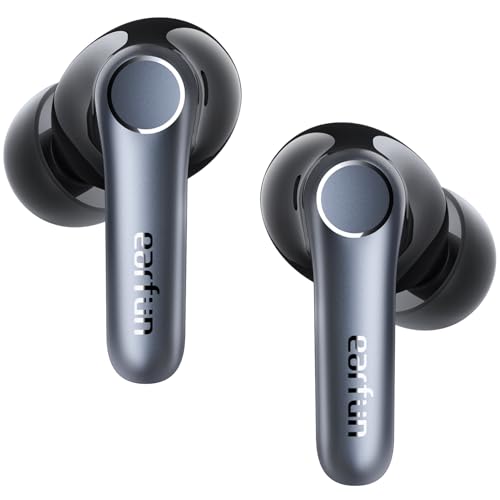
The pitch is simple. The noise cancelling copes just fine with engine drone, which is the majority of noise you’re trying to drown out. The case is small enough to live in a jeans pocket, and the whole thing costs less than checking a bag both ways. Are they the deepest-cancelling earbuds in this guide? Probably not. On a plane, cancelling the drone is what I want them for, and they do it.
Key specs, from EarFun’s own pages:
- 7.5 hours per charge with ANC on, 35 hours with the charging case (11 and 52 hours with ANC off)
- 6 hours per charge with ANC and LDAC both on, 28 hours with the case
- aptX Adaptive, LDAC, SBC and LC3
- IPX5 sweat and water resistance
- Multi-device connectivity with auto-pairing
- Charging case measures 62 x 47 x 29mm
EarFun has since released the Air Pro 4+, which I haven’t used, so I can’t tell you whether it’s worth the extra. The 4 is the pair in my pocket, and while it stays this cheap it’s the easiest recommendation I make.
Check the current price here: Check price on Amazon
Apple AirPods Pro 3 – Best for iPhone Owners
If you live on an iPhone, you already know how this ends. The AirPods Pro 3 pair instantly, switch between your Apple devices on their own, and hand off a call from phone to laptop without you touching anything. Note that this is Apple’s own iCloud-based device switching, not standard Bluetooth multipoint, so the magic mostly stays inside the Apple ecosystem. They’re not iPhone-only, though. Apple’s own guide covers pairing them with an Android phone, where they work as a plain Bluetooth headset: you lose Siri and all the automatic switching above, but you can listen and take calls.
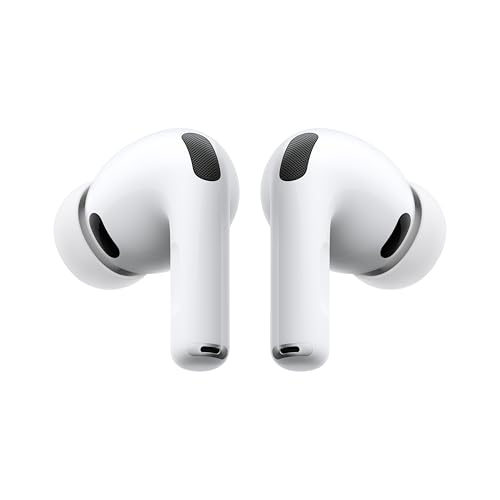
For flying, the numbers are pretty solid. You get 8 hours per charge with noise cancelling on, 24 hours with the case, and an IP57 rating that covers both the buds and the case. One thing to know before you’re at the gate with a dead case: Apple sells the USB-C charging cable separately, so pack one.
Key specs, from Apple’s spec page:
- 8 hours per charge with ANC on (7.5 with Spatial Audio and head tracking)
- 24 hours total with the charging case
- 5.55g per bud, 43.99g case
- IP57 dust, sweat and water resistance for buds and case
- USB-C charging, cable sold separately
Check the current price here: Check price on Amazon
Bose QuietComfort Ultra Earbuds 2nd Gen – The Premium Earbud Pick
Bose built its name on noise cancellation, and these are its flagship earbuds. If you want the earbud form factor with the fewest compromises on quiet, and you’re happy to pay several times the EarFun price for it, this is where I’d point you.

Bose lists Bluetooth multipoint on these, so you can stay paired to a phone and a laptop at once and switch between them, which matters if a flight is also your office.
Key specs, from Bose’s own pages:
- 6 hours per charge (4 hours with Immersive Audio on); the case holds up to three full charges
- Bluetooth multipoint
- IPX4 water resistance
- 7.26g per bud, 59.87g case
- USB-C charging, 12-inch USB-A to USB-C cable included
Check the current price here: Check price on Amazon
The Best Over-Ear Headphones for Travel
If your bag has the room, or your flights are long enough that comfort and battery outrank packing volume, this is the other side of the argument, and it’s a good side.
Sony WH-1000XM6 – The Best Over-Ears (and the Ones I Leave Behind)
I’ve owned the XM6 for about a year, and it’s on my head every working day. As a thing to listen to for hours, it’s the best audio product I’ve bought. Everything in the section above about why it stays home applies to this exact pair, and none of it is a criticism of the headphones.

If you’re buying one pair of over-ears to cover everything, flights included, this is the pair I’d buy again. The 30-hour ANC-on battery clears any sector on earth with a day to spare, 254g is pretty light for a flagship over-ear, and the multipoint with auto-switch is the feature I use most at the desk, and it follows me between laptop and phone without a thought.
They also fold up pretty neatly into the case for travel, which is nice. It also comes with a 3.5mm cable which tucks away neatly inside the case. This lets you plug it directly into normal headphone outputs, like those you might find on a place. And yes, ANC still works in that situation.
Key specs:
- 30 hours battery with ANC on
- 254g
- Bluetooth multipoint with auto-switch
Check the current price here: Check price on Amazon
Bose QuietComfort Ultra Headphones 2nd Gen – The Comfort Pick
The QuietComfort line has been the long-haul default for a generation of frequent flyers, and the current Ultra is the most travel-practical over-ear in this guide on one specific count. There’s a 3.5mm-to-2.5mm cable in the box, so it plugs straight into a seatback jack and keeps working over the cable even with the battery flat.

Bose quotes 30 hours of battery, and since its Quiet Mode (the ANC) is on by default, that’s effectively an ANC-on figure. Switching on the Immersive Audio spatial mode shortens it, so leave that off for the long sectors.
Key specs, from Bose’s own pages:
- 30 hours battery
- 264g
- 3.5mm-to-2.5mm audio cable and carry case in the box; works passively over the cable
- Bluetooth 5.4; aptX Adaptive with Snapdragon Sound devices
Bose also refreshed the step-below model in August 2026. The standard QuietComfort Headphones 2nd Gen started shipping on 13 August 2026 with Immersive Audio, multipoint, USB-C lossless audio and a 24-hour battery. It’s too new for anyone to have long-term views on it, but if the Ultra’s price stings, that’s the comparison to run.
Check the current price here: Check price on Amazon
Sennheiser Momentum 4 Wireless – Best Battery Life (Yes, the Older Model)
Here’s my favourite oddity in the category. Sennheiser’s own spec table, on its own site, measured under identical test conditions (iPhone, mid volume, ANC on), gives the older Momentum 4 sixty hours of battery and the newer Momentum 5 fifty-seven. The older model also costs less. So my battery pick is the previous generation, and no, that’s not a typo!

Sixty hours with ANC on is a different category of number. That’s New York to Sydney and back, plus the layovers, on one charge. If battery anxiety is the thing that ruins flying for you, buy this and never think about it again.
Key specs, from Sennheiser’s own pages:
- 60 hours battery with ANC on (iPhone, mid volume test condition)
- 3.5mm and 2.5mm audio cable in the box; works passively over the cable
- SBC, AAC, aptX and aptX Adaptive
Check the current price here: Check price on Amazon
Sennheiser Momentum 5 Wireless – The Current Generation
The newer Momentum earns its place on codecs rather than battery: it adds aptX Lossless, aptX HD and Snapdragon Sound over the Momentum 4. If you run high-resolution audio from an Android device, that list is the reason to pay the difference. If you don’t know whether you do, you don’t, and the Momentum 4 is the better buy.

Key specs, from Sennheiser’s own pages:
- 57 hours battery with ANC on (same test condition as the Momentum 4)
- 290g; folds flat
- 3.5mm and 2.5mm audio cable in the box
- SBC, AAC, aptX, aptX HD, aptX Lossless, aptX Adaptive, Snapdragon Sound
Check the current price here: Check price on Amazon
JBL Live 780NC – The Mid-Range Pick
The Live 780NC sits in the sensible middle of the market: 50 hours of ANC-on battery, real two-device multipoint, and a folding design that slips into a soft pouch instead of a rigid case, which is a bit more forgiving of an overstuffed bag.

The wiring is a bit different here. There’s no 3.5mm jack on the headphone itself. The socket is USB-C, and JBL includes a USB-C to 3.5mm cable in the box, which covers the seatback screen case. It’s a different arrangement from the Sennheisers and the Bose, so if you’re a cable person, know which kind you’re getting.
Key specs, from JBL’s own pages:
- 50 hours battery with ANC on (80 with it off, which is the number on the box)
- 260g
- Two-device Bluetooth multipoint
- Folds flat; soft carrying pouch and USB-C to 3.5mm cable included
Check the current price here: Check price on Amazon
Soundcore Space Q45 – The Budget Over-Ears
Anker’s Soundcore line is the sensible answer if you want the over-ear experience without the flagship bill. The Space Q45 runs 50 hours with ANC on, and Soundcore is one of the few brands here whose headline number already has the noise cancelling switched on, which I appreciated more than I expected to.

You get two-device multipoint, LDAC for high-resolution audio on Android (though LDAC switches off while multipoint is active), an AUX port for wired listening, and a carry case in the box.
Key specs, from Soundcore’s own pages:
- 50 hours battery with ANC on, 65 with it off (both at 60% volume)
- 292g
- Two-device multipoint (LDAC disabled while multipoint is active)
- AAC, SBC and LDAC
- AUX port; carry case included
Check the current price here: Check price on Amazon
The Battery Number on the Box Is Measured With ANC Off
The big number on the box is usually measured with noise cancelling switched off, which is the one condition you’ll never use in the air.
The EarFun Air Pro 4’s headline figure is 52 hours. With ANC on, it’s 7.5 hours per charge and 35 hours with the case, and with ANC and the LDAC codec both running it drops to 6 and 28. The JBL Live 780NC advertises 80 hours; with ANC on it’s 50. Soundcore prints both numbers for the Space Q45, which is the practice I’d like the rest of the industry to copy.
Nobody is lying, exactly. It’s a real measurement of a condition that doesn’t exist on a plane. Every battery figure in this guide, and every number in my comparison table, is the ANC-on figure, so the picks here are compared on the number you’ll actually get.
Bluetooth Headphones and Seatback Screens: The 2026 Picture
For years the rule was simple. Seatback entertainment is wired, your Bluetooth headphones can’t talk to it, and you bring a transmitter or use the airline earbuds. That rule is now breaking up, and it’s breaking up one airline at a time, so here’s where things stand as I write this in August 2026.
United is the outlier that has mostly finished the job. By its own May 2026 announcement, more than 800 United aircraft have Bluetooth-enabled seatback screens, the most of any airline, up from around 100 in late 2023 and 300 in early 2025. That covers most of the mainline fleet, though regional aircraft are a different picture, so a US flyer on United mainline can now more often than not pair their own headphones and skip the adapter entirely.
Delta is the contrast. As of early 2026, Bluetooth pairing works only in the first-class cabin of its A321neo fleet, with trials running on some 767s and Bluetooth-in-all-cabins arriving with select new aircraft deliveries from 2026 onward. Most Delta flyers still need a cable or a transmitter.
Outside the US it’s patchier still, though it isn’t a US-only story: Emirates supports Bluetooth pairing on its A350s, for instance. Everywhere else, assume wired until your airline tells you otherwise. Usefully, the Bluetooth-equipped aircraft pages themselves list Bluetooth alongside the ordinary wired socket, not in place of it, so a cable remains the safe fallback.
Twelve South AirFly Pro 2 – For Wired Seatback Screens
The AirFly is the bridge across all of the above, a 16.5g dongle that plugs into the seatback’s 3.5mm jack and streams the screen’s audio to your Bluetooth headphones. The Pro 2 pairs one or two sets at once, so two of you can watch the same film, and it runs 25+ hours on a charge, recharging over USB-C in about two hours.

My recommendation here depends on who you fly with. Flying solo on United mainline? You can probably skip it. Flying Delta, most other carriers, or as a pair who share films? It earns the pocket space.
Whether a Bluetooth seatback will pair two headphones at once is an open question I haven’t seen any airline answer, so for shared viewing the AirFly is still the reliable route even on newer aircraft. Twelve South also pitches it for gym equipment and older stereos, which is where mine would live between trips.
Key specs, from Twelve South’s own pages:
- Pairs one or two Bluetooth headphones from a 3.5mm source
- 25+ hours battery; full charge in 2 hours over USB-C
- aptX support
- 16.5g, 56.6 x 29 x 11.2mm
Check the current price here: Check price on Amazon
What Noise Cancelling Does (and Doesn’t Do) on a Plane
Active noise cancellation listens to the noise around you and plays an inverted copy of it, and the physics works best on steady, predictable, low-frequency sound. An aircraft cabin is close to the ideal case: the engine drone and air roar that make up most of the noise are exactly what ANC eats.
Voices, announcements, crying babies and clattering trolleys sit higher up the frequency range, where you’re mostly relying on the physical seal of the ear cups or ear tips. So no, noise cancelling won’t switch off the baby in row 12, which might surprise you when you first use noise cancelling headphones, but it removes the roar underneath, and the cabin gets a lot more bearable with the floor taken out of the noise.
If you really want to block out all the noise, then earplugs are probably going to work better. I’ve also had good experience with foam tips on my earbuds, which block the sound rather than using complex sound-inversion techniques.
Cabins are loud, but not as loud as the figure everyone quotes. The largest study I could find, published in the Journal of Exposure Science and Environmental Epidemiology across 200 flights, measured a median of 83.5 dB(A) across all flight phases, with only 4.5% of flights exceeding the 85 dB(A) occupational 8-hour exposure limit. You’ll often see “85 dB” quoted as the cruise level; that figure is the workplace exposure limit, not a cabin measurement. Turboprops are the exception, running 83 to 92 dB(A), noticeably louder than jets.
Does any of this reduce travel fatigue? That claim is everywhere, and when I went looking for its source the trail ended at marketing pages. What’s measurable is comfort: a 2025 TU Delft study that put participants in a 737 cabin at realistic noise levels found ANC headphones and earplugs both significantly improved comfort, with ANC slightly preferred.
The same study found a trade-off nobody’s marketing mentions. Over hours, ANC headphones caused more discomfort around the ear than earplugs, which cause theirs inside it. On a long flight that’s a real consideration, and it’s another point in favour of earbuds, or a cheap set of foam earplugs as backup.
Headphone Rules: Batteries, Take-Off and What Crew Can Ask
Two rules questions come up constantly, and both have calmer answers than the internet suggests.
First, take-off and landing. There is no US federal regulation that bans wearing headphones during taxi, take-off or landing; what exists is airline policy and crew instructions, and you’re required to follow crew instructions, so take them off when asked.
In Europe, EASA publishes safety advice against wearing them during those phases: they lower your awareness of what’s happening around you, and corded sets add a physical snag hazard, which is a small, real argument for wireless. Advice, not a ban, and airlines can of course be stricter.
Second, batteries. Headphones and earbuds are portable electronic devices with installed lithium batteries, which means they belong in your carry-on and raise no issue at all there, per the FAA’s PackSafe rules.
The rules that have tightened recently are about spare batteries and power banks, which must never go in checked baggage; if you travel with a battery pack for topping up a charging case, our travel power bank guide covers the current rules in detail. Nothing in the battery rules targets headphones as such. Pack them and stop worrying.
Frequently Asked Questions
Here are the answers to the questions that come up most often about headphones for flying.
Are earbuds or over-ear headphones better for flying?
For most travellers, earbuds. They take a fraction of the space, modern budget pairs cancel the engine drone that matters most, and studies suggest over-ears cause more around-the-ear discomfort over long wears. I own a flagship pair of over-ears and fly with fifty-dollar earbuds.
Over-ears win if your bag has room and you want the deepest quiet, the longest battery, and a cable for the seatback screen. Both answers are reasonable; mine is earbuds.
Can I use Bluetooth headphones with in-flight entertainment?
On United mainline, usually yes: the airline had Bluetooth-enabled seatback screens on more than 800 aircraft as of May 2026, so you can typically pair directly. On Delta it’s currently limited to first class on A321neos, and most other carriers worldwide are still wired.
For everything wired, a small Bluetooth transmitter like the AirFly Pro 2 plugs into the 3.5mm jack and streams to your headphones.
Do noise cancelling headphones block out crying babies?
Not really. ANC is excellent at steady low-frequency noise like engine drone and poor at voices and cries, which sit higher in the frequency range. The ear seal blocks some of it passively.
What ANC does do is remove the roar underneath everything, which makes the whole cabin, babies included, much less wearing over a long flight.
Can you wear headphones during take-off and landing?
There’s no US federal rule against it; headphone policy belongs to the airline, and crew instructions are the thing you must follow. European regulator EASA advises against wearing them during taxi, take-off and landing because they reduce your awareness, but that’s guidance rather than law.
In practice: keep one ear free or take them off during the safety briefing, and comply immediately if crew ask.
Why is my headphone battery life lower than advertised?
Because the number on the box is usually measured with noise cancelling switched off, and you’ll fly with it on. The gap can be large: the EarFun Air Pro 4 advertises 52 hours but gives 7.5 per charge with ANC on, and the JBL Live 780NC advertises 80 hours against a real 50.
When you compare headphones for travel, find the ANC-on figure. Every number in this guide is the ANC-on one.
How much headphone battery do I need for a long-haul flight?
Less than the marketing suggests. The longest nonstop flights in the world run under 19 hours, so any over-ear in this guide clears the worst case on a single charge with room to spare.
Earbuds are per-charge devices: at 6 to 8 hours per charge, you’ll just pop them back in the case once on a long sector. The case top-up takes care of it, so charge the case before you board.
Can I bring wireless headphones and earbuds in my carry-on?
Yes, with no restrictions worth your attention. Headphones are portable electronic devices with installed lithium batteries, which the FAA’s PackSafe rules place in carry-on as a matter of routine. The tighter rules you may have read about apply to spare batteries and power banks, which can never go in checked baggage.
Keep headphones in your carry-on, not checked luggage, and you’re done.
Are noise cancelling headphones worth it for flying?
Yes, and you don’t need to spend flagship money to get the benefit. Peer-reviewed research found ANC significantly improved comfort at realistic cabin noise levels, and the noise a plane makes is the exact kind ANC handles best.
The widely repeated claim that ANC reduces travel fatigue is one I couldn’t trace to any actual study, so comfort is the claim I’ll stand behind. It’s enough.
Further Reading
If this guide was useful, a few related ones from our flying and gear archives:
- Our long-haul flight essentials guide covers the rest of what’s in my carry-on, headphones included, from compression socks to the seat gadgets that earn their space.
- The best travel power banks guide matters more than it used to, with the 2026 rule changes on carrying and charging them in the cabin.
- A good travel adapter with USB-C ports will charge every pick in this guide from one wall socket.
- And if you’ve ever had an airline mislay the bag your gear was in, our luggage trackers guide is the cheap insurance read.
Check the ANC-on battery number, not the one on the box. Then buy for the bag you’re actually carrying. For me that’s a fifty-dollar pair of earbuds, and the Sonys stay on the hook by the desk.
Kendra says
I used Bose quiet comfort headphones last year, great during flight and in airports, hassle when not using them for 7 month trip. Plan on using Apple Airpods pro 3 next winter, they work with android not just iPhone. I am more annoyed by loud talkers and crying babies than airplane noise.
Laurence Norah says
Thanks Kendra — that’s exactly the trade-off the article is built around. Brilliant on the plane, then something you’re carrying around for the other 23 hours of the day. Seven months of that would have been vexing!
And you’re right about the AirPods. Fair criticism — I’d labelled that section “best for iPhone owners” and then never said they work with anything else. They pair with an Android phone as a standard Bluetooth headset; what you lose is Siri and the automatic switching between Apple devices, not the listening. I’ve added that to the article, so thank you for the nudge.
On the loud talkers and crying babies, you’ve landed on the thing most reviews skip. Noise cancelling is very good at the low engine drone and fairly poor at voices, which sit higher up the frequency range — there’s a section further down the article on exactly this. Foam tips on earbuds, or plain foam earplugs, will do more for a chatty neighbour than any amount of ANC.
Kendra says
Thanks for the response. I do not understand ANC. But in my experience, foam earplugs/earbuds are not adequate in very noisy environments such as restaurants and airports and only ANC from earplugs and headphones work. I previously tried ear plugs, and other earbuds and headphones without ANC. So glad I found the ANC headphones and ear buds I listed.
Laurence Norah says
My pleasure! Glad to hear that you’ve found a product that works for you, which is the main thing 🙂