
I'm Laurence, a professional travel photographer since 2010. Jess and I write this site from our own travels.
I’ve been a full-time travel photographer since 2010, and a large part of that time has been spent walking, kneeling on pavements for a low angle, and folding myself into economy seats in the same few pairs of pants. I’m British but I live in the US, so the sizing and the prices in this guide are American ones. If you’re reading from the UK, yes, these are trousers, and everything below still applies other than the name. Potatoes, potatoes.
For a city trip where one pair has to do everything, buy the Bluffworks Envoy Lightweight Travel Pant. For hot and humid weather, the Bluffworks Ascender Chino has the lightest fabric of anything here. If the trip leans toward trails, the prAna Stretch Zion Standard Pant is the pair I’d pick, and if you’re going to live in jeans regardless of what I say, the Bluffworks Departure Jeans 3.0 are the pair built for it.
What I actually travel in is a bit less tidy than that. It’s a mix of Levi’s jeans, chinos from Haggar and Dockers, linen pants from Quince, and various pairs from Columbia and Patagonia (I love Patagonia gear), plus five pairs of Craghoppers (a shipping error, don’t ask) that come out for safaris and hiking trips and stay at home for city breaks. This guide is about what happens to a pair after a few years of that, and a bit less about what it feels like out of the box, so that’s where it starts.
Jess and I have also been moving toward natural fibres and away from plastic where we can for a few years now. With travel pants that’s still difficult, because nearly everything technical is synthetic, so cotton and linen get their own section below, along with what you give up for them.
Table of Contents:
Where Travel Pants Fail First
Travel pants are a good idea. A pair that dries quickly, doesn’t crease, and has somewhere to put your phone that a pickpocket can’t reach makes a long trip easier in a dozen small ways, and one good pair beats three ordinary ones in my bag every time. This guide contains the list of things I check before choosing a pair of pants, because they’re the things that have ended pairs of mine.
On every pair of pants I’ve had that failed (shorts too), the crotch seam goes first, long before the knees or the seat. Walking all day, sitting on planes and trains, and kneeling on a pavement for a low shot with a camera bag on your back all put the stress in the same place.
So the thing I now look at before anything else is how that area is built. A gusset (a diamond of extra fabric in the crotch) or a reinforced seam is worth more to me than a tenth pocket, and a fabric with some stretch in it puts less strain on the stitching every time you sit down.
The second way I lose a pair is dirt. Ordinary dirt washes out. The dirt a safari or a long dusty hike grinds into a pale fabric does not, and I’ve retired pairs that were structurally fine because they’d never be clean again. The fix is boring. Buy the darker colour.
The third is heat, and this one is my mum’s fault. Most travel pants are nylon or polyester, and neither of them wants to meet a hot iron. On one visit home she kindly ironed a pair of my Craghoppers without my knowledge, and it did not go well for the pants, much to her alarm! So skip the hotel iron. The whole point of these fabrics is that they don’t need one, and if a pair does crease in the bag, hanging it in the bathroom while you shower does the job without melting anything.
The water-repellent finish is the other thing that doesn’t last. On most travel pants the repellency is a coating on the outside of the fabric. It wears down with abrasion, dirt, body oils and washing. A hot tumble dry brings it back for a while, and eventually you re-treat it with a wash-in or spray-on product.
I’m not going to put a number of washes on it, because how fast it goes is set by how you wash the pair and how dirty it gets, and any figure I gave you would be a guess. What I will say is that the finish sheds a light shower and that’s all it was ever for. A water-repellent pant is not a waterproof pant, and if it’s going to rain hard you want a long rain jacket over the top (more on mine at the end).
None of this stops a good pair lasting for years. It just changes what I look at first, and it’s the order I’ve used for the picks below. Fabric and construction first, pocket count last.
The Best Travel Pants for Men at a Glance
The whole list is in one table, so you can see what you’re choosing between. Every spec is the maker’s own published figure, not a retailer’s summary, and where a maker doesn’t publish one, the cell says so. Prices move around too much to print, so I’ve used three bands instead.
They’re based on list price, not on whatever today’s discount happens to be. Budget is under about $90, mid-range is $90 to $130, and premium is over $130, which is roughly the point at which you’re paying for fabric and construction you’ll notice in year three rather than day one.
| Pants | Fabric | Stretch | Zip pockets | UPF | Water-repellent finish | Price band | Best for |
|---|---|---|---|---|---|---|---|
| Bluffworks Envoy Lightweight Travel Pant | 57% recycled polyester, 33% polyester, 10% spandex (6.2 oz per yard) | 4-way | 5 of 9 pockets | Anti-UV fabric, no rating given | None | Premium | One pair for the whole trip |
| Bluffworks Ascender Chino | 100% polyester (5.31 oz per yard) | Waistband only | 3 of 10 pockets | Not stated | Water resistant | Premium | Hot and humid city trips |
| Bluffworks Departure Jeans 3.0 | 68% cotton, 22% COOLMAX polyester, 9% rayon, 1% spandex | Yes | 2 hidden security zips | Not stated | Not stated | Mid-range | People who live in jeans |
| prAna Stretch Zion Standard Pant | 95% recycled nylon, 5% elastane | 2-way | 2 of 6 pockets | 50+ | Yes, PFC-free | Mid-range | Trips with real trails in them |
| Kühl Renegade Pant | Nylon and spandex (DURALUX softshell) | 2-way | Zipped side pockets (Kühl’s page gives two different totals) | 50+ | Water resistant | Premium | Cold, rough or wet-ish days |
| Patagonia Quandary Pants | 96% recycled nylon, 4% spandex | Yes | 2 of 5 pockets | 40+ | Yes, made without added PFAS | Mid-range | Trail days that end in town |
| Columbia Silver Ridge Convertible Pant | 100% nylon ripstop, polyester mesh panels | Not stated (elastic at waist only) | None stated | 50 | Not stated | Budget | Hot-weather hiking on a budget |
| Columbia Silver Ridge Utility Convertible Pant | 100% recycled polyester | 2-way | 1 zipped security pocket, plus hook-and-loop pockets | 50 | Not stated | Budget | Budget hiking pants with a zip pocket |
My Levi’s aren’t in the table because jeans get their own section next, and the cotton and linen pairs get theirs straight after. My Craghoppers aren’t in it because you can’t easily buy them in the US any more, which I’ll come to.
Jeans: What I Still Travel In, and When They’re the Wrong Call
I’ll be the first to admit it. On a cool city break I usually travel in Levi’s, because they look right everywhere from a pub to a decent restaurant and I don’t have to think about them. If your trip is a week in London or Edinburgh in October, jeans are fine.
They are the wrong call in three situations. Heat and humidity, because heavy cotton is hot and takes forever to dry once you’ve sweated into it. Rain, for the same reason, and a wet pair of jeans on a cold day is not an experience anyone repeats twice. And any trip where you’re washing clothes in a sink, because a pair of jeans hung up at night is still damp in the morning, and you’ll wear them damp because you have nothing else.
Long-haul flights are a fourth, in my opinion. Twelve hours in a stiff waistband is a choice, and not one I’d make again.
If you’re going to wear jeans anyway, the pair I’d point you at is the Levi’s 541 Athletic Fit Jean, which is Levi’s athletic cut. The travel-specific alternative is the Bluffworks Departure Jeans 3.0, which look like jeans but are about a third synthetic, with COOLMAX polyester in the blend to move sweat and a little spandex so they give when you sit. They’re the pair I’d take on a warm trip where I still wanted to look like I was wearing jeans. Full details are in the picks below.
Natural Fibre Travel Pants: Cotton and Linen
Every pair in the main list is nylon or polyester, or leans on one of them, and that’s what technical travel pants are made of right now. The things that make a travel pant worth buying (quick drying, crease resistance, stretch and water repellency) mostly come from synthetic fibres and chemical finishes. Nylon and polyester are both plastics, and synthetic fabrics shed tiny plastic fibres when they’re washed.
So going natural means giving some of that up, and it’s a real trade. Cotton soaks up water and takes its time drying, so a sink wash or a downpour costs you more than it would in polyester, although a lightweight chino is nowhere near as bad as denim. Linen is lovely in the heat and creases if you so much as look at it.
You lose most of the travel features too. Neither the Haggar nor the Quince lists a zipped pocket, so with those two your phone and passport are better off in a zipped vest or bag pocket, and none of the three lists any water repellency or sun protection.
Even these aren’t completely plastic-free. The Dockers gets its stretch from 5% elastane, and no-iron cotton like the Haggar’s usually relies on a chemical finish. The Quince linen comes closest.
On the plus side, cotton and linen will both take a hot iron, which is more than you can say for the synthetics, and they pass as ordinary clothes anywhere, because that’s what they are. If that trade sounds fair, these are the three I’d look at, and I own all of them.
Haggar Work to Weekend Classic Fit Pant

One of my two new cotton pairs, in navy. Haggar says it perfected a no-iron, 100% cotton pant in the early 2000s, and this is that pant. It’s a plain classic-fit chino with a hidden expandable waistband that gives up to 3 inches, and it’s sold as no-iron, so it should come out of the wash ready to wear.
Haggar doesn’t say how it gets cotton to skip the iron. Wrinkle-free cotton is usually made that way with a chemical finish on the fabric, so if avoiding treated fabric is part of why you want natural fibres, bear that in mind. It’s in the budget band too, which makes it a cheap way to find out whether cotton suits the way you travel.
Fabric: 100% cotton
Stretch: Hidden expandable waistband, up to 3 inches
Pockets: 2 front seam pockets, no zipped pocket listed
Care: Machine washable, sold as no-iron
Crotch and seams: Not published by Haggar
Best for: Mild-weather city trips, and anyone who wants plain cotton chinos without the ironing.
Check current price on Amazon here.
Dockers Ultimate Chino with Smart 360 Flex

The other new pair, in a colour Dockers calls Dark Ginger. Strictly speaking this one isn’t all cotton. Dockers lists it at 95% cotton and 5% elastane, and that 5% buys four-way stretch (Dockers calls it Smart 360 Flex), which should make it the easiest of the three to sit in on a long flight. It’s the halfway house, mostly natural fibre with some of the comfort of a travel pant.
It’s also the only one of the three with a hidden security pocket, on the right side, and Dockers says it uses double-needle stitching and reinforced belt loops. It doesn’t say where the stitching is doubled, so I can’t tell you whether that includes the crotch seam.
Fabric: 95% cotton, 5% elastane
Stretch: 4-way
Pockets: 5, including a hidden security pocket on the right side
Care: Machine washable
Crotch and seams: Double-needle stitching, location not specified
Best for: City trips and flights, if you want mostly natural fibre with some stretch.
Check current price on Amazon here.
Quince 100% European Linen Pants
I’ve got two pairs of these, in flax and navy, and I’ve travelled in them a lot. They were excellent in Barbados, and again on trips around the US South, to places like Gulf Shores and Mobile. They’re 100% linen, made from European flax and certified under OEKO-TEX Standard 100, with a drawstring elastic waist, a zip fly and a relaxed cut that lets air move.
The trade-off is creasing. Linen wrinkles easily, so these are the hardest pants in this guide to keep looking tidy, and after a day of trains and café chairs they’ll look like you’ve slept in them. If that bothers you, the synthetics are the better bet. If you’re happy looking a bit relaxed in the heat, these are brilliant.
Fabric: 100% European linen
Stretch: None in the fabric, drawstring elastic waist
Pockets: Angled front and welt back pockets, no zipped pocket listed
Crotch and seams: Not published by Quince
Best for: Hot weather, if you don’t mind a few creases.
Check current price on Quince here.

How to Choose Travel Pants
The spec sheets on these pants are full of terms that sound technical and mostly aren’t. Here’s what each one means, and which ones I’d actually weigh.
Fabric
Nearly every pair here is nylon, polyester, or a blend with a little spandex (also sold as elastane), and the fibre choice is a real trade-off. Nylon is the tougher fibre. It shrugs off abrasion better, which is why the hiking-leaning pairs use it, but it absorbs a little water, so a nylon pant holds moisture for longer once it’s soaked. Polyester barely absorbs water at all and dries faster, at the cost of some scuff resistance.
Weight, weave and the stretch blend matter at least as much as the fibre, which is why a heavy polyester can outlast a gossamer-thin nylon.
My rule of thumb is polyester for hot and humid trips, nylon for anything involving rock, and a cotton blend only when I want to look like I’m wearing ordinary clothes. Fabric weight, where a maker gives it, is quoted in ounces per square yard. Bluffworks is the only brand in this guide that publishes one, at 5.31 oz for the Ascender and 6.2 oz for the Envoy. So the Ascender is the lightest fabric here that anyone has put a number on.
If you’d rather skip synthetics altogether, linen is the natural fibre for heat and a lightweight cotton chino the one for a mild city break. I’ve covered both in the cotton and linen section above.
Stretch
Two-way stretch gives across the fabric, so the pant moves with you when you step up onto something. Four-way stretch gives lengthways as well, which is what you want for sitting for hours, since a knee that’s bent for a whole flight pulls the fabric in both directions. For a long-haul day I’d take four-way every time. For walking, two-way is pretty much plenty.
Pockets
Count the zipped ones, not the total. Ten pockets sounds impressive until you realise seven of them are open and anything in them is available to the next person on a crowded metro.
What I carry in my pants on a city day is a phone, a spare camera battery and a card, so two zipped pockets is my minimum and I prefer one of them to be at the front. On a hiking day I’ll happily take cargo pockets. On a city day I won’t, because a thigh pocket is the surest sign that you’re wearing hiking pants to dinner.
Sun Protection
UPF is to fabric what SPF is to sunscreen, except that it counts both UVA and UVB. A UPF 50 fabric lets a fiftieth of the sun’s UV through, about 2 percent, and blocks the rest.
It’s a lab measurement reported under a voluntary labelling standard, so nobody in the US government checks it and the number is the maker’s own claim, but it’s a useful one on a safari or a long day in the desert. Bear in mind the protection only applies to skin the fabric covers, and it drops when the fabric is wet or stretched.
Water Repellency
A DWR finish (durable water repellent) sheds a light shower for a while and then wears off. It’s nice to have, it’s not a reason to choose one pair over another, and it’s never a substitute for a rain jacket.
Convertible Legs
Zip-off legs are useful on exactly one kind of trip, which is a hot one where you’ll be walking in the morning and swimming in the afternoon and don’t want to carry shorts. Both Columbia pairs below do this well. For anything else, the zip around the knee is a visible seam that announces what the pants are, and I wouldn’t wear a convertible pair to a city restaurant.
Do They Look Like Hiking Pants?
Stand in front of a mirror and look for four things. Cargo pockets on the thigh. A zip-off seam at the knee. A logo or a contrasting panel on the waistband or the leg. And the fabric itself, because a crisp, shiny nylon that rustles when you walk reads as outdoor gear from across the room, whatever the cut.
If a pair has none of those, it’ll pass at dinner. If it has two, it’s a hiking pant, and there’s nothing wrong with that as long as you pack it for a hiking trip.
By that test, the Bluffworks Ascender and Envoy and the Departure Jeans pass as ordinary clothes. The prAna, the Kühl and the Patagonia sit in the middle, quite plain in a dark colour, so nobody will look twice, and the two Columbias are hiking pants and make no secret of it.
Which Travel Pants for Which Trip
Every pair here is good at something. Make sure to match the something to the trip.
City Breaks
You want a chino cut in a fabric that doesn’t crease. Two zipped pockets minimum, and a colour that goes with everything else in the bag. The Bluffworks Ascender Chino is the pair built for this, and the Envoy does the same job with more stretch. Jeans are fine in a cool city, per the section above.
Hot and Humid
This is the trip where the wrong pants ruin the day. You want the lightest fabric you can find, polyester instead of nylon so it dries, and a loose enough cut that air moves.
The Ascender is the lightest fabric here at 5.31 oz per yard. If the trip is more beach and trail than city, the Columbia Silver Ridge Utility Convertible Pant is 100% polyester, turns into shorts, and costs quite a bit less than the Bluffworks. Whatever you buy, buy it in a light colour for the sun and accept that it’ll show the dirt, or buy it dark and accept that it’ll be warmer. I go dark.
For natural fibres, go linen. My Quince linen pants have been excellent in Barbados and on the Gulf Coast, and they’ll be creased by lunchtime whatever you do.
Trails and Safaris
Nylon, a UPF rating, some stretch, and a colour that hides dust. This is where my Craghoppers live, and where, for a US reader, I’d send you to the prAna Stretch Zion Standard Pant first, the Kühl Renegade Pant for colder or rougher days, and the Patagonia Quandary Pants if you want the lightest of the three. The Columbias are the budget route and they’ll do the job.
Long-Haul Flights
Soft waistband and four-way stretch, with nothing stiff at the knee. A zipped pocket for your passport too, so you’re not fishing through a bag at every checkpoint. The Envoy is my pick, and a pair of the Departure Jeans is the compromise if you want to step off the plane looking like you’re wearing jeans. I’ve got a separate guide to what to pack for a long-haul flight if you want the rest of the kit.
If You Can Only Take One Pair
The Bluffworks Envoy Lightweight Travel Pant. Five zipped pockets, four-way stretch, wrinkle resistant, machine washable, light enough for a warm day and plain enough for dinner. The one thing it isn’t is a hiking pant, so if your one trip is a week on the trail, take the prAna instead and eat somewhere casual.
The Best Travel Pants for Men: The Picks
The specs below are each maker’s own published figures. Where a maker doesn’t publish one, I’ve said so instead of guessing.
I’ve added a line to each one on how the crotch is built, because that’s the part I said goes first. It turns up an awkward thing about my own favourites. The three pairs I recommend most highly here are the three whose makers say nothing about it: Bluffworks publishes fabric, pockets, weight and care, and no construction detail at all. prAna states a ventilated gusset, Kühl a gusseted crotch, and both Columbias a gusset at the crotch seam.
That isn’t evidence the Bluffworks pairs are built worse, and the ones I’ve handled haven’t given me a reason to think so. It’s a gap in what the brand tells you before you spend at the premium end of this list. If crotch construction is the thing you want in writing before you buy, the prAna, the Kühl and the two Columbias are the pairs that put it there.
1. Bluffworks Envoy Lightweight Travel Pant
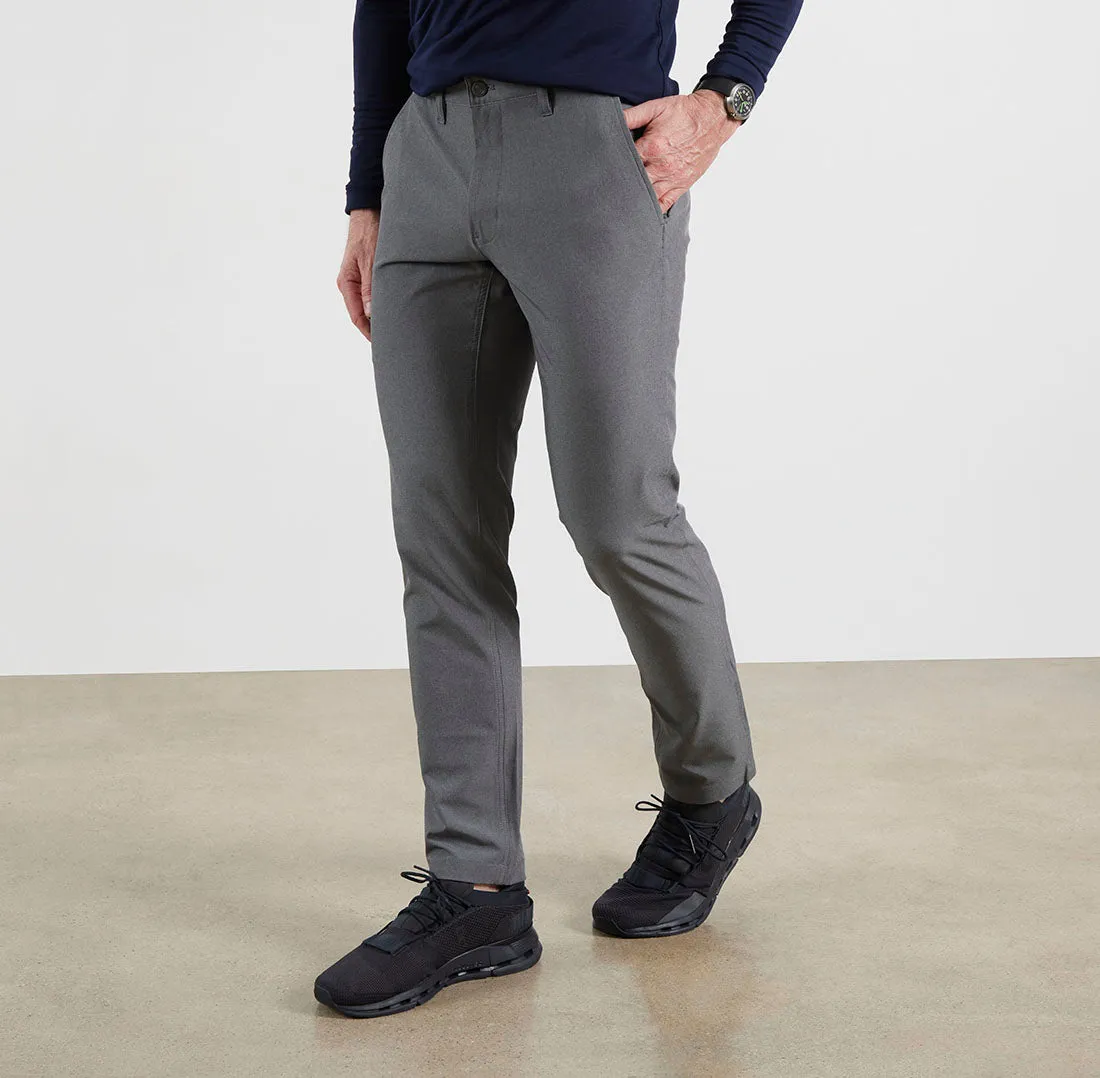
Bluffworks describes the Envoy as a pant for “both the trail and the opera on one trip”, which is marketing of course, but the spec sheet backs up the ambition better than most. Nine pockets, five of them zipped, in a four-way stretch fabric that Bluffworks lists as wrinkle resistant and machine washable, at a fabric weight (6.2 oz per yard) that’s light without being flimsy. Of everything in this guide it’s the pair I’d hand to someone who asked for one pair and no further questions.
Bluffworks is also the brand that makes the travel suit I reviewed and the rain jacket I wear, and the company sells through its own site. The fabric is described as having anti-UV properties without a UPF number, so if sun protection is the reason you’re buying, the prAna or the Kühl give you a rating and this doesn’t.
Fabric: 57% recycled polyester, 33% polyester, 10% spandex, 6.2 oz per yard
Stretch: 4-way
Pockets: 9, including 2 phone pockets and 5 zipped
UPF: Anti-UV fabric, no rating stated
Care: Machine wash cold, dry on medium heat
Sizes: Waist 29 to 38 and 40, inseam 28 to 34
Crotch and seams: Not published by Bluffworks
Best for: One pair for a whole trip, long-haul flights, anyone who wants zipped pockets without cargo styling.
Check current price on Bluffworks here.
2. Bluffworks Ascender Chino
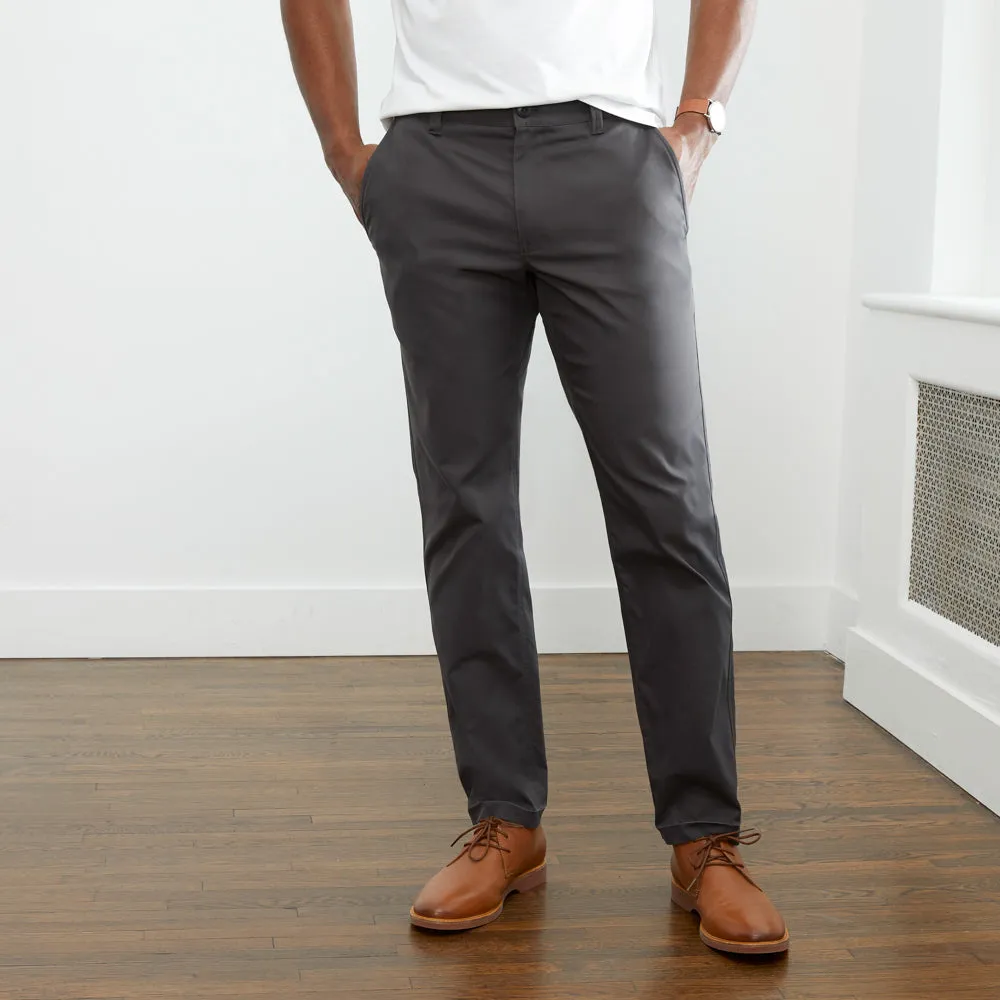
Bluffworks’ best seller, and the pair I’d buy for a hot city if I didn’t have a nice linen pair. It’s a chino cut in a 100% polyester fabric at 5.31 oz per yard, which is the lightest fabric in this guide, and it’s the pair that looks least like travel gear of anything here.
Bluffworks also says the fabric repels water, though it doesn’t say how. Ten pockets, three of them zipped, which is one more zip than I need and about seven more pockets than I’ll use.
The trade-off is stretch. The Ascender has a stretch waistband and that’s it, so on a twelve-hour flight the Envoy is the better pair. For walking around Bangkok or New Orleans in August, this is the one.
Fabric: 100% polyester, 5.31 oz per yard
Stretch: Waistband only
Pockets: 10, including 2 phone pockets and 3 zipped
UPF: Not stated
Water repellent: Water resistant fabric, no finish named by Bluffworks
Care: Machine washable
Sizes: Waist 28 to 38 and 40, inseam 28 to 36
Crotch and seams: Not published by Bluffworks
Best for: Hot and humid city trips, anyone who wants a pair that passes as ordinary chinos.
Check current price on Bluffworks here.
3. Bluffworks Departure Jeans 3.0
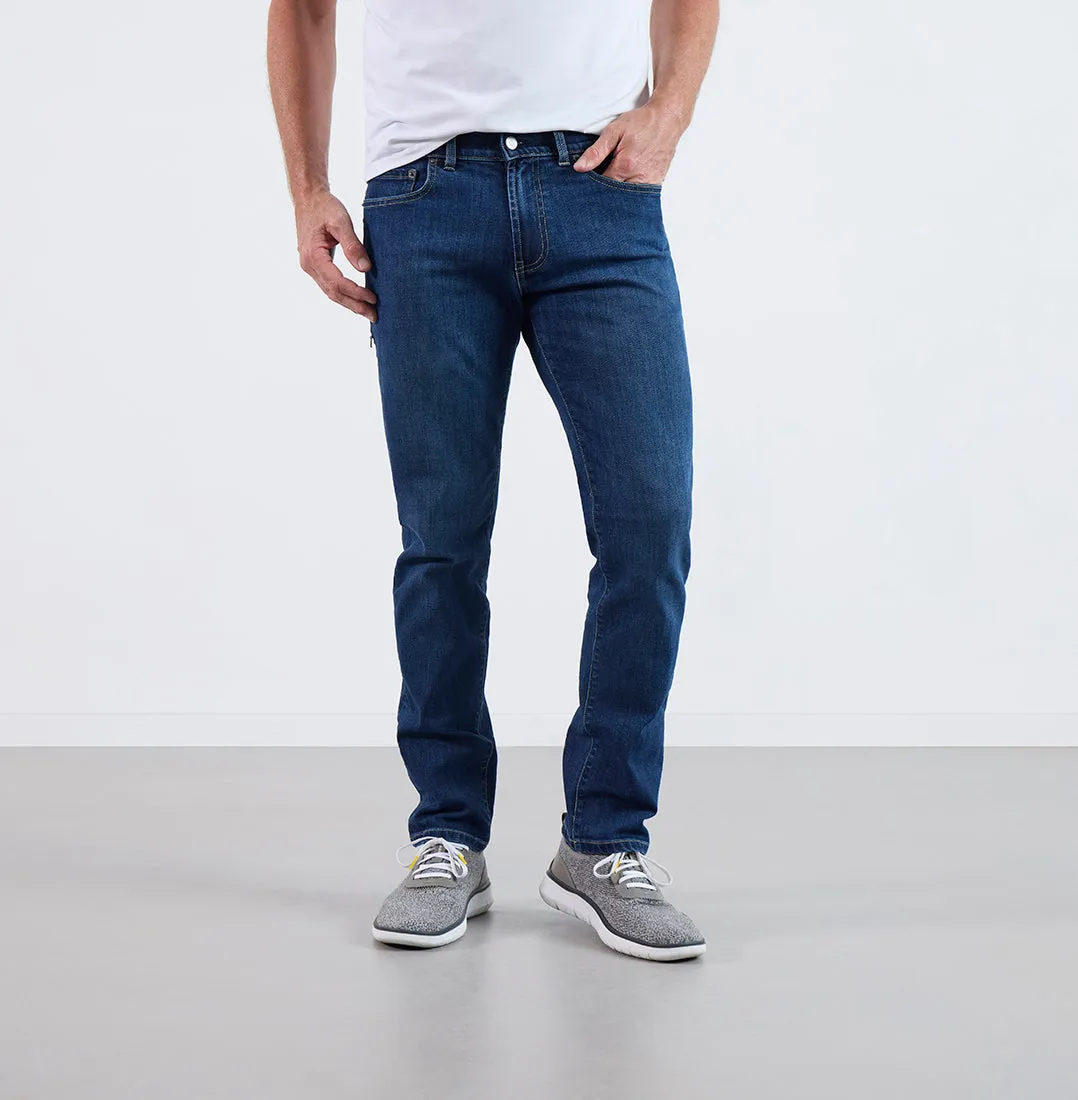
Jeans for people who’ve read the jeans section above and decided they’re wearing them anyway. The Departure is about two-thirds cotton, so it looks and feels like denim, with COOLMAX polyester in the blend to move sweat and a little rayon and spandex so it drapes and gives. Bluffworks builds them as a traditional five-pocket jean with two hidden zipped security pockets on top.
They won’t dry like the polyester pairs and they aren’t a hiking pant. What they are is a pair of jeans you can wear on a warm day and on a long flight without the two complaints I have about my Levi’s, and that’s a fair trade for the price.
Fabric: 68% cotton, 22% COOLMAX polyester, 9% rayon, 1% spandex
Stretch: Yes
Pockets: 5-pocket jean with 2 hidden zipped security pockets
UPF: Not stated
Care: Machine wash warm
Sizes: Waist 29 to 38 and 40, inseam 28 to 34
Crotch and seams: Not published by Bluffworks
Best for: Travellers who live in jeans, warm-weather city trips, flights.
Check current price on Bluffworks here.
4. prAna Stretch Zion Standard Pant

The Stretch Zion has been the default recommendation for a hiking-adjacent travel pant for years, and a quick note on the name, because prAna has reorganised the line. There’s no longer a product called simply the Stretch Zion Pant. The pant most older roundups are talking about is today’s Stretch Zion Relaxed Pant, and prAna now sells the fabric in Relaxed, Standard and Slim fits along with a few specialist versions. The Standard fit is the one I’d buy for travel, and it’s the one linked here.
The fabric is a recycled nylon with 5% elastane, two-way stretch, UPF 50+ and a PFC-free water-repellent finish, which covers every box in the fail-first section above. Six pockets, two of them zipped, including a concealed front zip pocket that’s exactly where I want a card and a spare battery. It’s a nylon pant, so it’ll take a scramble over rock better than any of the polyester pairs and dry a little slower afterwards. In a dark colour it’s plain enough for a casual dinner. In sandbar, it’s a hiking pant.
Fabric: 95% recycled nylon, 5% elastane
Stretch: 2-way
Pockets: 6, including 2 zipped (concealed front zip and a cargo zip on the left side)
UPF: 50+
Water repellent: Yes, PFC-free DWR
Sizes: Inseam 28 to 36
Crotch and seams: Ventilated gusset, double-layer scuff guard at the back cuff
Best for: Trips with real trails in them, safaris, anyone who wants one pant that can scramble and still look tidy.
Check current price on Amazon here.
5. Kühl Renegade Pant

The Renegade is Kühl’s softshell pant, in a nylon and spandex fabric it calls DURALUX, and it’s the pair I’d take for colder or rougher trips, the sort where the days are in the hills and the evenings are in a pub that doesn’t mind. Kühl lists it as water resistant and UPF 50+, with two-way stretch and zipped side pockets. This is the base Renegade in Kühl’s Klassik fit, and Kühl sells several siblings (Rock, Recon, and a Convertible), so check you’ve got the plain one if you don’t want zip-off legs.
Kühl’s own product page gives two different pocket totals, six in one place and eight in another, so I’ve not put a number on it. And this is the most expensive pair in the guide, which buys you a heavier, more structured pant than the prAna. It isn’t a better one. For a warm trip I’d take the prAna. For Scotland in April, this.
Fabric: Nylon and spandex (DURALUX), percentages not stated
Stretch: 2-way
Pockets: Zipped side pockets and two drop-in phone pockets, total not stated
UPF: 50+
Water repellent: Water resistant
Care: Machine wash cold, delicate, tumble dry low
Crotch and seams: Gusseted crotch, articulated design
Best for: Cold, rough or damp trips, hillwalking holidays, anyone who wants a softshell rather than a thin nylon.
Check current price on Amazon here.
6. Patagonia Quandary Pants
I travel in Patagonia gear and I love the stuff, so the Quandary was always going to be on this list. It’s a recycled nylon with 4% spandex that Patagonia makes from recycled fishing nets, with a water-repellent finish made without intentionally added PFAS and a UPF of 40+. Patagonia files it as the Quandary Hiking Pants on its site and calls it the Quandary Pants on the label, and both names are Patagonia’s own.
The pair linked here is the Regular length. There are Short and Convertible versions, and a jogger, so check which you’re buying.
Patagonia gives a garment weight of 318 g, about 11 oz, for the Regular, which is the only garment weight any maker in this guide publishes and a good indication of how light it is.
If you want the Patagonia over the prAna, buy it for the weight and the fabric. It has five pockets, two of them zipped (back right and right thigh), which covers my minimum, although neither zip is at the front, where I like to keep a card.
Fabric: 96% NetPlus recycled nylon, 4% spandex
Stretch: Yes
Pockets: 5, including 2 zipped (back right and right thigh)
UPF: 40+
Water repellent: Yes, made without intentionally added PFAS
Weight: 318 g (about 11 oz), Regular length, 32-inch inseam
Crotch and seams: Articulation behind the knees; a repair patch built into the left front pocket. No gusset stated
Best for: Trail days that end in town, light packers, anyone who already trusts Patagonia.
Check current price direct from Patagonia here.
7. Columbia Silver Ridge Convertible Pant
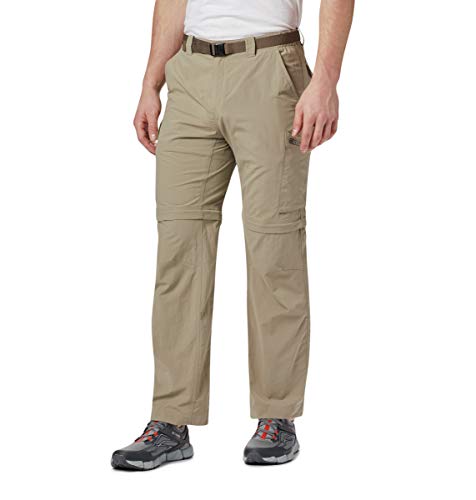
Columbia is one of the brands I travel in, and the Silver Ridge is its long-running hot-weather hiking pant. This is the classic version, a 100% nylon ripstop with polyester mesh panels for airflow, UPF 50, six pockets and legs that zip off into 10-inch shorts. Columbia doesn’t list any stretch in the fabric, just some elastic in the waist, and doesn’t name a zipped pocket, only flap closures on the back ones. So it’s a hiking pant, priced like one, and for a walking-and-swimming holiday somewhere hot it’s hard to argue with.
Where I’d be careful is the city. Everything about it, from the zip at the knee to the ripstop grid in the fabric, says outdoors. That’s fine on a trail and less fine at a table.
Fabric: 100% nylon ripstop body, 57% recycled polyester and 43% polyester mesh panels
Stretch: Not stated (partial elastic at the waist)
Pockets: 6, cargo pockets on each leg, flap-closure back pockets, two hand pockets
UPF: 50
Convertible: Yes, to 10-inch inseam shorts
Sizes: Inseam 28 to 36
Crotch and seams: Gusset detail at the crotch seam
Best for: Hot-weather hiking on a budget, trips where you’d otherwise pack shorts as well.
Check current price on Amazon here.
8. Columbia Silver Ridge Utility Convertible Pant

Columbia sells this alongside the classic Silver Ridge, and of the two it’s the one I’d buy. It swaps the nylon ripstop for a 100% recycled polyester with two-way stretch, so it dries faster and moves better, and it adds the thing the classic is missing, a zipped security pocket on the left leg.
The other pockets close with hook-and-loop, which isn’t a zip but is better than nothing on a bus. The legs zip off into 9-inch shorts, and Columbia’s care label says machine wash and do not iron, which after the incident with my mum I’d underline.
It’s still a hiking pant of course, so the same city caveat applies. But as the budget pick for a hot trip with a bit of walking in it, this is the one.
Fabric: 100% recycled polyester
Stretch: 2-way
Pockets: Zipped security pocket on the left leg, hook-and-loop pockets on the back and right leg, hand pockets
UPF: 50
Convertible: Yes, to 9-inch inseam shorts
Care: Machine wash, do not iron
Sizes: Inseam 30 to 34
Crotch and seams: Gusset detail at the crotch seam, articulated knees
Best for: Budget hiking pants with a zip pocket, hot and humid trips with trails in them.
Check current price on Amazon here.
Pairs I Own but Wouldn’t Send You Out to Buy
I own five pairs of Craghoppers (a shipping error, I only intended to own a couple, now I have spares), the British safari and hiking brand, and they’re what I pack for a safari or a real hiking trip. They’re good at that job. They’re also, very obviously, safari trousers, and they look wildly out of place on a city trip (unless you’re aiming for an urban safari look), so they stay home for those.
The other reason they’re not in the list is that Craghoppers has exited the US market. Its American store has gone and the brand’s own site no longer offers a US option, so if you’re reading this in the States you can’t easily buy them.
If you like the idea of a British walking-trouser brand, Rohan is the one that does still ship to the US. Rohan sends orders worldwide from its UK warehouse for a flat fee, usually within about eight days, and you may owe US import duty when the parcel arrives. It sizes men’s trousers by waist in inches with 29, 31 and 33 inch inside legs, so there’s no conversion to do. I have a Rohan linen suit, which I love, but I haven’t worn Rohan travel pants beyond the linen pants, so treat that as a pointer rather than a pick: Rohan’s men’s trousers.
Then there are the things I’d skip on spec alone. Zip-off legs for a city trip, for the reasons above. Any pair with no zipped pocket at all, unless your phone and passport live in a vest or bag, because at some point you’ll be on a crowded train with your phone in an open pocket and you’ll wish you’d listened. And any fabric that rustles when you walk. If it makes a noise in the shop, it’ll make a noise in the restaurant.
What I Wear Them With
Pants are half the outfit, so briefly, the rest of it. For pockets I use a SCOTTeVEST Travel Vest, which I’ve had since 2012 and which carries the camera batteries, the cables and everything else that would otherwise be dragging my pants down.
On hot trips the SCOTTeVEST LightEST Vest does the same job in a lighter fabric. And for rain, the Bluffworks Faroe Rain Jacket, which is long enough to keep the rain off the pockets of whatever pants I’m wearing, packs small, and looks like a coat rather than a cagoule.
Shoes are another area to think about, and I’ve written those up separately in my guide to the best travel shoes for men.
Frequently Asked Questions
What are the best pants for travelling on a plane?
Something with four-way stretch and a soft waistband, so a knee that’s bent for ten hours isn’t fighting the fabric. Of the pairs in this guide the Bluffworks Envoy is my pick for a long flight, with the Departure Jeans as the option if you want to look like you’re in jeans when you land.
Avoid stiff denim and anything with a rigid waistband. A zipped pocket for your passport is worth having too, because you’ll show it five times between the kerb and the seat.
What are some good travel pants for men?
It depends what you’re buying for, which is why this guide is organised by trip rather than by rank. If you want one name and no further questions, the Bluffworks Envoy is the pair I’d hand you.
If price is what decides it, the two Columbias are the budget end and they do the job. The prAna sits in the middle and is the best value of anything here. The three Bluffworks pairs are the premium end, and what the extra money buys is fabric, stretch and a cut that doesn’t announce itself.
What type of pants are best to travel in?
For most trips, a lightweight synthetic chino with a couple of zipped pockets. Polyester if the trip is hot, because it dries faster, and nylon if the trip involves rock, because it wears better. Some stretch in the fabric helps on flights and takes strain off the seams.
Jeans are fine in a cool city and wrong in heat, rain, or anywhere you’ll be washing clothes in a sink. Full hiking pants are right for a hiking trip and look like hiking pants everywhere else.
What are the best travel trousers for men?
Same answer as the rest of this guide, for anyone searching from the UK. The Bluffworks Envoy is the best all-rounder, the Ascender Chino the pick for heat, and the prAna Stretch Zion Standard the pick for walking trips.
If you’re in the UK and would rather buy a British brand, Rohan sizes by waist in inches and Craghoppers is still easy to find there, even though it has left the US market.
Are jeans bad for travel?
Not bad, just wrong for some trips. In a cool city they’re fine and I wear them. In heat, in rain, on a long flight, or anywhere you’ll be washing clothes in a sink, they’re the wrong call, because heavy cotton is hot, slow to dry and stiff to sit in for hours.
You don’t have to give them up. Take them for the evenings and something synthetic for the days with weather or walking in them, and you never end up putting on damp denim because it’s all you’ve got. A travel jean like the Bluffworks Departure splits the difference if you’d rather pack one pair.
Do travel pants look like hiking pants?
Some do, and the ones that don’t are usually the ones cut like a chino. The tells are all visual: a cargo pocket on the thigh, a zip-off seam at the knee, a logo or contrast panel, and a fabric that catches the light or rustles when you walk.
It matters less than people worry it does. Nobody at the next table is auditing your trousers. It matters in two places, somewhere with a dress code and somewhere you’d rather not read as an obvious tourist, and if either is on your itinerary, take a plain dark pair and you’ll never think about it again.
How many pairs of pants should I pack for a trip?
Two, for almost any trip up to a couple of weeks. One pair you wear most days and one that suits whatever the trip throws in, whether that’s a trail, a hot afternoon, or a smarter dinner. Wear the heavier pair on the plane.
Three is justified on a long trip with both hiking and city days. More than that is luggage you’ll carry and not wear.
Can you wash travel pants in a hotel sink?
Yes, and it’s one of the main reasons to own a pair. Wash them in the sink with a little travel detergent or shampoo, roll them in a towel to press the water out, and hang them somewhere with air moving. The lighter polyester pairs dry fastest, a nylon pair takes a bit longer, and jeans will still be damp in the morning.
Every maker in this guide that publishes care instructions lists its pants as machine washable too, so a laundrette on a longer trip is fine.
What does UPF mean on pants?
It’s the fabric equivalent of SPF, covering both UVA and UVB. A UPF 50 fabric lets about 2 percent of UV through and blocks the rest. Thirty to 49 counts as very good, 50+ as excellent.
Whether it should change what you buy is the more useful question. It’s a lab number under a voluntary standard, so it’s the maker’s own claim rather than a checked one, it only covers the skin the fabric covers, and it drops when the fabric is wet or stretched. On a safari or a desert day, buy the pair that has it. On a city trip it’s a line on a tag.
Are water-repellent travel pants waterproof?
No, and it’s the most oversold feature on a pair of travel pants. A DWR finish makes light rain bead up and roll off. In real rain the water goes through, and a rain jacket long enough to cover your pockets is the actual answer.
The part nobody mentions at the till is that it wears out. Abrasion, dirt, body oils and washing all kill it, a hot tumble dry brings it back for a while, and past that you re-treat it with a wash-in or spray-on product. Treat it as a feature you maintain, not one you bought once.
Nylon or polyester travel pants, which is better?
Neither, reliably, which is why every roundup gives you both. Nylon takes abrasion better, so it’s the fibre for rock and trails, but it absorbs a little water and holds it longer once soaked. Polyester barely absorbs water and dries faster, at the cost of some scuff resistance.
My rule is shorter than the spec sheet: polyester if the trip is hot or wet, nylon if there’s scrambling in it. And if you’re comparing two pairs of the same fibre, weight and weave decide it, not the word on the tag.
Are expensive travel pants worth it?
Usually, if you travel more than a couple of times a year. The premium pairs in this guide cost roughly twice what the budget Columbias do, and what the extra money buys is the fabric, the stretch, the zipped pockets and a cut that doesn’t look like hiking gear, all of which you notice more in year three than on day one.
If you take one big trip a year, a budget pair is fine and the money is better spent elsewhere. If you’re on the road for weeks at a time, the premium pair is the cheaper one per day worn.
Can you iron travel pants?
Mostly you shouldn’t, and mostly you don’t need to. Nylon and polyester don’t like a hot iron, several makers here say do not iron on the care label, and the whole point of a wrinkle-resistant fabric is to skip the ironing board.
If a pair does crease in the bag, hang it in the bathroom while you shower and the steam will drop most of the creases out.
What pants should I wear on safari?
A nylon pair with a UPF rating, some stretch, and a colour that hides dust. Pale colours are traditional and they show every mark, so I’d go for a mid-tone brown or green rather than sand. Of the pairs here the prAna Stretch Zion Standard is my first pick, with the Kühl Renegade for cooler mornings.
My own safari trousers are Craghoppers, which are ideal for it and which you’ll struggle to buy in the US now that the brand has left the market. I’ve also got a full guide to what to pack for Scotland and what to pack for Iceland in summer if your walking trip is somewhere cooler.
Further Reading
That’s my guide to the best travel pants for men. Here are some more of our guides that go with it.
- Shoes first, always. See my guide to the best travel shoes for men.
- If the trip has a smart evening in it, my guide to the best travel suit for men covers the pair of trousers that comes with a jacket.
- For getting all of this into a carry-on, see our guide to the best packing cubes for travel.
- For the flight itself, our list of long-haul flight essentials.
- For destination-specific packing, see our guides to what to pack for London and the UK, what to pack for Scotland, and what to pack for Iceland in summer.
- And for women’s travel clothing, Jess’s Fig clothing review over on Independent Travel Cats.
And that’s it. If you’ve got a pair of travel pants you’ve worn for years and want to tell me what went first, or a question about any of the above, let me know in the comments below.

Leave a Reply