
We’ve been travelling and writing about it full time since 2010, and for the past four years most of our clothes have crossed borders inside a set of cheap Amazon packing cubes we bought when we were living in the UK. Jess, meanwhile, has been packing with the same Eagle Creek cubes for over twelve years, a set that predates me. So between us we’ve lived with both ends of the packing cube market, the budget end and the premium end, and this guide is built on that experience.
If you just want the short answer, here it is. The Eagle Creek Pack-It Reveal set is the best packing cube set for most travellers. If you want to spend as little as possible, the Amazon Essentials 4-piece set does the job for a fraction of the cost, and I say that as someone who has used them for years. For compression, the Peak Design Packing Cube is the premium pick and the Gonex 4-piece set is the budget one.
The rest of this guide covers the full lineup, which cubes to buy for which sort of trip, whether they’ll fit a Ryanair bag, and whether you need to spend much on them at all. I’ll also cover how packing cubes work alongside camera gear, because as travel photographers we usually have a camera cube fighting for the same space. And if you’re buying during one of Amazon’s big sales, I list the packing cube deals worth having in my travel gear deals.
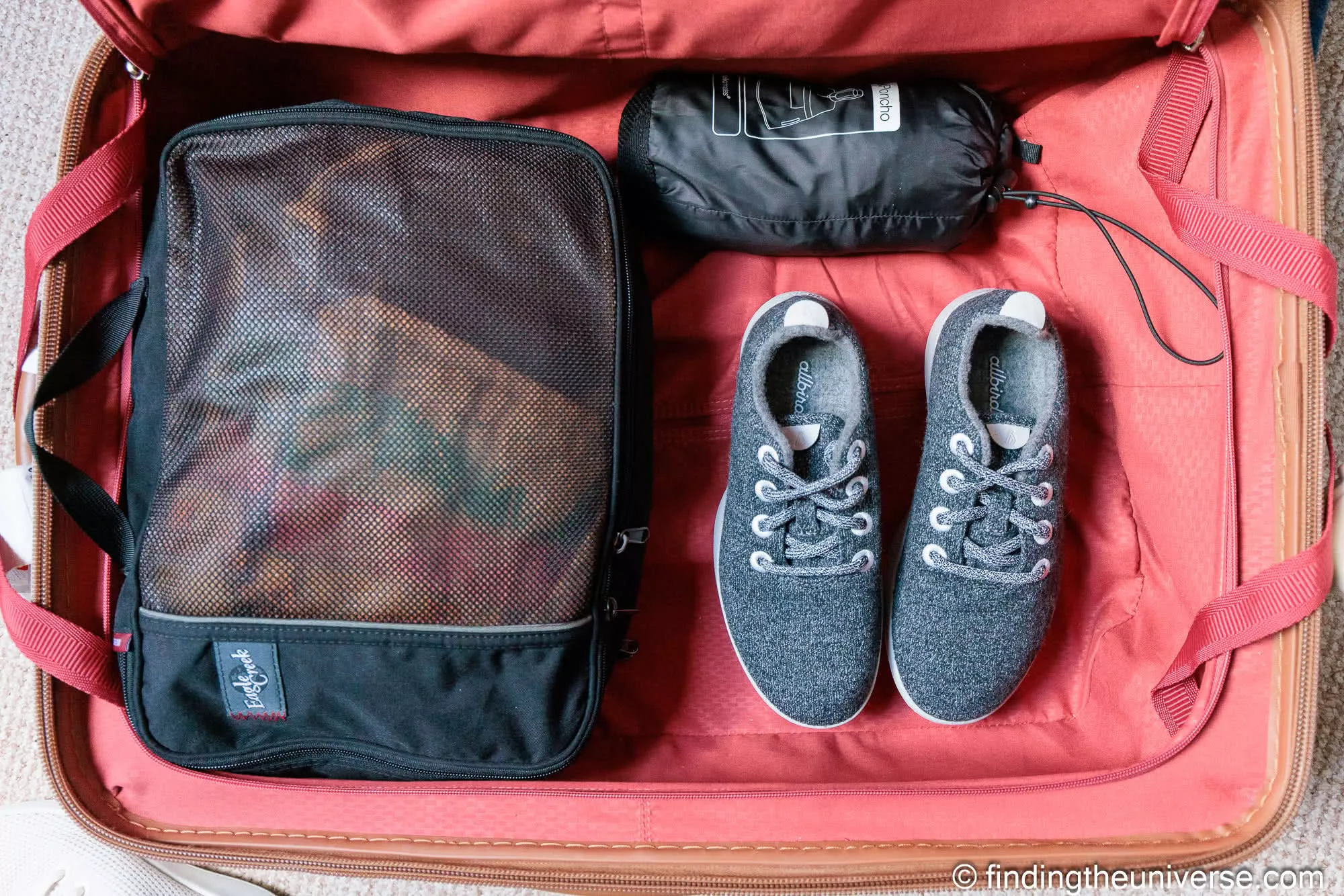
Table of Contents:
Quick Take: Which Packing Cubes to Buy
For most people, the Eagle Creek Pack-It Reveal set is the one to get. It’s well made, light, and backed by a lifetime warranty against defects, and Jess’s twelve year old Eagle Creek set is the best durability argument I can offer.
If budget is the priority, get the Amazon Essentials 4-piece and don’t look back. If you pack bulky layers or you’re determined to travel carry-on only, a compression cube makes a real difference, and Peak Design or Gonex cover the premium and budget ends of that.
Ultralight packers should look at the Eagle Creek Isolate Compression cube at 1.9 oz, families and overpackers at the Bagail 8-piece set, and anyone who wants a serious compression set for a carry-on at the Thule pair.
The comparison table below shows the whole lineup at a glance.
Packing Cubes Compared
| Packing Cubes | Best For | What You Get | Compression? | Material | Price |
|---|---|---|---|---|---|
| Eagle Creek Pack-It Reveal Set | Best overall | 3 cubes (XS, S, M) | No | 300D recycled polyester | Check price on Amazon |
| Amazon Essentials 4-Piece | Best budget | 4 cubes (2 medium, 2 large) | No | 100% polyester | Check price on Amazon |
| Peak Design Packing Cube (M) | Best premium compression | 1 cube, 8L to 18L | Yes | 70D weatherproof ripstop nylon | Check price on Amazon |
| Gonex Compression 4-Piece | Best budget compression | 4 cubes (S to XL) | Yes | Rip-stop nylon | Check price on Amazon |
| Thule Compression Set | Best carry-on compression set | 2 cubes (S, M) | Yes | 100D bluesign ripstop nylon | Check price on Amazon |
| Eagle Creek Isolate Compression (S) | Best ultralight | 1 cube, 1.9 oz | Yes | Recycled 70D nylon | Check price on Amazon |
| Bagail 8-Piece Set | Best big set / families | 4 cubes + 4 accessory bags | No | Nylon | Check price on Amazon |
The Best Packing Cubes for Travel
Here are our picks in detail. Where we’ve used a product ourselves I’ll say so, and where a pick is based on research rather than our own bags, I’ll say that too. Four of these we know first hand. The other three are there because they fill a slot our own cubes don’t, and the specs and track record back them up.
1. Eagle Creek Pack-It Reveal Cube Set – Best Overall

Jess has been packing with Eagle Creek Pack-It cubes for over twelve years. Her set is older than our relationship, it has been on every continent she’s travelled to, and it still zips shut without complaint. That kind of track record is why Eagle Creek is my default answer in this category, and the Pack-It Reveal set is the current version of that line.
To be clear about what’s first hand here, Jess’s cubes are an older generation of the Pack-It line, since the Reveal didn’t exist twelve years ago. What her set proves is how Eagle Creek build things and how they last. The Reveal line carries that forward with a large mesh front window, so you can see what’s inside each cube without opening it. A small thing, until you’re looking for the one t-shirt you actually want in a hotel room at 11pm.
The set has three graduated sizes, which covers a typical carry-on nicely, and the fabric is a 300D recycled polyester that Eagle Creek describes as water-resistant. One caveat, though. The mesh window is mesh, so treat these as splash protection at best.
The other reason to pay Eagle Creek prices is the warranty. The “No Matter What” warranty is a lifetime warranty, though a limited one, and the details matter. Manufacturing defects are covered for the life of the product; wear and tear, cosmetic damage and misuse are not, and you pay the postage to send an item in. That’s narrower than the name suggests, but a lifetime defect warranty on a packing cube is still more than almost anyone else offers.
Key specs:
- Set of 3 cubes: extra small, small and medium
- Material: 300D recycled polyester (100% post-consumer recycled, bluesign certified)
- Mesh front window, no compression zip
- Water-resistant fabric (mesh panel excepted)
- Limited lifetime “No Matter What” warranty covering defects
You can check prices and buy the Eagle Creek Pack-It Reveal set on Amazon here.
2. Amazon Essentials 4-Piece Packing Cubes – Best Budget

This is the set we’ve used for most of the last four years, bought back in 2022 under the old Amazon Basics name. Amazon has since rebranded the range as Amazon Essentials, but the listing confirms it’s the same set: two medium cubes and two large ones, polyester, mesh tops, double zips.
I’ll be blunt about what you’re getting. The fabric is thinner than the premium cubes, the zips are ordinary, and there’s no warranty beyond Amazon’s return window. And in four years of regular use, none of that has really mattered. Ours have been squashed into backpacks, duffels and roller bags, and the only visible ageing is that the blue has faded a bit.
The medium cubes are 13.75 x 9.75 x 3 inches, which is a useful size for shirts and t-shirts, and the large ones at 17.5 x 12.75 x 3.25 inches swallow jumpers and trousers. There’s no compression here, just simple, well shaped containers. If you’re new to packing cubes and not sure whether you’ll get on with them, this is the set I’d tell you to start with. If it turns out you hate organised luggage, you’ve lost very little.
Key specs:
- Set of 4 cubes: 2 medium (13.75 x 9.75 x 3 in) and 2 large (17.5 x 12.75 x 3.25 in)
- Material: 100% polyester with mesh top panels
- Double zippers, webbing grab handle
- No compression, no stated warranty
You can check prices and buy the Amazon Essentials packing cubes on Amazon here.
3. Peak Design Packing Cube – Best Premium Compression

I’ve been using Peak Design gear since 2015, when I bought one of their camera straps, and their packing cubes have ended up in our luggage alongside their camera gear. The design logic is the same as the rest of their range. It’s clever, a little over-engineered, and priced accordingly.
The medium cube expands to 18 litres and compresses down to 8, using an expansion zip rather than the strap-and-buckle systems some brands use. There are two internal compartments with a moving divider, which sounds like a gimmick until you use it to separate clean clothes from dirty ones on a long trip. After that you’ll wonder why every cube doesn’t do it. The main opening tears away quickly rather than making you run a zip around three sides, which you’ll appreciate when you’re packing in a hurry.
The shell is a 70D ripstop nylon that Peak Design calls weatherproof, which is their word and a fair one; it shrugs off drizzle and splashes, and that’s the claim, nothing more. At 144 g it’s light for what it does, though note this is a single cube rather than a set, so kitting out a whole bag with these gets expensive pretty quickly.
If you’re a photographer already invested in Peak Design’s system, there’s a further argument for this cube which I cover in the camera gear section below.
Key specs:
- Single cube, sold per size (medium reviewed)
- Volume: 8L compressed to 18L expanded
- Dimensions: 32 x 32 x 8 cm compressed, 32 x 32 x 17 cm expanded
- Weight: 144 g (5.1 oz)
- Material: 70D weatherproof ripstop nylon shell
- Compression zip, tear-away opening, divided clean/dirty compartments
You can check prices and buy the Peak Design Packing Cube on Amazon here.
4. Gonex Compression Packing Cubes – Best Budget Compression

We haven’t used Gonex cubes ourselves, so this pick is research rather than first-hand experience. The reason it made the list anyway comes from a set we do own. When we lived in France we bought a cheap 4-pack of Coolzon compression cubes on Amazon France, and they taught us something useful. Budget compression cubes work. The zips on ours have survived four years of being strained shut over too many clothes, which is not what I expected at the price. Sadly there’s no US listing for them, so I can’t sensibly recommend them here.
The Gonex set is the equivalent buy on Amazon US, and it’s the most popular budget compression set for good reason. You get four cubes from small up to a 17.3 x 13 x 3.54 inch XL, each with a second zip that cinches the packed cube down. The fabric is a rip-stop nylon that Gonex markets as water-repellent, and the whole set is listed at around 0.75 lb.
The compression mechanism on cheap sets like this is the same double-zip design the premium brands use, and in our experience with the Coolzon set, it holds. What you give up against Peak Design or Thule is fabric quality, finishing, and any warranty at all. Whether that matters depends on how often you travel; there’s a longer answer in the verdict section at the end.
Key specs:
- Set of 4 compression cubes: S (9.8 x 7.5 in), M (11.3 x 8.9 in), L (14.5 x 10.6 in), XL (17.3 x 13 in), all 3.54 in deep
- Material: rip-stop nylon, water-repellent
- Double-zip expandable compression design
- Set weight listed at around 0.75 lb / 340 g
- No stated warranty
You can check prices and buy the Gonex compression cubes on Amazon here.
5. Thule Compression Packing Cube Set – Best Carry-On Compression Set

Another research-led pick, this one for people who want premium compression as a set rather than Peak Design’s one-cube-at-a-time pricing. Thule is better known for roof boxes and luggage, and their packing cubes have the same slightly industrial build philosophy, with 100D bluesign-approved ripstop nylon, YKK zips, and a limited lifetime warranty.
This listing is the two-cube set, one small and one medium. The numbers tell the compression story well. The small cube is 10.2 x 7.1 x 4.3 inches expanded and squashes to 1.25 inches deep; the medium goes from 14 x 10 x 5.9 inches down to the same 1.25 inches. That’s a packed jumper flattened to the thickness of a paperback. Weights are 2.79 oz for the small and 4.3 oz for the medium, so the pair adds very little to your bag.
The semi-transparent fabric lets you see roughly what’s in each cube, and the material is water-repellent rather than anything more ambitious. Thule sells these individually too, but per cube the set is the more sensible way in. If I were building a carry-on-only compression system from scratch and didn’t already own cubes, this set and one budget large cube would probably be it.
Key specs:
- Set of 2 compression cubes: small and medium
- Small: 10.2 x 7.1 x 4.3 in expanded, 10 x 7 x 1.25 in compressed, 2.79 oz
- Medium: 14 x 10 x 5.9 in expanded, 13.4 x 9.1 x 1.25 in compressed, 4.3 oz
- Material: 100D bluesign-approved ripstop nylon, water-repellent, YKK zippers
- Limited lifetime warranty
You can check prices and buy the Thule compression cube set on Amazon here.
6. Eagle Creek Pack-It Isolate Compression Cube – Best Ultralight
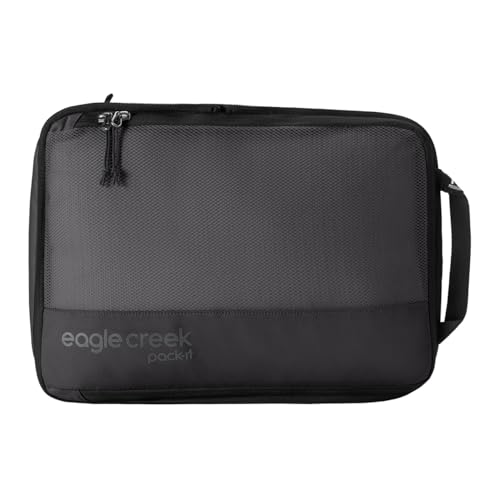
If you count grams, this is your cube. The Isolate is Eagle Creek’s ultralight line, and this small compression cube weighs 1.9 oz, which is 54 grams. For context, that’s less than half the weight of the Peak Design medium, admittedly for a smaller cube.
Note that this listing is a single small cube, not a set, so it’s best thought of as a supplement rather than a whole system. At 10 x 7 x 3 inches expanded and 10 x 7 x 1 inch compressed, it’s the right size for underwear, socks and a couple of t-shirts, or as the dedicated cube for a minimalist’s spare clothes on a one-bag trip. The fabric is a recycled 70D nylon, water-resistant in Eagle Creek’s wording, and the same limited lifetime “No Matter What” defect warranty applies as on the Reveal set above.
We haven’t used the Isolate line ourselves. It goes on the list because nothing else this light with a compression zip comes from a brand with Eagle Creek’s record, and Jess’s ancient set has left us fairly trusting of that record.
Key specs:
- Single small compression cube (not a set)
- Dimensions: 10 x 7 x 3 in expanded, 10 x 7 x 1 in compressed
- Weight: 1.9 oz / 54 g
- Material: recycled 70D nylon, water-resistant
- Limited lifetime “No Matter What” warranty covering defects
You can check prices and buy the Eagle Creek Isolate Compression cube on Amazon here.
7. Bagail 8-Piece Set – Best for Families and Overpackers
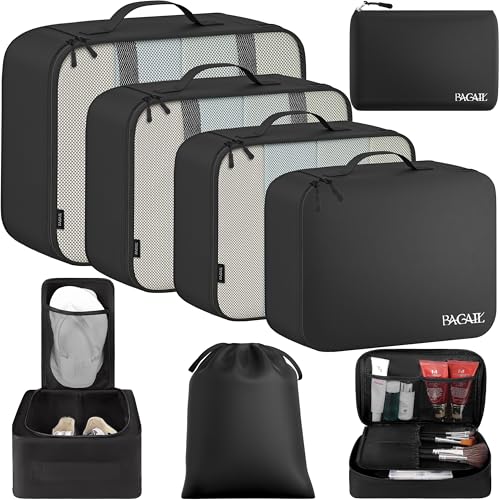
If you’ve ever sat on a suitcase to close it, this is your section. The Bagail 8-piece set is the checked-bag option: the most pieces for the least money, which is exactly what you want when you’re packing for a family, or you know you’ll fill whatever bag you bring.
One thing the listing name obscures, so I’ll spell it out. The “8 Set” is eight pieces, not eight cubes. You get four packing cubes (one XL at 17.5 x 12.75 x 4 inches, two medium at 13.75 x 9.75 x 4 inches, and one small), plus two clear toiletry bags, a laundry bag and a shoe bag. That’s a sensible mix. The laundry bag in particular gets used on every trip, and the shoe bag keeps your trainers away from your clean clothes.
The cubes themselves are nylon with mesh tops and a water-repellent finish, with standard zips and no compression. Build quality reviews are consistently quite decent for the price, and the range comes in enough colours that a family can colour-code a suitcase per person, which sounds twee and works brilliantly. This is another pick we know from research rather than our own bags, so I’d treat it as a well-reviewed value buy rather than a personal guarantee.
Key specs:
- 8 pieces total: 4 packing cubes (1 XL, 2 M, 1 S) + 2 toiletry bags, laundry bag and shoe bag
- Cube dimensions: XL 17.5 x 12.75 x 4 in, M 13.75 x 9.75 x 4 in, S 11 x 6.75 x 4 in
- Material: nylon with mesh top panels, water-repellent
- Standard zips, no compression, no stated warranty
You can check prices and buy the Bagail 8-piece set on Amazon here.
Which Packing Cubes for Which Trip?
A packing cube recommendation on its own is only half an answer. What you should buy depends on the trip, so here’s how we’d configure cubes for the sorts of trips we actually take and write packing lists for.
City Trips With a Carry-On
For something like a week in London, two medium cubes and one small cube in a carry-on covers it, with one medium for tops, one for bottoms, and the small for underwear and socks. No compression needed unless you’re travelling in winter. Our full London packing list has the complete kit this slots into. If that carry-on is heading onto a long-haul flight rather than a quick hop, our long haul flight essentials list covers what else earns space in the bag alongside the cubes.
Winter Trips and Bulky Layers
This is where compression cubes stop being a luxury. Fleeces and down layers are mostly trapped air, and a compression cube squeezes that air out. For a trip like our Iceland winter packing list, one large compression cube for the insulation layers plus two standard mediums is the configuration I’d use. The same logic applies to a ski trip, where base layers and mid layers multiply alarmingly.
Safari
Small-plane luggage limits on safari are strict, and soft duffel bags are usually required. Light cubes matter more than clever ones here, so something like the Thule set or the Isolate cube suits, and the cubes stop everything migrating around a soft bag that gets thrown onto a Cessna. Our safari packing list covers the weight limits in detail.
Adventure Trips Where the Bag Gets Wet
Packing cubes organise the inside of a rucksack well, but remember that none of them is waterproof; water-repellent fabric shrugs off drizzle, and that’s all. For a trip like Havasu Falls, where your bag may meet real water, cubes go inside a dry bag or a bin liner, they don’t replace one.
Long-Term and One-Bag Travel
Living out of one bag for months changes the calculus: fewer, better cubes, and the clean/dirty separation of the Peak Design cube goes from nice to essential. Our digital nomad packing list is built around exactly this kind of setup.
Family Holidays With Checked Bags
One Bagail-style set per person, one colour per person. When a suitcase gets opened at the other end, everyone grabs their own colour and the unpacking argument is over before it starts.
Packing Cubes and Camera Gear in the Same Bag
Here’s a problem none of the big packing cube guides cover: what happens when half your luggage is camera equipment. As travel photographers, our carry-on maths always starts with a camera cube, and clothes get whatever space is left.
We use Peak Design Camera Cubes for our camera bodies and lenses; you can see the full setup in our photography gear guide. A camera cube is a padded, rigid block, so it goes into the bag first, flat against the back panel where it’s protected and the weight sits close to your spine. Clothes cubes then fill the remaining space, and this is where compression cubes justify themselves. A compressed cube is thin and flexible enough to slide into the gaps a rigid camera cube leaves.
If you’re already in the Peak Design ecosystem, their clothes cubes and camera cubes are designed around the same dimensions, so they tile together neatly in one of their bags. That’s the tidiest version of this setup, but it’s not required; our cheap Amazon cubes have spent years sharing bags with expensive camera gear without any drama. One rule matters most. Camera cube against the back panel, clothes cubes take the leftover space, never the other way round.
For the bags themselves, our guide to the best camera bags for travel covers which ones have the space to pull this off.
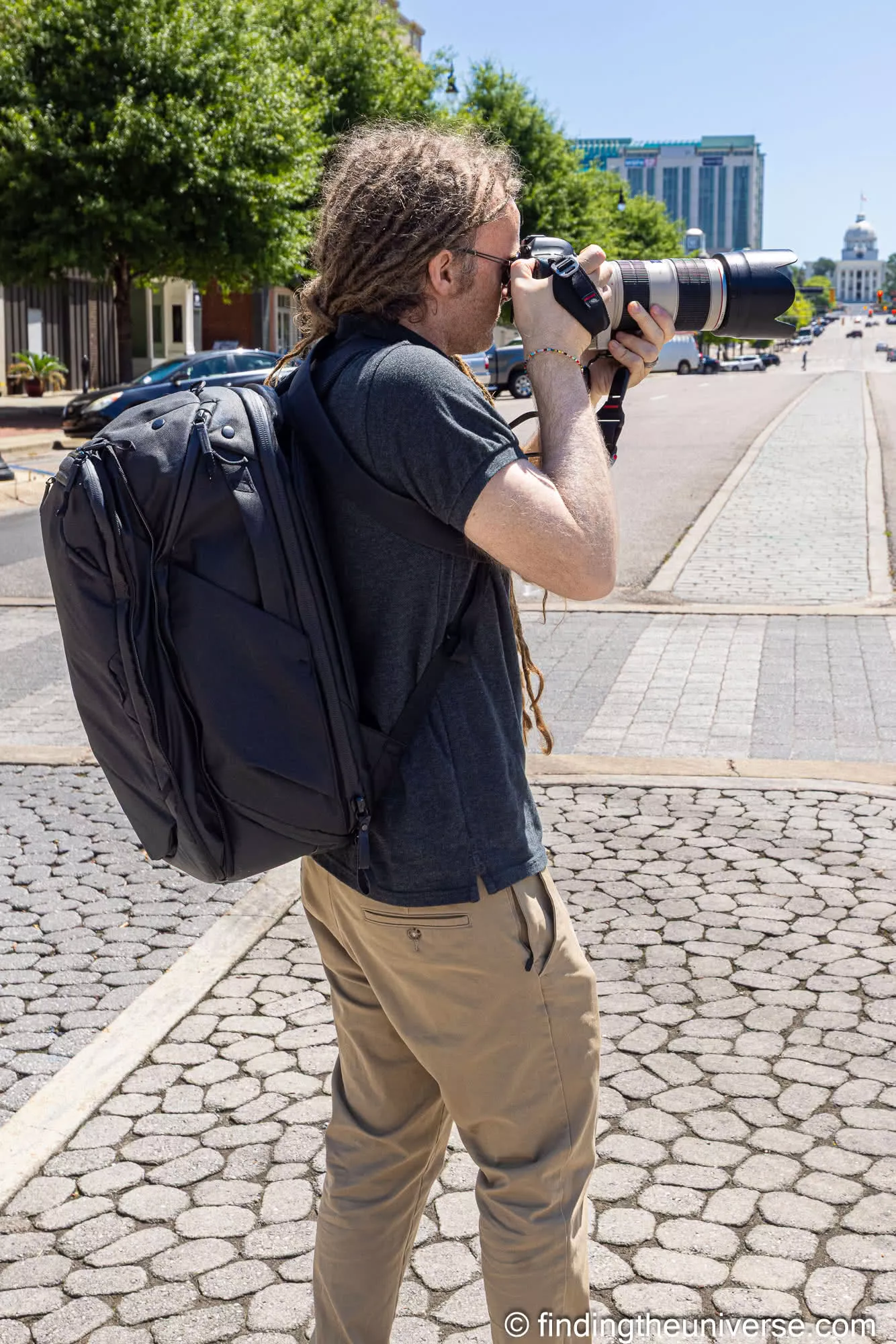
Will Your Packing Cubes Fit a Budget Airline Bag?
If you fly Ryanair or easyJet, the free luggage allowance is a small underseat bag, so it pays to check your cubes will fit before you buy. The current limits, from the airlines’ own bag policies:
- Ryanair: 40 x 30 x 20 cm, wheels and handles included. This went up from the old, smaller allowance in 2025, so plenty of older advice online quotes dimensions that are now wrong.
- easyJet: 45 x 36 x 20 cm, again including handles and wheels.
Both must fit under the seat in front, and Ryanair does check at the gate. Assume they’ll measure yours.
So which of our picks actually fit a 40 x 30 x 20 cm Ryanair bag? Running the numbers:
- Fits easily: the Thule small (25 x 18 x 3 cm compressed), the Eagle Creek Isolate Compression small (25 x 18 x 2.5 cm compressed), and the small and medium Gonex cubes (the medium is roughly 29 x 23 cm).
- Fits flat: the Amazon Essentials and Bagail medium cubes, at roughly 35 x 25 cm, lie flat across the base of a 40 x 30 cm bag with room to spare in depth.
- Doesn’t really fit: anything large. The Amazon Essentials and Bagail XL cubes are around 44 cm long, which is bigger than the bag. The Peak Design medium at 32 x 32 cm is an awkward squeeze in a 30 cm-wide bag; it goes in diagonally, which defeats the point of a tidy cube.
For budget airline flyers, build around small and medium cubes, use compression, and leave the large cubes for trips where you’re paying for a proper cabin bag anyway. Two compressed mediums and a small will fill a Ryanair bag efficiently and still leave room for the non-clothes essentials.
How to Choose Packing Cubes
If none of our picks suits, or you just want to know what actually matters when comparing cubes, this is what we’d look at after years of using them.
Standard vs Compression vs Ultralight
Standard cubes are simple zipped containers. They organise your bag and lightly flatten what’s inside, and for most people on most trips they’re pretty much all that’s needed.
Compression cubes add a second zip that cinches the packed cube down, typically to somewhere between a third and half its expanded depth. Manufacturers make bold claims here; Eagle Creek, for example, claims up to 50% more packing space from its compression cubes. Treat the exact numbers as marketing, but the effect is real, and it’s biggest with bulky, air-filled clothing like fleeces and down. The trade-offs are a bit more weight, more zips to fail, and more temptation to overpack. A compressed bag is smaller, never lighter.
Ultralight cubes strip weight to the minimum with thinner fabrics. They matter if you’re counting grams for a small-plane weight limit or true one-bag travel, and they’re more delicate as a result. Most travellers don’t need them.
Sizes and What “Sets” Actually Contain
Read the set contents carefully, because marketing counts generously. As covered above, an “8 set” may be four cubes plus four accessory bags. That’s not a scam, the accessory pieces are useful, but compare sets on cubes, not pieces.
On sizes, the boring answer is that medium cubes do most of the work. A medium cube holds a trip’s worth of tops; large cubes are for bulky layers and checked bags; small cubes take underwear, socks, chargers and the general debris layer. If in doubt, more mediums.
Materials, Zips and Handles
Cube fabric is rated by denier (the D in 70D or 300D), which measures the thickness of the threads. Higher numbers mean tougher, heavier fabric. Premium cubes run from ultralight 70D nylons up to 300D polyester, and budget cubes often don’t publish a rating at all, which tells you something in itself.
Zips are the part that fails first on a cheap cube, especially on compression cubes where the second zip is under constant tension. Named zips (YKK on the Thule set, for instance) are a good sign. A proper grab handle matters too, because it’s how you pull a cube out of a packed bag and how you hang it in a hotel wardrobe.
Water Resistance: What the Labels Mean
No packing cube in this guide is waterproof, and you should be suspicious of any cube that claims to be. The accurate terms are the ones the manufacturers themselves use: water-resistant (Eagle Creek), water-repellent (Thule, Gonex, Bagail), or weatherproof (Peak Design). All of them mean the same thing in practice. Fine in drizzle, fine against a leaked water bottle for a while, useless if the bag goes in a river. Anything with a mesh panel, which includes most standard cubes, isn’t even that. If your gear must stay dry, that’s a dry bag’s job.
Warranty
Warranty is the quiet argument for premium cubes. Eagle Creek’s limited lifetime “No Matter What” warranty covers manufacturing defects for the life of the product, and Thule offers a limited lifetime warranty too. The budget sets come with nothing beyond the retailer’s return window. If you travel a few times a year, that difference may never matter. If your cubes live permanently packed, it eventually will.
How to Use Packing Cubes
After years of trial and error, this is the system that’s stuck for us, and it’s the one I’d hand to anyone starting out.
Roll, don’t fold, for most things. Rolled t-shirts, underwear and casual trousers pack denser in a cube and crease less than you’d expect. The exceptions are structured items like shirts and smart trousers, which do better folded flat in a large cube.
Pack by category, not by outfit. One cube for tops, one for bottoms, one for underwear and socks. It sounds less clever than the pack-by-outfit approach, and it is, which is why it survives contact with a real trip. You always know which cube to open. Having to dig around multiple cubes to find that specific set of socks you want kind of defeats the whole point of them.
At the other end, cubes become drawers. This is the best thing about them, and it’s barely mentioned. You arrive, lift three cubes out of your bag into the hotel drawers or shelves, and you’re unpacked in under a minute. Repacking is the same process in reverse, which on a multi-stop trip saves real time on every hotel change.
Two more habits worth stealing. First, dedicate one cube (or the Peak Design divider) to dirty laundry from day one; future you will be grateful. Second, don’t compress everything just because you can. Fill compression cubes with the bulky stuff and leave everyday clothes in standard cubes, or you’ll spend the trip fighting zips and wondering how you got it all in there at home.
Are Packing Cubes Worth It?
Yes, with a caveat about how much you need to spend.
The organisational benefit is real and immediate. Your bag stops being a pile and becomes a set of drawers, packing and unpacking take minutes, and nothing migrates to the bottom of the bag. On the space question, expect a modest gain from standard cubes (mostly from packing more deliberately, although with a caveat as explained below) and a meaningful one from compression cubes with bulky clothing. Nothing gets lighter, of course. The scale at check-in is immune to organisation.
The caveat (something that surprised my mum when she started using packing cubes) is that if you are a super-efficient packer already, packing cubes will require you to think differently about how you pack. The cubes themselves only go into your bag a certain way, and even though they are light, they do take up space. So my mum, who has moved house around 47 times and been around the world more than me, had to rethink her packing strategy. She does still use packing cubes, but there was an adjustment period before the process clicked.
Another thing you should know is that the cheap ones are fine. Our Amazon Basics set and that French Coolzon set have covered four years of full-time travel between them, and they cost about as much as two airport sandwiches. Nothing about the way most people travel, a few trips a year, clothes in a suitcase, will wear out a cheap cube quickly. It’s basically nylon which will likely survive the heat death of the universe.
Where the premium cubes make their case is more extreme cases: compression that holds over hundreds of uses, fabrics that survive being permanently packed, warranties measured in lifetimes rather than return windows, and details like Peak Design’s clean/dirty divider that you didn’t know you wanted. The maths does work if you travel enough, or you just want the peace of mind of a more premium brand.
Our verdict: start cheap if you’re new to cubes, and buy once when you know what you use. And if you already know, the Eagle Creek Reveal set is the buy-once answer.
Frequently Asked Questions About Packing Cubes
Here are answers to the questions we get asked most about packing cubes.
Do packing cubes actually save space?
Standard cubes save a little space, mostly by making you pack more deliberately. Compression cubes save a lot more with bulky items like fleeces and jumpers, because they squeeze the trapped air out.
The bigger win is organisation. Cubes work like drawers for your luggage, and that’s the reason to buy them even if you never compress anything.
How many packing cubes do I need?
For a carry-on, three works well, with one medium for tops, one medium for bottoms, and one small for underwear and socks. For a checked bag, four or five, adding a large cube for bulky layers.
You’ll settle into your own system after a trip or two. Ours has been three cubes per person for years.
Are compression packing cubes worth it?
For winter trips, ski holidays and carry-on-only travel, yes. Compression makes the biggest difference with bulky, air-filled clothing, and it can be the difference between one bag and two.
For summer city breaks with a checked bag, standard cubes do the job and cost less. Compression also adds zips that can fail, so cheap compression cubes are the highest-risk buy in this category.
Do packing cubes add weight to your luggage?
A little, but less than you’d think. The lightest cube in this guide weighs 1.9 oz and even a full set of standard cubes adds well under a pound.
Remember that compression saves space, not weight. If your problem is an airline weight limit, cubes won’t solve it.
Should you roll or fold clothes in packing cubes?
Roll most things: t-shirts, underwear, casual trousers. Rolling packs denser and creases less than folding for soft fabrics.
Fold structured items like dress shirts and smart trousers flat in a larger cube instead. A mix of both, rolled clothes in medium cubes and folded ones in a large, works best for us.
What size packing cubes are best?
Medium cubes, around 13 to 14 inches long, are the workhorses and do most of the packing. Small cubes handle underwear, socks and cables, and large cubes are best for jumpers and jackets or checked bags.
If you’re buying your first set, prioritise sets with more mediums over sets padded out with accessory bags.
Do packing cubes fit in a Ryanair or easyJet underseat bag?
Small and medium cubes do. Ryanair’s free bag is 40 x 30 x 20 cm and easyJet’s is 45 x 36 x 20 cm, both including handles and wheels, and a medium cube around 35 x 25 cm lies flat inside either.
Large cubes, at around 44 cm long, don’t fit. For budget airlines, build around compressed small and medium cubes.
Are packing cubes waterproof?
No. The best cubes are water-resistant or water-repellent, which means they’ll shrug off drizzle and minor spills, and most standard cubes have mesh panels that let water straight in.
If something must stay dry, use a dry bag. A cube will keep your clothes tidy, but it won’t keep them dry.
Can you wash packing cubes?
Most cubes are best hand-washed with mild soap and air-dried. Machine washing is hard on zips and coatings, and heat from a dryer can damage the fabric’s water-repellent finish.
In practice, a wipe-out between trips is usually all they need. The laundry bag takes the abuse so the cubes don’t have to.
Are expensive packing cubes worth it over cheap ones?
For occasional travellers, no. Our cheap Amazon cubes have handled four years of full-time travel, and for a few trips a year a budget set will last ages.
If you travel constantly, want compression that lasts, or value a lifetime warranty, the premium sets from Eagle Creek, Peak Design and Thule justify the difference over time.
Further Reading
If this guide was useful, we have plenty more travel gear and packing content you might like:
- Our guide to the best travel adapter, the other unglamorous item that saves every trip
- Coffee drinkers should see our guide to the best travel coffee makers
- Photographers: the gear we travel with and the best camera bags for travel
- Packing lists for specific trips: London, Iceland in winter, safari and ski trips
And that’s it for our guide to packing cubes! If you’ve got a question we haven’t covered, or a cube set you swear by that we should look at, let us know in the comments below.
Leave a Reply