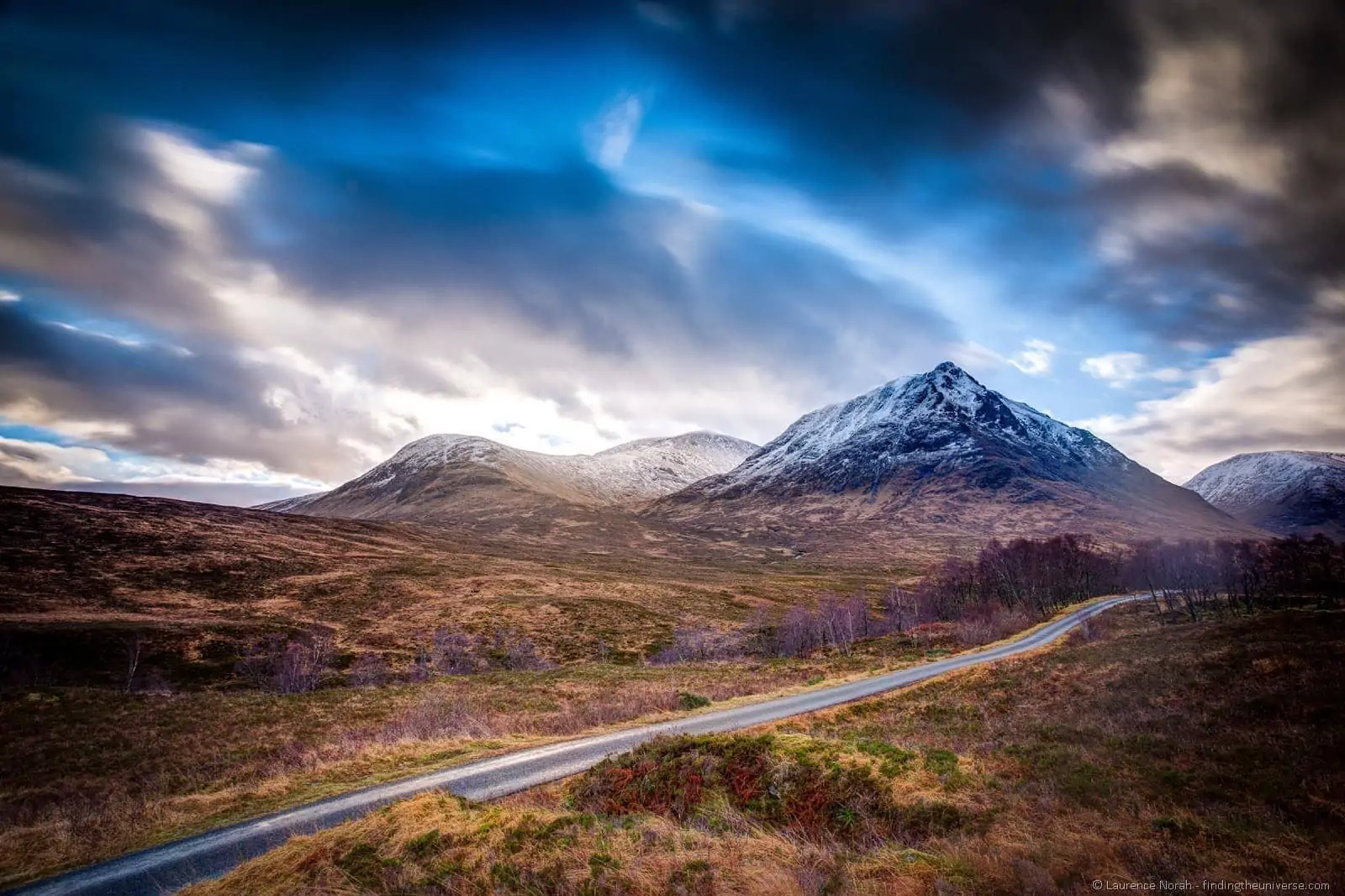

I'm Laurence, a professional travel photographer since 2010. Jess and I write this site from our own travels.
I lived in Edinburgh for four years, and Scotland has kept pulling us back ever since: repeat trips around the North Coast 500, Skye, Glen Coe, and one memorable evening in Ullapool that I’ll get to when we talk about midges. Over all those trips our Scotland packing has settled into a system, and this guide is that system written down.
The short answer first. You need a hooded waterproof jacket that’s actually waterproof, two or three layers rather than one heavy coat, waterproof footwear you’ve already broken in, and a UK Type G power adapter. If you’re heading to the Highlands or islands between late May and September, add midge repellent and a head net. Everything else depends on when you’re going and where.
That second part is what most packing advice skips. A July city break in Edinburgh and a July drive around the North Coast 500 need noticeably different bags, and January needs a different bag again. So along with the full checklist, I’ve broken everything down by season and by region, with verified numbers where numbers help.

Table of Contents:
The Scotland Packing List at a Glance
Here’s the whole list in one place. Every item on it gets explained further down, including the ones that only apply in certain seasons or regions.
| Item | Who needs it | Notes |
|---|---|---|
| Waterproof jacket with a hood | Everyone, all year | A proper waterproof shell, not a shower-resistant one |
| Base layers (2 to 3) | Everyone, all year | Merino or synthetic, never cotton |
| Fleece or wool mid layer | Everyone, all year | Yes, in summer too |
| Waterproof walking shoes or boots | Everyone | Broken in before you fly |
| Waterproof over-trousers | Highlands, islands, NC500 | Skip them for a city break |
| Midge repellent (Smidge) and a head net | West Highlands and islands, late May to September | The section below explains when and where |
| Tick remover | Anyone walking in the Highlands | Recommended by NHS Scotland; pharmacies and outdoor shops sell them |
| Warm hat and gloves | Everyone, September to May | Highland wind makes its own winter |
| UK Type G power adapter | Visitors from outside the UK | Check your appliances are dual voltage too |
| Power bank (INIU P63) | Everyone | Long days out, cold-drained phone batteries |
| Head torch (Black Diamond Spot 400) | October to March visitors, campers | Dark by mid-afternoon in December |
| Reusable water bottle (Klean Kanteen) | Everyone | Scottish tap water is excellent |
| Packing cubes (Eagle Creek Reveal) | Everyone | Especially on a multi-stop road trip |
| Sunglasses and sun cream | Everyone, April to September | Low sun angles, long summer days |
| Eye mask | Light sleepers, May to July | It barely gets dark in the far north |
| One smarter outfit | City visitors | For Edinburgh and Glasgow restaurants and bars |
| Swimwear | Optional | Wild swimmers and hotel pools only |
| Camera, spare cloths, dry bag | Photographers | See the camera section, learned the hard way |
How Scottish Weather Actually Works
Scottish weather is changeable rather than terrible. The famous line about four seasons in one day keeps being repeated because it keeps being true: on Skye we’ve had sunshine, a squall, and sunshine again inside an hour, and come out of it slightly wetter and no wiser.
This is why layering is the whole strategy. One heavy coat gives you two states, on and off, and Scotland will cycle through weather faster than you can cycle a coat. Two or three thinner layers under a waterproof shell give you a setting for everything, and the shell goes on and off a dozen times a day without drama.
The other thing to understand is that rain in Scotland is a regional business, which is where this list differs from most. The west coast catches the Atlantic weather first and the mountains wring it out: Argyll gets roughly three times Edinburgh’s annual rainfall, and parts of the western Highlands see over 4,000mm a year while Edinburgh sits around 730mm.
Wind follows a similar pattern, strongest on the west coast and the islands. Temperature barely shifts between east and west. So the question your packing actually has to answer is how hard the water will be trying to get in.
Never pack cotton for the outdoors here, and that includes hoodies and jeans. Wet cotton stays wet, chills you, and weighs a ton. Merino or synthetic layers dry in hours; jeans dry in geological time.

What to Pack for Scotland by Season
The temperature ranges below are Met Office 1991 to 2020 averages for Edinburgh, which is a fair guide for most of the country. The west coast runs slightly milder in winter and slightly cooler and cloudier in summer, but only by a degree or two. Rain and wind are what really change as you head west.
Spring (March to May)
Typically 5 to 12°C (41 to 54°F). Spring is underrated: the days stretch out fast, the midges mostly haven’t arrived, and you can get runs of bright, cold, brilliant weather. You can also get sleet in April, so pack for both. Full layering kit, warm hat and gloves still in the bag, waterproofs non-negotiable. May in the Highlands is lovely: long days, the landscape waking up, and the midge season still ahead of you.
Summer (June to August)
Typically 11 to 19°C (52 to 65°F). Note that top number. A Scottish summer day can be lovely, but 19°C with a breeze is fleece weather for a lot of people, and evenings get a bit cool everywhere. You still need the waterproof shell and a mid layer; you can drop the winter hat. Add sunglasses and sun cream, which sounds like a joke until you’ve spent a cloudless 18-hour June day outdoors.
Daylight is summer’s real gift. Around the solstice, Edinburgh gets about 17.5 hours of daylight and the north coast over 18, with twilight so long up there that it never really gets dark. That has two packing consequences: an eye mask if you’re any kind of light sleeper (B&B curtains vary wildly in their commitment), and the happy knowledge that you can walk after dinner until 10pm. Summer is also peak midge season in the west, so read the midge section carefully.
Autumn (September to November)
Typically 7 to 13°C (44 to 56°F). September is a favourite of ours: the midges fade through the month, the crowds thin, and the autumn colours around Glen Coe and Perthshire are as good as anywhere in Europe. October and November turn seriously wet and windy, so this is the season where over-trousers start paying for themselves even on lower-level walks. Warm hat and gloves come back into the bag.
Winter (December to February)
Typically 2 to 8°C (35 to 46°F), colder inland and on any height. Edinburgh winters, of which I did four, are less about severe cold and more about wind that finds every gap in your clothing. Base layers go on every day. I run merino base layers; Jess prefers synthetic, and the practical difference is merino stays fresh longer between washes while synthetic dries faster and costs less. Either beats cotton by a mile. For merino, the Smartwool Classic Thermal crew is the safe default.

The winter number that catches people out is daylight. Around the winter solstice Edinburgh gets about seven hours of it, sunrise after 8:40am and sunset at about 3:40pm, and on the north coast it’s closer to six and a quarter.
Plan for that: a head torch is a real packing item (more on that in the electronics section), and you’ll spend more time indoors than you expect, so pack for pubs and museums as well as hills. Our winter in Scotland guide and Edinburgh winter guide cover what those short days are like on the ground, and if you’re curious about snow sports, yes, Scotland has ski resorts.

What to Pack by Region: Cities, Highlands and Islands
Season is only half the packing decision. The same month produces a different bag depending on where you’re going, and this is the part almost nobody plans for. The quick version:
| Season | Edinburgh and the Cities | Highlands and NC500 | The Islands |
|---|---|---|---|
| Spring | Layers, waterproof shell, comfortable shoes | Add boots, over-trousers, hat and gloves | As Highlands, plus serious wind layers |
| Summer | Layers, shell, sunglasses; smart outfit for evenings | Add midge kit, boots, long sleeves for still evenings | Midge kit essential; wind shell even in July |
| Autumn | Layers, shell, warm hat by October | Over-trousers non-negotiable, gloves, head torch by November | As Highlands, ferries may test your stomach |
| Winter | Warm layers, shell, one smart outfit | Full winter kit, head torch, flask | Full winter kit; check ferry weather flexibility |
Edinburgh and the Cities
City Scotland needs less specialist kit than people pack for it. For Edinburgh or Glasgow you want comfortable waterproof footwear for cobbles and showers, your layers, and the shell. You don’t need hiking boots for the Royal Mile, and you don’t need over-trousers at all; an umbrella is usually more liability than help in the wind, which is why locals mostly don’t carry them.
What the cities do reward is one smarter outfit. Edinburgh and Glasgow have restaurant and bar scenes where you’ll feel underdressed in full hiking kit, and a pair of dark trousers with a decent top or shirt covers everything from a nice dinner to a whisky bar. My own city-shoe answer these days is a waterproof pair from Vessi, which handles both a wet Princes Street and a restaurant without a change.
Midges, for what it’s worth, are rarely a problem in the city centre, so leave the head net in the car. If you’ve got city days planned, our two-day Edinburgh itinerary, Edinburgh photography locations and Jess’s guide to hidden Edinburgh attractions will fill them.
The Highlands and the North Coast 500
This is where the full list applies. On our North Coast 500 trips the kit that mattered most, in order, was: waterproof shell, waterproof over-trousers, boots, midge kit, warm hat. Over-trousers are the item city-trip advice tells you to skip, and for cities that’s right, but on the NC500 they’re the difference between carrying on with your day and sitting in the car waiting out a squall. They also double as wind protection on exposed coast, which you will meet.
Distances up there are quite a bit longer than the map suggests and facilities are far apart, so this is also where the practical bits matter most: power bank, water bottle, snacks, a flask in the colder months, and the head torch if you’re camping or out late.
We’ve covered the route itself in our 5-day NC500 itinerary and NC500 highlights guide, campers have our NC500 camping itinerary (which includes its own camping-specific packing section) and campsites guide, and if you’re basing around Inverness, here’s what to do there plus our Loch Ness guide.
The Islands
Skye, Mull and the Outer Hebrides take the Highland list and turn the wind up. Island weather comes off the Atlantic with nothing to slow it down, so windproofing matters as much as waterproofing. A shell that cinches down tight, a hat that won’t blow off, and gloves earlier in the year than you’d expect.
The islands are also prime midge country in season, sitting on exactly the damp peaty ground midges breed in, so the whole midge section below applies. Skye rewards planning in other ways too; we’ve written up its best photography spots, and Jess has good advice on avoiding the Skye crowds.
Midges: The Packing Problem Nobody Warns You About
The worst midges we’ve ever met weren’t on a hike at all. We were in Ullapool, enjoying the sunset with a beer, and the moment we stopped moving they descended. Walking kept us ahead of them, so we spent the rest of that beer pacing the harbour front like sentries, and any time we paused to admire the view they caught up within seconds.
For four months of the year, in the wrong half of the country, midges will have more say in your evenings than the rain will. Yet they barely appear in most packing advice. Here’s what you need to know, and what actually goes in the bag because of it.
When and Where Midges Are a Problem
Midge season runs roughly late May to September, worst from late June through August. There are two waves: a first emergence in late spring, then a second, usually heavier generation from mid to late July.
Geography matters more than dates, though. Midges breed in damp, acidic, peaty ground, which is exactly what the west Highlands and islands are made of and exactly what central Edinburgh isn’t. You can have a midge-free city break and a rough week on Skye in the same fortnight.
Their behaviour is predictable once you know the trigger is light level. They’re worst at dawn and dusk, but a heavily overcast day can be midgy at noon. They love still, humid air, and rain doesn’t put them off at all.
What calms them down is bright sunshine and, best of all, wind: above about 7mph they’re much less active, which makes a decent breeze the most reliable midge deterrent there is, and it’s free. This is why locals will choose an exposed, breezy picnic spot over a sheltered one in August, and why our Ullapool evening went the way it did the moment the air went still. Before a west-coast trip in season, check the Scottish midge forecast, which maps predicted activity across the country.
What Works Against Midges
The clothing part first, because it’s the part nobody connects to their packing. A midge is 1 to 3mm long with tiny cutting mouthparts; it can’t drill through fabric. What it can do is walk through a loose knit, up a sleeve, or under a hem, and then bite the skin it finds.
So your defence is weave and closures. A thin, tightly woven long-sleeved layer with cuffs that close beats a thick loose-knit jumper, even in warm weather. In practice that means your light windproof shell is better midge armour than your fleece, and it’s another reason long sleeves stay in the summer bag for the west coast. Tuck things in at the ankles and wrists on still evenings and you’ve removed most of the entry points.
For repellent, the one that works is Smidge, the Scottish standard. It uses 20% saltidin (also called picaridin or icaridin, a well-established repellent), and Smidge say it protects for up to eight hours. Picaridin also lacks DEET’s famous habit of attacking plastics and synthetics, which matters if the hands applying it also handle camera grips and waterproof fabrics all day.

Then there’s the midge head net. You will not look cool in it. Nobody does, and nobody cares, because the people without one have gone indoors. It weighs nothing, packs to the size of a plum, and on a still July evening on the west coast it’s the best few pounds you’ll spend on the whole trip. For campers I’d call it essential.

And then there’s the folk remedy. Avon Skin So Soft Original Dry Oil Spray is the great Scottish midge legend, to the point that Royal Marines at Faslane were reported buying it in bulk back in 2005. Avon, though, sells it as a body moisturiser, and makes no insect-repellent claim for it at all.
The reputation is word of mouth, and the limited testing that exists suggests any repellent effect is mild and fades fast, with one study putting it around ten times weaker than a modest-strength DEET product. Pack it because half of Scotland swears by it and it’s pleasant on skin. Don’t pack it instead of a real repellent.

Ticks, and Why Light Colours Help
Midges are the famous nuisance; ticks are the one to take seriously. The Highlands have a lot of them, and NHS Scotland’s advice for walkers maps almost directly onto a packing list:
- Stay on the paths where you can.
- Wear long sleeves.
- Tuck your trousers into your socks, because ticks sit on vegetation waiting for you to brush past.
- Wear light-coloured fabrics, so you can spot a tick on your clothing before it reaches skin.
That last point is where the popular “wear light colours against midges” advice really comes from. The evidence behind it is about spotting ticks, which is a better reason anyway.
Pack a tick remover or fine-toothed tweezers. NHS Scotland specifically suggests carrying one, pharmacies and outdoor shops sell them for pocket change, and removing one promptly and cleanly reduces your risk of Lyme disease, which is present in the Highlands.
Keep the risk in proportion: tick bites are common, Lyme is not, and the full NHS guidance on tick bites is a five-minute read; do it before a walking trip. The pleasing bit of packing-list economy is that the same long sleeves and tucked-in trousers serve against both midges and ticks.
Footwear for Scotland
Footwear intent forks three ways in Scotland, and packing the right two of the three is the trick.
Waterproof walking shoes are the everyday answer: cities, castles, lochside strolls, light trails. If your trip is a city break plus the odd gentle walk, these plus something smarter for evenings is pretty much all you need.
Hiking boots come in when the Highlands do. Wet ground, rocky descents and bog margins reward ankle support and a grippy sole. We’ve both worn Scarpa and Merrell boots over the years, and the one I’d point most visitors at is the well-reviewed Merrell Moab 3 Mid Waterproof, which comes in men’s and women’s versions and won’t need a mortgage.
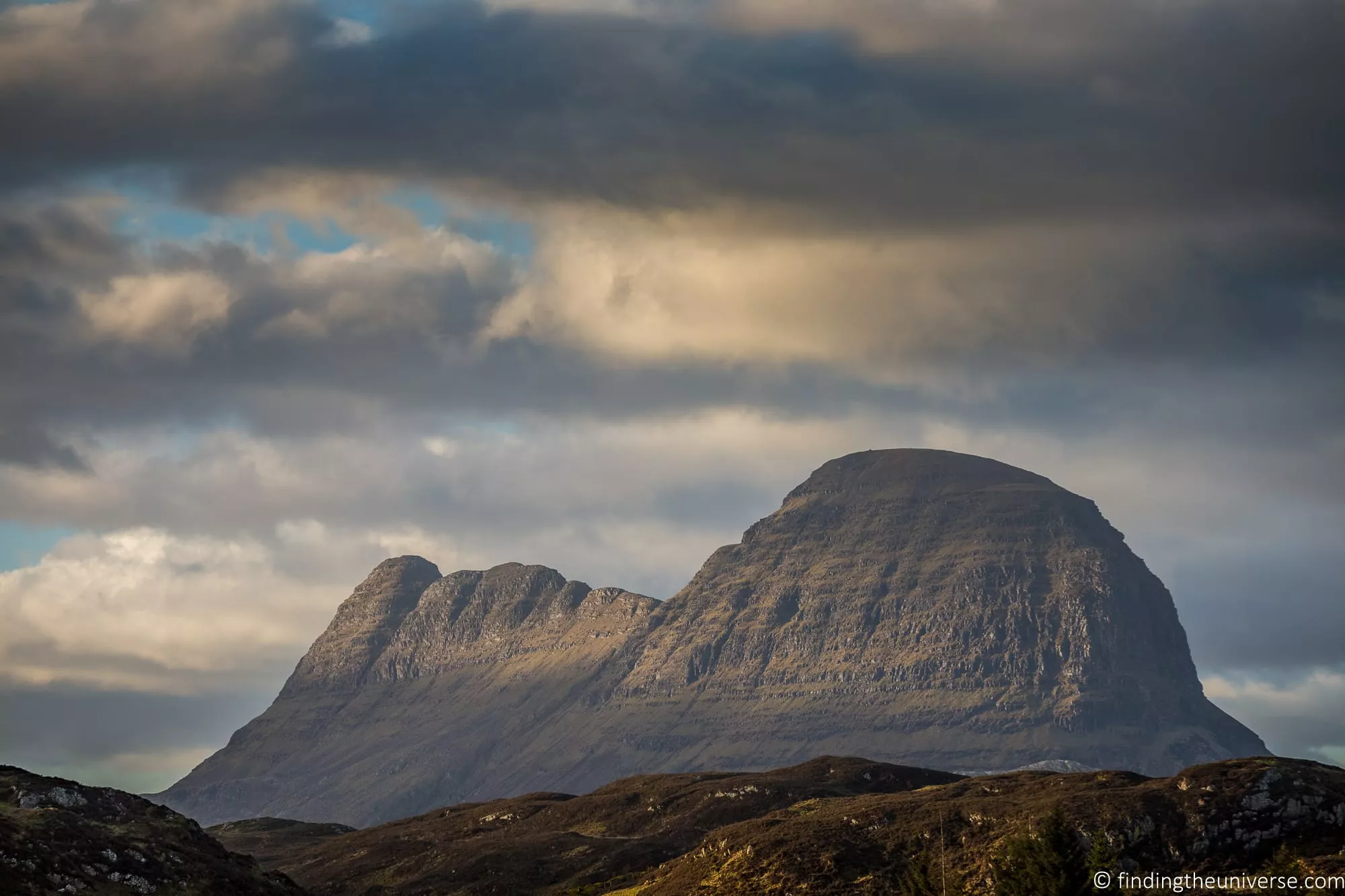
Whatever you choose, break it in at home first: Scotland is a terrible place to discover a blister on day one. If your plans run to a proper hill like Suilven, our Suilven hiking guide covers what that actually involves.

The third fork is the casual waterproof shoe, which is my Edinburgh answer: something that shrugs off wet pavements but doesn’t announce “I have just come off a hill” in a restaurant. Mine is the Vessi mentioned in the cities section above. Jess packs along the same lines: good hiking boots plus comfortable waterproof shoes for everything else.
Waterproofs and Outer Layers
The jacket is the most important item in the bag, so get the distinction right: what you want is a waterproof shell with a hood. Warmth comes from the layers underneath, which you can vary; the shell’s only job is to keep water and wind out, all year round.
My own shell is the Bluffworks Faroe, which I wear for exactly the trip style this article describes: it’s long enough to cover your seat, packs down small, and looks like a normal jacket, so it works in the city too. One caveat from experience, and it matters for this list: it’s a three-season city-and-travel shell, and for sustained Highland hiking in filthy weather I’d want a dedicated hiking hardshell instead. You can find the Faroe directly from Bluffworks here.
The budget pick that keeps showing up on trails for good reason is the Columbia Watertight II: fully waterproof, packs into its own pocket, costs a fraction of the technical brands. Jess has a North Face rain jacket she’s had for years; the equivalent women’s Columbia is the Arcadia II, same idea and same price bracket as the Watertight.

Check price on Amazon (men’s) · Check price on Amazon (women’s Arcadia II)
Waterproof over-trousers are the item whose value depends entirely on your itinerary, which is why they got their own row in the region table. City break: leave them at home. Highlands, islands, NC500, any serious walking, anything from October to March: pack them.
We carry over-trousers on every Highland trip (Berghaus, I think, plus a newer pair we picked up recently), and if you’re buying a pair fresh, the Marmot PreCip Eco is a solid choice: light, packable, with enough of a leg zip to pull on over boots when the squall arrives. It will arrive while you’re wearing the boots.

On top of the shell system, one warm hat, one pair of gloves, and a buff or scarf cover you from September to May. They weigh nothing and the Highland wind will make you glad of all three.
Camera Kit for Scottish Weather
Scotland is one of the most photogenic countries I’ve worked in, and I say that as someone who’s been a professional travel photographer since 2010. It’s also one of the more hostile places to camera gear, and the packing list reflects a few lessons that cost me soggy mornings to learn.
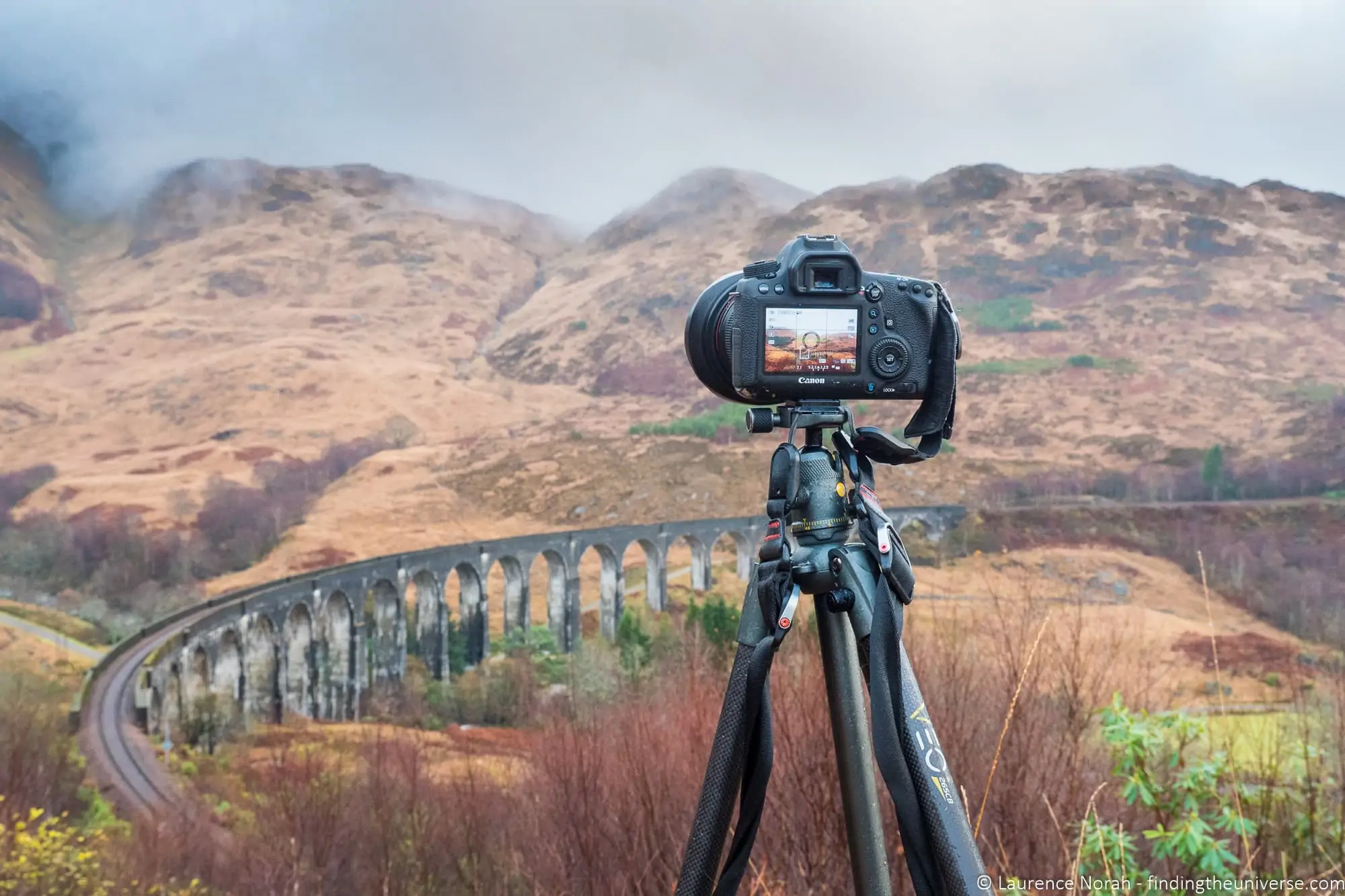
First: weather sealing is not waterproofing. A weather-sealed body and lens will handle drizzle and spray; none of it is rated for the sideways rain an Atlantic front delivers, so pack a rain cover or, at minimum, a dry bag you can retreat to. Second: bring more microfibre cloths than seems sensible, because the first one is soaked within ten minutes of a shower and a wet cloth just moves the water around your front element. I carry at least three, cycled through an inside pocket to dry.
Third: wind is the underrated enemy. A light travel tripod will go over in a Highland gust, so if you’re bringing one, bring one you trust, splay it low and hang your bag from the hook. And change lenses inside your jacket, in the car, or not at all when the rain is blowing; a sensor speckled with Scottish weather stays speckled for the rest of the trip.
Winter photographers get one extra line item: proper photography gloves. Bare fingers on metal dials at 2°C stop being fun within minutes, and normal gloves make you choose between warmth and controls. I use Vallerret’s Markhof Pro, photography-specific gloves with fold-back finger caps, and they’ve changed what a February shoot feels like.
If you’re planning to shoot specific locations, our guides to NC500 photography spots and Skye photography locations are built for exactly that, and if you’re carrying camera kit on walks, our hiking camera guide covers the carrying problem.
Electronics and Practical Bits
Scotland uses UK Type G three-pin plugs on 230V, 50Hz mains, so visitors from North America and most of Europe need a Type G adapter. The adapter is the easy half; the half that destroys hair dryers is voltage. Phone and laptop chargers are almost always dual voltage (look for “100-240V” on the brick), but single-voltage appliances plugged into 230V through a simple adapter die dramatically. Check the label on anything with a heating element before it flies.
The rest of our practical kit, tested across a lot of Highland miles:
A power bank, because Highland days are long, navigation apps are hungry, and cold drains phone batteries noticeably faster. The INIU P63 is my daily carry: , 25,000mAh, and it charges a laptop as well as phones. Check the Wh rating printed on the case against your airline’s limit before you fly; most carriers cap carry-on power banks at 100Wh. We compared the field in our travel power bank guide.

A head torch, which sounds like camping kit until you remember the sun sets before 4pm every day in December. Ours rotate as they wear out but it’s usually a Black Diamond of some description; the current Spot 400 is the well-reviewed standard. Pack it from October to March, for camping, and for any itinerary that includes “one last walk” in autumn.
A reusable water bottle, because Scottish tap water is excellent: 99.92% of regulatory tests at customers’ taps met standards in 2024, and Scottish Water is happy to tell you about it at length. One narrow caveat for very remote stays: around 3% of Scotland’s population is on a private water supply rather than the public network, and those aren’t held to the same monitoring, so if your cottage is at the end of a long single-track road, it’s a fair question for your host. We carry the classic Klean Kanteen.
Packing cubes, which matter more here than on most trips because Scottish itineraries tend to be multi-stop: a new B&B every night or two on the NC500 means living out of the bag, and cubes are what keep that manageable. The Eagle Creek Pack-It Reveal set () is our pick from testing the category. A luggage tracker is cheap insurance on the flights either side, too.

What Not to Pack for Scotland
An umbrella, mostly. Scotland eats umbrellas. The rain rarely falls conveniently downwards, and a hood plus a decent shell does the job with both hands free. If you’ll be mainly in the cities a compact one can ride along, but watch how few locals bother.
Jeans and cotton hoodies for the outdoor days, for the reasons covered earlier: wet cotton is a misery you wear for hours. They’re fine for pubs and travel days.
Heels or dress shoes beyond one smarter pair. Edinburgh is a city of hills, cobbles and closes; nobody’s outfit survives contact with the Royal Mile anyway.
A full wardrobe of “in case” outfits. Laundrettes and B&B laundry exist, every Highland town has an outdoor shop happy to sell you the layer you’re missing, and the layering system means the same few pieces recombine all week.
And unless you’re a committed wild swimmer, you can skip swimwear with a clear conscience. The North Atlantic in August is character-building in a way most holidays don’t require. Pack it only if your accommodation has a pool, or your character needs building.
How Our Scotland Packing Has Changed
Every trip refines the list, so here’s what ours has taught us.
Ullapool taught us to take still evenings seriously. A calm, warm sunset on the west coast is exactly when the midges arrive, so now the long sleeves come out to dinner with us and we check the midge forecast before planning an evening outdoors. It’s a small habit that’s saved a few evenings since.
Over-trousers went the other way, from afterthought to one of the first things in the bag. We recently bought a new pair, and for any Highland trip they go in before most of the wardrobe does.
And the bag itself has got smaller. Scotland has laundrettes, supermarkets and, in every Highland town, an outdoor shop happy to sell you whatever you forgot, so the just-in-case pile stays at home now. The one direction we’ve learned to over-pack in is socks: wet boots and long days get through more pairs than seems reasonable. Of course, your own list will evolve differently, but ours improves whenever an item has to argue its way in.
Scotland Packing List FAQ
When Is Midge Season in Scotland?
Roughly late May to September, with the worst period from late June through August. There are usually two waves, with the second generation in mid to late July typically the heavier one.
Location and weather matter as much as the calendar: midges concentrate in the west Highlands and islands, favour still and humid conditions, and are much less active in wind above about 7mph or bright sunshine. Midges are rarely a problem in central Edinburgh or the other eastern cities.
Are Midges in Scotland Really That Bad?
In the west Highlands and islands on a still summer evening: yes, bad enough to change your plans. In moving air, bright sun, or the cities, you may barely meet them.
The fix is cheap and effective: picaridin-based repellent like Smidge, a head net for still evenings, and long sleeves with closures rather than loose weaves. Wind is the great free repellent, so breezy spots stay comfortable when sheltered ones don’t.
What Shoes Should I Wear in Scotland?
Waterproof walking shoes cover cities and light trails; add hiking boots if the Highlands or hills are on the itinerary. Whatever you bring, break it in first.
For evenings, one smarter pair covers Edinburgh and Glasgow restaurants. A waterproof casual shoe does double duty for city streets and dinner, which is how we travel most of the time.
Do I Need Waterproof Trousers for Scotland?
For a city break, no. For the Highlands, islands, the NC500, or any walking holiday, yes, and doubly so from October to March.
Beyond rain, over-trousers earn their space as wind protection on exposed coasts and hills. Light, packable ones live in the daypack and go on over boots when a squall arrives.
Can You Drink Tap Water in Scotland?
Yes, and it’s excellent: 99.92% of regulatory tests at customers’ taps met the standards in 2024. Bring a reusable bottle and skip bottled water entirely.
The one narrow exception is private water supplies, which serve around 3% of Scotland’s population and aren’t monitored the same way as the public network. If you’re staying somewhere very remote, ask your host; they’ll be used to the question.
What Power Adapter Do I Need for Scotland?
Scotland uses the UK Type G three-pin plug on 230V, 50Hz mains, so you need a Type G adapter from North America and most of Europe.
Also check that your appliances are dual voltage before you travel. Phone and laptop chargers almost always are (marked “100-240V”), but single-voltage hair dryers and stylers will be destroyed by 230V through a simple adapter.
What Should I Wear in Scotland in Summer?
Layers: t-shirts or base layers, a fleece or jumper, and a waterproof shell, with one warmer layer for evenings. Summer averages around 11 to 19°C (52 to 65°F), so it’s mild rather than hot.
Heading west, add long sleeves for still evenings (midges) and keep the shell handy; the west coast is markedly wetter than the east all year. Sunglasses and sun cream matter more than people expect across the long daylight hours.
Is Scotland Cold in Winter?
Cold but rarely severe: lowland winter days average 2 to 8°C (35 to 46°F), colder inland and on high ground. Wind chill is the real factor, so windproofing and layers matter more than a single heavy coat.
The bigger adjustment is daylight, with around seven hours in Edinburgh at the solstice and less further north. Pack a head torch, plan indoor time, and winter Scotland is a treat rather than a trial.
Further Reading for Your Scotland Trip
If this list is doing its job, you have a trip to plan around it. These are the guides we’d point you at next:
- Winter in Scotland, for what the cold months are like on the ground (including its own winter-specific packing notes).
- Our 5-day North Coast 500 itinerary, the route this packing list was road-tested on.
- Two days in Edinburgh, for the city end of the trip.
- Our London packing list, if your trip takes in both ends of Britain, and our safari packing list for the next trip after this one.
For a guidebook to carry, Rick Steves Scotland is the one we recommend: opinionated, practical, and updated for 2026.

And that’s what goes in our bags for Scotland. If you’ve got a question this guide didn’t answer, or a packing trick we should know about, the comments are open as always. We read every one!
Leave a Reply