
Kampala is worth a stop. Most international visitors skip it for the gorillas and the chimps and the savannas, which I understand, but spending a day or two in Uganda’s capital before you head off to the parks gives you a much better sense of where you actually are. It’s the loud, busy, hilly, religious, royal, slightly chaotic city that the rest of the country comes to for work and school and weddings and football. Skip it and you’ve kind of skipped the country.
Jess and I have been four times now, mostly for a day or two, once for several days. So we’ve done the markets, climbed the Mosque minaret, enjoyed the Wednesday show at Ndere, eaten our way around with a tour guide who was funnier than any of the food, and walked enough of the city in the dust to acquire a permanent reddish-brown layer on our shoes. We have also, on one occasion, turned up at the Baha’i Temple too late, looked at a closed gate, and gone home. So consider this a guide written by people who got it wrong at least once.
This is our pick of what’s actually worth your time in Kampala, with notes on getting around safely, where to stay, what to eat, and a few day-trip options if you have an extra day or two. If you only have a day, we have a separate one-day Kampala itinerary with suggested routes by interest. We also have detailed guides to things to do in Entebbe, gorilla trekking, and chimpanzee trekking elsewhere on the site.
Travel advisory: The US State Department has Uganda at its highest warning level, Level 4: Do Not Travel, last updated on 4 June 2026 and still in force. One of the reasons given was the Ebola (Bundibugyo virus) outbreak in Uganda and the neighbouring Democratic Republic of the Congo. Uganda’s outbreak is now over: the World Health Organization and Africa CDC declared it ended on 27 August 2026, after 42 days with no new cases. Uganda recorded 20 cases and two deaths in total. The DRC outbreak is still running and is still a public health emergency of international concern, and there is a lot of movement across the border, so the regional risk has not gone away. Crime, the risk of terrorism, and the potential for unrest are also cited in the US advisory, and none of that has changed.
The US advisory has not been revised since Uganda’s outbreak ended, and different bodies read the same situation differently. The US CDC runs a separate travel-notice scale and has the DRC and Uganda at Level 2, Practice Enhanced Precautions. Official advice changes regularly, so check the latest guidance before you make any plans. You can read the current US advice here and the UK Foreign Office advice here. If you do travel, follow your government’s guidance and your tour operator’s health precautions closely. We will keep this guide updated as the situation develops.
Table of Contents:
Quick Take on Kampala
Worth visiting? Yes, for at least a day before you head out for the trekking and safari portion of your trip. It’s not a pretty city in the picture-postcard sense, but it is a real one, and that’s the point.
How long do you need? One day for highlights, two for a more relaxed pace, three if you want to add a day trip like Mabamba shoebill or Ziwa Rhino Sanctuary.
Top experience for us: The Wednesday evening Sherehe show at Ndere Cultural Center. Close runner-up: the view from the top of the Uganda National Mosque minaret.
Bring with you: Comfortable shoes you don’t mind getting dusty, a small daypack with a secured zipper, modest clothing for religious sites (women: long skirt or wrap), and a willingness to do most of your getting-around by Uber or boda boda rather than walking long distances.
Skip: Trying to “do” Kampala on foot. The city sprawls across hills and the traffic and dust make walking between major sights more punishment than sightseeing.
How Many Days Do You Need in Kampala?
One day is enough for the headline sights: the Mosque, Kabaka’s Palace, one of the cathedrals, a market, and probably a meal somewhere local. A guided walking tour can knock most of this out in a single morning.
Two days lets you slow down. Add Kasubi Tombs, the Baha’i Temple, the Uganda Martyrs Basilica at Namugongo, and an evening at Ndere. This is the pace we’d recommend if you can spare it.
Three days opens up day trips: Mabamba Swamp for the shoebill stork, Ngamba Island for chimps, Ziwa for rhinos, or even Jinja and the source of the Nile. None of these are in Kampala proper but they’re all reachable as day trips and most visitors don’t really realise this.
Things to Do in Kampala
Kasubi Tombs
Before Uganda was a British protectorate it was a collection of smaller kingdoms, and the largest of those was the Buganda kingdom of the Baganda people, ruled by a Kabaka in a tradition going back to the early fourteenth century. That tradition is still alive, and nowhere is it more visible than at the Kasubi Tombs on Kasubi Hill.
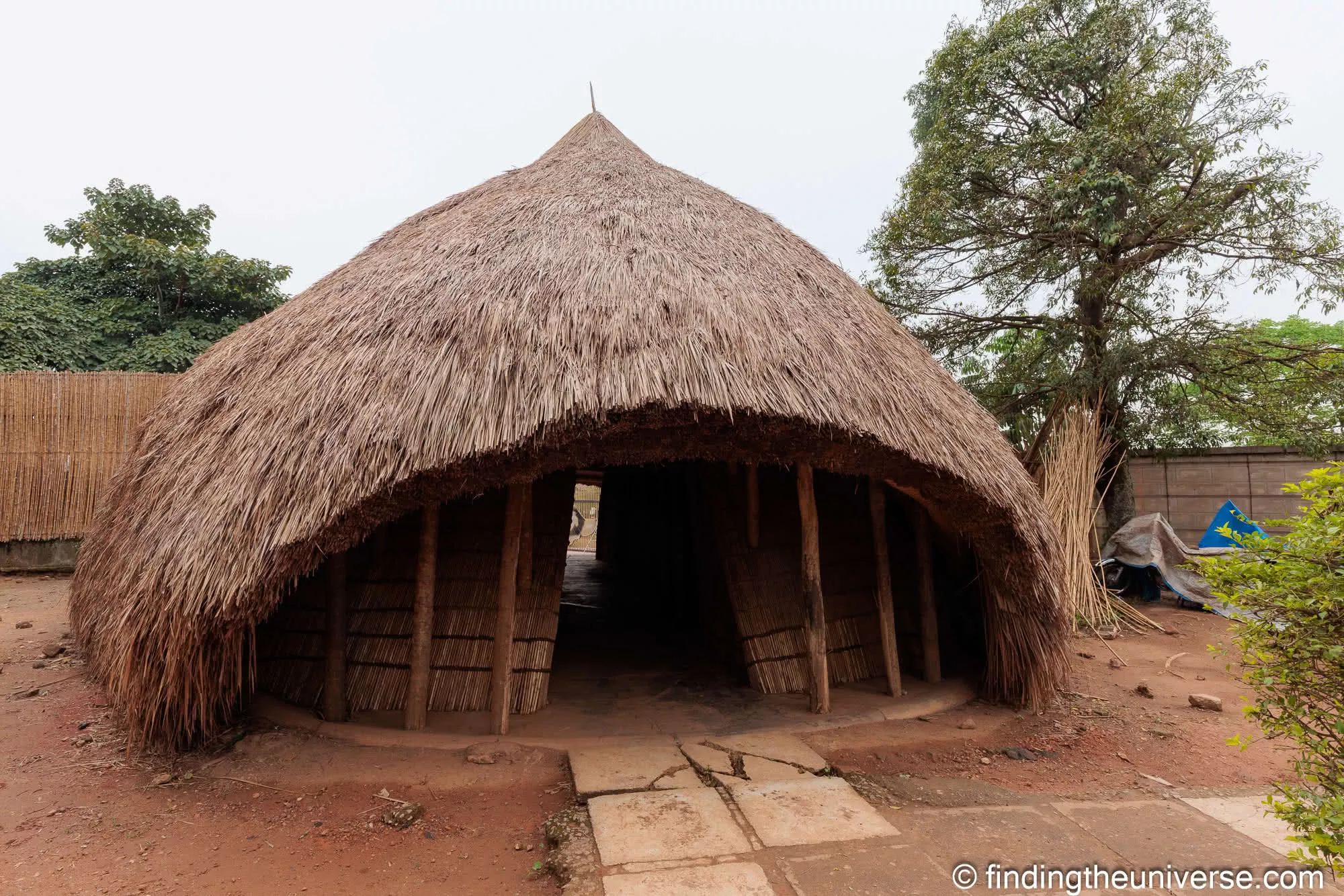
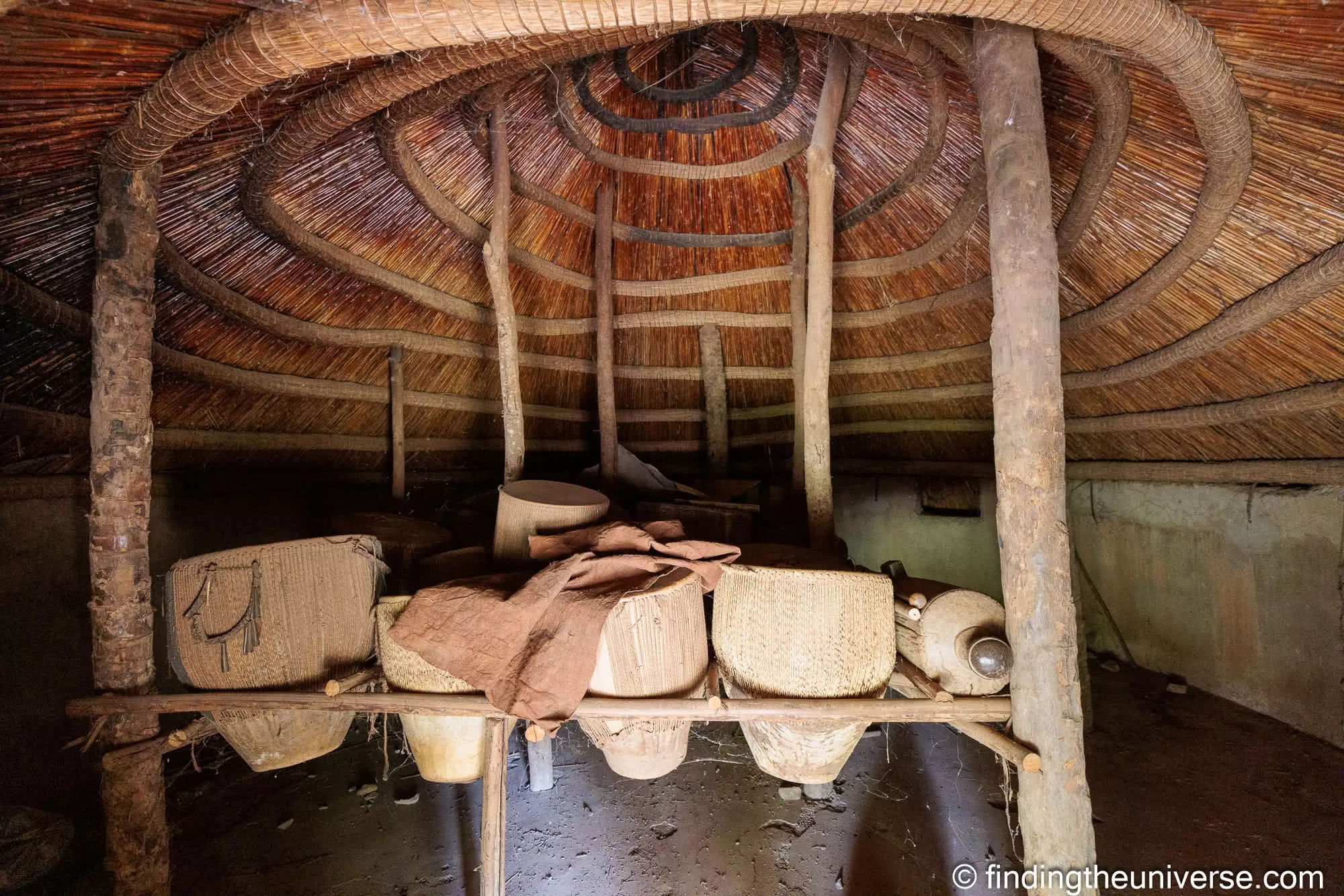
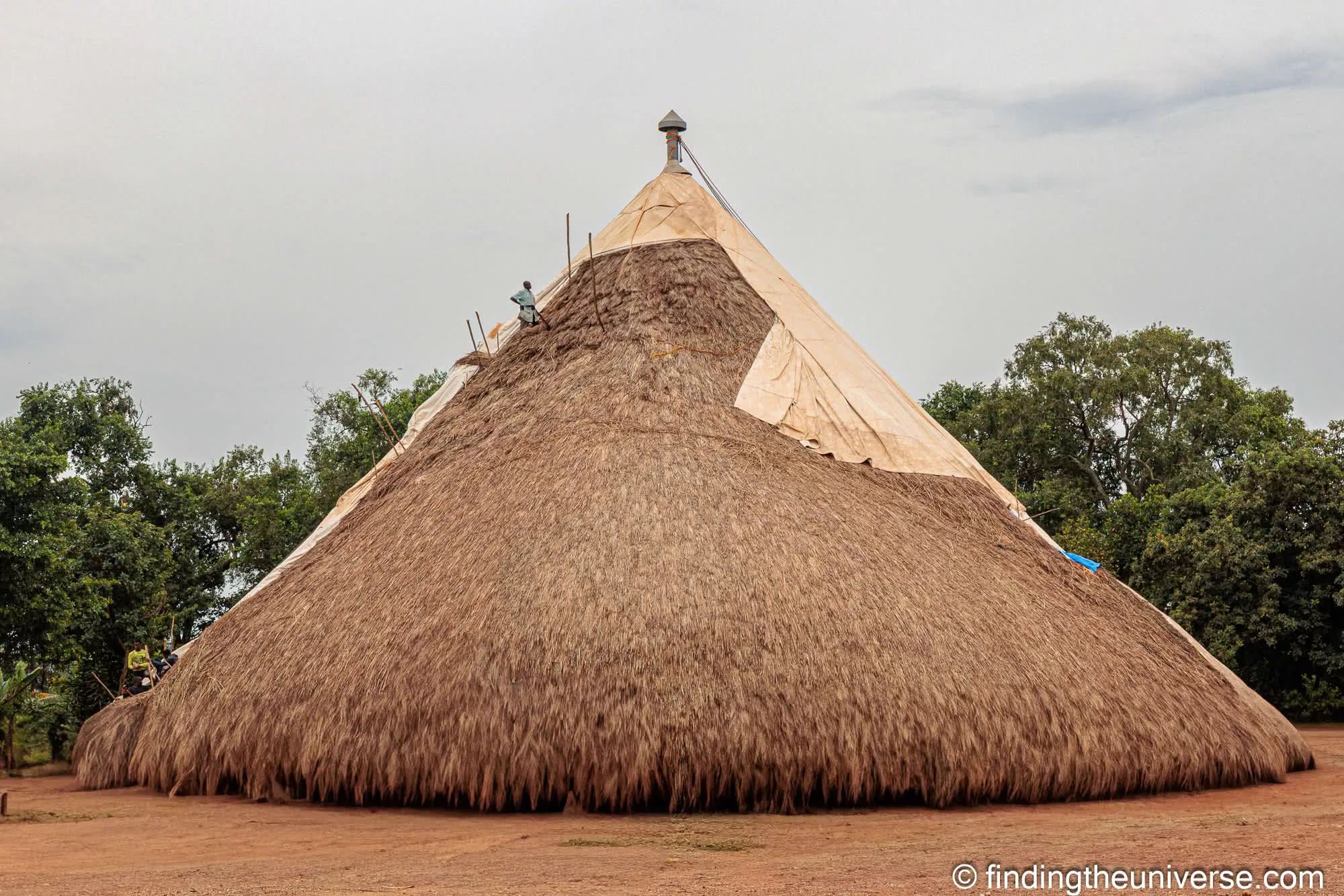
This is the burial place of four Buganda Kabakas, the only UNESCO World Heritage Site in Kampala, and a working spiritual site for the Baganda. The 64-acre complex dates from 1882. The centrepiece is an enormous conical thatched building called the Muzibu-Azaala-Mpanga, built using traditional materials: wooden poles, spear grass, reeds, wattle. There’s also a gatehouse, a drum house, family burial sites for the wives and children of the kings, and a number of traditionally constructed homes where the widows of former Kabakas still live and tend the graves.
The site was almost entirely destroyed by fire in 2010 and underwent a long rebuilding effort, finally reopening in 2025. We visited mid-rebuild and watched craftsmen from across Uganda working on it, which was actually the more memorable part.
This is a spiritual site, so dress conservatively. Women need to cover their legs with a long skirt or a large scarf tied around the waist, even over trousers. Jess had on long pants and was still asked to wrap a skirt before she could enter, so come prepared rather than discover this at the gate.
There’s an entry fee, payable on site, and you’ll be assigned a guide for your visit. You can also do it as part of a wider city tour like this guided city tour or this cultural tour, which combines several Kampala sites in one go.
Wamala Tombs
If you’ve done Kasubi and want more in the same vein, the Wamala Tombs are a smaller, less-visited burial site about a 30-minute drive north of the city centre. This is the resting place of the 29th Kabaka, Ssuuna II, who ruled from 1832 to 1856. By most accounts he wasn’t a particularly nice man (he had almost all his brothers executed, which tells you something).
The tomb is housed in a thatched building similar to Kasubi, alongside the remains of the former palace, the tomb of Ssuuna’s mother, and a collection of royal artefacts. It’s quieter and more atmospheric than Kasubi, partly because almost no one comes here. Worth combining with Kasubi on a half-day if you’re into the royal history thread, less worth a special trip on its own.
If you do want to visit, this Kampala cultural tour includes Kasubi Tombs, Kabaka’s Palace, and the central markets in one go, which is a more efficient way to do it than separate trips.
Kabaka’s Palace (Mengo Palace)
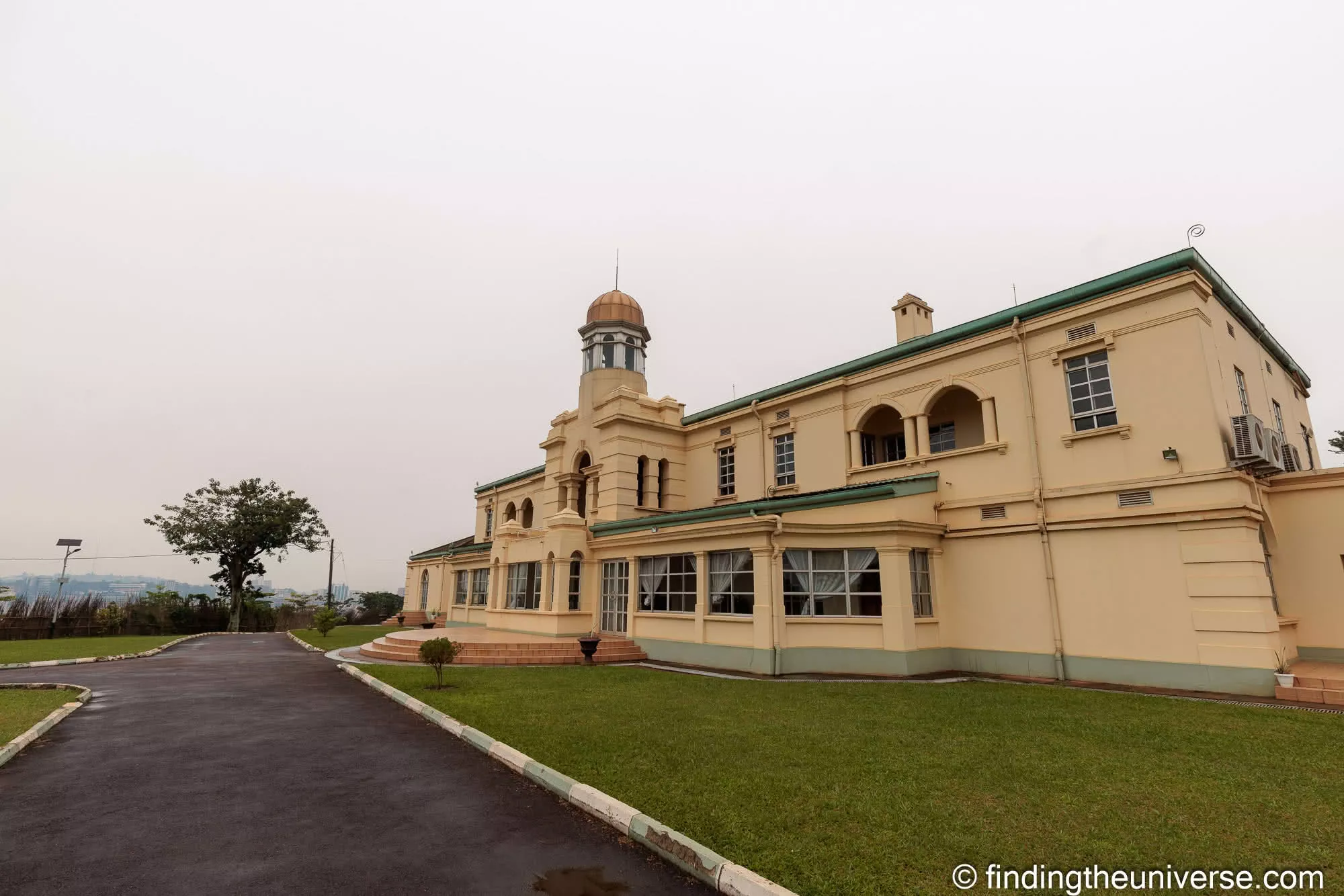
The Kabaka’s Palace, also known as Lubiri or Mengo Palace, is the traditional home of the Buganda King and sits on the top of Mengo Hill. The grounds are open to the public, although you can’t go inside the actual palace residence (the Twekobe Palace), which is no longer used as the Kabaka’s day-to-day base but is still in service for official visits and ceremonies. Day-to-day royal business happens at the Bulange, connected to the palace by a straight tree-lined road called the Kabaka Anjagala (the “Royal Mile”), which is itself a nice walk if the weather’s behaving.
The visit is mostly outdoors and guided. You turn up at the entry gate, pay the fee, and a guide is allocated. We had a guide named Fred who was excellent: warm, knowledgeable, happy to answer questions about everything from the trees on the grounds to the history of the kingdom.
The reason most visitors come, though, isn’t the palace itself but what’s underneath it.
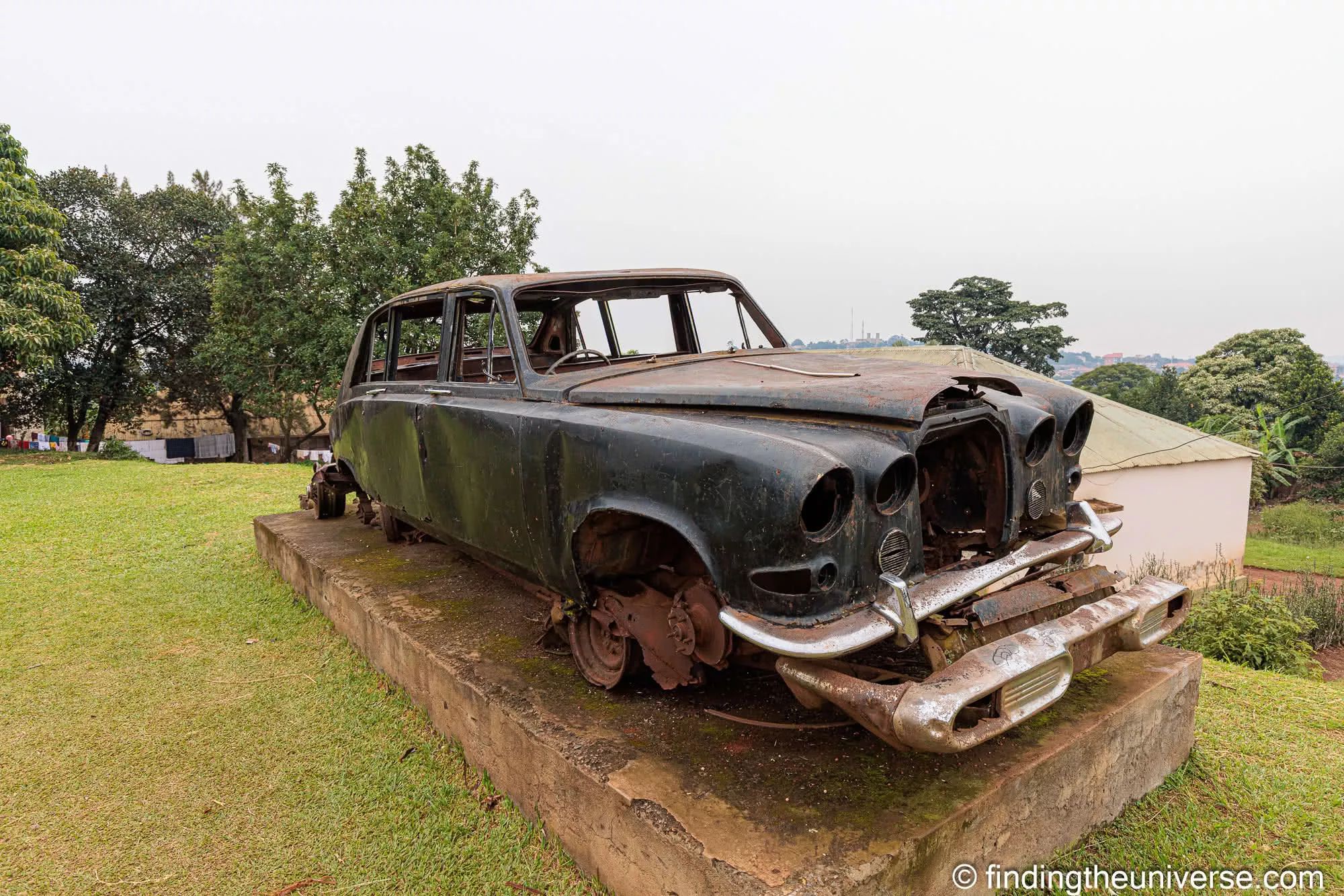
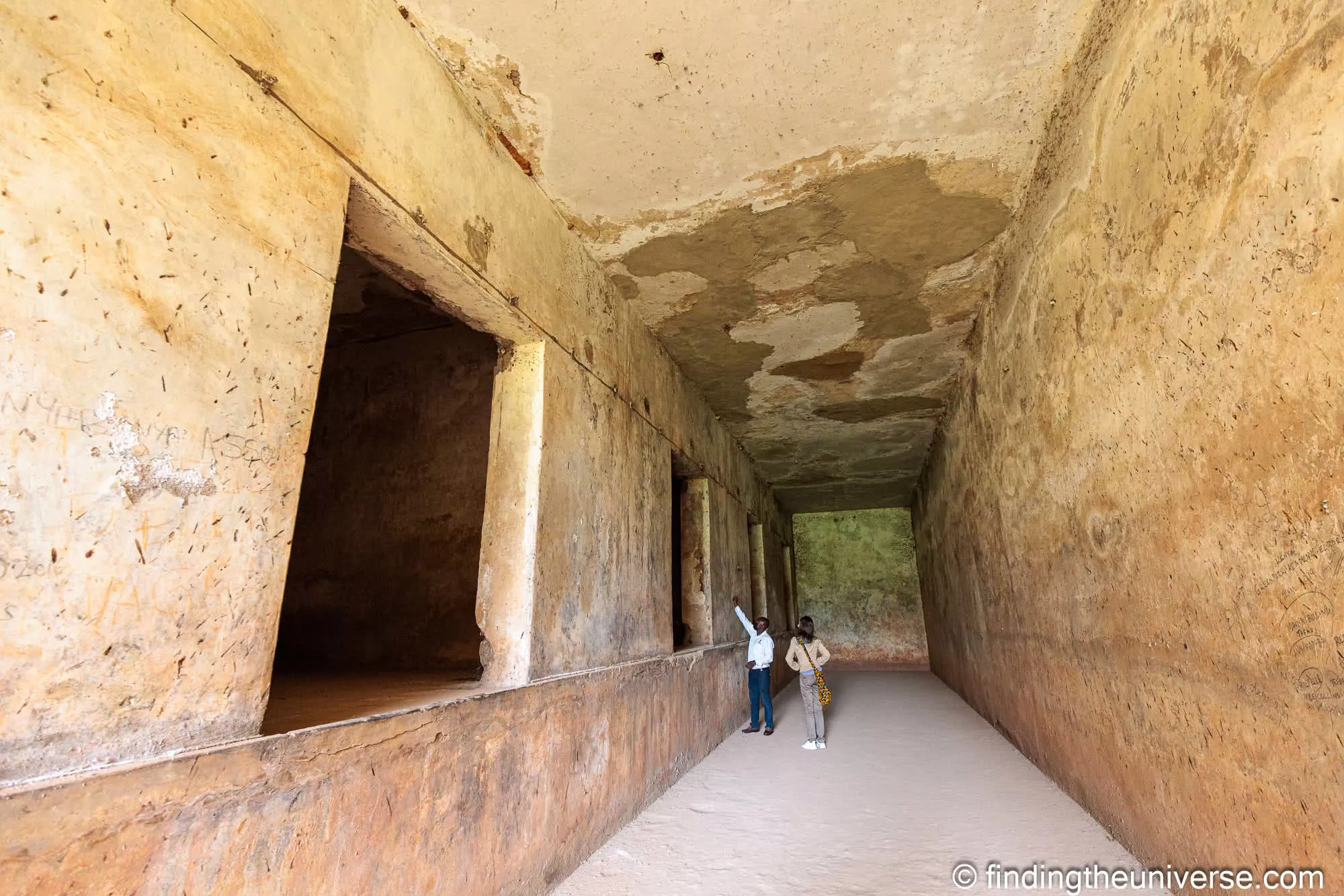
The grounds contain the underground torture chambers built during the regime of Idi Amin. These concrete cells were the final holding location of anyone deemed a threat to Amin’s rule. The guides here will tell you that as many as 200,000 people died in these chambers, their bodies dumped in a nearby lake. That figure is hard to verify independently (estimates of Amin’s total regime death toll across all of Uganda range from 100,000 to 500,000), but the scale of what happened here is undisputed. Walking through them is heavy. There are messages still visible on the walls, written in charcoal and blood by people who knew they weren’t coming out, and the contrast between the pretty palace garden above and these cells below is the whole experience in one image.
This dark chapter is part of the standard tour. Fred handled it with the seriousness it deserves and then walked us back to the surface to talk about something else: bark cloth.
Bark cloth is a traditional Ugandan fabric made from the inner bark of the mutuba tree, predating woven textiles by centuries. Many Ugandan artists still use it as a painting medium, and there’s a small shop on site selling painted bark cloth pieces and other traditional items. We brought some home and they make better souvenirs than most of what you’ll find in the markets.
The Kabaka’s Palace is a worthy stop, in the proper sense of the word: not light, not always comfortable, but a place that tells you something true about the country. There’s a fee to enter. You can visit independently as we did, or include it on a day tour like this guided city tour or this cultural tour, both of which include the palace as a standard stop.
Uganda Museum
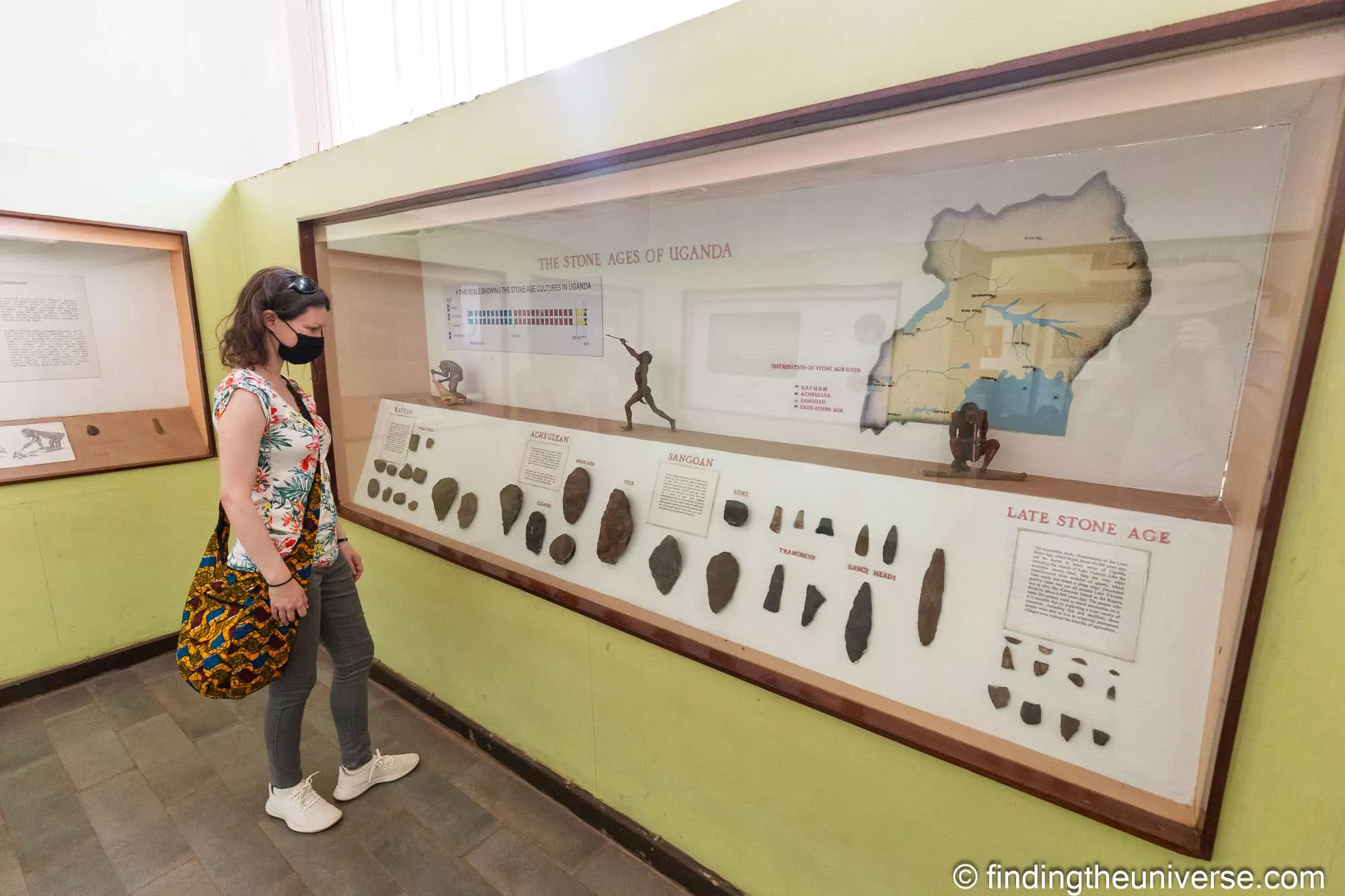
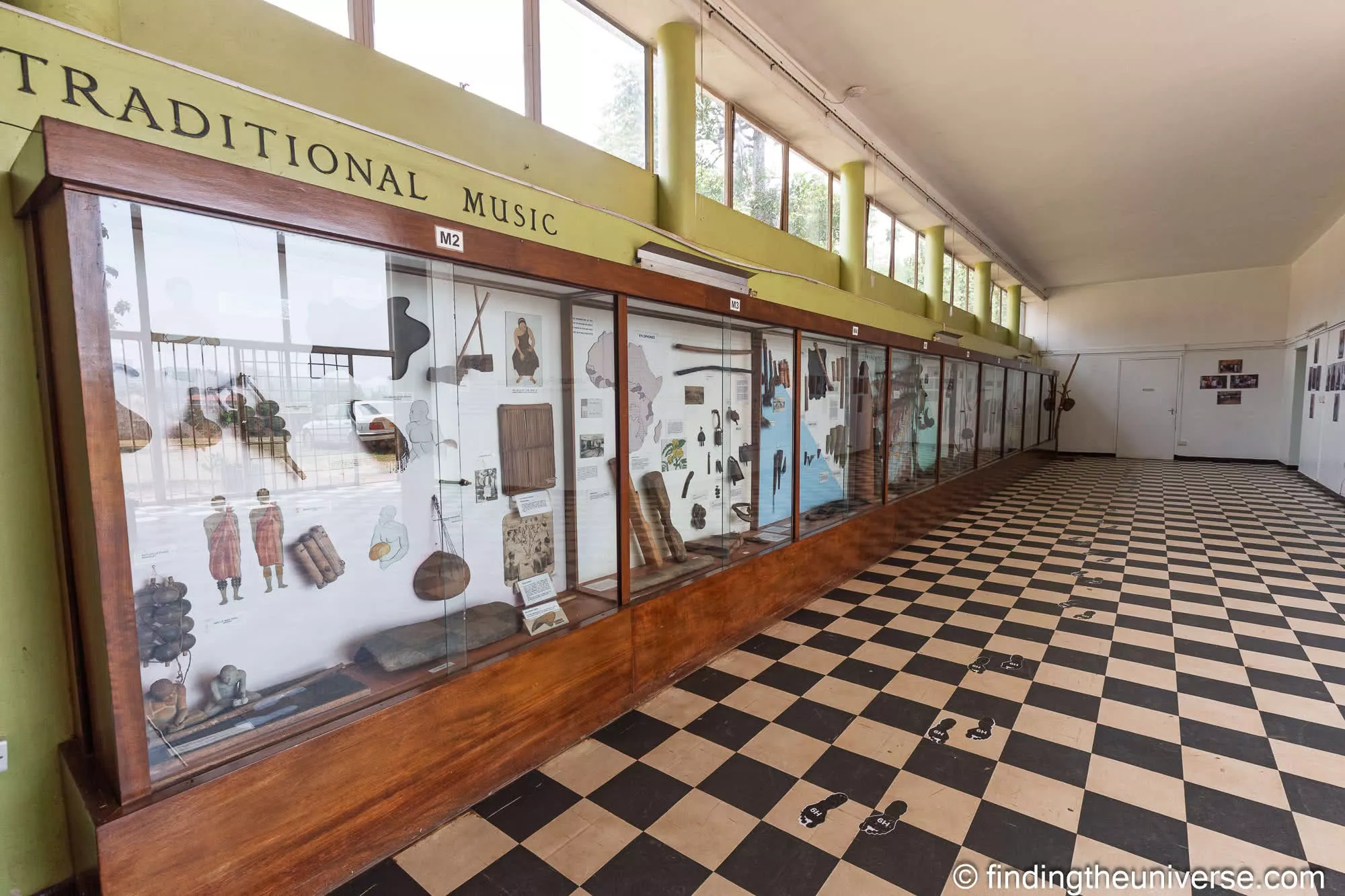
Founded in 1908, the Uganda Museum is the oldest museum in East Africa and one of the better places in Kampala to get a structured introduction to the country’s history. The collection covers musical instruments, weapons, bark cloth paintings, traditional medical supplies, clothing, and a fair amount of pre-historical material including fossils linked to human evolution in the region.
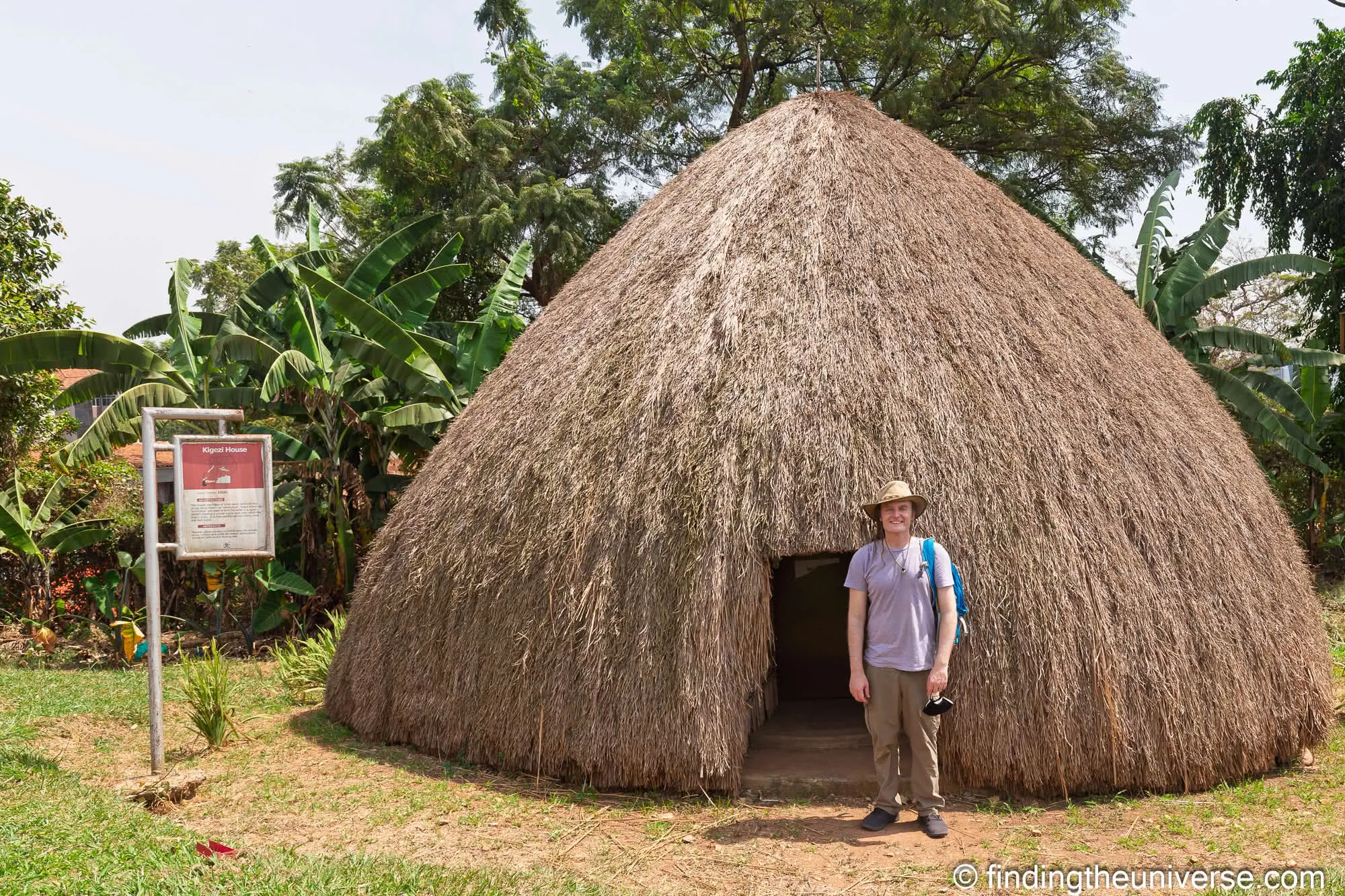
Outside, there’s a cultural village with a range of traditional buildings and items used through different periods of Ugandan history. This was our favourite part of the museum visit: it’s interesting in its own right and a nice way to see the variety of building styles and customs across Uganda’s many tribes.
The museum is not enormous and you can comfortably do it in two to three hours. There’s an admission fee. You can wander on your own or hire a guide if you want context.
Important note as of 2026: The Uganda Museum has been closed for renovation since August 2024. The original plan was a ten-month project with a June 2025 reopening, but it’s still closed with no confirmed reopening date. If you’re hoping to visit, check its current status before you plan your day, and have a backup option in mind.
Independence Monument
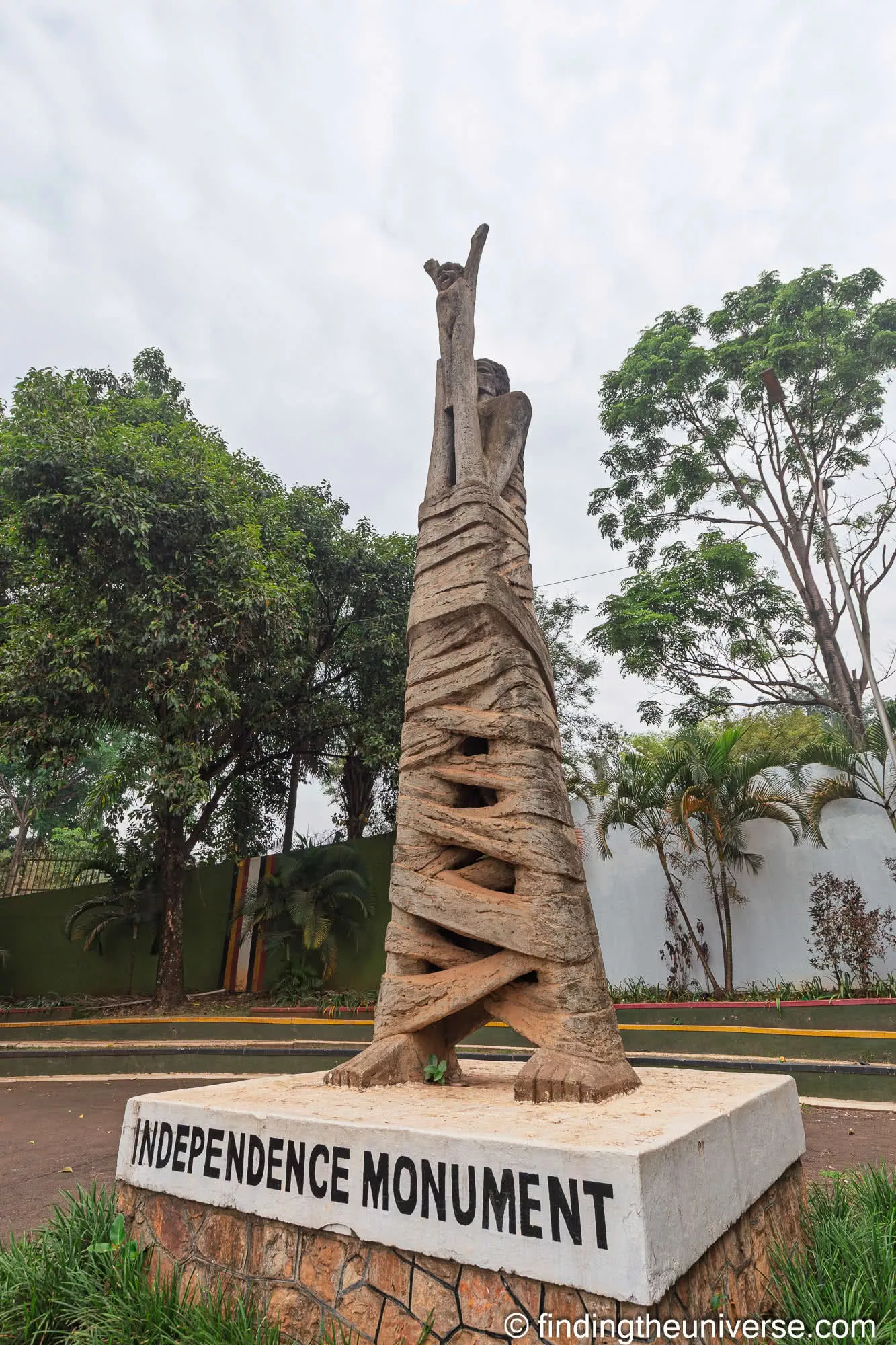
Uganda gained independence from the British on 9 October 1962, and this monument, unveiled the day before, marks the moment.
The 29-foot concrete sculpture sits in the King George V Jubilee Gardens and shows a mother lifting her child into the air, ropes around her own legs. The ropes represent the bondage of colonialism, the child the joy of freedom. You’ll already have seen the design before you see it in person if you’ve handled any Ugandan cash: it appears on Ugandan banknotes from 1,000 to 50,000 UGX.
It’s free to visit, and most walking tours include it as a stop. We saw it as part of this guided walking tour, and it’s also covered by this cultural tour and this guided city tour.
Other Historical Monuments and Statues in Kampala
Beyond the Independence Monument, there’s a scattering of smaller monuments and statues around central Kampala that you’ll come across naturally if you’re walking the city or being driven through it. The main ones to look out for:
- World War Memorial Monument. Built by the British in 1945 to remember Ugandan soldiers lost in both world wars. One of the oldest memorials in Kampala. On Kampala Road by the central police headquarters.
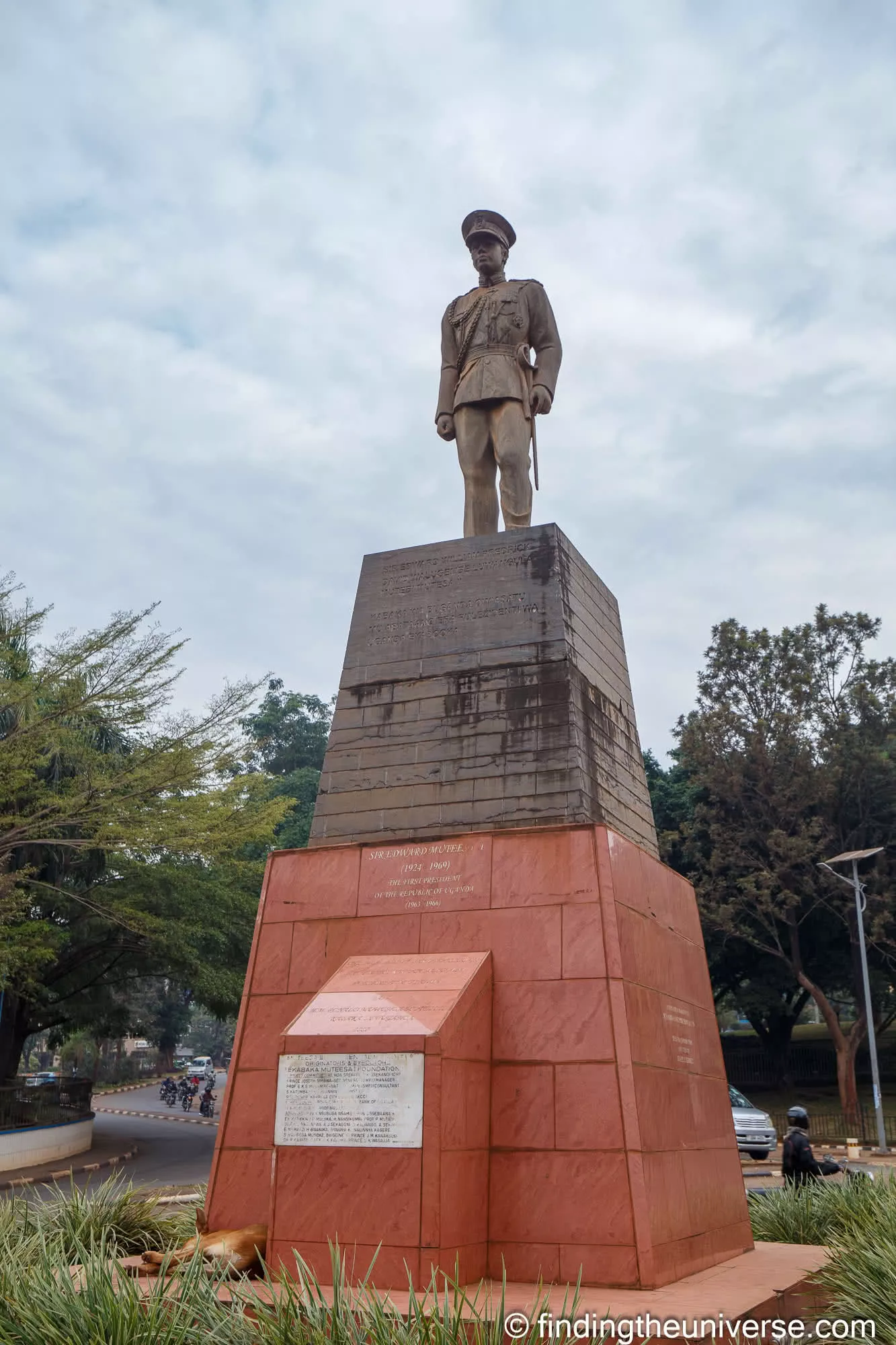
- King Mutesa II Monument. To the 35th Kabaka and first President of Uganda, who died in exile in 1969. He’s depicted in British military uniform, a nod to his service as a Queen’s Grenadier Guard (he was the first Black Commissioned Officer in the Grenadier Guards). Originally at the intersection of Speke Road and Nile Avenue, currently relocated due to road works to a spot between the Serena Hotel and the Imperial Royale.
- Centenary Monument. Commemorating 100 years of the Kampala City Council. In Centenary Park along Jinja Road.
- Stride Monument. Created for the 2007 Commonwealth Heads of Government Meeting, showing a family moving forward together as a symbol of Commonwealth unity. Between the Parliamentary Gardens and the Kampala Serena Hotel.
- Long Split Drum Statue. A tall statue of an engalabi, a traditional cylindrical drum covered with skin. At the Nantawete roundabout along the Kabaka Anjagala (the road between the Kabaka’s Palace and the Bulange).
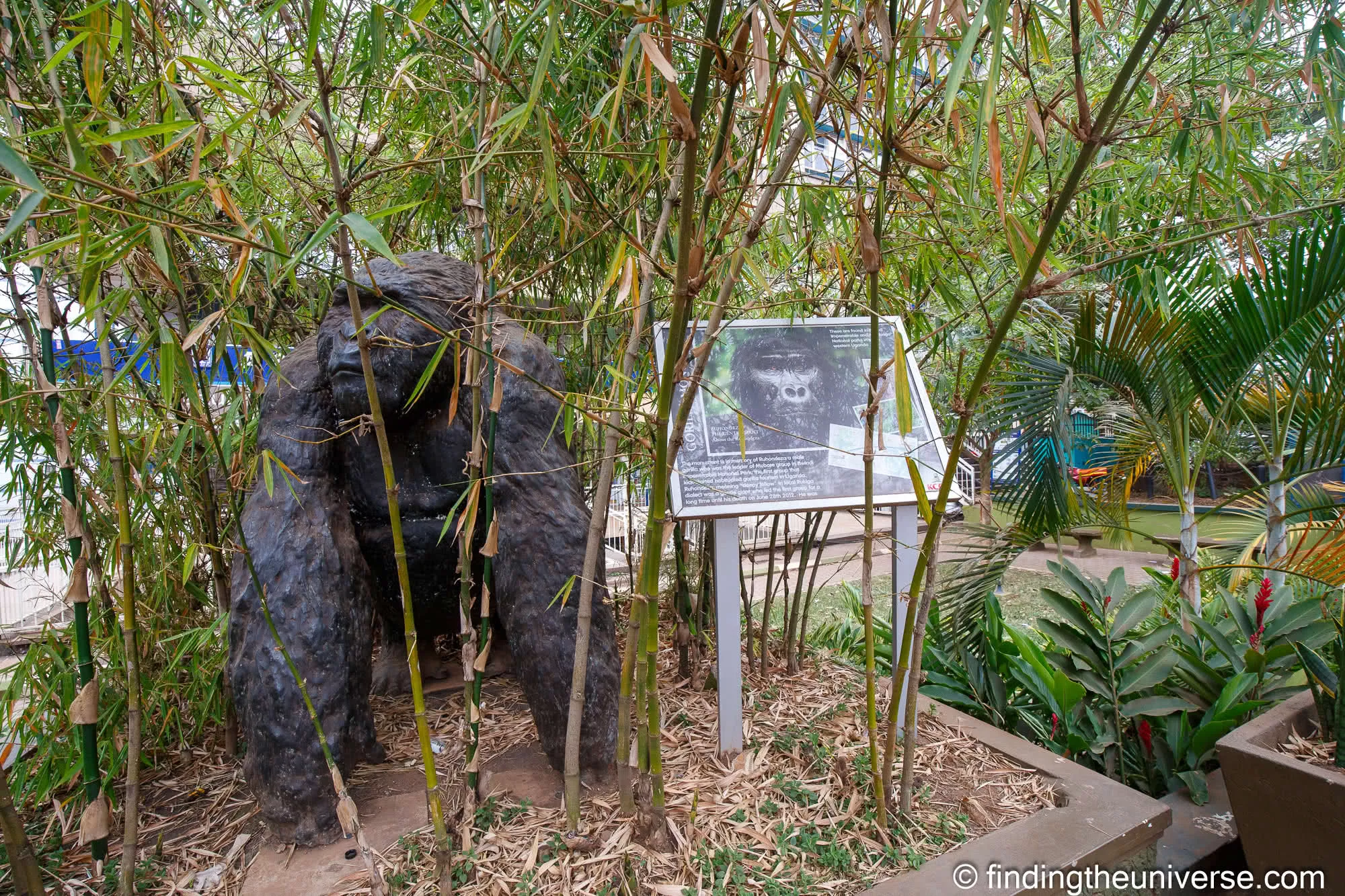
- Wildlife Statues. Scattered along the roads in central Kampala, particularly Old Kira Road. Lion, gorillas, cranes, giraffes, impala, plus a few others.
One thing to be aware of: there’s often security around public memorials and around government buildings in Uganda. You may be asked why you’re there and asked not to take photos. We were stopped at the war memorial by police and only allowed to approach because we were with a local guide. Don’t push it. If a guide isn’t with you and someone in uniform asks you to move on, move on.
Saint Paul’s Cathedral Namirembe
The next few entries are places of worship belonging to the major religious traditions you’ll encounter in Uganda. We’ve visited all of these and each is interesting in its own way. Pick the ones that match your interests rather than trying to do all five.
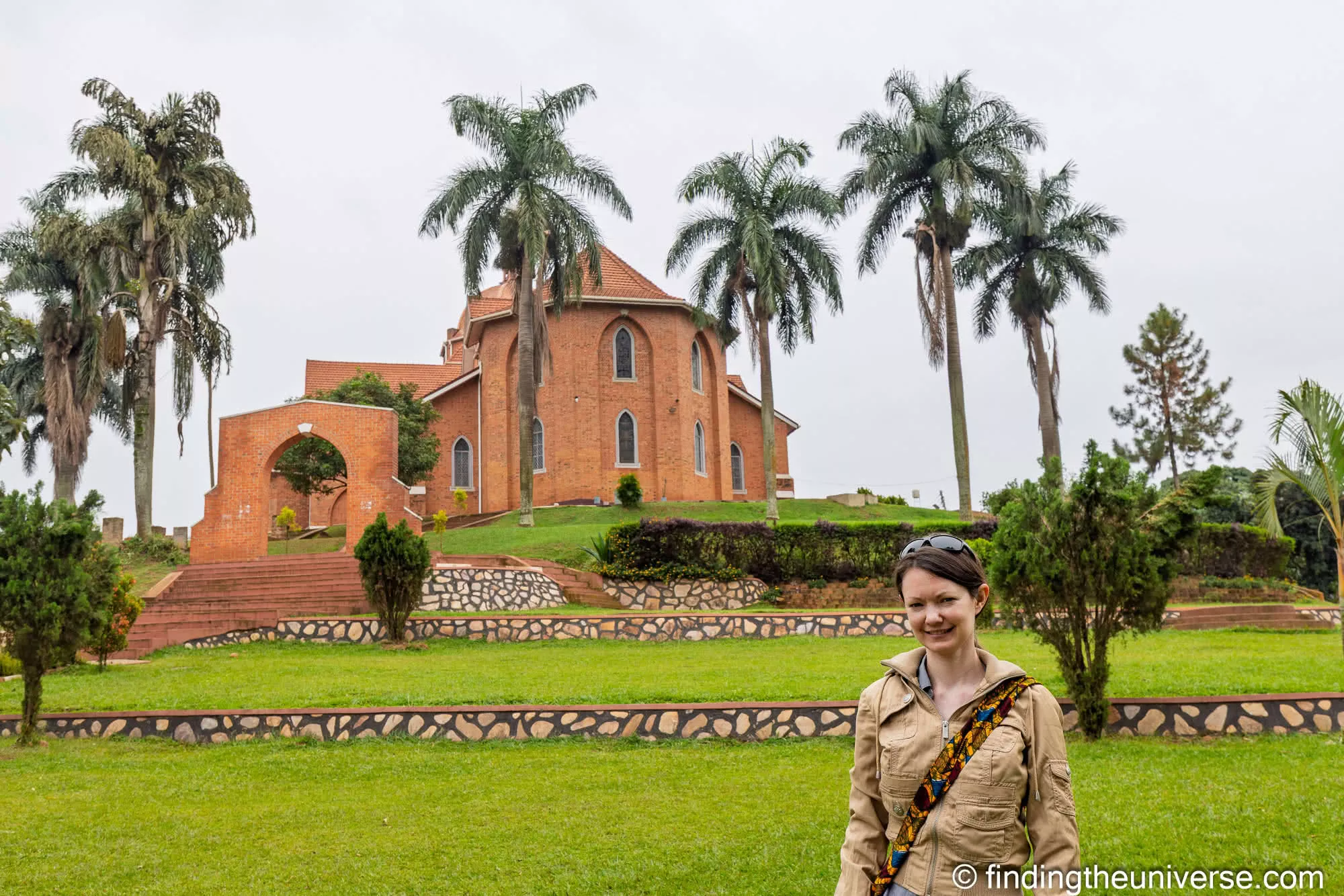
First up is Saint Paul’s Cathedral Namirembe, usually just called Namirembe Cathedral. This is the oldest Anglican cathedral in Uganda and the headquarters of the Anglican Church of Uganda. The current building was consecrated in 1919 and is the fifth church to stand on the site, with the previous four (dating back to 1890) all having been abandoned or destroyed for various reasons.
The current cathedral is a striking large red building with a domed roof, made from earthen bricks and earthen roof tiles. It sits on top of Namirembe Hill just west of the central business district, and as with most hilltop sites in Kampala, the view of the city from up here is one of the better ones you’ll get.
It’s free to visit the outside of the cathedral. There’s a small fee to go inside as a visitor, which includes a guided tour. Like all working churches, visits are not always allowed if a service is in progress.
St. Mary’s Cathedral Rubaga
St. Mary’s Cathedral Rubaga, usually called Rubaga Cathedral, sits on Lubaga Hill east of the city centre. Same hilltop principle, same wide views over the city.
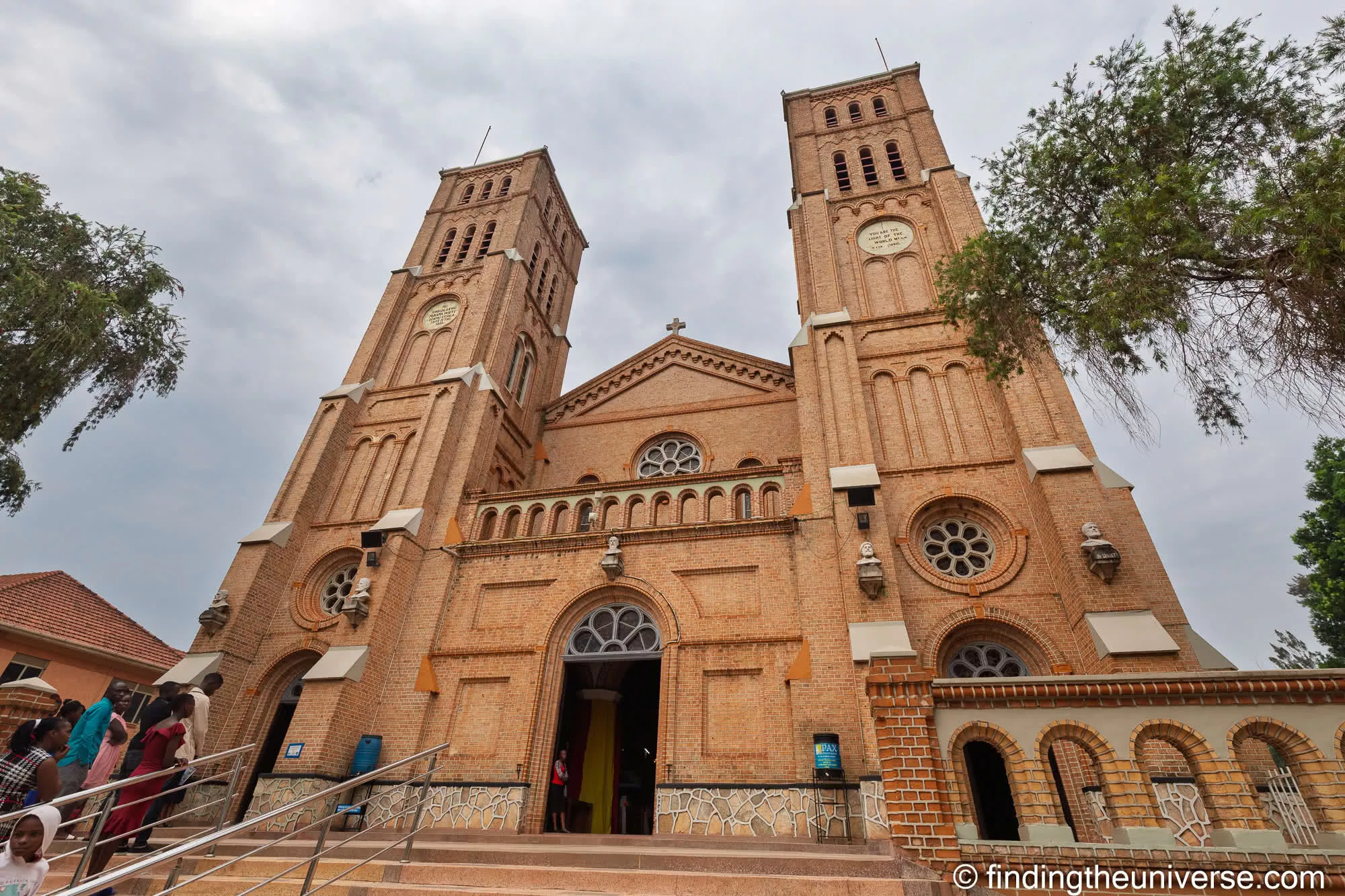
This is the Roman Catholic cathedral of the Archdiocese of Kampala, the oldest Catholic diocese in the country. Rubaga has been the seat of the Bishop since 1883, and the cathedral itself was consecrated in 1925. It was originally established by the White Fathers, a French Roman Catholic missionary order, on land granted to them by the 31st Kabaka of Buganda.
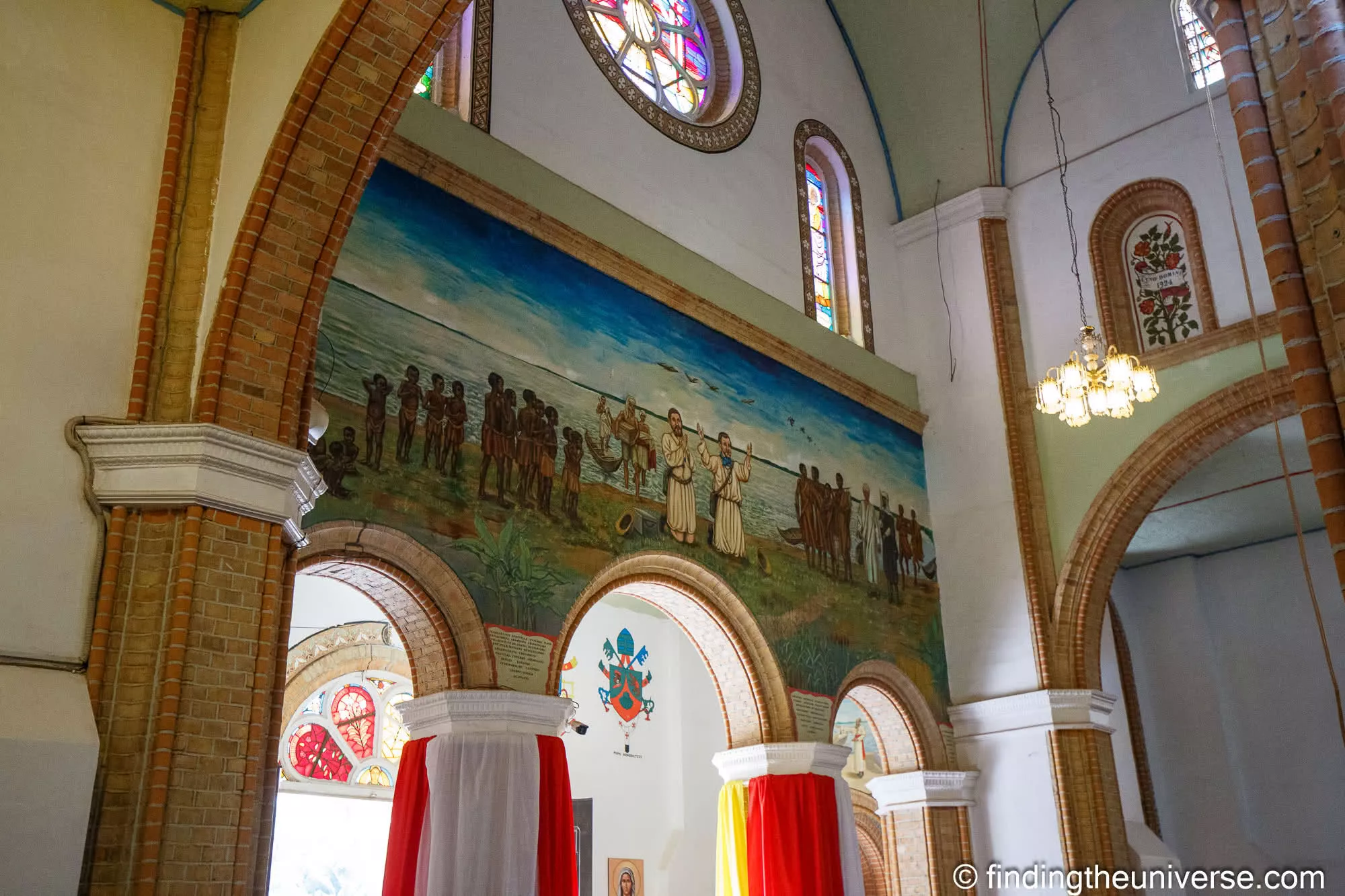
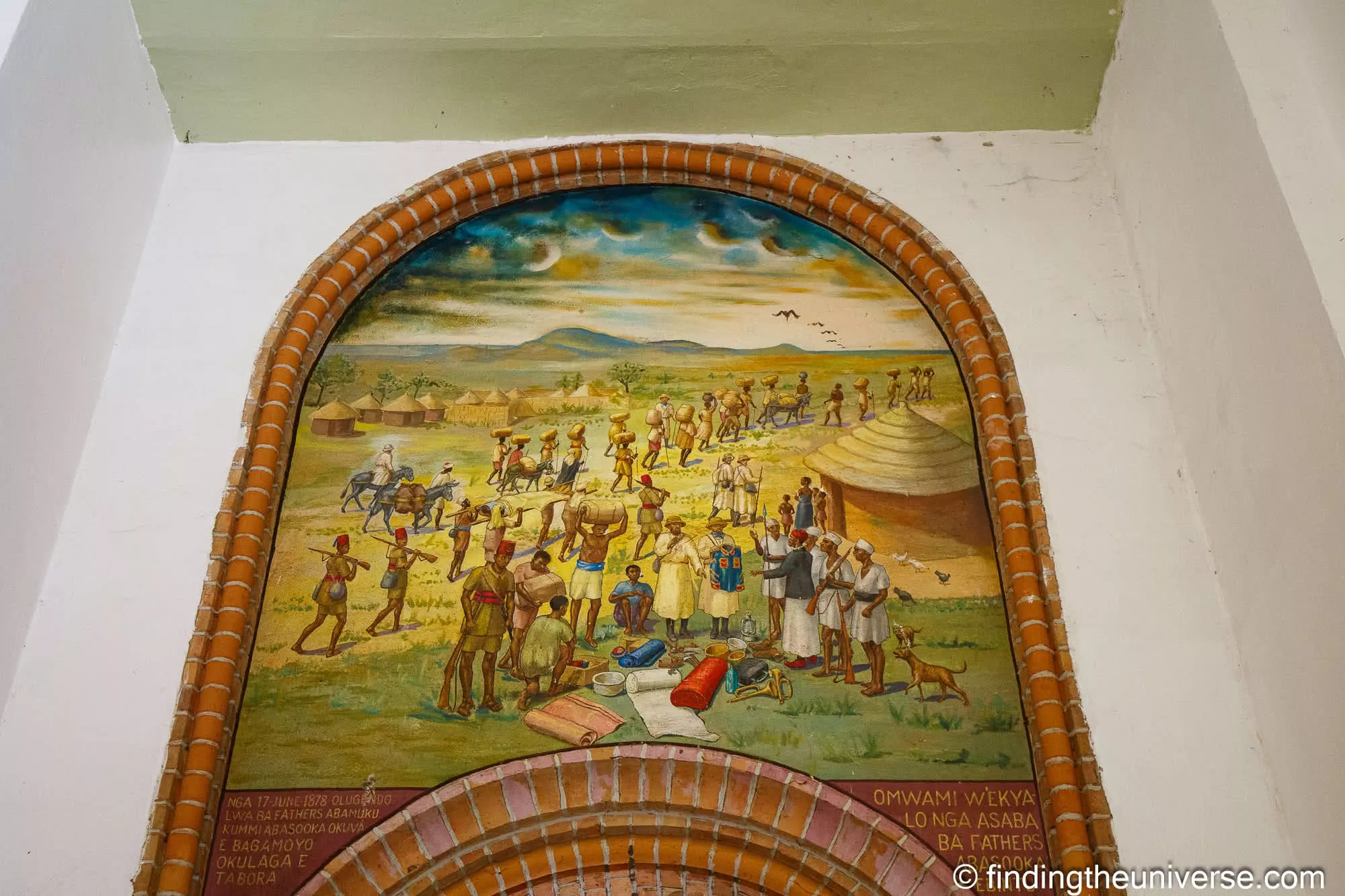
It’s a large brick building with two front towers, capacity for around 5,000 worshippers, and some lovely stained-glass windows, murals, and other artwork that tells the story of the Catholic Church in Uganda. We had a brief tour from a guide attached to the church.
For context: most Ugandans identify as Christian (over 80%), and within that, Roman Catholicism is the largest denomination, followed by Anglicanism. So between this and Namirembe Cathedral you’re getting the two biggest religious traditions in the country.
The cathedral is free to visit, donations encouraged. As with Namirembe, visits aren’t always possible during services.
Baha’i House of Worship
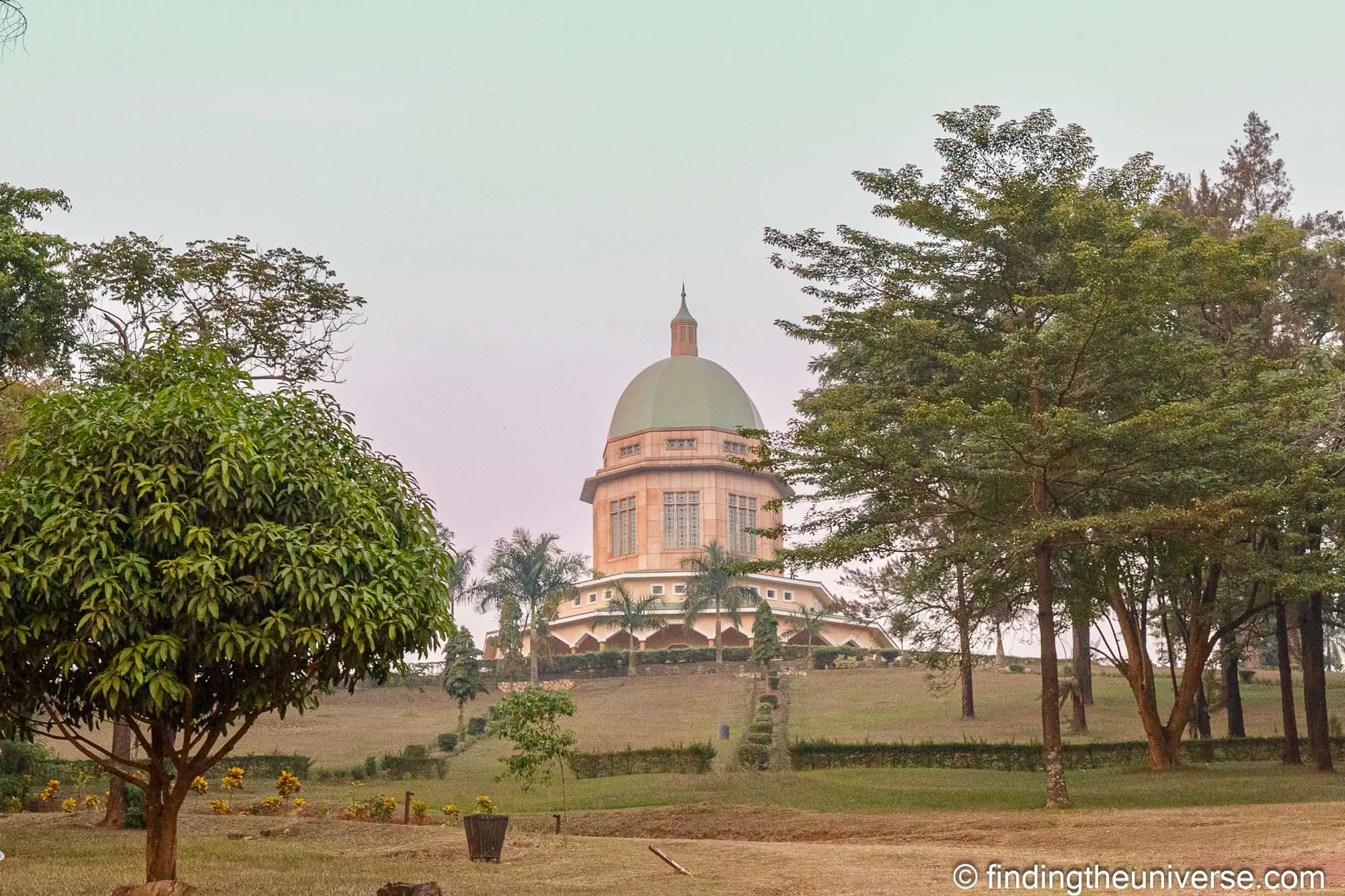
The Baha’i faith is small in Uganda but its main African house of worship happens to be here, on Kikaya Hill at the edge of the city. It’s an octagonal building 127 feet tall topped by a large green dome, set in a fifty-acre estate of landscaped gardens and a few outbuildings. You can see it for miles, which is part of the appeal.
I’ll admit we knew almost nothing about the Baha’i faith before we visited, which made the trip more interesting rather than less. All visits are by free guided tour, and our guide was patient and well-informed: she walked us through the property and patiently answered our questions about the building and the faith without making us feel like we were being recruited.
One important practical note: we actually visited twice, because the first time we took a ride-share out here and arrived after closing. You can only walk the grounds during visiting hours. So check the times before you set off (they’re posted on the temple’s notice board, but ideally you confirm before you’ve already paid for a taxi). Our second attempt went better: we signed in, were given a tour by a lovely guide named Esther, and were allowed inside the temple itself (no services were running). No talking and no photography are permitted inside.
The temple sits on the north side of the city, which makes it a sensible stop if you’re heading north out of Kampala anyway, perhaps to Ziwa Rhino Sanctuary or further on to Murchison Falls.
Uganda National Mosque
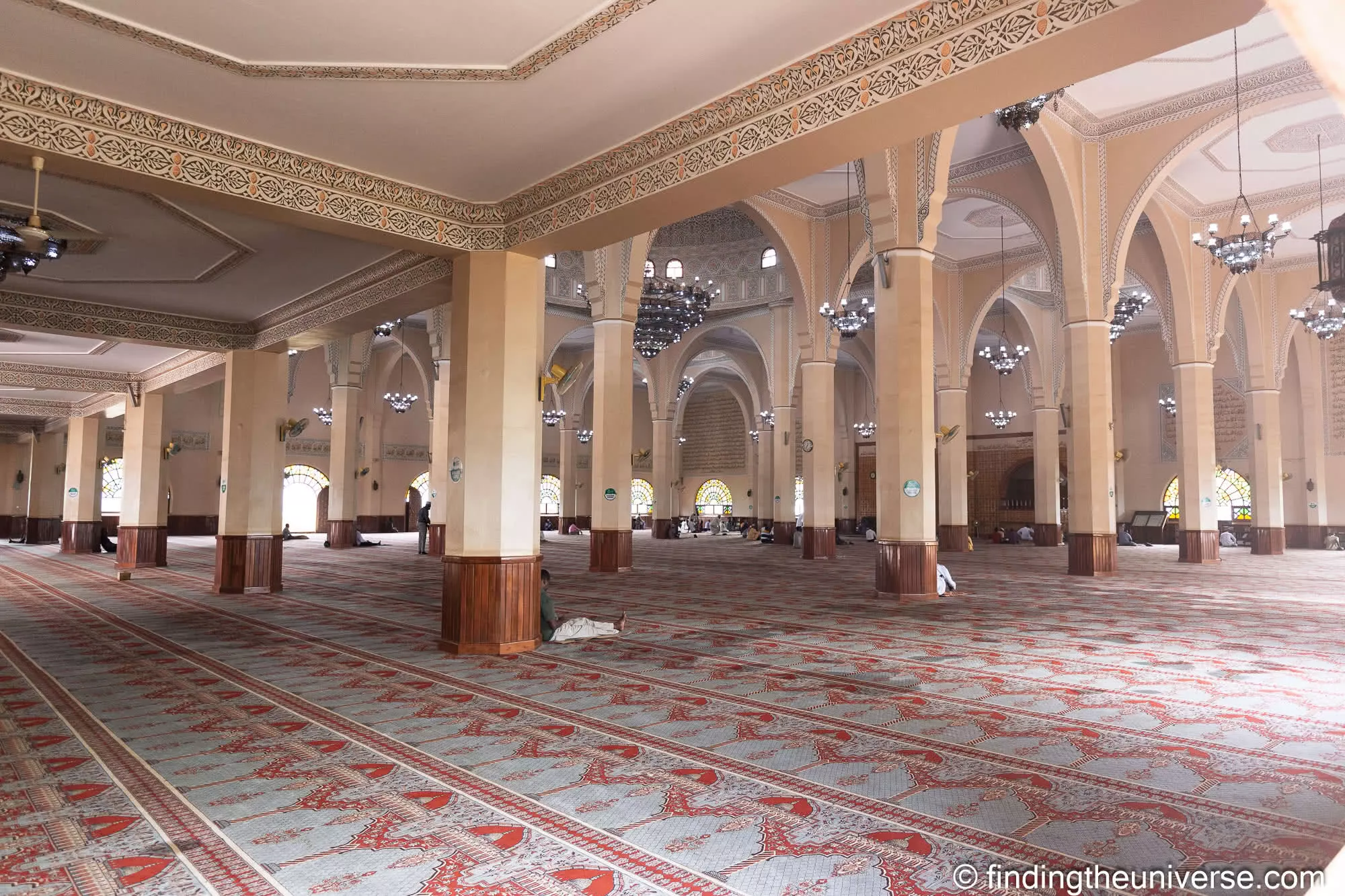
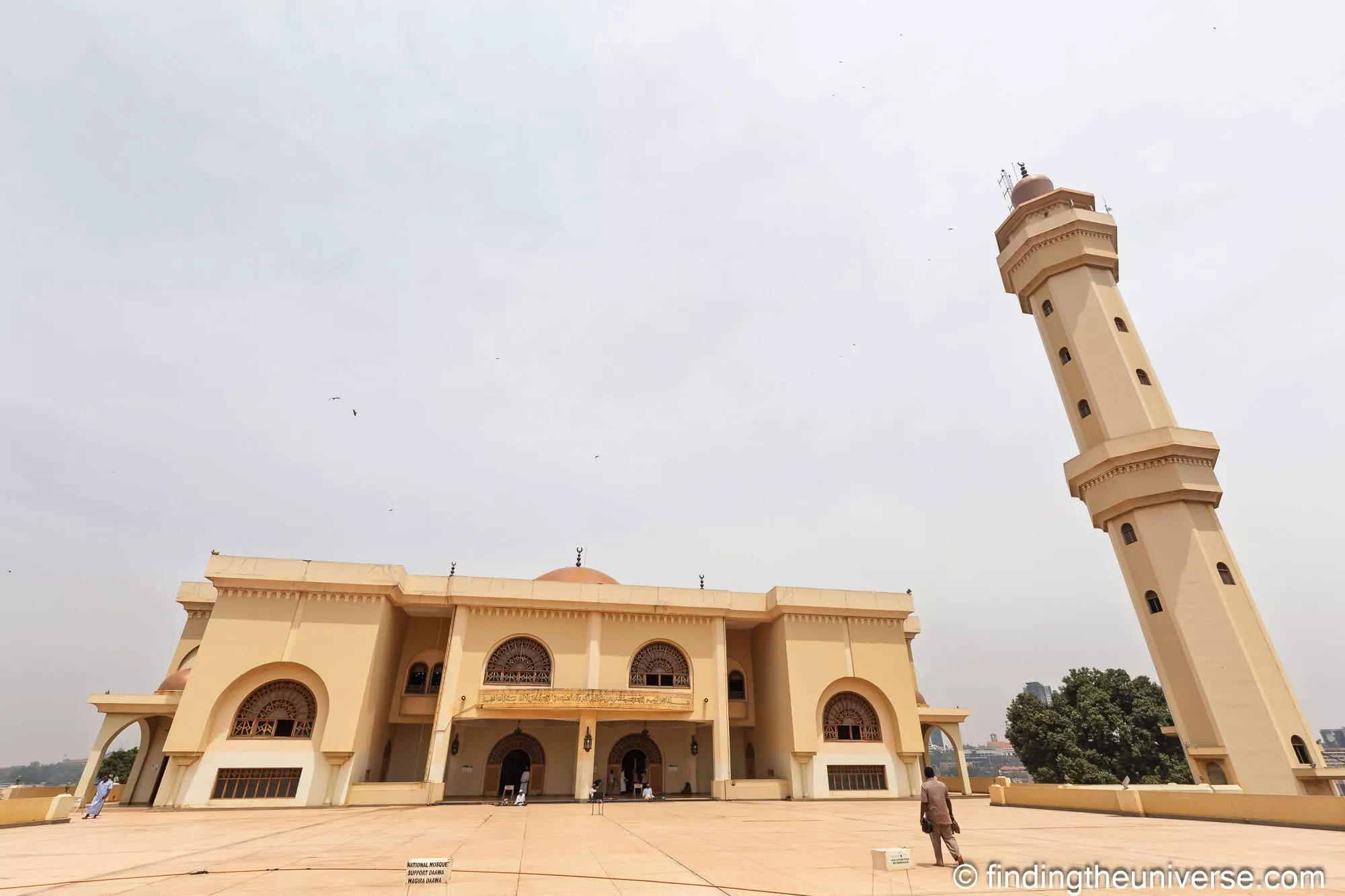
The Uganda National Mosque, previously known as the Gaddafi National Mosque, is the largest mosque in East Africa. Around 14% of Ugandans are Muslim (13.7% at the 2014 census) and this mosque holds up to 15,000 worshippers in the main hall, with room for several thousand more on the gallery and terrace.
Construction started in 1972 under Idi Amin’s regime but stalled in 1976 when the political situation made finishing impossible. It wasn’t restarted until 2001, this time funded by Libyan leader Muammar Gaddafi. The mosque opened for worship in 2007. Gaddafi was killed in 2011 and the mosque was renamed the Uganda National Mosque in 2013.
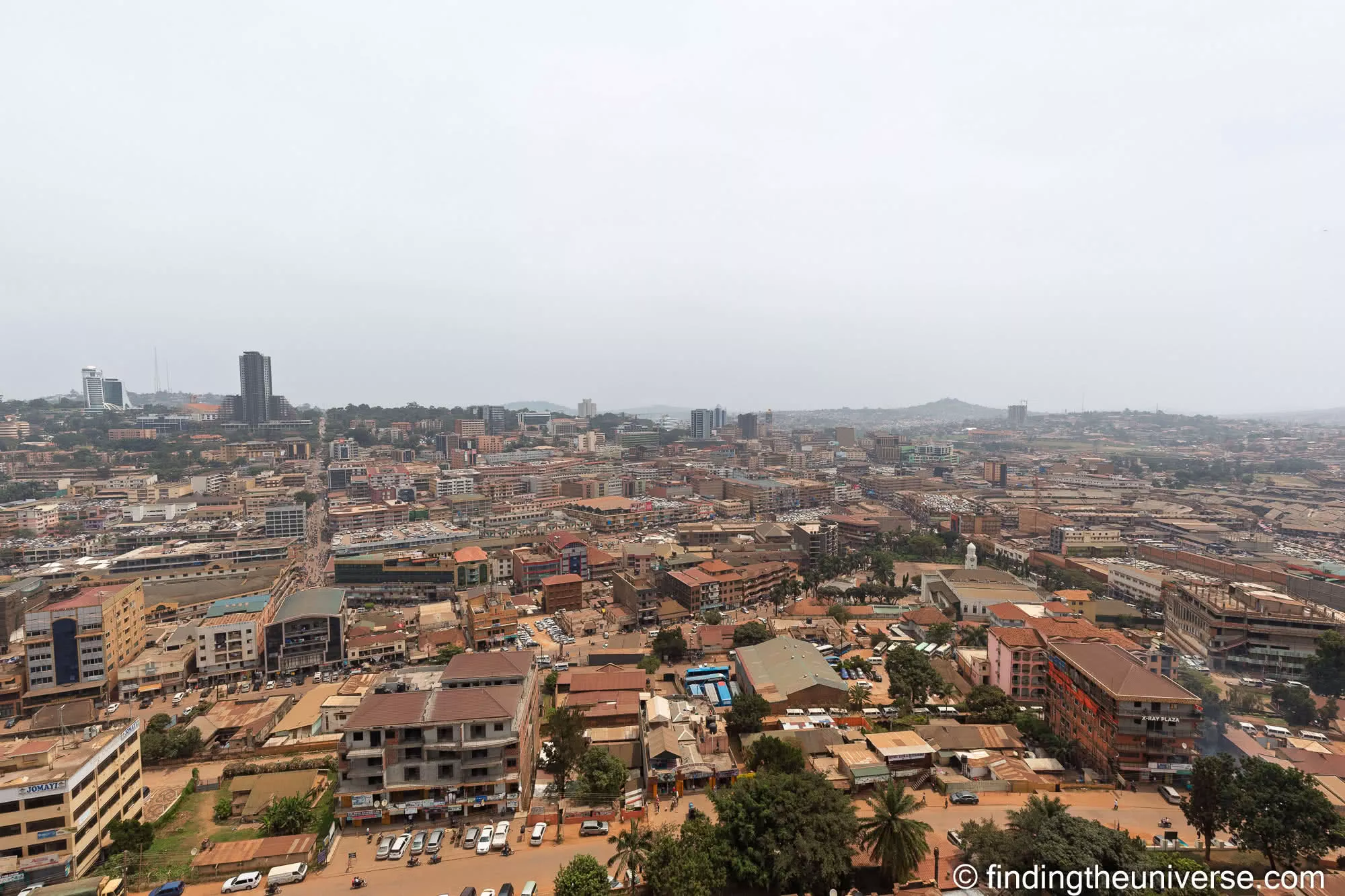
The single minaret is open to visitors and you can climb it for what is, hands down, one of the best views in Kampala. From the top you can see the city stretching out across its hills in every direction. It’s also the only spot we found that really makes the seven-hills geography of Kampala click visually. The minaret was featured in a 2019 episode of The Amazing Race, where the contestants had to count the steps on the way up. The official Amazing Race answer was 272, though in practice it’s a bit more depending on how you count (other sources say 304 or so). Either way, no lift.
You can visit as a non-Muslim as part of a tour. On Fridays and other holy days you may not be allowed inside the main prayer hall, but you should still be able to walk the exterior and climb the minaret. There’s an entrance fee for foreign visitors, and you’ll be assigned a mosque guide for the visit. We did this as part of this guided walking tour of the city centre, which is an easy way to combine it with other central sights.
Dress code is strict, as you’d expect. Women should wear loose clothing covering wrist to ankle (long skirt preferable to trousers), and a head covering. Men: trousers and shirts with sleeves. Coverings are available to borrow at reception, included in the entrance fee.
When we visited, Jess found the layered coverings rough going. She was already in long trousers, but had to wrap a large kanga around her waist, add a head scarf, and (because of COVID-era rules at the time) wear a face mask, all while taking shoes on and off at multiple points. She was glad we’d done it, but be mentally prepared for some fiddling.
Shri Sanatan Dharma Mandal Hindu Temple
While we’re on places of worship, the Shri Sanatan Dharma Mandal Hindu Temple in central Kampala is open to visitors and free to enter (a small donation is welcomed). Uganda has had a significant Hindu community since the colonial period, and the interior of the temple is impressive in a way that catches you off guard given how unassuming the exterior looks. Photography inside is generally allowed, but ask first.
It’s a small stop and most walking tours of central Kampala include it. Worth ten or fifteen minutes if you’re passing.
Uganda Martyrs Catholic Shrine Basilica
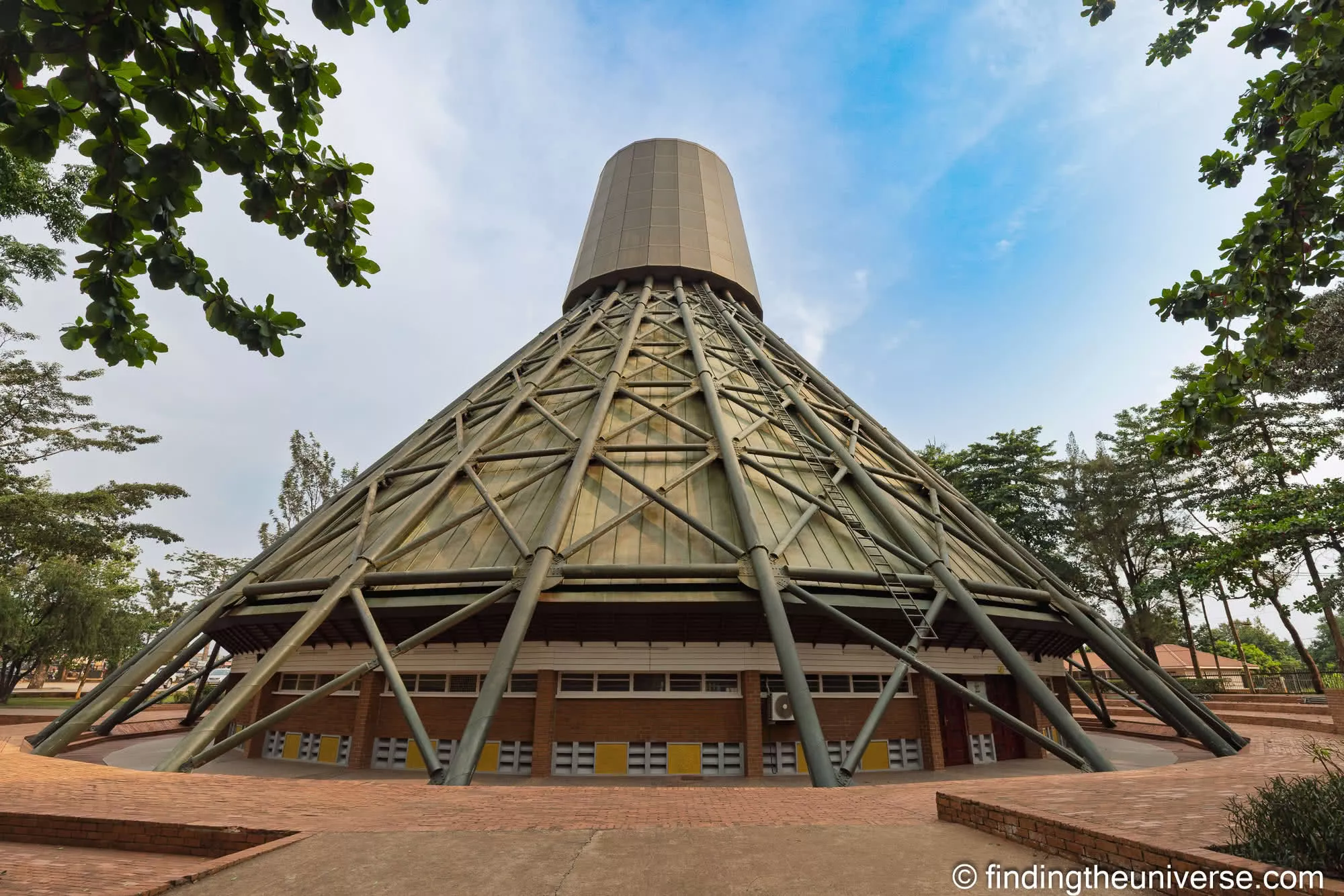
The Basilica of the Uganda Martyrs sits in Namugongo, about seven miles northeast of central Kampala. Architecturally it’s striking: a huge circular building designed to evoke a traditional African hut. It’s also one of the most visited Christian pilgrimage sites in Africa.
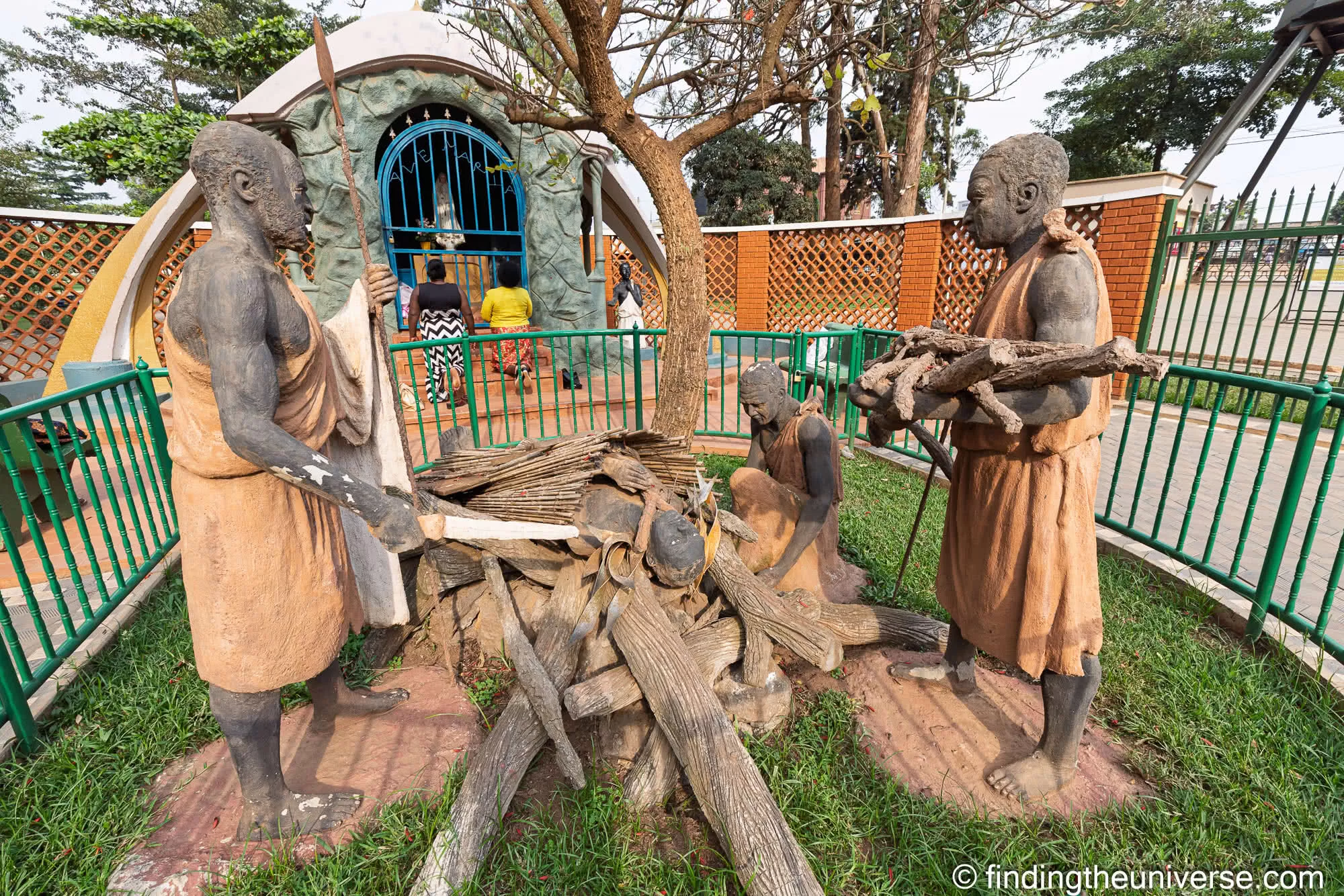
The Uganda Martyrs were a group of 22 Catholic and 23 Anglican Christians killed between 1885 and 1887. Many were members of the King’s Royal Court who had converted to Christianity against the Kabaka’s wishes and were ordered executed. Twenty-two of them were burned alive at Namugongo in 1886.
The deaths had outsized consequences. They generated a wave of popular support in Britain for taking on Uganda as a protectorate, which happened a few years later, and they catalysed widespread adoption of Christianity in Uganda. Today around 80% of the country identifies as Christian.
The 22 Catholic martyrs were beatified in 1920 and canonised in 1964. Since the basilica was completed in 1968 it has hosted the annual Martyrs’ Day celebration on 3 June, which is a national public holiday and draws hundreds of thousands of pilgrims.
Pope Francis visited in 2015 and celebrated Mass on the grounds. Outside of pilgrimage day, you can visit at any time during opening hours. There was a small fee for international visitors when we went.
The complex includes the basilica itself, a small museum, individual shrines to the martyrs, a small lake, an amphitheatre, a café, and a gift shop. It’s a calm and surprisingly peaceful place given the history, and we’d recommend it.

Kampala Markets
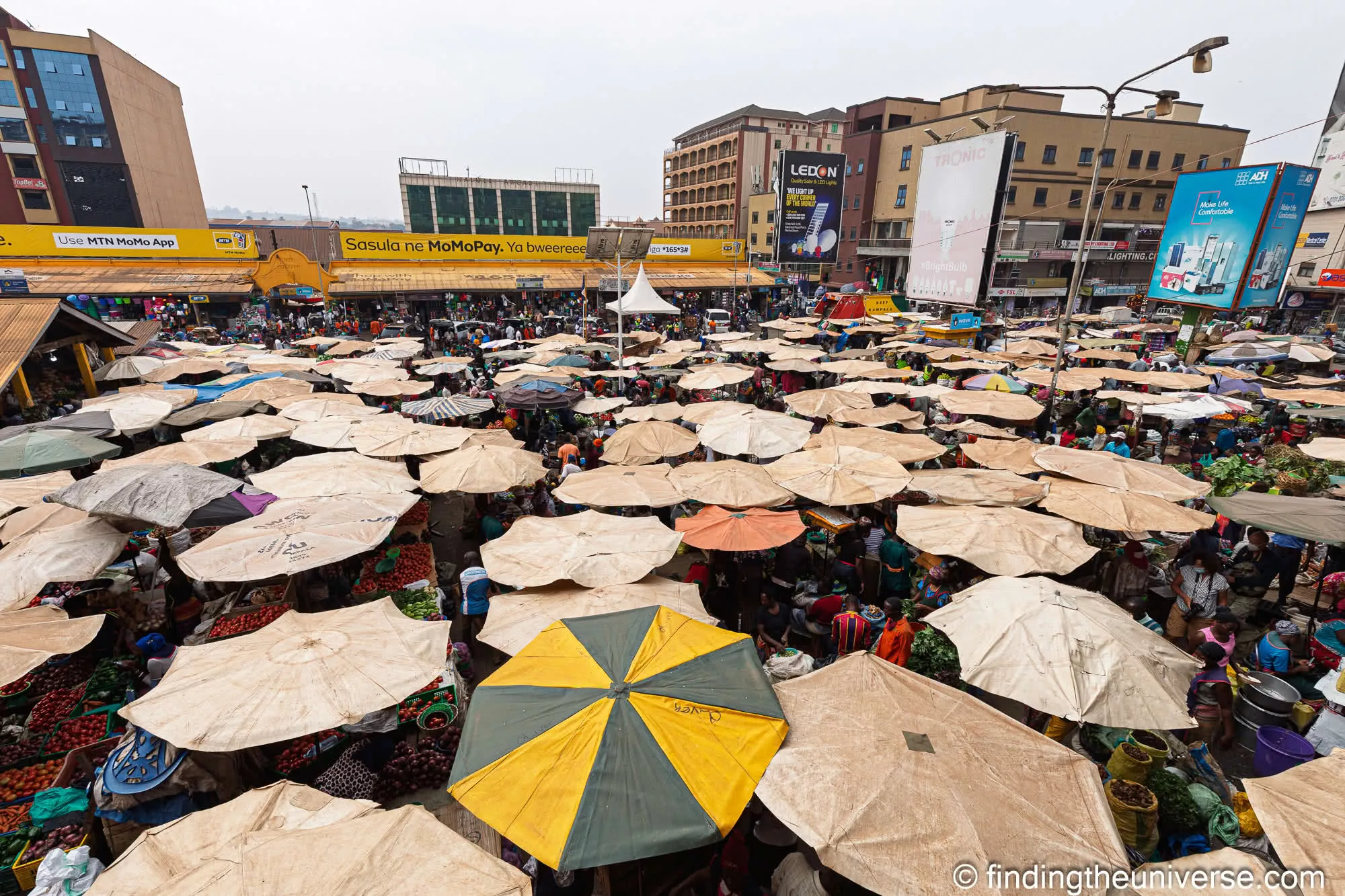
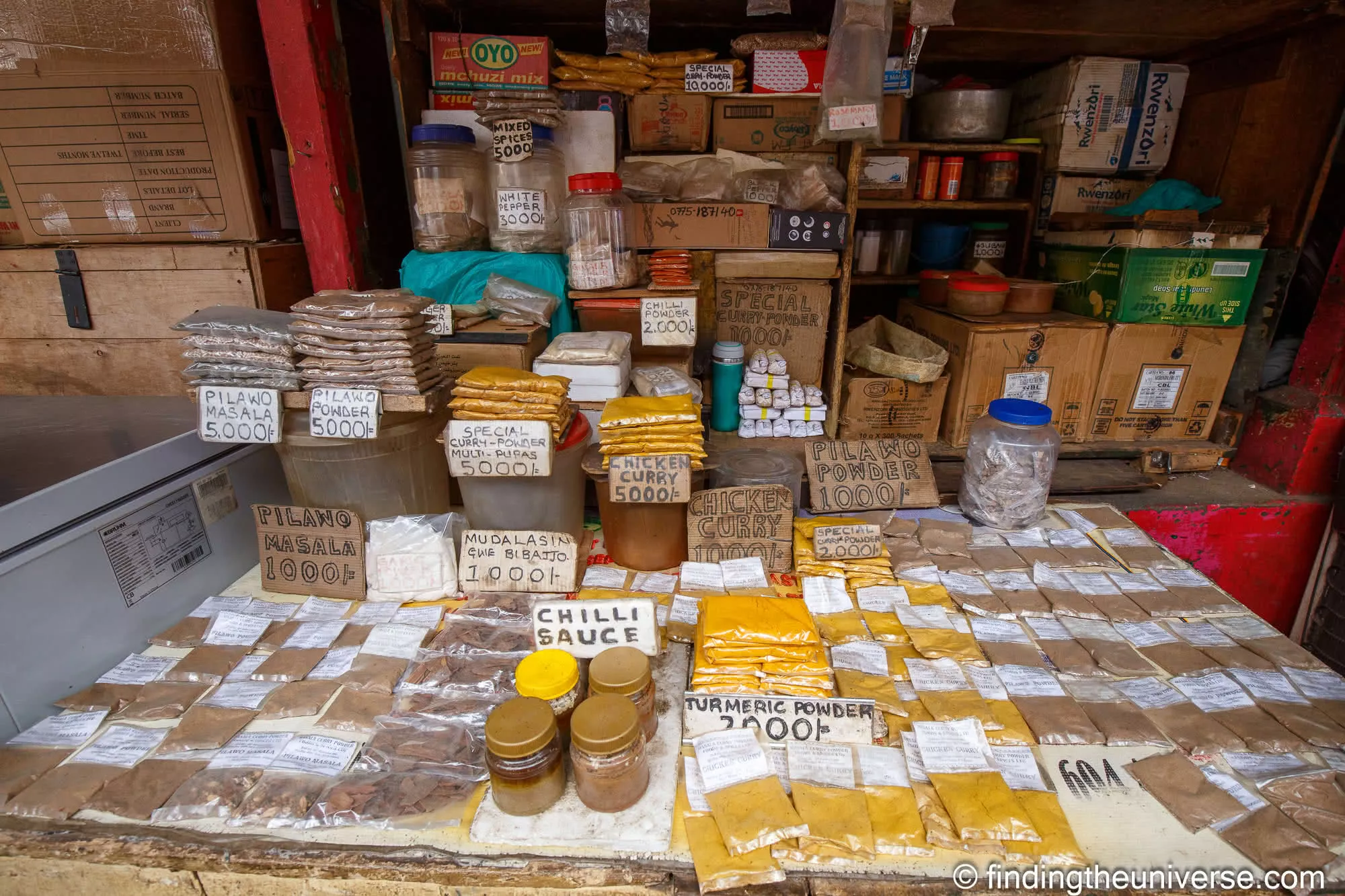
Markets are how you actually feel a place, and Kampala has plenty. The two big ones for visitors are Owino and Nakasero.
Nakasero Market is the oldest in the city and divides into two halves. The outdoor section is mostly fresh produce. Indoors leans toward clothing, textiles, and souvenirs. Owino Market (officially renamed St. Balikuddembe Market years ago, though no one calls it that) is the largest central market in Kampala. It sells everything, but it’s known particularly for second-hand clothing, shoes, and fashion accessories.
Beyond those two, every neighbourhood has its own smaller market. If you’re after souvenirs specifically, Exposure Africa on Buganda Road is a more curated option: over 30 stalls of arts and crafts mostly made in Uganda or Kenya, including antiques, paintings, sculpture, and textiles. Less haggling, less chaos.
For Owino and Nakasero specifically, we’d recommend going with a guide your first time. They’re large, busy, and pretty easy to get overwhelmed in. A guide will also help you handle price negotiation and communicate with vendors who may not speak English. We’ve been twice with a guide and found it the better way to do it.
A few practical notes. Pickpocketing is an issue in any crowded market and Owino especially. Leave the watch and the SLR at the hotel. We’re not exaggerating: even as a professional photographer, in our market photos I’m carrying a small compact camera with a thick neck strap, not the R5.
Photography is sometimes discouraged and you may be asked to stop. Always ask before taking a photo of a person or their goods. At Nakasero, our guide had to ask permission from one of the market owners before we could take any photos at all, and even then we were watched and asked to shoot only from a specific spot.
Old Taxi Park
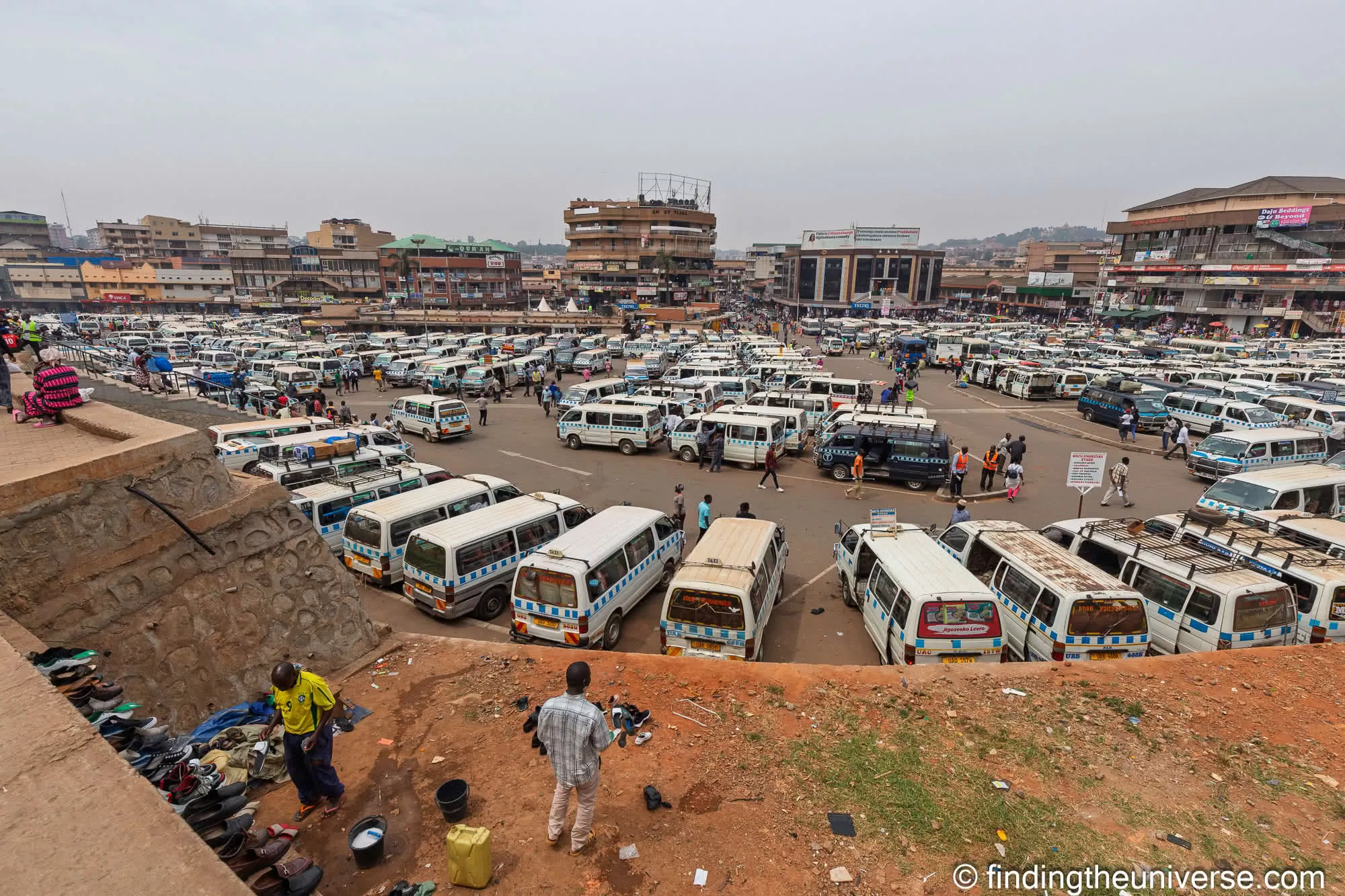
The Old Taxi Park is the oldest and biggest minibus terminal in Kampala. Hundreds of minibuses come and go in what looks like complete chaos but is actually a fairly organised system, once someone explains it to you.
It’s not essential viewing, but it’s included on most walking tours and it’s a useful stop for understanding how a lot of Kampala actually moves around. Five minutes from a viewing spot above is plenty.
Ndere Cultural Center
This was probably our single favourite evening in Kampala.
The Ndere Cultural Center exists to celebrate Uganda’s cultural heritage through dance, music, and theatre. The Ndere troupe was founded in 1984 by Stephen Rwangyezi as a cultural organisation aimed at “universal unity through music, dance and drama,” and they now also tour around Uganda with travelling groups.
For visitors, the main thing to do is one of the evening performances. These run a few times a week and include some mix of dance, theatre, and music. There’s usually the option to add a buffet dinner of traditional Ugandan food.
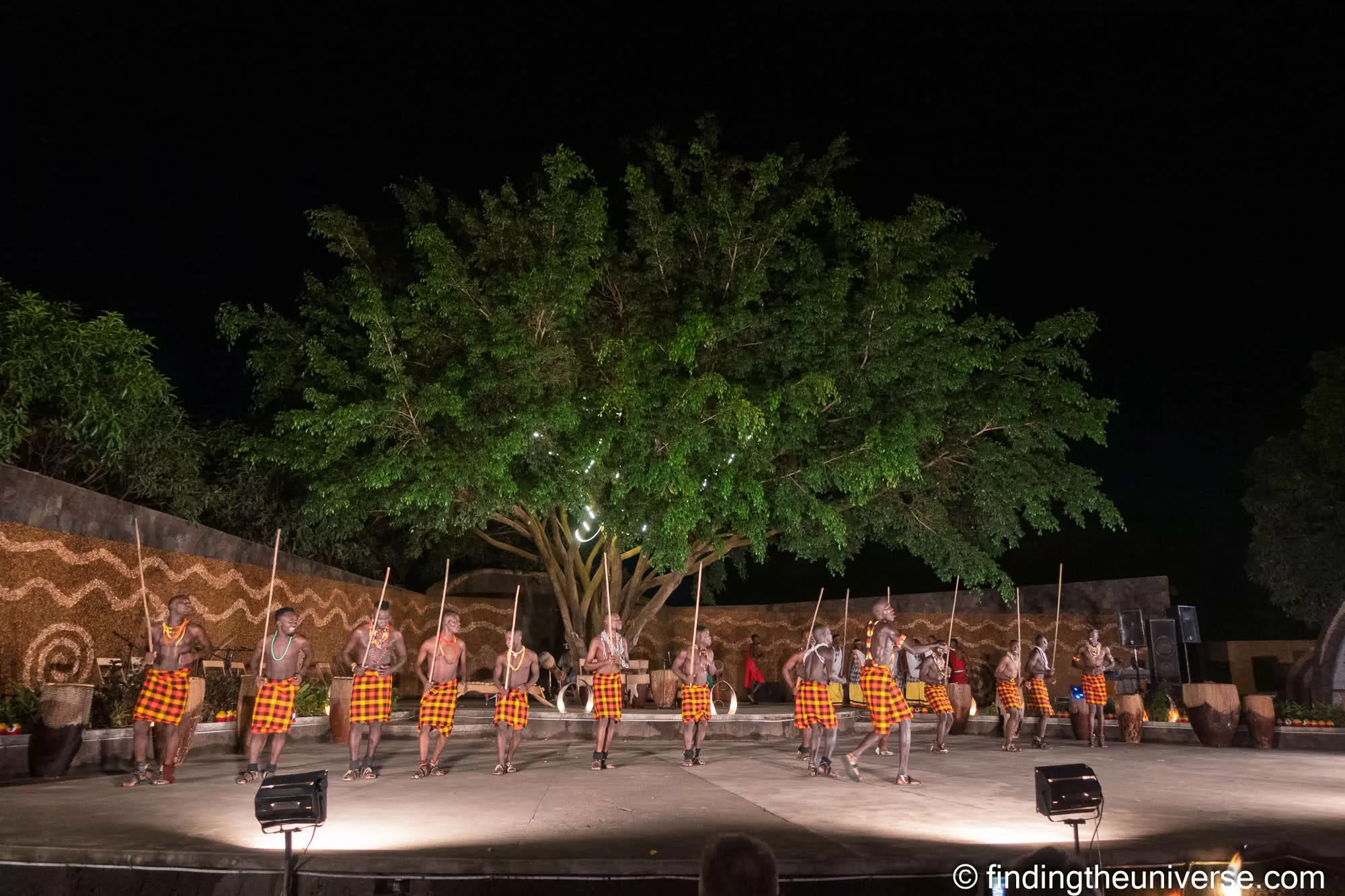
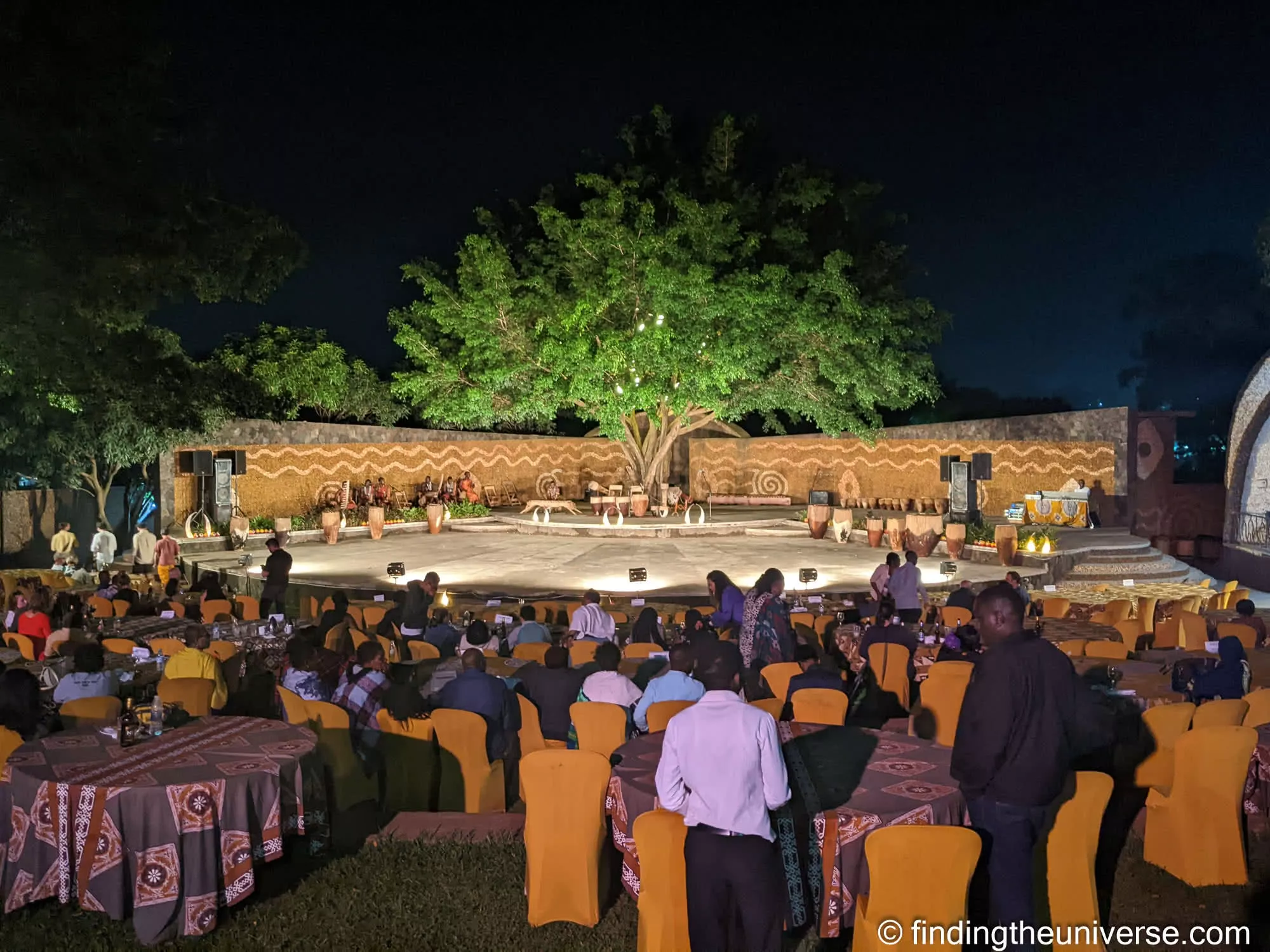
Performances run roughly 7pm to 10pm and take place outside under a large mango tree, which is exactly as nice as it sounds. We went on a Wednesday for the Sherehe show.
The Sherehe show works as a guided tour through the dance traditions of different Ugandan tribes, narrated by a host who’s both knowledgeable and very funny who keeps it all moving and gives you context for what you’re seeing. The dancing is the real draw (the kind of energy and athleticism that makes you a bit embarrassed about your own dance floor abilities), but the host turns it from “performance you watch” into “story you follow.” The buffet was solid traditional Ugandan: matooke, beans, groundnut sauce, a meat stew, and various other bits.
We’d recommend booking ahead if your visit overlaps with a performance night. You can book direct or include it as part of a tour with several sights and dinner, like this combined cultural tour and evening dance show.
Nommo Art Gallery
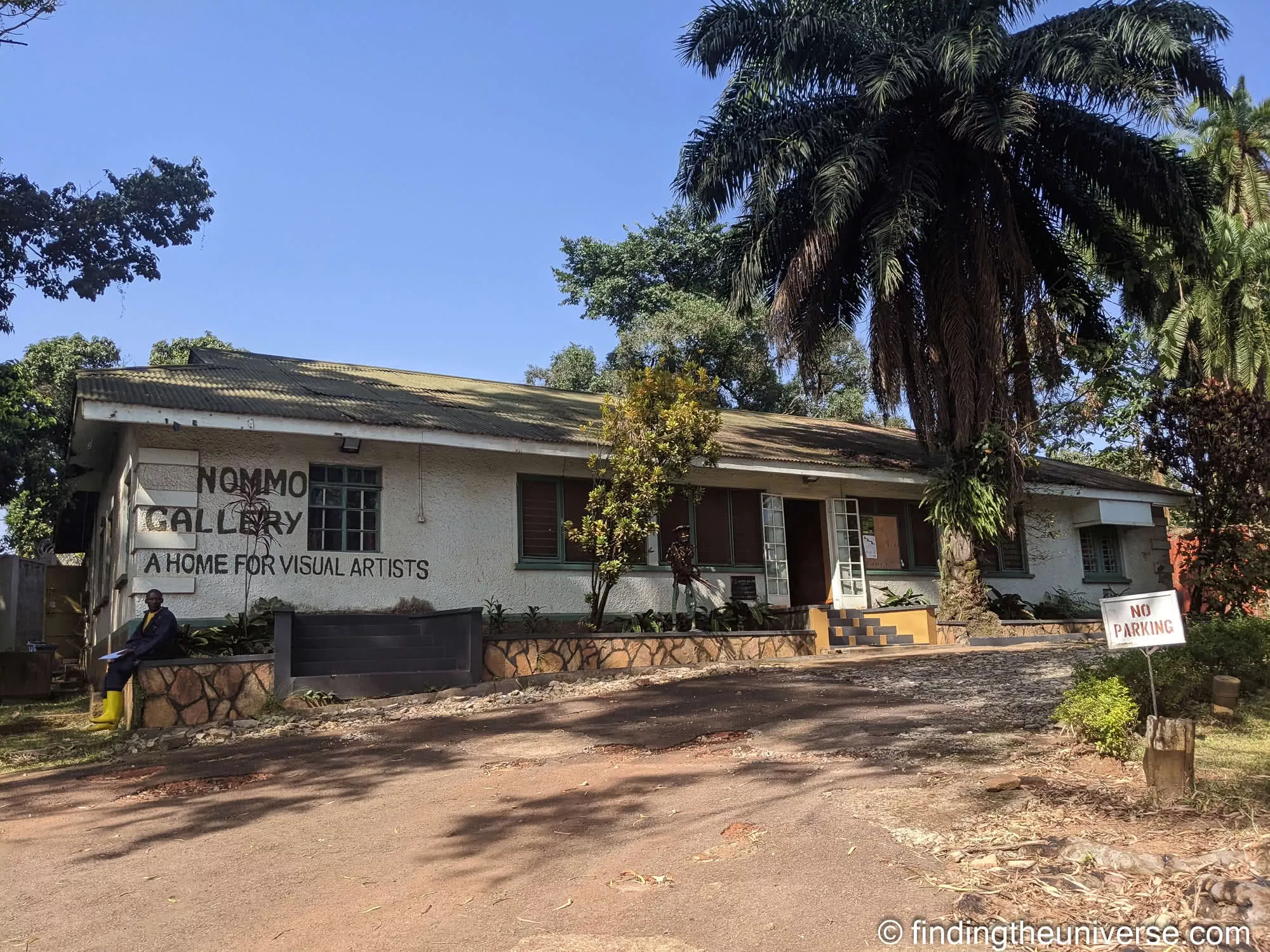
If you’re interested in seeing or buying local art, Nommo Gallery is worth your time. It’s small but it’s one of the few galleries in Uganda and it is the National Art Gallery, established by the Uganda National Cultural Centre in 1964. It’s near State Lodge in the city centre.
When we visited, the main exhibit was a black-and-white photography series about disability. There was also work for sale by local artists across painting, sculpture, wood carving, and paper art.
Getting to the gallery can be a bit of an adventure. We took a taxi but the driver had to drop us about a ten-minute walk away because of road closures and security checkpoints around the nearby State House. We then went on foot through a couple of checkpoints (where photo ID was required) to reach the gallery, and back the same way.
There’s been talk of relocating the gallery to a more accessible spot, but no decision has been made. Until that happens, take a photo ID and wear shoes you can walk in.
Take a Food Tour
One of the best ways into a country’s food, in our experience, is a food tour led by someone who actually loves the cuisine. On one of our Kampala visits we did a food tour like this one and it delivered.
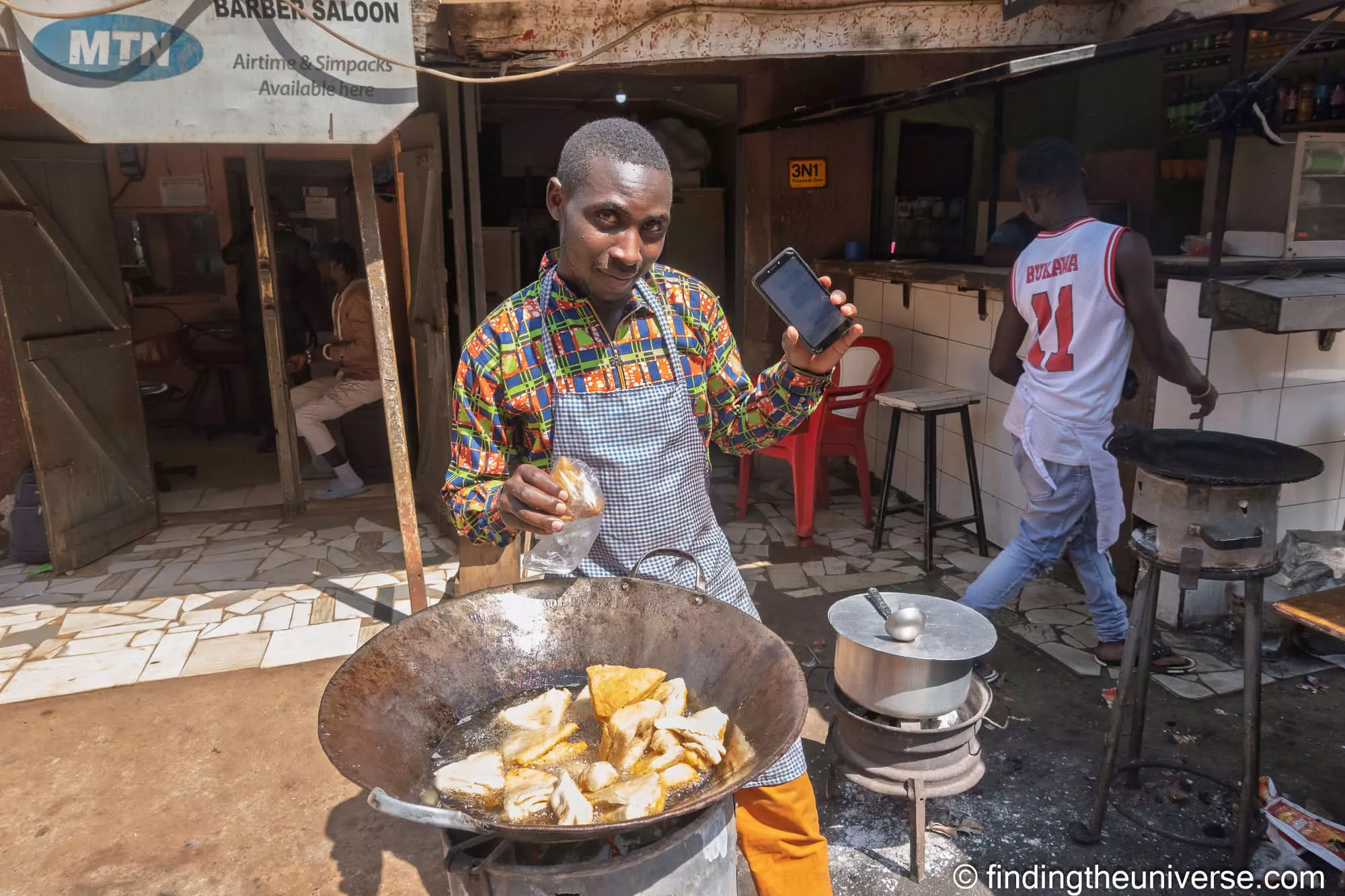
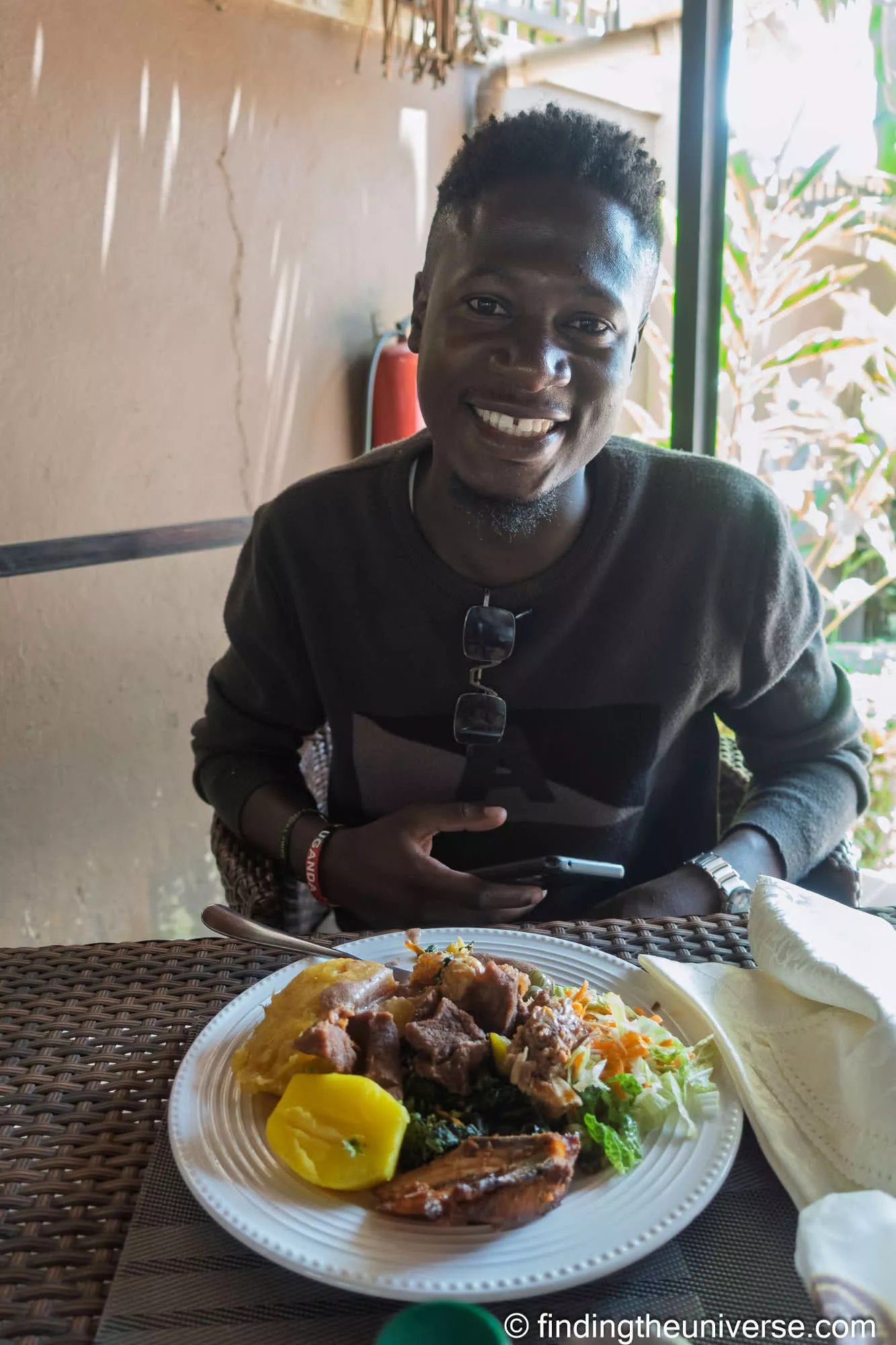
The tour covers a wide range of Ugandan dishes from a variety of street vendors: Rolex (a chapati rolled around an omelette, and one of Uganda’s signature street foods), deep-fried grasshoppers, fritters, fried fish, fresh fruit, sugar cane juice, samosas, and finishing with a buffet at a restaurant specialising in Ugandan cuisine. One thing to make sure you try at the buffet: matooke, mashed steamed green bananas, which is one of the most common staples in Ugandan cooking.
The grasshoppers, since you’re going to ask: surprisingly fine. The texture is crunchy in a salted-snack way and the flavour is unobjectionable. I’m not about to start ordering them at home, but I was glad to have tried them.
The real highlight of the tour, though, beyond the food, was our guide Andrew. The tours are led by passionate local Ugandans who are thrilled to share their food and their city, and Andrew was no exception. We were lucky to be the only people on the tour, which meant we got to chat about everything: Uganda’s political history, his favourite local dishes, football, and what daily life in Kampala is actually like for a young Ugandan.
If you want an immersive way into Ugandan food, this tour delivers it. Strongly recommended.
Take a Cooking Class
If you’d rather make Ugandan food than just eat it, several local operators offer home-based cooking classes in Kampala. These are usually run by Ugandan hosts in their own homes and cover dishes like Rolex, matooke, groundnut sauce, and chapati. Worth doing if you’ve got an interest in learning the techniques rather than just sampling the results, and a good way to meet local people in a relaxed setting. Ask your hotel or a local tour operator what’s running during your visit.
Visit AFFCAD
Like a lot of countries, Uganda has real, visible poverty, and it disproportionately affects children. Limited access to clean water, education, and healthcare leaves families with very few options.
One organisation working on this is AFFCAD (Action for Fundamental Change and Development), a nonprofit founded by four young men from Bwaise, one of the poorest neighbourhoods in Kampala. Bwaise was built on a former wetland, suffers from serious flooding and sanitation problems, and has grown rapidly without much in the way of urban planning. AFFCAD runs vocational training, schools, and healthcare programmes aimed at improving outcomes for people in Bwaise and other parts of the city.
If you want background reading before you go, watch the film Queen of Katwe, which gives you a strong sense of life in the slums in Kampala and tells the real-life story of Phiona Mutesi, a chess prodigy who grew up in Katwe, and her mentor Robert Katende.
AFFCAD also offers a slum awareness tour to visitors. We’ve written previously about ethical slum tourism and we’d recommend reading that before booking any tour of this kind. Based on our own visit, we think AFFCAD’s approach results in positive outcomes: the proceeds go directly to the organisation’s work, the tour is led by someone who lives in the community, and there’s no exploitative element to it.
We took our tour with Jaffar, one of AFFCAD’s four founders. He showed us around the various AFFCAD buildings (it wasn’t a school day, so they were quiet, but we saw the equipment used to teach skills like computing and sewing), then walked us through the Bwaise neighbourhood. The point of the walk isn’t to take pictures of poverty: it’s to understand how the place works, what the daily challenges are, and what AFFCAD is trying to change.
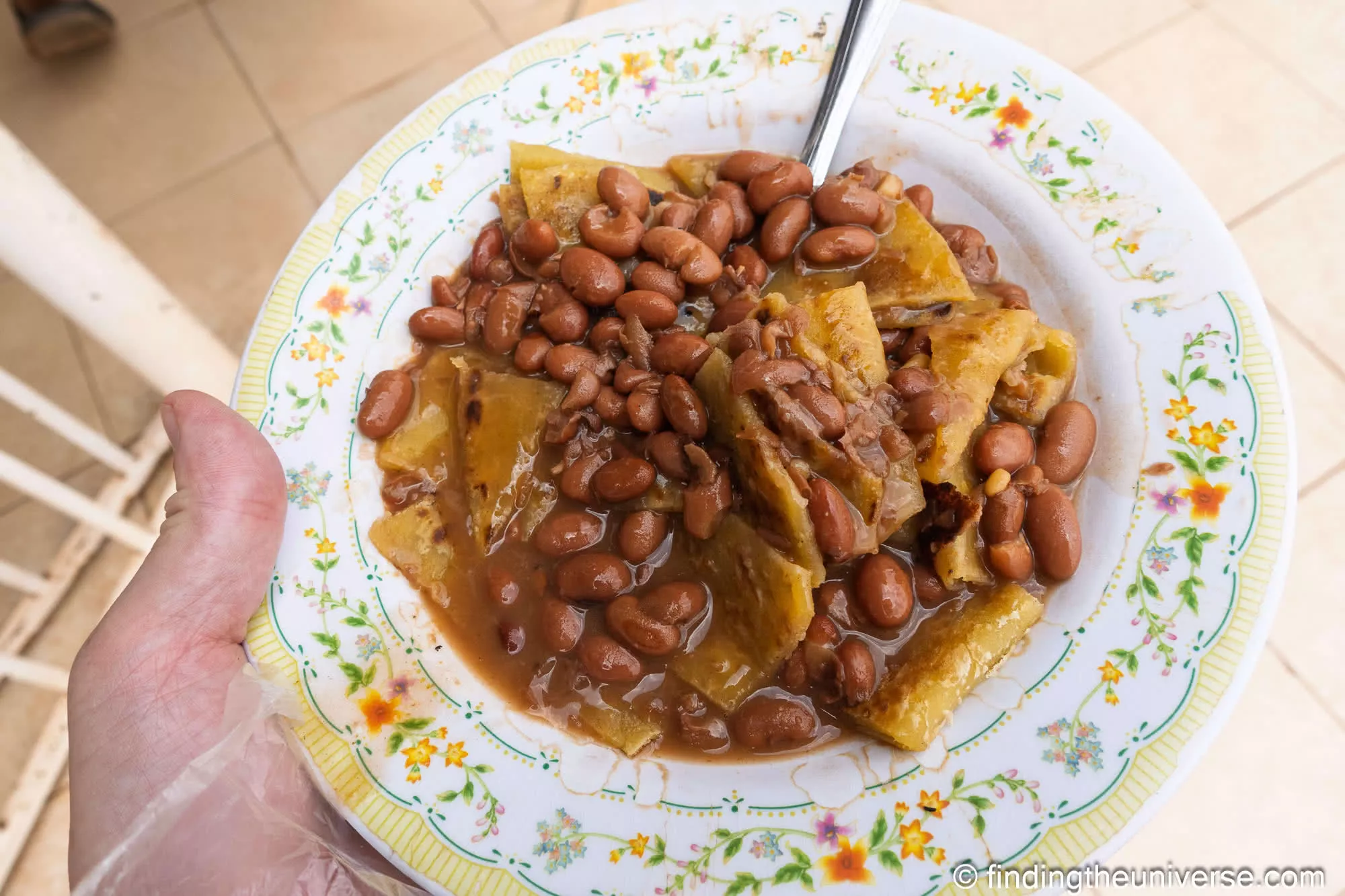
The tour ends with a traditional meal of kikomando, basically fried beans served with chapati strips. It’s filling, tasty, and a nice way to end an emotionally heavy couple of hours.
Our tour was about two and a half hours including transport from our hotel. We did it in 2023 and the cost was $35 per person, paid in cash at AFFCAD’s office at the start of the tour.
Tours need to be booked in advance, and the easiest way to arrange one is to email them directly at info@affcad.org.


Book a Walking Tour of Central Kampala
If you’re going to do one organised activity in Kampala, our pick would be a guided walking tour of the centre. Kampala can feel intense for a first-time visitor and letting someone else handle the logistics, navigation, and language lets you focus on what you’re actually looking at. A guide also helps with security checkpoints around government buildings and with the etiquette of taking photos in markets.
We took a guided walking tour like this one with a local guide named Arthur, and it was a solid introduction to the city. We’ve taken several walking and food tours on our various visits to Uganda and they’ve been consistently good every time.
The best local guides are young Ugandans keen to share their city, and a good one is worth a lot here. The same kind of operators usually run the food tours we mentioned above too.
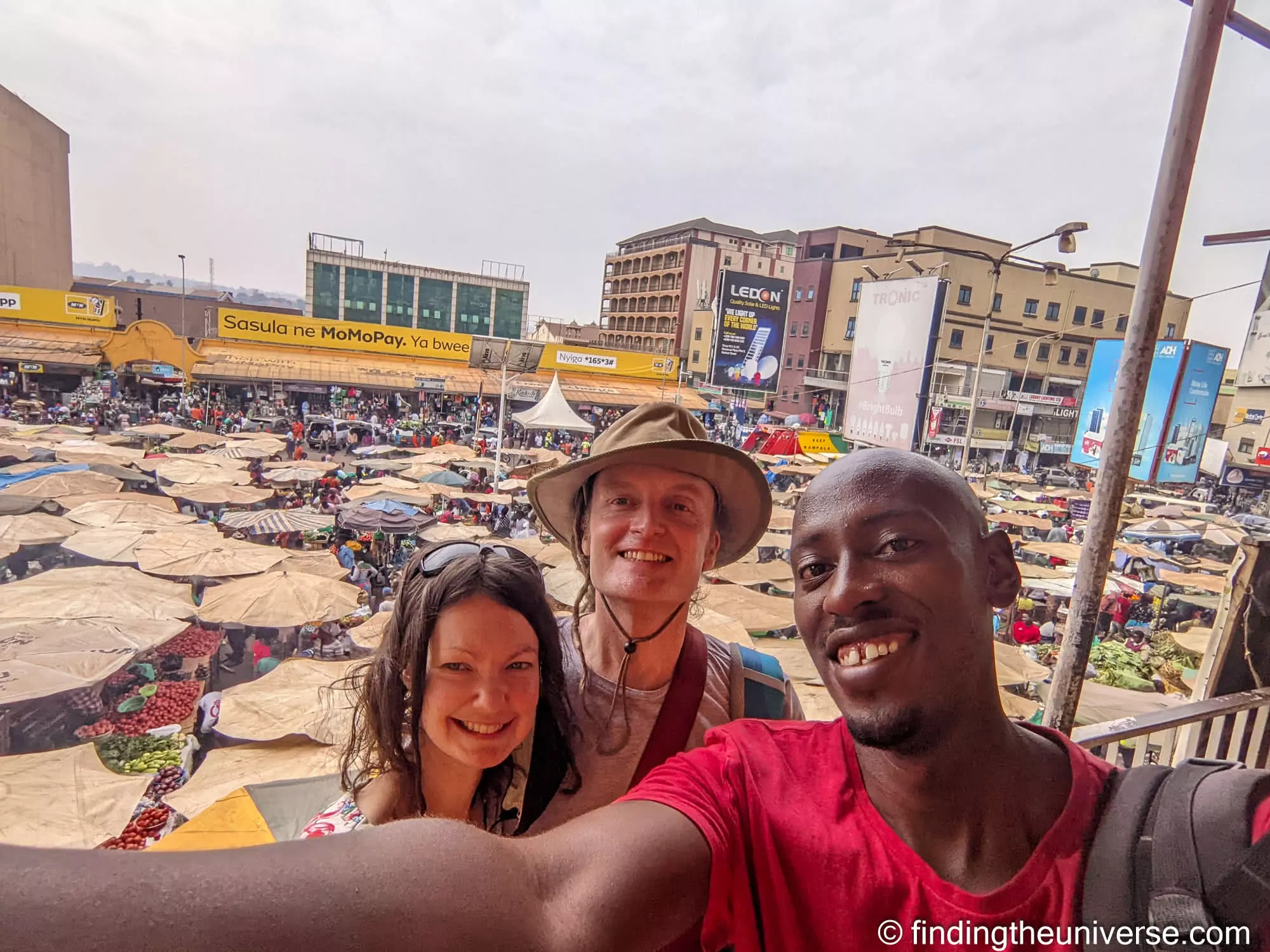
Arthur’s tour covered the highlights of central Kampala: a Rolex tasting, Nakasero and Owino Markets, the Hindu temple, Parliament Square, the Old Taxi Park, a coffee at 1000 Cups Café, and several monuments including the Independence Monument. We also added the Uganda National Mosque on as the optional extra.
Our recommendation: do a walking tour like this early in your time in Uganda rather than late. It’s the fastest way to get oriented, ask all the dumb questions, and understand how the city works.
Day Trips and 2-Day Trips from Kampala
If you find yourself with extra time in Kampala (a conference, a flight schedule that won’t budge, or just a slower itinerary), there’s a lot reachable from the city as a day trip. Most of these are bookable as guided tours, which is the easier option for an international visitor. Our picks:
- Jinja and the source of the Nile. Jinja is a relatively laid-back city on the shores of Lake Victoria, around two hours east of Kampala. It’s where Lake Victoria starts to feed into the River Nile, which is enough of a reason to go on its own. A guided day tour is a sensible way to do it.
- Entebbe. About half an hour from Kampala by ride-share or shuttle bus, Entebbe is where the international airport is and is also worth a day in its own right. The botanical gardens and zoo are the headline attractions. See our guide to things to do in Entebbe for the full picture.
- Chimpanzees at Ngamba Island. The main chimpanzee trekking sites in Uganda are too far from Kampala for a day trip, but Ngamba Island, on Lake Victoria, has a population of chimps and can be done in a day from the capital. The tour includes round-trip transport, a boat cruise, the trek, snacks, and lunch. Ngamba is also the only chimp-viewing site in Uganda we know of with no minimum age, so it’s the only realistic option if you have younger kids.
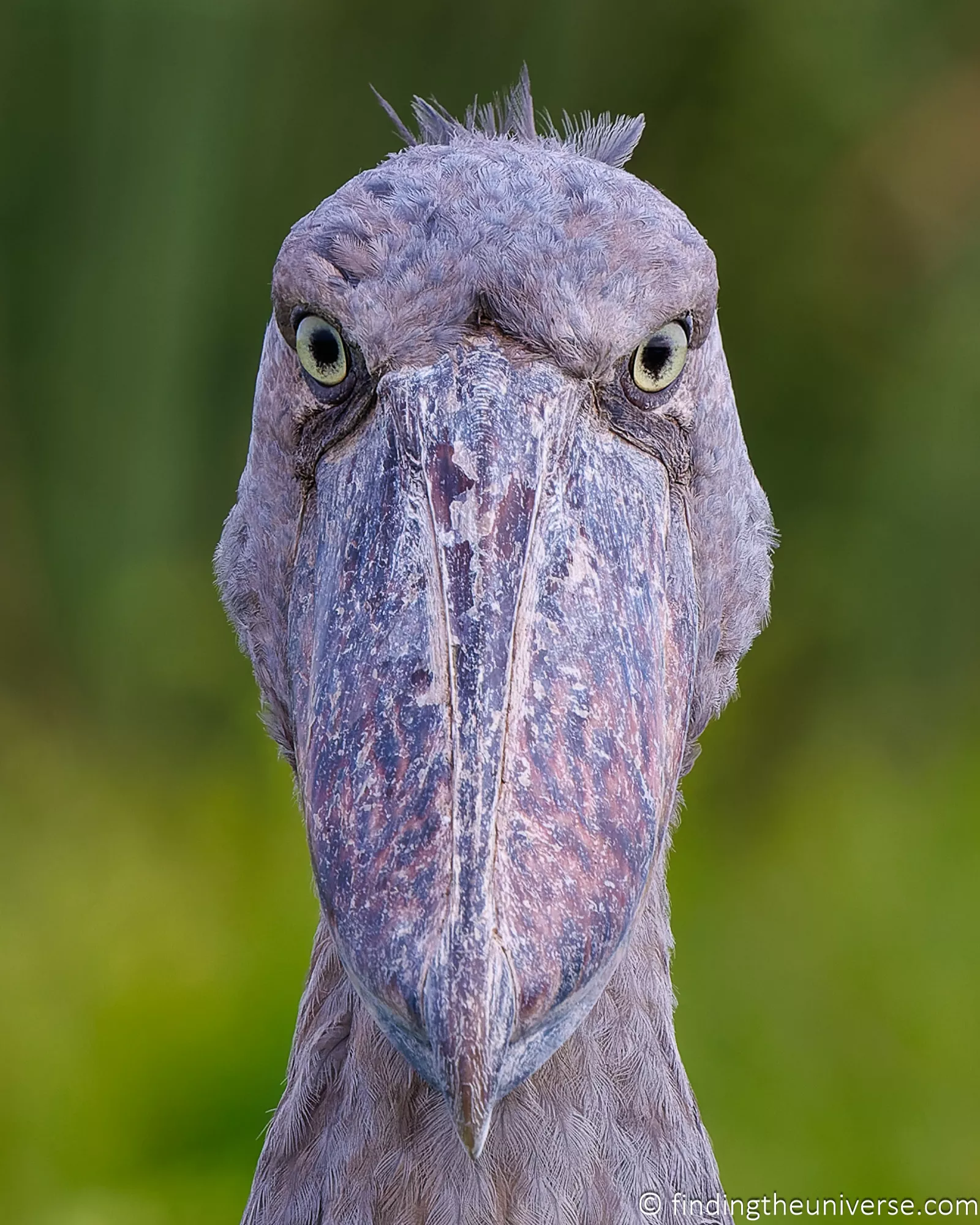
- Shoebill storks at Mabamba Swamp. One of our favourite experiences anywhere in Uganda was a boat birding safari on Mabamba Swamp to see shoebill storks. They look like prehistoric relatives of pelicans, with a giant shovel-shaped beak, and they’re only found in a handful of locations in Uganda. The boat tour also turns up a lot of other birds, but the shoebill is the headline. If birding is even slightly your thing, do this.
- Ziwa Rhino Sanctuary, currently the only place to see rhino in Uganda. The day tour includes round-trip transfers and admission. We’ve been to Ziwa twice and seen rhino both times, which feels even more remarkable when you realise you actually trek and find them on foot. You’ll also see plenty of birds and other wildlife. Highly recommended.
- Murchison Falls (overnight). If you want to fit a proper safari into a tight itinerary and don’t have a week, this two-day Murchison Falls trip is a workable option. It’s about four hours each way, but you’ll still see Murchison Falls itself, take a boat ride, and do a morning game drive. There’s an option to add Ziwa Rhino Sanctuary on the way.
- Multi-day safari and trekking tours. Plenty of multi-day options leave from Kampala, including ones that combine chimpanzee trekking and gorilla trekking with classic safari. Browse the options on GetYourGuide or Viator.
You can browse more day trip and tour options here. The one piece of advice we’d always give: check driving times realistically before you book. Uganda is large and the roads are quite a bit slower than the maps suggest. You don’t want to spend your whole “day trip” in a vehicle.
Practicalities for Visiting Kampala
How to Get to Kampala
The international airport for Uganda is in Entebbe, around 30 minutes from Kampala by car on the express highway. The express is a toll road, but it’s well worth paying because the old Entebbe-Kampala road can take over two hours in traffic.
If you’re arriving at Entebbe and staying in either city, your hotel can usually arrange a transfer. You can also book one yourself with a service like this.
The cheaper option is the Pineapple Express shared shuttle bus between Entebbe and Kampala (and on to Jinja), which runs scheduled departures from a number of locations including the airport. Book online here.
How to Get Around Kampala
Kampala spreads across hills and the attractions are spread out with it. You can walk to some of them but you’ll need transport for most.
The main options are: motorcycle taxis (boda boda), minivan taxis (matatu), ride-sharing apps (Uber and SafeBoda), private drivers, and tour companies. You could rent a car, but with the traffic and the road conditions we’d advise against it.
Practically speaking, you’ve got two sensible options as a foreign visitor: a car (private taxi or ride-share) or a boda boda. Boda bodas are the fastest and cheapest option, and sometimes the only thing that’ll get you somewhere in time. They can be hailed from almost any street. We mostly stuck to cars because there were two of us and we felt safer that way.
For most of our Kampala sightseeing we used Uber. Paying through the app is really convenient. One quirk: a lot of drivers are still new to the platform and either don’t fully understand it or will ask for cash anyway. We just refused and paid via app, which generally worked fine after a small friendly back-and-forth.
SafeBoda is the other main option and lets you choose between a car or a boda boda. If you do want to take motorbike taxis, we’d recommend going through SafeBoda specifically: you can pay through the app and they include a helmet and a safety vest as standard.
Some sights were close enough to our hotel that we walked. Bring shoes you don’t mind getting dusty (ours acquired a permanent reddish-brown layer). On a later visit we walked enough that the local security people in our area would say hello and stopped asking if we wanted them to call us a taxi. We felt safe walking, but it’s not necessarily comfortable for everyone (you will draw attention as a foreigner) and we wouldn’t walk after dark.
If you’re on a guided tour with transport included, that takes the whole question off the table. On our first visit, our driver just dropped us off and picked us up at agreed places, which made the day much less complicated.
The short version: Kampala isn’t hard to get around. If you want help, your hotel can arrange any of these options for you.
Where to Stay in Kampala
There’s a wide range of accommodation in Kampala across price points. Our shortlist, including the places we’ve stayed:
- Bushpig Backpackers. The budget pick. Hostel with both private rooms and shared dorms, a short walk from the Uganda Museum, with an on-site bar and restaurant where breakfast is served.
- ONOMO Hotel Kampala. We’ve stayed here twice. One of the newer, more modern hotels in town. Free WiFi, comfortable air-conditioned rooms, a pool, on-site restaurant, very good breakfast buffet.
- Humura Resorts. Where we stayed on our first trip. A relaxed boutique hotel with comfortable air-conditioned rooms, a restaurant, and a pool. A peaceful spot, good for unwinding after a few days in the city.
- Kampala Serena. We’ve stayed at several Serena properties around the world and always had good experiences, so we’re happy to recommend this 4-star. Large pool, air-conditioned rooms, on-site restaurants. A solid base for sightseeing.
- Sheraton Kampala. The 5-star option, in the city centre right next to the Independence Monument. Pool, multiple restaurants, comfortable air-conditioned rooms, fitness centre, sauna, salon.
For more options across price points, see the full Kampala list on Booking.com.

Best Time to Visit Kampala
Kampala can be visited year-round. It sits just north of the equator at altitude and the temperature stays pretty steady all year (mid-20s Celsius in the day, cooler at night).
The two dry seasons (roughly December to February, and June to August) are the most comfortable times to be out walking, going to markets, and doing day trips. The two rainy seasons (March to May, and September to November) bring sudden heavy showers that can turn unpaved roads to mud and make traffic worse than usual. You can still travel in the rains, but expect to plan around occasional washouts.
If you’re in Kampala specifically for the Uganda Martyrs’ Day celebrations (3 June), expect crowds, road closures, and accommodation pressure around Namugongo. Plan well ahead.
What to Wear in Kampala
Comfort and practicality first, fashion a long way second. You’ll be walking on dusty pavements and uneven surfaces, in and out of religious sites with dress codes, in heat that’s manageable but humid.
What we’d pack: light, breathable clothing; comfortable closed-toe walking shoes you don’t mind getting dusty (we usually travel with Allbirds or similar); a light rain jacket or small umbrella in the rainy season; a daypack with secured zippers for crowded markets; and at least one outfit suitable for religious sites (women: a long skirt or trousers plus a scarf for shoulders or head; men: long trousers and a sleeved shirt). For the Uganda National Mosque specifically, women may want to bring their own headscarf even though one is provided, just for comfort.
Evenings can cool down a bit, especially if you’re sitting outside at a restaurant or bar. A light layer is usually enough.
Safety in Kampala
Across our four visits, we’ve felt safe in Kampala as foreign visitors. It’s safer than many people expect, and probably safer than its reputation outside Uganda suggests. That said, it’s still a large East African city with the standard mix of risks: petty crime, occasional violent crime, terrorism risk, and health threats. Take standard big-city precautions and you’ll mostly be fine. One thing to do first, though: read the travel advisory near the top of this guide. Uganda’s own Ebola outbreak was declared over on 27 August 2026, but the US State Department still has the country at Level 4: Do Not Travel, over the continuing outbreak in the neighbouring DRC and other risks.
The everyday risk most visitors face is pickpocketing and opportunistic theft. A $1,000 camera or smartphone may feel normal to you but it’s a meaningful sum to someone living on a few dollars a day. Be sensible: keep valuables out of sight, carry a minimum of cash, and assume crowded markets and public buses are higher risk. You’ll notice in our market photos that even as a photographer, I left the R5 at the hotel and brought a small compact camera with a thick neck strap.
A money belt like this Eagle Creek one is a good way to carry money, cards, hotel key, and passport. Anything that can be snatched should be secured: a cross-body bag or a camera strap that goes around your neck is safer than something slung over a single shoulder. If you wear a backpack, make sure the closures are secure.
Going with a guide reduces the everyday risk meaningfully, although a guide isn’t a security guard and you still need to keep an eye on your own things.
If you do rent a car (we wouldn’t, for most visitors), don’t leave anything in it and park somewhere secure overnight.
Risk goes up at night, as it does anywhere. Don’t walk alone after dark. Take a ride-share back to your accommodation, ideally as part of a group or with a private guide.
One specific consideration for LGBTQ+ travellers: since the May 2023 Anti-Homosexuality Act, the legal and social environment in Uganda has significantly worsened. According to the U.S. Department of State, LGBT persons (and people perceived as LGBT, including those promoting LGBT issues) face increased risk of fines, violence, harassment, imprisonment, and the death penalty under the Act. This is something to weigh seriously when deciding whether and how to travel.
Language in Kampala
The official languages of Uganda are English and Swahili, but a lot of local languages are spoken across the country.
The most widely spoken language in the Kampala region is Luganda, the language of the Baganda people. Kampala sits within the historic Buganda kingdom, the largest of Uganda’s traditional kingdoms.
Although Swahili is officially recognised, we rarely heard locals speaking it unless they were talking to visitors from other East African countries. Some told us they prefer not to use it because they associate it with the era of Amin and military violence. Where it’s spoken, it’s largely as the practical language shared with the rest of East Africa.
As a visitor in Entebbe and Kampala you can get by pretty well in English. Most people working in tourism speak at least some, attractions usually have English signage, and museum information is in English.
If you don’t speak English, Swahili, or a local language like Luganda, hire a guide or translator and you’ll have a much smoother time. Or at minimum bring a good written guidebook.
Currency in Kampala
The local currency is the Ugandan Shilling (UGX), accepted everywhere.
US dollars are also accepted in many places, but with a catch: bills need to be recent, in very good condition, and ideally crisp. Any marking, tearing, or even a fold can mean rejection, because vendors worry the bank won’t take them. We had this happen multiple times in Uganda and other African countries. Easier to find an ATM and withdraw UGX.
Credit cards work at most hotels and larger restaurants, but it’s not universal. Always carry some cash.
Health in Kampala
As with any country, take some sensible precautions before and during your trip.
Before you go, check that your routine vaccinations are up to date and discuss travel-specific recommendations with your doctor. For Uganda this almost always includes anti-malarial medication.
Malaria risk in Kampala is lower than in much of the rest of Uganda but it’s still present. Mosquitoes carry other diseases too, so prevention matters: use insect repellent, wear long sleeves and trousers in the evenings, and consider a permethrin-treated layer for buggy environments.
We’d strongly recommend reading the official health advice for travellers to Uganda from your home country. The U.S. CDC’s information is here, and the UK Foreign Office travel advice is here.
Uganda’s Ebola (Bundibugyo virus) outbreak was declared over on 27 August 2026, after 42 days with no new cases. The outbreak in the neighbouring Democratic Republic of the Congo is still running and is still a public health emergency of international concern, and it was the reason several governments, including the United States, advised against travel to Uganda in the first place (see the travel advisory near the top of this guide, which is still in force). Check the latest health guidance from the WHO and your own government before travelling, and follow any screening or precautions that are in place. Uganda also sees periodic outbreaks of diseases like mpox, cholera, and yellow fever, so stay informed and take the standard precautions.
The most likely health issue you’ll actually face is an upset stomach, usually from contaminated water somewhere along the chain.
For water: stick to filtered, treated, or bottled. Avoid raw vegetables and unpeeled fresh fruit unless you trust the source, avoid unpasteurised milk, and skip cooked food that isn’t served piping hot. Hotel restaurants and licensed food vendors are generally fine. If you’d rather not buy bottled water for the whole trip, our guide to safe drinking water when travelling walks through the alternatives. We use a Grayl water filter bottle for tap water (drinking, cooking, brushing teeth) and didn’t buy a single plastic bottle on our last trip.
For food: stick to reputable places. The food tour we mentioned earlier is a good way to be more adventurous safely, because the guide steers you to vendors with good hygiene practices.
For what it’s worth, we’ve been sick in Uganda exactly once, and we’re fairly sure it was from raw vegetables on a sandwich after we’d been there for weeks and let our guard down. Don’t drop the precautions just because you’ve been fine for a while.
Tours of Kampala
If you want to see Kampala with a guide, here are the tours we’d recommend (we’ve taken the first two ourselves):
- Guided food tour covering street food classics through to a sit-down buffet, like the one we did with Andrew. Strongly recommended.
- Guided city-centre walking tour covering many of the highlights here. We did a walking tour like this one too.
- Kampala cultural tour covering several of the highlights including Kasubi Tombs and Kabaka’s Palace. We haven’t taken this one personally but it’s well-reviewed.

Getting Online in Uganda
Most hotels have free WiFi, as do many cafés and restaurants. So you’ll generally be online when you’re somewhere indoors and indoors-with-WiFi.
You’ll probably want connectivity outside that too, especially because most local guides use WhatsApp (which runs over the internet) and ride-sharing apps like Uber need data.
Two options. Local SIM: we’ve used Airtel, bought from the kiosk at the airport arrivals hall. There are a few carriers but Airtel worked well for us, was reasonably priced, and had a useful regional roaming bundle covering Kenya, Rwanda, and Tanzania since we were doing a multi-country trip.
The other option is an eSIM, if your phone supports it. We’ve used Airalo in Uganda and use it regularly when we travel; see our Airalo review for the full picture. It’s usually slightly more expensive than a local SIM but you’re online the moment you land, no kiosk visit required.
Our wider guide to getting online when travelling goes into more detail if you want it.
Power Outlets / Travel Adapters for Uganda
Uganda uses the three-pin Type G plug, the same as the UK and several other East African countries. If you’re coming from the UK or another Type G country, your kit will plug straight in.
If you’re coming from the USA, Canada, or most of Europe, you’ll need a travel adapter like this.
Uganda runs on 220-240V, the same as most of the world outside parts of the Americas. Lower-power devices (cameras, phones, laptops) almost always handle 110-240V automatically (it’ll be printed on the plug). Higher-power devices like hairdryers usually don’t, so check before you plug in. See our guide to travel adapters for more on this.
Frequently Asked Questions About Visiting Kampala
Is Kampala worth visiting?
Yes, for at least a day. It’s not a pretty city in the conventional sense, but it’s where Uganda actually happens, and stopping briefly before you head off to the parks gives you much better context for the rest of the country. Most international visitors skip it, which we think is a mistake.
How many days do you need in Kampala?
One day is enough for the headline sights: the Mosque, Kabaka’s Palace, a cathedral, a market, and a meal. Two days lets you slow down and add Kasubi Tombs, the Baha’i Temple, and an evening at Ndere. Three days opens up day trips like Mabamba Swamp for shoebill storks or Ziwa Rhino Sanctuary.
Is Kampala safe for tourists?
Generally yes, with standard big-city precautions. We’ve felt safe across four visits. The realistic everyday risk is pickpocketing in crowded areas, particularly markets. Don’t walk alone after dark, leave expensive jewellery and cameras at the hotel where possible, and use ride-shares (Uber or SafeBoda) rather than wandering at night.
Before planning a trip, though, check the current travel advisory: the US still has Uganda at Level 4 (Do Not Travel). Uganda’s own Ebola outbreak was declared over on 27 August 2026, but the outbreak in the neighbouring DRC continues and remains a public health emergency. Read your government’s official advice first.
One important note for LGBTQ+ travellers: since the May 2023 Anti-Homosexuality Act, the legal and social environment in Uganda has significantly worsened. Read your home country’s official travel advice carefully before deciding to visit.
What is the best thing to do in Kampala?
Our personal top pick is the Wednesday evening Sherehe show at Ndere Cultural Center, which combines traditional dance, music, and a Ugandan buffet under a mango tree. Close runner-up is climbing the minaret at the Uganda National Mosque for the best view in the city.
How do I get from Entebbe Airport to Kampala?
Three options. A pre-arranged airport transfer through your hotel or a service like Viator is the easiest. The Pineapple Express shared shuttle bus is the cheaper scheduled alternative, with a number of pick-up points including the airport. Or take an Uber from the airport.
The express toll road takes about 30 minutes. Avoid the old Entebbe-Kampala road if you can: it can take over two hours in traffic.
What food should I try in Kampala?
Start with the Rolex (a chapati rolled around an omelette, a Ugandan signature street food and not a watch). Try matooke (mashed steamed green bananas, the staple), luwombo (meat or fish steamed in banana leaves with groundnut sauce), and kikomando (fried beans with chapati strips). If you’re feeling adventurous, the deep-fried grasshoppers are a seasonal Ugandan delicacy and taste broadly like a salty crunchy snack. A guided food tour is the best way to try a range of dishes safely.
What is the best time of year to visit Kampala?
The two dry seasons (December to February, June to August) are the most comfortable for sightseeing and day trips. The two rainy seasons (March to May, September to November) bring heavy showers that affect roads and traffic. Temperatures stay fairly steady year-round (mid-20s Celsius by day, cooler at night) thanks to Kampala’s altitude.
What should I wear in Kampala?
Light, breathable clothing, comfortable closed-toe shoes you don’t mind getting dusty, and a light rain layer if you’re visiting in the wet season. For religious sites (mosques, cathedrals, Kasubi Tombs) bring something modest: women a long skirt or trousers plus something to cover the shoulders or head, men a long-sleeved shirt and trousers.
Do I need a visa to visit Uganda?
Most visitors need a visa, available as an e-visa through the official Uganda government portal. Apply in advance rather than on arrival to avoid delays. Confirm the current requirements for your nationality on your home country’s foreign office website or the Uganda government immigration site before you travel, as policies do change.
What currency is used in Kampala?
The Ugandan Shilling (UGX) is the local currency and is accepted everywhere. US dollars are also accepted in many places, but bills must be recent, clean, and undamaged or they’ll often be refused. Credit cards work at most hotels and larger restaurants but not universally, so always carry some UGX cash.
Further Reading
That’s our guide to things to do in Kampala. Before you head off, a few related guides on the site you might find useful:
- If you only have a day in the city, see our one-day Kampala itinerary with suggested routes by interest.
- Our guide to things to do in Entebbe covers the area around the airport, which is worth a day in its own right.
- Detailed guides to chimpanzee trekking in Uganda and gorilla trekking in Uganda, both of which we’d recommend doing if you have the time.
- Our guide to choosing the best safari camera and our tips for getting better photos on safari.
- Our detailed safari packing list covers what to bring.
- If Kenya is also on your itinerary, our guide to things to do in Nairobi and the suggested one-day Nairobi itinerary are useful starting points.
- Our guide to getting online when travelling for connectivity tips.
- Our guide to the best travel adapters.
- For a guidebook, the Bradt Travel Guide to Uganda is the standard recommendation and we’ve used a previous edition. It covers history, planning, packing, and detailed sections on chimp and gorilla trekking.
- For wildlife identification, we travel with both the Pocket Guide: Birds of East Africa and the Pocket Guide to the Mammals of East Africa. Both are conveniently sized and useful across any East African country.
That’s it. As always, if you have questions or comments, drop them in the comments section below and we’ll get back to you as soon as we can.
Marla says
Hello Laurence,
We had a wonderful trip, thank you for asking. Although there were a few snags here and there–a car breakdown, some bug bites and a bit of stomach issues–it went really well. All four of us had a lovely time. My husband and I shared an Airalo plan and it worked fine for our needs, we barely used it though once we got into our holiday…couldn’t spend our holiday time on our phones!
We did not get to visit the national museum as it was still closed as you predicted and our guide said he didn’t think it would open until end of summer. But we saw all the other things in Kampala and Entebbe on our list and had a really nice day out. Thank you for all your help in planning that.
Highlights elsewhere included, of course, seeing the animals in the three parks we went to (giraffes, elephants, a leopard, warthogs, monkeys, gazelle, buffalo, lots of colorful birds, etc. etc.), a river boat trip to see hippo and water critters, chimp trekking through a forest, the friendly people, and learning at some of the cultural sights. We also had lots of relaxing time at hotels and camps which was nice and even the day our Jeep broke down, we still got to spend it relaxing by the pool while it was fixed. Kigali was sad and startling, but powerful and glad we went there although I kind of wish it had been towards the beginning rather than end of our trip!
Although I don’t think I will ever have a chance to return, I would definitely jump at a chance to come back and see more of Uganda! Cannot believe it was already a full month ago since we came back from our trip.
Thanks again and sending you lots of warm wishes from the UK!
Marla & Phil
Laurence Norah says
Hi Marla,
Delighted to hear you had a good trip even with a few snags! Pleased to hear you saw a leopard, that’s always a special encounter. It sounds like you had a reallly wonderful time and it makes me want to go back to Uganda again 🙂 Happy to have been able to help a bit!
Safe travels!
Laurence
Marla & Phil says
Hello Laurence,
So my husband and I will be travelling to Uganda and Rwanda in May. Your post on Kampala is so informative but it also makes me a bit worried I haven’t left enough time to spend in the capital.
A bit about our situation: We are part of a 10 day tour, ourselves and another couple, and we arrive in Entebbe from London early in morning and then have about half day in Kampala scheduled. We’ll have a guide and car in Kampala but it just says “city tour” and we’ve just been told we can go to where we want and they will drop us off during that time or we can stay in car and they’ll take us around the city for sightseeing from car. So want to try to make most of that time as its the only time we have. We won’t be staying overnight here and time we’ll like be here is around 10:00am to around 3:00.
Places we would like to try to visit are: Basilica of the Uganda Martyrs (and rest of Martyrs sight complex), St. Mary’s Cathedral Rubaga, Kasubi Tombs, and the National Uganda Museum. Do you think these would be possible to explore in about 4-5 hours which would be our max time we’d have? Any tips on best order for these to maximize time?
Also, we have been given amount of cash we might need per day in USD and UGX. Would you recommend taking out/exchanging all the cash we need in Entebbe/Kampala or is it easy to get money along the trip in Uganda? Is airport best place or should we go to a bank our first day?
THANK YOU!
Marla & Phil
Laurence Norah says
Hi Marla & Phil,
Glad to hear you have found my guide useful and don’t worry, I think a lot of people don’t spend too much time in Kampala as obviously the main draw for visiting Uganda is the incredible wildlife. But you have some time set aside for the capital which is great.
I think with good planning you should be able to do the three sights which are currently open in the time you have available. Unfortunately the Uganda National Museum is closed for renovation until the end of May 2025, so I think you are going to miss that. The good news is that makes your three sights more doable as the four might have been a push. Just bear in mind the traffic can be very bad so I’d still recommend making a priority list and leave the one you want to see least for last.
Your route will depend a little on where you are heading after Kampala, I’m not sure if you’re returning to Entebbe or heading on to a different location. The reason for that is that the Uganda Martyrs Catholic Shrine is a little to the east of the city center, so depending on your final destination it may make sense to do that first or last in your day. However if that’s a priority I’d probably recommend doing it first and then heading on to the central Kampala sights. Kasubi Tombs and St. Mary’s Cathedral are about 10 minutes drive apart (depending on traffic), so it’s pretty easy to get between them.
For money, there are both ATMs and money exchange booths at Entebbe airport so that is probably the most convenient option or your driver can take you to a bank in Kampala if preferred. I would recommend getting all the UGX cash at beginning of trip so don’t need to try to find banks along trip. We have always gotten our US dollars at home before leaving for Uganda and have always taken out our Ugandan shillings at the Entebbe airport ATM with debit cards. We divide our USD and UGX into different places so not all in one place while traveling.
You will want to be aware that businesses in Uganda, like many African nations, are incredibly picky about their dollar bills. They need to be in pristine condition. Any marks (like the pen marks cashiers sometimes add), small tears or other blemishes on the notes are going to mean people won’t accept them. As we’re in the US it’s been easier for us to go to a bank and get very good condition notes but even then it can be hard. And we’ve had lots of notes rejected even then! So just a heads up that if you can get to a bank or something where you can choose the notes prior to your departure that is going to make your life easier.
If you are getting a physical SIM card for your phone, we can also recommend doing this at the airport. They are cheap and there’s good service across the country.
Let me know if you have any more questions, I’m happy to help. And have an amazing time in Uganda!
Laurence
Marla says
Thank you so much, Laurence! I have emailed with tour company after your reply and feel much better for day in Kampala. We have done quite a bit of travelling over the years but mainly in Europe so this trip is definitely more out of our comfort zones, both excited and a bit anxious.
1. Oh no, sad to hear the UGANDA museum may not be open. We’ll check with our guide once we arrive to see if open yet but if not, good to know we should be able to do the three other places in one day. Will start at Martyrs and then let the driver decide what is best order for the rest of places we’d like to see based on traffic and distance.
2. Yes we are arriving in Entebbe, checking in and dropping off bags at hotel and then going into Kampala for part of a day. Then returning to for dinner/night in Entebbe and an optional afternoon visit to gardens there.
3. We will get on top of sorting out the US dollar then soon, I think our bank may do this exchange, I will give them a call and also inquire about getting “clean bills”. Then just take out UGX as recommended at airport.
4. Yes, we will surely keep money divided into a few different places so if lost/stolen we still have cash with us.
5. I have a newer iphone model mobile and I don’t know if it can use a physical sim card- my son said I can use a digital one. Can you recommend ones that I can get in UK before I leave would work well in Uganda and Rwanda? We will be gone for a total of about 10 days between the 2 countries. Phil’s mobile will work with a physical one if easier and we could just share a phone during trip as well if not.
Laurence Norah says
It’s my pleasure! I think you will have a wonderful time in Uganda. It’s a lovely country and honestly, a wonderful continent! It will be a bit different to what you are used to for sure but that is the joy of travel 🙂
Yes, based on your returning to Entebbe that day that route makes the most sense. The Uganda museum being closed is unfortunate but the positive is that you won’t be as rushed. The Entebbe botanical gardens are worth the visit, especially if you like birds, although worth visiting anyway, especially after the madness of Kampala.
In terms of a SIM card, as your phone supports eSIM cards then I’d recommend going with one of them. We normally use Airalo, they have a 15 day eSIM with 2gb of data for $13. If you use code LAUREN8516 you get $3 of free credit so that would only cost you $10. I’ve used them in Uganda on one of our trips there and it worked well.
There are other eSIM providers of course, such as Nomad and Alosim, but we’ve had good success with Airalo and back when they launched they were one of the few that offered eSIMs across Africa, although most providers have expanded since then. Ultimately they all offer similar pricing and products.
I actually have a complete review of Airalo as well if you were wondering how it works.
Hope this helps, as I said, have an amazing time in Uganda and let us know if you have any more questions! We’d also love to hear from you after your trip is complete and hear how it was 🙂
Laurence
Laurence Norah says
Hi Marla!
Just wanted to check to see if your trip is done and how it went? I hope you had a great time! Any highlights?
Laurence