
We’ve visited Iceland multiple times over the years, including one four-week road trip where we filled every day and still felt there was more to see. So we know from experience that three days isn’t enough to see everything. But it is enough to see a lot of what makes Iceland special, and this itinerary will help you make the most of every hour.
This 3 day Iceland itinerary covers the Golden Circle, the south coast waterfalls, black sand beaches, and the Jökulsárlón glacier lagoon. We’ve included approximate timings for each stop, current parking fees, and accommodation options for each night. The itinerary works year-round, though we’ve noted where winter daylight or seasonal closures will affect your plans.
We’ve also included options if you’d prefer not to drive, with day tours and multi-day group trips that cover the same highlights from a Reykjavik base. Whether you’re here on a stopover or planning a dedicated short trip, this guide has everything you need.
Table of Contents:
Is 3 Days in Iceland Enough?
Three full days in Iceland will give you a great trip. You’ll see the Golden Circle, the famous south coast waterfalls, black sand beaches, and the Jökulsárlón glacier lagoon. You won’t see everything, and for something like the Iceland Ring Road we’d recommend at least a week. But three days is enough to understand what makes Iceland so special, without the cost of a longer trip.
That said, the longer you stay the more you’ll find. Our last Iceland trip was over four weeks, and we still felt we barely scratched the surface.
If you do decide to visit for longer, check out some of our longer Iceland guides and itineraries, including our Iceland Ring Road itinerary, our seven day Iceland road trip itinerary, and our guide to spending five days in Iceland.
Practical Tips Before You Go
Parking Fees
If you’re used to Iceland from a few years ago, one big change is that most major attractions now charge for parking. This caught us off guard on a recent visit and it’s worth knowing about in advance.
For the stops on this itinerary, expect to pay around 750 to 1,000 ISK per stop. Payment is usually through the Parka app, though some sites use checkit.is or contactless card machines. We’d strongly recommend downloading the Parka app before you arrive, as it covers the majority of sites and saves fiddling with payment machines in the cold.
Here are the current fees for stops on this itinerary:
- Thingvellir National Park costs 1,000 ISK (valid all day across all park lots, payable via checkit.is or card machines).
- Geysir is 1,000 ISK (Parka app).
- Gullfoss is free.
- Brúarfoss is 750 ISK (Parka app).
- Seljalandsfoss is 1,000 ISK (checkit.is or card machines).
- Skógafoss is 1,000 ISK (Parka app, valid 8 hours).
- Dyrhólaey is 750 ISK (Parka).
- Reynisfjara is 750 to 1,000 ISK (Parka).
- Fjaðrárgljúfur Canyon is 1,000 ISK (Parka).
- Skaftafell (for Svartifoss) is 1,040 ISK (Parka, and you get a 50% discount if you also park at Jökulsárlón the same day).
- Jökulsárlón and Diamond Beach are each 1,000 ISK (Parka).
Kerið Crater is slightly different. The 600 ISK charge there is an entrance fee per person rather than a parking fee, payable at the kiosk.
Car Rental and Fuel
As of 2026, Iceland has replaced its fuel-based road tax with a per-kilometre charge of 6.95 ISK/km. Your car rental company will add this to your final bill automatically, so don’t be surprised by the extra charge at the end. The upside is that fuel prices have dropped as a result, and you can expect to pay around 185 to 230 ISK per litre at the pump.
For car rental, we recommend checking Discover Cars to compare providers, or Northbound which is based in Iceland and lets you add the various Iceland-specific insurances upfront, avoiding the hard sell at the pickup counter.
See more on insurance and general driving advice in our tips for driving in Iceland post.
Getting Online
WiFi is widely available at hotels, restaurants, and coffee shops across Iceland. If you want mobile data while you’re out exploring, we’d recommend picking up an eSIM before you travel. We use Airalo, which lets you buy and install a data plan on your phone before you leave home. It’s much simpler than trying to find a physical SIM card on arrival, and works in most modern smartphones. See our guide to getting online when you travel for all the options.
A 3 Day Iceland Self-Drive Itinerary
Our 3 day Iceland itinerary is for three full days in Iceland. It would work for either two nights or three nights, assuming you have an early morning arrival and an evening departure. It could also be adjusted slightly to work for 2.5 days if you can’t make the flights work.
If you don’t have quite so much time, our suggestion would be to either base yourself in Reykjavik and do some day trips, or plan a two day trip that doesn’t include so many sites, either by dropping the Golden Circle, or only going as far as Vik on the south coast.
For now though, let’s look at how we suggest you spend three days in Iceland, driving yourself.
Day 1: Golden Circle (arrive ~9am, accommodation by ~5:30pm)
We’ll assume you arrive in the morning at Keflavik airport, where you’ll pick up your car rental. See our Practical Tips section above for car rental recommendations and what to expect with insurance.
If you want to visit the Blue Lagoon or Sky Lagoon, this is an option now, as they are both fairly close. You need to book your reservations in advance to enjoy either hot spring.
You can book the Blue Lagoon here and the Sky Lagoon here.
Note that the Blue Lagoon has experienced temporary closures due to volcanic activity on the Reykjanes Peninsula. See our detailed note on this in Day 3 below, and check the Blue Lagoon’s status page before booking
From the airport, (or lagoon) we’re going to head straight for the Golden Circle. This is a popular circular route that takes in a number of Iceland’s big attractions. The name Golden Circle derives from the name of the major waterfall on the route, Gullfoss, which means gold waterfall in Icelandic.
The Golden Circle route contains a number of highlights that you’ll want to stop at.
The first of these is Þingvellir National Park, pronounced Thingvellir in English. This is an important cultural and geological site, and is one of Iceland’s UNESCO world heritage sites.
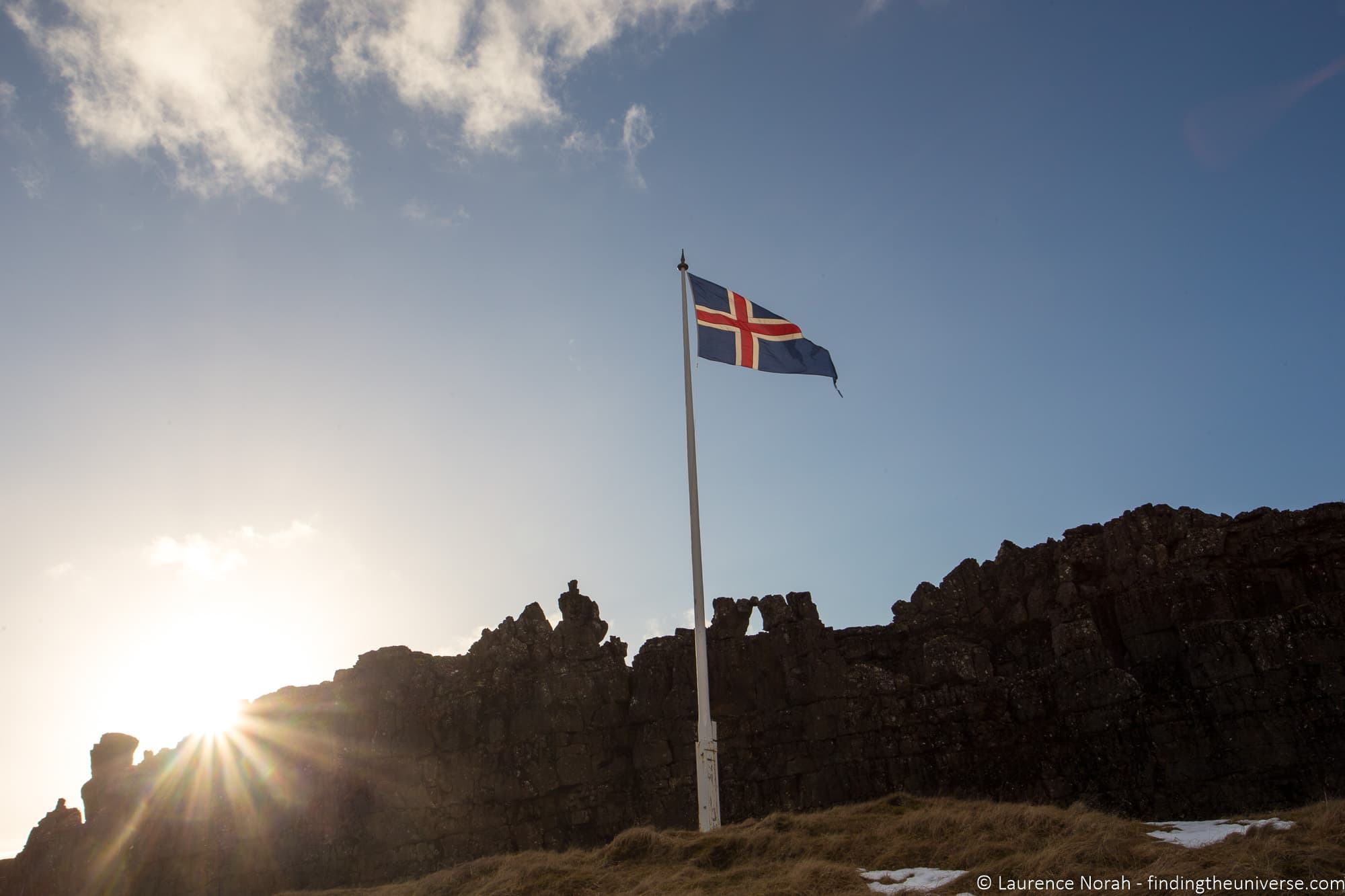
The national park has a number of attractions. First, it was the location of Iceland’s first parliament, and for hundreds of years Icelanders would convene here to discuss laws and politics. It’s also geologically interesting, as the continental divide can be seen here, with two continental plates moving apart from each other. You can actually walk (or snorkel!) in these rifts, which is a pretty cool geological experience.
Another attraction here that’s worth seeing is Öxarárfoss, which will be the first waterfall you see on this three day trip – but by no means the last! Near Öxarárfoss is a rift through the rock, which was used as a Game of Thrones filming location.
On the way from Thingvellir to Geysir, it’s worth making a short detour to Brúarfoss, sometimes called “Iceland’s Bluest Waterfall.” Until 2023 this waterfall was essentially inaccessible without trespassing on private land, but there’s now an official parking area and marked trail (parking is 750 ISK via Parka). The walk takes about 15 to 20 minutes each way on a well-maintained path. The waterfall itself isn’t huge, but the vivid blue colour of the water is unlike anything else on the Golden Circle. Check bruarfoss.is for current trail conditions, as the path closes in winter.
On the way to Geysir you’ll pass the Efstidalur II farm restaurant, which has excellent food and ice-cream options. You’ll also go past the Laugarvatn spa, where you can enjoy the waters and can also pick up geothermally baked “lava” bread, which we found to be very tasty!
Your next stop will be the Geysir thermal area, home to bubbling mud pots, steaming earth, and geysers that shoot boiling hot water and steam into the air on a regular basis. The geothermal area here is also home to a Geyser called “Geysir”, which is where the word for Geyser in English actually came from.
The Geysir area is a good spot for lunch. Friðheimar is a tomato farm and greenhouse restaurant nearby that’s become one of the most popular lunch stops on the Golden Circle. They grow tomatoes year-round using geothermal heat, and the restaurant serves excellent tomato soup and fresh bread right in the middle of the greenhouse. It’s open daily from 11:30 to 16:00, but it’s very popular so we’d recommend booking in advance through their website.
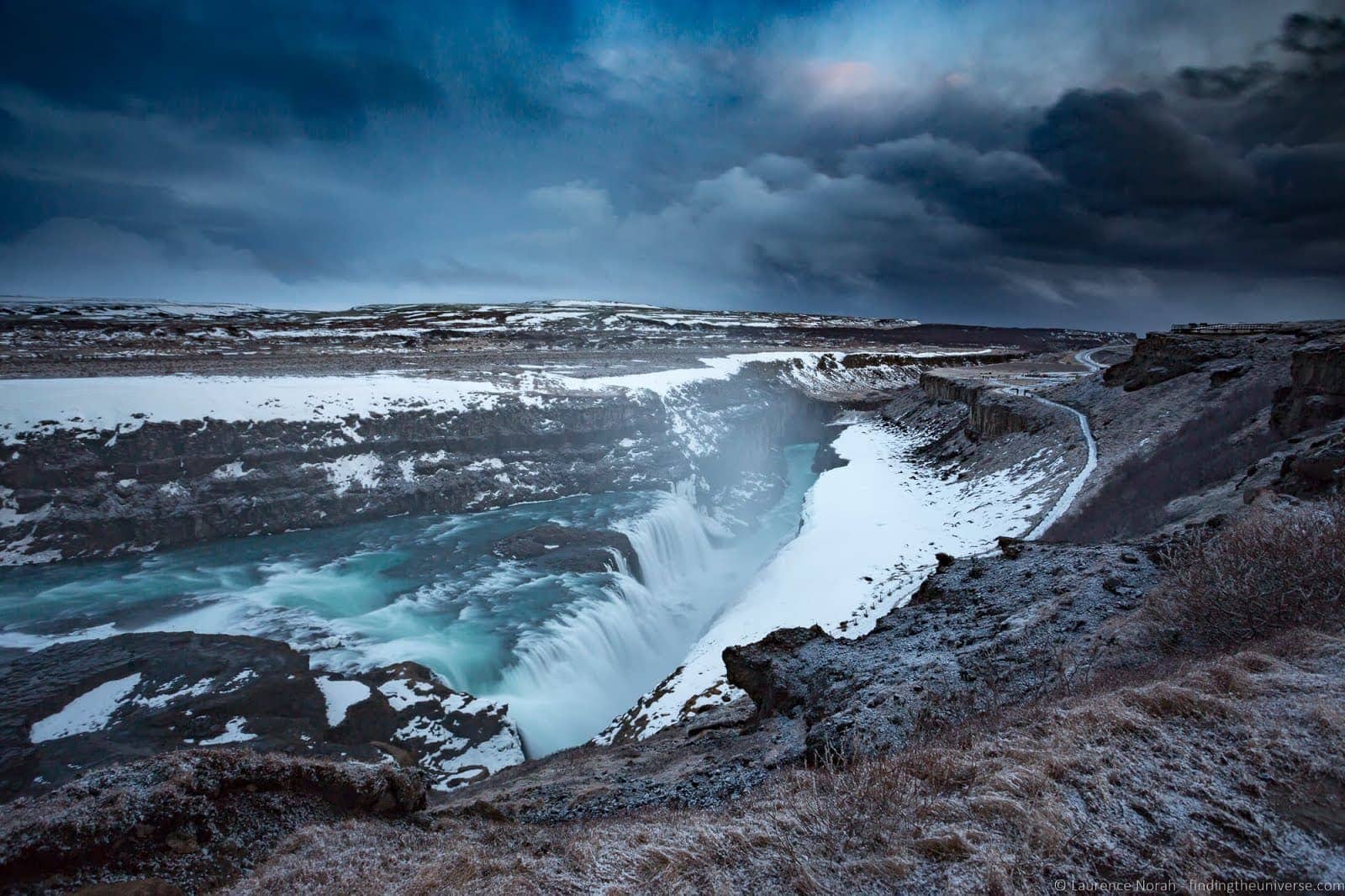
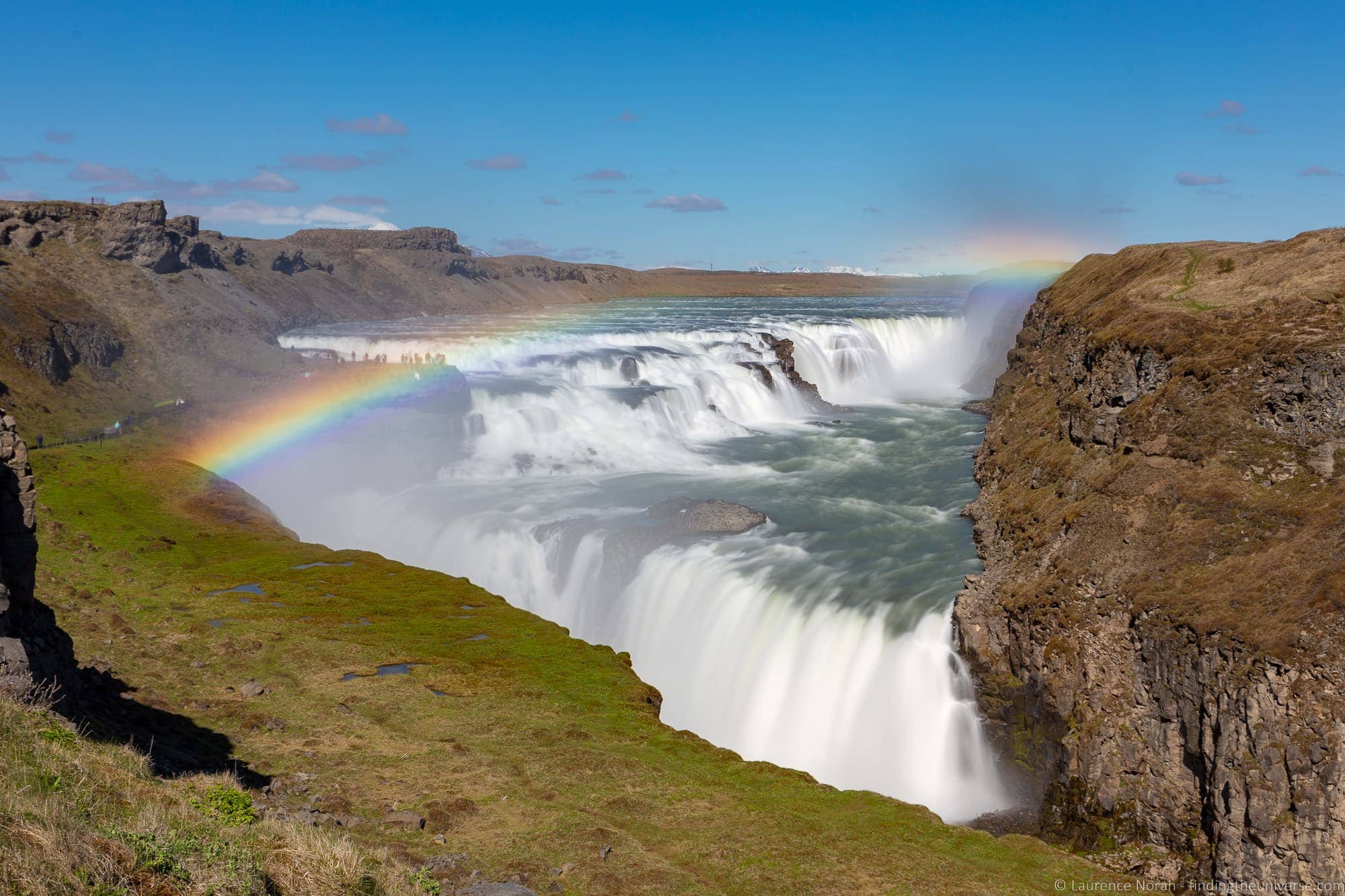
The last major attraction on the Golden Circle is Gullfoss, the aforementioned “Gold” waterfall.
This is definitely one of the most impressive waterfalls in Iceland. It’s a wide, two-tiered waterfall that plunges a total of around 105 ft. It’s quite the sight to behold, and there are a number of viewpoints that you can enjoy the falls from, as well as an on-site gift shop and cafe.
From Gullfoss, we suggest you head towards your accommodation for the night.
If you have time (and stamina!), an optional stop on the way to your accommodation is Kerið Crater. This 3,000-year-old volcanic crater lake has striking red and black volcanic rock surrounding vivid blue-green water. It’s a quick visit (15 to 20 minutes is plenty) and costs 600 ISK per person, payable at the entrance kiosk.
Where to stay
Our suggestion for your first night is to book accommodation somewhere between Flúðir and Hvolsvöllur, depending on how far you want to drive and what’s available. Here are some options to consider.
- Farmhotel Efstidalur — as the name suggests, this is found on a working farm. Private rooms are en-suite and there’s an on-site geothermal hot tub. The farm restaurant here is excellent too.
- The Hill Hotel at Flúðir — we stayed here on one of our Iceland trips and it was very comfortable, with an on-site restaurant. Formerly the Icelandair Hotel Flúðir, it’s now independently run.
- Garður Stay Inn by the Secret Lagoon — well reviewed and handy for Flúðir’s “Secret Lagoon”, a lovely geothermal bath.
- Midgard Base Camp — found in Hvolsvöllur, this highly rated hostel is a great budget option with a hot tub and a good base for the south coast the next day.
You can see more options in this region on Booking.com here.
Day 2: South Coast Highlights (depart ~8:30am, accommodation by ~6pm)
For your next two days in Iceland, we’re going to focus on the south coast, primarily following Route 1, which is also known as the Ring Road.
Whilst this can be done in one day if you skip things, we think a better option is to go a bit slower and take in more of the attractions – of which there are many!
The trip out to Jökulsárlón Glacier Lagoon, which is the end point of our route, will require you to drive the same route there and back. We’re going to take advantage of this, and split the sightseeing across the two days so you don’t feel you have to see everything in one day.
Our first stop is the Lava Centre in Hvolsvöllur. This award-winning interactive museum covers the volcanos and geology of Iceland, with exhibits that include earthquake simulators and a 12-metre recreation of Iceland’s magma flow. Given the ongoing volcanic activity on the Reykjanes Peninsula (more on that below), a visit here gives you real context for the landscapes you’ll be driving through. There’s also a good on-site restaurant, Katla, if you want an early lunch or coffee stop. Allow about an hour for the visit.
You can book your Lava Centre tickets on GetYourGuide here.
From the Lava Center, you’re going to head to some of Iceland’s most iconic south coast sights, including waterfalls and black sand beaches.
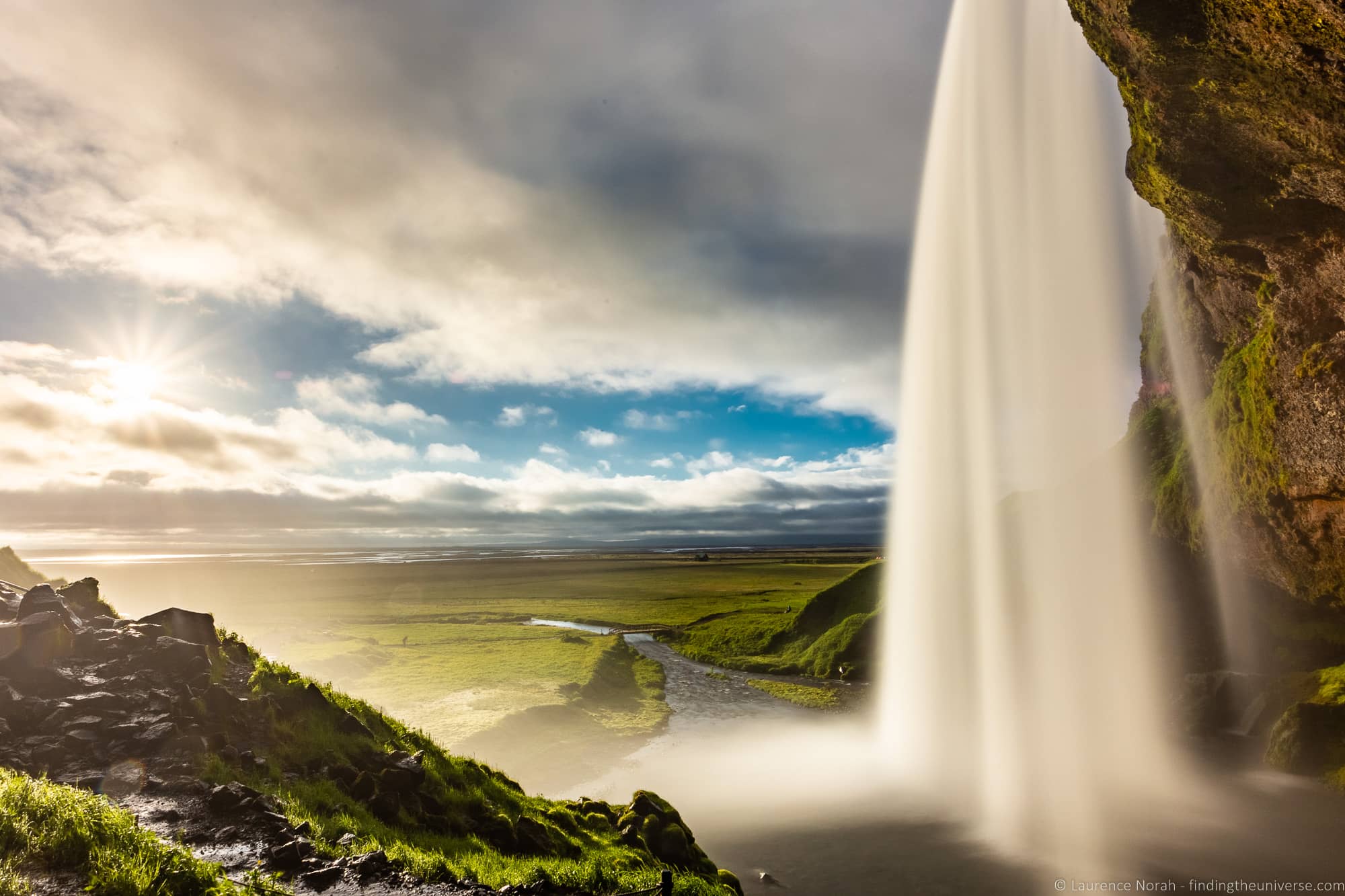
The first of these is Seljalandsfoss. This is an impressive waterfall found just off Route 1. Seljalandsfoss is one of the few waterfalls in Iceland you can actually walk behind.
Note that Seljalandsfoss has a parking fee of 1,000 ISK, payable via checkit.is or the card machines in the car park. I’d also add a word of warning about walking behind the waterfall: you will get seriously wet. On our visit I had a waterproof camera cover and I still struggled to keep the lens dry as the spray poured over me from every direction. That cover was absolutely essential, and I’d say the same for your phone.
Despite the soaking, walking behind the falls is one of those experiences I’d recommend to everyone. There’s something quite special about standing behind a wall of falling water with the Icelandic landscape framed through it.
As a bonus, there’s actually another waterfall near Seljalandsfoss – Gljúfrabúi. Note that this does require a short wade up a stream through a canyon to view, so don’t do this if this doesn’t sound like something you would be comfortable with, and ensure the stream is not too high before attempting it!
To get to Gljúfrabúi from Seljalandsfoss you head along the path (there’s a little sign pointing the way) to the right of Seljalandsfoss as you look at it (away from the Ring Road). A short 5 -10 minute walk will bring you to a stream coming out of a narrow canyon in the rock.
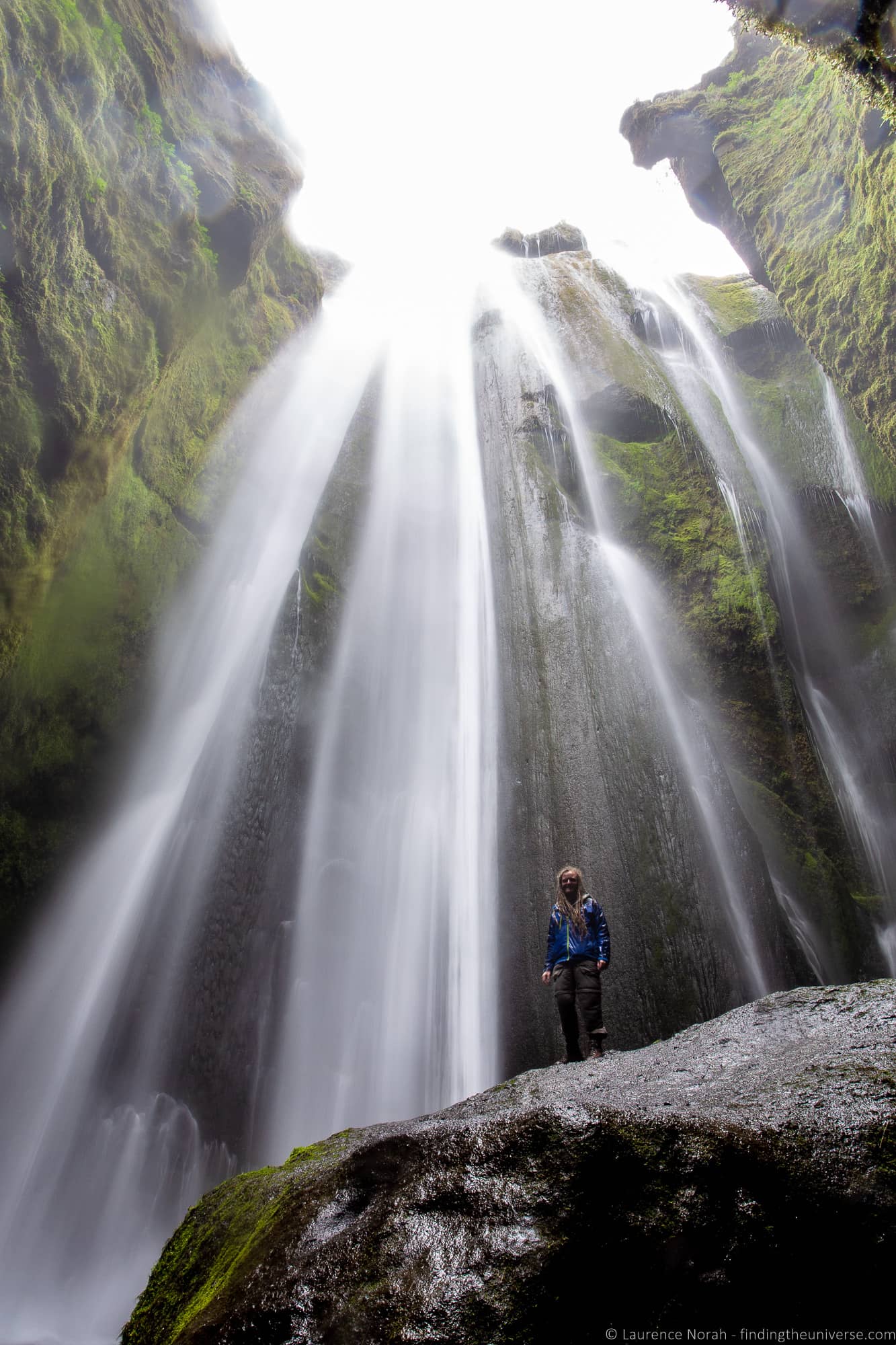
If you are feeling brave, have waterproof boots on, and the stream is not too high, you can head up this stream a few meters, where you’ll be rewarded with the gorgeous Gljúfrabúi waterfall, which tumbles into the canyon, and is quite spectacular.
Next, you’ll continue along the Ring Road to another of Iceland’s incredible waterfalls – Skogafoss. This is notable for its width and height. At 15 metres wide and with a drop of sixty meters, the amount of water thundering over these falls is an amazing sight to behold.
You can admire this from ground level, and you can get very close to the base here (although the spray will likely get you very wet!), or you can hike up the staircase to the viewpoint for a different perspective.
Parking at Skógafoss costs 1,000 ISK via the Parka app, valid for 8 hours.
Near Skogafoss is the Skogar Museum which is a lovely region museum focused on the cultural heritage of the area that has three large sections: Icelandic culture, Icelandic technology and transportation, and an open-air museum complex that includes old traditional turf buildings.
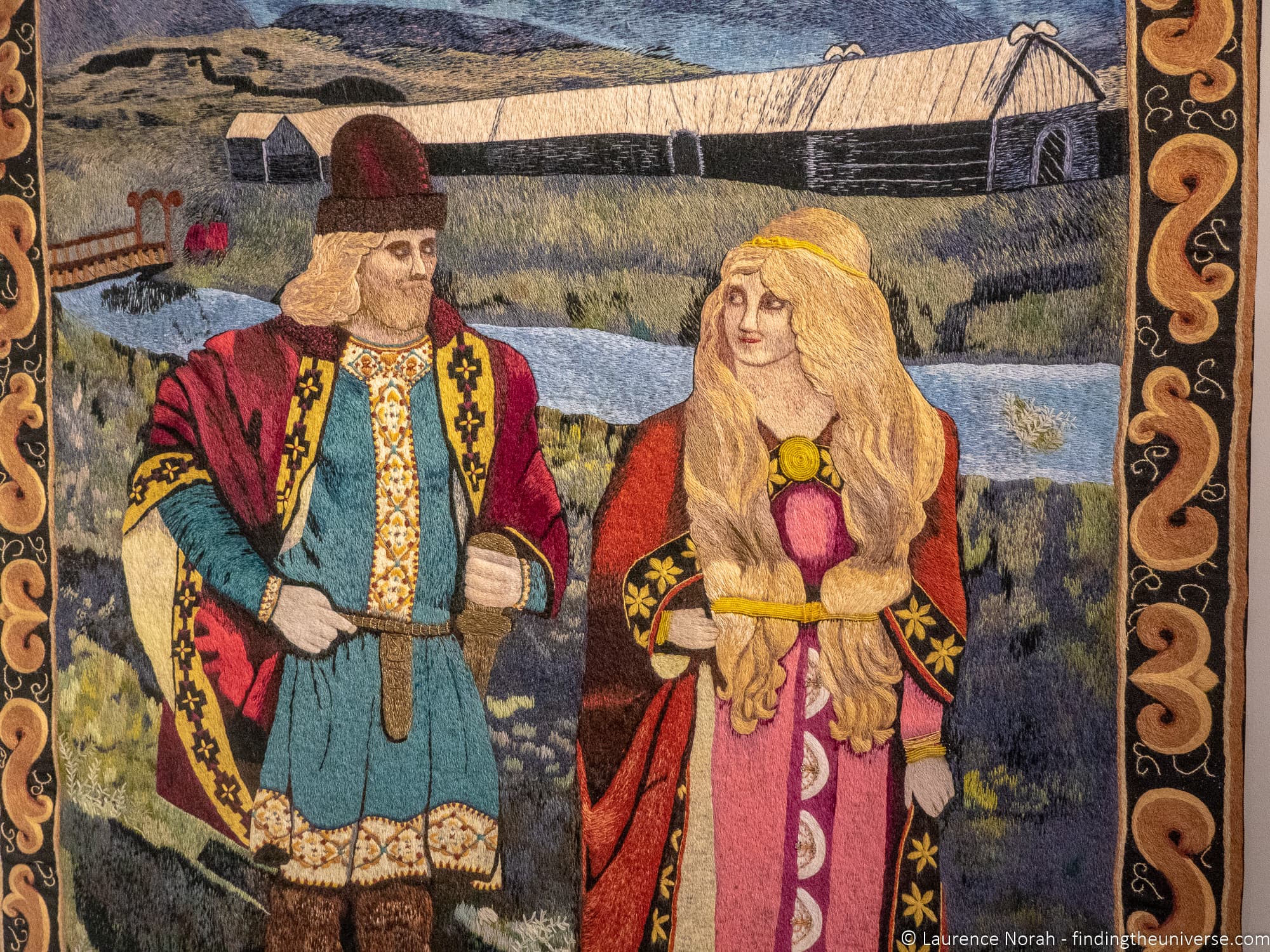
Your journey now continues to one of Iceland’s famous black sand beaches. The first stop though will be at Dyrhólaey – a rocky peninsula that is home to a massive black lava arch which juts out to sea. From atop the 120 metre high Dyrhólaey there are absolutely spectacular views, especially to the west, where a black sand beach stretches out for miles upon miles.
This is also one of the few spots on this three day tour from where you will be able to spot puffins. Every spring Iceland is home to millions of these cute little seabirds, who come here to nest and raise their pufflings. If you’re interested in seeing them, see our guide to puffins in Iceland, which has lots of information on the best places to see them.
Note that Dyrhólaey is normally closed to visitors during the early part of the puffin nesting season each year, usually from mid May to mid June.
From Dyrhólaey it’s a short drive down to the beautiful Reynisfjara Beach. This stretch of black sand is famous for its black basalt columns, which appear to rise out of the beach itself. There are also caves, and sea stacks in the distance.
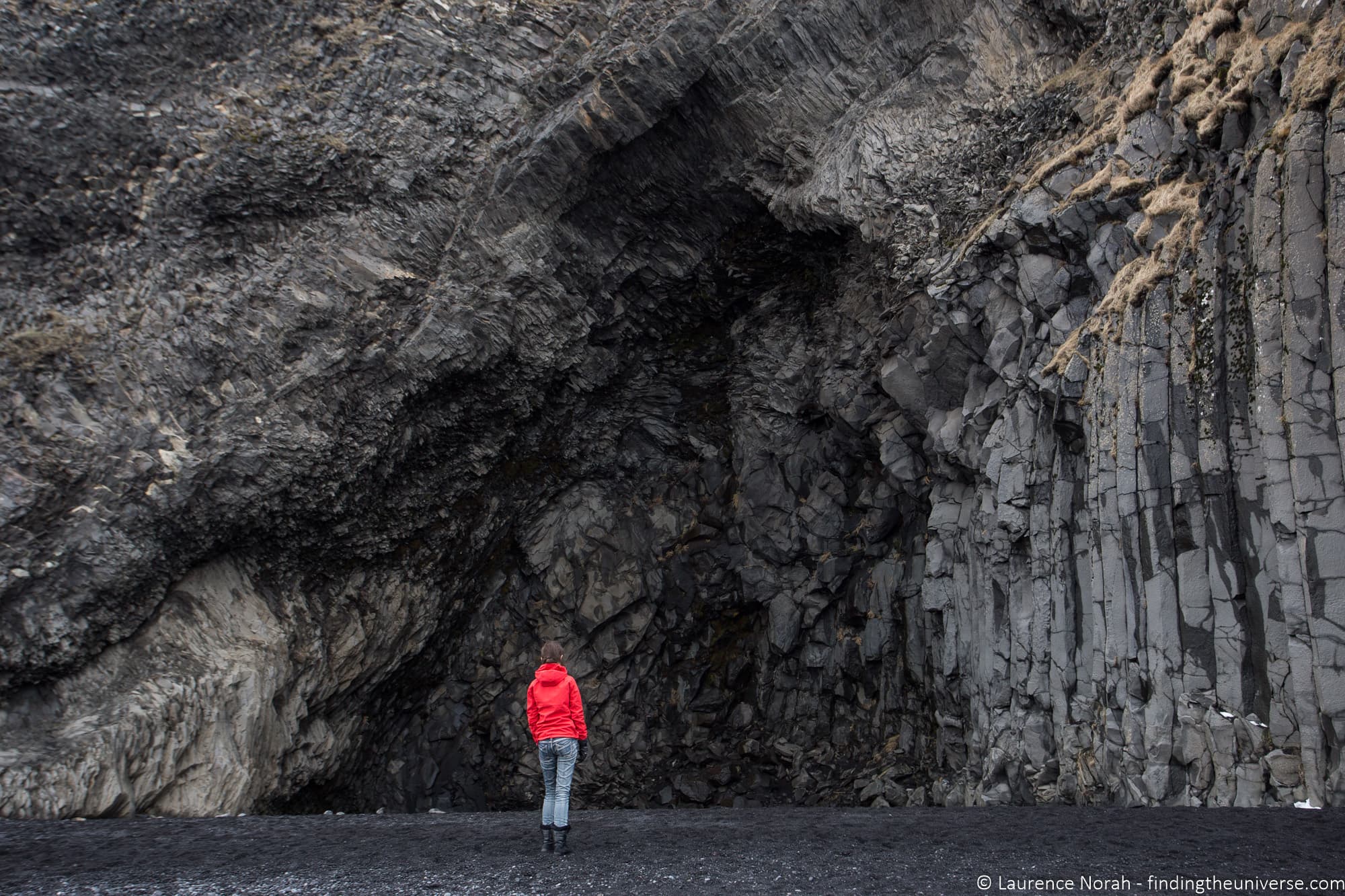
One important safety warning about Reynisfjara: this beach is known for powerful “sneaker waves” that surge up the sand without warning. These waves have killed visitors, and you should stay well back from the waterline at all times. There’s now a colour-coded warning system at the beach (green, yellow, red) indicating current wave danger. Pay attention to these signs and check SafeTravel.is for current conditions before visiting.
It’s also worth knowing that storms and coastal erosion can dramatically change the beach. In January 2026, severe storms eroded away most of the sand, making the famous basalt columns temporarily inaccessible. The beach recovers over time, but your experience may vary depending on recent weather conditions.
From Reynisfjara you will continue along Route 1 through the cute town of Vik (a good spot for refuelling and getting lunch) and then onwards across the Eldhraun lava field.
This is the largest lava flow in the world, covering an areas of 218 square miles, and it was formed when the Laki volcano erupted in 1783. The eruption lasted eight months, and 42 billion tons of lava was spewed forth. The eruption had far-reaching global consequences, with the ash in the air affecting the climate across Europe and causing crop failures and famine.
Today, the moss covered Eldhraun Lava Field is a unique and beautiful site, unlike anywhere else we saw in Iceland, and there are a number of spots you can stop to admire its vastness. Just be sure to stay to the marked paths and not to walk on the moss, as it is very fragile and takes decades to regenerate.
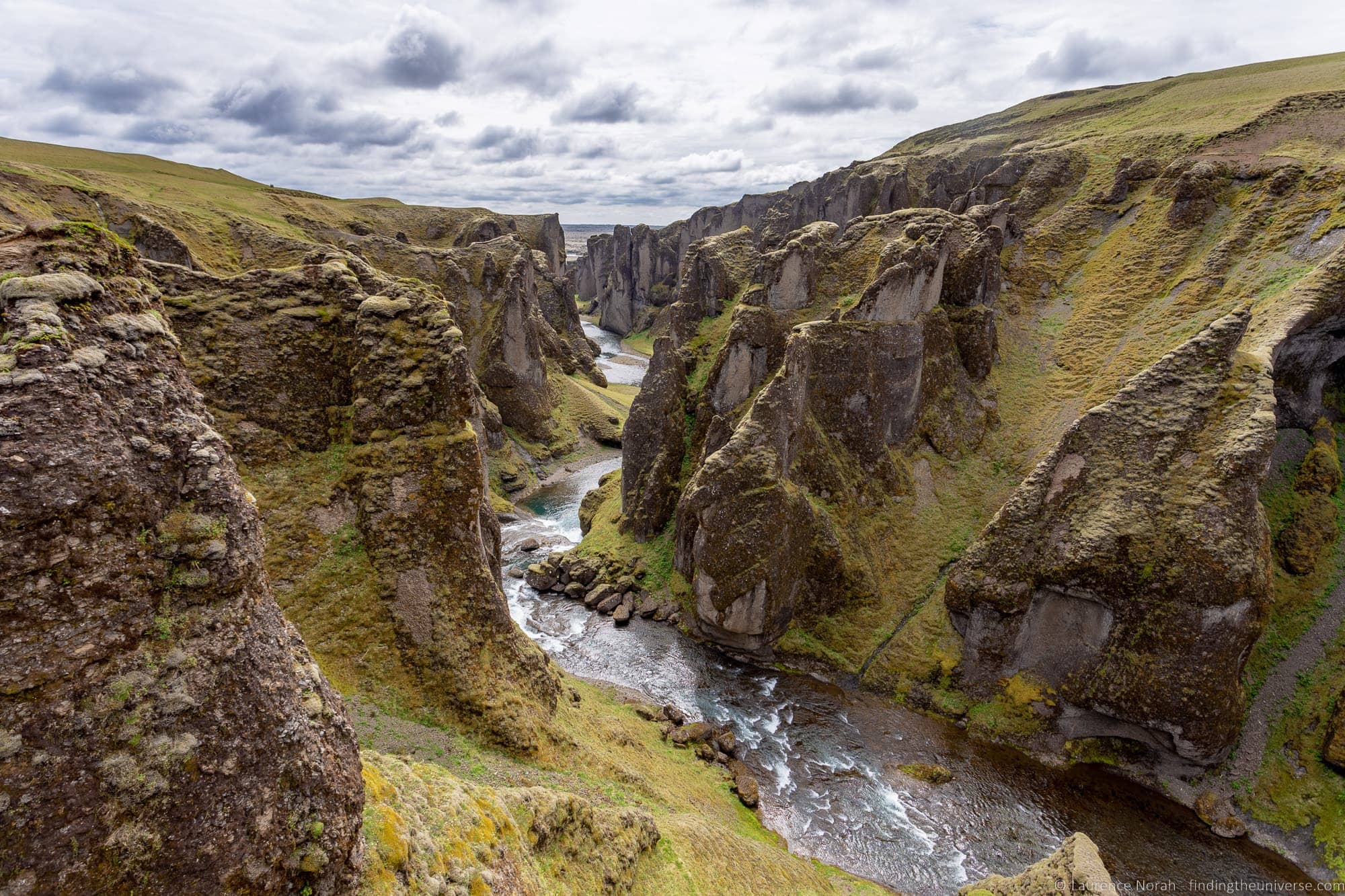
Our last stop on day two is at Fjaðrárgljúfur Canyon (parking 1,000 ISK via Parka). This 100-metre deep canyon has been carved by glacial meltwater over the past 10,000 years, and the winding shape of the walls makes for wonderful photography. For the best views, walk to the lookout platform, about ten to fifteen minutes from the parking area.
One thing to be aware of: Fjaðrárgljúfur was declared a nature reserve in 2024 and is occasionally closed in spring (typically April to June) to allow vegetation to recover from foot traffic. If you’re visiting in spring, check the Environment Agency of Iceland website before making the detour, as it would be a shame to arrive and find the gates locked.
That finishes up our second day of our 3 day Iceland itinerary. Now for some suggestions on where to stay!
Where to stay
Our suggestion for your second night is to stay somewhere between Hof and Jökulsárlón, which will set you up nicely for your third day of activities. Some suggested accommodation options are as follows.
- Hotel Skaftafell – found by Route 1, this hotel is 40 minutes drive west of Jokulsarlon Glacier lagoon, and offers lovely views, WiFi, on-site restaurant, and bar
- Old Cottage – a little east of the Jokulsarlon Glacier Lagoon, this budget hotel offers rooms with shared bathrooms, a restaurant, and an on-site kitchen
- Fosshotel Nupar – around an 80 minute drive west of the Jokulsarlon Glacier Lagoon, this property is part of the well-rated Fosshotel range. These sit in the mid to upper range of hotel options in Iceland, and rooms offer lovely views. There’s also an on-site restaurant.
- Hunkubakkar Guesthouse – a family run guesthouse found five miles from Kirkjubæjarklaustur. WiFi, on-site restaurant and cute colourful cottages.
You can see more options for this region on booking.com here.
Day 3: South Coast Highlights & Reykjavik (depart early, aim for Reykjavik by ~6pm)
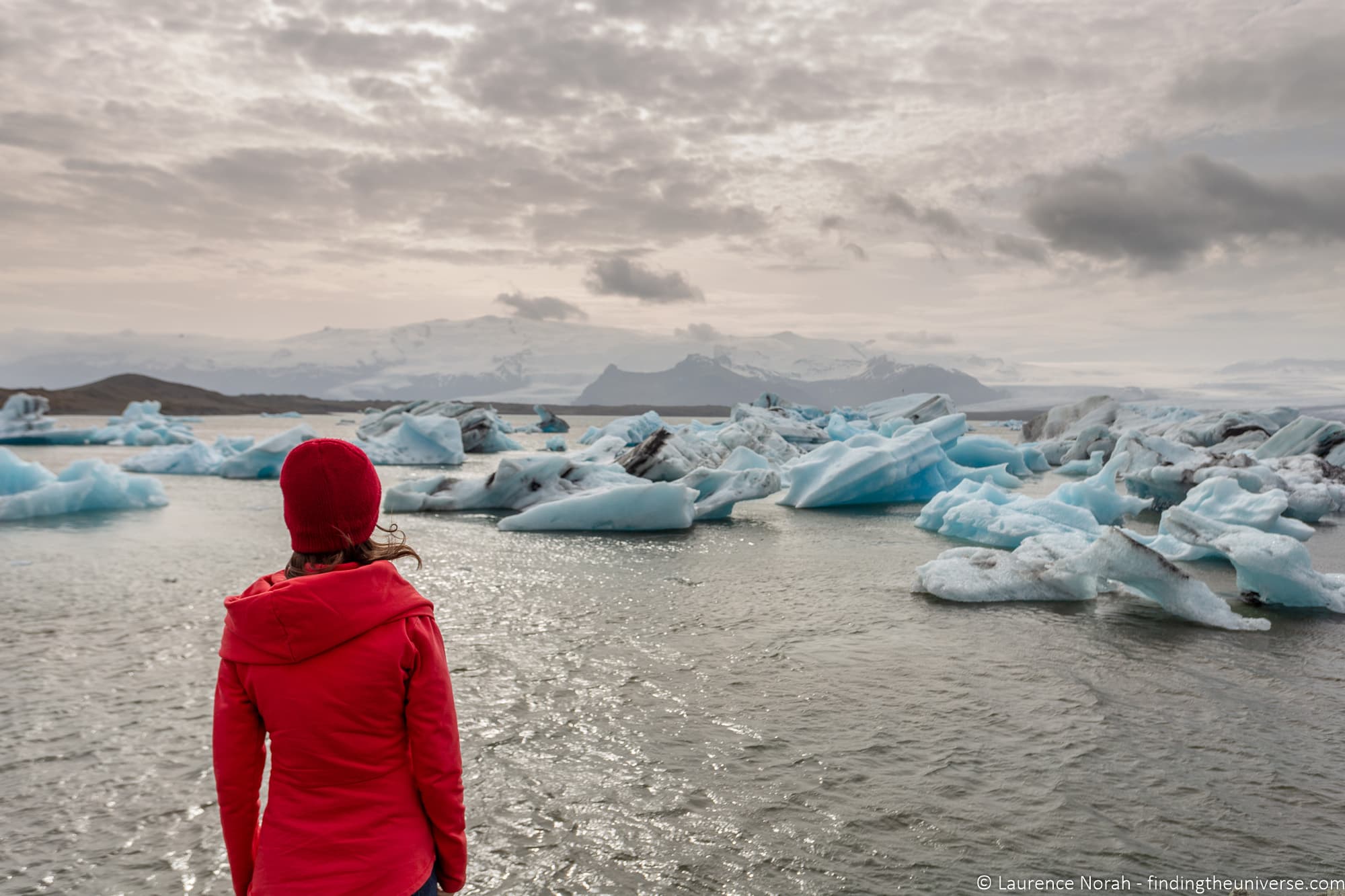
For your third day, you’re going to start at the Jökulsárlón glacier lagoon. This is a huge lagoon formed by run-off from the melting Breiðamerkurjökull glacier. It’s currently around 7 square miles in size, and is the deepest lake in Iceland.
The lake is filled with eerily blue icebergs, which break off the glacier and float around in the lake. After a long period of doing this, they become small enough to float out to sea, where many of them end up on the so-called Diamond Beach – named because all the washed up icebergs look like diamonds strewn across the sand.
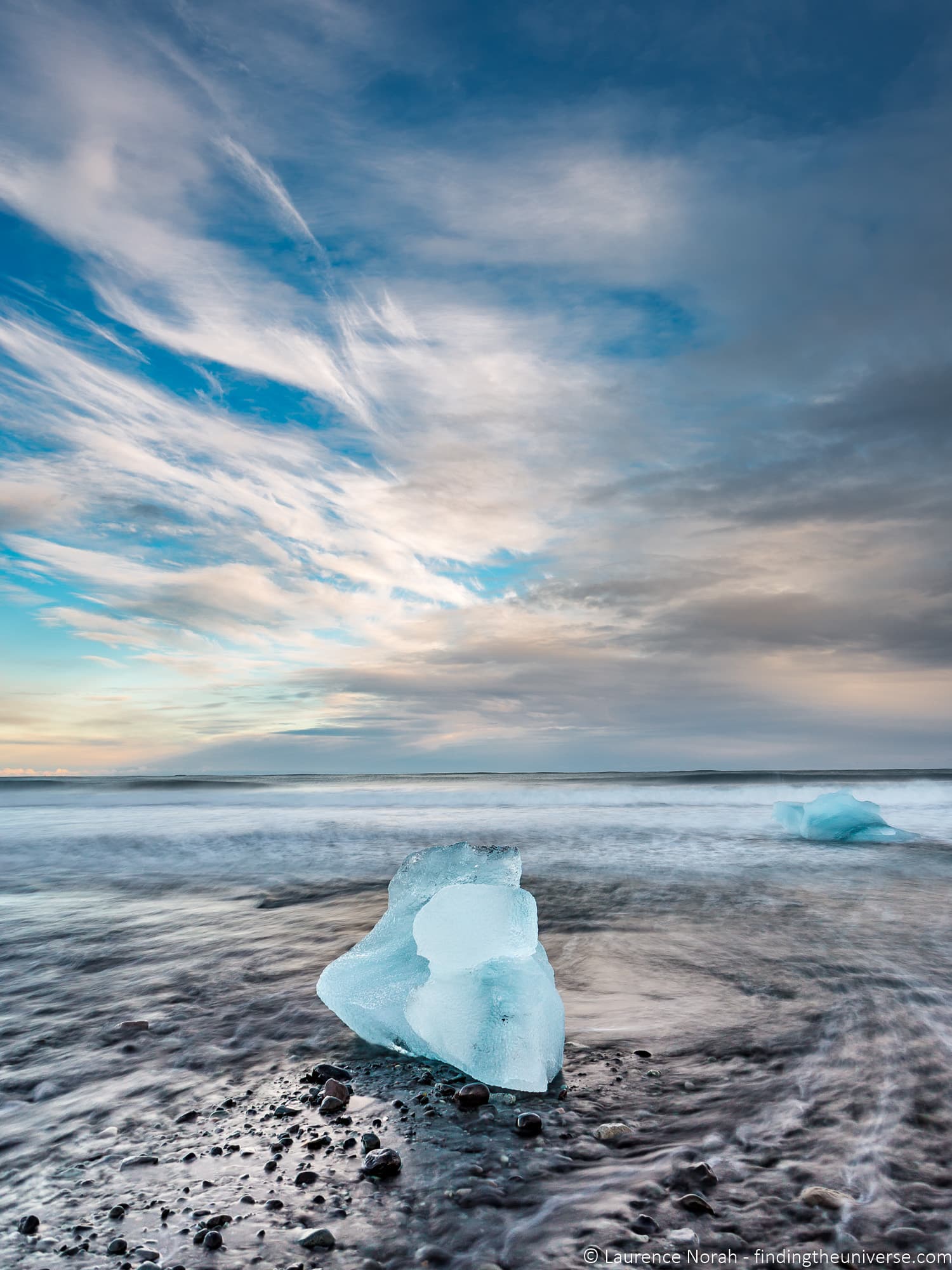
At Jökulsárlón you have a couple of options for activities depending on the time of year. In summer (May to October), you can take a boat tour on the lagoon, which gets you close to the glacier edge with a chance to see seals. The amphibian boat tours are the most popular option and typically last around 40 minutes. The lagoon has too much ice in winter for boat tours to operate.
In winter, you can do an ice cave tour instead, with departures from Jokulsarlon. These tours, which last around three hours, take you up onto Vatnajokull Glacier where an experienced guide will take you inside a beautiful ice cave. An ice cave tour is a popular activity, so definitely book this one in advance. Also be aware that it will take some time, so you might need to adjust the remainder of your days activities to accommodate it.
From Jokulsarlon, you’re going to start heading back to Reykjavik. However, there’s still lots to see on the way back.
The first stop is Svartifoss, or the black falls. These waterfalls are found in the Skaftafell areas of the Vatnajökull National Park.
Parking at Skaftafell costs 1,040 ISK via the Parka app. A useful tip: if you also park at Jökulsárlón or elsewhere in Vatnajökull National Park on the same day, you get a 50% discount at the second location. So visiting Jökulsárlón and Svartifoss on the same day (as this itinerary suggests) saves you money.
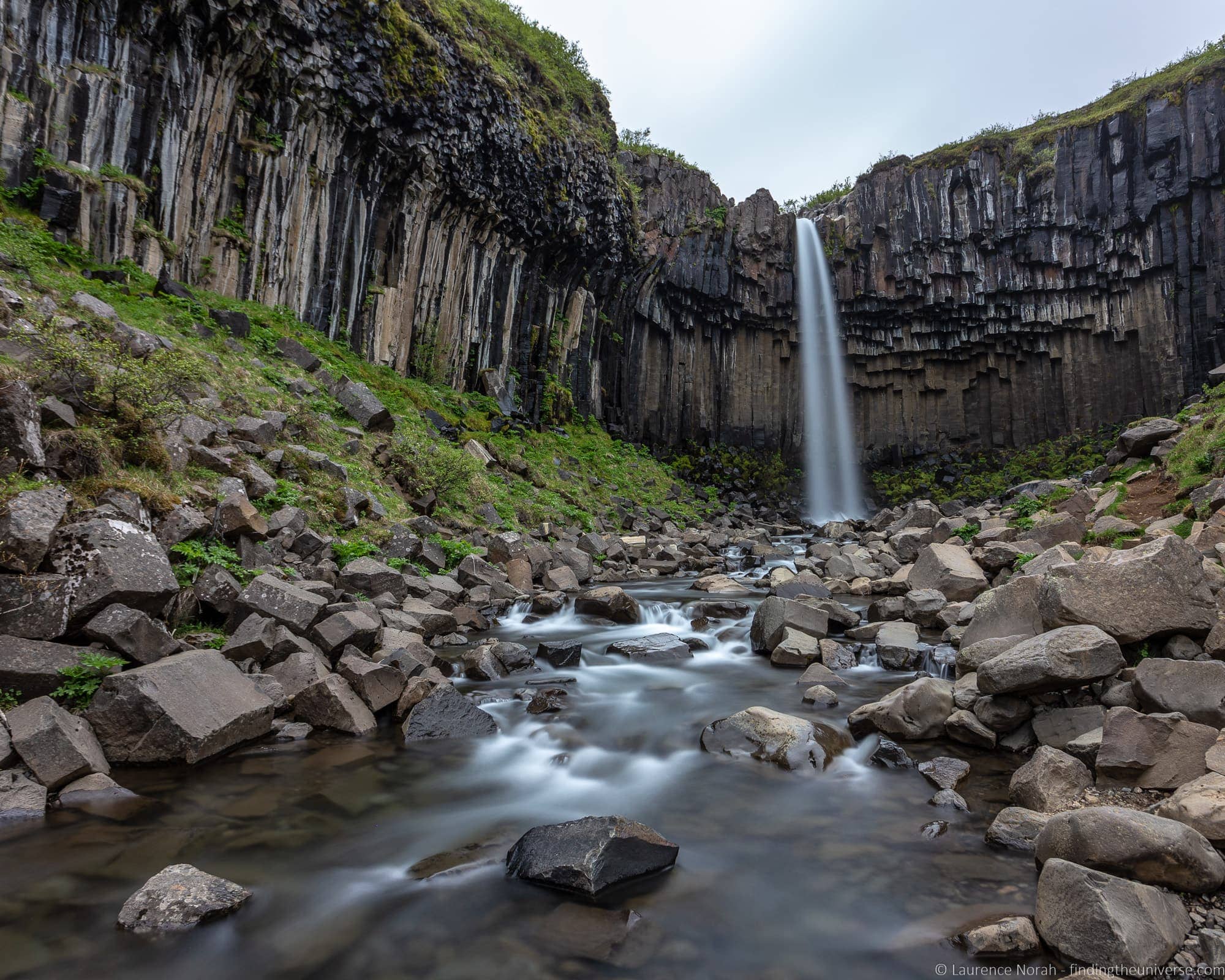
The hike up to the falls is fairly steep, and will take 50 – 90 minutes round trip, depending on your fitness levels. We think it’s worth it though, the water cascades of beautiful black basalt columns, and it’s certainly a unique look amongst the other waterfalls you’ll be seeing on this three day road trip!
Continuing along the south coast, our next stop is the DC-3 plane wreck. This is a popular stop off the Ring Road, with a hike leading you to the wreck of a DC-3 that crashed here some decades ago.
The walk out to the plane and back takes about 2 hours, and this is a very popular stop. It’s not for everyone, but if you do decide to head out here, make sure you are properly dressed and prepared for it.
See our full guide to finding the Iceland plane crash, so you know what to expect.
Again, this walk takes a bit of time, so make sure you consider this as part of your whole day and what else you want to see before committing to it.
Now as you head back, we have three options for what to do for the final part of your last day in Iceland: bathe in the Seljavallalaug swimming pool, visit the Blue Lagoon or Sky Lagoon, or explore Reykjavik, Iceland’s capital city.
The first option is Seljavallalaug swimming pool. Having done a bit of walking on your trip, we thought that maybe it was time for a dip in a free hot spring! Iceland has a wide range of geothermally heated pools around the country, which range from fairly pricey experiences like the Blue Lagoon, through to entirely free options.
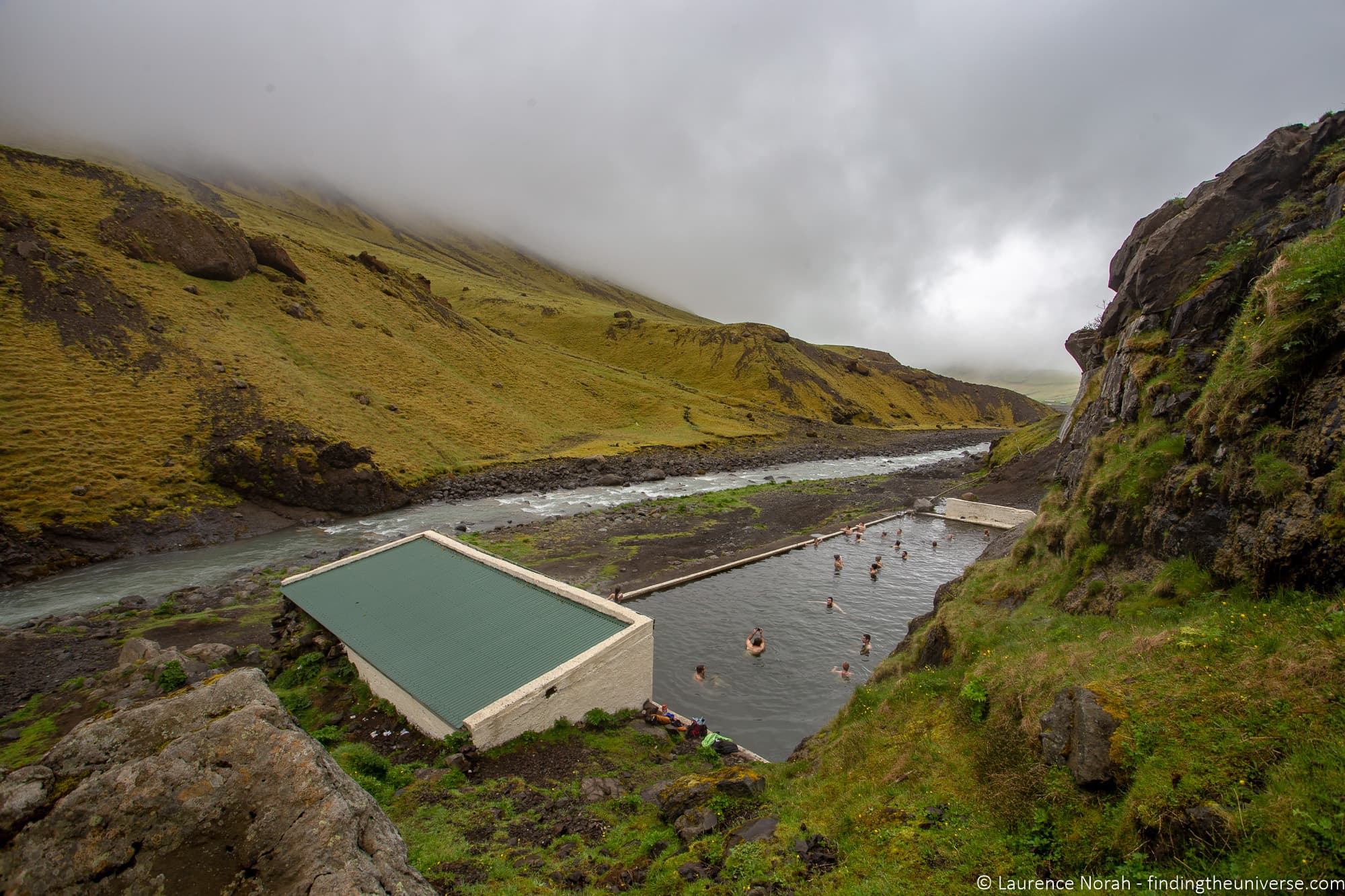
The Seljavallalaug Swimming Pool falls into the latter category. This 25 metre long 10 metre wide pool is about a fifteen minute walk from the parking lot (which you’ll find here on Google Maps), and there are changing rooms here so you can get in and out of your bathing clothes. We think visiting a geothermal pool whilst in Iceland is a must-do activity, and this is an excellent free option!
If you’d prefer a hot spring experience, you can head to the Blue Lagoon or Sky Lagoon instead of (or as well as) Seljavallalaug.
The Blue Lagoon is near Keflavik and is open until at least 8pm (hours vary by season, running as late as 11pm in summer). You’ll need to book well in advance as walk-ins aren’t accepted. One important note: the Blue Lagoon is located on the Reykjanes Peninsula, which has experienced a series of volcanic eruptions since late 2023 (the Sundhnúkur crater row).
The lagoon has remained open for the majority of this period and has strong safety protocols in place, but it has closed temporarily during some eruptions. We’d recommend booking refundable tickets and checking bluelagoon.com/seismic-activity and SafeTravel.is in the days before your visit.
The Sky Lagoon is closer to Reykjavik city and is a newer alternative. It’s been getting excellent reviews and isn’t affected by the volcanic activity on the Reykjanes Peninsula. It’s also open late and makes a great option if the Blue Lagoon situation is uncertain.
See our guide to visiting the Blue Lagoon for more detailed information.
A third option is to skip both pools, and head back to explore a bit of Reykjavik. We’d suggest checking out the beautiful Hallgrimskirkja, the Sun Voyager statue, and the pretty town center. This would also be a good opportunity to have a nice meal if your budget will stretch to it.
If you have a bit longer in town, and want to do some more sightseeing, consider a Reykjavik city card. A 24 hour card is good value and gets you free access to many of the city’s top attractions, as well as free public transport on the city bus services.
And that finishes off the last day of our 3 day Iceland road trip itinerary. Now let’s go over where to stay, followed by some more information to help you plan your trip.
Where to stay
You’ll be overnighting in Reykjavik tonight, or, if you have an evening flight, you can head straight to the airport. There are also some accommodation options closer to the airport if you have an early morning flight.
We’ve stayed at a number of hotels near the Reykjavik city centre which we are happy to recommend:
- Hotel Reykjavík Grand — around 1.2 miles from the city centre, offering four star accommodation, free wifi, spa and fitness centre, and free parking. We’ve stayed here.
- Berjaya Reykjavik Natura — near the city airport, this hotel offers free parking, a free city bus pass, on-site restaurant and spa facilities. Formerly the Icelandair Hotel Natura. We’ve stayed here.
- Guesthouse Galtafell — a good value option around ten minutes walk from the city centre and a quick walk from the BSI bus station. Offers both guest rooms and apartments with kitchenettes. We’ve stayed here.
- KEX Hostel — a well-located hostel in central Reykjavik with a great atmosphere, bar, and restaurant. A good social option for solo travellers or those on a budget.
If you’d prefer to stay near the airport, we’ve also stayed at the Northern Light Inn. This is conveniently located right next to the Blue Lagoon and is about a 17 minute drive from the airport (note the volcanic activity caveat above).
Travellers on more of a budget will like Start Hostel near Keflavik, which offers both private rooms and dorms, breakfast from 03:30 (handy for early flights), free parking, and a shared kitchen.
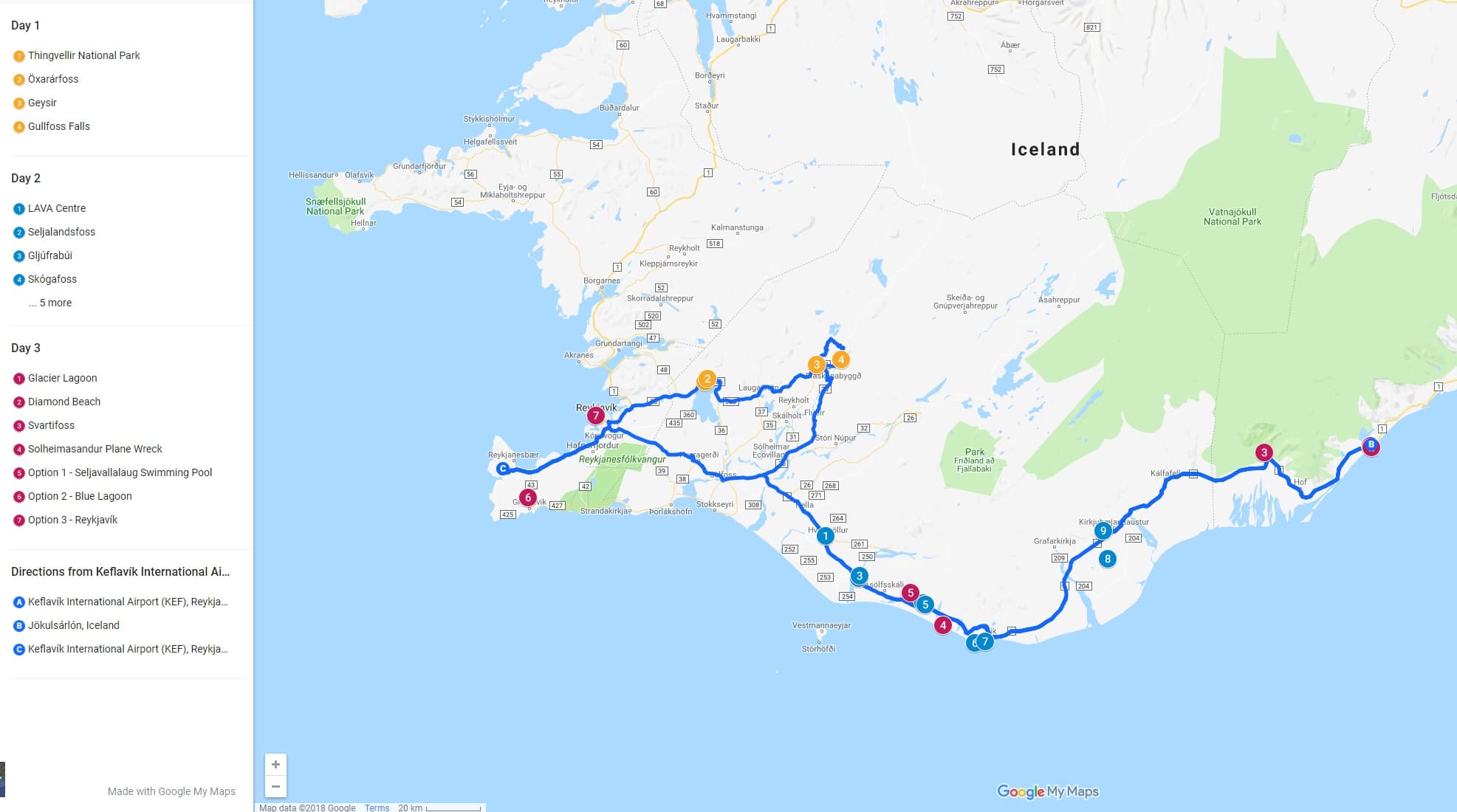
3 Day Iceland Itinerary Road Trip Map
To help you visualise this 3 day Iceland itinerary, we’ve put it into a map form, with the route and highlights marked. You can also see this on Google Maps here.
3 Days in Iceland: Overview Itinerary
Here’s a summary of our 3 day Iceland itinerary for quick reference.
- Day 1: Golden Circle. Thingvellir, Brúarfoss, Geysir, Friðheimar (lunch), Gullfoss, optional Kerið Crater
- Day 2: South Coast Highlights. Lava Centre, Seljalandsfoss and Gljúfrabúi, Skógafoss, Dyrhólaey, Reynisfjara black sand beach, Vík (lunch), Eldhraun lava field, Fjaðrárgljúfur Canyon
- Day 3: South Coast Highlights & Reykjavik. Jökulsárlón glacier lagoon, Diamond Beach, Svartifoss, optional DC-3 plane wreck, Seljavallalaug or Blue Lagoon/Sky Lagoon, Reykjavik
3 Days in Iceland Basing Yourself in Reykjavik
We appreciate that not everyone wants to drive in Iceland as car rental is relatively expensive and the various insurance options are fairly complicated to deal with (not to mention expensive!). Also those who are used to driving on the left side, may not feel comfortable driving on the right.
The good news is that it’s very possible to see the majority of the highlights from our 3 day self-drive itinerary by basing yourself in Reykjavik, and taking tours from the city. This also has the advantage that you can find somewhere to stay for three days, and not have to be packing or unpacking. You’ll also have time to explore the city, either on one of your days, or in the evenings.
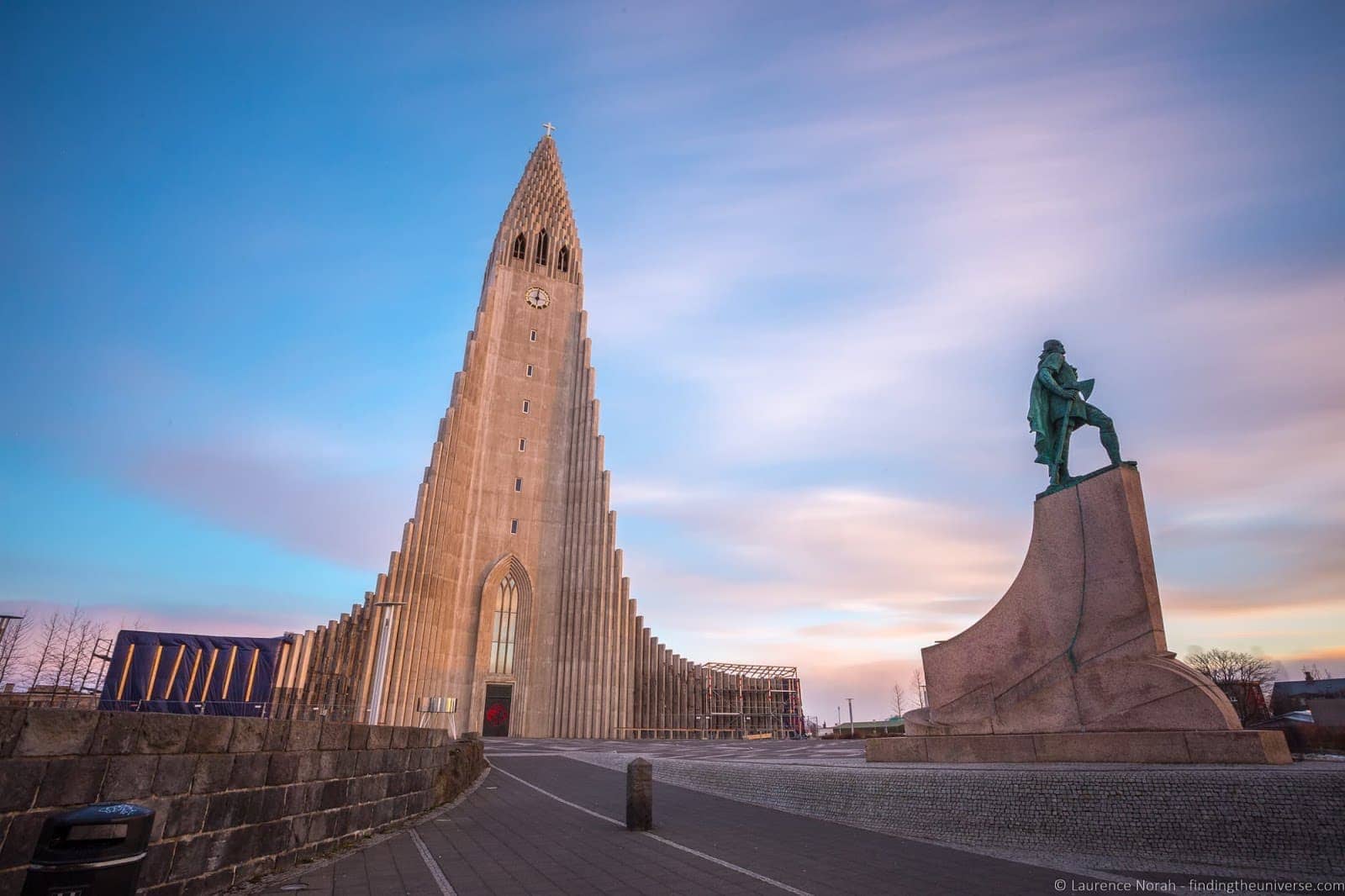
We have a detailed guide to the best day trips from Reykjavik, which we definitely recommend you take a look at. However, in summary, here’s our suggestion of which tours we think would be the best options for your 3 days.
A day trip to the Golden Circle.
The Golden Circle is relatively close to Reykjavik, and thus makes for a popular day trip. There are a wide range of operators offering Golden Circle day trips from Reykjavik, including:
- A Golden Circle tour that includes Kerið Crater, an 8 hour day trip covering all the main highlights plus the volcanic crater lake.
- A Golden Circle tour with Brúarfoss and Fontana Spa, which covers the Golden Circle highlights plus Brúarfoss waterfall and includes time at the Laugarvatn Fontana spa with a tasting of geothermally baked rye bread.
A day trip along Iceland’s South Coast
In our itinerary we suggest you take two days to visit Iceland’s south coast, however, it is also possible to do this as a long day trip from Reykjavik.
Whilst these don’t see absolutely everything, they do cover the major highlights, including the black sand beaches and the most popular waterfalls.
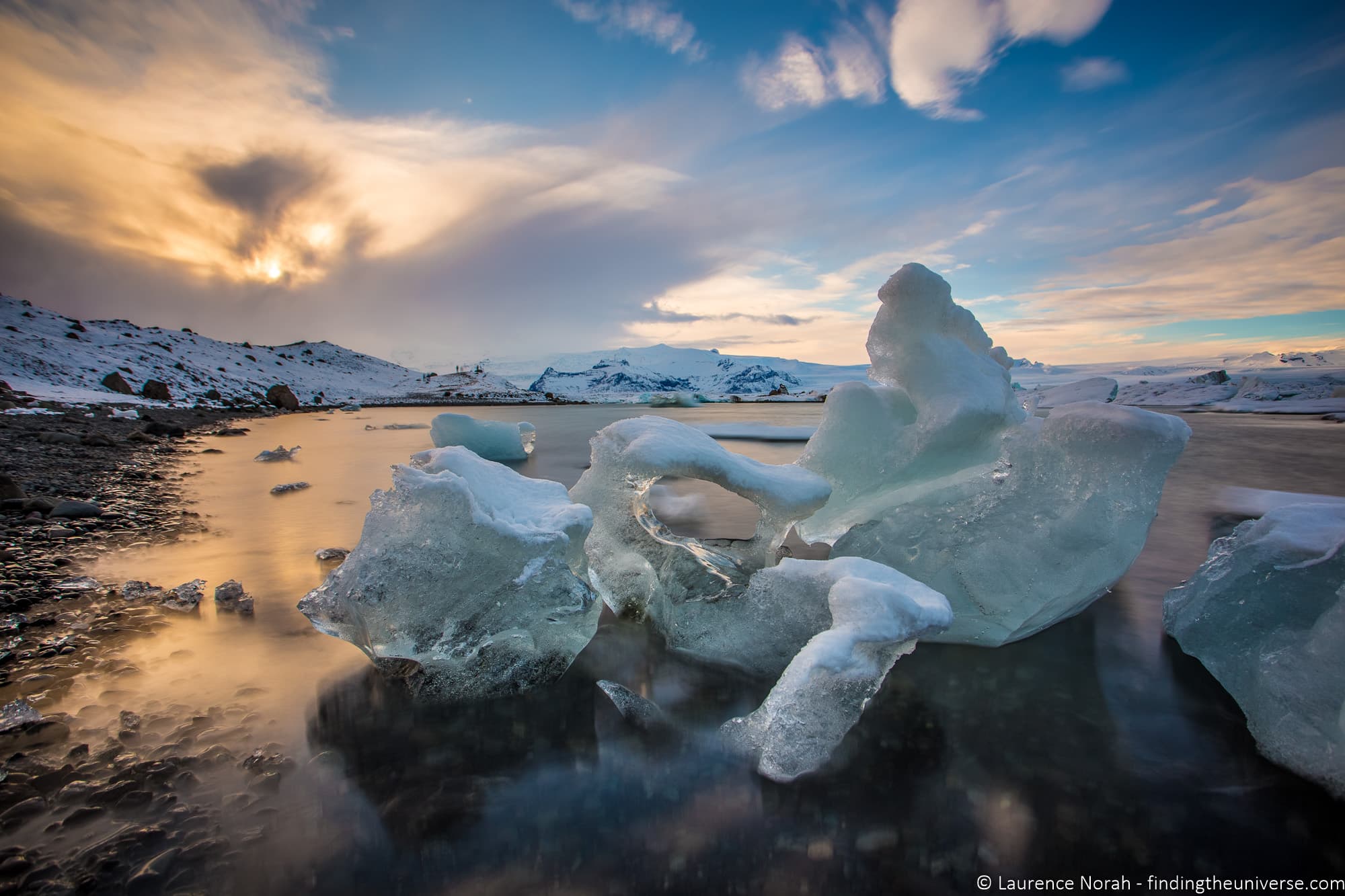
Some day tours also go as far as the Jökulsárlón glacier lagoon, although as this is a fairly long round trip from Reykjavik, those versions usually only run in the months of the year with longer daylight hours.
Here are some options to consider.
- The year round South Shore adventure tour. This tour takes around 10 hours, and covers all the highlights all the way out to Vik, including the main waterfalls and the black sand beach. This is a similar tour.
- A summer-only south shore tour that goes all the way to the Glacier Lagoon, and includes a boat ride on the lagoon. This is a long 14 hour long tour.
Snaefellsnes Peninsula
Whilst we haven’t included the Snaefellsnes Peninsula on our 3 day self drive itinerary, we did want to include it here as an option.
The Snaefellsnes Peninsula is around a two hour drive from Reykjavik, making it very accessible as a day trip. It has a number of attractions, including a massive glacier, the beautiful Kirkjufellsfoss waterfall, basalt columns, seal watching opportunities, the Shark Museum, and more!
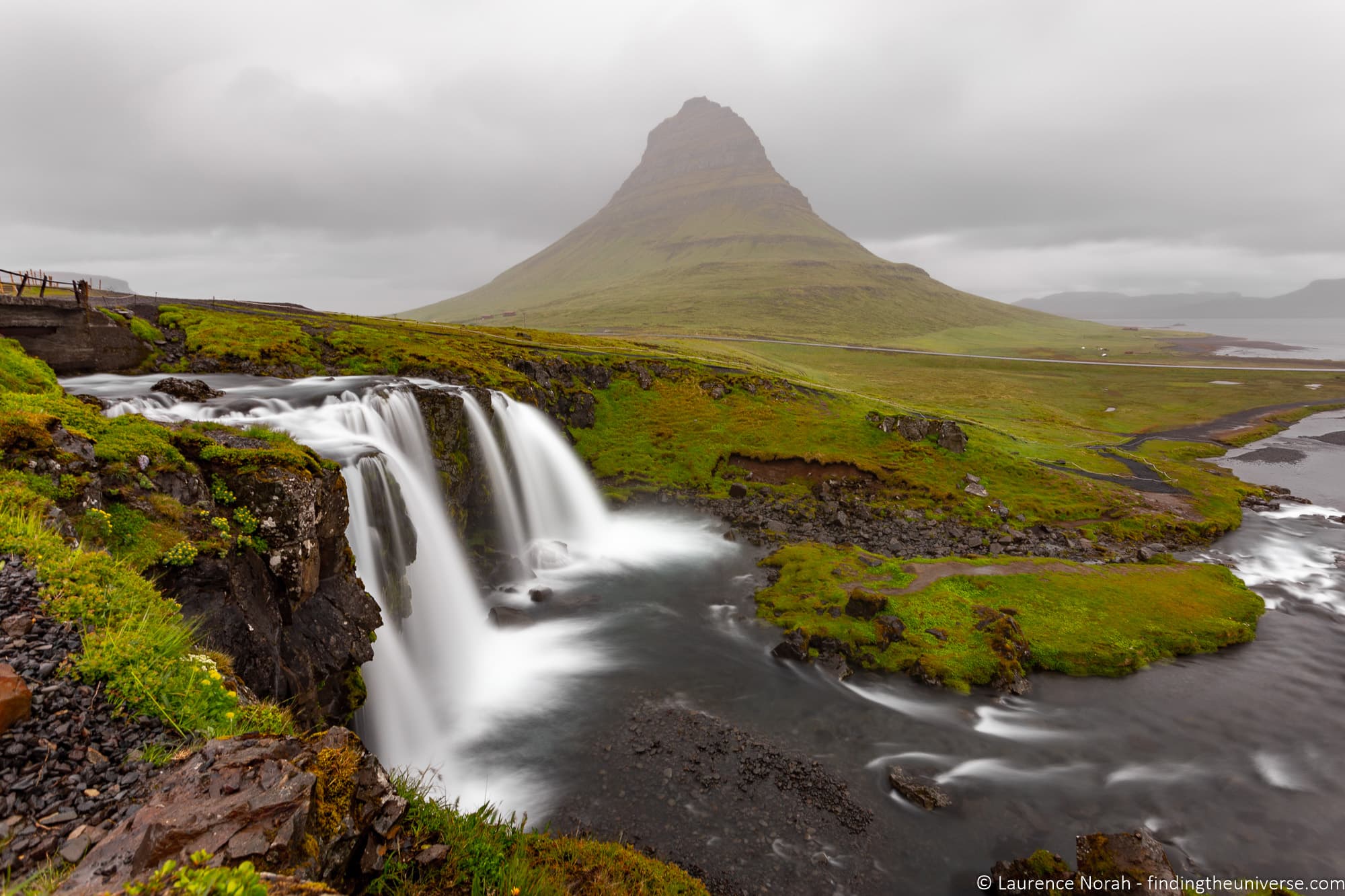
It makes for a great alternative to the Golden Circle or South Coast, and is a day trip we can highly recommend.
Take a look at this Snaefellsnes Peninsula small group tour as well as this tour to the Snaefellsnes Peninsula which includes a home cooked meal.
Northern Lights Viewing from Reykjavik
If you’re visiting Iceland in winter, you absolutely must try and see the northern lights. This magical display in the sky is an unforgettable sight, and one that is high on visitors wishlists when coming to Iceland. See our guide to how to photograph the northern lights for some tips on getting great shots.
Being based in Reykjavik will mean that the city lights will get in the way of good viewing opportunities, but the good news is that there are multiple tours available, at a wide range of price points. Many also offer a guarantee that if you don’t see the lights, you can take another tour, so we suggest booking one of these tours for one of your first nights in Iceland.
There are a lot of tours to consider. Some we suggest you include in your shortlist are this small group tour, this well reviewed and good value coach option or this private super jeep tour.
For more ideas don’t forget to check out our guide to the best day trips from Reykjavik!
3 Days in Iceland as a Group Tour
If you don’t want to drive, but also don’t want to base yourself in the city, we’ve got another option – take a group tour!
We’ve put together a detailed guide to a number of guided tours of Iceland, which range from a couple of days to a couple of weeks and more, but we wanted to share a few of our favourite shorter options here for you to consider.
- This 2 night / 3 day tour includes the Golden Circle, five waterfalls, amphibian boat ride on the glacier lagoon and a glacier hike. It also includes free WiFi on the bus.
- This 2 night / 3 day tour includes the Golden circle, an ice cave, glacier lagoon and black sand beach. Free WiFi is also included.
- A 1 night / 2 day tour that focuses on the south coast. This tour includes the famous black sand beach at Reynisfjara and goes all the way to the incredible Jokulsarlon glacier lagoon. It also includes ice caving and northern lights watching. This shorter tour would be a great option to combine with a night in Reykjavik, where you could take in some of the city’s sights, or head out to the Blue Lagoon, or even take a day trip to the Golden Circle.
See more tour options on GetYourGuide here, TourRadar here, and Viator here.
When to Visit Iceland
Iceland has very distinct seasons, and visiting at different times of year will give you very different experiences. We’ve visited in both summer and winter, and loved them both, but you should definitely be aware of the differences as they will affect your planning and what you can see.
In Winter, or at least, the period from October through to March, temperatures will be colder and the days shorter. In December and January in particular the days will be very short, which will impact your sight-seeing. If you are visiting in these two months, you will want to adjust your daily itinerary as you won’t be able to see as much given the fewer hours of daylight.
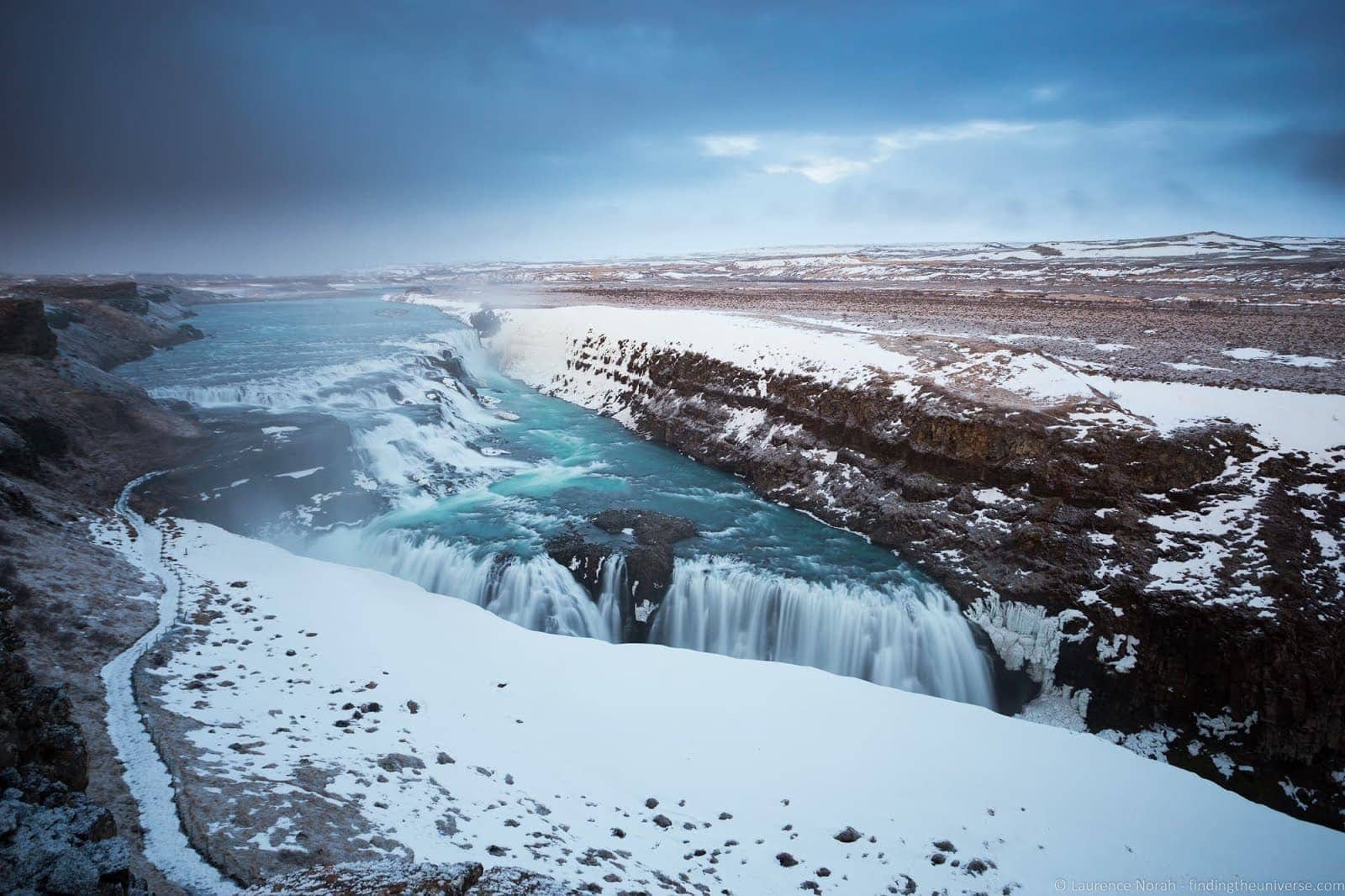
Winter is however the best time of year for a number of popular activities. If you want to see the Northern Lights for example, you’ll have to visit in winter, as this is when they are active. The best months are usually September / October and February / March.
In winter you can also go ice caving, skiing, and take part in many more winter activities such as these. However, the weather will definitely be colder, and snow is likely. You’ll want to read up on our guide to what to pack for Iceland in winter, and if you choose to drive, our guide to driving in Iceland in winter.
The months between March and October are the more “summery” time of year. Whilst it won’t ever be a tropical destination, and you’re still going to want to bring warm clothes, there is a much greater chance of sunshine and temperatures around 20C are not uncommon. This time of year, and especially from June to August, there is a great deal of daylight available, so you can sightsee for much longer on each day.
The summer is a much busier time of year in Iceland, so there will be more people. Prices will also be higher, and accommodation might be harder to come by. We recommend booking everything in advance and checking out our Iceland budget tips.
One special event to note: on 12 August 2026, a total solar eclipse will be visible from Iceland. This is likely to drive significant demand for accommodation and tours during the summer 2026 season, so if you’re planning a trip around that time, book everything well in advance.
To be honest, we don’t think there’s a bad time of year to visit Iceland, as long as you are prepared and know what to expect you will have a great experience!
Where to Stay in Iceland
Iceland has a variety of accommodations options, from self catered apartments through to hostels and hotels. Prices vary, but Iceland is far from a budget destination, so expect prices to be relatively high even for hostels.
For the self-drive trip we’ve included links to some recommended hotels on each day. If you choose to base yourself in Reykjavik, check out our recommended options under day 3 of the trip, plus you can check out more options in Reykjavik on booking.com here.
We usually recommend Booking.com as they have pretty much everything from hostels to hotels to apartments, and they offer very competitive pricing and usually a great cancellation policy.
Practicalities for Visiting Iceland
To help you plan your Iceland trip, we’ve put together some information that we think you will find helpful. We also suggest you read our detailed guide to planning a trip to Iceland, which has loads more practical information.
Driving
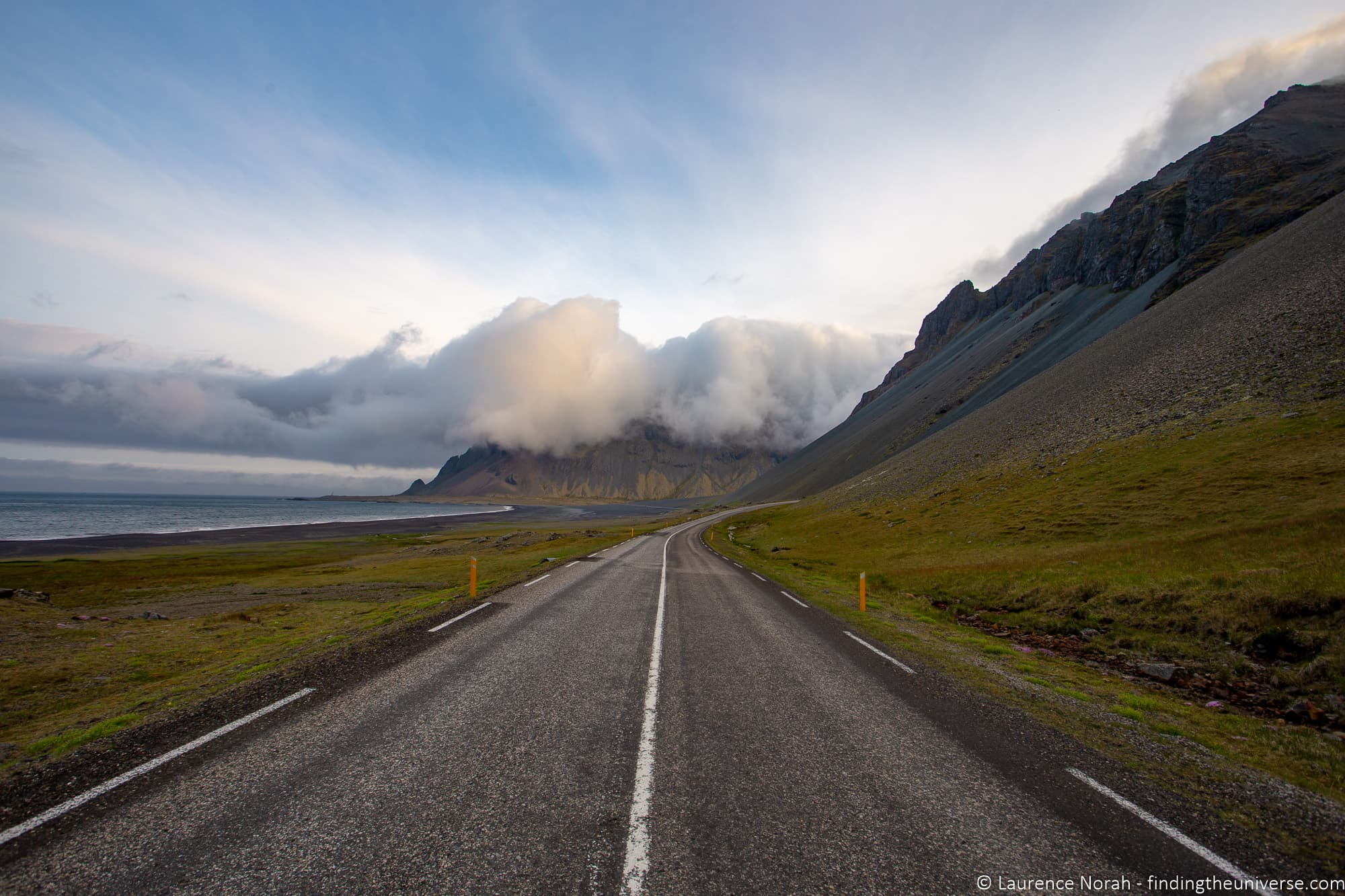
Driving in Iceland isn’t too difficult. The roads are well maintained and not too busy, and for the 3 day road trip we suggest, 99% of the driving is on paved roads. There will be some short sections of unpaved road (such as those leading to Seljavallalaug), but these are very short and fine in a standard two-wheel drive car.
Winter conditions can be more challenging, with snow and ice common. Check road.is for real-time road conditions before setting out each day.
As mentioned in our Practical Tips section, fuel currently costs around 185 to 230 ISK per litre, and car rental companies now add a per-kilometre road tax of 6.95 ISK/km to your final bill.
We have lots more information about driving in Iceland – see our guide to things to know before you drive in Iceland, as well as our guide to driving in Iceland in winter for lots of helpful advice, tips on renting a car, the right insurance for you, and more resources.
Electricity / Power
Like Europe and much of the world, Iceland uses a 220v system. It uses two pin plugs as you would find in much of Europe. If you are coming from the UK, the USA, or anywhere else that has a different shaped plug system, you will need a travel adaptor like this.
See more on travel adapters and how to choose one for your trip in our guide to the best travel adapters.
If you have a few devices, we also suggest you pick up a travel power strip so you can charge everything.
If you are coming from the USA or Canada (and several other countries with 120 V systems), you also need to be aware that the voltage in Iceland is different, so you’ll need to check your devices are compatible. Devices will have their voltage compatibility written on the power adaptor in most cases.
In our experiences, low power electronics like laptops, battery chargers and smartphones support a range of voltages, whilst higher power equipment like hair dryers, curling irons, and hair straighteners will not, unless they are travel specific dual voltage models. If you need one – check out dual voltage appliances such as this travel hairdryer.
Cost of Travel in Iceland
Iceland is definitely one of the more expensive countries to travel in. Everything from accommodation to car rental to food is relatively expensive, and there is definitely the potential for price shock if you visit unprepared for this fact.
Our suggestion if you want to visit Iceland on a budget is to plan ahead as to how to achieve this. Travelling as a group, booking low cost accommodation, going grocery shopping, and avoiding expensive restaurants are some tips – for more, check out our detailed guide to visiting Iceland on a budget.
Internet Access
See our tips on getting online in the Practical Tips section above, including our recommendation for eSIM data plans.
Safety
Our final point is safety. Iceland is rated as one of the safest countries in the world to travel in, but this doesn’t mean you should be complacent. In particular, petty crime has started to rise, so you will always want to be vigilant with your belongings, and don’t leave anything on view in your car when you park it. Otherwise, practice basic safety precautions and be sensible, and you should be fine.
The greatest dangers are usually presented by the landscape and changeable weather rather than other people, so if you just use common sense and don’t put yourself in any unsafe situations, you should be fine!
Frequently Asked Questions
Is 3 days enough for Iceland?
Three full days is enough to see the Golden Circle, the major south coast waterfalls, black sand beaches, and the Jökulsárlón glacier lagoon. You won’t cover the whole island, but you’ll experience the highlights that make Iceland special. If you can stretch to five days, our 5 day Iceland itinerary covers significantly more ground.
Do I need a 4×4 for 3 days in Iceland?
For this itinerary, no. The route follows Route 1 (the Ring Road) and paved secondary roads. A standard two-wheel drive car is fine for all the stops we recommend. A 4×4 is only necessary if you plan to drive highland F-roads, which this itinerary doesn’t include. In winter, a 4×4 can give you extra confidence on icy roads, but it’s not essential.
How much does 3 days in Iceland cost?
Iceland is an expensive destination. For two people on a moderate budget, expect to spend around 4,000 to 6,000 ISK on parking fees across the three days, plus car rental (prices vary hugely by season, but budget 15,000 to 30,000 ISK per day), accommodation (typically 20,000 to 50,000 ISK per night for a double room), and fuel. Food is also expensive, with a restaurant meal typically costing 3,000 to 5,000 ISK per person. See our Iceland budget tips for ways to reduce costs.
What is the best time of year for 3 days in Iceland?
This itinerary works year-round, but the experience differs significantly by season. Summer (June to August) gives you near-endless daylight and the best weather, but it’s also the busiest and most expensive time. Winter (November to February) brings the northern lights and ice caves, but daylight can be as short as four to five hours in December and January, so you’ll need to adjust the itinerary. The shoulder months of May, September, and October often give the best balance of decent weather, reasonable prices, and fewer crowds.
Can I do this itinerary without a car?
Yes. We’ve included a section in this guide on doing the same highlights as day tours from Reykjavik. The Golden Circle and south coast are both available as guided day trips, and there are multi-day group tours that cover the glacier lagoon as well. You’ll see slightly less than on a self-drive trip, but it’s a great option if you don’t want to deal with car rental and winter driving.
Is the Blue Lagoon safe to visit with the volcanic eruptions?
The Blue Lagoon has remained open for the majority of the Reykjanes Peninsula eruption series (2023 onwards) and has strong evacuation protocols. However, it has temporarily closed during some eruptions, sometimes at very short notice. We recommend booking refundable tickets and checking the Blue Lagoon’s own status page and SafeTravel.is before your visit. Sky Lagoon, which is closer to Reykjavik, is an excellent alternative that isn’t affected by the volcanic activity.
Further Reading
And that’s the end of our guide to spending 3 days in Iceland on a stopover! However, we have more content to help you plan your trip, based on our travels in Iceland.
- If you are looking for more road trip ideas of different lengths, we have a detailed 1 week Iceland Ring Road itinerary, a 7 day winter Iceland itinerary and a 5 day Iceland itinerary.
- We have an introductory guide to help you plan a trip to Iceland
- We have a detailed guide to driving in Iceland in winter, as well as a general guide to driving in Iceland.
- We’ve created a list of some of our favourite photography locations in Iceland to help you get awesome photos
- We have a guide to finding the Iceland Plane crash, which is a fun photography location
- We have a complete guide to visiting the Golden Circle, which has a map, suggested itinerary, and more.
- If you’re visiting Iceland in Winter, check out our guide to the best winter activities in Iceland and my tips for cold weather photography
- On a budget? Here’s a guide to visiting Iceland on a budget to help you make the most of your trip
- We have a detailed review of Airalo eSIM for staying connected while travelling
- We have a detailed packing guide to help you decide what to pack for Iceland
- We have a guide to visiting the Blue Lagoon
- We’ve also got a guide to the best day trips from Reykjavik should you wish to base yourself in the capital rather than self-drive around, as well as a guide to the best guided tours in Iceland
- The weather in Iceland can be fickle – the best website for real-time cloud cover is this one from the Icelandic Met Office.
- Whilst Iceland is a safe country to travel in when it comes to things like crime, the country itself is home to extreme conditions and all sorts of seismic activity. So to stay safe as you go, check out the Safetravel Iceland page
- We have a guide to how to photograph the northern lights if you are lucky enough to see this wonderful phenomenon.
- Finally, if you’re not sure what camera gear to take with, take a look at both our guide to picking a travel camera, picking a travel lens, travel tripods, and our personal travel photography gear
And that’s it! If you’ve got any questions or feedback on the above, just let us know in the comments below, and have an awesome trip in Iceland!
Judith Greco says
Hello,Our family is planning a trip to Iceland. We will land in KEF and begin our trip around the Circle. However ,one member needs to return back to the US after 3 days.By that time we should be driving and on our way to the Diamond beach. Is there any form of transportation that our family member could return back to KEF ( ie uber, plane or other form of transportation) to return back to airport >
Laurence Norah says
Hi Judith,
So there aren’t going to be Ubers (these don’t exist in Iceland) and I’m not aware of any flight options. There are public buses that run along the south coast from places like Vik, but they’d need to change in Reykjavik. The other option would be to arrange a private transfer from somewhere on your route, which might be your best option. I’d probably advise talking to your accommodation provider for the location they will be departing from, they should be able to offer some options.
Have a great time in Iceland!
Laurence
Cheryl says
Hi
Enjoyed your blog! Planning a three and a half day girls trip next month. Looking at an airbnb Austurbyggð 3, Laugarás, 801 Selfoss, Is that a good location. Planning to rent a car.
Would love to squeeze in as much as possible. The Blue Lagoon, Glacier, Waterfalls, Ice cave, Volcano bread, tomato farm and of course hoping to see the northern lights.
Any thoughts on where we should start – or really any advice at all –
Thanks so much!
Cheryl
Laurence Norah says
Hey Cheryl!
Glad to be of help 🙂 So that location will definitely be great for the Golden Circle, and you would be able to get to the majority of the other attractions on your list if you don’t mind driving a bit.
I would recommend visiting the Blue Lagoon either when you arrive into Iceland or when you depart as it is so close to the airport. After that most of the types of attractions you want to see are accessible from the Golden Circle.
I would say for an ice cave the nearest best option will be to go to Katla, there are a few operators which run ice cave tours with departure from Vik such as this one or this one.
There are some good waterfalls you will pass as you go to Vik, plus the Black Sand beach at Vik is definitely worth the visit.
Let me know if I can offer any more help, and have a great time in Iceland!
Laurence
Stella says
Hi there! We’re flying into Iceland at 1pm on Friday the 3rd February and we plan to rent a car for 3 days. We dont fly in till 1:20pm. Would you have any advice on where to go when we arrive? We were thinking of staying around Hella on the first night. Would we have time to do some highlights of the golden circle on day one or would we be better off leaving that till monday on the way back when we have more time. Is there any other route that might suit us better? Thanks so much!
Laurence Norah says
Hi Stella!
So it would depend on which order you plan to sightsee. If you are planning on doing the south coast first and the golden circle on the way back, then it would not make too much sense to deviate to the Golden Circle on the way. If you planned on visiting a hot spring in Iceland, your first day might be an option. You could for example visit the Blue Lagoon on arrival as it’s by the airport. If you did the Golden Circle first you might have time to squeeze in Thingvellir on day 1 and then complete the rest of the circuit on your second day, but that would depend of course on how quickly you got through passport control and collect your hire car. It’s normally fairly quick, but you might not want to feel rushed. I hope this helps, let me know if you have any more questions!
Laurence
Chris says
Hi,
I’m interested to follow your 3-days trip. My flight will arrive early morning, I have 3 full days, depart early morning. I’d like to spent a half day in Rejkavik city. With so many interesting places, I am afraid can not make it to spend the time to explore Rejkavik. The South Coast (Diamond Beach) takes 4-5 hours drive to Rejkavik, plus stopping more places. Any idea which should I skip.
You did not mention Kerid crater. Is it worth to see?
Thanks
Laurence Norah says
Hi Chris!
Great to hear from you. So it’s always tricky to advise what to skip because a lot of this comes down to personal preference. Some people really want to see waterfalls, whereas otherwise might prefer a hike or visiting hot springs. Kerid Crater is certainly interesting and worth visiting, but then, so are many other attractions. My recommendation would be to visit a hot spring, do the Golden Circle, and visit the major waterfalls on the south coast. If I was you, I would list the things I really want to see and then decide what else you can fit in as well.
I hope this helps. Have a great trip to Iceland!
Laurence
Barbara says
My son, his wife, and I are going to Iceland at the end of September (start of a European trip) or the middle of October (end of said trip). I love your 3 day itinerary but would love to add a mountain biking experience for my son, an avid and experienced mountain biker. When and where could that be worked into our visit? Really looking forward to our trip. Your Iceland guide is amazing!
Laurence Norah says
Hi Barbara,
Thanks very much. It sounds like you have a great trip planned! So I don’t have personal experience of mountain biking in Iceland, but there are a number of companies offering a mountain biking experience in the country. You can see a good selection here to choose from. A number of these are on the south coast or around the Reykjavik area, so you should be able to find something that lines up with our itinerary 🙂
Have a great trip!
Laurence
Stephanie says
Hello! Thank you for this itniery. My fiancé and I are planning on using this as part of our honeymoon planning. I am wondering, for day 3, the drive from Svartifoss to the Blue Lagoon is 5 hours long. Are there any good sights along the way?
Laurence Norah says
Hi Stephanie,
It’s my pleasure. So you are going to be largely retracing your steps on this part of the route, back along the south coast. So there are sights for sure, but you will likely already have stopped to see them. The main difference is after Selfoss, where you will drop down to Eyrardakki and then along the Reykjanes peninsula. So that will be new. Strandarkirkja has a nice historic church, and there are some other sights you can take in like the Seltun Geothermal area. However, as most folks want to experience the blue lagoon for a while, we wouldn’t advise planning too many stops as it’s quite a long drive already.
Have a great time in Iceland!
Laurence
Veronica says
Hello,
thank you for the very informational guide for Iceland.
I was just wondering if it is possible to do the journey in reverse, meaning visit the golden circle area on the last day. Our flight out of Reykjavik is in the morning the next day, so I suppose we will have ample time to drive to the airport.
Is there any reason why all the guides start with Thingvellir and the Golden Circle first?
Laurence Norah says
Hi Veronica,
You can absolutely do this journey in either direction. I chose to layout the itinerary this way so you have more driving towards the end, as you finish up the trip, but you can start off with the longer drive along the south coast of course. Oftentimes after a flight folks don’t necessarily want to do a long drive and instead want to get straight into the sight seeing, which is likely why the Golden Circle is the normal first point of call, but you should always adjust any itinerary to suit you 🙂
Have a great time in Iceland, let me know if you have any more questions!
Laurence
Rebecca says
Just booked our flights & hotel stay in Reykjavik and came across your blog! Wow amazing! I’m abit clueless on what to book when and would love a little help! We’re planning on just booking the tours from Reykjavik and ticking off most the tourist tours, golden circle, northern lights, blue lagoon etc. any help on when to book what?
We land at 9am Iceland time on Thursday and return 9am Sunday morning. So 3 full ish days! What and when to make to most of it all? Thankyou so much
Laurence Norah says
Hey Rebecca!
That sounds awesome! So if you have your hotel and flights booked you are most of the way there 🙂
So my recommendation would probably be as follows:
Thursday – go to the Blue Lagoon on the way from the airport (it’s right by the airport), then head into town. You can book a shuttle bus transfer from the airport here, and also on to Reykjavik afterwards. You can book your Blue Lagoon entry on the official site here.
I’d then probably advise spending your afternoon exploring Reykjavik, and perhaps doing a northern lights tour like this that evening. The advantage of booking a northern lights tour earlier in your trip is that if it’s cancelled due to bad weather most operators will allow you to go on another night.
On your second day, so the Friday, I’d suggest doing the Golden Circle. That will be most of a day and there are a few tour options, such as this one.
Finally, on the Saturday, you can do this full day south coast tour all the way out to the Glacial Lagoon. That is going to be a long day and a lot of driving, but it covers the main highlights. I checked the availability and it only runs on the Saturday. There’s also a shorter tour here which runs every day, but doesn’t get all the way out to the glacier lagoon.
Now, of course, you could do all the above by renting a car and driving yourself. If you did that then I’d follow my itinerary and stop somewhere around Vik. However, as you have a hotel already, I’d definitely do it as a tour to save yourself the drive.
Let me know if you have any questions, happy to help. Have an amazing time in Iceland!
Laurence
Maya Rao says
What a wonderful site with such detailed information, thank you so much for doing this! It makes planning so simple and enjoyable. We are planning a 3 day stopover in Iceland in September and look forward to following your 3-day itinerary as much as we can. I realized after booking our tickets that northern lights will be visible at the time (would have planned a longer stay had I known earlier!) and would love to include that in our trip. As per your suggestion, I booked hotels in Fludir, Skogar and Reykjavik for each of the three nights we are there (in addition to 2 nights near the a/p), Which of these places would you recommend for viewing the northern lights? Also, can we just drive around and look for the lights ourselves or do you recommend joining a tour? If we select a tour, I prefer to do it earlier in the trip so we have a fallback in case of cloudy skies.
Laurence Norah says
Hi Maya,
Thanks very much! So the northern lights are definitely fickle. You need a combination of solar flare activity and clear skies where you are to see them. For the best experience you also would want to be away from the city lights, although if there is a very strong display you will still be able to see them even with some light sources.
That said, your best chances are going to be in Fludir and Skogar where there is much less ambient light. In Reyjkavik you would want to travel a little outside the city to get more optimal conditions.
You can absolutely just head out in your own vehicle to see them. A tour is popular with folks in Reyjkavik as it gets you out of the city which is handy as not everyone has transport when in the city. The guides usually know good locations away from the city lights. But they aren’t too hard to find yourself. The main tip I suggest is to find an app for your phone that gives you alerts for the northern lights in your area. There are quite a few options including many free options that will do this, and it can save you missing a display.
Let me know if you have any additional questions, I’m happy to help!
Laurence
margie cole says
I am so excited to try this! we are going the end of January. Couple fo questions if you dont mind. 1. what is the best website for mapping things out with many stops and addresses?
2. If we wanted to go snowmobiling and glacier hiking where in the trip does it fit in and can you recommend a tour operator? LOVE your blog!!!
Laurence Norah says
Hi Margie!
Great to hear from you and thanks very much.
So for mapping things out I always just use Google Maps. There are two options. The easiest, and what I normally do on trips is to just use the list feature. If you click on any attraction / hotel on Google Maps you should have the option to save it to a list, and then a set of lists will pop up. I normally just use a combination of the stars, favourites and places to go, which put yellow stars, hearts and green flags on the map. For example, I might use green flags for attractions and hearts for accommodation.
The only thing you can’t do is save routes that way. If you want a map with routes, like I have in this guide, you need to use Google My Maps. It’s definitely best used from a computer in my experience.
For the snowmobiling, I assume you are planning to drive yourself? There are a few tours from Reykjavik, but they usually include the Golden Circle as well. If you have your own car, it makes more sense to add it in somewhere on the journey. For example, you can do it from Gulfoss on the Golden Circle day.
For the glacier hike, the easiest option is during the south coast part, from somewhere like Jokulsarlon on a tour like this. However there are quite a few options to choose from, you can see a selection here. We don’t have a preferred operator, we’d usually recommend picking a tour with good recent reviews at a price point that works for you 🙂
Let me know if you have any more questions, and have a great time in Iceland!
Laurence
Zack says
Thank you so much for this wonderful itinerary, it definitely inspired us to go to Iceland to see it for ourselves! We are planning on making this trip in January as that’s when we found the best flight deals; however, I noticed in your article you mentioned that due to the limited daylight hours, some activities will have to be cut. I was wondering if you had any advice or had another article for a 3-day itinerary in January to maximize the daylight hours while still having activities when it is dark? Thank you so much!
Laurence Norah says
Hi Zack,
Thanks! So it will depend on when you visit in January as the day length varies dramatically. On the 1st January for example you’re looking at 4 hours and 24 minutes of daylight, but by the 31st it’s a more reasonable 7 hours. In addition, there are quite lengthy dawn and dusk periods, so it’s not totally dark.
In terms of the itinerary, I’d look at trying to rearrange some of the attractions for which daylight isn’t so necessary. For example, the Blue Lagoon is open until 9pm, so you can definitely do that later at night. To save time, you might also want to skip some of the internal sights like the museums, and focus on the outdoor attractions.
I hope this helps. I don’t have another itinerary, but this should give you some idea of what is possible. Have a great trip!
Laurence
Danny B says
I cannot thank you enough for this guide and itinerary! My wife and I spent 3.5 days in Iceland and followed this almost exactly, we even printed your page out and read your synopsis of each site on the way! We had a blast and really felt we got to see everything important in that short time. The only time crunch we felt was on the third day, it’s a long drive from the glacier lagoon all the way to Reykjavik so we did end up cutting out the plane walk and free bath, but we had an awesome morning doing an ice cave tour near the lagoon, walking the diamond beach, and seeing Svartifoss! We did a northern lights tour that night in the city which was awesome as well. If you have an extra day I would definitely recommend getting to spend more time just exploring the city, there is just so much to see. Fjaðrárgljúfur Canyon was closed when we went (in March), luckily we were driving past there to go to the hotel anyway but be sure to check online before making the trip if it’s out of the way. Some of the recommended hotels were full when we were booking but we ended up finding great accommodations at the Skyggnir Bed and Breakfast for the first night and Hof 1 Hotel the second (closer drive for the third morning). We did get into the Galaxy Pod Hotel the third night and loved the atmosphere. Once again, thank you for this itinerary, we loved every minute of it!
Laurence Norah says
Hi Danny – thank you so much for dropping by to leave a comment – it means a lot to hear from people who have actually followed our itineraries that they work for them (plus it helps other people too know what’s do-able!). we’re thrilled you had a great time in Iceland, and thanks for the feedback too 🙂 If you have any photos from your trip, we’d love to see them in our facebook group if you feel like sharing! You can see that here: https://www.facebook.com/groups/travelloversandphotography/
Amy says
Hi! Great blog/site!!! I’m trying to plan a trip there in early June as a surprise graduation present for my 19 yr. oldd son; we would have 4 full days, maybe 5, but I like the idea of the 3-day itinerary so that we can have some “free” time to take our time and maybe find a place to kayak and/or hike. Plus, I want to just enjoy the “local” life there. I’d welcome any other thoughts; guessing we’d fly into/out of Reykjavik …
Laurence Norah says
Hi Amy,
There are lots of great hikes within an hours drive of Reykjavik! I’d suggest the Glymur waterfall hike, the hikes on Mt. Esja, and then the hike up to Reykjadalur hot springs as a good starting point. I think your idea of spending five days with this three day itinerary will certainly work 🙂 The only international airport is at Keflavik, which is about 40 minutes drive south of Reykjavik.
We have lots more Iceland content on both our sites with loads of tips and advice for planning a trip. But I’m happy to provide more specific answers too of course!
Laurence
Amy says
Thank you for the quick response. I will be making more definite plans in the in next few weeks and will be in touch. And of the Glacier Excursions you offer, which would you suggest for an 18 year old and a first time visit to Iceland (well, first time international trip!)?
Amy
Laurence Norah says
Hi Amy!
My pleasure. For clarity, we don’t offer any of the tours, we just recommend tours from companies we believe are reputable and have used ourselves. For the glacier tour, I would say that they would all be suitable as none of them require specific or previous knowledge. We’ve had positive experiences with tours on Iceland Travel and GetYourGuide, and have no hesitation recommending those. Of course, we recommend reading reviews of the tours and company as well to be sure 🙂
Best
Laurence
Michael says
I have been enlightened by your detailed guide and recommendations. We are planning to go middle of March so have a lot to look forward to.
Thanks
Michael
Laurence Norah says
My pleasure Michael – have a great trip and do feel free to ask any questions you might have 🙂
ANITA says
This is an amazing and detailed guide for layover in Iceland. I was there for almost two weeks and it was wonderful! Highly recommended destination.
Laurence Norah says
Thanks Anita!