
I grew up on Bird Island in the Seychelles, an island with a small handful of humans and several million nesting seabirds, where owning binoculars was less a hobby and more a condition of residence. My parents were keen birdwatchers and so were most of their friends, and I could tell a noddy from a sooty tern years before I understood why anyone would want to.
The habit stuck. These days Jess and I own two pairs of binoculars, both 8x42s, and they get used most mornings on the garden birds as well as on every trip where wildlife is remotely likely, including the Galapagos and multiple African safaris.
Here’s the quick answer. The best binoculars for birdwatching I’ve used at sensible money are the Vortex Diamondback HD 8×42, which have the widest field of view and the closest focus of anything in this guide. They’re also priced about where a pair this good ought to be.
The Vanguard VEO HD2 8×42 is the one to go for if you want real ED glass: in the field I can’t tell the difference between the two, though it costs a good deal more. It’s cheapest bought direct from Vanguard, where the code FindingTheUniverse takes 20% off. On a tight budget, the Celestron Nature DX 8×42 gets you a surprising amount of the way there.
Below are all eight pairs I’d suggest depending on your budget and how you bird, followed by a guide to choosing. The specs that matter for birdwatching are a bit different from the ones that matter for general wildlife watching, and close focus and field of view deserve more attention than they usually get.
I’ll also cover whether one pair can do double duty between your garden and your travels. If you’re brand new to the hobby, my beginner’s guide to birdwatching covers everything beyond the binoculars. If you’d rather take photos of birds, my guide to the best cameras and lenses for birdwatching has you covered.

Table of Contents:
Birdwatching Binoculars Comparison Table
All eight picks side by side. Every pair here is waterproof and fogproof, so I’ve left that column out. Field of view is the width of the scene at 1,000 yards, and for birdwatching wider is better. Close focus is the nearest a bird can be while staying sharp, and lower is better.
| Binoculars | Spec | Field of view (ft @ 1000 yds) | Close focus | Eye relief | Weight | Price band | Best for |
|---|---|---|---|---|---|---|---|
| Vortex Diamondback HD 8×42 | 8×42 | 393 | 5.0 ft | 17.0 mm | 21.8 oz / 618 g | $$ | Best overall |
| Vanguard VEO HD2 8×42 | 8×42 | 377 | 6.6 ft | Not stated | 25 oz / 709 g | $$ | Best ED glass |
| Celestron Nature DX 8×42 | 8×42 | 388 | 6.5 ft | 17.5 mm | 22.2 oz / 629 g | $ | Best budget |
| Celestron Nature DX 8×32 | 8×32 | 388 | 6.5 ft | 17.5 mm | 18 oz / 510 g | $ | Best lighter option |
| Nikon Monarch M5 8×42 | 8×42 | 335 | 8.2 ft | 19.5 mm | 22.2 oz / 629 g | $$ | Best for glasses wearers |
| Nikon Monarch M5 10×42 | 10×42 | 293 | 8.2 ft | 18.4 mm | 22.6 oz / 641 g | $$ | Open country and raptors |
| Vanguard Vesta 8×25 | 8×25 | 340 | 8.2 ft | 12.5 mm | 8.5 oz / 241 g | $ | Pocketable travel pair |
| Zeiss Terra ED 8×42 | 8×42 | 375 | 5.3 ft | Not stated | 25.6 oz / 725 g | $$$$ | Premium pick |
Vanguard and Zeiss don’t publish eye relief figures for the VEO HD2 and Terra ED, which is why those cells say “not stated” rather than a number I made up.
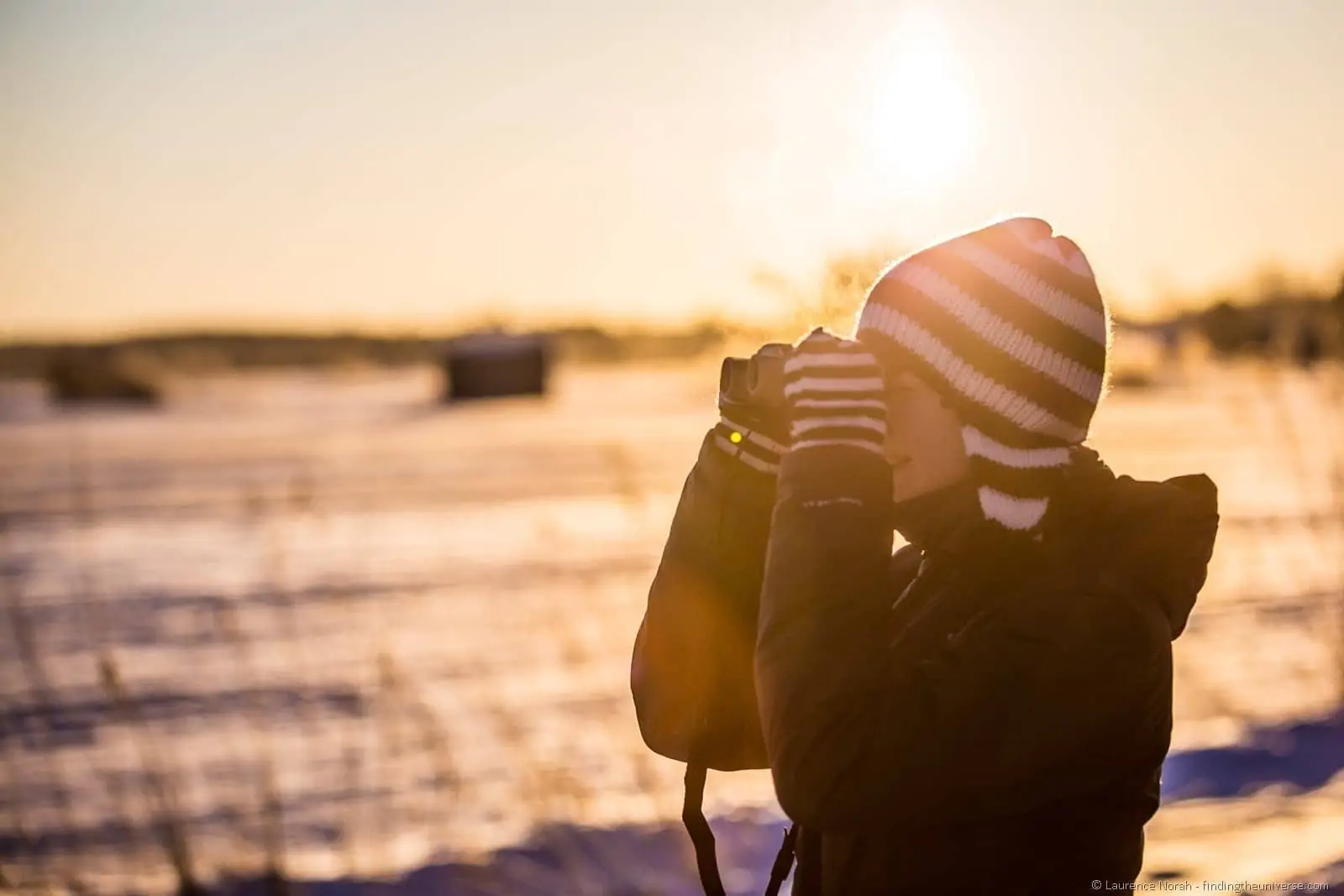
The Best Binoculars for Birdwatching
1. Vortex Diamondback HD 8×42: The Best Binoculars for Birdwatching Overall
One of the two pairs we own, and on paper the strongest birdwatching binoculars in this guide. Two numbers carry it: a 393 ft field of view, the widest in the lineup, which really helps when you’re chasing a warbler through foliage, and a 5 ft close focus, the nearest here, which you feel the moment a robin lands on the fence right next to you. They’re the lightest full-size pair on the list too, at 21.8 oz.

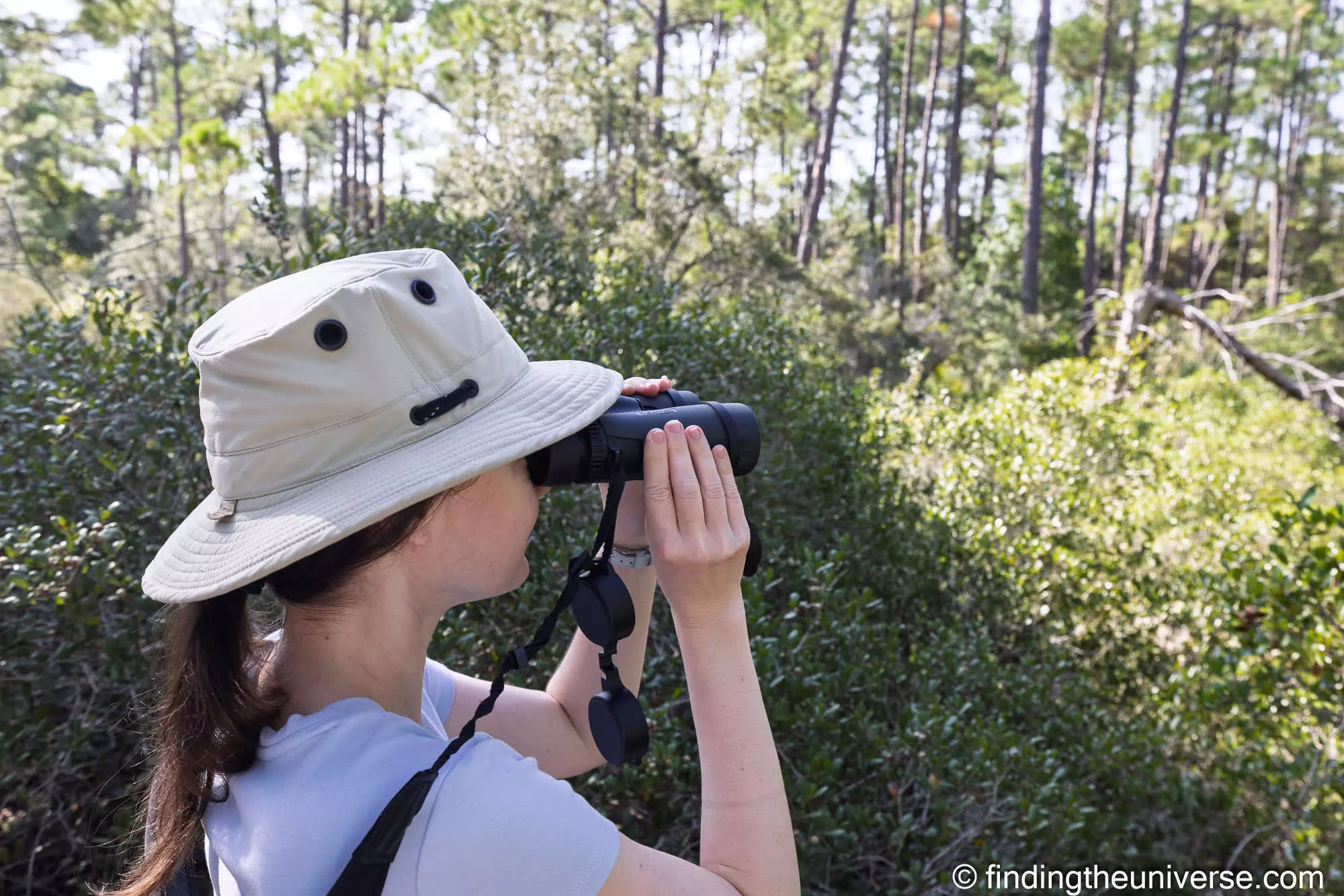
The Cornell Lab of Ornithology reviewed this exact pair, praising how light and comfortable they are while flagging a stiff focus wheel. That’s a fair review rather than a rave. In actual use though, comparing them against our Vanguard pair, I can barely tell the images apart, and the wider view means the Vortex is usually the pair I reach for on a bird walk.
The “HD” in the name refers to Vortex’s own optical system rather than ED glass, so don’t pay extra expecting the same glass as the Nikon or Zeiss. And stock can be patchy: the Amazon listing is the one I’d use, but it has come and gone over the years, and B&H is the backup if it’s out when you look. In their favour, the warranty is about as good as warranties get. Vortex describes it as “unlimited, unconditional, lifetime”, and their reputation for honouring it is excellent.
2. Vanguard VEO HD2 8×42: The Best ED Glass Option

The other pair we own, and the one that gets daily use at home on the garden birds. The VEO HD2 uses HOYA ED glass, which at this price is unusual, and it shows, with accurate colours and very little fringing on high-contrast subjects like a gull against a bright sky. Field of view is 377 ft and close focus is 6.6 ft, both a touch behind the Vortex, and using the two side by side I’ve struggled to see a practical difference in image quality.
At 25 oz it’s the heavier of our two pairs, though the weight sits well in the hand, and the build feels like it’ll shrug off the knocks that travel hands out. Vanguard backs it with a no-fault lifetime warranty. Current price on Amazon is Check price on Amazon.
Full disclosure: I’ve been a Vanguard ambassador for a number of years, so weigh my opinion accordingly, though we use this pair because it’s earned the spot. Being an ambassador does mean I can offer a discount: buying direct from Vanguard at $399.99 with the code FindingTheUniverse takes 20% off, bringing it to around $320.
3. Celestron Nature DX 8×42: The Best Budget Binoculars for Birdwatching

If you want to spend as little as possible while still getting binoculars you won’t outgrow in a year, this is the pair. The spec sheet reads well above its price: a 388 ft field of view that’s nearly as wide as the Vortex, 6.5 ft close focus, 17.5 mm of eye relief that works with glasses, and full waterproofing with nitrogen-purged barrels. That’s a birdwatching-shaped spec sheet at well under half the price of the Vanguard.
The compromise is the glass. This base model has no ED element (Celestron reserves that for its pricier Nature DX ED line), so backlit branches show a little more colour fringing and the image loses some bite in poor light. For garden birding, local walks and your first couple of years in the hobby, I think that’s a trade most people should happily make. Current price on Amazon is Check price on Amazon.
4. Celestron Nature DX 8×32: The Best Lighter Option

The smaller sibling of the budget pick, and the pair I’d suggest if a full-size 8×42 feels like more than you want to carry. Here’s the interesting part: the 8×32 has exactly the same 388 ft field of view and the same 6.5 ft close focus as its bigger sibling. I checked that twice because I didn’t quite believe it.
Eye relief is the same 17.5 mm too, so glasses wearers aren’t penalised. What you save is around 4 oz of weight and a chunk of bulk, which adds up over a long day with them around your neck.
The cost of the smaller objective lens is light. An 8×32 gives you a 4 mm exit pupil against the 5.25 mm of an 8×42, which means the view dims earlier at dusk and brightens later at dawn. In the middle of the day you really won’t notice. If your birding happens mostly at first light, stick with the 8×42; if it happens on walks and trips, the smaller pair is a very sensible buy. Current price on Amazon is Check price on Amazon.
5. Nikon Monarch M5 8×42: The Best for Glasses Wearers

If you bird with glasses on, eye relief is the spec that decides whether you see the whole picture or a porthole, and the Monarch M5’s 19.5 mm is the most generous here by some margin. Combine that with confirmed ED glass, dielectric prism coatings and a body that’s submersible rather than merely splashproof, and you get a pair built for the birder who wears glasses and wants optical quality above the budget tier.
The trade-offs are at the edges of the spec sheet. The 335 ft field of view is the narrowest of the 8x42s in this guide, which you’ll notice most when tracking small fast birds at close range, and the 8.2 ft close focus is fine rather than special (the Vortex focuses a full 3 ft closer). Neither is a dealbreaker, they’re just the reasons it sits here instead of at the top.
One naming note: make sure you’re buying the current Monarch M5, not the older Monarch 5, which is still on sale and has different specs. Current price on Amazon is Check price on Amazon.
6. Nikon Monarch M5 10×42: The 10x Option for Open Country

Most birders should buy an 8x, and I’ll make that case in the choosing section below. But 10×42 is a legitimate choice for a specific kind of birding: estuaries, reservoirs, moorland, hawk watching, anywhere your birds are distant, in the open, and not going anywhere fast. The extra reach helps you pull detail off a raptor circling half a mile away in a way an 8x can’t.
This is the same excellent Monarch M5 platform as the 8×42, with ED glass and the same submersible build, so the trade-offs are purely the ones that come with 10x: a narrow 293 ft field of view, a dimmer 4.2 mm exit pupil, and more visible hand shake. We don’t own a 10x pair ourselves, and for woodland and garden birding I’ve never missed it. If your local patch is a saltmarsh rather than a wood, the calculation flips. Current price on Amazon is Check price on Amazon.
7. Vanguard Vesta 8×25: The Pocketable Travel Pair

At 8.5 oz, the Vesta weighs about a third of anything else here, and it fits in a jacket pocket. Size is the main selling point, which for city trips, hikes where birds aren’t the main event, or as a backup pair in the glovebox, make these perfect.
Be clear-eyed about what 8×25 means, though. The 3.1 mm exit pupil makes for a noticeably dimmer view in low light, the 12.5 mm eye relief is tight if you wear glasses, and unlike its VEO HD2 stablemate the warranty is 5 years rather than lifetime.
Premium glass doesn’t buy its way out of any of that either. Swarovski lent me a pair of their CL Pocket 8x25s for a couple of years, and handing them back stung, but for all that the glass was as good as glass gets, they were still an 8×25, with the same dim exit pupil and the same pocket-format limits as the Vesta, only in four-figure money. Physics doesn’t care what you paid.
This shouldn’t be your only pair if birdwatching is the point. As the binocular for the days a full-size pair would’ve stayed home, though, the Vesta is cheap enough and small enough to be an easy yes. Current price on Amazon is Check price on Amazon.
8. Zeiss Terra ED 8×42: The Premium Pick

I haven’t used the Terra ED myself, so it’s here on specs and reputation rather than field time. The reason it makes the list anyway is the 5.3 ft close focus, the second-closest here and the kind of number that garden and woodland birders feel every day, plus ED glass with Zeiss’s hydrophobic coating that sheds rain and fingerprints.
It’s the heaviest pair in this guide at 725 g, and it costs more than anything else here. Whether it’s worth the premium over the Vanguard or the Vortex depends on how much those last few percent of optical polish matter to you. If your budget stretches this far comfortably, go for it. If it doesn’t, nothing above will hold your birding back. Current price on Amazon is Check price on Amazon.
How to Choose Binoculars for Birdwatching
The best binoculars for birdwatching are an 8×42: 8x magnification with 42 mm objective lenses. That’s the configuration both pairs we own use, it’s what the Cornell Lab calls the magic number for almost any birding use case, and it’s the default for a reason. Here’s what the numbers mean and where it makes sense to deviate.
Why 8×42 Is the Birdwatching Default
The first number is magnification, the second is the diameter of the front lenses in millimetres. More magnification sounds better. It mostly isn’t. Going from 8x to 10x narrows your field of view, amplifies every tremor in your hands, and dims the image, because dividing that 42 mm objective by the magnification gives you the exit pupil, the little disc of light that reaches your eye.
An 8×42 delivers 5.25 mm; a 10×42 delivers 4.2 mm. That difference is invisible at noon and very visible in the dim hour after dawn when the birds are busiest.
10×42 is still a legitimate choice, and Cornell rates both configurations as ideal for birding. The distinction is habitat: open country, coasts and raptor watching reward the reach, while woodland and garden birding punish the narrow view. If you’re not sure which birder you are yet, you’re an 8x birder. One thing worth ruling out entirely: zoom binoculars. The optical compromises are severe, and no birding authority recommends them.
Field of View
Field of view is how much width you take in at once, measured in feet at 1,000 yards. For birdwatching it’s the most underrated spec on the sheet. A small bird moving through a hedge doesn’t wait while you hunt for it in a narrow view, and a feeding flock is much easier to work through when you can see several birds at once.
Wide also makes the binoculars easier to point: raise them onto a bird you’ve spotted by eye and it’s already in the frame. It’s the main reason the 393 ft Vortex is my usual walk companion, and why I’d treat any 10x as a specialist choice rather than a default.
Close Focus
Close focus is the minimum distance at which the binoculars can produce a sharp image, and it’s a spec general wildlife guides barely mention. Birdwatchers should care about it though. When a wren works the shrub eight feet from your window seat, a pair that focuses down to 5 or 6 ft gives you a frame-filling view; a pair that bottoms out at 13 ft gives you a blur.
As a rule of thumb, around 6 ft or better is excellent, 8 ft is still perfectly fine, and it only becomes a real limitation somewhere past 12 ft. It’s also use-case specific: if your birding is estuaries and hilltops, you may never hit the close focus limit at all. If it’s gardens, hides and woodland trails, treat it as a first-class spec. It’s one of the two reasons the Vortex tops this list, and the butterfly watchers among you will care even more.
Eye Relief (Essential if You Wear Glasses)
Eye relief is the distance your eye can sit back from the eyepiece and still take in the whole picture. Bird without glasses and you can mostly ignore it. Wear glasses and your eyes are already pushed back, so you want roughly 16 mm or more or the view closes down to a letterbox.
Among these picks the Nikon M5 leads at 19.5 mm, the two Celestrons are comfortable at 17.5 mm, and the pocket Vesta’s 12.5 mm is the one glasses-wearers should steer clear of. Check for a dioptre adjustment too (they all have one), which lets you balance the two barrels to your own eyes.
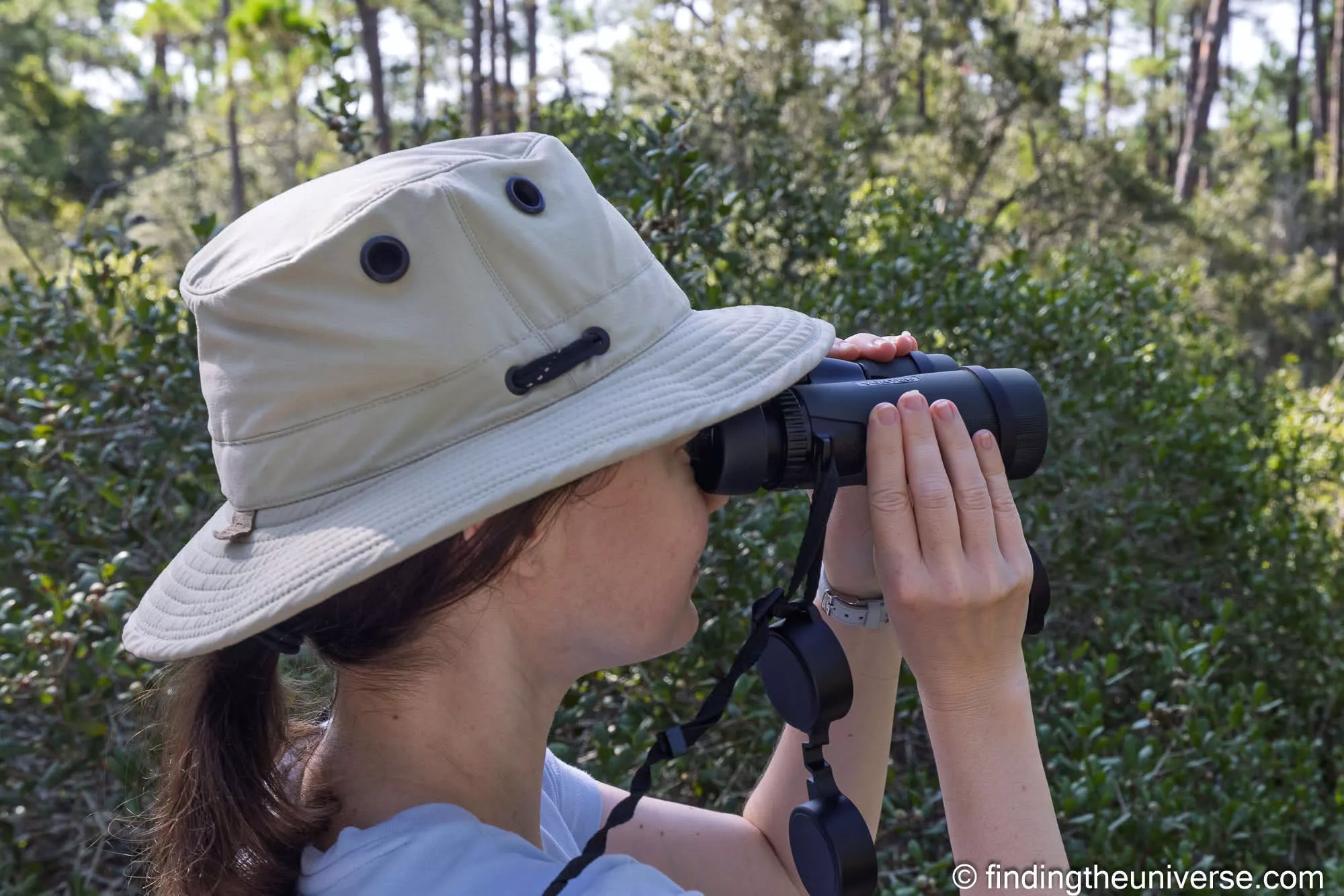
42 mm vs 32 mm vs 25 mm
Objective size is a brightness-versus-bulk trade. A 42 mm objective at 8x gives that 5.25 mm exit pupil and the best low-light performance, which is why it’s the default.
A 32 mm brings the exit pupil down to 4 mm, a mild compromise you’ll mostly notice at dawn and dusk, in exchange for a meaningfully lighter and smaller pair; as the Celestron 8×32 shows, you don’t necessarily give up field of view or close focus at all. A 25 mm compact is a double compromise, dim and tight-eyed, that buys true pocketability. My advice: 42 as your main pair, 32 if weight decides whether you carry them at all, 25 only as a second pair.
Roof vs Porro Prisms, and Weatherproofing
All eight pairs here use roof prisms, the straight-barrelled design that’s become the travel standard because it seals and packs so well. A porro prism (the old zigzag shape) can wring more brightness out of the same budget, which is why a roof pair adds phase-correction coatings to close the gap, and every pick here has them.
I’d also treat waterproofing and fogproofing as non-negotiable for birding, since the best birding weather is so often the wettest, and every pair here qualifies, with the two Nikons rated for outright submersion.
One Pair for the Garden and the Trip
Most people buying birdwatching binoculars aren’t only garden birders. There’s a Galapagos trip on the horizon, or a safari, or a camera bag that already weighs too much. The good news is that the standard birding configuration travels brilliantly: an 8×42 that can frame a wren at six feet will also pull a frigatebird off a distant colony, and everything I said about field of view applies just as much to finding a leopard in a tree.
Our two pairs have covered the Seychelles, the seabird colonies of the Scottish coast, and every safari we’ve taken, without either of us ever wishing for a different specification.
If a safari is specifically on your list, I’ve written a separate guide to the best binoculars for safari, which weighs the same pairs against dust, vehicles and bigger animals, and my safari packing list covers where they fit in the bigger kit picture.
The one lesson I’d pass on from travelling with both binoculars and a camera: when a sighting happens, reach for the binoculars first. They ask nothing of you, no lens cap, no focus point, just two eyes on the bird, so you watch it live instead of hunting for it in a viewfinder. The camera is for afterwards, once you’ve decided this one is worth the effort.
On game drives I keep binoculars on my chest and the long lens on the seat, in that priority order, and my safari photography tips go deeper on that workflow. And take one pair per person. We’ve tried sharing. The bird is always gone by the time the binoculars change hands, and the resulting negotiations are not romantic.
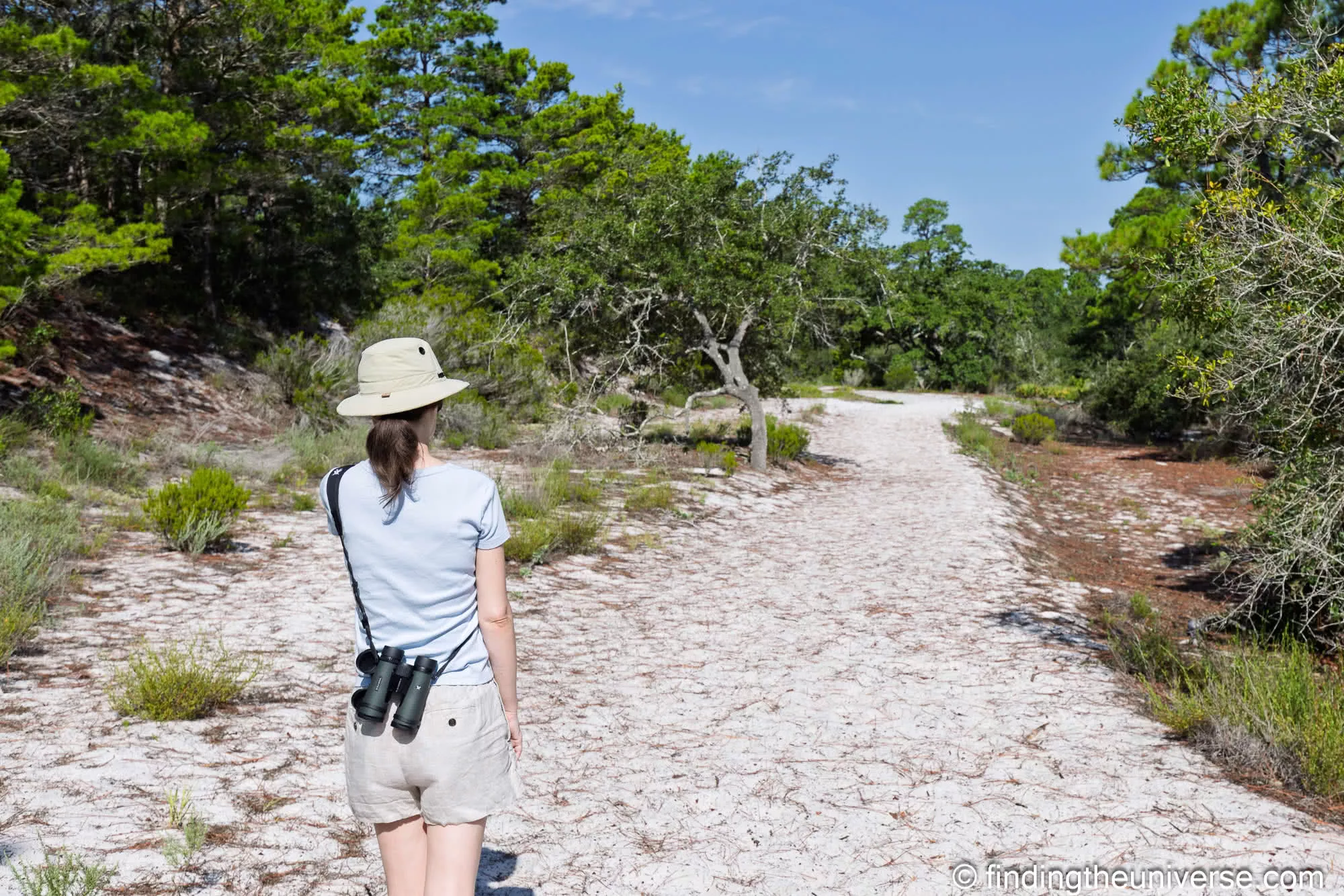
Do You Need a Spotting Scope for Birdwatching?
Not to start with, and possibly not ever. A spotting scope earns its place for a specific kind of birding: long, static sessions looking at distant water, mudflats or cliff faces, where 20x to 60x of tripod-mounted magnification reveals things no binocular can. For general birdwatching it’s slow, heavy and antisocial to carry.
I’ll also admit my direct experience is limited to a cheap scope I own and don’t rate, so I’m not going to recommend specific models here. If you’re at the stage where sea-watching or serious wader identification is calling, put your research time into scopes then, and put your money into the best binoculars you can afford first.
Mistakes to Avoid When Buying Birdwatching Binoculars
A few lessons from my own buying history, offered so you can skip the tuition fees.
The classic first-timer move is over-magnifying: reasoning that birds are small, so more zoom must be better, and coming home with a 12x pair (or worse, zoom binoculars) that shows a dim, shaky sliver of the world. Magnification is the spec you buy in the shop; field of view and brightness are the specs you use in the field.
The second mistake is going too cheap. There’s a tier of binoculars sold in supermarkets and airport gadget shops that will put you off the hobby, with soft edges, double images and mystery fog after the first rainy walk. The Celestron tier in this guide is roughly where lasting quality starts, and it’s not much money.
The third is ignoring the comfort specs, eye relief and close focus, because the brochure headline is always magnification and glass. If you wear glasses, eye relief will matter every single minute you spend birding, and a spec sheet can’t tell you how a pair sits in your hands, so try binoculars in person where you can.
The final is not setting it up correctly. Binoculars need adjusting to your eyes so you get the best results. Cornell have a good guide to setting up your binoculars here.
Beyond Binoculars: The Apps Worth Having
Once you’ve got the binoculars sorted, the best free addition to your birding is the Merlin Bird ID app from the Cornell Lab (this post was not sponsored by Cornell I swear). We use it on a near-daily basis at home, and on just about every guided bird walk we’ve done, across multiple countries, the guides have been running it too.
The sound ID feature in particular is pretty amazing: point your phone at the dawn chorus and watch it name the singers in real time. Its companion eBird, from the same lab, turns your sightings into a life list and shows you what others are seeing nearby.
If you’re just getting started, my beginner’s guide to birdwatching covers the rest of the picture, from fieldcraft and timing to attracting birds to your own garden.

Frequently Asked Questions About Birdwatching Binoculars
What are the best binoculars for birdwatching?
Of the pairs I own and use, the Vortex Diamondback HD 8×42 is the strongest for birdwatching, with the widest field of view and closest focus in this guide, and it’s the best value here too. The Vanguard VEO HD2 8×42 performs so similarly in the field that it’s worth the extra if you want real ED glass. On a budget, the Celestron Nature DX 8×42 covers the essentials remarkably well.
What magnification is best for birdwatching binoculars?
8x, in an 8×42 configuration, is the best choice for most birdwatchers. It gives a wide field of view for tracking moving birds, a bright image at dawn and dusk, and a steady view without a tripod.
10x is worth considering only if most of your birding is open country, coastlines or raptor watching, where the extra reach outweighs the narrower, dimmer, shakier view.
Are 10×50 binoculars good for bird watching?
They can work, but they’re rarely the best choice. The 10x magnification narrows your field of view and magnifies hand shake, which makes finding and following small birds harder, and 50 mm objectives make for a heavy pair that’s tiring around your neck all day.
For most birdwatching an 8×42 is more useful. If you want 10x for open-country birding, a 10×42 like the Nikon Monarch M5 gives you the reach in a lighter package.
Are compact binoculars any good for birdwatching?
An 8×32 is a good lighter option, and a well-made one like the Celestron Nature DX 8×32 can match a full-size pair’s field of view and close focus while saving real weight. The trade-off is a dimmer view in low light.
Pocket-size 8×25 pairs involve bigger compromises: dimmer still, and usually with eye relief too tight for glasses. They’re great as an always-with-you second pair, but I wouldn’t make one my only binoculars.
What close focus distance do I need for birdwatching?
Around 6 ft or better is excellent, and 8 ft is perfectly fine for most people. Close focus only becomes a real limitation somewhere past 12 ft, where nearby garden birds and butterflies turn into a blur.
How much it matters depends on where you bird: it’s a first-class spec for gardens, hides and woodland, and close to irrelevant for estuary and open-country birding.
Can I use the same binoculars for birdwatching and safari?
Yes, and I’d encourage it. An 8×42 is the configuration I recommend for both, and our two pairs have covered garden birding, the Galapagos and multiple African safaris without needing anything different. The specs that make binoculars good for birds, a wide field of view and a bright image, are exactly what helps you find wildlife on a game drive too.
Do I need to spend a lot on birdwatching binoculars?
No. Quality that will last starts at around the Celestron Nature DX tier, and the mid-range pairs in this guide are close enough to premium glass that most people wouldn’t spot the difference on a bird walk. Spend enough to avoid the bargain-bin tier, then put the savings towards a trip somewhere with better birds!
Final Thoughts
A good pair of binoculars improves every bird you’ll ever look at, from the blue tit on the feeder to the frigatebird wheeling over a distant colony. The Vortex Diamondback HD 8×42 is the one to buy. If you want real ED glass and don’t mind paying for it, the Vanguard VEO HD2 8×42 is worth the stretch. And if money’s tight, the Celestron Nature DX 8×42 won’t hold you back. Then stop reading about binoculars and go and use some.
If you’ve got a question about any of these pairs, or a favourite I’ve missed, let me know in the comments below. I’d love to hear what you’re watching!
Leave a Reply