We spent two months driving the length of New Zealand’s South Island, from the ferry dock at Picton right down to the bottom of the Catlins, in late autumn. I’ve worked as a travel photographer since 2010, and I shot pretty much all of it myself. If you just want the shortlist: Milford Sound, Aoraki/Mount Cook, Kaikoura, Abel Tasman and the West Coast glaciers are the five stops I’d defend to anyone.
The longer answer is this guide: seventeen stops, ordered north to south, so you can read it as a list or drive it as a route. For each one I’ll tell you what it’s for, roughly how long it deserves, and whether it’s worth bending your route for. Where we’ve written a full guide to a place, I’ll point you to it rather than cramming everything in here.
A quick word on time, because it decides everything else. With a week, pick one half of the island and do it well; I’d take the bottom half and build it around Fiordland and the lakes. With two weeks you can do the classic loop of the big names, and that is exactly the trip our two week New Zealand itinerary maps out, leg by leg, with the drive times attached. A month lets you do the whole thing justice, including the empty corners, and that’s the trip we’ve written up as a complete month-long New Zealand itinerary.
One more thing. We did our trip in late autumn, which everyone assured us was the wrong season. We arrived to what the forecast cheerfully described as an Antarctic blast, and it was still one of the best trips we’ve ever taken. Golden trees in Arrowtown, empty car parks at Milford, and hour after hour of that low, clear light photographers cross oceans for. More on that at the end.
If this is your first time in New Zealand, our first-timer’s guide to New Zealand covers the practical side: campervan versus car, driving on the left, what to book ahead and what to wing.
Table of Contents:
New Zealand’s South Island at a Glance
The South Island splits into a handful of regions, and the trick is to pick your priorities before you start plotting stops. This table squeezes the whole article onto one screen.
| Region | What it’s for | Rough time | Our verdict |
|---|---|---|---|
| Kaikoura and Marlborough | Whale watching, crayfish, sauvignon blanc | 2 to 3 days | Go. The whales are there year-round. |
| Nelson, Abel Tasman and Golden Bay | Kayaking, golden beaches, coastal walking | 2 to 3 days | Worth the detour north, especially in warm weather |
| Karamea and the Oparara Basin | Limestone arches, rainforest, nobody else | 1 to 2 days | The best detour on the island. Almost nobody goes. |
| The West Coast (Punakaiki to the glaciers) | Wild coast, rainforest, glacier country | 2 to 4 days | The drive itself is half the reward |
| The Mackenzie (Tekapo and Mount Cook) | Alpine walks, turquoise lakes, dark skies | 2 days | Unmissable. Stay a night for the stars. |
| Queenstown and the lakes | Adventure sports, Arrowtown, Wanaka | 2 to 4 days | Base yourself here; day-trip the rest |
| Fiordland (Milford and Doubtful) | The fiords | 2 to 3 days | Unmissable. Book the cruise ahead. |
| The Catlins, Dunedin and the east | Wildlife, lighthouses, empty coast | 2 to 3 days | Skip only if you’re really short on time |
| Christchurch and Banks Peninsula | The city bookend, Akaroa’s harbour | 1 to 2 days | A day for the city, a day for the peninsula |
Things to Do on New Zealand’s South Island
Here are the seventeen stops, running north to south from the Cook Strait ferry. If you’re flying into Christchurch instead, start at number seventeen and read this list backwards. It works just as well in that direction, and you’ll finish with the fiords, which is a pretty good way to end a trip.
1. Kaikoura
Kaikoura is the best place in New Zealand to see whales, and one of the most reliable places in the world to do it. A deep ocean canyon runs close to shore here, which keeps sperm whales in residence all year rather than just passing through. Dusky dolphins turn up in their hundreds, and the fur seal colony at Point Kean lounges around the car park as if it owns it.
We went out on the whale watching boat and saw sperm whales dive within the first hour, which rather set the tone for the whole trip. The cruise takes about half a day with check-in, and you can book the Kaikoura whale watching cruise here.
The town’s name means “eat crayfish” in Maori, and you should take the hint. The roadside caravans north of town sell it fresh, and eating crayfish out of a paper wrapper with the Pacific in front of you and the Kaikoura ranges behind is the correct way to do lunch here. We’ve written up the whole stop, whales and all, in our guide to Kaikoura.

2. Abel Tasman, Nelson and Golden Bay
Abel Tasman National Park is the South Island at its gentlest: golden beaches, clear turquoise bays and a coastal track you can walk in sections between water taxi drop-offs. The classic day here is a kayak along the coast, with seals hauling out on the rocks as you paddle past. It’s the smallest national park in the country and quite possibly the easiest to love.
We spent a couple of days doing exactly that, and you can read the detail in our Abel Tasman National Park guide. For kayak trips, cruises and walk-and-boat combinations, the Abel Tasman activity options are all here.
Keep going over the marble mountain to Golden Bay and things get quieter and stranger, in a good way. Wharariki Beach, out past the last town, has wind-carved arches and dunes that appear on a thousand Windows lock screens, and the lighthouse at Farewell Spit marks the island’s northern full stop. We covered this corner in our Golden Bay guide. The hill road to Takaka is winding enough that your passenger will stop reading their book. Worth it!
3. The Marlborough Sounds and Wine Country
If you arrive by ferry, the Marlborough Sounds are your first sight of the South Island: drowned valleys, dark green ridges and barely a building. Rather than racing off the boat and down the main highway, take Queen Charlotte Drive towards Nelson. It’s slow, it’s twisty, and it’s one of the lovelier short drives in the country.
We stopped so often for photos that a forty-minute drive took us most of a morning, which is all in our Picton to Nelson guide.
Half an hour south, the plains around Blenheim and Renwick grow the sauvignon blanc that made New Zealand wine famous. The cellar doors are relaxed, the distances between them are short and flat enough to cycle, and tasting the wine a few hundred metres from the vines it came from beats any bottle shop. Just decide who’s driving before the first pour, of course.
4. Karamea and the Oparara Basin
This is the entry I’d fight for. Karamea sits at the literal end of the road on the West Coast’s northern tip, a couple of hours past Westport, and almost nobody makes the drive. Their loss.
In the hills behind town, the Oparara Basin hides a set of limestone arches in deep rainforest, and the big one, the Oparara Arch, is reputedly the largest limestone arch in Australasia at some 219 metres long. Standing under it feels like standing inside a cathedral that grew by itself.
Moria Gate Arch, twenty minutes’ walk away, is smaller and arguably prettier, with the tannin-stained river sliding underneath it the colour of strong tea. We had both arches entirely to ourselves. On the South Island’s headline walks that simply doesn’t happen.
Karamea is also the southern end of the Heaphy Track, and in season the locals are preoccupied with whitebait, a tiny fish they net at river mouths and fry into fritters. Get one from whoever is selling them. The full story, arches and fritters both, is in our Karamea and Oparara guide.
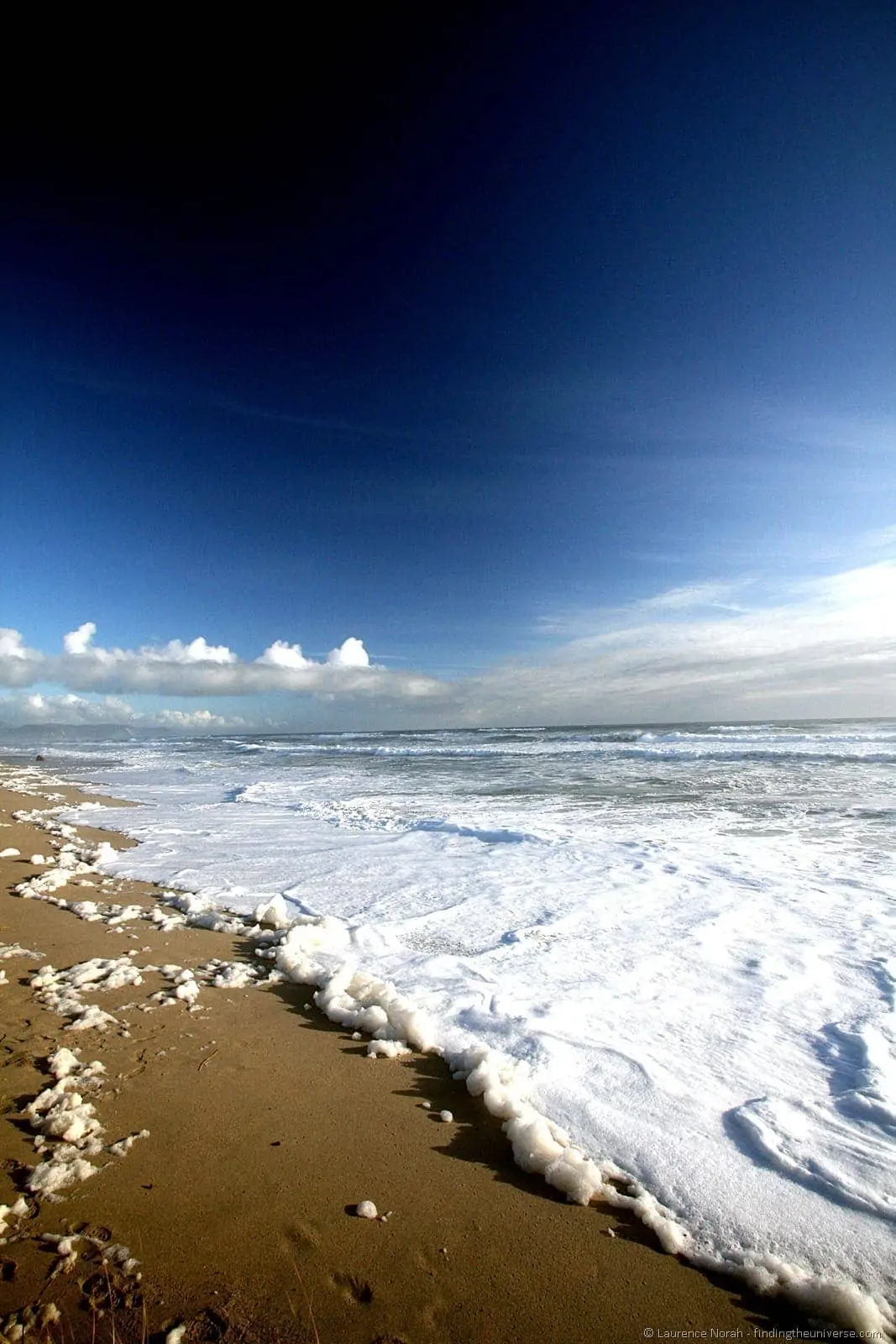
5. Punakaiki and the Pancake Rocks
The Pancake Rocks at Punakaiki are exactly what the name promises: limestone stacked in thin layers like a plate of pancakes some geological process forgot to eat. A paved twenty-minute loop walk takes you around the formations and over the blowholes, which really get going at high tide with a decent swell behind them. Time your drive for that if you can; DOC’s page for the walk has the practical detail.
The rocks sit right on the coast road through Paparoa National Park, so the stop plans itself: a leg stretch on one of the most dramatic roads in the country, with the Tasman Sea throwing itself at the cliffs on one side and rainforest pressing in from the other.
6. Hokitika Gorge
Hokitika Gorge is a short forest walk to water of a blue that looks colour-graded. The colour is real: glacial rock flour suspended in the water scatters the light, and on an overcast day it almost glows. A swing bridge takes you over the river, and the whole loop is under an hour.
It’s about half an hour inland from Hokitika town, which is itself worth a browse for its greenstone carvers, this being the historic source of New Zealand jade. The gorge is a filler stop rather than a headliner, but it’s a really good one, and the photos do a lot of work afterwards when people ask if the water actually looks like that. It does.
7. Franz Josef and Fox Glaciers
Franz Josef and Fox are the famous pair of West Coast glaciers, and they’re remarkable for how low they come: rivers of ice descending into temperate rainforest, a combination found in very few places on earth. Both glaciers have retreated a long way in the years since our visit, and the free valley-floor walks now end well short of the ice.
Which is why, if you want to actually stand on a glacier, the heli-hike is now the way to do it. A helicopter drops you on the clean upper ice for a guided walk among the pinnacles and crevasses. It’s weather-dependent and not cheap, but of everything we did on the coast, it’s the thing people still ask us about. You can book the Franz Josef glacier heli-hike here.
Don’t leave without the Lake Matheson walk near Fox, ideally at dawn when the lake is still and Aoraki/Mount Cook and Mount Tasman hang upside down in it. Our glacier country photo essay shows you what the fuss is about.

8. Arthur’s Pass and the TranzAlpine
Arthur’s Pass is the high road across the Southern Alps, linking the West Coast to Canterbury, and it earns a place on this list as a destination rather than just a transit. The road climbs through beech forest into proper alpine country, crosses the Otira Viaduct, and delivers you to a village with good short walks, including the Devil’s Punchbowl waterfall.
The village is also where you’ll likely meet kea, the world’s only alpine parrot: brilliant, curious and completely without respect for your property. One spent a determined ten minutes working on our aerial while we ate lunch. Do not feed them, do not leave your windows down, and do enjoy the show.
If you’d rather not drive it, the TranzAlpine train covers the same crossing from Christchurch to Greymouth and is regularly ranked among the world’s great rail journeys, with open-air viewing carriages that photographers monopolise. The pass also features in our round-up of New Zealand’s best scenic drives, along with several other roads on this list.
9. Aoraki Mount Cook and the Hooker Valley Track
Aoraki/Mount Cook is New Zealand’s highest mountain at 3,724 metres, and the drive to it along Lake Pukaki, with that improbable milky-blue water leading the eye straight to the summit, is one of the finest approaches to anywhere. The village at the road end sits inside the national park, surrounded by peaks on three sides.
The walk is back on: the Hooker Valley Track reopened end to end in July 2026, when the new swing bridge finally went in. At 189 metres it’s the longest swing bridge in the country.
The full walk is 10km return and takes three to four hours, mostly flat, over three swing bridges with the mountain ahead of you for the second half. Check DOC’s Hooker Valley Track page before you go anyway, because alpine weather shuts tracks here at short notice.
There’s plenty else in the park besides. The Tasman Glacier viewpoint, the Red Tarns steps, and the Sealy Tarns staircase if your knees are on speaking terms with you. We’ve collected our favourite shots in our Mount Cook photo essay, and the Hooker Valley features in our guide to New Zealand’s best day hikes.
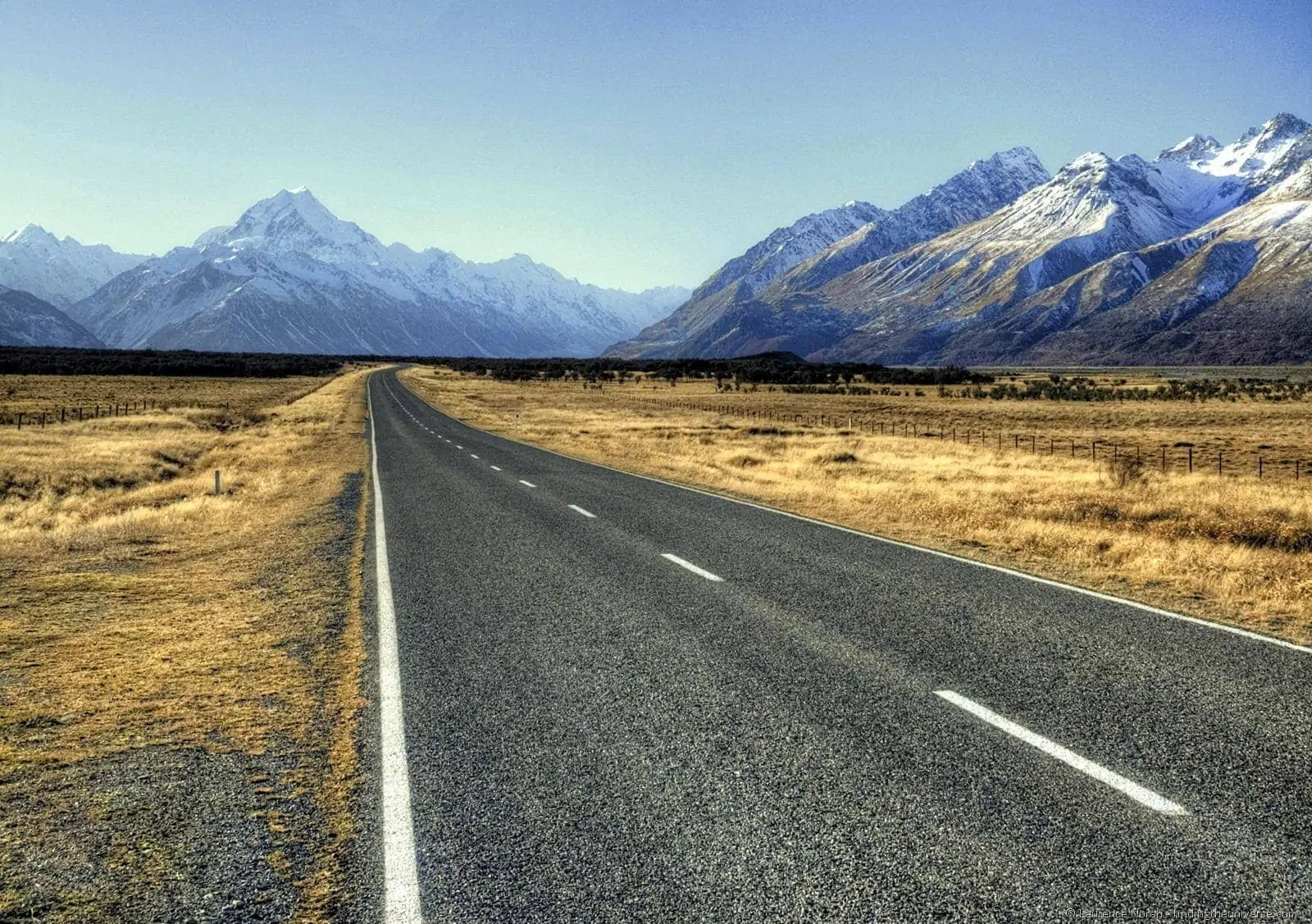
10. Lake Tekapo and the Mackenzie Dark Sky
Lake Tekapo gives you two shows for one stop. By day, there’s that startling blue lake with the little stone Church of the Good Shepherd on its shore, plus lupins along the water in early summer. By night, the main event: the Mackenzie Basin sits inside the Aoraki Mackenzie International Dark Sky Reserve, designated in 2012 and gold-tier, which is the top grade of dark sky going.
The stargazing tours at the Mount John Observatory above town put you behind telescopes under that sky, and in the colder months the nights are long, crisp and clear. You can book the Mount John stargazing tour here.
The famous lupins were long gone by the time we arrived in late autumn, which I’d braced myself to be disappointed about. Then the Milky Way came out over the church and covered the difference several times over. Bring a tripod, and every layer you packed.

11. Queenstown
Queenstown calls itself the adventure capital of the world, and it has a better claim than most: commercial bungy jumping started here at the Kawarau Bridge, and the town has spent the decades since inventing new ways to spend money on adrenaline. Jet boats through river canyons, paragliding off Bob’s Peak, rafting, ziplines, and skiing in winter.
If you only do one paid thing, my pick is the Skyline gondola up Bob’s Peak with a few runs on the luge, because the view over Lake Wakatipu to the Remarkables does the heavy lifting and the luge is more fun than any grown adult expects it to be! Browse the full spread of Queenstown activities here and pick your poison.
Queenstown is also the island’s best base: Arrowtown, Glenorchy, Wanaka and even Milford Sound all work as day trips from here, which is how we structured this leg in our month-long itinerary. The town itself is busy and unashamedly touristy. Eat well, book your activities, then sleep somewhere quieter.
12. Arrowtown and Glenorchy
Arrowtown, twenty minutes from Queenstown, is a gold-rush town that kept its miners’ cottages and its main street, and in late autumn it’s the postcard: the whole valley turns gold and amber, and photographers outnumber locals. We timed our visit for exactly this and it remains one of my favourite mornings of the entire trip. The restored Chinese settlement by the river tells the quieter, harder story of the miners who worked the tailings after the rush moved on.
Glenorchy is the other essential side trip: forty-five minutes along the edge of Lake Wakatipu on a road that’s a destination in itself, ending at a tiny settlement with a much-photographed red boatshed and the gateway into Paradise. That’s a real place name, and the film scouts agree, since scenes from The Lord of the Rings were shot in the valleys beyond.
The Gibbston Valley wine cellars sit right on the road between Queenstown and Arrowtown, growing pinot noir in an old gold-mining gorge. We ran out of trip before we ran out of wineries and never got to Gibbston, which I still regret. It’s firmly on the list for next time.

13. Wanaka
Wanaka is Queenstown’s calmer sibling, an hour over the Crown Range: same alpine-lake setting, a fraction of the crowds, and a lakefront made for doing very little slowly. It’s also home to That Wanaka Tree, a willow standing alone in the lake that has somehow become one of the most photographed trees on earth. Go at dawn, when the light is best and the tour buses aren’t.
The serious business here is Roys Peak, the ridge walk above town whose summit photo you’ve seen on Instagram whether you knew it or not. It’s 16 kilometres return and five to six hours of steady, shadeless climbing, so start early and carry water. The view over Lake Wanaka’s islands and bays is every bit as good as advertised.
If a six-hour climb isn’t your idea of a holiday, Rippon vineyard just outside town pours its wine above one of the better views any cellar door can claim, and the lakefront cafes are a fine plan B. Wanaka rewards an unscheduled day more than anywhere else on this list.
14. Milford Sound and Fiordland
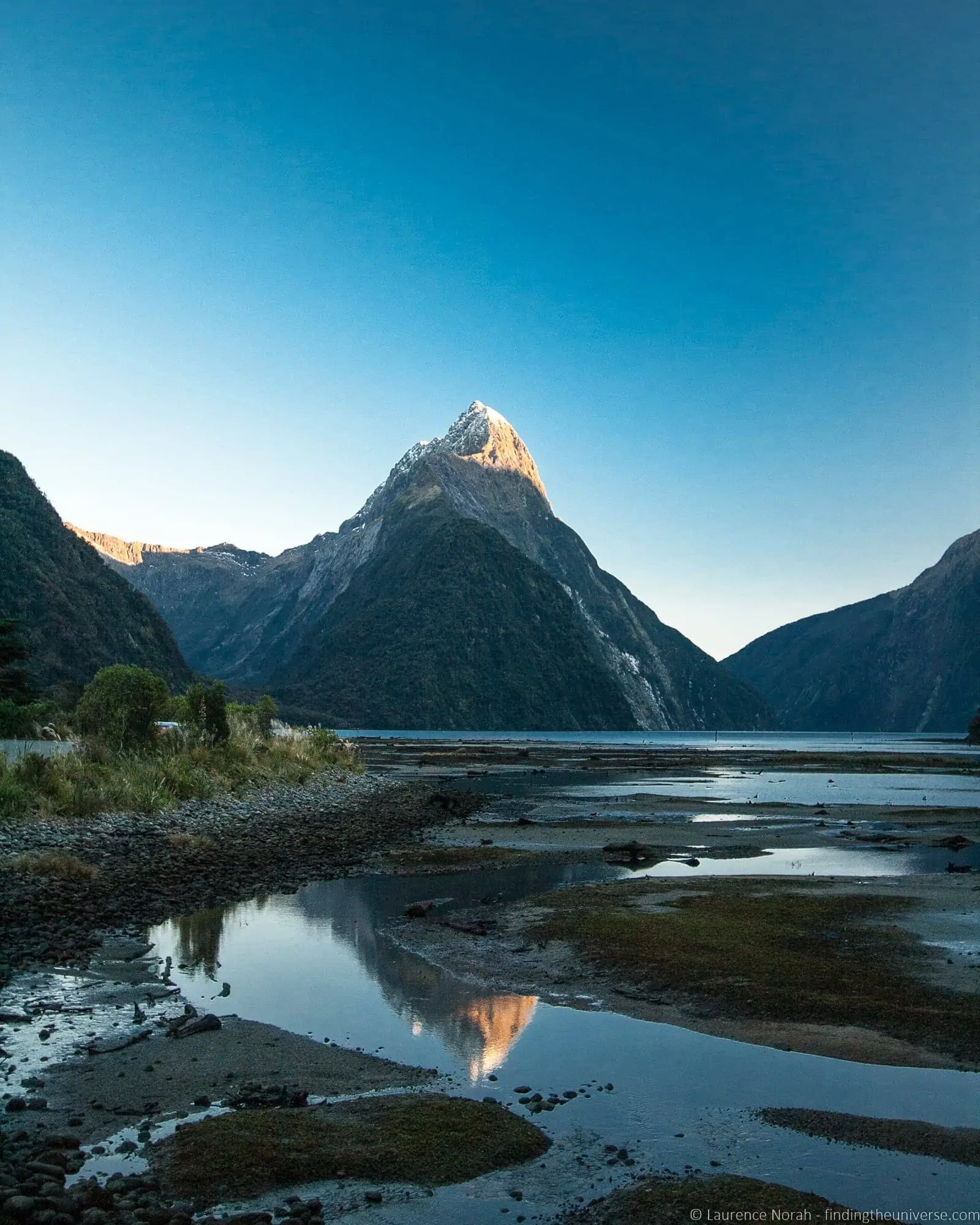
Milford Sound is the South Island’s headline act, and for once the headline undersells it. Mitre Peak rising straight out of dark water, waterfalls dropping hundreds of metres off hanging valleys, dolphins riding the bow wave of your boat. It sits in Fiordland National Park, New Zealand’s largest national park, which covers roughly five percent of the whole country and forms part of the Te Wahipounamu UNESCO World Heritage Area.
Getting there is half the event: the Milford Road from Te Anau runs past mirror lakes and glacial valleys before diving through the rough-hewn Homer Tunnel. Give it a full day and drive it in daylight.
And don’t fear rain, because Milford in the wet is arguably better, with temporary waterfalls appearing by the hundred. We’ve ranked the cruise operators, the road stops and the photography spots in our full Milford Sound guide, which is the place to plan and book that leg.
Serious walkers can go one better: the Milford Track, the four-day Great Walk into the sound, runs its season from November to April and its three huts book out almost instantly when reservations open. Plan that one many months ahead.
Fiordland’s other giant is Doubtful Sound: bigger, further, and far quieter than Milford, reached by boat and bus over Wilmot Pass. It’s the one that got away from us on our trip, and it’s the main reason we’ll be back. If we were doing it, we’d take the overnight cruise, sleeping on the fiord after the day boats leave; you can book the Doubtful Sound overnight cruise here.
15. The Catlins
The Catlins are the island’s forgotten south-east corner, a stretch of gravel roads, sea mist and wildlife between Invercargill and Dunedin. The reward for making the time: Nugget Point, where a white lighthouse looks down on wave-washed islets and fur seals, and which at dawn is one of the best photography stops in the country.
Curio Bay has a fossilised forest embedded in its rock shelf, 180 million years old and visible at low tide, with yellow-eyed penguins coming ashore in the evenings. Sea lions haul out on the beaches, waterfalls like Purakaunui Falls hide in the bush a short walk from the road, and the whole place runs at a pace that makes the rest of your trip feel hurried.
Allow a full day, expect gravel, and give the penguins their space. We’ve written the route up in full in our guide to the Catlins.
16. Dunedin and the Otago Peninsula
Dunedin is the South Island’s student city, all Victorian stone, street art and a railway station so ornate it’s reckoned the most photographed building in the country. But the real draw is on its doorstep.
The Otago Peninsula stretches out from the city’s edge, and at its tip, Taiaroa Head hosts the world’s only mainland breeding colony of royal albatross. Watching a bird with a three-metre wingspan come in to land like an overloaded cargo plane is worth the trip on its own; the Royal Albatross Centre runs the viewing tours.
The peninsula also shelters yellow-eyed penguins, little blue penguins and sea lions, all within half an hour of a city with very good coffee. That combination is rarer than it sounds. We’ve packed the highlights into our one-day Dunedin guide.
On the drive up the coast towards Oamaru, stop at the Moeraki Boulders on Koekohe Beach, a scatter of huge, almost perfectly spherical stones that look placed by someone with a sense of humour. They photograph best around low tide, ideally at sunrise before the coach tours arrive.

17. Christchurch and Banks Peninsula
Christchurch is where most South Island trips start or finish, and it deserves more than a night by the airport. The Botanic Gardens are among the best in either hemisphere, the restored trams loop the centre, and the city’s rebuild since the 2011 earthquake has filled it with street art, new architecture and a slightly defiant creative energy. Punting on the Avon is exactly as English as it sounds, which is rather the point.
The better half of the stop, though, is over the hill. Banks Peninsula is a pair of drowned volcanic craters folded into bays and ridgelines, and Akaroa, the little town at the heart of it, was settled by the French, kept the street names to prove it, and shares its harbour with Hector’s dolphins, the world’s smallest. The Summit Road drive gives you the whole peninsula laid out below.
It was also on Banks Peninsula, at the Mt Herbert saddle, that we found a long-drop toilet with a view most five-star hotels would kill for, an achievement we took seriously enough to rank in our round-up of New Zealand’s most scenic toilets. The rest of the peninsula gets the fuller treatment in our Akaroa and Banks Peninsula guide.
Getting Around the South Island
The South Island is a road trip, and there’s really no way around that. The distances look modest on a map and then the roads bend, climb and stop for one-lane bridges, so a “three-hour drive” routinely becomes four with photo stops. That’s not a complaint. The driving is the holiday.
We’d recommend hiring a car or campervan for the full leg, and picking up in Picton or Christchurch and dropping in Queenstown (or the reverse) is common and saves backtracking. We use and recommend Discover Cars to compare rental prices across companies, including the local firms the big aggregators miss.
Two practical notes from the road. Fuel stations on the West Coast are far apart, so fill up when you can rather than when you must. And if you’d like one leg without a steering wheel, make it the TranzAlpine train from Christchurch to Greymouth, then collect a car on the coast.
When to Visit the South Island
Summer, December to February, is the obvious answer: the warmest weather, the longest days, every track and business open, and prices and crowds to match. Book everything well ahead in those months, especially Milford cruises and any Great Walk huts.
Our contrarian pick, having done it, is late autumn, April into May. Arrowtown and Central Otago turn gold, the summer crowds are gone, the light goes low and clear in a way that flatters every photograph, and the long nights are a gift for stargazing in the Mackenzie.
The trade-offs are real: short days, cold nights, no lupins, and the odd southerly blast that reminds you Antarctica is the next stop south. Pack layers and you’ll take some of the best photos of your life. If I could hand you one month for this island, it would be May.
Winter belongs to skiers around Queenstown and Wanaka, and it’s a quietly lovely time everywhere else if you don’t mind early sunsets. Spring brings lambs, waterfalls at full volume and famously indecisive weather.
Further Reading for Your South Island Trip
We always travel with a paper guidebook alongside the blogs and apps, because cell coverage on the South Island has opinions about your plans. These are the two we’d take:
The Lonely Planet guide is the practical workhorse, current for 2025 to 2026 and strong on the detail this article doesn’t have room for:
The DK Eyewitness guide is the illustrated companion, better for deciding what you actually want to see before you go:

And from our own New Zealand archives, these are the natural next reads:
- Our perfect month-long New Zealand itinerary
- Tips for your first time in New Zealand
- The best day hikes in New Zealand
- New Zealand’s best scenic drives
- Things to do on New Zealand’s North Island
Frequently Asked Questions
A few of the questions we’re asked most often about the South Island, answered from our own trip.
What are the best things to do on the South Island of New Zealand?
The five we’d put first: cruise Milford Sound, go whale watching in Kaikoura, walk in Aoraki/Mount Cook National Park, kayak Abel Tasman’s coast, and get onto the ice at Franz Josef or Fox Glacier.
Beyond those, stargazing in the Lake Tekapo dark sky reserve, Arrowtown in autumn, and the wildlife of the Otago Peninsula and Catlins round out a trip. Our advice is to mix the famous stops with at least one empty corner, like the Oparara Basin, where you’ll have the place to yourself.
How many days do you need on the South Island?
Ten days is the realistic minimum for a loop that includes Fiordland, the Mackenzie and the West Coast without the trip feeling like a transport schedule. Two weeks is comfortable.
A month lets you do the island justice, including the Catlins, Golden Bay and Karamea, and that’s the length of trip we took. With less than a week, pick one half of the island rather than trying to see it all.
Is Milford Sound or Doubtful Sound better?
For a first visit, Milford. It’s more dramatic, easier to reach, and the road in is an event in its own right. Doubtful is bigger, quieter and harder to get to, and suits a second visit or anyone allergic to crowds.
We haven’t done Doubtful ourselves yet, and if we were booking it we’d take the overnight cruise, which is the version everyone raves about. If you only have time and budget for one fiord, make it Milford and don’t second-guess it.
When is the best time to visit the South Island?
December to February brings the warmest weather and the biggest crowds, and everything is open. It’s the safest choice for a first trip.
Having driven the island in late autumn, though, we’d argue for April and May: golden trees in Central Otago, quiet roads, clear low light and long stargazing nights, in exchange for cold nights and shorter days. Winter is for skiers, and spring has the waterfalls but also the most changeable weather.
Do you need a car on the South Island?
Realistically, yes. The island’s best moments are the roads between the sights, and public transport reaches the towns but not the trailheads, lookouts and lonely corners that make the trip.
Hire a car or campervan for the full leg, and consider a one-way rental between Christchurch and Queenstown to avoid backtracking. The one non-driving experience worth building around is the TranzAlpine train across Arthur’s Pass.
What is the most beautiful place on the South Island?
Pressed for one answer, I’d say the Milford Road between Te Anau and Milford Sound, which packs mirror lakes, glacial valleys and the Homer Tunnel into two hours and ends at the island’s single most dramatic view.
The honourable mentions: the approach to Aoraki/Mount Cook along Lake Pukaki, and Nugget Point in the Catlins at dawn. Ask me again next week and the order may shuffle, but those three keep the podium.
Fluent In Frolicking says
That blue photo of Milford Sound is gorgeous! I only got to see the North Island when I was in NZ. I keep hearing I missed the best parts of the country! Hope to get back there one day! Happy New Year!
Laurence Norah says
That is a good number of rainbows 😀 And yes, narrowing it down to five was a bit of a challenge!
Laurence Norah says
Thanks very much! It’s a seriously pretty place – have a great trip 😀
Saunter986 says
Your photos are truly amazing and you have captured NZ’s south island in it’s true glory!! 🙂 heading back for dose two in a few weeks… and seeing your photos have made me even more excited (if that is possible!!)
Erik Smith says
I love that you got a rainbow pic in here! I saw 27 of them in the 30 days I spent in NZ earlier this year.
I would incluse the Catlins in any list about the South Island, but I’m impressed you could pick just 5!!!
Turtle says
Would you believe I’ve never been to NZ (other than for work) and I’ve lived so long just across the Tasman? Ok, it’s going on the to-do list… within the next 12 months… I promise!!
bewitched in salem says
Love the valley carved out by the glaciers.
Laurence Norah says
You should – it’s an amazing place!
Harold Gardner says
I have always wanted to go to New Zealand. Now I REALLY want to go.
Jess | GlobetrotterGirls says
Love these images…big skies, amazing landscapes. Thanks for these great tips!
Karen @ Trans-Americas Journey says
High peaks, glaciers, tranquil coastlines, ancient volcanoes, scenic toilets…wait…what? Anyway, NZ really did sort of double dip in the “natural wonder” bowl, didn’t it? Thanks for narrowing down my South Island options!
Jeremy Branham says
New Zealand is incredibly beautiful! The volatile earth underneath has created some spectacular sights and scenery. I had heard of the glaciers but not didn’t know much about the rest of these. I definitely need to get to NZ one day.
rayj00 says
I think I’ve said it a million times already. I wanna go to New Zealand. Now, the urge is much greater, well, after seeing the pictures.
Check it out:
Rima Mari says
Woah.. The beach blew me away.. I have seen Mount Cook from a far. When I was in New Zealand, we only visited the South. We asked for some tourist spots or nice places to see in the North but one of the locals said that there is nothing to see there. We shouldn’t have bothered him.
Laurence says
Thanks Rima 🙂 It’s a really wonderful place up there, seems to be it’s own little world. The town even has it’s own radio station, which ain’t bad for a place with less than a thousand inhabitants. If you ever get the chance, I can recommend a visit. And it’s always interesting getting a locals opinion on things. I was told the west coast of the north island wasn’t worth visiting, but my day hike up Taranaki was my favourite walk in all my time there! I guess it’s a question of finding the right local…
Lukasz Lorentz says
Hi Loz!
Great list, we are on our way through the South Island and unfortunately we also missed Karamea 🙁 Currently in Queenstown and the next stop is Dunedin and then Oamaru to see some penguins! Have you been to Lake Tekapo? I heard that is quite stunning as well 🙂 All the best! PS why didn’t the sausage capital of NZ not make the list? haha
Laurence says
Hey Luke! Good luck with the penguins, we kept intending to see some but they never seemed to turn up for us at the times when we were there. Oamaru has an awesome old bit of town though, and the craziest steampunk style steam engine in the middle of town for some reason! Worth a wander around no doubt. And just south from there on the way to Dunedin are the Moeraki boulders – make sure your bus driver stops there! And sausages… well… I have to keep some secrets eh 😉
purplekat99 says
When my family came to visit me, we did a whistle stop tour of the whole country (CHC-AKL!) in 12 days (!!) and my sister wanted to go to Kramea but we had no time as there is only one road in and out. Sorry we missed such a picturesque spot!! Instead we hit Golden Bay, which was pretty fantastic too.
Akaroa is my FAVORITE town in the entire country! I just love it!!!
The Catlins Coast is another favorite spot, as is the town of Dunedin..
Oy, look at me! I could gush forever too:-).
Laurence says
Gush away, I’ve been banging on about the place for nearly a year now 😉 Amazing that you managed to do a tour of the country in such a short time, great work! Golden Bay was certainly close to making this list – loved the sandspit at the far end in particular. Karamea would have been a bit out of the way for such a short timeframe, but never fear, I’m sure you’ll make it some day! Also, can’t argue with the Catlins, and I think Dunedin was my favourite city in NZ 🙂