

I'm Laurence, a professional travel photographer since 2010. Jess and I write this site from our own travels.
I’ve been a professional travel photographer since 2010, which involves a surprising amount of standing around in the rain waiting for the light to do something interesting. Jess and I also lived in Edinburgh for four years, and we once spent four weeks driving Iceland’s ring road in June and got very thoroughly rained on. So we’ve worn a lot of rain jackets in a lot of weather, on hikes in Scotland, England, mainland Europe, Australia, New Zealand and the US, and on a lot of city trips.
If you just want the answer, the best packable rain jacket for most travellers is the Patagonia Torrentshell 3L. It’s a three-layer waterproof with pit zips, it stuffs into its own hand pocket, it comes in a women’s version too, and Patagonia’s aftercare is the best of any brand here.
If weight is your priority, the Outdoor Research Helium UL Jacket weighs well under half as much. And if you don’t want to spend much, the Columbia Watertight II (or the women’s Columbia Arcadia II) packs into its own pocket for a fraction of the price.
Most of the rain jackets Jess and I have owned have since disappeared from sale. Brands retire and refresh their lines on an almost yearly basis, so this is to be expected.
My old Berghaus is a model from about twenty years ago. Jess’s favourite came from a North Face outlet, and the only place we can find it now is a second-hand listing. Even the jacket I’ve worn on recent city trips vanished from its maker’s website while I was writing this. Rain jackets get redesigned and renamed all the time, so I’ve weighed each brand’s warranty and repair programme as heavily as the jacket itself.
That also means none of the eight picks below is a specific model of jacket we own. They’re chosen on research, against what years of wet trips have taught us to look for. That means what each one weighs, how it packs, how long it is, whether it has pit zips, and what the brand will do for you when it eventually wears out.
Table of Contents:
Quick Picks
- Best overall: Patagonia Torrentshell 3L (women’s), for durability and the best aftercare going
- Best ultralight: Outdoor Research Helium UL Jacket (women’s), about 160 g and it packs into its own pocket
- Ultralight with pit zips: Montbell Versalite Jacket (women’s), a 3-layer shell that packs smaller than a wine bottle
- Best premium: Arc’teryx Beta SL Jacket (women’s), GORE-TEX with a helmet-sized hood for real wind
- Best mid-price: Marmot PreCip Evo Rain Jacket (women’s), light, long in the back and packs into a pocket
- Best budget: Columbia Watertight II (women’s Columbia Arcadia II), the household-name jacket that packs into its own hand pocket
- Cheapest that works: frogg toggs Ultra-Lite2 Rain Jacket (women’s), to leave in the car or the bottom of a bag
- Best poncho: frogg toggs Ultra-Lite2 Poncho, 9 oz in its own stuff sack, and it covers your daypack too
Packable Rain Jackets Compared
These are the makers’ own figures, read on each brand’s product pages in November 2026. Most brands don’t say which size they weighed, so treat small weight differences as a rough guide. Where a cell says “not listed”, the figure isn’t on the maker’s product page.
| Jacket | Best for | Weight (men’s / women’s) | Packs into | Back length (men’s / women’s) | Layers | Pit zips | Price band |
|---|---|---|---|---|---|---|---|
| Patagonia Torrentshell 3L (women’s) | Best overall | 14.1 oz / 12.4 oz | Own hand pocket | Not listed | 3-layer | Yes | $$ |
| Outdoor Research Helium UL Jacket (women’s) | Ultralight | 5.7 oz / 5.6 oz | Own chest pocket (men’s), own hand pocket (women’s) | 29 in / 27 in | 2.75-layer | No | $$ |
| Montbell Versalite Jacket (women’s) | Ultralight with vents | 5.9 oz / 5.4 oz | Stuff sack (0.7 L) | Not listed | 3-layer | Yes | $$ |
| Arc’teryx Beta SL Jacket (women’s) | Premium, wind | 12 oz / 10.6 oz | Not listed | 30 in (M) / 28 in (S) | 3-layer GORE-TEX | Yes | $$$ |
| Marmot PreCip Evo Rain Jacket (women’s) | Mid-price | 10 oz / 9 oz | Own pocket | 30 in / 28 in | 2.5-layer | No | $$ |
| Columbia Watertight II (women’s Arcadia II) | Budget | Not listed | Own hand pocket | 29 in / 26 in | Omni-Tech, mesh lined | No | $ |
| frogg toggs Ultra-Lite2 Rain Jacket (women’s) | Cheapest | 8.8 oz / 6.4 oz | Stuff sack | Not listed | Non-woven | No | $ |
Price bands: $ is under 100 dollars, $$ is 100 to 300 dollars and $$$ is over 300 dollars. Live prices are in each section below where available.
The Best Packable Rain Jackets for Travel
1. Patagonia Torrentshell 3L: Best Overall
The Torrentshell is the heaviest jacket here that lists a weight, at 400 g (14.1 oz) for the men’s and 352 g (12.4 oz) for the women’s. I’d still buy it over everything else here, because for that extra weight you get a jacket built for years of use and a company that will look after it when something goes wrong.
It’s a full three-layer shell, made to Patagonia’s H2No Performance Standard, with a 100% recycled face fabric. Patagonia says the fabric, membrane and water-repellent finish are all made without intentionally added PFAS.
The pit zips are covered by welted storm flaps, which helps keep the rain out when you open them on a muggy day walking around a city. The hood adjusts two ways, has a laminated visor and rolls down and stows when you don’t need it, and there’s a microfleece lining around the neck, which is a nice touch when the zip is done up to your chin.
For packing, the whole jacket stuffs into its left hand pocket, which has a carabiner loop so you can clip it to the outside of a daypack. Patagonia calls the fit regular, and customers on its site say it runs true to size. It doesn’t list a back length, so if you want coverage below the hip, check Patagonia’s size guide or look at the Marmot or the Arc’teryx.
The biggest reason it tops this list is the Ironclad Guarantee. If a Patagonia product doesn’t perform to your satisfaction, you can return it for a repair, a replacement or a refund, and damage from wear and tear is repaired at a reasonable charge. Most of the other jacket brands here exclude wear and tear from their warranty, although Arc’teryx and Montbell will still repair it for a fee, as the warranty section further down shows.
I’d skip it if you’re an ultralight hiker counting every gram, or if you want a long coat. Both versions were $189 at Patagonia when I checked in November 2026.
We own a number of Patagonia products and are continually impressed by their quality and longevity, as well as the reassurance of that guarantee, so this is an easy recommendation to make.
Buy the men’s Torrentshell 3L or the women’s Torrentshell 3L at Patagonia.
2. Outdoor Research Helium UL: Best Ultralight

The Helium UL is what Outdoor Research calls its next-generation Helium, and it’s very light indeed, at 162 g (5.7 oz) for the men’s and 159 g (5.6 oz) for the women’s. That’s well under half the weight of the Torrentshell, and it packs into one of its own pockets: the chest pocket on the men’s, and the left hand pocket on the women’s. In practice you can leave either one in a daypack for a whole trip and forget about it until you need it.
The fabric is Toray Dermizax, a 2.75-layer waterproof with a 15-denier ripstop face, and it’s fully seam taped. The hood has a wired brim to keep rain off your face, the cuffs are part-elasticated and the zips are YKK Aquaguard water-resistant ones. Outdoor Research gives back lengths of 29 inches for the men’s and 27 inches for the women’s, which is about average for this list.
The Helium UL has no pit zips, so on a climb or a humid day you’ll be venting through the front zip. It’s also made from thin 15-denier fabric, and Outdoor Research’s Infinite Guarantee doesn’t cover rips and tears. The company replaces faulty gear but says it doesn’t currently offer a repair service. So it suits people who are reasonably careful with their gear, and I wouldn’t scramble through gorse in it.
If you want the lightest rain cover you can get for a city trip with a hike or two thrown in, it’s a great choice.
3. Montbell Versalite: Ultralight With Pit Zips
The Versalite has no pockets. None at all! Montbell calls it “pocket-free construction”, and it’s how the company gets a full three-layer jacket down to 166 g (5.9 oz) for the men’s and 152 g (5.4 oz) for the women’s.
Whether that works for you depends on how you travel. On a hike, with a pack on, I rarely use jacket pockets anyway. In a city, where I want somewhere to put my phone and a card without unzipping a bag, it would drive me mad. So I’d treat the Versalite as a jacket for walkers who want the lightest shell they can get without giving up ventilation, which is what the Helium UL lacks. The Versalite has pit zips.
The fabric is Montbell’s 3-layer DRYTEC, which Montbell labels PFAS-free, with a 7-denier ripstop face. Montbell rates it at 20,000 mm+ for water resistance, the seams are fully sealed, and the hood adjusts in three directions and rolls away under a hook-and-loop tab. It comes with a stuff sack, and Montbell gives a packed size of 7 x 7 x 13 cm (0.7 litres) for the women’s and 7 x 7 x 14 cm for the men’s. That’s smaller than a bottle of wine.
Montbell is a Japanese outdoor brand that isn’t as well known in the US as the others here, but it has a US online store and runs a repair service (more on that below). The men’s Versalite was $285 and the women’s $275 on Montbell’s US site in November 2026. Montbell also sells an older two-layer Versalite, so check the listing says 3-layer DRYTEC before you buy.
Buy the men’s Versalite or the women’s Versalite from Montbell.
4. Arc’teryx Beta SL: Best Premium Rain Jacket

This is the jacket I’d want on the top of a Scottish hill or a windy Icelandic headland. Arc’teryx calls the Beta SL its lightest Beta, and it weighs 340 g (12 oz) for the men’s and 300 g (10.6 oz) for the women’s, which is pretty light for a three-layer GORE-TEX shell.
It uses GORE-TEX’s newer ePE membrane, which Arc’teryx says is made without intentionally added PFAS, with a fluorocarbon-free (FC0) water-repellent finish on the outside. The StormHood is big enough to go over a climbing helmet, so there’s plenty of room for a warm hat underneath.
There are pit zips, two zipped hand pockets, an internal chest pocket and a RECCO reflector to help rescuers find you. The cut is what Arc’teryx calls fitted, so it sits close to the body over a base layer or light fleece, and the back length is 30 inches in a men’s medium and 28 inches in a women’s small.
It’s the most expensive jacket here by a long way. Arc’teryx tags it “Superlight”, which it describes as putting light weight and packability ahead of durability. It also warns that the face fabric on ePE jackets may “wet out” a little faster than on older GORE-TEX, though it says this doesn’t affect the waterproofing, and washing and drying the jacket brings the water repellency back. There’s no stuff pocket or stuff sack either, so it goes into your bag loose.
On the plus side, Arc’teryx runs a repair programme called ReBIRD, and if your jacket carries Gore’s black diamond “Guaranteed To Keep You Dry” hang-tag, Gore’s own guarantee applies too. I’ve covered both in the warranty section below.
5. Marmot PreCip Evo: Best Mid-Price Rain Jacket

If the Torrentshell is more than you want to spend, look at the PreCip Evo next. It’s 283 g (10 oz) for the men’s and 262 g (9 oz) for the women’s, it stuffs into its own pocket, and with a 30-inch back for the men’s and 28 inches for the women’s it’s one of the longer jackets here.
Marmot makes it from its 2.5-layer NanoPro fabric with a 100% recycled nylon ripstop face, and it’s fully seam taped. Marmot says the coating gives it a soft look and the printed backer a supple feel, which helps if you’re mostly wearing it around town. On the men’s jacket, Marmot says the C0 water-repellent finish is made without intentionally added PFAS. There are zipped hand pockets, a drawcord hem and Velcro cuffs.
What you don’t get is pit zips, and a 2.5-layer jacket tends to be less hard-wearing than a 3-layer one. Marmot’s warranty also makes clear that a jacket which has stopped keeping the water out after years of use can count as wear and tear. For a city break or a week of mixed weather, though, it’s a lot of jacket for the money.
6. Columbia Watertight II and Arcadia II: Best Budget Rain Jacket

The Columbia Watertight II (men’s) and Arcadia II (women’s) have been our budget suggestion in our Scotland packing list and Iceland summer packing list for a while, and they’re the obvious choice if you want a fully waterproof jacket without spending much.
Both use Columbia’s Omni-Tech waterproof-breathable fabric with fully sealed seams, a breathable mesh lining, an adjustable storm hood, zipped hand pockets, a drawcord hem and adjustable cuffs. They pack into their own hand pocket. Columbia calls them waist length, with a 29-inch back on the men’s and 26 inches on the women’s, so the women’s version in particular is on the short side.
Columbia doesn’t list a weight for either jacket, but OutdoorGearLab weighed the men’s Watertight II at 12.7 oz (about 360 g). A mesh lining also tends to add bulk, so they won’t, of course, disappear into a small daypack the way the Helium UL does. They also have no pit zips. But for occasional rain on a city break or a week in Britain, they’ll keep you dry for a fraction of the price of everything above them.
7. frogg toggs Ultra-Lite2 Rain Jacket: Cheapest That Works

frogg toggs sells this as its Ultra-Lite jacket on its own website, and it’s listed on Amazon as the Ultra-Lite2. Whatever you call it, it’s about as cheap as a waterproof jacket gets, and frogg toggs says the men’s version is the brand’s best-selling product.
It’s made from a breathable non-woven fabric, not a woven shell with a membrane, which is how it gets the price down. frogg toggs lists the men’s jacket at 8.8 oz and the women’s at 6.4 oz, and both come with a stuff sack. You get an adjustable hood with cord locks, a full front zip with a storm flap and elastic cuffs, and that’s about it. There are no pit zips.
What you give up for that price is durability. Reviewers and owners report that the fabric tears quite easily, and frogg toggs’ warranty varies by style and excludes normal wear and tear. So I wouldn’t buy one as my main travel jacket. As a backup that lives in the car, a festival bag or the bottom of a suitcase, it’s hard to argue with.
8. frogg toggs Ultra-Lite2 Poncho: Best Poncho

Jess and I keep a couple of cheap ponchos from Amazon thrown in our bags as a backup. If you want something a step up from the throwaway kind, the frogg toggs Ultra-Lite2 Poncho weighs 9 oz, packs into its own stuff sack and has an attached hood with cord locks, plus side snaps to stop it flapping around.
A poncho goes over you and your daypack, which a jacket can’t, and it lets air in underneath, so it’s far more comfortable than a sealed shell in warm, humid rain. In real wind it’s hopeless, though, so treat it as a summer backup.
Check the price on Amazon
Buy the Brand, Not the Model
Because rain jackets change so often, the model you read about today may well be gone in a couple of years, and that’s what happened to most of ours. What lasts is the company behind it. I made the same argument in our guide to the best luggage for travel. Once two products look similar on paper, the useful questions are what the warranty covers in practice and whether the company will still be around to honour it.
So I read each brand’s own warranty and repair pages. This is what they say for US customers.
| Brand | Warranty | Repairs and aftercare |
|---|---|---|
| Patagonia | Ironclad Guarantee: if a product doesn’t perform to your satisfaction, return it for a repair, replacement or refund | Wear-and-tear damage repaired at a reasonable charge. Worn Wear resale shop and trade-in for store credit |
| Arc’teryx | Defects, for the jacket’s “practical product lifespan”, which Arc’teryx says doesn’t mean your lifetime | ReBIRD repairs gear “for as long as it is repairable”. Some repairs cost a fee, and you pay shipping one way |
| Montbell | Defects, for the product’s “effective lifespan”, which Montbell says isn’t an indefinite period | Repair service through an online form or a Montbell store, with a cost estimate first. You pay shipping both ways, plus any duties |
| Marmot | Defects, for the original owner, for the “practical lifetime of the product” | Marmot decides whether to repair, replace or refund. Worn-out water repellency and leaking laminates can count as wear and tear |
| Columbia | Defects, for the original owner, for the “practical lifetime” of the jacket. Only if you bought it in the US from Columbia or an authorised seller, with proof of purchase | Free inspection, then a repair or store credit for the list price. You pay shipping one way and must clean it first. Normal wear and tear and “the natural breakdown of materials over time” aren’t covered |
| Outdoor Research | Infinite Guarantee: gear is “guaranteed to perform throughout the lifetime of the product” | Approved claims get a replacement from current stock. No repair service, and rips and tears aren’t covered |
| frogg toggs | Varies by style, from 30 days up to lifetime on some products. Register within 30 days of purchase | Repair or replacement only. Normal wear and tear isn’t covered |
| GORE-TEX (Arc’teryx Beta SL) | “Guaranteed To Keep You Dry” for the original owner, on jackets with Gore’s black diamond hang-tag, for the product’s useful life | Gore repairs, replaces or refunds. Wear and tear is excluded, but Gore says it “may be repaired at a reasonable price” |
Nobody’s “lifetime” warranty here covers a jacket that has simply worn out. Marmot spells it out clearly, listing “loss of DWR (Durable Water Resistance) and laminates losing their ability to keep out moisture” among the things that can be considered wear and tear. My old Berghaus, which I’ll get to in a moment, would have been a wear-and-tear case under every one of these policies.
So look at repairs, where Patagonia stands out. It repairs wear-and-tear damage for a reasonable charge, it sells used gear through its Worn Wear programme (washed, inspected and still backed by the Ironclad Guarantee), it has a store in Chicago dedicated to used gear and clothing repair, and you can trade in old Patagonia gear for store credit.
Arc’teryx and Montbell will also repair your jacket, for a fee where it isn’t covered. Outdoor Research, at the other end, will replace a faulty jacket but won’t repair a worn or torn one.
How Rain Jackets Fail (and What My Old Berghaus Taught Me)
For about fifteen years I wore a lightweight, long Berghaus Extrem made with GORE-TEX Paclite. It came on countless hikes and held up well on all of them. Then the seam tape started to give way.
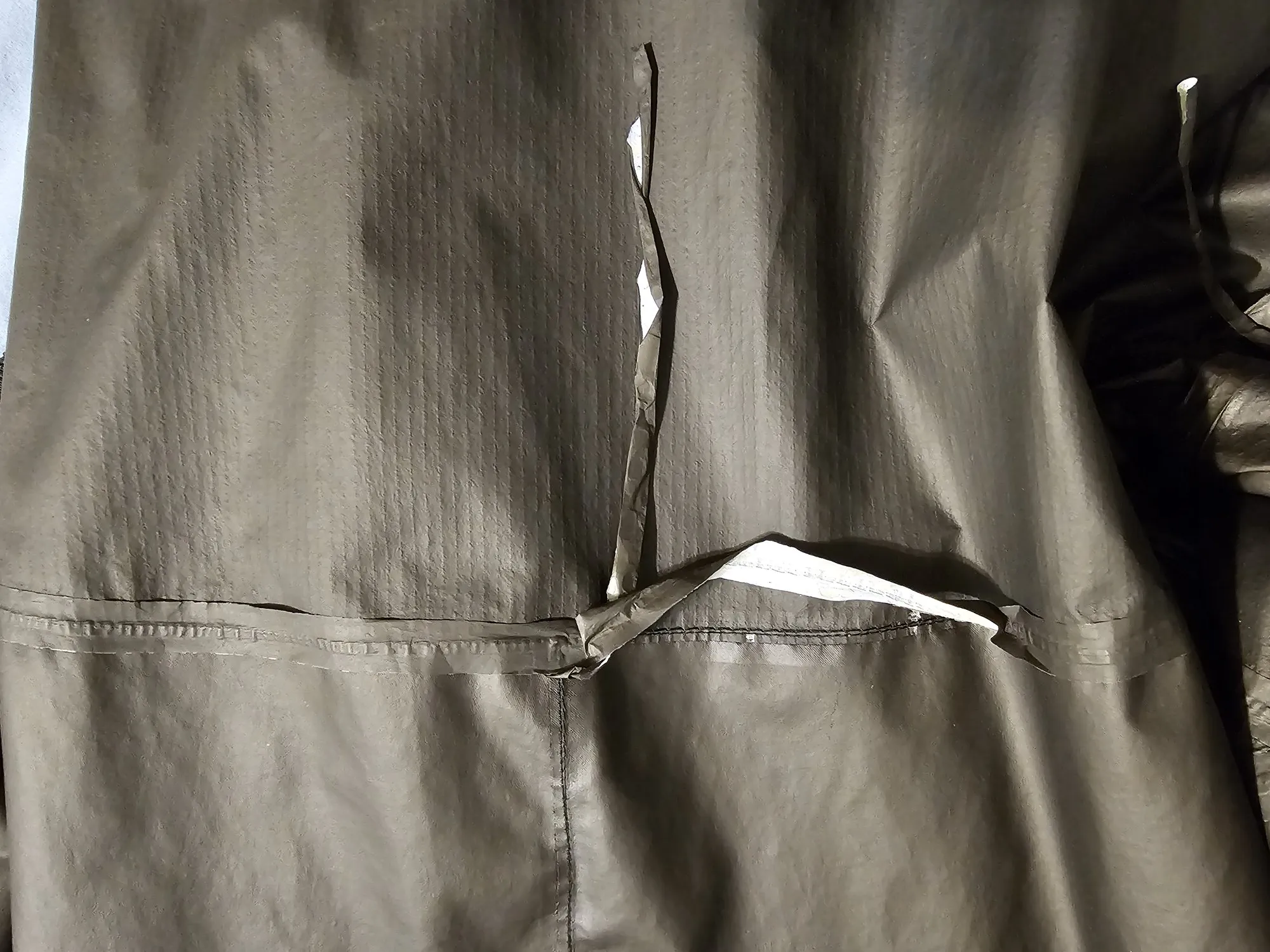
You can see the result in the photo above. The tape that seals the seams on the inside has come away, and the shell beside it has torn. Once that happens, water gets in along the seam however good the fabric is. I still wear it around the yard, but it isn’t a rain jacket any more.
Seam tape isn’t the only thing that goes. The other common failures are the water-repellent finish (DWR) wearing off, which makes the outer fabric soak up water and the jacket feel clammy even when no rain is getting through, and the layers of the fabric separating, which is called delamination.
The DWR you can usually restore yourself, as I’ll explain below. The other two need a repair, if they can be fixed at all, and as the warranty table above shows, none of the brands treats that kind of wear as a defect.
The lesson I took from the Berghaus is that fifteen years is a very good innings for a rain jacket, and that how long a jacket lasts depends as much on care and repairability as on the price tag.
Which Rain Jacket for Which Trip
A City Break With Showers
For cities I want a jacket that doesn’t look like I’ve come straight off a mountain. The jacket I’ve worn on recent city trips (the one that has just disappeared from sale) taught me what I’m after. It’s so light I barely notice it, it’s long enough to cover my pockets, it has pockets for everything, and I’d happily have worn it on a commute. I wouldn’t take it up a mountain, but that was never its job.
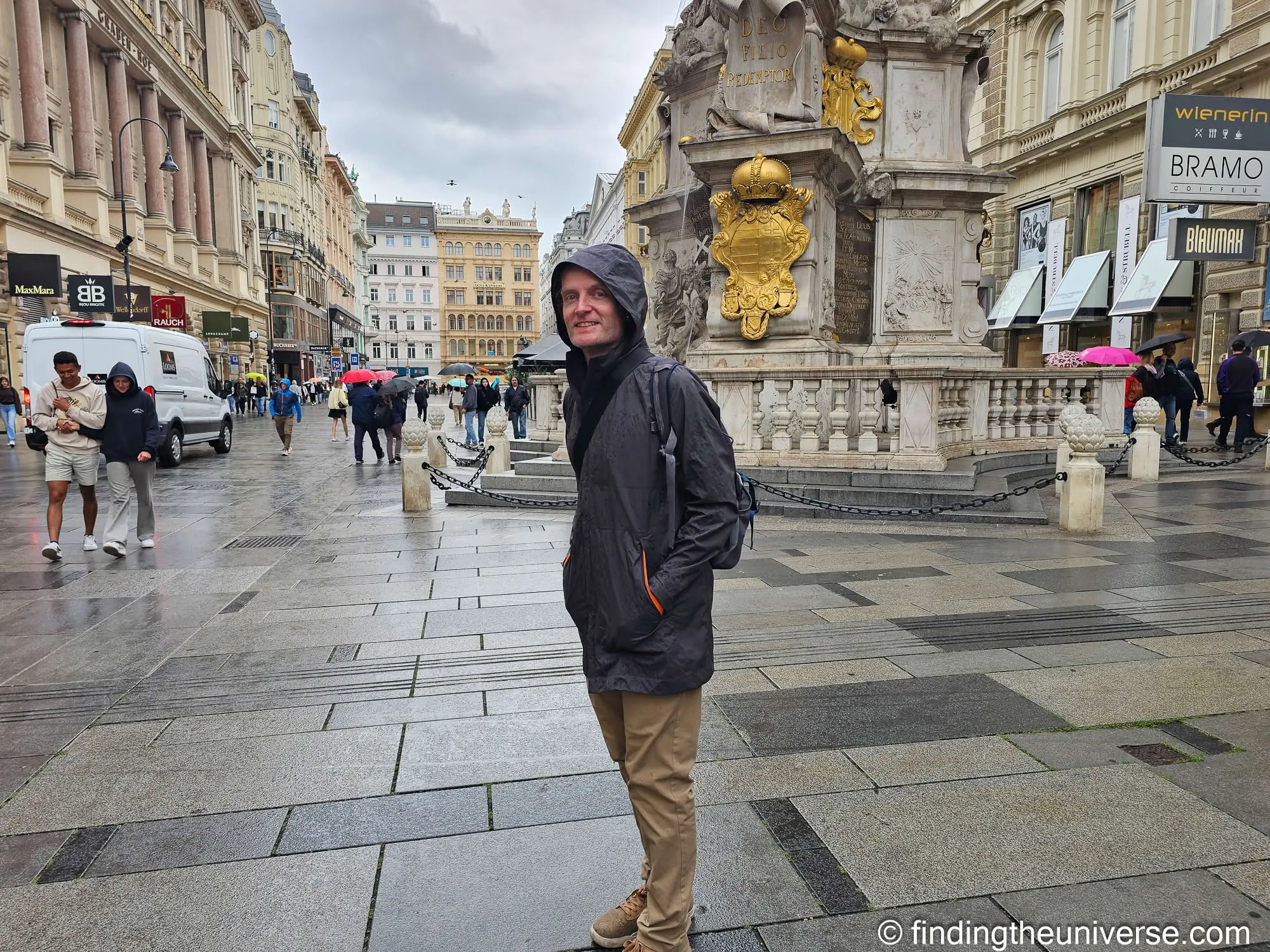
Jess dislikes the plasticky look a lot of rain jackets have, which is why she likes her own so much. So for a city trip, look for hand pockets (which rules out the Montbell) and a plain dark colour.
My pick would be the Marmot PreCip Evo. It’s one of the longer jackets here, and Marmot says its coating gives it a soft look. If you’d rather have something tougher, with pit zips, the Torrentshell is the one I’d look at next, although it’s heavier and Patagonia doesn’t list its length.
If showers are the only rain in the forecast, a small umbrella is worth packing as well. Our London packing list has the rest of what we take for a city trip.
A Week in Britain or Ireland
Four years of living in Edinburgh taught me that British rain rarely lasts all day, but it rarely stays away for a whole day either. You’ll be taking your jacket on and off, which is where a jacket that packs into its own pocket really helps, and where pit zips stop you overheating on a bus or in a museum. I’d take the Torrentshell for this kind of trip. On a budget, the Columbia is fine.
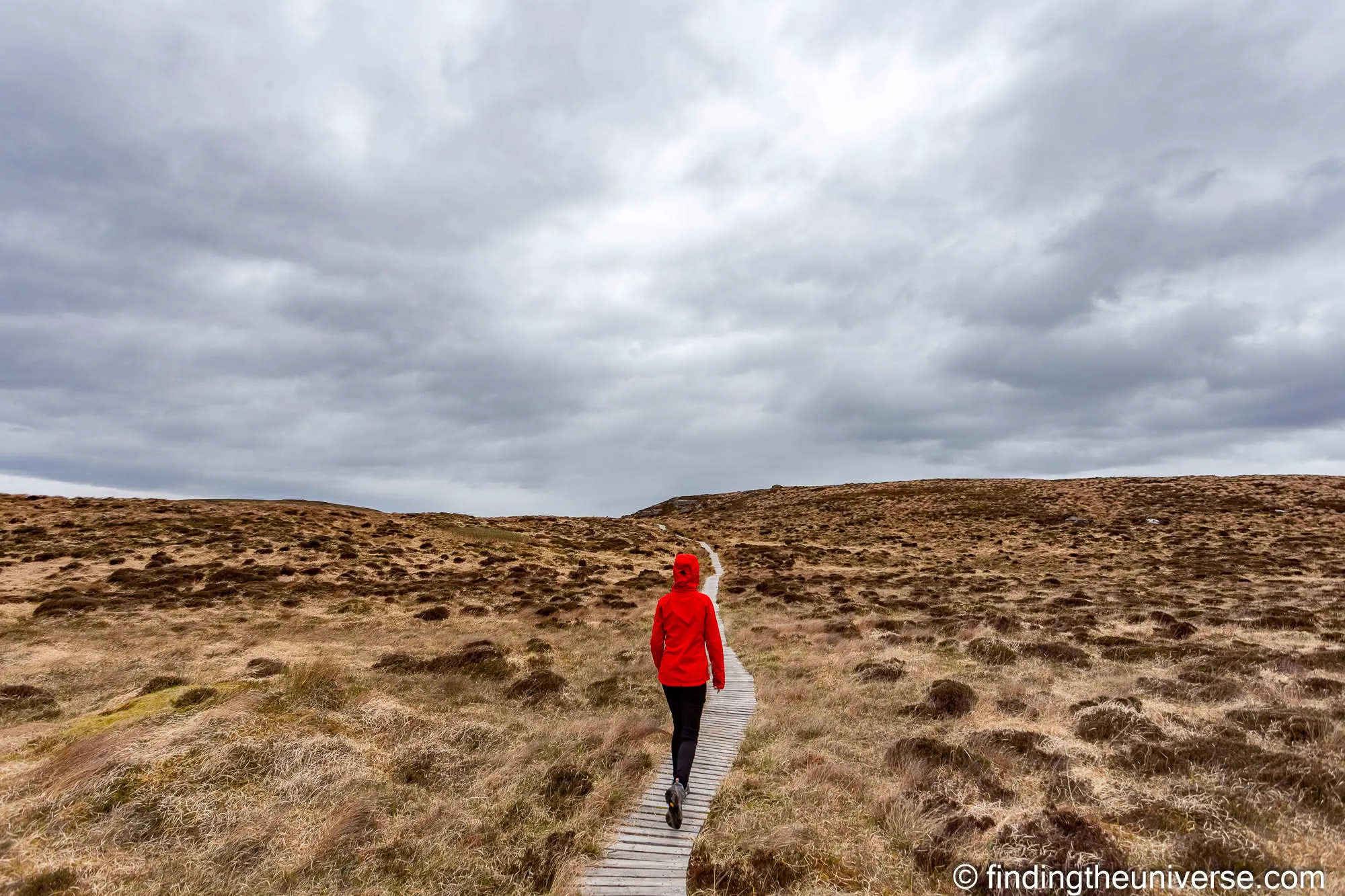
If you’re heading north, our Scotland packing list covers everything else you’ll want for a Scottish trip.
Iceland and Wind-Driven Rain
It rained a lot on our four weeks driving Iceland’s ring road, and our inexpensive Trespass jackets saved us, so a cheap jacket can do the job as long as it’s fully seam sealed. What Iceland adds is wind. Umbrellas are useless, ponchos turn into sails, and rain comes at you sideways, so a hood that cinches tightly and a jacket that’s long in the back are what keep you dry.
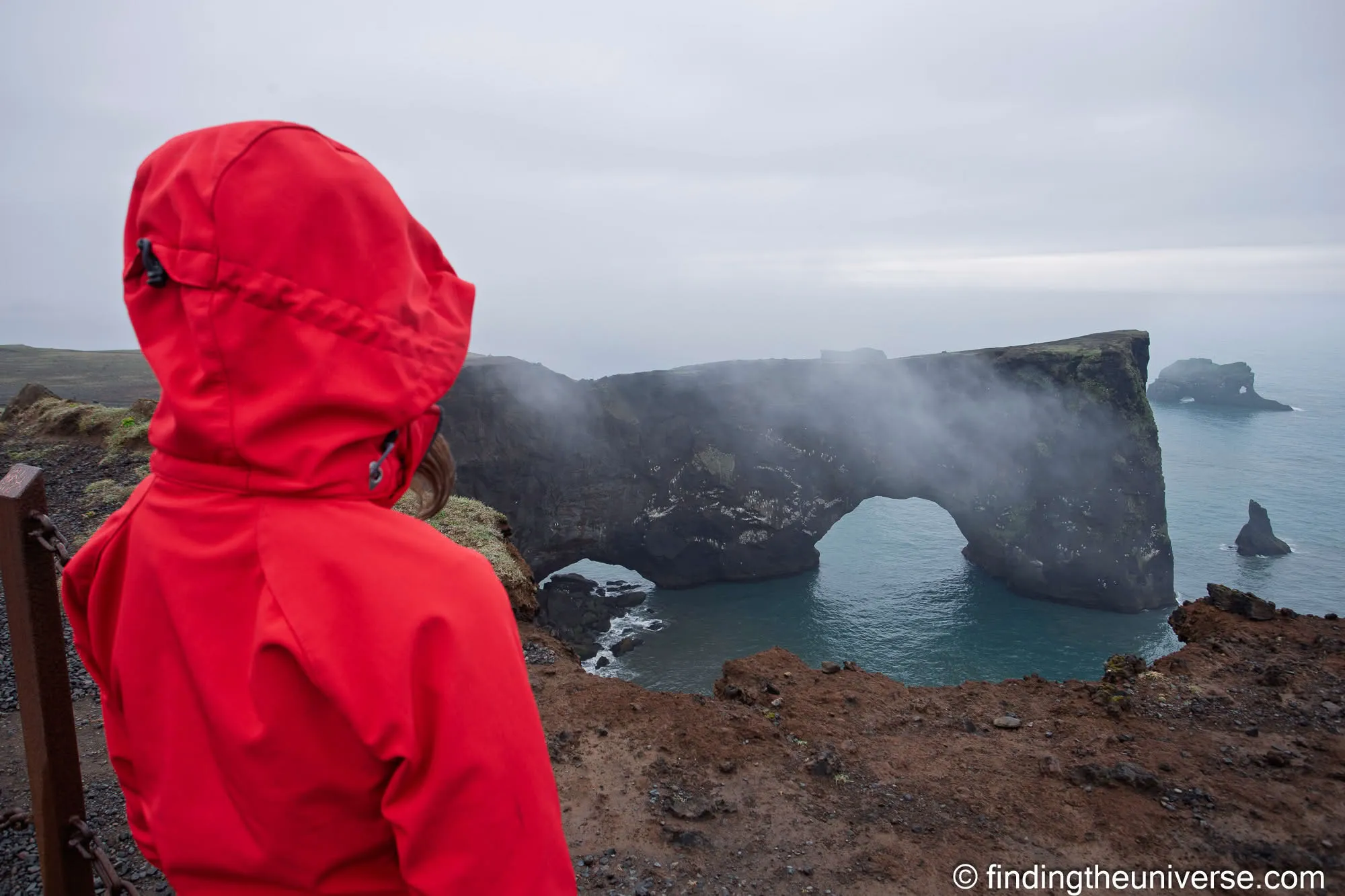
If you can afford it, the Arc’teryx Beta SL is the one I’d want, with a StormHood big enough to go over a climbing helmet and a 30-inch back on a men’s medium.
For less, the Marmot PreCip Evo also has a 30-inch back on the men’s, and the Torrentshell has a two-way adjustable hood and a tougher three-layer shell, although Patagonia doesn’t list its length. Pack rain pants too.
Our Iceland summer packing list has the full kit list, and for a winter trip see our Iceland winter packing list.
Summer Heat and Tropical Rain
In warm, humid rain a fully sealed shell gets sweaty very quickly, even with the pit zips open. This is where the poncho or an umbrella wins. If you do want a jacket, pick one with pit zips (the Torrentshell, the Montbell or the Arc’teryx) and expect to have it unzipped most of the time.
A City Trip With a Hiking Day
If you’ll mostly be in town but want to do a hike or two, go light. The Helium UL or the Montbell Versalite will vanish into a daypack until you need them. Our guide to the best travel daypack has a few packs that will carry one easily.
Is a Cheap Rain Jacket Good Enough?
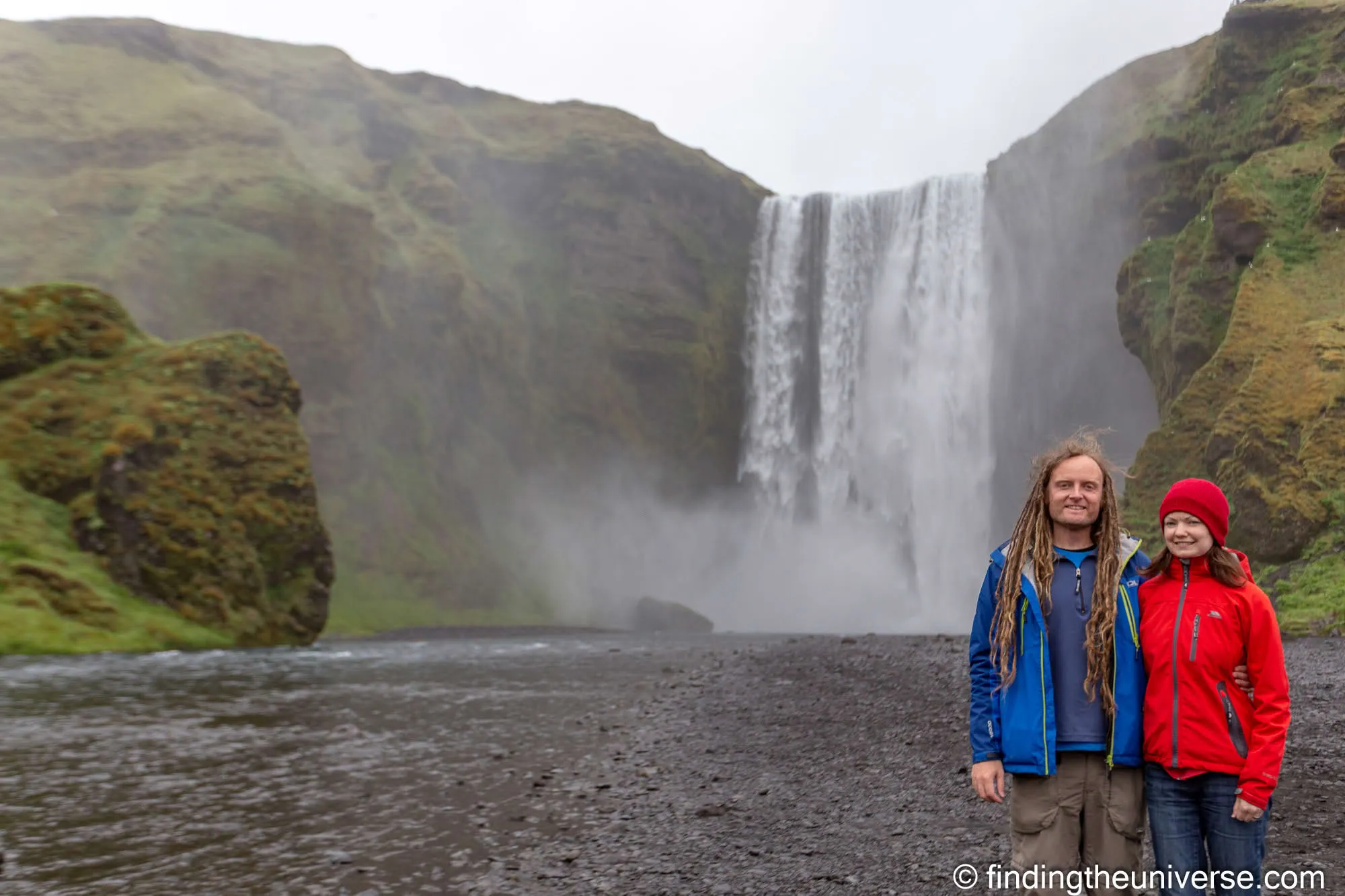
For a lot of trips, yes, and our own history is the evidence. Jess still has two jackets from Trespass, an inexpensive outdoor brand based in Glasgow: an insulated one whose label promises 5,000 mm of waterproofing and taped seams, and a fleece-lined softshell. I had a Trespass jacket too, and ours were the ones that got us through four weeks of Icelandic rain. For the price, they’ve been excellent.
Further down the price ladder, a frogg toggs jacket or a cheap poncho will keep you dry in a downpour. It just won’t last very long. And at the other end, my Berghaus wasn’t especially cheap at around £120 about twenty years ago, but it gave me roughly fifteen years of hiking before it finally failed.
If you’ll wear a rain jacket on one or two wet trips a year, buy something inexpensive that’s still fully seam sealed, and the Columbia is a good bet. If you’ll wear it all the time, on commutes, hikes and every trip, spend more. You’re mostly paying for longevity and for a company that will repair it, and spread over ten years or more, that’s not a lot per year.
Rain Jacket vs Umbrella vs Poncho
If you’re travelling carry-on only, you probably don’t have room for all three.
A rain jacket is the one to take if you’re only taking one. It works in wind, it keeps your hands free and it adds a layer of warmth on a cold day.
An umbrella is the most comfortable option in a city, especially in warm weather or when you’re in and out of shops and museums, but it’s useless in wind and awkward on a hike.
A poncho covers you and your bag, breathes better than any jacket and packs tiny, but it’s a nuisance in a crowd and turns into a sail in wind. They can also look a bit kooky.
Waterproof Ratings and Layers, Explained
Waterproof vs Water-Resistant
A waterproof jacket has a waterproof layer, either a membrane or a coating, plus taped or sealed seams, so rain can’t get through the fabric or the stitching. A water-resistant jacket usually just has a water-repellent finish. It will shed a light shower, then soak through in heavy rain. Every pick in this guide is sold as waterproof. When you’re comparing other jackets, look for the words “fully seam taped” or “seam sealed” in the specs.
What a Waterproof Rating Tells You
“Waterproof” isn’t one fixed number. Lab tests such as ISO 811 measure how much water pressure a fabric takes before it leaks, recorded as the height of a column of water in millimetres, and each brand picks its own pass mark.
To give you an idea of the range, Jess’s insulated Trespass is labelled 5,000 mm, and Montbell rates the Versalite at 20,000 mm+. Patagonia’s H2No standard, which the Torrentshell is built to, tests fabric at 20,000 mm and then requires it to still hold 10,000 mm after Patagonia’s “Killer Wash” test.
That’s a useful reminder that a jacket’s rating when new isn’t the whole story. You won’t find a figure on every product page, so I wouldn’t rule a jacket out just because it doesn’t quote one.
2-Layer, 2.5-Layer and 3-Layer Jackets
The layer count tells you how the jacket is built. A 2-layer jacket has the face fabric bonded to the waterproof layer, usually with a loose lining hanging inside to protect it. If a jacket has a mesh lining, as the Columbia does, it’s usually built this way.
A 2.5-layer jacket swaps the lining for a thin printed or sprayed “half layer” on the inside, which is what Marmot means when it talks about the PreCip Evo’s “backer print”. A 3-layer jacket has the membrane sandwiched between the face fabric and a bonded inner fabric.
As a rule of thumb, 2.5-layer jackets tend to be the lightest and most compact, and 3-layer jackets tend to be the most durable but heavier. Modern 3-layer shells like the Montbell and the Arc’teryx blur that line quite a bit, though, so check the weight before assuming.
How to Keep a Rain Jacket Waterproof
Most rain jackets that “stop working” haven’t really failed. The water-repellent finish has worn off or been clogged by dirt, body oil and sun cream, so the face fabric soaks up water and the jacket feels damp inside. Usually a wash brings it back.
GORE-TEX’s care advice is a good general starting point. Machine wash the jacket at 40°C (105°F) with a little liquid detergent, with no powder, fabric softener or bleach. Tumble dry it on a warm, gentle setting or line dry it, and once it’s dry, give it a further 20 minutes in the dryer to reactivate the water-repellent finish.
Always check your own jacket’s care label first, because they vary. Marmot says to tumble dry the PreCip Evo on low, for example, while Arc’teryx says medium for the Beta SL, and some shells shouldn’t go in the dryer at all.
When washing and heat no longer bring the beading back, it’s time to re-proof. Nikwax makes TX.Direct Wash-In for jackets without a wicking lining and TX.Direct Spray-On for jackets with one, and recommends cleaning the jacket with a technical wash first. Follow the product’s own instructions on drying, as they differ.
Newer PFAS-free finishes need this a bit more often. Gore says its PFAS-free DWR is less resistant to oils and needs more regular maintenance, and as I mentioned earlier, Arc’teryx says ePE jackets may wet out a little faster. On the PFAS front, California and New York have restricted PFAS in everyday clothing since January 2025, and Colorado follows in January 2028. Only specialist expert gear for severe wet conditions gets until 2028 in the first two.
A Rain Jacket as Part of a Carry-On Wardrobe
If you’re travelling carry-on only, think of your rain jacket as the outer layer of a system. An unlined shell over a fleece or a light down jacket is more flexible and much easier to pack than one heavy waterproof coat, and it works on a summer trip and a winter one. On travel days, wear the warm layer and the shell on the plane, which frees up a surprising amount of space in your bag.
Our guides to the best travel backpack, the best travel pants for men and the best travel shoes for men cover the rest of a light travel wardrobe, and if you want to look smart as well as dry, see our guide to the best travel suit for men. For really cold weather, see my guide to winter photography clothing.
How I Chose These Jackets
I started from the kinds of trips our readers take, such as city breaks, a week in Britain or Ireland, Iceland, and city trips with a hike or two. Then I looked for jackets that pack small, come in men’s and women’s versions, cover a wide range of prices, and come from brands with a track record and a clear warranty.
Every figure in the comparison table comes from the maker’s own product page, read in November 2026. Where a maker didn’t give a figure, I’ve said so instead of guessing, and the warranty details come from each brand’s own warranty and repair pages. The experience behind it is ours, from years of rain jackets succeeding and failing on wet trips, including the jackets that kept us dry in Iceland and the one that finally gave up after fifteen years.
Packable Rain Jacket FAQ
What is the best waterproof jacket for travel?
For most travellers, it’s the Patagonia Torrentshell 3L. It’s a durable three-layer shell with pit zips that packs into its own pocket, it comes in men’s and women’s versions, and Patagonia’s Ironclad Guarantee and repair service mean it should last for years.
If you want something lighter, look at the Outdoor Research Helium UL. If you want something cheaper, the Columbia Watertight II (or the women’s Arcadia II) is the best budget option.
What is the best rain coat for travel?
For most trips, a packable rain jacket is a better choice than a long rain coat, because it folds into a pocket or stuff sack when the rain stops. The Torrentshell 3L is our top pick.
If you want more coverage, check the back length. Of the jackets in this guide that list one, the Marmot PreCip Evo and the Arc’teryx Beta SL are the longest, at 30 inches for the men’s versions.
What is the best lightweight rain jacket for travel?
The Outdoor Research Helium UL, at 162 g (5.7 oz) for the men’s and 159 g (5.6 oz) for the women’s. It packs into its own pocket (the chest pocket on the men’s, a hand pocket on the women’s).
The Montbell Versalite weighs about the same, at 166 g (5.9 oz) for the men’s and 152 g (5.4 oz) for the women’s (so the women’s is a little lighter than the Helium UL), and unlike the Helium UL it has pit zips. It has no pockets at all, though.
What is the best packable waterproof jacket?
The Patagonia Torrentshell 3L, which stuffs into its own hand pocket and has a carabiner loop to clip it to a bag. The Marmot PreCip Evo and the Columbia Watertight II and Arcadia II also pack into their own pockets.
If you want it as small as possible, look at the two ultralights. The Helium UL packs into one of its own pockets, and the Montbell Versalite packs into a stuff sack measuring 7 x 7 x 13 cm for the women’s version.
Do I need rain pants too?
For a city trip, no. A rain jacket, plus an umbrella if you like, is enough.
For a day hiking in Scotland or Iceland, or anywhere with wind-driven rain, yes. Rain runs straight off a jacket onto your legs, and wet pants in the wind get cold quickly.
Is GORE-TEX worth it for travel?
Not necessarily. Plenty of brands make excellent waterproof fabrics of their own, including Patagonia’s H2No (used in our top pick, the Torrentshell), Marmot’s NanoPro and Montbell’s DRYTEC.
What GORE-TEX does add is Gore’s “Guaranteed To Keep You Dry” promise on jackets carrying its black diamond hang-tag, which sits on top of the jacket maker’s own warranty. That’s a nice extra, but I’d choose on fit, features and the brand’s aftercare first.
Can a rain jacket work in winter?
Yes, as the outer layer over warm layers. A shell like the Torrentshell or the Beta SL keeps wind and rain off a fleece or down jacket underneath.
Just make sure you buy a size that leaves room for those layers, especially with a fitted cut like the Arc’teryx.
Is a poncho better than a rain jacket for travel?
In hot, humid rain, often yes. A poncho lets air in underneath and covers your daypack as well as you.
In wind it’s much worse, and it gets in the way in crowds. We each travel with a jacket and keep a cheap poncho in the day bag as a backup.
Final Thoughts
If I were buying one rain jacket for travel today, I’d buy the Torrentshell 3L, and I’d expect it to outlast whatever the next new model turns out to be. If you’d rather go light, the Helium UL weighs about as much as a smartphone.
Whichever you choose, wash it now and then, re-proof it when the rain stops beading, and keep the receipt. Given how quickly rain jackets disappear from sale, there’s a good chance the one you buy will be discontinued long before it wears out!
Leave a Reply