If you’ve landed here from Google, you’re probably looking for one specific thing: which war museum in London should you actually visit? Let me answer that first, and then if you want the longer version with eight museums, eight war memorials, a walking route around the central memorials, and a few brief pointers to the niche museums I haven’t been to yet, I’ve put it all underneath.
The short answer: the Imperial War Museum London. The Imperial War Museum London is the one I’d send most people to. It’s free, it’s vast, and it’s the only one where you can spend a whole day and still not see everything. But the right answer for a couple in their seventies with a granddad in Bomber Command is different to the right answer for a parent of an eight-year-old who’s currently obsessed with Spitfires, which is different again to the right answer for someone with a half-day to fill before catching the Eurostar. So here’s how we’d call it.
Table of Contents:
Quick Picks: Which War Museum Should You Visit?
If you can only visit one: Imperial War Museum London
It’s free. It covers everything from the First World War through to the present day. The Holocaust Galleries are the best of their kind anywhere in Europe. You don’t need to book and you don’t need to plan, you can just turn up and stay as long as you like. Closest tube stations are Lambeth North, Waterloo, or Elephant & Castle.
If you can visit two: Imperial War Museum + Churchill War Rooms
The Churchill War Rooms are the underground bunker where Britain’s wartime government actually operated, preserved more or less as they were on VE Day. It’s the most atmospheric military museum in London (you’re walking through the actual bunker, and it still looks like 1944 in there), and it pairs naturally with the IWM because they’re both run by Imperial War Museums. There is a fee, currently from £33, and book online in advance because the queue without a booking can swallow an entire afternoon. Closest tube is Westminster.
If you can visit three: add HMS Belfast or the RAF Museum
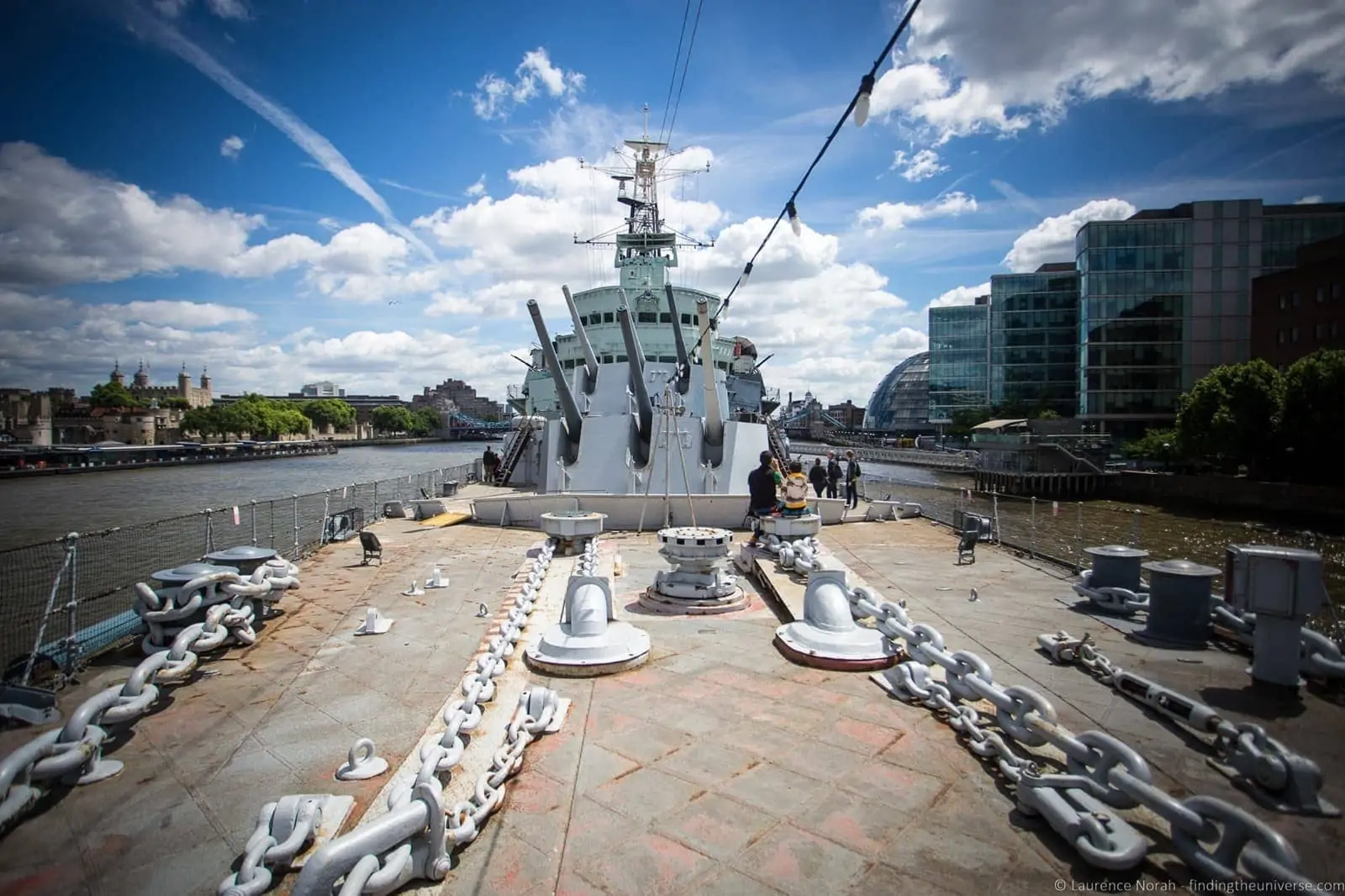
HMS Belfast if you want something hands-on and central (she’s moored on the Thames near Tower Bridge, you can climb all nine decks, kids love it, £26.80 adult). RAF Museum London if you specifically care about aircraft and don’t mind a trek out to Colindale on the Northern Line (it’s free, it’s enormous, and you can easily spend half a day inside).
And then by specific interest:
For aviation: RAF Museum London, no contest. For families with kids under twelve: HMS Belfast (climbing things) or the National Army Museum (the interactive Soldier gallery is excellent for that age range).
For Churchill specifically: Churchill War Rooms, then Jess’s guide to Churchill sites in England for the wider trail.
For naval history: HMS Belfast in central London, or make a day of it in Greenwich for the National Maritime Museum and Cutty Sark.
For the British Army’s full sweep from the Civil Wars to Afghanistan: National Army Museum in Chelsea.
For the Household Cavalry, the King’s Life Guard, and the working stables behind Horse Guards: Household Cavalry Museum, which is also the natural anchor for the central London memorial walk I’ve put together below.
And for free entry only: IWM London, RAF Museum London, National Army Museum, and the National Maritime Museum at Greenwich.
Some of the paid museums (Household Cavalry Museum, Guards Museum and HMS Belfast) are included on the London Pass, which can make sense if you’re visiting two or more. We’ve got a full London Pass review over on ITC if you want to work out whether the maths stacks up for your trip.
Right. With the short answer out of the way, here’s the longer one.
War Museums in London
1. Imperial War Museum London
If you only have time to visit one military museum in London, this is the one. The Imperial War Museum London (IWM London) is free, it’s open every day except 24-26 December, and it covers modern military conflicts from the First World War through to the present day, told from the perspective of the people who lived through them. There’s a strong focus on first-hand testimony alongside the hardware.
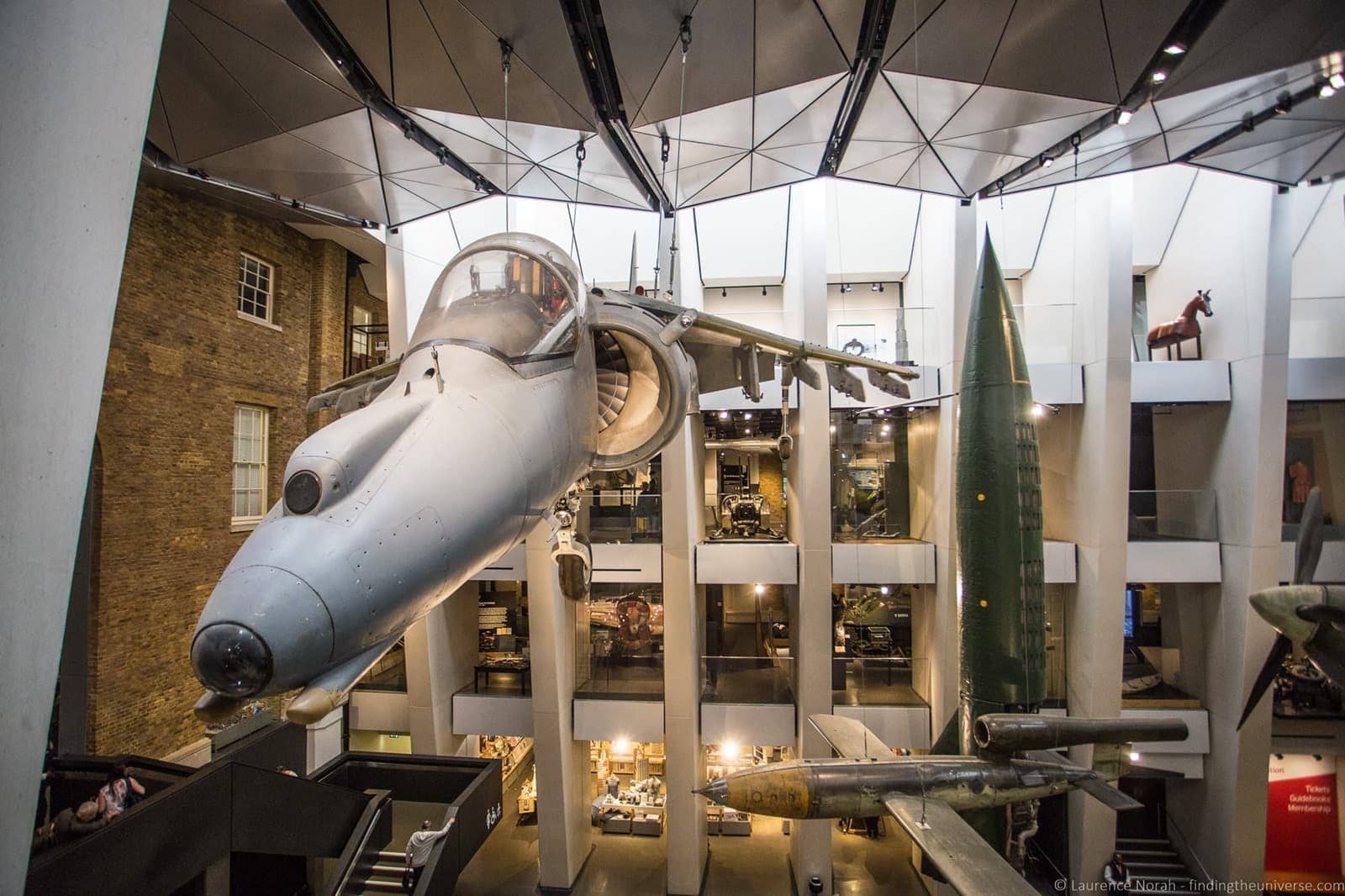
The atrium is the bit everyone photographs (a Harrier jet and a Spitfire hanging from the ceiling, a 14-metre V-2 rocket standing upright in the middle of the floor), but the museum’s real heart is upstairs.
The First World War Galleries take you through the war chronologically, the Second World War Galleries do the same, and the Holocaust Galleries are the best of their kind anywhere in Europe. The Holocaust Galleries are heavy going (rightly), so if you’re visiting with younger kids, IWM’s guidance is that they’re not recommended for children under 14.
Other permanent galleries cover the Holocaust, espionage and the Special Forces (the Secret War), Northern Ireland, and War to Windrush.
You could spend half a day here without trying. We’ve come back multiple times over the years and still haven’t seen everything.
Useful info: Free entry (special exhibitions sometimes have a fee). Open daily 10am-6pm. Closest tube stations: Lambeth North, Waterloo, Elephant & Castle. Plenty of buses too. Official site here.
2. Churchill War Rooms
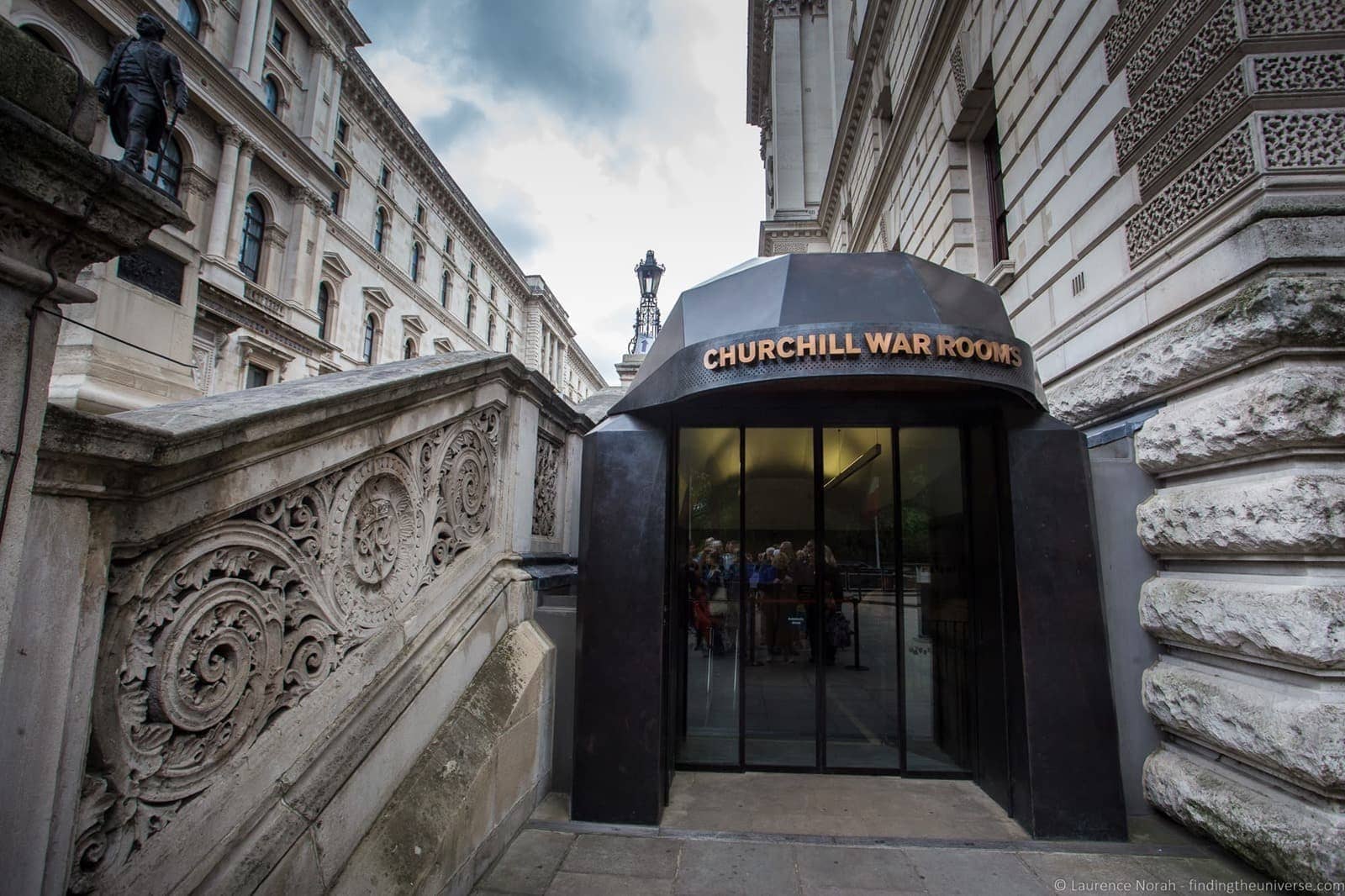
The Churchill War Rooms are part of the Imperial War Museums, and they sit in the actual underground bunker where Winston Churchill and the British government coordinated the Second World War. The complex was locked up at the end of the war and reopened to the public in 1984, largely as it was the day after Japan’s surrender in August 1945 (when the lights in the Map Room were finally switched off), which makes it one of the more atmospheric museums you can visit anywhere.
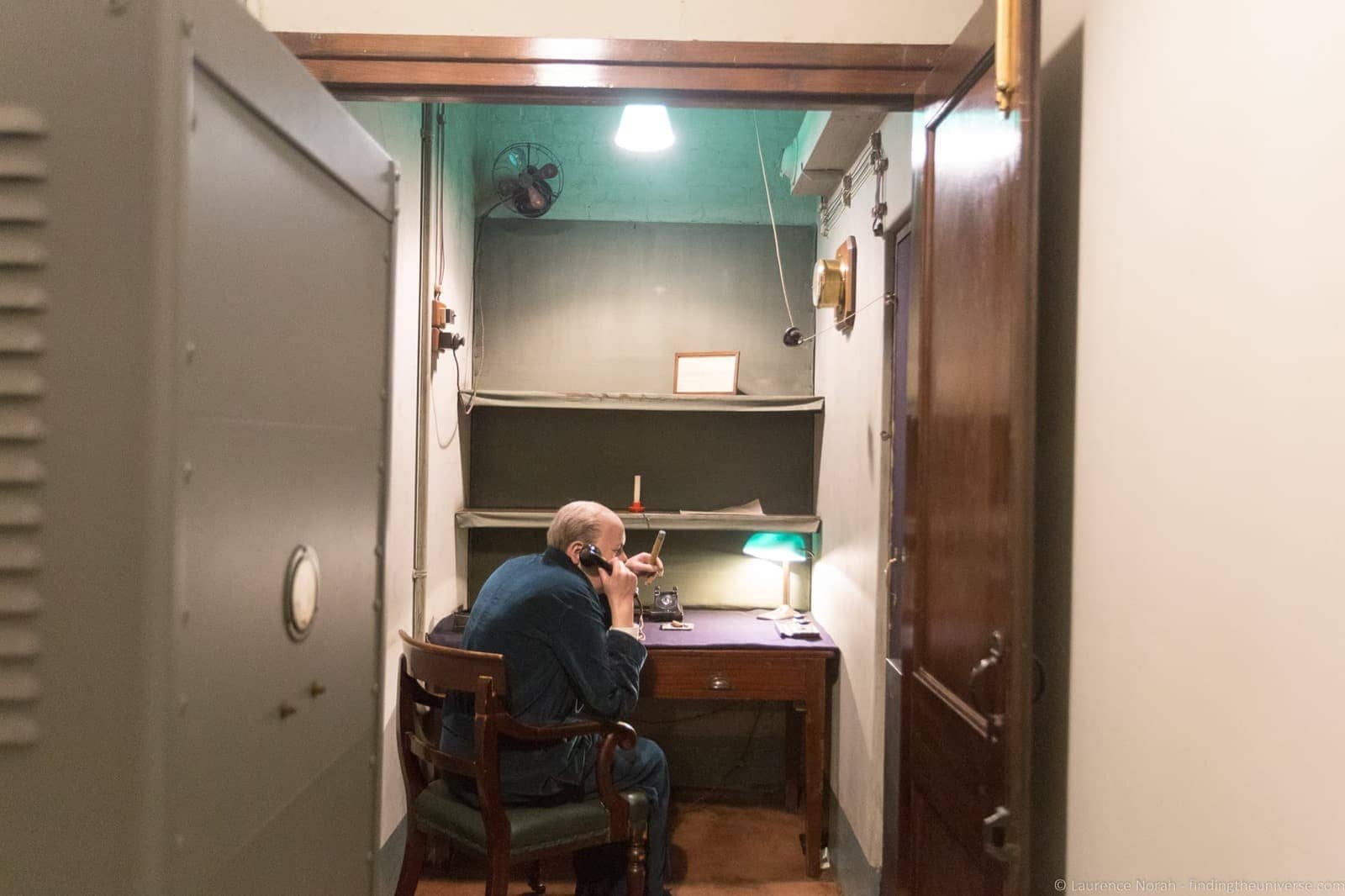
The site is split into two halves. The first is the Cabinet War Rooms themselves: a warren of low corridors and small rooms, where you’ll see Churchill’s bedroom, the Map Room with its original wall maps and pencil-marked notes, the Transatlantic Telephone Room (a converted broom cupboard, basically) where Churchill spoke to Roosevelt, and the Cabinet Room where the war was actually run.
The second half is the Churchill Museum, which tells the story of the man himself, from his birth at Blenheim Palace through his political career, including a walk-in interactive timeline of his life and the original door from 10 Downing Street.
This is one of the most popular museums in London. The queues for walk-up tickets can be brutal, especially in summer or on weekends. Book online in advance for a timed slot and you’ll skip the worst of it (though you may still queue briefly at security). Allow at least two hours, ideally three. If you’re a Churchill enthusiast, take a look at Jess’s guide to Churchill sites in England, which covers the wider trail beyond London.
Useful info: Tickets currently from £33 adult, with discounts for children, students, and concessions. Open daily 9.30am-6pm (closed 24-26 December). Closest tube: Westminster. Book online here. If you want a guided experience, the Churchill War Rooms are also included on this WWII Westminster walking tour via GetYourGuide.
3. Royal Air Force Museum London
I’ll admit my bias up front. I love anything to do with flying, so the RAF Museum London was always going to be a favourite. It’s also free, which never hurts.
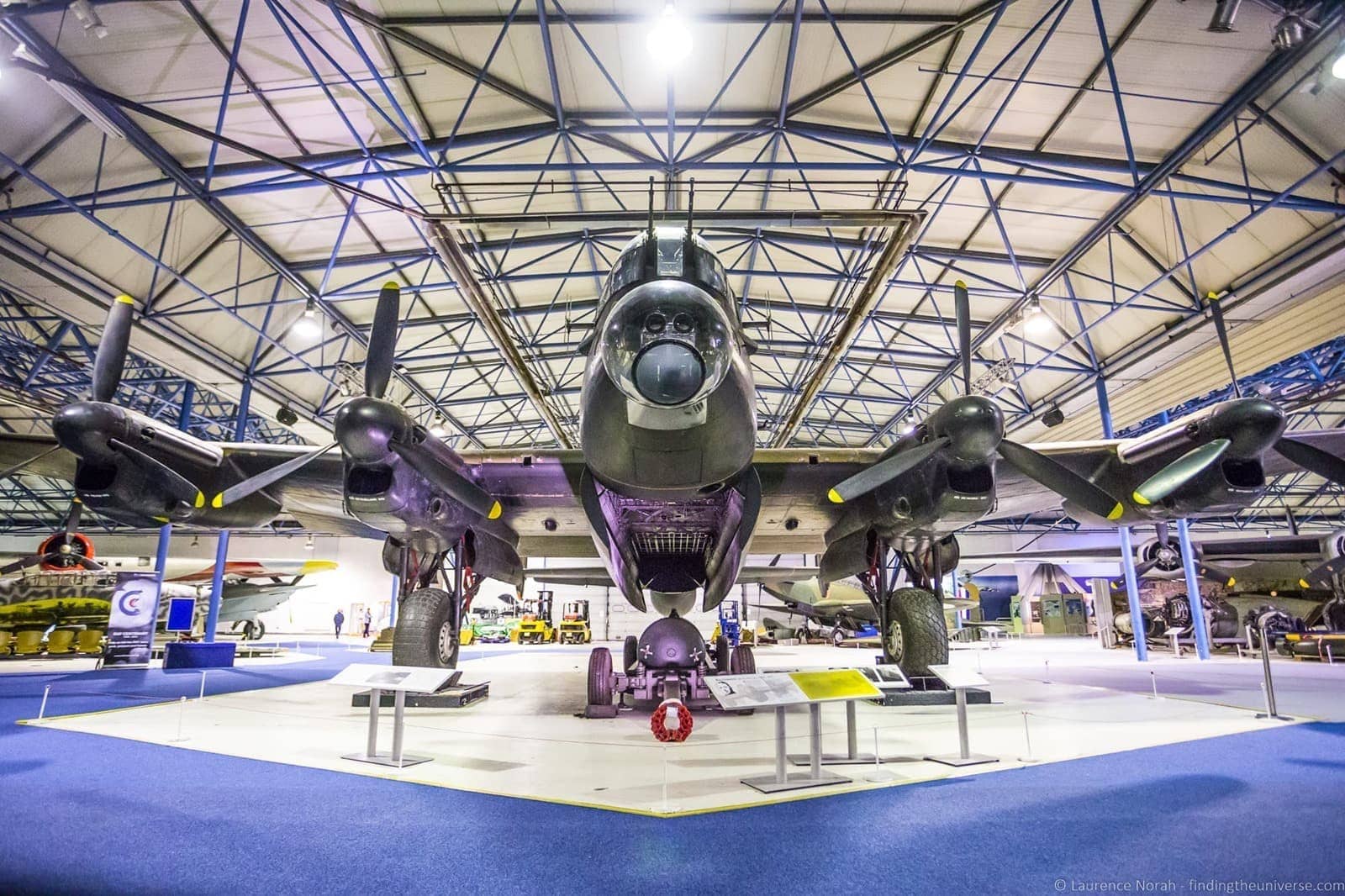
The site is the former Hendon Aerodrome in Colindale, north London, and it spans six hangars with over a hundred aircraft inside. Sopwith Camels and other early biplanes through to modern fast jets, with the famous in-betweens (Spitfire, Hurricane, Lancaster Bomber, Vulcan) all present. The Battle of Britain hangar and the Bomber Command exhibition are the headline attractions, but it’s the sheer scale of the place that gets you. You walk into one hangar, look around, and realise there are five more.
The flight simulators and 4D experiences cost extra, and they’re worth it if you’ve got kids in tow. Allow at least half a day, possibly a full day if you’re an aviation enthusiast or you’ve got the kind of child who’ll happily stare at a Spitfire for forty minutes.
The trek out to Colindale is the only catch. It’s the end of the Northern Line (about 30-40 minutes from central London), and Colindale tube is a 10-minute walk from the museum. There’s free parking on site if you’re driving.
Useful info: Free entry. Open daily, paid attractions inside (simulators, films, cockpit experiences). Closest tube: Colindale (Northern Line). Official site here.
4. National Army Museum
The National Army Museum in Chelsea is the official museum of the British Army, and it covers the full sweep of British military history from the English Civil Wars in the 1640s right up to recent operations in Afghanistan and Iraq. It re-opened in 2017 after a major redevelopment, and the layout actually works.
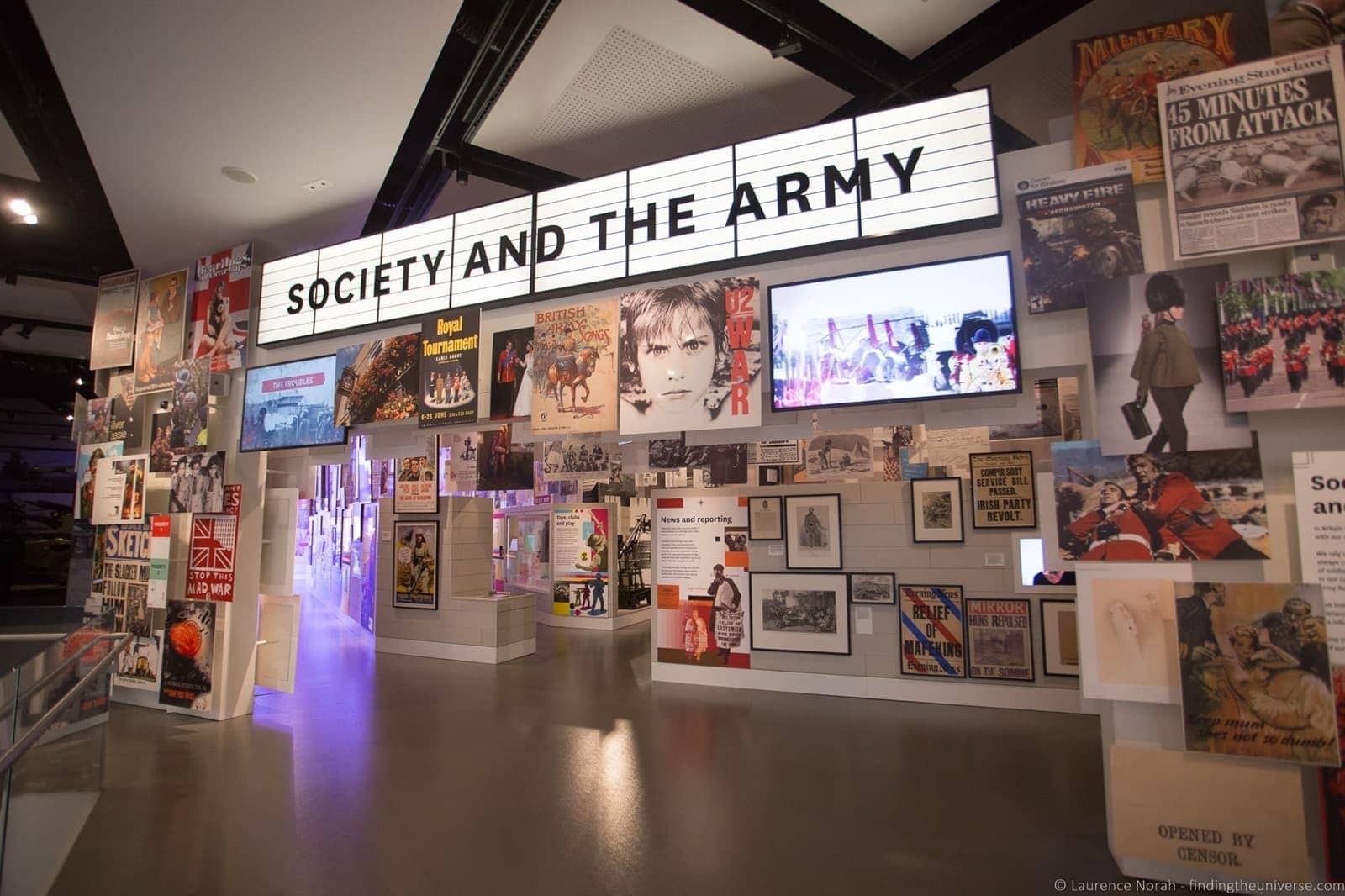
The galleries are arranged across five themes: Soldier, Army, Battle, Society, and Insight. The Soldier gallery walks you through the changing daily life of a British soldier across the centuries (uniforms, kit, food, pay), the Army gallery covers structure and evolution, the Battle gallery focuses on key battles and tactics, the Society gallery looks at how the Army and British society have shaped each other, and the Insight gallery covers global impact. It’s interactive without being gimmicky, and the artefact selection is strong (Lawrence of Arabia’s robes, the tunic of an officer wounded at the Somme, a Churchill Mk VII tank you can climb on, that sort of thing).
The Action gallery and Play Base soft play area mean it’s also one of the better London museums for families with younger kids. Allow two to three hours.
Useful info: Free entry. Open daily 10am-5.30pm (closed 25-26 December and 1 January). Closest tube: Sloane Square (5-minute walk). Official site here.
5. National Maritime Museum
This is technically a maritime museum rather than a military one, but it covers so much British naval history (Trafalgar, the First World War sea battles, the eighteenth-century navy in detail) that it earns a place on this list. And if you want a dedicated Royal Navy museum, the National Museum of the Royal Navy is in Portsmouth rather than London (about 90 minutes by train from Waterloo). Worth knowing if you’re a serious naval history enthusiast and you’re prepared to make a day of it.
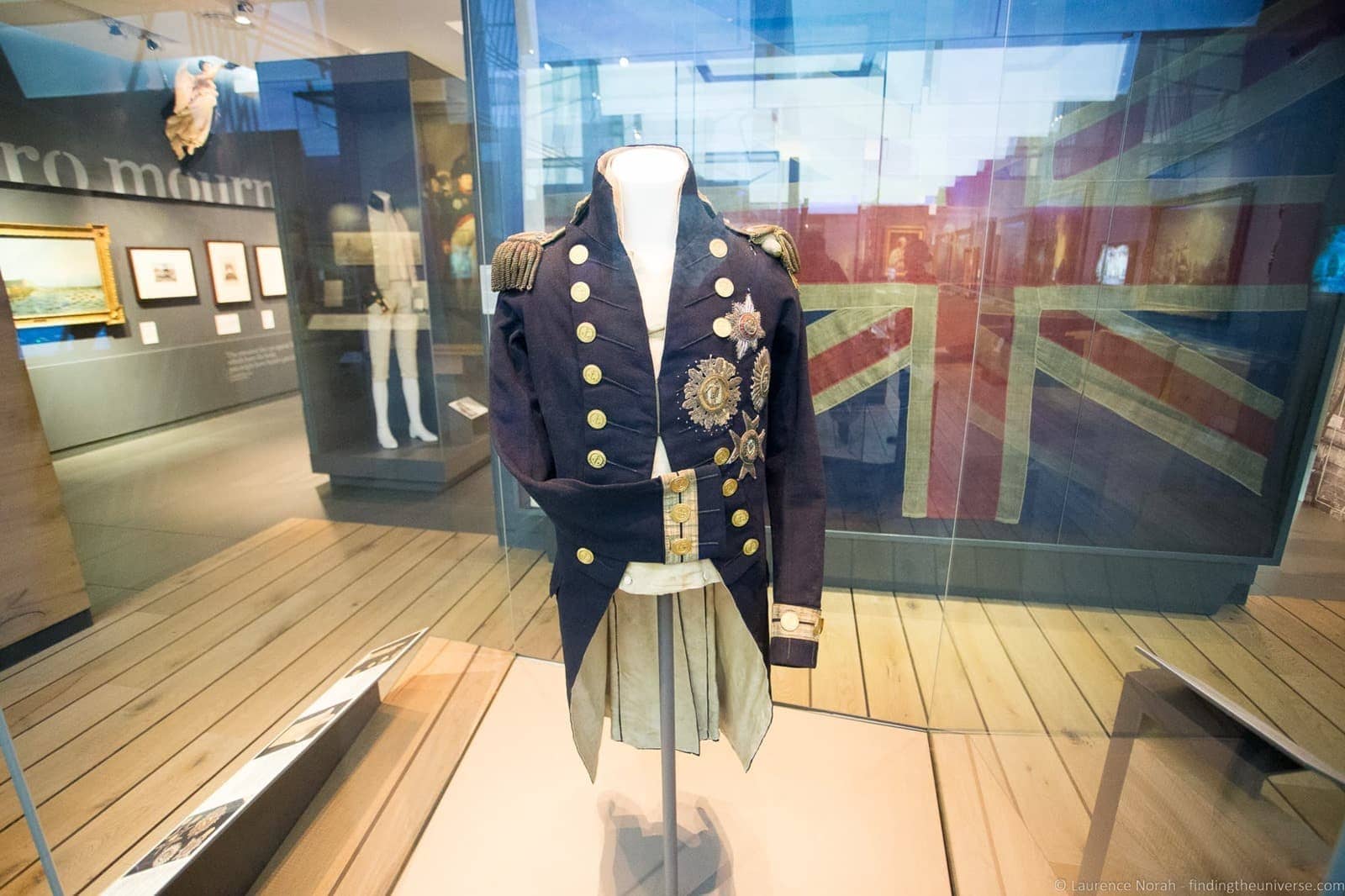
The National Maritime Museum is in Greenwich, on the south bank of the Thames, and it’s part of the Royal Museums Greenwich group. The “Nelson, Navy, Nation” gallery is the main draw for naval-history visitors, charting the Royal Navy from 1688 to 1815, and including the actual jacket Nelson was wearing when he was shot at Trafalgar (bullet hole and all). The wider collection covers exploration, trade, and Britain’s involvement in the Atlantic slave trade in a substantial dedicated gallery.
The other thing about Greenwich is that you really shouldn’t go just for the Maritime Museum. The Cutty Sark (the last surviving tea clipper) is a five-minute walk away, the Royal Observatory and the Prime Meridian are up the hill, and the Painted Hall at the Old Royal Naval College is one of the most spectacular interiors in London. Make a day of it. Boat from Westminster or Tower Bridge if you want to do it properly, or DLR from Bank if you don’t.
Useful info: Free entry (temporary exhibitions sometimes ticketed). Open daily 10am-5pm (closed 24-26 December). Reach by tube/DLR (Cutty Sark for Maritime Greenwich), train (Greenwich), or boat. Official site here.
6. HMS Belfast
HMS Belfast is moored on the Thames just east of Tower Bridge, and she’s the most hands-on of the lot. A Royal Navy light cruiser commissioned in 1939, she saw action in the Second World War (including providing bombardment support for the D-Day landings) and the Korean War, retired from active duty in 1963, and opened to the public as a museum ship in 1971. She became part of the Imperial War Museums in 1978.
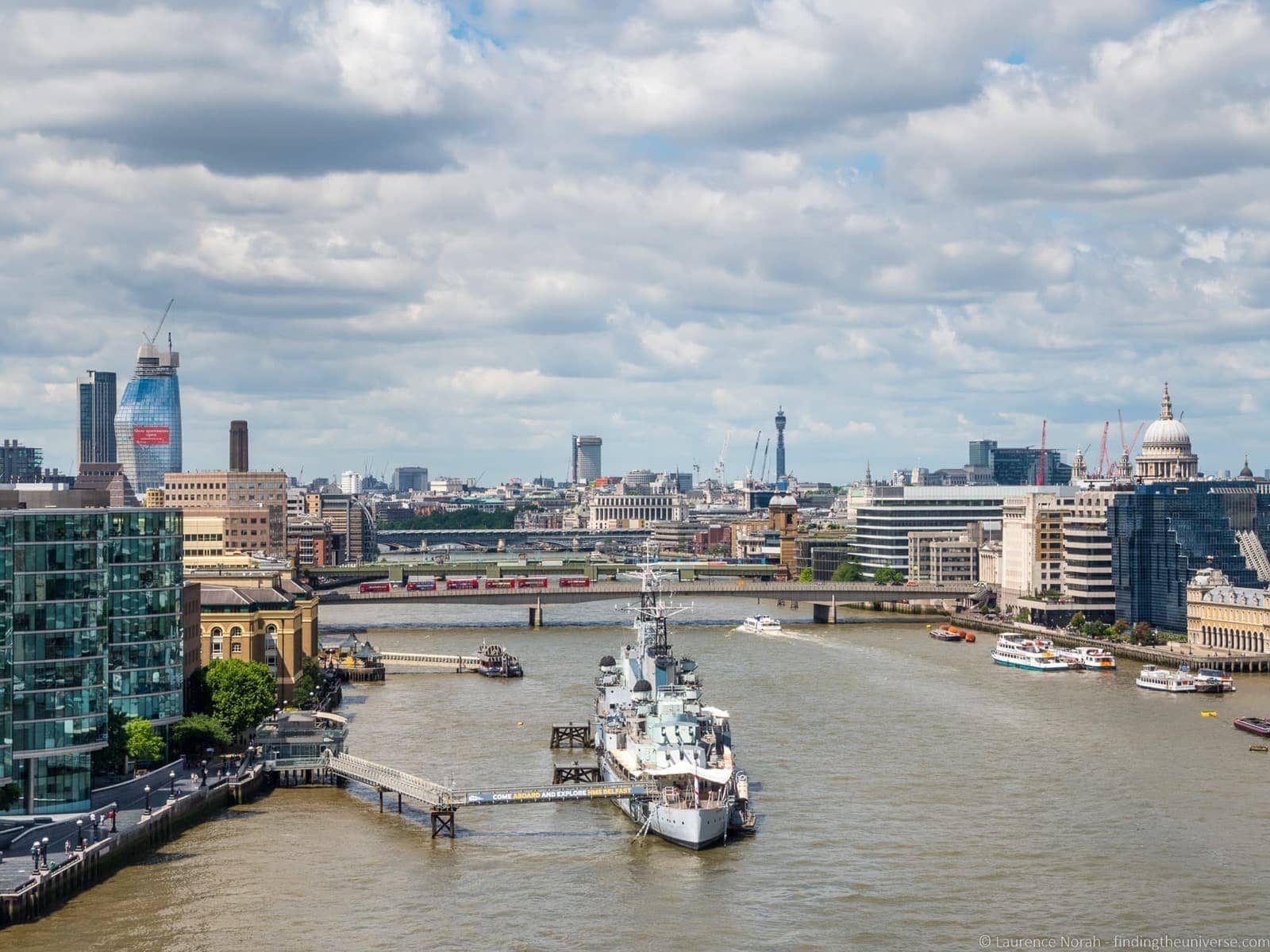
The whole ship is open to visitors, all nine decks of her, from the bridge down to the boiler rooms (which are a serious climb, fair warning). You’ll see the messes where the crew of up to 950 men ate and slept, the gun turrets, the operations rooms, and the captain’s quarters. There’s a strong emphasis on what daily life was actually like aboard, both during action and in peacetime. Kids tend to love HMS Belfast because there’s so much to climb on, and it does count as a small workout (those ladders are not friendly).
Allow at least two hours. Book online in advance for a timed slot, especially in summer (the old “buy at the gangway” approach has effectively been retired and you’ll save yourself a queue).
Useful info: £26.80 adult, with child and concession rates. Open daily, opening hours vary by season (typically 10am-6pm summer, 10am-5pm winter). Weather can affect deck access. Closest tube: London Bridge (5-minute walk). Book online here.
7. Household Cavalry Museum
The Household Cavalry Museum is right in the middle of London, at Horse Guards on Whitehall, and it’s the official museum of the two most senior regiments in the British Army (the Life Guards and the Blues and Royals, who together form the Household Cavalry, the Sovereign’s mounted bodyguard). The regiments date back to 1661, when Charles II raised them shortly after his restoration to the throne.
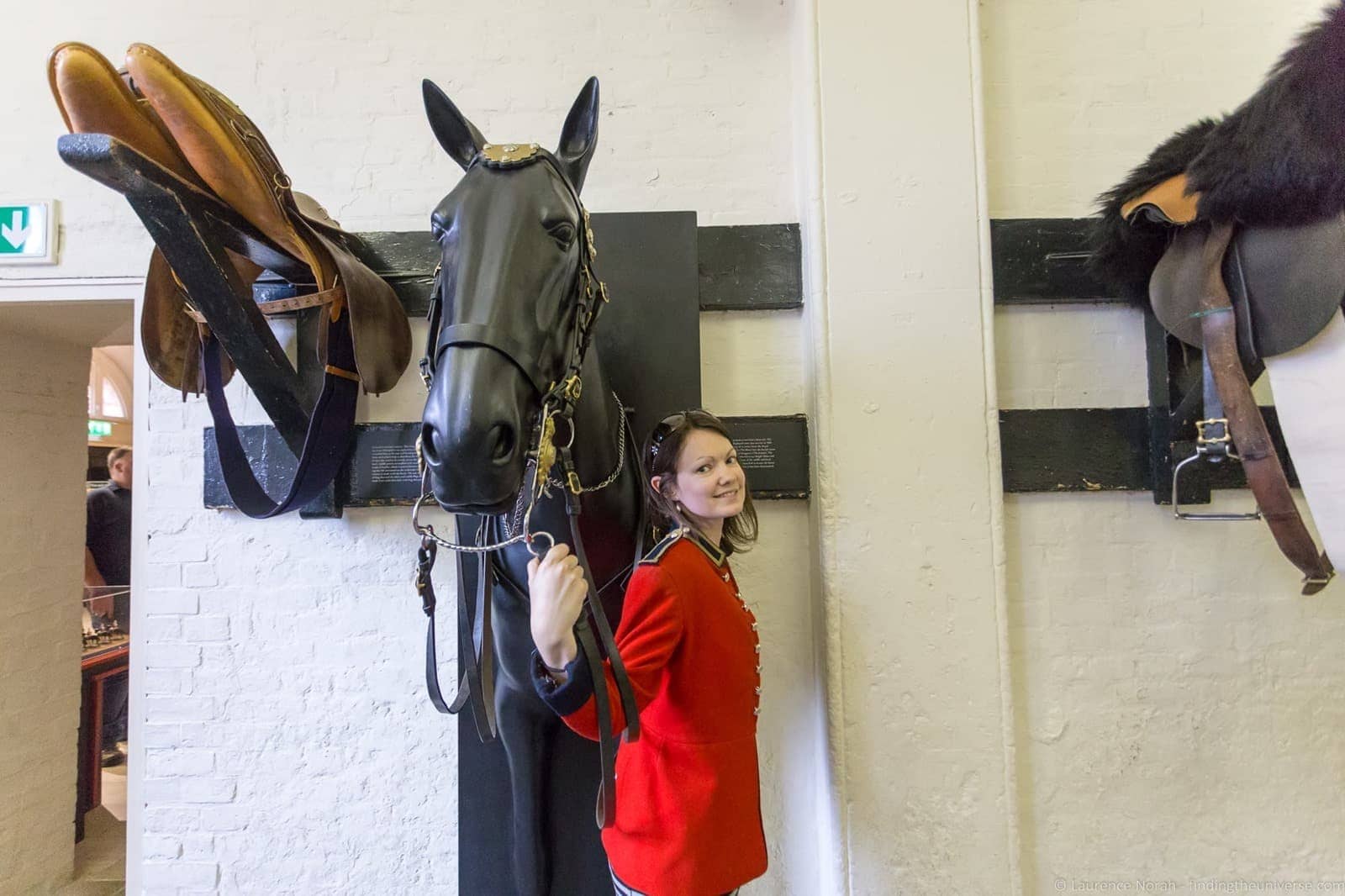
The museum sits inside the working 18th-century Horse Guards stables, and one of its better tricks is that you can see the actual horses being looked after through a glazed partition while you’re going round the exhibition. The collection covers the regiments’ history, their ceremonial duties (which are the bit most visitors recognise), and their modern operational roles, with uniforms, standards, awards, and a try-on station where you can have a go at the ceremonial breastplate and helmet (heavier than you’d expect, in the way that all reproduction historical kit is heavier than you’d expect).
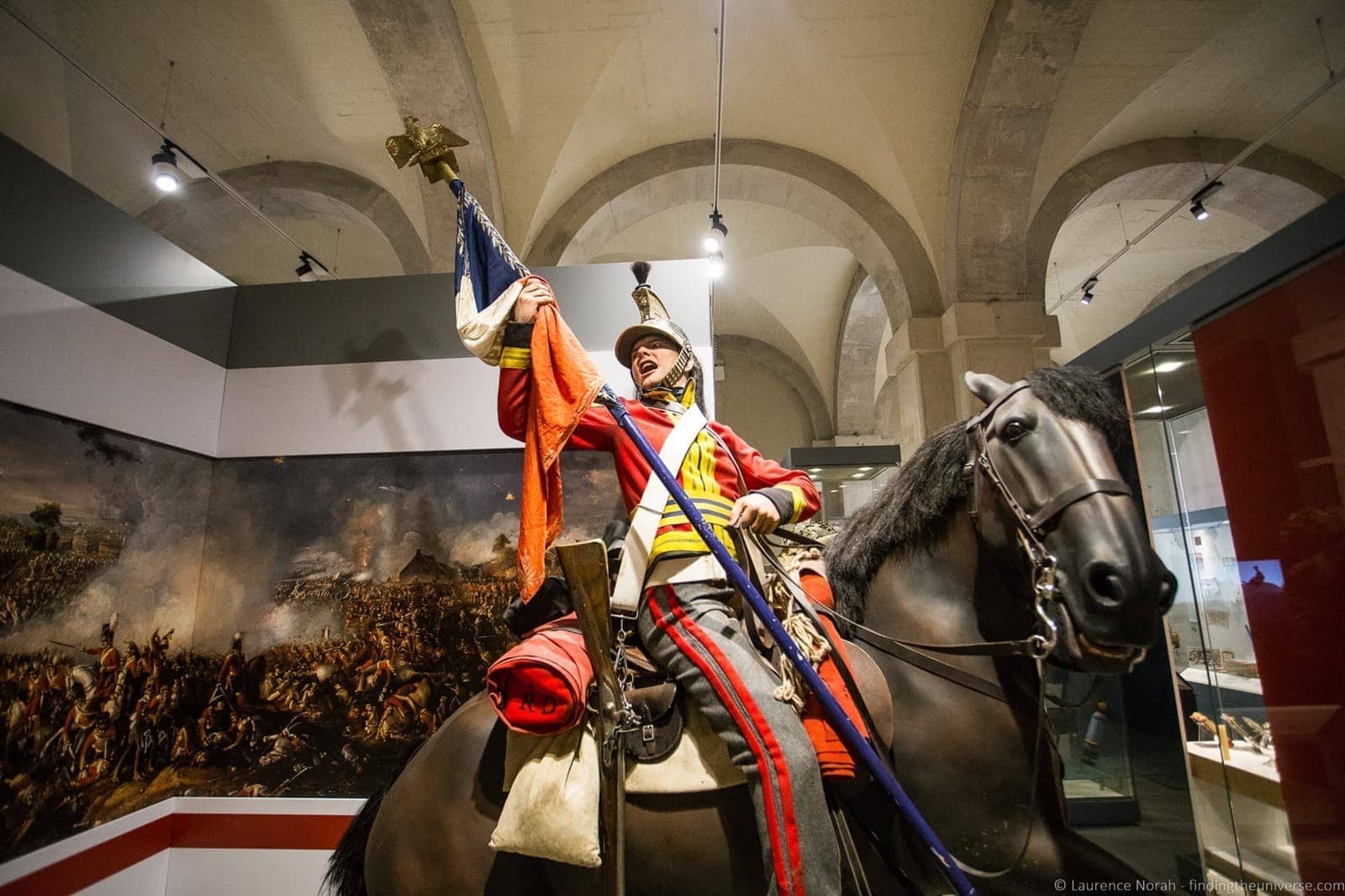
Time it right and you can also catch the Changing of the King’s Life Guard outside (Mondays, Wednesdays, Fridays at 11am, with a shorter inspection on other weekdays at 11am and the daily 4pm dismounting ceremony every day). All free to watch, no museum ticket required, and frankly an underrated alternative to the much more famous (and much more crowded) Buckingham Palace Changing of the Guard a few hundred metres away.
Useful info: £11 adult, £9.50 over-60s, £8 child 5-15, £29 family. Open daily, 10am-6pm April-October, 10am-5pm November-March (last admission one hour before closing). Closed annually for Marathon Day, Easter Friday, and 24-26 December. Closest tube: Westminster, Charing Cross, or Embankment. Free entry with the London Pass. Official site here.
8. Guards Museum
The Guards Museum, tucked away at Wellington Barracks on Birdcage Walk (right next to St James’s Park), is the museum of the five regiments of Foot Guards: the Grenadier, Coldstream, Scots, Irish, and Welsh Guards. Together with the Household Cavalry, they form His Majesty’s Household Division.
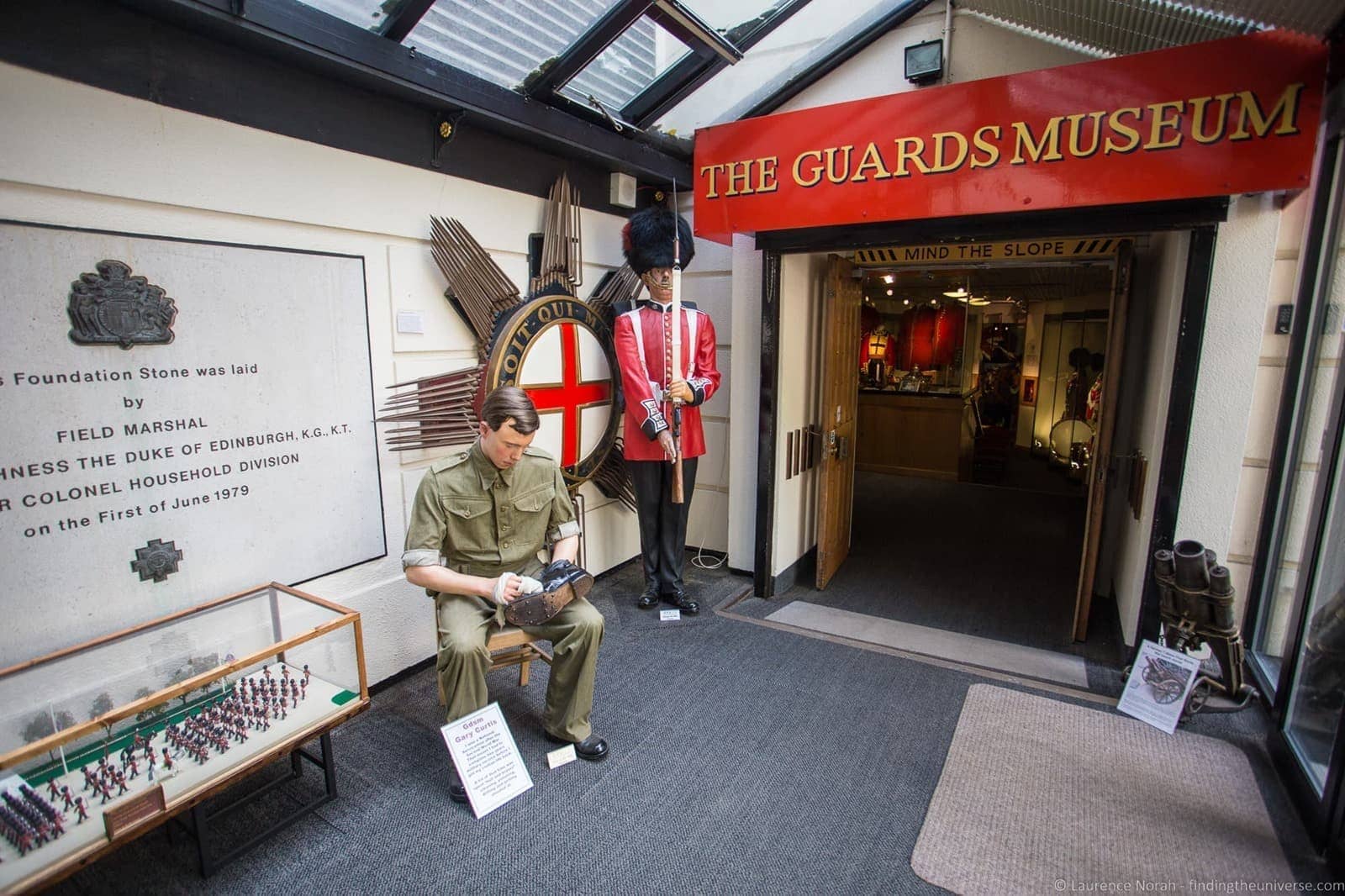
The collection is detailed and well presented, with uniforms and artefacts from each regiment and good explanations of what the Guards actually do beyond standing very still in red tunics outside Buckingham Palace. It started life as an education centre for new Guardsmen learning their regimental heritage, and you can feel that lineage in how the displays are pitched.
While you’re there, two extras worth knowing about. The Guards Chapel is opposite the museum, free to enter, and has the regimental colours of the Foot Guards lining the walls (some of them dating back to 1770). And the Guards Toy Soldier Centre, the museum’s on-site shop, is worth a wander even if you’ve no intention of buying. They sell hundreds of beautifully painted toy soldiers, many arranged as set-piece battle dioramas, and it’s the sort of place small children stare at slack-jawed for fifteen minutes. Don’t miss the Guards Memorial just opposite Horse Guards Parade either, which commemorates Foot Guards killed in conflicts since the First World War.
Useful info: £11 adult, £9 over-65, £8 young person 16-25, £3 child 6-15, under 5 free, £28 family. Open daily 10am-4pm (last entry 3.30pm). Closest tube stations: St James’s Park, Green Park, Victoria. Free entry with the London Pass. Official site here.
A Few Niche Museums Worth Knowing About
The eight above are the big ones, and they’re the ones we’ve been to ourselves. London also has a long tail of smaller, more specialised military museums that we haven’t yet visited, and which are worth knowing about if your interest sits in a specific corner of military history. I’m flagging them upfront here rather than dressing them up as recommendations:
The Polish Institute and Sikorski Museum at 20 Prince’s Gate (Knightsbridge) is the leading UK museum and archive for Polish forces during the Second World War, the Polish government-in-exile (which was based in London), and the Polish contribution to the Allied war effort. Open Tuesday-Friday afternoons and the first Saturday of the month. The Royal Armouries collection at the Tower of London is Britain’s oldest museum, and houses the national collection of arms and armour (it’s included with Tower of London admission, see our Tower of London guide for the full visit). The Royal Hospital Chelsea (next door to the National Army Museum) is home to the Chelsea Pensioners and offers tours led by the Pensioners themselves, which by all accounts are excellent. There’s also the Florence Nightingale Museum at St Thomas’ Hospital, which is small but well-regarded, and the Inns of Court & City Yeomanry Museum on Lincoln’s Inn Fields. For families researching ancestors, the IWM Memorial Register is the place to start; it’s the UK’s national database of war memorials.
If we get to any of these in person, I’ll come back and update this section properly. For now, the URLs are the best pointer I can offer.
London War Memorials
London has more war memorials than you can reasonably visit in a single trip (the IWM Memorial Register lists thousands across the UK), but most of the significant ones are concentrated in two clusters: a roughly half-mile stretch around Whitehall and Westminster, and a smaller cluster around Hyde Park Corner.
Below I’ve covered the ones I think are worth your time, and then I’ve put together a walking route through the central cluster so you can see most of them in a single afternoon. The memorials themselves are all free to visit.
1. The Cenotaph
The Cenotaph stands on Whitehall, halfway between Trafalgar Square and Parliament Square, and it’s the UK’s official national war memorial. It was originally put up in 1919 as a temporary timber-and-plaster structure for the Peace Day parade after the First World War, and the public response was so overwhelming that it was rebuilt in Portland stone in 1920 and made permanent.
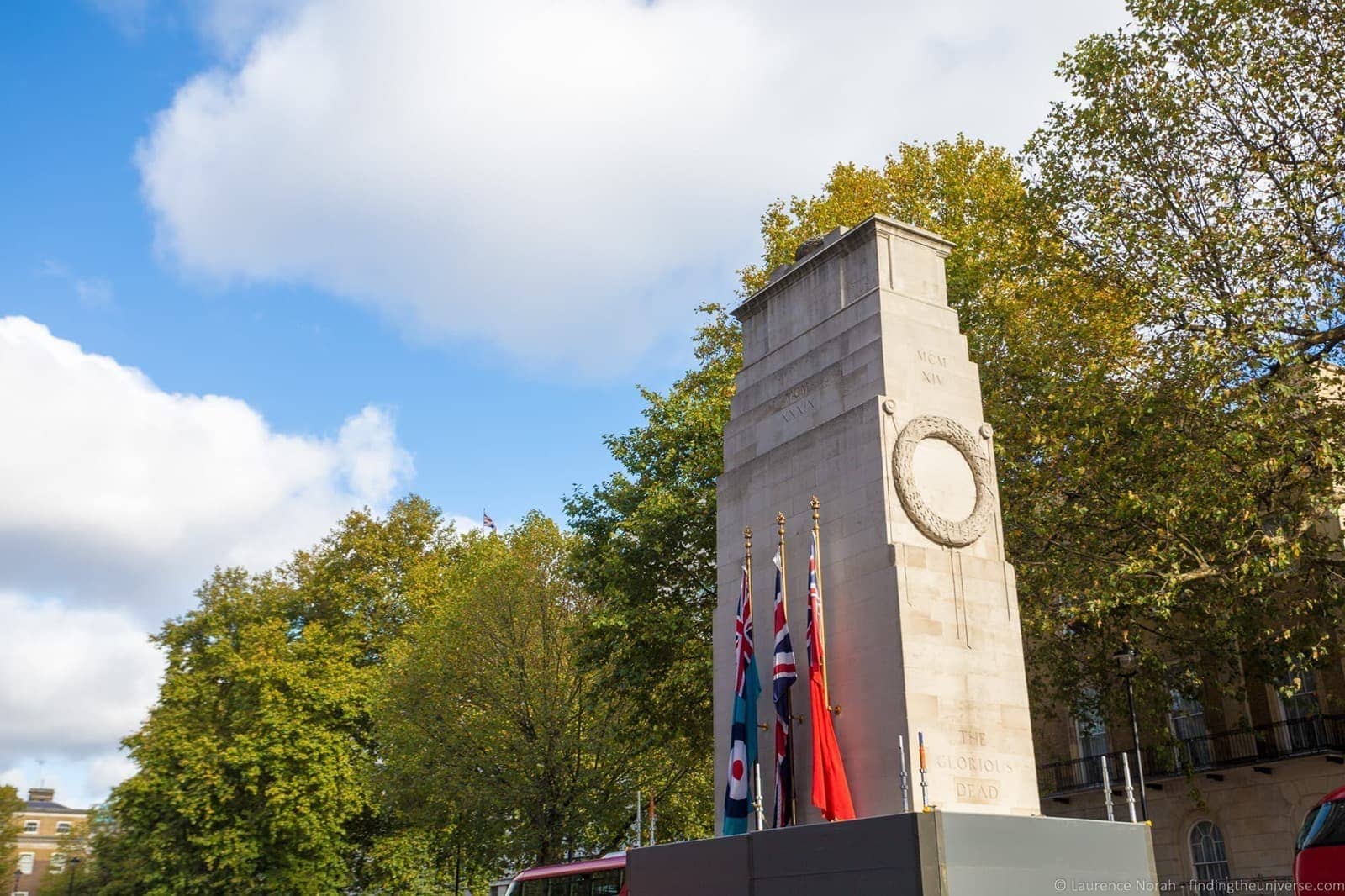
It’s the focal point of the National Service of Remembrance every November, on Remembrance Sunday, when the Royal Family, the Prime Minister, and the heads of the armed forces lay wreaths and the country falls silent. If you’re in London on Remembrance Sunday and you want to see the ceremony, you’ll need to be on Whitehall well before 11am (and you won’t get particularly close, but the atmosphere is unlike anything else).
2. Monument to the Women of World War II
Just up Whitehall from the Cenotaph, in the middle of the road, is the Monument to the Women of World War II. It was unveiled by Queen Elizabeth II in 2005 and dedicated to the work and sacrifice of women during the war. It took an absurdly long time to get built (the campaign ran for years before funding came together) and it’s a strong piece of design: a 22-foot bronze block with seventeen sets of clothes and uniforms hanging on it, each representing a different role women played during the war (nurse, welder, ARP warden, land girl, and so on).
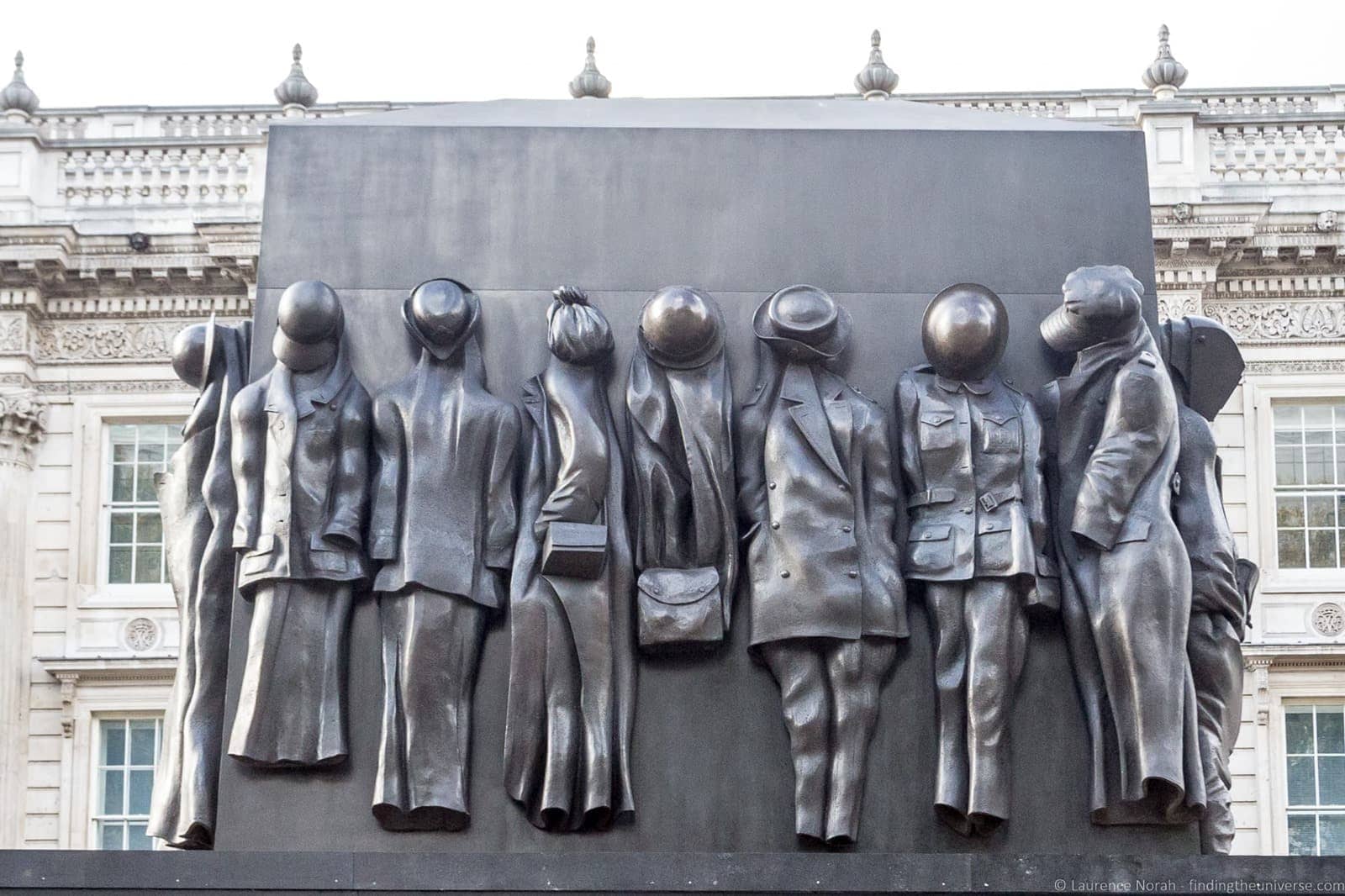
If you walk between this and the Cenotaph, you’ll pass several smaller memorials and statues to other wartime figures, so it’s worth going slowly.
3. Battle of Britain Monument
The Battle of Britain Monument is on the Victoria Embankment, overlooking the Thames, and it commemorates the British and Allied military personnel who fought in the Battle of Britain (the campaign in the summer of 1940 when the RAF defended the UK against the Luftwaffe and arguably saved the country from invasion). Worth knowing the name distinction: the actual Battle of Britain Memorial is at Capel-le-Ferne in Kent. This one in London is officially the Monument.
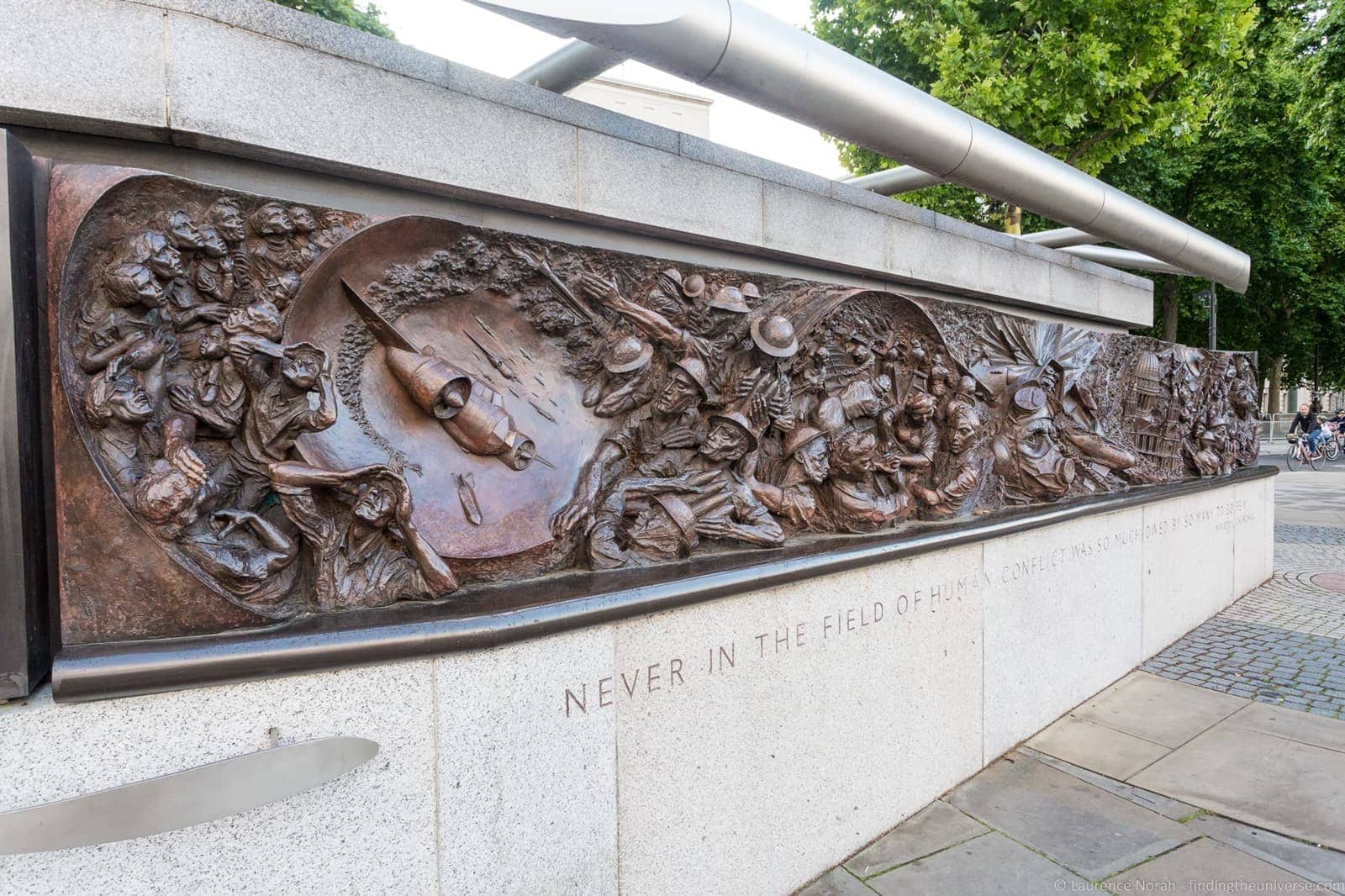
Churchill’s famous line about The Few (“Never in the field of human conflict was so much owed by so many to so few”) is inscribed on the monument, and the 25-metre granite structure carries the names of 2,937 pilots and aircrew from 14 countries who served on the Allied side, all of whom were awarded the Battle of Britain Clasp. The relief sculptures show scenes from the battle (pilots scrambling to their aircraft, ground crew rearming, civilians sheltering in the Underground). It’s not as well-known as the Cenotaph but it’s one of the more affecting memorials in London if you give it time.
4. Animals in War Memorial
The Animals in War Memorial is on the eastern edge of Hyde Park, on Park Lane, and it commemorates the animals (horses, mules, dogs, pigeons, even camels) who served alongside British and Allied forces. The memorial is a curved Portland stone wall depicting various animals, with two heavily laden bronze mules struggling through a gap in the wall in the foreground.
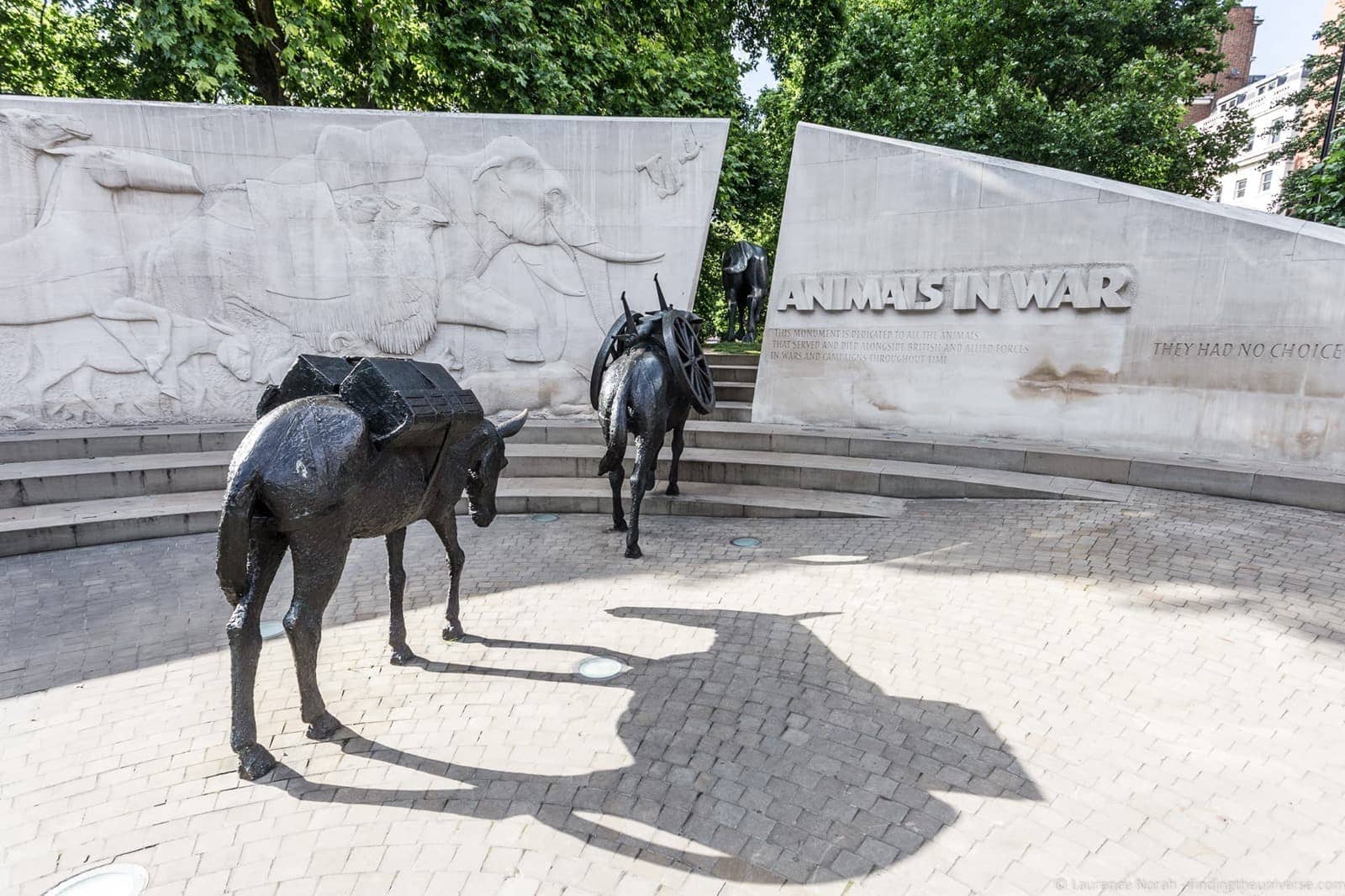
The inscription is the bit that sticks with you: “They had no choice.” It’s hard to walk past it without slowing down. The official site has more on the campaign that built it and the animals it commemorates.
5. Guards Crimean War Memorial
The Guards Crimean Memorial stands on Waterloo Place at the south end of Lower Regent Street, just by St James’s, and it commemorates the British victory in the Crimean War of 1853-56. It was unveiled in 1861 and is now Grade II listed.
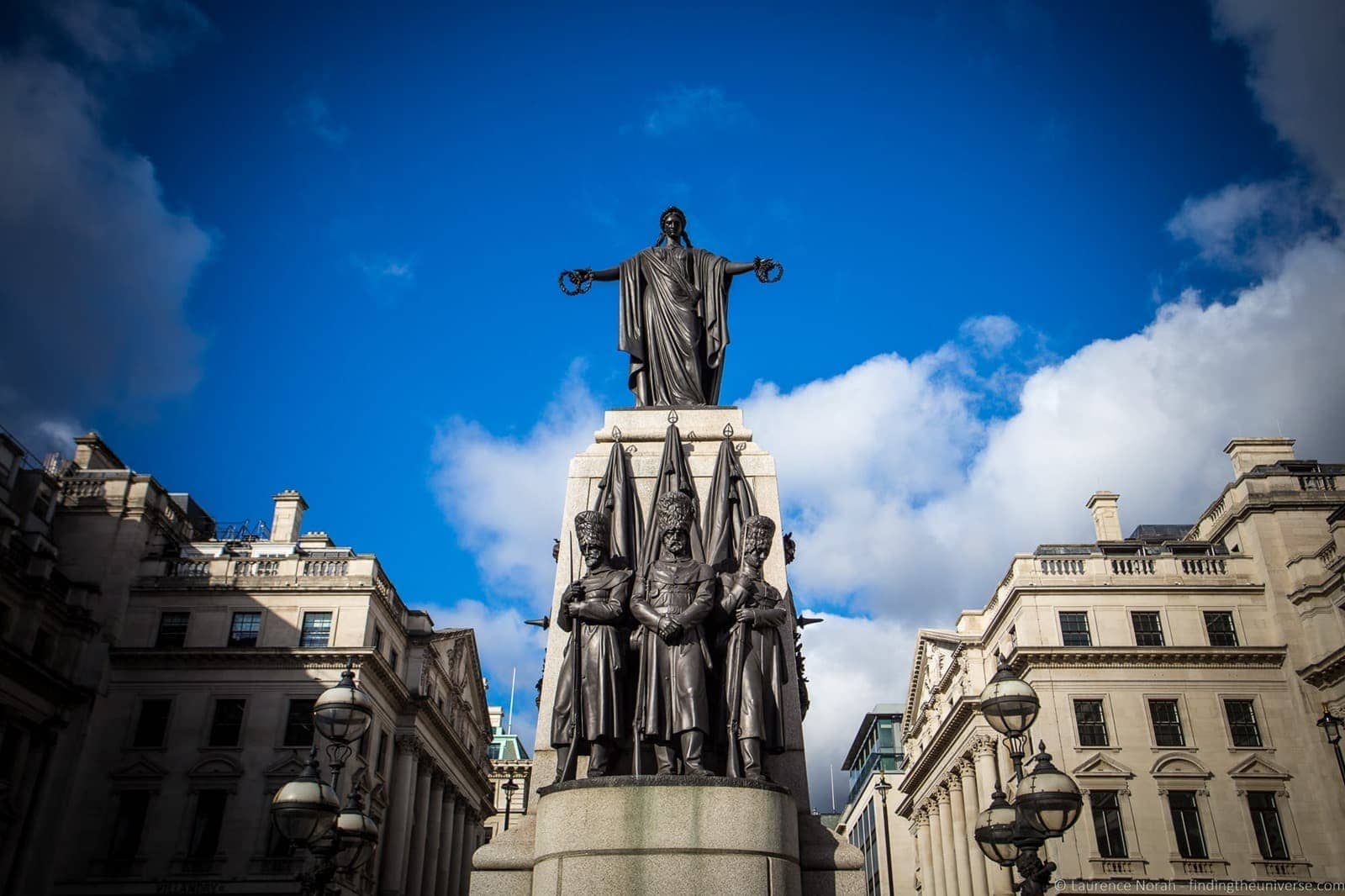
The statue features three Guardsmen with a figure representing Honour above them, cast in bronze melted down from cannons captured at the Siege of Sevastopol. Florence Nightingale and Sidney Herbert (the wartime Secretary at War who recruited her) have flanking statues nearby, added later, which is a nice piece of memorial geography.
6. Bomber Command Memorial
The Bomber Command Memorial sits at the northwest corner of Green Park, just along Piccadilly from Hyde Park Corner. It was unveiled in 2012 and commemorates the airmen who served (and died) in RAF Bomber Command during the Second World War.
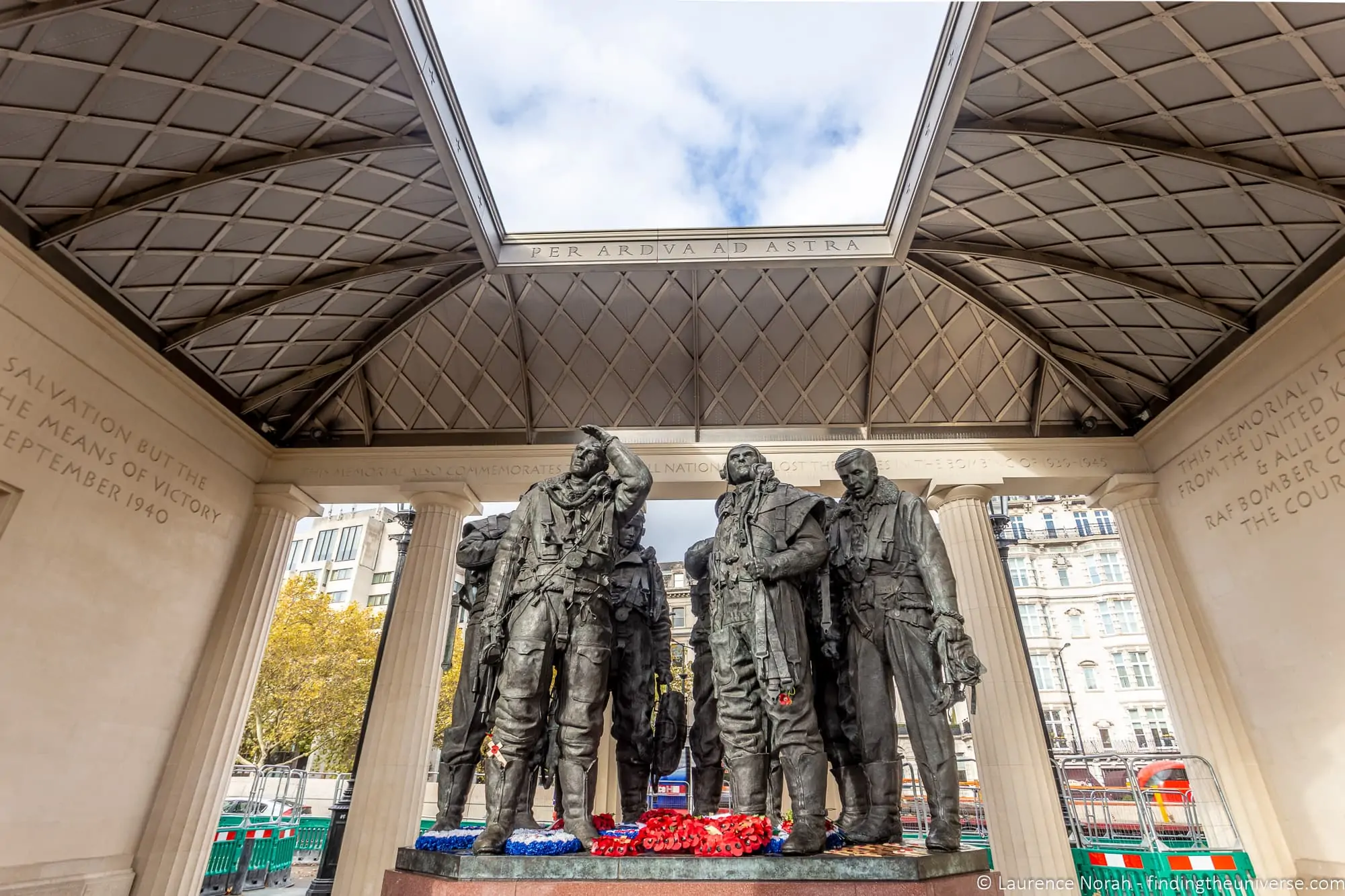
The numbers really put the war into perspective. Of the 125,000 aircrew who served in Bomber Command, 55,573 died: a casualty rate of over 44%, the highest of any major branch of the British armed forces.
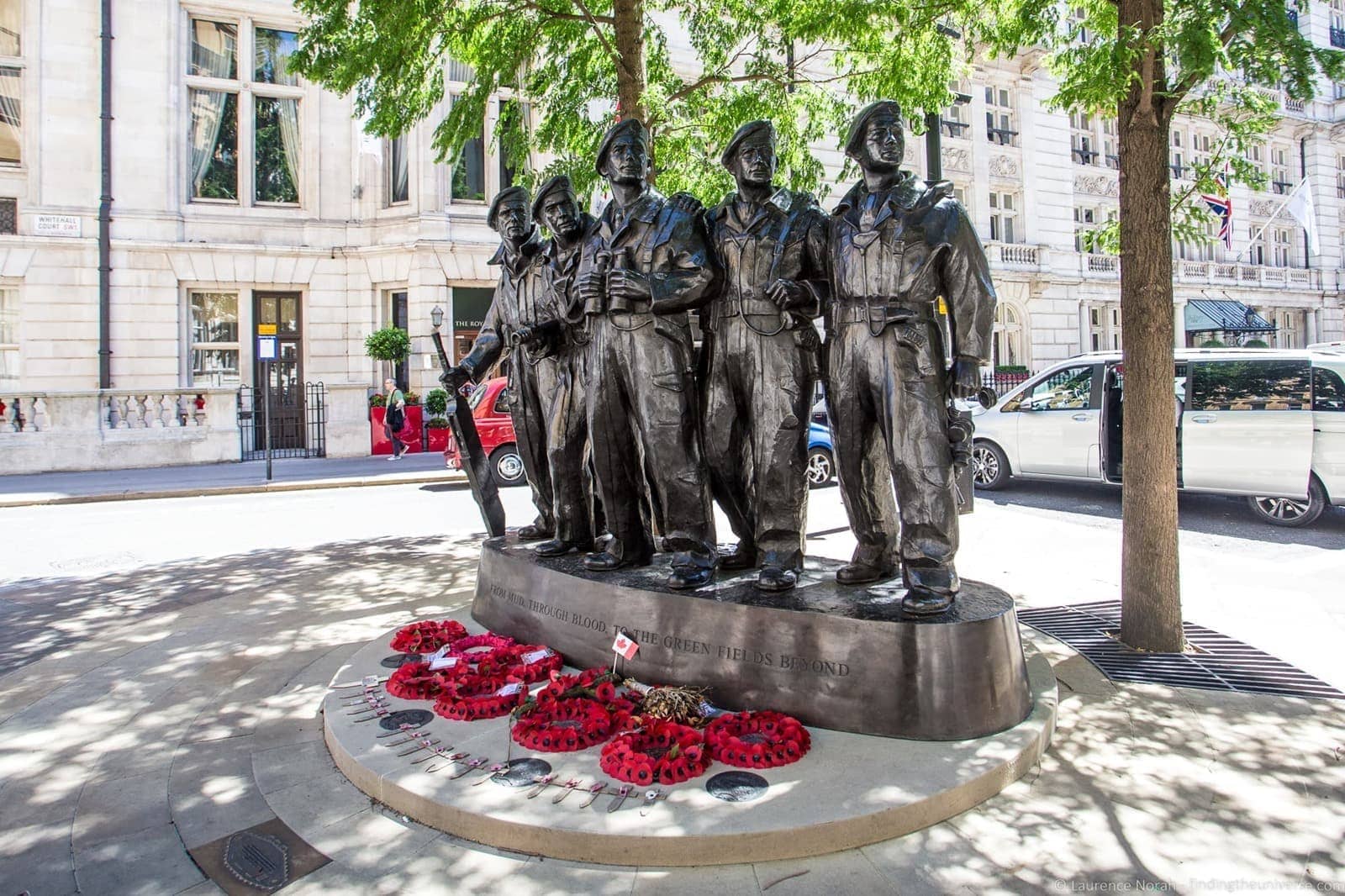
Liam O’Connor’s sculpture inside the memorial pavilion shows a seven-man bomber crew looking upward, each figure representing a different role aboard the aircraft. The memorial took an awkwardly long time to be built (the political controversy around the area-bombing campaigns delayed it for decades), but the result is one of the more affecting memorials in central London. Worth pausing.
7. Wellington Arch and the Hyde Park Corner Cluster
Wellington Arch is the large triumphal arch at Hyde Park Corner, originally built in the 1820s as an entrance to Buckingham Palace, later moved and repurposed as a victory arch celebrating Wellington’s defeat of Napoleon. You can climb to the top for views over Hyde Park and Buckingham Palace gardens (it’s run by English Heritage, modest entry fee).
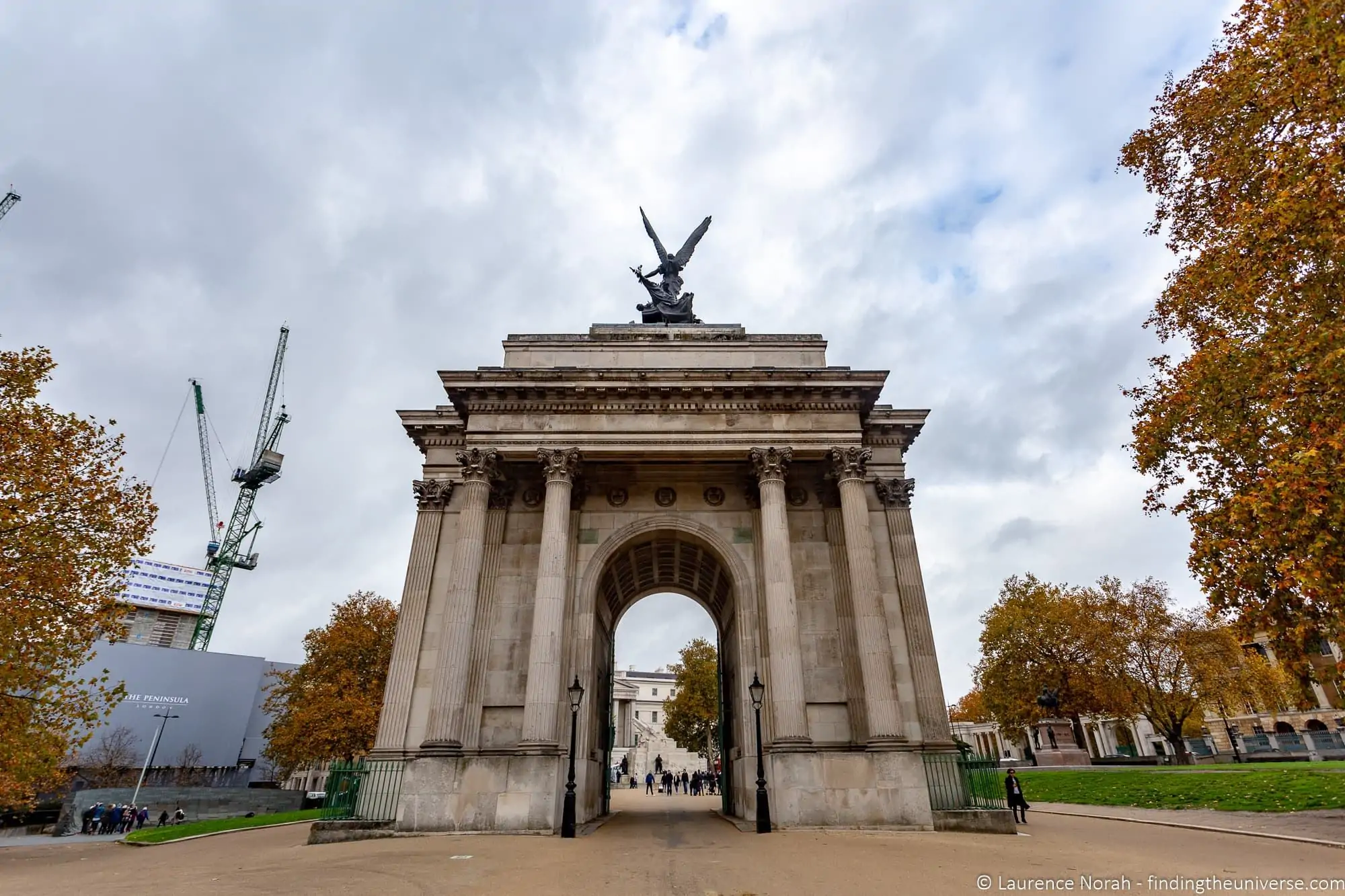
What makes Wellington Arch worth specifically including in a memorial visit, though, is the cluster of memorials around it. Within a 100-metre walk you’ve got the Royal Artillery Memorial (one of the most powerful First World War memorials in the city, with its enormous stone howitzer), the Australian War Memorial, the New Zealand War Memorial, the Commonwealth Memorial Gates (which honour the five million volunteers from the Indian subcontinent, Africa, and the Caribbean who served in both World Wars), and the Machine Gun Corps Memorial. Add the Animals in War Memorial just down Park Lane and you’ve got a self-contained 30-minute memorial walk in its own right.
8. Imperial Camel Corps Memorial
The Imperial Camel Corps Memorial is in Victoria Embankment Gardens, very close to the Battle of Britain Memorial. It commemorates a relatively short-lived First World War mounted infantry brigade that operated in Egypt, Sinai and Palestine between 1916 and 1918, and depicts a camel-mounted soldier on a small plinth.
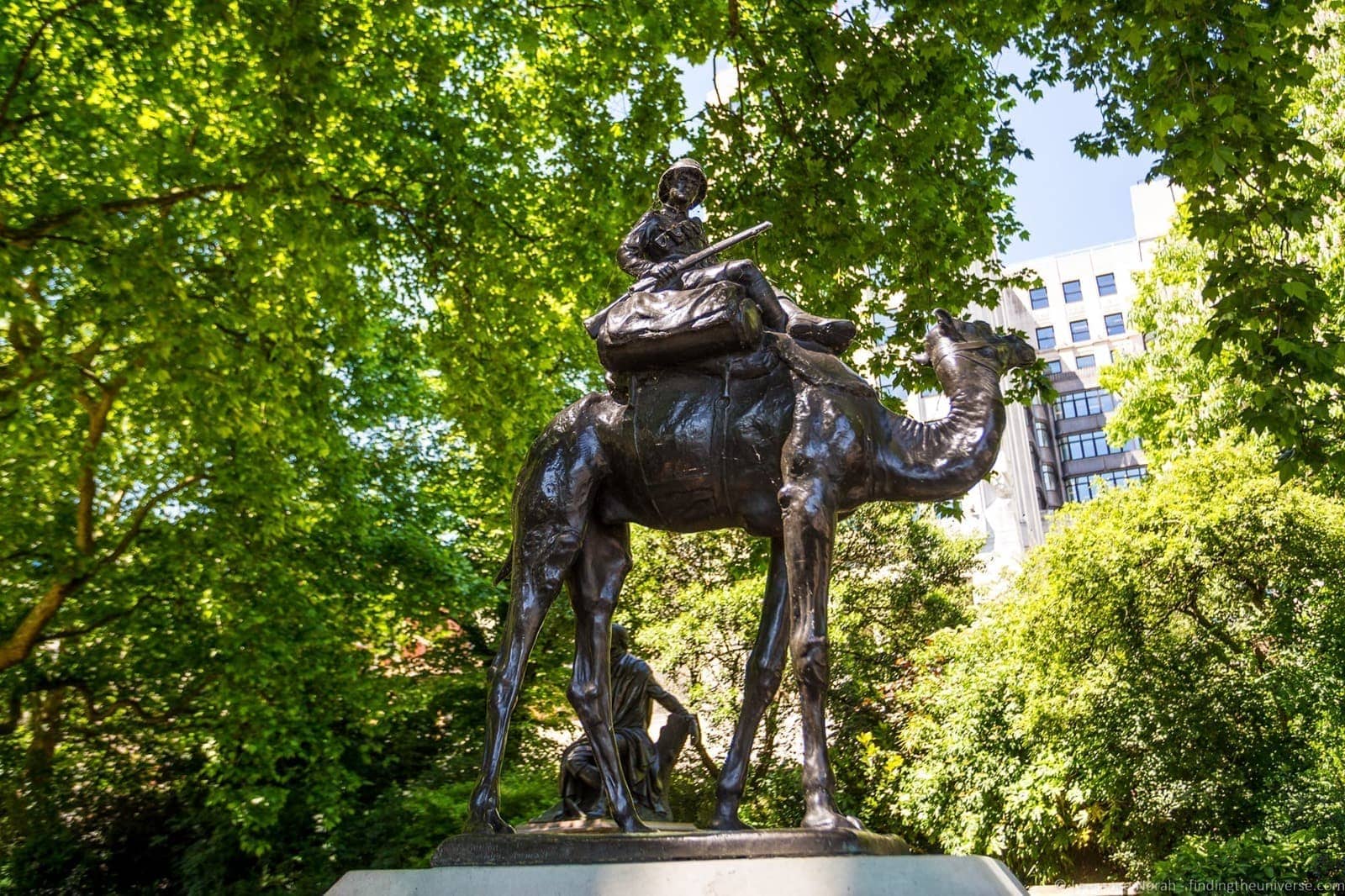
It’s small, it’s easy to walk past, and it lists the 346 men of the Camel Corps who died in service. Worth pausing if you’re already in the Embankment Gardens for the Battle of Britain Memorial (which most people are).
And a few statues worth detouring for
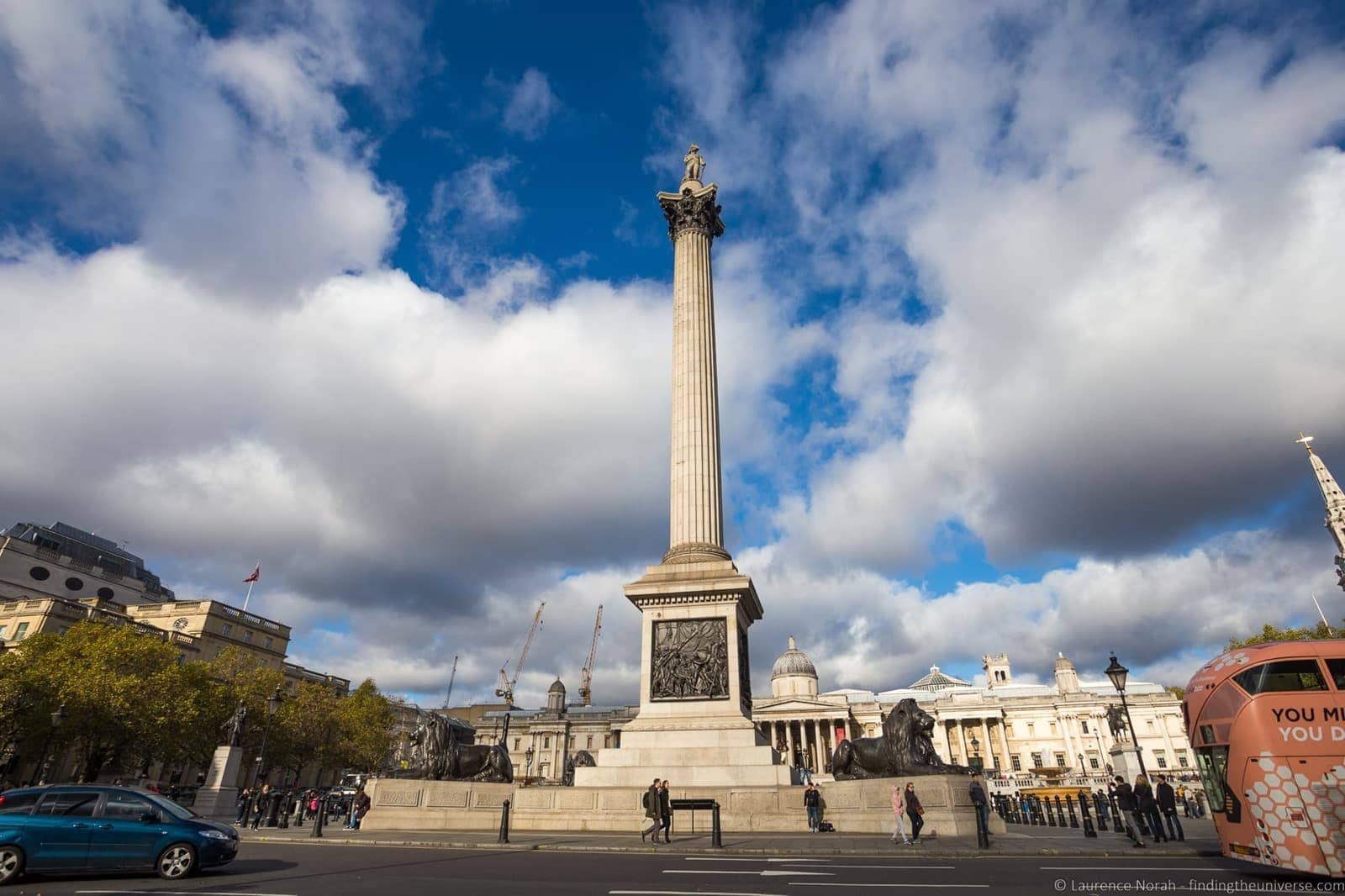
While you’re moving between these, there are some related statues worth a brief detour. Nelson’s Column in Trafalgar Square is the obvious one (Admiral Nelson, killed at Trafalgar, atop a 169-foot column), and the equestrian statue of Charles I just to the south marks the official centre of London (all road distances are measured from this point).
The memorial to Edith Cavell on St Martin’s Place, just north of Trafalgar Square, commemorates the British nurse executed by the Germans in 1915 for helping Allied soldiers escape from occupied Belgium. And outside Whitehall, the statue of Sir Winston Churchill in Parliament Square has become a gathering point in its own right.
Walking Route: Central London War Memorials
Most of the central memorials cluster within walking distance of each other, and the natural way to see them is on foot. Here’s the route I’d suggest if you want to do it as a self-guided walk. It takes about 1.5 to 2 hours at a steady pace, depending on how long you spend at each stop, and it’s all flat and on pavement.
Start: Westminster tube station. Come up the exit by Big Ben and walk north up Whitehall (with Parliament behind you). After about three minutes you’ll see the Cenotaph in the middle of the road. Pause here. Just past the Cenotaph, also in the middle of the road, is the Monument to the Women of World War II. Between the two, on the western side of Whitehall, you’ll pass the various Ministry buildings and a number of smaller statues of wartime figures.
Continue north up Whitehall and after another two or three minutes you’ll reach Horse Guards on your left. Cross through the archway at Horse Guards onto Horse Guards Parade. The Guards Memorial is on your left as you emerge. This is also the entrance to the Household Cavalry Museum if you want to combine this walk with a museum visit (allow another 60-90 minutes for that). If you time it for 11am on a Monday, Wednesday, or Friday, you’ll see the Changing of the King’s Life Guard.
From Horse Guards Parade, walk back to Whitehall and turn left, continuing north towards Trafalgar Square. After two minutes you’ll be in Trafalgar Square itself, with Nelson’s Column in the middle. Worth a circuit of the square (the bronze reliefs at the base of the column are made from melted-down French cannons captured at Trafalgar). Look out for the Edith Cavell memorial on St Martin’s Place just north of the square.
Head down to the river: from Trafalgar Square, walk southeast down Northumberland Avenue (about three minutes) to the Victoria Embankment. Turn left along the Thames and walk roughly 400 metres along the river. You’ll pass the Battle of Britain Memorial set back from the road, and a few minutes further on, in Victoria Embankment Gardens to your left, the Imperial Camel Corps Memorial.
End: Embankment tube station, which is right on the river. From here you’ve covered the central Whitehall cluster and the Embankment memorials, and you’ve had the option to drop into the Household Cavalry Museum on the way through.
Optional: the Hyde Park Corner extension
If you want to also see the Hyde Park Corner cluster (Wellington Arch, Royal Artillery, Bomber Command, Animals in War, the Commonwealth Gates, the Australian and New Zealand War Memorials), I’d treat it as a separate short walk rather than tacking it onto the Whitehall route, because the geography doesn’t connect cleanly.
Start at Hyde Park Corner tube. Wellington Arch is right there (climb to the top first if you want the view). Walk a slow loop around the arch to see the Royal Artillery Memorial, the Machine Gun Corps Memorial, and the Australian and New Zealand War Memorials. Cross under to the Commonwealth Memorial Gates on Constitution Hill. Then walk a few minutes north up Park Lane to the Animals in War Memorial. From there it’s a 5-minute walk back to Marble Arch tube, or a 10-minute walk east through Green Park to the Bomber Command Memorial (which sits just inside the park’s northwest corner). Allow about an hour for the full Hyde Park Corner loop.
Frequently Asked Questions
Are the war museums in London free?
Most of the major ones are free to visit. The Imperial War Museum London, the RAF Museum London, the National Army Museum, and the National Maritime Museum at Greenwich all have free entry, with charges only for special temporary exhibitions or extras like flight simulators.
The Churchill War Rooms, HMS Belfast, the Household Cavalry Museum, and the Guards Museum all charge for entry. The Household Cavalry Museum, the Guards Museum and HMS Belfast are included on the London Pass, so if you’re visiting two or more pass-included London attractions, it can be worth checking the maths.
Which is the best war museum in London?
The Imperial War Museum London (IWM London) is the one most visitors should start with. It’s free, it’s centrally located, it covers conflicts from the First World War to the present day, and the Holocaust Galleries are world-class. You can spend a half-day there easily.
If you specifically care about Winston Churchill or want a more atmospheric, immersive experience, the Churchill War Rooms (the actual underground bunker where the war was run) are the strongest second choice and are unlike anything else in London.
Is the Churchill War Rooms worth visiting?
Yes, very much so. It’s the most atmospheric military museum in London because you’re walking through the actual bunker where the war was coordinated, preserved more or less as it was on VE Day. The Map Room with its original wall maps, the Cabinet Room, Churchill’s bedroom, the Transatlantic Telephone Room, the entire Churchill Museum upstairs (which covers his whole life): it’s all properly impressive.
That said, it’s not free (currently from £33 adult), it gets very crowded, and the corridors are narrow which can make it feel claustrophobic during peak periods. Book online in advance and aim for the first or last slot of the day to avoid the worst of the crowds.
Do I need to book Churchill War Rooms tickets in advance?
Yes, you should. Walk-up tickets are sometimes available but the queue can be substantial (we’ve seen people waiting over an hour). Booking online for a timed slot is faster, often slightly cheaper than the door price, and guarantees you’ll get in. You can book directly via the Imperial War Museums website.
Where is the Imperial War Museum in London?
The Imperial War Museum London is at Lambeth Road, SE1 6HZ, on the south side of the Thames. The closest tube stations are Lambeth North (Bakerloo Line, 5-minute walk), Waterloo (multiple lines, 10-minute walk), and Elephant & Castle (Northern and Bakerloo Lines, 12-minute walk). Plenty of buses also stop nearby.
How long do you need at the Imperial War Museum?
Allow at least three hours for the highlights, and a full day if you want to see everything properly. The atrium and main galleries can be done in a couple of hours, but the First World War Galleries, Second World War Galleries, and Holocaust Galleries each warrant an hour on their own. Most visitors underestimate how much there is to see.
Are there any military museums in London suitable for kids?
HMS Belfast is the standout choice for younger children because there’s so much to climb on (nine decks, ladders between them, gun turrets to peer into). The National Army Museum has excellent interactive galleries and a soft-play area for under-eights. The RAF Museum London has flight simulators and the chance to sit in some aircraft cockpits. The Household Cavalry Museum lets kids try on a (very heavy) ceremonial uniform.
The Imperial War Museum has plenty for older children but the Holocaust Galleries are not recommended for children under 14; you may want to plan around that depending on your kids.
How do I see the Cenotaph?
The Cenotaph stands on Whitehall, in the middle of the road between Trafalgar Square and Parliament Square. The closest tube station is Westminster, and you’ll see the memorial within three minutes of walking north up Whitehall from the station. It’s free to visit (it’s a public monument in the street) and there’s no need to book anything.
Further Reading
We’ve got a lot more London and UK content on both Finding the Universe and Independent Travel Cats. A few that pair well with this post:
-
- If you’re going to visit two or more of the paid museums on this list, take a look at our full London Pass review, which works through whether the pass actually saves you money.
- For Winston Churchill specifically, Jess’s guide to Churchill sites in England covers the wider trail beyond London.
- Our London packing list is a good starting point if you’re planning a trip.
- For shorter trips, our itineraries for 1 day in London, 2 days in London, 3 days in London, and 6 days in London all include a military museum stop where it makes sense.
- Detailed guides to visiting the Tower of London (which houses the Royal Armouries) and the London Eye.
- Our guide to photography locations in London if you want to capture some of the memorials yourself.
- For Harry Potter fans, our guide to key Harry Potter filming locations in London.
- If you want to focus on a specific area, our 8 things to do in Kensington guide.
- If London is the start of a longer trip, our 2 weeks in the UK itinerary, or for day trips out, our guides to Stonehenge, Bath & Cotswolds and Oxford as a day trip.
- Heading north? We have lots on Scotland, including a 2-day Edinburgh itinerary, the North Coast 500, and a 2-day Glasgow and Loch Lomond itinerary.
- For full London travel guides, the DK London and Rick Steves London are both worth a look.
And that’s it. If you’ve got questions or there’s a museum we’ve missed that you think deserves to be on this list, let us know in the comments.
Lorraine clarke says
Hello, I live in Perth Australia. My grandfather served in the RAF as a tail gunner. I’m trying to find out more details of his involvement. Are you able to help me please.
His name was William Charles Halford. He was from Gloucester. I believe he was around 23 years old. With his consent I claimed his medals when I was 13 years old. I don’t have the details that I claimed this with. Granddad has me passed now for 30 years.
Please are you able to help. Many thanks
Laurence Norah says
Hi Lorraine,
Thanks for your comment. I’m afraid I’m not sure I can be of much help – my advice would be to contact the UK government. Service records for military personnel are held by the UK Ministry of Defence, so you would need to contact them, and you need to be next of kin I believe. You can see more here:
https://www.gov.uk/government/collections/requests-for-personal-data-and-service-records
Good luck!
Laurence
Dr. Keith Vincent Smith says
I wonder if you could help me?
Does the Naval & Military Museum still exist in London.
In 1832, ‘Capt. Norton, late 34th regiment’, donated ‘The Bome-rang, or Magic Stick, of New South Wales’ to the Naval and Military Museum in London.
For research on boomerangs I would like to know if the Museum still exists or where Captain Norton’s ‘magic stick from Australia might be?
Thank you for your help.
Keith Vincent Smith, cultural historian Sydney Australia
Laurence Norah says
Hi Dr. Keith,
The closest I would think would be the Greenwich Maritime Museum, which is the main maritime museum of the sea. I would recommend reaching out therefore to either the Greenwich Maritime Museum folks. I did have a look at their collection online and it does include at least on boomerang (https://collections.rmg.co.uk/collections/objects/2989.html), but the history of the object is not detailed. Alternatively, I’d suggest contacting the Imperial War Museum, who have a huge amount of items and data, and may also be able to help,
Good luck in the search,
Laurence
Seana Turner says
My husband and I are history nerds, so we would love visiting these places. We seem drawn to visit places where we learn something. I’ve been to many in the US, but not so much in other countries. I think I would enjoy visiting some of these more than the more typical tourist sites. Thanks, as always, for the great information!
Laurence Norah says
Hey Seana – our pleasure! We love learning about history as well, and these are all excellent museums and memorials. We hope you get to them someday soon 🙂
Roy L Neve says
Thanks for sharing, I’ve never realized that there were more military museums besides the Imperial War Museum in London that my father took me to in the late 60s. My father was a survivor of the London Blitz & the Second World War & then survived the Vietnam War as well when he was posted there with the US Army as an American soldier. If I ever return to England, I would love to explore all the museums that you mentioned. Unfortunately, my father will not be with me this time as we used to do so many activities together while I was growing up around the world with him. Since I grew up as an Army Brat in the US Army. He passed away in my home in Texas this past August 2017, I have him buried with full military honours at Fort Sam Houston Military Cemetary, San Antonio, Texas.
Laurence Norah says
Sounds like your father will have seen a lot, what a wonderful story. And certainly, when researching for this article, we were also surprised by how many excellent military museums London has 🙂 Thanks for sharing with us!