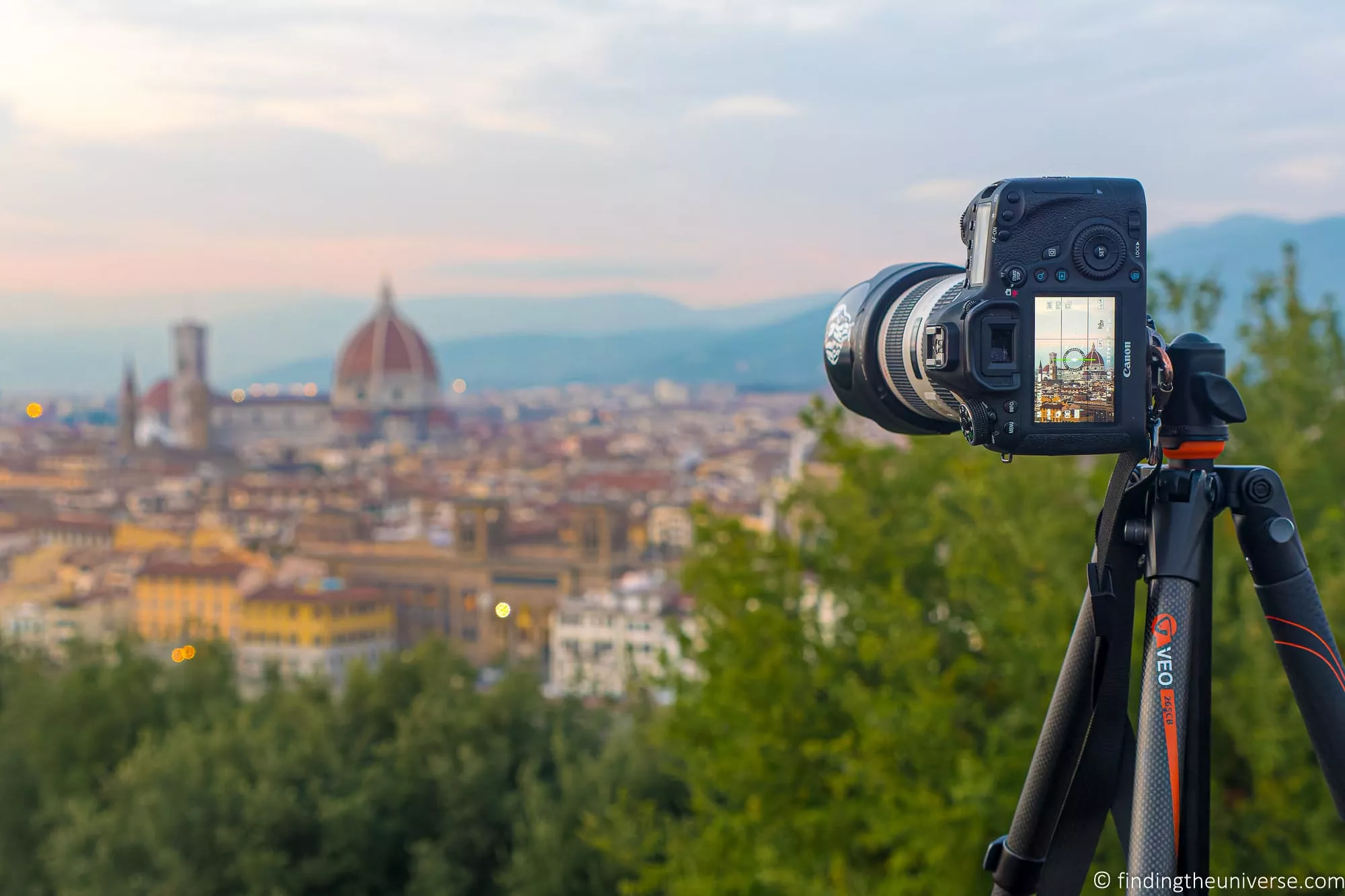
I’m a professional travel photographer. I’ve been shooting with Canon cameras since 2010, I’ve taken photos in over 40 countries, and one of the most common questions I get from readers and students on my travel photography course is: what’s the best travel camera?
It depends on what you need. But “it depends” isn’t helpful when you’re trying to make a decision, so in this guide I’m going to tell you exactly what I’d buy in 2026 at every budget level, and why.
I currently shoot with a Canon EOS R5, and before that I used a pair of Canon 6D bodies for years. Jess and I travel for a living, and between us we’ve put camera gear through just about every scenario you can think of, from Icelandic waterfalls to African safaris to freezing Scottish winter mornings.
This guide is organised by what you actually need a camera for, not by camera type. If you want deep dives into specific categories, I have separate guides to the best compact cameras, best mirrorless cameras, best action cameras, the best safari cameras, and the best cameras for hiking and backpacking.
Table of Contents:
Do You Actually Need a Dedicated Camera?
Before I recommend any cameras, I should say this up front: your smartphone might be good enough.
I currently use a Samsung Galaxy S26 Ultra alongside my Canon R5, and I find myself reaching for the phone more often than I would have five years ago. In good light, for social media sharing, for quick street shots, and for those moments when you just want to capture something without thinking about settings, a modern smartphone does a brilliant job.
The optical zoom on current flagship phones is particularly impressive. My S23 Ultra gives me a usable 3x and 10x optical zoom, and the ultra-wide lens means I can get more of a scene in than even some dedicated cameras. For the majority of travellers who want nice holiday photos to share with friends and family, a good smartphone is all you need.
So when does a dedicated camera actually matter? A few situations stand out from my experience.
Low light and night photography. Smartphones have improved enormously here, but they still can’t match even a mid-range mirrorless camera when the light drops. If you want to photograph the northern lights, shoot inside dimly lit churches, or capture a city at blue hour without everything looking processed, you need a larger sensor.
Wildlife and fast action. Tracking a bird in flight or a lion on the move requires optical reach and fast autofocus that no smartphone can match. If you’re going on safari, you need a dedicated camera.
Creative control. Real depth of field (not the simulated portrait mode blur), long exposures, RAW files for serious editing, interchangeable lenses for different situations. If you want to learn photography properly and have full control over your images, a smartphone won’t get you there.
Large prints. If you want to print photos larger than about A4 size and have them look sharp and detailed on close inspection, a dedicated camera with a larger sensor will give noticeably better results.
If none of those apply to you, save your money. Get a Google Pixel 10 for excellent value, a Samsung Galaxy S26 Ultra for the best zoom, or an iPhone 17 Pro if you’re in the Apple ecosystem. All three take great photos. I’d also add that even if you do buy a dedicated camera, having a good smartphone camera as a backup is always worthwhile.
Quick Reference: My Top Picks by Budget
Here’s a summary of my recommendations. I go into detail on each one further down the page.
Under $500: Canon EOS R100 with kit lens. Best value entry into interchangeable lens cameras.
$500 to $1,000: Nikon Z50 II with kit lens. A step up in features and image quality.
$1,000 to $1,500: Sony a6700. The best all-round travel camera for most people.
$1,500 to $3,000: Canon EOS R6 III. Full frame quality in a well-priced package.
$3,000+: Canon EOS R5 II. The best travel camera money can buy, and what I’d buy today.
Best compact (pocketable): Sony RX100 VII. The best small camera that still takes proper photos.
Best budget compact: Panasonic Lumix ZS99. A proper camera for not much money.
Best Travel Camera for Most People
If you’ve decided you want a dedicated camera but aren’t sure where to start, this is the section for you. The sweet spot for travel cameras in 2026 is an APS-C mirrorless camera. These use a sensor that’s significantly larger than a smartphone or compact camera, but the cameras and lenses are still compact enough to carry all day without it feeling like a chore.
Sony a6700 – My Top Pick for Most Travellers
The Sony a6700 is, in my opinion, the best all-round travel camera for most people in 2026. It hits a sweet spot of size, image quality, features and price that’s hard to beat.
You get a 26MP APS-C sensor with in-body image stabilisation (IBIS), which means sharper handheld shots even in lower light. The autofocus system is borrowed from Sony’s professional cameras and can recognise and track people, animals, birds, and vehicles. It’s weather-sealed, has a tilting touchscreen, and supports 4K video.
At around $1,600 for the body, it’s not cheap, but you’re getting a camera that will handle everything from street photography in Barcelona to wildlife in a national park. Pair it with a versatile zoom lens like the Sony 18-135mm and you have a kit that covers the vast majority of travel situations in a package that fits in a small day bag.
Check price on Amazon here and B&H here.
Canon EOS R10 – Great Alternative
If the Sony is a bit more than you want to spend, the Canon EOS R10 is an excellent alternative at around $1000 for the body. You lose image stabilisation and weather sealing compared to the a6700, but you still get Canon’s excellent autofocus system (the same tracking technology found in cameras costing four times as much), a 24.2MP APS-C sensor, and access to Canon’s huge range of RF-mount lenses.
The R10 is lighter too, which matters when you’re carrying it around all day. If you’re new to photography and want a camera that’s easy to learn with but won’t hold you back as your skills develop, this is a great choice. I’ve personally always found Canon’s menu system to be the most intuitive to use, which helps when you’re learning.
Check price on Amazon here and B&H here.
Best Budget Travel Camera
You don’t need to spend a fortune to get a camera that’s a meaningful step up from a smartphone. Here are my picks for travellers watching their budget.
Canon EOS R100 – Best Value Mirrorless Camera
The Canon EOS R100 is the best budget travel camera available right now if you want an interchangeable lens camera. You can often find it for under $500 with a kit lens included, which is remarkable value for what you get.
It has a 24.1MP APS-C sensor (the same size as in cameras costing three times as much), Canon’s excellent autofocus system, and access to the full range of Canon RF and RF-S lenses. The relatively large sensor means it will outperform any compact camera or smartphone in lower light situations.
There’s no touchscreen and no in-body image stabilisation, which are reasonable omissions at this price. But the image quality is excellent, and if you’re buying your first “proper” camera, this is a hard one to beat.
Check price on Amazon here and B&H here.
Nikon Z50 II – Budget Pick with More Features
At around $1000 with a kit lens, the Nikon Z50 II costs more than the Canon R100 but gives you a few extras for the money. You get a tilting touchscreen, an OLED viewfinder, 30fps burst shooting (great for capturing action), and 4K video.
If you’re an existing Nikon user with F-mount lenses, you can use them on this camera with Nikon’s FTZ adapter, which saves you having to replace everything. It’s a well-rounded camera that punches above its price, and Nikon’s Z-mount lens selection has improved considerably over the past couple of years.
Check price on Amazon here and B&H here.
If you’d prefer a simple compact camera rather than an interchangeable lens system, the Panasonic Lumix ZS99 (around $700) is one of the few compact cameras still in production. It has a 30x optical zoom, manual controls, and RAW shooting, all in a properly pocketable body. It’s a good option if you want simplicity over versatility.
Also worth mentioning: buying used camera gear can save you a lot of money. A used Sony a6700 or Canon R10 can often be found for significantly less than new.
Best Compact Travel Camera
If you want something that actually fits in a jacket pocket, you’re looking at a compact camera with a fixed lens. The selection is smaller than it used to be (smartphones have killed much of the compact camera market), but there are still some excellent options.
Sony RX100 VII – Best Pocketable Camera with Zoom
The Sony RX100 VII has been my go-to compact camera recommendation for a while now, and despite being released in 2019, nothing has replaced it. We own and use the RX100 V ourselves.
What makes this camera special is the combination of a 1-inch sensor (much larger than a smartphone sensor), a 24-200mm zoom lens (equivalent to about 8x optical zoom), and full manual controls including RAW shooting. You also get an electronic viewfinder, image stabilisation, and a tilting screen. It’s a proper camera that happens to fit in your pocket.
The age is the main caveat. Sony hasn’t released a new model since 2019, and availability can be patchy. At around $1,700, it’s not cheap for a compact camera either. But if you can find one, it’s the best pocketable camera with a zoom that you can buy.
Check price on Amazon here and B&H here.
I should also mention the Fujifilm X100VI and the Ricoh GR IV. These are premium fixed-lens cameras with APS-C sensors that produce extraordinary image quality. The X100VI in particular has become something of a cultural phenomenon. However, both have fixed focal lengths (no zoom), both are supply-constrained, and both sell for well above their MSRP due to demand.
The X100VI launched at $1,600 but you’ll often find it priced at $1,800 or more. They’re fantastic cameras if you can find one at a reasonable price, but they’re not for everyone.
For a much more detailed breakdown, see our complete guide to the best compact cameras for travel.
Best Travel Camera for Landscape and Scenery
If your travel photography is primarily about landscapes, cityscapes, and capturing the feel of a place, you’ll benefit from a full-frame sensor.
Full-frame cameras have larger sensors that capture more light and more detail, with better dynamic range (the ability to capture both bright skies and dark shadows in the same image). They also work better with wide-angle lenses, which is what you’ll be using most for landscape work.
Canon EOS R6 III – My Landscape Pick
The Canon EOS R6 III, released in late 2025, is what I’d recommend for anyone serious about landscape and travel scenery photography. At $2,800 for the body, it’s a significant investment, but what you get is a 32.5MP full-frame sensor with 8.5 stops of in-body image stabilisation. That stabilisation is a game-changer for handheld shooting at dawn and dusk when the light is best but a tripod isn’t practical.
The autofocus is superb (it can even register specific people’s faces to prioritise tracking them in a crowd), the weather sealing means you don’t need to worry about shooting in rain or mist, and the battery life is enough for a full day of shooting. If you’re a Canon user or thinking of buying into the Canon system, this is an exceptional all-rounder that happens to be particularly good for landscapes.
Check price on Amazon here and B&H here.
The Nikon Z6 III (around $2,000) is the equivalent pick for Nikon shooters. It has a partially stacked sensor that’s excellent for both stills and video, and Nikon’s Z-mount lens lineup has matured considerably. The Sony a7C II (around $2,200) is worth considering too if you want the smallest possible full-frame body.
Best Travel Camera for Wildlife and Safari
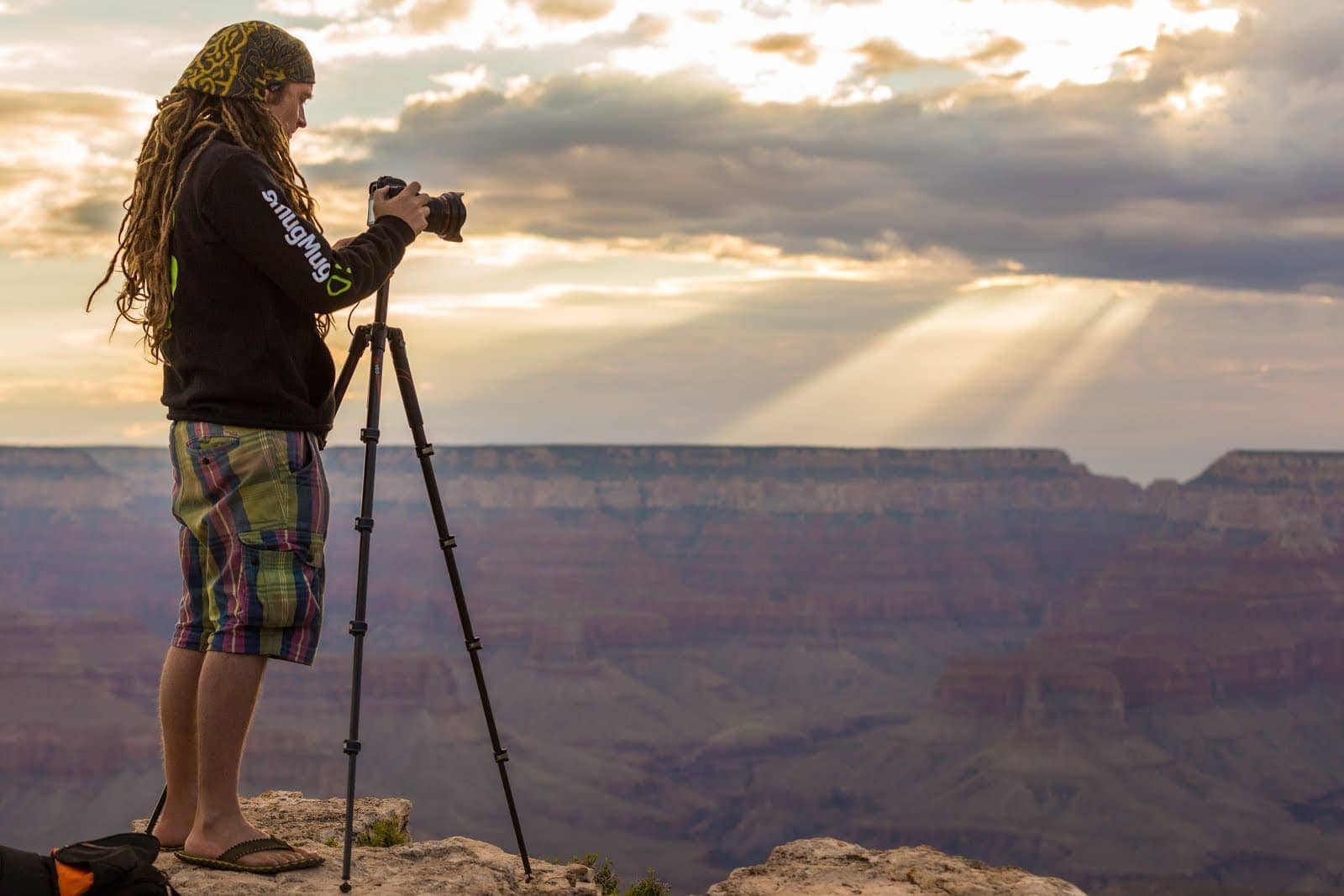
Wildlife photography has very specific requirements: you need reach (long focal lengths to photograph distant animals), fast autofocus that can track moving subjects, and rapid burst shooting to capture the perfect moment. This is one area where camera choice really does make a huge difference to your results.
Canon EOS R7 – Best for Wildlife on a Travel Budget
For wildlife and safari photography specifically, I’d recommend the Canon EOS R7. This might seem like an odd choice when there are more expensive cameras on this list, but there’s a very practical reason: the APS-C crop sensor gives you a 1.6x reach multiplier.
What does that mean? A 100-400mm lens on this camera gives you the equivalent reach of a 160-640mm lens on a full-frame camera. That extra reach is invaluable when you’re photographing a leopard in a tree 50 metres away or a bird perched on a distant branch.
I’ve used the R7’s autofocus system extensively, and the animal and bird tracking is impressive. The camera can lock onto an animal’s eye and hold focus even as it moves through the frame, through vegetation, and at speed. You also get 15 frames per second with the mechanical shutter (30fps electronic), weather sealing, and a 32.5MP sensor.
Pair it with the Canon RF 100-500mm f/4.5-7.1 L IS USM and you have a safari kit that will get you results that would have required equipment costing three or four times as much just a few years ago.
For more on this topic, see my detailed guide to the best safari cameras and lenses, as well as my safari photography tips.
Check price on Amazon here and B&H here.
Best Travel Camera if Money Is No Object
If you want the best travel camera available and price is less of a concern, here’s what I’d buy.
Canon EOS R5 II – The Best Travel Camera You Can Buy
I shoot with the original Canon EOS R5, and it has been the best camera I’ve ever owned. The R5 II, released in 2024, improves on it in nearly every way: a new stacked sensor for faster readout and reduced distortion, 30fps burst shooting, eye-control autofocus (the camera focuses where you look in the viewfinder), and 8K video if you need it.
The 45MP full-frame sensor produces files with extraordinary detail and dynamic range. The autofocus system can track people, animals, birds, vehicles, and more. In-body image stabilisation gives you sharp handheld shots even at slow shutter speeds. It’s weather-sealed, has dual card slots, and the build quality is what you’d expect from Canon’s professional range.
At $4,299 for the body, this is clearly not a camera for everyone. But if you’re serious about photography and want one camera that can handle anything from landscapes to wildlife to low-light street photography to astrophotography, this is it. I’d pair it with a wide-angle zoom for landscapes and a telephoto for wildlife, and you’d have a kit that can do anything.
For alternative systems, the Sony a7 V (around $2,900) is excellent value for a full-frame camera with class-leading autofocus, and the Nikon Z8 (around $3,800) matches the R5 II on specs in a weather-sealed, pro-level body.
Check price on Amazon here and B&H here.
What I Actually Travel With
It’s useful to know what a working travel photographer actually packs, because it’s rarely as simple as “buy the most expensive camera.” What I take depends entirely on what I expect to be shooting.
My camera body: Canon EOS R5. If I were buying today, I’d get the R5 II, but the original R5 is still an outstanding camera and is now available at a reduced price from some retailers. You can read my full Canon EOS R5 review here.
My most-used lens: Canon EF 16-35mm f/4 L IS USM. This is an EF-mount lens that I use on the R5 with Canon’s EF-RF adapter, which works perfectly with no loss of autofocus speed or image quality. It’s my go-to for landscapes, cityscapes, and interiors. If you’re buying new into the Canon RF system, the closest equivalents would be the Canon RF 15-35mm f/2.8 L IS USM (premium) or the Canon RF 16-28mm f/2.8 IS STM (more affordable and compact).
My telephoto: Canon RF 70-200mm f/2.8 L IS USM. Essential for isolating subjects in landscapes, compressing perspective, and getting closer to things you can’t physically approach. I use this on most trips.
My wildlife lens: Canon RF 100-500mm f/4.5-7.1 L IS USM. This comes out for safari trips and whenever I expect to be photographing wildlife. It’s a big lens, but the reach is worth the weight.
My macro: Canon RF 100mm f/2.8 L Macro IS USM. For close-up details, flowers, food photography, and anything where I want to get really close.
Phone: Samsung Galaxy S23 Ultra. Always in my pocket, always a backup. I’d get the latest model if buying today.
How I Pack for Different Trips
For a road trip, the full kit stays in the car in my Vanguard Alta Sky bag (you can get 20% off the Vanguard store with code FindingTheUniverse). I grab what I need for each stop. This is the scenario where I’m least constrained by weight.
For a city break, I take the R5 with the 16-35mm, and usually the 70-200mm in case I want it. These go in my Peak Design Travel Backpack 45L with Camera Cubes to keep the gear protected. For a lighter day, I’ll just take the wide-angle and leave the telephoto at the hotel.
For a wildlife or safari trip, I take two bodies (the R5 plus a Canon 6D as backup) and pre-mount different lenses to avoid changing lenses in dusty conditions. The 100-500mm lives on one body, the 16-35mm on the other. This way I’m ready for anything from a sweeping landscape to a distant leopard without fumbling with lens changes.
The one thing I never travel without is my Peak Design Slide camera strap. I bought my first one in 2015 and I’ve never used anything else since. I own three of them now. They’re quick to adjust between carrying and shooting positions, and they distribute the weight well even with a heavy lens attached.
For a more complete rundown, see my full photography gear list.
How to Choose: What Actually Matters
If none of my specific picks quite match what you’re looking for, here’s how to think about choosing a camera for travel.
Sensor Size Is the Most Important Spec
The sensor is the part of the camera that captures light, and its physical size is the single biggest factor in image quality. Bigger sensors capture more light, which means better performance in low light, more detail, and more natural-looking depth of field.
From smallest to largest, the common sensor sizes are: smartphone sensors (tiny), 1-inch (compact cameras like the RX100), Micro Four Thirds (some Olympus and Panasonic cameras), APS-C (most mid-range mirrorless cameras), and full-frame (professional cameras).
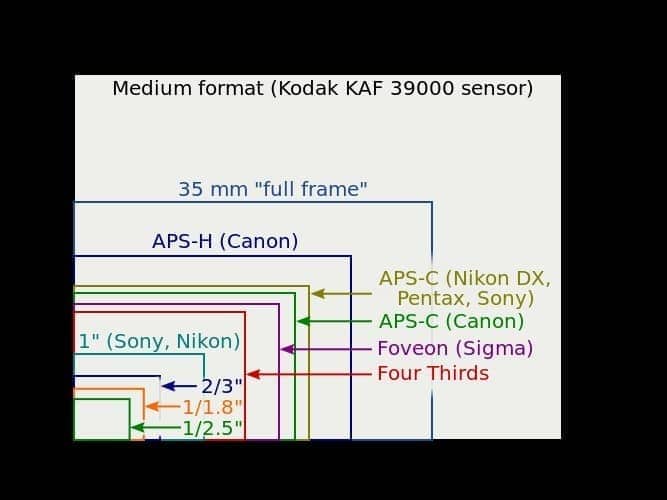
For most travel photographers, APS-C is the sweet spot. You get a meaningful step up from smartphones and compact cameras, without the size and cost of full-frame equipment. If image quality is your top priority and you don’t mind the extra weight, full-frame is the way to go.
Lenses Matter More Than Bodies
This might be the single most important piece of camera buying advice I can give you. Don’t blow your entire budget on the camera body and then stick a cheap kit lens on it. A mid-range camera body with a good lens will outperform an expensive body with a poor lens every time.
If you’re buying an interchangeable lens camera, budget for at least one decent lens. A versatile zoom that covers from wide-angle to moderate telephoto (something like an 18-135mm for APS-C, or a 24-105mm for full-frame) will handle most travel situations. For more detailed recommendations, see my guide to the best lenses for travel photography.
Weight and Size Are Practical Deal-Breakers
The best camera in the world is worthless if it sits in your hotel room because you couldn’t face carrying it. Be realistic about how much weight you’re willing to carry. If you’re a light packer, an APS-C camera with one lens is a better choice than a full-frame camera with three lenses, even if the full-frame system produces technically better images.
I travel with a heavy kit because photography is my job. If it’s your hobby, you might be happier with something smaller that you actually take everywhere.
Pick a System, Then a Camera
When you buy a mirrorless camera, you’re buying into a lens system. Canon, Sony, Nikon, and Fujifilm all have different lens selections, and your lenses will likely outlast several camera bodies over the years.
If you already own lenses for a particular system, it usually makes sense to stay with that manufacturer. Canon and Nikon both make adapters so you can use older DSLR lenses on their mirrorless cameras, which can save you a lot of money on the transition.
A Note on DSLRs
If you already own a DSLR and it’s working well for you, there’s no urgent need to switch to mirrorless. DSLRs still take great photos. However, I wouldn’t recommend buying a new DSLR in 2026. All the major manufacturers have moved their development focus to mirrorless systems, and the future of the industry is clearly mirrorless. If you’re buying for the first time or upgrading, go mirrorless.
If you’re curious about DSLRs or already own one, I have a complete guide to using a DSLR camera.
Action Cameras
If your travel involves a lot of water sports, skiing, or adventure activities, you might also want an action camera. These are a separate category entirely, designed for survivability rather than image quality. I have a dedicated guide to the best action cameras for travel that covers this in detail.
Frequently Asked Questions
Is a mirrorless camera better than a DSLR for travel?
For new purchases in 2026, yes. Mirrorless cameras are generally lighter, have better autofocus systems, and offer features like in-body image stabilisation and electronic viewfinders that most DSLRs don’t have. All the major manufacturers (Canon, Nikon, Sony, Fujifilm) have shifted their development to mirrorless systems, which means the latest technology and new lenses are all designed for mirrorless cameras.
If you already have a DSLR that you’re happy with, there’s no need to rush out and replace it. DSLRs still produce excellent images. But if you’re buying new, mirrorless is the way to go.
Is a smartphone good enough for travel photography?
For many travellers, yes. Modern flagship smartphones take excellent photos in good light, and the convenience of having your camera always in your pocket is hard to overstate. I use a Samsung Galaxy S26 Ultra alongside my Canon R5, and there are plenty of situations where I reach for the phone instead of the camera.
Where smartphones still fall short is low-light photography, wildlife and action photography (you need real optical zoom and fast tracking autofocus), and situations where you want full creative control over depth of field and exposure. If any of those matter to you, a dedicated camera is worth the investment.
What’s the best camera for a beginner traveller?
For most beginners, I’d recommend the Canon EOS R100 with a kit lens. It’s affordable, easy to learn, takes great photos, and gives you room to grow into more advanced techniques as your skills develop. If your budget stretches further, the Sony a6700 is a step up that adds image stabilisation and weather sealing.
Do I need a full-frame camera for travel photography?
No. An APS-C camera will produce excellent results for the vast majority of travel photography situations. Full-frame cameras have advantages in low light and offer more creative control over depth of field, but the difference is smaller than marketing might suggest. The main benefit of full-frame is when you want to make large prints, shoot in very low light, or when you need the maximum dynamic range for landscape photography.
If you’re starting out, invest in a good APS-C camera and a quality lens rather than stretching for a full-frame body with a cheap lens. You’ll get better results that way.
What one lens should I get for travel photography?
If I could only take one lens on a trip, it would be a versatile zoom that covers wide-angle to moderate telephoto. For APS-C cameras, something like an 18-135mm covers most situations from landscapes to portraits to candid street shots. For full-frame, a 24-105mm or 24-70mm serves a similar purpose.
I have a full guide to the best lenses for travel photography with specific recommendations across systems if you want more options.
Are used cameras worth buying?
Yes, and I’d actively encourage it if you’re on a budget. Camera technology moves fast, and last year’s model is usually available at a significant discount. Bodies like the Canon EOS R6 Mark II, Sony a7 IV, and Nikon Z6 II are all excellent cameras that have been replaced by newer models but still produce fantastic results. I have a guide to buying used camera gear with tips on where to shop and what to look out for.
Further Reading
If you found this guide helpful, here are some related resources to help you get the most from your travel photography:
- My guide to the best lenses for travel photography
- My guide to how to use a mirrorless camera
- A review of the Peak Design camera strap system and the Peak Design travel tripod
- My guide to the best photo editing software
- My northern lights photography guide and astrophotography guide
- Tips on backing up your photos while travelling
- An overview of all my photography gear
Improve Your Travel Photography
If you want to take better travel photos, you might want to check out my online travel photography course. Since launching the course in 2016, I’ve helped over 2,000 students learn how to get more from their cameras. It covers everything from the basics of how a camera works through to composition, light, and editing, as well as more advanced topics like astrophotography, long exposure photography, and flash.
You get feedback from me as you progress, access to webinars and videos, and membership of a community where you can get feedback on your work. You can find out more here.
And that’s it! If you have any questions about picking the right travel camera, leave a comment below and I’ll do my best to help.
Ian Andersen says
Thanks for great and thorough reviews. I did not read through all of them and I was wondering if you could say which travel (super zoom) camera WITH GPS is better.
Laurence Norah says
Hi Ian,
Unfortunately, the majority of newer cameras don’t come with built-in GPS tagging functionality on the camera. Instead, if you find a camera which has WiFi and a companion smartphone app, they tend to pull the GPS info from the companion app. So really what you want is one of the travel cameras which has this feature. The Sony cameras in this list such as the RX100 do support this, and I believe the Panasonic ones do. However I’d recommend doing a search for each camera to ensure it does meet your requirements. Do you have a short list of cameras you like already, and I can look at trying to help.
Laurence
Ian Andersen says
Thanks Laurence,
I was a satisfied Lumix TZ user for many years up to – was it TZ 60 or 70 that still had the GPS built in. The argument for losing it was saving battery power but I found that carrying extra batteries was way simpler than using their clunky iPhone app. My latest is a TZ 202. Great pictures but annoying not to gave them tagged. I tried to switch to the SONY DSC-HX90V hoping for easier operation of the phone connection. Again, great photos but clunky GPS solution. So I am really hoping for a small (belt-carried) camera with GPS so I can get away from almost exclusively using my iPhone 15 pro.
Laurence Norah says
Hi Ian,
I assure you, I feel your pain. I shot on a Canon 6D for a very long time and one of the features I loved was the built-in GPS tagging. Now I have an R5, and I have to use the Canon companion smartphone app for GPS tagging. Whilst it works pretty well, it’s another step I have to remember to do. It also eats up my smartphone battery if I forget to shut it off after shooting. About the only system I know of that still has built in GPS on a relatively compact camera is the Olympus Tough TG6, but that doesn’t have much of a zoom and is more designed as a rugged camera. So I’m not sure it will meet your needs, but one to look at.
Happy shooting 🙂
Laurence
Farhana Farid says
This guide on the best travel cameras is a game-changer for wanderlust enthusiasts like me! The detailed reviews and recommendations provide a clear understanding of which cameras are most suitable for capturing those breathtaking moments on the go. The consideration of factors like portability, image quality, and versatility is spot on. Thanks for making my travel photography decisions so much easier!
Laurence Norah says
My pleasure Farhana, I hope you find a great camera for your travels 🙂
Kevin Nalty says
Hi. Agree- this is really thorough and didn’t overwhelm me. I’m curious what you think of the Canon EOS R50. I did a review of it in my blog (Willvideoforfood) but I’m not even remotely as informed. -Kevin
Laurence Norah says
Hi Kevin,
Thanks very much! So I think Canon has been hitting it out of the park recently with their mirrorless camera options and to be honest it’s almost hard to go wrong with whatever recent mirrorless model you pick up. The R50 specifically offers tremendous value and you get a lot of features, especially the autofocus system, which has the same features as you would find on their super high-end models like the R5 (which is what I use). In the old days of Canon they arbitrarily kept some features for their higher end models only, but that approach seems to be changing for the better which is good news for us consumers. The main downside with the R50 as you note in your review is a lack of optical image stabilization. I would also add that I don’t create video, so those areas of a camera are something I don’t review or use.
For anyone else reading this, now is honestly a great time to be buying a camera. The vast majority of recent releases have been excellent, with superb image quality and a solid range of features. As I said, it’s almost hard to go wrong 🙂
Thanks for stopping by!
Laurence
Gurshabad Bakshi says
Hi, awesome post. Very thoughtful and comprehensive.
I have been reading your bogs and planned a visit to Bali based on your suggestions. I want to carry a leisure photography budget camera, that can click good photos and underwater videos and stuff.
I have some questions for that. For what all activities and where all do you use Akaso Brave 7 camera? Is its image quality good enough? And if you could share some sample pics and viseos, it would be so very wonderful and helpful.
Laurence Norah says
Hi Gurshabad!
So we honestly only use the Akaso (and any other action camera for that matter) for specific situations like underwater photography. The reason is that we personally have other cameras that are better for things like landscapes, and wildlife photography, but the Akaso is the only camera we have for underwater photography. So whilst it definitely works for that, we wouldn’t personally use it for everything just because we have other camera gear. However, if you are happy with the limitations, like not being able to zoom or adjust many settings, it could certainly work. I’m on a trip right now so don’t have access to all my images, so I can’t share samples unfortunately.
Hopefully this helps a bit. Have a great time in Bali 🙂
Laurence
William says
Great review and suggestions!. Thank you.
Laurence Norah says
Thanks William!
Rachel says
Thank you for this great article! I’m going to be traveling for my honeymoon soon, and decided I should upgrade from using my smartphone for all my photos to using an actual camera so I can get some printable quality photos. I’ve read a few lists like this one, but yours is the only one I’ve read that doesn’t just feel like a paid advertisement. I appreciate all the tips and advice you listed here. I now have a camera on my wishlist, thank you!
Laurence Norah says
Hey Rachel! I’m so glad you found my article helpful, and many thanks for taking the time to let me know. I hope you enjoy your new camera, and if you have any questions as you continue your photography adventure feel free to reach out!
Laurence
Claude AYMARD says
Hello, for you which can be the best safari travel camera easy to used for good photo quality
-canon sx70 hs
-canon m200 with 55-200mm
-lumix tz100
-Lumix GX9 with 14-140mm
thank’s in advance
Laurence Norah says
Hi Claude,
I do have a guide to the best safari cameras here which might help. However, from your list I would probably lean towards the Canon SX70HS for ease of use and also the great zoom means you can get good shots of further away subjects. My dad actually has the SX60 and he really likes it, we’re on safari right now and he is using it with good results.
Let me know if you have any more questions and bon voyage 🙂
Laurence
Tanis says
Amazing 🤩
Laurence Norah says
Thanks Tanis!
Holly says
Hello! I am so happy that I stumbled upon your website when researching for a trip to Iceland. I fell in love with photography when I was on my high school’s yearbook staff, a long long time ago. I have collected many SLR cameras over the years, manual and digital along with lenses (Nikon and Canon). Sadly, none of them have been used for several years and when I recently pulled them out, I realized how outdated they are. So…I am looking to sell everything (thanks for your amazing article on how to do that!) and start fresh. If you were me, with a budget of $2k-$4k, looking for a very high quality, relatively light weight camera system with the latest and best technology, what would you recommend? I would like one camera with two lenses at the most. Light weight enough that it’s easy to carry and use, without sacrificing image quality. Something that I can ‘grow into’ as a I renew my love of photography. Many thanks for sharing your expertise. Cheers!
Laurence Norah says
Hi Holly!
It’s great to hear from you, and I’m so pleased you have been finding the site useful so far!
With your requirement for something lightweight but that also has great image quality (and within budget of course) I would probably suggest the Sony Alpha 7c. Excellent autofocus, in body image stabilization, a full frame sensor and a weather sealed design, somehow all in a body that weighs about a 1lb.
If you wanted lighter, the Canon EOS RP is another full frame option which is fractionally lighter and also significantly cheaper, however you lose in body image stabilization and the focus tracking system isn’t quite as accomplished as the Sony in this model. It’s also slightly larger, despite being less heavy.
Both cameras have an excellent selection of lenses to choose from depending on what you want to photograph 🙂
Let me know if I can help any more!
Laurence
AJ says
Hello Laurence,
First off let me say thank you for such great articles, guides, advice and overview for someone who’s never been to Scotland and interested in touring the NC500.
With that said, there are many great choices concerning camera & lens combinations in your article. Getting specific addressing the NC500 route, just what would be your best advice for focal lengths in reference to 35mm full frame? I see many wide to ultra wide images in the article, so inquiring about specific needs. Want to pack a 1-2 lens kit for this specific trip, and of course I’m thinking a tripod will be handy also!
Laurence Norah says
Hi AJ!
It’s our pleasure, I am pleased to have been of help. So I primarily travel with two lenses, a 16-35mm and a 70-200mm. Most of the landscape shots I take are with the wide angle, although there are sometimes nice opportunities to use the longer lens for isolating a subject. But if I was going to only take one lens it would be the wide-angle all the way.
Hopefully this answers your question! Let me know if I can offer any further input, I’m happy to help.
Laurence
Edward says
Hi, I was happy to read where you wrote “Personally, I love having a camera with GPS”. So do I, or rather so would I, but I am having trouble finding one that I like the look of. All I want is a compact camera with GPS and a viewfinder, with a useable zoom (say up to 200mm equivalent) and good image quality (which today would imply a sensor of 1″ or bigger). There is no such unicorn.
So what do you use, please, that gives you GPS? Or do you use an “add-on later” method like recording a GPS track and geotagging your photos later? I personally am reluctant to do that for a number of reasons, mainly that I travel for 3-6 months at a time (or at least I did when I could) without carrying a computer, so I would not only have a lot of geotagging to do later, but the on-the-road backup to Dropbox would not be geotagged.
Laurence Norah says
Hi Edward!
I currently use a Canon 6D, which is a full frame DSLR. For a while Canon added GPS units to a number of their cameras, but unfortunately this useful feature has been missing from their newer models. For me it’s one of the most useful features to have, so I don’t like the omission. The reasoning is to do with battery life I suspect. GPS units take up power, and newer mirrorless cameras are already battery hungry. So leaving off the GPS is done in an effort to conserve battery power I suspect.
The good news is that many cameras today include the ability to pair with a smartphone app over Bluetooth or Wifi. When the camera takes a picture, it polls the smartphone app for location data, and embeds that in the photo. This of course does require extra setup, remembering to connect the camera to the phone before every shoot, and can drain your smartphone battery too. So it’s not amazing as an alternative, but it does at least work.
I believe that the Sony Image link app supports this for the Sony RX100 series, so with your requirements of a 200mm zoom and a 1″ sensor, the Sony RX100 VI or higher would be an option. Another option I believe would be the Panasonic ZS200.
Finally, another option, as you mention, is to use a third party GPS logger, either a standalone device or an app on your phone, that records the data and saves it, which you can then manually sync later. Again, it’s more work.
Overall, I would much prefer that manufacturers just add the GPS device and let us as users decide for ourselves if we want to use it and use up battery life. Hopefully it makes a reappearance as a standard feature!
Edward says
Hello, thanks for the well thought-out response. It gives me a lot to think about, and if I do have to give up one or more of my checkboxes (or at least half of one, by needing to use a separate app), I may rethink them all – take a step back and ask myself what I really want to do, rather than ask what equipment will satisfy what I think are my wants.
I suspect that the RX100 VI plus the app would be the nearest I could get. Or the Panasonic SZ200/TZ200 (or SZ100) plus its app.
It is ironic that it seems that 1-inch sensor compacts really took off in the mid-2010s, just as manufacturers were deciding to drop GPS.
Laurence Norah says
My pleasure Edward! I would say that one of those would be the best option. It is certainly disappointing that this is no longer a standard feature!
Kyle O'Donnell says
awesome list, you put it together very well 🙂 i got a Sony A6400 from amazon, it’s absolutely amazing, it really show in my vlogs.
Laurence Norah says
Thanks Kyle!
Charles Haskins says
I have been reading through your responses to questions and I am astonished by the detail and the thoughtfulness of your answers. Quite apart from the photography info, it is a great lesson in human decency – great “customer service” for people who aren’t even customers really. I will definitely be following you in the future! Thank you!
Charlie
Laurence Norah says
Hi Charlie,
Thanks very much, that’s kind of you to say. We do our best to try and answer everyone’s questions, be it photography or travel related 🙂 If folks have taken the time to read and leave a comment, then we feel it’s only right to answer if we can!
Thanks again for your comment, and don’t hesitate to reach out if you have any questions of your own!
All the best
Laurence
Craig says
I am quite new to photography. I purchased the M50 last summer (my first non-compact). I don’t know if it is my skills, the camera, or that I need better lenses, but so far I haven’t had much success getting sharp images.
Laurence Norah says
Hi Craig,
Sorry to hear about your issues. There are so many variables that go into what could make an image less sharp, from incorrect focus through to a lens issue. It’s hard to diagnose without seeing an image – do you have one somewhere online you can link to that I can take a look and provide some more insight? It would be best if it also shows the camera settings at the time – usually a site like flickr will save this info.
Thanks!
Laurence
Craig says
These aren’t all from the M50, but several of them are. Also, these happen to be the better ones: https://www.flickr.com/photos/me77777. I feel like I have to sort through so many that aren’t as sharp as these to find a good one, but even some of the ones I’ve posted could certainly be sharper.
Laurence Norah says
Hi Craig,
Thanks for sharing. So, some initial thoughts:
On this image of the lighthouse:
https://www.flickr.com/photos/me77777/49596740501/in/photostream/
The camera is set to f/29. This is a super narrow aperture. Most lenses produce their sharpest images at around f/8, with sharpness falling off towards the edges wider than f/8 (i.e. f/5.6, f/4 etc). Above f/16, sharpness dramatically reduces due to an effect known as diffraction. It’s generally not advisable to go above f/16 for this reason. Performance will vary by lens, but as a general rule, f/8 – f/12 is a good range.
Of course, this doesn’t consider depth of field for composition. For landscapes, a wider depth of field is usually preferable, so you’d be looking at f/8 – f/16 in most cases. For portraits, a shallow depth of field would be preferable. Softness in portraits is less of an issue as you wouldn’t normally have the subject on the edge of the shot, so the softness wouldn’t be too noticeable.
Now, here’s another image of a church in a city:
https://www.flickr.com/photos/me77777/49503917028/in/photostream/
So this was shot a 1/40th of a second at 200mm focal length. The longer the zoom, the harder it is to hold a camera steady. As a general rule of thumb, shutter speed should not be lower than the inverse of the focal length. So if you are shooting at 200mm, you would not use a shutter speed slower than 1/200th of a second. A 50mm focal length would be 1/50th of a second.
The file format you are shooting in will also make a difference. If you’re shooting in JPG, then the compression setting and sharpness setting in camera will make a big difference to the final image sharpness. Ideally you’d want to shoot in RAW, so you can edit sharpness after the fact.
These are just some ideas to start with. Something like this shot looks wonderfully sharp to me:
https://www.flickr.com/photos/me77777/49498974486/in/photostream/
Happy to provide any more feedback if you have more specific images of course 🙂
Laurence
https://www.flickr.com/photos/me77777/49503917028/in/photostream/
Craig says
Thanks for taking the time to give feedback. You have an amazing site.
Laurence Norah says
Thanks Craig – my pleasure 🙂
Natalie says
Hi,
Thank you very much for collating all this information together- I do not feel nearly as overwhelmed as I did before!
I am going away travelling to India and South East Asia, and would like to both take great pictures in low light, and film a short documentary (so stability is also key without lugging a tripod around (Oof).
I am looking into purchasing a DSLR, budget however is a concern. This will be my first time camera, however I have a little experience in film cameras (mostly SonyPMW200).
I am currently looking at the Nikon D750…can you recommend something cheaper and still great for filming? I guess the Nikon D5300?
Nikon also seems to be cheaper for lenses than Canon- what would you reccomend?
Any suggestions would be great. Thanks so much
Laurence Norah says
Hi Natalie,
Thanks very much!
So I have to be honest, video is not an area of expertise for me. However, if you want to shoot stable video without a tripod, you are going to need to think about how you are going to stabilize your camera. Without a tripod, your best bet is going to be some kind of camera stabilization. Currently, the Canon and Nikon DSLR’s don’t offer this in camera, so you would need to rely on a lens with image stabilization built in.
Alternatively, you could look for a camera with image stabilization built in. I’m not sure what your budget is all in, but one of the micro four thirds cameras from Olympus or Panasonic might be a good option. These are notable for producing great video, have a wide choice of lenses, and most importantly, have built in image-stabilization in the camera body. The Olympus Om-D E-M10 Mark 3 is currently on sale all over the place with a lens. For video and low light, you will benefit from a wide aperture prime lens, such as the Sigma 30mm f/1.4.
I appreciate this might not be the answer you were looking for, but if video is important, I think this might be a better direction to go in than a DSLR. All the capabilities are the same, the only disadvantages are a reduced battery life and a slightly smaller sensor. However, by using a wide aperture lens you can make up for the reduced low light performance.
I hope this helps – I’m happy to discuss further of course!
Laurence
esgbt says
Sorry I visited your site but couldn’t read a thing. Please fix the site.
Best regards
Laurence Norah says
Hi!
Thanks for your comment. Could you clarify perhaps what you couldn’t read and what i need to fix? The site loads ok on all our devices, but if you can let me know what device and browser you are using, and what specifically is not working, then I will be happy to take a look,
Thanks
Laurence
Martha Dobson says
Website was beautiful, I think that this man is lying to you about the website not being legible.
Laurence Norah says
Thanks Martha!
Marije says
Hi Laurence,
Thank you so much for this very insight- and helpful review. I’m looking to buy a compact camera with good optical zoom possibilities for photographing people, landscapes and wildlife during my holidays. As I’ll be visiting Swedish Lapland for a week of winterfun, I would like a camera that will also be Able to capture the northern light (autora). Which compact camera will be a good or even the best choice. Was Leaning towards a Sony Cybershot DSC-RX 100 series but found vi and vii quite expensive anD not shure about optical zoom of v. Love to hear your opinion.
Laurence Norah says
Hi Marjie,
So I would say probably the next best option after the RX100 would be the Panasonic Lumix ZS100 or ZS200. The Canon Powershot G3X is another good option as it has a 1 inch sensor and a 25x zoom lens. I have to say, northern lights photography is a challenge for any camera though, even a full frame DSLR. So while you will definitely be able to get photos with a compact camera, just be aware of its limitations. I have some tips on taking taking photos of the northern lights here, which might be worth a read.
Otherwise, let me know if you have any more questions – and have a great trip!
Best
Laurence
Gary says
How about the Panasonic G90/95? It has all bells and whistles of GX9 and much more (like UHS-II support, stronger IS and focus stacking). It has a comfortable grip and a rugged body, a swivel touch screen, unlimited video shooting, mic and headphones port (hello vloggers!). Similar to GX9 it can be charged via usb but comes with an external charger and both can be charged via a powerbank with 2 ports! I’m almost happy with my gx9 but miss the weather sealing and the mic port. If Pana doesn’t release a gx10 with these 2 features I’ll go for the G90.
Laurence Norah says
Hi Gary,
The G90/95 is certainly an excellent camera, although is at a bit of a price premium compared to the GX9 so isn’t directly comparable in my mind. However, if it fits what you are looking for you should definitely go for it – this list is by no means definitive (hence the long section at the beginning to help people decide).
Enjoy your new camera, whatever it turns out to be!
Laurence
lalan kalansooriya says
Hi
I am bigginer to the photography and i wish to buy a camera. I love to travel photography. My budjet is about 300$. So I would like to know what are the recomended cameras for me
Laurence Norah says
Hi Ialan,
At $300 you will definitely be looking at either a mid-range compact camera or a lower end DSLR. There aren’t many mirrorless cameras at that price point unfortunately, unless you go second hand. In terms of compact cameras, I’d suggest either the Lumix DC-ZS70 or the Sony RX100.
For DSLRs, consider the Nikon D3400 or the EOS Rebel T6.
Vass says
Hi Laurence and Jessica,
Just a quick thank you message to say that this is the first article I read (and I ‘ve read quite a few!) that really explains things about cameras in a clear way! Im new to travel photography and was looking for info on how and where to start from. Thanks a lot!
Laurence Norah says
Hi Vass!
Our pleasure! We’re always happy to hear that we’ve been able to help people, and believe me, I know that photography is not the easiest topic to get to grips with 🙂 Let us know if you ever have any questions!
Laurence
Stuart Svoboda says
Thanks for your thoughtful and comprehensive advice. Obviously, budget plays a big role in most people’s decisions and there are few aspects of photography that don’t involve some compromise. However, for those who are willing to part with a bit more cash in pursuit of a supremely capable yet practical alternative, you missed at least one significant choice and that’s the Lumix G9. My G9, battery grip, lenses (mostly Leica, covering the 35mm-eq range from 16-800mm), spare batteries, flash/soft box, filters, etc. (including an Olympus TG-5, which I agree is a great, bomb-proof, go-anywhere camera) all fit into a small pack that weighs 6400) ISO noise with moving subjects. Big deal (looks more like film anyway). A much more compact (although not pocket-sized) and far cheaper alternative that still produces great IQ (stills and 4K video–much better than a 1/2.3) is the Lumix FZ1000. The first-gen (which I got for c.US$600) is still available and a great bargain (IMHO, the best price/performance value currently available). The Mk II adds some nice features but has the same great 1″ sensor and 25-400mm-eq Leica lens. If you can’t get great images under most conditions with that, it’s not the camera… And no, I don’t work for Panny–they just make great cameras (performance and ergonomics). Bottom line: the IQ achievable in most conditions from even “mid level” cameras these days is more than enough for most purposes–much beyond that is overkill (but some of us like overkill on occasion).
Thanks for your blog.
Laurence Norah says
Thanks Stuart! We also like the Panasonic gear, I’ve had a G6 and still use the GX8 on a regular basis. There just wasn’t room for every camera on the list, but we certainly appreciate your recommendation and no doubt folks reading the post will find your input useful as well 🙂
Sandra says
Thanks for such a great article! I am wondering what you think of the new Canon PowerShot G5 X Mark II which was announced July 9th and is due in stores August 1st. How do you think it compares to others in your compact camera list? I am taking a 3-week trip to China in September and want a great travel camera.
Looked at the Sony RX100 VI but it felt very small in my 73-year-old hands and I missed it not having a grip. I am replacing a very old Canon G16. Thanks for any input you can share!
Laurence Norah says
Hi Sandra,
I’ve been reading up on these two cameras and they both look very promising. I would say that they would probably be excellent, but I’ve not been able to personally try them out as yet. However, if you are used to Canon, it would be a logical step to buy one of these two, and I am confident you will be happy with the performance. I’ll be updating this post in the near future, but likely after your trip. In the meantime though, I am still happy to recommend them on spec as the price / specifications are great.
Laurence
Candy Luong says
Hi!
Thank you for the well-written review! I am on the market to purchase an upgrade from a 2011 Canon Rebel T3i with a couple of EF lens. I am conflicted between upgrading to a DSLR or mirrorless camera for travel and leisure photography. What I look for in an upgrade is WIFI, GPS, lightweight, adaptability to the canon lens, and does not break the bank (max $1500) for a full kit. Is there a mirrorless camera that has a proven adapter for canon lens? I’ve looked into the Canon EOS RP but the price point for a full kit is insanely expensive. What would you recommend?
Laurence Norah says
Hi Candy!
So the Canon EOS RP would be my recommendation – with the adaptor the body only should come in under your budget, and it will work great with the Canon lenses you have. If you move to another manufacturer, I think you will struggle to get a full frame camera for any less money, and the adaptors are not so good as they have to do a conversion between the electronic systems, which usually results in slower performance. The only thing missing from the EOS R is built in GPS, however the low energy bluetooth capabilities mean you can sync GPS from your phone without too much battery drain.
If it’s still too much, you might consider a second hand Canon 6D or 6D Mark 2, which are both great cameras. I still shoot full time with the original 6D and have no complaints. GPS is one of my favourite features on it, and I wish more cameras had it as a default!
I hope this helps!
Laurence
Kathy Golden says
I just happened upon your website while researching DSLR cameras and I found a treasure-trove of information! Thank you so much for this thorough and informative blog. It is very helpful. I hope to compare mirrorless and DSLRs for both travel and “family” photography.
Laurence Norah says
My pleasure, let me know if you have any questions!
Laurence
Flo says
Hi,
Really found this article useful – thanks!
Soon, I am quitting my job and going travelling for the ‘foreseeable future’ – yay fun!
I love taking pictures generally (e.g., smartphones or on friends cameras). But knowing I am going travelling, I would love to capture some great quality shots and edit them myself etc along the way. Although a ‘first purchase’, I need it to be high quality so that it is worthwhile over a smartphone, worth the financial investment, and worth carrying around. I am very likely to take a look into some of your courses too before I go (so that I actually CAN capture some good moments) – with this in mind, what would you recommend?
Many thanks in advance!!
Flo
Laurence Norah says
Hi Flo!
My pleasure! So it will depend on how much you want to carry with you. If it’s a minimal amount, then you’d be better off with a high end point and shoot, like the Lumix ZS200 or the Sony RX100 series. These both take excellent photos, have full manual controls and even shoot in RAW.
If you want to step up above that there are many choices. For travel, I’d recommend probably a mirrorless camera to keep the weight down, paired with one or two lenses. At this point it will come down to your budget – all the mirrorless cameras on this list will do a great job, but they are at different price points, starting with less expensive and then getting more expensive! At the higher end, I’d suggest perhaps the Canon EOS RP, whilst at the lower end, the Sony a6000 or Olympus OM-D E-M10 Mark III.
Let me know if I can help any more 🙂
Laurence
Sky says
Hi thank you for such wonderful tips. Im no expert. I would really appreciate some guidance. I own iphone x and photos are great. But for travel I d also need a solid zoom for vast landscapes. I ve been looking into Panasonic, I like idea of Leica lens… what I d like is what can i get up to 1000 usd ( preferabbly less) that would make sense to get better photography then iphone x, a good zoom and still a nice looking not too big camera.
Thank you 🙂
Laurence Norah says
Hi Sky,
So based on your requirements for a smaller camera, I’d say either the Sony RX 100 VI or the Lumix ZS200. They both offer a good zoom range and good image quality, as well as manual controls.
You could look into mirrorless cameras too, but to get a good zoom you’d need a larger lens, and it wouldn’t be so compact!
Let me know if you need any more information, I’m happy to help 🙂
Laurence
Ruchi says
Hi .. I am a Nikon d5300 (with two lenses 18-55mm and 55-200mm lenses) user and I need to buy a compact camera with dslr quality lesser in weight .. please suggest
Laurence Norah says
Hi Ruchi,
So if you want something really compact then the Sony RX100 range is a good option. The quality is great for a compact camera, and you also get full manual controls. If you just want something a bit smaller, then you might consider one of the mirrorless options, but they aren’t always a lot smaller, so a compact is likely to be a better option.
Laurence
Thomas Mygind says
If you want the smallest Full Frame option – then this basis option weighs 450 gram + EF-lenses.
Cannon M100 + Viltrox 0.71x adapter makes your APS-C into a full frame eqvivalent.
Then add any EF-lens you like -for example:
Canon EF 24-70mm f/2.8L USM Lens 33.5 oz (950g) 3.3 x 4.9″ (83 x 124mm) 77mm 2002
Canon EF 24-85mm f/3.5-4.5 USM Lens 13.4 oz (380g) 2.9 x 2.8″ (73 x 70mm) 67mm 1996
Canon EF 24-105mm f/4L IS USM Lens 23.7 oz (670g) 3.3 x 4.2″ (83.5 x 107mm) 77mm 2005
Canon EF 28-105mm f/3.5-4.5 II USM Lens 13.2 oz (375g) 2.8 x 3.0″ (72 x 75mm) 58mm 2000
Canon EF 28-105mm f/4.0-5.6 USM Lens 7.4 oz (210g) 2.6 x 2.7″ (67 x 68mm) 58mm 2002
Canon EF 28-135mm f/3.5-5.6 IS USM Lens 19.1 oz (540g) 3.1 x 3.8″ (78 x 97mm) 72mm 1998
Canon EF 28-200mm f/3.5-5.6 USM Lens 17.6 oz (500g) 3.1 x 3.5″ (78 x 90mm) 72mm 2000
James says
Hi,
I’m relatively new to serious photography, but I’ve long had an interest in photo editing and am now wanting to learn more about the actual photography part of it. As it is, you’ve pretty much sold me on the Nikon D3500 since it sounds like an excellent option to learn from without being too expensive, though I’m also considering the D5300 for its video capabilities (from what I’ve found) and the GPS option. Can you recommend a few additional lenses, ideally at least one for further away shots? Particularly for some darker areas.
Whatever the case, this guide has taught me quite a bit and given me a lot to think about. Thank you for that.
Laurence Norah says
Hi James!
Delighted to have been of assistance. So my first recommendation would be to check out our guide to the best travel lenses, which has a number of options for Nikon. You can see that here:
https://www.findingtheuniverse.com/best-lenses-for-travel-photography/
The criteria you have (long lens that is good in low light) does unfortunately bring you into the more costly type of lens – you need a wide aperture to capture more light, and all the glass ends up costing more. I’d suggest looking for a lens with a f/4 or faster aperture (f/2.8 would be ideal), and 200mm to 400mm focal length.
Happy to provide some more specific suggestions if my linked post doesn’t do it for you 🙂
Laurence
James says
Hey Laurence,
You make a compelling point, as did the price tags once I looked into what you suggested. I’ll add that to my “eventual” list once I’ve gotten good enough to justify the cash.
I ordered a D3500 bundle “w/AF-P DX 18-55mm & 70-300mm Zoom Lens” and “55mm Wide Angle & Telephoto Lens”. Seemed like a fair way to start (though I wish I’d have ordered it a few hours prior because I missed a nice sale, haha).
I’m keeping this page bookmarked, there’s so much to learn and I appreciate the help. I had to check out your guide on San Francisco since that’s part of why I wanted a new camera: I’m taking a trip up that way later this year and am planning on making the most of it – I live in California, but I’ve never spent much time that way since it gets expensive fast – including a few museums, Grace Cathedral, Chinatown, and several other areas. Now I’ve just got to practice a lot in the next 3 1/2 months so that I can manage something awesome by then.
Thanks again, this has been incredibly helpful.
-James
Laurence Norah says
Hi James,
It’s absolutely my pleasure, and please do reach out if you ever have any more questions about photography or travel, and I’ll do my best to help out. Enjoy your new gear, I’m sure you’ll be very happy with it!
Laurence
JJ says
Hello,
Great website!
I will be going to Europe this summer and I intend to take many HDR pics. I currently have a Nikon D3400. (I prefer the APS-C cameras to the full frame cameras because I like the lighter weight, especially for travel.). I like the camera except for the fact that it has no exposure bracketing at all. This makes HDR photography, especially of tourist sites that might have people walking in the distance, slightly difficult. My question is: Should I take the D3400 to Europe or purchase the latest Canon Rebel, with which I can do 3 quick shots continuously?
Please consider: I have compared my Nikon to my old Canon T3i. Using the same settings for both, the Nikon seems to take better pictures when I compare the exact same shots side by side. Is that just my imagination or is that due to the very slightly larger sensor?
So, again, the choice is: 1) take the Nikon, which seems to take good pics, and be forced to take all my HDR shots manually? (The advantage there is that I could take 5 or more.); OR 2) buy a new Canon T7 or T7i and be able to take 3 quick shots at different exposures? (I don’t mind the extra cost if you find it is the best choice.)
I would appreciate any advice you can provide.
Thank you very much for your time and consideration to this matter.
Laurence Norah says
Hi JJ!
Thanks! So the sensor size probably doesn’t make that much difference, but the sensor technology likely will. The T3i was released in 2011, and it’s hard to really compare that against a much newer camera, as sensor technology moves on every year. I would say that the newer Canon would likely be comparable. It’s definitely frustrating that the Nikon cameras in the D3xxx range don’t have exposure bracketing, that’s a real omission by Nikon. I would say that if this is something that is important to you, and you don’t have a wide selection of Nikon lenses, that you might find the Canon more suited to your specific needs. I also can’t speak for the T7i, but on my Canon 6D, I can set it to take 3 or 5 shots for the exposure bracketing 🙂
Best of luck, and have a great trip!
Laurence
JJ says
Thank you for your great article. It is well-written and informative. I notice in your picture comparing sensor size, that Nikon’s aps-c is larger than the Canon aps-c. Is Nikon’s significantly better than Canon’s in terms of the final picture? What is the measurable difference between the two, in terms of pixels and/or quality? Should I base my decision on that? Thanks again
Laurence Norah says
Hi JJ!
There is not a big difference between the two to be honest, the small size difference is not big enough to make a real world difference in my opinion, certainly not enough to make a purchase decision on 🙂
Laurence
Mohit Chupra says
Hi , after read the content i understand that there a lot of good value entry -level DSLR cammers .
Laurence Norah says
That is correct, DSLR cameras are great value for sure 🙂
Ran says
Hi,
I currently have galaxy s10 and thinking of buying Famon g7x for travelling. The main purpose of the trip is the northern lights. Would g7x worth buying? Or would s10 do the trick?
Thanks
Laurence Norah says
Hi Ran,
So the Canon G7x does have a larger sensor than a smartphone, and will therefore be better for northern lights photography. Smartphones are capable of taking pictures of the northern lights, but they won’t produce the best results. Either way, you will definitely want a tripod as otherwise you will get blurry pictures. I have a full guide to taking pictures of the northern lights you might want to check out too.
Let me know if you have any questions!
Laurence
Sanjeev Rai says
Hi
I am going on a family trip to Europe covering Italy Switzerland and Paris . Looking into various videos of gopro I am inclined to buy go pro but not sure how much I will utilize as I am not into adventure sports. Although I feel a good family video covering mountains and beach will be cool. Also thinking of buying Nikon D3500 or May be both . Totally confused . I am not a photography enthusiast but regularly travel and wants to keep memories of my trips . Pleas guide
Laurence Norah says
Hey Sanjeev,
So a GoPro is good as a general point and shoot action camera that will survive most situations. It’s also great for video. However, it has limitations – you can’t zoom, and it takes very wide angle photos. So things will seem further away. This is great for action sports and so on, but not really ideal for landscape photography.
If you want something pocketable that does great quality, I’d probably suggest one of the compact cameras on our list, or a mirrorless cameras. Most of these also do good video as well 🙂
Best
Laurence
Sanjeev says
Thanks Laurence
I have budget of USD 500 . Will see which one fits the budget. Also may be GOPro + IPhone 7
Laurence Norah says
Best of luck 😀
Deb says
Hi –
I’ve been a portrait photographer for too many years to say 🙂 and have always used Canon. At the moment we have 2 5d mark iii and one 7d at the studio with multiple lenses. I have finally made a decision to follow my passion and start traveling to shoot more landscapes and small towns. Weight is the biggest issue for me, however, quality of camera and lens is too. I’ll be headed for Europe then Asia this fall so I have some time but I’m trying to figure it out now. Any advice would greatly be appreciated.
Laurence Norah says
Hi Deb!
Ah, the old conundrum – weight vs quality! Personally, we travel with a pair of Canon 6D’s and usually three lenses, a wide angle, a 70-200 (plus 2x convertor for wildlife) and a fast prime.
The key is a good strap for the camera (we love the Peak Design straps) and a good bag.
If I was you, and used to the Canon system (which I am), I would stay with it. I’d probably also suggest sticking with full frame. If size is the predominant issue, mirrorless cameras can help a bit, but not as much as folks might make out, because often so much of the weight is in the lens anyway.
I would probably be tempted by the Canon EOS RP. It’s a full frame mirrorless camera that, with a mount, will be compatible with all your EF (and even EF-S) lenses. It’s very compact for a full frame mirrorless camera.
If you want to just start over, and don’t mind investing in new lenses, then I might suggest something like the Fuji X-T30, which produces really lovely images. My only concern with shifting to a new system is that Canon is really great and colour, and other camera systems may not be as good as you used to (this is a reason many photographers I know have not shifted to the Sony mirrorless system for example).
I hope this response helps a bit! Let me know your thoughts 🙂
Laurence
Deb says
Hi Laurence,
Thank you for your quick reply. I agree about the Sony, as we are so invested in all Canon lenses it makes it hard to change. I have, however, been very interested in the mirrorless camera and now with Canon’s out I have contemplated it but don’t see it being so much better than the 5diii except of course the weight, (which is what I need) I also worry that the battery doesn’t last long and even if I use an attachment won’t it slow down my lens?
Deb
Laurence Norah says
Hi Deb,
Canon has designed the mount adaptor so it just works like a passthrough. There’s no impact on the lenses. I know this has been an issue with other systems, like using the Canon lenses on Sony cameras, you lose autofocus speed and sometimes stops of light, but Canon didn’t want that to happen so the lenses should work just as well as if they are native.
To be honest, the performance won’t be massively improved over the 5D Mark III which is a great camera. If you are happy travelling with that, then go for it. But if size is a consideration, I’d say it’s the best option that would also let you use your existing lenses.
Carrie says
Hi Laurence,
Thanks for the reply.
It’s a little difficult for me to describe how looking through a viewfinder on a non-DSLR camera affects my eyes. For many photos I prefer using the viewfinder, but for other photos I really like having the articulated screen.
I’m leaning toward the Canon EOS Rebel SL2 or one of the Nikon’s with an articulated screen (the good thing about a Nikon is my boyfriend has Nikon cameras and we might be able to share lenses). It’s just a matter of finding the right Nikon.
Carrie
Laurence Norah says
Hi Carrie,
My pleasure. So it sounds like a DSLR is the right kind of camera for you. I would definitely recommend Nikon if your boyfriend has Nikon already, as this will save you the hassle of multiple lenses. When Jess and I got together, she had Nikon and I had Canon, and we just decided we’d merge everything to Canon to make life easier.
In terms of cameras, the Nikon D5600 is probably the best option as it comes with the tilting screen. You could also pick up the D5500 for a lower price if budget is a concern.
I hope this helps!
Laurence
Carrie says
Hi,
The current camera I’m using is a Nikon B700, which I like for its small size, articulated screen, and super-zoom. However, the image quality seems to have deteriorated a lot in the two years I’ve had it and I now am having issues with using the viewfinder (my dry eyes are making it difficult to see what I’m trying to focus on because I’m looking at a tiny screen). So I think it’s time to switch to a DSLR or mirrorless camera. Mirrorless might be better because of the smaller size, but having never used one I don’t know how my eyes will handle it.
Any recommendations for a good, smaller DSLR or mirrorless with a good zoom and an articulated screen? My father has been using Panasonic Lumix cameras for years and has been very happy with his results.
Thanks!
Laurence Norah says
Hi Carrie!
So for DSLR and mirrorless cameras, these don’t come with a fixed lens, meaning you can change the lens to something that meets your requirements. However, there are not many lenses out there that would offer the sort of zoom you might be used to with the B700, that would also be smaller. So even if the camera body ends up being smaller, the overall package would be fairly large. Bridge cameras like the one you have are a fairly specific product and the main way they have been able to differentiate from all the other types of camera out there is by offering these pretty incredible zoom lenses.
I am a little confused though – the B700 has a screen, so I am wondering why you would not be using that for the focus? If the viewfinder is too small, this will be a similar problem with viewfinders on other cameras too I think.
I just don’t want to recommend a camera that doesn’t actually solve the problem!
Best
Laurence
Norma says
Hi,
I have been looking into the Sony RX100 VÍ and the brand new Lumix FZ 1000 II.
I want zoom, big sensor, tilting LCD, and low light capability. My only concern is size of the Lumix since my primary use will be for travel. Please help! What are your thoughts?
Laurence Norah says
Hi Norma!
So both cameras actually have the same size sensor, which is the 1″ sensor. The FZ1000 II definitely has more zoom, but it is much less compact. However, it also has a longer battery life and a tilting / swivel screen.
Personally if a compact camera is what you want, I would go for the Sony as it will slip into a pocket or purse. The Lumix definitely won’t. I don’t think image quality will be much different, although there are not many reviews on the FZ1000 II as it’s so new.
I hope this helps 🙂
Laurence
Norma says
Thank you so much. It definitely helps.
Donna F. says
This article is super! And, so is findingtheuniverse.com – I’ve learned so much as I am researching what camera to purchase. Any recommendations would be welcomed. I want a compact camera to travel with me on my motorcycle. It will need to endure a lot of vibration. I’d like for it to fit in a jacket pocket or tank bag. And, I’ll be taking pictures of landscapes, awesome views and interesting people.
Thank you!
Laurence Norah says
Thanks very much Donna – delighted to be able to help!
So if you think the camera is going to be subjected to a pretty rough time, you might consider the Olympus TG-5 Waterproof Camera. It’s a good camera, although the 4x optical zoom, whilst good, may not be perfect for everything. It’s certainly the toughest camera in our list though.
If image quality and more zoom is more important, and you think you can trade off a bit of the survivability factor, I might consider either the Panasonic Lumix ZS100 or the Sony RX100 VI. These both have more manual controls as well as a larger image sensor, so the image quality will be higher. The Sony is at quite a premium price point though, so you would definitely want a good case to protect it!
I hope this helps a bit 🙂
Let me know if I can help out any further!
Laurence
Nowshad Rahman says
I was looking for features the basic travel camera and this helped a lot.
Thanks for the insightful article.
Sony RX100 VI is good for travel?
Laurence Norah says
It certainly is. It is definitely a premium compact camera, but the combination of image quality, manual controls, and the impressive zoom and autofocus performance make it probably the best compact camera for travel on the market today 🙂
Mallory J says
Looking for some input… I have a Nikon D80. I used to do newborn photography some years ago. It worked fine for me then. Had my own kids, moved on in my career and on the side we travel a ton. The Nikon is clearly older and the whole set up is too heavy to travel with (I have 4 lenses total for it, however only use the my 24mm and 50mm. Rarely the 125 as I felt the quality was bad and never the telephoto that I bought with it. Anyhow, years later I know nothing about photography anymore and am looking for something other than my phone (iPhone xsmax). I want better, easier and more convenient than the D80. I like the blurry backgrounds (see I can’t even remember the correct terminology for this)
and clear photos for nature and sports. My questions is, right off the bat, is there a camera that stands out? Do I go Nikon and continue to use my lenses and forgo the weight? Do I get something new, compact, same brand, different brand?
Laurence Norah says
Hi Mallory,
The word you are looking for is bokeh 😉
Ok, so this is a bit of a challenging question. SInce you already have lenses, my initial response would be to consider maybe the Nikon Z6. Whilst this is pretty much identical in size to the D80, it’s a mirrorless camera with a full frame sensor, so you will be getting a marked step up in image quality and capability in a camera that is the same size. There’s also a Nikon adaptor so your existing lenses should work, although you’ll want to check compatibility. You should also find it easier to pick up as the menu system will be similar.
If size / cost is more of a consideration, then I think you would want to consider a mirrorless camera and look to invest in a couple of lenses. If you are happy with prime lenses then this is great because they tend to be cheaper and higher quality.
I’d say perhaps the Canon RP, or the Fujifilm X-T30 would be a great starting point, depending on budget 🙂
Happy to answer any follow up questions of course!
Laurence
Arpan says
Hi, thanks for you great article about various compact/travel cameras.
I am planning to buy a new camera. I am trying to decide between Canon m50, Canon 200d, Nikon d5600 as well as Canon g3x. I live in humid area & that’s why I am concerned & also bit worried about that. I don’t have budget to buy expensive camera that have weather sealing. Canon g3x. does have weather sealing but then it have only 1 inch sensor (I do need camera which takes great quality images, video making is not my priority). Moreover, I also want to have a touchscreen. Kindly help me in this regard.
Thanking you for the same
Laurence Norah says
Hi Arpan!
So based on your requirements and budget (I am assuming your budget based on the cameras you are looking at), I am going to suggest a totally different camera to those which you have been looking at.
My suggestion is either the Pentax KS-2, the Pentax K70 or the Pentax KP.
These are all APS-C sized sensor SLR camera which are weather sealed. They are also great value for a weather sealed camera.
The only disadvantage is that they do not come with touchscreens. I know this is something you want, but it might be a decision between weather sealing and a touchscreen at this price point. If the touchscreen is more important, I would suggest the Canon m50.
Arpan says
Thanks for your reply.
Kindly let me know why you suggested Canon m50 and also are mirrorless camera more sensitive to moisture/dust than DSLR? Thanks
Laurence Norah says
Hi Arpan,
So a mirrorless camera is more sensitive to dust than a DSLR. This is because there’s no mirror protecting the sensor, and every time you change lenses the sensor is exposed to the elements. In terms of moisture, I would not say there is a significant difference. A mirrorless camera has more electronic parts if you include the screen, so in theory more could go wrong, but I would say in the real world this isn’t likely to be a big issue.
I recommended the M50 as it’s a great compact mirrorless camera that is easy to use and produces quality results. However, a compact DSLR from Canon or Nikon would also be a good choice. Honestly, most cameras these days will take great photos in the right hands, the technology has come along very far. It’s just question of what has the specific specifications you need.
Arpan says
Thank you sooo much for your swift response. And thank you for clearing my doubts too. Actually I had almost decided to buy canon m50 but due to doubt about absence of mirror may make it more sensitive, I have narrowed down my choices to Nikon D5600 and Canon 200d. But still confused cause Nikon D5600 have 39 AF points whereas Canon 200d have just 9 and canon have dual pixal Autofocus. My priority is for stills. Kindly let me know if more Autofocus points are really that important. And please help me to decide between these two models. Thank you soo much for helping me out.
Laurence Norah says
A lot of autofocus points can be useful if you are shooting fast action or wildlife photography. Otherwise it’s not too critical. I have a Canon 6D which is my primary camera, which I think has 9 autofocus points, and I’ve never found I needed more!
Ana says
Hello, hope you’re doing well.
I love your web page ❤️ I have some months suffering and searching information about a digital camera. I am interested for full frame & Mirrorless Camera for my work as a Aesthetician , and for travel also , I have considered Canon G7 X Mark II but im not pretty sure if it good for photography.
Suggest me one good camera or good lenses for travel, fashion, makeup .
Good bless you and thankful if you wanna respond
Laurence Norah says
Hi Ana,
If you’re interested in a full frame mirrorless camera, I’d say that the Sony A7II would be a good option. The G7X Mark II is a lighter and more compact camera, but you can’t change the lenses, and it doesn’t have a full frame sensor.
Other options include the Canon EOS RP, Canon EOS R, Nikon Z series, and the more recent Sony A7 III, although this is somewhat more expensive now than the version 2.
For lenses, there’s a huge choice. I’d suggest a walk around lens for general travel photography, and then a fast prime lens for portrait work. A 50mm f/1.8 lens would be good for that. I have a guide to travel lenses you can see here:
https://www.findingtheuniverse.com/best-lenses-for-travel-photography/
Mick England says
This may have been written before the D7500 came out as you state: “This is Nikon’s high end APS-C camera, with a 20.9MP sensor, fast autofocus, a weather sealed body, dual SD card slots and Wi-Fi.” In fact Nikon actually dropped the dual card slot that was present in the 7200 but the D7500 is nevertheless an excellent camera and I have never had a card fail on me.
Laurence Norah says
Hi Mick! Thanks for the catch 🙂 I’ve updated the description of the D7500. I too have never had an SD card fail on me in any camera, although I appreciate some folks like the peace of mind – especially for critical work like weddings and other event photography.
Jitt says
Hi,
I have come across your website while I am searching for best travel camera. I am very limited knowledge about camera and planning to get my first ever camera. Thinking of getting either sony or canon. I am going to visit Euroup in 2 months and need travel camera for both photo and video capturing. May I request for your recommendation please? Thanks in advance ~
Laurence Norah says
Hi Jitt,
I would likely recommend a mirrorless camera like the EOS M100 as they are easy to pick up and use, and also easy to learn. However, I don’t know your budget – the M100 is at the low end of the budget (although it’s still a great choice). However, if you have more money to spend, there are other options too 🙂
Laurence
Flo says
Hey there,
I want to buy a travel system camera because my DSLR is just too heavy to carry around all the time.
I‘m currently trying to decide between the sony a6000 and sony a63000. So far, from what i‘ve heard it seems like there‘s no big difference between the two cameras that justifies the much higher price of the newer model. However, since i‘m planning to go to south east asia, i‘m not sure how important it is for me to have a camera that‘s water and dust resistant (as the a6300 is). What‘s your experience? Is the a6000 likely to survive rainy season (pf course i‘m going to put my camera in the rain either way) or is worth investing 300€ more for that feature?
Thank you!
Laurence Norah says
Hi Flo,
I would probably lean towards the a6000 – it’s less costly, and weather sealing won’t make a camera waterproof unfortunately – you’re better off just trying to keep it dry 🙂 The a6300 is a decent camera, but I think for the price difference it’s not that much better.
Have a great trip!
Laurence
Tan says
hi, thanks for your such informative blog.
I am considering to purchase Fujifilm X-T20 with 18-55mm lens or Canon M50.
And, my usage is more to photo shoots instead of video shoot.
I appreciate if you could give advise on this,
Thanks.
Laurence Norah says
Hi Tan,
Both are excellent cameras, so it is hard to really decide between them. The Canon is slightly better for videos, and the Fuji might give slightly better photo performance, but the difference is very small. The main difference is the lens options – I would say there are more better value lenses for the Canon than the Fuji, but to be honest, both are really great cameras and I don’t think you will be disappointed with either choice!
Best
Laurence
Roxanne says
What camera would you recommend for the following..
Indoor for a convention I will be attending
Site seeing photos
Novice photographer
Selfies
Price isn’t a deal breaker, so as long as it’s going to last me
Captures my memories
Ease of grab and shot
Social posting
Printing
Also considering a upgrade on cell too. To have both a camera and cell phone handy for just in case. I currently have a iPhone 7plus. But open to a smartphone that offers better photo capabilities.
Thanks in advance for your help!
Laurence Norah says
Hi Roxanne!
So the most challenging scene you’ll be looking at shooting will be the indoor scenes, which is where many cameras will struggle due to a lack of light.
If you wanted a capable smartphone, I currently use the Google Pixel 3 which is excellent for a wide range of shooting scenarios, including low light. I’ve not tried out the latest iPhone though.
In terms of a camera, for point and shoot I’d have to suggest either the ZS100 / ZS200, or one of the Sony RX100 options. However, the smaller sensor might not give the best results for indoor work.
So if you don’t mind a slightly bigger camera, I’d probably recommend the Fujifilm X-A5. This has a flipping screen for selfies, a large sensor that performs well in low light, and is still quite portable and easy to use.
I hope this helps! Let me know if you have any more questions 🙂
Laurence
Ranjeet Kaur says
Hi guys, thanks so much for creating this page its an amazing read… i had a dslr camera for 10 years but it has now broken i also have a small canonn camera very small.brought in 2005 takes a card of 2gb but thats givent up as well. I i belive its time to up grade…. i use the camera for travling, gathering and amy social events. I also use it with work when i go and look at properties… so with this in mind im strugling to decide which camera to buy as i would like to get a small compact one…. what would you recommend?
Laurence Norah says
Hi Ranjeet!
Our pleasure. So if it’s a small compact camera you are after, that is the section of the post to look at. We also have an expanded version of suggested compact cameras here. It’s hard to recommend without knowing your budget, but that page should give you lots more options!
Best
Laurence
Donna says
I’m hoping you can help as I am probably comparing apples to oranges. I’m looking for a travel camera for an amateur that is fairly compact, has an auto function, can take selfies, and takes bright, crisp pictures. Deciding between the Canon EOS M50 and the Sony RX100 iii. Any advice?
Laurence Norah says
Hi Donna,
Sure thing! So the RX100 will be more compact than the M50, but my personal preference would be the M50. It has a larger sensor, meaning images will be higher quality in a variety of shooting situations, has the full auto function, and also has a fully articulating screen for selfies. So that would be my preference of the two.
Another option is the EOS M100, which is a bit smaller, but has similar features. It’s also less expensive. It might be a good balance between the two options 🙂
I hope this helps!
Best
Laurence
Flo says
What would your opinion be with getting the 200d with a 35mm prime and an ultrwide zoom? Do you have any suggestions as to which lenses I should look at? Total budget would only be around 700 I think at this stage.
It would be used for travelling (cities and mountains) as well as a little bit of filming in the woods, but this is very much a secondary use
Many thanks
Laurence Norah says
Hey Flo!
So that would be a great combination. Assuming a total budget of $700 to include the 200d, which is around $400 body only, then my suggestion would be the Canon 10-18 ultrawide angle, and the Canon 50mm f/1.8, which is an amazing lens for the price.
That will take you to $794 all in, which is pretty decent for what you are getting 🙂
I hope this helps!
Best
Laurence
Flo says
Sounds just about perfect, thanks for the speedy reply
If I remember I’ll try to post how I get on with them, such a good thread I’ll probably have a read over in a few months again XD
Thanks for the help,
Flo
Laurence Norah says
Hey Flo,
My pleasure 🙂 I’d love to hear how that combination works for you, so do pop back and let me know 🙂
We keep this post up to date as newer models come along, we also have a guide to travel lenses if you want another post to read 🙂
https://www.findingtheuniverse.com/best-lenses-for-travel-photography/
Have a wonderful 2019!
Laurence
Helen says
Thanks for your article, it was really helpful. I was already considering the Nikon D3500 with an 18- 140mm lens as an alround in-expensive travel camera for an upcoming trip where we really only want to travel with the bare minimum. We can get this as a kit lens in Aus. However, I was wondering about the comparison between the D3500 and the D5600 with the 18-140 mm which is also available as a kit?
Laurence Norah says
Hi Helen, and thanks!
So there is not a great deal of difference between the two. They have pretty much the same specification, the main difference is that the D5600 has a moveable touchscreen and the D3500 has a fixed, non touch-screen. The D5600 is a bit heavier too, but they are otherwise dimensionally identical.
So really it comes down to whether or not the moving touchscreen is something you would want, as otherwise these two cameras are pretty much identical.
Hope this helps!
Laurence
valina1981 says
Absolutely love this post! Thank you. I’ve spent the last few weeks drowning in information and agonizing over which camera will be the best for me. As a complete beginner who wants to capture great images but wouldn’t have the slightest idea where to start with changeable lens this guide is ideal. Thank you
Laurence Norah says
My pleasure!
Steve says
I found this very helpful and an now as subscriber. I was going to sign up for your course, but got confused (my constant state) when I was about to pay and was greeted by a different instructor (‘Nomatic” Matt, or something like that). I now have a little over and hour experience reading your material and felt there was a good match, so didn’t sign up with Matt, if that is what I was doing. May be I missed something. Please let me know if you are in fact the instructor. Thanks
Laurence Norah says
Hey Steve!
Sorry about that confusion, I should probably try to make it clearer. So the course that you are talking about is my course, I wrote the whole thing, and all the homework / feedback comes to me. The course is just hosted at the Nomadic Matt site as he has a number of courses that compliment each other, plus it means I don’t have to worry about server hosting and the technology of the course – I just run it 🙂
But yes, that’s the one to sign up for to get to me 🙂
Thanks!
Laurence
Steve says
Thanks for the quick response and clarification. I will be signing up.
Steve
Laurence Norah says
Thanks Steve, looking forward to helping you out 😀
Shirzad says
You are a star!! Thank you, very informative.
Laurence Norah says
My pleasure! let us know which one you chose 🙂
David Stepenberg says
Outstanding publication that was informative and easily understood. I appreciate your sharing your experience and expertise.
I’m interested in a digital camera that produces extremely high quality photos for canvas enlargement, has a large sensor, image stabilization, and is compatible with a high quality long range zoom lense. Based on this publication I’m assuming a DSLR is best, but I’m not sure which one and would appreciate your feedback.
Thank you.
Laurence Norah says
Hi David!
Thanks very much 🙂
So based on your requirements, you’d be looking at a fairly high end camera. You have a few options, depending on your budget:
The Canon 5D Mark IV
The Sony A7r III
The Nikon D850
These are all roughly the same price. For your specific needs, I would probably lean towards the Sony a7 rIII, which is a mirrorless full frame camera, with in body image stabilization and a high megapixel sensor which means you’ll be able to get those high quality images you’re after.
The 5D is a great camera, but the sensor doesn’t have so many megapixels. The Nikon is also excellent, with a fantastic (Sony made) sensor, but has no in body stablization.
Of course, both Nikon and Canon offer stabilised lenses, so you can get the same effect with a lens.
I hope this helps. There are other options at lower (and higher!) budgets, but this would me my starting point without knowing your exact budget 🙂
shan says
Nice article..!
Any reason to choose D3300 over D3400?
Laurence Norah says
In terms of the cameras under $500, I wanted to pick a great value camera, and the D3300 certainly fits that bill, especially since the D3400 and D3500 have since been released. However, if you have the budget, the newer models are definitely worth checking out 🙂
Joe says
I feel you are missing a well known and loved travel camera. The Ricoh GR &/or GRii essentially the same, is ultra light, a somewhat fast 2.8 for low light, no AA filter that delivers sharp images and can be found used $350 or brand new $600. Yes, it has a fixed 28mm lens but it’s also so sharp with an aps-c sensor That cropping into a RAW image is still sharp after digital processing. Not the fastest auto focus but for those who focus on setting up their image or are patient for the scene to develop, it’s sufficient.
Great blog. Thanks for the work.
Laurence Norah says
Hey Joe!
Thanks very much! There are a lot of great cameras out there for sure, and thanks for recommending your favourite. Hopefully someone finds your recommendation useful 😀
Laurence
Suzie says
Absolutely brill article thankyou! I have a question for you . . . Im a land artist in the UK and currently looking to invest in a camera to capture my artwork. Been using a samsung galaxy phone up till now but seriously need to upgrade as Im being asked for large prints! Im good with light and composition but have very little tech knowledge! So looking for the smallest simplest camera that is not a phone! that shoots in RAW for high quality large prints that I can carry easily and not have to think about! Ive been looking at the Sony RX100 V and wondering if the image quality will be good enough . . friends saying Sony Alpha series is better! Help! Getting confused with so much choice! Would really appreciate your opinion or advice :)) *artwork ranges from small macro creations to much larger woodland or river work
Laurence Norah says
Hey Suzie!
So for something small the shoots in RAW, a higher end point and shoot should work fine for your specific needs 🙂 The Alpha series from Sony is a great choice too, but they are certainly bigger than a point and shoot, and also a bit more complicated to use. So I would advise something like the Panasonic or Sony in this post. We also have a more comprehensive Point and shoot camera guide here with even more choices 🙂 https://independenttravelcats.com/best-compact-camera-travel-point-and-shoot-cameras/
Let me know if you have any more questions!
Laurence
Cecilia Lawrence says
Hi there! Thank you for taking the time to write up this list! I was wondering if you could give me some camera recommendations. I’m an amateur photographer and I mostly use my camera for taking interior photos (like architecture or portraits) for art references. The things I’m looking for are:
1.) Long battery life (when traveling)
2.) Under $500
3.) Good in low-light settings
I’m trying to find either a good point-and-shoot or a mirrorless camera that fits in my budget. I was told that the Canon Rebel t6 is a good DSLR for what I’m looking for, but I’m wondering if it might not be a little too cumbersome when traveling. Any suggestions?
Laurence Norah says
Hi Cecilia!
My pleasure. So, your wishlist is quite a challenge I have to be honest 🙂
For a long battery life, your best option is going to be a DSLR, as mirrorless cameras use up more battery due to not having an optical viewfinder, which means you always need to be powering a screen.
Low light is the hardest environment for a camera to work in. My suggestion for the type of photography you are wanting to do would be to invest in a tripod, which can help get around some of the challenges of shooting in low light by letting you use longer exposures.
My suggestion would be perhaps the Canon M100. This has the same sensor has the Canon DSLR cameras, but is in a smaller body, so it is quite compact. It comes in under budget including a lens. The only issue is that the battery life is not going to be as good as a DSLR.
let me know how that sounds!
Cecilia Lawrence says
Thank you so much for your quick response! This camera looks perfect–exactly what I was looking for. Thank you again!
Laurence Norah says
My pleasure Cecilia 🙂 You inspired me to add it to the post as well, I think it’s an excellent option at this price point 🙂
Prashanth says
Hello, thank you for an excellent article. I’ve got a tough one for you – my trusty Panasonic FZ300 has checked itself out after three terrific years. I can’t seem to find anything else that matches its set of amazing features. Can you help? Thanks!!
Laurence Norah says
Hi Prashanth,
I think the logical replacement would be the new Panasonic FZ330, which seems to have a similar set of features and upgraded technology 🙂
Hope this helps!
Laurence
Prashanth says
Oh wow Laurence, thank you! I can’t believe I wasn’t able to find it myself. I kept searching for “FZ300 successor” but apart from a few forum postings on what a potential successor should look like, I only saw pages from four years ago that declared that the FZ300 was a successor to the FZ200!
I noticed that you don’t have a section for bridge cameras on your blog – from my own experience, I found the FZ300 the most versatile cam I’ve used. I go on an annual 5500+ meter trek (Kailash Manasarovar yatra if you’re interested), and I’ve really put the weather sealing capabilities of the FZ300 to the ultimate test! The ultrazoom really comes in handy on the trek (to scope out far away features or wildlife) and the insane feature set (from 4 years ago!) – 4k video, timelapse, wifi, multiple zoom controls, touchscreen, etc. make this camera an absolute treat to use. If at all anything could be improved, it would be the sensor, because it isn’t good at all in low light (thats when the RX100 comes out of my pocket ;-)). I look forward to checking the FZ330 out – thanks again!
Prashanth says
Oops! I had just replied to your comment Laurence, but I’m afraid the FZ300 and the FZ330 are exactly the same 🙁
“There is no functional difference as far as I know. It is a brand / labeling thing. The FZ330 IS the FZ300.”
Laurence Norah says
You are right! I am so sorry, I just found that and figured it must be the latest version of it as that’s what Panasonic has on their website. They don’t seem to have anything newer with the same sort of features, and I can’t find anything else that is the same sort of bridge design with the same feature set. The FZ300 / 330 seems to still be the only option. So I’m not sure if you’ve considered just buying another one?
You are definitely correct that this guide is currently missing bridge cameras, the only reason being I don’t have personal experience with them so it’s hard for me to give good advice!
Laurence Norah says
Hi again Prashanth!
A bit of a delay, but I thought you’d be interested in the recently launched FZ-1000 II. It doesn’t have quite the zoom of the FZ330, but the sensor is both bigger and has higher megapixels, so when you crop the image you will likely end up with the same results. It’s also somewhat more expensive. But in case you were still looking, I thought you’d like to know 🙂
Best
Laurence
Rachel says
Thank you so so much for this. This helped me so much
Laurence Norah says
My pleasure Rachel 😀
Techwhippet.com says
Hi findingtheuniverse,
This article is very much helpful. But still I have question on it should I ask here ?
Laurence Norah says
If you have a question you are welcome to ask it 🙂
nick esposito says
6D II has a swivel screen and a touchscreen..your info is wrong in the article.
Laurence Norah says
Thanks Nick – I’ve fixed that in the article 🙂
Gezina Uys says
I have been looking for a travel camera for a long time now, but not one can can do everything I want it to do.
1. It must be lighter than my Canon EOS .
2. Must take superb photo’s because I print a lot and enlarge them.
3. Large sensor.
4. Good optical zoom lens.
5. Image stabilization.
6. Build in flash with range more than 10m.
7. Megapixels – more than 20.
Please advice me what to buy. I go on a holiday in August and must have the camera by then. My Canon is just to heavy to carry around.
Laurence Norah says
Hi Gezina,
That is quite a list 🙂
Getting everything you want in one camera is going to be quite hard – a large sensor will require a larger camera body, that’s just how it works. I’d also add that very few built in flashes are either that powerful or produce good results – this is why pretty much every professional level camera doesn’t even have a built-in flash.
It’s hard to give specific advice without a budget in mind. However, my advice to you would be to consider the Sony mirrorless systems, and in particular the Sony Alpha a7II (http://amzn.to/2CbOehK) for your requirements. This has nearly everything you have asked for:
1 – mirrorless, so smaller and lighter than EOS full frame cameras, weighs 1.32lbs
2 – takes great photos
3 – full frame sensor
4 – lots of lenses available
5 – built in 5-axis image stabilisation
6 – no flash (see above for why)
7 – 24.3MP
Laurence Norah says
Hi Gezina,
To follow on from your e-mail where you say that Sony are leaving the South African market (!). This is definitely a problem, as there aren’t any other full frame mirrorless cameras that I’m aware of, other than the Leica range, which are really expensive.
So my advice would be to look instead at the APS-C sized sensors on mirrorless cameras. These still produce great image quality and come in a smaller format. I’d specifically advise either the Fuji XT2 or the Fuji XT20, depending on your budget, both of which offer superb image quality. I know a number of professional photographers who love these cameras and use them as their main cameras day in and day out.
Techwhippet says
Hi Mate! I just bought the Olympus OM-D E-M10 Mark III, and am curious, do you ever take prime lenses when travelling? I’ve seen some amazing travel pictures taken with Olympus OM-D E-M10 Mark III. Amazing blog, keep up the great work!
Laurence Norah says
Thanks very much! I don’t usually take prime lenses, I usually have a wide angle and a telephoto, and find that is enough to carry!
Greg Kennon says
Wow! Awesome in depth post! We recently bought a Sony point and shoot camera and we have loved it. We have used a DSLR before but they are so heavy to take on long walks/hikes! Thanks for the great post! I will definitely reference this when it’s time to upgrade:)
Laurence says
Thanks Greg, pleased you find it useful!
Leslie Hoerwinkle says
So, which camera is the best? ????
Laurence Norah says
It really depends on what you want to do with it, and your budget! I’d suggest checking out the post and making a decision on the best travel camera for you 🙂