
One of our favourite road trips in the UK is the North Coast 500, a driving route that loops around the far north of Scotland, taking in fantastic scenery, gorgeous castles, and loads of attractions. It’s rapidly becoming billed as one of the best road trips in the world, and for good reason!
We’ve driven the route both ways many times, and have already shared some of our experiences doing so to help you plan your own NC500 road trip. We’ve put together a detailed North Coast 500 planning guide as well as a photography guide, a 1 week NC500 itinerary, and a guide to where to stay on the North Coast 500.
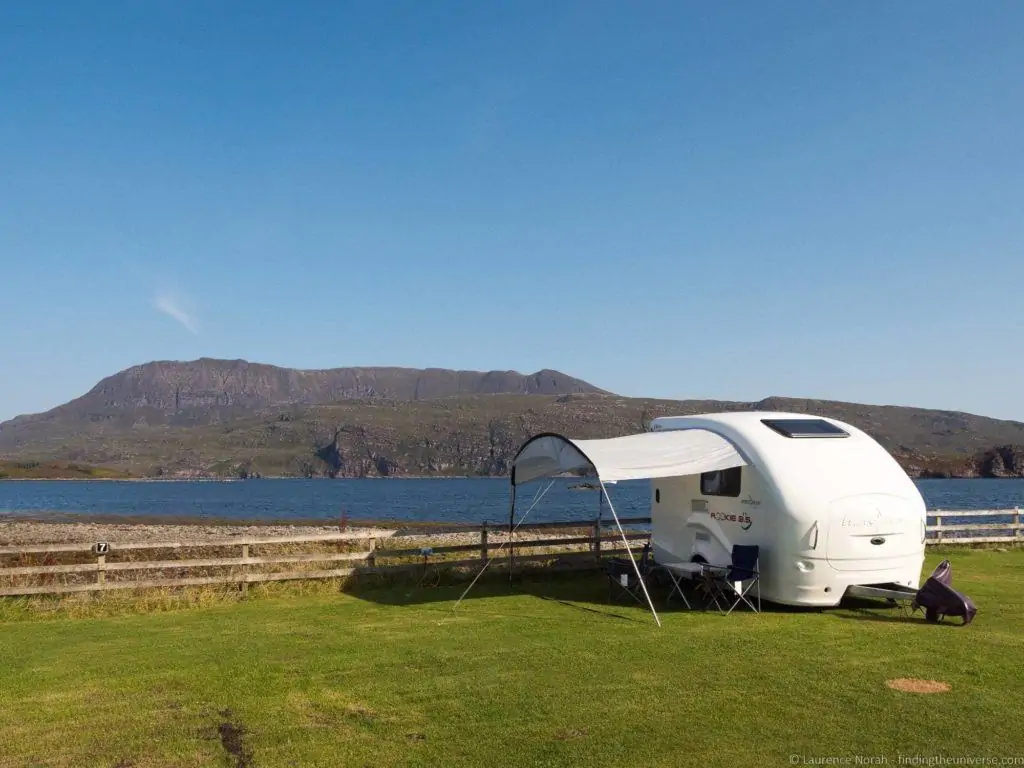
One popular option for driving the North Coast 500 is to camp, either by taking a tent, or driving a campervan or motorhome. In this post, we’re going to share a suggested seven-day North Coast 500 itinerary for those of you looking to camp around the North Coast 500.
We’ll be including tips on the best NC500 campsites to stay at, approximate driving times for each day, places to get supplies and fuel, food recommendations, tips on campervan rental, as well as dedicated sections covering everything you need to know to have a fun time camping around the North Coast 500.
This post recommends a number of campsites, but it isn’t comprehensive on every option. If you’d like a complete listing, see our guide to campsites on the NC500, which covers every camping and glamping option we could find around the route.
We think seven days is a good amount of time to see a lot of the route without rushing too much, although you could adjust this by a couple of days either way depending on your time constraints. We also have a 5 day North Coast 500 itinerary to help plan a quicker trip.
More time is always better, as you’d be able to fit in more fun activities such as hiking, clay pigeon shooting, kayaking, whale watching tours, and fly fishing.
We’d highly recommend taking at least five days to drive the route. 500 miles might not seem like a lot, but the route is meant to be enjoyed, and many of the roads are single track and therefore can be slow going, especially if you are driving a larger vehicle like a motorhome!
If you have less time, we’d suggest checking out the North East 250, a driving route that covers highlights of the Moray Firth coast, the Cairngorms National Park and Aberdeenshire. We have a 3 day NE250 itinerary you can take a look at.
This North Coast 500 camping itinerary will work if you are driving the route in a motorhome or packing a tent in your car.
You could also do it towing a caravan, although some of the sections of single track road will need to be skipped as they aren’t suitable for caravans. You’ll also want to be comfortable reversing your caravan as this might be needed, especially on the single-track sections of the route.
If you like the sound of this itinerary but don’t necessarily want to camp, you might like to read it in parallel with our NC500 B&B guide, and our guide to the best hotels on the North Coast 500. We also have a 1 week NC500 itinerary that is more geared towards non-campers. But that’s enough introduction. Let’s get started!
Table of Contents:
7 Day North Coast 500 Camping Itinerary
This 7 Day North Coast 500 road trip itinerary has you going in a counter-clockwise direction, starting and ending in Inverness.
You can reverse it of course if you prefer, and start anywhere you like, although Inverness is the most logical place to start and end as it has an airport and train station, as well as camping supplies and motorhome rentals.
If you have time, we can also recommend spending a bit of time in Inverness at the start or end of your journey. Highlights in the area include Loch Ness, Culloden Battlefield and Fort George, to name but a few, and the city itself has a lot of attractions that warrant a bit of time here.
Day 1: Inverness to the Black Isle
Driving time: Around 30 minutes from Inverness to Fortrose (without stops).
The first day of our itinerary has you exploring the city of Inverness and the nearby Black Isle. Definitely take advantage of the large supermarkets here to pick up last minute supplies for the route.
In Inverness there is plenty to see. The Inverness Museum is a good place to start your trip to learn about the history of the region, plus the tourism office nearby has a lot of information about attractions along the route that you might find useful.
We can recommend a trip to the nearby top of Inverness Castle for a wonderful view over the city, stopping in at the Victorian Market for trinkets, and a visit to Leakey’s Bookshop if you love books.
For more ideas, check out our guide to things to do in Inverness.
From Inverness, you’re going to head to the Black Isle, which, despite the name, is neither black nor an island. Instead, it’s a peninsular bordered by two firths, originally named for the dark forests which covered it. Today, it’s a popular spot for visitors, with a number of attractions to visit.
We’d highly recommend visiting the Black Isle Brewery where you can take a brewery tour and sample some of this delicious locally made beer, plus buy some for the rest of your road trip! Next, head up to the town of Fortrose, to explore ruined Fortrose cathedral.

Just along from Fortrose is Rosemarkie, where you can learn about Pictish standing stones at the Groam House museum, plus take a short walk to the gorgeous Fairy Glen Falls, one of my photography highlights along the North Coast 500.
There’s plenty more to do on the Black Isle, depending on how you are doing for time, including visiting the town of Cromarty, taking dolphin watching tours, and more.
Finally, we suggest you overnight at the Fortrose Bay Campsite. There’s a lovely beach here, plus from the nearby Chanonry Point you might see dolphins chasing salmon, which is a real highlight of the NC500 for many!
Facilities en-route: Inverness has a wide range of large shops and service stations so you can stock up before you set off. We can also recommend Robertsons the Larder just outside Beauly for picnic supplies and a chance to meet some friendly Highland coos.
Where to eat: In Inverness you’re spoilt for choice. On the Black Isle, the Black Isle Brewery has a taproom and the Black Isle Bar in Inverness itself is a good pre-trip dinner option.
Suggested accommodation: Black Isle – Fortrose Bay Campsite. Nearby alternatives are Dingwall Camping and Caravanning site and Bunchrew Caravan Park. If you prefer to head a little bit further north, check out either Delny Glamping and Farm Animals or Evelix Pods Dornoch for a bit of a luxury camping option.
Day 2: Black Isle to Wick area
Driving time: Around 2.5 hours from Fortrose to Wick (without stops).
On Day 2 it’s time to start heading north in earnest, with the route taking you up the relatively easy to drive A9 road.
There’s plenty to see along the way to keep you busy though. Your first good stop is the town of Dornoch, which is well worth some time. The local castle hotel in the centre of town is worth seeing, and the castle bar has lots of whisky! If you’re into golfing, you’ll be passing the Royal Dornoch Championship Course, which is one of the top courses in the world.
While you’re in Dornoch, pop into Cocoa Mountain for what might be the best hot chocolate you’ll ever have. They have two locations on the NC500: this one in Dornoch and another at the Balnakeil Craft Village near Durness (which you’ll reach on Day 5). Both are open seasonally from March to November.
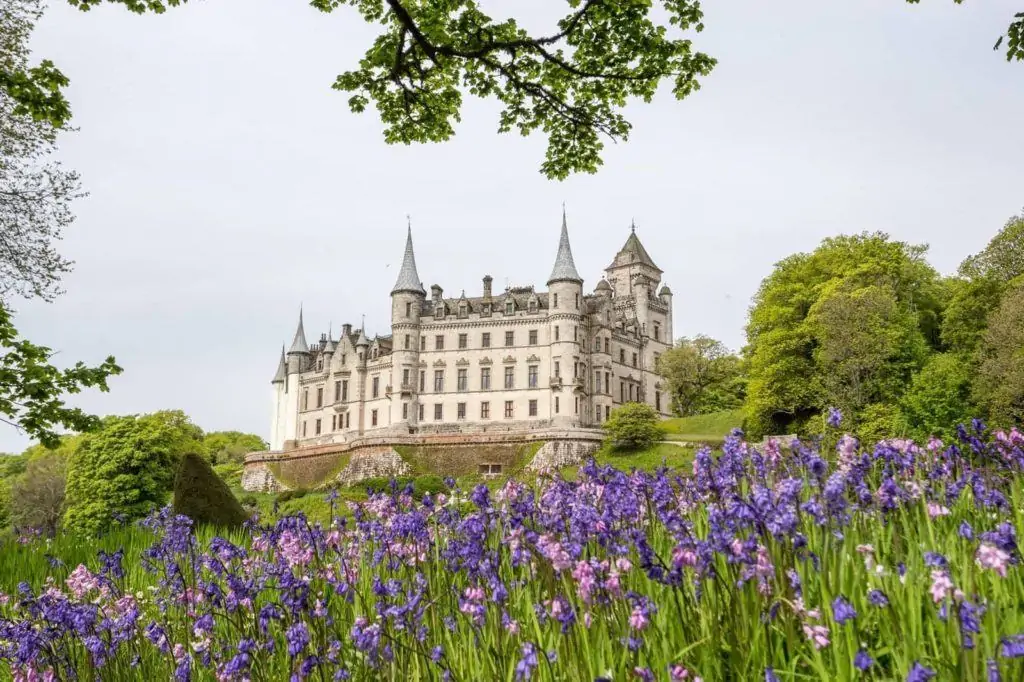
Slightly north of Dornoch near the town of Golspie is Dunrobin Castle, a must-see stop on the North Coast 500. This is a castle that seems to be straight out of a fairy tale, and a visit to both the castle and grounds should be high on your to-do list for the day.
Heading on from Dunrobin, we can recommend a quick stop at Carn Liath Broch, which is just off the road and one of the easier to access brochs along the way. Broch are thousands of year-old structures that are found throughout this area, and we think you should see at least one on your journey.
After that, our next suggested stop is the town of Helmsdale. This has a cute fishing harbour, and the Timespan museum is a worthy stop to learn all about the history of this area. They also have a really good cafe, making this a good lunch stop option.
From Helmsdale, continue the journey up the A9 along the beautiful coastline, to your next stop, the Whaligoe Steps. If you’re also interested in old structures, there are a number of three to five-thousand-year-old structures known as brochs along this section of the road. Badbea is also home to a highland clearance village site.
At Whaligoe you’ll find the Whaligoe Steps, a steep staircase which was built to provide access to the natural harbour formed here between two steep cliff walls. It’s quite a walk down the 365 steps. Try to imagine doing it with baskets full of fish, which is what the local women would have been doing in the 18th century!
Finally, you’ll end your second day in the Wick area. For campsites, you can decide how much you want to drive today. There’s a campsite in Dunbeath, about 20 minutes before Wick. Or you can push on to John O’Groats, 20 minutes after Wick.
There is a caravan and camping site in Wick (now called Wick River Campsite) which you can see here.
In Wick itself you might want to visit the Pulteney Distillery Co to learn a bit about Scottish whisky, or the Wick Heritage Centre which is an excellent museum covering the history of the area.
If you have time, you might also want to head out to the ruins of Old Wick Castle or Castle Sinclair Girnigoe, which has a spectacular location perched on the sea cliffs, and makes for a nice spot to watch the sunset.
Facilities en-route: Wick is your best bet for supplies with lots of cafes, restaurants, and shops, including major grocery store chains Tesco, Lidl, and the Co-Op.
Where to eat: The Timespan cafe in Helmsdale is a good lunch stop. In Dornoch, the Dornoch Castle Hotel restaurant does excellent food using local produce, or Cocoa Mountain for coffee and hot chocolate. In Wick, try Mackays Bistro on the world’s shortest street.
Suggested accommodations: Dunbeath – Inver Caravan Park or John O’Groats campsite at John O’Groats. For something a little different, head inland a little to Bower Wigwams and Pods, or a little further south to the North Star glamping pods!

Day 3: Wick to Dunnet Bay
Driving time: Around 40 minutes from Wick to Dunnet (without stops). Add another 40 minutes if you’re heading to John O’Groats and Duncansby Head first.
For the third day of our North Coast 500 itinerary, we’re going to visit the most northerly point in mainland Britain, see some incredible coastal scenery and try some Scottish spirits!
From Wick, follow the A99 north. Along the way there are also more brochs you can stop to see.
You’re now going to head up to John O’Groats, famed as being the most northerly town in mainland Britain. Here there are a couple of nice cafes, and on a clear day, a great view across to the Orkney Islands.
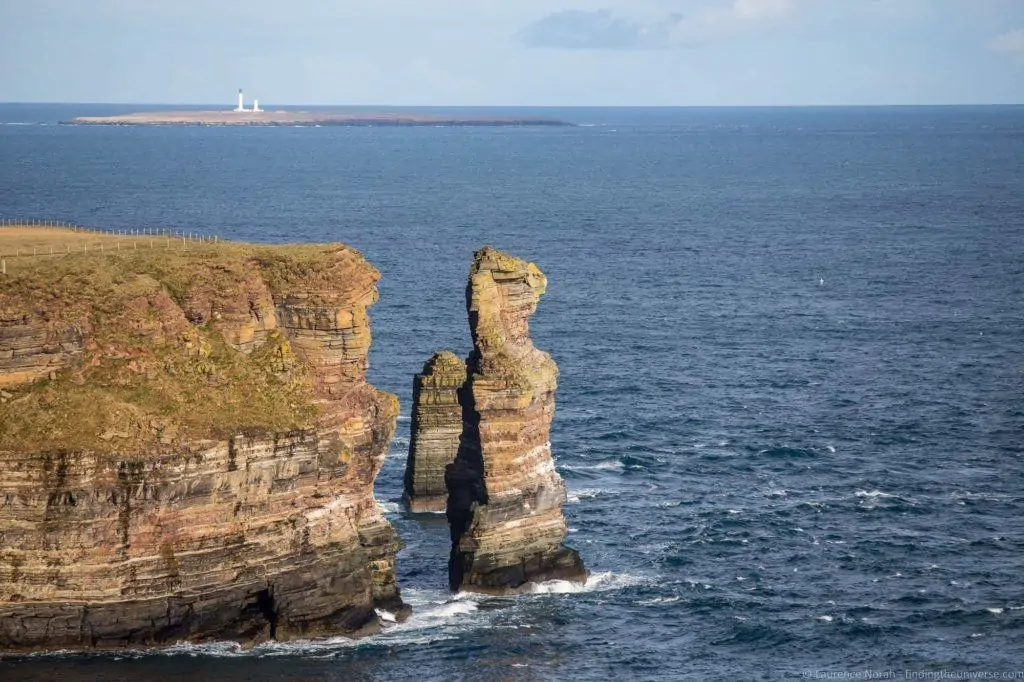
You can also take a five-minute drive east from here up to Duncansby Head Lighthouse, from where you might spot whales. From the car park here it’s an easy ten-minute walk across the fields to see the Duncansby Head sea stacks, impressive piles of rock jutting out of the sea which are popular with a wide variety of seabirds.
If you’re interested in wildlife, you can take wildlife cruises from here to spot seals, seabirds and (if you’re lucky) whales and dolphins.
Fans of royal history will definitely want to stop at our next recommendation, the Castle of Mey. This was the Castle that the Queen Mother bought, and she often spent time visiting the castle, which she helped to restore to its former glory from its fairly ruinous state. Today you can take a tour of the castle, the gardens, The Animal Centre (farm animals), and also have afternoon tea in the on-site tearoom.
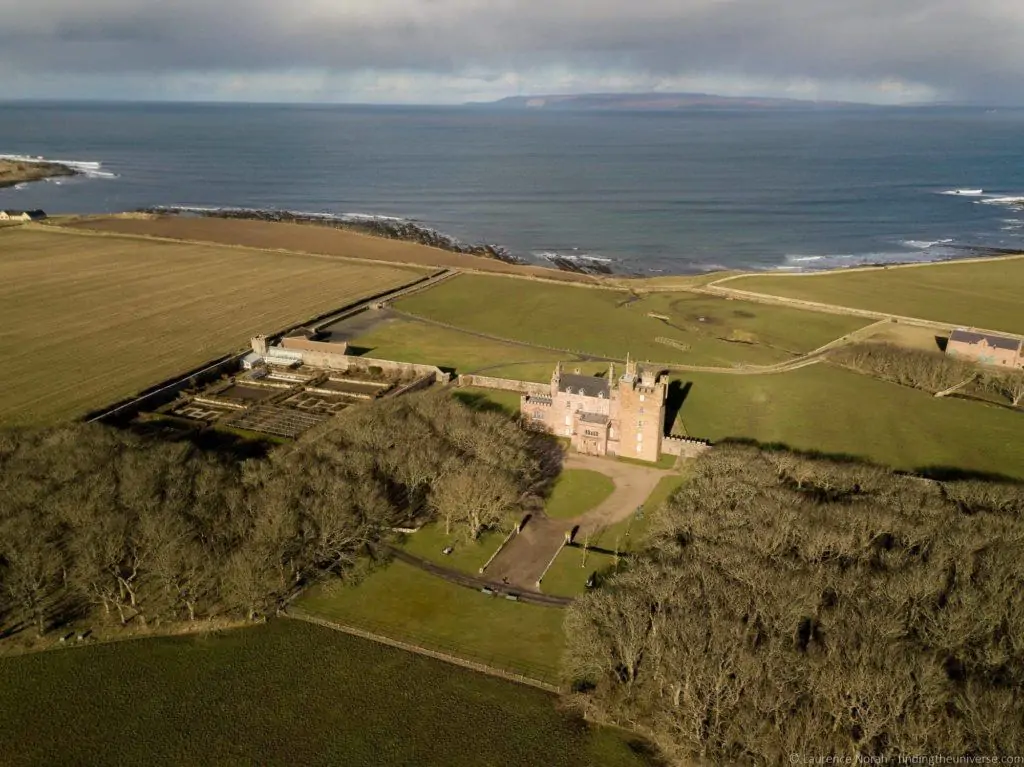
From the Castle of Mey, head along to the Dunnet area. We recommend first stopping at the Dunnet Bay Distillery, home to the award-winning Rock Rose gin, Holy Grass vodka, and their newer rum. Here you can learn all about how their spirits are made, plus try some of their distinctive flavours.
Then backtrack a few yards and take the B855 road out to Dunnet Head, the most northerly point in mainland Britain, where you can admire the 19th century lighthouse, gaze across to the Orkney Islands, and spot seabirds. There’s also the option when you go out to Dunnet Head to take a short detour to Mary Ann’s cottage, where you can take an excellent tour to learn all about the history of crofting. We really enjoyed this, but note it’s seasonal and timings are limited.
We missed it on our first few trips round the NC500 because we couldn’t sync up our timings with the opening hours, but we were very pleased when we were finally able to visit it.
After Dunnet Head, you’ll return to the main road (the A836). This area is where you’ll be spending the night. If you still have time, you might want to pop along to the brand new Stannergill Distillery in Castletown. This whisky distillery is from the same team behind Dunnet Bay Distillers. Housed in a beautifully restored 200-year-old Castletown Mill, Stannergill now runs tours and tastings from June to October (Tuesday to Sunday, 11am and 2pm, £25 per person), and the restaurant (The Grain Store) and shop are open Thursday to Sunday. It’s a fantastic new addition to the NC500.
Facilities en-route: Recommend picking up any needed supplies before leaving Wick. There are cafes and a small store with essentials at John O’Groats. There is also a small store in Castletown.
Where to eat: The Stannergill Distillery’s Grain Store Restaurant in Castletown is a great lunch or dinner option and is right on the route. Stacks Cafe and Bistro at John O’Groats is also a good stop for lunch.
Suggested accommodation: Dunnet Bay – Dunnet Bay Caravan and Motorhome Club Campsite. Nearby alternatives: Murkle Caravan Park and Morven View campsite. If you’d rather push on, try The Halladale Inn, a pub with touring park. For glampers, check out Braeside Retreats near Thurso. If you’d rather push on, there are also pods at the Wee Hoose Glamping pods.
Day 4: Dunnet Bay to Durness
Driving time: Around 3 hours from Dunnet to Durness (without stops). This is on increasingly narrow roads, so don’t rush.
The road from Dunnet Bay to Durness across the northern coastline of Scotland is where you’re going to start encountering primarily single track roads. If you’re not familiar with driving on these, take a look at our guide to driving on single track roads for tips.
From Dunnet Bay, you’ll first pass through the town of Thurso. This is one of the last larger towns you’re going to encounter for a couple of days, so is a good place to get any needed fuel and supplies. However we recommend also patronising smaller convenience stores and shops as you travel the North Coast 500 as it is a wonderful experience and a nice way to support the local economy.
Thurso is well worth a stop for more than supplies though, and the town centre is a good place to explore on foot. We can also recommend the North Coast Visitor Centre, an excellent museum set in the old town hall which has exhibits on everything related to Caithness, from Pictish Stones to nuclear power.
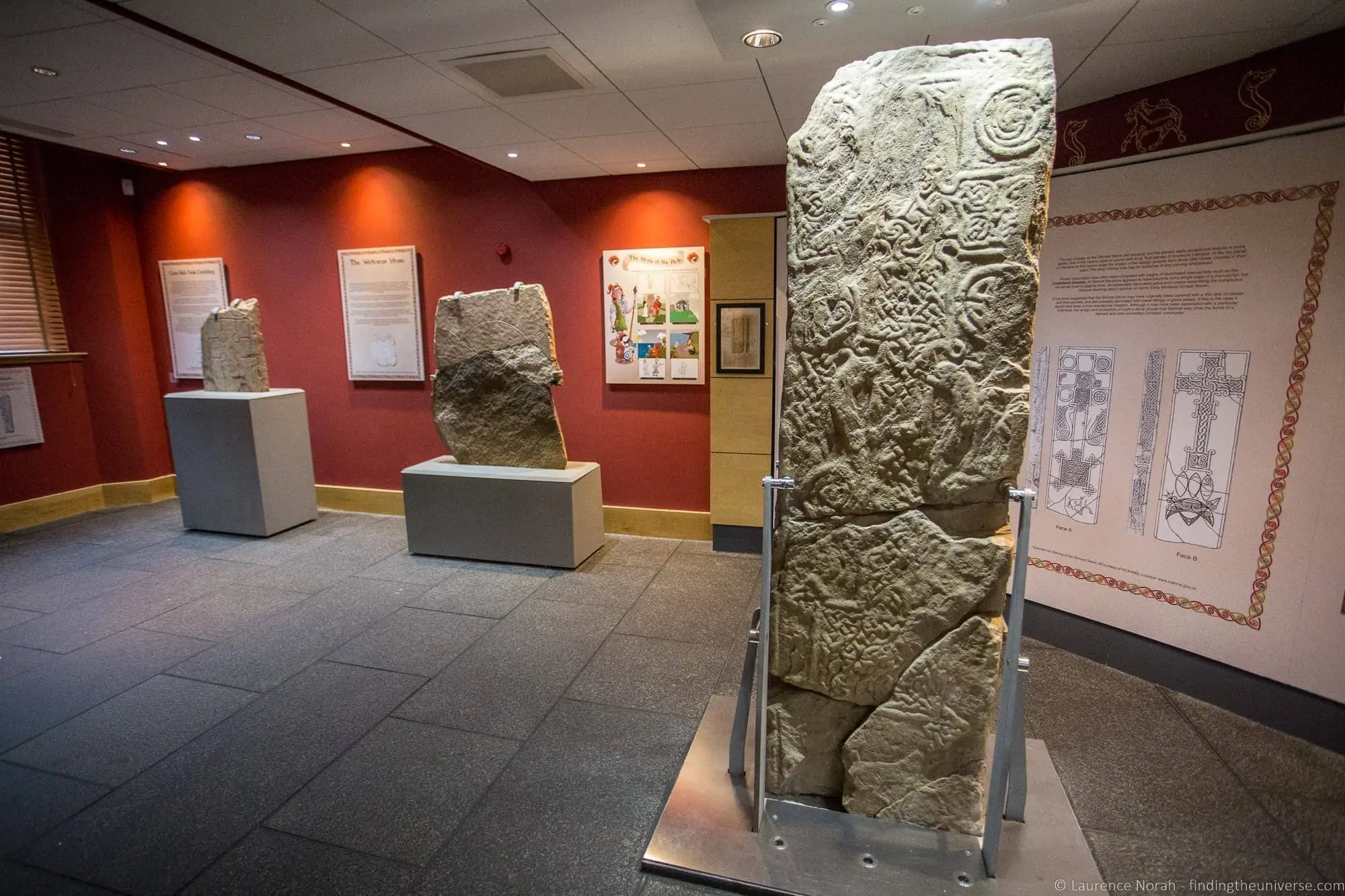
Next, continue to follow the A836 along the north coast, taking in the views. You’ll go past Scrabster, which is where the ferry to Orkney departs from.
A good spot to stop is Strathy Point, where a short ten minute walk will reward you with lovely views of a lighthouse and the coast in both directions.
A little further along you’ll find Strathnaver, home to a museum that will fill you in on the history of this area, with a particular focus on the clans and the Highland Clearances. Farr Beach is found here as well, which is a beautiful beach, well worth taking a wander along, and popular with surfers.
The road continues to wind along the coast, and becomes single-track more often than not, so do exercise caution, especially if you are driving a motorhome or towing a caravan.
Our next stop is the town of Tongue, which has a small Spar (convenience store) with a petrol station attached. You can also have lunch here at the Ben Loyal pub, or food is available at the Tongue Hotel.
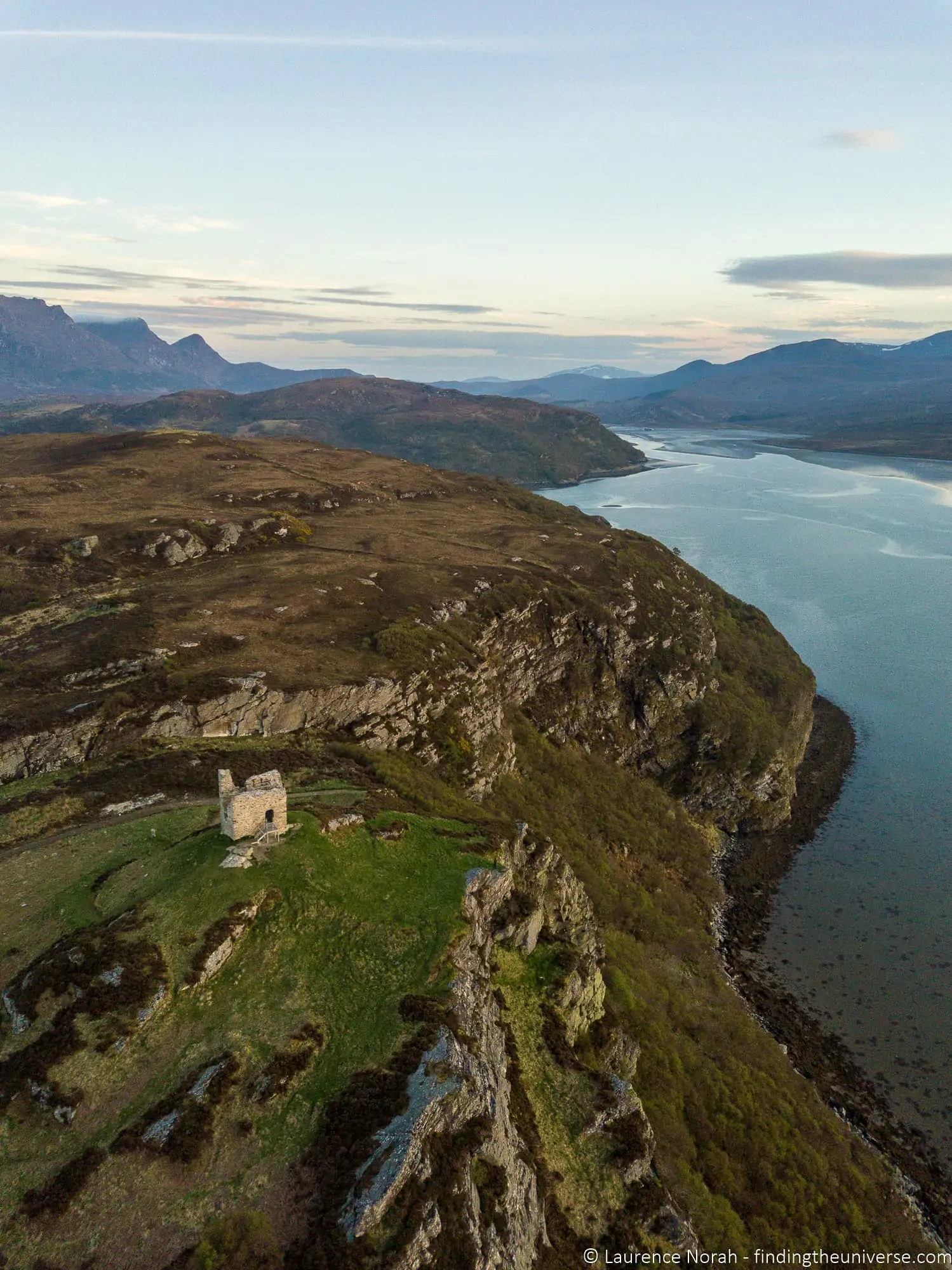
If you are looking for a hike, there is a path starting near the Ben Loyal pub that leads uphill to a ruined castle above town. It is about a 1 hour leisurely round-trip hike up to the ruins of Castle Varrich, which is perched high on a rocky promontory and offers spectacular views.
Finally, continue your drive for another hour or so until you reach the town of Durness, where we suggest you spend the night. This is famous for the impressive Smoo Cave, a cavern you can walk inside which has a waterfall to admire. If you want to further explore the inside of the cave, you can take a guided tour. Tours run from April to October, cost £15 for adults and £5 for under-16s, and are cash only. The area also has a number of beautiful beaches.
Facilities en route: Major fuel and supermarket brands in Thurso. Smaller grocery stores and cafes in Bettyhill, Tongue and Durness. Full motorhome services at Sango Sands Oasis Caravan Park, as well as cafes and pubs.
Where to eat: In Tongue, the Ben Loyal Hotel has an excellent restaurant we can recommend. In Durness, the Smoo Cave Hotel does hearty pub food and local ales, and is a popular stop for NC500 travellers.
Suggested accommodation: Durness – Sango Sands Oasis Caravan Park. There is a campervan stopover at Kinlochbervie, although the latter is an additional bit of driving.
If you want a pod, there are options in Tongue, about 45 minutes before Durness. Check out Island View Glamping pods or the Ben Loyal Hotel and Glamping pods in Tongue. The latter has an excellent restaurant we can recommend.

Day 5: Durness to Achmelvich Bay
Driving time: Around 2 hours via the main A-road, or 3 hours if you take the scenic B869 via Drumbeg (not recommended for larger vehicles).
You’re now going to be heading south down the west coast of Scotland, which is home to some of the most dramatic scenery you’ll find anywhere in Scotland. Think sparkling lochs, white sandy beaches, incredible mountains, and curvy roads.
Before leaving Durness, you might want to head to the Balnakeil Craft Village, a short way west of Durness. Here you’ll find a Cocoa Mountain cafe serving mind-blowing hot chocolate (if you tried the Dornoch branch on Day 2, this is the original location). Both the Dornoch and Balnakeil locations are open seasonally from March to November. There are also a number of local art and craft shops here, making this a great stop if you are looking for souvenirs from your trip.
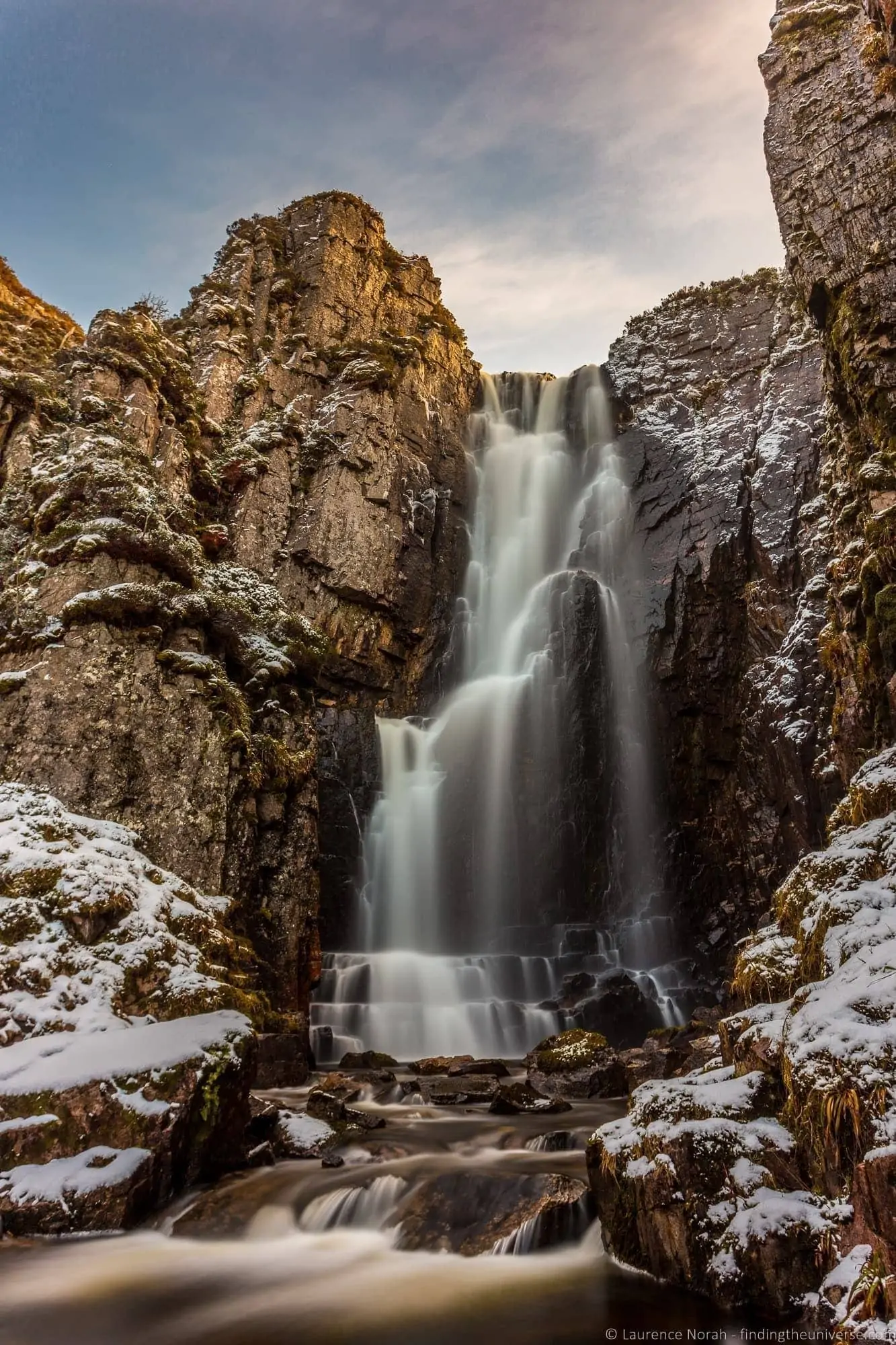
Next, start heading south on the A838. Despite its “A” designation, this is largely a single-track road, and is not a section of road to rush. This is also one of the more remote parts of the North Coast 500, so services and stores are harder to come by, and there aren’t really any large towns until you reach Ullapool.
Still, this is kind of the point of coming to a remote part of Scotland! From Durness, the road winds down through some magnificent scenery, with lots of waterfalls and lochs to take pictures of as you go.
After you cross the Kylesku bridge, keep an eye out for the Rock Stop, a visitor centre for the North West Highlands Geopark, where you can learn all about the incredible geology of this area. They also have a cafe. You can also take boat tours from Kylesku.
After the Rock Stop you have a decision to make, which will largely depend on your vehicle. We can highly recommend turning off the A894 and taking the B869 towards Drumbeg just after Kylesku, although this road is not recommended if you are driving a larger vehicle or towing a caravan.
From the official NC500 website:
“We would also recommend avoiding the B869 from Lochinver to Kylesku as this can be a tricky route to follow for large vehicles. If you take the A837 back from Lochinver on the main road you will be fine. As always, please take due caution on the roads and use passing places where possible.”
If you do take the B869, you will want to stop at the general store in Drumbeg, which has won awards, and is a good place to pick up a bite to eat. On this road highlights include the waterfall at Clashnessie (a nice short 20 minute hike), and if you want to take a longer hike (3 miles each way), the walk out to the Old Man of Stoer is beautifully rugged.
Alternatively, if you have a larger vehicle, you can continue down the A894 and then turn onto the A837, following the shore of Loch Assynt until you reach Lochinver. From Lochinver, you can take the B869 road to Achmelvich, which is more manageable and only a short section.
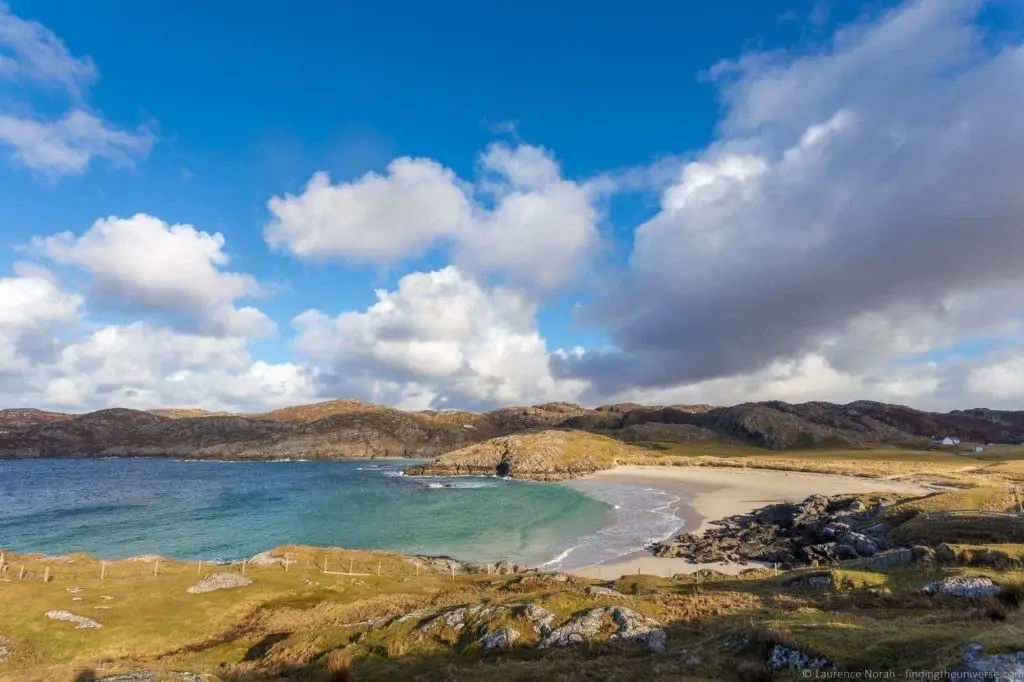
If you like fishing, then you are now in the perfect location. Local fishing expert Stewart has been fishing in the Assynt area for over four decades, and he now leads fly fishing tours in the area. These are great for experienced fishers to beginners, and fun for families. We really enjoyed our tour with him. You’ll definitely book in advance. Full information on his website, Assynt Fly Fishing.
I’m going to suggest you spend the night on the peninsula. There are two nice campsites by the beach at Achmelvich Bay and Clachtoll Beach, both of which offer gorgeous white sand and turquoise waters. We think these are two of the most beautiful NC500 campsites!
There are also walking trails throughout the area. As mentioned above, the road around the south of the peninsula from Lochinver is easier to drive, so if you are pulling a caravan you will definitely want to come in that way.
Facilities en route: This stretch of the route is more limited, with Lochinver (a little south of the official route) being your best option for fuel and supplies. Lochinver has a few really good restaurants, a couple of small shops, and a well-known pie shop.
Where to eat: The Lochinver Larder is famous for its pies, and rightly so. The venison and cranberry pie is exceptional, and they have an excellent selection of sweet and savoury options. You can eat in with views over the loch, or take them away for the road. It gets busy, so arriving early is a good plan.
Suggested accommodation: Achmelvich Bay – Shore Caravan Site or Clachtoll Beach Campsite. Also check out the NC500 pods at Achmelvich.
Day 6: Achmelvich to Gairloch
Driving time: Around 2.5 to 3 hours (without stops).
From Achmelvich, return to rejoin the A837, making a stop at Lochinver if necessary for supplies and fuel if you haven’t already stopped.
From Lochinver, head back inland along the A837. You’ll pass the glorious ruins of Ardvreck Castle, which are worth a photo stop and short walk, and then continue south.
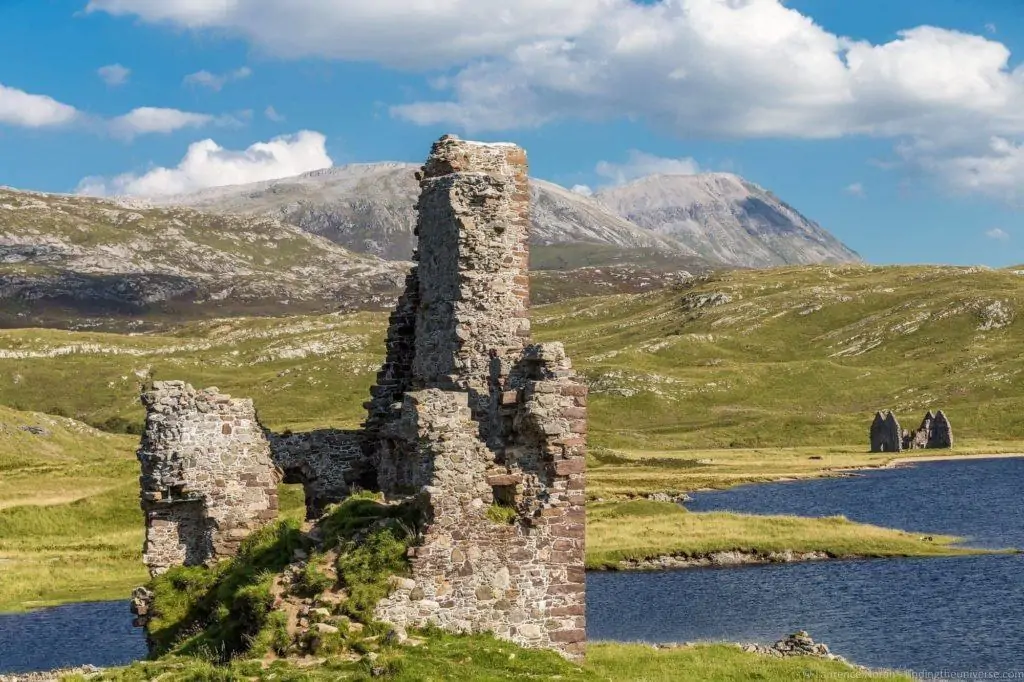
You’ll shortly come to Knockan Crag, a national nature reserve which offers wonderful views, as well as a journey back through time where you can learn a bit more about the geology of the area. The signed walking route here takes about 30 minutes to an hour to complete, depending how far you go. If you’d prefer a longer walk, we enjoyed the roughly 2 hour hike out to the Bone Caves, found just north of Knockan Crag.
Depending on your interests, you might want to head back out to the coast towards Achiltibuie. There’s an awesome outdoors company based in Achiltibuie, Hamlet Mountaineering, who offer a wide variety of outdoor activities which include guided hiking and climbing, canoeing, and sea kayaking.
If you’re the outdoors type and want to get active, we can highly recommend them. They offer half day to multi-day tours. Be sure to book in advance. You can read our experience of a hike up Suilven and overnight camping trip with Hamlet Mountaineering here.
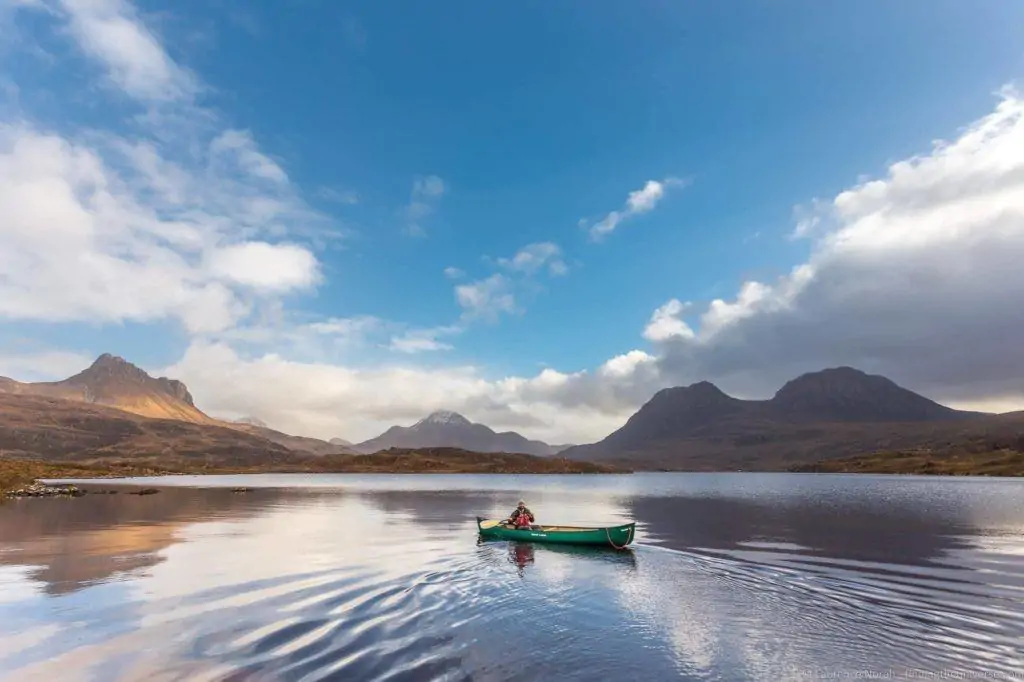
Otherwise, head on, and you’ll arrive in Ullapool. A great town to stock up on supplies and stop for food (has several cafes and restaurants), and it also has a pretty harbour, lots of gift shops, and a good local history museum.
After Ullapool, stop off at Corrieshalloch Gorge to marvel at the steep canyon and test your nerves on the canyon bridge, then head back out to the coast on the A832. The scenery is definitely the star of the show today. You’ll probably be making lots of unscheduled stops for photo opportunities.
Our recommendation would be to overnight at Gairloch as this will give you plenty of time to see the highlights along the way, although you could push through as far as Applecross if you were feeling so inclined. There’s also a tent-only campsite at Torridon, which is about halfway between Gairloch and Applecross.
Facilities en route: Lochinver has a small store and petrol station, Ullapool has a larger Tesco and another fuel stop.
Where to eat: If you didn’t make it to the Lochinver Larder yesterday, today is your chance for a pie. In Ullapool, the Arch Inn has always been one of our favourites. The upstairs restaurant is reopening in Spring 2026 as the Eat Inn, and the bar does food throughout the day. For a quick bite, the Seafood Shack in Ullapool is also worth a visit when it’s open (seasonal, reopening April 2026).
Suggested accommodation: Gairloch – Sands Caravan and Camping Park or Gairloch Holiday Park. Other options include Torridon Campsite (tents only), Shieldaig Camping and Cabins, Applecross Campsite.
Day 7: Gairloch to Lochcarron
Driving time: Around 2 hours from Gairloch to Lochcarron (without stops).
From Gairloch, the plan for the day is to head to Lochcarron, passing through Torridon and around the beautiful Applecross peninsula. Depending on your time, you could also head back to Inverness rather than overnight at Lochcarron, if you were thinking of a 6 night / 7 day itinerary.
If you’re not pulling a caravan or driving a huge motorhome, then a drive from Applecross down the incredible alpine-like Bealach na Ba road is a must. This is one of Britain’s highest roads, and offers gorgeous views across to the Isle of Skye. The drive around the Applecross peninsula is also beautiful, but don’t expect to drive it quickly. It’s a windy, slow, single-track road.
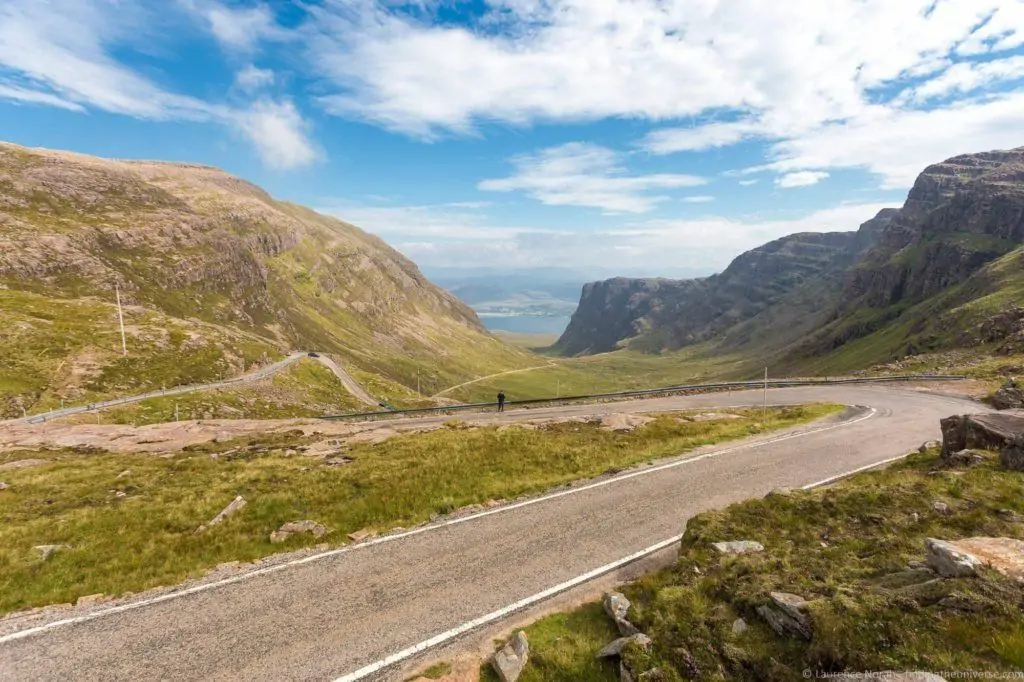
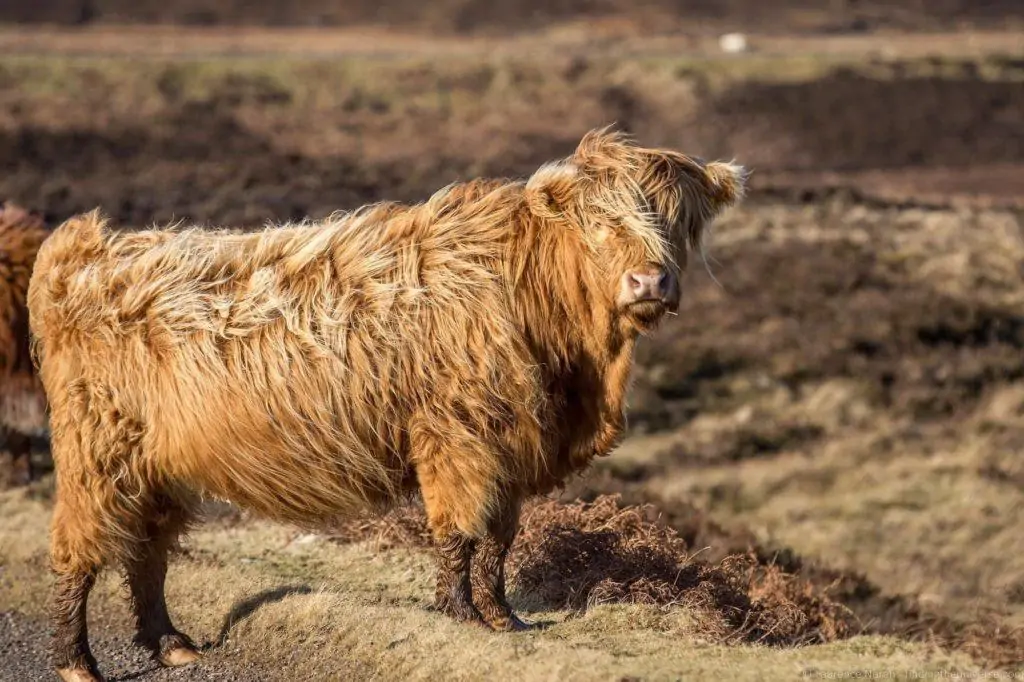
Just take your time and soak in the fantastic scenery, stopping off to take as many photos as you can. If you’re after Highland Coo photos and somehow haven’t spotted any by now, a stop at the Torridon is a good idea as they have a herd on site (plus a great cafe and pub).
Facilities en route: This is still quite a remote part of the world. You’ll find some services at Kinlochewe, Applecross and Lochcarron. We can also recommend stopping off at the Torridon where there’s an excellent cafe.
Where to eat: The Applecross Inn is well known for its food, particularly the seafood. It books out well in advance during the summer months, so plan ahead if you want to eat here. The Torridon also has a good cafe and pub.
Suggested accommodation: Lochcarron – The Wee Campsite. Near Inverness – Riverside Chalets and Caravan Park
Finally, you return to Inverness from Lochcarron to finish off your fantastic North Coast 500 adventure! You could also extend your trip by a few days and take in the Isle of Skye at this point if you wanted to of course. It’s your adventure after all!
Speaking of which, don’t forget that just because you’re camping doesn’t mean you can’t have a bit of luxury on your way around. You could mix up the above route by taking a break from camping, and maybe staying at a nice property on the way around.
Based on the route, we can recommend Forss House Hotel around night 3, Eddrachilles Hotel around night 5 or the Torridon, around night 6. For more ideas, check out our detailed guide to the best hotels around the North Coast 500.
North Coast 500 Camping Route Map
To help you visualise the above, we’ve put together a map of our 7-day North Coast 500 itinerary, which you can see as an image below, and on Google Maps here. As well as the route, it also includes a number of campsites and glamping locations on the North Coast 500 for reference.
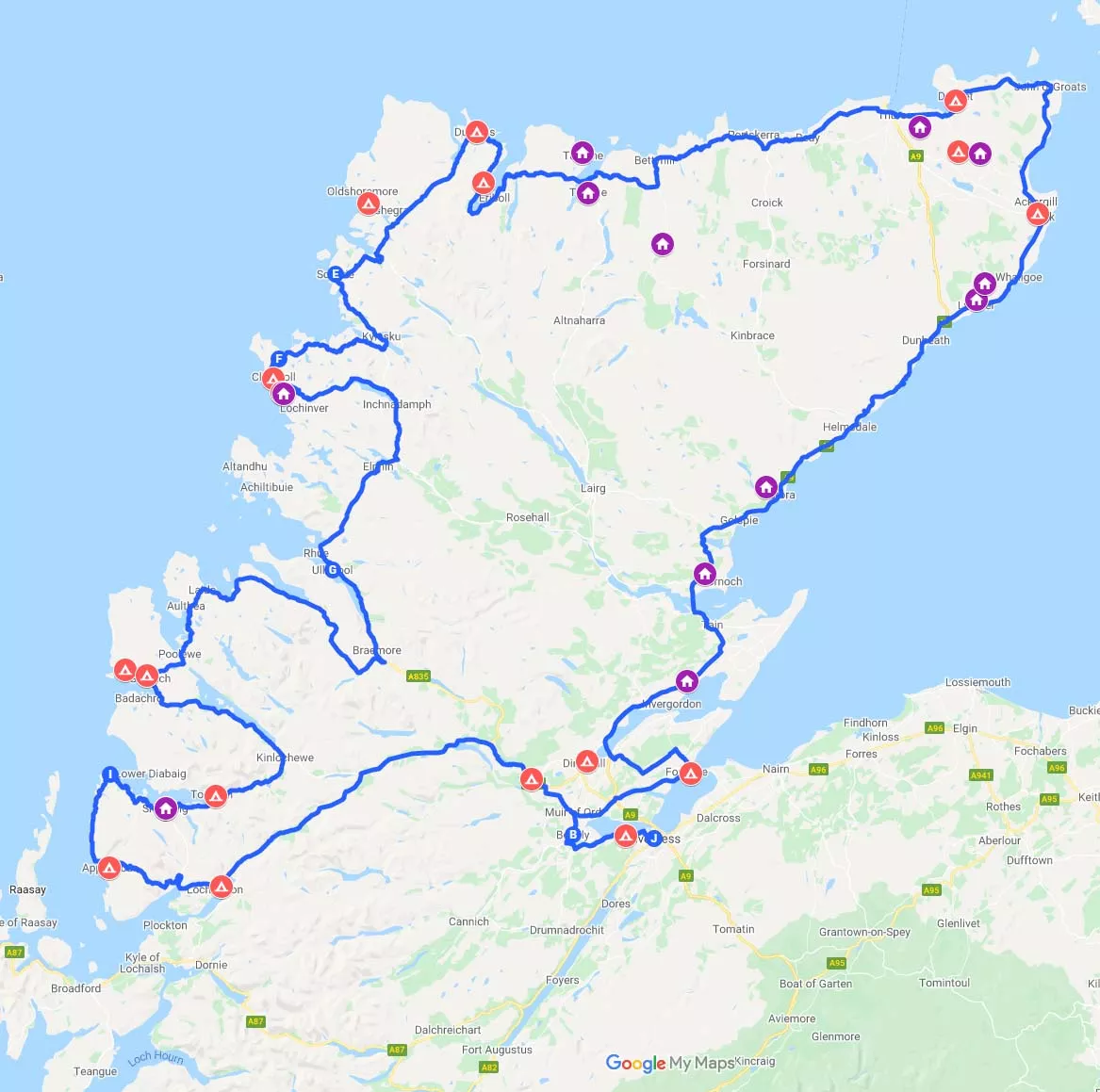
If you’re looking for a physical map to take with you, we’d recommend the Collins NC500 Pocket Map, which you can purchase online in advance of your trip from Amazon.
The official NC500 printed map has been discontinued, but the NC500 app is a good digital alternative and includes maps, points of interest and suggested itineraries.
Now we’re going to go through some questions you may have about camping around the North Coast 500 and try to provide as much information as we can to help you plan your trip.
North Coast 500 Camping Itinerary Summary
Here’s a quick overview of the itinerary day by day for reference:
- Day 1: Inverness to the Black Isle (~30 min driving)
- Day 2: Black Isle to Wick area (~2.5 hrs driving)
- Day 3: Wick area to Dunnet Bay (~40 min driving, plus JOG detour)
- Day 4: Dunnet Bay to Durness (~3 hrs driving)
- Day 5: Durness to Achmelvich Bay (~2-3 hrs driving)
- Day 6: Achmelvich to Gairloch (~2.5-3 hrs driving)
- Day 7: Gairloch to Lochcarron (~2 hrs driving)
Midges: The One Thing Every NC500 Camper Needs to Know
If you’re camping on the NC500 between late May and September, you need to be prepared for midges. These tiny biting insects are a fact of life in the Scottish Highlands, particularly on the west coast and in sheltered, still conditions. They are at their worst around dawn and dusk, and on warm, overcast days with no wind.
The good news is that a decent midge repellent makes a huge difference. We’d recommend Smidge, which is made in Scotland specifically for Scottish midges and works better than most alternatives we’ve tried. A midge head net is also well worth packing, as you’ll look ridiculous but it makes cooking, setting up camp, and just being outside so much more bearable during midge season.
If you’re travelling before mid-May or after the end of September, midges are much less of an issue, though not entirely absent.
Mobile Phone Signal on the NC500
Be aware that mobile phone signal is patchy to non-existent on large stretches of the NC500, particularly along the north and west coasts between Tongue and Ullapool. If you’re relying on your phone for navigation, make sure you download offline maps before you set off. Google Maps and OS Maps both support offline downloads. For the rest of what we install before a trip, see our guide to the best travel apps.
This is especially important for campers, as you may need to find campsites, check opening times, or look up fuel stations in areas with no signal. A paper map is also a good backup. We recommend the Collins NC500 Pocket Map for this.
Where Can I Rent a Campervan, RV, or Motorhome for the NC500?
There are lots of options for campervan rental in Scotland. The widest choice is likely in Edinburgh, however for the NC500 you might want to look for options in Inverness. This is the easiest city on the route to get to from other parts of the UK, being well served by both flights and trains.
If you are doing a longer trip, or want to see more of Scotland, then Edinburgh is a good starting point. It’s only three hours’ drive from the start of the NC500 in Inverness.
Either way, if you are planning on hiring a motorhome for the North Coast 500, then we recommend comparing prices across a range of providers using a service like Motorhome Republic. You can see their UK listings here.
If you’d like a more robust camper vehicle, check out the four wheel drive camper trucks from Wild Camper Trucks. See their Scotland options here.
When comparing prices, always check what’s included. Look for things like unlimited mileage, the costs of extra drivers, and so on.
If you’d prefer to rent in Inverness, Rover Rentals hires campervans in the city.
In terms of age, to hire a car or motorhome in Scotland most companies will require you to be at least 21, although some will require you to be older than this. There may also be a surcharge for drivers under 25. You will also normally need to have held a licence for at least a year. You can rent a motorhome on a standard driving licence. Always check with the rental agency to see what their policy requirements are before planning a trip.
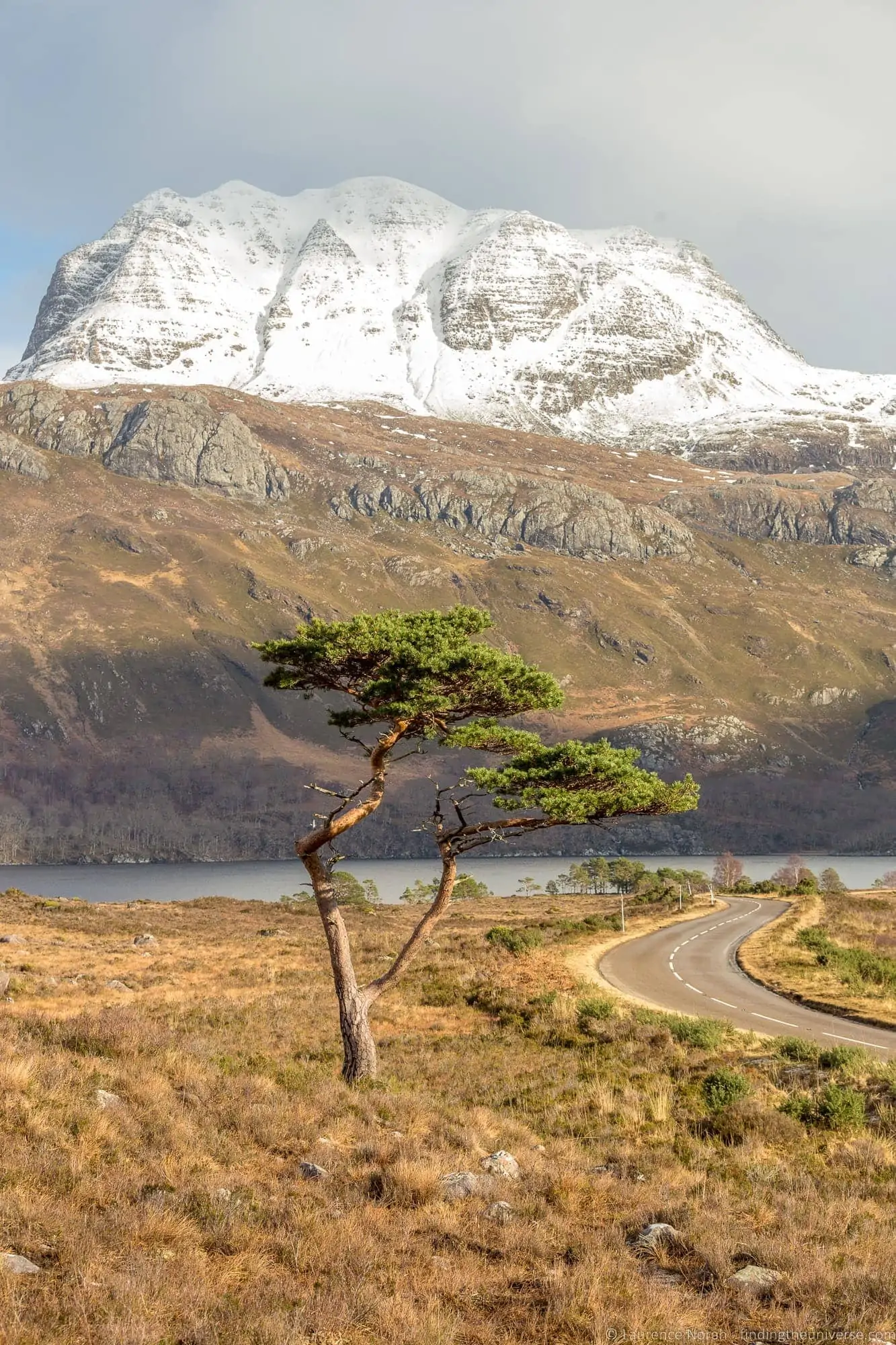
We highly recommend picking the smallest size vehicle you can find, as many sections of the North Coast 500 are narrow and winding, and a larger vehicle might end up being quite nerve-wracking or even impossible to drive. See more in the section below on vehicle size restrictions on the North Coast 500.
If that sounds too scary, consider using a hire car and a tent. There are a number of outdoor suppliers in Inverness from whom you’ll be able to get fully kitted out for your North Coast 500 camping adventure!
Vehicle Size Restrictions on the North Coast 500
The only stretches of the route that really aren’t suitable for longer vehicles (generally those over 26ft in length) are the B869 between Lochinver and Kylesku. Whilst there is no legal length limit, this road can be challenging in a longer vehicle, so you would be best taking the A837 / A894 instead.
The other stretch of the road you should avoid in a longer vehicle, and especially if you are towing something like a caravan or even a trailer tent, is the Bealach Na Ba. This has some steep switchback bends and longer vehicles have gotten stuck here, which causes no end of issues for other drivers. Instead, take the main road from Shieldaig to Tornapress.
With the above said, if you are planning on driving a motorhome or towing a caravan around the North Coast 500, there are some things to keep in mind.
Long stretches of the route, particularly around the north west section between Tongue and Lochinver, are on single track roads. These have passing places, but in many cases you may have to reverse your vehicle some distance to get into a passing place. So if you are considering driving a vehicle that you are not confident in reversing, you might consider using a smaller vehicle, as otherwise you could end up blocking the road and causing issues for other drivers.
In general, the recommended length for a vehicle on the North Coast 500 is up to 18 feet in length. Of course, if you are very familiar with your vehicle and confident in reversing it, then a longer vehicle will be ok.
Can you Wild Camp on the North Coast 500?
In this post you probably noticed that we have listed a fully serviced campsite for every night of the trip. These come with power hook ups and, more importantly, proper disposal points for chemical toilets and “grey water”, as well as things like showers, flushing toilets, and picnic areas. Many are situated in scenic locations such as within a short walk of the ocean or a loch.
In Scotland, wild camping is certainly legal, but the definition of wild camping is away from a road, and not in a motorised vehicle. Here is a link to the Scottish Outdoor Access Code, plus guidance from Visit Scotland on wild camping.

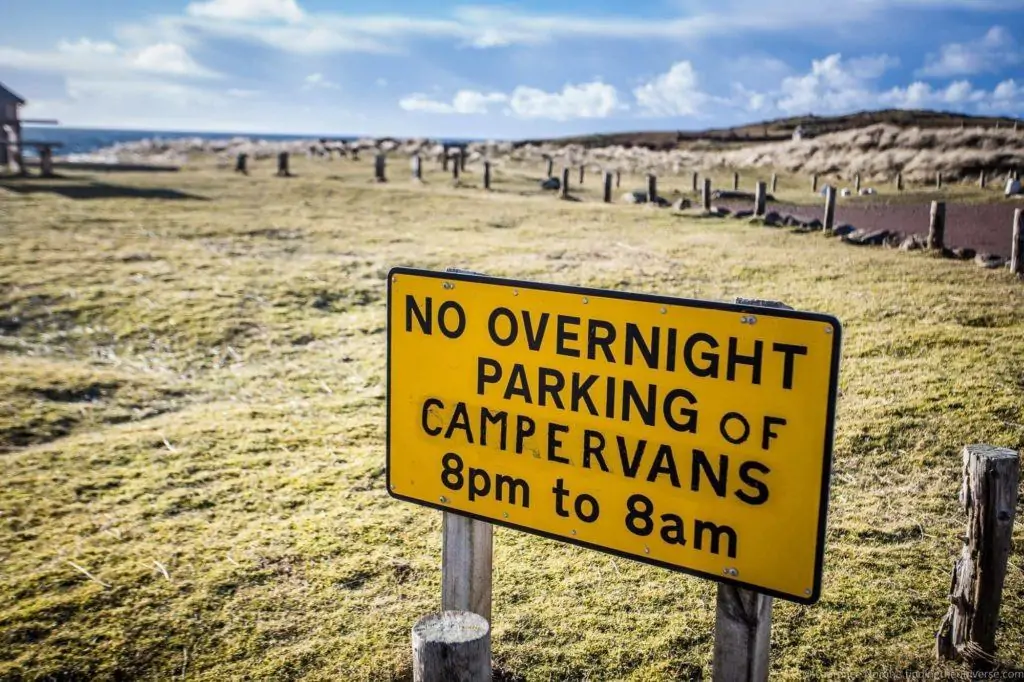
That said, there are places around Scotland and the North Coast 500 where you can park up your motorhome and spend the night far away from anyone. We would just suggest you take a look at our responsible tips for travel on the North Coast 500 below, be considerate, and not park overnight where it is clearly stated that you are not allowed to.
Parts of Scotland, such as the Loch Lomond & Trossachs National Park, have already had to start clamping down on people wanting to camp because of the inconsiderate actions of a few, as well as overcrowding, so you don’t want to be contributing to a future action like that.
We’d also urge you to consider supporting the local economy on your trip. Staying at local campsites along the NC500 means you’ll be helping to do just that, plus you won’t have to be worrying about finding somewhere to park, which can become a real challenge in the busier months (July and August especially).
Do you Recommend Tent Camping or Doing the North Coast 500 by Campervan / Motorhome / RV?
There are pros and cons to each approach, so what you choose will really depend on you, your travel style, your budget, and your driving ability.
Packing a tent into your vehicle, be that a car, motorbike or bicycle, will mean your overall footprint on the road is smaller. This will make it easier to navigate side roads and single track roads, as well as open up more wild camping options. Tent sites also tend to be cheaper as you won’t normally need as much space, electrical hookups or chemical toilet disposal facilities.
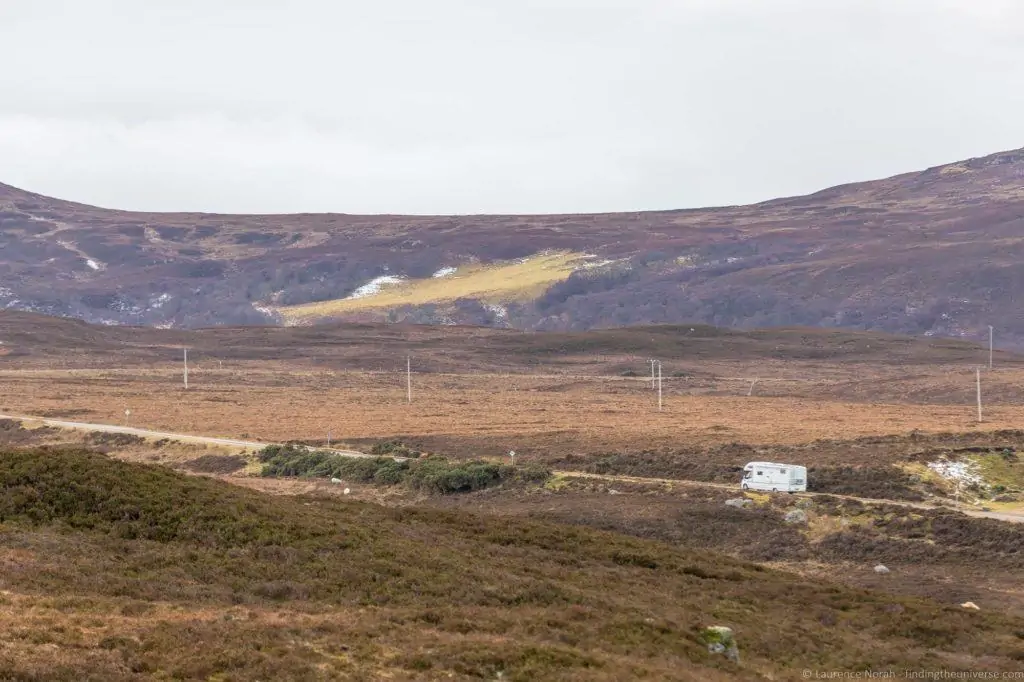
Campervans on the other hand provide lodging on wheels, meaning you don’t have to worry about putting a tent up or taking it down, which is not much fun if the weather is against you. The larger ones come equipped with everything including the kitchen sink, meaning you can shower and use the loo. Even smaller vehicles usually have sleeping arrangements for two and a small kitchen area.
In a camper van you do have to think about where you’ll be able to empty your chemical toilets, and they are both more expensive to hire, and more expensive to drive than a normal car. They also cost more per night on campsites.
Another option is to do neither of course. Many of the campsites we list on the NC500 have a variety of accommodation options from static campervans to wigwams and pods, so if you plan and book well in advance, you can “camp” around the North Coast 500 without having to take any camping equipment at all!
No matter which you choose, we recommend driving or renting the smallest sized vehicle needed for your group in order to be able to better handle the roads and parking areas along the route.
What Services are Offered at North Coast 500 Campsites?
The services vary from site to site, but the majority of the NC500 campsites that we recommend on this list offer electrical hook-ups, pitches for tents and campervans / motorhomes, flushing toilets and shower blocks. Some also have laundry facilities, picnic areas, WiFi, playgrounds, and other facilities.

As well as these services, many of the sites we list and that you will find around the North Coast 500 offer static campervans, travel trailers, glamping tents, cabins, and wigwams for rent. Great for those just wanting to “camp” but not have to worry about bringing or setting up a tent!
Are there Dog Friendly Accommodation Options on the NC500?
Many campers love to travel with their dogs, and we often get requests from folks asking us if the route is suitable for dogs.
Certainly, the NC500 itself is dog friendly, with plenty of walking options and places where you can share the adventure with your pet.
In terms of accommodation, the majority of campsites that we have mentioned do accept pets. You’ll need to check in advance of course for the campsite you want to stay at, and see if there are any additional fees.
For hotels, it is very variable. We have added information on which hotels and B&Bs are pet friendly on the NC500 in our NC500 B&B guide and our NC500 hotels guide so you can make an informed choice.
Do you Recommend Booking Campsites along the NC500 in Advance?
The North Coast 500 is becoming more popular every year, and we highly recommend booking well in advance for the busier months, which tend to be from May through to September. The peak season for camping is July and August (this coincides with school holidays in the UK and Europe), so you definitely need to plan and book well in advance for those months.

Areas that get particularly booked out tend to be the more remote areas where there are fewer options. For example, the northwest corner around Durness, and the southwest area around Applecross.
If you choose to travel in the winter months, you will likely not need to book in advance, but you should definitely research which options will be open, as many accommodation options and campsites close during this time.
Having Trouble Finding an Available Campsite or RV site?
Here are our tips to help you avoid having trouble finding an available campsite, and what to do if you’re struggling to find somewhere to stay on the route.
- Try to book in advance if you can (especially in June to August) to prevent this issue as you don’t want to have to drive an hour out of your way
- If you are in a tent, definitely consider wild camping
- Don’t discount hotels and B&Bs, even if the campsites are full you might be able to get a room. See our guide to the best B&B’s on the North Coast 500 for some great options.
- Holiday cottages and apartments are another option. See our guide to holiday cottage websites in the UK for lots of websites with thousands of properties available
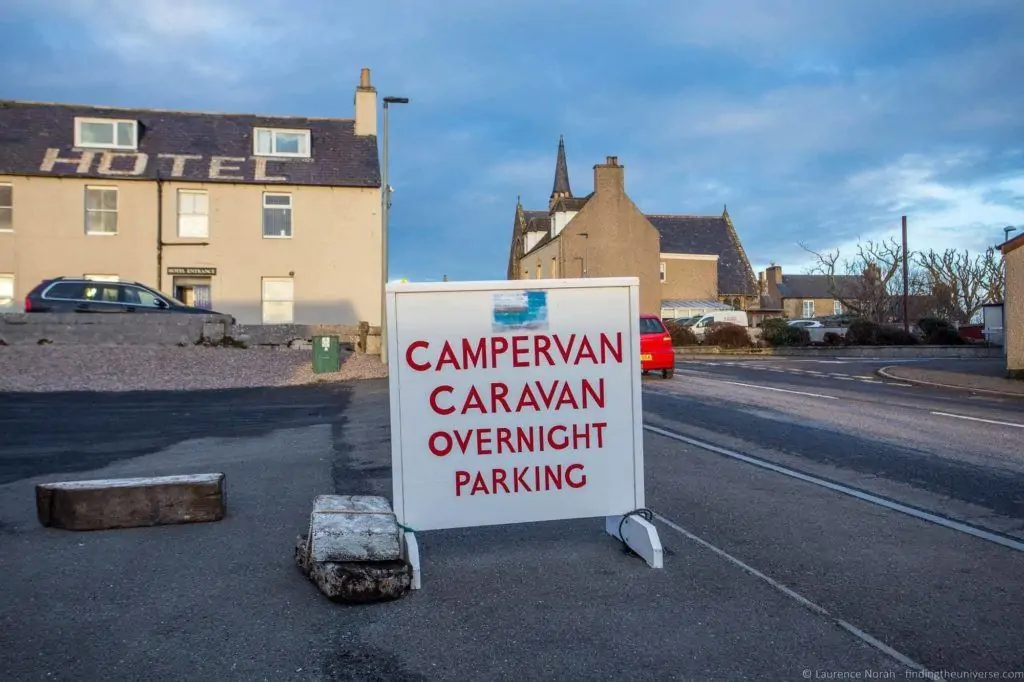
- Some stores, restaurants, and service stations have started offering inexpensive RV parking (and limited services) along the route as the route has gotten more busy. For example in Keiss we saw a sign advertising free overnight camping stops
Tips for Responsible Travel when Camping on the North Coast 500
The North Coast 500 runs through one of the most beautiful parts of Scotland, and it will hopefully remain that way for many years to come. However, this is also an environmentally fragile area with more limited infrastructure than many other parts of the country.
Of course, the popularity of the route has brought more people to the area, which puts a bit of a strain on the local infrastructure, especially during the Spring and Summer months. There have also been reports of folks travelling a little irresponsibly.
To help out, we wanted to share some tips for responsible travel on the North Coast 500, to help you minimise your impact and contribute to a positive experience for everyone.
Chemical Toilets: Dispose of your chemical toilets (and other waste) at proper dump points only. Don’t dump them out anywhere else, they contain highly toxic chemicals and will cause serious damage to the environment if not disposed of properly. Also, please note that some campsites, especially the more remote ones, may only accept green eco-friendly toilet chemicals like this.
Single Track Roads: Driving on single-track roads might be a new experience for you, and it can be a little daunting. Read up on our guide to driving on single track roads to master the proper etiquette, and don’t forget to use passing places to allow faster traffic to pass you.
Overnight Camping: We definitely recommend you use official campsites. If you choose to wild camp, make sure you do so in a zero impact way, leaving no trace behind, and only doing so where you are allowed to. Be careful not to block access roads or gates when you park up.
Litter: If there are no litter bins, just take your rubbish with you until you find somewhere you can legally dispose of it.
Fires: You are welcome to have a fire or gas BBQ of course, but only if it is safe to do so and you extinguish it fully before you leave.
The Best Time to Camp on the North Coast 500
We have driven the North Coast 500 at a number of different times of year, including in winter. Based on our experiences, our suggestion for a camping trip would be to tackle the route between May and September, which will give you a shot at the best weather. It’s also the time of year when the majority of attractions, shops, cafes, and services will be open.
Many of the campsites along the route (especially in the west and north stretches) are seasonal, meaning that it is going to be more difficult to find campsites and camping services during the winter months. Most are open from March or April to September or October with fewer camping options available between November and March.

The route can be driven year round of course, although conditions in winter can include snow and ice, and on the more rural roads these can take a bit of time to clear. So be prepared to go more slowly and for possible detours or road closures in the winter months.
However, winter does offer far quieter roads and if you are hunting true solitude, can be a wonderful time to travel. Just make sure you have the equipment and clothing to handle freezing conditions, and the driving knowledge to handle the road conditions. Also be sure to plan ahead to know which sites and services will be open during your trip.
What to Pack for a Camping Trip on the North Coast 500
We have a general packing list for London and the UK that covers many of the essentials you need, so here we will add in just those items you may specifically want for a NC500 camping trip:
- Sunscreen
- Smidge midge repellent and a midge head net. Essential if travelling from late May through to the end of September.
- Camping gear (tent, sleeping bag, roll mat etc)
- Cooking equipment (gas stove, pots, pans, cutlery, plates etc)
- Toilet paper / soap or hand sanitiser (the toilets along the route are sometimes out of paper or don’t have hot water and/or soap)
- Water bottles
- A road map of Scotland and the Collins NC500 Pocket Map. Mobile signal is patchy in the Highlands so a paper map is a real lifesaver.
- Rubbish bags for your litter
- Gear for outdoor activities (hiking, cycling, climbing, kayaking etc.)
- Offline maps downloaded to your phone (Google Maps and OS Maps both support this)
- Duct tape (so useful!)
- Winter gear: extra antifreeze, snow chains, emergency blankets, a collapsible snow shovel
- The Rough Guide to the North Coast 500, as well as the Rick Steves Scotland book
How Long To Plan for a North Coast 500 Road Trip
As you can see from our guide, we have suggested seven days for this NC500 camping itinerary. This is a good amount of time. You won’t be too rushed, and especially when you are camping, you have to factor in time for getting set up and packed away each day.
We would say that the minimum amount of time for an NC500 road trip would be five days, as outlined in our 5 day NC500 itinerary.
You can do it in less time of course, but we feel that might be a bit rushed, and you would miss many of the highlights doing it in less time.
Further Reading for your North Coast 500 Adventure
We’ve driven the North Coast 500 route many times, and continue to add to our content on the route to help you have the best experience. Below are a number of articles and resources we think you’ll find helpful for planning your NC500 adventure.
- Our ultimate guide to planning a North Coast 500 trip
- Jess’s detailed guide to where to stay on the North Coast 500 which has accommodation options for every part of the route. We also have a guide to the best B&B’s on the North Coast 500
- My detailed guide to my favourite photography spots on the North Coast 500, which also has some photography tips for your trip.
- For a shorter trip, see our 5 day North Coast 500 itinerary
- We also have a guide to whisky distilleries on the North Coast 500 if you’re interested in visiting distilleries along the route.
- The North Coast 500 has a lot of single track roads. See our advice for how to drive on single tracks roads to help you prepare if you’re not familiar with these.
- This trip starts and ends in Inverness. See our guide to things to do in Inverness for some ideas for what to do in Scotland’s most northerly city.
- If you’ve never driven in the UK before, see our guide to driving in the UK for some tips.
- For budget planning, see our guide to how much it costs to travel in the UK
- The official website for the North Coast 500, which has maps, itineraries and advice to help you plan your route.
- If you’re driving the North Coast 500 as part of a longer visit to the UK, check out some of our other guides to both Scotland, and England.
- Looking for more road trip inspiration? Check out our guide to the world’s best road trips for more ideas!
- If you would like a guide book for your trip, check out the Rough Guide to the North Coast 500, as well as the Rick Steves Scotland book
And that’s it for our guide to camping on the North Coast 500! Is this the kind of trip you want to take? Have any questions or feedback for us? Just let us know in the comments below!
Frequently Asked Questions about Camping on the NC500
How many days do you need for the NC500 by campervan?
We’d recommend a minimum of five days and ideally seven. Seven days lets you see the highlights without rushing, and gives you time to set up and pack down camp each day. You could do it faster, but the roads are slow (especially on the west coast) and you’d end up spending most of your time driving rather than enjoying the scenery.
If you have longer, ten days to two weeks would let you explore more of the side roads, take longer hikes, and visit places like the Isle of Skye at the end. We’ve spent up to four weeks driving the route and never ran out of things to see.
Can you wild camp on the NC500?
Yes, wild camping is legal in Scotland under the Scottish Outdoor Access Code, but the definition is specific. Wild camping means on foot, away from a road, and not in a motorised vehicle. So if you’re in a tent and willing to walk a short distance from your car, you can wild camp in most places.
If you’re in a motorhome or campervan, parking overnight in a lay-by is technically not wild camping under the access code. That said, many people do it, and the key is to be considerate: don’t block roads or gates, leave no trace, and move on in the morning. We’d always recommend using official campsites where possible, both for the facilities and to support the local economy.
Do you need to book NC500 campsites in advance?
From June to August, yes. The route is very popular during the summer months and the more scenic or remote campsites (like those around Durness and Applecross) can fill up weeks in advance. We’d strongly recommend booking ahead for the peak season.
In May and September you’ll usually find space, though popular sites can still get busy at weekends. Outside the main season, booking ahead is less critical but worth checking, as many campsites close entirely between November and March.
Is the NC500 suitable for motorhomes and caravans?
Most of the route is fine for motorhomes. The main exceptions are the B869 between Lochinver and Kylesku and the Bealach Na Ba near Applecross, both of which are narrow and have tight bends that are difficult in longer vehicles. For these sections, there are alternative routes on wider roads.
If you’re towing a caravan, you’ll want to skip those same sections, and also be confident in reversing on single-track roads, as there are long stretches of these on the north and west coasts. In general, we’d recommend keeping your vehicle under 18 feet in length for the most comfortable experience.
What is the best time of year to camp on the NC500?
May to September gives you the best weather, the longest days, and the most facilities open along the route. July and August are the busiest (and most expensive) months, coinciding with UK school holidays. May, June and September are quieter and often just as good weather-wise.
Be aware that midges are a factor from late May through September, especially on the west coast. If you want to avoid them entirely, aim for early May or October, though you’ll trade midge-free evenings for shorter days and cooler temperatures. Some campsites close by mid-October.
How much does it cost to camp on the NC500?
Campsite prices vary quite a bit depending on the site and your setup. As a rough guide, expect to pay anywhere from around £10 per night for a basic tent pitch to £25-35 per night for a motorhome pitch with electric hookup. Glamping pods and wigwams tend to run from £40-80 per night.
On top of campsite fees, budget for fuel (the route is 500+ miles and fuel in the Highlands is more expensive than in cities), food and supplies, and attraction entry fees. Many of the best things on the route are free though: beaches, walks, viewpoints, and castle ruins.
Gary says
Hi, thank you very much for your travel guide. I have used this page as guidance to plan our NC500 7-day trip with a motorhome. We finished our trip last week and it was a great success! There are different websites and advices on where to go and in which sequence. We followed your approach by travelling from Inverness in a counter clockwise way. As it was our first motorhome experience I am very glad we started of gently and by the time we were in the more rough High Lands, our camping and my driving skills were where they should be.
We were very lucky with the weather, what made it a trip of a lifetime. What a beautiful scenery that you can only capture being there. No camera can do it justice.
We skipped the night at Achmelvich as we have 2 dogs and they are not allowed on the Shore Caravan Site. This created an extra day we used to go to Skye. This was a well worth addition, especially the 2 distilleries 🙂 . We stayed the night at the Glenbrittle Campsite which I would definitely recommend. This camping is on a bay with fantastic views with the added bonus of no phone or wifi reception, not distracting you…
7 days seems a lot of time but if I have any advice it is to not cover too much distance a day, especially on the north and west coast. We drove 680 miles in 7 days, have seen a lot, but doing it again we would have had spend more time at each stop and skip others..
Thank you again in contributing to our fantastic, once in a lifetime, holiday.
Gary & Lisa
Laurence Norah says
Hey Gary & Lisa,
I’m so glad to hear you guys had a great time and found our content useful, and thanks very much for dropping by to share your adventures. We agree, the scenery is just spectacular, and very hard to capture. Thanks for the tip on Glenbrittle – we have visited Skye a number of times but haven’t done a camping guide yet, so I will file this away for future reference.
I hope you get back up again to this part of the world soon, it’s very special 🙂
Safe travels!
Laurence
jason wallace says
Hi, just read this as I’m an aged biker and will be lone/solo motorcycle camping/touring at Easter 2022. The best guide I’ve come across. Thanks for all the links and hard work. I’m not overly keen on following the herd or not having time to detour and generally poodle about so seems perfect? Regards Jason
Laurence Norah says
Thank you very much Jason! I hope you have a great trip! It’s a fantastic road and I am sure you will. Let me know if you have any questions, we’re always happy to help 🙂
All the best for 2022!
Laurence
Vicky says
I just wanted to say a huuuge thank you for all of this information! My partner and I have just come back from a week of camping our way around the NC500, and we used your blog as a base for our plans. We had the most AMAZING time and managed to see so much! What a trip! And we probably would have missed some amazing sights if it weren’t for your info, so thank you so much! 🙂
Laurence Norah says
Hi Vicky!
Thanks so much for popping back and letting us know, it means a lot! We’re delighted to hear you had an awesome time on the NC500 😀 Here’s to many more safe and adventure filled trips!
Laurence
Rob Salisbury says
Hi thanks for compiling all that info would love to do route I have a Bailey 76-2 Motorhome and just like to ask if this size would be ok on single track ?
Laurence Norah says
Hey Rob,
Our pleasure! Having taken a look at your motorhome specifications it should be fine assuming you’re not towing a trailer or anything. You will want to be comfortable driving single track lanes, having to reverse and pulling into passing places of course, but otherwise you shouldn’t have any issues on the route 🙂
Have a fantastic trip – let me know if you have any more questions!
Laurence
Charlie says
Great guide – thank you! We have booked a motorhome and are going to be brave and do it in early November as we need to be in Edinburgh at the end of the week! We know the weather may be against us some days but love the idea of the solitude and scenery! Hopefully some campsites will still be open! Thanks again – this will be our Bible for the trip!
Laurence Norah says
Hi Charlie – our pleasure! November will definitely have more changeable weather, but we’ve done the route at all times of year with no trouble. The main thing is just to have appropriate clothing and to drive to the conditions. You should have a lovely time – I find the light at that time of year if you get good weather to be just beautiful. Have a great adventure – do pop back and let us know how it went when you are done 😀
Fakruddin Shahariar says
Hi,
Good morning and thank you very much for pilling all the info about route 500 in one place, brilliant job.
I am thinking to do it by campervan (2 adults & 2 kids), any suggestions to rent campervan suitable for the route?
Once again highly appreciate for your efforts to put all the information about route 500.
Regards
Shahariar
Laurence Norah says
Hi Shahariar,
Thanks very much for your comment and kind words. We do have some suggested campervan companies in the guide, although with the current situation I am not sure which of them will be operational when you choose to do the route. But you can see them here:
https://www.findingtheuniverse.com/7-day-north-coast-500-camping-itinerary/#Where-Can-I-Rent-a-Campervan,-RV,-or-Motorhome-for-the-NC500
Have a great trip!
Laurence
Sinclair says
Hi. We’re planning a NC500 trip this year in our camper and I stumbled across this page. Wow, perfect. Thank you so much for putting the time in and all the wonderful information. I’ll be booking our over night stays and looking forward to a pre midgie trip. 🙂
Laurence Norah says
Hi Sinclair – my pleasure, and thanks so much for taking the time to comment. It really means a lot to hear we are helping people! Have a great time on the route, and don’t hesitate to pop back if you think of any questions!
Laurence
Sally Anne du Plessis says
Wow, thanks for all this wondeful info!!!
My hubby and I would love to do a road trip arounds Scotland in September.
I’m a bit nervous (ok im very nervous 🙂 with all the planing etc, but your info will be of such great help.
I am extremely grateful to you for sharing your wealth of info.
Regards
Sally
from Cape Town South Africa
Laurence Norah says
Hey Sally
Our pleasure! If you have any questions at all, just let me know! You do at least have the advantage of already knowing how to drive on the left 😉
Laurence
Tony Lusted says
Just reading your VERY, VERY excellent and comprehensive info on the NC500, including your 7 day camping itinerary.
I’m a single 75 year old seasoned camping traveller (with car, not RV) and a (notionally) 6-man tent. What with all the other clutter I take, the thought of making/breaking camp EACH NIGHT is a bit daunting. I have seen somewhere your suggestion to somebody else about having 4 bases, each for 2/3 nights, which I’m looking at – I’m an NC500 “virgin”, so doing a shedload of reading-up !
What about the other way round ? Is it sensibly possible to do it from, say, 2 bases, each 3/4/5 days each ? Or could you go to a more inland base and travel “out” every day ? I’m not limited time-wise ( one good thing about retirement !).
I’m thinking of early May. My way of working is to be as organised as possible with a plan, so would like to have a few fixed points in the 7/10 allocated days, although in May perhaps it is still possible to just turn up at a campsite on spec ?
Your suggestions would be appreciated. If there is some stuff already on your site that I missed on this topic, please point me in the right direction……
Laurence Norah says
Hi Tony,
Thanks very much!
So to be honest, I would probably advise against doing it from 2 bases as the going can be quite slow, especially around the north west corner. Even if the distances are great, the roads are winding and often single track, so the going can be quite slow. So you would end up doing a lot of driving. I would instead suggest at least three but ideally four stops, and then spending time exploring each region from those bases.
In May you *should* be able to turn up to a campsite without a booking, although the route is likely to be quite busy this year based on the volume of enquiries we’ve had about it ourselves, so this might not be the case. So you might want to book in advance to play it safe, even if it turns out not to be necessary.
I hope this helps. As you say you have time on your side, I would take advantage of that. We’ve spent up to four weeks driving the route and never ran out of things to see and do if that helps!
Have a great time, and don’t hesitate to get back in touch if you have any more questions,
Best
Laurence
Virginia says
What a fantastic site with a wealth of information. We are planning to rent a campervan and drive the NC500 in June and were having trouble figuring out how long it will take to get to places and where we should plan stopping for the night. This itinerary is fantastic and so detailed! Thank you.
Laurence Norah says
Hi Virginia,
Thanks very much, it’s always appreciated when folks leave us lovely comments like this! Have a wonderful time on the NC500 and do pop back to tell us your experiences 😀
Laurence
Virginia says
Hi Laurence,
When we travel the NC500, we will be filming for our (very small) YouTube channel. Would you mind if we mention your website? It may help others planning their trip. I’d love to say it will give you publicity but when I say small, I mean small channel!! (No need to publish this comment. I am not looking for publicity! Thanks.)
Laurence Norah says
You’re welcome to! I also sent this in an e-mail but just in case you didn’t get it I’ll put it here too.
BERLINDA says
A lot of hard work has gone in to this, will save me hours in planning our visit NC500 next year. thank you.
cheers B
Laurence Norah says
Thanks Berlinda – have a great trip, and do let us know if you have any questions!
Barry Wilkinson says
Hi. Found your information brilliant. I was thinking of taking my Tab teardrop caravan on this trip but was concerned about your comments on having to miss out the single track roads. The van is only as wide as my car so I thought it might be ok. What are your thoughts. If it’s a no go is there a route or list of where to avoid. Other than that I will look to another way to do it.
Regards, Barry
Laurence Norah says
Hi Barry!
So there are only two sections that are a not recommended, the detour around Drumbeg from Lochinver, and the Bealach Na Ba near Applecross. It’s not recommended to take vehicles longer than around 18ft in length on these roads, and there are signs that they are not suitable for caravans. The passing places are not very long on these stretches, and you would need to be able to easily reverse if necessary. There’s also the road from Lochinver around the coast to Achilitibuie, which has a length limit in place of 26ft. It’s not part of the official route, but it is a scenic drive that some folks like to do.
I would say that other than those small sections, the rest of the route should be fine, although there are quite a few single track sections, so you will definitely want to be confident with your reversing anyway 🙂
I hope you have a great trip and do let me know if you have any more questions!
Best
Laurence
Susan says
Great guide. I’m planning to travel in August myself and my two kids 16 and 13 we are all campers and only plan to take the basics with us in the car. Is there a lot of places suitable to wild camp on route and do you think it would also be safe enough. X
Laurence Norah says
Hi Susan!
So you can wild camp all across Scotland due to the outdoor access code (if you’ve not seen it, you can read it here https://www.outdooraccess-scotland.scot/practical-guide-all/camping). However, wild camping is not quite the same as car based camping, as it’s more about walking and finding a campsite. So the harder part is likely to be finding parking places where you can leave the car and then walk to a suitable site. In terms of safety, I would say that you shouldn’t have any problems.
Have a great time!
Laurence
Janet says
Really enjoyed reading this blog. There is loads of useful information. We are very excited about our planned holiday next May (2021), we have booked a motor home hire and plan to do your suggested 7 day itinerary of the Nc500.
Thank you so much for taking the time to write this and your photographs are stunning.
Laurence Norah says
Hi Janet – thanks very much for your comment, it’s much appreciated. We love the NC500, and have driven it many times. It’s a pleasure to be able to help others enjoy it as much as we have, and I hope you have a wonderful trip next year. If you have any questions about your trip, don’t hesitate to ask. We also have a group on facebook with many other travellers who have done the NC500 or are planning to, which you are of course welcome to join! https://www.facebook.com/groups/travelloversandphotography
Safe travels,
Laurence
Sadie Rhodes says
great guide – thank you!
We have booked our accommodation but wonder if there is a guide / map detailing where the petrol stations are? would be really helpful.
Cheers,
Sadie
Laurence Norah says
Hi Sadie!
Thanks for your comment! Jess has answered it over on our other blog, you can see the answer here:
https://independenttravelcats.com/north-coast-500-road-trip-planning-guide-nc500-route/#comment-314520
🙂
Laurence
Alexandra Murphy says
FABULOUS POST! I am however concerned now, as we have booked campsites along the way with a touring caravan …. we have planned 2 weeks for the trip but I am worries about the roads. are there more suitable roads away from the coast?
thanks
Alex
Laurence Norah says
Hi Alexandra!
Thanks very much 🙂
So well done on planning for two weeks and also booking in advance 😀 Two things we always recommend are taking plenty of time and booking in advance 🙂
I don’t think you need to worry too much about the caravan. Admittedly there are a lot of single track roads, but only some of them are specifically not suitable for longer vehicles. For example, the Bealach Na Ba is generally not idea if towing, and the coastal road from Lochinver to Achiltibuie is also not suitable. However, the main road from Lochinver down to Ullapool is a normal two lane road.
So as long as you take your time on the single track roads, follow the signs about the roads which are marked as unsuitable for caravans (they are well marked in our experience) and use the passing places to let faster traffic through, you should be fine.
Have an amazing trip!
Laurence
Jane Melley says
I’m planning on doing the NC 500 this summer camping with my grandson who will be 10 by the time we head off, oh yes and our 2 year old Lab Buddy. I have cycled up the east coast from Inverness a few years agoand I regulalry hostel with my grandson but wanted to do the NC 500 as it takes in our amazing west coast and all ofthe beauty that comes with it.
When I saw your page it all fell into place having already gone through pages and pages of info and thinking I was flogging a dead horse trying to work it all out.
Your page has all of the information I need and I like many others I thank you both for that, it’s made it so much easier and all of a sudden I’m excited again..
Laurence Norah says
Our pleasure Jane, and thanks so much for your comment, it is much appreciated! We just returned ourselves from another trip around the NC500, and I assure you, it never gets old! Do let us know if you have any questions at all during your planning 😀
Laurence
Beverly Bottomley says
I was planning to do this in September in my little campervan. First I was excited, then I was scared – now I think I’m excited again.
I have just read your camping trip suggestions. I was worried about traveling just me & the dog but i am feeling a bit more confident now. I’m doing a photography course so the photo opps and camping suggestions are perfect. Thank you.
Hopefully I can find a dog friendly whale/dolphin watching trip as well.
Laurence Norah says
Hi Beverly! I don’t think you have much to be scared of – excitement should definitely be the order of the day 🙂 Have a wonderful trip – we’re actually driving the route right now for our fifth time and having a wonderful time!
Alison says
what an excellent site! Just what I was looking for and we’ll probably follow it exactly in April.
Your detailed advice is terrific and now we are just so excited to get over there and start driving in our campervan
Laurence Norah says
Hey Alison – thanks so much! It’s such a wonderful drive which we’ve now done many times – you’re going to have a great trip!
Andrea Araujo says
Guys…you ROCK !!! Fab post, Fab blog.
Tks for share each information.
We have a motorhome (big one) , we are a brazilian family who lives in UK and we are going explore NC500 next week. I’ve planning to stay for 10 days and this post will help a lot.
Keep going…..
xx
Andrea and family
Laurence Norah says
Thanks very much Andrea! Have a great trip! We’ll be back up on the NC500 at the end of the month ourselves 😀
Amy Sapwell says
Hi! This is a great post. Something I am trying to find though is based on doing the trip in 7 days, how long roughly can we expect to spend in the car driving every day? We have an 8yo and although he is pretty good in the car we don’t want to spend tooooooo much time driving.
If you could give me an idea i’d really appreciate it!
Many thanks,
Amy
Laurence Norah says
Hi Amy!
So this will vary a little by day, and which attractions you visited, but we tried not to have too much driving each day – although it is a road trip covering 500+ miles (usually more with all the attractions you might want to add on, plus the roads are quite slow going). So we’d say probably 2 – 4 hours driving a day on average. It will be slower on the north west and west coasts as these are windy narrow roads.
I hope this helps!
Have a great trip!
Laurence
Zoe says
Fantastic review. We would like to do this in 5 days starting from Strathcarron and ending in Inverness. Can you suggest how to stagger our days?
Laurence Norah says
Hey Zoe!
Thanks very much. Five days is do-able, although of course the more time the better 🙂
Of course, depending on your interests you might want to adjust the following suggestion, but my idea would be:
Strathcarron -> Gairloch (assuming you do the Applecross drive)
Gairloch -> Achmelvich
Achmelvich -> Durness
Durness -> Dunnett
Dunett -> Black Isle / Inverness
This is a bit more skewed to the west side, which in my mind has the most dramatic scenery, but also the windiest roads, so you’ll want to take a bit more time to drive there.
I hope this helps a bit 🙂
Lisa & Wil says
Hi guys
I wanted to do this with my 10yr old son next year. We want to camp. After reading your blog we are more excited than ever to be planning next year’s adventure.
Thank you for your great tips, suggestions and all information provided.
Roll on next summer!
Laurence Norah says
Our pleasure – have an amazing time (we know you will!)
Tim and Michelle says
Absolutely brilliant site, easy to navigate and so much useful information. Thank you for taking the time and trouble to do this – we wish you a great summer and we look forward to our Route 500 adventure commencing on 23rd July 🙂
Laurence Norah says
Hey Tim & Michelle – thanks so much for stopping by and your kind words, it’s comments like this that inspire us to keep creating content to help people! Have a wonderful trip, it’s a fantastic part of the world 😀
Laurence
Tony says
Been looking for weeks for a itinerary. that would suit me to do the north coast 500 in my VW campervan. And this is the best yet.
Laurence Norah says
Thanks very much Tony – that’s much appreciated! We’re actually just back from driving the route again and had a lovely time – we’re sure you will too 😀
Darren says
Dear Laurence, your pictures are inspirational. We are currently planing our first route 500 trip and your Day 5 – Durness to Achmelvich Bay picture took our breath away. Where is this waterfall?
Laurence Norah says
Hi Darren! This is a beautiful waterfall called the Wailing widow falls. It’s a short five minute walk from the road, but it’s not signposted. There’s a parking area here though: https://goo.gl/maps/b49npb5H8YF2, from where it’s a quick walk to the falls 🙂 Enjoy!
Kristin L says
You have no idea how long I’ve wanted to do this trip—even though I’ve been to Scotland a dozen times, the NC500 is still at the tip-top of my bucket list. SO jealous, and definitely will be referencing your very thorough guide when my time finally comes =)
Laurence Norah says
The North Coast 500 is such an epic journey – so good we’re doing it again this May 😀
budget jan says
We campervanned around Scotland back in the day. Time for another I think, so this will come in handy. Our trip was in early Spring and it is true that the caravan parks were quite often still closed at this time of year. Still I think it is a good time because of there are fewer people. I like your tip to ask for camping options at service stations. I wouldn’t have thought of that one – in Ireland we always asked at a country pub for information when all else failed.
Laurence Norah says
It’s always a good time to go camping in Scotland 😉
Amanda says
I guess I’ve never thought about the possibility of doing this as a campervan trip, but that actually sounds awesome! The North Coast 500 is high on my list of things to eventually do in Scotland!
Laurence Norah says
Camping on the North Coast 500 is definitely one great option for the trip! Hope you make it soon 😀
travlermb says
I love your postings! This one especially brought back memories of my trip with my mother (Clan Macfarlane, her grandfather and brothers emigrated to US) visiting Handa Island, Smoo Cave, Mey Castle, Caithness, etc, etc. We stayed at Torridon Hotel(pricey but very nice!). Keep up with your blog, I enjoy it. Using your posts as a guide for my retirement trip to Scotland in 3 years, planning a minimum 6 months!
Laurence Norah says
Thank you very much! The Torridon is lovely, we stayed there on one of our North Coast 500 trips 🙂 Have a wonderful trip, and don’t hesitate to ask any questions you may have as you plan 😀