
Stonehenge is one of those places almost everyone visiting London wants to see, and happily it makes a great day trip from the city. The harder part is working out how to get there, and whether to bundle in Bath and a pretty Cotswolds village while you’re at it. If the Cotswolds are the draw rather than the add-on, they’re worth two or three days of their own. Bath rewards a longer stop than a coach tour gives it, and we have a full guide to what to do in Bath if you would rather give it a day of its own. There are two good ways to do it, a guided tour or a self-guided trip by car or train, and the better fit is really down to your situation.
Jess and I know this corner of England well. We lived in Bath for four years, so the Roman Baths and the Cotswold lanes were our weekend backyard, and we’ve visited Stonehenge many times over the years. We’ve also made the short trip out to Avebury, the lesser-known stone circle you can walk right into, which most day trips overlook entirely.
Below you’ll find our straight recommendation on tour versus doing it yourself, full logistics for both, and notes on what each of the main stops is actually like to visit.
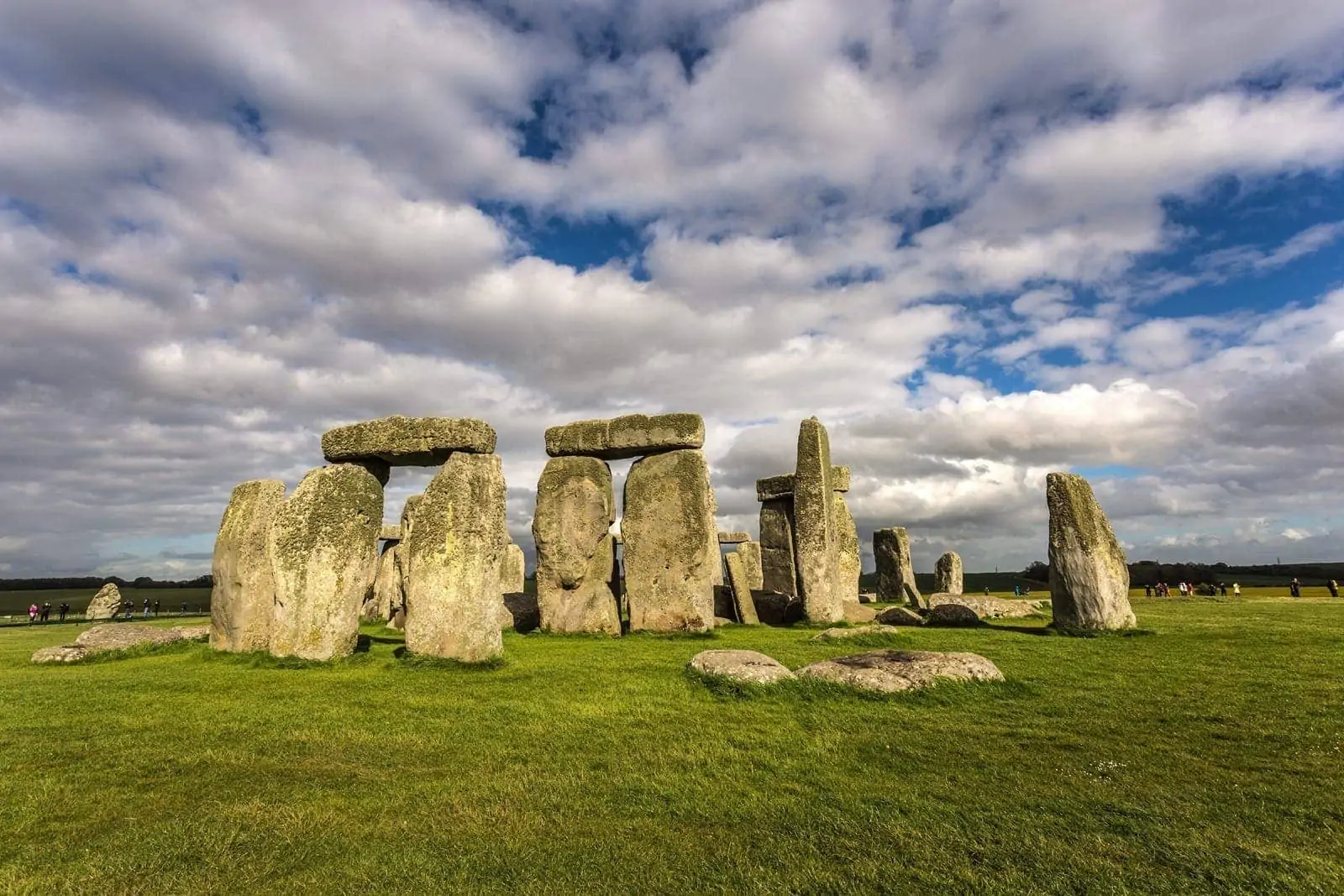
Table of Contents:
Tour or Do It Yourself: The Quick Answer
If you don’t have a car, a guided tour is almost always the better call. It removes every logistical headache, and it makes it realistic to see Stonehenge, Bath and a Cotswolds village in a single day, which is very hard to pull off on public transport. For most people we’d point to a full-day Stonehenge and Bath tour, or a small-group tour that adds Lacock and Avebury if you want the fuller Wiltshire sampler.
If you have a hire car, doing it yourself is cheaper, more flexible, and lets you visit at your own pace. Driving also opens up Avebury, which tours rarely include and which is one of our favourite stops of the lot.
Just heading to Stonehenge and nothing else? The train to Salisbury plus the dedicated Stonehenge Tour bus is simple, good value, and needs no car at all.
Should You Take a Tour or Go It Alone?
That hinges on what you have to work with, how much you want to see, and what kind of day you enjoy. Here’s how we’d call it for the most common situations.
| Your situation | What we’d book | Why |
|---|---|---|
| No car, and you want Stonehenge plus Bath and a village | A full-day guided tour | Public transport can just about reach Stonehenge and Bath, but chaining all three in a day without a car is impractical. A tour does the driving and the route planning. If the Cotswolds are the part you care about, our carless Cotswolds guide covers reaching the villages by train and bus. |
| You have a hire car | Do it yourself | You’ll pay less, set your own pace, and you can add Avebury, which tour itineraries rarely cover. |
| Tight budget, Stonehenge only | Train to Salisbury, then the Stonehenge Tour bus | The cheapest hassle-free option. No car needed, and the bus ticket bundles in your admission. |
| Short on time, want a half-day | A half-day tour, or a self-drive there and back | Either way you can see Stonehenge and be back in London by mid-afternoon. |
| Travelling with kids | A guided tour with no more than two extra stops | Long coach days test small attention spans. Fewer stops, and a guide who tells the story, keep everyone engaged. |
| You want to walk inside the stone circle | A special-access tour | Standard tickets keep you on the path around the stones. Only a special-access or inner-circle tour gets you among them. |
How far is Stonehenge from London?
Stonehenge sits on Salisbury Plain in Wiltshire, about 90 miles west of central London. Driving takes roughly two hours each way on fast roads, though London traffic and the A303 near the site can both add time, especially on summer weekends. By train it’s a similar journey to Salisbury, the nearest city, with a short bus ride to finish. Either way it’s an easy day trip, and you don’t need an overnight stay to see it properly.
Taking a Guided Tour From London
A guided tour is the most popular way to visit Stonehenge from London, and for most first-time visitors it’s the one we’d recommend. Jess and I did this when she first visited the UK as we didn’t yet have a car.
A guided tour picks you up in central London, drives you from stop to stop, and you get a guide who can explain what you’re looking at. Stonehenge rewards a bit of context. Standing in front of the stones is atmospheric, but it’s the story, the theories about how and why it was built, that makes the visit stick.
Most tours run as full-day trips and pair Stonehenge with one to three other stops. Bath is the usual partner, and many tours add a Cotswolds village such as Lacock, or Windsor Castle on the way out of London.
Which tour should you book?
There are a lot of tours to choose from, and they’re broadly similar. The differences come down to which extra stops are included and how long the day runs. Here are the ones we’d look at first:
- The full-day Stonehenge and Bath tour pairs the two big UNESCO sites, with a guided look at Stonehenge and a generous block of free time in Bath. A solid default if those two are your priority.
- This Stonehenge and Bath full-day trip is a similar combination, with skip-the-line entry and time to explore Bath at your own pace over lunch.
- A small-group tour covering Stonehenge, Bath, Lacock and Avebury packs in the fuller Wiltshire picture, Avebury included, which most coach tours leave out. It can also be booked as a private tour for a group.
- This tour adds Windsor Castle and a traditional pub lunch in Lacock, at a 14th-century inn, alongside Stonehenge and Bath. It’s a long day, but the lunch and the extra castle stop make it good value.
- If you’re short on time, a half-day tour focuses on Stonehenge alone. It runs about six and a half hours, with morning and afternoon departures and over two hours at the stones.
Our advice, after doing day trips like this ourselves, is to resist the temptation to book the tour with the most stops. Two extra stops on top of Stonehenge is plenty. Beyond that, you spend more of the day on the coach than off it, and the stops get rushed. A day that visits Stonehenge and Bath well beats one that scrambles through four places.
What a Tour Day Actually Looks Like
Tours from London start early. A pick-up somewhere between 7am and 8am is normal, so choose one that leaves from a point near where you’re staying rather than across the city. The reward for the early start is beating the worst of the traffic out of London.
Expect a fair amount of coach time. A full-day tour covering Stonehenge, Bath and a village can run 11 to 13 hours door to door, with perhaps five of those hours actually spent sightseeing and the rest driving between stops. That’s the trade. Someone else handles all the logistics, but it is a long day.
If lunch isn’t included, time is usually set aside for it at one of the stops. Pub lunches used to be a standard inclusion on day tours from London, but most operators have dropped them in recent years, so a tour that still bundles a picnic or pub lunch is worth seeking out. We’d also pack a few snacks and a water bottle, because the gaps between stops can be longer than you expect.
Walking Among the Stones
On a standard visit, by tour or under your own steam, you follow a path that loops around the stone circle. You get close, but you don’t go in among the stones themselves. The exception is a special-access visit, run early in the morning or in the evening outside normal hours, when a small group is allowed to walk right into the circle.
This special-access tour includes exactly that, an inner-circle visit to Stonehenge, along with stops in Bath and Lacock. It’s a private, small-group experience and costs more than a standard coach tour, but standing inside the circle with hardly anyone else around is a different experience entirely. If Stonehenge is a real bucket-list moment for you, it’s worth the splurge.
If you’d rather not pay for special access but still want to walk among standing stones, read on, because Avebury lets you do exactly that for free.

Doing It Yourself: Stonehenge by Car or Train
Visiting independently costs less and puts you in control of the day. It takes a little more planning, but none of it is difficult. There are two realistic ways to do it: drive, or take the train to Salisbury and connect by bus.
Driving from London
Driving is the most flexible option, and the only one that comfortably lets you add Avebury. Pick up a hire car in London and budget around two hours each way, more in summer weekend traffic. The route is mostly motorway and fast A-road.
Stonehenge has a large car park at the visitor centre. It’s free for English Heritage members, and there’s a £4 parking charge for everyone else. From the visitor centre, a shuttle bus, or a walk of about 30 minutes across the landscape, takes you the last mile and a half to the stone circle.
Whichever way you arrive, book your timed-entry ticket in advance. You can do that through GetYourGuide, or directly with English Heritage, where booking online ahead of your visit saves 15% on the gate price.

By Train and the Stonehenge Tour Bus
No car? The train-and-bus route is simple. Trains run from London Waterloo to Salisbury roughly twice an hour, and the journey takes around an hour and a half to an hour and three-quarters. You can check times and book train tickets in advance for the best fares.
From Salisbury station, The Stonehenge Tour bus runs directly to the site, taking around half an hour. Its all-in ticket is good value: it covers the bus, your Stonehenge admission, and entry to Salisbury Cathedral, home to one of the four surviving original copies of Magna Carta. You can see timetables and book on the official Stonehenge Tour website.
This is the simplest no-car option if Stonehenge is all you’re after. It also lets you fold in Salisbury itself. Salisbury Cathedral has the tallest church spire in Britain, at 123 metres, and the city is worth an hour or two of anyone’s time.
Can you do Stonehenge, Bath and the Cotswolds yourself in a day?
This is only really comfortable if you drive. With a hire car, a Stonehenge, Bath and Castle Combe loop is a long but very doable day, and you can swap in Avebury or Lacock easily.
Without a car it gets hard. You could reach Stonehenge and Bath by train in a day, since both sit on rail lines, but the Cotswolds villages have very little public transport, and stitching all three together by bus and train will eat your whole day in transit. If you don’t have a car and you want all three, this is exactly the situation a guided tour is built for. If you’re happy to choose, Stonehenge plus Bath by train is a comfortable independent day out.
Stonehenge: What to Expect When You Arrive
Stonehenge has changed for the better over the years. The old road that used to run right past the stones has been closed and grassed over, and the visitor centre now sits more than a mile away, out of sight of the monument. The result is a calmer, more natural setting than older photos suggest. The stone circle itself was raised around 2500 BC, so you are looking at a monument some 4,500 years old. You arrive at the visitor centre, which has a good museum and exhibition, then travel the last stretch to the stones themselves.
Entry is by timed ticket, and you’ll want to book ahead. Same-day tickets are sometimes available at the gate, but they aren’t guaranteed, and a slot booked online in advance is both cheaper and one less thing to worry about. Adult admission is around £27 as of 2026, with a 15% saving when you book online ahead of time. You get a 30-minute arrival window rather than a fixed minute, so there’s no need to stress about hitting an exact time.
Opening hours shift with the season, roughly 9.30am to 5pm in the colder months and 9.30am to 6pm across the summer, with last entry about two hours before closing. Hours change around the solstices, so check the English Heritage site if you’re visiting in late June or December.

Avebury: The Free Stone Circle You Can Walk Right Into
If you only have time for one stone circle, make it Stonehenge. But if you can add a second, Avebury is the one we’d send you to, and it’s the stop most day trips quietly skip.
Avebury is the largest stone circle in the world, so large that a whole village sits inside it. It dates from the same broad prehistoric era as Stonehenge, but the experience could not be more different. The stones aren’t roped off or fenced. You walk straight in among them, lean on them, picnic beside them, and share the field with the local sheep. The site is looked after by the National Trust, and access to the stones is free, all year round, dawn to dusk.
It’s about a 30-minute drive from Stonehenge, which makes the two an easy pair if you have a car. Parking is the one cost: the National Trust car park is £8 for the day, or £5 after 3pm, and free for National Trust members. The village also has the Alexander Keiller Museum and Avebury Manor, both worth stopping at and both charged separately, but the circle itself, the reason to come, costs nothing.
We always tell people Avebury is the antidote to Stonehenge. Stonehenge is the icon you photograph from behind a rope. Avebury is the one you get to put your hand on.


Bath: The Obvious Second Stop
Bath is the natural pairing with Stonehenge, and it’s a city we know inside out, having lived there for four years. It’s compact, walkable and uniformly handsome, built almost entirely from the same honey-coloured limestone, and the whole city centre is a UNESCO World Heritage Site.
The headline sight is the Roman Baths, the remarkably complete remains of a Roman bathing complex built around Britain’s only natural hot springs, where the water still surfaces at around 45°C. It’s one of the best Roman sites in the country and worth the entry fee. Adult tickets are around £29 on a weekday in 2026, and the Roman Baths uses date-based pricing, so a winter weekday is noticeably cheaper than a summer weekend. You can book a timed entry ticket ahead, or check current prices on the Roman Baths website for your date.
Right next door is the Pump Room, the elegant Georgian tearoom attached to the baths, where the tradition is afternoon tea, or a Bath bun and a pot of tea, often to live piano or a string trio.

Beyond the baths, Bath is a city for wandering. Don’t miss the Royal Crescent, a sweeping arc of thirty Georgian townhouses, and the Circus, its circular cousin a short walk away.
Pulteney Bridge is one of only a handful of bridges in the world lined with shops along its full span. Bath Abbey, the tight Georgian streets and the views down to the River Avon round out an afternoon easily. On a tour you’ll usually get two to three hours here, which covers the highlights but will leave you wanting to come back. If Bath is the part you really care about, it also works as a day trip from London on its own, giving you a full day in the city rather than a couple of hours.


The Cotswolds: Castle Combe and Lacock
The Cotswolds proper would fill their own trip, but two villages on the Wiltshire edge, Castle Combe and Lacock, fold neatly into a Stonehenge day and deliver that picture-postcard England everyone is after. Both are an easy drive from Bath, and both appear on plenty of tour itineraries.
Castle Combe
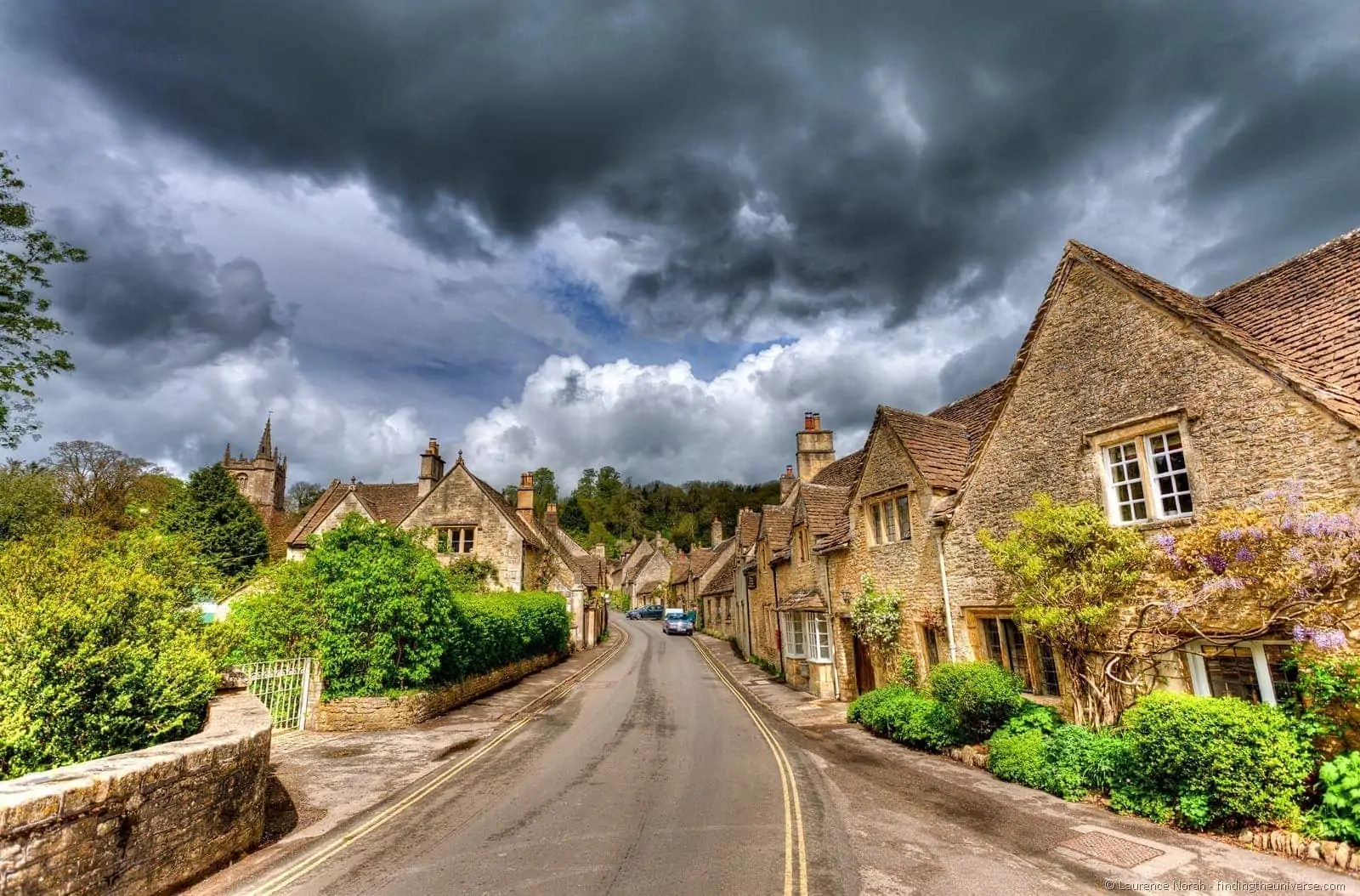
Castle Combe regularly gets called the prettiest village in England, and it earns the label. A row of honey-stone cottages, a market cross, a small church, and a stream running under a low bridge, and that’s essentially the whole village. It’s tiny. You can walk the lot in twenty minutes, which is part of the charm.
St Andrew’s Church is worth stepping into for its faceless medieval clock, dated to the late 15th century and reckoned to be one of the oldest working clocks in the country. Castle Combe is an ordinary, privately-owned village rather than a National Trust property, so there’s nothing to book and nothing to pay, though it also means parking is limited and the main street gets busy. Film crews love it, and you may well recognise it from a period drama or two.



Lacock
Lacock is the other essential Cotswolds-edge village, and unlike Castle Combe almost the entire village is owned and looked after by the National Trust. There are no overhead wires, no road markings and few modern intrusions, which is why it’s such a sought-after filming location.
At its heart is Lacock Abbey, which began life as a 13th-century nunnery and became a country house after Henry VIII dissolved the monasteries. It matters for two reasons. The first is photographic. It was here, in 1835, that William Henry Fox Talbot created the oldest surviving photographic negative, an image of a window in the abbey. As a photographer myself, standing in that room is a small pilgrimage.
The second reason is the screen. The abbey and village have appeared in the Harry Potter films, The Other Boleyn Girl, the BBC’s Wolf Hall and its 2024 sequel The Mirror and the Light, and Downton Abbey. If that list means something to you, you’ll spend the visit recognising corners. There’s also a 14th-century tithe barn in the village, one of the best-preserved in England. You can read more in our guide to Harry Potter filming locations in the UK.
Lacock Abbey, the tithe barn and the village car park all carry an entry or parking charge. If your trip takes in several National Trust properties, an overseas-visitor National Trust Explorer Pass covers them, Lacock and Avebury included. It does not cover Stonehenge, which English Heritage runs separately.


When to Visit
Stonehenge is a year-round destination, but the season changes the day quite a bit.
Summer, from June through August, brings the longest days and the best odds of decent weather, along with the biggest crowds and the highest prices at places like the Roman Baths. The summer solstice around 21 June is a special case. English Heritage runs a managed open-access event when visitors can walk among the stones overnight to watch the sunrise. It’s free and memorable, but it’s busy and nothing like a normal visit, so check the English Heritage site for the current year’s arrangements if it appeals.
Spring and autumn, April, May, September and October, are our pick. The light is lovely for photos, the Cotswolds villages look their best in blossom or autumn colour, and the crowds are thinner. Winter, November through to March, is the quietest and cheapest time, with the trade-off of short daylight, dark by late afternoon in December, and reduced opening hours. A crisp, clear winter day at the stones with hardly anyone around is really special, but you need to start early to make the most of the light.
What We’ve Learned About Doing This Day Trip Well
A few things we’d pass on, having done versions of this trip many times:
- Two extra stops is plenty. The single best decision you can make is to not over-pack the day. Stonehenge plus Bath, or Stonehenge plus a village, done properly, beats four stops done at a jog.
- Book Stonehenge ahead. Timed entry sells out at peak times, and pre-booking is cheaper anyway. The same goes for the Roman Baths if Bath is on your list.
- Dress for British weather. Salisbury Plain is open and exposed, and there’s no shelter at the stones. Layers, and something windproof and waterproof, will serve you well even in summer. Comfortable shoes matter too, since there’s a fair bit of walking at every stop.
- Start early, whichever way you go. Tours do this for you. If you’re driving, an early start beats the traffic and gives you the quieter, better-lit hours at the stones.
- If you can drive, add Avebury. It’s the stop people don’t expect and end up loving, and it costs nothing.
- Eat before you set off, and carry snacks and water. Gaps between stops, tour or DIY, can run longer than you’d think.
None of this is complicated. Get the pace right, and it’s one of the best days you can have from London.

Frequently Asked Questions
Is it worth visiting Stonehenge on a day trip from London?
Yes. Stonehenge is one of the most significant prehistoric monuments in the world, and it’s close enough to London to see comfortably in a day.
The visit itself is fairly quick, an hour or so covers the stones and the museum, so most people pair it with Bath or a Cotswolds village to make a full day of it.
How long do you need at Stonehenge?
Around an hour to an hour and a half is enough for most visitors. That covers the walk around the stone circle, time for photos, and a look through the visitor centre museum.
Allow a little longer at busy times, or if you’d rather walk the last mile to the stones than ride the shuttle bus.
Can you visit Stonehenge, Bath and the Cotswolds in one day?
Yes, but realistically only with a car or on a guided tour. All three sit within about an hour’s drive of each other, so a tour or a self-drive day handles the route easily.
Doing it by public transport is much harder. You can reach Stonehenge and Bath by train, but the Cotswolds villages have very little public transport, so without a car a guided tour is the practical choice.
Do you need to book Stonehenge tickets in advance?
It’s strongly recommended. Stonehenge uses timed-entry tickets and slots can sell out at busy times. Booking online in advance also saves 15% on the gate price.
Same-day tickets are sometimes available at the entrance, but they aren’t guaranteed, so booking ahead is the safer and cheaper option.
Can you walk up to the stones at Stonehenge?
On a standard ticket you follow a path around the stone circle and get fairly close, but you can’t walk in among the stones.
To go inside the circle you need a special-access visit, run before or after normal hours for small groups. If you want to walk freely among standing stones for free, head to nearby Avebury instead, where there’s no barrier at all.
Is it cheaper to visit Stonehenge by tour or on your own?
Doing it yourself is usually cheaper, especially with two or more of you sharing a hire car or splitting train costs.
A guided tour costs more, but the price includes transport, a guide and the route planning. For solo travellers, or anyone without a car who wants to see several places in a day, a tour can work out competitive once you add up separate train, bus and admission tickets.
What’s the best tour to Stonehenge from London?
For most people, book the full-day Stonehenge and Bath tour. It hits the two main sites without overloading the day. If you want the fuller Wiltshire picture, the small-group tour that adds Lacock and Avebury is the one to book instead.
If you’re short on time, there’s also a half-day tour that focuses on Stonehenge alone.
Further Reading
If you’re planning more of your UK trip, here are some of our other guides that might help:
- Our guide to what to pack for London and the UK, whatever the season.
- For the city itself, see our one-day London itinerary, two-day London itinerary, and our more detailed six-day London itinerary.
- More day trips from London: Oxford in a day, things to do in Cambridge, Blenheim Palace and the Cotswolds, and Brighton by the sea.
- Harry Potter locations in London, for fans planning a themed visit.
- If you enjoy military history, our guide to London’s best military museums and memorials.
- Where to stay: our complete guide to where to stay in London, with over 60 recommendations across the city.
- For budgeting, see how much it costs to travel in the UK.
- Thinking bigger? Our two-week UK road trip itinerary, and our experience taking a full-day walking tour of London.
- Heading north? We have loads on Scotland, including a two-day Edinburgh itinerary, a guide to the North Coast 500, and a two-day Glasgow itinerary.
- For a guidebook, the DK London Travel Guide is packed with itineraries and ideas, and Rick Steves England guidebook is a reliable companion for the wider trip.

Vivek says
Hello,
Thoroughly enjoyed reading your post.
We are 2 folks planning for a 15 days trip to UK. We were wondering in addition to covering the entire UK (London + scotland +Ireland) , should we also include one EU country say Paris or Switzerland or focus mainly on UK only?
Laurence Norah says
Hi Vivek,
So this will really depend how much of each destination you want to see. If you are just thinking of spending a few days in the main cities of each country, and then just seeing the main highlights in each location (London, Edinburgh, Dublin and Belfast) then you could of course add in another country. Generally I would normally suggest trying to focus more on a smaller area and focusing in, but I also appreciate of course that it is often a long way to travel for people and not it’s not always an area they are necessarily planning to return to. So in that case, adding in another country or destination can make sense. I’d say Paris would be a good option from London as you can easily take the train there direct. There are also lots of cheap regional flights from the UK to destination across Europe. The only thing I would suggest is trying to give yourself a minimum of two days (ideally three) in each city, so you have time to explore. Adding a third day will also let you take some day trips such as to Stonehenge from London, the Highlands from Edinburgh, the Giant’s Causeway from Belfast / Dublin, and so on.
Have a great trip!
Laurence
Asha Jerome says
Hi Laurence and Jessica,
Enjoyed reading your blog.
I plan to visit Bristol and then visit Stonehenge from there. Are there any tour buses that you can suggest for this route?
I am from India :), planning to visit my daughter who is studying at Bristol this October 🙂
Regards,
Asha
Laurence Norah says
Hi Asha,
Great to hear from you! So as you have probably noticed most day tours to Stonehenge depart from London. I wasn’t able to find a tour company currently operating tours from Bristol to Stonehenge, the closest option I could find was this company which operates from Bath. This might work for you as their schedule shows they run from Bath at 1pm in October. It is easy to get from Bristol to Bath, you can go by train in about 11 minutes, and Bath is well worth visiting as well.
The other option is you can just take a train from Bristol to Salisbury, which takes about 1hr and 20 minutes. Then you can take the shuttle bus as described in my post to Stonehenge. This wouldn’t be a guided tour though, but it is still quite easy I think.
Let me know if you have any more questions, I am happy to help!
Laurence
Asha Jerome says
Thank you. Looks like going to Bath and then to Salisbury and take the shuttle to Stone henge, as you have suggested.
Sandy Chang says
Hi, thank you for a terrific summary of your trip to Stonehenge. I was wondering how close your group got to the structure. Do you admire the stones from a long distance or closer? And can you tell me more about the new visitors center?
Thanks
Sandy
Laurence Norah says
Hi Sandy,
So you get quite close to the stones. Unless you book a specific experience where you go inside the circle, all the tours go on the path which goes around the stones. These get quite close, about 10 metres / 30 ft at the closest point. So they are definitely close! If you look at Google maps here you can see the path and the stones.
The visitor centre has an informative display all about the history of the site and the area, and is well worth visiting.
Let me know if you have any more questions!
Laurence
Gabbie says
thank you so much for your honest insight, we are plan to go see London and Stonehenge soon. this post gave me a clear idea how should we spend our day! thank you again for this good work!
Laurence Norah says
Our pleasure Gabbie – have a great trip and let me know if you have any questions!
Laurence
Mary Rameson says
This has been a wonderful learning experience for our trip to the UK. I have been all through the UK, but am bringing my boys in January 2020 and they want to see Stonehenge, Lalock, etc. We will probably hire a car and drive down so we can go at our own pace. Thank you for your knowledge and tips.
Laurence Norah says
Our pleasure Mary – have a wonderful trip, and do let us know if you have any questions at all 🙂
Laurence
Andy Newton says
Whilst you are in the vicinity of Stonehenge, I really do urge you to travel a bit farther to the even more ancient stone circle at Avebury. These are big stones! It is much more atmospheric, and has a village within the circle (and a couple of good pubs). Better still, access is free, but there is a parking charge. http://www.stone-circles.org.uk/stone/avebury.htm
And in the area my home town of Shaftesbury, with its iconic Gold Hill – https://goldhillshaftesbury.co.uk/gold%20hill%20photos.htm
joe hernandez says
Arriving Saturday 3/24. I’ve done this type of tour in the past (11yrs ago!). This was a Very helpful synopsis and lovely photos! Thank you.
Laurence Norah says
Thanks Joe, have a great trip!