
Glen Coe is the most photographed valley in Scotland for a reason. It’s also one of the wettest, so check our Scotland packing list before you go. Three immense ridges rear up out of the floor of the glen in a sequence so theatrical you almost can’t believe the road just drives you straight through it. We’ve been visiting since we lived in Edinburgh, in pretty much every season Scotland throws at the place, and it’s still one of the few drives that makes us pull over and just stare.
Today’s post is what we’d tell a friend planning their first trip. How long you actually need, when to come, where to base yourself, which viewpoints are worth the walk-in and which you can shoot from the car, and what to do when the weather turns and the cloud sits on the ridges (it will, at some point). We’ve also rebuilt the photography section around the specific lay-bys and the light, because that’s what we’d want to read.
There’s a lot here, so jump around using the table of contents. Let’s start with the short version.
Table of Contents:
Quick Take
A few sentences before the detail, in case you’re trying to make a quick decision.
How long you need: A full day if you’re driving from Glasgow or Edinburgh and want to do Glen Coe justice, including the Glen Etive side road. Two days lets you slow down, walk a section, and catch the light at both ends of the day. Anything less than half a day is a series of photo stops on the way to somewhere else.
Best time to visit: Late September through early November for the autumn colour and the cleanest light. April and May for green flushing through the slopes without the worst of the midges. Mid-summer is fine for the weather but busy on the A82 and the midges are at their peak from late June into August.
Where to base yourself: Fort William makes the most flexible base for two or three nights. Inside Glen Coe itself, the Clachaig Inn or the Kingshouse Hotel put you at either end of the valley. If you’re squeezing it into a day trip from Glasgow, allow yourself a full nine hours door to door, drive the A82 in, take in the Three Sisters and Glen Etive, then come out via the same road.
If the weather is grim: Glen Coe is at its most atmospheric with cloud on the ridges and a bit of drizzle. The drive itself is the experience. Stop at the Glencoe Visitor Centre, drop into Clachaig Inn for a meal, and don’t write the day off because the summits are hidden. The valley delivers in flat light too.
Basic Information for Visiting Glen Coe
Let’s start with the practical information you’ll need to plan your visit. This covers when to go, how to get there, and where to base yourself.
Is it Glen Coe or Glencoe?
When you start researching, you’ll see both spellings used interchangeably. Glen Coe (two words) is the valley itself, since a glen in Scotland is a valley. Glencoe (one word) is the small village at the foot of the valley.
We use Glen Coe for the valley and the wider area, and Glencoe when we mean the village specifically. You’ll see businesses and locals use the two interchangeably, so don’t take the inconsistency personally.
Where is Glen Coe?
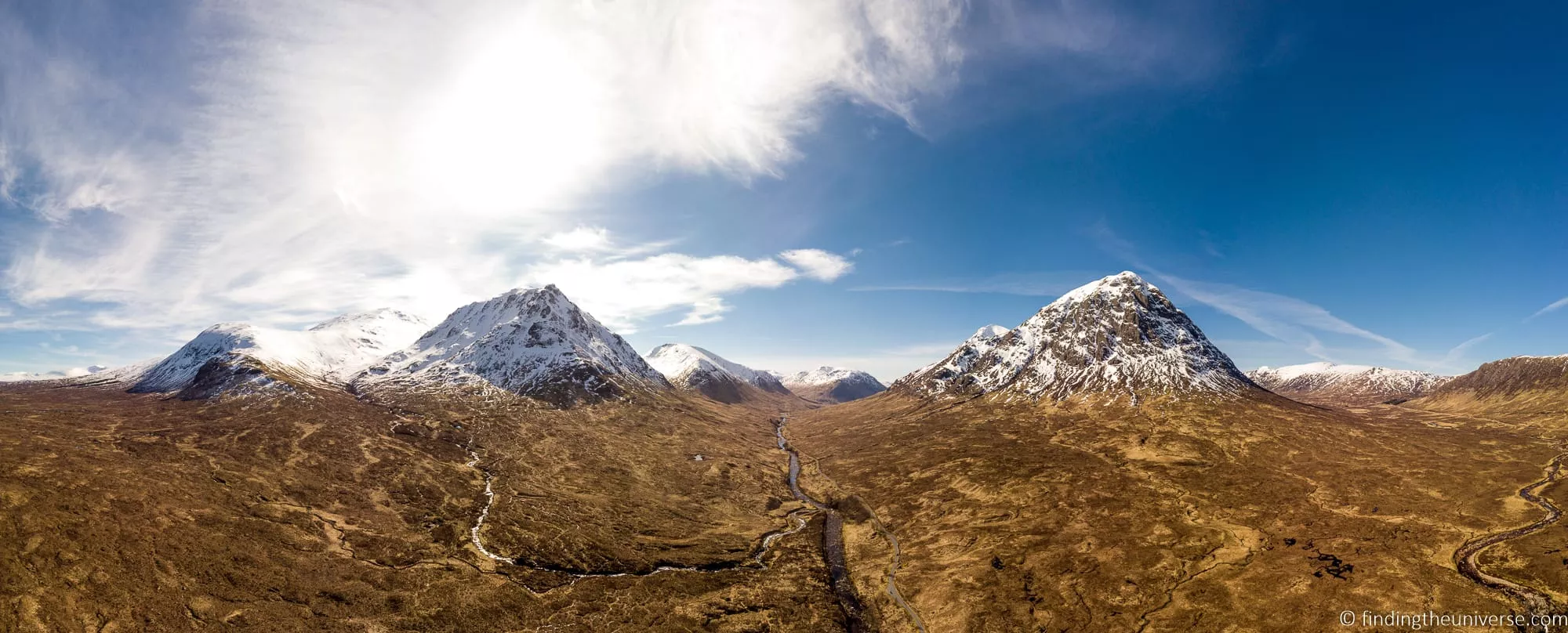
Glen Coe is in the Highland region of Scotland, in the historic county of Argyll, on the west side of the country. The nearest village is also called Glencoe, sitting at the western mouth of the valley where the River Coe meets Loch Leven.
Approximate drive times:
- From Edinburgh: 120 miles, around 2 hours 45 minutes
- From Glasgow: 90 miles, around 2 hours
- From Fort William: 16 miles, around 30 minutes
- From Inverness: 85 miles, around 2 hours
Those times assume good driving conditions. In summer the A82 carries serious tourist traffic and behind a motorhome you can quite easily add half an hour.
How to Get To Glen Coe
There are three sensible ways to reach Glen Coe: drive, take public transport, or join a tour.
Driving is what we’d recommend for almost anyone. Glen Coe is best experienced as a drive through the valley, with the freedom to stop at lay-bys and side roads as the light moves. The A82 from Glasgow runs you straight up Loch Lomond, across Rannoch Moor, and into the head of the glen, which is itself one of the great scenic drives in Britain.
If you’re flying in and need a car, we book through Discover Cars, which compares the major rental companies and the smaller Scottish operators in one search. Glasgow and Edinburgh airports both have full hire fleets. If you’re new to UK driving, our tips for driving in the UK and our guide to driving on single track roads are both worth a read before you head north.
By public transport, the nearest train stations are Fort William (the main hub) and Bridge of Orchy (small but useful if you’re staying near the south end of the glen). Both are on the West Highland Line out of Glasgow Queen Street, which is itself one of the most scenic train journeys in Europe. From either station you’ll need a local Citylink bus to reach Glencoe village or stops within the valley. You can check timetables and book in advance through Trainline, and you can plan onward Scottish bus connections via the Traveline Scotland website.
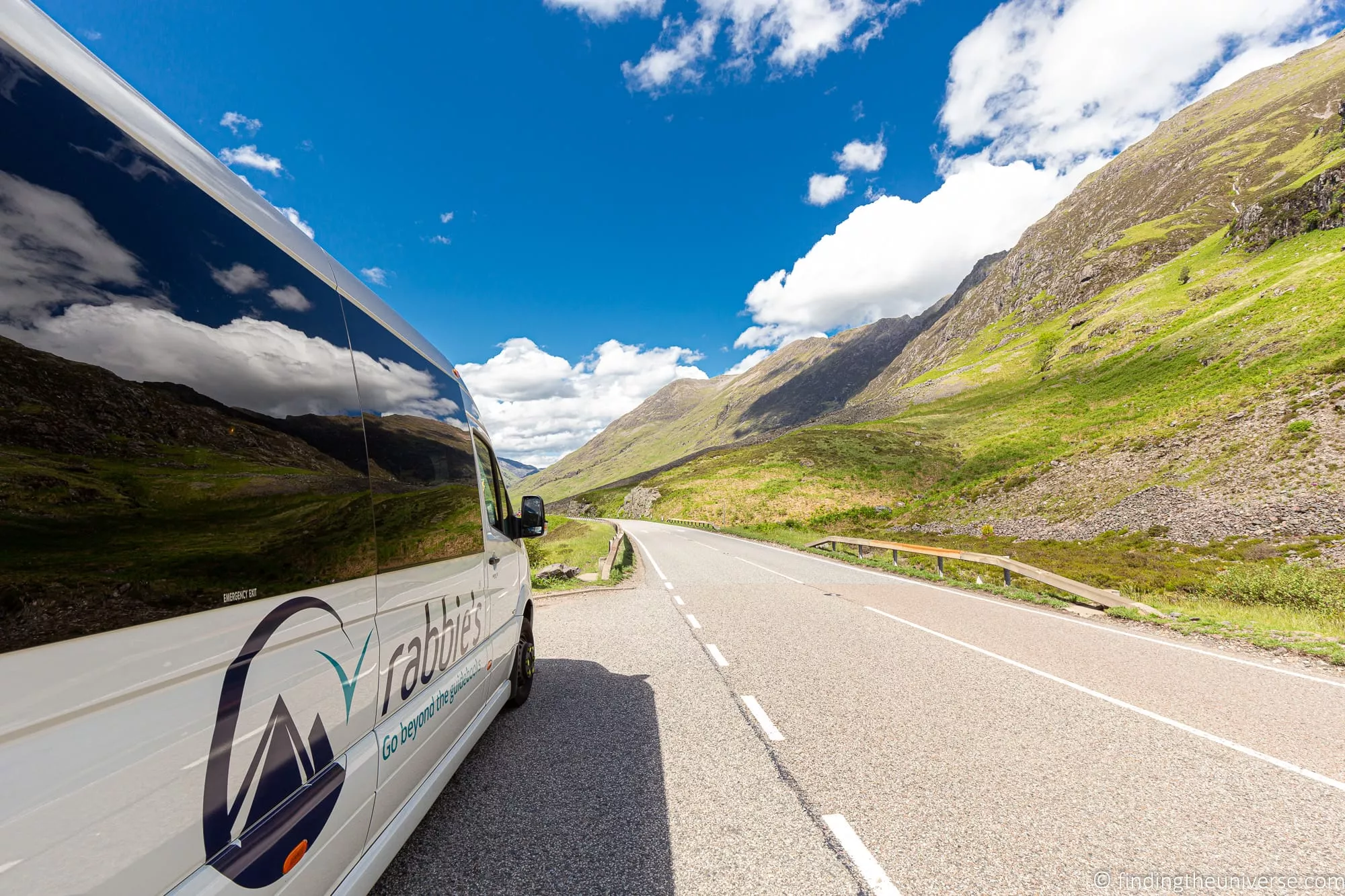
By tour is the easiest option if you don’t want to drive and the train doesn’t fit your schedule. Day tours from Glasgow and Edinburgh include Glen Coe alongside Loch Ness or the Highlands, and multi-day tours include Glen Coe as part of a wider Scottish Highlands or Skye itinerary. We’ve travelled with Rabbie’s a few times in Scotland over the years, including their five-day Highlands and Skye tour, and they run a tight, well-narrated minibus.
A few options to consider:
- Rabbie’s 1 day tour from Edinburgh covering Loch Ness, Glen Coe and the Highlands. Also available from Glasgow.
- This Glasgow day tour via GetYourGuide which includes Glen Coe, the Glenfinnan Viaduct and Fort William.
- A 3 day Rabbie’s tour from Edinburgh taking in the Isle of Skye, Glen Coe, and Loch Ness. Also available from Glasgow.
We’ve collected more tour options further down in the Tours of Glen Coe section.
When to Visit Glen Coe
Glen Coe is open year-round, and we’ve visited at every time of year. Our pick is autumn, but the right window depends on what you’re here for.
If you’re coming primarily for photography, late September through early November (autumn colour, low side-light, manageable midges) is our pick, with February through early April as the second window for snow on the tops, dramatic light, and long shadow. For hiking, late May into early July, and again in September, give long daylight, midges below their summer peak, and high paths clear of snow. If you’re skiing the resort or ski touring, January to early March is the window, depending on snow cover (Glencoe Mountain’s season is short and weather-dependent). For a drive-through with one stop, pretty much any month works. Glen Coe doesn’t really have an off-season for the road itself.
It’s worth flagging that Scottish weather is fickle at any time of year. Pack waterproofs and warm layers even in summer, and don’t book a trip on the assumption that the forecast you read three days out will hold.
Below is a season-by-season breakdown of what to expect.
Visiting Glen Coe in Winter
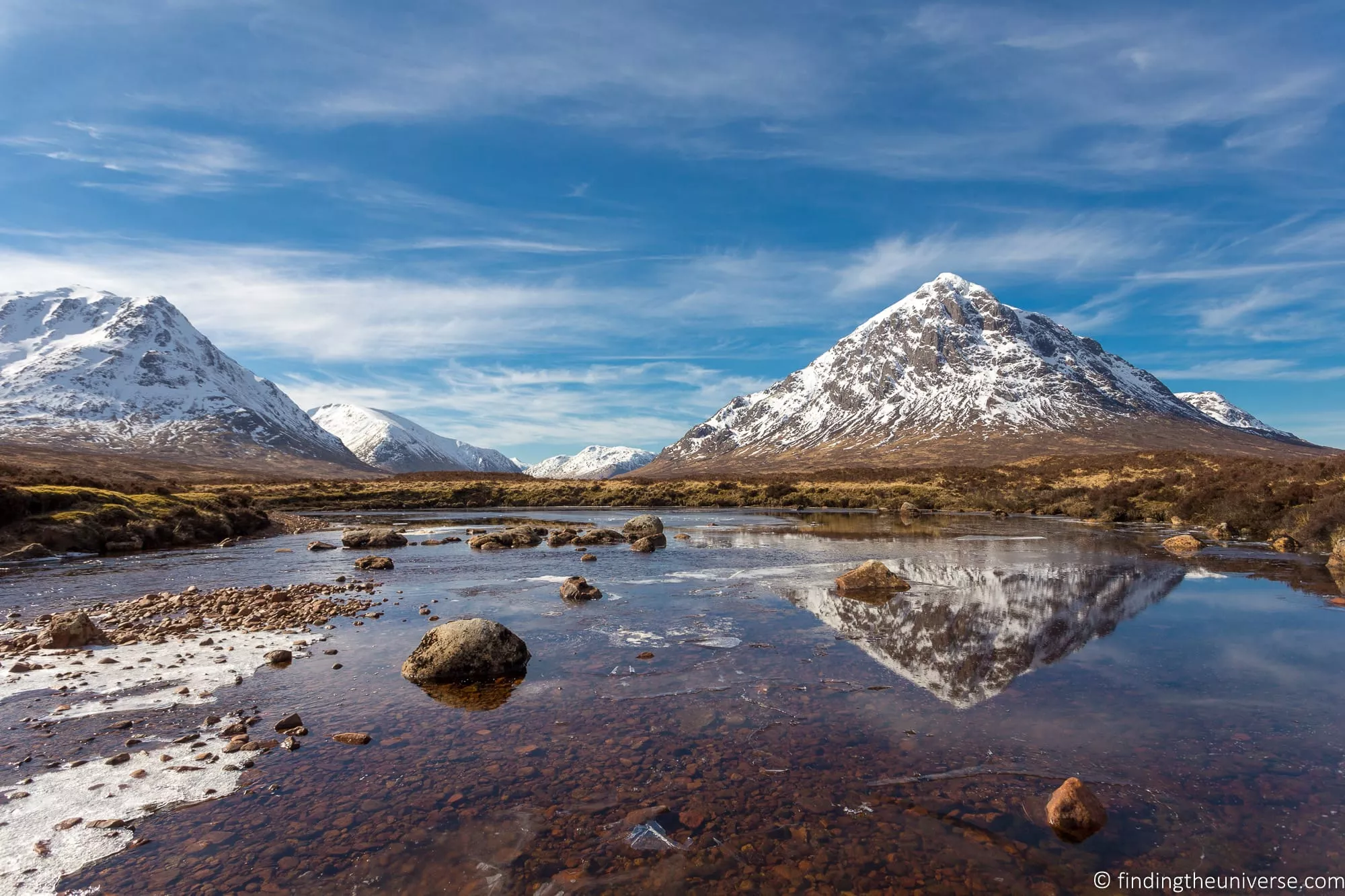
Winter is one of our favourite times to visit Glen Coe for photography. Snow on the ridges, the low winter sun raking the mountains side-on, and the valley emptier of tourist traffic than at any other time of year. The light gets up around 8:30am in December and goes down by 4pm, so you get a compressed but really rewarding shooting window.
The trade-offs are real. The A82 stays open in normal winter conditions but the Glen Etive side road, with its single-track surface and lack of gritting, can be snow-bound or icy after weather. Walking onto the high ground needs winter kit and the skills to use it. Daylight is short and the cafés in Glencoe village have reduced opening hours. For wider context on visiting Scotland this time of year, see our winter in Scotland guide.
If you ski, this is also when Glencoe Mountain is open for snowsports. We cover this in the skiing section below.
Visiting Glen Coe in Spring
Spring is the season that tends to fly under the radar. Daylight stretches out fast (by late April you’re getting around 14 hours), the slopes turn from rust-brown into green, and the wildflowers along the lower trails come into their own.
You can still get snow on the high tops well into April, which gives you that contrast of green valley floor against white peaks. The midges haven’t really got going in March or April, and the worst of the summer crowds are still a month or two away. For our money, late April into mid-May is one of the best windows to come.
Visiting Glen Coe in Summer
For the chance of the best weather, summer is your window. A warm Scottish summer’s day in Glen Coe will see temperatures in the high teens to mid-twenties Celsius (60s to mid-70s F), and you’ll have around 17 hours of daylight in June. That makes for relaxed walking and plenty of time to chase the light at both ends of the day.
The two downsides are crowds and midges. The A82 gets busy and parking lay-bys fill up early in the day, especially during school holidays. The Highland midge is at its peak from late June through August, and the early morning and early evening hours near water (lochans, river banks, woodland) are when they swarm. We always pack Smidge insect repellent in summer, which works as well as anything we’ve tried and is what most of the outdoor crowd in Scotland actually use. If you’re hiking near water at dawn or dusk in July, a head net is worth packing too.
If you’re hiking in summer, take more water than you think you need. The streams in Glen Coe are clear but not always close at hand on the high routes. We carry a Klean Kanteen reusable bottle on every trip, which holds enough water for a half-day walk and survives being dropped on Scottish granite.
Visiting Glen Coe in Autumn
Autumn in Glen Coe is what we’d choose if you forced us to pick one season. Late September into early November is when the bracken on the slopes turns rust-orange, the birch and rowan in the lower glen yellow up, and the air clears into the cold long shadows that suit the landscape. Crowds thin out after the school holidays end, and the midges have packed away for the year.
There aren’t many trees in Glen Coe itself (it’s mostly open moorland and ridge), but the pockets of woodland around Glencoe Lochan, the lower slopes near the Clachaig Inn, and the road into Glen Etive all colour up nicely. Early-morning frost on the heather in October is one of the harder things to leave behind once you’ve shot it.
Where to Base Yourself for Glen Coe
This is one of the harder decisions for a first visit. Three options work well, and each suits a different kind of trip.
| Base | Time needed | What it buys you | Best for |
|---|---|---|---|
| Glasgow (day trip) | One long day (allow 9 hours door to door) | 2 hours each way on the A82; around 4 to 5 hours of actual Glen Coe time including Glen Etive | Travellers with one Scotland day to spare; first-time tasters; cruise stops |
| Fort William (2 nights) | 2 days, 2 nights | 30-minute drive in; access to Ben Nevis, Glenfinnan, the West Highland Line; restaurants and supermarkets on tap | First-timers who want a single base; bad-weather flexibility; non-drivers using buses |
| In the glen (1 to 2 nights at Clachaig Inn, Kingshouse, or Glencoe village) | 2 days, 1 to 2 nights | Sunrise and sunset in the valley itself; the road to yourself before the day-trip coaches arrive; pub dinners in mountain company | Photographers; walkers using the high paths; couples who want quiet evenings |
Our standing recommendation for a first proper visit is two nights in Fort William, with day trips into Glen Coe on both days. Day one drives the A82 east to west and includes the Glen Etive side road. Day two takes in shorter walks, the Visitor Centre, and a sunset shoot at Three Sisters or the White Cottage. For a second or third visit, we’d swap one of the Fort William nights for a night at the Clachaig Inn or Kingshouse, so you can shoot dawn from the valley floor.
Glen Coe Accommodation
If you’re staying more than a day, you’ll want somewhere to base yourself. There are options inside the glen, in nearby Glencoe village, and a short drive away in Fort William. Here are the places we’d recommend or have stayed in ourselves.
- Glencoe Youth Hostel sits just outside Glencoe village. A well-rated hostel offering both shared and private accommodation, with a self-catering kitchen. Budget end, good for walkers and groups.
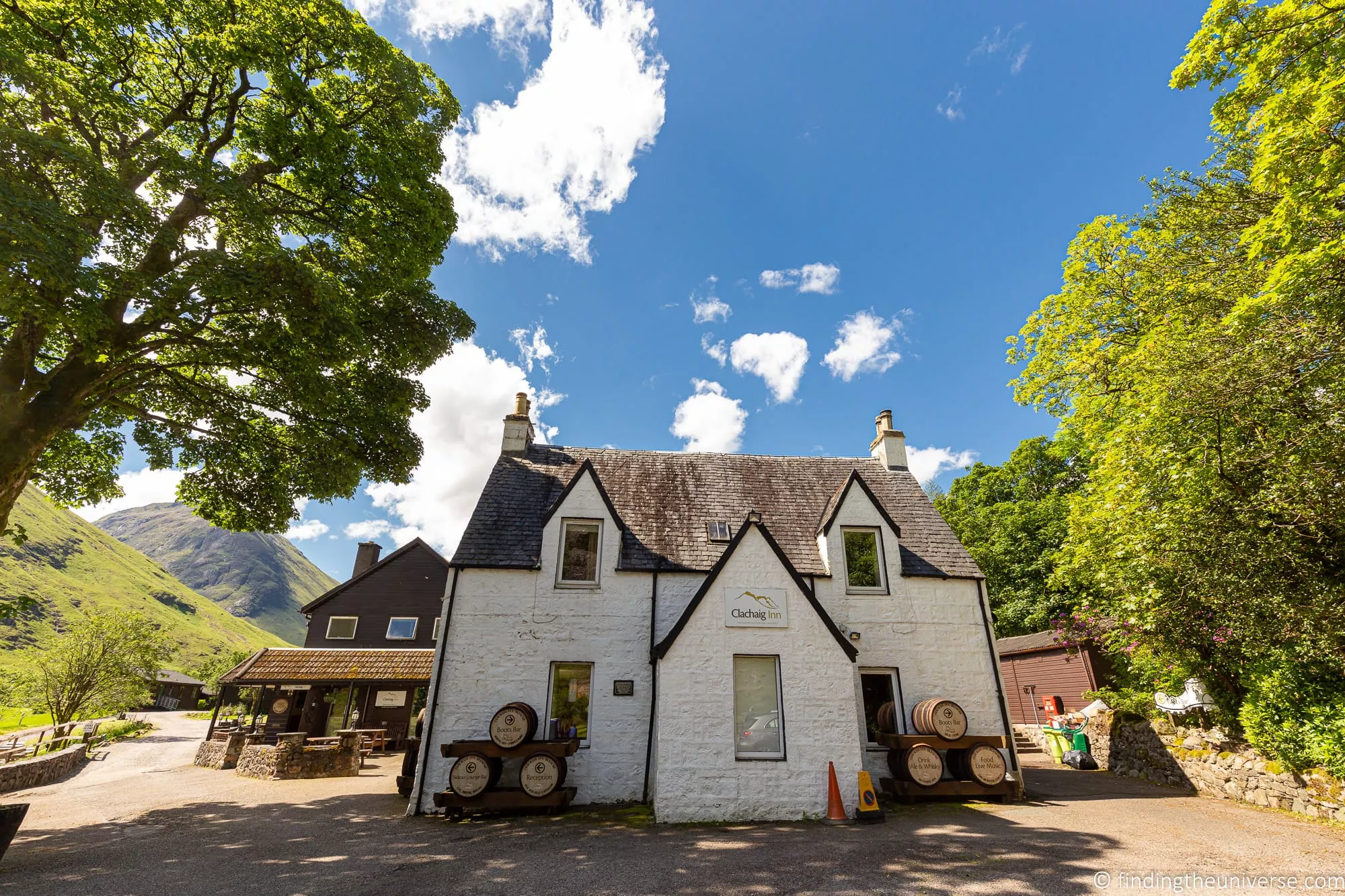
- Clachaig Inn is inside the glen itself, moments from one of the Harry Potter filming locations. There’s an excellent on-site restaurant and a famously good pub (the Boots Bar, popular with climbers), as well as comfortable private rooms. We’ve eaten here many times and it’s one of our standing recommendations.
- Cruachan Hotel is a few minutes’ walk from the centre of Fort William. Well-rated, with a range of private rooms and an on-site restaurant.
- The Isles of Glencoe Hotel sits just outside Glencoe village on the shores of Loch Leven. A 3-star family-friendly hotel with a swimming pool, restaurant and bar, and a range of room types.
- Loch Leven Hotel & Distillery is a family-run hotel with a 17th-century bar that brews its own gin on site. Lochside location, and good food.
- Kingshouse Hotel sits near the head of the glen, with the Buachaille rising right behind it. Renovated to a high standard, with private rooms as well as a separate bunkhouse aimed at hikers. The on-site restaurant has a great view of the mountain at dinner.
- Bridge of Orchy Hotel sits at the south end of the glen, with a rail station and a local bus stop nearby. A well-rated 4-star hotel with a restaurant, bar, and ensuite rooms. Good base if you’re arriving without a car.
There are many more options in the area. See listings on Booking.com for Glencoe here for the full picture.
Camping at Glen Coe
If you’d rather camp, there are a handful of options where you can pitch a tent or park a motorhome.
- Glencoe Mountain Campsite sits beside the ski centre on the floor of Glen Coe and is open year-round. There are tent pitches and caravan/campervan pitches with hookups.
- Red Squirrel Campsite is on the River Coe a couple of miles outside Glencoe village. A quiet, woodland-feel site offering tent pitches with showers. Motorhomes are accepted but there aren’t any hookups.
- Invercoe Caravan & Camping Park sits on the shores of Loch Leven. A wide range of accommodation: tent pitches, caravan/motorhome pitches with hookups, and lodges available.
Wild camping is also legal in Scotland under the Scottish Outdoor Access Code, which is one of the joys of camping here. The rules are clear: tent-based camping, away from roads and habitation, leave no trace. Motorhomes and campervans aren’t covered by wild camping rights and need a formal pitch. Full details on the Scottish Outdoor Access Code website.
Things to Do in Glen Coe
Now you’ve got the planning sorted, here’s what we’d actually do once you’re here. These are all either inside the glen, in or near Glencoe village, or a short drive away.
Stop at the Visitor Centre
Operated by the National Trust for Scotland, the Glencoe Visitor Centre is a good first stop, especially if it’s your first visit and you want orientation before driving into the glen proper.
Inside, the staff can point you towards walks that suit your fitness and the weather, tell you what wildlife has been spotted recently, and give you the current forecast. There’s a 3D relief map of the glen that’s a really useful planning aid. The exhibits include a short film on the geological history of the valley, a section on the mountaineers who built the climbing scene here over the past century, and a permanent panel on the Glencoe Massacre of 1692.
A few walks start directly from the Visitor Centre car park, ranging from a 20-minute woodland loop to longer half-day routes. There’s a café and a gift shop on site, with profits supporting the conservation of the nature reserve.
Entry to the visitor centre itself is free. Parking is £4 per car, with free parking for National Trust for Scotland members. If you join NTS for the trip (we have for years), parking and access to NTS properties across Scotland is included.
Photograph the Viewpoints of Glen Coe
This is the section we’d most have wanted to read on our first visit. I’ve been shooting Glen Coe for years and the difference between a holiday snap and a frame you’d actually print is almost always about where you stood and what the light was doing. Here are the seven viewpoints we keep coming back to.
| Viewpoint | Access | Best season | Best light | Difficulty |
|---|---|---|---|---|
| Three Sisters lay-by | Drive-up (A82 lay-by) | Autumn, winter | Mid-afternoon to sunset | Easy |
| Glen Etive (Skyfall road) | Drive-in (14 mile single track) | Autumn, spring | Sunrise, late afternoon | Easy if you can drive single track |
| Loch Achtriochan | Drive-up (A82 lay-by) | Calm days, any season | Early morning (reflections) | Easy |
| White Cottage / Lagangarbh | Drive-up plus 5 min walk from Altnafeadh lay-by | Winter, autumn | Early morning, late afternoon | Easy |
| Glencoe Lochan | Walk (circular path, around 1.6 miles) | Autumn (woodland colour) | Soft / overcast | Easy |
| Loch Leven shore (Ballachulish) | Drive-up | Any | Sunset | Easy |
| Meeting of Three Waters | Drive-up (same lay-by as Three Sisters) | After rain, autumn | Overcast or low side-light | Easy |
Below is what we’d say about each one if you asked us at the pub.
Three Sisters lay-by. The classic Glen Coe view, and the one most visitors photograph. There’s a large lay-by on the south side of the A82 between Loch Achtriochan and the Pass of Glen Coe. The three ridges (Beinn Fhada, Gearr Aonach, Aonach Dubh) sit shoulder to shoulder facing the road, with the Meeting of Three Waters waterfall in the gully below. The view faces roughly south, which means it lights up in the afternoon and again at sunset. In winter, the snow line picks out the ridges in a way the summer green can’t match.
Glen Etive (the Skyfall road). Turn south off the A82 at the head of Glen Coe, just past the Kingshouse. The 14-mile single-track road runs down Glen Etive towards Loch Etive, and Buachaille Etive Mòr rises on your left for most of it. The Skyfall stretch (where the Aston Martin sat overlooking the glen) is in the first couple of miles. Sunrise here is one of the great experiences in Scottish photography: the Buachaille catches the first light while the glen floor is still in shadow. The road is narrow and passing-place driving, so go slow and read our single-track driving guide if you’ve not done it before.
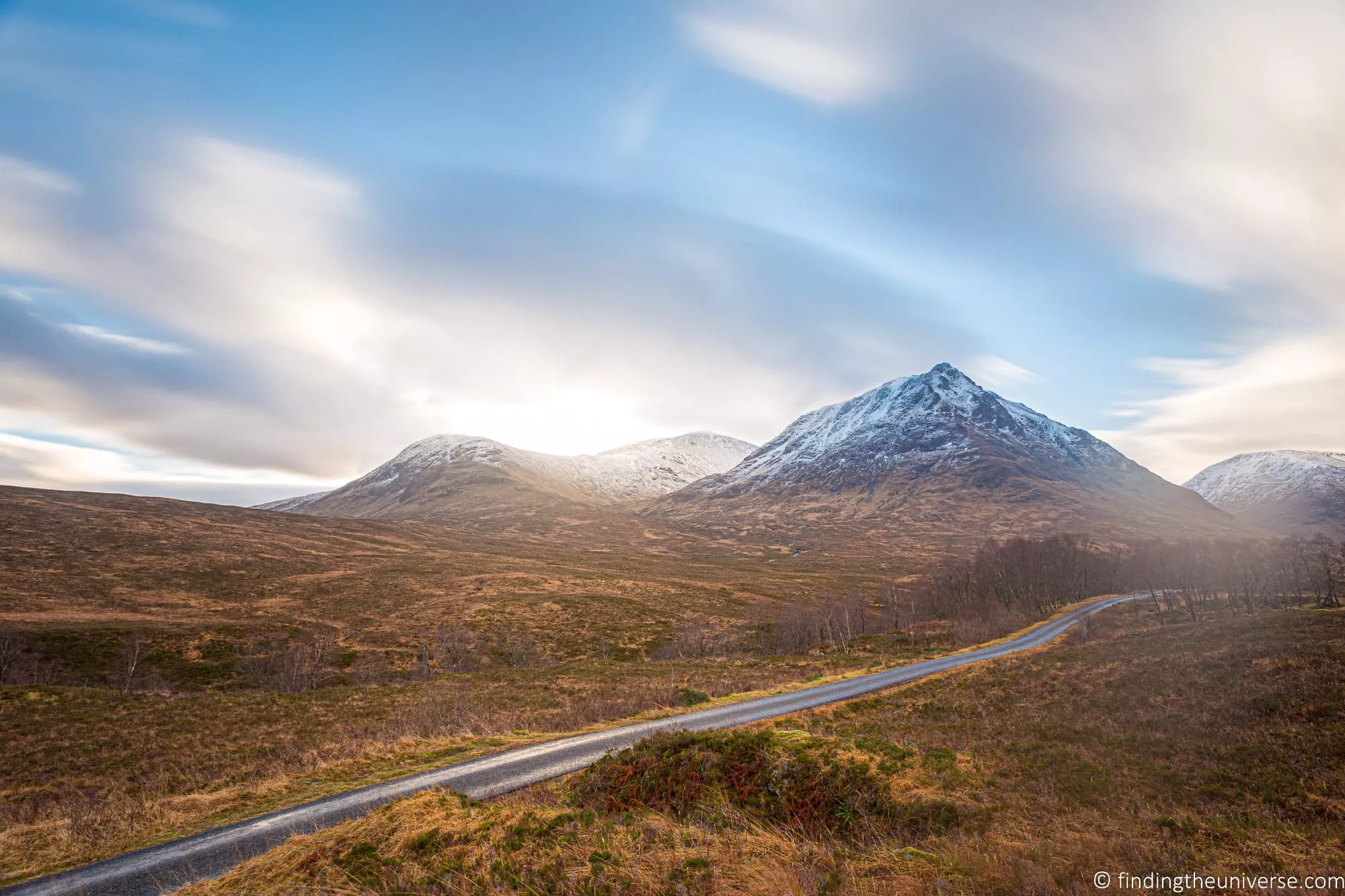
Loch Achtriochan. A small lochan on the north side of the A82, just east of the Three Sisters lay-by. On a still morning the surface holds a clean reflection of the ridges opposite. There’s no formal car park; pull into the lay-by carefully. In summer this is a midge hotspot at dawn and dusk, so dress accordingly.
White Cottage at Lagangarbh. A small, lone whitewashed cottage at the foot of Buachaille Etive Mòr, with the mountain rising directly behind it. The lay-by is on the north side of the A82 at Altnafeadh, where Glen Coe meets Rannoch Moor. From the lay-by, a short footbridge crosses the River Coupall, and a five-minute walk takes you to the cottage. Lagangarbh is owned by the National Trust for Scotland and has been maintained by the Scottish Mountaineering Club since 1946, so it’s still very much a working mountaineering hut. The classic shot puts the cottage small in the frame with the Buachaille looming above. Early morning side-light works best.
Glencoe Lochan. A small ornamental loch a short drive from Glencoe village. There’s a circular walking path of around 1.6 miles around its shore, with pine woodland and views of the Pap of Glencoe across the water. This is the one to walk in soft overcast or after rain, when the woodland colour saturates without harsh shadows. Autumn is the best season here.
Loch Leven shore at Ballachulish. Easy to overlook because everyone aims their cameras at the mountains, but the south shore of Loch Leven catches some of the best sunsets in the area. Pull off in Ballachulish village and walk down to the water. The Pap of Glencoe rises across the loch.
Meeting of Three Waters. This is the waterfall in the gully directly below the Three Sisters viewpoint. Two ways to shoot it: from the A82 lay-by looking down (uses the road bridge as a foreground), or by walking down to the bank for a long-exposure shot of the water itself. After heavy rain it’s at its most photogenic. Overcast light works best because the gully sits in shadow most of the day.
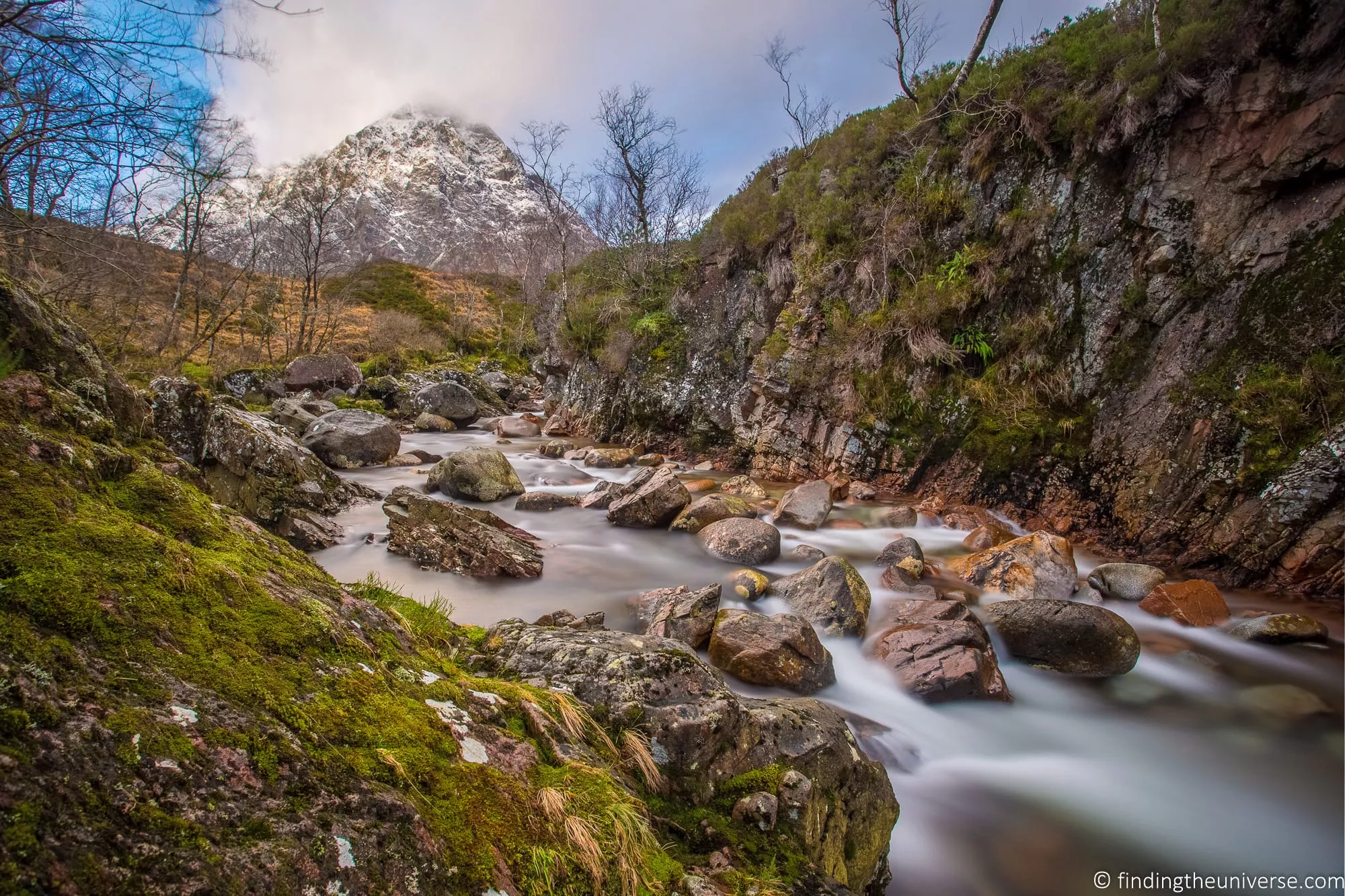
A practical note on photography kit. A standard zoom from around 24mm to 70mm covers almost every viewpoint here. For the Glen Etive sunrise shot of the Buachaille, a longer lens (70-200mm) lets you isolate the mountain against the sky. A polariser helps with reflections at Loch Achtriochan and with cutting glare off wet rock at the Meeting of Three Waters. If you don’t have a tripod, the rocks at most of these lay-bys will hold a camera steady for a long exposure.
You really don’t need professional kit to come back with frames you’ll be pleased with. The light does most of the work here. A smartphone in the right conditions will out-perform an expensive camera in flat midday.
Go Hiking
Hiking is one of the things Glen Coe does best. The mix of glaciated U-shaped valley, steep-sided ridges, and accessible high routes makes it one of the most rewarded walking areas in the Highlands. There’s a route to suit every level, from a 20-minute valley-floor stroll to a full-day Munro horseshoe.
For a short walk, the routes from the Visitor Centre (Signal Rock, Woodland Walk) and the path around Glencoe Lochan are all under 2 miles and don’t need any specialist kit. For a half-day, the Lost Valley walk (Coire Gabhail) climbs up between Beinn Fhada and Gearr Aonach into a hidden hanging corrie that the MacDonalds historically used to hide cattle. It’s around 3 miles return and the last stretch involves a bit of rock-hopping.
For the high ground, Buachaille Etive Mòr is the classic. The mountain has two Munros on its ridge: Stob Dearg (1,021 metres / 3,351 feet) at the head of the glen, and Stob na Bròige at the southern end. The full horseshoe is a long day’s hike and shouldn’t be underestimated, especially if there’s snow or ice on the high paths. The Curved Ridge route up Stob Dearg is a graded scramble, climber’s territory rather than a walking route.
The Walk Highlands website is the best resource for Scottish hiking, with detailed route descriptions, photos, and difficulty ratings. You can see their Glen Coe routes here.
We always carry water (the Klean Kanteen we mentioned above), waterproofs, and warm layers. The weather on the high ground in Glen Coe can shift inside an hour. Phone signal is patchy.
Look for Wildlife
Glen Coe is a National Nature Reserve, which means it’s recognised as containing habitats and species of national importance. The result is a strong wildlife list for somewhere so accessible.
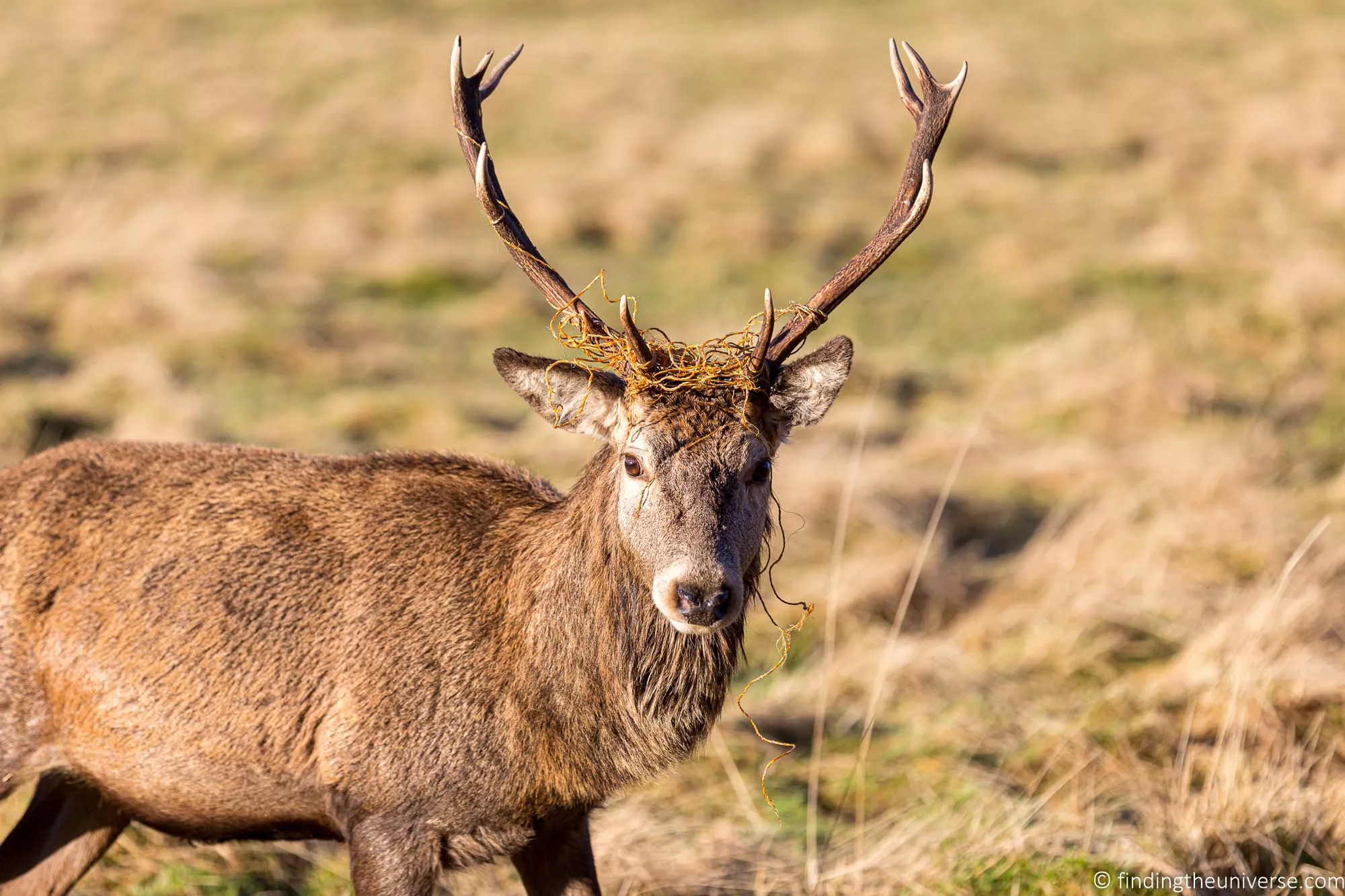
Species you might see include red deer (very common, often grazing within sight of the A82 at dusk), mountain hare, ptarmigan (high ground), golden eagle, pine marten, otter (around Loch Leven), and red squirrel. Birders should pack binoculars; we use ours every visit.
The best way to see wildlife is to get away from the road and onto one of the trails. The staff at the Visitor Centre know which species are around at the time of your visit and can suggest the best trails for sightings.
Go Cycling and Mountain Biking
Glen Coe has options for both road cyclists and downhill mountain bikers, with routes that suit a wide range of fitness and skill.
One of the most popular road routes in the area is the Loch Leven Circular, an approximately 20-mile loop that follows the shore around Loch Leven, starting and finishing at Glencoe village (or Ballachulish or Kinlochleven, depending on where you begin). It’s a pretty flat ride for the Highlands.
A bigger project is the Caledonia Way, also known as National Cycle Route 78. This is a 234-mile long-distance cycle route running from Campbeltown on the Kintyre peninsula up to Inverness, with a section that runs along the A82 through Glen Coe. Sustrans suggests around 11 days at a leisurely pace.
For dedicated mountain biking, both Glencoe Mountain in the glen itself and the nearby Nevis Range have downhill mountain biking routes of varying difficulty. You can bring your own bike or hire one from a local rental shop in Fort William.
Visit the Glencoe Folk Museum
If you want to learn more about the people who have lived in Glen Coe over the centuries, the Glencoe Folk Museum in Glencoe village is the place to do it.
Founded in the 1960s, the museum is housed in a pair of restored 18th-century thatched cottages. It holds Jacobite relics, classic toys, domestic objects, and memorabilia from the two World Wars, alongside a dedicated room covering the Glencoe Massacre of 1692.
One thing to flag: at the time of writing, the museum is closed for a major redevelopment. The Folk Museum is due to reopen in 2027, with refreshed exhibits and new opening hours. We’ve left this section in because the museum is well worth a visit when it reopens, and we’ll update with current admission once it does. For latest news on the redevelopment, check the museum’s website directly.
Go Skiing at Glencoe Mountain
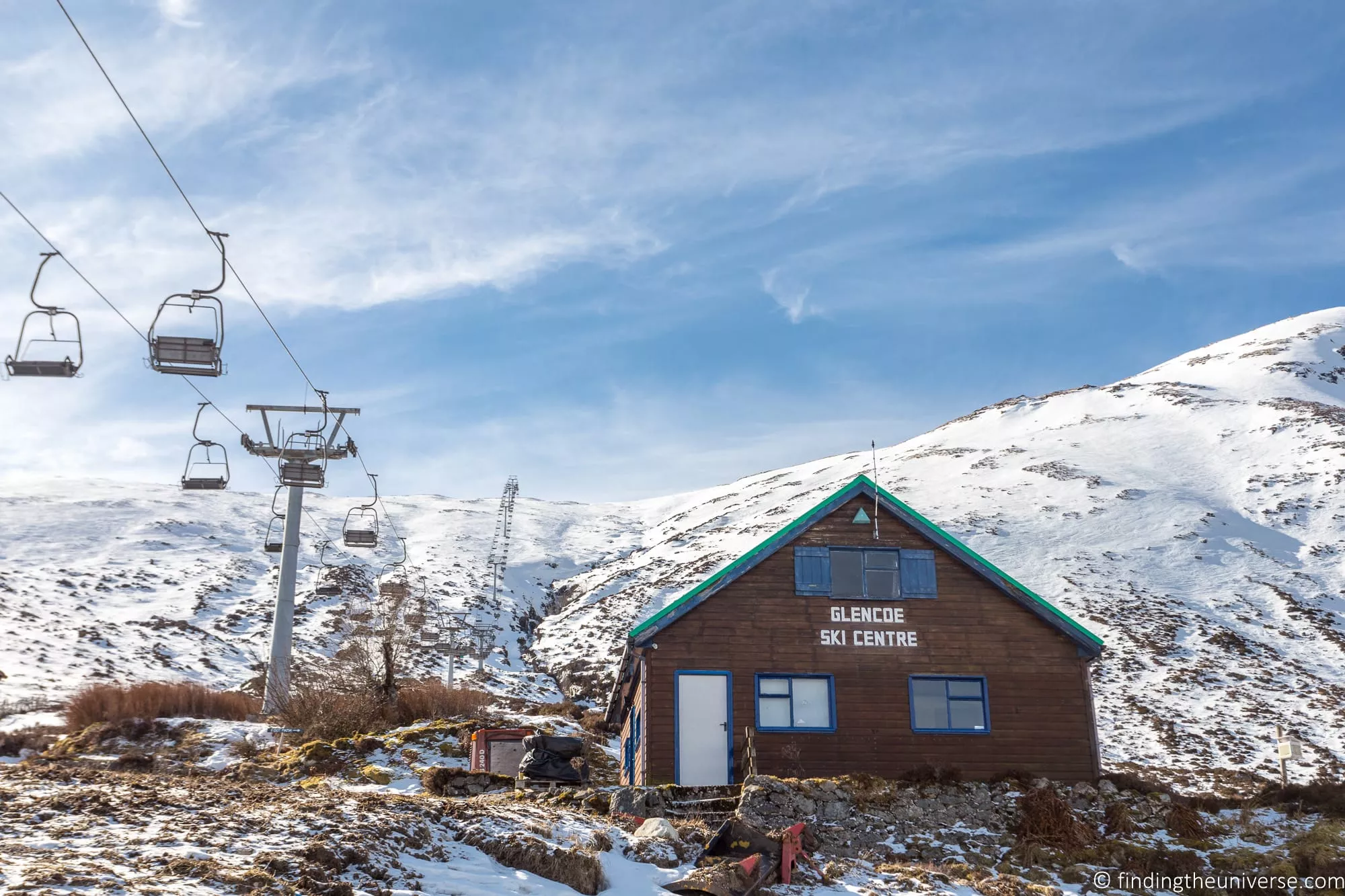
You can go skiing in Scotland, and one of the five Scottish ski resorts sits inside Glen Coe. Glencoe Mountain was the first commercial Scottish ski area, with the original chairlift built on Meall A’Bhuiridh in 1956. It has been operating in some form ever since.
The resort has 20 runs serviced by 8 lifts, ranging from beginner runs to expert. It claims both the steepest and the longest ski slopes in Scotland. There’s a bus stop at the base and a large car park, so it’s pretty easy to reach.
Alongside skiing you can snowboard, sledge, or just take the chairlift up for the view. There are also micro-lodges on site for overnight stays, though you’ll need to bring your own sleeping bag.
If you’re visiting outside the ski season, Glencoe Mountain is still worth a stop. The chairlift usually runs in summer for the view, and the on-site mountain biking trails are open.
Skiers planning a longer trip to this part of the Highlands might also include Nevis Range near Fort William, around 30 minutes away. Combining the two gives a wider variety of terrain over a few days.
Find Film and TV Locations
The drama of Glen Coe means it has appeared on screen many times. Highlander, Rob Roy, and the opening credits of Outlander all use the valley as a backdrop, but it’s two franchises that draw most film tourists: James Bond and Harry Potter.
In Sam Mendes’ Skyfall, the family-home scenes are set in a fictional Highland estate in Glen Coe. The famous Aston Martin DB5 sequence was filmed on the Glen Etive road, with Buachaille Etive Mòr and Buachaille Etive Beag framing the car. One thing to know: the Skyfall lodge itself was a built set on Hankley Common, in Surrey, not in Scotland. The landscape on screen is real Glen Etive, but the house was never there. The road is well worth driving regardless. Read our guide to single-track driving before you go.
Harry Potter filmed multiple scenes around Glen Coe. The most-visited is the location of Hagrid’s Hut from Harry Potter and the Prisoner of Azkaban, built at Clachaig Gully across the road from the Clachaig Inn, overlooking Torren Lochan. The set was removed after filming and the hillside restored, so you’re walking to the view rather than the hut. From the Clachaig Inn parking area, it’s about a 5 to 10 minute walk uphill. The backdrop was reused in Order of the Phoenix and Half-Blood Prince.
For more on Harry Potter filming locations across Scotland, see our sister-site guide to Harry Potter filming locations in Scotland.
If you’d rather see the locations on a tour, two we’d point at:
- A 2-day Outlander Experience small-group tour from Edinburgh, which includes Glen Coe alongside other Outlander filming locations in Scotland.
- A Harry Potter steam train tour from Edinburgh via the Jacobite Steam Train, which includes the Glenfinnan Viaduct as well as Glen Coe scenery.
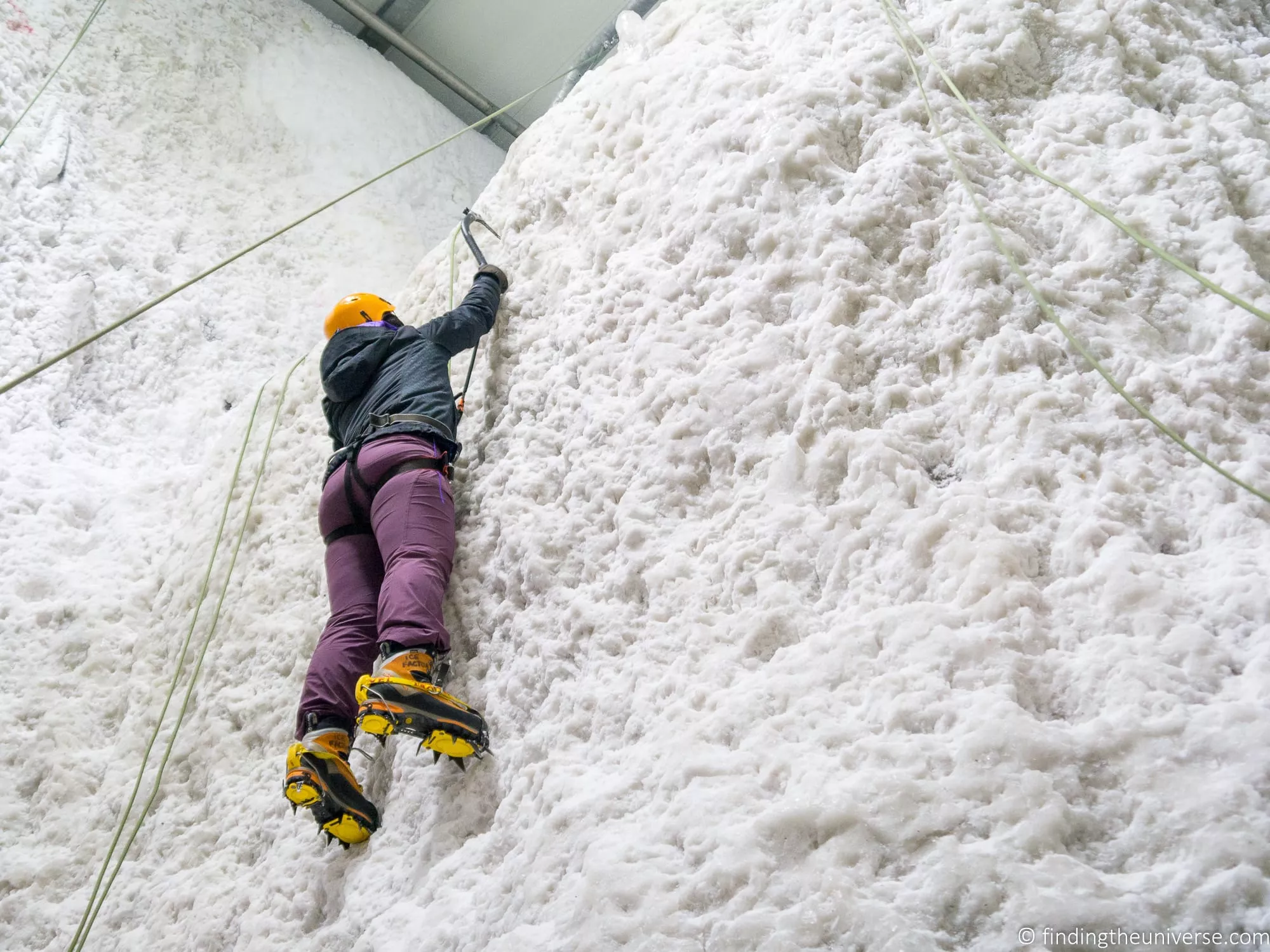
Try Ice Climbing
Glen Coe and the surrounding Lochaber area have some of the best winter mountaineering and ice climbing in the UK. Routes like Curved Ridge on Buachaille Etive Mòr, the gullies on Stob Coire nan Lochan, and the classics on Aonach Dubh are well-known to the British climbing community.
We want to be clear: outdoor ice climbing is a serious technical activity. You need experience, the right kit (ice axes, crampons, harness, helmet, ropes), and an understanding of avalanche risk and Scottish winter conditions. If you’ve not done it before, the only sensible route in is to hire a qualified guide. Look for a Winter Mountain Leader or, for technical climbs, a Mountaineering and Climbing Instructor (MCI). The Mountaineering Scotland directory and the British Mountain Guides (BMG) listings are both good starting points.
One example we’d point at is Tim at Hamlet Mountaineering, who is based up in the northwest Highlands and works across Scotland with small groups. We hiked Suilven with Tim, which gives a sense of how he works. He’s not Glen Coe-specific, but he’s the kind of guide we’d happily hand a friend over to.
A historical note: the indoor ice climbing wall at Ice Factor in Kinlochleven, around 7 miles from Glencoe village, was the largest indoor ice wall in the world. It closed in 2023, and at the time of writing the building remains shut. There is community interest in reopening the centre, and reporting from the BBC suggests a possible relaunch in 2027, but nothing is confirmed. We’ve left the section here because Glen Coe’s ice climbing identity is closely tied to Ice Factor, and we’ll update if it does reopen.
Visit Local Historical Sites
There’s serious history packed into Glen Coe, and a few sites worth visiting alongside the Visitor Centre and the Folk Museum.
The first is Signal Rock, also known as the hill of the sun. This small hill is believed to have been used as a gathering place for Clan MacDonald in times of emergency, with beacons lit on top as a warning signal (hence the name). It’s reached by an easy walk of around 1.5 miles round trip, taking 60 to 90 minutes for an averagely fit walker. The Walk Highlands route map is available here.
A short walk from Glencoe village is the Glencoe Massacre Memorial, which commemorates the members of Clan MacDonald who lost their lives in the massacre. The exact location can be seen on Google Maps.
On your way to the memorial you’ll pass the Glencoe War Memorial, which commemorates the residents of Glencoe killed or listed as missing in the two World Wars.
A brief on the massacre, since it’s so central to the area’s identity. In the early hours of 13 February 1692, soldiers from Argyll’s Regiment of Foot, under the command of Captain Robert Campbell of Glenlyon, attacked their MacDonald hosts in Glen Coe. The soldiers had been quartered with the MacDonalds for nearly two weeks, accepting their hospitality, before turning on them. Around 30 MacDonalds were killed, with contemporary accounts varying between 25 and 38 dead. The first killed was the clan chief, MacIain. The breach of Highland hospitality (which carried real cultural weight at the time) shocked Scotland and is still remembered locally.
If you’d like a wider history of the area, both the Glencoe Visitor Centre and (when reopened) the Folk Museum cover the events in more depth. If you find yourself in Fort William, the West Highland Museum is also worth a stop.
Spot Waterfalls
Glen Coe has a number of waterfalls, most of them small but very photogenic. Several are visible from the road, and a couple need a short walk in.
The most accessible is the Meeting of Three Waters, in the gully directly below the Three Sisters lay-by. You can see it from the road bridge, and walk down to the bank for a closer view.
Another favourite is the waterfall with Buachaille Etive Mòr as a backdrop, which sits at this spot on Google Maps, just off the Glen Etive road.
Larger waterfalls sit nearby, outside Glen Coe itself. The Grey Mare’s Tail at Kinlochleven and Steall Falls in Glen Nevis are both around a 90-minute round-trip walk to reach and well worth the effort.

Play a Round of Golf
Scotland and golf go together, and even though Glen Coe isn’t a golf destination in the way St Andrews is, there’s a nine-hole course nearby that’s worth a mention for any visitor who wants a round on a Scottish course in a scenic setting.
Woodlands Golf Course sits in Glenachulish, about 4 miles west of Glencoe village. Nine holes set against the Highland scenery, with a single ticket giving you as many rounds in a day as you want to play. Book online via the course’s website.
Go Canoeing or Kayaking on Loch Leven
The River Coe flows out of Glen Coe and into Loch Leven at Glencoe village. The loch is a sea loch, almost 9 miles in length, with several small islands. One of them, Eilean Munde, was historically the burial island of Clan MacDonald.
If you’d like to get on the water, kayaking trips with companies like Rockhopper Scotland are a great way to see the loch from a perspective most visitors miss. Trips typically run from spring through autumn.
What We’ve Learned from Multiple Visits to Glen Coe
After many trips up here in different seasons, there are a few things we wish someone had told us on the first visit. Not horror stories: just the texture of the place, the things that aren’t on the standard “things to do” list, and how we’d handle the weather when it goes sideways.
The weather will change. Plan for it. Glen Coe sits at the head of a long sea loch with high ridges to either side, which means cloud, rain, and wind all arrive faster than you’d expect. We’ve started days in clear sun and finished them in horizontal rain. Pack waterproofs, warm layers, and a hat in any season. Check the Mountain Weather Information Service forecast for Western Highlands before any high-ground walk.
If the cloud is on the ridges, the day is not lost. Some of our best Glen Coe photos have come from low-cloud days. The mountains play hide-and-seek through the mist, the colour of the heather and bracken saturates in the soft light, and there’s nobody else at the lay-bys. The drive itself stays spectacular. If you’ve come for high-ridge walks and the weather closes in, switch to the valley-floor routes (Glencoe Lochan, the Visitor Centre walks, the Lost Valley if conditions allow), or drive the Glen Etive road for the scenery without the exposure.
The midges are a planning constraint in summer. Late June to mid-August at dawn or dusk, especially near water, the Highland midge can wreck a still summer evening. They concentrate around lochans, river banks, and shaded woodland; they don’t really bother windy ridges or open coastlines. Carry repellent, plan high-ground walks for the middle of the day in summer, and don’t pitch a tent in long grass next to a stream in July without a head net to hand.
Winter single-track driving needs respect. The A82 stays open and gritted in normal winter conditions, but the Glen Etive side road and many of the smaller side routes do not. After fresh snow, single-track surfaces can be slick well into the afternoon. Don’t drive Glen Etive in winter without confidence in those conditions, and never assume passing-place spacing leaves you room to brake. If you’re not certain, stick to the A82 in winter and admire the side roads in spring.
The most photographed view is not always the best view. The Three Sisters lay-by is busy with coach tours from late morning onwards. If you want it empty, get there before 9am or stay until the last coach has left after sunset. The light at both ends of the day is also better than the harsh midday angle most visitors arrive in.
Phone signal is patchy. Most of Glen Coe has weak or no mobile signal. Download offline maps before you set off, write down emergency numbers, and don’t rely on Google Maps mid-route. We list the travel apps we rely on in a separate guide. Mountain Rescue numbers are 999 (then ask for Mountain Rescue once you’re connected).
You don’t need to do everything on one trip. Glen Coe rewards repeat visits more than it rewards a single packed day. If the weather is grim or you’re tired, do less and do it well. The valley will still be here.
Attractions Near Glen Coe
If you have more time in the area, Fort William and the wider Lochaber region are well worth exploring. Here are some sights to consider alongside Glen Coe itself.
- Ben Nevis Distillery sits at the foot of Ben Nevis on the outskirts of Fort William. Produces single malt whisky and runs distillery tours; check the website for current times.
- Lochaber Geopark covers a large area around Fort William, taking in Glen Coe, Ben Nevis, and the surrounding ranges. It’s one of four Scottish geoparks, and the only one not designated as a UNESCO Global Geopark. The geopark office is at 55A High Street, Fort William. Visitors can buy a Geotrails pack of 8 self-guided leaflets, or stop in at the geopark visitor centre in Fort William for an overview.
- Glen Nevis and Ben Nevis. At 1,345 metres / 4,413 feet, Ben Nevis is the highest mountain in the UK. It’s a popular day hike from Fort William and a serious destination for winter climbers and ice climbers (subject to the same safety caveats as Glen Coe).
- Fort William is the nearest town of any size and the regional transport hub. Known locally as the Outdoor Capital of the Highlands, it has outdoor-gear shops, restaurants, and supermarkets. It’s also home to the West Highland Museum, which is free to enter.
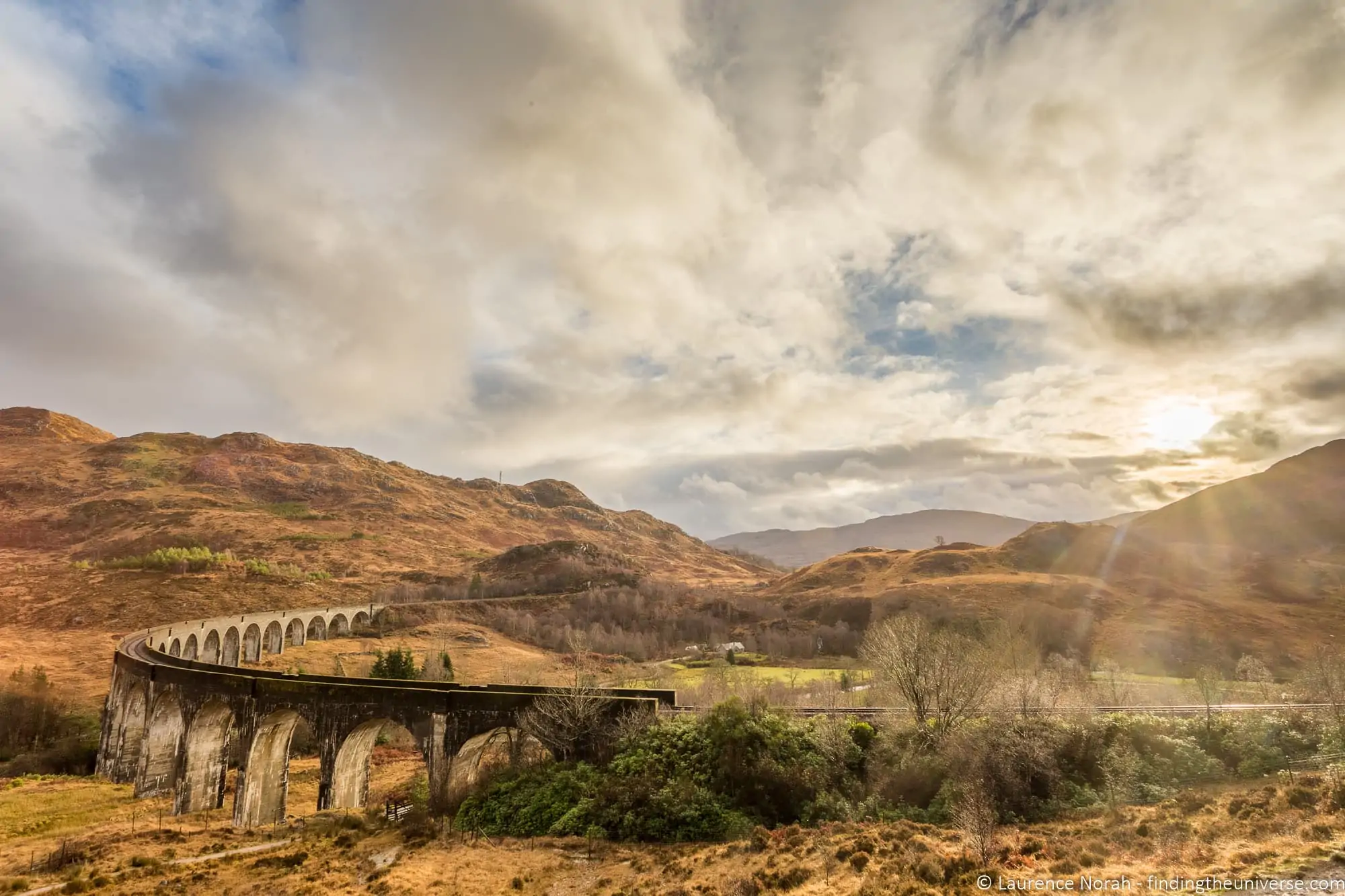
- The Jacobite Steam Train runs from Fort William and is the train that played the Hogwarts Express in the Harry Potter films. The line crosses the Glenfinnan Viaduct, which is the famous curved railway viaduct from the films.
- The Glenfinnan Viaduct is around a 20-minute drive west of Fort William. The official National Trust for Scotland car park is £5 per car (free for NTS members), and an overflow car park at the Glenfinnan Community is also available if the NTS one fills up. Note that the older informal trailhead parking at the lay-by is no longer accessible; you’ll be turned around.
- Inverlochy Castle is the closest castle ruin to Glen Coe, just east of Fort William. Right beside it is the Inverlochy Castle Hotel, one of our favourite five-star country house hotels in Scotland.
- Loch Lomond and The Trossachs National Park sits south of Glen Coe on the A82 back to Glasgow. Easy to combine into a Highlands itinerary; see our sister-site guide to things to do in Loch Lomond.
Tours of Glen Coe
If you’d rather let someone else handle the driving and the navigation, plenty of tours include Glen Coe in their Scottish Highlands itineraries. The options below run from a single day out of Glasgow or Edinburgh to multi-day Skye-and-Highlands trips.
A practical tip on choosing: tours vary widely in how much actual Glen Coe time they give you. Some include just one or two photo stops while you’re driven through; others spend half a day in the valley. Read the itinerary before booking and pick one that matches what you want to see.
Some suggested tours to consider:
- Rabbie’s 1-day tour from Edinburgh covering Loch Ness, Glen Coe and the Highlands. Also available from Glasgow.
- A Glasgow day tour via GetYourGuide, which includes Glen Coe, the Glenfinnan Viaduct, and Fort William.
- A 2-day Outlander Experience tour from Edinburgh covering a number of Outlander locations across Scotland alongside Glen Coe.
- A 3-day Rabbie’s tour from Edinburgh covering the Isle of Skye, Glen Coe, and Loch Ness. Also available from Glasgow.
- A 5-day Rabbie’s tour of Skye and the far north, which also includes a stop in Glen Coe.
There are lots of options across the day-trip and multi-day range.
Frequently Asked Questions About Visiting Glen Coe
Here are answers to some of the most common questions we get about planning a Glen Coe trip.
How long do you need at Glen Coe?
For a meaningful first visit, plan a minimum of a full day, with two days giving you a much fuller experience. A full day from Glasgow or Edinburgh means around 9 hours door to door, which gets you the A82 drive, the Three Sisters lay-by, Glen Etive, and one short walk. Two days lets you add the Visitor Centre, the Lost Valley walk, a Glencoe Lochan circuit, and the chance to catch the light at both sunrise and sunset.
Is Glen Coe worth visiting?
Yes, and we’d put it on the shortlist for any first-time Scotland trip. The drive through the valley is one of the great Highland experiences, the walking is varied and accessible, and the photography is some of the best in Britain. Even in poor weather the valley is atmospheric.
What is the best time of year to visit Glen Coe?
Our pick is late September into early November, for the autumn colour, the soft low light, and the absence of midges. April and May are also very good, with spring green coming through and midges not yet at full strength. Mid-summer (June to August) gives you long daylight and the best chance of warm weather, but brings crowds and midges. Winter (especially February and March) is the most photographically dramatic season, with snow on the tops, but daylight is short and conditions need respect.
How do I get to Glen Coe without a car?
The best non-driving options are coach tours from Glasgow or Edinburgh, or the West Highland Line train to Fort William or Bridge of Orchy and a local Citylink bus from there. Tour-only is the easiest if you have a single day. Train plus bus gives you more independence over two or three days but takes longer.
Where should I stay near Glen Coe?
For most first-time visitors, Fort William is the most flexible base, with restaurants, supermarkets, and easy access to Glen Coe, Ben Nevis, and the wider area. Inside the glen itself, the Clachaig Inn and the Kingshouse Hotel both put you in the middle of the landscape. Glencoe village offers a couple of mid-range options on the shore of Loch Leven. For budget travel, the Glencoe Youth Hostel is good value.
What is the famous viewpoint in Glen Coe?
The Three Sisters lay-by on the A82 is the best-known viewpoint, looking south at three ridges of Bidean nam Bian (Beinn Fhada, Gearr Aonach, and Aonach Dubh) lined up shoulder to shoulder. The White Cottage at Lagangarbh, the Glen Etive road below Buachaille Etive Mòr, and Glencoe Lochan are the next-most-photographed.
What films have been shot in Glen Coe?
The most famous are the Glen Etive Aston Martin sequence in James Bond’s Skyfall (2012), the location of Hagrid’s Hut in Harry Potter and the Prisoner of Azkaban (2004), and various wider Highland scenes in Highlander (1986), Rob Roy (1995), and the opening titles of Outlander. The Skyfall lodge itself was a set built in Surrey, but the surrounding landscape is real Glen Etive.
Are there midges in Glen Coe?
Yes, and they’re a planning consideration if you visit between late May and early September, with peak biting in July and August. They’re worst at dawn and dusk near water (lochans, rivers, woodland) and on still, humid days. Carry repellent (we use Smidge), avoid pitching tents in long grass by streams, and consider a head net if you’ll be near water at dawn or dusk in midsummer. Wind, sun, and open coast all reduce the problem.
Can I drive the Glen Etive road in winter?
You can, but it needs care. The Glen Etive road is a 14-mile single-track route with passing places and no gritting, so after fresh snow or in icy conditions it can be impassable or unsafe. In normal winter weather, with confidence in single-track driving on snow, it’s doable in the middle of the day. If in doubt, leave it for spring or autumn and enjoy the A82 instead.
Is Glen Coe open in winter?
Yes. The A82 stays open and gritted in normal conditions, so the main drive through the valley is accessible year-round. Some side roads (Glen Etive in particular) can be closed or unsafe after snow. The Glencoe Visitor Centre runs reduced winter hours. The Glencoe Mountain ski resort is open in the winter season for skiing and snowboarding when conditions permit.
Further Reading
That’s our guide to visiting Glen Coe. To help you plan the rest of your Scotland trip, here are some related posts you might find useful.
- We have a photo essay on Glen Coe with more Glen Coe photos. For photography elsewhere in the Highlands, see our guide to photography locations on Skye, and for Edinburgh-specific spots, our Edinburgh photography locations guide.
- We have guides to Outlander filming locations in Scotland and Harry Potter filming locations in Scotland. Both films used Glen Coe as a backdrop.
- If you’re skiing, see our complete guide to skiing in Scotland. For Scotland’s other ski cluster, see our guide to the Cairngorms in winter.
- For other Highland inspiration, we have a guide to Loch Ness, day trips from Inverness, and a guide to the Black Isle.
- If you’d like an itinerary that covers Skye and the Highlands, see our 5-day Isle of Skye and Scottish Highlands itinerary.
- For first-time UK driving, see our UK driving tips and our guide to the cost of UK travel.
- For road-trip inspiration further north, we have a guide to the North Coast 500 and a North Coast 500 accommodation guide, our NC500 photography highlights, and a 7 day NC500 camping itinerary.
- For Edinburgh, see our 2 day Edinburgh itinerary, our sister-site guide to things to do in Edinburgh, and our guide to day trips from Edinburgh. We also have a guide to getting from London to Edinburgh.
- For Glasgow, see our Glasgow and Loch Lomond itinerary, the best day trips from Glasgow, and our sister-site guide to things to do in Glasgow.
- For Aberdeen, see our guides to things to do in Aberdeen, our favourite Aberdeen restaurants, and our best day trips from Aberdeen.
- For whisky lovers, our guide to Scotland’s whisky distilleries covers regions, processes, and our favourite distilleries.
- If you’d like a guidebook for your time in Scotland, we recommend the Rick Steves’ Scotland guide. It’s the one we always pack ourselves.
That’s it for our guide to visiting Glen Coe. As always, we’re open to your feedback or any questions you might have. Pop them in the comments section below and we’ll get back to you as soon as we can.
Akshay Sawant says
Hi,
I think Scotland is one of the best travel destinations, I was just planning to visit there but due to the covid situation I didn’t get there but next year I will plan a long trip There. Thank You!
Laurence Norah says
It is a beautiful destination! I hope you have a wonderful trip next year Akshay 🙂