

I'm Laurence, a professional travel photographer since 2010. Jess and I write this site from our own travels.
I’ve been a professional travel photographer since 2010, and every lens in my camera bag was bought for a DSLR. These days they all go on a Canon EOS R5 through Canon’s EF to RF adapter. So when someone asks me which mirrorless camera to buy, my first question back is usually which lenses they already own.
I don’t own any of the cameras on this list. Mine is the original R5, the camera the R5 Mark II succeeded.
What I have done is take photos since 1993 and teach photography through my online course, which is a lot of time spent learning which features make a difference once you’re out shooting and which ones only look good on a spec sheet. I checked the specs here against the camera makers’ own spec pages and launch announcements in November 2026, and where I own the gear (the R5, the EF lenses, the adapter), I’ll tell you.
If you’re buying mainly for travel, my travel camera guide is the better place to start. I’ve also got guides to the best compact cameras and the best DSLR cameras if you’re not set on mirrorless.
Table of Contents:
Quick Verdict: Which Mirrorless Camera Should You Buy?
If you’re starting from scratch, my pick for most people is the Fujifilm X-T5. You get a 40.2MP APS-C sensor, in-body stabilisation rated at 7 stops, a weather-resistant body and physical dials for the main settings, in a camera that weighs 557g with its battery and card.
If you want full-frame, get the Canon EOS R6 Mark III, which does everything well. The Nikon Z5 II is the cheaper way into full-frame, and the Nikon Z6 III and Sony a7 V are the equivalents if you already own Nikon or Sony lenses. If you own Canon DSLR lenses, they’ll work on any of the Canon bodies here through Canon’s EF-EOS R adapter.
New to photography, or on a smaller budget? Get the Canon EOS R10, or the R50 or R100 if you need to spend less. For video, the Canon EOS R6 V records 7K RAW and has a built-in cooling fan, but it has no viewfinder at all, so read its section before you order one.
My travel camera guide picks the Sony a6700 instead of the X-T5, because travel photography rewards fast autofocus above almost everything else, and that’s where the a6700 is strongest. As a camera to own and use for everything, the X-T5 is the better buy.
Quick Picks: The Best Mirrorless Cameras in 2026
In a hurry? Here are my picks for different needs and budgets:
- Best overall: Fujifilm X-T5. A 40.2MP sensor, physical dials for everything and a weather-resistant body.
- Best for beginners: Canon EOS R10. Easy to learn on, with enough controls that you won’t outgrow it in a year.
- Best value full-frame: Nikon Z5 II. Full-frame, a sealed body and two card slots for a lot less than the all-rounders.
- Best full-frame all-rounder: Canon EOS R6 Mark III. A 32.5MP sensor and stabilisation rated up to 8.5 stops.
- Best compact full-frame: Sony a7C II. A 33MP full-frame sensor in a body lighter than the X-T5.
- Best enthusiast full-frame: Nikon Z6 III. A partially-stacked sensor and 6K internal RAW video.
- Best Sony full-frame all-rounder: Sony a7 V. A 33MP sensor and bursts of up to 30fps.
- Best for video: Canon EOS R6 V. 7K RAW at 60p and a cooling fan, with no viewfinder.
- Best for wildlife and action: Canon EOS R7. Bursts of up to 30fps and a 1.6x crop that stretches your telephoto lenses.
- Best Sony APS-C: Sony a6700. Excellent autofocus in a small, light body.
- Best high-resolution: Sony a7R VI. 66.8MP, Sony’s highest-resolution Alpha camera.
- Best high-end: Canon EOS R5 Mark II. A 45MP stacked sensor, and the camera I’d replace my R5 with.
- Best for vlogging: Fujifilm X-M5. The lightest interchangeable-lens camera in Fujifilm’s X Series.
- Best rangefinder-style: Fujifilm X-E5. The X-T5’s sensor in a flat-topped body, and the first X-E camera with in-body stabilisation.
Best Mirrorless Cameras Compared
Here’s how the 14 picks compare. Prices update live from Amazon and are for the body only, except the Canon R10 and Nikon Z5 II, which Amazon sells with a kit lens. Weights are for the body with its battery and memory card (no lens), taken from each maker’s own spec pages.
| Use case | Camera | Price | Sensor | Weight | IBIS | Standout |
|---|---|---|---|---|---|---|
| Best overall | Fujifilm X-T5 | Check price on Amazon | 40.2MP APS-C | 557g | 7 stops | 40.2MP sensor, dials for everything |
| Best for beginners | Canon EOS R10 (with kit lens) | Check price on Amazon | 24.2MP APS-C | 429g | None | More controls than Canon’s cheaper bodies |
| Best value full-frame | Nikon Z5 II (with kit lens) | Check price on Amazon | 24.5MP full-frame | 700g | Up to 7.5 stops | Two SD slots, sealed body |
| Best full-frame all-rounder | Canon EOS R6 Mark III | Check price on Amazon | 32.5MP full-frame | 699g | Up to 8.5 stops | Does everything well |
| Best compact full-frame | Sony a7C II | Check price on Amazon | 33MP full-frame | 514g | Yes | Full-frame quality in an APS-C-sized body |
| Best enthusiast full-frame | Nikon Z6 III | Check price on Amazon | 24.5MP full-frame | 760g | Up to 8 stops | Partially-stacked sensor, 6K internal RAW |
| Best Sony full-frame all-rounder | Sony a7 V | Check price on Amazon | 33MP full-frame | 695g | Yes | Sony’s all-round full-frame body |
| Best for video | Canon EOS R6 V | Check price on Amazon | 32.5MP full-frame | 688g | 7.5 stops | 7K/60p RAW, active cooling (no viewfinder) |
| Best for wildlife and action | Canon EOS R7 | Check price on Amazon | 32.5MP APS-C | 612g | Up to 7 stops | 30fps burst, 1.6x telephoto reach |
| Best Sony APS-C | Sony a6700 | Check price on Amazon | 26MP APS-C | 493g | Yes | Excellent autofocus, small body |
| Best high-resolution | Sony a7R VI | Check price on Amazon | 66.8MP full-frame | 713g | Yes | Sony’s highest-resolution Alpha body |
| Best high-end | Canon EOS R5 Mark II | Check price on Amazon | 45MP full-frame | 670g | Up to 8.5 stops | Stacked 45MP sensor |
| Best for vlogging | Fujifilm X-M5 | Check price on Amazon | 26.1MP APS-C | 355g | None (digital IS for video) | Lightest interchangeable-lens X Series camera |
| Best rangefinder-style | Fujifilm X-E5 | Check price on Amazon | 40.2MP APS-C | 445g | 7 stops | First X-E body with IBIS |
How to Choose: Pick the System Before the Camera

You’ll probably replace your camera body in a few years. The lenses can stay with you for a lot longer than that, and they only fit one maker’s mount. So the bigger decision is the system you’re buying into, and the body comes second.
I’ve been a Canon user since I was 13, and that’s how it’s worked out for me. When I moved from the Canon 6D to the R5, I didn’t have to replace a single lens. It cost me an adapter rather than a new bag of glass, which is about the cheapest upgrade a photographer ever gets to make.
Which Mounts Are Open to Other Lens Makers?
Third-party lenses from the likes of Sigma, Tamron and Viltrox are often cheaper than the camera maker’s own, and some fill gaps in the range. How many you can choose from depends a lot on the mount:
- Sony E-mount is the most open of the big systems. Sony released its specifications to other lens makers royalty-free back in 2011, and it has the widest choice of third-party full-frame autofocus lenses. Some Sony bodies do limit burst speed with some third-party lenses.
- Fujifilm opened its X-mount to third parties in 2020, and you can now buy autofocus X lenses from Sigma, Tamron, Viltrox, Tokina and Zeiss.
- Nikon’s Z-mount is partly open. Tamron, Laowa and Viltrox make full-frame autofocus lenses for it, while Sigma’s Z lenses are APS-C only.
- Canon’s RF mount is the most restricted for full-frame. Sigma and Tamron have sold Canon-licensed autofocus RF lenses since April 2024, but almost all of them are APS-C (RF-S) lenses, and the full-frame third-party options tend to be manual focus. If you’re buying a full-frame Canon, budget for Canon’s own lenses.
- The L-mount was set up as an alliance by Leica, Panasonic and Sigma in 2018, and other members have joined since. If you buy a Panasonic Lumix S body, Sigma’s L-mount lenses fit it natively, with no adapter.
In practice, it means a beginner buying a Canon APS-C body like the R10 has plenty of affordable lens options, while someone buying a Canon full-frame body is mostly paying Canon prices for glass.
What a First Kit Costs Beyond the Body
The price on the box is never the price of the kit. Before you settle on a body, add up what you’ll actually need to go out and shoot:
- A lens. The kit lens is fine to start with, but the next lens you buy (usually a fast prime or a telephoto zoom) can easily cost as much as an entry-level body. Our guide to the best lenses for travel photography covers what to buy next.
- A spare battery. Mirrorless cameras run their screen or electronic viewfinder the whole time they’re on, so they get through batteries faster than DSLRs, and even faster in the cold (my cold weather photography tips cover that). Carry at least one spare.
- The right memory card. Check which card type the body takes before you buy, because some higher-end cameras need CFexpress cards, which cost a lot more than SD cards.
If the total is over your budget, drop a tier on the body before you skimp on the lens.
Already Own DSLR Lenses?
Then the brand decision has probably been made for you. All three of the big DSLR makers sell an adapter that lets your old lenses work on their mirrorless bodies:
- Canon’s EF-EOS R mount adapter lets EF and EF-S lenses work on Canon’s RF bodies, and Canon says there’s no loss of autofocus speed or image stabilisation. It’s how every lens I own goes on my R5, and it’s dust- and water-resistant too. It’s Check price on Amazon on Amazon, and Canon also makes a version with a control ring.
- Nikon’s FTZ II adapter puts F-mount lenses on Z bodies. You get full autofocus with AF-S, AF-P and AF-I lenses, while older screw-drive AF-D lenses become manual focus.
- Sony’s LA-EA5 adapts A-mount lenses to E-mount bodies, but autofocus with older screw-drive lenses only works on some recent Sony bodies, so check Sony’s compatibility list for yours before you rely on it.
If you’ve got a good set of DSLR lenses, the adapter is the cheapest part of switching to mirrorless. Our DSLR beginner’s guide is still worth a read if you’re sticking with the camera you have for now.
Try a System Before You Buy It
If you’re torn between two systems, just rent one for a weekend first. Lens Rentals will send you a body and lens to try, and a few days of real shooting tells you more about whether a camera suits your hands than any amount of reading. It’s also a sensible way to try an expensive lens you’re not sure about.
Five short emails over ten days, from me: the settings to change out of the box, keeping it powered and safe on the road, a test shoot before you fly, and backing up your photos while you travel.
You'll also get my monthly newsletter. Unsubscribe any time.
The Best Mirrorless Cameras in 2026
Here are my picks in full, roughly from the cameras most people should look at to the more specialist ones. If your budget is tight, look at buying used too. There’s more on that further down, and our guide to buying used cameras and gear goes into the detail.
Best Overall: Fujifilm X-T5
The Fujifilm X-T5 is the mirrorless camera I recommend to most people. It gets the balance between image quality, size and physical controls closer than anything else on this list.
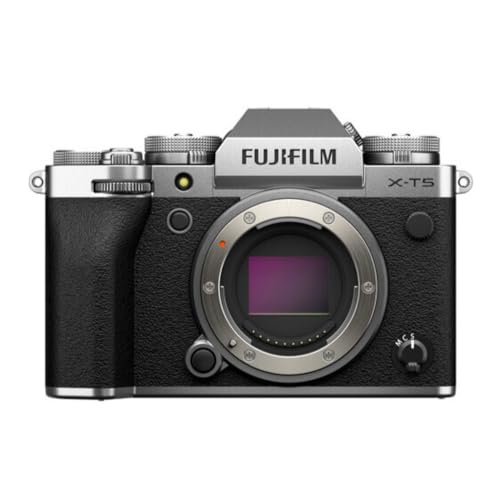
The 40.2MP X-Trans sensor gives you files you can crop hard or print big, and Fujifilm’s film simulations give you film-style colour straight out of the camera. You also get in-body stabilisation rated at 7 stops, and Fujifilm has put 56 weather-sealed points into the body, which it rates to work down to -10°C.
Then there are the dials. Shutter speed, ISO and exposure compensation all have their own dial on top of the camera, so you can see your settings at a glance, even with the camera switched off. It’s a great way to learn what each setting does, and of course it looks the part too.
Where it falls behind is speed and video. The 15fps mechanical burst is pretty quick and fine for most things, but not for fast action, and while it shoots 6.2K video, the X-T5 is a stills camera first. If video is your priority, look at the R6 V or the Panasonic S5 II below.
Pros: high-resolution sensor, 7-stop stabilisation, weather-resistant body, a dial for every main setting.
Cons: video is an afterthought compared with the hybrids here, not fast enough for serious action, and 40MP files fill cards and drives quickly.
Key specs
- Sensor: 40.2MP APS-C X-Trans CMOS 5 HR
- Stabilisation: 5-axis in-body, up to 7 stops
- Weight: 557g with battery and card
- Weather resistance: 56 sealed points, rated to -10°C
- Mount: Fujifilm X
Best for: photographers who want one camera that does most things well, with dials for the main settings.
Best for Beginners: Canon EOS R10
The Canon EOS R10 is the camera I’d buy someone who’s learning photography. It’s simple enough to start on, and it has enough controls that they won’t outgrow it in a year.

Canon’s beginner bodies work as a ladder:
- The Canon EOS R100 (24.1MP) is the cheapest way into Canon’s RF system. It’s a perfectly good camera to learn the basics on, but it misses a few things the R50 has, including a touchscreen. Also on B&H.
- The Canon EOS R50 (24.2MP, 375g with battery and card) is the simplest of the three to use, with a touchscreen and an interface built for people stepping up from a phone. Also on B&H. (Don’t confuse it with the R50 V, which is a separate, video-focused camera.)
- The R10 (24.2MP, 429g with battery and card) adds a bigger grip and more physical controls, which are the things you start to want once you’ve moved off auto.
I’d go straight to the R10 if your budget stretches that far. It’s also the beginner camera I recommend in my guide to using a mirrorless camera, so if you buy one, that guide will walk you through the controls.
Canon doesn’t claim weather sealing for any of the three, and the R10 has no in-body stabilisation, so you’re relying on the stabiliser in the kit lens. On the plus side, the third-party autofocus lenses Canon has licensed for RF are almost all APS-C lenses, so the R10 gets the cheaper lens choice that full-frame Canon owners don’t.
If you’d rather be in Nikon’s system, the Nikon Z50 II is the equivalent. It has a 20.9MP sensor, weighs 550g with battery and card, and like the R10 it has no in-body stabilisation, so it relies on stabilised lenses. Also on B&H.
Pros: easy to learn, more controls than the R50 and R100, light, plenty of affordable APS-C lenses.
Cons: no in-body stabilisation, and Canon doesn’t claim any weather sealing.
Key specs
- Sensor: 24.2MP APS-C
- Stabilisation: none in the body (use a stabilised lens)
- Weight: 429g with battery and card
- Mount: Canon RF (takes RF-S and RF lenses, plus EF lenses on the adapter)
Best for: beginners stepping up from a phone who want a camera they can grow into.
Best Value Full-Frame: Nikon Z5 II
The Nikon Z5 II is my value pick for full-frame. It’s a lot cheaper than the all-rounders below, and you give up less than the price suggests.

You get a 24.5MP full-frame sensor, 5-axis in-body stabilisation rated up to 7.5 stops, and a magnesium-alloy body that Nikon says is sealed against dust and moisture. It also has two SD card slots, so you can write every photo to two cards at once. That’s the setup I’d want for anything you can’t reshoot, like a wedding or a once-in-a-lifetime trip.
Amazon sells it as a kit with Nikon’s 24-50mm lens, and B&H has the body on its own. Nikon also sells the Z5IIC, which it says has the same performance in a flat-topped body with no viewfinder and one SD slot, for about $200 less at list price. I’d pay the extra for the Z5 II’s viewfinder, especially if you shoot in bright sun, where a rear screen gets hard to see.
Canon shooters should look at the Canon EOS R8 Mark II instead. Canon calls it the lightest EOS with in-body image stabilisation, at 546g with battery and card, and it has a 24.2MP sensor with stabilisation rated at 7.5 stops. It was announced in September 2026, and it keeps you in Canon’s RF system. Also on B&H.
Pros: full-frame for much less, sealed body, two card slots, strong stabilisation.
Cons: fewer third-party full-frame lenses than Sony (Sigma’s Z lenses are APS-C only), and heavier than the APS-C picks.
Key specs
- Sensor: 24.5MP full-frame
- Stabilisation: 5-axis in-body, up to 7.5 stops
- Weight: 700g with battery and card
- Card slots: two SD
- Mount: Nikon Z
Best for: anyone who wants full-frame image quality without paying for a top-tier body.
Best Full-Frame All-Rounder: Canon EOS R6 Mark III
If you want one full-frame camera that does pretty much everything well, buy the Canon EOS R6 Mark III. It’s also one of the two cameras I’d consider if I were replacing my R5 today (it wasn’t out when I bought mine).
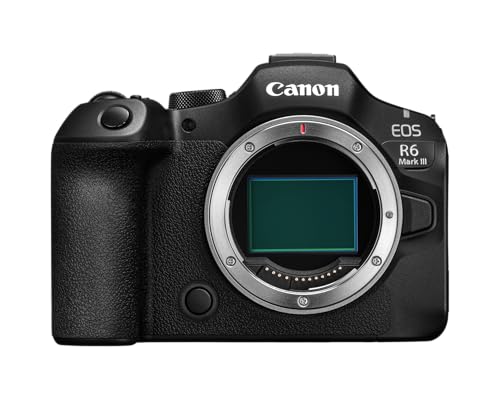
The 32.5MP sensor gives you a bit more room to crop than the Z6 III’s 24.5MP, and Canon rates the in-body stabilisation at up to 8.5 stops in the centre of the frame. It shoots bursts of up to 40fps with the electronic shutter and records 7K video, and Canon has added dust- and water-resistant gasketing around the battery compartment and card slot.
Canon sells it side by side with the R6 V further down, which is the video-first version, with no viewfinder and no mechanical shutter. The R6 Mark III keeps both, so for stills, or a mix of stills and video, buy this one.
If you already own Nikon lenses, the Z6 III is the equivalent camera. Starting from nothing, I’d pick the R6 Mark III for its higher-resolution sensor. Just remember that Canon’s full-frame RF mount has very few third-party autofocus lenses, so you’ll mostly be buying Canon’s own.
Pros: 32.5MP sensor, very strong stabilisation, viewfinder and mechanical shutter (unlike the R6 V).
Cons: Canon’s own lenses are the main choice for it, and it’s heavier than the APS-C options.
Key specs
- Sensor: 32.5MP full-frame
- Stabilisation: in-body, up to 8.5 stops (centre)
- Weight: 699g with battery and card
- Weather resistance: gasketing at the battery compartment and card slot
- Mount: Canon RF
Best for: photographers who want one full-frame body for everything, now and for years.
Best Compact Full-Frame: Sony a7C II
The Sony a7C II puts a 33MP full-frame sensor into a body that weighs 514g with its battery and card. That’s less than the X-T5, and it’s the lightest full-frame camera on this list.
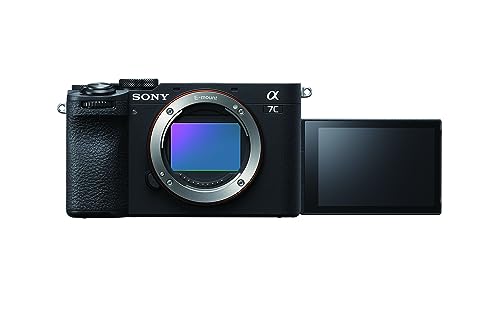
It has sensor-shift stabilisation in the body, Sony’s very good subject-tracking autofocus, and access to the E-mount, which has the widest choice of third-party full-frame lenses of any system. Pair it with a small prime and you’ve got a full-frame camera you can carry all day without noticing.
The compromises are in the handling. The viewfinder is small, and there’s no autofocus joystick, so moving your focus point takes longer than on the bigger Sony bodies. If you can, hold one in a shop before you buy.
Pros: full-frame in a small, light body, reliable autofocus, huge lens choice.
Cons: small viewfinder, no autofocus joystick.
Key specs
- Sensor: 33MP full-frame
- Stabilisation: in-body, sensor-shift
- Weight: 514g with battery and card
- Mount: Sony E
Best for: photographers who want full-frame quality in the smallest possible body.
Best Enthusiast Full-Frame: Nikon Z6 III
Already in Nikon’s system and want one body to do everything? Get the Nikon Z6 III.

It uses a 24.5MP partially-stacked sensor, which Nikon says reads out about 3.5 times faster than the conventional sensor in the Z6 II. That speed is behind its fast electronic shutter and quick bursts. Nikon rates the in-body stabilisation at up to 8 stops, it records 6K/60p RAW video internally, and Nikon says the body has the same level of dust and drip resistance as its professional Z8, rated to work down to -10°C.
If you own Nikon F-mount lenses, the FTZ II adapter puts them on the Z6 III with full autofocus, as long as they’re AF-S, AF-P or AF-I lenses. Older screw-drive lenses work in manual focus only.
At 760g with battery and card, it’s the heaviest camera on this list, so look elsewhere if weight is your main concern.
Pros: fast partially-stacked sensor, 8-stop stabilisation, internal 6K RAW, Z8-level sealing.
Cons: the heaviest body here, and fewer third-party full-frame lenses than Sony.
Key specs
- Sensor: 24.5MP full-frame, partially stacked
- Stabilisation: in-body, up to 8 stops
- Weight: 760g with battery and card
- Video: 6K/60p internal RAW
- Mount: Nikon Z
Best for: Nikon shooters who want a do-everything full-frame body.
Best Sony Full-Frame All-Rounder: Sony a7 V
Sony calls the a7 V an all-around full-frame camera. It sits below the Alpha 1 II, Sony’s flagship, and above the smaller a7C II.
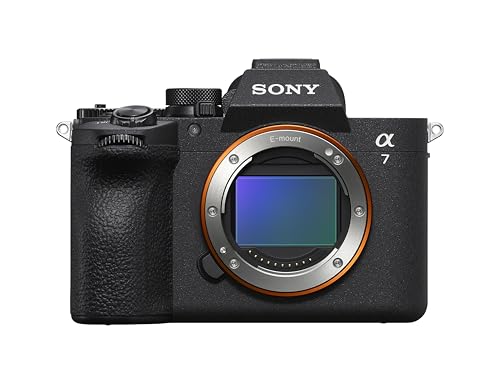
It has a 33MP sensor, in-body stabilisation and Sony’s AI-based subject recognition, and it shoots bursts of up to 30fps. Sony says the body is designed with dust and drip resistance in mind, and also says it won’t completely keep dust and water out.
The choice between this and the a7C II is mostly about handling. The a7 V is heavier at 695g, but it has the bigger grip and more of the physical controls you’ll use every day. If you don’t need the smallest Sony, just get the a7 V.
Pros: fast, dependable autofocus, quick bursts, better handling than the a7C II, the most open lens mount.
Cons: heavier and pricier than the a7C II.
Key specs
- Sensor: 33MP full-frame
- Stabilisation: in-body, sensor-shift
- Weight: 695g with battery and card
- Mount: Sony E
Best for: Sony shooters who want one full-frame body for everything.
Best for Video: Canon EOS R6 V
If video is the main reason you’re buying, start with the Canon EOS R6 V. Canon calls it a video-centric camera.

It records 7K RAW at 60p from a 32.5MP full-frame sensor, and a built-in cooling fan keeps it going on long takes. Canon quotes up to 120 minutes of continuous 7K 60p RAW Light or uncropped 4K 60p recording (measured at 23°C from a cold start), so in normal conditions overheating shouldn’t cut a long take short. For takes that long you’ll want external power, as Canon rates a single battery at about 70 minutes of 4K 60p. Stabilisation is rated at 7.5 stops in the centre.
There’s no electronic viewfinder, though, so you compose on the rear screen. There’s no mechanical shutter either, only an electronic one (up to 1/16000s), and Canon itself warns that fast-moving subjects can show rolling-shutter distortion.
Canon says flash support with the electronic shutter is coming in a future firmware update. For stills, buy the R6 Mark III instead. The R6 V doesn’t replace it, and Canon sells the two side by side.
If you want one camera that does video and stills well, the Panasonic Lumix S5 II is the better hybrid. It has a viewfinder, and Panasonic says it records unlimited 4K (C4K and 4K at up to 60p, as long as you’re between 0 and 40°C). It uses the L-mount, so Sigma’s lenses are an option too. I’d only choose the R6 V over the S5 II if video clearly comes first for you.
Pros: 7K RAW, long recording times with the fan, strong stabilisation.
Cons: no viewfinder, no mechanical shutter, and not a camera I’d buy for stills.
Key specs
- Sensor: 32.5MP full-frame
- Stabilisation: in-body, 7.5 stops (centre)
- Weight: 688g with battery and one card
- Video: 7K/60p RAW, built-in cooling fan
- Viewfinder: none
- Mount: Canon RF
Best for: video-first shooters and content creators who want long recording times.
Best for Wildlife and Action: Canon EOS R7
The Canon EOS R7 is my pick for wildlife on a budget. It’s Canon’s top APS-C body, and for wildlife the smaller sensor works in your favour.

On my R5, the EF 100-400mm is my wildlife lens. Put the same lens on an R7 and the 1.6x crop makes it frame like a 160-640mm, so distant animals fill quite a lot more of the frame without you buying a longer lens. It also takes EF lenses through the same adapter I use, which makes it a natural second body for anyone with Canon DSLR glass.
It shoots 15fps with the mechanical shutter and up to 30fps with the electronic one, Canon rates the stabilisation at up to 7 stops, and Canon describes the body as dust and moisture resistant, a claim it doesn’t make for the R10.
It’s been around since 2022, and as of November 2026, Canon hasn’t announced a successor.
Pros: extra reach from the crop sensor, fast bursts, sealed body, works with EF lenses on the adapter.
Cons: an older design than most of this list, and APS-C struggles more than full-frame in low light at dawn and dusk.
Key specs
- Sensor: 32.5MP APS-C
- Stabilisation: in-body, up to 7 stops
- Weight: 612g with battery and card
- Burst: 15fps mechanical, 30fps electronic
- Mount: Canon RF
Best for: wildlife, birds and sport, on a budget.
Best Sony APS-C: Sony a6700
The Sony a6700 is my favourite of Sony’s APS-C cameras, mostly for its autofocus. That’s also why it tops my travel camera guide.
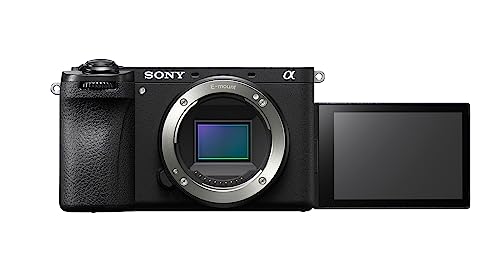
You get a 26MP sensor, sensor-shift stabilisation and Sony’s subject-tracking autofocus in a body that weighs 493g with battery and card. Sony’s E-mount also gives you more lens choice than any other APS-C system, including affordable options from Sigma and Tamron.
The main downside is Sony’s menu system. It’s improved over the years, but it’s still a bit harder to find your way around than Canon’s or Fujifilm’s. If you’re the sort of person who sets a camera up once and leaves it, that won’t bother you much.
Pros: fast, reliable autofocus, small and light, lots of lens choice.
Cons: fiddly menus, fewer physical controls than the X-T5.
Key specs
- Sensor: 26MP APS-C
- Stabilisation: in-body, sensor-shift
- Weight: 493g with battery and card
- Mount: Sony E
Best for: anyone who shoots moving subjects and wants a small camera.
Best High-Resolution: Sony a7R VI
The Sony a7R VI has a 66.8MP sensor. That makes it Sony’s highest-resolution Alpha body and, as of November 2026, the highest-resolution full-frame camera on sale.
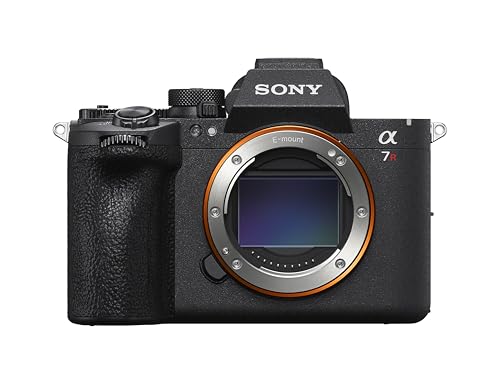
You can crop a wildlife shot hard, make very large prints, or shoot a landscape knowing there’s detail to spare. It has in-body stabilisation and weighs 713g with battery and card, which isn’t much more than the a7 V.
Most people don’t need 66.8MP, and the files need fast cards and plenty of storage space. If you print big, crop heavily or sell your work, it’s worth it. Otherwise, the a7 V or the a7C II will serve you better for less money and smaller files.
Pros: a 66.8MP sensor, and still fairly light for what it is.
Cons: expensive, and the huge files need fast cards and lots of storage.
Key specs
- Sensor: 66.8MP full-frame
- Stabilisation: in-body, sensor-shift
- Weight: 713g with battery and card
- Mount: Sony E
Best for: landscape and fine-art photographers, and anyone who prints large or crops a lot.
Best High-End: Canon EOS R5 Mark II
The Canon EOS R5 Mark II is the successor to my R5, and if I were buying today, it’s most likely the camera I’d buy, simply because it’s going to get firmware support for a bit longer.

Canon’s flagship is the EOS R1, but for almost anyone who doesn’t shoot sport for a living, the R5 Mark II is the high-end Canon I’d recommend. The 45MP back-illuminated stacked sensor gives you plenty of resolution and fast readout, Canon rates the stabilisation at up to 8.5 stops in the centre, and the body is dust- and weather-resistant to the same standard as the original R5.
It’s also the camera my travel camera guide picks for when money is no object. For most people it’s more camera than they need, and the R6 Mark III does most of the same jobs for a lot less. But if you shoot professionally, or you want one body to cover landscapes and wildlife for years, it’s worth the money.
Pros: 45MP stacked sensor, 8.5-stop stabilisation, sealed body, takes EF lenses on the adapter.
Cons: expensive, and overkill for most people.
Key specs
- Sensor: 45MP full-frame, back-illuminated stacked
- Stabilisation: in-body, up to 8.5 stops (centre)
- Weight: 670g with battery and card
- Weather resistance: same as the original R5
- Mount: Canon RF
Best for: professionals and serious enthusiasts who want the best Canon short of the flagship.
Best for Vlogging: Fujifilm X-M5
Get the Fujifilm X-M5 if video and social content are as important to you as stills. At 355g with battery and card, it’s the lightest interchangeable-lens camera in Fujifilm’s X Series.

It has a 26.1MP X-Trans sensor with Fujifilm’s film simulations, shoots open-gate 6.2K video, and has a vertical video mode for clips of up to 60 seconds, so you can film for social media without turning the camera on its side.
It gives up quite a lot to be that small. There’s no in-body stabilisation (only digital stabilisation, and only for video), and Fujifilm doesn’t claim any weather sealing. Pair it with a stabilised lens or a small gimbal if you’re filming handheld. For stills, the X-T5 or X-E5 are the better Fujifilm cameras.
Pros: very light, Fujifilm colour, a good video feature set for the money.
Cons: no in-body stabilisation, no weather sealing claimed.
Key specs
- Sensor: 26.1MP APS-C X-Trans CMOS 4
- Stabilisation: digital, video only
- Weight: 355g with battery and card
- Mount: Fujifilm X
Best for: vloggers and content creators who want Fujifilm’s colour in a light body.
Best Rangefinder-Style APS-C: Fujifilm X-E5
The Fujifilm X-E5 gives you the X-T5’s image quality in a smaller, flat-topped body styled like a classic rangefinder.
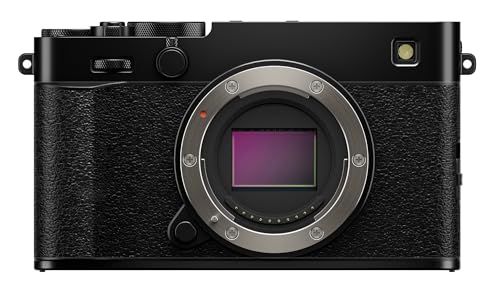
It uses the same 40.2MP X-Trans CMOS 5 HR sensor as the X-T5, and it’s the first X-E camera with in-body stabilisation, rated at 7 stops in the centre of the frame and 6 at the edges. It weighs 445g with battery and card, which is light for that sensor, and it pairs nicely with Fujifilm’s small primes.
The X-E5 is about style as much as specs, and there’s nothing wrong with that. A camera you enjoy using is a camera you take out more! If you shoot a lot of fast-moving subjects, though, the a6700 is the better tool.
Pros: the X-T5’s sensor in a smaller body, in-body stabilisation, classic styling.
Cons: a smaller grip than the X-T5, and not built for fast action.
Key specs
- Sensor: 40.2MP APS-C X-Trans CMOS 5 HR
- Stabilisation: in-body, 7 stops (centre), 6 (edges)
- Weight: 445g with battery and card
- Mount: Fujifilm X
Best for: street and everyday photographers who want classic looks and Fujifilm’s colour.
Buy Current or Last Generation?

The reality is that most high-end cameras these days do everything most photographers need. I only ever upgrade when a new camera can give me something that’s going to make a significant improvement to my photography.
Moving from the 6D to the R5 was that kind of step. The burst rate, the autofocus and the overall performance were all a really big jump. Going from the R5 to the R5 Mark II wouldn’t be anything like as big a difference. When I bought the R5 it was the latest model, and I expect it to stay my main camera for years to come (assuming I don’t break it).
So my advice is to ask what the newer model would do for you that the older one can’t. If the answer is “not much”, buy the older one, or buy it used and put the savings into a lens. On a budget, or as a second body, the original R5 is still a remarkably good camera.
If you do go used, buy from a dealer that inspects and grades what it sells, like MPB, and not from a stranger online. Our guide to buying used cameras covers what to check before you hand over any money.
What I Shoot With
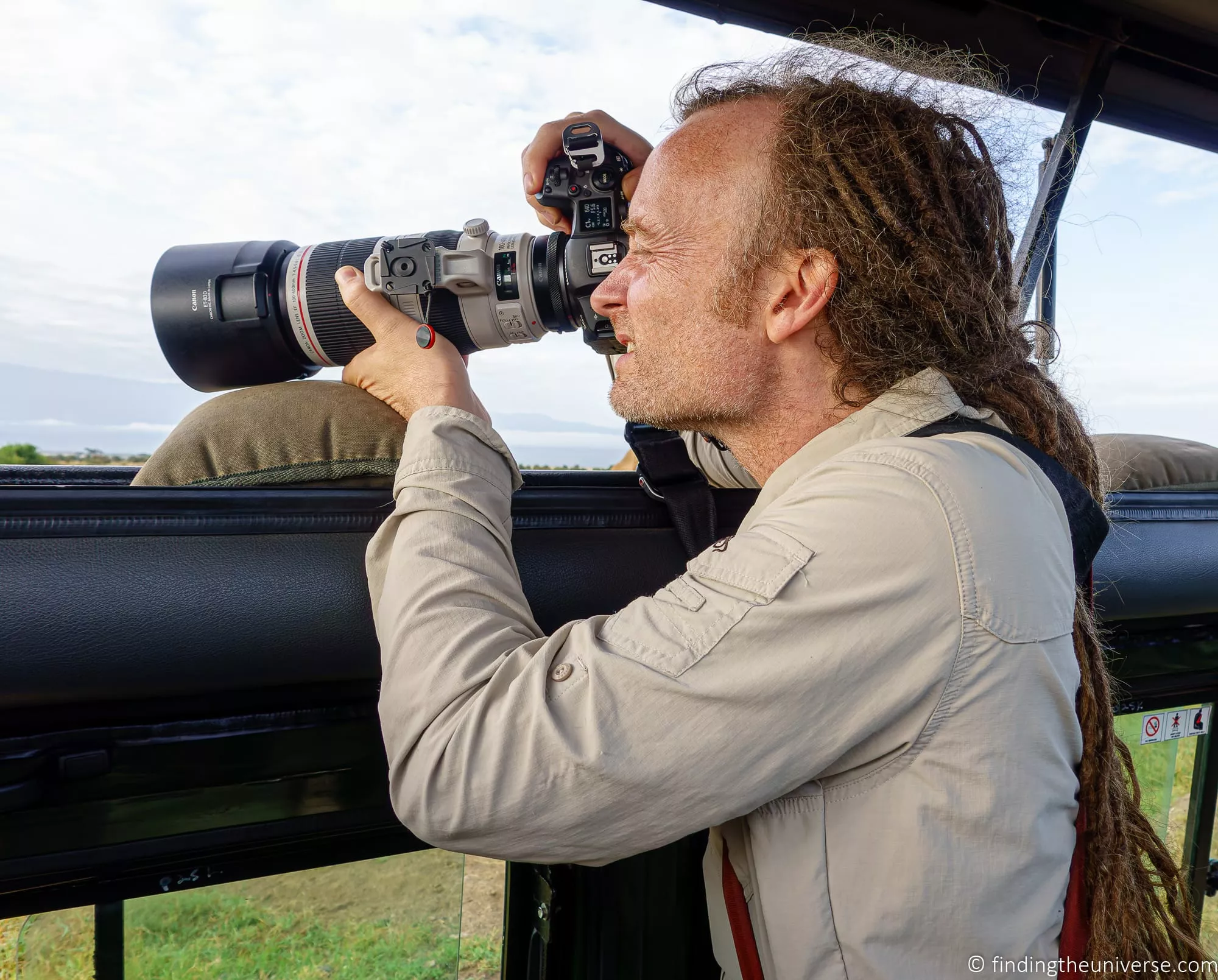
People often ask what’s in my bag, so here it is. My main camera is a Canon EOS R5, and every lens I own is a Canon EF lens, used on the R5 through the EF-EOS R adapter. I don’t own a single RF lens. The ones I use most are the EF 100-400mm f/4.5-5.6L IS II for wildlife, the EF 16-35mm f/4L for wide landscapes and interiors, and the EF 70-200mm f/2.8L.
I also still have two Canon 6D bodies. On safari, one of them comes along with the 16-35mm on it while the R5 has the 100-400mm, so I’m not swapping lenses in a dusty vehicle. For days when I don’t want to carry any of that, I’ve got a Sony RX100 V that fits in a pocket (it’s in my compact camera guide).
You can see the full list, bags and tripods included, in my travel photography kit, and my Canon R5 review goes into the R5 in a lot more detail.
What I’ve Learned Since Going Professional
These are the things I’d tell any friend who asked me about buying a camera.
Lenses Outlast Bodies
Cameras improve every couple of years, but a good lens will outlast several bodies if you look after it. Spend a bit less on the body and a bit more on the glass, because the lens goes with you to the next camera and the body doesn’t.

That photo was taken with an EF lens, made for DSLRs, on a mirrorless body.
Read the Small Print on Weather Sealing
Every camera maker words its sealing claims carefully. Nikon’s own page for the Z5IIC says that complete dust- and drip-resistant performance is “not guaranteed in all situations or under all conditions”. Sony says much the same about the a7 V.
So sealing will help when the weather turns, but I wouldn’t stand out in a downpour and rely on it. It’s worth paying for if you shoot near the sea, in the mountains or anywhere humid. In proper rain, a cheap rain cover still makes sense, sealed camera or not.
The Best Camera Is the One You’ll Carry
A heavy full-frame kit that stays in the hotel room because it’s too much to lug around takes fewer good photos than a light APS-C kit that’s always in your bag. Before you buy, weigh the whole kit you’d actually carry, with the lenses on the scale too.
Switching Systems Costs More Than You Expect
Changing brands means replacing lenses, learning new menus and changing how you work, and that rarely pays off unless the new system does something specific you need. If you already own Canon or Nikon lenses, the adapter route above is almost always the better move.
Want to Take Better Travel Photos?
Picking the right camera is the first step. Knowing how to get the most out of it is the next one, and that's what my online travel photography course is for. It starts with how your camera works, then moves on to composition, light and editing, and I give you feedback on your photos as you go.
I've been teaching it since 2016, over 2,500 students have taken it, and it's a single payment for lifetime access.
See What the Course CoversJust bought a camera? I'll send you five free emails on getting it ready for your first trip.
Frequently Asked Questions About Mirrorless Cameras
What is the best mirrorless camera in 2026?
For most people, it’s the Fujifilm X-T5. Its 40.2MP APS-C sensor, 7-stop stabilisation and weather-resistant body make it the best all-rounder for the money, and its dials show your main settings at a glance.
If you want full-frame, my pick is the Canon EOS R6 Mark III, with the Nikon Z5 II as the cheaper way in. If you already own lenses for one system, buy the best body in that system you can afford.
What brand makes the best mirrorless camera?
If you already own lenses, they should decide it for you. Starting from nothing, each of the big four has a clear strength.
Sony has the most third-party lens choice, because its E-mount is the most open. Fujifilm suits you if you like physical dials and film-style colour straight out of the camera. Canon’s menus are the easiest to learn, but its full-frame mount has very few third-party autofocus lenses. Nikon is strong on value, especially with the Z5 II.
What is the difference between a mirrorless camera and a DSLR?
A DSLR uses a mirror to bounce light up into an optical viewfinder. A mirrorless camera has no mirror, so you see the image on an electronic viewfinder or the rear screen instead, exactly as the sensor sees it. That makes mirrorless bodies smaller, and it means you can see your exposure before you take the photo.
Both take interchangeable lenses and give you full manual control. New development has moved almost entirely to mirrorless, though. Canon has said its future flagship cameras will be mirrorless only, and Nikon hasn’t launched a new DSLR since the D6 in 2020.
Do professional photographers use mirrorless cameras?
Yes, and I’m one of them. My main camera is a Canon EOS R5, although I still use my 6D as a second body, and a DSLR that works is still a perfectly good camera.
The camera makers are all heading the same way. Canon has said its future flagships will be mirrorless only. Nikon still makes, sells and services DSLRs, but it hasn’t released a new one since the D6 in 2020. Sony stopped selling its last A-mount SLR-style bodies in 2021 and now only makes mirrorless cameras.
Is a mirrorless camera worth buying in 2026?
Yes, if you want more than your phone can give you. That means a much larger sensor, lenses you can change, full manual control, and RAW files you can edit in photo editing software.
If you’re happy with your phone’s photos and don’t want to learn any settings, a phone or a compact camera will probably suit you better.
Is full-frame the same as mirrorless?
No. Mirrorless describes how the camera is built (with no mirror inside), and full-frame describes the sensor size (the same size as a 35mm film frame). You can buy a full-frame mirrorless camera like the Canon EOS R6 Mark III, an APS-C mirrorless camera like the Fujifilm X-T5, and DSLRs in both sizes too.
So you’re really making two separate decisions, about the sensor size you need and the system you want to buy into.
Is APS-C or full-frame better?
For most people, APS-C is plenty. It’s lighter and cheaper, and cameras like the X-T5 and R7 are more than capable of professional-quality images.
Full-frame is better in low light and gives you more background blur at the same aperture, and it’s what I shoot. If you shoot a lot indoors, at night or at events, or you want very shallow depth of field for portraits, full-frame is worth the extra size and cost.
What is the best budget mirrorless camera for beginners?
The Canon EOS R100 is the cheapest way into a major camera system, and the R50 adds a touchscreen and an easier interface. My pick is the R10, which costs a bit more but has the extra controls you’ll want once you’ve moved off auto, so you won’t outgrow it as quickly.
For Nikon, the Z50 II is the equivalent. Once you’ve got your camera, my beginner’s guide to using a mirrorless camera and my guide to photography composition are good next steps.
What is the best affordable full-frame mirrorless camera?
The Nikon Z5 II. It has a 24.5MP full-frame sensor, stabilisation rated up to 7.5 stops, two card slots and a sealed body, at a much lower price than the all-rounders. Canon’s equivalent is the EOS R8 Mark II.
The other way to get full-frame for less is to buy a last-generation body used.
Should I buy a used full-frame mirrorless camera?
Often, yes. A camera from the last generation, bought from a reputable dealer, usually gives you most of the image quality of the current model for a lot less money. My own original R5 is a good example. It’s still a remarkably good camera, and a used one is a sensible buy on a budget or as a second body.
Buy from a dealer that inspects and grades what it sells, like MPB, and read our guide to buying used cameras before you do.
Can I use my DSLR lenses on a mirrorless camera?
Usually, yes, with the right adapter. Canon’s EF-EOS R adapter lets EF and EF-S lenses work on Canon’s RF bodies, and Canon says there’s no loss of autofocus speed or stabilisation. It’s how every lens I own goes on my R5.
Nikon’s FTZ II puts F-mount lenses on Z bodies, with full autofocus on AF-S, AF-P and AF-I lenses (older screw-drive lenses become manual focus). Sony’s LA-EA5 adapts A-mount lenses, but autofocus with screw-drive lenses only works on some recent bodies, so check Sony’s compatibility list first.
What is the best mirrorless camera for video and vlogging?
For video first, the Canon EOS R6 V, which records 7K RAW at up to 60p and has a built-in fan for long takes. It has no viewfinder, though, so I wouldn’t buy it as a stills camera.
If you want one camera for both, the Panasonic Lumix S5 II is the better hybrid, with unlimited 4K recording. For vlogging on a smaller budget, the Fujifilm X-M5 is very light and has a vertical video mode.
What is the best mirrorless camera for wildlife?
On a budget, the Canon EOS R7. Its APS-C sensor makes a 100-400mm lens frame like a 160-640mm, and it shoots up to 30fps with the electronic shutter.
With more to spend, a full-frame body like the Canon EOS R5 Mark II gives you better image quality in poor light, which you get a lot of at dawn and dusk. I photograph wildlife with the original R5 and Canon’s EF 100-400mm.
How much should I spend on a mirrorless camera?
Budget for the whole kit. That means the body plus a lens you’ll keep, a spare battery and a fast memory card. If that adds up to more than you want to spend, save on the body and keep the money for the lens.
As a rough guide to the tiers on this list, Canon’s R100, R50 and R10 kits are the entry level. The X-T5, a6700 and R7 are the mid-range, the Z5 II is the value step into full-frame, and the R5 Mark II and a7R VI are high-end cameras that most people don’t need.
What is the best mirrorless camera for travel?
For most travellers, I recommend the Sony a6700, for its autofocus and its size, and my travel camera guide goes through the alternatives. The X-T5 is the better all-round camera, but for travel specifically, fast autofocus wins.
If you’re stuck between two of these, tell me what you shoot in the comments below, and I’ll tell you which one I’d buy. I’ve been answering camera questions on this site for years, so ask away!
Leave a Reply